Bovine Ska and Rocksteady 8/20/2014: Ken Parker Spotlight

Standard

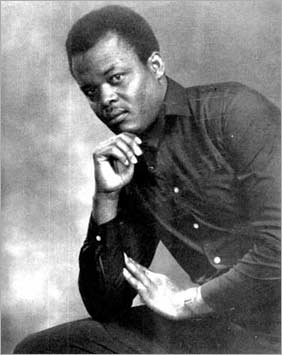
On the August 20th edition of the Bovine Ska and Rocksteady, we started off the show with two sets of ska, which included the track, “Can the Poor Survive” from the Four Aces, a single never before played on the BSR. After the mento set of the week, we were delighted to present an interview with Ken Parker to commence the spotlight on the great vocalist.

Ken Parker

Though Ken Parker eventually had a fantastic set of tracks as a soloist, he began his music career as a backup vocalist. When he left Westmoreland Parish and arrived in Kingston, Ken matched up with two men named Bill and Gil to back up vocalists at Studio One as the backing group, The Blues Blenders. During this time period, they would audition for other labels and would cut a few tracks for Coxone’s competitor, King Edwards.

When the Blues Blenders eventually got the chance to audition as a spotlight vocal group, Bill and Gil did not show up for the audition, and Ken went for the audition as a solo artist. After a successful try out, he would stay at Coxone as a soloist for Studio One, where Coxone would give him Nat King Cole, Sam Cooke, and Jim Reeves records in order for Ken to pick the singer’s style that most appealed to him, and the influence of these artists can definitely be heard throughout his recordings. In addition, Ken credits Coxone Dodd as the man who taught him how to sing in the reggae style as compared to a gospel ballad style, which was the way that Ken was most familiar with.

The Ken Parker spotlight includes his recordings with the Blues Blenders and his solo tracks for producers Coxone Dodd, Duke Reid, Bunny Lee, Joe Gibbs, and Lloyd Charmers. It includes Ken Parker’s ska and reggae recordings and two of his most beautiful gospel tracks.

Here is the archive link for this special Ken Parker spotlight, which will be available via the WMBR website until 9/1/2014. LISTEN NOW

Our show can be heard live in the Boston area on 88.1FM, WMBR Cambridge from midnight to 2 am ET on Tuesday nights/Wednesday early mornings or anywhere online at WMBR.ORG.

Learn To Make Minestrone, The Fierro Way!

Standard

What does radio DJ Generoso know about everyone’s favorite Italian soup, minestrone? Well, he sure does eat a lot of it, and his momma taught him out to make it so he wouldn’t be penniless from eating out every night. Completely vegetarian (even vegan if you can avoid covering it in romano cheese like Generoso does) and outrageously delicious!  Video is 13 minutes in length.  Music supplied by famed non-Italian, Antonín Leopold Dvořák!

A Misfit Among Misfits in the 1980s: Deadly Class

Standard

Note: This post is going to be a little more of a traditional review. Please bear with me for the length of the narrative setup. Thank you! 

Marcus is a vagrant outsider.

Marcus is hell bent on avenging the premature deaths of his parents.

Marcus is a pupil in a school for assassins.

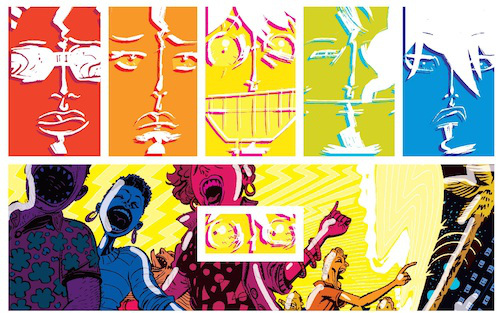
Cover of Deadly Class Vol. 1: Reagan Youth

Marcus Lopez is the primary protagonist in the Image Comics series, Deadly Class. At the opening of Deadly Class, we meet Marcus as he wanders the streets of San Francisco. Life has not been kind to him; his parents were accidentally and gruesomely killed when a former psychiatric patient jumped off of a bridge and landed on top of them in the aftermath of Ronald Reagan’s allowance for the de-institutionalization of state mental health facilities from the late 60s to the mid 70s during his terms as governor of California.

After the loss of his parents and his sinking into severe Post Traumatic Stress Disorder, Marcus becomes a homeless vagrant whose constant, overwhelmingly nihilistic thoughts continue to prevent him from moving forward. Despite the intense pessimism of most of his thoughts, Marcus has a bizarre optimism at points that he ties back to the last words about life that his father told him and continues to wander about looking for some meaning in life with a small amount of faith that there may be some deity or being to help him. This optimism and faith in the midst of the Marcus’s dour, miserable world is the beginning of the strange contradictions in Deadly Class.

During a street parade, a mysterious Yakuza affiliated girl rescues Marcus after a series of detectives and police officers chase after him. She takes him to an underground world where a teacher appears who has the semblance of any old, wise master from a karate film. After explaining to a group of students that Marcus was chosen because he has the undying motivation of revenge, the teacher invites Marcus to become a student of the Kings Dominion of the School of the Deadly Arts, a school that marks the humble beginnings of the world’s best assassins. Marcus’s prayers for help to find a path in life may have been answered.

On Marcus’s first day of class, he quickly realizes that he is yet again an outcast, even though all of his classmates are the major outcasts of society, and we, as the readers, are quickly thrusted into an archetypal world of high school but with a little more thirst for bloodshed. For those who went to high school in a place where clique divisions were more dogmatic than the dress code as I did, we are quickly reminded of our experiences, for better and most likely for worst. In the School of the Deadly Arts, the students go through the same issues around perceived image that most teenagers experience, except that image at this school includes one’s propensity to harm others. Who is dating the popular girl is important in this world. Who is the child of who is important in this world, but most of all, who is (or seems) the toughest is important in this world. The first two issues of the series create an interesting setting for the narrative, but there are some peculiar decisions in the progression of Deadly Class.

Although the projects that the students have to complete are outrageous and sensationalistic and the characters that we encounter are handpicked from various arch criminal groups, Deadly Class is mostly a coming of age story, and being so, has some maudlin and, dare I say it, sanguine moments that destroy the dour tone that it worked so hard to set up at its beginning, which confuses me a bit. I’m not entirely sure about the author’s intent on this one. Is it supposed to trace the rise of the outcast from the bottom of the feeding pool to the top? Is it supposed to be a bildungsroman with an assassin training school wrapper? The first volume opens up with an introduction from David Lapham, the author of Stray Bullets, about how he was a nobody in high school in the 80s, and how he met his wife there, who was a member of the popular clique, giving a sense into the motivations of strange optimism embedded in the narrative of Deadly Class: the adolescent mindset of the 1980s instilled by John Hughes films.

As the series unfolds, it becomes a story almost too close to the Breakfast Club, which feels like a betrayal to the intricate and interesting concept of a school for assassins. Marcus tries to get the girl from one of the more popular cliques. He and representatives from some of the major cliques work together to execute Marcus’s revenge on Ronald Reagan, which is the same plot as a group of kids trying to take over a school from an oppressive principal at a larger scale. And in the the most betraying twist of all, Marcus, upon being accepted, has an excitement for life.

Personally, I never really identified with any John Hughes film, where a social pariah rises in ranks by adopting a set of expectations and suddenly loves life, and it seems like writer Rick Remender, identified with them just a little too much. Perhaps I’m a bit of a grim person myself, but I really would have preferred for Deadly Class to be an investigation into the psychology of Marcus. As I continued to read, I kept asking myself, “Why does Marcus, who has some questionably psychopathic and sociopathic tendencies, have such traditional teenage motivations?” I would have loved for the series to wallow in the darkness of Marcus’s internal world and the malice and disregard for societal standards in the school. The story could have explored some interesting frontiers in a sullen, macabre setting, but it sadly does not.

Nevertheless, I do not think that Deadly Class is a horrible graphic novel. I think it simply plays it too safe. I think it is trying to shock its readers with the setting of the School of the Deadly Arts and the consequent events of violence, but it’s core story is far too traditional and suffers from the same fantasy optimism of the films and culture of the 1980s that I think the author may have originally hated but secretly desired. It is still worth a read for at least the artwork; the colorist Lee Loughridge and the illustrator Wes Craig create beautiful sequences, including a fantastic neon, two-dimensional acid trip that Ken Kesey would be proud of. Take a look at Deadly Class, just do not expect a groundbreaking narrative behind its sensationalistic facade.

Deadly Class is published by Image Comics and is currently up to issue six with issue seven to be released in mid-September.


Sergio Leone Pulls The Strings, Damiano Damiani Take The Fall: The Fiasco That Is “A Genius, Two Partners, and a Dupe”

Standard

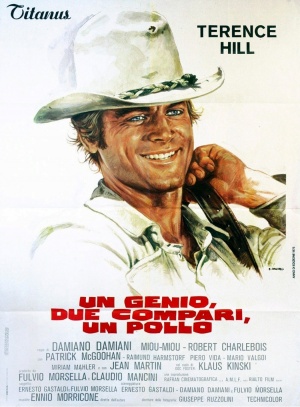
In a strange follow up to last week’s review of Bertrand Blier’s “Calmos,” is the Blier inspired 1975 spaghetti western, “A Genius, Two Partners, and a Dupe” (Un Genio, due Comparu, un Pollo) directed by Damiano Damiani by way of Sergio Leone. Leone had been an admirer of Blier’s awkward sex comedy “Les Valsuses” and was determined to make a western based on its themes. Leone had just also come off the success of the comedic “My Name Is Nobody” (ghost directed by Tonino Valerii) and was interested in making a sequel but with more of a Blier touch. Here enters Damiani, a serious political auteur (director of the superb “Quien Sabe” in 1966) who wasn’t going to be down with the endless slapstick and fart jokes of a “My Name Is Nobody”, and Terence Hill (Mario Girotti), the star of “My Name Is Nobody” who was not OK with the awkward sexuality of “Les Valsuses.” According to Alex Cox, director of “Repo Man” and the writer of the superb book “10,000 Ways To Die”, Leone then decided that this sequel to “Nobody” was going to be his take on George Roy Hill’s con film, “The Sting.”

A clip from “A Genius, Two Partners, and a Dupe”

The comedic plot centers on “The Genius,” Joe Thanks (Terence Hill), and his friends “The Partners,” Lucy (Miou Miou from Les Valsuses) and Steam Train (Robert Charlebois), who concoct a plan to steal $300,000 that belongs to the Navajo but is currently controlled by Colonel Pembroke (Patrick MacGooghan, yep from BBC’s The Prisoner). Damiani had never directed comedy and would further undermine Leone’s comedic intentions by bringing in the all too serious MacGooghan, and everyone’s favorite spaghetti western heavy and total psychopath, Klaus Kinski. My first issue after an hour of watching the film was that I wasn’t sure as to whom the “genius” actually was, as three of the main set of characters was called “a genius” on several occasions. I did find myself laughing at some of the setups and dialog but the script from Ernesto Gastaldi, who wrote “A Genius” as either a political film or slapstick comedy, becomes neither comfortably.  For example, “A Genius” tries to make statements on racism that fall flat and even play into racial stereotypes that kills comedic moments. Lastly, the film’s score, done by the brilliant Ennio Morricone, is very jovial and fits the mood of what could be a comedy, but there is only so much merriment that his talent can add.

I will hold back on condemning the acting and visuals because the original negative to “A Genius” was stolen, along with Pasolini’s “Salo” and Fellini’s “Casanova,” and held for ransom. Producer Fulvio Morsella refused to negotiate with the thieves and thus a version of the film was cut together using outtakes (gulp). This goes beyond a small problem, so I will be kind about performances, which go from Hill’s usually solid, cute, and charming characterization of “Joe Thanks” to Robert Charlebois’ almost bored portrayal of “Steam Train” to Miou Miou’s “Lucy” who offers the viewer little more than her adorable face and constantly radiating smile. The visuals unfortunately suffer even more, as there are what looked like an overabundance of 2nd camera wide shots, many of which are usually washed out and tough to watch.

Being that “A Genius” was labeled as a sequel to the very successful “My Name Is Nobody,” the film did well on its European release despite being hammered by critics but was not successful here in the U.S. Leone claimed to have never directed a scene (though photographic evidence of him and Damiani on set exists) and that means that the failure of “A Genius” was stuck on Damiani, who passed away in 2013 at the age of 90. So, for those of you who are completists like I am and just need to see everything that Leone ever touched that is a western, do watch “A Genius, Two Partners, And a Dupe.” Though almost two hours, you’ll still get a few laughs out of it. For the ladies, Terence Hill is pretty handsome, and for the gents, Miou Miou is nothing to sneeze at, but most of all, you’ll be reminded that even the greats can misstep every now and then.

Hell, here’s the whole film.  I don’t think that Leone’s going to miss it.

Bovine Ska and Rocksteady 8/13/14: Norman T. Washington Spotlight

Standard

On the August 13th edition of the Bovine Ska and Rocksteady, we started off the show with two sets of ska, a set of mento, and a set of early reggae to prepare us  for our spotlight of the week, the soul and reggae recordings of Norman T. Washington.

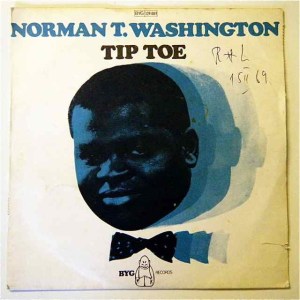
Norman T. Washington on the single cover of Tip Toe

Norman T. Washington on the single cover of Tip Toe

Norman T. Washington, like so many West Indian artists who went to England, would not bring Jamaican rhythms to his earliest recordings. In the case of Jimmy Cliff and Jackie Edwards, for example, both were packaged as soul and pop singers for Chris Blackwell. Like both of these artists, Norman T. Washington would also begin with soul tracks, first recording for Pama. He would then similarly record great reggae cuts later in his career. We started off the spotlight with 5 tracks of the soul kind for the mighty Pama imprint.

Here is the archive for the 8/13/14 show which will be up on the WMBR archive until 8/26/14.  LISTEN NOW

Our show can be heard live in the Boston area on 88.1FM, WMBR Cambridge or anywhere online at WMBR.ORG.

Sex in the Noir World of Satellite Sam

Standard

Once upon a time, I, an avid Hawkeye reader, was waiting for new issues to be released. My local comic book store had kindly realized that other readers were also eagerly awaiting the new issues and placed tags on other series created by the clever Hawkeye writer, Matt Fraction. Right by the familiar space on the shelves where the Hawkeye singles rested were the early issues of Sex Criminals and a reassuring handwritten tag, “From the creator of Hawkeye.”  Immediately, I picked up the first two issues and began to read them the next day.

Sex Criminals Issue 1 Cover

Sadly, my hunger for more Matt Fraction writing was not satisfied with Sex Criminals. The dialog was claustrophobically self-aware, and a pretty clever idea did not blossom as much as it could have. Besides those two points, Sex Criminals has one of my major pet peeves when it comes to the comic book and graphic novel world: highly sexualized women that are advertised as relatable. Given my disappointment with Sex Criminals, I returned to my comic book store looking for a new series to devour. After perusing through different shelves, I saw another handwritten tag that flagged another Matt Fraction series, Satellite Sam.

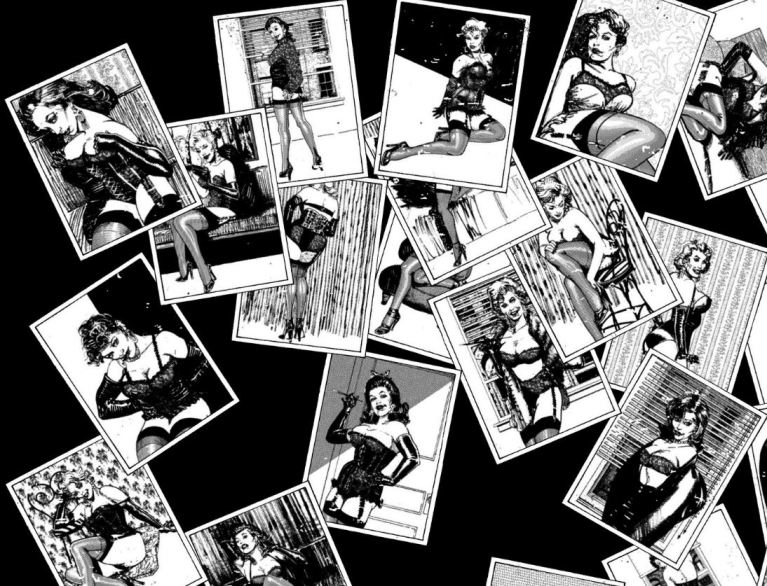
Unlike Sex Criminals and my beloved Hawkeye, Satellite Sam had the most salacious cover art of the three Fraction works, and immediately, my concern alarm went off. However,  Satellite Sam had been illustrated by Howard Chaykin, whose art pays homage to one of my favorite visual trends, 1950s pin-up girls. After opening up the trade and reading the first five pages, I was lured into the glamorized noir world of Satellite Sam.

Satellite Sam Volume 1 Trade Paperback Cover

Satellite Sam follows the stories of the imperfect staff of the Le Monde television station in the aftermath of the murder of Carlyle White, the star of the channel’s signature show in which the graphic novel series is named after. The story arc of Michael White, the son of Carlyle and a minor production assistant for the show, lies at the heart of the series’ narrative. After finding evidence of his father’s deviant sexual habits, White becomes obsessed with his own investigation into his father’s world and his various rendezvous partners to find the person who killed his father. Along the way, Fraction presents other members of the Le Monde staff, and we quickly enter into a noir world where people are not who they seem, and everyone seems to have a reason to harm Carlyle White.

At this point, you may be wondering, why exactly are you okay with the sexuality of Satellite Sam when you had problems with Sex Criminals? My answer: sexuality lies at the heart of both series, but in completely opposite ways.

In Sex Criminals, the main characters talk about their sexual repression and awakening. The two meet and realize they have the supernatural power of stopping time when climaxing. The couple then use this power to rob a bank and eventually face other super characters. Interesting idea, right?

The core narrative of Sex Criminals is fairly a traditional one; it is a story that is not far off from that of Bonnie and Clyde. However, the first two issues become heavily overwhelmed with building the sexual history of the main characters, making the sexuality in Sex Criminals feel like a luring device to try to get people to believe that they are reading something more provocative than the familiar story of criminal partners/lovers. It attempts to make the lead characters more realistic and approachable to this generation of 20-somethings, but both characters are deceptively glamorized like the central characters of the 1967 film of the Bonnie and Clyde story. However, rather than accepting that the story is highly fictional and stylized, the dialog in Sex Criminals constantly tries to remind you with facile comedic interruptions that you have most likely experienced similar situations as these characters. The overall narrative is disingenuous; it suffocatingly feels the need to remind you that the semi-realistic moments of the main characters’ history and present are close to your own current reality when in fact the bulk of the characters’ acts are as fictional, generalized, and glamorized as those of superheroes.

On the other hand, immediately from the start, Satellite Sam sets you in a period long past. It is in a fantasy world, and the actions and stories that ensue are supremely fictional, though they have a setting that once existed with people that once existed (and whose remnants may still exist today). Satellite Sam, in its most diluted form, is a murder mystery that could be from any noir film of the 40s or 50s. However, what makes Satellite Sam so different from a traditional noir narrative is its use of sexuality; the explicit details of the sex lives of the characters could only exist in a period piece made today. The sexuality here portrays what all family-oriented parents in the 40s and 50s were afraid of and consequently preached to their children; highly promiscuous and deviant people pay severe consequences with their lives. Sexuality in Satellite Sam does not act as a way to lure people into a traditional and unimaginative story; it is the Achilles heel of some very flawed people, and it allows us to think more about the characters that we are following. Consequently, the mystery of who murdered Carlyle White takes a back seat in Satellite Sam, and the greatest attention is focused on the development of everyone we meet at Le Monde. The series emerges as studies of ill-fated characters whose motivations are always suspect and whose sexual inclinations give a perspective into who they are and why they behave in certain ways, which is something that could have never been discussed in a 40s or 50s noir and is ultimately what makes each issue so much fun to read. Satellite Sam uses sexuality to make a set of rich stories divergent from a traditional central narrative rather than to add flourishing trim to a standard framework.

Satellite Sam, Sex Criminals, and Hawkeye are published by Image Comics. There are currently 9 issues of Satellite Sam available, with the tenth one to be released on September 10, 2014.

Hang Gliding Into A Giant Vagina! Bertrand Blier’s Lost 1976 film, “Calmos”

Standard

I was 21 when I saw my first Bertrand Blier film, “Too Beautiful for You” (Trop belle pour toi) at the Ritz Theater in downtown Philadelphia, one of the city’s few sophisticated art house cinemas in the late 80s.  I hadn’t seen anything quite like it, the story of a successful car dealer (played by Blier regular Gerard Depardieu) who rejects the love of his beautiful wife to have an affair with his frumpy middle-aged secretary.  Its almost surrealistic dialog and narrative construction were actually shocking to me and even more shocking to some of the audience, who walked out during a now notorious dinner scene.  At the time, I assumed that the scene in question was a bit too “sophisticated” for the audience, but as this film sparked an obsession with Bertrand Blier that forced me to watch his oeuvre, I eventually came to realize that “sophistication” was not a concern for this director.

Most audiences in the States first saw Blier when his second film was released here in 1974, the thrillingly audacious “Going Places” (Les Valseuses) , which garnered great, if not horrified reviews and turned its three leads, Gerard Depardieu, Patrick Dewaere, and Miou Miou into international stars.  The story follows two hippies/Visigoths who screw just about everything they find in the French countryside (and even each other when no one else is around) until they get a clue that women possibly want something more than a play by play commentary during a ménage à trois, or to get paid to be nuzzled on a train.  It’s upsetting and hysterical but miraculously ends as an almost tender film.  Yep, Blier managed to pull that off.

I saw “Les Valseuses” shortly after “Trop Belle Pour Toi” on video and was floored, so naturally I wanted to see what Blier came up with next, which was not easy.  I would eventually discover that his next effort was a much maligned 1976 film called “Femme Fatales” (Calmos).   But being that this search began in 1989, and “searching” meant more than typing a few words into IMDB, I was left with just film guides and microfiche to hunt for more information on this film that was not available in any media format.  Even Montreal’s excellent Francophile video store” La Boite Noire” could not track it down for me.  In fact, as I write this, there has yet to be an English subtitled release for “Calmos” on VHS or DVD.   And here’s why…

“Calmos” (written by Blier and Philippe Dumarçay, who also co-wrote Going Places) is basically “Les Valseuses” in reverse.    Here we have two middle-aged men, Paul (a bored gynecologist played by Jean-Pierre Marielle) and Albert (an almost eerily successful pimp portrayed by Jean Rochefort) who flee the city and the female gender only to be hunted down by their wives, and virtual army of horny, militant women who crave only the power of their middle-aged libidos.    At first, I enjoyed Paul and Albert’s transition from their “normal” lives into this misogynistic nightmare.  It’s what you would you expect from Blier: the absurdly entertaining bawdiness, mixed with terse moments of dizzying hate that expose the protagonists’ shortcomings with the opposite sex.  Unfortunately, as we get deeper and deeper into a dizzying comical surrealism that would make even Luis Buñuel cringe, the ideas play out as audacity for audacity’s sake, and even the brilliance of our heroes landing into a soon-to-be penetrated giant vagina cannot save “Calmos”.  (if you don’t believe me, look at the clip below)

Not surprisingly, “Calmos” was not well received both critically and commercially, but two years later in 1978, Blier would receive accolades with, “Get Out Your Hankerchiefs” (Préparez vos mouchoirs), by again reworking some of the ideas of “Going Places” . It was awarded “Best Film” by the National Society of Film Critics here in the U.S., and the Academy gave it the most ill-advised Best Foreign Film Oscar in 1979.

Blier, much to my delight, would finally move away from the scenario of “Les Valseuses” for his next three films, 1979’s Cold Cuts (Buffet Froid), 1981’s “My Father” (Beau Pere) and 1983’s “My Best Friend’s Girl (La Femme de mon pote) which truthfully also crudely play with our ideas of sexuality and normal relationships, but they have an almost, dare I say “restraint”?  Or at least, restraint in Bertrand Blier terms anyway.

Blier, now 75, won a Cesar (France’s equivalent to the Academy Award) in 2011 for his last film, “The Clink of Ice”.