Jonas Carpignano

Standard


Originally published in Ink 19 on January 17th, 2018
Interview conducted by Lily and Generoso Fierro

It has been two years since we last saw Ayiva (Koudous Seihon), the African refugee from Burkina Faso who settled in the Calabrian port town of Gioia Tauro and who is the protagonist of director Jonas Carpignano’s much heralded debut feature, Mediterranea. What distinguished Mediterranea was its intimacy with Ayiva’s experience as a newly arrived immigrant, and this intimacy is continued in Carpignano’s second feature, A Ciambra, but with Pio (Pio Amato), a Romani boy, now teenager, whom Ayiva sporadically encountered in Mediterranea. As a resident of Gioia Tauro himself these last six years, Carpignano has a rare and honest understanding of his surroundings and the perspectives of the people who live in it, which enable him to create film experiences that are true to his fellow residents while being reflective of his own process of assimilating into the community.

Originally a peddler of small stolen goods in Mediterranea, Pio, in A Ciambra, has ambitions to follow in the footsteps of his older brother Cosimo (Damiano Amato), who subsists in the underground economy, the only economy that is accessible to the Romanis that offers any ability to ascend out of poverty. When a desperate need for Pio to contribute more to his family emerges, Pio develops a friendship and also somewhat of a partnership with Ayiva that draws into question Pio’s allegiances to his own family. As was the case with MediterraneaA Ciambra is fervently committed to its central figure, Pio, and as a result, the film serves as the astute second installment of a triptych of character-driven films that aim to form a comprehensive examination of the town that Ayiva, Pio, and Carpignano call home.

We sat down with Jonas Carpignano during AFI Fest this past November and spoke at length about how his experiences with the people of Gioia Tauro shaped his approach to telling their stories.

Q: Lily Fierro: We recently watched Ettore Scola’s Brutti, Sporchi e Cattivi, which focuses on a Romani family living outside of Rome and is also a really fine example of Italian grotesque cinema, a genre which also includes films such as Lina Wertmüller’s Love and Anarchy and Marco Ferreri’s Le Grande Bouffe. We think that a lot of people who see your film will probably connect it to either crime or neorealist genres, but, for us, we see your film, A Ciambra, as almost an update and a modernization of the Italian grotesque, mostly because it is completely unrelenting, which is a key feature of the grotesque. Even though the films that I mentioned somewhat play on comedy and yours does not, could you talk about your approach to making everything unrelenting, and in turn, perhaps updating and extending the grotesque?

A: Carpignano: I think that the major distinction to make, even though I love all of those films, is that you feel that those films look to contextualize those communities and those people within Italian society, and that is why I feel that those films come off as slightly comic, or completely comic, so to say. There is certainly a way of dealing with a real situation through humor, which is common in the tradition of comedy. I think that the major difference and the reason why people tend to connect my film more to the neorealist movement is that there is an idea, or better put, a desire here to make the protagonist of the subject matter also the protagonist of the film.

The goal of both Mediterranea and A Ciambra, and what was very important to me, was to show underrepresented communities, but through their actual experiences and not the way Italians experience these underrepresented communities. There is no let up. There is no moment to step back and say, “But this is the context that they live in.” This is their life from their perspective, and if it is not important to them, then it is not going to be important to us either. One of the things that people always harp on is, “Where are the Italians in these films?” and they always say to me, “Where is the port? Gioia Tauro is a major port town, so where is it?” For me, it is not important to show that because it is not important to the protagonist of the film. In Mediterranea, people always ask, “There is a mafia presence there. Why don’t you show that?” Well, if something is not important to Ayiva, who has just gotten off a boat, who is literally just looking for his next meal, and who is literally just looking for a way to bring his family over, then you will not see it. So, if the mafia is not going to be important to him, it is not going to be important to the film. It is the same thing with Pio. People always ask, “Where are the beaches in this town?” I’ll tell them, “Well, Pio never goes to the beach because Pio doesn’t swim.” So, if it is not going to be important to him, I don’t feel the need to stop and say, “This is his life, and also this is his context.” And I think that this is why my film feels so unrelenting, so to say, because they are systematically and dogmatically married to the perspectives of the people who are the protagonists of the films.

Q: Generoso Fierro: We can understand your exclusion of showing the mafia in the film as you have no need to contextualize things that your protagonists do not encounter as part of their experiences. However, that is not to say that Pio’s experiences and interactions are entirely insular to his own Romani community. A Ciambra captures Pio’s interactions with many people, and from them, we get a sense of the social structure that Pio sees and must learn to navigate. In one particular scene, where Pio almost gets run over by a car, and in the car we see a mirror with cocaine, you expose the different kinds of criminality that occur between the groups that Pio encounters. With the “Italians,” the criminality is seen through protection and strong-arming. With the Africans and Romani, their crimes are mostly petty ones and auto theft, yet with none of these groups do we see drug trafficking. Is your omission of narcotics sales a statement on these two groups’ limited powers of organized crime? Or, did you simply not experience that form of crime in these communities?

A: Carpignano: It gives me immense amounts of pleasure and satisfaction when people draw these conclusions based on these small details because, in my own life in Gioia Tauro, I have to figure things out like that through small observations. I made a similar reflection a few years ago when I realized that no one here (in the Romani community) is dealing drugs, and no one in the African community is dealing drugs. And then one day, just like you see in my film, a car rolled up like that, and I remember Pio’s mom telling me to hide because those people were drugged up, and they were people from the “Italian” community, and that’s how I sort of managed to put it together. If you are going to be dealing drugs in that community, or in that society, you need to be in a different place in the social hierarchy than the Gypsies and the Africans, and the more I did research, the more I realized that that was true. There is a very strict hierarchy that the film tries to lay out, but not didactically, because I hope that the audience can piece it together through these little details—like I had to in my own experiences—so the fact that you did, brings me so much pleasure. Also, when we were first putting that scene together, my colorist said, “I don’t think that people can see the cocaine.” So, we put a little window on it, and we changed the shading and placed a mirror underneath—I wanted to make sure that it “popped.”

Pio Amato in A Ciambra

Pio Amato in A Ciambra

Q: Lily: As you mentioned in the discussion after the AFI Fest screening of A Ciambra, you are creating a triptych of Gioia Tauro. You started with Ayiva’s story in Mediterranea, and Ayiva continues his thread into A Ciambra, but did you write something that details Ayiva’s progression in between the two films? What are we to assume about Ayiva’s integration into this world in the time period between Mediterranea and A Ciambra?

A: Carpignano: I didn’t write it, but it was something that sort of wrote itself just because I live with him (Koudous Seihon). I have seen the difference in his, and I don’t want to say “status,” but position in that community. Whereas in the beginning he was just someone who picked oranges, years later, he has become someone who can move in a different way around Gioia Tauro because of his charisma and because he has been living there for so long. So, I have been able to see what should happen to Ayiva through what has been happening to Koudous and to many people as they sort of try to move into the underground economy. Obviously, there is no place for them in the actual economy; no one is going to give them jobs as we’ve seen in Mediterranea, so where do you go when you are sick of picking oranges? What is that next step? And naturally, that next step is participating in a kind of commerce that is somewhat underground in background. And, where are those relationships where a commerce role can exist for Ayiva? Obviously, they are between the gypsy and African communities, and not necessarily where the other communities exist in the town. How I see what happened to Ayiva between his arrival and now, is in some way, parallel to what happened between Pio’s grandfather and his family in the years since they settled and became part of Gioia Tauro. That process of becoming sedentary, of deciding that you are going to stay and live in a specific place, changes your occupations and your possibilities within this underground economy.

Q: Generoso: In regards to the underground economy, there is a particular scene in A Ciambra that suggests that, at least in Gioia Tauro, the Italians and the Romani might be growing closer by how the two groups set themselves apart from the newly arrived African immigrants. The scene we are thinking of here is when Pio’s older brother Cosimo (Damiano Amato) returns from prison and tells his younger brother about how the Romani and Italians joined forces in jail and distanced themselves from the African inmates.

A: Carpignano: I think that very rarely, when a new kid comes in, the last new kid says, “Let me help you make your life easier here.” Faced with the option of helping the new kid, the last new kid most likely will make a jump to be with the group that was there before them, and I think that is what happens here. There is now a sort of lower rung on the ladder, which inadvertently brings us closer to where we want to be, which is to this more established community. They are basically saying, “We may be Gypsies, and they may be Italians, but we are definitely more Italian than the Africans, and this place is more ours than theirs.”

Q: Generoso: You in fact have a scene in Mediterranea, which is what brought up our comparison to the Ettore Scola film that we mentioned earlier, where Ayiva begins to experience the harshness of the conflict against him and his fellow African immigrants, so he responds to a rat that enters his room by stomping it to death. It seems to suggest that we have a natural inclination to step on someone in a lesser position to gain some sense of control?

A: Carpignano: Wow, do you two read my emails? You just say a lot of the things that we talked about as we made the film that no one has ever written into an article. I am feeling so weird right now (laughs). Yes, that scene of Ayiva stomping on the rat is a statement that says: “This is the thing that is invading my space. This is the thing that is reminding me of where I am, so if I could kill that thing or distance myself from that thing…” This is a moment where his frustration can come out.

Q: Generoso: Thinking now about that change from being nomadic to sedentary, which is an essential theme in A Ciambra, you show this shift with a motif of citrus fruits (oranges and lemons) in both Mediterranea and A Ciambra. In Mediterranea, we paid close attention to how Ayiva eats the oranges that he picks. At first, he doesn’t eat them, but by the middle of the film, we see him beginning to eat the oranges, but he does so by only peeling away a small percentage of the orange peel and eating, as if he is slowly uncovering the community where he lives. By the end of the film, he is sorting out just the peels on a conveyor belt. You then begin A Ciambra with an image of a young Emiliano, Pio’s grandfather, when he was still a traveling Romani, slicing a lemon and drinking its juice, which then cuts to the present day, with Pio handling a lemon in his kitchen. Thematically this is one of our favorite elements of your first two features.

A: Carpignano: You know you two are killing me right now, because the scene that was the toughest for me to take out of the film is a scene after Pio’s brother comes back from serving time in jail, where he and Pio are sitting together the morning after their grandfather’s funeral in silence when Pio cuts a lemon and gives himself some citrus, and then he gives his brother a slice, and his brother eats it, and then the little boy comes in and grabs a piece of lemon and sits down in the chair.

Q: Generoso: Oh no, why did you cut this?! We so wondered why we didn’t see the citrus used as much in the film.

A: Carpignano: I am going to my editor’s wedding on Sunday, and I am going to make him pay (laughs).

Q: Lily: Also part of our sadness is that Generoso’s family is from Campania, and you know they have the prettiest citrus there, so we were a bit sad not to see it. (laughs)

A: Carpignano: Yes, it is the dominant agricultural element of that region. The plain is famous for the citrus industry. People say even further back that the ‘Ndràngheta started to form because of the bergamot, that bigger yellow lemony-looking citrus thing. The bergamot was one of the first things that they exported, and they cornered the market on that, and that was the beginning of their agricultural syndicates. So, citrus is a very prominent part of the plain, and that is where they got a lot of their commercial viability.

Q: Lily: Speaking of motifs, there is also a key visual motif of Emiliano and his horse that appears throughout the film. You begin A Ciambra with a scene showing Emiliano traveling with his caravan and his horse, and then, Pio sees his grandfather as a younger man with his horse as a recurring image/vision. Why does Pio see this? Is Pio one of the last of the members of the generation who is connected to the past of his grandfather, or is this past just romanticized because he has heard about it from his grandfather?

A: Carpignano: It is all of the above. This is very much Pio’s story, and I think that the film tries to, through being very specific through Pio’s experience, arrive to larger truths about the Romani community in general, and one of the most important things I think about that community is this solidarity that they feel that they have. History has a weight on all of us, and this sense of tradition is what makes Pio’s decision at the end the inevitable one. I think that the greatest limit and the greatest potential of this community is its solidarity, because, on one hand, they have created this really intense social network that has kept them alive for years. There, they always say, “No one here is going to die from hunger,” and that is is because they have each other’s backs. But in another way, Pio is unable to transcend the social architecture of that place because that tight knit community won’t let anyone else in or out, and I think that part of that is because they feel that they all come from the same tradition. They still refer to the others, mind you, they are as Italian as anybody, but they still refer to the others as “Italians” and themselves as “Gypsies.” And, why is that? It is because they believe that they have a past that is different from everyone else’s, and to me, that is what the horse represents. Pio needs to feel tied to the past in some way, shape, or form. He needs to feel as part of this tradition to justify, even to himself, betraying someone who might be even closer to him than his own brother. The sense of community, the identity politics that we all fall back on, is something that I think comes from this constructed identity that exists within many communities, and most specifically this one.

Q: Lily: Staying on Pio for a moment, another of his characteristics that we wondered about was his fear of closed spaces, specifically being enclosed in a space that is moving. What is the origin of that fear?


A: Carpignano: First of all, just speaking about the motifs, thank you for using the word “triptych” rather than “trilogy” before, because when you look at the great triptychs, they are really tied together through overlapping characters and motifs, even less than narrative logic, so to say. When you look at one of the great triptychs of all time, the Kieślowski Three Colors films, the things that tied those films together are not only the motifs and the use of color, but also the recurring actions. But speaking about Pio, specifically his claustrophobia, to me, that is less of a dramaturgical device as opposed to a psychological one—to come up with that and to put that in a film and find the right context for it, I had to get to know him better because that is something that actually happens to him. The elevator where Pio panics is my elevator, and that apartment is my apartment, and Pio has never gotten in the elevator to get to the apartment. Every single time, we had to go up and down the stairs to shoot that scene, and we had to rebuild the elevator, putting it on the terrace so that there is a removable wall for him. Pio is actually afraid of enclosed spaces, and he is actually afraid of things that go fast, and I find that to be incredibly fascinating because we are talking about people who historically were on the road in small spaces, in caravans, and in boxcars, moving together. Now that they have become sedentary, they almost have this aversion to these things. Moving too much, moving too fast, getting in an airplane, and getting in a train are things that he just would hate to do. And, that is why the train is there as a reminder in the background. There is the possibility of movement, of mobility, but now paradoxically, the gypsies feel more true to their tradition and their people and their identity by staying put. It is as if they have gotten this piece of land finally, and they are claiming it and saying that this is ours, and now that land is the source of their identity. So, that to me was something that was very important to put in the film, because in the end, when Pio is finally forced to move, he is enclosed in this tight space in this train, and he gets flashes of everything at this one point. He begins to freak out as he is put in the position to do something that he doesn’t want to do, and that connects him to his past, his present, and ultimately, that is where he gathers the courage to do what he needs to do. I felt that putting Pio in a position where he isn’t able to reflect on what he is doing, like when he is living through this phobia, this paranoia, brings out the raw emotions in him, and that is why I felt O.K. to open it up to that dream-like space again in that scene.


 

www.ifcfilms.com/films/a-ciambra

Andrey Zvyagintsev

Standard

Originally published in Ink 19 on December 19th, 2017
Interview conducted by Generoso Fierro

We were fortunate to have the opportunity to see twenty two feature films during this year AFI Fest held in Hollywood from November 9th to the 16th. Many were from veteran directors whose work we have appreciated over the years like Hong Sang-soo and Laurent Cantet, who gave us wonderful new features during the festival, but it was director Andrey Zvyagintsev, who we have admired since his 2003 film, Vozvrashchenie (The Return), who provided us with our favorite film of this year’s AFI Fest, Nelyubov (Loveless).

In Loveless, Zvyagintsev follows Zhenya (Maryana Spivak) and Boris (Aleksey Rozin), a soon to be divorced couple, whose constant battling has caused severe emotional trauma to their young son Alexey, who in the midst of his parents’ other ongoing dalliances, has gone missing, a fact which is not even noticed by his parents until days later. Loveless then becomes a film that plays with its audience by putting you in the position of the argumentative couple, who seem more concerned with their anger towards one another and seemingly unfulfilling affairs than the welfare of their own child. Throughout Loveless, we see youth as a commodity in contemporary Russia in terms of romantic pursuits, yet children are often seen as an encumbrance by adults for their attainment of more financial and status oriented goals. Another dichotomy that is also depicted in the film is the divide between religion and faith and how that plays out in the decisions of key characters, which became the focal point of my discussion with Andrey Zvyagintsev, along with a comment from Zvyagintsev’s longtime collaborator, producer Alexander Rodnyansky.

Q: In an early scene shot in a cafeteria that is adorned with religious paintings, we see Boris (Aleksey Rozin) speaking to a coworker about his boss, a character whom you never see, who has a requirement that all of his employees must be married. That scene drew my attention to how faith or religion is seen through certain key characters in your film. How does faith play a part in the narrative?

A: Zvyagintsev: So, the boss is not a completely fictional character. He is more of a composite of conservative ideals in Russia, but there is a person who we were thinking of specifically. There is a factory in Russia where the boss, Vasily Boiko, had 6,500 employees under him, and in 2010, he told all of his employees who were spouses to get married in a religious ceremony or else they would be dismissed. In terms of religion, for a true believer, there is a clear distinction like the one between an ostrich and an eagle, a clear difference between good and bad, and that line goes through that person’s heart. And for those who are not true believers like the boss, that line is between them and the world, so they truly believe in their own Pagan ideas, conservative views like the ones displayed by this character. So, in my film this character is quite satirical. Oh, and one more thing, Vasily Boiko has added “the great” to his title so now he is Boiko The Great. (laughter)

A: Rodnyansky: It was really important for us that the comments that we are making are not about faith, but about the religion. We want to make it clear that we are speaking about the church as an institution, and let’s say the intrusion of the church into secular life as an organization, so our film does not make any comment about faith. Of course, we have a lot of true believers, perhaps not as much as we used to have one hundred years ago, but we still do have a lot. When people speak about the church, we can see it is playing a role in what the people perceive as faith. The church is a kind of an administrative department of the contemporary government. That is why we believe that this is an extraordinarily effective tool to implement the so-called conservative values in Russia today. That is why when we speak about the “religious” people, we always have a distinction between the true believers and the ones involved with the institution.

Q: You show youth as a definitive commodity in contemporary Russian culture as seen through the extramarital affairs of Zhenya and Boris. I was impressed in the film by the intense level of the search that the private/non-governmental organization mounts when Alexey goes missing. Is that level of intense search more a function of the value of youth in Russian society, or more due to Boris and Zhenya’s affluent economic status?

A: Zvyagintsev: Because this is a volunteer organization that has existed for seven years called Liza Alert, the people involved work regular jobs and do the searches for missing people for free. This organization looks for all missing people, so it does not have to be a child who is missing. When they receive a request, there is no money that changes hands, so the economic status of Boris and Zheyna does not play a role here. It could of course be the parents of a lost child that the organization has been asked to help, but it could also be a wife looking for her spouse, or children looking for their parents, so age does not matter, financial status does not matter. It is the awakening of citizens and their ability to organize themselves, and they do this only because of their empathy and desire to help in a way that the government cannot.

Zhenya (Maryana Spivak) speaks to her son Alexey (Matvey Novikov)

Zhenya (Maryana Spivak) speaks to her son Alexey (Matvey Novikov)

Q: Have organizations like Liza Alert become more prevalent recently because of a specific crisis, like the refugee crisis in Syria or the conflict in the Ukraine?

A: Zvyagintsev: No, not specifically the Ukraine or Syria, it is just a need that had to be addressed by citizens in a way that the Russian government was unable to do.

Q: I ask this question as you regularly show dire, almost apocalyptic political situations in Russia via news clips seen on television during your film. This brings me back to my initial thoughts on how religion and faith are exhibited by the characters and how there may be a divide between older Russians who are gravitating towards religion because of the state of their country, and younger people who have become more secular because of the failings of the previous generation. Organized religion as you stated earlier is being used to foster conservative ideals. In general, is the current political situation driving more Russians closer or farther from organized faith, away or towards being “true believers’ as you say?

A:Zvyagintsev: Statistics show that 74% of Russians say that they are believers, but when they asked that 74% if they had read the Bible or the central text of their faith, only 30% admit that they have actually read the text. It is essentially like Paganism in that there is a social sickness, and a lot of people who consider themselves “believers” don’t understand which god they serve. So, questions about growth of numbers really don’t reflect what is going on in society. It is a social sickness of Paganism rather than true belief. This sickness isn’t just unique to Russia, it is going on all over the world. There are a lot of people who look for God, but find a short God. So, the criteria for a person who is a true believer, a true Christian, like I mentioned earlier, is that he has his border between good and evil going through his heart. It is an epic battle between your real self and your fake self, and if the person sees that evil is not within him, like this religious person who considers the line between good and evil to be outside of him, then he is a fake and not a true believer.

www.palacefilms.com.au/loveless

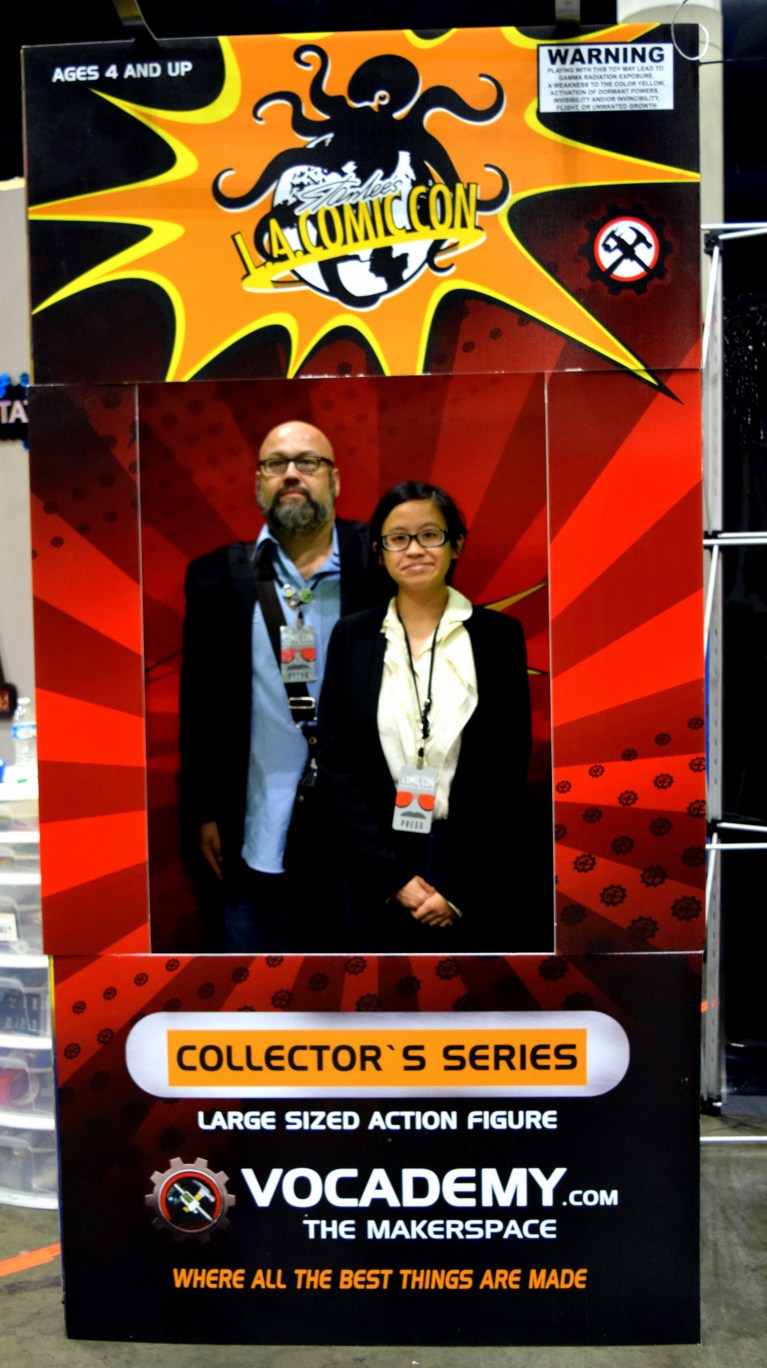
Lily and Generoso at Stan Lee’s Los Angeles Comic Con 2017

Standard

Originally published in Ink 19 on November 9th, 2017
Review by Lily and Generoso Fierro

Since moving to Koreatown in the spring of 2015, whenever we begin seeing the jack-o-lanterns adorning the lawns of the homes on our drive to work, we know that Stan Lee’s Los Angeles Comic Con (SLLACC) is just around the corner. Usually held in the days before Halloween, if not Halloween itself, this con is now becoming a fall fixture here, with this year’s installment (the seventh in its short existence) being the biggest one yet in terms of its Guests of Honor, which ranged from The Rock to Kevin Smith to Stan “The Man” Lee himself. Of course, Stan’s appearance is never a surprise, but it is always thrilling as he has begun every one of his cons that we have attended with a personal appearance to give an update on new projects by his company, POW! Entertainment. A friend described our SLLACC attendance as one of being “panel heavy,” and this is indeed true that we do love the panels a bit more than those who indulge on the one on one experience that is available on the expo floor or in the gaming rooms, but we feel that we did more than our fair share of admiring the work of cosplayers, talking to comic and show creators at their tables, and even buying the odd Rick and Morty pin too, as the popular Adult Swim show was well represented in every material form available at the con. We selected our favorite moments from this year’s edition of SLLACC to share with you.

It usually takes some resolve to wake up super early on a Saturday morning, but when presented with an opportunity to see Stan Lee in person, it becomes a much easier task to avoid hitting the snooze button for an extra fifteen minutes because that bit of extra sleep might cost us a prime spot near the main stage. The Stan Lee Panel did not disappoint, as we were all informed of the status of two upcoming projects being helmed by Luka Contents and Lee’s Pow! Entertainment: Chroma and Prodigal. Jim Krueger, the winner of the Eisner Award for the DC Comics series, Justice was on hand to introduce Lucy Kim from Luka and Gill Champion, who was representing Pow!. Krueger soon expressed his excitement for being able to write a new hero with the comicbook, Chroma, which the book’s sizzle trailer later described as Korea’s first superhero. Kreuger described his inspiration for Chromaas coming from reading the first thirty six issues of Stan Lee’s Spiderman and imagining how to create a character using modern writing techniques while capturing the spirit that went into Stan Lee and Steve Ditko’s partnership, and the dynamic images that we saw for Chroma in the sizzle reel gave us a preview of the work that artist Drew Johnson of Midnight Society: The Black Lake and DC Comics contributed to the series. The story begins with Chroma as a young boy who is traumatized by the killing of his sister, who was burned to death. When the boy turns into an adult, he becomes a scientist who experiments with the regenerative skin of octopi to help burn victims, but he soon stumbles upon a corporate conspiracy and an attempt is made on his life. We then were told that the Chromacomicbook will soon become a Korean-language superhero film, the first of its kind, and the film will be directed by Jee-woon Kim, who is best known for the 2008 neo-western, The Good, The Bad and The Weird. Kim was unable to attend the panel, but he sent a highlight video of clips from his previous films, and an interview where he expressed his deep admiration for Stan Lee.

Prodigal director, Yong-hwa Kim, speaks as Stan Lee looks on

Prodigal director, Yong-hwa Kim, speaks as Stan Lee looks on


Prodigal
, based on an original idea from Stan Lee, was next up for discussion on the panel. As described by Kreuger, Prodigal is about a young adult named Warren, whose dad is a vigilante superhero, but Warren soon finds out that he is adopted, and that his birth father is a supervillain, which takes the narrative into the age-old questions surrounding nature versus nurture, with the two fathers battling over their son’s transformation into an agent of good or evil. It was at this point that Gill Champion invited Stan Lee to take the stage before any further discussion about the project. Stan was as sharp and funny as ever when he set up the Prodigal trailer by asking the crowd to “pay attention, as there may be a test afterwards.” A trailer with some storyboard images followed and ended with the announcement of the release date of summer of 2019. It was then that the director chosen to helm Prodigal, Yong-hwa Kim, was introduced to the audience. The director explained that his wife recently gave birth to their first child, so he has naturally channeled his personal experiences as a father into this project, which will be unlike what you normally see through DC or Marvel, as family is such an integral part of the Korean way of life.

Since the toy’s release some forty years ago, there have been many rumors about the production of a media property to couple with the popularity of everyone’s favorite rubbery hero, Stretch Armstrong. Films were slated to be made by Disney and Universal in the ’90s and 2000s, respectively, but alas, nothing came to fruition. Now, Netflix has picked up the gauntlet with the production of the animated series, Stretch Armstrong and the Flex Fighters, which follows frantic teen, Jake Armstrong and his two best friends, who all have been exposed to a chemical that makes them super stretchy, and in response, they use their rubbery powers to fight evil. The sneak peak of the series that we saw had a ’67 Spidermanfeel about it as Jake and his pals wisecrack away whilst performing superhuman feats like turning themselves into human slingshots so that they can launch cars at giant monsters. Netflix seems to be going all out with this venture, as they have recruited some big name voice talent in the form of Steven Yeun, Wil Wheaton, Keith David, Kate Mulgrew, and Henry Rollins.

 The Stretch Armstrong and The Flex Fighters Panel

The Stretch Armstrong and The Flex Fighters Panel

As much as Stan Lee’s appearance brought out cheers from the crowd around the main stage, it wasn’t at deafening as the higher-pitched screeches of joy that emanated from the crowd when the original voice actors of The Powerpuff Girls: Tara Strong (Bubbles), E.G. Daily (Buttercup), Cathy Cavadini (Blossom), and Tom Kane (Professor Utonium, and HIM) were brought onto the stage. Released almost twenty years ago, this trio of kindergarten-aged superheros took the world by storm and are still enjoyed in reruns on the Cartoon Network. The quartet discussed their auditions for the series and the extended length of time it took before the series began to hit TV screens. Our favorite part of the panel occurred early on when the moderator asked our actors to give their favorite voice from their main character on the show and then a voice of a different character that they had done on The Powerpuff Girls. It was startling to watch adults instantly transform into four year olds right before your eyes, especially when the women sang “Love Makes The World Go Round” in their Powerpuff Girl voices.

The reunion of the original voice actors of The Powerpuff Girls!

The reunion of the original voice actors of The Powerpuff Girls!

So, if you did not have enough of a ’90s nostalgia injection with The Powerpuff Girls reunion, the cast of the crown jewel of ABC’s TGIF programming, Sabrina the Teenage Witch, arrived at Comic Con! Yes, they were all there onstage to represent their much-beloved show that was based on the Archie Comics series: Sabrina Spellman herself (Melissa Joan Hart), her aunts, Hilda (Caroline Rhea), and Zelda (Beth Broderick), her cat, Salem Saberhagen (Nick Bakay), Sabrina’s sweetheart, Harvey Kinkle (Nate Richert), The Quizmaster (Alimi Ballard), her coffee shop boss and crush, Josh Blackhart (David Lascher), her college roommates Roxie (Soleil Moon Frye), and Morgan (Elisa Donovan). First, they all spoke of the international appeal of the show, as evidenced by the cast’s ability to know the word “witch” in the different languages of the nations where the show aired around the world, and yes Caroline, “strega” is indeed the Italian word for witch (it is also a very tasty liqueur as well). We learned about the sometimes negative reactions of fans to Sabrina’s onscreen boyfriend selections and the cool tidbit that surprised us — Melissa Joan Hart’s mother, Paula Hart, was the executive producer of the show, and she was responsible for getting the show added to ABC’s Friday night lineup, a fact that Melissa was more than proud of to share with the attentive audience at SLLACC.

The cast of Sabrina the Teenage Witch

It was soon back to present day for us, as no SLLACC would be complete without a stop at one of the Troma panels, and this year we selected the Troma Entertainment Presents: Toxie’s Friendship Celebration panel, which was moderated by Megan Silver and included a brief visit from Toxie himself, who, after a brief introduction (without his signature broom which had sadly been confiscated at the con’s weapons check), had to run back to the Troma booth. After Toxie departed, it was the Lloyd Kaufman show for a bit, as the President of Troma regaled the crowd with some dark stories of their group’s banishment from this year’s Cannes Film Festival where they had been a fixture for over forty years. Hugo Award nominated author and Tae Kwon Do Master, Dr. Chuck Tingle, spoke of his recent writings, and battles with his Jerky Neighbor Ted. Also on the panel was professional wrestler and former WWE/NXT Tag Team Champion Simon Grimm, who talked about his experiences leaving the world of wrestling for life with Troma. As the panel veered towards its conclusion, we saw what we had all been waiting for, a trailer for the soon to be released Troma feature, Return to Return to Nuke ‘Em High aka Volume 2</i?, which includes the last ever onscreen appearance of Motörhead’s Lemmy Kilmister. We love the Nuke ‘Em High series, and this one looks to be the goriest and silliest one yet. A more somber Troma panel than the ones we’ve seen in years past, but it was one that was still full of great laughs, stories, and encouragement to create independently. We also caught up to Lloyd Kaufman after the panel for an interview to soon be published here on Ink 19, where he expressed his thoughts about his former collaborator, director John G. Avildsen, who passed earlier this year, and what exactly occurred at the Cannes Film Festival that got Troma banned.

Troma Entertainment Presents: Toxie's Friendship Celebration panel

Troma Entertainment Presents: Toxie’s Friendship Celebration panel

After the Troma panel, it was back to the main stage for one of the most loveliest moments of this year’s SLLACC, A Tribute to Adam West. Moderators Kevin Smith and Ralph Garman sat with the late actor’s real life friends and Batman cohorts, Burt Ward (Robin) and Lee Meriwether (Catwoman) for a charming, sad, and at times, funny conversation about working with the late actor on the seminal 1960s TV show and the feature film. Ward brought up how West made him laugh from the very first moment they met at the screen test for Batman and told audiences that “the last thing that Adam would ever want you to do is cry for him, as he spent his whole life trying to entertain people.” Meriwether, who replaced Julie Newmar in the role of Catwoman for the feature film, revealed in a story of how badly she wanted that part, and how sad she was that West was not present at her audition for the role as she admired him on the television show. Story after story told onstage by those who knew West confirmed one fact over and over, and that is that West was the same funny and irreverent person off-screen as he was on it. Smith and Garman were excellent in their roles as moderators as they calmly straddled the line between excited fanboys and thoughtful interviewers.

The original Robin (Burt Ward) entertains the panel, and the audience at the Adam West Tribute

The original Robin (Burt Ward) entertains the panel, and the audience at the Adam West Tribute

As the heart of any comic con lies in the spirit of creating comics, we were eager to attend the Publishing Your First Comic Book panel which was led by Rylend Grant, the writer/creator of Aberrant for Action Lab Comics, who smartly led a discussion with five comic book, television, and film professionals. It never ceases to amazes us that no matter how many of these nuts and bolts panels we attend, we always come away with some new pieces of information about this very complex process. Much of the early conversation of this panel centered around the art of the pitch, specifically on what should be the length of what you submit to publishers: Is this a few pages, a few issues, or a completed book? Most of our panel fell on the side of a completed issue so that the publisher can see clear ability to tell a story with sequential art. This is the first time that anyone actually acknowledged and discussed the exact avenues to enter comics in a clear way, going so far as to having panelists who have experiences with publisher submission, independent publication, and anthology contribution. In the end, the Publishing Your First Comic Book panel was one of the most well moderated and helpful panels that we have attended at a con in some time.

 The Publishing Your First Comic Book panel

The Publishing Your First Comic Book panel

There are three absolutes for us at Stan Lee’s L.A. Comic Con: Seeing Stan The Man in the flesh for our first activity there, spending some time with the denizens of Tromaville, and the antithesis of the blood-spurting, four-letter word throwing activities that are akin to the world of Troma, Jordan B. Gorfinkel’s Heroes and Faithpanel. For all of our years of attending both professional and pop culture conventions, this panel is hands down the most consistently strong in terms of moderation and discussion, and much of that credit belongs to Gorfinkel, a former editor for DC Comics who supervised Batman for over a decade. The panel, which normally discusses the role of a specific motif from faith and religion (including atheism) in media and culture, chose as their focus this time around: hymns, rhythm and music. On the panel was David Sacks, writer/producer for The Simpsons, Lisa Klink, a writer/producer/novelist who has worked on Star Trek: Voyager, film composer Kurt Farquhar, who is working on music for the CW drama, Black Lightning, and composer James Covell, who is currently scoring Fast N’ Loud for the Discovery Channel. The panel was hit by Gorfinkel with intense thoughtful questions like the following: within the Old Testament, can you speak about a specific time when music is important to faith? Can you give some examples of where religious-type music is successful in enhancing and movie or television show? The answers that followed such questions created engaging conversations throughout the panel, and led up to the always exciting and illuminating lightning round of short questions that closes this event every year.

A group photo of the always thoughtful and entertaining Heroes and Faith panel

A group photo of the always thoughtful and entertaining Heroes and Faith panel

For our final panel of SLLACC 2017, we selected The Kaiju Kingdom Podcast Live: Tribute to Haruo Nakajima, and we were so glad that we did, as hosts Chris Eaton, Jessica Tseang, and Mark Jaramillo provided endless astonishing facts about the man who brought to life not only Godzilla, but also Rodan, Moguera, and many other kaiju in over one hundred films during his illustrious career. In fact, our respect for Nakajima grew exponentially as we heard stories of his struggles wearing costumes that weighed over 200 pounds, being submerged in icy water for hours upon hours while wearing those overweight suits, and even, on an occasion, being severely electrocuted while filming, yet still working later in the day. It indeed was a loving tribute as our hosts not only dispensed intriguing facts, but they also shared their personal memories of meeting the late actor at various events over the years. Sadly, the audio visual department at the con failed our panelists as they were unable to show the clips that they had collected for their presentation, but that didn’t matter as the love and respect that they gave to the actor, who passed away earlier this year at the age of 88, was felt by all of the attendees in the room.

The sweet and informative Tribute to Haruo Nakajima Panel

The sweet and informative Tribute to Haruo Nakajima Panel

We were somewhat lighter on the panels on Sunday (we only did the three), which did allow us significant time to travel down artist alley and the adjoining creator booths in order to spot emerging projects, and two have caught our eye that we would like to share with you.

The new science fiction comicbook, Oasis, attracted our attention due to the absolutely stunning cover art by Breno Girafa. We actually stopped by the Oasistable just to acknowledge how impressed we were with what we saw, and we were greeted by the comicbook’s writer, Alex Wills, who gave us an enthusiastic overview of the series which spans four volumes, with each volume containing two issues. Based on our conversation with Wills, we picked up volume one, and so far, we have been very impressed with not only the art, but also the writing as Wills and Girafa create a dystopian world that is somewhat reminiscent of the world Ballard creates with High Rise, for Oasis is the name of a protected city that is removed from the harsh reality of a futuristic downtrodden Los Angeles. After reading the first two installments, we are curious to read the subsequent volumes as our main character, Miranda, has assembled a sort of dysfunctional family à la Fagin of Oliver Twist, a master who guides his “children” in the same dubious manner, but here set in futuristic and more violent world with the class struggle being at its core. The situations our “family” are put into and the choices they make that challenge their own emotions are compelling after just a few pages.

Like many attendees these days at comic cons, we are always on the lookout for new cartoons that would fit into the realm of Adult Swim’s idiosyncratic, if not disturbing programming, so we were intrigued when we saw concept art on a monitor for a new animated pilot that is looking to be funded on Kickstarter entitled, The Oracle Of Outer Space, which is about the last-existing AM radio station in the cosmos that is about to explode and crash into the earth. We spoke with the show’s creator, musician and writer Carl King, who like us is a huge fan of the legendary CBS sitcom, WKRP in Cincinnati, which turns out is one of the key inspirations for the show that he wants to create. Assembled by King for this project is veteran animator Lance Myers, who amongst his credits, was the lead animator for Richard Linklater’s feature film adaptation of Philip K. Dick’s A Scanner Darkly. Also on board is famed voice actor Jon Schnepp, who has worked on Adult Swim shows such as Metalocalypse and Aqua Teen Hunger Force. Given that we have been doing a radio program for the last twenty plus years ourselves and the fact that we love The Swim, we found this project to be one we would love to see come to fruition.

The creator of The Oracle of Outer Space, Carl King

The creator of The Oracle of Outer Space, Carl King

In 2015, when we attended our first Stan Lee’s Los Angeles Comic Con (then called Stan Lee’s Comikaze), it was housed in two exhibit halls at the Los Angeles Convention Center, and during that year’s three day run, both halls were fairly packed with the robust attendance. For 2016 and this year, SLLACC has been relegated to just the one exhibit hall, which we found somewhat odd given its growing popularity. We wonder if last year’s one-time decision by the group that handles San Diego Comic Con to move Wondercon, which is normally held in Anaheim, to the Los Angeles Convention Center was the cause for this downsizing of space. As Wondercon is now back in Anaheim, we hope that future editions of SLLACC go back to an even larger space as before as this is one of the most entertaining and eclectic collections of panels and speakers about pop culture in the Los Angeles area.

See you next year!