
Originally published on Ink 19 on December 6, 2021
by Lily and Generoso Fierro
Joy. Resilience. Limitations. Isolation. Four words to describe cinema in 2021.
With the pandemic still in the foreground of life, the films we saw this year had a bittersweet quality to them. Some celebrated the survival of cinema. Others the joy of life. And others tested the limitations of film as a medium. But, all had a deep understanding of the dire realities within or surrounding the narratives and experiences on screen.
Our favorite films this year heightened the awareness of the loneliness and chaos of contemporary life and explored the many ways in which we try to deal with both. These films articulated our anxieties about the present and our fears about the future. Some showed how we try to assert control and fail. And one particularly embraced the relinquishing of control and celebrated the unpredictability of a surreal, irrational world.
In a time where news images have become paradoxically more powerful because they allow us to see reality when we are not allowed in it, but more trivial because we are primarily experiencing all of our lives through images on screens, the films that moved us were the ones that reflected on the power of the moving image and challenged the traditions, expectations, and restrictions of the form.
We should note that there are some films that are sadly absent from this list because we did not get the opportunity to see them. This includes Apichatpong Weerasethakul’s much heralded Memoria, Hong Sang-soo’s In Front of Your Face, Jonas Carpignano’s A Chiara, and Gaspar Noé’s Vortex. Regardless, our viewings in 2021 were most certainly still strong and as relevant to our rapidly changing times as they’ve ever been.
A special thanks goes out to the good folks at Acropolis Cinema, AFI Fest, Independent Film Festival Boston, the Brattle Theater, and the Coolidge Corner Theater for their exceptional programming efforts that provided us with an immense amount of joy and inspiration throughout this year. We ask you to please support these festivals, microcinemas, and independent theaters as they are essential to the growth and enlightenment of our communities.
• •
Malmkrog / Romania, Serbia / dir. Cristi Puiu
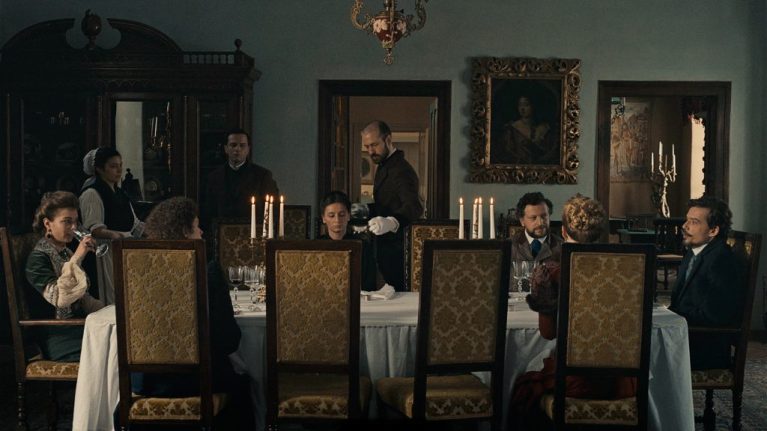
The moment Malmkrog ended, we took a deep breath as the words of the closing speech and fragments from the discursive, philosophical exchanges in the two hours plus prior faded down from the center of our minds, and we returned to reality. Immediately, we felt that we needed to read more and listen better, for Malmkrog is dense in its dialogue, composition, and ideas in a way that tests the limits of both cinema and cognition. But then, as the last reverberations of scenes pulsed in our thoughts, we understood: the world (and life) exists beyond the words, sounds, and images we ingest and digest in our confined spaces, and sometimes the world reacts to what we read and discuss (and vice versa), but more often than not, the world invades our thoughts and philosophies before we can ever come to any logical solution for the past and the future. Malmkrog is entirely contained on an estate in Transylvania near the beginning of the 20th century. Inside the opulent home, five aristocrats move about in clusters challenging and questioning each other’s opinions and projections on a variety of important topics, including war, Christianity, and the state of Europe. The five are waited on by servants who move in and out of frame throughout, and, for a few moments in the film, take over the screen, providing short breaths of relief away from the realm of theory that the aristocrats continuously explore throughout the film. Malmkrog appears bloated with intellectualism, so with its period setting, you may be deceived into believing that it is a merely pretentious exercise of philosophy and history. However, when your mind struggles to reconcile the images you see on screen, the subtitles you’re reading, and the tones in the voices you’re hearing, relish in the fact that you are seeing the growing pains of the cinematic form in front of you and know that from such discomfort comes change, which is in the room now and will be constant until the end.
• •
Diários de Otsoga (Tsugua Diaries) / Portugal / dirs. Miguel Gomes and Maureen Fazendeiro
COVID-19 remains at the top of our collective consciousness (and will likely remain there for years to come), so it is no surprise that it made its way into the films that premiered in 2021. Tsugua Diaries, on the surface, is about coping during the pandemic, but step away from the protocols of quarantine life—the masks, the cleaning and sterilization procedures, the testing protocols—and you’ll see a triumphant ode to the endurance of cinema. Told in reverse, Tsugua Diaries theoretically documents twenty-two days on the set of a film production in the late summer of 2020. In order to produce the film safely, everyone involved lives and works in a large country house and limits their exposure to the outside world as much as possible. The cast and crew have no choice but to live, work, and play together, and in turn, they become their own close-knit community. We see moments of life and play influencing and reacting to the film that the cast and crew are trying to make within Tsugua Diaries, and all of this is gloriously captured by the camera for Tsugua Diaries itself because, after all, everyone we ultimately see on screen is an actual member of the cast and crew playing themselves. Reality collides with fiction, and both fold on top of themselves and each other, to the point where the scenes that co-directors Miguel Gomes and Maureen Fazendeiro capture for the film within and the film that is Tsugua Diaries become simultaneously representative, symbolic, abstract, and expressive. This convergence is the affirmation of the purpose, joy, and strength of cinema, which, despite the rapid, disruptive changes of COVID-19, thrived on the home, set, and stage of Tsugua Diaries.
• •
Slow Machine / USA / dir. Paul Felten and Joe DeNardo
Films about members of the American artistic class can be unbearable, and the directors of Slow Machine, Paul Felten and Joe DeNardo, know it. So, instead of centering their film on a dead-eyed, overly aware, unsympathetic contemporary bohemian, they cast all eyes on Stephanie (Stephanie Hayes), a theater actress who may or may not intentionally place herself consistently in volatile situations and, consequently, is always on the edge of an adverse reaction. Early in the film, Stephanie tries to escape her claustrophobic living situation by going on a bender and stumbling along the sidewalks of Brooklyn. She passes out, and when she awakens, she’s in a studio apartment that could double as a panic or hostage room with Gerard (Scott Shepherd), a man who claims to be an intelligence agent with an affinity for experimental theater. The two begin a peculiar relationship of attraction and repulsion, and as Stephanie’s breakdown becomes more palpable, we begin to suspect that Gerard is a vehicle for the cultivation of her paranoia and instability, two characteristics that enable her to shape-shift and transform at any moment, whether she wants to or not. In stark contrast to the spaces where Stephanie and Gerard clash, we also see Stephanie in an idyllic artist compound in upstate New York helmed by Eleanor (Eleanor Friedberger). In the manicured spaces surrounded by musicians who are more interested in the sounds they create and tag football than the human condition, Stephanie attempts to re-center herself away from Gerard and the frenzy of the city. But, inevitably, when she must interact with the others, her erratic reactions resurface and push her to finally meltdown. Slow Machine at its heart asks, “What does it mean to be yourself, everyone, everything, and nothing?” And as Stephanie tries to find the answer, she treads into hazardous and destructive places, all of which drive the engine of great performances—the ones that are unnerving, striking, and soberingly human.
• •
Gûzen to sôzô (Wheel of Fortune and Fantasy) / Japan / dir. Ryûsuke Hamaguchi
When describing the ethos behind the triptych of films that became Wheel of Fortune and Fantasy, director Ryusuke Hamaguchi stated that they are explorations of “coincidence and imagination.” As these occurrences and abilities play out in the lives of the characters contained in the three stories that comprise the film, the characters’ consequent improvisations and performances become the practical machines for Hamaguchi’s explorations, and it is this need to adapt and reply to situations, both contrived and spontaneous, that is the power behind Wheel of Fortune and Fantasy. As we watch the female protagonists of each story assume a fabricated persona in response to an uncomfortable situation, we see how their role playing creates a method to better understand the people they’re engaging with, while simultaneously allowing them to step away from who they are to clearly see themselves. The transformative effect of impersonation plays out in the first segment of the film, “Magic (or Something Less Assuring),” through Meiko (Kotone Furukawa), a fashion model who must conceal her true self when she finds out that her best friend has fallen in love with her ex-boyfriend, whom she still has feelings for. In the second story, “Door Wide Open,” Nao (Katuski Mori) is coerced into taking on the part of a seducer in order to trap and embarrass an esteemed literature professor, and in the final story, “Any Day Now,” a lonely housewife named, Nana (Aoba Kawai), role plays as the long lost classmate of a woman named Moka (Fusako Urabe). Even though the women’s actions elicit a vast array of emotional reactions from us, including sadness, violent discomfort, and being overwhelmingly touched, we admire them for their righteous ability to neglect their desires for the sake of others and celebrate with them as they gain a greater insight into who they are and what they really want.
• •
Doraibu mai kâ (Drive My Car) / Japan / dir. Ryûsuke Hamaguchi
Though the images and sounds of movement through space and time are often the first things that come to mind when you’re thinking about cars, there’s something more fascinating about the gray area between public and private space when you’re inside of a vehicle. In Drive My Car, Yûsuke Kafuku (Hidetoshi Nishijima), an actor and theater director, feels the safest in the driver’s seat of his red Saab 900. It’s where he can control his physical direction. It’s where he absorbs and recites the words of Anton Chekov’s Uncle Vanya. And, it’s where he has the deepest connection with his wife Oto (Reika Kirishima), whose voice reads out all the parts except for Uncle Vanya’s, leaving space for Kafuku to respond. Since the death of their child, Oto and Kafuku have remained loving and respectful towards one another, but they also keep each other at a distance: Oto has had multiple affairs, and Kafuku knows about them, but neither have ever spoken about the transgressions. After Oto’s sudden death, Kafuku drives to Hiroshima to direct a multi-lingual performance of Uncle Vanya at a theater festival. Upon arriving, he is immediately informed that he will not be allowed to drive the vehicle for the duration of his preparation of the production, and he’s assigned a driver: a taciturn young woman named Misaki (Tôko Miura). The car is Kafuku’s home, office, and crutch, and now, he must attempt to process his work as a director and his fears as an actor alongside his grief and his unresolved, conflicting feelings toward Oto, with another person along for the ride. As they drive, Kafuku continues to fill in the silences between Oto’s recitation of Uncle Vanya, and slowly both his and Misaki’s respective external shells begin to fall away and allow them to better connect with everything in the present and past around them. The red Saab is undoubtedly a symbol of Kafuku, but it also is a physical manifestation of our self-imposed separation from others as we attempt to direct our lives (and the possible self-isolation that may become habit due to the pandemic). However, as Drive My Car reminds us well, we can still find ways to share the space inside the car, and we can most certainly step outside of it too. And, we’ll be better artists, colleagues, friends, parents, children, and individuals when we do either, or better yet, both.
• •
Felkészülés meghatározatlan ideig tartó együttlétre (Preparations to be Together for an Unknown Period of Time) / Hungary / dir. Lili Horvát
At the center of Lili Horvát’s impressive debut feature is Márta Vizy (Natasa Stork), an Hungarian-born doctor in her 40s, who has been living in the States where she is a well respected leader at a prominent neurosurgery center. On the surface, everything is going well for Márta, but after decades of living abroad, she makes the abrupt decision to travel back to her native Hungary to rendezvous with a fellow countryman and neurosurgeon named János (Viktor Bodó), whom she met at an academic conference in New Jersey. Upon arriving in Budapest, Márta heads to the Liberty Bridge, the mutually agreed upon location of her scheduled tryst with János, but when she gets there, he is nowhere to be found. Márta responds to the snubbing by tracking János down for an answer, but when she confronts him, he has no idea who she is, and she falls unconscious. Distraught and confused, Márta decides to stay in Budapest and rents a shabby apartment with a view of the Liberty Bridge, reminding her of the failed reunion with János daily. She takes a position beneath her abilities at a dilapidated hospital in Budapest where János works, despite the warnings that she receives from an old colleague who assures her that her immense talents will be ignored by the patriarchal agenda of the surgical team there. Then, she sets out on investigating if she and János actually made a promise to meet again in Hungary and if she ever knew him at all. In her use of formal elements of romantic cinema to actualize her protagonist’s reawakening of cultural identity, Horvát imbues a constant ambiguity between inner and outer realities to externalize the disorienting cross-conscious states and cross-cultural spaces that Márta is trying to navigate. As we observe Márta excelling in her duties at the hospital where her skills are steadily gaining notice, the question becomes less about her being recognized by János, and more about whether her voice can finally be heard in her own homeland. Read Generoso’s full review of Preparations to be Together for an Unknown Period of Time here on Ink 19.
• •
A Night of Knowing Nothing / India / dir. Payal Kapadia
The act of performance can take on many forms, and in Payal Kapadia’s debut documentary feature, A Night of Knowing Nothing, we have the the pleasure of experiencing it in a multitude of ways, which altogether allow us to understand the complexity and ambiguities of being a filmmaker and student hoping to make the future a better place while entrenched in a period of political unrest. The film opens up with a striking, grainy, black-and-white shot of young people dancing. Instead of music, we hear the voice of a narrator reading letters found in a student hostel at the Film and Television Institute of India (FTII), and we’re introduced to L, a student filmmaker, whose unsent letters to her lover become the sinew between the images and other sounds of A Night of Knowing Nothing. At first, L’s letters are focused on her despair that her lover has left her because of his family: she’s in a lower caste, and his family refuses to allow him to marry her. But, as L’s life continues, her letters begin to center on her reflections on the student protests happening in India in 2016, and her thoughts as she emerges as a political being start to overlay and bridge sounds and images from protests, found archival and mobile phone footage, and shared footage from Kapadia’s own friends at FTII. A Night of Knowing Nothing contracts and expands its visual scope and conceptual breadth throughout. Moments after we see a person in silence in a sparse room, we often see large groups joining together to protest the inequalities of Indian society. We hear audio from the protests and speeches from key representatives cross fade into L’s reflections on herself and her thoughts on Pasolini and Eisenstein. A Night of Knowing Nothing is like a living organism growing into consciousness, moving its attention fluidly inwards and outwards and learning throughout, and this progression emerges as a performance too, one that beautifully shows us what it means to develop into a more aware being. We spoke with director Payal Kapadia at AFI Fest 2021, and that conversation can be read here.
• •
Just Don’t Think I’ll Scream / France / dir. Frank Beauvais
A shining example of contemporary anxiety stoked by isolation and the consumption of images, Frank Beauvais’s film essay Just Don’t Think I’ll Scream assembles scenes from over four hundred fiction films that the director viewed during a six month period of seclusion in a village in Alsace around the end of 2015 and the beginning of 2016. The film vacillates between therapeutic exercise and neurotic compulsion as Beauvais attempts to find comfort in cinema away from his struggles emanating from his split with his partner, his feelings of hopelessness to change the oppressive climate following the state of emergency after the November 2015 Paris attacks, and his relationships with his parents. However, no matter how much Beauvais attempts to immerse himself in the images of films, he remains aware of his distance from society, and thus the images recalled from his binge watching become reflective of his mindset. There are neither faces nor particularly iconic images in the scenes that serve as excerpts, reactions, and memories, so, as each film clip flashes on and off the screen, we see worlds often resembling our own appear, disappear, and re-emerge in alternate forms. Reality and fiction pass by, and we continue to watch alongside Beauvais while his voice elaborates on the experiences and anxieties that motivated his departure from Paris to the countryside and memories that return to him as he sits in front of the screen. Just Don’t Think I’ll Scream is the perfect pandemic film not made about the pandemic itself. In fact, it serves as a reminder that the alienation exacerbated by COVID-19 has been with us in our digital, post-truth era for years, and it’s most likely here to stay as images on screens of various sizes pull us away from our surroundings into smaller and smaller physical and psychological spaces.
• •
Titane / France, Belgium / dir. Julia Ducournau
The most formative event of Alexia’s childhood was a car accident: it led to the installation of a titanium plate in her skull and marked the moment when her trust shifted away from her father (who partially caused the accident when he turned around, while driving, to reprimand a very young Alexia because she was kicking the back of his seat) to machinery, specifically cars. As a result, adult Alexia (Agathe Rousselle) has little regard for other people, and her complete lack of humanity is on full display in frightening and absurd ways in the first act of Julia Ducournau’s Palme d’Or winning Titane. When we see Alexia as an adult for the first time, she’s a wiry, intimidating dancer who writhes on top of muscle cars. She’s feral in the presence of others, be it other dancers or her parents, and she’s a serial killer who’s racking up victims. After killing a house full of people and setting her childhood home ablaze, Alexia takes on the identity of Adrien, a young boy who went missing years ago and would now be in his late teens. Much has been made about the scenes of gruesome body transformations and violence that occur up until this point in the film, but these are the least surprising parts of Titane. When Alexia meets Adrien’s father, Vincent (Vincent Lindon), a firefighting chief, he brings Alexia back to his station and attempts to integrate her into the family of men he’s created in the years since Adrien’s disappearance, placing Alexia in a space more masculine, yet more tender than she’s ever known. Though her aggressive tendencies come out from behind her disguise at first, Alexia’s guard begins to fall as she receives love and care from Vincent and as she sees his struggles to maintain his muscle-bound body. Gender notions and roles switch back and forth between Alexia and Vincent, but some return to their original states, and consequently, we end up seeing fundamental elements of Vincent’s and his men’s masculinity redeeming Alexia’s humanity, which is an unexpected, new territory for films about women told by women and for storytelling overall. Male brutality and abuse of power have been in the headlines and at the forefront of societal discourse for the past few years since the Me Too movement. Yet, with Titane, Ducournau presents the male form in the most honest, vulnerable, respectful, and loving way possible, and that is far bolder than any of the images and sounds of viscera that are luring in and shocking audiences.
• •
Mandibules (Mandibles) / France / dir. Quentin Dupieux
Upon its U.S. release earlier this year, I (Generoso) finally had the opportunity to review Quentin Dupieux’s 2018 phantasmagoric crime comedy, Au Poste! (Keep An Eye Out). In my review, I anointed Dupieux as the heir apparent to the great Bertrand Blier as Dupieux possesses the same surrealistic and audacious approach to comedy that Blier trademarked throughout his career. Back in March, after Dupieux’s feature Mandibles screened as part of the Rendez-Vous with French Cinema festival through Films at Lincoln Center, the director described his new comedy as his first positive film with an elevator-pitch of “E.T. meets Dumb and Dumber,” but given my anointing of Dupieux, I of course saw Mandibles more as “E.T. meets Blier’s Les Valseuses (Going Places),” with infinitely less random sexual debauchery than Blier’s notorious masterpiece. Set around a small beach community in the South of France, Mandibles is a caper story centered on lifelong downtrodden friends in their 30s, Manu and Jean-Gab, who are portrayed to slack perfection by Grégoire Ludig and David Marsais, who are known in France mainly through their long-running sketch-comedy television program, Palmashow. As Mandibles opens, we find the homeless Manu comfortably asleep on the beach, where he is awakened by a friend who offers Manu a seemingly easy mission that could put 500 Euros into his empty pockets. Without the car deemed necessary for the job, Manu hotwires an old Mercedes and then corrals his friend, Jean-Gab, to do the deed. All is well until the pair hear a loud buzzing coming from their trunk, and after investigating, they discover a docile housefly that is the size of a three year old child. Only slightly spooked by this development, Jean-Gab doesn’t panic, and instead, he imagines a future where he and Manu train this fly to rob banks for them. Like our anti-heros in Going Places, Manu and Jean-Gab haphazardly roam the countryside and find women to offer them a bed, but they are less concerned about sex or wreaking havoc and more fixated on finding a place to train their buzzing partner in crime, now affectionately named Dominique. Mandibles does a lot in its lean 77 minute running time. It’s a very funny and oddly sweet surrealistic comedy that somehow manages to also address issues of class and privilege while never pulling you too far away from the strong friendship between Jean-Gab and Manu and their new buddy, Dominique. Generoso’s full review of Mandibles is available here on Ink 19.
• •
SUPPLEMENTAL LIST
Saint Maud / United Kingdom / dir. Rose Glass
In 2021, descents into sin are the norm, and ascents to sainthood are the exception. With her film Saint Maud, Rose Glass looks at why someone would strive for saintliness today and how they may get misguided in a life of rectitude. Maud has become a private hospice nurse after changing her name and leaving her previous life where the care of a patient went horribly wrong. She’s also become a devout Catholic attempting to be an ascetic, but when she takes on a new job caring for Amanda, a former dancer dying of cancer, Maud’s conception of faith gets rattled, and her interior state begins to crumble as remnants of her past behaviors resurface. Everything surrounding Amanda exists in stark contrast to Maud’s current beliefs. Amanda is a hedonist. She lives in a lavish home with dark jewel tones and rich textures everywhere—on the walls, the upholstery of the furniture, and the fabrics that drape Amanda’s failing body. Maud dresses in pallid tones, and her apartment is a bleak room with only a single bed, kitchen table, and a homemade altar to Christ on top of a set of drawers. During their initial encounters, Amanda and Maud grow towards each other, enough for Maud to share her relationship with God and invite Amanda to be a part of it. But as Amanda’s artistic past and lover Carol enter her home, the worldliness that Maud once tried to engage with, but now shuns is on parade in front of her, launching an obsessive mission to bring Amanda to the light that also forces her to confront her own earthly desires. Maud is undoubtedly a fanatic, but Glass shows us glimpses into Maud’s past promiscuity, loneliness, and traumas to allow us to completely understand how she arrived at this current life of extreme piousness. So when Maud’s faith get entangled with her mental instability, pushing her away from God, away from earth, and towards an abyss within herself, we sympathize with her because we can see how the sharp conflict between her noble motivations to be a nurse and a savior and her past experiences of failure and alienation distort her senses. Religious zealots are easy antagonists, and Maud’s approach to faith is subject to ridicule and horror, but thanks to Glass’s commitment to ensuring that we comprehend Maud’s life, motivations, and fragile state, the terror of Saint Maud lies in seeing Maud’s disintegration and standing by, as the audience, completely unable to help.
• •
Siberia / USA , Italy, Germany / dir. Abel Ferrara
During the middle of the lockdown last summer, I (Generoso) reviewed Tommaso. That film was Abel Ferrara’s first purely non-documentary feature since his 2014 triumph, Pasolini, where Ferrara inventively sidestepped all of the deep-seated traps of the biopic to form his sublime and personal piece on the slain poet/director of Teorema and Mamma Roma. Though Tommaso was formed as a hybrid-fiction film, many of its core elements depicting the artist’s conflicts between the creative process and the mundane were clearly drawn from Ferrara’s experiences in depicting Pasolini’s life at and away from his camera and desk. Willem Dafoe portrayed Tommaso, a film director living in Rome who is struggling to find balance between his addictive past, his shortcomings arising from being an older man with a young wife and child, and his pains in creating his newest work, Siberia, a film whose storyboards depict a sole male character confronting the frozen wasteland surrounding him. Whereas Tommaso becomes Ferrara’s stand-in for the frustrations of his day to day life in Rome, Siberia’s Clint (also played by Dafoe) serves as a guide through Ferrara’s inner psyche in tumult. In the actual version of Siberia, Clint is a keeper of a remote outpost in the eponymous wasteland who tends to his patrons, who speak to him in a language that he does not know, but somehow understands. These dreamlike communications build out as Clint travels from his establishment on a dog sled through the tundra, eventually finding the destinations of an African desert, snow-capped mountains, and the somewhat purgatorial deep recesses of the earth. Regardless of the journey’s end, Clint is mired by an Oedipal complex and the challenges of fading masculinity that mirror Tommaso’s late night excursions through the streets of Rome where he looks in vain for anything that might allow him deviate from his present or distance himself from his past. As for Abel Ferrara, Siberia evidences that he is keenly aware of how he can never evade his previously immoderate lifestyle and his filmography of obtuse genre cinema, but we understand that he will always continue to move forward, taking his past with him as part of wherever he goes next.
• •
Cryptozoo / USA / Dash Shaw
It’s been five years since Dash Shaw released his first feature, My Entire High School Sinking Into The Sea, a collaboration between Shaw, who was the director and writer, and his wife, Jane Samborski, who was the animation director. The film accomplished a handmade, playful, and bold style indicative of Shaw’s comics that perfectly matched the whimsical plot. For their second feature, Cryptozoo, which premiered at the Berlinale in 2020 and the Sundance Film Festival in 2021, Shaw and Samborski expanded their scale and pushed their animation style and techniques to new heights in creating an astonishing kingdom which stretches reality into a fantastical, dystopian world. Set in the 1960s, Cryptozoo presents as its protagonist Lauren Gray (Lake Bell), a champion of cryptids, creatures that exist based on folklore, myths, and individual accounts, but have never been identified as known species by the scientific community. Lauren has committed her life to rescuing cryptids in trouble after a baku consumed her bad dreams as a child and has been the lead conservationist and veterinarian of the Cryptozoo, a sanctuary for cryptids funded by an eccentric heiress named Joan (Grace Zabriskie). However, the Cryptozoo, in its noble intentions to protect cryptids and raise awareness around the creatures, treads into the same shaky moral grounds that zoos face when trying to preserve endangered species while showcasing them in captivity in order to sustain and finance their conservation efforts. Like the Cryptozoo itself, the film traps the viewer in an era and setting where we know the outcome. Though the cryptids are fantastical by definition and in their visual design, their introductions within the Cryptozoo evoke less wonderment and more unease because we invariably know that the fate of the Cryptozoo will be grim based on the actual history of the environmental optimism and good intentions of the 1960s that came to nothing (and even sometimes to the malevolent) in the decades to come. In August of this year, we spoke with Dash Shaw and Jane Samborski about their influences and animation process for Cryptozoo.
• •
Les Sorcières de l’Orient (The Witches of the Orient ) / France / Julien Faraut
Constructed primarily from the perspectives of Major Leaguers who played for some of the Japanese professional ball clubs, Robert Whiting’s 1989 book, You Gotta Have Wa, offers readers a unique and fascinating view into the mindset and history of baseball in Japan. Through the players’ viewpoints combined with a retelling of stories drawn from Japanese baseball folklore, Whiting’s book effectively illustrates key differences between American and Japanese culture via the idiosyncratic ways that each nation handles the same sport. As we read the book, it becomes clear that although we approach the sports from different angles, the one major aspect of baseball that links the United States and Japan is how it has historically brought up our morale in desperate times. In the early 1960s, Japan was at a crossroads. Still dealing with the devastating aftermath of their defeat in World War Two, Japan was making incredible strides forward in rebuilding and industrial growth, but the country was still searching for a win that went beyond baseball and onto an international stage as a means of repairing some of the negative impact that the war inflicted on the nation’s cultural identity. It is at this critical point where we meet the heroes of Julien Faraut’s dynamic documentary The Witches of the Orient, the legendary women’s volleyball team Nichibo Kaizuka. The winners of a record 258 consecutive matches between 1961 and 1966, the Nichibo Kaizuka team was recruited from a pool of factory workers by the owners of a textile plant in the small town of Kaizuka, near Osaka. Coached by a combat veteran named Hirofumi Daimatsu, who justly earned the moniker “The Demon” due to his fanatical training techniques, these women worked their full shifts at their plant, and then subjected themselves to regular all-night sessions of the most physically demanding practices that would rival anything contained in the pages of You Gotta Have Wa. To construct his narrative that connects sport and national identity as Whiting’s book did decades earlier, Faraut provides abundant cultural context through archival footage while offering the direct testimonies of the surviving members of the Nichibo Kaizuka team who discuss their experiences leading up to and including their monumental gold medal triumph at the 1964 Summer Olympics in Tokyo, where the Nichibo Kaizuka won a tense match against a powerful Soviet squad only hours after the Japanese men fell short of a gold medal in judo. Much to his credit, Faraut’s blending of a rapid editing style, contemporary music, and vintage anime created to deify the Nichibo Kaizuka keeps the pace frenetic throughout as it builds towards the team’s Olympic win. As a result of Faraut’s sharp choices, The Witches of the Orient never treads into overly sentimental territories as he highlights the uniqueness of Japanese culture through the achievements of this group of hardworking women who sacrificed their personal lives to unite as a formidable team that gave their country a much needed victory.
• •
Les Olympiades, Paris 13e (Paris, 13th District) / France / dir. Jacques Audiard
Modern Love seems like an obvious alternate title for Paris, 13th District, but upon watching the film’s main characters’ intimate relationships, along with their communications with each other, start, intensify, stop, and begin elsewhere, a more appropriate secondary title is Modern Honesty. Adapted from short comics from Adrian Tomine’s Killing and Dying and Optic Nerve, director Jacques Audiard transplants Tomine’s sense of isolation despite being amongst people to Paris and adds in technology as a conduit and barrier between people who know each other in physically intimate ways. Emilie (Lucie Zhang) is a Sciences Po post-grad living in an apartment in a tower of Les Olympiades in the 13th arrondissement. Camille (Makita Samba) is a schoolteacher who responds to an ad for a room in Emilie’s apartment. The two immediately hook up and begin a roommates-with-benefits relationship until Emilie calls things off. Nora (Noémie Merlant) is a new graduate student in law at the Sorbonne. She’s excited to leave her former life in Burgundy for a more cosmopolitan Parisian one until she’s mistaken for the cam-girl Amber Sweet. Emilie, Camillie, and Nora’s lives crash, tangle, and separate, and at every intersection, each fail to share what’s really going on in their lives, histories, and communities even though there’s plenty of time shared in bed. Given such a conceit, Paris, 13th District may sound caricaturish, but in our modern era where texts, in-app messaging, and timed video chats have condensed our communication into hyper-concise, reactive phrases and images, which our characters often rely on to speak to one another in Paris, 13th District, director Jacques Audiard connects such a communication style to the way that people selectively compose their outward image and their consequent failure to build meaningful relationships. The characters of Paris, 13th District often substitute physical intimacy for self-honesty, and that isn’t a new idea, but Audiard, along with his co-screenwriters Céline Sciamma and Léa Mysius, overlay it with modern brashness and disjointedness that permeate individual interactions, which together form a vital, sympathetic, and acute look at what it means to be a twenty- or thirty-something today.
• •
A Metamorfose dos Pássaros (The Metamorphosis of Birds) / Portugal / Catarina Vasconcelos
“Objects have their own secret lives.” This spoken statement resonates throughout The Metamorphosis of Birds as director Catarina Vasconcelos weaves together her pensive and beautiful feature debut by painstakingly focusing her camera on objects with the hope of creating the lost story of her grandparents, Beatriz and Henrique. Henrique was a naval officer who wrote impassioned letters to his wife, “Triz,” while on duty at sea. Triz passed at a young age, and as Henrique prepared for his own demise, he asked to have his love letters to Triz burned after he passed, leaving Catarina without any knowledge of the grandmother whom she never had the chance to meet. Sadly, Beatriz and Henrique’s son, Jacinto, Catarina’s father, also lost his wife at a fairly young age, and with Catarina and Jacinto mourning the passing of each other’s mothers, there comes a reconstruction of the story lost in the burnt letters by the individual memories evoked by the objects and living nature around them. As Catarina, Jacinto, and other family members narrate above the elegantly lensed images, we become witness to a poetic catharsis that the recollection of memories can provide, and similar to Payal Kapadia’s exceptional hybrid-documentary from this year, A Night of Knowing Nothing, we are given the rare pleasure of observing the change of personal perspectives within a filmmaker through their implementation of a unique process of investigation that organically evolves throughout their project.
• •
Atlantis / Ukraine / dir. Valentyn Vasyanovych
Set in the year 2025, Valentyn Vasyanovych’s dystopian feature, Atlantis has as its canvas the war-ravaged Eastern Ukraine landscape that we in the West only know through the images and reports emerging from the region after the 2014 Russian invasion, which displaced well over a million and a half residents from occupied Crimea and Donbas. At the film’s opening scene, Vasyanovych depicts a grim future for this area by holding us at a distance while watching two men dragging a third into a shallow grave for an execution by gunfire. Shot on infrared film, this already gruesome undertaking achieves an addition layer of dehumanization, which sets the stage for the introduction to our protagonist, a former soldier afflicted with PTSD named Sergiy (Andriy Rymaruk), as he and a fellow soldier take target practice on human silhouettes made of metal. Without an active conflict to engage in, Sergiy and his comrade have found work at an American-run steel factory, but as it about to cease operations, Sergiy is forced to find new work as a truck driver delivering potable water to areas that no longer have access to due to pollution caused by years of war. On this job, Sergiy crosses paths with Katya (Liudmyla Bileka), a volunteer worker who has made it her mission to exhume the war dead with the goal of providing these victims with a proper burial. As Sergiy assists Katya with her endeavor, they grow closer, and in turn, he begins to see some glimmer of order and humanity in a place he once deemed as devoid of hope. Though Atlantis could easily drift into mawkishness, Vasyanovych and his camera skillfully adjust the distance by which we experience Sergiy’s shift in outlook, allowing just enough closeness to understand his situation but not enough to fully grasp his psychological state. In the end, we are certain that the decimated world where Sergiy lives will not change, but any small moment of contentment that he achieves in his small, controlled space will have to suffice for now.
• •
BEST REPERTORY FILM EXPERIENCE (TIED)
What Happened Was… 4K Restoration / USA / Tom Noonan
Universally praised upon its release in 1994, when it won the Grand Jury Prize and the Waldo Salt Screenwriting Award at the Sundance Film Festival, What Happened Was… is the brainchild of Tom Noonan, who independently produced and directed the film from his screenplay adaptation of his own stage play. Similar to Louis Malle’s My Dinner With Andre, What Happened Was… is a purely conversation-based feature that stars a cast of two: Noonan and stage actress and Hal Hartley regular Karen Sillas. Sillas and Noonan portray Jackie and Michael respectively. Jackie is an attractive and cautiously friendly administrative assistant in her 30s, while Michael is an snarky and ostentatious paralegal in his 40s, and both are employed by the same Manhattan law firm. The pair make a plan to meet up at Jackie’s apartment for a first date dinner, but unlike the free-flowing intellectual dining discourse in Malle’s classic, What Happened Was… provides the viewer with some of the most gratifyingly painful moments in American independent cinema history. At its awkward core, Jackie and Michael arrive at their date with misconceptions about each other based on the superficial workplace interactions between them. Evidenced by their early date repartee stumblings, Jackie sees Michael as a quirky scholar, while Michael’s frequently demeaning responses suggest that he views Jackie as nothing more than a pretty face. But, as the evening slogs through and the wine removes Jackie’s inhibitions, she feels confident enough to showcase her ample talents and express her true inner self, which, in turn, exposes Michael’s hubris and emotional and professional shortcomings. Sillas and Noonan are brilliant in What Happened Was…, but a significant amount of credit must also go to set decorator Andras Kanegson and production designer Daniel Ouellette, who created a space for Michael and Jackie that amplifies the loneliness and foreboding of their encounter into a dating house of horrors where the walls seemingly tighten around every misspoken word. Many thanks to O-Scope Pictures for their masterful 4K restoration of this seldom-seen, but essential work of cinema, which has gained an even greater relevance today due to our growing inability to openly communicate with one another face-to-face.
• •
De Quelques Événements Sans Signification (About Some Meaningless Events) / Morocco / dir. Mostafa Derkaoui
Featured image: Still from Malmkrog. Courtesy of Shellac
This vital 1975 work of docu-fiction was, for many years, thought to have been lost, but was recently discovered and presented at the Doc Fortnight 2021 festival hosted by the Museum of Modern Art in New York. A film-within-a-film, About Some Meaningless Events is set in Casablanca, primarily in a smoky dockside tavern where Derkaoui and a group of filmmakers flirt with women, discuss Marxism, and solicit on-camera opinions from patrons about the purpose of contemporary cinema in their country. Many of the interviewees state the need for film to be an important tool in highlighting relevant social issues, and as the conversations continue, the crew realizes that one of the men whom they spoke with may have actually killed his boss, a gangster who was pilfering his wages. Here, the film veers into crime genre, and the conversation between the filmmakers manifests into a discussion of their concerns about what they can capture on film, the complicitous nature of their actions, and the potential for retaliation they might incur from the forces in power. About Some Meaningless Events examines finding inspiration from reality or capturing it as the mission of filmmaking, while acknowledging how and why filmmakers can fall quite short of such an accomplishment. Remarkable in its structure and energy, but sadly ironic in its censorship by the Moroccan government, Derkaoui’s debut feature was banned in its home country shortly after it was screened in Paris. Thankfully, a negative of the film was discovered in the archives of Filmoteca De Catalunya in Barcelona, and the institution’s restoration re-introduced the world to this kinetic film that is exceptionally pertinent to current questions about the purpose of fiction and documentary filmmaking, especially in unstable times.
Featured image: Still from Malmkrog. Courtesy of Shellac

 LILY & GENEROSO 4EVER!