
Originally published on Ink 19 on May 29, 2025
The Damned
directed by Roberto Minervini
The subjects of The Other Side, Roberto Minervini’s 2015 documentary set in northern Louisiana, share a vague understanding of American freedoms. We spend the first half of that emotionally taxing and uncannily prescient portrayal of modern-day America intimately with Mark, a chemically addicted and visibly racist Caucasian male of unknown age who drifts around town unopposed (and enabled) by those around him. Mark makes ends meet by taking an occasional day labor job whenever available and by dealing homemade controlled substances to finance his life with his equally addicted girlfriend Lisa while also providing what he can for multiple generations of his birth family who are barely surviving. Without looking inward for answers, something or someone has put Mark in this situation, and since he doesn’t have a clear enemy — other than the drugs which he recognizes are inescapable in his community — he chooses to vent his anger on then President Obama.
Cut abruptly to the second half of the film, where a group of predominantly Caucasian disenfranchised men, many military veterans themselves, have assembled as an anti-deep state militia and are getting ready to defend an attack on their liberties from a variety of government agencies, which inevitably leads them to target the federal government and Obama once more. With its two disparate stories, The Other Side articulates how the perception of an amorphous threat against the entitled freedom ingrained in our national identity manifests in extreme and misguided actions and beliefs. However, none of our subjects’ daily lives are made better by identifying and rallying against their common enemy, and instead, their overwhelming fear of lost freedom and consequent focus on contemporary political figureheads distract them away from the multitude of historical, economic, and social forces causing their community to be left behind.
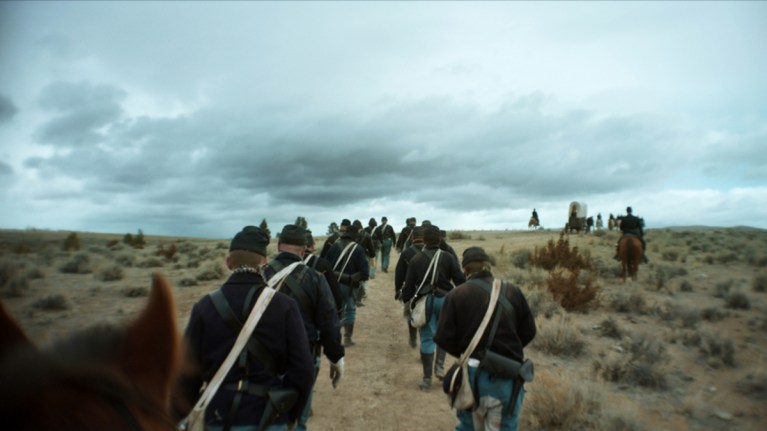
Throughout his career directing hybrid-documentaries, Minervini, an Italian by birth who has resided in Southern US communities for decades, has taken his combinatorial objective outsider and adopted insider perspective to examine America’s contemporary identity by focusing on personal stories within our disenfranchised communities to reveal how regional culture, history, and government have shaped the challenges of today. With his newest film, The Damned, his first fiction feature and one that earned him the Best Director prize in the Un Certain Regard section of last year’s Cannes Film Festival, Minervini takes aspects of the desperation inherent in his documentary subjects and their settings and goes back in time to 1862. Set during the early years of the Civil War, The Damned follows a small group of otherwise hapless and mostly indigent Union infantrymen who are mysteriously dispatched to patrol the Northwestern part of the country to protect the land against an undefined foe. Factually, the US Army was sent to that region to secure land during the Gold Rush, and facets of that particular deployment are only hinted at in one scene, leaving the viewer to suppose otherwise. But regardless, as Minervini’s film progresses, the need for historical accuracy erodes away along with any need to adhere to the conventions of the war genre in order to allow The Damned’s philosophical, experiential narrative to flourish.
Soon after the foreshadowing supplied by the film’s opening moments, where we witness a pack of wolves steadily devouring a deer carcass, we are introduced to a group of soldiers of varying ages stationed at their frigid tent-strewn encampment as they wile away their days guarding against attack. The men play cards, drink whisky, take shots at passing wild game, and discuss in a modern vernacular the whys of their enlistment and if/how war aligns with their individual belief systems, be they faith-based, survival-based, or morally-based on the obligation to the anti-slavery cause that was their side of the Civil War. The men eschew all discussions of politics that would further ground them to that moment in time, and we attentively reside in these small moments in the first third of The Damned as we instinctively anticipate the time-tested war movie development of empathetic characters to root for against adversity. Yet, those characters remain purposely underdeveloped as the pall of ever-present danger that consistently looms over these men takes precedence over any single man’s story when we’re thrust head first into a fierce battle where our troops are fired upon from all angles by an intentionally hidden and ubiquitous entity closer to phantoms than any wartime enemy.
For the duration of this ferocious attack, which only lasts minutes (but given its intensity feels endless), Minervini and first-time cinematographer, though longtime collaborator, Carlos Alfonso Corral closely stick to either one or a few of our Union troops at a time as they return rounds while desperately attempting to survive the ordeal that sees many of their number down and the rest in a state of confusion. Once the battle subsides, it is time for the living to gather the dead and continue with their assignments, even though the purpose of their mission, given the unnamed but now very impactful threat, forces our men to question not only their place at this moment, but also the greater meaning of their own existence in a section of a divided country where wilderness still reigns above all else. When the narrative progresses slowly past the days that follow the violence, the conversation shifts as the reality of further assaults, diminishing rations, and the ever-increasing frost and cold creates a wider array of dangers for the troops, who start to exhibit greater levels of vulnerability.
During these moments where the short seconds of silence add a deafening tone, Carlos Alfonso Corral’s camera smartly tightens the frame to examine the winter-worn and increasingly concerned faces of the men as their journeys meander into realms unknown. Onscreen, we see the familiar cinematic image of Union soldiers and the genre specifics of a Civil War epic, yet the mostly improvised, anachronistic dialogue, coupled with the enigmatic idea of evil, suggests a timeless aspect to the crisis depicted: for the echoes of its historical context stretch from the 19th century to the 21st, and the ideas discussed remain at the core of most contemporary conflicts and problems.
As was the case with Minervini’s The Other Side and 2018’s What You Gonna Do When the World’s on Fire?, The Damned becomes less of a film about good versus evil and more about the existential crisis that occurs in this nation when faced with an unseen enemy that is taking its physical and psychological toll on us. By cleverly manipulating our expectations for what we have come to expect out of a historical war film, Minervini creates an effective allegory for our current political and social situation where our frustrations with the dysfunctional status quo demand our efforts to assign blame to and attack a physical entity rather than comprehensively addressing the complex institutionalized errors that will most likely never be fully repaired due to the unrelenting waves of perceived threats before us that hijack our attention and demand our immediate, albeit ultimately futile, response.
The Damned screens in Los Angeles at 2220 Arts + Archives on June 13th, 2025 at 8pm with director Roberto Minervini in person. The screening begins the Acropolis Cinema’s multi-evening Minervini retrospective.
The Damned
Photo courtesy of Grasshopper Film
Lily & Generoso Fierro
 LILY & GENEROSO 4EVER!