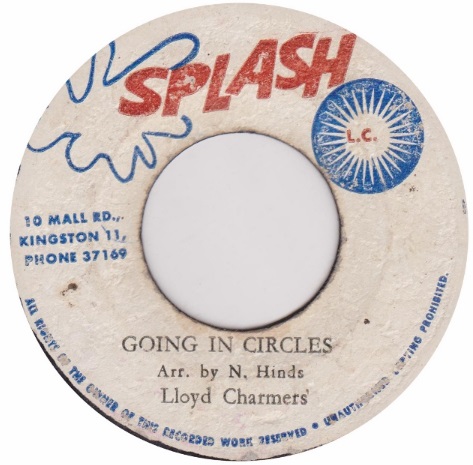
This weekend prior to the July 26th, 2016 Bovine Ska and Rocksteady, Lily and I had an awesome visit from our old friend Jeff and our new friend Lodrina, we saw a ton of Pialat movies at UCLA and pulled one beast of a Generoso and Lily’s Bovine Ska and Rocksteady Radio Show for you! For our spotlight this week, we put together a special ONE HOUR look at Lloyd Charmers’ SPLASH label which features some of the best Jamaican covers of American soul and pop cuts that we have ever heard. BB Seaton covering The Persuaders, Alton Ellis covering The Spinners, The Now Generation covering Bobby Womack..This label is truly special! The spotlight starts midway through the show.
Leading up to the Splash label spotlight which started midway through the show we began the program with two sets of ska which had a very short but tasty Maytals track that Toots and the band cut for the ND label in 1964, Hey Hey Girl. We played another short, but spectacular ska during these two sets with The Charmers on Prince Buster’s Voice Of The People, It’s A Dream. We started our mento set with The Diggers take on Peanut Vendor for Top Sounds in 1964 and ended that set with our favorite mento artist, Count Lasher on Caribou in 1956 with Calypso Cha Cha. We ended the first hour with a long set of reggae and Sir Harry on Carib-Dis-Co in 1972 with My Time Now. We then went deep into the special one-hour spotlight on the Splash Label…
The Fierro household adores Lloyd Charmers.
We love him as a member of The Charmers. We love him as a member of The Uniques. And we really love him for his wildly salacious recordings as Lloydie and the Lowbites, so much so that we are always on the lookout at for any Lloydie records wherever we go.
Born in Kingston as Lloyd Tyrell, Lloyd Charmers began his career as a singer in the duo known as The Charmers with Roy Willis. The two competed, like so many wonderful Jamaican musicians did, on the Vere Johns Opportunity Hour, and caught the attention of producers in the music scene. The Charmers would record with heavy hitters Prince Buster and Coxsone Dodd, and they would appear in the film This is Ska, but the two would part ways, with Lloyd recording as a soloist and then joining Slim Smith and Jimmy Riley as a member of the second reincarnation of The Uniques.
At the close of the sixties and the beginning of 70s, Charmers starting working on his other musical talents. He established a reputation as an excellent keyboardist, and he opened up the Splash label to work on his own productions, bringing in phenomenal talent and his own great love for American soul of the 1970s. We’re thrilled to present you this hour long spotlight on Splash because there are outstanding productions and some covers of soul tracks that challenge the originals. We began with Lloyd himself and the 1969 classic, Birth Control, which was later adapted by The Specials on Two Much Too Young.
Charmers house backing band of choice was the Now Generation Band. The seed that started the group was planted when Mikey Chung and Val Douglas were students at the College of Arts and Sciences Technology. The two both went to the same high school together, but they did not begin practicing and recording together until later. They began using the equipment of the disbanded group, Ti & the Titans, and they formed the band the Mighty Mystics. Then the Mighty Mystics broke up and joined an existing band known as Now Generation, creating the house band that people would come to know well throughout reggae. The members of the group were brothers Mikey and Geoffrey Chung on guitar, Val Douglas on bass, Mikey Boo and Martin Sinclair (who was only a member for early recordings) on drums, Robbie Lyn and Wire Lindo on keyboards.
We hope you enjoy the July 26th, 2016 Bovine Ska and Rocksteady:
The July 19th, 2016 Bovine Ska and Rocksteady may go down as one of the silliest shows that we have done in the twenty year history of the radio show. It seems that the heroes of comic strips and comic books were firmly in the minds of some of Jamaican greatest recording artists as we have comic book inspired tunes about Batman, Superman, Popeye, Spider-Man, Jungle Jim being performed by everyone from Hopeton Lewis to The Upsetters to Big Youth! Here’s a bit of background on comic books and their relation to Jamaican music to help you prepare for this show!
Golden Age of Comics– approximately from the late 1930s to the beginning of the 1950s. Era that introduced to world to Superman, Batman, and Captain America and marked the foundations of the Marvel and DC dynasties
Silver Age of Comics – approximately from the mid 1950s to the early 1970s. In the Silver Age, the superheroes of the Golden Age continued to exist, but the era also introduced the world to two other superheroes: Hulk and Spider-man
These superheroes of the Golden and Silver Ages would make their way all over the world, and Jamaica was not an exception. In Jamaica, comic books would be sold alongside general goods sold at Chiney shops. In addition to the superheroes, comic strips and comics from other genres would also gain popularity, especially the Western comics such as Kid Colt, Lone Ranger, and Roy Roger whose title characters would become the performing names for many artists in reggae.
This may be one of the silliest shows we’ve ever done, but theme shows are some of our favorites to put together, and we think you’ll have a lot of fun with this one. In addition to the tracks that all reference comics, you’ll hear lots of comicbook fun, including chidren’s recordings involving some of your favorite cmics and some comicbook disco as well
Dick Tracy – The strip premiered on October 4, 1931 in the Detroit Mirror and what we now know as Tribune Media Services picked it up and nationally distributed the strip. Created by Chester Gould, who drew the series until the late 1970s, Dick Tracy followed the investigative cases of the title character. A police detective, Dick Tracy lives in a noir world, and over time, his look and his cases would evolve to match the times, taking him to space in the 60s and putting him in the company of a hippy in the 1970s
Jungle Jim debuted on January 7, 1934. Created by Alex Raymond, Jungle Jim was focused on the story of the hunter Jim Bradley. Raymond also created Flash Gordon, one of Generoso’s favorites, and Jungle Jim was intended to compete with the successful Tarzan stip and to sit above Flash Gordon. As a result, both Jungle Jim and Flash Gordon reached the public eye for the first time on the same day.
Andy Capp is a British comic strip that first appeared in the Daily Mirror in 1957. Andy is a working class man from Hartlepool, and for decades, readers have seen Andy at his home, local pub, and about town. Though a bit gruffer than gruff, Andy has had a strong following through the years, and the strip is still going strong to this day.
Of all of the comicbook characters we found for this show, there was none more popular than Jughead. Interestingly, Jughead Jones made his debut in 1941 in Pep Comics, and he has continued to exist in the Archie universe since. Known for being a little bit of an outsider, Jughead has a signature humor and an S on his shirt, which is believed to be from an abbreviation of Skunk Hill in Haverhill, MA.
We hope that you enjoy this very special Bovine Ska and Rocksteady:
Being that our spotlight for the July 12th, Bovine Ska and Rocksteady was reggae heavy, with the New Dimension label we thought to start out show with two sets of ska and why not one from the king of the ska trombone, Don Drummond. Don D recording this ska for Coxsone in 1964, the sensational, Royal Flush. Our mento set began with a cheeky 1956 Kalypso 7″ from Count Zebra And The Seasiders, Cat-O-Nine. We followed the mento set with a long set of early reggae to get you ready for the New Dimension spotlight. In that long set of reggae we included a back to back version with the late great Delroy Wilson and his cuts for Attack in 1972, Mood For Love. At the end of the reggae set we went right into our spotlight of the New Dimension label…
Here on the Bovine Ska, we look for any excuse to play tracks from Count Ossie and Cedric ‘Im’ Brooks, and that was what led us to this week’s label spotlight on the New Dimension label.
Brooks’s career got its humble start at the Alpha Boys School, and upon graduation, he toured with the Jamaica Military Band. Originally a clarinet player, he switched to saxophone when he played with the Vagabonds and would stay with sax in the years to come as a member of Sonny Bradshaw’s stage band and the Granville Williams Orchestra. Brooks’ style evolved when he moved to Philadelphia in the late 60s, and as a student at the Combs College of Music, he got further exposure to the experimental jazz work of Sun Ra and Pharoah Sanders, and they would heavily influence his arrangements and his playing style when he returned to Jamaica.
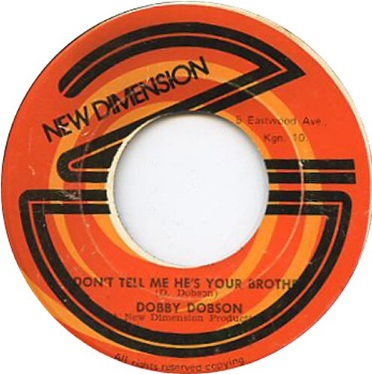
On his return, Brooks first created the Mystics to perform the works combining the jazz he learned in Philadelphia with reggae, which was surging on the island. The Mystics met Count Ossie and his percussion group, forming Count Ossie & The Mystic Revelation of Rastafari. Arthur Wedderburn, a jazz collector, opened up the New Dimension studio and label to record the seminal Count Ossie & The Mystic Revelation of Rastafari record Grounation Wedderburn produced and engineered with that record, and it is one of the few productions he did for the label. Many of the recordings on New Dimension had other producers, giving us the sense that outside of the Count Ossie record, New Dimension was a studio and label that artists and producers could bring their songs to for recording and pressing.
Regardless of the producer, what is consistent throughout these New Dimension recordings is a richness in the arrangements and the vocals, and that is one of the many reasons why we are excited to present this spotlight tonight. And, of course, we began with the Count Ossie and Cedric Im Brooks collaboration that is The Mystic Revelation of Rastafari with their track, Lumba.
We hope you enjoy the July 12th, 2016 Bovine Ska and Rocksteady:
The July 5th, 2016 Bovine Ska and Rocksteady began with a version to version excursion with Shark Wilson & the Basement Heaters 1971 cut for Moodisc, Make It Reggae. We actually played two sets of early reggae to start the show ending with another version to version with Barbara Jones cover of the Patti Page classic, Changing Partners which Jones recorded for GGs in 1974. Our weekly mento set contained a gem from The Wrigglers Sing Again LP which was released by Kalypso in 1958, the suggestive tune, Biggest Maracas. The final set of the first hour, a ska set in fact, started with a Stranger Cole tune that has never been played on the show before, a 1963 cut entitled Morning Star for the Dutchess label, We ended the first hour with Lee Perry’s Trial and Crosses which he recorded for Coxsone Dodd’s Worldisc in 1964. We then began our spotlight of the Down Beat Label.
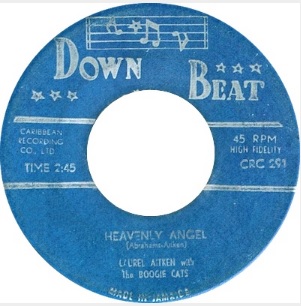
Deonaire ‘Dada’ Tewari started out as a businessman. His family had a growing dry goods business, and in addition, they owned the Tivoli Theater, which would later become the Queen’s Theater. Tewari worked primarily in his family’s businesses until 1953, when he opened the Caribbean Recording Company, one of the earliest recording facilities to be opened in Jamaica, opened only after the recording studios of Ken Khouri and Stanley Motta. Two labels existed to distribute the music recorded at the Caribbean Recording Company: Caribou and Down Beat. You’ve heard selections from Caribou during our weekly mento sets, but we have yet to share a mass of tracks from Down Beat. Consequently, Down Beat was our label spotlight.
We started the second hour with Laurel Aitken, an artist who got his start with Tewari. After getting spotted at the V-Rocket sound system, Laurel was introduced to Dada Tewari. He recorded many tracks for Tewari, including the early hit “Roll Jordan Roll” for the Caribou label, and “Boogie Rock” for the Down Beat label, the track which will start this spotlight. A student of the Alpha Boys School, Lester Sterling began playing trumpet before switching over to alto sax. He performed as a member of the Jamaica Military Band before entering the recording industry. Throughout his career, Sterling worked extensively with Coxsone Dodd, and this next track “Pipe Dream” is one product of their collaborations. Though Tewari did produce many recordings on Down Beat, some of the tracks released on the label were also produced by Coxsone Dodd. Tewari’s Caribbean Recording Company, located on Torrington Road, was highly productive throughout the fifties and early sixties. Unfortunately, we don’t hear any recordings from Tewari after the ska rhythm because the facilities experienced a fire, and Tewari did not return to the music industry.
We hope you enjoy the July 5th, 2016 Bovine Ska and Rocksteady:
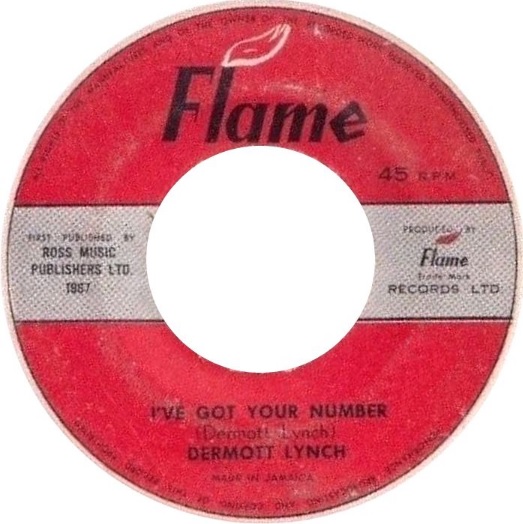
We started off the June 28th, 2016 Bovine Ska and Rocksteady with two sets of Jamaican rhythm and blues, beginning with the tune, Call Me, a superb 1961 track on Wild Bells from his eminence, Prince Buster and ending with Bunny and Skitter’s song, A Little Mashin’ for Vincent Randy Chin’s Randy’s label. We then followed with our weekly mento set and a top cut from Chin’s Calypso Sextet, Give Her Love, released on Chin’s in 1956 and we ended that first hour with a very long set of rocksteady that started with Rugged Girl, Bumps Oakley’s cover of The Four Seasons hit, Rag Doll. After that set, we went right into our spotlight on Charles Ross’ Flame Label!
As a Trojan subsidiary, Blue Cat distributed the recordings of many producers including: Joe Gibbs, Joe Mansano, Bunny Lee, Alvin Ranglin and Coxsone Dodd. Some of the strongest releases came from a producer whose legacy has not received as much attention over the years, and that producer is Charlie Ross. Outside of his own Sugar label, which had its own distribution in the UK, Ross also owned the Flame label in Jamaica, which reached the UK via Blue Cat. On the Bovine Ska, we love Charlie Ross as a producer, and we are thrilled to present these Flame recordings because Ross’s work is exceptional. Keep in mind that there were two other well known labels that share the same name with this label, but those labels existed later, and you can identify this one because of Ross’s excellent understanding of arrangement and production.
Backing up many on the Flame label was Lynn Taitt and Karl Cannonball Bryan. Of the major saxophonists, we’ve discussed Roland Alphonso and Cedric Im Brooks, but we also would like to highlight Cannonball Bryan. Like many other phenomenal Jamaican musicians, Cannonball attended the Alpha Boys’ School. As a performer, he backed many touring artists during their visit to Jamaica, including everyone from the Mighty Sparrow to Jackie Wilson. As a recording artist, he worked with many producers including Coxsone Dodd, Prince Buster, Clancy Eccles, and of, course Charley Ross
We hope you enjoy the June 28, 2016 Bovine Ska and Rocksteady:
First off, we just want to thank everyone who gave us love for last week’s 20th Anniversary episode of the Bovine Ska. It was a tough show to glue together so we are so happy that you all loved it so much. Here’s to another twenty years!
Our weekly mento set began with Miss Goosie from Count Owen’s Rock Steady Calypso LP which came out on Federal in 1968 and ended with Lord Power’s wildly festive, Let’s Do It on Hi Lite in 1956. We ended the first hour with a rousing set of ska, with our final track being Hortense Ellis disguised as Little Darling and No One, which she recorded for Prince Buster on Voice Of The People in 1965. We then began our spotlight on Sir Mike The Musical Dragon Label…
From the early soundsystem era, we always hear about Lloyd Daley’s Matador, Duke Reid’s Trojan, Coxsone’s Downbeat, Prince Buster’s Voice of the People, and Vincent and George Edwards (collectively known as King Edwards) The Giant sound systems. Mike Shadeed’s Sir Mike the Musical Dragon Sound System stood in the company of these big names, but we often do not hear of Shadeed’s work.
Sir Mike the Musical Dragon was considered one of the big six sound systems in Jamaica, so much so that Shadeed was invited by the Jamaican government to partake in Independence celebrations and dances in the mid-60s. As a testament to the reputation and popularity of the Sir Mike sound system, King Tubby, in interviews, has even discussed the power of Sir Mike’s, saying that Sir Mike was even stronger than Coxsone Dodd’s Downbeat and Duke Reid’s The Trojan by the time the mid-60s arrived. Sir Mike the Musical Dragon also introduced the music world to Prince Far I, who was a DJ for the sound system before he became a recording artist.
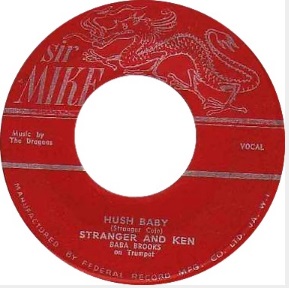
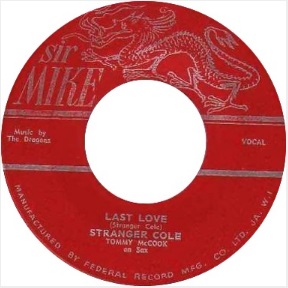
As a record label, Sir Mike the Musical Dragon gave us some excellent ska from some of the best artists at the time. We kicked off this spotlight on the Sir Mike label with a duo of great talent, Stranger & Ken, Stranger Cole and Ken Boothe, who recorded, Hush Baby, for Mike Shadeed in 1963.
Before playing melodica in the 1970s, Joe White recorded primarily as a vocalist in the 1960s. For the Sir Mike the Musical Dragon label, White recorded two beautiful skas. Wanna Go Home, features a simple and gorgeous trumpet line from Baba Brooks playing in tandem with White’s solid voice, and “When You Are Wrong” also features Baba Brooks, but White’s voice shines in the track. We started off the second set of the spotlight with both of these wonderful Joe White recordings.
XOXO
Lily and Generoso
Here is the June 21st, 2016 Generoso and Lily’s Bovine Ska and Rocksteady:
Happy Anniversary Bovine Ska and Rocksteady Listeners!
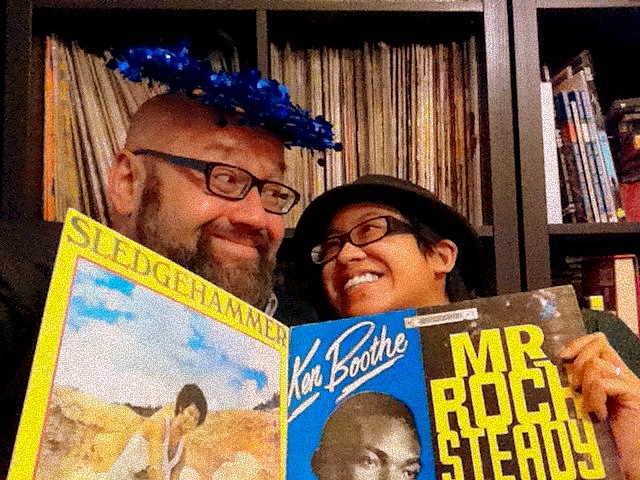
Twenty years ago this week, Generoso arrived to the basement of the Walker Memorial building at MIT and stepped into the studios of WMBR, 88.1FM Cambridge where he filled in for his friend Chris’ radio show, Spiddle, Urine, Phlegm, and Blood by playing two hours of a mix of original Jamaican and Two Tone Ska. The program director at the time enjoyed his show and offered Generoso a slot on Tuesdays at midnight and the show remained at that time for the next nineteen years. In 2010, Generoso met Lily and they began doing the show together ever since. The show remained on the schedule at WMBR until 2015 when Generoso and Lily moved to Los Angeles where the show continues on Mixcloud.
Over the last twenty years The Bovine Ska and Rocksteady has played early Jamaican music from 1955-1975 ( we sometimes go much earlier than that but rarely later) concentrating on the earliest recorded musics in Jamaica, mento, rhythm and blues, ska, rocksteady, and early reggae. We have also been fortunate to have some of the greatest recording artists in Jamaican music history visit the show from Jimmy Cliff to Owen Gray, Prince Buster, Roy and Yvonne, BB Seaton, Lynn Taitt, Eric Monty Morris, Keith and Tex, Big Youth, Lord Tanamo, Derrick Morgan, and Laurel Aitken as well as modern performers like Dave Wakeling of The English Beat, Greg Lee from Hepcat and David Hillyard (who composed our opening theme) and Glen Pine from The Slackers. This has been a blast these last two decades.
Over the last few weeks, Lily and Generoso have rummaged through the years via piles of old cassette tapes, DATs, CDs and MP3s to create this past week’s twentieth anniversary show, Included are interviews from the aforementioned artists and live performances from the show, and even a set from the patron saint of The Bovine Ska, Magnus Johnstone, who passed away in 2013, as well as the rare recordings of tracks from the performers that you have come to expect over the last twenty years.
We have no intentions of stopping what we have been doing since 1996 and we would like to thank all of the listeners, artists, and WMBR for their support over the years.
XO
Generoso and Lily
So, please celebrate with us by listening to our 20th Anniversary Special:
As the Bovine Ska veered towards its 20th Anniversary on June 14th, 2016, we decided to stay the course and do a traditional show (traditional for us) that you have heard these last twenty years. Our spotlight, which occurs midway through the show as always, was on Prince Tony’s reggaerific HIGH SCHOOL LABEL!
The show began with two sets of superb rare ska beginning with a Maytals cut which has never before been played on The Bovine Ska, a gem from Toots from Rolando and Powie in 1963 entitled, Make Me Do. We are still celebrating Toots’ return to the stage this summer after a three year absence. Do check him out when he comes to your town! Starting our mento set was Harold Richardson and The Ticklers’ cover of Don’t Fence Her In on MRS in 1952 and we ended our first hour with a long set of rare rocksteady included a version to version on Studio One of Alton Ellis’ Mad Mad Mad. After that set we started on our thirty minute spotlight on Prince Tony’s High School Label.
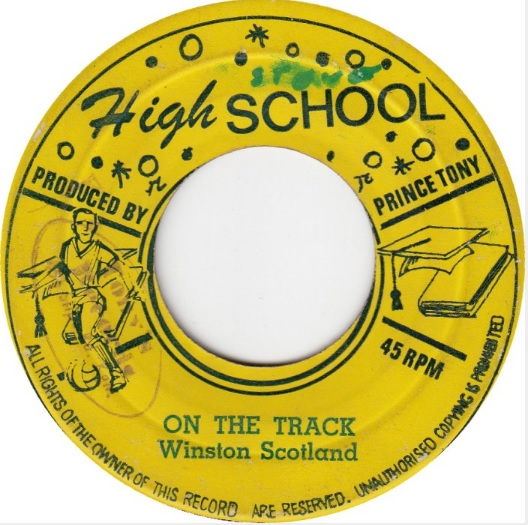
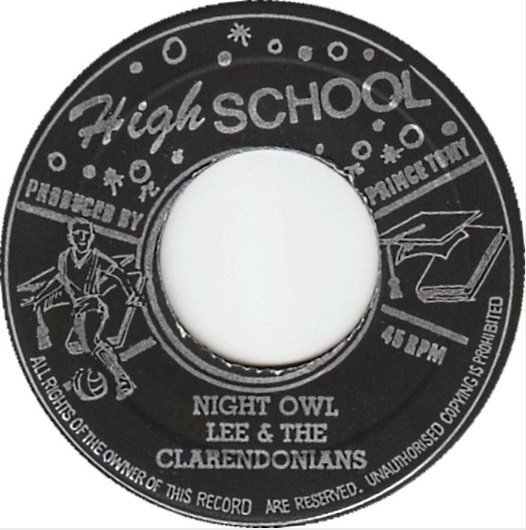
Prince Tony is the king of the deejays and the version, so this spotlight on the High School label had plenty of both! Known as Prince Tony as a producer, Tony Robinson began his production career in reggae. Many of his productions would make their way over to England, where plenty of his artists would see success. Though the High School label releases did get decent distribution through Trojan and Pama subsidiaries, Prince Tony’s production legacy is often tied to The Gladiators’ LPs Trenchtown Mix Up and Proverbial Reggae and Big Youth’s LP Dreadlocks Dread, so we are excited to show the brilliance of his earlier productions for the High School label. This spotlight has many major names in it, and we were excited to kick it off with one of the biggest deejays out there, Dennis Al Capone, here known as Young Al Capone and his recording “Girl Called Clover” and its version.
One of the deejays that spent a lot of time at High School was Winston Scotland. Believed to be the brother in law of U-Roy, another fine deejay and an artist who also stopped by the High School label, Scotland got his start toasting over the selections at the Sound of Muzik and the Soul King sound systems. As a recording artist, Scotland worked with Joe Gibbs and Phillip Monroe before heading over to the High School label. At High School, Scotland recorded some of his best tracks, including “Buttercup,” which Prince Tony had great ambitions for with his licensing of the track over to the Philips label in the UK for major distribution.
For our disco background for the first hour this week was The Tee Cee’s 1978 LP on AVI, Disco Love Bit and for the second hour, Barbara Mason’s Lady Love LP superb 1973 release on Buddha.
XO
Generoso and Lily
For your listening pleasure, here is our June 7th, 2016 Generoso and Lily’s Bovine Ska and Rocksteady:
The May 31st, 2016 Bovine Ska and Rocksteady began with a never before played on the show ska single from Justin Hinds and The Dominoes which was released on Treasure Isle in 1965, Zion Higher. In fact the first two sets of the show were of the ska variety ending with Trial and Crosses from a very young, Lee “Scratch” Perry which was released on Coxsone’s Worldisc label in 1964. In honor of Memorial Day, we began our weekly mento set with a 1956 MRS recording entitled, Soldier Man, from the seldom played Arthur Knibbs. I say seldom as even though he was as prolific an artist that existed during mento, finding his recordings has been a real chore but as always we continue to search the racks. We started the final set of the hour with the Bassies, too pretty for words rocksteady cut on Coxsone in 1967, River Jordan. When that set ended, with the end of the first hour. we launched right into our spotlight of Enid Barrett’s DELTONE LABEL.
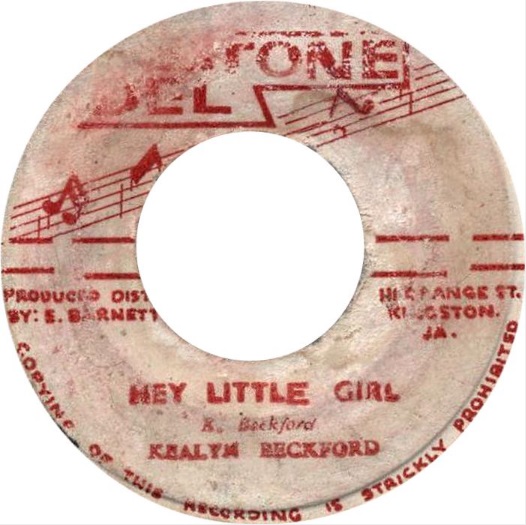
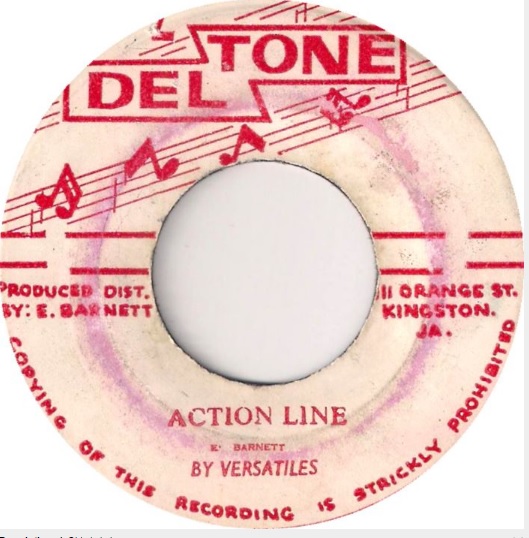
One of the most interesting things about Deltone is the names of two women attached to it. There is solid evidence to believe that Dorothy Barnett owned the label. Meanwhile, there are other claims that Enid Barnett owned the label, which most likely comes from the fact that Enid is credited as the producer of many records on Deltone. From what we can tell, Enid is a relative of Dorothy’s or Dorothy’s producer name, if anyone listening has any thoughts on this, we’d love to hear from you. We do know that Dorothy Barnett had some solid experience in the record industry before she ventured out to create her own label and record shop. She worked as Coxsone Dodd’s secretary, and from her observations of the ins and outs of the record business, she opened up Deltone, the shop and label. The shop, like other legendary ones, had its storefront on Orange street, and as a result, Barnett’s record label had the ability to attract much talent, including Lee Scratch Perry, who would engineer plenty of tracks for Deltone. We kicked off this spotlight in the rocksteady with Some of Them A Bawl from The Pioneers.
Deltone was somewhat of a family business. One of the musicians who saw the greatest success at Deltone was Keeling Beckford, who was Dorothy’s cousin. Also, as a result of Keeling’s presence at the label, Theo Beckford, Keeling’s uncle, would play piano on multiple Deltone tracks. The Versatiles had worked consistently with Joe Gibbs, but they decided to venture out and went over to Deltone. Teardrops Falling, Someone to Love, and Children of Today were engineered by Scratch for Deltone!
XOXO Generoso and Lily
Here is the May 31st, 2016 Bovine Ska and Rocksteady for your listening pleasure….
No one seemed to complain in 2000 when Wong Kar Wai followed up his melancholy tale of unrequited love from three years earlier, Happy Together, with his equally melancholy tale of unrequited love, In The Mood For Love. To be accurate, it actually went beyond not complaining, as Happy Together, though it was critically praised, did not receive one-tenth of the accolades garnered by In The Mood For Love . The latter film, a perfectly sculpted narrative centered around two once-in-a-lifetime performances, ended up on many critics’ lists as the best film of the 2000s. Sadly, WKW should’ve quit while he was ahead as his eagerly awaited follow-up, 2046, was a universally panned, needlessly sentimental, muddled mess.
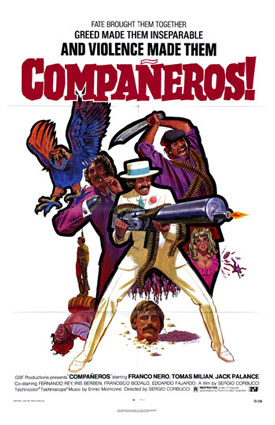
It is a common practice in film, among even the finest directors, to take an earlier work of their own creation and to refine it to their satisfaction, so even a film that was well received will sometimes get a do over. This process of revisiting and renovation is common with theater directors who will change a production for each year of its run, but I feel that we still look at this retooling in cinema as odd due to the fact that filmmaking is an expensive process that produces a physical medium which can be seen again, making it ripe for scrutiny. So why would Sergio Corbucci, the famed director of the original Django, want to follow up his popular 1968 Zapata western, The Mercenary, complete with its overdone, left-of-center politics, with Compañeros!, which similarly uses the 1913 Mexican revolution as its setting to push Corbucci’s political stance? And, why for main characters, would he have, again, two adversarial protagonists/buddies who hate/love each other? Corbucci even recruited Franco Nero and Jack Palance from The Mercenary for the leads, but I suppose to nuance his earlier film, he made the decision to switch out the slightly terrifying Tony Musante for the even more terrifying Tomas Milian, two actors who possess pairs of the craziest eyes in spaghetti westerns this side of Klaus Kinski. You may think that with all of this hemming and hawing that I don’t like Compañeros!, but that is not the case. It is more action packed than its similarly themed and cast predecessor, and despite losing some steam in the second half, Compañeros!, without giving too much of the plot away, has one of the better endings of any Corbucci western.
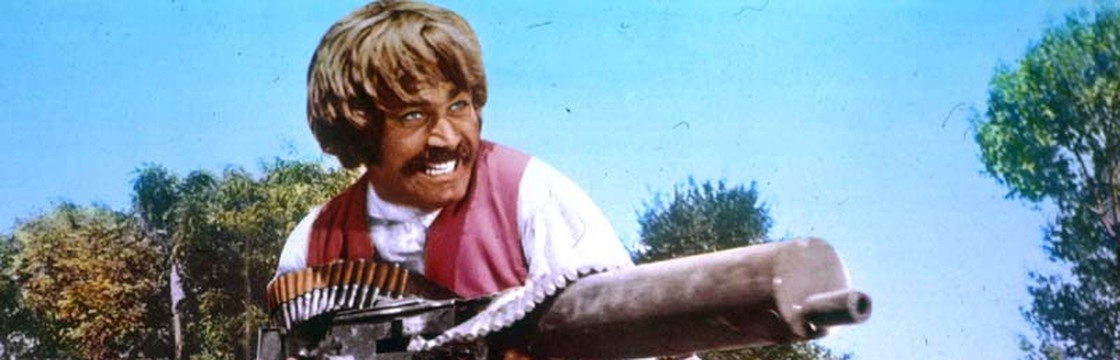
Franco Nero plays the well-coiffed, avarice-fueled Swedish (?!) arms dealer, Yodlaf Peterson, who has come to Mexico during the revolution of 1913 to sell his wares to the tyrannical General Mongo (yes, this film was made before Blazing Saddles, and yes, I was giggling a bit when I heard the name). Soon after arriving in town to make his deal with Mongo, Peterson meets Vasco (Milian), the leader of a group of banditos who have assumed power along with Mongo after they have killed the army colonel in command. The pair exchange macho stares, and a mysterious coin gifting occurs between the two before Peterson checks into the only hotel where he finds Lola (German actress Iris Berben), who is leading a group of student counter revolutionaries led by Professor Xantos (Fernando Rey). Xantos has been imprisoned by the United States army after refusing the terms for the money the U.S. government has given him to fund his non-violent revolution against Mongo; the terms being that the U.S.A. wants the rights to all of Mexico’s oil resources. So, where is the money that Xantos got for his revolution? It is in an indestructible safe, and only Xantos knows its combination. As Mongo needs the money to pay for more arms, he sends the dueling pair of Vasco and Peterson to bust Xantos out of the army jail. Standing in their way, besides the U.S. Army guarding the prison of course, is an American named John (Jack Palance), who wants Peterson, his former business partner, extremely dead. Some time ago, the greedy Peterson had left John to die after he was crucified, leaving John’s beloved, a hawk named Marcia, to peck his right hand off to save him. John has a legitimate gripe with Peterson and will go to some extreme methods to get him, including using a gopher as a torture device in one of the film’s more squirm-inducing scenes. The good news is that Peterson is ready for John as our Swedish arms dealer doesn’t only sell weapons, he is good at using them too, so you know that the obligatory Django-esque scenes must occur with Nero utilizing a normally too heavy to lift belt-fed machine gun to kill more bad guys than any six-shooter could ever attempt to accomplish. Yes, long before Rambo, Corbucci’s Django was the king of the one man army.
Now that you have a good idea of the plot, we still have to address the question that I brought up in the beginning and that is…What was left out of The Mercenary that bothered Corbucci enough to basically remake the film two years later? One thought is that, like many of the significant Italian directors who were making westerns in the late 1960s/early 1970s, the western was an excellent vehicle for attacking greed and, more topical for the time, the United States and their allies’ efforts against Communism around the globe, especially in Southeast Asia. After all, when Compañeros! was produced in 1970, the worldwide opinion against foreign military involvement in the war in Vietnam had reached it’s height, and what better struggle to reference American involvement in Vietnam than the 1913 Mexican revolution? But again, that political message was covered with The Mercenary, so what is the new message being delivered in Compañeros!? The character that stands out the most, is that of the non-violence preaching Professor Xantos, who I assume is a stand-in (and this is a stretch, mind you) for Thích Quảng Đức, the Vietnamese Mahayana Buddhist monk who famously immolated himself in 1963 to protest the South Vietnamese government’s persecution of Buddhists. Weeks after Quảng Đức’s suicide, many other monks also committed suicide by fire, which raised awareness of their struggle worldwide, but I cannot imagine that the Thích’s message was in Corbucci’s mind when he created the character of Xantos.
The Dazzling Original 1970 Italian Trailer For Compañeros!
Lastly, if you are thinking that perhaps Corbucci was just trying to cash a check by banking on his most popular film, then why don’t we see Django IV in 1970? Lord knows, every other spaghetti director did a Django ripoff during that time to varying degrees of commercial success, but Corbucci never did try and capitalize on that film’s immense box office receipts through sequels. Even though I cannot pinpoint the necessity for Corbucci to make a film so similar to The Mercenary, its heart seems to be in the right place, even if the political message is somewhat unclear, but more importantly, Compañeros! is an entirely entertaining western from one of the master directors of the genre, who like Sergio Sollima and Leone could still impress even when they weren’t entirely on point. The film’s pacing is quite good, a mark above other westerns of that era, as are the over-the-top performances and the lavish, yet playful, score by Ennio Morricone. It was also a treat to see Nero in another film where he uses his own speaking voice. In The Mercenary, Corbucci had Nero play the Polish mercenary, Sergei Kowalski, just so Nero’s Italian accent could be masked, and he could use his own expressive voice. If Compañeros! was solely invented just to have the popular actor, Franco Nero voice his own character to get the film’s message across to a global audience more genuinely than a potentially bad overdub, then perhaps this not too different take on the Zapata Western was worth the effort for that alone.







 LILY & GENEROSO 4EVER!