Diving into Shallow Waters: Jeff Lemire’s The Underwater Welder

Standard

For years, on days where work, school, and general daily responsibilities got tough, I would ask Generoso what occupation would make sense for the rest of our lives, and he would often fervently respond with, “UNDERWATER WELDER!!!”

Underwater welder (or amateur canine dentist, but that’s a career to be discussed at another time) has been a fake occupation Generoso and I have each claimed as our livelihood. Consequently, when I was perusing through the shelves of Million Year Picnic a couple weeks ago and stumbled upon Jeff Lemire’s The Underwater Welder, I knew I had to read it if only for my own excitement to see a full novel about a job Generoso and I have been speaking about for so long.

Cover of The Underwater Welder

Jack Joseph grew up in Tigg’s Bay, Nova Scotia and has never been able to leave the place. Attached to the ocean and the isolation he gains in his work as an underwater welder for oil rigs, Jack spends more time underwater than on land where he and his wife Suse live and are expecting a baby in the coming month. Jack’s father’s disappearance and supposed drowning haunts him, and from the onset of The Underwater Welder, we get a strong sense that Jack has displaced his dissatisfaction with the ambiguity of his father’s end into his work. Sure Jack’s occupation allows him to dwell in the ocean, a place where he has always found comfort, but it also gives him a very faint chance of hope to one day find any clue of his late father’s disappearance into the ocean.

On Halloween two decades later, the almost too coincidental anniversary day of his father’s disappearance, Jack dives down as he has every year (he always makes sure that he is at work on Halloween) and finds a remnant of his father: a pocket watch Jack’s father had found on a treasure hunting dive. Despite the tangibility of this one buried piece of personal treasure, Jack, upon picking it up, gets sent into what appears to be another dimension and then blacks out.

Fortunately, Jack’s work has various checks in place to protect the welders, and this time, his partner, who by protocol monitors him through the radio, immediately signals for help when he loses communication with Jack, and other welders manage to rescue him. Upon waking up , Jack is disoriented and confused, and something just does not feel right.

After observation by a doctor, Jack returns home to his wife, and despite her need and request for him to remain on land with her during the last minutes of her pregnancy, he feels a relentless urge to return to the ocean to follow the only lead he has to finding his father. After so many years of hoping for his father’s unlikely return, Jack is closer than ever to learning what happened 20 years ago on Halloween, but his current responsibilities to his wife mean he should postpone his desire to answer the question always lingering in the back of his mind.

However, Jack has always had a conflict about where exactly he belongs: in the ocean or on the land, and this sudden discovery of the watch worsens the conflict. Despite his acknowledgement of his absence from most of his wife’s pregnancy and his failure to support her emotionally, Jack returns to the ocean, hypnotized by the memories of his father and the supernatural occurrence he experienced with the watch, pulling him further and further away from his wife and his life with her.

At its heart, The Underwater Welder is an exploration of grief over a flawed relationship and very flawed loved one. Despite the extraordinary circumstance Jack finds himself in, all of his time in the ocean, whether working, looking for the pocket watch, or traveling to an alternate world, leaves him obsessed with his own past, seeking answers for his father’s demise, which will ultimately lead to no change. Jack still has a wife. Jack still has a baby on the way. Jack still has a mother who cares for him. Yet, his fixation on his father has led him to neglect all of them and unable to progress in his own reality.

A release of Jack’s haunting memories set at the bottom of the ocean, The Underwater Welder certainly has an alluring setting and premise, but unfortunately feels all too contrived. Advertised as a never-before-produced episode of The Twilight Zone, it lacks the looseness necessary to make the story an enormous success. Every moment is foreshadowed too heavily; the novel has little spontaneity to build an intriguing and entrancing mystery like an episode of The Twilight Zone. In addition, the climax, Jack’s final realization of why the pocket watch ended up on the floor of the ocean, borders a maudlin and overly sentimental territory, which defies the narrative’s own attempts to capture the nuances of Jack’s grief.

With the potential to triumph as a delicate and poignant novel about the obsession and displacement of loss, The Underwater Welder amounts to a simple, almost facile tale about a man who travels back in time through an underwater portal to try to find answers about his and his father’s past. Daphne du Maurier’s Rebecca and Emily Brontë’s Wuthering Heights handles a similar theme of unearthing the ghosts of the past with much more grace and suspense. And in the graphic novel world, Dash Shaw’s Bottomless Belly Button, better and more effortlessly explores how finding answers to one’s own and loved ones’ pasts can allow people to progress in the present. Like the examples above, The Underwater Welder also blends reality with the supernatural but only to create a dull and trite story about getting closure for a loved one’s death, which is something most of us rarely even get. Early in the grieving process, we strive for closure but eventually realize that despite our efforts, closure will never bring our loved one back, and it most definitely will not uplift the pain and trauma of the loss.

The Underwater Welder is at best a framework of a story with some pretty visuals (though nothing groundbreaking) waiting to be further fleshed out and bulked up by someone else. Given that Lemire’s new series Descender already has plans to be adapted for the big screen, it would not be surprising if The Underwater Welder meets the same fate.

Let’s hope that whoever decides to transform The Underwater Welder into a film turns it toward a more experimental, fragmented, and nuanced direction, away from the mushy, sappy, family drama road it’s already driving down.

The Underwater Welder by Jeff Lemire is available via Top Shelf Productions.

Loss and Rebirth in Chicacabra

Standard

For almost everyone, death is a difficult concept to grasp, especially when encountered at a young age through the death of a loved one. Beyond the trauma of death, grief can also consume and completely destroy people. During the time of grieving a loved one, the purpose of life becomes unclear, and many will begin to doubt their existence and purpose upon the realization that death is completely beyond their control or input. Some will respond to this time of pain, confusion, and perceived loss of control with retreat and isolation while others will lash out in anger and frustration. Grieving is an ugly and exhausting process for everyone;  we try to continue our lives when we just want to hide under the covers and cry, forcing us to make mistakes and often feeling the need to further repress the sadness and pain from our loss.

In Chicacabra, grief looms over Isabel Sanchez and never seems to dissipate. After brutal carjackers murdered her father, her mother entered a state of catatonia, leaving Isabel to be raised by her uncle Tony alone. With the memories of her mother and father together always in her mind and their sudden removal from her life, Isabel has a difficult time fitting in. The amount of loss she must handle alienates her from her classmates and even her friends, and her guilt for never appreciating her father or mother enough furthers her isolation from others.

Cover of Chicacabra

Cover of Chicacabra

Isabel thankfully has one family member left in her life, but given the unexpected tragedy of her father’s death and the instant onset of her mother’s vegetative state, Isabel has little to believe that she will have any family members who will continue to be by her side. Consequently, in addition to the immense pain and guilt she carries, Isabel also carries a belief that instantaneously she could lose anyone she cares about, and in trying to prevent the pain she will feel by losing yet another loved one, she shies away from investing emotion and time into most of the relationships around her. Isabel’s grieving is not going well.

Paired with her distance from the people in her life, a nihilistic recklessness also lives in Isbel, and one day, she decides to scale down a cliff and wander into a dark tunnel, and here, inside of the cliff, life completely changes for her. After falling into an antiquated science laboratory, a spirit or creature takes over her and disappears, only to return again to dismember two men who attempt to assault Isabel in an elevator. Isabel seems to have a new protector, but this guardian does not arrive from the sky to save the day; it lives inside of her and takes over when Isabel faces danger.

At first, Isabel does not know the identity and the history of the guardian creature living inside of her, and she struggles to learn how to tame its release. However, after the night of the elevator attack, Professor Chemo, a scientist who has searched for the presence of chupacabras in Puerto Rico his entire life, fortuitously finds Isabel’s driver’s license at the elevator scene and rushes to Isabel in order to help to explain what to expect from her new friend. Upon the arrival of Professor Chemo at the Sanchez home, Isabel and her uncle learn of her hero’s identity: her defender is a chupacabra queen who has merged her soul with Isabel’s.

With Chicacabra (the name Isabel gives to her chupacabra), Isabel is always safe; however, the people in Isabel’s are not at first. Like Isabel, Chicacabra has experienced an immense of loss herself through the hands of human beings, so much so that she is the last of her kind. Both Isabel and Chicacabra need to learn how to trust people again, and the scenarios in which the two place other facilitate their healing process from their individual losses.

The presence of the Chicacabra in Isabel’s life and her uncle’s kind response and immense amount of understanding of his niece’s unique existence as part human part animal opens Isabel’s eyes to see how much her uncle loves her and cares for her, allowing her to be more loving and grateful to him. Additionally, Professor Chemo’s commitment to helping Isabel understand Chicacabra expands Isabel’s understanding of family and her willingness to accept a new person in her life. In parallel to Isabel’s growth, Chicacabra also learns and grows. The kindness Isabel’s uncle and Professor Chemo show to Chicacabra allows her to understand that not all humans intend to harm her, and consequently, Chica does not always need to remain in a hostile defensive or attacking state. And, like Isabel, Chica now has a family she appreciates and loves.

Isabel and Chica have plenty of adventures in their attempts to adapt to each other in Chicacabra. Both have to learn each other’s completely foreign tendencies and tempers, and both have to try to re-integrate into a world they believed had left them behind. Despite the species differences, both have an immense amount of pain, grief, and sorrow to overcome, but together, they can begin to live again and learn to heal and help not only themselves but also the people around them, ranging from Isabel’s uncle to Tarantino, a vejigante who shepherds children’s souls in the transition phase between earth and the afterlife. Chica and Isabel have awakened from their slumbers of grief to see a new world to explore and experience.

Filled with an understanding of the ability of grief to cripple, Chicacabra uses the chupacabra as a metaphor for the grieving process. It is fundamentally inevitable to live without losing a loved one, and we all must find a way to continue to live on, but that task is not an easy or simple one. For Isabel, Chicacabra enters her life, and yes, she has supernatural powers, but most importantly, Isabel finally has more awareness for the people and the world around her and a better capacity to understand others’ suffering as well, pulling her out of the isolation that simultaneously magnified and suppressed her pain and worsened her grieving.

Though it is unlikely a chupacabra will ever combine its soul with ours, Chicacabra explores how we can understand and learn from grief rather than allowing it to eat us away. Never trite or overly simple in its approach, Chicacabra successfully describes the complexities and nuances surrounding life after the loss of a loved one with grace, humor, and energy in addition to a complete understanding of sorrow. It’s a perfect read for children and adults alike and one I certainly wished I had read when I first experienced the death of a loved one when I was a teenager myself.

Chicacabra by Tom Beland is available via IDW now.

The Mystery and the Dread of Lauri and Jaakko Ahonen’s Jaybird

Standard

Based on my experience with Finnish films, Finnish creative works seem to have a pace of their own. In the films, there seems to be a general bleakness mixed with glimmers of absurdity and most noticeably a terseness that make every word and gesture feel a tiny bit awkward but all the more meaningful because of the space and extended silence between every dialog or plot event. The films do not represent this style alone. In the comic book ream, Jaybird by Lauri and Jaakko Ahonen transfer this distinctively Finnish tone into a somber tale about a jay stuck physically and psychologically in his childhood home.

Stunning Cover Image of Jaybird

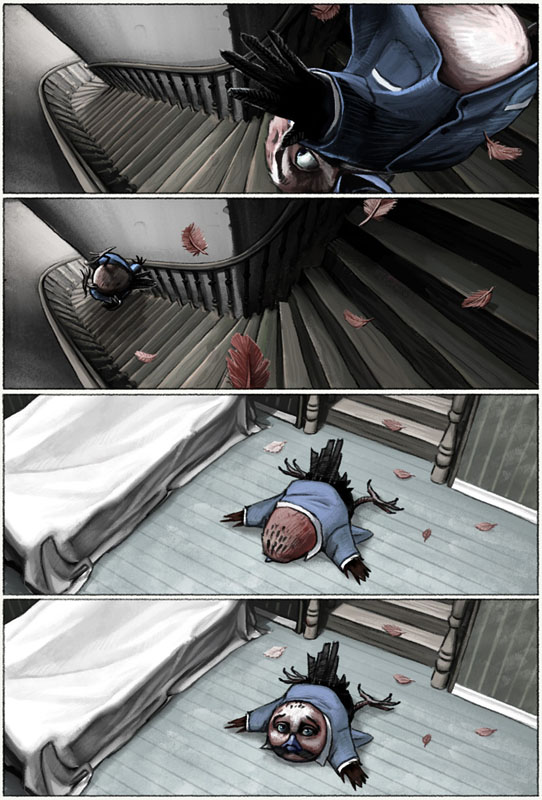
Jaybird, the first comic book and winner of the 2013 Comic Book Finlandia prize by the Ahonen brothers, develops a unique amount of dread and sorrow for a story centered on probably one of the most adorable and heartbreaking animated birds. There’s a lot of Yorgos Lanthimos’s Dogtooth seasoned with a dash of William Faulkner’s A Rose For Emily and even a sprinkle of Alfred Hitchcock’s Psycho in here, creating an unrelenting, unsettling feeling heightened by the dark and lush illustrations of the decrepit house. And, to push the creepiness further, the Ahonens include very little dialog and spend a great deal of the book focused on Jaybird’s house. Consequently, with less plot structure and dialog to focus on, the bleak atmosphere climbs out of the book, pulling you in the house where hundreds of paintings of ancestors hang on every hallway wall with their eyes perpetually devoid of life yet eerily able to follow and watch Jaybird’s every move.

Left alone in a large, once glorious, now ramshackle Victorian house, Jaybird spends every moment of his day taking care of his ill mother and meeting every demand she makes. Jaybird cooks for her, changes her diapers, and responds to her requests made by ringing a homemade chain of bells, empty cans, and silver plates hanging from the ceiling of the halls. He has no world outside of his home and his mother, and he never will. No sunlight enters the home, and it never will. Jaybird’s mother has boarded up every window and has kept Jaybird from ever wondering what lies beyond the boards by instilling a paralyzing fear of the “Bad Birds” who live outside of the house who will torture and murder innocent birds who cross their paths. Jaybird himself has no desire to test his mother’s claim and does not develop any curiosity about a world beyond, so he remains in his home in the constant fear that the Bad Birds may even find him inside of his home.

Living a life of pure isolation and knowing nothing about the world beyond the little information his mother relays to him to remind him why he needs to stay quiet and clean the house, Jaybird is unable to understand any facet of reality beyond his own. Consequently, one day, when he befriends a tarantula in the house, Jaybird’s world begins to fall apart as he asks more questions and explores the forbidden parts of his home. And through Jaybird’s response to the things he discovers, we also begin to see traces that perhaps Jaybird was not just a dutiful son.

Possibly a pure psychological horror story exposing the perversity and damage (both psychological and physiological) parents can inflict on their children, Jaybird leaves many open questions for the reader to infer. By the end, we wonder what exactly is real or a figment of Jaybird’s all-fearing imagination. Does his mother even exist? Who are the relatives on the walls? Who is alive, and who is dead in the Jaybird house? Who is responsible for the decline of Jaybird’s once triumphant and noble family? The only concrete information we have to piece everything together is Jaybird’s paranoia and agoraphobia stemming from his mother’s tales of the Bad Birds. This information has thrown him deeper into his crippling alienation, but the paranoia and isolation may have existed before in a hidden form of psychopathy, so his mother’s tale may have only exacerbated his condition.

By the end of the book, it is uncertain who is the villain in Jaybird because the Ahonens do not lead us in any absolute direction to decipher where the line between Jaybird’s imagination and reality lies. We have sympathy for Jaybird but suspect he serves as an unreliable and unstable narrator. We know his mother protected him from the world at the cost of his psychological well being, but some uncertainty remains on how much of his antisocial tendencies stem from her alone. Jaybird almost leaves a little too much unanswered by the end of the book, but it deserves an applause for the amount of mystery, horror, and gloominess it accomplishes with few pages and minimal dialog and plot; I have yet to encounter such a simple yet cryptic book where almost any interpretation of the end leads to such grim and severe outcomes.

Jaybird establishes an unwavering melancholic mood and atmosphere to explore some terrifying corners of the human mind through the adventures and possible illusions of a potentially psychotic cartoon bird. That sentence definitely sounds insane and absurd, but I think it means you should take a look at Jaybird. Bravo Lauri and Jaakko; you have created an absurd, horrific, and tragic story told from a perspective far from American or French ones, which currently dominate the graphic novel and comic book scene. Please do keep the distinguishable and unique Finnish tone and style going in comic books to come.

Jaybird is written by Jaakko Ahonen and illustrated by Lauri Ahonen. It is available via Dark Horse Books. 


A Creation in the Shadows of Blankets: The Sculptor

Standard

It seems like the theme of trying to find the meaning of life is following me around these days. Perhaps my own interest in the search for the meaning of life has led me to the graphic novels and comic books I have been reading of late, or perhaps there is a general trend in graphic novels and comic books today in a topic that has been the focus of a variety of media for centuries. Regardless of the why, I would like to preface this review of Scott McCloud’s The Sculptor with the acknowledgement that, yet again, I have selected a novel which contains a main character searching for a meaning to his existence.

Cover of The Sculptor

As an unsuccessful artist, irresponsible alcoholic, and overall misanthrope, David Smith has little to live for when his 26th birthday arrives. What joy he once had has all but vanished from his life. Every member of his loving family has passed away. His successful art career dissolved when he publicly insulted his benefactor. And after his fall from grace in the art world, he only has one friend left in New York City, and he does not commit much to maintaining even that relationship.

From the onset, David is not the most likable or sympathetic character, but buried under each insult toward other people’s art, each moment of neuroticism, and each moment of complete social clumsiness, we understand that David carries an enormous amount of pain with him and has not developed a method in which to express the pain. Naturally, as a sculptor, we would expect that the process of creation would enable David to channel and direct his pain away from himself. Unfortunately, this is not the case; his pain instead stunts his creative ability, leaving all of it bottled up inside and ready to erupt at the most unreasonable times.

David vowed to his late father that he would make a name for himself, but sculpting is his only means to make his mark on this world, and at this point, his sculpting will barely allow him to pay the bills let alone gain any acclaim. While wallowing in his despair at a diner he visited in New York with his family when he was ten, David receives a greeting and visit from his Uncle Harry. Surprised by the sudden appearance of his uncle whom he had not seen in years, David recounts his downward spiral from his initial success in the art world to his current state of desperation. Harry counsels and encourages David to continue on with his art but in a more realistic way: by settling down, moving to a less vital art scene, and working as a teacher in the daytime and as a sculptor in the night time, but David refuses this life Harry suggests, leading to the manifestation of Harry’s true identity as Death.

Upon hearing David’s refusal, Harry/Death begins to propose a deal for David to succeed in his art in the way he desires but at a cost. Despite the severe terms of the offer, David seizes the opportunity from Death to have the power to sculpt anything with his hands alone, allowing him to create the sculptures he wanted to create but could not due to budget and resource limitations, and in return, he agrees to sacrifice his life to Death within 200 days of gaining his new, supernatural sculpting abilities. He now has all of the tools he needs to flourish as an artist.

But, alas, having the ultimate set of skills to create does not necessarily lead to the most magnificent artwork, and David quickly learns that as he creates everything he sketched without any discerning self critique or self-reflection, leading to a collection of sculptures lacking a unified theme or concept. David’s realization of his concepts from the past reveal his need for a new source of inspiration, a new breath of life into his work, and upon the understanding of this need, Meg enters David’s life.

As his muse, Meg acts as the galvanizing force behind the revitalization of David’s artwork, but his artistic voice develops most when he begins to love her. Upon falling in love, David begins to live and become more aware of his surroundings as he meets Meg’s friends and sees and enjoys the world with her, and eventually, he decides on the audience for his art: Meg. With his audience decided, David sheds his concerns for what other people think and can alas create at his own artistic pinnacle.

When focusing on understanding what breathes vitality into an artist, The Sculptor succeeds. As members of the audience for any piece of art, we always wonder what process, thought, and experience exist behind an artist’s creation, and McCloud intelligently conveys why David was failing before he met Meg and why he succeeds after he meets her. McCloud clearly understands what would lead an artist to fall into a creative block and what it takes to break it.

Where The Sculptor fails is in its execution of its narrative arc and its character development, which is too consciously constructed to please a general audience.

Parallel to the story of the artist, The Sculptor also explores the meaning of existence. With the days counting down and his recurring interactions with Death, David gradually understands life can end at any moment, so a fulfilling life simply includes the opportunity to love and earn love from someone else. This is a bit of a saccharine meaning of existence, but it is not bothersome to me and is certainly not an uncommon or unpopular argument to the meaning of life in Western culture.

My major problems with The Sculptor come from how McCloud communicates this message. In building David and Meg’s relationship and David’s simultaneous self-realization to the meaning of his life, McCloud has an awkward lack of commitment to realism or to deliberate storytelling. There’s a dissonance between the effort McCloud puts into building the characters’ personas and the desire to convey the themes of the book, making the events used to convey the themes feel too contrived and the moments to build the characters feel too tangential.

Furthermore, McCloud includes narrative events and literary techniques that hearken more to pathos or a commitment to formalism than a desire to achieve successful storytelling. It is admirable that McCloud wanted to create a work containing many archetypes and motifs, but they do not quite combine and congeal into a fully successful novel. He puts in a great deal of effort to detail a deus et machina moment, a clear villain, many foreshadowing events, and Meg’s recurring severe depression, but none of these events or details emerge in a natural way in the course of the narrative, which makes me begin to suspect that many of them were included to try to pull in different types of people to the book. There’s something in The Sculptor for people who like realistic fiction, romance, drama, or fantasy, and there’s even something for the comic analysts, critics, and theorists. There are events and techniques to please all.

As a result of having something for everyone, The Sculptor contains a mixed set of successes and failures. It has a complete narrative skeleton, but the flesh to fill out this skeleton is just too unfocused, overworked, and contrived. There is no doubt that McCloud is an accomplished theorist and scholar on comics, but unfortunately, with The Sculptor, he focuses more on including all of the great ideas he had in his mind and had observed in his analysis of comics and less on pulling The Sculptor together into a complete novel. Oddly enough, The Sculptor suffers the same indecisive and tangential voice revealed when David Smith created only from his sketchbook. Like the David’s sketches, the sketches of The Sculptor contain strong ideas, but when realized into their final form, they lack a clear voice and a clearly selected audience, making them feel as if they were all created to please a general public and no one in particular, even McCloud himself.

The Sculptor by Scott McCloud is available via First Second Books. 

Epilogue:

On further thought and conversation about this critique of The Sculptor with Generoso, I realized where my general unease with the novel came from. After some distillation, I realized that The Sculptor is a supernatural, secular version of Craig Thompson’s highly acclaimed and celebrated Blankets. Blankets similarly focuses on how artist creation intertwines with love, but it also includes how faith interacts with both love and creation, leading to a more complex and nuanced understanding of existence, love, and inspiration.

In addition, Blankets triumphs through its commitment to realism. There is nothing in Blankets that feels like it was included in order to check off a box on a marketing demographics sheet. There is not a single heavy handed literary device in it. And most importantly, Craig Thompson had a clear audience in mind when he wrote Blankets: himself. It is more of a discourse on his understanding of his own growth as a man and an artist than a work to be heralded by people; the celebration of the novel comes from the success of its execution, not its desire to please. The Sculptor, on the other hand, aims to please more than to deliver a story to a specific person, making it almost critic-proof but much less exciting, engaging, and affecting. It is a watered down work created for general public consumption and adaptation, so it is no surprise that its rights have already been picked up for a movie adaptation.


Understanding Transience and Time – Here by Richard McGuire

Standard

Upon picking up Here, I admittedly knew nothing about Richard McGuire, and I suspected there was another reason why our dear friend Chris sent over this graphic novel beyond its content. Once I finished this brilliantly minimalist work, I reached the sleeve insert on the back cover, which revealed Chris’s motivation behind this gift and an insight into the tone and style of the novel: Richard McGuire founded Liquid Liquid, one of my favorite New York No Wave/Disco Not Disco bands. With this enlightened knowledge of McGuire’s musical history, a sudden clarity on the intention and the voice of the novel struck me.

Cover of Here

Like Liquid Liquid’s musical construction, destruction, and reconstruction of familiar themes and rhythms, Here combines familiar motifs and settings to create an overall mood of transience through utilitarianism. Despite all of the fragments and interruptions placed in each page, there’s a constant rhythm to Here parallel to the constant rhythm underlying wavering moments in Liquid Liquid’s musical compositions.

Set entirely within one room, Here documents the evolution of a space over time through moments layered and weaved into other moments. Within Here, McGuire completely disassembles the concept of chronological order to create fragments of time ready to be compiled into neat and orderly collages. Each page of Here displays the date used for each piece of the collage, thus revealing how little or how much people, animals, language, mannerisms, and non-living items such as decor change.

Cleverly, McGuire begins the novel with a family’s memories in the room, providing a human-centric perspective of the room in the 20th century and making you suspect that Here may be a graphic novel version of the acclaimed Up Series. However, that suspicion begins to quickly disappear when fragments of prehistoric, pre-colonial, and colonial times begin to interrupt the narrative following the family. Gradually, glimpses into the future begin to appear on the pages next to other moments older in time, and, despite the potentially disorienting shifts and interruptions of time, we begin to develop an overall sense that the world as we have understood it for the past 300 years is only a tiny lapse in the course of the world’s history.

Illustrated in the most unassuming color palette and flat drawing style, Here approaches the line of pretension with its grandiose message delivered through its utilitarian illustration and uniquely non-linear yet rigorously organized narrative technique; however, its dry, distant style fortifies the argument of the narrative. With so few lines and figures to become attached to each image, each moment, each object, and each person in time, we, as the readers, better understand the overall capricious nature of existence because we do not have any anchors to attach ourselves to any character or any moment in the narrative. Reading Here feels like you are traveling in time viewing only the life of others without any memories or foresight into our own, thus giving us the distance to reflect and ruminate on the meaning of our own lives in the context of history and time.

By constructing an overall mood rather than a narrative with major plot events and characters to complete a story arc, Here encourages us to dissolve any sentiment of hubris. By the end of the novel, we see the past, and we see what the future holds, a future brought about by our own creation of destruction and then atoned for by nature. We have brought about our own end, but alas, nature continues to survive to reinvigorate and repopulate the Earth with life, though clearly non-human again as in prehistoric times.

Possibly interpreted as a work of nihilism, Here reminds us that humans are only a small moment in the life of the Earth and universe, and we will most likely be nothing more than a small moment in the course of history like the tyrannosaurus rex or woolly mammoth. Though it minimizes the significance of human existence, Here establishes that message of insignificance through a certain reverence for forces far bigger than human life, making the novel much less dour or pessimistic. Here does not condemn humans (though it does put into perspective the damage we have done to other living creatures); instead, it reminds us that we are an era in the Earth’s history, like eras before and eras to come.

Here is less about the concept that everything is nothing and more about the understanding that all life has its own cycle on Earth. Consequently, with this understanding that this human era will one day meet its end, we should not fear death, and simultaneously we should not fear life. Here stresses the fact that we as humans cannot believe we can live forever and change nature’s plans. The only control we have is over our own current actions in our own lives, so we should live life as fully as possible without holding on to too much to our past, without fearing the future, or without overestimating our own strength. For, regardless of how powerful we may think we are now, how much we fear our own future, or how much we ruminate on our pasts, one day, our home will be the grazing field for giant creatures who are the new inhabitants of Earth, and our remains, if we are lucky, will be the soil for future species of blossoming trees, and we have absolutely no control to prevent this all from happening.

Here by Richard McGuire is available now via Pantheon Books.

Hey, it’s the week of Lunar New Year! Let’s Celebrate with Banh To!

Standard

Lily has the fondest memories of Banh To. To her, it was always a crispy, chewy treat that arrived in her grandmother’s home the week before Lunar New Year. It was also a delicious snack only she and her grandmother enjoyed, so the pans of Banh To were always devoured by the two of them together before, during, and after the New Year’s celebrations.

This year is the year of the goat, Lily’s zodiac year, and to celebrate, she decided to make her own Banh To, especially since she has not been able to find it, since she no longer lives in a Vietnamese concentrated city.

In this week’s video, she’ll show you how to make Banh To and fry it up for Lunar New Year. It takes some time to cook, but the cooking time allows you to spend more time with your loved ones on this major holiday. Enjoy!

Music by Felix Mendelssohn’s Piano Concerto No. 2 in D minor, Op. 40.

The Impressive Realism of OR_NGE

Standard
Or_nge

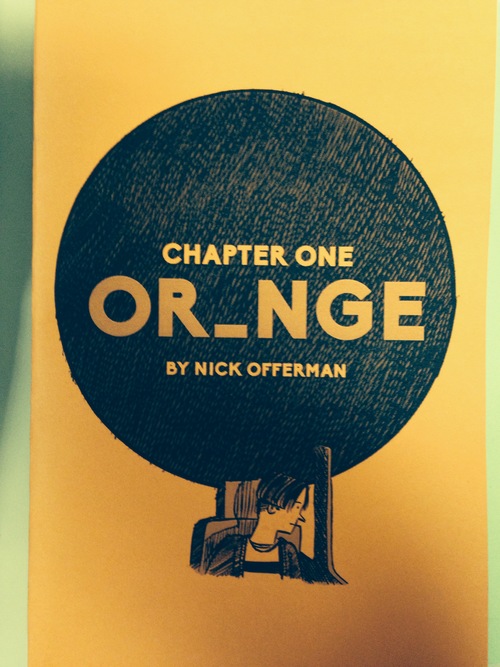
Cover for Chapter One of OR_NGE

The first chapter of OR_NGE opens Henry McNeil’s story of self-discovery. Orphaned upon the unexpected and possibly self-inflicted passing of his mother, Henry has spent most of his formative years in Detroit, raised by his uncle and aunt. There is nothing….absolutely nothing that is out of the ordinary in his daily life. He works a job as a stocker for a nameless hardware or indoor furnishings store. He occasionally sneaks a smile at a female patron as she enters the shop. He returns home after work to his aunt and uncle and repeats. However, there is something unsettling to Henry; he feels there is a hole in his life and/or identity, and his aunt and uncle feel the same thing.

Consequently, in the attempt to find a course to his life and to fill this unknown void, Henry decides to pick up his non-impacting life in Detroit and take a pilgrimage to his birthplace and his mother’s hometown, Toronto, to better understand his mother, her life, and his own origins.

By the end of the first chapter, the core narrative of OR_NGE does not offer too much in terms of innovation; like so many other protagonists before him, Henry McNeil embarks on his voyage to adulthood by trying to understand his past. With that being said, if there is nothing new to Henry McNeil’s story, then what will keep the reader excited and interested in this series? My answer: the ability of the narrative to create a world like our own and to pull you into it.

Despite the normalcy of Henry’s motivations and goals, Nick Offerman (the cartoonist and NOT the well known actor/comedian) gifts Henry and the omniscient narrator with peculiarly neurotic yet endearing voices and personas. Henry’s internal dialog fixates on numbers, whether he’s estimating the speed of a bus or counting the number of months marking the major landmarks in his past, yet, despite his slight number eccentricity, there’s a certain humbleness to Henry that makes you feel like his world is your own. You sit by Henry on the bus. You are in the store with Henry as he moves boxes. You are sitting at the table with Henry’s aunt and uncle as he tersely greets and abruptly says goodbye.

Henry’s dialog and interactions exemplify the palpable realism of OR_NGE. In Chapter One, none of the characters feel exaggerated, and none of their conversations, minimal or otherwise, seem overly constructed, allowing the reader to ease into the series and almost feel like a close observer. This realism to the characters and the events make OR_NGE shine and exhibit the potential for the series.

In addition to the notable realism and honesty established by the narrative and dialog of the first chapter, Offerman’s introduction to the series with an explanation of the properties of orange as an object and adjective conveys his strength in storytelling. Mixing in the descriptions of orange with short moments of Henry McNeil’s life, we understand that Henry’s life will intersect somewhere with the definition of orange outlined in the introduction. Here, Offerman writes and illustrates intelligently and cleverly without being overly self-aware, making even the potentially pedantic opening an inviting and welcoming one foreshadowing the things to come for the series.

OR_NGE has a strong start so far, and it looks like Chapter Two will be on its way soon. Check out the humble realism of Henry McNeil’s world in OR_NGE; he’s going to remind you very much of your own moments of directionlessness, and you’ll be just as curious to see where his travels take him as you are with your own.

OR_NGE Chapter One by Nick Offerman is an independentally published work and is available via goodklown.com

Lily’s Shrimp-less Version of Banh Xeo

Standard

Banh xeo can be found as an appetizer in most Vietnamese restaurants. Lily has two main memories of Banh Xeo

  1. The giant banh xeo that took up an entire food tray made by a stand in a food court at the Vietnamese market/mall in Houston
  2. The hurried banh xeo made at banh xeo parties where someone was always at the stove churning out the treat and passing it to empty plates

In most translations, banh xeo is called Vietnamese crepe. Sometimes you’ll even see it described as Vietnamese pizza. Regardless of what it is called, banh xeo is a delicious dish perfect for entertaining and sharing. The coconut milk and the mung bean paste in the batter make the banh xeo batter perfectly savory, rich, and the tiniest bit sweet. Paired with lettuce, mint, and fish sauce, each bite of banh xeo has a mix of flavors, textures, and even temperatures.

There’s a good amount of preparation required for this dish, but don’t be intimidated; the cooking time is actually very short. Enjoy!

Music: Symphony no. 2 in Cm, WAB 102 by Anton Bruckner

A South to Love, Fear, and Remain: Southern Bastards

Standard

After living in the Northeast for a few years now and hearing folks mock southerners and after watching media create shows, films, and cartoons which do the same, I am always a little weary when I pick up anything that looks like it could be an inflammatory jest at the place I once considered home and still love. Despite my initial concern when I picked up Southern Bastards Volume One: Here Was A Man, when I read the introduction by Jason Aaron, I was sold on picking it up and writing about it for this week.

Cover of Southern Bastards Volume One

As a young child, I loved gothic horror, and as an adult, I came to adore westerns. It is thus of little surprise that one of my favorite short stories of all time is William Faulkner’s A Rose For Emily, my introduction to the sub-genre of the Southern gothic. Southern Bastards carries on the tradition of the southern gothic but in more modern times, which despite the missing Victorian and plantation style houses, is damn well just as terrifying.

The first volume of Southern Bastards introduces us to Earl Tubb and his return to Craw County, Alabama. Earl found every way to try to leave his hometown and succeeded when he fought in Vietnam as a U.S. Marine and when he settled in Birmingham as an adult. Craw County is an insular, country town which has traces of its past coexisting with its ugly present. It’s a paradox of a place where traces of a Christian ethic remain in the air, but a crippling economic state has left people in a new level of desperation, and humanity has been traded in order to get by.

Earl has the responsibility of packing up his family home, but his return to Craw County causes much more than just the reawakening of the ghosts and nightmares of his past. When he witnesses the oncoming of a fatal beating of an old acquaintance, Dusty, by a local gang, Earl’s father’s spirit possesses him, and he begins to shed the persona of a modern, city person that he worked so hard to build and transforms into a punishing vigilante, rising to the legacy of his tough as nails father who was once the sheriff in town. Unfortunately, Earl’s first confrontation of the gang in his valiant and successful effort to rescue Dusty is not met with gratitude from the man he saved or with resignation by the gang he beat.

By upsetting this local gang run by a man named Coach, Earl entrenches himself in the world he rejected and decides to single handedly lead a battle against the tirade of Coach and his gang. As the volume progresses, we see Earl’s noble motive and his immense bravery, but gradually we realize that Earl’s march against the Coach may just be more than he can handle as an older man.

Like every western, our protagonist Earl, has the greatest odds against him but continues to wield his signature weapon, his father’s own giant, wooden whooping stick, with a clear motive of justice. However, in the modern Craw County, Earl is a figment of the past with an antiquated and extinct mindset of unrelenting righteousness, which will most likely bring about his own end rather than begin a revolution.

In combination with the severe narrative, what really pulls together Southern Bastards as a Southern gothic is its artwork. Deftly colored with a muted palette, with moments of dark red during flashes of stinging memories or brutal violence, the illustration of Southern Bastards captures the true and consuming Hell of Craw County. With jarring panels mixing the memories of war, the present, and the ghost of Earl’s father, the artwork of Southern Bastards heightens our understanding of Earl Tubb’s experience and enforces the tone of the series. Together, the narrative and the artwork meld flashes of and allusions to William Friedkin and Tracy Lett’s Killer Joe, Steven Cronenberg’s adaptation of A History of Violence, and Clint Eastwood’s High Plains Drifter along with the tiniest splash of Gran Torino, making Southern Bastards an amalgam of familiar characters and motifs now immersed into the horrifying, miserable, and darker-than-Hell world of Craw County in need of a hero and a cleansing.

Southern Bastards Volume One: Here Was A Man captures the transitions of eras from one to another and how the fixtures of each face extinction and eradication as time passes. But, alas, there is something about the South that allows the good and bad spirits of the past linger, and there’s almost something supernatural in how these spirits return, whether it is through a seemingly coincidental strike of lightning or a wild, possibly prophetic dog reminding the people that the misery and despotism of modern Craw County once existed before and once eroded before. The violence of people’s actions never quite disappear in this South, and vengeance almost always makes an unexpected appearance. The motifs of westerns and Southern horror stemming from the South of the past re-emerge in the current Craw County where horses have been replaced by cars, gangs dress in modern garb, and the gang leader continues a reign of terror with his muscle and power harnessed through the fanaticism of high school football. Yet, despite all of the elements of modernity enveloping it, the Southern spirit of old in Southern Bastards has never been more alive.

Southern Bastards Volume One: Here Was A Man is written by Jason Aaron and illustrated by Jason Latour. It is now available via Image Comics.

Remembering the Daily Life of World War I in Alban B. Butler’s “Happy Days!”

Standard

World War I is gradually disappearing from the American collective memory. The history that remains is passively stirred up on a few occasions with History Channel’s specials and books such as Erich Maria Remarque’s All Quiet On the Western Front, with both highlighting the devastation by the technology introduced to make WWI the the first impersonal and massively destructive war. However, most children only skim over WWI in history classes, focusing more on WWII, given its even larger annihilation of human life and its opening of the age of weapons of mass destruction. Consequently, most common knowledge about WWI only exists around the introduction of gas warfare and the crippling German defeat that would eventually fuel the rise of National Socialism.

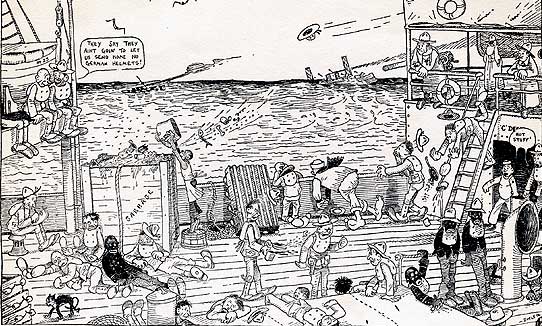
Written from the perspective of an infantryman on the frontline, “Happy Days!” by Alban B. Butler, Jr. documents the daily lives and occurrences of the First Division during WWI, beginning with their journey to Europe in 1917 and ending with their return home in 1919. Unlike most historical retellings of WWI, the grisly details of the war are almost entirely avoided. As a collection of cartoons written for the the men of the First Division and their daily trench newspaper, the First Field Artillery Brigade Observer,  “Happy Days!” provides nearly one hundred snapshots of the little moments of absurdity, insanity, and silliness in the war, all hoping to deliver a laugh to the men battling in dire conditions against difficult forces and weapons.

Cover of “Happy Days!”

From the absurdity depicted in the cartoons, Butler’s work reminds us that WWI was not a war where the United States was at its pinnacle as a world power. Men had to adapt to trench warfare, the French language and culture, multiple nation armed forces, and new weapons to protect oneself with but also to protect oneself against. With all of these new things to learn and understand, there were plenty of mistakes, mishaps, and altogether poor planning along with strange but effective procedures and protocols, creating a point of comedy for Butler’s cartoons to occupy.

Ranging from horse races with sated horses that were excessively fed after being starved due to a prolonged journey in harsh climate to the firing celebration on the 4th of July by the Division for the French forces’ acquisition and delivery of gas shells, Butler documents the endless humor existing in many of the soldiers’ activities. Although the cartoons certainly stand alone, what really makes “Happy Days!” special is the additional commentary included with each cartoon about the context of its creation. With the cartoon and the commentary, each page of the collection feels like the diary of Alban Butler, making the reader feel much closer to events occurring almost one hundred years ago.

Life in the Trenches from Butler’s eyes

In addition to Butler’s work, the introduction, preface, and afterword all provide further context for Butler’s cartoons, making the book a perfectly packaged moment in history. Arguably, “Happy Days!” may be interpreted by a modern eye as pro-morale propaganda for soldiers, but each cartoon has the voice of a soldier addressing something of specific concern or interest, making each cartoon feel as if it were created after hearing soldiers speak in the trenches or in a mess hall.

As a result of its distinct voice, “Happy Days!” contains a different, more personal perspective on WWI. While it is essential for us to remember and learn from the wreckage of WWI, it is also important to understand the people who lived, worked, and served our nation in it. Through comedy but not satire or allegory, Butler reminds us of the absurdity of the war while allowing the reader to relate to the men who were in it. The men of the First Division valiantly served in a war where a lot of inexperienced people led and fought on both sides, but they also had their own lives outside of battle that are worth understanding and remembering now that war tactics and activities have deviated so far away from where they were at the beginning of the 20th century.

“Happy Days!” by Alban B. Butler, Jr. is available via Osprey Publishing and The First Division Museum at Cantigny.