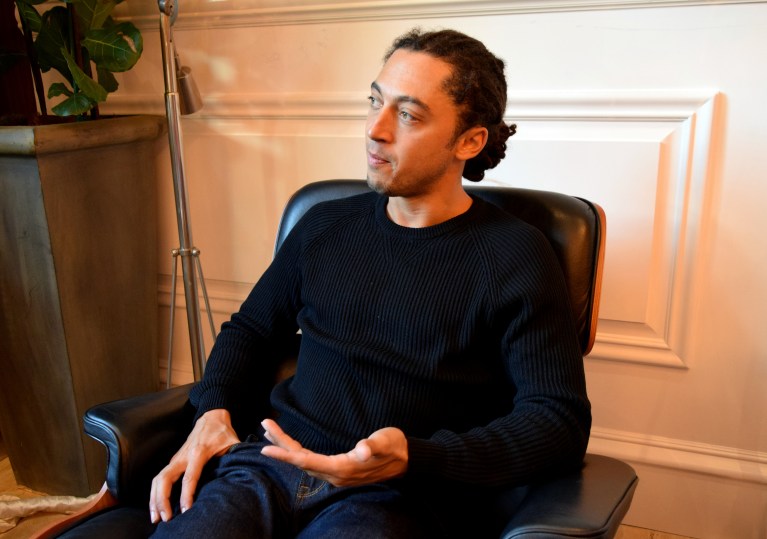
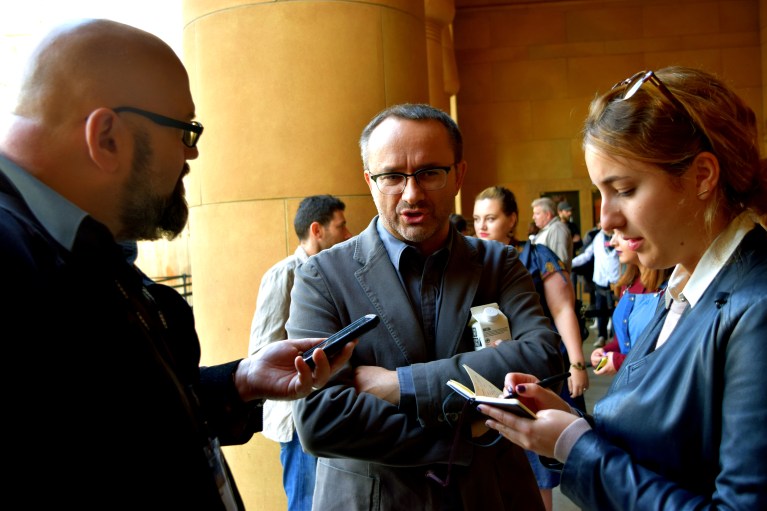
Payal Kapadia

Standard

Originally published on Ink19 on November 24, 2021
by Lily and Generoso Fierro

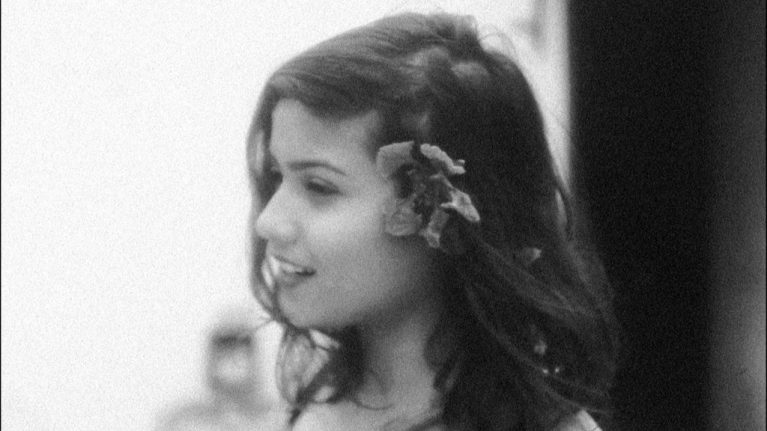
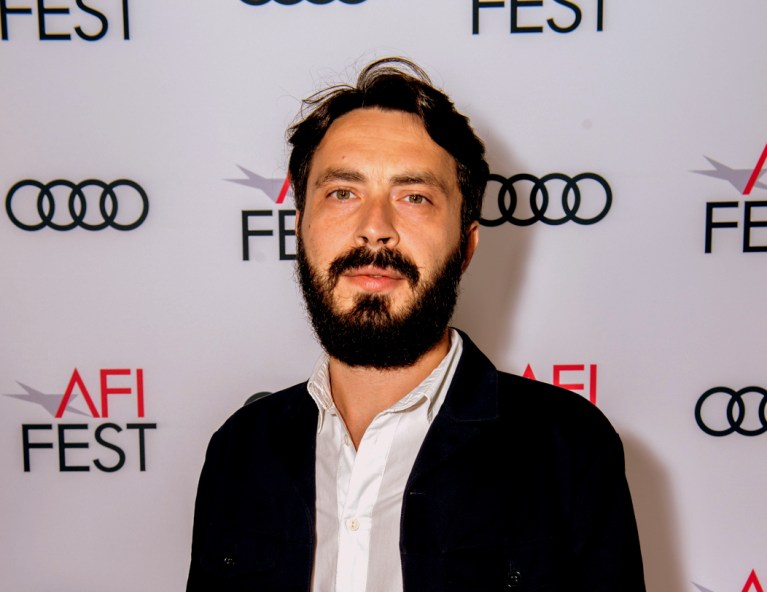
It was an honor to interview director Payal Kapadia during AFI Fest about her distinctive and powerful full-length film debut, A Night of Knowing Nothing. Earlier this year, Kapadia was the recipient of the Oeil d’or (Golden Eye) award for best documentary at the 74th Cannes Film Festival, which was a remarkable achievement for a first-time feature director, made even more impressive as her work was in competition for the prize against new offerings from legendary filmmakers: Todd Haynes (The Velvet Underground) and Marco Bellocchio (Marx Can Wait).

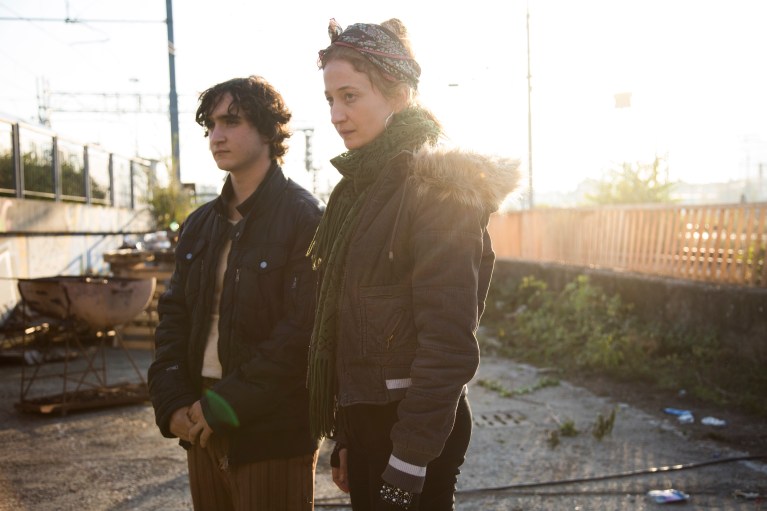
Set against the backdrop of the violent student protests that erupted at university campuses in India during the middle of the last decade, A Night of Knowing Nothing is driven by the voice of a narrator reading the found unsent fictionalized letters written by a female student, known only as L, to her lover who once actively engaged in the demonstrations, but ultimately was unwilling to defy his family who refused to allow him to marry a woman from a lower caste. As L’s words are read aloud over images shot by Kapadia and cinematographer, Renabir Das, along with scenes from found archival and mobile phone footage and shared footage from Kapadia’s own friends at the Film and Television Institute of India (FTII), we are compelled to consider the grey area between one’s participation in direct public action and the self-examination which ideally leads to personal and familial confrontations that are essential in enacting lasting societal change.

In our interview with Payal Kapadia, we discussed the origins of A Night of Knowing Nothing, as well as the director’s creative process working with co-writer Himanshu Prajapati, who helped create L’s letters. Kapadia also revealed the editing method that she and Ranabir Das implemented for fusing the narrated letters from L to align with the diverse sources of footage seen in the film and her thoughts on avoiding the cinematic romanticization of protest.

• •

Your film begins and ends with images of young people dancing, and throughout, there is a parallel between the performative nature of dance and protest. Was there a specific visual approach that you and your cinematographer, Renabir Das, aimed for when capturing bodies moving in space to some sort of rhythm, be it music or chants?

We didn’t actually keep it in mind while shooting. But I guess you are right, inherently, protest and dance have this similarity. Dance has a sense of abandonment, as does protest. It was perhaps decisions that we made while editing where we began to observe this. We wanted to talk about people in unity, coming together as a collective, and that idea resonated with these shots.

As we understand, when you and Ranabir began shooting your footage in 2016, it was originally to serve as a portrait of your friends at FTII, but otherwise you didn’t have a clear narrative structure at that time. Was there a particular interview or moment of protest that encouraged you to form your film in the way that it eventually came together?

It was not one particular moment, but rather the events that were taking place while we were shooting, even if we were not present there. Things were changing around us, and hence the film started changing too. But, one thing we had shot quite early on, and wanted to lead up to, was the speech at the end given by my friend, Harishankar. There were times we thought of letting it go…but kept coming back to it.

Harishankar’s speech is, in a way, the thesis of your film, so it makes sense that you continued to return to it. Where did it fall chronologically in yours and your friends’ experiences?

It was the starting point of the editing of the film. We shot and edited this sequence in 2017, which was when the student union election was taking place at FTII. This speech was given to the new students who were joining the film school. Harishankar was the outgoing president of the union, and he was talking about the responsibility of a student union. He was speaking about the political climate and how it was impossible to now be “apolitical,” and as filmmakers, we need to be conscious of how we make films. I think what he meant was a larger idea of the word “politics,” which comes from a collective action to bring about a more ethical society. What I like about his speech is that he does not polarize the discussion and alienate people, but instead tries to instil a sense of responsibility within every individual. Every individual action is a reflection on the collective, which is why we each need to be conscious of what we do and make.

Given the place of cinema in French culture, the May ‘68 riots have been extensively depicted through both narrative and documentary film. A few of these films, such as Phillipe Garrel’s, Regular Lovers (Les Amants réguliers), romanticize the moments before and after the events of May 1968. As you and you and your co-writer, Himanshu Prajapati, were writing L’s letters, which would become the primary voice of your film, how consciously did you want to avoid the romanticization of the events that were happening at the protests?

Both Himanshu and I were very much a part of the protests at the film schools, so it was something that we felt very strongly about while we were a part of it. But as the years passed, we had also become critical of some of the decisions we made or how we were thinking of things then. I guess that is also the process of growing up.

For both of us, it was the first big protest we had been involved in, and it was pretty overwhelming. So, we thought of the character also as someone who is not overtly political, but is sort of becoming more aware of things as time goes on. There is a romanticized fervor present especially in student protests. However, we didn’t want to romanticise the protests too much, especially through the eyes of the character. We wanted her to be there, experiencing things around her, and not always be entirely certain about things. It is ok, I think, to be vulnerable and honest and keep questioning the world you inhabit while also questioning yourself.

We understand that you and Himanshu wrote L’s letters while you edited the found footage and the footage that you and your friends shot. Was there ever a moment where you wrote a letter that you felt was integral to L’s voice and wanted to shoot something new to support it?

We arrived at the idea of the letters a bit later in the process of filmmaking. By the time we started thinking of them, a lot of the film was already shot. We did shoot a few things after we started to write the letters, keeping them in mind. But mostly, we went with the opposite approach—we would watch the rushes that we had shot or collected and discuss them, and then, think of possible letters that would work with the material. This way, the editing and letter writing happened simultaneously. Himanshu and I would write the letters and then propose them to Ranabir, who would edit them. Sometimes a letter worked, other times, it would not and would be rejected. Finally, we had a lot of unused letters too…This is why I like to call this a found footage film, because we only discovered the meaning within our footage as we edited it.

In regards to the reading of the letters, did Bhumisuta Das see any edited footage before she recorded her voicings, or did you want her to read the words separately from the rest of the film?

No, she watched the film. We watched sections many times with the complete sound design as it was important to understand the feelings those scenes were inherently creating.

By the end of the film, we have an understanding that cinema should not be a dogmatic political voice, but rather a view of society through the eyes of individuals, even if those experiences are not completely complementary to the political actions occurring. How did you approach blending personal perspectives with political rhetoric in order to provide a fuller context around the protests?

Indian society is very complicated with a lot of inequalities. Gender, caste, class, and religion all determine one’s identity and political position. Without talking about these, it is impossible to talk about protesting students. Rather than get into a long discussion about these elements, we tried to make them an inherent part of the form of the film.

The reference to Pasolini’s sympathy with police that you include in the film raises a common question about the effectiveness of student protests, and L’s disappointment in her lover refusing to confront his parents over the caste conflict underscores the discrepancy between intention and commitment. Is this a suggestion that protest can raise awareness, but real change occurs through the confrontation of societal issues ingrained in individual relationships?

Absolutely. I am very happy that you brought this up. This was the main reason to have these elements in the film. Can we really hope for political change without social change? People seem to think that people come to power out of the blue, but this is not true. Society festers certain ideas, and those ideas find form in a political figure. We need to acknowledge the inherent problems in the society and within ourselves, and only then will politics start to align itself to the change we hope to bring.

https://squareeyesfilm.com/features/anightofknowingnothing/

This interview has been edited for clarity and length.

Featured image: still from A Night of Knowing Nothing courtesy of AFI Fest.

Alonso Ruizpalacios

Standard

Originally published on Ink 19 on October 20th, 2021
by Generoso Fierro

Having greatly admired Alonso Ruizpalacios’ work since viewing his auspicious debut from 2014, Güeros, I knew that the day was forthcoming when the native Mexico City director would have to take on a more visceral approach to confront the unethical elements of his society that plagued the main characters of his first two feature films: the aforementioned Güeros and his highly-acclaimed follow-up, Museo.

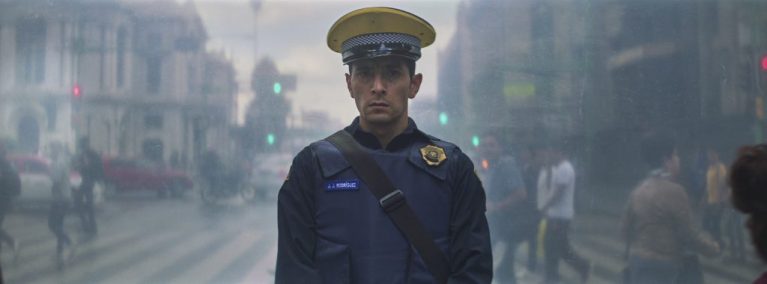
A Cop Movie, Ruizpalacios’ third feature, which was nominated for Best Film at the Berlinale where it won the Silver Bear for Outstanding Artistic Contribution, sees the director not only abandoning temporal settings decades in the past—Güeros and Museo examine the institutionalized dysfunctions of previous eras in the ’90s and ’80s respectively—but also sees him incorporating a daring hybrid cinema approach that creates empathy for his characters, while he closely investigates the human costs of police corruption that is omnipresent in and around Mexico City.

As our film opens, we witness Teresa, a lone police officer who is patrolling her sector of Mexico City, being called to respond to an apartment where a woman is giving birth. Teresa arrives on-scene, but without an ambulance in sight, she wades through the bystanders amassed in front, and is questioned by them as to the absence of emergency personnel who had been called some time before. As Teresa is a veteran officer, she sadly knows full well that EMTs, who are in short supply and in high demand in Mexico City, will most likely not be arriving anytime soon. Still, she pleads with her dispatcher to send an ambulance, but receives no helpful reply, so she is forced to deliver the baby herself, a feat that Teresa executes bravely with her only pair of rubber gloves to grab the baby and children’s scissors that the expectant mother’s husband has on premise to cut the umbilical cord. It is a miraculous moment of valor, and when the mother’s state raises concern after the birth, Teresa has no choice but to call in a favor with her life partner, Montoya, a fellow officer, who normally has better luck in getting the dispatcher to do her sworn duty.

Through filmed recreations of Montoya’s and Teresa’s exploits on duty, which Ruizpalacios adeptly combines with direct to camera interviews with the pair, we gain knowledge of this couple, who, despite taking different paths that led them to their careers in enforcement, are still confronted with similar negative outcomes from their time on the job. We see these officers struggle in their interactions with a public who refuse to view them as anything but corrupt, even though it is made clear through Teresa’s and Montoya’s own testimony that it was never their intention to be complicit with the graft that is the hallmark of their department. Their fellow officers also provide no relief to their feelings of persecution either, as Teresa and Montoya must begrudgingly pay cash to them for the use of the very gear that is essential for them to do their jobs.

As A Cop Movie progresses with its erratic construction that purposefully keeps the viewer off balance, we become immersed into Teresa’s and Montoya’s turbulent world, and thus, we develop a great deal of sympathy for their situation. This is the case until the halfway point of the film, when Ruizpalacios makes an abrupt shift in the structure through the use of a surprising reveal—a reveal that makes us question the reality of what we have seen until that point, and potentially opens up preconceived notions that we may have about law enforcement in Mexico.

I was thrilled to have an in-depth conversation with Ruizpalacios about his new feature. We discussed his original motivations for making A Cop Movie, as well as his decision to incorporate a hybrid documentary approach and his unique methods for preparing his actors for their challenging roles.

Q (Generoso Fierro): I see a parallel between your previous feature, Museo, and A Cop Movie in that both films delve into the normalization of motivations and behavior that clash with society’s expectations and morality. In Museo, Benjamin and Juan are middle class, whereas Teresa and Montoya come from working poor families. After you made Museo, was it important for you to examine this societal issue from a different socioeconomic perspective with your next project?

A (Alonso Ruizpalacios) : Yes, it is a very interesting link, the one that you’re making here, Generoso, and I think that it’s probably there, but in a very subconscious way. I will say that the motivations for this project came from a different place, but then, of course, it ends up happening that once you’re doing something or even when you are finished doing something, you realize what was really behind your motivations. Also, I should say that at some point during filming, I realized that I am making another road movie in Mexico City (laughs). You know during this one moment, when we were shooting that patrol car around town, I thought to myself, “Shit, am I really doing this again? Why, why am I shooting people in cars in Mexico City!?” (laughs)

But for me, the starting point was to do something to address a kind of false hope of feeling useful somehow, as I don’t believe that cinema is useful at all, but that is also why I like it. I think that it gives us the illusion of somehow being able to do something that will be a useful tool, and so I did have that urge of wanting to create something useful at the end of the Peña Nieto period.

Peña Nieto, the former President, towards the end of his term was operating at an all-time high of impunity and corruption, so I wanted to make a movie that addressed that, and I got together with Elena [Fortes] and Daniela [Alatorre], my producers, to start thinking about some way to comment on this situation. So, it didn’t all start off as specifically being about the police force or about someone being in a lower sphere of the social ladder, but that kind of came together organically as we all began exploring the subject matter.

Q: I do feel that through the story of Teresa and Montoya in A Cop Movie, you do exemplify the absurdity of the corruption of the Peña Nieto period. I also believe that, although A Cop Movie exhibits you taking a different kind of approach than the ones you took with Güeros and Museo, you still have as central characters people who want to exact some kind of change in their lives, but who are all stymied because of the reality of a corrupt or unethical system in front of them. With Güeros, which is set in the late ’90s, and Museo which is set in the mid-80s, we have a chance to look back and judge in hindsight the negative effects of the venality of the past, but with A Cop Movie being contemporary, how do you view the corruption of the past eras that you explored with Güeros and Museo in terms of how they led to the institutionalized corruption that is present with the police in Mexico today?

A: That is an interesting question. For me, it is very sad to realize that corruption is still so pervasive and that it rules over Mexico. It is one of the biggest cancers in Mexico, and it is one of the main sources of all that is going wrong with our country, particularly, I mean, corruption combined with impunity. So, frustratingly, it has not been solved. That is the big wager with the current government in Mexico; they came in saying that they were going to fight corruption and that it is their main agenda. We’ll see what happens and if they have any success, but I don’t think that it has been fixed.

We discussed this issue a lot when we were developing this movie. This movie had a long period of gestation when we spoke with academics, very smart people who specialize in public order and public policy as well. We had some key advisors who accompanied us through the whole process of making the film. Even during the editing period, I was still having conversations with these advisors, three key people who work in police reform and public policy who assisted us along the way.

I remember one of these early conversations, we even went as far as discussing the foundations of Mexico. I remember asking an advisor, “Why is corruption so pervasive in Mexico, and why is it so much a part of our psyche?” His reply was very interesting. He said, “When Mexico was a Spanish colony, and the laws were dictated from Spain, the laws were made in Spain for how España, the colony of New Spain, was going to govern themselves. It was made by people who were not physically there—they were thousands of miles away. So, the legislators in New Spain had this saying between them: ‘We abide by the law, but we do not obey it.’” That was a common saying. And so, Ernesto López Portillo, who shared this with us, was serious when he said that this attitude comes from the foundation of Mexico. There is this huge distance between the law and what is achievable in reality. And I still think that is kind of the case. It is a very complex issue.

Q: As corruption is such an overarching dilemma in Mexico, it makes me wonder how some of the police cadets whom you interviewed for your film felt about how they could make any difference. And here, Alonso, I am particularly thinking of the one cadet in your film who stated that she joined up because of the tragic epidemic of femicide. Did any of the cadets, or the veteran officers whom you spoke with, express to you that the corruption which encumbers officers from doing their job effectively subsequently contributed to the rise of this particular crime?

A: That is a tough question, and there is most likely some relation, but the issue of femicide is again, a very complex problem. I think that a lot of the cadets whom we spoke to come in with a real desire to change things. That said, for many of them, it is frankly just a job, a way of making a living, and for others, it is a family tradition. But for a small number of the cops, it is a vocation. But in the end, you have this body of people who are undertrained, underpaid, and those factors are going to bring out all sorts of problems, but the femicide problem is beyond my comprehension and theirs. It is a tragedy, a sickness, and there are too many factors playing into it.

Q: Thinking about your process in creating A Cop Movie, I understand that you were originally approached by your producers to do a conventional documentary, but then you ultimately made the decision to utilize actors, even going as far as sending them to police academies and to patrol the streets, which ultimately created a work of hybrid cinema. What I found to be an interesting choice was that you waited until the middle of the film to show the audience that we are indeed watching actors portraying Teresa and Montoya. Can you talk about that decision?

A: The premise that we set out for ourselves was that we were going to find the form as we went along. We were not going to predetermine anything, and we were going to let the material tell us how it was going to be shot and how it was going to get shaped. And so, it was a very organic process of investigation for me, both thematically, because I was going to dive into something very foreign for me, and also formally. It was very freeing in that sense. I think that every decision was a solution for a particular problem.

Originally, we were not going to have actors portray the police officers. When we found Teresa and Montoya, our first instincts were to record them and somehow illustrate what was said, and then we thought, how are we going to illustrate all of these things that they are talking about that are very sensitive and impossible to capture on camera? All of these acts of corruption, their relationship with the public, the racism, it seemed impossible for me to capture all of that, so we are going to have to use fiction elements for this to work. Also, I have a soft spot for actors. I trained as an actor myself. I have a theater company. I am married to an actor, so the acting process has always fascinated me, and so, that is how the idea came to me, to make that a part of the movie. Why don’t we register that process, and that will be the audience’s process of getting to know the world that Teresa and Montoya are portraying.

So, finding the structure and doing that reveal in the middle of the movie was something that I wanted to give as a little shock to the audience to change lanes. There are really two stories in one: There is the story of Teresa and Montoya, and there is the story of Raúl and Mónica. There’s not one story, there are two stories, and Raúl’s and Mónica’s story is as important as Montoya’s and Teresa’s story.

Also, I thought that by that point in the movie people are going to be wondering, “What about everything that we know about the police? Where do I stand as a citizen and as a viewer with what you are showing me? I have all of these ideas about this, and they have not been addressed. The film has spent this whole time being empathetic to these characters, but what about my feeling of insecurity when I see a policeman? And what about my knowledge of corruption?” And so, I wanted to address all of this through the actors, and I thought that once we became engaged with Teresa and Montoya, it was going to be a good shift, and we were now going to address your problems with the police. I like this structure where this happens in the middle of the movie, as it switches lanes and abandons Teresa and Montoya, but then we circle back to them, and the stories reunite. And so, when you meet Teresa and Montoya after you’ve just been listening to their voices, I think that it comes as a surprise. To discover the structure along the way is a different process for me.

Q: As far as the preparation that Mónica and Raúl did for this role, did they listen to Teresa and Montoya’s dialog and then offer an emotional interpretation of what they heard, or were they directly reciting what was said to them?

A: The process was that we recorded Teresa and Montoya during interviews that took many days, and then we transcribed the interviews; we edited them; and then, we created a script, we meaning myself and a friend of mine named David Gaitán who is a playwright whom I worked with in the theater before. So, together we did the structure for what the actors were going to play, and while we were doing that, writing the script and deciding what we were going to shoot fictionally, the decision of always using the real voices was there. I knew that I never wanted to lose the voices of the real Teresa and Montoya, so then we cut the interviews into what was scripted, and we gave that to the actors, but we only gave them the sound. I didn’t want the actors to see the real Teresa and Montoya. They had no image, so they had to memorize by sound because I never wanted the actors to do an imitation of Teresa and Montoya. I wanted the actors to become them just with their voices. And so, they did the training first, and then they had two months to learn the lip sync. Raúl and Mónica worked their asses off, and they were pitch perfect.

So, they rehearsed, but they never saw the people whom they were portraying until the final day when we were shooting, and we brought Teresa and Montoya to the set where they met for the first time. We recorded that moment actually, and it was originally going to be part of the movie. But these things never turn out the way you think they will, because for me, I realized that that moment didn’t need to be seen.

A Cop Movie will be released globally through Netflix on November 5th, 2021.

https://www.netflix.com/ACopMovie

This interview has been edited for clarity and length. Photo courtesy of Netflix.


Jane Samborski and Dash Shaw

Standard

Originally published on Ink 19 on August 18, 2021
by Lily and Generoso Fierro

Some time back in 2013, we were perusing the shelves of our local comic book shop, and a short comic book, ambiguously entitled Three New Stories, hypnotized us. Its layered color washes, unexpected collages, and heavy figure lines pulled us into the world and aesthetic of Dash Shaw, and we’ve been admirers of his comics ever since.

In 2016, we had the privilege of interviewing Shaw to talk about his debut animated film, My Entire High School Is Sinking Into the Sea. A collaboration between Shaw, who was the director and writer, and his wife, Jane Samborski, who was the animation director, the film accomplished a handmade, playful, and bold style indicative of Shaw’s comics that perfectly matched the whimsical plot. For their second feature, Cryptozoo, which premiered at the Berlinale in 2020 and Sundance Film Festival in 2021 in the midst of the pandemic, the duo increased the scale of their film and pushed their animation style and techniques to new heights, and the outcome is a spectacular visual world simultaneously grounded in fantasy and reality that meets the demands of the narrative and themes of Cryptozoo.

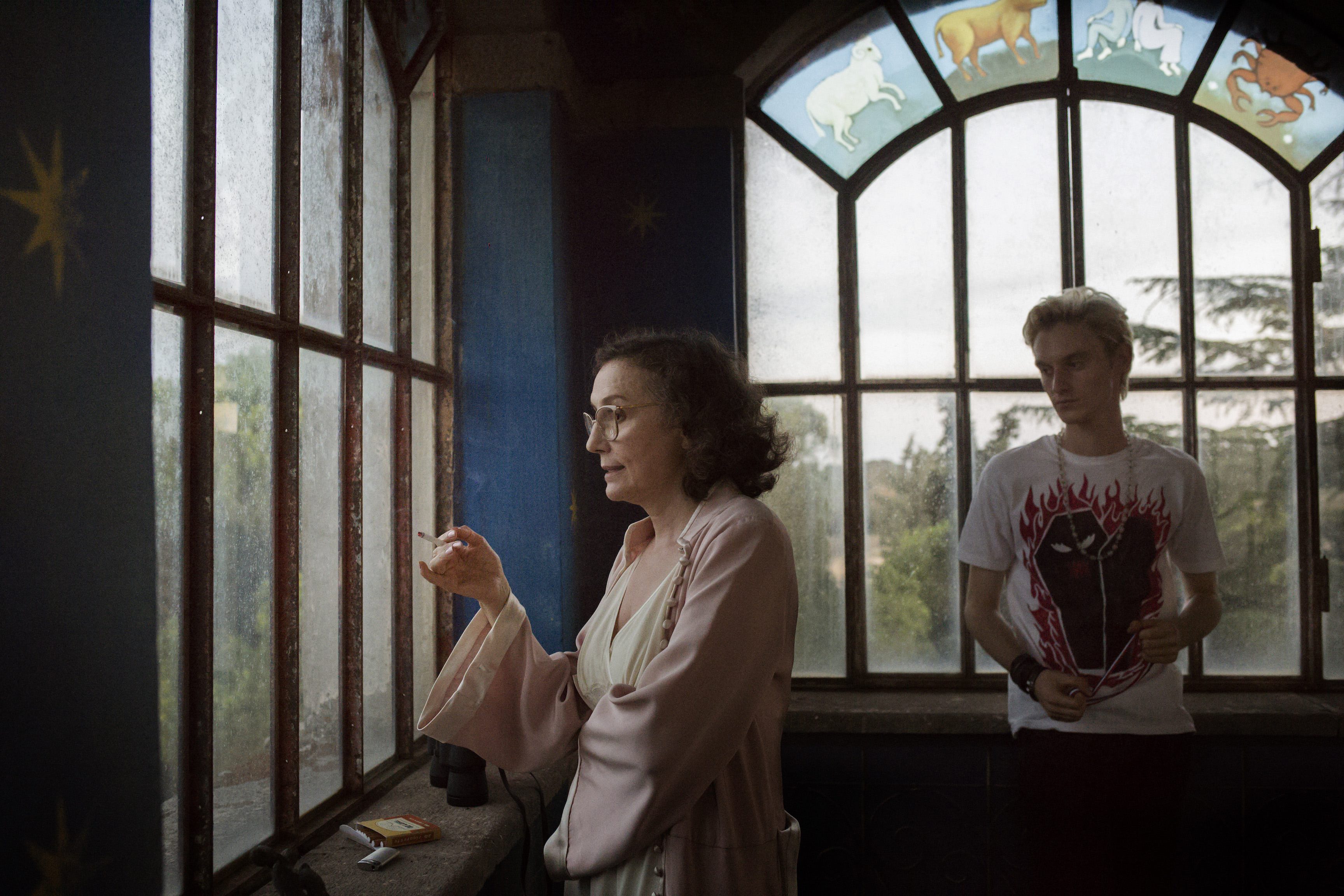
At the opening of Cryptozoo, we meet the hippie couple, Amber (Louisa Krause) and Matthew (Michael Cera), on a prototypical self-discovery experience in a forest somewhere in California in the 1960s. The two find a large, ominous barrier wall and scale it, expecting to find something defense related, but their hopes of discovering a nefarious governmental secret fade when the two encounter a unicorn roaming the forest behind the barriers. In an act of foolishness that becomes a perfect representation of how the desire to experience anything and everything can go utterly wrong, Matthew, in attempting to touch the unicorn, startles the creature and is gored by its horn. And Amber, in her grief, kills the unicorn and wears its horn on her neck. Gone are the peace and love hippies we met at the beginning: in their place, on full display, is the ugliness and mess left behind when members of the naive love generation tread into places where they should not be and try to experience things they do not (and cannot) understand, cementing a theme that flows continuously throughout the film.

After the shock of the unicorn death, we meet Lauren Gray (Lake Bell), a champion of cryptids, creatures that exist based on folklore, myths, and individual accounts, but have never been identified as known species by the scientific community. Lauren has committed her life to rescuing cryptids in trouble after a baku consumed her bad dreams as a child and has been the lead conservationist and veterinarian of the Cryptozoo, a sanctuary for cryptids funded by an eccentric heiress named Joan (Grace Zabriskie) and the place that Amber and Matthew unfortunately trespassed into. However, the Cryptozoo, in its noble intentions to protect cryptids and raise awareness around the creatures, treads into the same shaky moral grounds that zoos face when trying to preserve endangered species while showcasing them in captivity in order to sustain and finance their conservation efforts. When Lauren embarks on a mission with Phoebe (Angeliki Papoulia), a cryptid who can disguise herself as a human, to find and save the baku from the US military, we watch on with curiosity to understand how deeply Lauren has bought into the vision of the Cryptozoo, and dread that the baku will inevitably end up in captivity either as a spectacle for entertainment or as a counter-intelligence weapon.

Like the Cryptozoo itself, the film traps the viewer in an era and in a setting where we know the outcome. Though the cryptids themselves are fantastical by definition and in their visual design, their introductions within the Cryptozoo evoke less wonderment and more unease because we invariably know that the fate of the Cryptozoo will be grim based on the actual history of the environmental optimism and good intentions of the 1960s that came to nothing (and even sometimes to the malevolent) in the decades to come.

We sat down with Samborski and Shaw to unpack the consequences of environmentalism and conservationism in the 1960s, the influences for the rendering of the cryptids along with considerations to avoid problematic exoticism in Cryptozoo, and the role of manga and comics in the animated films that the duo create. 

Q (Lily Fierro): Jane, it’s so nice to meet you! We interviewed Dash in 2016 at AFI FEST for My Entire High School Is Sinking Into the Sea. We’ve long been fans of Dash’s comics, and we’re so excited for you both on the success of Cryptozoo. A lot has happened in five years for you both: you left New York for Richmond; you started a family; you did an animation for an episode of 13 Reasons Why. How did all of these events blend together and lead into the genesis and creation of Cryptozoo? What did you take away from your experiences from My Entire High School Is Sinking Into the Sea and the projects you’ve done together since?

A (Dash Shaw): There was definitely a whole lot going on at once when My Entire High School Sinking Into the Sea premiered: Jane was pregnant; our baby was born in November of 2016; Trump was elected; and, we moved to Richmond. There was so much there all at once, so I felt like I spent a couple of years afterwards just recovering from all of those things happening. The 13 Reasons Why piece was really wonderful, as we enjoyed doing that little two minute animation, and that sort of became the foundation for how we approached Cryptozoo. Jane learned how to do a structured production line for Cryptozoo from that 13 Reasons Why section. Also, I drew the characters in that 13 Reasons Why clip based on the actors—they aren’t rotoscoped from the actors, but they are figure drawings of the actors, and that kind of became the hope for what Cryptozoo would look like.

A (Jane Samborski): One of the big things that we learned from My Entire High School Is Sinking Into the Sea is just—and every person in the world who wakes up and goes to work in the morning knows this—that you get up; you do your project; you have a structure; and, you complete it all little by little, and having that structure is integral, absolutely critical to finishing things. And all of that gets thrown out of the window when you have these huge life changes. I remember feeling adrift until I started working on Cryptozoo and 13 Reasons Why. A project is the thing in my life that frames the other things. There needs to be a separation between the two, but they don’t need to conflict with each other. By having time to devote to the art and to the larger project, I don’t feel like I am floating around. Right now, for example, I feel floaty because we are in between projects, and I am aching for the next project to start because being in the project is where I am the happiest—knowing that I get to wake up and solve animation problems.

Q (Generoso Fierro): There are many references and inversions of Disney animation conventions in Cryptozoo. A significant one is the opening scene, which we feel is a nod to the killing of Bambi’s mother, a moment which is sometimes considered as a spark for the modern environmental movement. How influential were those early perspectives and efforts of environmentalism on your decision to set Cryptozoo in the 1960s?

A (DS): When I started writing the movie, I had a fellowship at the New York Public Library, and one of the other fellows there was researching countercultural newspapers of the 1960s, and the New York Public Library had all of them in their archives. So, there would be this 1967 free weekly paper from Brazil and another alternative paper from that same week in Chicago, and both would have that same kind of incredible utopian optimism, as well as a particular stylistic quality that was consistent across all of these papers that is almost like a Winsor McCay, thin line, famous new artists look. When I think about people discussing all of these different key moments of the 1960s, the one that was key for me in the genesis of Cryptozoo is the moment when Walt Disney died, and Epcot Center, which was supposed to be an actual city where people would live, was turned into just another amusement park. Amusement parks are products of imagineers, so these places are supposed to be dream worlds where anything is possible, but of course, in actuality, they are very dictated spaces where you feel kind of trapped. And this becomes especially clear in a place like Epcot Center where they are trying to present the whole world to people who haven’t been all over the world, and the choices in representation that were made can seem bizarre. So, in regards to Disney as an influence, I was thinking more about Epcot Center than the Bambi moment, but totally, when you’re rendering the death of a unicorn, it’s something that is so symbolic that it needs extra attention to also be realistic. Jane gets ninety percent of the credit for making that moment actually painful and not a joke and not simply a symbolic, abstract thing happening. That was super important to the movie. You know, Amy Taubin wrote about Cryptozoo for Art Forum, and she mentioned the relation to the Bambi death scene as well, and she described the scene as “hyperreal,” and I think that that is a perfect thing to say about the death of the unicorn, hyperreal.

A (JS): Something else that makes the 1960s a good pairing for this film is that when you think of the 60s, you think of this intense idealism and this drive to fix things, but we are many years out from then, and we know that it didn’t exactly work out. And so, when you’re telling this story where you know from the beginning that the Cryptozoo is going to fall and that the principle discussions that the characters are having with each other are about “how to make the world better,” the 1960s are a time and place that set up a good framework that resonated well with the themes in the movie.

Q (LF): In the film’s narrative, Dash, you touch on how the Cryptozoo theme park, in its displays of mythical creatures from all around the world, treads into problematic territories of exoticism. We understand that, Jane, you designed all of the cryptids, and naturally, in rendering them, you could have also tread into similar difficult areas. How did you ensure that the cryptids weren’t overly exoticized or caricaturish? For example, the baku’s swirls allude to similar swirls in Japanese prints, but they are respectful in their homage.

A (JS): I think honestly that is just me having fun, as I love to paint. I really enjoy the act of painting, and so, I am approaching each of these creatures as a kind of puzzle. I am looking at early renditions from the source cultures, because every cryptid is from its own culture in real life, and it wasn’t difficult because every time I would look at those images, there would be something in them that I was excited about. But, it is all going to come through the filter of Jane. I am the artist that I am. I can only change it so much. And so, I think just focusing on the joy and the honesty of the source material and what I was going to bring to it, I would then end up with a genuine product, I hope.

A (DS): What you are talking about is something we definitely spoke about while making the movie. The goal, I believe, is that, just like all the characters in the movie, to have sincere reasons for why we’re doing the things we do. So, the movie is somehow a collage that is looking at these different motivations and their relationships with each other and with the audience. We were definitely aware of thinking that they have to have a very good reason for creating and running the Cryptozoo that we can believe, but we are also outside of it and judging it as an audience member, and so modulating our experience of that was then the hard thing to keep our eyes on while making the movie.

Q (GF): In making the film, did your perspective on the role of the human in conserving the natural and the unseen evolve over time?

A (DS): So, this is my art school answer to your question: it used to be that people would see a landscape painting as a kind of frivolous, low-genre painting that is cheesy and that has nothing to offer us. There is a Brecht poem that states, “What kind of times are these, when to talk about trees is almost a crime,” meaning that there is all of this other stuff going on in the world, so why would you paint a landscape when it is totally lame and unnecessary relative to everything else? And now, someone like David Hockney is spending years painting those trees, and, in many ways, they are the most politically relevant paintings that you could make. They are so powerful and important, and so I hope that the landscape paintings in Cryptozoo have some of that feeling because now I feel that it is a crime not to talk about the trees.

A (JS): I think the other thing is that the world had changed a lot over the course of the making of the film. Dash wrote that script before Trump was elected. We had the summer of racial justice as we were coming to a close. We had a very surprising resonance with a line early in the film. I think that when we wrote it, it felt very theoretical. Of course, we were interested in the idea that we were presenting, and believed in those ideas and those questions, but by the time the film actually came out, they felt very real.

DS: You know they played My Entire High School Is Sinking Into the Sea at a theater near where we are and watching that movie again now has a lot of different things that relate to it too.

LF: I think that Cryptozoo is incredibly relevant because there have been more studies coming from academia and conservation that are thinking about how humans can play a role in other species’ evolution. This film is very timely because questions about if and how humans should help species adapt and survive are becoming more important as the environment changes. A great example is in the Great Barrier Reef where, right now, there are scientists who are trying to breed heartier types of coral that can survive the rising temperature of the ocean, but that also has a variety of implications on the environment in the future that we just don’t fully know about today. And so, I think that Cryptozoo plays with similar ideas very well.

JS: Yes, that’s a great example of someone who has this really wonderful idealistic notion, and it’s great if it works, but we always have to be checking in with our idealism to make sure that it’s still steering us in the right direction.

Q (LF): There’s a moment when Lauren and Phoebe go to Kentucky that sticks out in our minds. Lauren suggests that Phoebe would have an easier time in a large, more liberal city. Phoebe informs Lauren that having more space and privacy would be better. It made us realize that the city looms over the film as a concept, but we never really see it. How mindful were you both of the role of physical distance and isolation in the work of Lauren, Joan, and Phoebe? Cryptids, after all, live on the periphery of our notions of reality.

A (DS): Well, I think that you should be our therapist, Lily (laughs) because you’re tapping into something here. I didn’t consciously do this, but yes, at this moment right now, I am consciously thinking about how Lauren would think that the city would be more progressive than how Phoebe sees the reality of it.

A (JS): I remember this more clearly than Dash, I think, but Dash was the impetus for leaving New York. I was fine to stay, but Dash got to this point, especially after his fellowship ended where he said, “I cannot handle people everywhere,” and I get it because there is nowhere that you can go in New York without people everywhere. In our apartment, we could hear other people all of the time, and he started to find that very oppressive. And now he finds the lack of people oppressive (laughs).

DS: I love New York!

JS: But he was desperate to escape. He just doesn’t want to remember that (laughs). And you know, absence makes the heart grow fonder. You remember what you loved about the place that you lived in before. But the thing that you pointed out, there is even more to that because there were a couple of shots that took place in cities that were cut, but they were all in that crazy mayhem section of the film at the end, and so we were just destroying the city, and that was the only city-related content. So, not only did you see what was in the film, but you magically saw what was not in the film too!

LF: It might just be a personal bias because I’ve experienced that feeling of how the city drives you nuts, and you decide to leave it, and then you have some fondness for it, but finally you are glad that you’ve left.

JS: Yeah, that one snuck in under both of our radars, so I’m glad that you alerted us to it.

Q (GF): One of the strongest elements of Cryptozoo is this convergence of reality and fantasy throughout the film. One excellent example of this is the sequence in which Lauren talks about her childhood in Okinawa, where there’s a blending of illustration and archived imagery, and altogether, they pay homage to gekiga illustration styles and topics. Could you talk about the research and development process for this sequence?

A (DS): Well, I thought that Lauren needed to be connected to her childhood because many people have this love of mythological beings that’s rooted in their six year old selves. So, that had to be a real enough motivation for her to do what she does. It’s not like in Indiana Jones where they establish early on that this is the good guy of the movie. Once they [Lauren, Phoebe, and Joan] are buying the child cryptid, you can see that this is kind of fucked up, but this is also why we thought that we shouldn’t start the film with her and why we should start with these hippies stumbling across the Cryptozoo. Therefore, I thought that rooting her character in her childhood was the most important way to show that she had a sincere motivation. In terms of the gekiga, I first heard about the baku in an experimental manga anthology called Comic Baku, but I had never heard of the creature before that. I should also say that I was a sixteen year old living in the south of Nagoya as a teenager, so I have had this love of Japanese comics in me from that time in my life. Also, in high schools in Japan, the whole school takes a trip together, which is a bit weird because you end up in a hotel with all of your classmates in your junior year, and you all go to baths together, but it is a standard thing. And on our particular trip, we all went to Hiroshima. I bring this up because it has some conscious or subconscious influence here.

GF: Thank you for sharing that, as I found the blending of ideas there to be an interesting choice.

DS: To clarify, is your question more about the technical blending or the story blending?

GF: It is a bit of both actually. There is a technical element in that we believe that it is the only scene where any archival-like footage exists.

DS: The idea of the collective trauma of the bombings of Japan during World War Two is played out in so many anime where they are still processing this horrible event that happened. Also, with incidents like school shootings, the archival footage has a similar connection to this kind of “duck and cover” imagery, which I think is traumatizing for a lot of children today as well. As for that decision on the combination of archival and drawn images, I think that it is about the boundaries of our fantasy movie where the fantasy world and reality are close to each other and how that can be disorienting. This is opposed to so many fantasy movies where there is a very clear allegorical space that is removed from our world, and you are kind of outside of it: Cryptozoo is closer to our world, and it’s bumping up against our world, which is unusual and interesting.

JS: Yes, I think that a lot of those decisions come out of this place where we need to express this idea and ask: what visual ideas can we throw in there, on top of it, that make sense? I know that originally there was just straight archival footage there, but it didn’t feel right. And that is a very intuitive process and part of what is so fun and joyful about the film is that Dash and I were doing the bulk of the creation of assets, and we had a lot of other people coming in, so each scene is kind of compartmentalized, and we were looking at this space and asking, “How can we make this as exciting as its own little short film?” And how can we marry these elements and be true to the intent of the original artist? And so, the whole film is very much a collage and very much about how we can make this work.

DS: There are collages that try to melt everything together, and then there are collages where things still have their individual integrity as separate elements, and you are creating the associations and connections between these separate parts. I think that I lean more towards the latter.

Q (LF): Manga definitely has influences on the visual style of Cryptozoo, but I also wanted to talk about the influences of comics on the dialogue in the film. Economy and compactness of dialogue is a part of your comics style, Dash. How much of that approach to dialogue did you transfer or walk away from when creating Cryptozoo, which is more complex in concept than My Entire High School Is Sinking Into the Sea, and yet feels more sparse in its conversations and narration?

A (DS): The best way that I can answer that, and I don’t know if this is a good answer, is that comics are so different from movies and that one thing that helps out in comics is that words take up physical space, so you learn to reduce things down. Even when you are lettering a panel, you’re often, in the act, deciding to cut certain words out. Good comics writing is like Peanuts or something like that, in that it has a very reduced and refined kind of an exaggerated abbreviation, and that is sort of like Hollywood movie dialogue. Meaning that people are speaking in this kind of heightened way that is a little more effective than the Rohmer version of dialogue. There are definitely parts of Cryptozoo where I tried to tap into that.

A (JS): Also, with this project, we knew that we could potentially get some really amazing actors. With My Entire High School Is Sinking Into The Sea, the film was created with normal dialogue for normal people to say, but with Cryptozoo, we had more confidence going in that we could have more heft with the words.

A (DS): But, I do think that there is some kind of alternative comic contrarian impulse in me to write some cartoonish dialogue and then see a weird positive quality emerging from it in the film. There are some key scenes in Cryptozoo that I can think of as an example of that quality, such as where the antagonist Nicholas says, “We’re not so different.” That is such a cliché to have him say that, but, in a way, it is like a moment you would expect in a Hollywood movie, and cartooning is often a similar exaggeration of a pre-existing thing or idea. So, in the end, I think that it is a contrarian impulse.

https://www.cryptozoofilm.com

This interview has been edited for clarity and length. Photo courtesy of Magnolia Pictures.

Alejandro Telémaco Tarraf

Standard

Originally published on Ink 19 on November 17, 2020

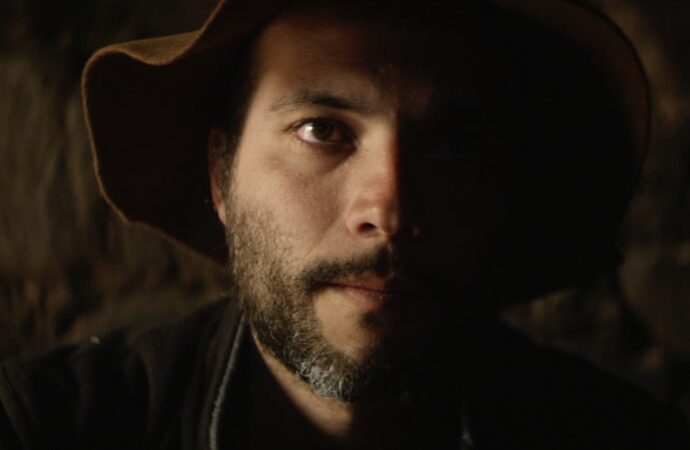
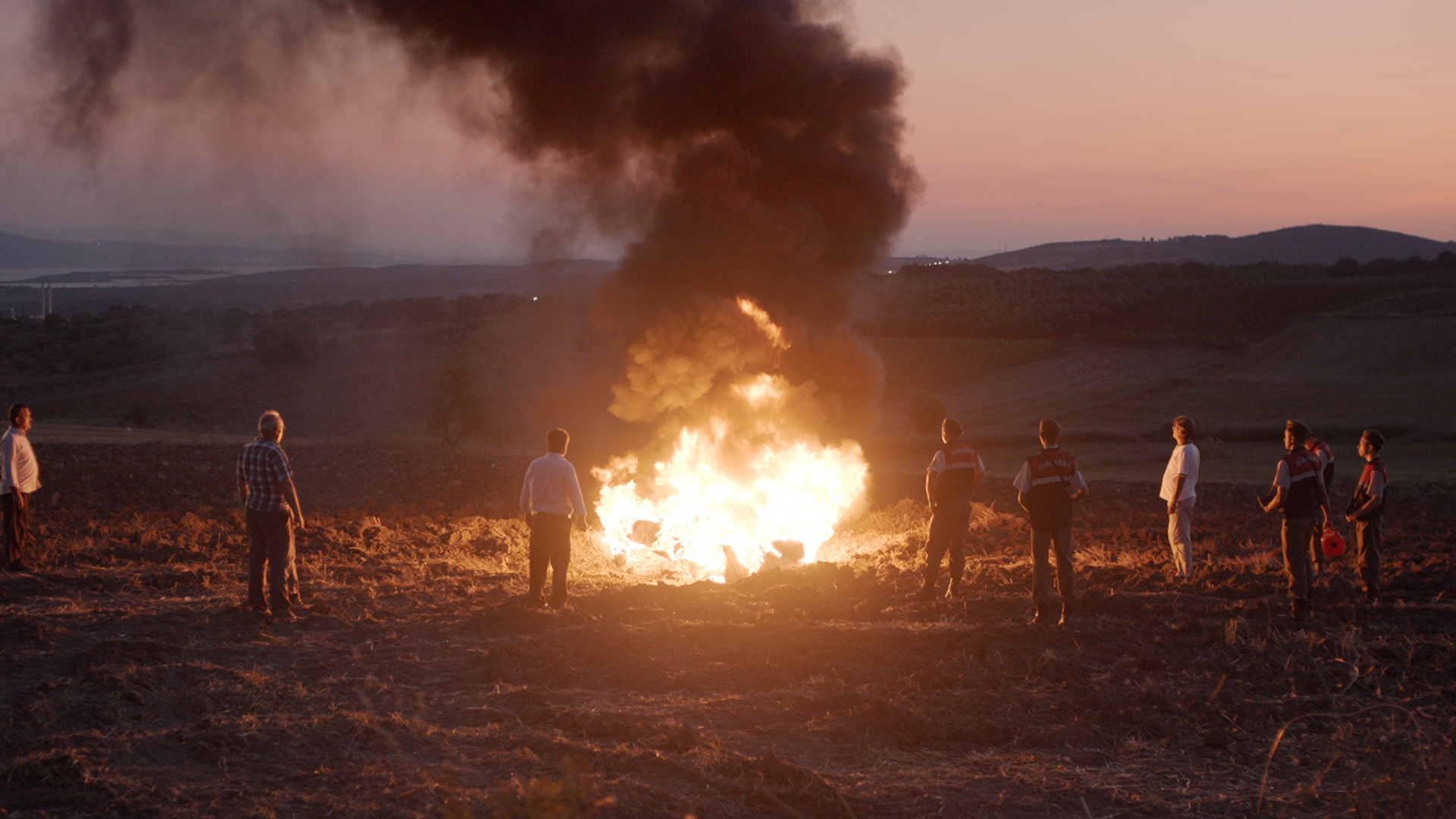
Initially inspired to locate the mythical rock that is the subject of the 1941 poem, “Piedra sola,” by legendary Argentinian folk singer and writer Atahualpa Yupanqui, first time feature director Alejandro Telémaco Tarraf journeyed to the Northern region of his native Argentina where by chance he met llama herder Ricardo Fidel Tolaba. After many conversations with Tolaba, Tarraf took a small crew to the remote village of El Condor, located between the bordering mountains of Northern Argentina and Bolivia, where he and his team lived with and filmed Tolaba and his family over the next year. As the crew immersed themselves in Tolaba’s community, they documented the native rites there and subsequently combined the footage that they shot with a fiction written by Tarraf and Lucas Distéfano that was inspired by the Andean Cosmovision to make Piedra Sola. This compelling 71-minute feature follows Ricardo after he and his family ritually sacrifice a llama and journey to a nearby village to sell the animal’s meat and pelt as a means of survival. Soon, when several more of Ricardo’s llamas are found dead, Ricardo goes on a physical and spiritual journey away from El Condor to locate the unseen puma that he believes is killing his herd. I thankfully caught up with Tarraf when his transcendent first feature screened as part of the New Auteurs section at this year’s American Film Institute’s Festival.

Q: Looking at your film and your blending of documentary and fiction cinema, my mind immediately went to Pedro Costa’s Vitalina Varela and the process that Costa utilized as he lived in the community of his actress for some time. I understand that you did this as well—you lived with Ricardo Fidel Tolaba and his family in making Piedra Sola. Costa knew Vitalina’s story before filming the recreation because she appeared in his prior feature, Horse Money, and so I wondered: how did you meet Ricardo, and how familiar were you with the rituals of the people of El Condor before you moved in with his family? Also, at what point in the process did you and Lucas Distéfano start to create the fictional elements of your script?

A: Well, I am from Buenos Aires, which is very far from the Puna region, about 2000 kilometers away actually. So, my first encounter with the region was via a poem from Atahualpa Yupanqui. Yupanqui is a very important poet and musician in that region, but I should also say that he is better known as a musician than as a writer. The first poem which I read of his was called, “Il Tempo Di Hombre (Man’s Time),” where he speaks of a universal man. Then, I read his first book of poems, Piedra sola: poemas del cerro, where he speaks about a rock that falls from a mountain and lands in the valley, and that rock becomes a refuge for the shepherds where they can contemplate. Originally, my romantic idea was to go and find the rock Yupanqui wrote about, and so, my wife and I went on a journey to find this place and in turn find out more about Atahualpa Yupanqui to make a documentary on him. That was the initial idea, but then on this journey, I met Ricardo and really was touched by him, and so, I put aside the documentary on Yupanqui, and thought to write my own script. But in the back of my mind, I was still thinking of Yupanqui and considered the way that he approached art, in that it is universal and without borders. I was with my wife when we met Ricardo, and after a half of an hour of conversation with him, I began to cry because I knew that I had found someone who had so much wisdom.

We became friends, and I stayed with him for a month that first time. Afterwards, I went back to Buenos Aires, and then back again to Ricardo. At first, the community was very closed off, as it is on the border between Bolivia and Argentina, and thus they needed time to open up and adjust to me being there. Also, I always said to myself that if I were to film there, then I needed to do it from the inside and not from the outside, and so to do that, I needed time. In that way, I feel my process was like that of Pedro Costa, as he insists on spending a good deal of time with the people in his films. I agree that you need to spend the time with these people to create a home environment and a family. So, I did a few more journeys with Lucas Distéfano and our cinematographer, Alberto Balazs, and I wrote a script which I presented to the Institute of Argentine Cinema to solicit funding for my first feature. But then, I went back to Ricardo in El Condor and wrote another script, which constantly evolved. When we began shooting, the film was a pure documentary at first that was done with Alberto (Balazs) and a very small crew of about four, which eventually expanded to about ten people as shooting continued. However, I would say that fifty percent of the filming was still done with just four people in the crew. In the beginning, we had all this documentary footage that I gathered together and watched, but it left me with a dilemma, as I then had the desire to add some fiction to what I had in order to organize what I felt was a bit of chaos with the documentary (laughs). I then used all of the stories Ricardo told me to create a very precise script.

Q: At that juncture, did you feel that the script aligned well with what you had filmed?

A: Yes, but I subsequently did take another journey back to El Condor with a sound designer to record only sound for two weeks. And with all of that material, I was able to make the film. But regarding the region, it is an amazing place, Generoso. It feels so remote and untouched in a way, and thus you feel like you are looking at a place that could very well be the origins of the planet. And it is for that reason at the start of the film that we show the storm to put the viewer in a mindset that they are indeed viewing the creation of the world and the place of first humans. It is a very mythological place, the Puna region, because if you have ever been to Buenos Aires, it is the exact opposite—it is a very cosmopolitan and modern place.

Q: When you speak of the first moments of your film, seeing and hearing the storm and this feeling of being put at the beginning of time, I also think of the image of the hobbled horse that you present. While watching Piedra Sola, I believed that Pachamama was simply a representation of mother nature, but now, as I understand from your director’s statement, it can also mean time and universe, as in the poem by Yupanqui. What then did you wish to suggest by showing the horse at that moment? Should we see it as a reflection on Argentina’s past by way of Spanish rule? If not, what does the horse suggest in terms of the time and history of the region?

A: The horse is very important in many ways. First, the ritual that you see involving the horse in the film is a real ritual in that region. When they go to the bonfire, the horse becomes a vehicle as a means of transportation to the other world. But for me, in the north, there is a synchronicity between the Americans and the Spanish because, as you know, the horse is a Spanish animal. When you see this lighting of a fire with this horse, it was also in a way a symbol of fusion between these two cultures. This was important to me as I feel that we need to integrate more in this way and not be separate because, when it is all said and done, we are all in the human race. What is funny is that the horse that you see is white, and it is called, “The Gringo,” which you know means, “the foreigner,” and so the idea was to show the horse in the beginning, so, at the end, you could see a transformation in a non-linear way as to give respect to the idea of time and the universe. As you see that in the end of the film, you are ascending, and you are not very clear as to the destination, like a Fata Morgana, and as you ascend, time becomes a bit more unclear, which was my goal as to keep the narrative non-linear. But the horse is indeed about this colonialism and our need to transcend this.

Q: In Apichitapong Weerasethukhul’s 2010 film, Uncle Boonmee Who Can Recall His Past Lives, as the titular character is dying, his past, present, and future all collapse into one plane of existence. As Ricardo lives in El Condor, which, in the Andean Cosmovision, is where the past is thought to be ahead and the future behind, what then does the ascent of Ricardo at the end of the film suggest to you about the boundaries between the physical and the spiritual?

A: You know many people believe that Ricardo has died at the end of my film, but I don’t see the ending that way. For me, the end of my film is a condensing of the past, the present, and the future. I feel that we are always thinking in a linear way, but the idea of the film is to bring in these planes of the present, past, and future, and we are eternity itself. And when Ricardo shows a shadow, it is because when we are eternal this shadow will integrate with ourselves, and we will become complete.

There is a phrase that we say in Spanish, and I don’t know if you also say it in English, but we say, “In a grain of sand, we can see the totality of the desert.” So for me, it was exactly the same thing, but with the stone.

Q: In Buddhist doctrine, when a food or drink sacrifice is offered to a spirit, it shouldn’t be eaten by people and must eventually be thrown away. As you have stated in a previous interview, there are three planes of existence for the people in the Puna Region: the level of the condor, which is the elevated level, the level of the puma, which is the current plane, and the level of the serpent, which is underneath. In Piedra Sola, when Ricardo goes into the village to sell the llama meat that he used for the ritual, people refuse to buy it, and a woman whom he offers it to even says, “Oh, it is from El Condor. I have heard that the meat from there is tough.” Is the custom in El Condor to sell the meat and pelt of the ritual animal, or in a sense, given the “meat is tough” statement, is the puma singling out Ricardo’s herd as some sort of punishment for treating the llama as a commodity?

A: I can say this: in the North of Argentina, life is very simple. So, the puma and the llama are part of the level of man, and thus, their relationship to each other is very sacred, but eating the llama is also the only way that the people can survive. In the ritual that you see in my film, the blood that is painted onto the house is the offering, and then the family will survive off of the meat because you must remember that this is a mountainous and very unfertile region to grow agriculture. Therefore, their relationship is very sacred, and that is why when Ricardo sacrifices the llama, he closes his eyes as to connect with the animal, so Ricardo really does understand what the sacrifice means in that this animal represents so much to him and his family. For that reason, the llama gives so much to these people and to the survival of their community, and because of this importance, the llama is sacred in human territory. But, at the same time, the people cannot do the same thing with a condor because that is on another level, the world of the gods, and so that is not a good thing, but the llama is part of this world.

Q: So then, when Ricardo’s son sells the llama pelt for cash, I wondered what needed to be purchased with money in what is seemingly a bartering community like El Condor? Money of course, isn’t necessarily modern, so I do not believe that it in conflict with Pachamama specifically in terms of time, but does it suggest a level of unnaturalness in El Condor, as money becomes an intermediary outside tool in a community where most of life’s necessities can be traded for?

A: Yes, I can understand this thought about the money that they make by selling the meat and the pelt, but with it they purchase vegetables to eat, and they buy the coca leaves that they use in rituals because you cannot find the coca leaves where they live, so they have to travel to Bolivia to get buy them. I’m sure that you understand this, but the coca leaves are key to the whole cosmology there, and for that reason, we closely filmed the veins in the leaves so you see the totality of it all.

Q: Are the coca leaves crucial for just that community, or did you find that they were essential to the entire Andean cosmology?

A: Yes, in Northern Argentina, but also in Bolivia, the north of Chile, and Peru, they are sacred. You know that we are so removed from the sacredness of the coca leaf because we only think of it in its refined state for drugs, but for them it is so sacred in the way that they can “see” with it. In the end of the film, when Ricardo sees the fire, you should know that in the actual community when they see and read the smoke from a fire, they can tell who is going to die. So, the fire was always prescient for me when I was filming. When people in the community gathered around a fire, I felt that it was part of the totality as well.

Q: There is a danger in ethnographic filmmaking, and that is of a sort-of exoticizing of the culture, which I feel your film never does because of the connection to the pain that exists in the life of Ricardo and the people in El Condor, but at the same time, there is a physical and spiritual ascension that goes beyond the human form. How concerned were you that the people whom you were filming would become too subject-like? To specify, as an outsider, were you ever concerned about the perception that we as the viewers might have that you are studying the people of El Condor as clinical subjects?

A: Here, I should say again that it was always crucial for me to film from the “inside” and to do that, apart from spending time with the people, I had to be like them, and they had to be like me, so we could have a kind of fusion. Like, if you film a storm, Generoso, you need to feel a storm—you have to be under that storm in order to show that you are there. Otherwise, it would feel like you were watching it from outside. Also, because I lived there, I had so much respect for the Cosmovision that I was trying to bring my camera to the level of the circumstance. It is a matter of being present, and because we are in the present, we can then have the ability to play with time. Lastly, I should say that I always felt that I had to have one foot on the earth and one foot in the sky at all times there because in order to reach the sacred I need to be on the earth too.

Q: In terms of the practical aspects of filming when you were in such a remote location, I am so curious as to your exact access to electricity when you were in El Condor.

A: Electricity wasn’t everywhere in El Condor when I was shooting, and there wasn’t access to the internet at all. This is quite funny, but in the scene when Ricardo and his son are coming back to El Condor on the bus, if you look at the newspaper, it mentions the internet, which was on its way there at the time. So now in 2020, there is the internet, and I can communicate with the people there, but for the year that I was there, it didn’t exist. So yes, there was some electricity there like in the school and in the small clinic that they operated for the community, but for our electricity needs like charging the camera’s batteries and the lights, we had to bring some gas generators with us.

Q: Given the way of life in El Condor, do you feel that your lack of access to modern conveniences, aided you and your crew in feeling more inside of their world?

A: Yes, it did, but to explain further, in El Condor, when we were filming there, the method that was used when someone needed to communicate with others involved going some distance to a place with a radio transmitter and communicating that way. They would also get the news like that, so it was a difficult situation. Now though, I do wonder how El Condor will develop as they have the internet there along with some other conveniences. In that way, I feel that Ricardo is between generations, and for that reason, I wanted to put those three faces in that house: this old person, Ricardo, and his son.

Q: At this point, do you have a desire to go back to El Condor to film how the modern world has changed the people and place?

A: No, for me it definitely is a curiosity as far as keeping track of these people, but it is not an artistic curiosity. No, for my next project, I am looking at another region of Argentina, in the northeast, because I think that it is very important in my country as a filmmaker to not always be in Buenos Aires, but to give a voice and good stories to other communities. You see, we have this idea to always show Buenos Aires as the European capital of South America and to avoid filming the native people, and so, I have no desire to feed into that tradition. That is also why I am very happy about my film being shown at AFI Fest because their festival supports this kind of cinema that I have created here with Piedra Sola.

Q: Lastly Alejandro, for your next project, do you want to continue working in a documentary fiction hybrid style?

A: No, I feel that in the next film I will move more into fiction, but I will continue working with local people from the region, non-professional actors, because I feel that to make a good fiction film, you need to do it like a documentary. And conversely, if you want to make a good documentary, you need to think in terms of fiction filmmaking. So, in a way, I am going to put my focus in the story, the fiction with this documentary approach, but this is a challenge for me because to make a good fiction, you need to be very real.

My thanks to Alejandro Telémaco Tarraf for this conversation and a special thanks goes to Johanna Calderón-Dakin, Senior Publicity Associate for AFI Fest, for introducing us.

vientocine.com/Piedra-Sola

Generoso Fierro

Corneliu Porumboiu

Standard

Originally published on Ink 19 on December 16, 2019

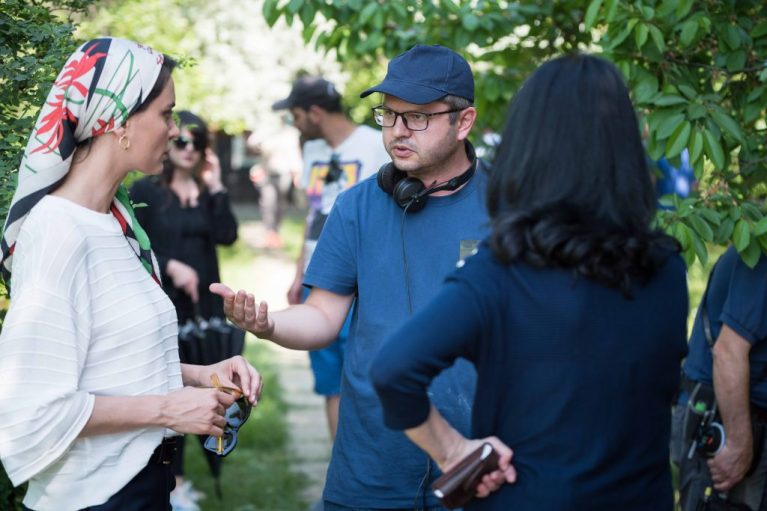
It was a distinct honor for me to briefly speak with director Corneliu Porumboiu at AFI Fest this year where he accompanied his latest film, the intricate comedic noir, The Whistlers (La Gomera). My adoration of Porumboiu’s work began over a decade ago after a chance screening led me to his impressively dry and satirical debut feature, 12:08 East of Bucharest, and shortly after seeing that film, I was fortunate to have the chance to see and program a couple of his promising early short films: A Trip to the City and Liviu’s Dream, at a small festival that I co-curated in Boston. The director’s 2009 feature, Police, Adjective, the winner of the Jury Prize in the Un Certain Regard section at that year’s Cannes Film Festival, is a masterwork that creatively reflected on the after effects of the 1989 Romanian revolution, a subject of so many of Porumboiu’s subsequent films released throughout this decade.

The Whistlers, Porumboiu’s sixth feature, finds the director returning to the realm of police work and the subject of language. To expand on Cristi (Vlad Ivanov), the protagonist of 2010’s Police, Adjective, Porumboiu places his detective in a drug ring operating alongside a corrupted law system; however, Cristi is less occupied by the interpretation of the Romanian language these days. Now, he is learning Silbo Gomero, a language composed entirely of whistling in order to undetectably communicate with his drug ring partners. But, Silbo Gomero is only one of the many types of languages in The Whistlers. In order to form his discourse on methods of communication, Porumboiu weaves together film noir conventions, his own cinematic language, and music into the crime drama plot of The Whistlers to create an experience that toys with our notions of how image and sound can tell a story, evoke an emotion, and modulate our expectations and reactions.

Q: I understand that the origins of The Whistlers began a decade ago when you viewed a television program on the Silbo Gomero language. Language has always been such a large part of many of your films, especially Police, Adjective, so did seeing the program somehow inspire you to revisit the character of Cristi, or were you always looking to examine that character’s progression after a decade, and the discovery of the Silbo Gomero language was a perfect mechanism?

A: In the beginning, I was really fascinated by what I read about the language, and after studying it more, I came up with the idea to put what I learned into that character from Police, Adjective. So yes, first, it was about the language, and then, it was about the exploration of the character. Because for me, the Silbo Gomero language is fascinating in that it is like a code, but it is also poetic, and at the same time it is like a bird language, which made me want to read more about it, and the more I discovered about its origins, the more I knew that it would have to be the center of the film. So then, I thought of Cristi. The reason being is that, for me, this character has always stayed in my mind due to the fact that someone like Cristi has an ideology, a way of thinking that is very inflexible, and that kind of one-dimensional thinking just simply cannot endure in the future, so I wanted to explore Cristi further by exposing him to this multifaceted language.

Q: With Police, Adjective, you took the standard urban crime genre, and you twisted the tropes of the genre by making it dialog-driven for the purposes of examining language and ethics post Ceaușescu. On the other hand, The Whistlers, by utilizing film noir as a construct, is in many ways the polar opposite of Police, Adjective, because the noir genre has so many strict demands for you to adhere to in order to be considered as noir that you cannot stray too far from the established motifs. So then, when you were imagining Cristi a decade after Police, Adjective, how did the noir motifs assist you in creating that character?

A: I should say first that I have always liked film noir a great deal. I knew that I wanted the characters in my film to exist in a setting where they felt like they could easily get double crossed and where they would have a hard time trusting communication, so the decision to go into genre film came down to something that could be seen in a character like Gilda, who is living in a world where she would have to play a role, and so she would play a role that she could borrow from cinema. My goal was to have this type of tension between the camera and the character because, in the beginning of cinema, the camera was used to tell stories. So, I decided that I wanted to have this style of two cameras, one used in the way that we are using cameras today as surveillance, but also another as a storytelling device. There were a lot of decisions that were made which were like these, and thus I went deeper into genre because I wanted a film that was more of a visual expression and not very realistic, considering that in my mind, I was thinking a lot about these niche characters and how they can build their identities due to their playing to this surveillance camera. It is this kind of second nature that develops through this second camera that becomes more important than the first, which drove me even more intensely into genre cinema.

Q: I see how you play with this genre’s archetypal characters like the anti-hero protagonist/corrupt cop and the femme fatale. And, in terms of visual motifs, you played with flashbacks, a common method in a classic noirs like The Killers, where the technique is used to recall the past to build characters, but you chose to use flashbacks to illustrate how Cristi is learning the Silbo Gomero language.

A: Yes, and the reason for that is that I wanted to have as the center of the film Cristi’s process of learning the Silbo Gomero language and form a double movement. At the beginning of the film, when he is going to learn this language, he is going to learn it to use it for something nefarious, but at the same time while Cristi is learning the language, he is reflecting on his personal history, and so there is a movement inside of the learning process. A film noir construct allowed me to do this. Otherwise, if I tried to do this in a more traditional style of storytelling, the language would appear in the middle of the film, but the metaphor would be revealed at the end.

Q: I so appreciate your casting of Catrinel Marlon as Gilda, but I understand that your search for the right actress for the part was a burdensome one. My curiosity is, given her character’s name of Gilda and how that name evokes a classic noir reference, was part of that difficulty because you couldn’t decide if the actress should or shouldn’t possess Rita Haymorth’s look and qualities?

A: It was indeed a difficult casting process for that part, but what I liked about Catrinel is that she had a type of style and body language that would allow her to become the character and build it her own way. Also, when I cast the character of the mother, for example, I wanted to her resemble Gilda in that she is an ex-femme fatale, and it is this kind of play on the imagery that I wanted in the film as well.

Q: One usually thinks of jazz music in film noir like John Lewis’ score for the 1959 film, The Odds Against Tomorrow. Could you talk about your unexpected use of classical pieces, such as Jacques Offenbach’s “Barcarolle” or Carl Orff’s “Carmina Burana”, in The Whistlers?

A: At first, I used classical music to build the character who worked at the hotel, to make him very unpredictable, as that clerk doesn’t want people to stay there, but then I started using music for many other purposes—for example, to create a more personal moment or to build contrast to add humor to a scene.

Q: To me, your use of music as a contrast comes through the most at the end of the film in artificial garden in Singapore. When did you decide on that particular piece of music for the final scene?

A: The music was there at the park in Singapore already. In my original script I wanted to have Iron Butterfly’s song, “In-A-Gadda-Da-Vida,” but when we got to the location and I heard them playing this other music, I thought that it was better for the scene, so I used it instead.

Q: That park was a perfect setting for the end of the film. Was that a location that you had scouted out prior to writing the script?

A: Since the beginning of my project I wanted the film to end in a certain kind of garden, a futuristic paradise, you can say, because of the way that gardens are consistently seen throughout the film. The island of La Gomera, for example, is a kind of garden, as is of course the actual garden that the mother tends to, and this is very important to what I wanted to do with The Whistlers. So, I really wanted a kind of technologically advanced garden to appear at the end of the film, and I had an instinct that I could find such a garden in Asia, in either Hong Kong or Shanghai, and I was fortunate to find one in Singapore.

Interview conducted by Generoso

• •

Feature photo courtesy of mk2 films.

www.thewhistlersfilm.com

Sofia Bohdanowicz

Standard

Originally published on Ink 19 on December 19th, 2019

In the first seconds of MS Slavic 7, directors Sofia Bohdanowicz and Deragh Campbell present an open book with side-by-side Polish and English versions of, “To Józef Wittlin on the Day of His Arrival in Toronto – 1963,” a poem written by director Bohdanowicz’s own great-grandmother, Zofia Bohdanowiczowa. The film then immediately cuts to the image of Audrey Benac (Deragh Campbell) entering a minimalist hotel room followed by a visit to the Houghton Library at Harvard to explore the correspondence between Bohdanowiczowa and Wittlin. A hybridized character combining Bohdanowicz’s experiences and family history, Campbell’s perspectives and interpretations, and elements of fiction, Audrey is the great-granddaughter of Bohdanowiczowa, and as the literary executor of the Bohdanowiczowa estate, she wants to shine a light on her great-grandmother’s work.

As MS Slavic 7 proceeds, the letters guide Audrey towards a fluid path moving between the present and the past in her memory space, allowing her to form connections to Bohdanowiczowa’s writings and more broadly to her own heritage, family, and artistic research process. As part of AFI Fest 2019, I had the opportunity to speak with director Sofia Bohdanowicz about incorporating documentary elements in her practice, portraying the research and archive process, and overall, interweaving and mirroring hers and co-director Deragh Campbell’s experiences and perspectives to create and progress the character of Audrey Benac.

Q: Before we dig into MS Slavic 7, I have to ask: were you able to access your great-grandmother’s letters before or since the film’s completion? I know that the archive access approval can sometimes be difficult to attain.

A: When we were first doing research, when I was just looking for the letters themselves, I didn’t actually go to Houghton library. I found the letters online, and I was able to request and receive PDF scans of them. But, that doesn’t make for a very interesting film!

Before shooting, we didn’t get a chance to visit Harvard, so we did a lot of research and imagined what it would be like, and then staged everything in Toronto, and we amazingly captured some uncanny resemblances in some architectural pieces on the University of Toronto campus that made the film look and feel like Harvard. We actually saw the letters in September because we were invited to screen the film at the Harvard Film Archive. It was a very easy process, and they were really warm and welcoming because we were invited guests. But, in general, those archives are open to the public, so there are some hoops you have to jump through, and it is a little bit of a process, but it’s not so bad.

Q: That’s great to hear! Getting into some university libraries can be difficult. So many require targeted, very specific searches for the approval process.

A: It’s funny. The film has brought up tensions about institutions and archives, which is not something I completely expected. I’ve had people say to me, “We’re really interested in how you’re critiquing institutions and sticking it to the man. We can tell you’re frustrated with Harvard.” I don’t feel this at all! The dissonance that’s present between access and archives wanting to preserve and venerate letters is fascinating. I don’t think there’s anything wrong with the approval process; it is there for a reason. Archives put in great work to preserve artifacts, so they need to know who is looking at them because those objects must stay protected. Although the access process can be very frustrating—for example, I was just in archives in Cambridge in the UK recently, and it took us two hours to get set up—I have an appreciation for institutions and how they protect important artifacts because if they weren’t doing that, then we wouldn’t have any way of accessing our history and telling these stories.

Being able to see my great-grandmother’s letters for the first time in September was such a moving experience because the letters were just there in Houghton, waiting for me to access them. It’s very touching that they’ve been there for over fifty years, and they were taken care of and preserved all of this time. Had they not been, I would not have had the opportunity to make MS Slavic 7 and to explore my family’s history through the film. When I was holding the letters in my hand, I was doubly moved: I was moved by the fact that were my great-grandmother’s letters, her words written by her hand, and I was also moved by this act of preservation. These letters still exist. They are intact, and they are still collected together because of how much care and thought has gone into this archival system.

Q: With MS Slavic 7, you have taken the literary tradition of writers’ own roman à clef novels and made it cinematic. In literary roman à clef, the intertwining of reality and fiction is in the psychological perspective, but in cinema, the intertwining is in not only the psychological but also the audiovisual perspectives. How did you integrate how you feel, see, and hear into what Audrey does, sees and hears on screen?

A: In editing and in discussing the film, I’ve consistently stressed that Audrey is a very sensitive person. She’s a very anxious person, and she’s very layered. She’s a weighted character, so, when I think about the interactions she’s having with the archivist, with her aunt, and with the translator to a certain extent, I think sometimes they can be perceived as reality, but other times they can be perceived as her own internal perspective of an experience because this film is very much about the act of remembering and oscillating between the past and the present. That’s how the film is constructed: we’re going back and forth between Houghton library and this family reunion that she’s remembering. There’s this point of oscillation, and MS Slavic 7 is not a perfectly cerebral film in any way, but in our editing process, we kept asking ourselves, “Is she perceiving this in the here and now, or is this something she’s remembering?” because memories of interactions with people and stories we retell are perpetually changing in our minds and are sometimes modulated by what we’re experiencing in the present moment.

As for the letters themselves, we wanted to focus on three important components of what the letter as an object is, what it represents, and how you can explore that on screen. The first way that we wanted to do that was to try to simulate the experience of what it feels like to hold a letter in your hands, to hold an object that is of holy value, something that is sacred to you. So, exploring the letter as a sacred object and also trying to capture this moment of discovery were the goals of Audrey’s first day at the archive. We did that by using macro lenses, so we could have a nice, shallow depth-of-field. We focused a lot on foleying, and we were able to get these nice crinkling sounds, so you can hear the texture of the letters. We also wanted to play with subtitles at the bottom of the screen, to experiment with this idea that even though she doesn’t understand Polish, the weight of the letters’ history is still present—her great-grandmother’s spirit is still lingering, and her words are about to be discovered.

Whereas the first day focused on the object properties of the letters, the second day in the archive focused on the spirit of the letters—the letters as talismans or objects that hold magical properties. We did that by playing around with acetates and showing projections of the letters to give Audrey a different perspective to observe them. I feel the way that the scene in the archive was staged gives the letters this kind of ghost-like aura. We wanted to represent all of the distance that the letters have traveled, and she talks about that in her monologues. What kind of powers do these letters hold because of their rich history?

And finally, on the third day, we wanted to focus on the content, not only the translation, but also a recital of the letters. We wanted to capture what they sound like when they are spoken aloud. In many films, letters are explored in only one, standard way, but in making MS Slavic 7, we tried to sit down and think mindfully about different experimental ways to depict the research process and the beauty of discovery accurately.

Q: As a former researcher myself, I appreciated the veracity of your portrayal of the research process. Audrey’s attempt to digest all of her research feels so honest and real. When you dig into a topic, you can get extremely overwhelmed by the mess of information in front of you, and you know that it all comes together in some way, but getting there feels like trying to find a path in the dark. And, without an academic framework, you’re left to your own devices to find the way. You capture all of this so well. Could you speak about how you worked with Deragh to elicit this disorienting sense?

A: The monologues were Deragh’s idea. I discovered the letters, and she pitched a very intelligent structure for the film. One particular element that I was interested in were these monologues that she envisioned with a locked-off camera on a tripod, all shot in a single take. When Deragh works on a film, she really likes to focus, especially when she’s building a character, on genuine connections. She is an actor who likes to react in the moment to experiences, which I think is a brave and courageous way of operating. To prepare for the monologues, the night before shooting one of them, she read one section of the letters for the first time. And, I threw in my own notes on my great-grandmother’s words and what I thought along with some historical anecdotes, and she read those as well, and then she proceeded to fill up her own notebook with her own thoughts and ideas. The next day, we would go to a restaurant that a friend of mine managed, and she would deliver those monologues. For each one, I think we did about eight or nine takes, but they were always done in one continuous shot.

This feeling of frustration and difficulty and strangeness in articulation actually came out of the situation that we were shooting in. The film was made very cheaply with a production budget of about 5,000 dollars. My friend offered the restaurant location for free, and we went for it. He told me that the restaurant was going to be empty, but when we were filming, he would open it up for coffee in the morning. I would be all set up and ready to shoot, but then people would come in and out of the restaurant, so it was a distracting space that wasn’t great for Deragh to act and be vulnerable in. She was trying to deliver these beautifully crafted thoughts, but was being met with disruption. It was really frustrating, and we weren’t sure how it was going to work. At the same time, we didn’t have a choice. We went along with it, and thankfully, what it yielded was this effect where you can tell that she was frustrated and having a hard time pulling out her thoughts. And, I think if you were actually synthesizing and digesting your research and discovery in a busy restaurant, it would be that challenging, so everything ended up working in our favor in the end.

I love to work within the realm of what some filmmakers call process cinema. If something happens when I’m filming—for example, this situation with this restaurant that was supposed to be quiet and closed down, but was open and busy—instead of looking at it as a problem, I try to look at it and ask: What are the variables that are being offered to me right now? How can I work with them to make my film unique? How can I look at these unexpected situations as gifts? It can be an incredibly hard thing to do, but if you’re open to creatively embracing those elements, I always find you can come up with something exciting.

Q: Your film is literary in its subject but not its approach, and that’s quite an accomplishment. How did you approach the challenge of avoiding literature-in-film clichés (i.e. re-enactments of moments or letters, voice-over narration)?

A: I was recently at a film festival on the Canary Islands with Shengze Zhu, who made a film called Present.Perfect. She works in hybrid cinema as well, and she said to me, “You know, Sofia, hybrid filmmaking is cheap.” And, I started to laugh because it’s true. It’s an inexpensive and excellent way to tell a story with a small amount of money. For us, re-enactment wasn’t an option because we just didn’t have the means to go there. As for a narrator, my practice stems from a place of collecting documentary footage first, so with this project, we collected the family reunion footage before we went into shooting MS Slavic 7. It was the first thing we filmed, and we treated it as an exercise. What you see is my actual aunt and uncle’s wedding anniversary! Deragh went as a guest. She sat down at the table, and she engaged with my family. From then on, we had that footage as a base, and I could intersperse acts of restaging, so instead of having a talking head or a voice-over narration, these scenes at the reunion became the stitching fiber to tell the story.

I’m always interested in different ways that we can propel a narrative without relying on the typical tropes used in a documentary. The other thing to consider about the film is that it didn’t have a strict outline; the script was very, very loose. We knew what Deragh would be doing over the course of three days. We would go to those environments, and we would shoot those scenes, but I would shoot them very much like a documentary. For example, on the first day, when Deragh sits down to look at those letters, and she’s holding them in her hands, we shot for about forty-five minutes in silence. She continued to look at things and give her small directions here and there, but we kept it very open. Consequently, it took about nine months to edit the film, to find its voice and its trajectory, which was challenging. It was hard to find what felt right within the grammar of the film when Deragh and I were editing. But once we discovered it, we were excited that we found such a strange, compelling little film in all of the footage. We couldn’t quite believe that it existed. It just emerged from a lot of conversation, trial and error, and dedication. We met two or three times a week to edit the film.

Q: What an excavation project. What’s amazing is that it seems like your editing process ended up aligning with Audrey’s process of digging through the letters. Perhaps the energy of Audrey’s search through the letters to find the connective thread between herself and her great-grandmother led to a similar feeling of trying to find the thread between you, Deragh, and Audrey in the film, forming a resonating circle between the letters, your family history, the film’s narrative, and the film’s editing?

A: Throughout making MS Slavic 7, I had my own process when I discovered and explored the letters, not in their physical form, but in their translated, digital form. Then, when filming, there was this double layer of capturing Deragh’s live responses to the letters based on my reflections, which created a lot of mirroring and bouncing back and forth between the information, reactions, note-taking, and research practice. This process worked very well. We both feel comfortable being very vulnerable with one another. We have an open practice and a close relationship. I believe the film has such a strange and unique voice because we were so supportive of one another throughout the writing, filming, and editing process.

Q: Your closeness and trust with each other definitely comes through. Given that Audrey is somewhat of a stand-in for you, how much of Deragh’s perspective of you, which may be different from how you see yourself, is integrated into her performance?

A: It’s a fascinating thing. Audrey is a character Deragh and I developed in my first feature film, Never Eat Alone, which is about my grandmother searching for her long lost love from her twenties. She was a character who was built out of experiences that I had with my grandmother, named after my cousin, Audrey Benac. In the film, Deragh, as Audrey, lives in my cousin Grace’s apartment, and throughout, she is wearing my clothing or some of my grandfather’s clothing. So, to make Never Eat Alone, Deragh got to know my family well, and she could look at my traits and my other family members’ traits and carry them forward in her own creative decisions within her own process. Over the course of the evolution of the character from Never Eat Alone to Veslemøy’s Song to MS Slavic 7, I feel now more than ever that Audrey is a co-synthesis of mine and Deragh’s inputs. That’s a major reason why Deragh became a co-director on the project.

Originally, I was the sole director of MS Slavic 7. Deragh had pitched me the structure, and we were going to be co-writers, but for the first time in our collaborative relationship, I truly felt that I couldn’t come up with all of the answers. They weren’t all coming from me, and that was a positive thing. I just didn’t know, and it was a mystery, and ultimately, I realized Deragh’s voice was the other half of the equation. I think that speaks greatly to her investment in the film and in her work as an actor. She throws herself in and deeply invests herself in the world that the filmmakers are trying to create. She gives herself reading lists and watches a lot of cinema, and she is very involved in the wardrobe. With this film, I remember her and Mariusz Sibiga, the actor who plays the translator, sitting down in the restaurant, planning out their dialog scene and how that was going to go because that scene was largely improvised. I found myself feeling so touched and moved by how well-studied she was in regards to the letters, my great-grandmother’s work, my own thoughts, and Józef Wittlin’s work. I feel lucky to work with a collaborator who cares as much about my family as I do.

Q: In previous conversations, you touched on how funny and strange it was to explore a little of Audrey’s sexuality and overall her intimacy with others. Could you expand on that tension? Intimacy can be more difficult to convey for the female roman à clef protagonist as compared to a male one. To me, creators like Kerouac and Bukowski struggle with intimacy because when they pursue it, their own definitions don’t always align with others’. Audrey appears to struggle with intimacy because it may not be her priority right now, but it is something she wants and needs.

A: I love that. I was having a conversation recently with a friend about being self-partnered. It was something Emma Watson said recently because someone had asked her, “Are you dating someone? Are you single?” And she just replied, “I’m self-partnered,” which I think is a beautiful thing because even though you’re single, that doesn’t mean you’re available. You might not want to be partnered with someone. You might just be happy being by yourself.

It’s funny. I’ve been told that the scene with Audrey and the translator in bed is scandalous because it looks like Audrey is using the translator to get what she wants from the letters. When the translator kisses her on the shoulder, and she has no reaction to it, people misinterpret Audrey to be a really cold person. It’s an interpretation that I completely disagree with because Audrey is a thinking, feeling, sensitive being, and the whole film is about how she has a hard time articulating and expressing herself. She’s finding her voice and trying to ask for what she wants and say what she wants. Just because a person isn’t able to express themselves clearly doesn’t mean that they’re not feeling things deeply.

What that scene actually was for us was an opportunity where we could explore the overlap of two things that Audrey wants: she wants a recital of these letters, and she wants to sleep with this man. She wanted him to read the letters aloud, and he does. And, they do sleep together, but ultimately, she doesn’t want their relationship to go any further. Plus, MS Slavic 7 is not a film where this person is having a hard time completing her thoughts, and her thoughts are completed by a male counterpart. This is a film about a person who has the desire to complete her own thoughts and to self-actualize on her own terms. She’s not looking to rely on a man to fill that void. She wants to continue the search.

And for me, on-screen intimacy was a big thing missing in my work. I’m a very private person in that regard, and the scene in bed was Deragh’s idea. It was enlightening for me as a filmmaker, artist, and person to confront how uncomfortable I felt and to realize I was moving into new territory as an artist to talk about this element of myself, this element of Audrey, and this element that Deragh wanted to talk about. It was a challenge for me to film the scene, and I’ve been quite surprised by people’s reactions to it.

Q: Self-discovery as an intellectual or artist through family history can be simultaneously uplifting and deflating, depending on the discoveries made and the reactions that come from them. Do you foresee a moment when Audrey will walk away from creative works and research that use material or inspiration from her family history?

A: Funny that you should ask—I have a new film coming out with Audrey called Point and Line to Plane. It’s about a friend of mine who passed away very suddenly last year. He was my first producer and collaborator, and I wanted to find a way to honor him. I started writing a letter to my grandmother, and this eventually evolved into a film about trying to find him or traces of him through artwork made by Wassily Kandinsky because he was an artist whom we mutually admired. For the first time, one of my films is much less concerned with family history or with archives, and instead it deals with regret, mourning, and grieving. Point and Line to Plane also explores Freud’s theory of magical thinking, which Joan Didion appropriated in the book, The Year of Magical Thinking, which is about looking for signs, coincidences, and messages from a person when they pass away because of your inability to cope or navigate that person’s loss. So, this new film is about my attempt to communicate with this friend of mine after his sudden passing.

Q: That’s beautiful. I love The Year of Magical Thinking. I found Joan Didion’s approach to the passing of her husband to be a compelling way to look at grief.

A: I found myself very much relating to her words and her perspective in a way that was extraordinarily validating. I thought, “Yes, I feel all of these things so strongly!” Reading that book propelled me to make the film. I didn’t know about the phenomenon of magical thinking, nor did I possess the language to investigate it or to describe it, but when I read that book, I realized, “Oh, this is the virus that I’m sick with right now,” and it gave me an entire spectrum and palate to start expressing myself.

Q: Didion has a gift for examining realities. Play It as It Lays says so much about Los Angeles. The Year of Magical Thinking says so much about love, grief, and attempts to rationalize both.

A: Contrary to what you may believe about me after seeing MS Slavic 7, I don’t read as much as Deragh does. Audrey’s literary references in the film all come from Deragh. The Year of Magical Thinking is the first Joan Didion book that I have ever read, but I hope to continue to read more.

Q: I know getting time to read between living, working, and seeing cinema is hard. I think it’s harder now than it’s ever been.

A: It’s such a challenge. Deragh said to me recently that books are like friends—you just have to nurture the relationship, so that’s something that I’m working on right now.

Interview conducted by Lily

Feature photo: Still from MS Slavic 7


Alice Rohrwacher

Standard

The eclectic World Cinema programming at the American Film Institute Fest is always exceptional, as year after year they have brought the most eagerly awaited new features from established talents who have consistently garnered prizes at Cannes, Venice, and Berlin, and this year was no exception as AFI Fest 2018 welcomed the newest and justifiably distinguished works from Nuri Bilge Ceylan, Hirokazu Kore-eda, and Jafar Panahi to name a few. As strong as the features were from veteran directors, what distinguishes the curation this time around was the work of some of the newer voices in international cinema, most notably the brilliant third feature by Italian director Alice Rohrwacher titled Happy as Lazzaro, which earned her a Best Screenplay award at Cannes. Amazingly, given that Rohrwacher’s first feature, Heavenly Bodies, was only released seven years ago, this 2018 Best Screenplay win for Happy as Lazzaro is not her first award at Cannes, as her accomplished 2014 feature, The Wonders, received that year’s Grand Prix.

Like The WondersHappy as Lazzaro shares that film’s timeless and naturalist core narrative of rural people who are out of sync with the modern world. Both films also interestingly utilize the talents of veteran actresses playing against type (Monica Bellucci in The Wonders, and Nicoletta Braschi in Happy as Lazzaro), and the two features both contain exceptional performances from the director’s sister, Alba Rohrwacher.

Happy as Lazzaro follows the titular character, a pure spirited man (played by the seraphic-faced Adriano Tardiolo) who works amongst a community of sharecroppers in the mythical town of Inviolata where they toil for a tobacco overlord, the Marchesa Alfonsina de Luna (Nicoletta Braschi). Through the use of organized religion and a certain amount of twisting of the truth, which convinces the workers that they are environmentally unable to leave their village, the Marchesa exploits the sharecroppers who are overwhelmingly unhappy with their situation, except for Lazzaro, whose unblemished soul allows him to complete his farming tasks without issue while he even becomes the unknowing victim of his already exploited community. Regardless of his treatment, Lazzaro lives beatifically in the hills above Inviolata until one afternoon when Lazzaro befriends Tancredi (Luca Chikovani), a young nobleman and member of the Marchesa’s family who wishes to remain separate from his people as well. Shortly after sealing their friendship, Lazzaro hides Tancredi so that this cynical privileged man can fake his own kidnapping to make some funds to escape his own predicament, but the subsequent search for Tancredi uncovers the ugly truth of the Marchesa’s activities, which have a ripple effect that forces the workers of Inviolata into the urban landscape, bringing them face to face with an even more grim reality.

I spoke with Alice Rohrwacher during AFI Fest 2018 about her meditative feature, focusing on her symbolic use of the Roman Catholic religion, her comments in the film on systematic exploitation, and the use of surrealism and the grotesque to draw attention to urgent contemporary economic and social issues.

• •

Q: After the family’s liberation from Inviolata, Antonia regales to Pippo on the bus a story of a saint and a wolf. You do not identify the saint as St. Francis of Assisi, but given the story, are we to assume that this is a reference to St. Francis’ experience with the Wolf who terrorized the town of Gubbio, and who St. Francis eventually appeased by offering it food from the very people whom it had terrorized? If it is a direct reference, then is what we see as the inability of Lazzaro to appease the wolf of the modern, urban society beyond Inviolata due to the fact that this wolf is an unnatural being?

A: There are many ways to explain this. Let’s say that Antonia only knows stories of saints. In fact, she is unable to tell any other kind of story, but somehow with the power of these narratives, she can bring us to another time. Of course there are references to the Wolf of Gubbio and St. Francis of Assisi, but I think that Lazzaro is a saint that exists outside of religion, so we can see similarities between Lazzaro and St. Francis, but I wanted Lazzaro to exist outside of that world. He’s almost prehistoric. He’s beyond a formal human era.

For me, in my film there are two religions: On one side is Roman Catholicism, and it is a very historical religion, and in a way, it is part of the problem in the film because it is an instrument that is being used by the Marchesa Alfonsina De Luna to keep the sharecroppers in ignorance. So, in Happy as Lazzaro, the Catholic religion is a very strong force over people, but there is another religion in my film, a religion of the people who believe. It is the religion of innocence, and there is no name for this religion — it is just the belief that human beings have in other human beings, so in Antonia’s story, you can see how the individual names of these saints could be connected, but there is not a direct reference.

Q: What I find interesting in your film is that the exploitation comes from the sharecroppers as well as the Marchesa, suggesting that exploitation and even cruelty is an essential part of natural existence, and here I am thinking of the moment when Pippo is being teased when he was a child that his mother committed suicide because of how ugly he is.

A: I wanted to establish that there are behaviors that are good and bad in this film, and we cannot simply make the conclusion that the peasants are good and the Marchesa is bad, as this kind of exploitative behavior is like a chain effect in that the people who are being exploited will occasionally seek out others to exploit who they feel are beneath them, but sometimes there are miracles because, in this ugly cycle, there are people who remain free of this need to take advantage of others, and they are considered by their peers as fools, but maybe they are in fact, saints.

Q: In terms of the geographic change that occurs in your film from a rural to an urban landscape and how that change plays out as far as the behavior of your characters, do you suggest that nature provides a protection of sorts for innocence? I ask this question as I feel that your film, in terms of its message, has a kinship with Lee Chang-dong’s most recent feature, Burning, in which two of the protagonists, both rural characters, find themselves in Seoul for different reasons, and the various challenges of urban existence and their inabilities to react quickly enough play out in tragic ways.

A: From one side, I think that over the last fifty years the world has changed in such a dramatic way that we are sort of stunned, and for that reason, we don’t acknowledge the good and the bad the way we used to — we just acknowledge the size of the change. Before all of this rapid change that has occurred recently, humans moved in conjunction with what had occurred in the eras before them, but now, like what happens to Lazzaro in my film, we seemed to have jumped from one era to another without any link to the past. Now, I am not saying in any way that it was better or worse in the past. I am not nostalgic, and as a woman, I have absolutely no desire to return to a time long ago, as it was even harder than it is now, even with the problems that the world is seeing today, to have been a woman in any point of the past, but I do feel a need to show to my children and the people in my life that something monumental has happened to humans, that we once had a common language somehow against enemies, that we now have passed from a social middle age to a human middle age. So, I think that if you were making a movie about this phenomenon you need to do it right now, because things are moving so fast that in a few years, even the storytelling language will be fantasy, and for that reason I feel that this generation is on the precipice of something, and we have to document this before we move on.

There is something available for these rural people to use in the city, as I show with the group from Inviolata finding the chicory to eat right by the squat where they live, so there is nature thriving in the city, but this isn’t as much about the urban environment making nature unavailable as it is about there being no place for innocence. I tried to create an atmosphere in Happy as Lazzaro that is timeless. When the sharecroppers are in Inviolata, they do not know about the outside world, and so they are able to maintain their sense of innocence, so they aren’t necessarily good or evil because the definitions of good and evil are not clear to them, but now that they have experienced the reality of the outside world, they have become skeptical, and I feel that my film tries to divide these two times. As for nature, it is always there, and it is consistent to all experiences, just like the wolf that you see in the bank and in the street with cars, you also see the plants that grow on the borders by the side of the train, but the problem is that people do not want to see it.

Q: As in the way the sharecroppers harvested tobacco for the Marchesa, but yet, could not identify the plants that they could easily eat in the area around them because they were never instructed in Inviolata on how to sustain themselves?

A: Yes, and because of being so insular in their environment in Inviolata, they ate only what the Marchesa gave them, so now, when living in the city, they only try and eat processed, packaged food that they steal.

Q: There’s something that I discussed at last year’s AFI Fest with your colleague, director Jonas Carpignano, when we spoke about his film, A Ciambra, regarding the dilemmas faced by rural people who are being thrust into more urban situations, that I’d like to discuss with you. There are moments in his film that, to me, conjure up memories of the Italian grotesque films of Ettore Scola, Marco Ferreri, and Lina Wertmüller. Specifically in your Happy as Lazzaro, there is also an absurd, but no less real possibility of people today living like the people from Inviolata, who are forced to live in city and have no choice but to squat in an abandoned oil tanker and who would have to steal an entire display of potato chips from a gas station to feed their group. Do you feel that these moments in your film appear because the dire economic and refugee situations that exist in today’s Italy, and throughout the world, mirror the era when the Italian grotesque films were being produced? Do you feel that given the extreme issues going on now, that a more exaggerated, almost surrealist treatment needs to be employed in order affect audiences, as the grotesque films did in the 60s and 70s?

A: I didn’t make any direct references to any particular scenes in those Italian films, but I very much do feel that, specifically how the platforms of most politicians have become so nightmarish, even yes, grotesque as their agendas are not based on what anyone would see as rational thought, so during this time, I truly feel that we do indeed need more surrealism in cinema to get people to understand their reality. For example, let’s look at the scene in (Happy as) Lazzaro when Nicola is selecting refugee workers to pick olives, and he is having them outbid each other so that he can select the workers who will work for nothing. The scene, as I created it, is done in an absurd, surrealistic manner, but in this desperate time, it plays out more realistically than a scene using realism. So, sometimes you indeed need to be grotesque to understand reality when the reality is this vulgar.

Q: Finally, this is a personal question, but it has been quite a while since we’ve seen Nicoletta Braschi in a film, and so my wife and I were thrilled to see her in Happy as Lazzaro. We love her work, especially her films with Jim Jarmusch where she plays wide-eyed, sweet characters. In your film, her performance as the Marchesa exudes a conniving insipidness that I have never seen her do in a film before. To my knowledge, she has never played a villainous role before, so why did you feel that she was right for this part?

A: I always love to work with great actors and to ask them to play against type, the way that we imagine them in our imaginations, like the way that I used Monica Bellucci in my film, The Wonders. So, for Nicoletta in Lazzaro, it was fun for me to have her play a villain because she almost always plays characters who are good spirited and sweet, like the parts she plays in Jarmusch’s films, so I felt that it added something intangible to her role as the Marchesa.

Nicoletta Braschi as the Marchesa Alfonsina De Luna, Credit: Cinetic Media

Special thanks to Rachel Allen at Cinetic Media for her valued assistance with this interview.

Happy as Lazzaro is available now on Netflix.

https://www.palacefilms.com.au/happyaslazzaro/

This interview was conducted by Generoso Fierro and was originally published on Ink19.com.

Tarik Aktaş

Standard

Year after year, AFI Fest, through their New Auteurs section, dedicates a substantial amount of their programming to the feature film work of new talents, whose usual port of entry into festivals that are this prestigious is through the short film programming. AFI Fest’s robust New Auteurs selections draw from works from all over the world, and in 2018, the amount of features that were screened in the section went up to eighteen as opposed to the eleven that were shown there in 2017, and in fact, two of our most appreciated films came from the New Auteurs section last year, both best described as having experimental narratives: Júlia Murat’s Pendular, and Joshua Bonnetta & J.P. Sniadecki’s El Mar La Mar. This year, our favorite film to come out of the New Auteurs selections was the confident first feature by Turkish director, Tarik Aktaş, Dead Horse Nebula, which to be candid, we also felt employed an experimental narrative construction like Pendular and El Mar La Mar, but after my conversation with Aktaş, I now realize that I was mistaken in a way.

Utilizing naturalist elements and a sparse, but effective amount of dialog, Dead Horse Nebula follows Hay (Baris Bilgi), who first experiences death as a boy by way of interacting with the titular deceased horse. As Hay stands in awe of the horse, he begins to poke at the rotting horse’s stomach and then witnesses the life that is subsisting within the animal’s organs, which creates a thought in Hay’s mind about the transitory/cyclical nature of death. The film then jumps to Hay as an adult, who we then observe having more interactions with death, and we see how these cumulative experiences and his memories of these moments shape his behaviors as he encounters more episodes dealing with mortality. Impressively executed in its 73 minute running time, Dead Horse Nebula succeeds by allowing the viewer to clearly examine the experiences of Hay, the passive protagonist, and interpret how Hay’s memories determine his future.

My lively and meditative conversation with Aktaş examines the director’s own particular method of production, his preference for working with non-professional actors, the challenges and rewards that choice presents, and his thought process for creating his central character.

• •

Q: I’ve been thinking about the pure definition of a nebula, a dark cloud that blocks light while forming an environment where stars and planets can form. If we are to assume that mortality is the dark cloud that shadows Hay’s thoughts, how then do you see that nebula allowing for Hay’s ability to grow in the world around him?

A: Actually, I never thought about the nebula as a darkness, but perhaps something that is just material that has no life, but in the end when it comes together, and there is an explosion, the planets are formed, which leads to organic life. In another way, regarding the material world, the incidents that we see also, through memory, shape this one particular soul. I have always seen the film as having two parallel motifs: one motif is for the material world, and the other is for the more metaphysical side.

Q: Hay first observes death with the horse, then partakes in death by way of slaughtering the sheep, and then faces his own death in the end. In terms of the construction of the film, how do you feel that his earlier experiences address Hay’s mindset on the construction site as he is almost killed while behaving a bit recklessly?

A: I think that death merely initiates his skill of observation. Death is of course important; it is something that is important for every human being because of its inevitability, and because of this inevitability, it is something that ignites a fire in someone’s character. If you look at Hay’s friends, for example, in the scene at the beach, they are concerned about the dead bodies on the sand, but not in the way that Hay is concerned, as they have a more ethical question, and ethics always emerge after reality. The reality is the boy’s lying dead on the sand, and then if you start talking about the ethics of the situation, it becomes something else, a way of reacting as we tend to do as human beings. Similarly, when we see the women in that scene crying, we understand that they are having an emotional reaction, but as you can clearly see, the effect overall is indeed very material. So for Hay, death is something material, but the emotional side of his reaction is somewhat lacking because of the previous incidents that he experienced, such as the way that he saw the dead horse—it was no longer a living animal, it was material, but from the dead animal, he saw life coming out of it. Of course, since he experienced the dead horse as a small child, he could not intellectualize the moment at that time, but he did find an awesomeness in the experience. There was a huge body, and it was dead, but when he saw the animal’s insides come out and witnessed the living parasites on the organs, he understood death produces more life, and this understanding carries through his perspective as an adult.

Q: Then, in terms of the perception of life, and here I am thinking of your film in contrast to Michelangelo Frammartino’s Le Quattro Volte, like Frammartino’s film, you have a naturalist setting, but in his film you witness a transitional progression of life from man to goat, from goat to tree, and then finally from tree to mulch, whereas in Dead Horse Nebula you see death as a looming obstruction more than a natural transition inherent in life. Frammartino’s film is about the circle of life in reincarnation, so death is not an obstruction, but again, in your film, even the removal of the horse takes on an element of conflict by having the need to blow the horse to bits in order to clear it from the field because it is a potential impediment to the community’s water source. Then, while slaughtering the goat, Hay almost dies from cutting the artery in his leg, and by the end, Hay takes the tree he and his friend have chopped down and brings its processed planks to a building site, but Hay almost dies working on it. So, to me, in your film, there is always this obstruction that appears in the cycle of life. How does that play into Hay’s perception of death?

A: I think that in our daily routine we mostly miss the point of death. Maybe this is just me who does this, but I am pretty sure that I am not the only one, but I see things, and I find some value in almost everything. For example, right now I am sitting in my hotel room, and looking at the curtains, I see a value there and that value is in the crafting of the cotton, and then I see agriculture in it, and then I see our civilization in it, and that is what I do. So, in our daily routine, no matter what our industry is, let’s say education or really any other work, there is always a meaning there. For Hay, this obstruction as you say, is like a veil between life and what life carries as a meaning, and for him that veil is becoming more invisible. At a certain point, when Hay sees the bird when he is hanging from the ledge in the construction site, he sees that bird as a savior, not that the bird could physically save Hay, but the bird is a savior because he looks into his eyes. The bird’s existence itself is already a savior for Hay.

Q: I find that very interesting as I saw the bird in that scene as something completely different. I wouldn’t say that I thought the bird was mocking Hay, but I interpreted that moment as one where Hay might feel that the bird’s natural ability of flight, which allows it escape the unnatural predicament that he is in where he could potentially fall to his own death on the worksite, is kind of taunting Hay, who killed the tree, a natural material, which has now become the structure that might end his life.

A: That is not too far from my point then if you feel that the bird is mocking Hay in that situation, or mocking death to be more specific, because Hay already has already confronted death, so he will not be so sorry if he dies, and he shouldn’t be, given what he has seen so far in his life.

Q: This is your first feature Tarik, and it has been described as having an experimental narrative, but compared to your short film work, Dead Horse Nebula seems to have a more conventional structure, especially visually.

A: Indeed, my early short film work has much more of an experimental nature than Dead Horse Nebula does. And although I do understand why you might call my feature experimental, I myself would not call it that. My short films use elements of illustration, and I incorporate small fragments from very well known movies and other found footage to build up a narrative. I am fortunate as when I made them, they soon were accepted to national film festivals and then to international festivals. But again, about Dead Horse Nebula being experimental, or why does my feature have such a structure? I will say that my next feature will possibly not have have a structure like this film does in its fractured, fragmented sense of time. As I see it, reality is completely fragmented, at least in terms of memory, for when you try to remember moments, you rarely to never remember them chronologically. You might remember a sound or an emotion, or a smell, so there is an illusion in your mind that you remember that day, but in reality it is very fragmented, and your brain combines these pieces, and that combination becomes your memory, whether you are fond of that memory not, and that is why this film has this structure.

Q: Narrative structures similar to yours are normally assessed as works of “dream logic,” but I appreciate that in your film, you are trying to replicate the narrative through the way we recall memory. Will you further explore this kind of narrative with your next feature?

A: This might sound even more abstract, but my next film will be about what I mentioned before, and that is the “veil.” So to explain further, Dead Horse Nebula is about, “seeing,” and more specifically, when the veil disappears. In my second feature, you will understand how to move once the veil vanishes, so it is then about movement and the will to do it. In Nebula, Hay is a very passive character. He just observes, but in the next film, the character, though not in the very beginning of the film, will begin to learn how to move to change his fate.

Q: Not to dwell on this point, but Hay is, as you describe him, a completely passive character, but do you feel that any of his actions lead to his potential demise or to an implicit tie between the events leading up to his death?

A: I think these two things, passiveness and assertiveness, merge together, and by this I mean, that if you do something or if you do nothing, the nature of your action or inaction will lead to this conclusion. For example, Hay is not the one who says, “Hi friends, I have found a job for us. We will chop down this tree and sell it to this construction company.” Hay is just the friend of the person who is being proactive in getting work. So, when I say, “passive” or “active,” I am referring to a person who makes decisions, and in the case of my film, Hay is never the person who makes the decision. In the first edit, for example, I had Hay asking, “Why don’t we go fishing tonight?” to his friends, but of course, I edited that moment out of the final cut because it shows Hay as being more of an active participant than he really is.

Q: I must ask then, how did that moment of proactive speech come about in the earlier cut?

A: That line came about from a motivation for the actor. You see, these are all non-professional actors. Baris Bilgi, who plays Hay, just a few months before shooting the film, was working as security guard in an apartment building. The characters were all played by my friends and family, so when Baris asked me, “Why don’t I ask my friends to go fishing?,” I said, “Sure,” because it was part of the process, since there was no script for him to reference. None of the actors in this film actually had to read a script. We would all just meet in the morning on location, and I would give them direction like, “Now, let’s cut down this tree,” and they would all say, “Sure, O.K.” We bonded so well because I started working with the actors three months before shooting, but I never actually rehearsed a scene with them because I wanted their natural reactions to come through.

Some directors, I feel, make a big mistake when they select non-professionals to be in their film, but then apply acting methods on them, which destroys the natural feel of their performances. So, I never discussed the movie with my performers. I never had them read the script so that they could simply focus on the physical activity that they needed to do that day.

Q: I really appreciate that method and your philosophy there Tarik. Almost twenty years ago, I was very fortunate to have interviewed Abbas Kiarostami, and he told me something that I keep with me to this day. I asked him if he still preferred to use non-professional actors, or if he was unable, since the revolution in Iran, to find actors whom he really wanted to work with on his films? As a response Abbas asked me, “Do you know the game of polo?” and I said, “Yes,” and he said, “Well, in polo you are on the horse, and you are supposed to control the ball, correct? But, the ball is always in front of you, and that is why I insist on using non-professional actors.” I didn’t understand it at first, but it soon became clear. You must direct these performers, but the flow of movement and of the pitch will send them places that are more natural, even with your direction.

A: Yes, exactly. But, do not get me wrong as everything on Dead Horse Nebula was indeed scripted, and in this film, as was the case in my short experimental films, I draw up storyboards for every scene. Everything that you see onscreen has been scripted and drawn up prior to filming. Let’s take the scene where the Ömer character delivers the monologue where he talks about the time when he almost drowned in the sea. Well, that scene is a mixture of Ömer’s own memory and mine. There was a moment like that in the script, but the scene came about as such: I told Ömer that in the scene, “You need to come up with a memory of your own, so what can you recall that involves this moment and that moment?” I gave him the keywords, and we made the scene happen together.

Q: I am not sure if he continued it throughout his career, Tarik, but, to me, your method is somewhat similar to what Mike Leigh did with his 1996 film, Secrets and Lies. Leigh would take Brenda Blethyn and Marianne Jean-Baptiste to the shoot location, and before a scene would start, he would hand the actors each a slip of paper that would have written on it, something to the effects of, “This is your mother, who you are meeting for the first time.” And then, they would have to improvise the scene from there. How did your method come about?

A: In my art school, we also had an acting department, but even with that talent there, I always used my friends or family to act in my short films instead because I could place them on the frame wherever I wanted to place them. You just cannot take how the acting should be done for granted, more specifically, what kind of acting does your film require? Perhaps in my second feature, I will need professional actors, but as a director you have to think about it, and truthfully, I am not sure if every director thinks about the kind of acting their film needs prior to shooting. For example, we can see the difference between a director’s approach to the camera: the framing, the lighting, but we usually don’t focus in on the director’s choices for the acting.

As you mentioned Mike Leigh, you can see how realistic the acting is in his films, and I recently showed one of his shorts to my students, and it really was incredible, the acting in his films, especially the flow, and I feel that filmmakers are indeed using this powerful kind of tool in their work, and that has always been my approach, and I have never thought about acting differently.

Q: Once you have selected the type of acting you require, and given that you, at least for this film, preferred a more natural reaction from your performers, did you then only rehearse a scene on location?

A: Since I didn’t want them to overthink the scene, the only rehearsal that took place was on location. In Dead Horse Nebula, there are two or three monologues that take place, and like I stated earlier, I only give keywords, and those words are incorporated in the dialog, but what is really open for improvisation is the structure of the sentences, which I feel is important, as it is necessary for the idiosyncratic aspects of the Turkish language to come through.

Generoso: Thank you very much Tarik, and best of luck on your next film.

Tarik: Thank you so much. This was a very nice experience.

Still from Dead Horse Nebula, Credit: AFI Fest

Thank you to Johanna Calderón-Dakin for her valued assistance in making this interview possible.

Featured image credit: AFI – Manny Hebron

This interview was conducted by Generoso Fierro and was originally published on Ink19.com.

Jonas Carpignano

Standard


Originally published in Ink 19 on January 17th, 2018
Interview conducted by Lily and Generoso Fierro

It has been two years since we last saw Ayiva (Koudous Seihon), the African refugee from Burkina Faso who settled in the Calabrian port town of Gioia Tauro and who is the protagonist of director Jonas Carpignano’s much heralded debut feature, Mediterranea. What distinguished Mediterranea was its intimacy with Ayiva’s experience as a newly arrived immigrant, and this intimacy is continued in Carpignano’s second feature, A Ciambra, but with Pio (Pio Amato), a Romani boy, now teenager, whom Ayiva sporadically encountered in Mediterranea. As a resident of Gioia Tauro himself these last six years, Carpignano has a rare and honest understanding of his surroundings and the perspectives of the people who live in it, which enable him to create film experiences that are true to his fellow residents while being reflective of his own process of assimilating into the community.

Originally a peddler of small stolen goods in Mediterranea, Pio, in A Ciambra, has ambitions to follow in the footsteps of his older brother Cosimo (Damiano Amato), who subsists in the underground economy, the only economy that is accessible to the Romanis that offers any ability to ascend out of poverty. When a desperate need for Pio to contribute more to his family emerges, Pio develops a friendship and also somewhat of a partnership with Ayiva that draws into question Pio’s allegiances to his own family. As was the case with MediterraneaA Ciambra is fervently committed to its central figure, Pio, and as a result, the film serves as the astute second installment of a triptych of character-driven films that aim to form a comprehensive examination of the town that Ayiva, Pio, and Carpignano call home.

We sat down with Jonas Carpignano during AFI Fest this past November and spoke at length about how his experiences with the people of Gioia Tauro shaped his approach to telling their stories.

Q: Lily Fierro: We recently watched Ettore Scola’s Brutti, Sporchi e Cattivi, which focuses on a Romani family living outside of Rome and is also a really fine example of Italian grotesque cinema, a genre which also includes films such as Lina Wertmüller’s Love and Anarchy and Marco Ferreri’s Le Grande Bouffe. We think that a lot of people who see your film will probably connect it to either crime or neorealist genres, but, for us, we see your film, A Ciambra, as almost an update and a modernization of the Italian grotesque, mostly because it is completely unrelenting, which is a key feature of the grotesque. Even though the films that I mentioned somewhat play on comedy and yours does not, could you talk about your approach to making everything unrelenting, and in turn, perhaps updating and extending the grotesque?

A: Carpignano: I think that the major distinction to make, even though I love all of those films, is that you feel that those films look to contextualize those communities and those people within Italian society, and that is why I feel that those films come off as slightly comic, or completely comic, so to say. There is certainly a way of dealing with a real situation through humor, which is common in the tradition of comedy. I think that the major difference and the reason why people tend to connect my film more to the neorealist movement is that there is an idea, or better put, a desire here to make the protagonist of the subject matter also the protagonist of the film.

The goal of both Mediterranea and A Ciambra, and what was very important to me, was to show underrepresented communities, but through their actual experiences and not the way Italians experience these underrepresented communities. There is no let up. There is no moment to step back and say, “But this is the context that they live in.” This is their life from their perspective, and if it is not important to them, then it is not going to be important to us either. One of the things that people always harp on is, “Where are the Italians in these films?” and they always say to me, “Where is the port? Gioia Tauro is a major port town, so where is it?” For me, it is not important to show that because it is not important to the protagonist of the film. In Mediterranea, people always ask, “There is a mafia presence there. Why don’t you show that?” Well, if something is not important to Ayiva, who has just gotten off a boat, who is literally just looking for his next meal, and who is literally just looking for a way to bring his family over, then you will not see it. So, if the mafia is not going to be important to him, it is not going to be important to the film. It is the same thing with Pio. People always ask, “Where are the beaches in this town?” I’ll tell them, “Well, Pio never goes to the beach because Pio doesn’t swim.” So, if it is not going to be important to him, I don’t feel the need to stop and say, “This is his life, and also this is his context.” And I think that this is why my film feels so unrelenting, so to say, because they are systematically and dogmatically married to the perspectives of the people who are the protagonists of the films.

Q: Generoso Fierro: We can understand your exclusion of showing the mafia in the film as you have no need to contextualize things that your protagonists do not encounter as part of their experiences. However, that is not to say that Pio’s experiences and interactions are entirely insular to his own Romani community. A Ciambra captures Pio’s interactions with many people, and from them, we get a sense of the social structure that Pio sees and must learn to navigate. In one particular scene, where Pio almost gets run over by a car, and in the car we see a mirror with cocaine, you expose the different kinds of criminality that occur between the groups that Pio encounters. With the “Italians,” the criminality is seen through protection and strong-arming. With the Africans and Romani, their crimes are mostly petty ones and auto theft, yet with none of these groups do we see drug trafficking. Is your omission of narcotics sales a statement on these two groups’ limited powers of organized crime? Or, did you simply not experience that form of crime in these communities?

A: Carpignano: It gives me immense amounts of pleasure and satisfaction when people draw these conclusions based on these small details because, in my own life in Gioia Tauro, I have to figure things out like that through small observations. I made a similar reflection a few years ago when I realized that no one here (in the Romani community) is dealing drugs, and no one in the African community is dealing drugs. And then one day, just like you see in my film, a car rolled up like that, and I remember Pio’s mom telling me to hide because those people were drugged up, and they were people from the “Italian” community, and that’s how I sort of managed to put it together. If you are going to be dealing drugs in that community, or in that society, you need to be in a different place in the social hierarchy than the Gypsies and the Africans, and the more I did research, the more I realized that that was true. There is a very strict hierarchy that the film tries to lay out, but not didactically, because I hope that the audience can piece it together through these little details—like I had to in my own experiences—so the fact that you did, brings me so much pleasure. Also, when we were first putting that scene together, my colorist said, “I don’t think that people can see the cocaine.” So, we put a little window on it, and we changed the shading and placed a mirror underneath—I wanted to make sure that it “popped.”

Pio Amato in A Ciambra

Pio Amato in A Ciambra

Q: Lily: As you mentioned in the discussion after the AFI Fest screening of A Ciambra, you are creating a triptych of Gioia Tauro. You started with Ayiva’s story in Mediterranea, and Ayiva continues his thread into A Ciambra, but did you write something that details Ayiva’s progression in between the two films? What are we to assume about Ayiva’s integration into this world in the time period between Mediterranea and A Ciambra?

A: Carpignano: I didn’t write it, but it was something that sort of wrote itself just because I live with him (Koudous Seihon). I have seen the difference in his, and I don’t want to say “status,” but position in that community. Whereas in the beginning he was just someone who picked oranges, years later, he has become someone who can move in a different way around Gioia Tauro because of his charisma and because he has been living there for so long. So, I have been able to see what should happen to Ayiva through what has been happening to Koudous and to many people as they sort of try to move into the underground economy. Obviously, there is no place for them in the actual economy; no one is going to give them jobs as we’ve seen in Mediterranea, so where do you go when you are sick of picking oranges? What is that next step? And naturally, that next step is participating in a kind of commerce that is somewhat underground in background. And, where are those relationships where a commerce role can exist for Ayiva? Obviously, they are between the gypsy and African communities, and not necessarily where the other communities exist in the town. How I see what happened to Ayiva between his arrival and now, is in some way, parallel to what happened between Pio’s grandfather and his family in the years since they settled and became part of Gioia Tauro. That process of becoming sedentary, of deciding that you are going to stay and live in a specific place, changes your occupations and your possibilities within this underground economy.

Q: Generoso: In regards to the underground economy, there is a particular scene in A Ciambra that suggests that, at least in Gioia Tauro, the Italians and the Romani might be growing closer by how the two groups set themselves apart from the newly arrived African immigrants. The scene we are thinking of here is when Pio’s older brother Cosimo (Damiano Amato) returns from prison and tells his younger brother about how the Romani and Italians joined forces in jail and distanced themselves from the African inmates.

A: Carpignano: I think that very rarely, when a new kid comes in, the last new kid says, “Let me help you make your life easier here.” Faced with the option of helping the new kid, the last new kid most likely will make a jump to be with the group that was there before them, and I think that is what happens here. There is now a sort of lower rung on the ladder, which inadvertently brings us closer to where we want to be, which is to this more established community. They are basically saying, “We may be Gypsies, and they may be Italians, but we are definitely more Italian than the Africans, and this place is more ours than theirs.”

Q: Generoso: You in fact have a scene in Mediterranea, which is what brought up our comparison to the Ettore Scola film that we mentioned earlier, where Ayiva begins to experience the harshness of the conflict against him and his fellow African immigrants, so he responds to a rat that enters his room by stomping it to death. It seems to suggest that we have a natural inclination to step on someone in a lesser position to gain some sense of control?

A: Carpignano: Wow, do you two read my emails? You just say a lot of the things that we talked about as we made the film that no one has ever written into an article. I am feeling so weird right now (laughs). Yes, that scene of Ayiva stomping on the rat is a statement that says: “This is the thing that is invading my space. This is the thing that is reminding me of where I am, so if I could kill that thing or distance myself from that thing…” This is a moment where his frustration can come out.

Q: Generoso: Thinking now about that change from being nomadic to sedentary, which is an essential theme in A Ciambra, you show this shift with a motif of citrus fruits (oranges and lemons) in both Mediterranea and A Ciambra. In Mediterranea, we paid close attention to how Ayiva eats the oranges that he picks. At first, he doesn’t eat them, but by the middle of the film, we see him beginning to eat the oranges, but he does so by only peeling away a small percentage of the orange peel and eating, as if he is slowly uncovering the community where he lives. By the end of the film, he is sorting out just the peels on a conveyor belt. You then begin A Ciambra with an image of a young Emiliano, Pio’s grandfather, when he was still a traveling Romani, slicing a lemon and drinking its juice, which then cuts to the present day, with Pio handling a lemon in his kitchen. Thematically this is one of our favorite elements of your first two features.

A: Carpignano: You know you two are killing me right now, because the scene that was the toughest for me to take out of the film is a scene after Pio’s brother comes back from serving time in jail, where he and Pio are sitting together the morning after their grandfather’s funeral in silence when Pio cuts a lemon and gives himself some citrus, and then he gives his brother a slice, and his brother eats it, and then the little boy comes in and grabs a piece of lemon and sits down in the chair.

Q: Generoso: Oh no, why did you cut this?! We so wondered why we didn’t see the citrus used as much in the film.

A: Carpignano: I am going to my editor’s wedding on Sunday, and I am going to make him pay (laughs).

Q: Lily: Also part of our sadness is that Generoso’s family is from Campania, and you know they have the prettiest citrus there, so we were a bit sad not to see it. (laughs)

A: Carpignano: Yes, it is the dominant agricultural element of that region. The plain is famous for the citrus industry. People say even further back that the ‘Ndràngheta started to form because of the bergamot, that bigger yellow lemony-looking citrus thing. The bergamot was one of the first things that they exported, and they cornered the market on that, and that was the beginning of their agricultural syndicates. So, citrus is a very prominent part of the plain, and that is where they got a lot of their commercial viability.

Q: Lily: Speaking of motifs, there is also a key visual motif of Emiliano and his horse that appears throughout the film. You begin A Ciambra with a scene showing Emiliano traveling with his caravan and his horse, and then, Pio sees his grandfather as a younger man with his horse as a recurring image/vision. Why does Pio see this? Is Pio one of the last of the members of the generation who is connected to the past of his grandfather, or is this past just romanticized because he has heard about it from his grandfather?

A: Carpignano: It is all of the above. This is very much Pio’s story, and I think that the film tries to, through being very specific through Pio’s experience, arrive to larger truths about the Romani community in general, and one of the most important things I think about that community is this solidarity that they feel that they have. History has a weight on all of us, and this sense of tradition is what makes Pio’s decision at the end the inevitable one. I think that the greatest limit and the greatest potential of this community is its solidarity, because, on one hand, they have created this really intense social network that has kept them alive for years. There, they always say, “No one here is going to die from hunger,” and that is is because they have each other’s backs. But in another way, Pio is unable to transcend the social architecture of that place because that tight knit community won’t let anyone else in or out, and I think that part of that is because they feel that they all come from the same tradition. They still refer to the others, mind you, they are as Italian as anybody, but they still refer to the others as “Italians” and themselves as “Gypsies.” And, why is that? It is because they believe that they have a past that is different from everyone else’s, and to me, that is what the horse represents. Pio needs to feel tied to the past in some way, shape, or form. He needs to feel as part of this tradition to justify, even to himself, betraying someone who might be even closer to him than his own brother. The sense of community, the identity politics that we all fall back on, is something that I think comes from this constructed identity that exists within many communities, and most specifically this one.

Q: Lily: Staying on Pio for a moment, another of his characteristics that we wondered about was his fear of closed spaces, specifically being enclosed in a space that is moving. What is the origin of that fear?


A: Carpignano: First of all, just speaking about the motifs, thank you for using the word “triptych” rather than “trilogy” before, because when you look at the great triptychs, they are really tied together through overlapping characters and motifs, even less than narrative logic, so to say. When you look at one of the great triptychs of all time, the Kieślowski Three Colors films, the things that tied those films together are not only the motifs and the use of color, but also the recurring actions. But speaking about Pio, specifically his claustrophobia, to me, that is less of a dramaturgical device as opposed to a psychological one—to come up with that and to put that in a film and find the right context for it, I had to get to know him better because that is something that actually happens to him. The elevator where Pio panics is my elevator, and that apartment is my apartment, and Pio has never gotten in the elevator to get to the apartment. Every single time, we had to go up and down the stairs to shoot that scene, and we had to rebuild the elevator, putting it on the terrace so that there is a removable wall for him. Pio is actually afraid of enclosed spaces, and he is actually afraid of things that go fast, and I find that to be incredibly fascinating because we are talking about people who historically were on the road in small spaces, in caravans, and in boxcars, moving together. Now that they have become sedentary, they almost have this aversion to these things. Moving too much, moving too fast, getting in an airplane, and getting in a train are things that he just would hate to do. And, that is why the train is there as a reminder in the background. There is the possibility of movement, of mobility, but now paradoxically, the gypsies feel more true to their tradition and their people and their identity by staying put. It is as if they have gotten this piece of land finally, and they are claiming it and saying that this is ours, and now that land is the source of their identity. So, that to me was something that was very important to put in the film, because in the end, when Pio is finally forced to move, he is enclosed in this tight space in this train, and he gets flashes of everything at this one point. He begins to freak out as he is put in the position to do something that he doesn’t want to do, and that connects him to his past, his present, and ultimately, that is where he gathers the courage to do what he needs to do. I felt that putting Pio in a position where he isn’t able to reflect on what he is doing, like when he is living through this phobia, this paranoia, brings out the raw emotions in him, and that is why I felt O.K. to open it up to that dream-like space again in that scene.


www.ifcfilms.com/films/a-ciambra

Andrey Zvyagintsev

Standard

Originally published in Ink 19 on December 19th, 2017
Interview conducted by Generoso Fierro

We were fortunate to have the opportunity to see twenty two feature films during this year AFI Fest held in Hollywood from November 9th to the 16th. Many were from veteran directors whose work we have appreciated over the years like Hong Sang-soo and Laurent Cantet, who gave us wonderful new features during the festival, but it was director Andrey Zvyagintsev, who we have admired since his 2003 film, Vozvrashchenie (The Return), who provided us with our favorite film of this year’s AFI Fest, Nelyubov (Loveless).

In Loveless, Zvyagintsev follows Zhenya (Maryana Spivak) and Boris (Aleksey Rozin), a soon to be divorced couple, whose constant battling has caused severe emotional trauma to their young son Alexey, who in the midst of his parents’ other ongoing dalliances, has gone missing, a fact which is not even noticed by his parents until days later. Loveless then becomes a film that plays with its audience by putting you in the position of the argumentative couple, who seem more concerned with their anger towards one another and seemingly unfulfilling affairs than the welfare of their own child. Throughout Loveless, we see youth as a commodity in contemporary Russia in terms of romantic pursuits, yet children are often seen as an encumbrance by adults for their attainment of more financial and status oriented goals. Another dichotomy that is also depicted in the film is the divide between religion and faith and how that plays out in the decisions of key characters, which became the focal point of my discussion with Andrey Zvyagintsev, along with a comment from Zvyagintsev’s longtime collaborator, producer Alexander Rodnyansky.

Q: In an early scene shot in a cafeteria that is adorned with religious paintings, we see Boris (Aleksey Rozin) speaking to a coworker about his boss, a character whom you never see, who has a requirement that all of his employees must be married. That scene drew my attention to how faith or religion is seen through certain key characters in your film. How does faith play a part in the narrative?

A: Zvyagintsev: So, the boss is not a completely fictional character. He is more of a composite of conservative ideals in Russia, but there is a person who we were thinking of specifically. There is a factory in Russia where the boss, Vasily Boiko, had 6,500 employees under him, and in 2010, he told all of his employees who were spouses to get married in a religious ceremony or else they would be dismissed. In terms of religion, for a true believer, there is a clear distinction like the one between an ostrich and an eagle, a clear difference between good and bad, and that line goes through that person’s heart. And for those who are not true believers like the boss, that line is between them and the world, so they truly believe in their own Pagan ideas, conservative views like the ones displayed by this character. So, in my film this character is quite satirical. Oh, and one more thing, Vasily Boiko has added “the great” to his title so now he is Boiko The Great. (laughter)

A: Rodnyansky: It was really important for us that the comments that we are making are not about faith, but about the religion. We want to make it clear that we are speaking about the church as an institution, and let’s say the intrusion of the church into secular life as an organization, so our film does not make any comment about faith. Of course, we have a lot of true believers, perhaps not as much as we used to have one hundred years ago, but we still do have a lot. When people speak about the church, we can see it is playing a role in what the people perceive as faith. The church is a kind of an administrative department of the contemporary government. That is why we believe that this is an extraordinarily effective tool to implement the so-called conservative values in Russia today. That is why when we speak about the “religious” people, we always have a distinction between the true believers and the ones involved with the institution.

Q: You show youth as a definitive commodity in contemporary Russian culture as seen through the extramarital affairs of Zhenya and Boris. I was impressed in the film by the intense level of the search that the private/non-governmental organization mounts when Alexey goes missing. Is that level of intense search more a function of the value of youth in Russian society, or more due to Boris and Zhenya’s affluent economic status?

A: Zvyagintsev: Because this is a volunteer organization that has existed for seven years called Liza Alert, the people involved work regular jobs and do the searches for missing people for free. This organization looks for all missing people, so it does not have to be a child who is missing. When they receive a request, there is no money that changes hands, so the economic status of Boris and Zheyna does not play a role here. It could of course be the parents of a lost child that the organization has been asked to help, but it could also be a wife looking for her spouse, or children looking for their parents, so age does not matter, financial status does not matter. It is the awakening of citizens and their ability to organize themselves, and they do this only because of their empathy and desire to help in a way that the government cannot.

Zhenya (Maryana Spivak) speaks to her son Alexey (Matvey Novikov)

Zhenya (Maryana Spivak) speaks to her son Alexey (Matvey Novikov)

Q: Have organizations like Liza Alert become more prevalent recently because of a specific crisis, like the refugee crisis in Syria or the conflict in the Ukraine?

A: Zvyagintsev: No, not specifically the Ukraine or Syria, it is just a need that had to be addressed by citizens in a way that the Russian government was unable to do.

Q: I ask this question as you regularly show dire, almost apocalyptic political situations in Russia via news clips seen on television during your film. This brings me back to my initial thoughts on how religion and faith are exhibited by the characters and how there may be a divide between older Russians who are gravitating towards religion because of the state of their country, and younger people who have become more secular because of the failings of the previous generation. Organized religion as you stated earlier is being used to foster conservative ideals. In general, is the current political situation driving more Russians closer or farther from organized faith, away or towards being “true believers’ as you say?

A:Zvyagintsev: Statistics show that 74% of Russians say that they are believers, but when they asked that 74% if they had read the Bible or the central text of their faith, only 30% admit that they have actually read the text. It is essentially like Paganism in that there is a social sickness, and a lot of people who consider themselves “believers” don’t understand which god they serve. So, questions about growth of numbers really don’t reflect what is going on in society. It is a social sickness of Paganism rather than true belief. This sickness isn’t just unique to Russia, it is going on all over the world. There are a lot of people who look for God, but find a short God. So, the criteria for a person who is a true believer, a true Christian, like I mentioned earlier, is that he has his border between good and evil going through his heart. It is an epic battle between your real self and your fake self, and if the person sees that evil is not within him, like this religious person who considers the line between good and evil to be outside of him, then he is a fake and not a true believer.

www.palacefilms.com.au/loveless