Staying Right At the Middle: Gene Luen Yang’s Level Up

Standard

In recent memory, Amy Chua’s Battle Hymn of the Tiger Mother was the last time I heard about the Asian-American experience in popular news. I’ll skip over my thoughts on the work because that demands an extended conversation for a different time and avenue, but with the high publicity of Chua’s work, Asian-Americans have an opportunity to begin to describe their experiences living within two somewhat contradictory cultures, and most importantly, to emerge as distinct voices (ideally, from my perspective, against the Amy Chua practices for breeding replicant, financially successful but soul and imagination empty Asian-Americans).

Released in the same year as Battle Hymn, Gene Luen Yang’s  Level Up, tackled the Asian-American experience from the child’s rather than the parent’s perspective and aimed its message at children and young adults.

Before this review continues, I will make a specific distinction in describing the experiences of Yang’s and Chua’s work. In general Western media, they identify as works that discuss the Asian-American experience. However, as an Asian-American myself (who is culturally Vietnamese though genetically half-Chinese), I will say that the “Asian-American experience” is a far too broad of a term because the acculturation process in America greatly differs from culture to culture and nation to nation of origin. Consequently, I will take a stance and say that Battle Hymn of the Tiger Mother and Level Up are specifically works that address the Chinese-American experience. With that moment of semantics over, let’s continue…

Cover for Level Up

In Level Up, Dennis Ouyang loves video games, but his destiny forbids him from pursuing his video game passion and gifts. Since early childhood, Dennis has received constant reminders that he must study and become a medical doctor, specifically a gastroenterologist, from his strict Chinese parents. Under the restrictions of his parents and their constant reminder that life is pain and full of sacrifices, Dennis succeeds in high school and stays on the course defined for him, but life changes when he encounters death for the first time; Dennis’s father dies of liver cancer right before he begins college.

To express his grief, Dennis devours video games, and in turn, shifts his priorities from academic success to beating video games, thus committing hours and hours to moving pixels rather than organic chemistry. As his destiny of medical school seems farther and farther away, a group of tiny angels appear in Dennis’s life, reminding him that he must become a doctor. With their constant urging and support on household tasks and studying, the little angels get Dennis back on track toward the day of his Hippocratic oath, and Dennis manages to go to medical school. Despite his academic success, Dennis has yet to answer the essential question: “What is my purpose in life?”

Thus, to no surprise, Dennis has a mental breakdown in his first year of medical school, realizing his decision to pursue a career as a gastroenterologist has no foundations in his own desires, only those of his parents. With this awakening, Dennis begins to introspectively question his motivations and slowly unravels his parents’ definition of his destiny to begin the journey of defining his own.

While I appreciated Yang’s ability to capture the guilt and the pressure to succeed in Chinese-American households and his own encouragement to young people to ask why one decides to pursue a career, I was greatly disappointed by the end of Level Up: Dennis, despite a brief hiatus from the doctor life as a competitive video gamer, returns to medical school, with the only new perspective to his career being that he will consider other medical specialties. After his brief introspection and his final understanding that this course to become a doctor existed because his father had failed to become one, Dennis does not really forge his own path; he defaults to the path he has always been told to follow, or, even worse, his father’s guilt in his own failure has become Dennis’s motivation to succeed as a doctor himself. Regardless of which reason is the one, neither sets Dennis up for a satisfied career as a doctor. 

With Level Up, Yang had the great opportunity (and somewhat responsibility) to explore what success and ultimately happiness and confidence look like outside of Chinese-American standard expectations, but like Dennis the character, he chooses a safer route that does not completely rock the boat. Level Up could have been a work that encouraged young Chinese-Americans to explore their own interests and passions, but instead, it latently tells them that parent-defined expectations are the ultimate route we follow. Yang himself took his own life and career in a direction far from the Chinese preferred ones as a doctor, professor, or lawyer, and that thought process for his own life should have influenced the arc of Dennis Ouyang and made Level Up a far richer and far more revolutionary novel. But, alas, Dennis decides on becoming a doctor and even has some of his gaming interest filled with the game-like controller used in a Lower GI (oh, how, cute!).

To arrive at this happy doctor ending, Dennis does not ask himself if the medical material fundamentally interests him. He does not ask himself if the life of a doctor is what he really wants. He does not ask himself what other options exist to help people, which is the reason why he decides to return to medical school. He just decides that the gaming world is too trivial for him, and he selects the only other course he has ever known, preparing him for another crisis not too far down the road.

Level Up could have been a youth-oriented counterpoint to Battle Hymn of the Tiger Mother, but, sadly, it is somewhat of a complementary piece. I’ll have to keep waiting and hoping for that book from the Asian-American community that finally stands up and says no more to the Chinese-American standards of success. I just hope that it arrives before the onset of my own mid-life crisis.

Level Up, available by First Second, is written by Gene Luen Yang and illustrated by Thien Pham.

A Lightning Bolt of Fun: Michael Brennan’s Electric Girl

Standard

While I regularly fail to maintain a well-balanced food diet, I try my best to stick to a well-balanced media consumption regimen. For some reason, of late, I’ve been directed in my comic book reading toward lighter works than my taste generally prefers. While the short-term break from my preferred dour and serious comics fare has been refreshing, it has also been somewhat enlightening in understanding my own perceptions when simultaneously digesting works of different media forms, styles, genres, or moods.

On a recent early morning trip out to Marina del Rey, we immediately turned around our car after we saw the electric blue walls of Dreamworld Comics. Perhaps it was my early morning craving for something to start off the day in a bright way, or perhaps it was the enormous open windows and bright sun filling the room and making me feel far more joyful than I would ever be at nine in the morning, but the turquoise spine and the premise of Michael Brennan’s Electric Girl caught my eye, and I left the shop with it (along with some neon green Hot Wheels for dearest Generoso).

Cover For Volume One

Mischief follows Virginia, the protagonist of Electric Girl; Oogleeoog, a goblin of menace, has had his grips on her from the day she was born. As part of his long term plan of interference, Oogleeoog gave Virginia the ability to produce electricity from her own body, and he also graced her with his eternal presence. As a result, Virginia not only manages to shock people and ruin electronics on humid days but also carries trouble for anyone around her when Oogleeoog must execute his goblin duties to make each daily task that much harder, whether that is making a phone call, sleeping, or watching a baseball game.

While this premise lured me in and kept me entertained throughout the first volume of the series, when the time arrived to tackle this review, I found little I could say about it, so I began to go through my mental checklist of dissecting my own reaction.

Did it evoke a positive or negative type of entertainment? Certainly positive.

Did I like the characters? Yes.

Did I like the dialog? Yes.

Did I like the artwork? Yes.

What adjectives would I use to describe this work? Silly, fun….

And at that point in the list, I realized why I had little else to say about Electric Girl. Brennan does not focus the series on some grandiose message about existence and responsibility of a super power; he just wants to make Electric Girl a simple, funny read. As a result, at least in the first volume, Virginia never uses her power as anything more than a convenience, and the ability to conduct electricity does not become more than an annoyance for Virginia, making the entire series feel a little Bewitched or I Dream of Jeannie of the 1960s, entertaining and enjoyable but definitely a bit thin on philosophical and intellectual dimensions because we do not get to see her experience any major struggle or triumph from possessing this quality.

Virginia, like Samantha and Jeannie of the aforementioned TV shows is charming and adorable. She similarly gets into quirky situations that always have a layer of cuteness to them in their emergence and solutions, especially when her adorable dog Blammo enters the plot. Virginia’s powers are more of a small eccentricity that lead to party tricks and little giggles than a complex part of her identity.

And the same goes for Oogleoog. He is less of a foreboding character and more of a wacky sidekick. His tricks on others cause far less nuisance than one would expect from a goblin, and with every trick he throws in, you almost want to say, “Aw, that darn silly Oogleoog. What did he do this time?” while in your best 1950s housewife pose with hands on your hips and a smirk in knowing that someone has stolen socks off of the clothing line or a cookie from the cookie jar.

Despite my own teasing of the basic concepts of Electric Girl, times do exist when you want more simplistic plots and characters, and if you like to keep your comic book consumption as broad as possible, Electric Girl will fit in at a specific time, place, and mood. As long as you take the series at its face value and do not expect to find some profound observation of humanity in it, you’ll have fun reading Electric Girl, exactly like the fun you have watching Bewitched, I Love Lucy, or I Dream of Jeannie. None of these works are life changing, but you come to appreciate them when you have a lot on your mind, when you’re having a bad day, when you’re getting ready for the day, or when you just want something basic in your own complicated reality. These works don’t demand much from you: just some attention and some laughs. They are perfect palette cleansers in between heavy works; they deliver the same uncomplicated joy of a chocolate chip cookie.

But, as said before, for a balanced diet, you need more than just the cookie, and for me, reading Electric Girl reminded me that while any piece of media or art has its own inherent value, it also develops separate layers of value based on your own mental state and in comparison to the contributions of other works you enjoy. Consequently, while the simplicity of Electric Girl may feel overly saccharine and juvenile to some, it allowed me to step out of my own ruminating thoughts of existence based on my current piecemeal reading and digestion of Jack Kerouac’s On The Road and other general life circumstances, and there is value in that ability to deliver a quick shot of untaxing amusement, even if it does not answer your own questions about the meaning of life.

Electric Girl by Michael Brennan is available via AiT/Planetlar.

Satellite Sam Volume Three: Adios New York! Hello Los Angeles!

Standard

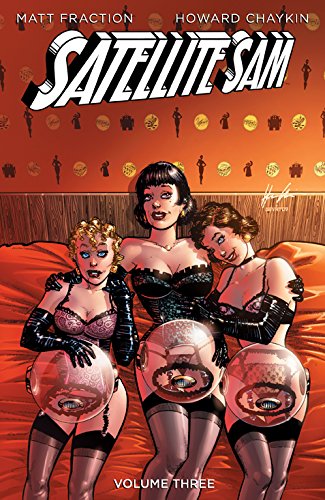
From the start, Matt Fraction and Howard Chaykin’s Satellite Sam set out to be more than just a standard noir. Certainly more on the tawdry side, emphasized by Chaykin’s illustrations, Satellite Sam contains a dirtier, uglier, and far more sinister America than we’ve seen historically in the noir genre, so much so that I feel a little scummy every time I read it (and even ickier when I admit to how much I really enjoy this series).

Volume Three, Satellite Sam and the Limestone Caves of Fire, marks the closing of the first major arc of the series. While the first volume sets the foundation for the series and puts the mystery of Carlyle White’s death into motion, the second and third volume move further away from the whodunnit component of the first and instead, focus more on the individual characters and their own focused minor arcs. In fact, by the middle of the second volume, you pretty much know the identity of the murderer; you stick along for the ride to see how the different people involved react and the peripheral plots develop.

51xC4-V-WoL

The Always Suggestive Cover of Satellite Sam

Now, with the murder mystery interest cast to the side, Satellite Sam emerges primarily as a work of pure mood creation, with its characters and storylines built to convey the underbelly of post World War II America and the bleakness, desperation, and abandonment of normalcy of not only those who fought in war but those who survived. This is the lurid America of The Naked City rather than that of Don’t Knock the Rock.

As mentioned in my discussion of the first volume, unlike the traditional noir, Satellite Sam reveals all of the debauchery that consumes people and discusses the social issues of the era with a freedom unaccepted in the 1940s and 1950s. From the dialog referencing the abundance of Antisemitism in the television world to the strained race relations seen through the tormenting of Eugene Ford, the first black man (though originally represented as white to audiences) to be on television, Satellite Sam captures the overall turmoil and tension of the era that we’ve looked back on with images of jukeboxes, poodle skirts, and Elvis Presley’s singing and dancing. Most significantly, the series concentrates on the deviant sexuality of the era we often recall as the age of the cheerful teenager. Running with America’s fascination with Bettie Page’s bondage images, Fraction and Chaykin use sexual perversity as their primary tool to explore a rotting America where sex is used as a weapon of power and domination. As a result, the sex never gets too sensationalistic; it is a symptom of a diseased state of being evinced by Michael White’s descent (and eventual sobering) as well as Carlyle White’s fall along with Reb Karnes’s and Madeline Ginsberg’s.

With this focus on the overall mood of the era, the third volume of Satellite Sam feels a bit anticlimactic, since the atmosphere and characters keep more interest than the sequence of actions as Michael White closes in on his father’s murderer and the conspiracy boiling up behind the scenes of the LeMONDE network. Consequently, this greater focus on telling stories about a time and place rather than just setting a story somewhere at sometime prepares the series for its extension. With volume three, Fraction and Chaykin have completed their portrayal of New York City in the golden television age, exposing the underside of what lies right under the cold, the dirt, and the garbage of the city. Now, it is time to begin a new tale about a new place…Los Angeles.

As a modern day recent transplant from the east coast to the west coast myself, I look forward to seeing how the cast of Satellite Sam will adapt and how perhaps they participate in the rise of what we know as television today. Unlike New York, which we see drawn in a dour black and white for nearly the entire city, Los Angeles is represented in color in a few of the closing pages of the volume. New York’s disease lived under and was the byproduct of the starkness and severity of the city. We’ll see where the depravity lies in Los Angeles for Michael White, Libby Meyers, Eve Nichol, and Eugene Ford. I’m guessing it will not be far from the spotlights, red carpets, well tanned skin, and sunglasses.

And most of all, I look forward to the new illustrations and short descriptions of the characters at the end of each issue, since after all, I myself enjoy a good bit of slick art and bylines filled with wit and a touch of sleaze.  

The Texas Western for All Ages: Yehudi Mercado’s Pantalones, TX

Standard

Westerns have a certain timelessness to them that will always attract me to the genre. We’ve certainly seen revisionist Westerns and modern adaptations, but there is this vacuum that Westerns create to place their stories and characters in a distant time and place without ever really becoming a period piece, which pulls me closer to works in the style. Oddly, I related to the Western films even though the only connection I had to them was the fact that I grew up in Texas, but even the Texas I knew was so far removed from that of Duel in the Sun and For A Few Dollars More that I had no reason at all to connect with the genre, yet, I felt this extraordinary bond with it, despite the fact that I am a Vietnamese-American female. After much contemplation, I realized that the gun play did not tie me to Westerns–their code of ethics did. Western rules for morality, though today often scorned as barbaric, felt more reasonable to me than those of modern times, and the Western sense of honor especially resonated with my Vietnamese-Buddhist upbringing.

Given my own fascination (and borderline obsession) with the moral undercurrents of the genre, I always wondered how I would interpret Westerns to children, especially since I myself did not begin to devour the films until I was a teenager. How do you adapt the archetypal bounty hunter into an occupation that is less egregious to explain? How do you convey governmental corruption? How do you represent differences between different regions of the United States without being overly simplistic and patronizing? And most importantly, how do you convey the Western essence of adventure, defiance, and triumph without using violence (since I’m certain that most parents will not want to explain the technicalities of a duel to a child right before bedtime; I know mine left that discussion to my American history teachers when they explained the Burr-Hamilton duel and how a cornerstone of American government died in such an ordeal)?

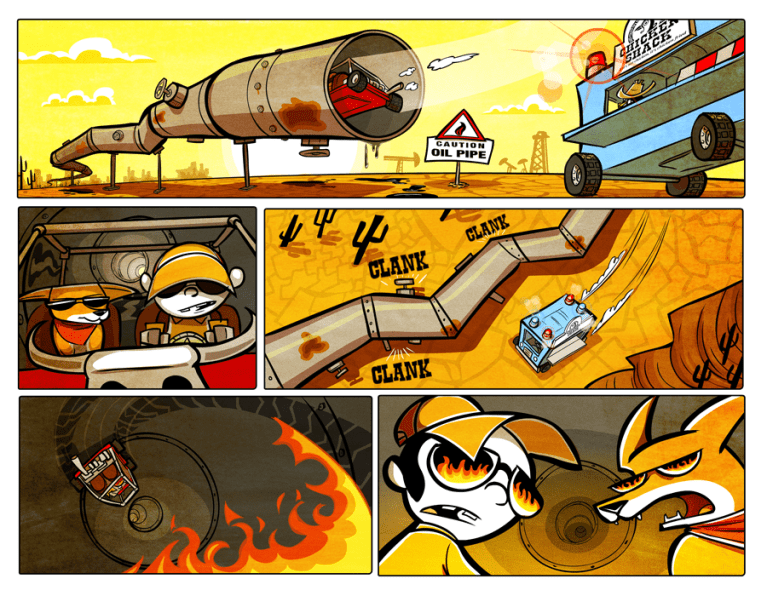
Yehudi Mercado’s Pantalones, TX answers these questions with the adventures of kid daredevil and wild child Chico Bustamente as he attempts to become a legend in Texas history. Chico, as the bold and flashy folk hero of the town of Pantalones, TX, channels the fiercely independent and outspoken persona of the bounty hunters of Westerns but in a bit of a more modern time and with more societal accepted intentions. Rather than chasing a band of criminals or seeking revenge, Chico aims to have his own page in Texas history, but to do that, he must do something that tests the limits of humans. 

To make his mark, Chico attempts to wrestle clouds, windsurf over thorny patches, and form a record large cannonball splash, but these stunts fail, since they exist to only accomplish a record, not really to change the face of history. Consequently, in order to get into the record books, Chico must accomplish something far bigger and far more impacting, even if he does not know it.

The Bright, Spirited Cover for Pantalones, TX

Thus, when Sheriff Cornwallis presents his prized giant chicken, his edge to defeat the rival Gengo County in the culinary contest of best poultry, Chico sees an opportunity to make his record; he bets he will ride the giant chicken for nine seconds. Chico and Pig Boy prepare for this day as Bucky, a vegetarian, does too, trying to scheme up a plan to convince Chico not to eat the chicken if he successfully wins the bet. Chico succeeds as the rider, but his adventure in the history of Pantalones is far from over after the ride. Post victory, Bucky convinces Chico to free the giant chicken, and rather than basking in freedom, the chicken, named Tony in order to give him somewhat of a persona, goes rogue and pulls a Godzilla on the town. With Tony tearing apart homes and businesses, Pantalones, more than ever needs a hero, and Chico rises to the occasion, eventually learning that his love for his hometown triumphs over his desire for fame.

Illustrated with vibrant colors and an overall vivacious joy, Pantalones, TX captures the attention and imagination of all readers. Like the narrative, the visual style melds traditional Western themes and styles with contemporary cartoon sensibilities, creating an overall playful take on the Western. Altogether, the action involved with all of Chico’s stunts and challenges keeps young ones entertained, and the sly jokes about Texas history balanced against a general appreciation for Texas as an odd melting pot of old and new cultures and beliefs adds a layer of complexity to satisfy adults. Pantalones, TX updates and transforms Western motifs for modern day audiences of multiple ages, making it a strong stepping stone into Westerns for young readers and watchers or anyone interested in seeing a lighter side to the genre.   

Beyond my enjoyment of the tales (and name) of Chico Bustamente, I love the Texan spirit of Pantalones, TX. As a fellow transplanted Houstonian, Yehudi Mercado manages to capture the peculiar relationship modern day Texans have with our home state. Along with Chico, we also understand that our hometown is by no means a perfect place (so much so that we no longer live there), but something about it has formed a part of our identity and, as a result, always remains in our hearts (and stomachs) to lure our souls and minds back, even if we never set foot in the state again.

Pantalones, TX by Yehudi Mercado is available via Archaia Entertainment.

A Bear, Purple Hair, and a New Home: Robert Goodin’s The Kurdles

Standard

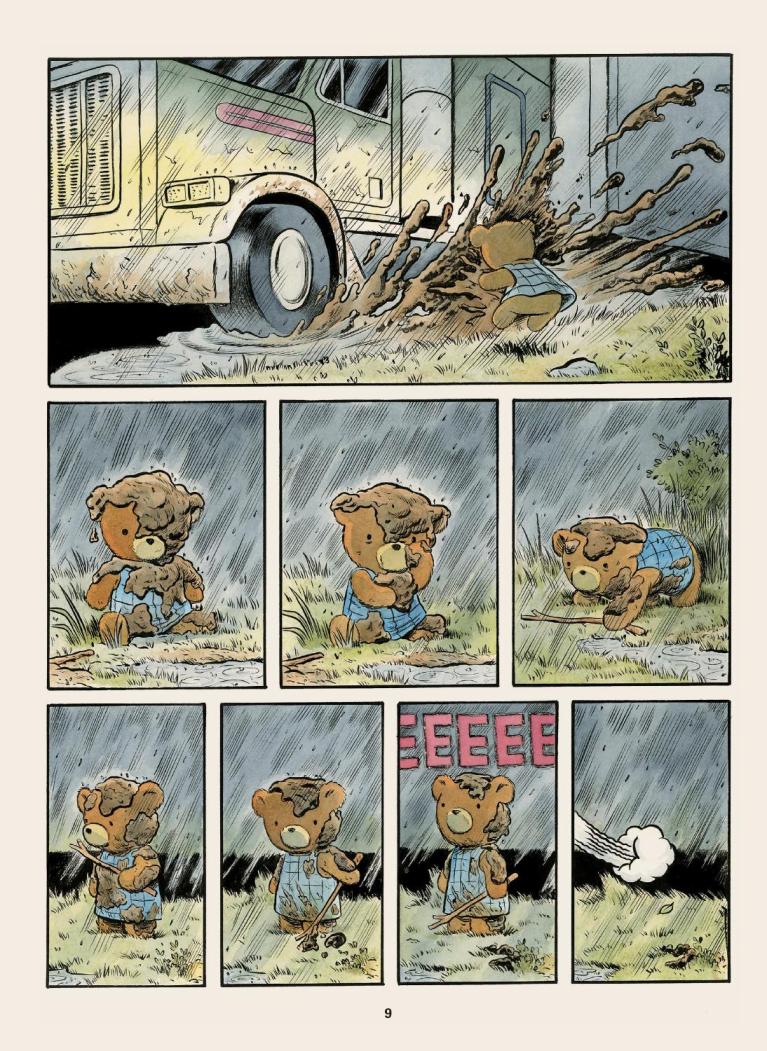
After reading Robert Goodin’s The Man Who Loved Breasts, which contained three comics with its humor slightly in the vein of Robert Crumb’s Snatch but with far more restraint and less genitalia, I did not know what to expect from Goodin’s first book, The Kurdles, a story with a tale and accompanying illustrations aimed toward children. However, when looking at the large album format and watercolor pages of the book, I knew I was in far different territory from the black and white clever and perverse pages of The Man Who Loved Breasts. And in addition to the different formats, the mostly non-human cast of characters of The Kurdles, led by a Snuggle-like, adorable bear, prepared me for a tale with just as much fun but far more innocence.

Cover for The Kurdles

The fundamental plot of The Kurdles is a simple one. Unwanted by her owner, Sally the bear gets lost in the forest where she meets Dog, Hank the miniature unicorn, Pentapus the five-legged color changing creature, and Phineas the little scarecrow. The group promises to help Sally return to the road to find her home, but only after they handle the disease plaguing their home. Consequently, Sally must return with the crew to their house, sick with a peculiar disease where purple hair grows and envelops it.

As the hair devours more and more of Hank, Pentapus, Phineas, and Dog’s home, it develops eyes, becomes a creature of its own, and begins to sing sea shanties, creating more urgency to find a cure in order to not only save the group from homelessness but also from insanity induced by the purple haired monster’s perpetual drunken songs. Consequently, Sally, originally a bystander, must jump into the mission to cure the house of the purple malady in order to try to make it back to her home. But instead of winding back up on the road in search of her owners who dismissed her, in the course of searching for a treatment and eventually creating and applying a yellow-green concoction to the house, Sally finds out the real meaning of the words home and family in the company of Dog, Hank, Pentapus, and Phineas.

Similar to other children’s tales of getting lost and finding a new home, The Kurdles distinguishes itself with a charming, inviting, and imaginative world and set of characters. While Sally is undoubtedly cute, so much so that you want to jump into the panels and give her a hug, Pentapus, Hank, and Phineas capture most of your attention. Pentapus’s color changes, sneezes and congested speech remind me of a goofier version of my childhood self in the midst of springtime allergies. Hank, the confident and somewhat temperamental unicorn, delivers some of the funniest insults, mumbles, and observations. And to temper the differences in personas between Pentapus and Hank, we have Phineas, the moderate, patient, and somewhat paternal of the bunch, who manages to keeps a level head throughout the course of the battle against the purple growth and leads the effort to take back the home.

With The Kurdles, Goodin makes a strong showing in his first venture into the children’s book arena. The sweet yet never sentimental plot influences the lovely artwork and vice versa, creating a complete work that will engage not only children but also adults. The setting and the characters are drawn and colored with the softness of Maurice Sendak’s Little Bear sprinkled with a touch of Dr. Seuss’s playfulness, humor, and imagination, taking you back to your own time of wide-eyed adventures and awe stemming from your own mental, magical creations. I look forward to seeing Goodin further develop children’s books, especially with further deviations away from traditional children’s storybook conventions and plots and more injections of his absurdist sense of humor and understanding of the oddities of the world as featured in The Man Who Loved Breasts

A nice, short escape from reality, The Kurdles accomplishes the balance of light and dark concepts to elicit sadness, sympathy, and joy, teaching children about the emotional spectrum ranging from despair to hope and reminding jaded adults of the same and all because of purple hair and inebriated sailors’ sea songs.

The Kurdles by Robert Goodin is available now via Fantagraphics Books. 

Long Beach Comic Con Spotlight: Sam Spina’s Hilarious and Fantastic Tarn

Standard

Oh, where did the weekend go? It’s early Monday morning, and as I wake from my short overnight nap, I think about the fast-paced, sensory-overloaded past two days at Long Beach Comic Con. Generoso and I will be providing our overview of our visit to our first major comic convention for Forces of Geek later this week, but for this week’s review, I wanted to select something from the many goodies we picked up over the weekend.

We spent much of our time at Long Beach in the many rows of Artist Alley, which reminded me of my beloved Hub Comics’ consignment section but scaled to a glorious giant’s size. Toward the end of Saturday, after attending panels and snaking through a majority of the tables, we stumbled (yes, actually stumbled because we only had a little under three hours of sleep from the night before) upon comic book artist and writer, Sam Spina.

Sam’s table included multiple standees of his characters and his table contained a dozen or so books in a varying array of colors and images, making our selection a difficult one. After deciding on a couple of items, a package of shrink-wrapped mini-comics caught my eye, and we added it to the modest stack.

Simply and elegantly packed with a cover card and a sticker, The Complete Tarn collection contains five sequential issues where four independent storylines in four separate issues crash into each other in the final one. Mr. Futts, Pigboss, Sans San, Mr. Harland all live in their own worlds until they all meet on the maiden voyage of the Titanic 2, a mammoth airplane flying to Brazil. Each character in some way is on the run from his own reality, and, in turn, the trip on the Titanic 2 most certainly allows them to depart from their existence. And, throughout each of these character’s worlds, looms the presence of Tarn’s head executive, Bich Bird, an omnipresent force throughout the series.

Cover Card for the 5 issue collection of Tarn

Part one introduces Mr. Futts who loves to eat butts; yes, that rhyme brought both me and Generoso laughter for well over an hour. In contrast to the struggling existence of Mr. Futts, part two presents Pigboss, an arrogant, self-obsessed, demanding celebrity with a highly successful police show on television. Across the Pacific Ocean in Japan, in part three, Sans San cannot get his life together. He has trouble starting and keeping any job he receives, and fortune always seems to run far away from him. In part four, we meet Mr. Harland, an egomaniac airplane builder and descendant of Edward James Harland, the founder of the firm that built the doomed RMS Titanic. Mr. Harland has built the Titanic 2, and despite all warnings from safety inspectors, the airplane will make its first flight on a course from Tampa Bay, Florida to Brazil. Finally, in part five, Bich Bird, the ruler of the Tarn corporation and really the universe of the Tarn series.

While each Tarn issue focuses on a completely different character, each packs no less amount of entertainment and outrageously funny dialog and scenarios. Spina’s absurdist and outlandish sense of humor shines and slaps you in the face throughout the concise and efficient series. Fully contained and realized, Tarn represents the pinnacle of how a developed mini-comic concept can come to outstanding fruition.

Tarn was exactly what we hoped to find at the Long Beach Comic Con. Completely devoid of pretension and filled with strange, bright comedy, Tarn has a distinctive and impressively spirited and succinct visual and narrative style that never becomes too self-aware of its humor and weirdness. Each issue stands alone as a solid piece of work, but together, the five issues create a perfect start to finish series that leaves no plot or character holes. While it may be considered as a sketch or a short exercise in plot development, Tarn exhibits Spina’s strength and surgical preciseness as an illustrator, storyteller, and humorist, revealing why it is of no surprise that he storyboards for the The Regular Show, a fifteen minute cartoon of pure whimsy, imagination, and fun.

The Complete Tarn demonstrates the effectiveness of minimalism and deliberate construction in funny comics. Despite its laconic approach, these wildly playful comics are as satisfying to a reader as butts are to Mr. Futts.

The Complete Tarn is available via Birdcage Bottom Books.

Alfredo Castelli and Lucio Filippucci’s Elaborate Steampunk Parody: True Memoirs of Docteur Mystere

Standard

A few weeks ago, while perusing through the used comics section at Amoeba Records, I picked up Alfredo Castelli and Lucio Filippucci’s True Memoirs of Docteur Mystere, No. 1: The Mysteries of Milan on a complete whim. With its science fiction, steampunk style, on a quick flip through the pages, the True Memoirs of Docteur Mystere appeared like something outside of my normal taste, but something about it intrigued me, and despite my usual genre and style preferences, I decided to give it a closer look.

This sense of undefinable instinctive allure I felt while deciding on purchasing this comic book continued as I delved into the early pages of The Mysteries of Milan.

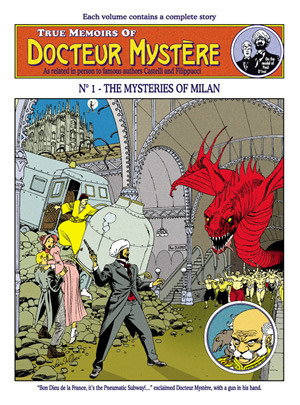
A dragon, mob of Chinese warriors, cathedral, damsel in distress, and silver train, all on the cover of The Mysteries of Milan

Docteur Mystere may be the most interesting and capable man in the world. He has a stupendous wealth of knowledge and skills gained from his extensive travels and interactions with every martial arts, monastic, criminal, and dark arts group in the world. Docteur Mystere almost possesses too many skills and knows almost too many people. He excessively fits his character as a Jules Verne-esque, savvy, and worldly hero.

Similarly, all of the other characters in The Mysteries of Milan fit their archetypes to excess. Lady B***, the truest damsel in distress and the woman who calls on Docteur Mystere to help find her husband who disappeared after completing his top secret pneumatic subway, cries out, “Virgin Mother,”and faints anytime she sees anything shocking. Chin, Docteur Mystere’s long-time friend and his accomplice and aid for the mission to find Lady B***’s husband, looks and speaks like he stepped out of a hybrid production between Flower Drum Song and a C grade knock-off of Enter the Dragon that you would see on cable in the wee hours of a Tuesday morning. Lastly, Cigale plays the all too ignorant and naive sidekick/assistant to Docteur Mystere, constantly making you ask, “Why in the world would such a great man as Mystere have such a nimrod for a sidekick?”

This question of Cigale’s existence exposes the intention of Castelli and Filippucci’s Docteur Mystere series, since the ridiculousness of his behavior and Mystere’s patronizing remarks to him hearken back to many comedic sidekicks we’ve seen before, especially Igor from Young Frankenstein and Cato from The Pink Panther. After Mystere’s third insult to Cigale, Lady B**’s fourth faint, and Chin’s fifth line in broken Chin-glish, you realize the True Memoirs of Docteur Mystere parodies the science fiction set in Victorian times fueling the steampunk movement. And when that elucidating moment of realization arrives, The Mysteries of Milan transforms into a rollicking, hilarious, and over-the-top adventure.

Beyond jests at the the science fiction of Jules Verne and H.G. Wells, The Mysteries of Milan also takes a stab at conspiracy theory fiction, particularly the works of Dan Brown. Released in 2004 at the height of the world’s obsession with Dan Brown’s novels about conspiracy in the Catholic Church, The Mysteries of Milan pokes fun at conspiracies churning in the catacombs of Italy and unveiled by what seems like an unrelated, isolated event. The entirety of this first issue of the True Memoirs of Docteur Mystere focuses on the search for Lady B***’s husband, but in the process, the search takes a step back from the foreground to give more importance to a mission to save the world from the sorcerer Fu Manchu. Lady B***’s husband may have accidentally gotten mixed up with Fu and his minions attempting world domination, so in order to find him, Mystere and Chin will need to figure out how to first defeat Fu, the ethnic caricature of Asians seen in literature in the early to mid 1900s.

Indicative of the sense of humor of Castelli and Filippucci, Chin and Fu have a history together, and Chin has been carrying around his own pinky fingers laced with magic powers for the day that he and Fu cross paths again. Fu cut off Chin’s pinky fingers, and Chin wants these severed digits to be his humiliating weapon of choice to destroy Fu. Consequently, the climax of The Mysteries of Milan contains outrageously funny illustrations of pinky fingers flying from an ornamented box toward Fu Manchu’s eyes. This battle scene, more than any other in the book, conveys the humor in the utter abandon of any sense of reality and the exaggeration of character and plot archetypes in True Memoirs of Docteur Mystere.  

Without revealing too much of the end, all of the hullaballoo to find Lady B***’s husband occurs in complete futility, completing the entire parody of science and conspiracy fiction that had transpired with a single punchline. The Mysteries of Milan ends without inspiring any sense of catharsis for the reader or any satisfaction of the answer to the primary mystery; it simply ends by provoking one giant, hearty laugh.

Clever and awakening in its humor, True Memoirs of Docteur Mystere: The Mysteries of Milan, points out the silliness of fiction set in complete fantasy where the characters are not represented as fellow humans. Admittedly, I loved Matt Fraction’s Five Fists of Science, the work I would consider to most resemble the type of story Castelli and Filippucci scorn with the True Memoirs of Docteur Mystere, but I do understand that there’s an absurdly ridiculous amount of suspension of disbelief required to read a steampunk type work like Five Fists of Science. In sum, Castelli and Filippucci mock the fiction that utilizes characters less as empathetic humans and more as devices to fuel an extravagant plot and to establish and perpetuate a mood and setting, which could apply to multiple genres, but unfortunately, science fiction of the steampunk variety is the major culprit of this style and, in turn, makes itself most susceptible to their parody.

Sadly, the wittiness of Castelli and Filippucci and their True Memoirs of Docteur Mystere only lasted for two issues. It must have turned off science fiction fans, and fans of more realistic fiction must have completely bypassed it. I still do not entirely know what lured me in based on just the cover and a few cursory page flips, but I’m so glad my instinct picked up on the gem hiding inside the overwhelmingly busy, action-packed, and insane cover.

The Timeless Humor and Wit of George Herriman’s Krazy and Ignatz

Standard

Last Sunday, Generoso and I visited the Los Angeles Comic Book and Science Fiction Convention on a bit of whim. The first comic book convention for us, we did not know what exactly to expect, but we nevertheless entered the room of The Reef exhibition space like bright eyed toddlers when we caught sight of tables of vintage comics, stands of toys, and wire racks and bins of hard to find DVDs.

While most of the convention was dedicated to comics of the DC and Marvel universe, one exhibition table stood out from all of the others, and that was the stand of Tony Raiola Books and his Pacific Comics Club. After walking up and down the rows of The Reef, strolling by the line to meet Hayley Atwell from Agent Carter, and searching through bins for any underground comics, Tony’s table lured me in with an extensive collection of Italian comics, including multiple English volumes of Milo Manara’s gorgeous and almost dangerously erotic comics. Then, the Raiola area quickly reeled in a Generoso with multiple Flash Gordon collections available in large print with vibrant, stunning colors.

After extensive internal debate on what to take home, especially given that we only had only a bit of cash left, and the ATMs in the building had been drained, we decided on a three volume collection of Krazy Kat daily strips from one of the original fathers of alternative, underground comics, George Herriman.

As a fan of Harvey Kurtzman and Robert Crumb, I’ve always seen George Herriman’s name in their company but had yet to encounter a collection of his work in comic book stores. Fantagraphics has printed multiple volumes of his work, but for the most part, they are only available online. Consequently, when I saw the paperback volumes of Pacific Comics Club Presents Krazy and Ignatz, I knew I could not leave without them.

4389028-pac1

Cover for the Book 1 with the strips printed in 3.25 x 4 inch blocks

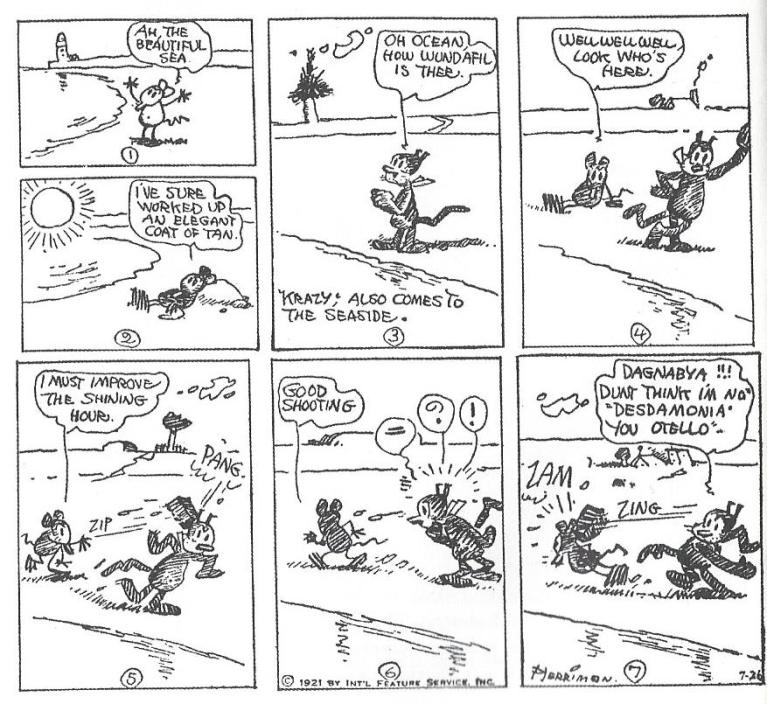
Book one of the Krazy and Ignatz volumes collects Krazy Kat daily strips from January 1921 to December of the same year. Upon opening the book, what immediately catches your eye is Herriman’s boldness, outlandishness, and intelligent playfulness in Krazy Kat. Despite its age, the Krazy Kat comics, like the silent films of Charlie Chaplin, still pack laughs while tackling some high political, social, and artistic concepts in a welcoming and relatable form.

Each page of the book contains one strip, more often than not beginning with Krazy Kat or Ignatz talking about something and always ending with Ignatz delivering a brick to Krazy’s head paired with a clever, laugh out loud punchline. Sure, this may sound repetitive after 300 pages, but each Krazy Kat and Ignatz strip has its own fascinating story, and despite the same start and ends, each strip has a different path to travel between the two points.

Beyond the timeless absurdist humor embedded in all of Krazy Kat that consistently reminded me of W.C. Fields (a Fierro house favorite), the various topics addressed by the strips pushes the series far ahead of its time. First and foremost, the ambiguous, possibly sado-masochistic relationship between Ignatz the male mouse, and the sometimes male, sometimes female Krazy Kat almost shocks even a modern day reader. Krazy Kat pines for Ignatz and his bricks as Ignatz gains pleasure from tormenting Krazy. In addition, Herriman implicitly yet keenly addresses race relations between Americans, illustrating Krazy Kat with black fur and Ignatz with white fur and occasionally swapping their colors. And in between the Krazy Kat and Ignatz frenzy stands Officer Pupp, the policeman of the town, who has an overwhelming affection for Krazy Kat and always tries to protect him/her from Ignatz, though such a thing stands against Krazy’s desires.

Beyond the advanced understanding and representation of dysfunctional relationships between people (though conveyed by animals), Krazy Kat and Ignatz also addresses blue laws, prohibition, race relations, and English language and societal idiosyncrasies, presenting questions about the various aspects of life we encounter but all with a smirk. In addition to these political and societal topics, Herriman also plays with the cartooning form itself, having Krazy and Ignatz interacting with drawing elements on the page such as a horizon line or adding in his own commentary about the colors of objects, since the strips were printed in black and white.

Above all, Herriman constructs a distinctively humorous and fantastical set of comics with the dailies of Krazy Kat. Light on his feet with his story and illustration techniques and sharp as a tack with his wit, George Herriman set the foundation of comics and cartoons in the generations to come. After reading Krazy and Ignatz, you’ll see his influence everywhere ranging from Looney Tunes to Tom and Jerry to The Simpsons to Crumb’s Fritz the Cat to maybe even George Orwell’s Animal Farm (after all, Herriman did very early popularize in media the practice of using animals to satirize human behavior), signifying his lasting impact on our culture, even if his name may not exist today as a household one.

Go out and pick up the Pacific Comics Club collections of Krazy and Ignatz; you’ll get paradoxically transported back to the 1920s and forward to an almost outer space planet/desert with the bizarre, smart, and fascinating comic styling of George Herriman allowing for constant laughter and self-reflection throughout your journey.

A Story for All Ages – Diana Thung’s August Moon

Standard

While I spend most of my media consumption focused on adult-oriented works, I always savor a breath of fresh, more optimistic air when I get the opportunity to enjoy a work made for both children and adults. Let me reassure you, I’m not one of those Disney Princess loving gals that lives with a constant childish naivete; however, I must admit that sometimes, when I’m feeling somber about being an adult, I enjoy reading a book or seeing a television show made for kids, since the best children’s content can approach serious topics with whimsy and spirit, which is sobering for an adult jaded by reality. Refreshingly, such an awakening occurred for me with Diana Thung’s August Moon.

Cover for August Moon

Filled with bright imagination, August Moon most resembles the Japanese folk tales I recall reading as a child. I have fond memories of tip-toeing out of my room to a wire shelving cart in the living room on quiet Saturday mornings when no one was awake to read stories filled with mysterious visitors, giant peaches, altering gusts of wind, and magical fish. Around the age of 7, I was introduced to the world of second hand books, and on one of my visits to what felt like an enormous warehouse (which in retrospect was just a two story bookstore), I found a hardback collection of Japanese folktales for a few dollars and asked to take it home. That collection remained on the wire shelving for years, and on Saturday mornings or lazy afternoons, I opened it up to read a new story or to re-read one I wanted to recall.

These Japanese folk tales could have elaborate mythologies, but those fictional components remained distinctively grounded in reality, making the tales more relatable as they taught valuable lessons in honor and kindness. Like these Japanese tales of my quiet Saturdays, August Moon has an intricate and playful mythology of fictional creatures, but these creations of pure imagination exist in a reality not too far from our own, allowing the book to convey its core teaching without ever getting dogmatic or severe.

In August Moon, Fi Gan returns to Chino, her mother’s home city, one that time has somewhat forgotten, when her scientist father receives reports of the discovery of a potentially undiscovered species. As the daughter of a pragmatic scientist, Fi hardly believes in anything beyond what her own eyes can see and remains distant, passive, and overall, stoic. Fi takes pictures to document her experiences, but she hardly seems to experience anything at all, including feelings of grief for her mother’s recent passing.

But, Fi’s indifference cannot remain in a city like Chino, where belief in the unknown still exists and most likely for a reason. Chino has no factories; its economy runs on the shops and the food carts that provide to the community. Beyond its own efforts to sustain its own people, the community of Chino also takes great pride in the nearby forest and spends much time and care preserving it and allowing it to remain as untouched as possible. Consequently, much of the forest remains undiscovered, leaving much to the imagination of Chino’s citizens.

Of the stories of creatures seen in the forest and around Chino, the tales of Soul Fires, creatures who carry the spirit of past ancestors who light up the sky, dominate the myths of Chino. Children report on seeing them as large rabbit/hamster/bear-like creatures, and many adults recall seeing them too, so Soul Fires have been woven into the culture of the city. In fact, the Soul Fires play such a large part of the Chino’s heritage that a yearly festival exists to celebrate them.

Fi and her father arrive to Chino in the days before the festival, led by Fi’s uncle, Simon Bo. The Bos, Fi’s mother’s family, have long resided in Chino, and as a result, they have more imagination, faith in the unknown, spirituality, and a love for the phenomenons of nature. On the other hand, the Gan side of the family, has lived more in an industrialized world, so they place value on the pragmatic, especially in science. Since her mother’s passing, Fi has experienced mostly a science perspective on life, but everything changes when she meets Jaden, the leader of the children of Chino and a boy with a super-human ability to move quickly and to leap long distances.

After befriending Jaden, Fi meets a Soul Fire, and quickly, her father’s rationality driven upbringing fades away. A group of industrialists known as the Monkeys have discreetly entered Chino and have plans to eliminate the Soul Fires, the forest, and the overall spirit of Chino, and in order to prevent the Monkeys from laying siege on the beloved forest and city, Jaden will need Fi’s help. However, in order to help, Fi’s demeanor must change; her disaffect and disbelief must turn into passion and care. She must begin to engage with other people, and she must begin to express a full spectrum of her emotions, since only these definitively human tools will help to give her the courage and strength to support the battle against the Monkeys.

2010-02-25-30403c64

Fi Meets Koo, a Soul Fire

Despite the adorable visual representation of the Soul Fires, August Moon never patronizes its audience and never feels cloyingly sweet and sentimental. Over the course of Fi’s transformation and battle against the Monkeys with Jaden, Diana Thung masterfully blends moments of lightness and darkness and fantasy and reality together to create an awe-inspiring story for children and captivating plot for adults. With the Soul Fires, Jaden, and Fi, Thung creates a tale that not only entertains but also teaches people, regardless of age, to understand the destructive environmental, cultural, and societal effects of industrialization and technology. While the work of the Monkeys will surely damage the land, it will also bring with it a disregard and dismissal of forces beyond humans, and that, may be the most devastating loss of all.

August Moon discusses a highly adult concept but without any air of pretension or heavy-handedness, making it highly effective, for the book can facilitate discussions across and within multiple generations. It has plenty of whimsy and action to pull in children, and it has absolute relevance to adults’ present and past. Given this balance of material for audiences of different ages and according experiences, August Moon simultaneously returned me to those Saturday mornings of my own childhood and kept me in my current reality, allowing me to enjoy it with both a childish joy and an adult perceptiveness along with my own ageless, timeless fascination for engaging storytelling.

August Moon by Diana Thung is available via TopShelf Productions. 

Filler Bunny Becomes Filler: The Collected Works of Filler Bunny

Standard

Over the course of media and art, the creative process itself has stepped into the foreground as a topic of discussion around and in works. Some have succeeded in capturing the turmoil and the joy of creation while others have wallowed in pretentious failure. To understand the creative process of a piece of art or media, there have been two approaches: a realistic, documentary one or a metaphoric, symbolic (and often surrealistic) one.

The Collected Works of Filler Bunny takes the more fictional route of the two. Filler Bunny documents the struggles of a dark, bizarre comic book creator, such as the comics’ own, by putting Filler Bunny through torture and suffering as the fictional creator of Filler Bunny, as a character and as a comic book series, has enormous difficulty filling up the pages for each story. At its best, Filler Bunny entertains with its clever bouncing between the creator’s and the bunny’s world, and the breaking of the walls between them and you as a reader.  

Cover for the Collection

Filler Bunny speaks to you and his creator, and the creator does the same, leading to a fascinating concept of Filler Bunny literally filling the pages in nonsense scenarios his creator puts him in as the creator himself attempts to beat the clock to deliver his work with some level of quality. Given that Filler Bunny as a concept within the series exists to only meet a deadline, no limits exist on what he can or cannot do to pass the time on each page. Filler Bunny eats a lot, poops often, sees his new friends killed off, and gets frequently tortured throughout the collection, and as a result, he also spends a lot of time begging the reader to end his existence for him. Filler Bunny lives an iterative existence of pain and suffering; rather than filling the pages up with plot lines and character arcs, the creator makes Filler Bunny repeatedly experience horrible situations and wish for change.

At its core, Filler Bunny serves as a comedically bleak and nihilistic discourse on the purpose of creating characters and storylines in a comic book. Each story seems almost like a surreal daydream or nightmare coming from Vasquez’s twisted mind asking himself, “What if I created a comic book character used only to fill pages?” Rather than creating lukewarm B-side pieces, Vasquez’s fillers jeer at the idea of creating filler comics in the first place, making the first Filler Bunny encounter quite fun, silly, and even smart.

Unfortunately, the novelty of parodying the idea of creation only for creation sake in Filler Bunny wears off quickly, especially as the grotesqueness of the comics amplifies from story to story. By the second story, “Revenge! of the Filler Bunny,” the comics already begin to lose their initial charm. As Filler Bunny continues to get tortured by his creator, he becomes mediocre filler, the one thing he was created to defy. Filler Bunny takes beating after beating in one over-extended joke; Vasquez tries to make the tormenting more ridiculous over the course of the stories, but the repetition of Filler Bunny’s distress delivers fewer and fewer laughs, leading to a state of general boredom.

As short exercises, Filler Bunny may have served its purpose to transition between stronger stories and to poke fun at filler at the same time. However, when collected together, their disgust-inducing approach for the meta-analysis discourse on creation wears far too thin, lacking any change or exploration of new ideas into how Filler Bunny can fill a page. I would have loved to have seen Filler Bunny waiting in line at the bank, Filler Bunny watching his favorite movie, or Filler Bunny feeding his pet lizard. Other ways for Filler Bunny to pass time would have made the series funnier and more engaging and less dependent on revulsion as a mechanism to deliver Vasquez’s own exploration of how creating something can feel so futile.

After the first story, “Filler Bunny in I Fill 15 Pages,” I so badly hoped the collection would succeed, since the core idea of the comics was a strong one, but after the tenth time of seeing Filler Bunny raped by a monkey, all of that hope disappeared. Perhaps I’m too normal for Filler Bunny and its sick world; I just get far too tired of comics that overuse shock and vulgarity as their only devices for satire. Call me square, but one moment of projectile intestine expulsion is one too many in a comic collection…

Jhonen Vasquez definitely has talent, imagination, and a distinct perspective as seen by his work on Invader Zim, and perhaps that is largest disappointment of Filler Bunny. Vasquez could pack so much more into Filler Bunny, but his unrelenting toilet humor prevents this collection from developing beyond a pubescent teenager’s scribbles in class or in a dark basement at home. Filler Bunny could have progressed into a witty and astute statement on creation, but instead, it goes down an excrement and assault filled road, losing sight of its original intention and its fundamental joke, making it the filler it dreaded and teased to become.  

The Collected Works of Filler Bunny by Jhonen Vasquez is available via SLG Publishing.