The Human and Uncanny World of Ripple

Standard

Ripple is strange. Very strange.

Well, maybe not.

Cover of Ripple

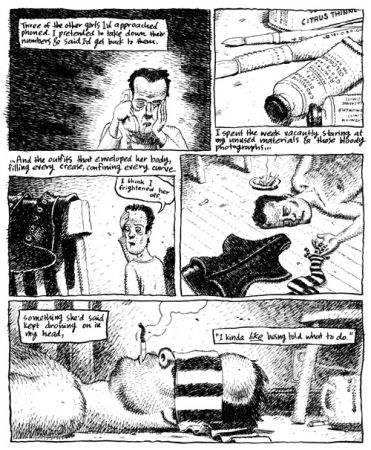
Martin, the narrator of our story, is an uninspired illustrator. After failed attempts at making underground comics, his entire existence has morphed into a cotton candy malaise as he spends his days illustrating facile children’s books for a post-Barney generation. Upon the notice of an unexpected grant award, Martin’s stupor of indifference quickly ends.

In trying to muster up any piece of inspiration, Martin decides that his grant will produce paintings for an exhibit tritely titled, “The Eroticisim of Homeliness.” What begins as a dull concept of trying to paint conventionally unattractive women in an erotic light spirals rapidly out of control when Martin meets his first model, Tina.

Tina, by no means, is a physically attractive woman. She has the grace of a boar. She is unkempt and slovenly. She has the most peculiar canines, almost like those of a dog. She is completely untamed.

Tina’s personality does not have much to allure either. She’s not quite the sharpest girl. She lacks manners. She lacks tactfulness. She lacks the ability to consider the feelings of others. She is completely hedonistic in her philosophy of behavior.

Regardless of Tina’s lackluster, almost grotesque image and persona, Martin becomes completely infatuated with her, in a suffocating and overwhelming way that he cannot understand. His obsession is both carnal and transcendent. He physically longs for her and simultaneously hungers for her love. He is completely enamored.

Ripple is the complete recounting of Martin’s obsession with his subject Tina and their resulting relationship: their meeting, their physical encounters, and their end. It is more than just a tale of an artist-subject infatuation; Ripple is a character study of Martin, the artist, in the confines of his vacuum of a world. As Martin becomes more and more enraptured by Tina, we slowly begin to understand his seemingly mysterious, irrational desires for her.

Prior to Tina, Martin’s life lacked any emotional dynamic range. He lived at a stasis with his art, with his apartment, and we can assume with his love life. Love was abstract to him, derived from books and poems and never from any human encounter. He lived a life of complacency, rarely emoting and experiencing the feelings that are unique to humans.

Consequently, in facing Tina, Martin’s stasis ended. With Tina’s purely hedonistic sensibilities, Martin finally experienced and felt the highest range of excitement, joy, and lust and the lowest embarrassment, sadness, and disappointment. Though Tina was not his normal, “type,” Tina’s inability to even be classified leads Martin to his first time to actually experience the full emotional range of a person in love and to achieve the concept of the Ripple, the sensation of a complete disconnection from reality and the entrance into a world of complete consumption of another person. The Ripple is the heightening of pure sensuality in a way that is completely incomprehensible unless you have experienced it. For him, the Ripple is a completely abstract concept at first and one that Tina mocks him for until the two finally enter the Ripple at the climax of their relationship.

Regardless of the outrageousness and possibly sensationalistic sexual encounters between Tina and Martin, Ripple is a study of the compromises we make in life and how they affect our perceptions and preferences of sexuality, a topic well discussed by Bertrand Blier’s Too Beautiful For You, a film where a wealthy car dealership owner has an affair with his homely secretary. In living a complacent life, free of any major imperfections or traumas, one’s irrational desires and tendencies get displaced. All of the paths it travels are unknown, but in Ripple and in Too Beautiful For You, it goes toward sexuality.

By the end of Ripple, for Martin, love is no longer a flowery concept, no longer an abstracted, holy, sacred concept. It is tied to the earth, tied to Tina and the reality of all of her imperfections. The book itself is his attempt to pull apart this phenomenon of his desire for her, but she is gone, leaving him with a new sensation, irreconcilable love and longing.

Martin is certainly not well. His encounters with Tina were definitely unsavory, but, he has now at least experienced something more human than anything else in his normal, pallid life and can perhaps return to illustrating children’s novels without such complacency and maybe, just maybe, can create something inspired. This book is at least a good start.

Ripple by Dave Cooper is available via Fantagraphics Books.
 

Love and Faith and Growing Up in Craig Thompson’s Blankets

Standard

PREFACE: My dearest friend Samantha Fleitman brought up the graphic novel I am about to review two summers ago when she found out that I was beginning to delve into the medium. The seasons progressed, and I began to read more and more and constantly forgot to read Blankets. I must admit that it was somewhat due to the intimidating length, but that’s a lame excuse. Alas, on Friday, I determined that THIS was the weekend that I started and finished Craig Thompson’s Blankets, and it is thus the subject for this week’s review. Many thanks to Samantha for the recommendation!

Blankets Cover


Released in 2003, Blankets is a bit older than what I normally review here, but given the relevance of its message and narrative, it is by no means a dated novel (after all, all of the 2000s seem kind of like a blur to me anyway). An autobiographical coming of age story for Craig Thompson, the creator, Blankets intimately follows Craig’s transition from a young boy to a young man. A hybrid of the Bildungsroman and the Künstlerroman, Blankets simultaneously weaves Thompson’s more abstract battles with his spirituality with his very Earth-bound battles with family drama, bullying, and love. In the process of mixing these two realms of conflict, Thompson’s persona as an artist and voice as a storyteller emerge.

Born to an evangelical Christian family, Thompson grew up in rural Wisconsin as an outsider, with his family’s lower middle class status and his mother’s extreme evangelicalism casting him as a pariah among his secular and Bible school classmates. The first eighth of Blankets gathers and develops the context of the creation of Thompson’s voice through non-linear moments from his childhood and adolescence. From a very early start, Thompson has a strong connection with the Bible and a complementary guilt complex nourished by his family and his conservative church. He is a quiet boy often picked on in school, and in turn, is often the catalyst for arguments at home with his brother, Phil.

After the introduction of young outcast Thompson, the narrative begins to linearize as a teenage Thompson meets Raina, his first love, at church snow-camp. As the other campers ski and snowboard, Raina, another outsider, and Craig ditch chapel hours and spend time getting to know each other. After the end of camp, the two begin their enamored long-distance relationship.

The blossoming and growth of Craig and Raina’s relationship dominates the rest of the novel, which seems like it could lead to boring or stereotypical comments and details about young love, but Blankets opts for a much different course. Thompson, in the narration of the relationship between him and his first love, ties in fragments of his childhood and moments of her childhood, building their relationship in a naturalistic, anti-hyper-dramatic, and even in an anti-sexual way. As their relationship progresses, Thompson builds Raina into a nearly saint-like character with the way he worships her for her natural beauty and poise in the midst of handling her parent’s divorce, caring for her mentally disabled older brother and sister, and nurturing her niece whose parents completely disregard. Mixed into all of the storyline of Craig and Raina are moments of Thompson’s reality as a soon to be high school graduate considering ministry school and as a young Christian who is perpetually connected and disconnected with the Bible and afraid of disappointing God, making this coming of age tale more layered than a basic story about a young person trying to deal with his or her current circumstances at home or at school.

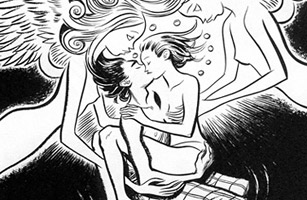
By the end of Blankets, much of the original dogmatism of Thompson’s Christianity has eroded, with the method of the erosion being the grand strength of the novel. In the process of placing Raina up on a pedestal after spending two weeks with her in her home in Michigan, Thompson feels conflicted between earthly love with carnal desires and divine love with reverence of a superior, perfect being. In worshipping Raina,  his love for her is that of into divine love instead of love between two partners, making it almost too suffocating and overwhelming to Raina when the two are apart.

When Raina calls Craig to end their romantic relationship, he begins to attempt to reconcile the concepts of earthly love versus divine love which then transitions into reconciling religious fervor versus piety. As Thompson becomes enraptured by the book of Ecclesiastes, his faith moves away from the blinded, fervent devotion of a divine, infallible, omnipotent being who must be worshipped in the Church with song and ritual. Gradually, he begins to discover more of the gifts and powers of God through the earth itself through his admiration of all of God’s creation, with the understanding that it is all fleeting and transforming.

From this enlightenment of faith, Craig also realizes that his love for Raina is unsustainable and ends their friendship, for his abstract love for Raina prevents him from understanding how to love her as another fallible human being. In a moment of parallel symbolism, Craig destroys all of the gifts Raina had given him (with the exception of a quilt) that have become idolatry for him, paralleling his concurrent distancing from the church and the eventual hiding of his Bible. By placing God, Christ, and Raina on a pedestal of perfection, Craig is unable to fully develop his true sense of faith in God and love for another human, stunting his ability to make a decision to move forward with his life because he views himself as an inferior being. With the discovery of his faith and his understanding of his relationship with Raina, Craig makes the final change in his path with his decision to go to art school after graduation, a decision which he could not make because he once feared that going to art school would be sinful.

By the end of Blankets, Craig returns to his home as an adult, and re-discovers his Bible and his quilt. His faith no longer involves the devotion to a perfect being and the consequent fear of offending God, and in parallel, his thoughts of Raina become more bound to his experiences with her. By the end, Craig’s faith and belief stems from learning the teachings and actions of Christ on earth, reminding him that the beauty and admiration of Christ lies in his interactions with people, and not as simply an omnipotent deity in the sky. And simultaneously, the beauty of his relationship with Raina lies in their time together in each other’s company as human beings, and his admiration of her lies in her character’s strength in being able to gracefully continue with love and affection through a difficult time rather than her existence as a pure, perfect saint.

Blankets is a beautiful coming of age story that captures so much more than just a first love or a first major conflict. It weaves together multiple crises of familial, societal, and spiritual origin to allow us to comprehend how the growth and shift of our individual belief systems manifest into our actions and our relationships with the people and the world around us.

Blankets is available via Top Shelf Productions.


The Return to Noir Fundamentals in The Fade Out

Standard

It’s been over seventy years since film noir was at its peak, but the genre and its framework seems to never have left our culture, with iterations, updates, and transformations in films, novels, and of course, comic books. With so many new takes on the noir, it was oddly refreshing to read The Fade Out, a series that goes back to the fundamentals of this embedded genre.

Issue One Cover

The Fade Out centers its mystery on the murder of Valeria Sommers (birth name: Jenny Summers), the young starlet on the course to becoming the next Veronica Lake. The year of our story is 1948, a year where all of America was on its toes. Pearl Harbor and World War II had put people on alert for any signs of physical attack, and anti-communist sentiments had people on alert for any signs of cultural attack. Despite the victory of World War II, America still had some paranoia about what major force will be faced next, and it looked like communism was it. With America on the brink of full McCarthyism, the industry that would feel the brunt of it, the film industry, had begun to experience the rising concern about communists infiltrating media.

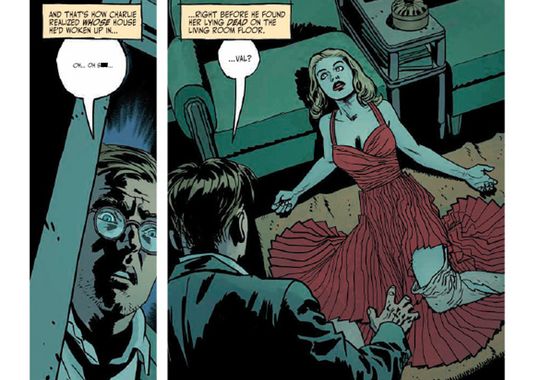
Set in the iconic noir location of Los Angeles, the narrative of The Fade Out is carried by Charlie Parish, a screenwriter for a studio on the edge of failure and the oddly lighthearted but very confused narrator of the series. Issue One introduces us to Charlie as he wakes from a drunken coma in an unknown apartment and tries to recollect the night before. As his blurred memories gradually become clearer and as he walks through the apartment, he realizes that he is in Valeria’s bed in her apartment and finds her murdered Valeria in the room next door. The discovery of her body incites panic in Charlie because it must have happened while he was asleep in the next room, but he has no memory of waking up to any disturbance. What entails is Charlie’s attempts to further recall the details of the party he attended and to wipe away evidence that he was at Valeria’s apartment in fear that he may be considered as a suspect. The main case to solve in The Fade Out is a pretty traditional one with a setup almost identical to that of Clue; we know the set of suspects, and we follow Charlie along as he tries to piece together each of their potential motivations to kill Valeria. On the murder mystery plot line alone, The Fade Out is motivating and attention-grabbing. However, what makes The Fade Out a series that I look forward to is its incorporation of the rich political and cultural environment of the late 40s.

Issue Two Cover

At the height of noir in America, films could not fully incorporate a wide range of subjects ranging from sexuality to political climate, and they certainly could not discuss the ugly details of the impact of McCarthyism on the film industry itself. With The Fade Out written in current times, the creators have the opportunity to enrich the noir story with relevant cultural and political topics affecting America’s film industry in the late 40s, and they certainly take advantage of this more open creative license.

In the core murder case, the details of the film studio’s actions to cover up the circumstances of Valeria’s death in order to avoid scandal enhance the narrative by leaving Charlie as the single person to acknowledge that Valeria was in fact murdered and as the only person left responsible to find her killer. In retrospect, we now know about film studios’ actions of megalomania and monopoly in the 40s and 50s, but in no way could those be addressed in the films made by those studios at the time–that would absolutely setup a conflict of interest. But given that The Fade Out is written today, those details of truth manipulation can now be included, making the setting and narrative more engrossing and setting up the onus on Charlie to find the perpetrator alone without the intervention of any law enforcement, making the perspective of the mystery even more alluring.

In addition, one of the most captivating sub-plots in the narrative is that of Charlie and Gil Mason, a story that could have never been addressed on film on the brink of McCarthyism. When Charlie entered the film industry, Gil served as his mentor, but after Charlie’s stint in the war leading to perpetual writer’s block and Gil’s communist sentiments preparing him to be blacklisted, Charlie and Gil become embroiled in a cover-up scheme that could only occur in the late 40s and could only be explained in a narrative written today. For me, Charlie and Gil’s tumultuous working and personal relationship drive the narrative and augment what would otherwise be a fairly standard murder mystery. Given the belligerent and oddly sympathetic nature of their actions, Charlie and Gil’s conversations and actions with each other emerge as the star component of the series.

As with any noir adaptation set in the 40s and 50s but written in modern times, The Fade Out contains more explicit details of sexual hedonism alluded to but never allowed in the films of that era. Unlike in Satellite Sam, sexuality does not exist as the core device of re-imagining the noir for The Fade Out. The update to the noir here really occurs through the integration of political and cultural artifacts and sentiments into the main plot and subplots of the series. The Fade Out sticks to the basics of the noir genre, but it rises above a classification as a noir duplication in its ability to use history to make a period piece come alive and engage readers who are almost three quarters of a century removed from the original setting. It may not be the most groundbreaking series, but for those who like history, mysteries, and noir, The Fade Out, with its earliest issues, seems to have potential for strong narratives and fascinating characters and relationships.

The Fade Out Issues One and Two are available now via Image Comics.

Hawkeye vs. Deadpool, the Unlikely Couple to Save the World

Standard

This week, when I traveled to my local comic book shop, I was thrilled to find the newest issue (#20) of Hawkeye. For me, Fraction and Aja’s take on Hawkeye was my entry point into the world of graphic novels and comic books, and it is a series that I perhaps hold a little too dearly to my heart. Sadly, my excitement faded when I found out that the issue was a Kate Bishop one rather than a Clint Barton one (especially after #19 which is almost entirely written with sign language). I’ll cut my criticisms short on the Kate component of the Hawkeye series and just say that the narrative for Kate’s story arc is lackluster and pallid compared to that of Clint’s.

In light of my disappointment, a neighboring series caught my eye because I am now programmed to take a look at anything that has the name “Hawkeye” on it. Hawkeye vs. Deadpool is a new Marvel cross-pollination hero series, with issue zero released in September and issue one released in October. Superhero collaborations, be it two heroes or teams of heroes, are always a little dicey. Like greatest hits albums, which will often only include the most popular tracks and only show one side of an artist, superhero collaborations often lose the nuances and the intricacies of the characters involved and end up showing only a more polished version of the skeleton of the main subjects. However, the best thing that a summary/compilation album can do is introduce you to the fundamental core of an artist and encourage you to explore beyond. Similarly, collaboration/crossover narratives in comic books can do the same, and Hawkeye vs. Deadpool is one of those superhero combinations that facilitates the desire to dive deeper into the individual characters involved.

Artwork for Issue Zero Cover

Artwork for Issue One Cover

Hawkeye vs. Deadpool introduces us to Clint Barton’s and Deadpool’s vastly conflicting personalities and tactics as superheroes, with Clint as the semi-diplomatic and semi-reasonable member of society and Deadpool as the brash and semi-caustic mutant. Both have senses of humor that also acutely reflect their personas, making their interactions with each other the bright star of this series. The action part of the story focuses on the two trying to prevent a S.H.I.E.L.D. hacker from causing harm, but the real meat of Hawkeye vs. Deadpool lies in their uncanny working relationship; the two oddly have a similar relationship as Peter Falk and Alan Arkin in The In-Laws (1979), with Hawkeye resembling Sheldon, the mild-mannered dentist, and Deadpool resembling Vince, the impetuous businessman and possible CIA agent. Both pairs are in desperate situations and must rely on non-ideal partners to try and save the day. Consequently, in their bickering and in their comedic moments of miscommunication, Hawkeye and Deadpool, like Sheldon and Vince, become characters that you care for, cheer on, and want to learn more about.

Don’t expect an insightful commentary on humanity through superhero metaphors from Hawkeye vs. Deadpool, but do get excited for its silliness and its pure entertainment and comedic value. Though not a masterpiece, Hawkeye vs. Deadpool achieves what it sets to accomplish: a fun integration of two unlikely heroes and personalities. In addition, I am not familiar with the new Deadpool series, and I am now motivated to read it, which makes Hawkeye vs. Deadpool all the more successful in its endeavor.

Hawkeye vs. Deadpool issues #1 &2 are now available via Marvel comics.  

The Myths of the Afterlife with Ten Grand

Standard

In anticipation of its second volume’s release next month, for this week’s graphic novel pick, I selected the newest series by the comic book and graphic novel veteran, J. Michael Straczynski, Ten Grand.

The Intriguing Cover of the First Volume of Ten Grand

Following last week’s trend of super agents/guns-for-hires of organizations, Ten Grand is the story of a former mob contracted enforcer, Joseph Fitzgerald (who is referred to as Joe in the series and for the rest of this review), who took his last job to get out of the life and ended up in a contract much more difficult to maintain and handle than that of his severe mob boss. Joe is the hired agent of Heaven, kept on earth to do what he is asked to and resurrected from death in order to continue to do anything and everything Heaven requests.

Oddly enough, Heaven’s tasks for Joe are not as easy or as peaceful as one would expect. In fact, the contract exists because Joe could only choose between separation from his beloved wife, Laura, with eternal damnation in Hell or long-term separation from Laura by remaining on Earth as a perpetual agent of Heaven, with the benefit of 5 minute breaks to see and spend time with Laura in the time window between his noble death on the job and his resurrection to continue his now destined work. Given the darkness and evil of Joe’s past, his contract requires him to dig into the darkest, most decrepit corners of humanity and the edges of Hell. In order to repent for the sins of his first life, Joe, in each of his resurrected lives, must do the dirty work of Heaven: tracking the work of the devil and preventing the devil and his demons from taking over Earth.

In his spare time, beyond the jobs requested by Heaven, Joe works as a private investigator for people in the most dire situations for a fee of $10,000, thus giving us the title of the series. The first volume of Ten Grand begins with the job to find Sarah Thomas, the sister of Debbie Thomas, a woman who hires Joe for the job. Sarah joined a new demonic cult known as the Divine Will, and her sister Debbie is very concerned about her whereabouts since joining. At first, the request seems like an easy one, but it quickly spirals out of control when Joe realizes that the leader of the Divine Will, Brother James, is an agent of the devil’s demons and the man who he had killed previously in order to avenge Laura’s death.

The job to find Sarah eventually transforms into the personal quest to find and destroy Brother James. On the surface, Ten Grand is a story about vengeance, but as the narrative unfolds, we embark on a modern spin on a mythological battle between good and evil with an expansion on the worlds of Heaven and Hell and all of the planes in between. In the tradition of mythology, we meet many archetypal characters, ranging from the blind prophet to the guardian angel. And in the same tradition, there is cryptic symbology and an understanding of the abilities and difficulties to pass between the different dimensions of existence.

Though Ten Grand contains the supernatural forces and events expected in any mythology, its elements of realism make it captivating and relatable. The characters in Joe’s reality on Earth are by far some of the most interesting. One of them is the spirit of a woman who committed suicide but has not left Earth because she is too attached the the memories in her home; she communicates with and longs for the company of Joe, who was one of the first people to try to understand her spirit’s cries after her death. Another is a coroner at the local morgue who interacts with Joe as if he were a regular customer. Another is Lenny  (who we barely meet), the bartender who allows Joe to run his private investigation business in his bar. Like any good mythology, Ten Grand blends the supernatural with the real, with both worlds containing fragments of each other, and making the narrative seem like it is not to far from our own reality.

Beyond the characters and the pretty awesome premise, what I think is the most interesting about Ten Grand is its discourse on salvation and damnation and what happens if your fate does not include either one. With the help of the artists Ben Templesmith and C.P. Smith, Straczynski presents multiple options for those who cannot be sent to Heaven or Hell. There are some who are determined travelers of the planes like Joe. There are messengers of the planes like the spirit who remains at the home she died in or the blind prophet, Johnny. And there are others who are stuck in purgatory, those whose souls are lost and do not belong.

Ten Grand is an original, imaginative modern mythology, with thought-provoking criteria for existence in the different levels of afterlife. In an enlightening discussion with the boat guide on what looks like the River Styx, we find out that those who are in purgatory are those who betray their hearts and suppress their souls in life. According to Straczynski’s myth, the people who remain in purgatory are those who have eroded their souls by the time they die: the people who concede to what is expected of them without thought and the people who live lives determined by other people, or in other words, the people who settle and become complacent with lives they do not want. Ten Grand is a fascinating story about a very flawed man who lives an almost futile existence, but in its narrative paths, it allows us to ask ourselves who we want to be, what afterlife we hope to reach, and how we should and should not act to try to get there.

Ten Grand is available via Image Comics. Volume One was released in January 2014, and Volume Two is set to be released on November 12, 2014. 

The Unoriginal Life of Edward Zero

Standard

Edward Zero is the “Agency’s” former best secret operative whose life in 2038 is at the hands of a child operative from the agency in which he was once the shining star. As he speaks to the child, he begins to explain his story about how one of the world’s best agents fell from grace. From chapter to chapter, we see many of Zero’s missions, ranging from returning a stolen bioweapon in the Gaza Strip to eliminating a former agent who is now the leader of a nonviolent community in Brazil. Along the way, we meet the people in Zero’s life: Zizek, his trainer and mentor, Mina, his childhood love, Cooke, the new leader of the agency who is highly suspicious of Zero, and Ginsberg Nova, a masked man who is known as the leader of global terrorism who claims to know and remember Zero.

Zero Volume 1: “An Emergency”

What ensues in Zero Vol. 1: “An Emergency,” is a relatively standard story of a rogue agent of the CIA or some fictional secret operative agency that is supposed to represent the CIA. For the most part, each checkpoint in Zero’s escape from the agency is fairly predictable; Zero begins to break away from his stoic, machine-like, humanity-void countenance and protocol when he experiences emotional trauma. The first break happens when his love Mina is killed. The second break happens when he has to kill another rogue agent. Then, the major break happens when he simultaneously begins to ask questions about his parents, whom he cannot remember, and also realize that his agency is responsible for some bio-hazard material that has transformed people into lumpy, blob-like beings that look a little too much like a hybrid cross between Samantha Eggar in David Cronenberg’s The Brood and the pustule-laden  Baron Harkonnen in David Lynch’s Dune.

I reference these two films because the blob creatures are only a minor example of a sad and disappointing trend in the Zero series: watered down motifs, plot devices, and characters taken directly from films. As a graphic novel, Zero is not entirely a failure. As I read it, I was moderately interested and was at least motivated enough to complete the volume. And from a visual perspective, there is some stunning artwork in the series, with each chapter illustrated by a different artist in order to add visual segmentation of the different phases of Edward Zero. However, upon completing the reading, I had an overwhelmingly unsettling feeling that what I had just read was a graphic novel reconstitution of pieces of films. After spending some time talking to Generoso about the volume, three films came up in our discussion: the Bourne trilogy, The Conversation, and Three Days of the Condor.

Zero takes plot devices and themes from these films and fails to do what they all do so brilliantly: create suspense and an overall feeling of cynicism toward the agency one is part of while creating a sympathetic central figure that the audience hopes will succeed. Like the Bourne series, the narrative of Zero has a semi-paternal relationship between Zizek (the trainer) and Zero, the agent/trainee. In addition, Zero begins to go rogue as he begins to question about his past which has been wiped from his memory, which is the identical to the motivations of  Jason Bourne when he goes rogue. Like Joe Turner in Three Days of the Condor,  Zero falls from the top of the agency when he gains prohibited knowledge of a secret operation. And, like Harry Caul in The Conversation, what leads to Zero’s end is what he was himself.

Okay, so sure, as long as the story was engaging, I should not take too many points away from the graphic novel. But what makes Zero an unsatisfying read is that not only did it mimic narrative branches from some excellent films about espionage and secret operations but it also failed to combine these duplicated devices in a way that created suspense or allowed me to connect with Edward Zero as a character. Despite the small moments of human emotion that we see in Edward Zero, there is little to motivate the reader to sympathize with him and to desire to see him accomplish and triumph, which I feel is essential in any narrative where anyone leaves an affiliated organization and former friends and colleagues become enemies.

By the time I completed the first volume of Zero, I felt that I wished I had seen a film instead. There are intricacies in the espionage genre that just were not captured in Zero, despite the fact that it used material from some impeccable sources. Consequently, the failure of Zero as a graphic novel is even more upsetting because the story is both unoriginal, with identifiable pieces from other older material, and dull, failing to capture the paranoia, the suspense, and the constant desire to see the protagonist triumph over corruption and evil that make a betrayal, rebellion, or fall from grace story thought-provoking and alluring. Zero combines multiple motifs and themes used in the espionage genre, and yet, is unable to execute any one of them completely and successfully.

Zero is written by Ales Kot and is available via Image Comics.

The Mythology of The Sixth Gun

Standard

As many may know, I really love westerns.

They seem to always have a paradoxical moral simplicity and complexity. They almost always have a protagonist with questionable motivations. And yet, the good almost always triumphs the evil, leading to an overwhelming catharsis for the reader or watcher (depending on the medium). Consequently, the simplicity of the fundamental structure of the basic western lends itself to transformation and evolution without losing its core.

After spending some time looking around for the next series to read, I found this list from IGN. Yes, I was a little weary of the source, but I figured I’d at least try to read something that other people are talking about. After scrolling through, I settled on The Sixth Gun, a western set in Reconstruction era America.

The Sixth Gun Vol. 1 Cold Dead Fingers

The Sixth Gun is an excellent example of a successful transformation of a western. It has the archetypal characters and themes of a western with new layers of horror and the supernatural that could only occur in the comic book, rather than film, form. Cullen Bunn and Brian Hurtt, the creators of the series, realized that despite their inability to mimic the epic film landscapes and the tense duels in the comic book form, they had the ability to add fantasy elements that could not be captured in any old western films. While The Sixth Gun adds innovative ideas and characters to the basic structure of the western, it also pays homage and reverence to a genre that the creators clearly love.

At the opening of The Sixth Gun Vol. 1 Cold Dead Fingers, we meet the sinister looking Mrs. Hume, a widow of the former Confederate General Oleander Bedford Hume, as she speaks to Pinkerton detectives she has hired to find her husband and some of his possessions. After that very brief introduction, we meet Drake Sinclair, a man dressed like a Pinkerton, as he approaches the prophetic spirits of the Gallows Tree (a really interesting take on the hanging tree motif). Sinclair is looking for some treasure and the spirits of the tree send him to the home of the Montcrief family. From the introduction of the two story branches, we immediately get the sense that Mrs. Hume is going to be our force of evil and Sinclair our flawed and seemingly dubious protagonist.

The story then jumps to the Montcrief farm, where Becky Montcrief, is taking care of her ill father. As her father gives her instructions on how to live after he has passed, he hands her a box and asks her to get rid of it in a place where no one can find it. As he begins to explain why, a crowd approaches the farm, and a shootout begins. The Pinkertons have arrived, and they are looking for the contents of the box, a gun with a small red symbol brandished on the ivory handle.

After, one of the Pinkertons kills the father, Becky picks up the gun and immediately faints. When another man tries to pick up the gun, and it burns him with a green fire, we immediately understand that the desired gun has supernatural powers that must be valuable to Mrs. Hume. When Sinclair arrives at the scene and recognizes the father Montcrief, he gets details about the goal of the Pinkertons from a dying man shot in the gunfight, galvanizing the plot.

The setting then abruptly shifts to a mission with a group of priests preparing for a brutal fight. When an army of ghouls arrives at the mission, they demand for the body of their leader, the former General Oleander Hume. After a bloody battle between the army and the fathers of the mission, the General is excavated from a well, and his ghost-like, demon form awakens and immediately demands his gun.

As the plot continues, we slowly find out more about the goblin General Hume and his army of the undead. We also learn more about Sinclair, who is much closer to Hume’s nefarious army than expected. Most interestingly, we learn about the gun that we are introduced to in the Montcrief home; it is one of a set of six guns which never need to be reloaded and each grant a specific power to the owner.

With one gun in the hands of Becky Montclief and the other five in the hands of Hume’s leading commanders, the complete powers of the collection cannot be harvested by General Hume. On one branch of the narrative, we follow Hume’s hunt for his gun. On the other branch of the narrative, we travel with Becky Montcrief, who is taken under Drake Sinclair and another bounty hunter, Billjohn O’Henry’s wing, on the quest to find the General’s treasure at a fort with a pit leading to the mouth of hell.

The rest of the first volume of The Sixth Gun follows the cat and mouse chase between General Hume and Sinclair. In the process of the chase and the clashes, we meet an incredible spectrum of characters ranging from a giant bird demon who guards the valleys in the canyon to soldiers of the dead killed by Hume who emerge as sand figures. As we encounter each of these fantastic characters and creatures, each one becomes a landmark hurdle and counter forces marking the course of our protagonists’ odyssey.

While the plot sounds like one engulfed in fantasy, The Sixth Gun is not exactly a fantasy or mystical western. Throughout the narrative, buzzards reappear as the storytellers of the supernatural events and as the guides in the transition from one’s current life to the afterlife. Given that the buzzards are often the last witnesses to a disastrous event, they are able to give the final words about life on Earth and are the only ones who are left to explain all of the secrets of our existence. The buzzards serve as a chorus to the odyssey, revealing the mythology approach of The Sixth Gun.

What is great about The Sixth Gun is that it a western Homeric odyssey, with myths conveying a spiritual reverence for nature, an understanding of the thin line between the present life and the underworld, the manifestation of evil, and the plight of hubris. It is a western at its heart, but it also provides an insight into the face of evil and how to avoid and escape it. The Sixth Gun is able to use elements of the supernatural without straying too far from reality, and by the end of the first volume, we are able to step away with a myth about decline of General Oleander Hume from his hubris and the triumph of Drake Sinclair when he finally understands courage, humility, and self-sacrifice.

The Sixth Gun Volumes 1-6 are available via Oni Press. 

Experimenting and Challenging the Form: “3 New Stories” by Dash Shaw

Standard

There’s always something alluring and overwhelming when you look at the consignment comics section at your local comic book shop. There’s always so much to pick from. There’s a horror comic in one section and a comic about a local coffee shop in another. There’s a plethora of comics about various incidents, supernatural or natural, that we may encounter in life. And, to make my decision more complicated, there are often books with covers and artwork that are almost too interesting to pass up.

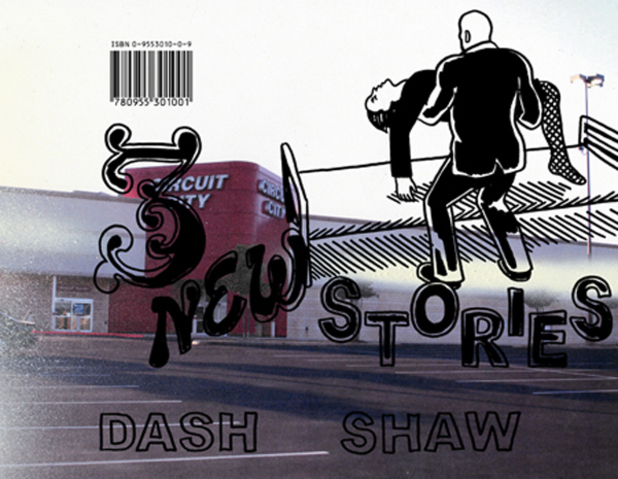
The last time I was at my local comic book shop (Hub Comics in Somerville), there was plenty to pick from. After opening and browsing through many of the shelves, I stumbled upon 3 New Stories, a small book with a stunning cover and early pages that motivated me to pick it up.

Back and Front Cover of 3 New Stories

3 New Stories, as the casual title suggests, contains a collection of three stories in three separate realities. All of the stories take place in a surrealistic, absurd America oddly reminiscent of the Springfield of The Simpsons in the 90s and frighteningly not too far away from our current reality. The first story, Object Lesson, introduces us to an anachronistic private investigator who loses his job and finds himself back in high school to finish his diploma, which he possibly did not complete due to a technicality. The second story, Acting is Reacting, briefly introduces us to the depressing, decaying world of Girls Gone Wild. Lastly, the final story, Bronx Children’s Prison, follows the life and the attempted escape of the prisoners in the Bronx Children’s Prison.

3 New Stories is really quite difficult to review. From a text based narrative perspective, Object Lesson is by far the most successful. It’s clever, funny, and surprisingly absurd. It also makes an interesting statement about how American businesses and con men prey on people through nostalgia when they get older. It also makes an implicit statement about how the American economy is very coldly and inhumanely throwing out its older workforce. Most impressively, both of these large statements are made in a matter of a few pages. In contrast to the strong text narrative of the opening story, the next two were a little disappointing and lackluster by comparison. Acting is Reacting from a pure narrative perspective falls pretty flat, and Bronx Children’s Prison is a pretty basic prison story, despite the young age of the prisoners and an element of fantasy.

However, there is a separate layer to address with 3 New Stories: its artwork as its major storyteller.

3 New Stories has some of the most daring and innovative artwork to appear in the comic book/graphic novel arena. It pays homage to the traditional flat black and white style of most comics while adding layers of exceptional texture from watercolor and paint. And from the interesting art techniques, 3 New Stories emerges as almost, dare I say it, an experimental comic book.

Given the strength of solely the text narrative of Object Lesson, the artwork is used to enrich the tone of the narrative. There are streaks of sickly olive green and rust in the backgrounds, enhancing the misery and the direness of the older students in the high school and conveying the sinister nature of the people who are running the high school. There are disjointed panels and floating images that emphasize the disorienting world the private investigator is experiencing. Here, the combination of non-traditional artwork and basic text narrative construction is at its best, demonstrating the epitome of what the medium of graphic novels and comic books can be as a storytelling form.

For Acting is Reacting, which probably is the most bizarre of the bunch, the artwork takes the stage in front of the story. While the panels of the narrative show how a Finnish girl ends up in a Girls Gone Wild video, the background artwork of maps of parts of Texas seems to be suggesting the endless roads traveled by the Girls crew to film their clips. The endlessly branching roads and the numerous letters of towns give us a sense of the monotony of the whole Girls enterprise. The Finnish girl on the panels is no more than one girl one town on a map of thousands of cities, towns, and roads. In this second narrative, the background artwork far overpowers the narrative in the panels in its ability to add layers to the storytelling, but the two nevertheless interact and project onto each other in order to form a richer and certainly more interesting story with very few words and interpretive liberty for the reader/watcher.

As for Bronx Children’s Prison, the artwork overpowers the narrative given by the text in a way that almost feels like a successful experimental film montage. In a story about children taking over and escaping a prison, there are elements of clear fantasy, and these moments are separated visually with overwhelming dots of color, evoking the feelings of a dream or hallucination. However, in the story there are moments of realistic consequences, and here, the dots are absent, leaving the reader with only sparse black and white forms. While this last story is probably my least favorite of the collection, the use of the oversaturated, overwhelming images to demarcate states of fantasy versus reality adds a layer of complexity to the narrative that had me motivated to finish the story.

3 New Stories, though flawed, is an excellent representation of how the comic book and graphic novel world can expand and challenge its boundaries. As a passionate fan of both literature and visual art, I have always felt that graphic novels have the advantage of an enormous range of visual, non-verbal techniques to tell a story. Consequently, graphic novels and comic books have more opportunities to create richer settings, to convey complexities in mood and tone, and most of all, to communicate nuances in a character, all of which Dash Shaw attempts to do in 3 New Stories.

Of everything I have written about, please do check out 3 New Stories. While it may not be the epitome of the full fruition and realization of the comic book and graphic novel media form, it is much closer than many (if not most) of its peers. And even though I admit that the text based narrative composition is lacking, I must commend its willingness to experiment with the combination of verbal and non-verbal storytelling. As much as I love more traditional forms of comics and graphic novels, I was excited and thrilled to see and read something that is trying to reach far beyond its own expectations as a storytelling form.

3 New Stories was created by Dash Shaw and is available via Fantagraphics Books


Am I A Western? Looking at High Moon

Standard

As a fanatic of westerns, I felt that it is appropriate that the same love for those films carried over into my graphic novel readings. In the wake of the current craze surrounding East of West, which I admittedly did not enjoy because of its pretentiousness and overbearing dialog, I read the first volume of High Moon, a former webcomic from DC’s online comic branch, Zuda. In 2009, High Moon was selected from a pool of webcomics published by Zuda to be transferred to the print format. After reading the first print volume, I cannot say that the print transition was a bad idea for Zuda, maybe just not the best.

High Moon Volume One

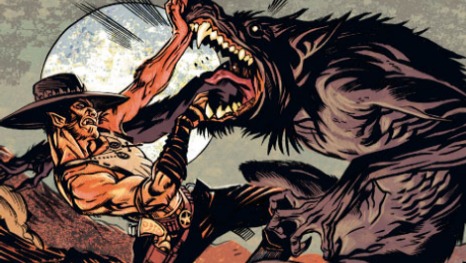
High Moon centers around a man named Macgregor in the opening of its first chapter. Macgregor is a former Pinkerton detective who now has more of the appearance of the archetypal man without a name. He is somewhat of a bounty hunter, and in the tradition of the many bounty hunters of westerns past, he speaks little with the few words he says tied to questions around getting more information on the man he is chasing. After talking to many of the town locals, we find out that there is a little girl missing and that there is something causing blight on the cows and the cowboys around the town. In parallel to Macgregor’s investigation, we get to know more about the the man he is after, Edward Conroy, and we find out that the hunter and the prey are far more similar than Macgregor would believe; both are werewolves who are able to tame their transformations, and both are trying to save the little girl.

As the chapter progresses, the true villains of the Texas town emerge and Conroy and Macgregor, in a very abrupt moment, battle together against the monsters who are the source of the destruction and the massacre in the town. And in a bizarre twist, Macgregor is killed and Conroy absorbs and bears the identity of Macgregor. In the next chapters, we see Macgregor version 2 on his adventures in Texas. On his path, Macgregor runs into traveling performers, bartenders, arguing family members, and train robbers, the universal western peripheral crew. However, he also runs into the supernatural: other werewolves, a Native American tribe with the ability to transform into bird-like super beings, and oddly enough, steampunk accomplices and assistants to Nicolas Tesla.

High Moon is a bit of a tough graphic novel to review. While the main idea of the bounty hunter werewolf is interesting, there are almost too many supernatural elements to the story. By the time the Tesla assistants emerge and use their seemingly mystical robotic weapons, the story loses its greatest strength, its core character. As Conroy Macgregor continues to encounter more monsters in his journey, he defies death more and more. We begin to get the sense that he is invincible, and thus, every monster and supernatural challenge he faces becomes less interesting and engaging because we know that he is going to definitely survive.

Don’t get me wrong; I think that having an invincible protagonist is not necessarily a bad thing, but given that the physical challenges the protagonist will face will have the same outcomes, there must be further attention given to the exact persona of the character in order to keep the reader interested. For example, we never find out why Conroy has decided to become a protagonist in the first place. In the first chapter, we know that Conroy has committed serious crimes, and in the second chapter, we found out that he is the reason behind the death of another young girl. However, we never get a sense of the origins of his change of purpose. Without the layers of character construction, the entire narrative gets reduced to a bunch of moments of big fights and victories, which get all too boring too fast.

I don’t think that the creators David Gallagher and Steve Ellis were oblivious to the fact that they were not building characters. They give us the history of the warring brothers in a town; they give us the history of  the steampunks, Tristan Macgregor and his wife. However, they just do not give history and complexity to their center character, which is a very strange decision because he is the one who warrants and rightfully deserves the most attention.

In terms of a formal style critique, High Moon has dialog and narration written in a very abrupt style. The artwork is beautiful, and I think in order to preserve the art, there are few sentences on each page. Consequently, with few words used to guide the story, there are some events that happen in the narrative that are not relayed to the reader in a clear way. I found myself too often reading a piece of narrative that did not have clear motivations or that did not make sense given the previous events.

High Moon is a messy graphic novel. It has a strong core narrative, but it feels as if someone talked to the authors about avoiding alienating non-western loving audiences, and consequently, they added all of these other elements ranging from steampunk to love triangles to try to pull in a more general audience. All of these additions lead High Moon to become a bizarre mix of stories with an identity crisis.

There is one remaining layer that is the most bizarre of all: the race politics. When we meet Macgregor version 1, he is an Anglo American, again, the archetype of westerns in the past. Then, Edward Conroy, Macgregor version 2, is African American. The authors made this explicit decision to change the race of the bounty hunter, but they did not seem to consider to try to change the clear racial stereotype tied to Conroy’s past: his criminal activity. There is some political statement trying to be made here, but it is cloudy and conflicted, which is probably the deepest, though not necessarily last, nail in the coffin for High Moon.

High Moon has some interesting ideas in it, but the execution sadly leaves the reader wanting more. The artwork is excellent, but the lettering is too sparse. The main character is interesting, but more attention is given to the peripheral characters. There is halfhearted commitment to both traditional western and werewolf narratives. It’s really a shame. High Moon had the potential groundwork to become a magnificent series, but it just got too ambitious and too confused, which is why I suspect that it ended at the beginning of 2011, a little over a year after the first volume of the graphic novel was released.

High Moon Volume One is available via DC Comics. 

Forming Beliefs with Harvey Pekar in Not the Israel My Parents Promised Me

Standard

While Generoso is the Pekar aficionado in the Fierro house, for this week’s graphic novel glimpse, I will be reviewing Harvey Pekar’s Not the Israel My Parents Promised Me. I’ve read a few sections from various volumes of American Splendor, and there are many layers to Harvey Pekar to be extracted from those works, and all of those layers are at play in his last work prior to his passing, Not the Israel My Parents Promised Me.

When I think of Harvey Pekar, I think of him as the essential perspective on modern American life. Harvey is fairly neurotic, but he is also sharply insightful. Harvey is a regular man who had a fairly regular 9-5 job but also had a profound love for jazz and comic books. Harvey Pekar has an amazing ability to extract a fable around proper social behavior from some of the seemingly most meaningless details about our existence, and for that, he is a voice that is missing in this post-modern era.

Harvey Pekar via Gerry Shamray and The Comics Journal

Consequently, in light of the current and likely transient ceasefire between Israel and Palestine, I feel that now is a good time to review Pekar’s statement on his political belief on a subject that hits close to home for him. Not the Israel My Parents Promised Me was not Harvey’s first foray into politically focused graphic novels. In 2007, he wrote Macedonia with Heather Roberson, which was his novel dedicated to exploring the political and social climate of Macedonia, one of the few former Yugoslavian states that avoided civil war.

While Not the Israel My Parents Promised Me is a highly political graphic novel that most definitely conveys Harvey’s opinion on the state of Israel, it is more about the formation of one’s political and spiritual perspectives in the progression of life. The novel takes you through the formation of Harvey’s spiritual and political identity without any heavy handedness or any dogmatism. What becomes the most brilliant feature of the novel is its ability to weave  Jewish scripture and theological history with political history across centuries leading up to the current conflict while also unraveling how this gained knowledge of the history of the conflict molded Harvey’s perspective.

In the novel, we see the progression of beliefs that many of us go through, and the various stopping points that stunt people from forming clear, individual beliefs. As a child, Harvey established his beliefs about Israel based on the teachings of highly pro-Zionist parents. Naturally, he accepted what his parents taught him without questioning their’ motives and often clear hypocrisy with a naïve and fervent acquiescence and acceptance that is all too similar to our own belief foundation periods as children when we simply did not have any other frame of reference.

As the narrative progresses, Harvey meets people who began to change his pro-Zionist views, which he held until his twenties. In addition, he weaves in the events in the the late 60s which fully reversed his opinion on Israel. Gradually, we begin to understand why pro-Zionism was erased from the identity of adult Harvey Pekar.

Above all, what is one of the most clever devices of the narrative is its structure and relationship to younger Jewish Americans who Harvey interacts with as he tells the history and the events that led to his change in belief. Harvey interacts with his illustrator, a younger Jewish American who spent time in a kibbutz in Israel, and the sons of a bookstore that he frequents. In establishing the history of the Jewish faith and the diasporas over thousands of years, it becomes clear that the younger men he interacted with either did not have knowledge of this essential history or did not take the time to tie the centuries-old history to the current conflict. And consequently, their beliefs around faith and the intertwined thoughts on the state of Israel are quite uninformed, naïve beliefs. With the interactions with these younger men, Harvey is able to convey how lack of knowledge and lack of commitment to tie all of the parts necessary to form one’s political and spiritual beliefs can lead to passiveness that is detrimental to our own identities, and consequently, our macro identities as a cultural group and as a society.

From the political perspective, Not the Israel My Parents Taught Me is Harvey’s literary piece to convince people to question their pro-Zionist views, but this is all done in the signature Harvey Pekar way. All of the persuasion is as objective as he can make it and is delivered in small moments of his own memories ranging from his memory of his mother never attending synagogue to taking a class with an anti-Zionist peer in college to much larger moments in history ranging from the foundation of the Israeli State to the brash expansion of the state into surrounding occupied territories under Prime Minister Menachem Begin in the 70s. In the formation of Harvey’s beliefs on Israel, we are taken on a fragmented ride that we experience with the formation of any belief, any stance we take in life. And while Harvey is persuading the reader to reject pro-Zionist views and the political motivations of the state of Israel today, he is also persuading us to read, to learn, to question, and to think about any major political and spiritual belief we have in life. He encourages us to understand, dissect, and try to disregard our biases that may come from our parents, our families, and our communities in order to establish beliefs that are informed, intelligent, and ultimately, ones that we can wholly believe in.

Not the Israel My Parents Promised Me is written by Harvey Pekar and illustrated by JT Waldman. It is available via Hill and Wang publishing.