
Note: This post is going to be a little more of a traditional review. Please bear with me for the length of the narrative setup. Thank you!
Marcus is a vagrant outsider.
Marcus is hell bent on avenging the premature deaths of his parents.
Marcus is a pupil in a school for assassins.

Cover of Deadly Class Vol. 1: Reagan Youth
Marcus Lopez is the primary protagonist in the Image Comics series, Deadly Class. At the opening of Deadly Class, we meet Marcus as he wanders the streets of San Francisco. Life has not been kind to him; his parents were accidentally and gruesomely killed when a former psychiatric patient jumped off of a bridge and landed on top of them in the aftermath of Ronald Reagan’s allowance for the de-institutionalization of state mental health facilities from the late 60s to the mid 70s during his terms as governor of California.
After the loss of his parents and his sinking into severe Post Traumatic Stress Disorder, Marcus becomes a homeless vagrant whose constant, overwhelmingly nihilistic thoughts continue to prevent him from moving forward. Despite the intense pessimism of most of his thoughts, Marcus has a bizarre optimism at points that he ties back to the last words about life that his father told him and continues to wander about looking for some meaning in life with a small amount of faith that there may be some deity or being to help him. This optimism and faith in the midst of the Marcus’s dour, miserable world is the beginning of the strange contradictions in Deadly Class.
During a street parade, a mysterious Yakuza affiliated girl rescues Marcus after a series of detectives and police officers chase after him. She takes him to an underground world where a teacher appears who has the semblance of any old, wise master from a karate film. After explaining to a group of students that Marcus was chosen because he has the undying motivation of revenge, the teacher invites Marcus to become a student of the Kings Dominion of the School of the Deadly Arts, a school that marks the humble beginnings of the world’s best assassins. Marcus’s prayers for help to find a path in life may have been answered.
On Marcus’s first day of class, he quickly realizes that he is yet again an outcast, even though all of his classmates are the major outcasts of society, and we, as the readers, are quickly thrusted into an archetypal world of high school but with a little more thirst for bloodshed. For those who went to high school in a place where clique divisions were more dogmatic than the dress code as I did, we are quickly reminded of our experiences, for better and most likely for worst. In the School of the Deadly Arts, the students go through the same issues around perceived image that most teenagers experience, except that image at this school includes one’s propensity to harm others. Who is dating the popular girl is important in this world. Who is the child of who is important in this world, but most of all, who is (or seems) the toughest is important in this world. The first two issues of the series create an interesting setting for the narrative, but there are some peculiar decisions in the progression of Deadly Class.
Although the projects that the students have to complete are outrageous and sensationalistic and the characters that we encounter are handpicked from various arch criminal groups, Deadly Class is mostly a coming of age story, and being so, has some maudlin and, dare I say it, sanguine moments that destroy the dour tone that it worked so hard to set up at its beginning, which confuses me a bit. I’m not entirely sure about the author’s intent on this one. Is it supposed to trace the rise of the outcast from the bottom of the feeding pool to the top? Is it supposed to be a bildungsroman with an assassin training school wrapper? The first volume opens up with an introduction from David Lapham, the author of Stray Bullets, about how he was a nobody in high school in the 80s, and how he met his wife there, who was a member of the popular clique, giving a sense into the motivations of strange optimism embedded in the narrative of Deadly Class: the adolescent mindset of the 1980s instilled by John Hughes films.
As the series unfolds, it becomes a story almost too close to the Breakfast Club, which feels like a betrayal to the intricate and interesting concept of a school for assassins. Marcus tries to get the girl from one of the more popular cliques. He and representatives from some of the major cliques work together to execute Marcus’s revenge on Ronald Reagan, which is the same plot as a group of kids trying to take over a school from an oppressive principal at a larger scale. And in the the most betraying twist of all, Marcus, upon being accepted, has an excitement for life.
Personally, I never really identified with any John Hughes film, where a social pariah rises in ranks by adopting a set of expectations and suddenly loves life, and it seems like writer Rick Remender, identified with them just a little too much. Perhaps I’m a bit of a grim person myself, but I really would have preferred for Deadly Class to be an investigation into the psychology of Marcus. As I continued to read, I kept asking myself, “Why does Marcus, who has some questionably psychopathic and sociopathic tendencies, have such traditional teenage motivations?” I would have loved for the series to wallow in the darkness of Marcus’s internal world and the malice and disregard for societal standards in the school. The story could have explored some interesting frontiers in a sullen, macabre setting, but it sadly does not.
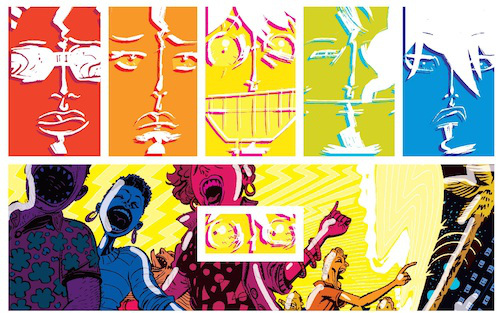
Nevertheless, I do not think that Deadly Class is a horrible graphic novel. I think it simply plays it too safe. I think it is trying to shock its readers with the setting of the School of the Deadly Arts and the consequent events of violence, but it’s core story is far too traditional and suffers from the same fantasy optimism of the films and culture of the 1980s that I think the author may have originally hated but secretly desired. It is still worth a read for at least the artwork; the colorist Lee Loughridge and the illustrator Wes Craig create beautiful sequences, including a fantastic neon, two-dimensional acid trip that Ken Kesey would be proud of. Take a look at Deadly Class, just do not expect a groundbreaking narrative behind its sensationalistic facade.
Deadly Class is published by Image Comics and is currently up to issue six with issue seven to be released in mid-September.


 LILY & GENEROSO 4EVER!