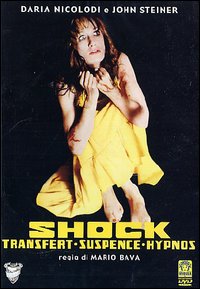
Mario Bava Scares You One More Time With His Final Theatrical Film “Shock” From 1977

Standard
Shock 1

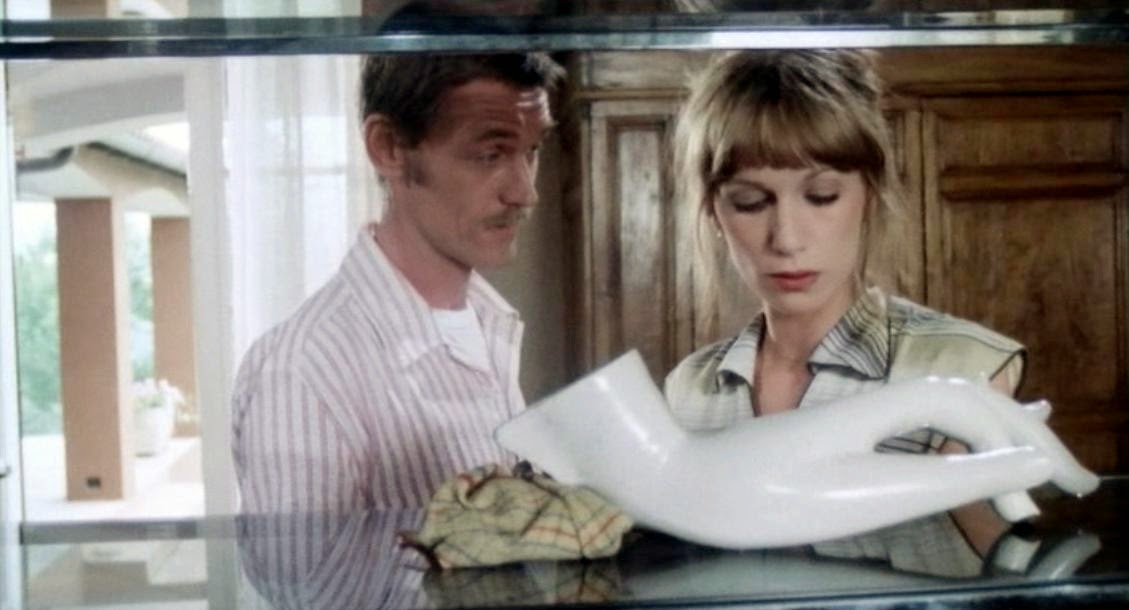
John Steiner and Daria Nicolodi in Bava’s Shock

Sometime during the late spring of 2007, my friend Michelle and I hoofed it over to the Brattle Theater in Harvard Square to check out some of their Grindhouse series that they had programmed following the popularity of the recent Tarantino/Rodriguez double feature film experience that revived interest in the exploitation films of the late 1960s and 70s. The day we decided to head over to Cambridge was a way too pretty Saturday afternoon to see a nasty giallo, but such things like a clear sky rarely matter to horror fans, even fans who had just spent the last few months buried under New England snow and grey skies. Also, what helped me convince Michelle to head to the theater that day was the opportunity see a 35mm print of  Shock, the last feature film directed by the father of giallo genre, Mario Bava.

Before he became a pioneer in Italian horror, Bava started his film career assisting his father Eugenio at the special effects department at Benito Mussolini’s film factory, the Istituto LUCE, before becoming a cinematographer himself. Bava had lensed over twenty films before getting his first opportunity to co-direct when director Mario Camerini needed an AD for his sword and sandal film, Ulysses, an Italian production that starred Kirk Douglas. The next year, during production of Riccardo Freda’s 1956 film, Beatrice Tenci, Freda and his friend Bava discussed the possibility of making a horror film, which would be the first Italian horror film of the sound era, as the genre had been banned in Italy throughout the 30s and 40s. The pair negotiated a production deal with Studio Titanus, provided that they could write a script in a few days and have the film done in two weeks to which they agreed, and I Vampiri was born, a nasty low budget film centered around the murders of young women who are found drained of their blood. Though I Vampiri did not perform well at the box office, it wasn’t met with huge opposition either, despite the film’s carnality, so the door was now opened for the horror genre again in Italy.

For a few more years, Bava would shoot several more gladiator films, but in 1960,  he would have the chance to direct a loose adaptation of Nikolai Gogol’s 1865 horror story “Viy” into a feature film, the outrageously gory La maschera del demonio (Black Sunday), a film so visceral that it it would be banned in England for most of the decade but would help launch Bava as a relevant director of the horror genre internationally. After Black Sunday, Bava would occasionally direct a sword and sandal and even a few spaghetti westerns (Roy Colt And Winchester Jack is a favorite), but it was the giallos that he would master such as Black Sabbath, Kill, Baby, Kill and Bay Of Blood.  

Fueled by the success of the Bava giallos, the genre began to flourish, so by the mid-1970s, there were many directors such as Dario Argento, Sergio Martino, and Lucio Fulci challenging Bava for the giallo crown, and even though Mario would always be regarded as the master, the theaters were packed with competing Italian horror films from younger directors. Jumping genres again, in 1974 Bava would direct the nihilistic poliziotteschi, Rabid Dogs, which had been plagued with production issues that were further exasperated when the film’s producer went bankrupt after the main investor died in a car crash. Bava would take two years off from directing after the headaches provided by Rabid Dogs, but he would return in 1977 with Shock, a smart, small horror film that would prove that the master still possessed a bevy of technical tricks from all of his years as a cinematographer to scare you senseless.

Shock stars Daria Nicolodi as Dora Baldini and John Steiner as her husband Bruno, who begin the film by moving back into Dora’s family home. Bruno is Dora’s second husband as her first, Carlo, died several years prior, and the house has been locked up ever since. Given the circumstances of her first husband’s death and the fact that his dead body had never been located, Dora is not too happy about moving back into the home, and her head is not all together there, since years of drugs and electroshock therapy received during her institutionalization after her husband’s death have left her quite the mess. Adding to her daily dilemma is that Dora had a son with her first husband, the waifish-looking Marco (David Colin Jr.), who gets along with his stepfather Bruno, but he is still not one hundred percent accepting of this new man who amorously embraces his gorgeous and slightly catatonic mom. Coming to Marco’s rescue, as the forces of evil always seem to be there to fiendishly assist with the sadness of youngsters, a new friend in the house, an imaginary one, enters Marco’s life, and given that his stepdad is an airline pilot and frequently away, little Bruno spends lots of time talking to his new “friend” and spends much time in the basement where some evil mojo is boiling up in the Baldini home.

Original Trailer for Mario Bava’s Shock

What really bumps Shock’s creepiness up to eleven are the incestuous actions that little Marco (or perhaps Carlo living inside of him) begin to take towards his mother. Marco begins by spying on his mom in the shower, slicing up her panties, jumping on top of her and sexually thrusting, and even romantically touching his sleeping mother’s face and neck with a hand that suddenly transforms into that of a rotting corpse, which all perhaps suggest that maybe Carlo is looking for love from beyond the grave? It is these moments where Marco begins to morph into his dead father that provide the greatest jolts in Shock, including one scene that I will not give away that occurs when Marco runs towards his mother that sent both Michelle and me leaping from our seats. It is the kind of scare that only a master director could imagine, so basic in its visual construction, relying on no special effects, and yet it still scares you silly. Although the scene that I just described may be the best of the film, Shock is loaded with a ton of smart, visual inventions that make you believe that during the two years that Bava was “retired,” he was compiling his terror filled ideas into a notebook for later use, and I, for one, am so glad that he had enough inspiration to make a giallo, one that despite its modest structure and a surface that looks like another post-Exorcist era possession film, comes off with so many jolts to make it a captivating, haunting watch. Shock’s overall dark tone, a killer fusion score from the Italian/Motown signed band I Libra, and low budget but affecting visual elements make it a fitting final theatrical release for the brilliant Bava, who sadly died of a sudden heart attack in 1980 at the age of 65.

I found out shortly after that afternoon screening that Shock was my friend Michelle’s first Bava film, and she was very impressed. In the seconds after the film, I thought that I should’ve started her out with one of the director’s earlier, more accomplished films, but I soon was confronted with the reality that a giallo from a then 62 year old Bava affected Michelle, who was then a young filmmaker herself, making Shock just as qualified as Bava’s other works. I have always said that if a comedy without an audience can make you laugh out loud, then it is very successful, and I guess a similar type of success exists for a horror film that terrorizes you on a pretty day.
Generoso and Lily’s Bovine Ska and Rocksteady: Duke Reid’s Dutchess Label 12-1-15

Standard
dutchess B

Killer Derrick and Patsy on Dutchess!

Hello Bovine Ska and Rocksteady Listeners!

Hope you had a wonderful Thanksgiving! On the first day of December, we were excited to present another edition of Generoso and Lily’s Bovine Ska and Rocksteady with a special label spotlight on Duke Reid’s Dutchess label. To kick off the show, we started with a fantastic version to version cover of the Isley Brothers’ hit, “It’s Your Thing.” Delroy Wilson and Alton Ellis each took a shot at the iconic track, and the results are both impressive. After the first set of reggae, we began the second set with “Penny Wally,” a track from the Soul Defenders, followed by “Pack Up Your Things and Go” from The Overdrives, a group who recorded a limited number of gems for Lloyd Daley’s Matador label. For the mento set, we opened up with “The Walls of Jericho,” a mento from Laurel Aitken, and then closed off with Lord Composer’s “Daphne Walking,” a track from the Songs from the Caribbean LP, a release from the American ART label.

Then, to prepare for the spotlight on Dutchess, we presented a set of ska that included the lovely “Too Late” from Lloyd and Glen and the too pretty “Dance With Me” from Bob Marley and the Wailers.

At the top of the second hour, we were proud to present the spotlight on Duke Reid and his Dutchess imprint. We’ve had spotlights on imprints on all of the major soundsystem names from Coxone Dodd to Prince Buster to King Edwards, and in that arena of music giants, we cannot forget Duke ‘The Trojan’ Reid. Long before he entered the music industry, he served as a police officer for ten years before he changed courses. First, he opened up The Treasure Isle Grocery and Liquor Store in Kingston. And, in addition to this business, in 1953, Duke opened up his Trojan soundsystem, which was supposedly named after the Trojan van that Duke Reid drove and filled with the equipment, liquor, and records for the dances he held. Given the distinctiveness of the Trojan van and Duke Reid, when he would arrive to a location, it is claimed that people said, “Here comes the Trojan,” thus giving birth to the name of the soundsystem.

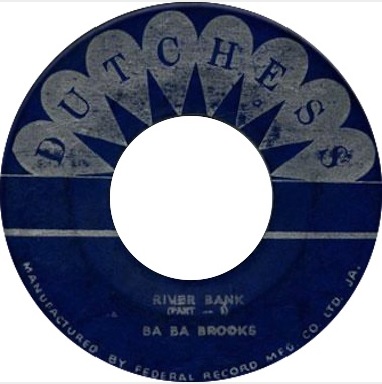
Like many other operators, Duke first played R&B from America on his soundsystem but would have the itch to record his own tracks. In the late 50s, Duke first recorded 78s for his Trojan label, and when he moved to recording on vinyl, he opened up additional imprints, including Dutchess, which was named in honor of his wife and is the subject of our spotlight tonight.

“Love Not to Brag” was an early hit for the Dutchess label and for a young Derrick Morgan. One of the earliest hits for a male and female duet; it preceded Keith and Enid’s “Worried Over You.” Derrick has said that the track was Inspired by Monty Morris, whose family was better off than Derrick’s, so he may have boasted a little bit about the things he had.

The backing bands for the label were a bit scattered:

In early recordings:

  1. Baba Brooks Orchestra
  2. Lynn Taitt and the Comets
  3. Tommy McCook and the Supersonics
  4. Treasure Isle Stars

By the time rocksteady comes around, we see a domination by Tommy McCook and the Supersonics and the Lynn Taitt Band

By the time reggae comes around, the backing bands are mostly the Treasure Isle All Stars and Tommy McCook and the Supersonics

You can listen to our full show from December 1, 2015 HERE. Subscribe to our show on Mixcloud; it’s FREE, and you’ll get an email every Tuesday when we post a new show.

Happy December!!! Please help us and spread the word and repost if you liked the show! Repost anywhere you see fit.

Join the group for the Bovine Ska and Rocksteady on Facebook.

Love,

Generoso and Lily

Taking Cues from Steinbeck and the Bible: Fábio Moon and Gabriel Bá’s Two Brothers, an Adaptation of Milton Hatoum’s Dois Irmãos

Standard

In recent years, the graphic novel has emerged as an alternative medium for literary adaptations. From the writings of Victor Hugo to Edgar Allen Poe, graphic novel writers and artists have begun to dissect and reimagine famous Western literary works into word bubbles and panels of illustration. Generally, I avoid such adaptations (there’s something a bit disorienting about the idea of reading The Black Cat in comicbook panels), but sometimes, when the adaptation is placed in capable hands, a gem can emerge, one that not only has a distinct style of its own but also pays respect to the source material in a way that encourages the readers to delve further into the origin of the adaptation; this is the case with Fábio Moon and Gabriel Bá’s Two Brothers.

Cover for Two Brothers, released in October 2015

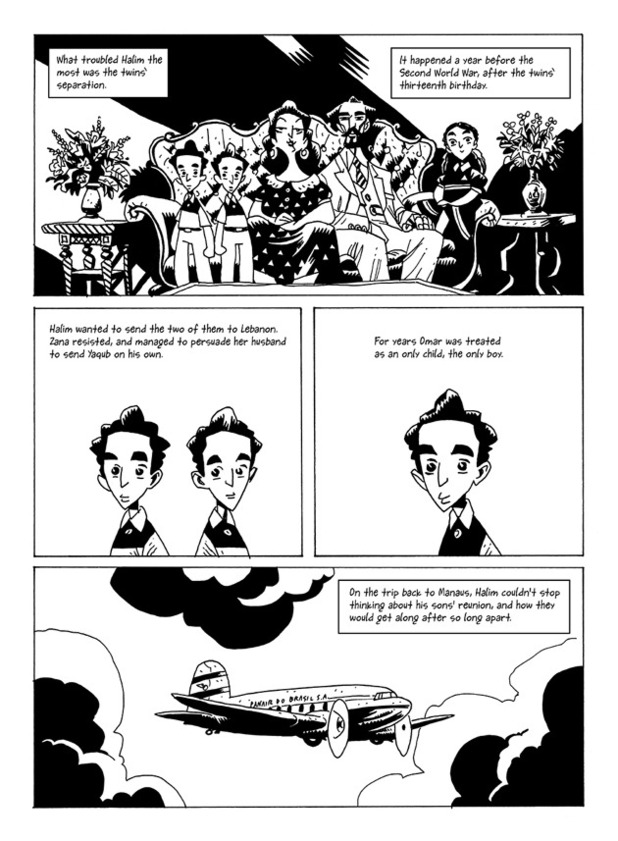
Adapted from Milton Hatoum’s celebrated novel, Dois Irmãos, released in Brazil in 2000 and translated into English in 2002, Two Brothers opens with the images of an industrialized town center before abruptly transitioning to the haunting, decayed remains of a once glorious European style manor in the Brazilian town of Manaus. Immediately, the narrator, once intimate with the family that lived in the home but not necessarily a member himself, prepares you for a tale of the rivalry between two twin brothers and their disastrous consequences on the people and the world around them. From the start, you know that Two Brothers will follow the course of Cain and Abel or Jacob and Esau, but Hatoum’s tale travels to the bowels of uncertain morality as foreign investment and industrialization creep into Manaus, eliminating its quaint history as a quiet port town and the people tied to the city’s former heart.

While Two Brothers certainly alludes to the biblical battle between brothers, it most resembles Steinbeck’s approach to the adaptation of Cain and Abel in the early 20th century in East of Eden. Like Cal and Aron, Omar and Yaqub are twins, with Omar possessing a darker complexion and more sinister in nature like Cal and Yaqub possessing a kinder heart and an affinity for education like Aron. Zana, the twins’ mother, fixates on Omar, a sick and weak infant who required more care as a baby. Omar continues to devour Zana’s affection and attention throughout his growth, and as a result of his mother’s incessant doting, Omar never seeks to accomplish anything because, after all, he will always stand as his mother’s favorite, guaranteeing him a home for the rest of his life or at least as long as his mother is alive.  

The same cannot be said for Yaqub. As the more accomplished and kinder son, Yaqub must fend off most of the world himself. Zana abandoned Yaqub as an infant, leaving him primarily in the care of Domingas, an orphan given to Zana and Halim as a servant for their home, and this first act bears course on Yaqub’s status in his home for the rest of his life. When an adolescent Omar slices Yaqub’s face open with a broken bottle upon seeing Yaqub with Lívia, a girl both brothers have tried to pursue, Zana and Halim send Yaqub away to Lebanon in the guise of allowing him to learn more about his family’s roots, but in such an act, they cast away their first born son, placing him on a course of aloofness and solidifying the contempt between the two brothers and Yaqub’s conviction to establish himself without the aid of his family.

For the first half of the book, Omar emerges as the obvious antagonist in Two Brothers, but by the end, it is difficult to determine whether Omar or Yaqub possesses more evil. While Omar outwardly displays his jealousy toward his brother as Yaqub succeeds as an engineer in Rio de Janeiro, Yaqub quietly holds his spite and acts on it in a more backhanded and manipulative manner. Though Omar has the darker complexion, Yaqub has a permanent scar on his face, a mark which can parallel the mark placed on Cain after he murders Abel. Both brothers have inherent malice and malevolence, but they choose to act on it differently. Omar conveys his evil in the sense of an irresponsible child; he’s hedonistic, violent, lazy, and outrageously selfish. Yaqub’s evil manifests in a more covert manner; he’s a vengeful industrialist determined to wipe away the history of the town and members of his family who made him a pariah. Which is worse?  

To contrast the graveness of the tale of Omar and Yaqub’s destructive relationship, Moon and (twin brothers who we imagine have a far better standing with each other) illustrate Two Brothers with a deceiving simplicity and lightness. The wilderness surrounding the family home has a certain whimsy to it, and the fading of this magical sense of the jungle into decay then manicured, superficial gardens of a parody of the Orient on the edges of the Amazon jungle best conveys the changing face of Brazil in the years after World War II. The shifts in the settings along with the physical appearance of the characters help to tie each character to a certain place and time and aid us in understanding why as time passes, certain types of people rise as others fall depending on their connection and adaptation to the evolution of society.

Though the story of Omar and Yaqub dominate the plot because their actions influence all of the peripheral plotlines and the future of the town of Manaus, Two Brothers, at its core, addresses and explores the psychological motivations of individual family members and how their differing states lead each to interact differently with each other. While Omar and Yaqub do possess inherent evil, the expression of this evil comes from the environment that their parents created in the family home. Halim, the patriarch of the family, never wanted to have a family, and as a result, he keeps a specific distance from his family that prevents him from being a strong parent. Zana displaces her original passion for her husband on her son Omar, alienating the rest of her family. As a result of the psychological states of Zana and Halim, we spend the rest of the Two Brothers studying their impact on their sons and anyone else who crosses the threshold to enter the family home, adding a richness to the story that keeps you engaged with every character and page.

Fábio Moon and Gabriel handle the adaptation of a novel containing severe ideas and concepts with poise and grace, making Two Brothers a captivating and enlightening but never heavy-handed read. They manage to extract the fundamentals of the book without overly simplifying its themes, and in doing so, have me interested in picking up and visiting Hatoum’s original novel, which is a result that every adaptation should try to achieve.

After reading Two Brothers, I realize that I perhaps have been too judgemental against graphic novel adaptations of literature. Admittedly, I have avoided the adaptations of works by literary authors I adore, so perhaps I read Two Brothers simply because I have no familiarity with the original work. Thus, my opinion may change after reading Hatoum’s Dois Irmãos, but I can say that a standalone piece, Two Brothers, balances layers of complexity in a graphic novel in a way that few other releases have this year, and for that, it should be commended regardless of its relationship to its source material.

Two Brothers by Fábio Moon and Gabriel Bá is available via Dark Horse ComicsIt’s a heck of a gift for any graphic novel enthusiast this Christmas. 

Generoso’s Festive and Fried Crocchette di Patate

Standard

As the holidays are approaching, the Neapolitan in me starts to think of fried foods.  My Crocchette di Patate (Italian potato croquettes) are a wonderfully tasty appetizer that you can put on the table at any holiday party that will satisfy your guests. A deep fried mix of potatoes, cheese, ham, and spices that I know you will love.  One key note: The drier your mix before frying the better.  My recipe as it is made is quite wet so allow your mix at least 3-4 hours in the fridge to solidify.  You will need: 6 medium sized russet potatoes,  8 oz of mozzarella, 8 oz of sliced ham (smoked, sweet, your call), 3 oz of pecorino romano cheese, 4 eggs, fresh parsley, oregano, plain breadcrumbs, one bulb of garlic (thanks Bob and Sherry Roffi), white flour, olive oil, salt and pepper.

I have a deep fryer but you don’t need one.  That said, do not skimp on oil when making these as they absolutely need to be submerged in boiling oil for the crocchette di patate to properly cook.

Good luck!  Let us know how yours turns out and Happy Holidays!

Generoso

Music: Gustav Mahler’s Symphony no. 1 in D major

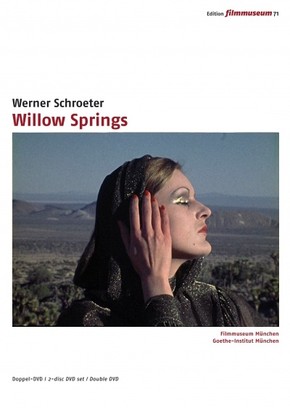
Werner Schroeter’s Playful and Dreamlike 1972 Low Budget Film “Willow Springs”

Standard

willow springs still

“Werner Schroeter will one day have a place in the history of film that I would describe in literature as somewhere between Novalis, Lautréamont, and Louis-Ferdinand Céline; he was an ‘underground’ director for ten years, and they didn’t want to let him slip out of this role.” – Rainer Werner Fassbinder

I start this review of the 1972 film, “Willow Springs,” with the above quote from Schroeter’s friend and admirer Fassbinder as it is purely the uncompromising and “underground” nature of Schroeter’s work that made him so respected and in turn kept him from being as well known as the other directors of the German film wave that included Fassbinder, Herzog, and Wenders. A mostly self-taught filmmaker who began his career making short 8mm experimental films, he would soon meet fellow experimental film-maker, Rosa von Praunheim, and this introduction turned into a partnership resulting in their co-direction of “Grotesk-Burlesk-Pittoresk” in 1968. For his first full-length film, 1969’s “Eika Katappa,” Schroeter began to showcase the idiosyncratic techniques that would mark much of his later work. The experimental visuals, mixed minimalism, drama and the incorporation of twentieth century songs to contrast these elements created a film that blurred the line between art and satire. Because of his ambiguous and modernist approach to filmmaking, Schroeter films would rarely be screened outside of his native Germany and would remain virtually unseen in the States until his passing in 2010, which sparked an interest in his work.

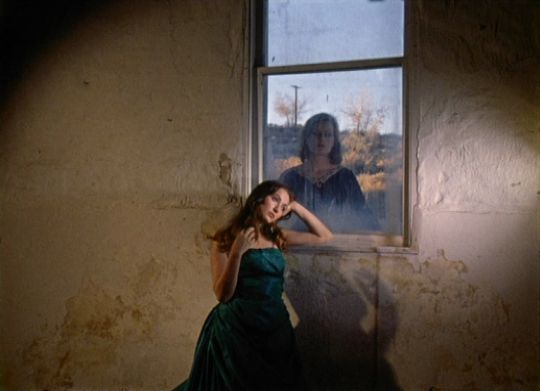
“Willow Springs,” Schroeter’s 1972 film, and his only film that was shot in the United States, sets the scene in a lonely, dilapidated house with a bar on the edge of the Mojave desert; the house, like the place in which it is located, is called “Willow Springs.” Like his 1970s film, “Der Bomberpilot,” the focus is on three women, except that in “Willow Springs,” these women are not passive and waiting for the men in their lives to make all of their decisions; no, this trio of women rob and kill the men who dare to visit their roadside shack. The women are lead by the severe Magdalena (Magdalena Montezuma, the star of many of Schroeter’s films) who dominates the ethereal Christine (Christine Kaufmann), an angelically sad woman who seems content with the middle. And finally at the bottom of the totem pole is the frumpy Ila (Ila von Hasberg), who serves as maid to Magdalena and Christine but is quickly growing unhappy with the situation and voices her displeasure. To unify them in their gender, Magdalena leads them in a Amazonian-like ritual, and in her movements, she has as her soundtrack a mix between the Andrew Sisters “Rum and Coca Cola” and opera, clearly indicating the immortality of her character, while Ila and Christine get free rocking Doobie Brothers to affix them to the early 1970s .

Soon, a drifter named Michael (Michael O’Daniels), a beautiful pure embodiment of the American west, enters “Willow Springs” and falls is love with Ila, who is more than glad to leave, but will Magdalena allow them to do so? What transpires is a sequence that plays into all of Schroeter’s strengths as a director, incorporating dream logic and surrealistic imagery as Magdalena’s attempts to create a unified feminist front in her deserted family home starts to quickly unravel. Shot in California, the film’s location, Willow Springs, plays an important role: One is clearly reminded of the Spahn Movie Ranch where the Manson family congregated and mapped out their plans of Helter Skelter prior to making their ugliness real. There, music in the form of the Beach Boys and Beatles was also used in the same manic way that juxtaposed the eventual violence that would ensue the lives of all involved. Like the music utilized in the film, Schroeter’s cinematography is in constant conflict between the gorgeous still pieces and haunting contempt held within Magdalena’s gazes. As it was the topic of many of the post-1968 directors, “Willow Spring” eludes to a passing of of the flower generation and its conflict with the uglier undercurrents that seemed to circle under all of the love they hoped to make real.

Scene From “Willow Tree” 1972

Though it was made in the States, “Willow Springs” was only seen here through festivals and never found adequate distribution. Receiving steady funding from German television, Schroeter continued to work with Magdalena Montezuma on several films until her until her untimely death in 1984 at the age of 41. Schroeter then worked with the French actress Isabelle Huppert on two fiction films, “Malina” in 1990 and “Deux” in 2001, but increasingly devoted his time to the theater and documentaries. In 1982,  Schroeter was destroyed when his friend Fassbinder, who seemed to admire Schroeter’s underground spirit, was able to get funding and purchased the rights to direct a version of Jean Genet’s novel “Querelle de Brest,” which Schroeter had declared that he was trying to do himself. This effectively ended their friendship, and Schroeter publicly trashed Fassbinder’s film, “Querelle,” which was to be his last as Fassbinder died shortly afterwards at the age of 38.

As for Schroeter, he continued to work for the rest of his life and directed his final feature, “Tonight,” just two years before his death in 2010 at the age of 65. A flamboyant and interesting talent, who, despite not reaching the level of success of his contemporaries, was a defiantly nonconformist director who refused to make film in any other way than in his own idiosyncratic style.

Generoso and Lily’s Bovine Ska and Rocksteady: Bobby Kalphat’s Soul Sounds Label

Standard
A New Gaylads Track on Bobby Kalphat's label with Willi Williams at the Producer Helm

A New Gaylads Track on Bobby Kalphat’s label with Willi Williams at the Producer Helm

Hello Bovine Ska and Rocksteady Listeners!

Thanksgiving is one of our favorite holidays, and, to celebrate, we had a food themed Thanksgiving edition of Generoso and Lily’s Bovine Ska and Rocksteady. All sets outside of the spotlight on Bobby Kalphat’s dazzling Soul Sounds label were related to food in some way, and to start off the Thanksgiving cheer, we presented two sets of ska, beginning with a 19 year tradition of starting the Thanksgiving edition with Prince Buster’s excellent track, “Thanksgiving,” a super ska from the Hard Man Fe Dead LP. Then, Laurel Aitken kicked off the second set with his “Mash Potato Boogie,” a rollicking track that should make you dance anytime you are mashing potatoes (regular or sweet!). Given the food theme, there was no way that we would forget to include “Night Food” by Alerth Bedasse or “Night Food Recipe” by Chin’s Calypso Sextet in the mento set. After some fun and salacious mento, the last set of the first hour featured food related rocksteadys, including “Coconut Water” from Desmond Dekker and “Food of Love” from The Inventors.

At the top of the second hour, we presented a two set spotlight on Bobby Kalphat’s label, Soul Sounds.

Bobby Kalphat, the mighty melodica player, began performing as a vocalist. Upon realizing that his voice was not quite the best, he began to perform as an instrumentalist, first as a keyboard player and then gaining enough of a reputation to become a member of Bobby Aitken and the Carib-Beats. He first recorded for Lloyd Bell’s President Hi Fi sound system before heading over to Lyndon Pottinger’s SEP label. And after recording for other producers and saving up his salary from being a correctional officer as he honed his craft as a musician, in 1968, Kalphat began producing his own tracks, debuting with, “Rhythm and Soul,” which he released for his own label, Soul Sounds.

We began the spotlight on “Rhythm and Soul,” which was distributed in England through Pama, whose purchasing payment did not include a royalty agreement but did allow Bobby to purchase a Wurlitzer keyboard he would use in the coming years.

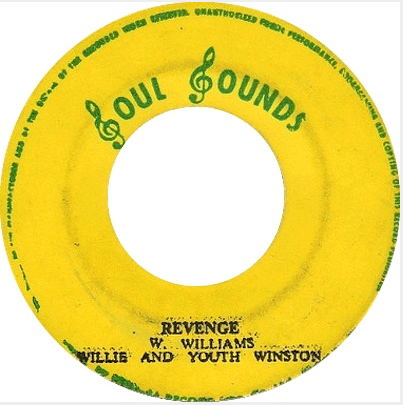
While Bobby founded the label and even designed its logo, Willi Williams, who was a member of the Set Takers, a band that Bobby performed with, would eventually take over the Soul Sound label, releasing his own recordings on it along with his own productions. One of those Willi Williams’ productions of note is “Revenge,” credited to Youth Winston. Youth Winston would become Dr. Alimantado, but Willi Williams met him before those days and gave him the name Youth Winston in order to evoke a similarity to Big Youth, who was rising in popularity.

Beyond Soul Sounds, Bobby Kalphat continued to produce records and open up his own imprints. Some of note are Roots Rock Inc./International, which released tracks in the late 1970s, Hit Vibes, which released recordings in the 1980s, and Music Mania, which released productions in the 2000s.

After the trek through Soul Sounds, we closed off the show with some sensational reggae, including I Roy’s “My Food Is Ration” and Skin, Flesh and Bones’ “Bammie Fe Fish.”

You can listen to our full show from November 24, 2015 HERE. Subscribe to our show on Mixcloud; it’s FREE, and you’ll get an email every Tuesday when we post a new show.

Happy Thanksgiving!!! Please help us and spread the word and repost if you liked the show! Repost anywhere you see fit.

Join the group for the Bovine Ska and Rocksteady on Facebook.

Love,

Generoso and Lily

Wilfrid Lupano and Jérémie Moreau’s The Hartlepool Monkey: A Microcosm of England and France’s Ugly Past

Standard

After reading Wilfrid Lupano and Jérémie Moreau’s The Hartlepool Monkey, I began to prepare myself for giving, at best, a lukewarm review for the book. At face value, I found the monkey trial of espionage on behalf France and consequent hanging by a group of townies in Hartlepool to be a bit of a heavy handed metaphor in combination with the final discourse and cautionary message about the effects of severe xenophobia. In fact, immediately after my first read, I felt that The Hartlepool Monkey possessed the satire sensibilities of Voltaire’s Candide but diluted with a few buckets of distilled water.

But, everything changed when I delved into the cultural history of the legend of the Hartlepool monkey. Sure, the back cover alluded to the inspiration from the legend, but prior to reading the book, I had not realized the influence of the monkey across the course of time.

Cover for the English Edition of The Hartlepool Monkey

So at this point, you must be asking, what is the Hartlepool monkey legend? And what about it caused you to reverse your perspective of the work?

The legend/myth/tale of the Hartlepool monkey claims that during the Napoleonic Wars, when Napoleon attempted to extend his ruling domain across Europe, a French commercial ship crashed off the coast of Hartlepool, a small city on the eastern coast of England. It is believed that the only survivor was a monkey, most likely some type of chimpanzee, and given that the denizens of the town had never interacted with any citizen of France, they believed that the monkey was in fact a spy for France. The legend then claims that the town gave the monkey a trial, and as expected , they found the creature guilty of espionage and lynched it on the beach (how could a monkey proclaim its innocence in the first place?).

Though the exact origins and the truth of the tale remain somewhat contentious, Hartlepool has continued to embrace the story, so much so that the city’s soccer club’s mascot is H’Angus the Monkey. And as if the impact of the tale could not get more absurd, the man who dressed up as H’Angus for Hartlepool F.C. became the mayor of Hartlepool in 2002, serving the town for ten years until the city decided to eliminate the role of mayor in favor of a ruling local committee. With absurd and macabre origins, the legacy of the Hartlepool monkey got even more bizarre in modern times.

Given the generally positive perspective of the myth of the monkey hanging in Hartlepool, it makes sense that Moreau and Lupano would want to revitalize the story with a focus on its outrageousness and absurdity. The skeleton of the story focuses on the Hartlepool monkey, and the flesh focuses on building the mannerisms and cultural practices of the people of the setting. Unlike in the original myth and the song popularized by Ned Corvan in the 1800s, The Hartlepool Monkey contains a voice of reason whose thoughts weave through the tragedy of the monkey. A doctor, whose carriage fails on a trip, stops into Hartlepool and offers a more modern perspective on human brutality and xenophobia. However, it becomes clear that his perspective is out of place, and as thus, the course of events of the legend will have to occur.

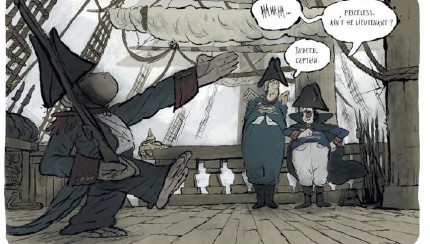
While most of the narrative focuses on Hartlepool’s rogues, who Moreau illustrates to their utmost grisliness, Lupano prefaces all of the events in Hartlepool with a sequence that casts light on the overall ugliness of the people of the time. The Hartlepool Monkey opens up on the decks of the French vessel that crashed, where the captain himself proves to be as ignorant and vulgar as the Hartlepudlians to come. As a former slave trader turned navy man, the captain reigns over his ship with a reverse direction xenophobic severity as the Hartlepool yokels. In foreshadowing the idiocy ahead, the captain sentences a French servant boy to death when he sings a sea shanty and mentions that his nanny was English. Though the tale of the Hartlepool monkey certainly exposes a dark truth about the town, the actions of the French navy on the ships do not make the French citizens more sympathetic than the Hartlepudlians. In this period, France hates England; England hates France, and both act stupidly and violently out of their hatred.

With the contrasting settings on the boat and in Hartlepool, Lupano conveys the overall heinousness committed by humans, regardless of nationality, in the era of the Napoleonic Wars, which is by far the strongest part of the novel. Sadly, it stands in the shadow of the doctor’s more philosophical statements and eventual closing speech on the brutality of man in the name of patriotism, which the book could do without, for we as readers should be able to infer such a message from the story. But, I’ll pardon these more dogmatic and heavy-handed panels, since after all, perhaps we need a more explicit reiteration of the learnings from the tale of the Hartlepool monkey, since a slightly disconcerting pride in the tale continues to exists nearly two centuries later.

The Hartlepool Monkey is written by Wilfrid Lupano and illustrated by Jérémie Moreau. The English edition is available via Knockabout.

Lily’s Powerful Vietnamese Curry – Ca Ri Ga

Standard

Winters in Los Angeles are certainly much milder than they were in Boston, but there’s a coolness to the air here that always has Lily craving for soup-type items, particularly curry. After eating plenty of Thai and Indian curries out, Lily realized that she has not made Vietnamese curry for Generoso, so Ca Ri Ga (Vietnamese Chicken Curry) would be this week’s recipe.

Lily makes her curry a bit thinner in terms of viscosity and spicier with red chili pepper flakes, Sambal, cayenne, and black pepper in addition to the curry powder. We used S&B curry powder for this recipe, but you are welcome to use Massaman curry powder or garam masala if you can find it and prefer to do so. Generally, Lily prefers a curry powder with fenugreek, star anise, and tumeric for a bright yellow curry but feel free to pick a spice blend that makes sense for you.

Feel free to choose your protein as well! Meat generally adds more flavor to the curry liquid, but tofu and vegetable broth can definitely be used for a vegetarian version.

As a final preference note, Generoso and Lily like savory curries, so this recipe of Ca Ri Ga does not have any sugar in it. If you prefer a sweeter curry, you can add a little bit of white sugar, brown sugar, or even molasses.

This curry was served with brown rice, but it is delicious with egg noodles, thick rice noodles, a crusty baguette, or simply by itself as a hearty soup. Enjoy!

Music provided by Robert Schumann’s Piano Concerto in A minor, Op. 54

“Dusty And Sweets McGee” from 1971: Think American Graffiti With A Lot Of Heroin

Standard
Dusty-and-Sweets-McGee-1971

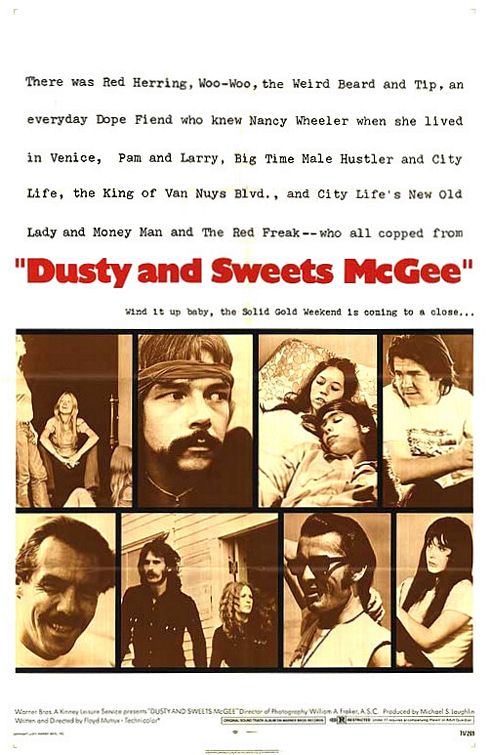
Floyd Mutrux’s Dusty and Sweets McGee

A few months back on this blog, I reviewed American Hot Wax, Floyd Mutrux’s failed 1978 biopic on legendary Cleveland disc jockey, Alan Freed. Though Mutrux’ film contained real life rock and roll pioneers, Chuck Berry,  Jerry Lee Lewis, and Screamin’ Jay Hawkins as well as an excellent performance from Tim McIntyre as Freed, the film’s too loose narrative structure and poorly drawn characters, mixed with flat TV movie visuals killed the film’s energy, making for a pretty mess of a film. I must admit that part of my dismissive review of American Hot Wax was fueled by the film’s release during the 1950-early 1960s nostalgia craze that engulfed American theaters in the mid to late 1970s. After the runaway success of George Lucas’ 1973 music-filled sentimental car romp through Downey, California, American Graffiti, Hollywood seemed like they couldn’t get enough slicked backed haircuts, cute teenage boys and girls, and classic rock and roll blared through car stereos, so they set out to produce as many stories from that era as they could, but what didn’t come along for the ride was the neo-realist style of Lucas’ film, which is its finest quality. The subsequent nostalgic films after American Graffiti relied heavy on cheese and tunes but were mostly rigidly structured narratives for ABC Sunday Night Movie of the Week releases that played out like long episodes of Happy Days. As for Lucas, I often wondered: why would this gadget-obsessed USC graduate, whose feature film career began with the clean Kubrickesque science fiction visuals of THX 1138, follow up his debut with the neo-realism of American Graffiti?  The answer may lie with Floyd Mutrux’s notorious American new wave film released the same year as THX 1138: Dusty And Sweets McGee.

I write “notorious” in describing Dusty and Sweets McGee because the film’s legend has long preceded it because of Warner Brothers’ stark action of pulling it out of theaters a week after its release. As Mutrux’s film was not given the chance to succeed and was also packed with enough doo-wop and rock hits that would incur massive clearance rights issues, the film would remain in the vaults for over twenty years until successful retro screenings in the mid-1990s created a demand that encouraged the studio to strike a few prints. It is rumored that Warner Brothers objected the non-judgmental treatment of the heroin use that the main characters in the film participate in throughout the film, and yes, there is a lot, and it is out there for all to see. Dusty and Sweets McGee, shot in a faux-documentary style, follows an group of unrelated Los Angeles heroin junkies, dealers, and hustlers (mostly non-professional actors) through a weekend where they talk about their love of horse and the problems that have beset them, which doesn’t play out entirely as a cautionary tale.

At the blurred center of the film is Mitch and Beverly (“Dusty and Sweets”) who lie around various LA motels, jamming each other with needles loaded with opiates in long deliberately harsh scenes as they berate one another in a way that would make Sid and Nancy wink with approval years later in the Chelsea Hotel. A few years younger than Mitch and Beverly are an angelically sweet looking couple, named Larry and Pam who also have a love for the needle. Nancy is also strung out but alone in a room with nothing but four walls and a bed. We also hear from Tip, a low level criminal who professes his love for heroin and crime directly into the camera, and Kit, a confident hustler from NYC. Their lives play out over a weekend while famed LA radio DJ, Arnie “Woo Woo” Ginsburg plays the golden oldies ranging from The Marcels to Gene Chandler to Del Shannon…gleeful songs that play over the muted conversations of broken young people, which given the dire situations of the lives, darkly delineate the era they live in from the era that those songs originally played in that brought joy to the boomers who were looking at a very bright post World War Two America. Also cleverly added into the soundtrack at key moments in the film are contemporary songs such as Van Morrison’s “Into the Mystic” and  Harry Nilsson’s “Don’t Leave Me Baby,” which immediately bring the viewer back into the characters’ reality. Much has been made about the soundtrack construction of American Graffiti in that songs were laid out prior to the screenplay and that scenes were created in the timeline using the soundtrack structure. Likewise, the soundtrack of Dusty and Sweets McGee is as integral to the storytelling as it is inLucas’ film, except that instead of using the sentimentality of the older rock and roll cuts that Lucas employs to create empathy for his characters in American Graffitti, Mutrux uses the same sentimentality here to create distance and, even at times, pity. It is an excellent technique, one that produces a intensive subliminal surrounding that goes beyond the drone of most of Dusty and Sweets’ dialog, which feels completely free form but at times too repetitive. The soundtrack also serves to link the characters in a way that goes beyond their lifestyles and addictions, which, again, could become tedious despite the harrowing nature of their problems.

What also separates this work from the rest of Mutrux’s later films is the impeccable visual style he achieved through an astonishing amount of talent behind the camera that was allowed to work on this low budget film. I imagine that the executives at Warner Brothers most likely greenlit this avant-garde project out of desperation to make any film that related to young people; thus they were willing to give Mutrux some serious talent in the form of cinematographer William A. Fraker, who had just lensed the massive hits, Bullitt and Rosemary’s Baby, and photographers of note, Vilmos Zsigmond and László Kovács. Together, this visual team created an halcyon like aesthetic for Dusty And Sweets McGee that would rival any film released in the States that year. Like the soundtrack, this almost Malick-esque visual style adds a pathos to the small conversations of the characters within this film, giving their words greater significance as the film maintains an almost playful attitude in the face of all the horrific goings on with its characters.

Overall, Dusty And Sweets McGee leaves you with a constant feeling of lost desperation, the same despair our protagonists experience. After the six or seventh time you see Nancy, Mitch, Larry, or Pam slowly stick a needle in their arms, legs, or ankles, you wring your hands with realization that the only way their situations will change is through an overdose, which you know will befall one of these kids before the credits roll. This is hardly Scared Straight, but I can’t imagine that anyone at Warner Brothers thought that this film would encourage the use of narcotics in any way, despite its claim that all of the characters are real. As Dusty And Sweets McGee in no way glamorizes the use of drugs, I theorize that execs at Warner Brothers were just not prepared when they saw the faces of their own kids when looking at Nancy, Mitch, or Pam. Like Richard Pryor once said, “They call it an epidemic now. That means white folks are doing it.”

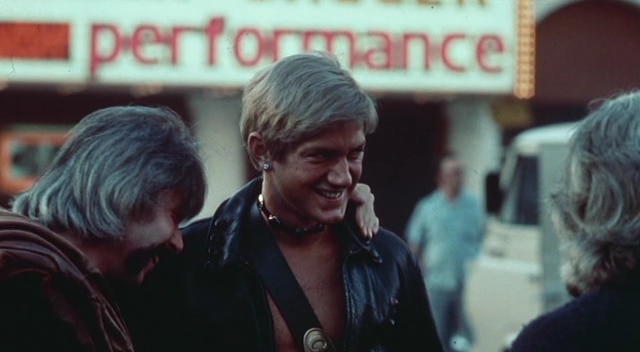
Clip From Dusty and Sweets McGee

Though Dusty And Sweets McGee was yanked after only a few days in theaters, it now remains, after its re-release, as a strong document that looks at a lost generation of kids at the tail end of the hippie movement and as a well crafted film that perhaps inspired more than a few young directors like Lucas to work within that same exciting neo-realistic style until the blockbusters took over and made selling a soundtrack more important than creating a soundtrack that builds a world.

A Tale of Parenting Beneath a Vietnam Veteran and Werewolf Tale: Brian Buccellato’s Foster

Standard

A devilish cold has been rampaging through the Fierro house, and in the midst of our cough syrup and cold medicine stupor, I rummaged through a couple of stacks of recent comicbook purchases looking for this week’s review piece. After recent convention visits and trips to our local comic book shops, the “to read” pile is steadily getting out of hand. Consequently, I completely forgot about the volume of Brian Buccellato’s Foster that was hiding underneath a copy of Will Eisner’s To the Heart of the Storm (on the to read list…) until I pulled apart the precarious stack of books above our modest comicbook shelf.

Cover for Foster Volume One

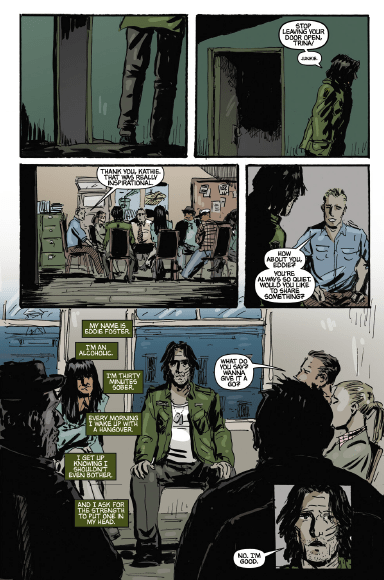
Truth be told, I probably never would have picked up Foster based on its cover. Upon opening up the collection, it is evident that Foster wants to eat, breathe, and consume the 70s of Martin Scorsese’s Mean Streets and James Toback’s Fingers, but the cover gives off more of a Rambo with a hint of werewolf scent. Thankfully, the psudo-script opening written by Robert Place Napton describing or pondering on Buccellato’s origins lured me in and opened the curtain for the character of Eddie Foster and the setting of Vintage City, a future wasteland and composite of America’s major cities in the 1970s.

Buccellato’s first full-creator controlled series, Foster, exists in 6 issues that trace the first arc for Eddie Foster. A Vietnam War veteran, Eddie struggles to re-adapt into society. We know he saw ghastly things and committed the same in Vietnam, and as a result of his sins and those of others, Eddie cannot function as a husband, father, or working man. Instead, he remains in a haze of depression and alcoholism, languishing in the ruins of his past and present.

Adapted to the wreckage of his current state, Eddie attempts to rise above, but he lacks a clear reason to live. Redemption may be something he craves, but he is so mired in his regrets that he is unaware of it. That is, until, one day, his next door neighbor’s son, Ben, appears to be orphaned by his dysfunctional mom, and Eddie Foster must serve as his guardian, caretaker, and protector in the days to come.

In parallel to Eddie Foster’s chance to redeem himself as a father, the leader of the Dwellers has returned to Vintage City, and he wants his son back to become the heir of the Dweller kingdom. Part ape, part wolf, part human, the Dwellers lurk in the night, picking off the unnoticable of members of the city’s society. They quietly rule the underworld of Vintage City, and they are ready to emerge at the surface.

The Dwellers not only interest those fascinated with the supernatural beings of nightmares but also the geneticist Doctor Marjorie Fisher, who wants to learn more about the biology of the creatures. Consequently, Marjorie has had a few conversations with Ben’s mother, Trina, because Ben is not just the adorable six year old he appears to be. In fact, he may only be the only documented half-human, half-Dweller to exist.

Thus, the task of caring for Ben involves far more than just taking him to school, preparing his meals, and providing him with a place called home. Eddie must protect Ben from Dr. Fisher and the Dweller king, both who want him for their own motivations, and both who will prevent Ben from ever having any consent in the course of his future. So, despite the characters and plot which have hues of Vietnam Veteran, werewolf, and science fiction tales, Foster, at its core, explores the meaning of being a parent in a world in disrepair. Eddie, the Dweller king, and Dr. Fisher all represent different parental motivations with Eddie as the unlikely (and unconventional) but most supportive parent, the Dweller king as the genetically tied parent demanding filial loyalty, and Dr. Marjorie Fisher as the parent interested in studying and experimenting on her own child.

While the dialog does get a bit clumsy here and there, Foster, stands as an accomplished first full creator-owned work for Buccellato because his own battles with parenting ascend from the action sequences and the Dweller battles of the series, making Foster a far more introspective and ruminative work than it would seem on its action-packed surface. I am a firm believer in synchronicity, and it is of no surprise that reading Foster reminded me of a film we caught at AFI Fest 2015 and remains fresh in my mind, Jacques Audiard’s Dheepan. Buccellato and Audiard have similar sensibilities in understanding the differences between genetic and constructed families, and both Dheepan and Foster involve war veterans on a track for redemption via the protection of their non-traditional families. In turn, both are able to balance an enormous amount of action with sympathy and emotion, creating a story that should not only pull in people attracted to explosions and gunfire but also those who prefer more conversationally based, pensive works.

And while I do emphasize that Foster at a superficial level looks like a comicbook inspired by a extravagant action films of the 70s and beyond, I must admit that I love Walter Hill’s Southern Comfort and Streets of Fire, both of which have covers and surfaces that do the same, so perhaps my appreciation of Foster is not such a surprise after all.   

Foster is written and colored by Brain Buccellato and drawn by Noel Tuazon. The first volume with the first six chapters/issues is available via OSSM Comics.