
Once upon a time, I, an avid Hawkeye reader, was waiting for new issues to be released. My local comic book store had kindly realized that other readers were also eagerly awaiting the new issues and placed tags on other series created by the clever Hawkeye writer, Matt Fraction. Right by the familiar space on the shelves where the Hawkeye singles rested were the early issues of Sex Criminals and a reassuring handwritten tag, “From the creator of Hawkeye.” Immediately, I picked up the first two issues and began to read them the next day.

Sex Criminals Issue 1 Cover
Sadly, my hunger for more Matt Fraction writing was not satisfied with Sex Criminals. The dialog was claustrophobically self-aware, and a pretty clever idea did not blossom as much as it could have. Besides those two points, Sex Criminals has one of my major pet peeves when it comes to the comic book and graphic novel world: highly sexualized women that are advertised as relatable. Given my disappointment with Sex Criminals, I returned to my comic book store looking for a new series to devour. After perusing through different shelves, I saw another handwritten tag that flagged another Matt Fraction series, Satellite Sam.
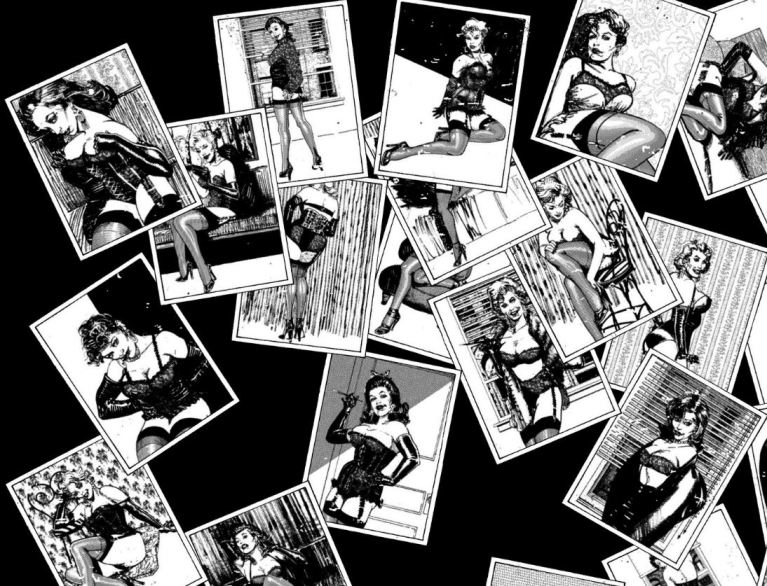
Unlike Sex Criminals and my beloved Hawkeye, Satellite Sam had the most salacious cover art of the three Fraction works, and immediately, my concern alarm went off. However, Satellite Sam had been illustrated by Howard Chaykin, whose art pays homage to one of my favorite visual trends, 1950s pin-up girls. After opening up the trade and reading the first five pages, I was lured into the glamorized noir world of Satellite Sam.

Satellite Sam Volume 1 Trade Paperback Cover
Satellite Sam follows the stories of the imperfect staff of the Le Monde television station in the aftermath of the murder of Carlyle White, the star of the channel’s signature show in which the graphic novel series is named after. The story arc of Michael White, the son of Carlyle and a minor production assistant for the show, lies at the heart of the series’ narrative. After finding evidence of his father’s deviant sexual habits, White becomes obsessed with his own investigation into his father’s world and his various rendezvous partners to find the person who killed his father. Along the way, Fraction presents other members of the Le Monde staff, and we quickly enter into a noir world where people are not who they seem, and everyone seems to have a reason to harm Carlyle White.
At this point, you may be wondering, why exactly are you okay with the sexuality of Satellite Sam when you had problems with Sex Criminals? My answer: sexuality lies at the heart of both series, but in completely opposite ways.
In Sex Criminals, the main characters talk about their sexual repression and awakening. The two meet and realize they have the supernatural power of stopping time when climaxing. The couple then use this power to rob a bank and eventually face other super characters. Interesting idea, right?
The core narrative of Sex Criminals is fairly a traditional one; it is a story that is not far off from that of Bonnie and Clyde. However, the first two issues become heavily overwhelmed with building the sexual history of the main characters, making the sexuality in Sex Criminals feel like a luring device to try to get people to believe that they are reading something more provocative than the familiar story of criminal partners/lovers. It attempts to make the lead characters more realistic and approachable to this generation of 20-somethings, but both characters are deceptively glamorized like the central characters of the 1967 film of the Bonnie and Clyde story. However, rather than accepting that the story is highly fictional and stylized, the dialog in Sex Criminals constantly tries to remind you with facile comedic interruptions that you have most likely experienced similar situations as these characters. The overall narrative is disingenuous; it suffocatingly feels the need to remind you that the semi-realistic moments of the main characters’ history and present are close to your own current reality when in fact the bulk of the characters’ acts are as fictional, generalized, and glamorized as those of superheroes.
On the other hand, immediately from the start, Satellite Sam sets you in a period long past. It is in a fantasy world, and the actions and stories that ensue are supremely fictional, though they have a setting that once existed with people that once existed (and whose remnants may still exist today). Satellite Sam, in its most diluted form, is a murder mystery that could be from any noir film of the 40s or 50s. However, what makes Satellite Sam so different from a traditional noir narrative is its use of sexuality; the explicit details of the sex lives of the characters could only exist in a period piece made today. The sexuality here portrays what all family-oriented parents in the 40s and 50s were afraid of and consequently preached to their children; highly promiscuous and deviant people pay severe consequences with their lives. Sexuality in Satellite Sam does not act as a way to lure people into a traditional and unimaginative story; it is the Achilles heel of some very flawed people, and it allows us to think more about the characters that we are following. Consequently, the mystery of who murdered Carlyle White takes a back seat in Satellite Sam, and the greatest attention is focused on the development of everyone we meet at Le Monde. The series emerges as studies of ill-fated characters whose motivations are always suspect and whose sexual inclinations give a perspective into who they are and why they behave in certain ways, which is something that could have never been discussed in a 40s or 50s noir and is ultimately what makes each issue so much fun to read. Satellite Sam uses sexuality to make a set of rich stories divergent from a traditional central narrative rather than to add flourishing trim to a standard framework.
Satellite Sam, Sex Criminals, and Hawkeye are published by Image Comics. There are currently 9 issues of Satellite Sam available, with the tenth one to be released on September 10, 2014.

 LILY & GENEROSO 4EVER!