The Joyous Power Within The 1971 Concert Film, “Soul To Soul”

Standard
ike and tina

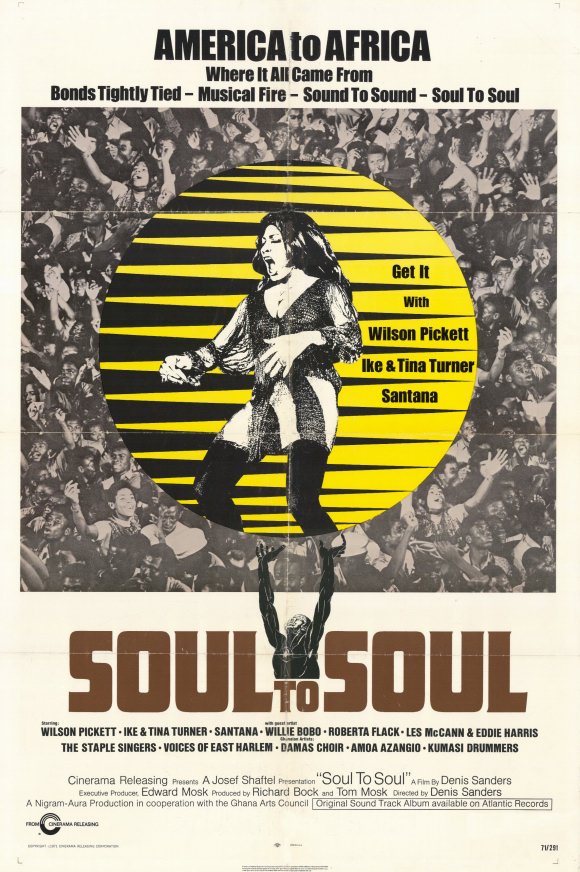
Ike and Tina Turner Stun The Crowd In “Soul To Soul”

The concert film, that relic of the screen before MTV, is still kicking around in 2015, though an artist has to reach the level of international fame of a Katy Perry or Justin Bieber before producers are willing to bankroll a two hour ego extravaganza to be seen by screaming teeny boppers worldwide. Prior the dawn of MTV, the concert film was the only way for many small town folks throughout USA and the globe to see a range of world class acts who wouldn’t come to their town in a larger than life way. As a boy I loved staying up late to watch Don Kirschner’s Rock Concert, the syndicated weekly live music show that brought many of us our first glimpse at rock and soul acts from Curtis Mayfield to Cheap Trick, but there was nothing like going to a theater to see a twenty foot tall Mick Jagger strut his stuff. In these years prior to the insanely expensive fees that now exist for music licensing, the concert film of the 1970s was a low risk moneymaker.

Adding into the frenzy of rock concert films was the wake left by the popularity of Gordon Park’s 1971 blaxploitation crime drama “Shaft” and its Academy Award winning soundtrack by Issac Hayes. Finally, Hollywood was now not only looking to distribute Afro American narrative films but also documentary films celebrating soul music that had the added potential of releasing a high selling soundtrack. Columbia distributed “Wattstax,” a 1973 concert film depicting the Stax Label fueled musical event that commemorated the Watts riots of 1965, and “Save The Children,” the film of the star-studded show attached to 1972 Jesse Jackson-led PUSH exposition held in Chicago, which was distributed by Paramount Pictures. Hot on the heels of “Shaft” and before even “Wattstax” and “Save The Children” was Denis Sanders’ superb documentary on the fourteen-hour concert that took place in Accra, Ghana in 1971, “Soul To Soul.”

After declaring its independence from England in 1957, Ghana had attempted to connect with a multitude of African diasporas and succeeded by getting the attention of poet Maya Angelou, who reached out to Ghana’s Prime Minister, Kwame Nkrumah, to invite many Afro American musicians to Ghana to help the newly independent country celebrate its freedom. Many years later, after Nkrumah was deposed, producers Tom and Ed Mosk presented the same idea to the Ghana Arts Council who agreed that the time was right for such an event to happen and thus the Soul To Soul concert was born. Amongst the American artists who would perform were some immensely popular soul artists: The Staple Singers, Ike and Tina Turner, Roberta Flack, and Wilson Pickett. The San Francisco rock group Santana would join the bill as would jazz performers Les McCann and Eddie Harris. Many Ghanian artists such as Kwa Mensah, The Kumasi Drummers, Charlotte Dada, and even house band for the Ghana Arts Council, The Anansekromian Zounds would play their hearts out for the tens of thousands in attendance.

The narrative construction of “Soul To Soul” would be much different from the previous mentioned “Wattstax” and “Save The Children” as far as showing the political (read: non musical) environment surrounding the concert. Gone are the moments within the town to hear what non-musicians think about the day-to-day lives. The few interviews that do exist in this documentary are mostly relegated to the beginning of the film, when the planeload of traveling soul artists is asked about their expectations for performing in Ghana. The musicians speak with great enthusiasm on their feelings about going back to the motherland, the clothes they will find and the people they will meet, but they all seem rather underwhelmed by the potential of hearing great music while there. Once they all land in Ghana, the wide-eyed tourist in our American envoy quickly disappears, as once they hear what their fellow musicians from Ghana can bring to the table, it becomes all about the music from that moment onward. A wide-eyed Tina Turner learning how to sing from a powerful Ghanian vocalist in the street is a moment that sums up the early collaborations well.

We then see the live concert, expertly filmed with brilliant sound that surpasses many films of its kind from that era. On stage, Ghanian musicians playing solo or with some of the American acts add a powerful communal element to the show. Also not lost on this viewer are the looks of awe from the audience upon seeing Tina and her backup singers howling out notes and gyrating wildly during “River Deep-Mountain High” in a way that I am sure would be scandalous for musical performances by women in Ghana at that time. Some dance in the crowd, but many just stare with open mouths and confused stares. More subdued but no less awe inspiring is the performance of Curtis Mayfield/Donny Hathaway written soul stirrer; “Gone Away” that Roberta Flack heartbreakingly sings that almost silences the enormous crowd. Strangely, Santana performs the most African sounding music of any of the American artists much to the crowd’s delight. The Staple Singers are given a few numbers on film and in general perform even better than they did on “Wattstax,” especially Mavis Staples on lead vocals, and the great Wilson Pickett, an audience favorite, gives his all as he always does.

There many powerful moments woven in between the live concert scenes, including a wedding and a funeral ritual that are seen without any over narration, and a trip to one of the many “slave castles” in Ghana that is done with few words from the guide and with a very poignant rendition of “Free” sung in acapella in the background. These scenes feel organic due to their placement, and therefore, flow well within the film’s construction as opposed to the attempts at similar emotional moments that are dispersed haphazardly in “Save The Children,” which leave you cold.

Original 1971 Trailer For Soul To Soul

 Sadly, “Soul To Soul” saw less distribution than needed during its initial run, and the Mosks did not make back their initial investment, so the documentary was near impossible to locate for many years. Thankfully, The Grammy Foundation paid for a restoration of the film and reissued it back in 2005 with added footage, interviews, and a companion soundtrack that I’m sure would’ve been a must-have had the film be seen by more of an audience back in the day.
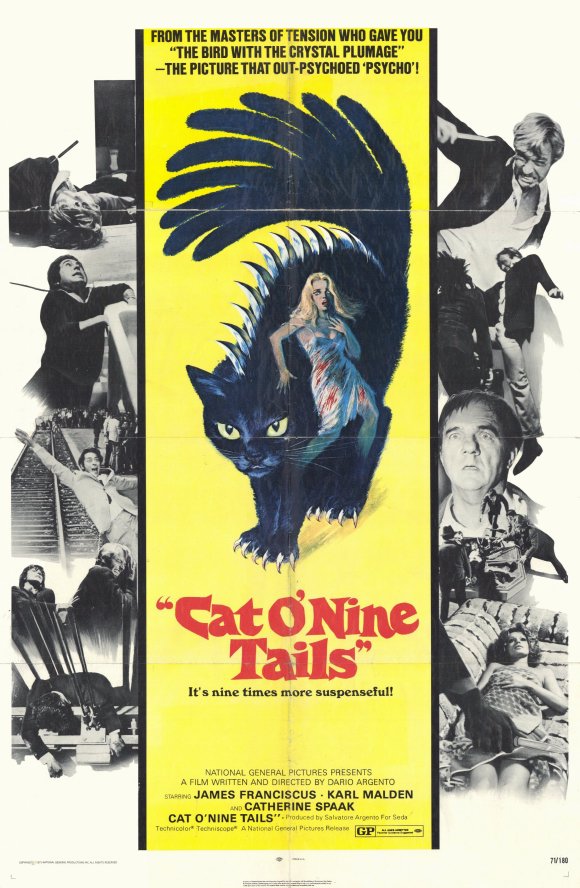
Karl Malden Shines In Part Two of Dario Argento’s “Trilogia Degli Animali,” 1971’s “The Cat o’ Nine Tails”

Standard
the-cat-o-nine-tails-1971-karl-malden-james-franciscus

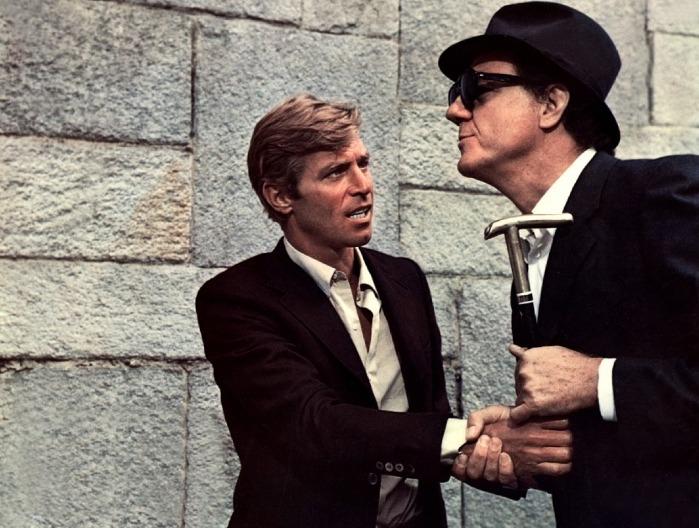
Cookie (Karl Malden) Meet Carlo (James Franciscus)

Before I write one critique about Dario Argento’s second film in his “animal trilogy,” “Cat o’ Nine Tails,” let me first commend him on casting the usually gruff talent of Karl Malden in the role of Franco “Cookie” Arno, a blind ex-reporter who creates crossword puzzles while taking care of his adorable niece, Lori. Sure, Malden is solid in this role as always, but the mind swims at the concept of Dario possibly sitting at his office and pitching to his producer/brother Salvatore that Malden would be perfect as the lovable Cookie, a year after Malden’s tough portrayal of General Omar Bradley in “Patton.” Either Dario is a genius, or Malden could just nail any part that came before him. I also wonder if Michael Douglas ever pulled the “Cookie” card on Malden the following year when they began filming “The Streets Of San Francisco?”

You might think that it is a bit odd that I am reviewing the middle film in a trilogy without ever reviewing the first and third films, but let me assure you that there is absolutely no connection between the three that might encourage you to watch Dario’s first in the series, “The Bird With The Crystal Plumage,” before reading further into my review.   What is true about this period in Argento’s work is that it represents his thriller output before he would embrace more of the supernatural aspects that would define his later films. In “Cat o’ Nine Tails” you have our young director drawing from Hitchcock, as so many of his peers were, but here he adds that element of sinister violence that is less gory than his later masterpiece “Suspiria,” but still quite jarring at times, especially one very creative and teeth-clinching elevator-related death. Though not a masterwork, I found “Cat o’ Nine Tails” to be as solid a thriller as Argento would make at this point in his career.

Our story begins with a burglary occurring at a genetics lab and the sounds of this event being picked up by our darling Cookie, who becomes interested a la James Stewart in Rear Window, so he then teams up with a young and all too hunky reporter, Carlo Giordani (played by the rugged and coiffed American television star, James Franciscus). After a few folks associated with the lab start ending up dead, it becomes clear that the lab has discovered some genetic strand that bears out the criminal tendencies that lie within people, and they have also created a drug that can cure these bad thoughts, but someone isn’t thrilled with one of these two discoveries, so the bodies start to fall. As stated earlier, the murders are not of the lavish, glowing straight razor variety that you would come to expect from Argento; most of our victims in “Cat o’ Nine Tails” are dispatched in the rope around the neck style. This is fine by me as Dario tries to make the plot the star around our killings, as opposed to a sketch of a plot that exists just to glue together a series of baroque imagery as in many of his giallos. My only real stylistic complaint comes from the enviable sex scene between Carlo, our dedicated reporter, and the wealthy daughter of the genetic lab’s director, Anna (Catherine Spaak, the gorgeous lead from Dino Risi’s 1962 film, “Il Sorpasso”). I’m not sure why Argento insisted on filming their coupling in the most robotic way possible, but as an Italian man, I am a bit taken aback by such non-emotional touching that given the dire circumstances that those two characters were surrounded by, should’ve heated up their illicit tryst.

Kudos again to Dario for the attempt at plot complexity here, but it may just be a bit too complex as the “nine” in the title refers to the nine potential criminal leads that are never followed fully enough to potentially draw your interest away from the reveal of the actual killer making the ending, despite a stunner of a death scene, fairly anticlimactic.  There is also a score created by legendary composer Ennio Morricone, that is pretty lackluster, which is not surprising considering that Ennio has scored over five hundred projects over his illustrious career. There has to be a few throwaways in the bunch, and sadly we have one of those here. Malden and Franciscus are the main reasons why you stay in your seats as they are veteran actors that can make any scene work a cut above the rest.

Original 1971 Trailer For Cat o’ Nine Tails

“Cat o’ Nine Tails” is a decent enough film that now stands as a kind of testing ground for a young Dario Argento for what would and would not work and not work in his subsequent films. There are more than enough visual creations that will make you jump, and the overall cinematography is more than a cut above the usual early 1970s giallo.  Finally, I tip my hat to director Argento for acquiring the acting talents of Malden and Franciscus for this, only his second feature film. I don’t know if I would have the nerve to fly an actor the stature of Malden across the Atlantic and saddle him with a character named “Cookie,” but I still admire Argento for thinking that Malden would fit into that character so well.

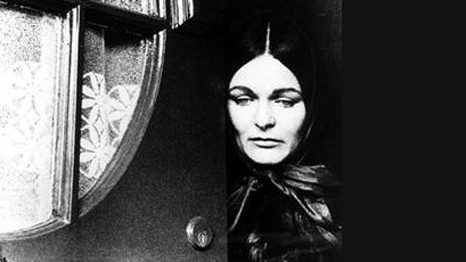
Mike Leigh’s Debut Film Is a Small Masterpiece: 1971’s “Bleak Moments”

Standard
bleak-moments-1971

The brilliant Anne Raitt of “Bleak Moments”

There have been few British film directors over the last forty years whose overall body of work I would label as “uncompromising.” Especially difficult was to stay real past the era of creative freedom that was the 1970s; there was the creative lock down and resulting button down stiffness of the 1980s, a decade that forced the British film industry to get all “Chariots of Fire” on us. Which of course, lowered our standards and set the plate for what would be the most successful English filmmaker of today, the human codpiece, Danny Boyle. Truly one British director whom never succumbed to the vile era of the period piece and or uptown glitz over this time is director Mike Leigh.  With Leigh’s 24th film, “Mr. Turner,” about to be released here in the States, I thought to go back and look at Mike’s astonishing 1971 debut effort, “Bleak Moments.”

I cannot imagine as to what folks thought of “Bleak Moments” when it was released in the early 1970s. Though devotees of the films from the British New Wave were used to seeing fairly tough to watch fare like “A Taste of Honey” and “Saturday Night, Sunday Morning,” we must remind ourselves that although those films possessed some fairly shocking themes for the time (abortion, homosexuality), their actors and the overall tone would still rise above the hardships to provide the viewer with many entertaining moments.  No such uplifting time exists within “Bleak Moments,” a film that succeeds in a dour, hopeless tone that few films have been able to reach since.  Much of that not only is due to our Mr. Leigh, who both wrote and directed “Bleak Moments,” and its talented actors who convey the desperation to create this unrelenting, low mood but also it’s modest budget, which lead to the dark visuals and low-fi sound to enhance its already stark feeling of hopelessness.

The film is about Sylvia (Anne Raitt) an office worker, who after putting in a hard day, tends to her mentally challenged sister in her tiny apartment. She is a pretty and somewhat cynical woman whose only amusements given her charge in life and financial situation are the occasional good book and a glass of sherry. At work she chats with her friend Pat, (Joolia Cappleman) who also has the burden of taking care of a physically incapable family member, her elderly mother. They commiserate, but little is actually said about their true sadness that is their lot in life.   Sylvia has a man in her life, the equally quite teacher, Paul (Eric Allan) who wants to be with Sylvia but lacks the fire necessary to break through to her and show her how he really feels. There is also Norman (Mike Bradwell), a hippie folk song singer who also fancies Sylvia and rents the garage, but he also lacks in the self-worth category, so when he is dismissed by Paul as a failure, Norman takes the failure route out.

Paul and Sherry go out on a date, but what follows is a series of awkward dialogs, an incredibly rude waiter that exposes Paul’s inabilities to be a man, and a scene of courtship that occurs back at Sylvia’s place that may never be rivaled for its depiction of sad desperation in screen history. Again, whereas an earlier British New Wave film would’ve resorted to moments of comedy in such a scene, Leigh never lets you off the ropes because he shouldn’t.  These are people whom we all know, good-natured people whom life has pushed aside, but you know that deep down inside that there is little in their makeup to allow them to overcome their self-imposed malaise. You know that they are doomed to “live lives of quiet desperation” that I’m sure would even go well beyond Thoreau’s imagination of such as he penned that line. First time director Leigh allows for every small moment to hit home. It is exceptionally intelligent work for a director the age of 28.

Though this was Leigh’s first outing as a film director, his knowledge of the theater allowed him to select the right acting talents to head this project, a project that was funded by the stars of many of those British New Wave classics, Albert Finney and Michael Medwin, whose production company, Memorial Films, had just bankrolled Lindsay Anderson’s “If” and provided the twenty thousand Pounds that was necessary to get Leigh’s career as a director off the ground. This decision was made by the two after they saw Leigh direct “Bleak Moments” at the Open Space Theater. Though Finney and Medwin could boast such illustrious acting careers, I personally would also hope that they would be as proud as to have helped start the career of our Mr. Leigh.

Norman Sings Us A Sad One in “Bleak Moments”
http://www.youtube.com/watch?v=E62rL6v2GBg

I was once asked by my friend Charlie some thirty years ago, shortly after I described “Bleak Moments” to him and before I shoved a VHS copy of the film into my player; “Why would you ever want to watch something that would make everything seem so hopeless for decent people?” A question I really respected at the time and one that made me wonder for years to come. Though this answer is some thirty years late, I think that in the case of “Bleak Moments,” you feel there is a poetic beauty in even the saddest moments of the film because as much as you hope that characters like Sylvia and Paul could just rise above the troubles that have been bestowed upon them, you are moved to see how they delicately maintain themselves in the face of it all.