Best of Film 2024

Standard


Originally published on Ink19 on December 13, 2024

In a year where chaos continued to reign supreme, our favorite films naturally do not have a consistent thread running through them. Instead, there are patterns that convene in our best of film selections that may not logically fit together, but alas, feel like an accurate collage of the ideas, images, sounds, and texts that reverberated in our minds this year.

For the first time, we have four films from Canadian directors that represent three provinces on our list, with each film capturing key essences of its portrayed region. We also have three films that meditate on the concept of the spiritual quest. There are two challenges to the biopic form, two Argentinian re-interpretations of the crime genre, and two works from French cinema stalwarts that cultivate all of their fascinations and their methods into supreme culminations. In addition, there are three documentaries that use repetition in thought-provoking and revelatory ways.

Despite these many differing motifs, there’s one commonality, perhaps obvious, in our selections for 2024 that we should articulate. All of these films are specific: to a geography, to a zeitgeist, to an experience, to a technique. This may seem like a prerequisite for any respectable piece of art, but as the forces of cultural homogenization become more dominant via algorithms every day, never has specificity been more necessary and critical.

As with every year, we’d like to give our appreciation to the outstanding folks behind Acropolis Cinema, AFI Fest, Independent Film Festival Boston, the Brattle Theater, Films at Lincoln Center, the Coolidge Corner Theater, and the Cleveland Cinematheque for their programming and their unwavering efforts to preserve the communal experience and audiovisual wonder of filmgoing. Please support these festivals, microcinemas, and independent theaters in their substantial work.

• •

Việt and Nam / Philippines, France, Singapore, Italy, Germany, Vietnam / dir. Trương Minh Quý

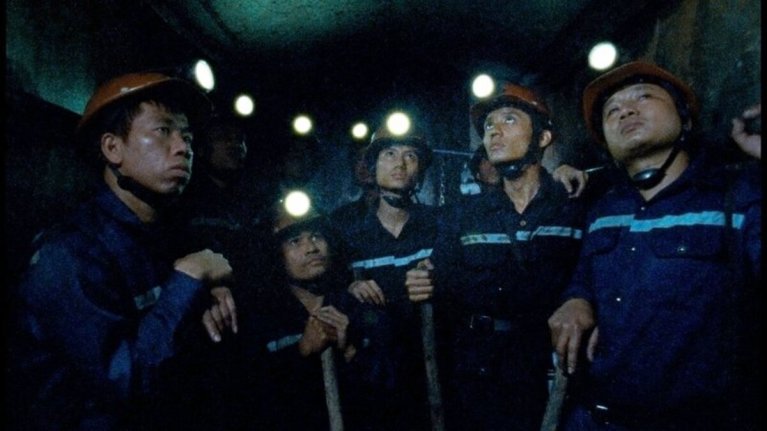
With each of Trương Minh Quý’s films, the director sets forth ideas of the cosmic and the historic along with the multi-layered conceptions of house and home and allows us to watch all of these forces clash and interplay. In his most recent feature, Việt and Nam, Trương’s method has reached its highest form to date, resulting in a hypnotic, moving film made up of various interwoven, open-ended essays on Vietnamese culture and history, all of which are framed by the relationship between the two titular characters. The plot of Việt and Nam is simple albeit particular: Việt and Nam are miners who are best friends and lovers. In the year 2001, Nam is getting ready to leave Vietnam in search of a better future outside of the country, and the film documents the period where Nam looks towards his unknown future and bids his farewell to a present that will soon become the past. As such, history and collective memories weigh heavily on each of Nam’s interactions with his surroundings — his home, his workplace in the mine, and the forest where he attempts to help his mother recover the remains of his father who was killed in the Vietnam War — and his relationships with his mother and Việt, imbuing Việt and Nam with a profoundly elegiac tone. Haunted by the real future incident of the discovery of thirty-nine Vietnamese migrants who were killed in a lorry container that landed in the UK in 2019, Việt and Nam intimates a tragic end to Nam’s departure, but remains fixed throughout on all of the forces that encourage Nam’s migration. Trương offers a multitude of ways that fixations on the past extinguish potential, swelling up Việt and Nam into a mourning cry for the loss of home for all who departed Vietnam’s shores and the loss of opportunities and vibrancy for a country that lost its people. Misinterpreted as a work of slow cinema in the manner of Apichatpong Weerasethakul, Việt and Nam is, in fact, a collage of cinematic techniques ranging from long-takes to cross-cuts, which build the momentum of the film to take us from the bowels of the Earth to its surface and then to a plane above. We had the honor of speaking with Trương Minh Quý in the days before Việt and Nam screened at AFI Fest 2024. You can read that conversation here.

• •

New Dawn Fades (Yeni șafak solarken) / Turkey, Italy / dir. Gürcan Keltek

Symbols and signs have never been more important, and less recognized, than they are today. We are constantly bombarded with visual stimuli as our experiences of reality are mediated by a variety of screens on phones, laptops, televisions, etc. In order to make it through the day without a complete cognitive meltdown, we rarely stop to try to decipher each image and word and deduce what is being signified, and we certainly are remiss in paying such close attention to the objects in our physical reality too. Gürcan Keltek’s superb fiction debut, New Dawn Fades, valiantly takes up the task of revitalizing the significance of sign theory in experience. The film opens in the Hagia Sophia, panning the walls covered in writing and the geometric ceilings of the iconic place of worship, and then narrows its view on Akın (Cem Yiğit Üzümoğlu), our physical and mental guide through Istanbul’s present and unseen past. As we look at Akın in the mosque (and former church), we hear unintelligible, multilayered whispers: the tourists in the background are speaking, but voices from the past or from within Akın are present too. He then returns home to his mother, where we learn that he has recently completed a period of institutionalization. He is clearly still not well, but his mother worsens the situation by relying on medieval beliefs and practices to try to release the malevolent spirits plaguing her son. As such, home is not a place of convalescence and restoration for Akın, and he takes to wandering Istanbul, visiting people and places of varying degrees of significance to him as ancient, Byzantine, Ottoman, and contemporary forces infuse into his perception. Keltek allows us to experience everything as Akın does, and the sound design by Son of Philip acts as a non-verbal representation of Akın’s sign processing, which steadily builds towards a messianic vision (or delusion). Akın’s mental response to the symbols that he encounters may not be fully understandable by those of sound mind, but his ability to detect such signs remind us of how powerful they can be and how our decisions to avoid interpreting them may be paradoxically protective and destructive. We wrote a full review of New Dawn Fades during its festival run this year. That piece is available here.

• •

Tardes de soledad (Afternoons of Solitude) / Spain / dir. Albert Serra

In many of Albert Serra’s films, the frame is the theater stage with a pedestal, and on it is some figure(s) of grand stature, by way of history, notoriousness, and/or national standing, whom the director will strip down and reduce to their most basic form for all of us to examine away from any facades that once entranced us. This Serra method is in full effect in his latest film, Afternoons of Solitude, a documentary which meticulously captures the in-arena trials and tribulations of the world’s leading torero, Andrés Roca Rey. There’s little glory to be had or found in Serra’s rendering of Spain’s controversial, but nevertheless significant national pastime: the director presents close-up studies of multiple corridas without any shot of audience reactions, and though the fights are stitched together by a handful of beyond the arena scenes of transit, undressing, and dressing, the bullfights develop into an increasingly predictable loop, with each fight differentiated merely by the change in costumes by Rey and his cuadrilla and, of course, by the change in the bull opponent. Like a three-act play, a bullfight is structured in thirds, and its script plays out as consistently as that of a passion play. Occasionally, the fight veers off course: a bull attacks and nearly steps on Rey in one and pins him to the arena wall in another, but the script corrects itself each time, with the cuadrilla stepping in to help, Rey returning to the battle full of bravado, and voices exclaiming admiration for Rey’s manhood heard over the images of the torero continuing on until the bull is killed and dragged away by horses, leaving a large streak of blood in the arena sand. Even though we see the arcs of the bullfight over and over again, Serra’s documentation of this national play/shared ritual never becomes tedious thanks to the incredible close-ups and dynamic editing that draws our eyes to the faces and the natural materials and fluids as well as the man-made substances and objects that are essential to a bullfight. The horror of the violence repeatedly enacted towards the bulls in the arena does not go away, but our emotional activation dampens with each fight, replaced by a new lucidity: bullfighting is a tradition that feeds the spectator’s primeval motivations and tendencies at the cost of animal and human life. Afternoons of Solitude dissolves our collective consciousness’s fascination with bullfighting and confronts the culpability of the viewers of the sport. It could become one of the most important records of a long extinct pastime some day in the future — if only we could step away from our deeply rooted attachment to violence.

• •

Comme le feu (Who by Fire) / Canada, France / dir. Philippe Lesage

One of the most energetic reflexive works about filmmaking that we’ve seen in many years, Philippe Lesage’s Who By Fire lures us into a spider web overseen by Blake Cadieux (Arieh Worthalter), a once famous fiction filmmaker who has moved on to become a documentarian and a woodsman (of sorts). Blake invites his former screenwriting partner, Albert Gary (Paul Ahmarani), for a retreat and reunion at his palatial cabin in the woods, and Albert brings along his college-aged children, his daughter, Aliocha (Aurélia Arandi-Longpré), and his son, Max (Antoine Marchand-Gagnon). And Max brings along his best friend, Jeff (Noah Parker), an aspiring filmmaker. When Albert and company arrive to the cabin by a seaplane flown by Blake himself, they meet Blake’s editor, Millie (Sophie Desmarais), his best friend and assistant/wilderness guide, Barney (Carlo Harrietha), and the house chef, Ferran (Guillaume Laurin). At this point, nearly all of the crew members needed to make a film are present, and Blake naturally takes on his role as the director as well as the lead actor in the group’s dynamic even though the cameras aren’t rolling. Blake’s command at the dinner table the first night raises old tensions between him and Albert, and this clash between the former collaborators lets loose an uneasiness that permeates the film. Despite the dominance of Blake as a character, Lesage anchors Who By Fire on Jeff, and as the film progresses, we see the awkward and highly sensitive Jeff get caught between his attraction to Aliocha and his eagerness to impress and learn from Blake, who is quick to share his director’s copy of the screenplay for one of his most famous films with his aspiring disciple. Much to his embarrassment, Jeff gets lost in the woods at night after making a confusing pass at Aliocha and has to be rescued by Blake the next morning. Then, in the late hours of the same day, Jeff catches Blake and Aloicha together as his would-be mentor takes partially clothed photos of his object of desire. Jeff seethes, but he can do little in this space where all activities, including lounging, fishing, dining, or canoeing, are set up and helmed by Blake. As a result, Who By Fire materializes a microcosm where artistic striving crashes into grappling between generations, the older clutching onto what remains of its dominance and the younger trying to ascend while also desperate to glean knowledge and wisdom from its contender. And yet, the film is also an ode to filmmaking: a celebration of the joy, dread, drama, and sadness that the moving image can bring because Blake takes Jeff and all of the people in the cabin through each of these emotions with different situations masterfully constructed and integrated together by Lesage and effortlessly lensed by cinematographer Balthazar Lab. In turn, Who By Fire rejoices the possibilities of cinema as an artform while also sharply articulating the limitations to its progression that people, be it themselves or others, place on it.

• •

L’Été dernier (Last Summer) / France, Norway / dir. Catherine Breillat

There’s something amazing about Last Summer even though its premise around an illicit affair between a stepmother and her stepson is straightforward and its execution doesn’t immediately appear to challenge any conventions of cinema on an initial viewing. But, after some contemplation, what readily becomes apparent about Last Summer is its effortlessness in its unraveling of female desire in an extremely inappropriate relationship, a topic that has dominated the works of Catherine Breillat for decades. With Last Summer, all of Breillat’s daring provocations and examinations of female desire are elegantly channeled into the relationships, self-image construction, and traumas of Anne (Léa Drucker), a prominent attorney who protects abused minors. Anne has a seemingly enviable life: she is well-respected in her career and lives in splendor with a successful and loving businessman husband, Pierre (Olivier Rabourdin), and two adorable adopted Asian daughters on a modest estate protected from the outside world and nearby Paris by lush foliage and beautiful lawns. But, in a moment of intimacy between Anne and Pierre, we see fissures in Anne’s picture perfect existence that hint at a traumatic early sexual experience, and upon the arrival of her stepson, Théo (Samuel Kircher), the fissures begin to rupture, propelled by an entangled mess of Anne’s first sexual encounter, the repression of her sexuality overall due to the AIDS pandemic during her early adult years, a fatalistic desire to demolish the life she’s created for herself, and her attraction to Théo’s beauty, sensuality, and rebellious energy. All of these are heavy forces that compel Anne to continue her relationship with Théo, but Breillat expertly infuses them into glances, conversations, and, of course, sexual acts such that nothing ever feels like an overt proclamation or explanation of motivations. As a result, such nuances extend Anne’s character naturally in a highly unnatural, objectionable situation to the point where our judgment of Anne is overtaken by a lucid understanding of her actions. We all know Anne’s relationship with Théo is wrong, but the reasons for its existence and endurance are fundamentally human and, though complicated, within the realm of reasonable comprehension. Last Summer feels like a film that only a later stage of Catherine Breillat could make: there’s no viscera or physical brutality here, only the psychological tumult brought on by the self and others as well as by societal and familial forces — a kind of violence that permeates our own thoughts and desires even if our consequent actions are radically divergent from Anne’s. We reviewed Last Summer during its US theatrical release. You can read our full piece here.

• •

C’est pas moi (It’s Not Me) / France / dir. Leos Carax

Before we dig into It’s Not Me, we do feel the need to address the “what” of Leos Carax in output and opinion prior to this point in his career…Carax was only 24 in 1984 when his celebrated debut feature, Boy Meets Girl, was released. Universal acclaim for his triumphant follow-up, Mauvais Sang (Bad Blood), exalted him as the next great young voice in French cinema, a title that was virtually stripped away after his third feature Les Amants du Pont-Neuf (The Lovers on the Bridge) went spectacularly over-budget and polarized critics, which led him to respond with Pola X, his fittingly bitter adaptation of Herman Melville’s critically detested novel, Pierre: or, The Ambiguities. After the death of his longtime collaborator, cinematographer Jean-Yves Escoffier in 2003, it would be nine more years before Carax’s Holy Motors would hit theaters, a luxuriously enigmatic masterwork that simultaneously honored and challenged cinematic conventions — a film that also subsequently landed on multiple best of the decade lists, including ours. Now, at 64, with his long desired Sparks musical Annette directed and behind him, Carax has internalised the loss of Jean-Luc Godard and connects JLG’s later compositional filter to his own œuvre and historical and contemporary worldview to compose It’s Not Me, a commissioned short film for The Centre Pompidou, a video essay response to the question posed by them: “Who Are You, Leos Carax?” Visually stunning and enthusiastically chaotic in presentation, Carax pulls together the pieces that vacillate wildly inside his mind, from the films seared into him from his own filmography to Murnau’s Sunrise and Hitchcock’s Vertigo to stark documentary footage of Nazi rallies, dictators galore, and drowned migrant children. Carax connects the stimuli to his psyche and supplies his own over-narration, which at times is as judgemental of others as it is self-effacing, and even occasionally lovely with sequences dedicated to the people closest to him, his daughter and Jean-Yves Escoffier. For those uninitiated to and less appreciative of all things Carax, It’s Not Me, will most likely not have the same kind of impact as other directors’ introspection pieces like Bertrand Tavernier’s My Journey Through French Cinema or Varda by Agnès, as those delightful films strive more for a display of personal influences and experiences than what Carax clearly intended for his short: an admission that he still actively searching history and himself for answers to the whys of the world and the present state and potential future of his beloved medium. Though Carax’s undertaking may seem a bit overwhelming to address in a scant forty minutes, It’s Not Me’s overall power lies less in any answer given, but in its glittering omnibus of ideas that come together as questions. Lastly, we must thank Leos for giving us the most surprising and exhilarating post-credit sequence in film history!

• •

Matt and Mara / Canada / dir. Kazik Radwanski

A comedy of manners about the reunion of two estranged friends who are writers living in a rarefied air, Matt and Mara has the construction of a modern love story but is, in fact, a kinetic exploration of the blurred line between an artist’s life and work. When we first meet the pair, Matt (Matt Johnson) surprises Mara (Deragh Campbell) as she hurries towards the door of her classroom. From her furrowed brow and overall countenance, we can immediately tell she’s uncomfortable with his presence. He tells her he’s back in town and wants to meet with her. In quick response, she lets him know she’ll be in touch via email and proceeds to enter the lecture hall. The film then cuts to the beginning of Mara’s lecture for a poetry class and her shifting attention to Matt tiptoeing into the classroom and clumsily looking for a seat. Mara smiles, and we can sense that these two have known each other incredibly well, despite the tension in their interaction in the opening scene. After Mara’s class, the duo head to a cafe where they talk about the ideas that they are creatively reflecting on: Matt is trying to find proximity to characters in his writing that are far different from himself, and Mara is interested in a protagonist who “truly believes that they know nothing about themselves and that all of their desires are complete secrets from them.” We learn more about the past dynamic between Matt and Mara from conversations Mara has with one of her colleagues as well as with her husband, moments that are interspersed between scenes of Matt and Mara in the present. With Matt back in Toronto after an extended period in New York, the two friends frolic and play around on the city’s sidewalks, get passport photos taken, attend a party at the house of Mara’s department head, and visit Matt’s comatose father in the hospital. The pair are radically different, but together, both have a vibrancy and warmth with each other that is noticeably different from their relationships with others in their respective lives. And yet, Mara’s own uncertainty with herself and Matt’s false extroversion that distracts away from his lack of confidence eventually come to a head when Matt chaperones Mara to a conference, and both writers are forced to assess their relationship with each other as people, not artistic personas. With Matt and Mara, Kazik Radwanski exhibits a refreshingly contemporary understanding of communication, action, and intimacy and where they all break down, making Matt and Mara one of the most sharply resonant and observant films that we saw this year. You can read a full review of Matt and Mara here

• •

Algo viejo, algo nuevo, algo prestado (Something Old, Something New, Something Borrowed) / Argentina / dir. Hernán Rosselli

With his hybrid-fiction crime film, Something Old, Something New, Something Borrowed, director Hernán Rosselli creates a visually diverse and complex low-budget feature that is as innovative in its inception as it is thoughtful in its construction. Utilizing ideas from his own familial experiences, along with surveillance footage, news reports, and the home videos given to him by his longtime Lomas de Zamora neighbor (and ultimately the star of his film), Maribel Felpeto, Rosselli cleverly composes a fictional narrative on a family’s illegal gambling business that blurs reality in a similar fashion to our own memories through the use of the aforementioned varied media elements. The plot is centered on Maribel, who, along with her mother Alejandra (portrayed by Maribel’s real-life mother, Alejandra Cánepa) and some trusted allies, attempts to carry on the their clandestine bookmaking operation after the sudden suicide of the family’s patriarch, Hugo Felpeto. While attempting to stay two steps ahead of federal officers, who are systematically raiding gambling dens all over the country in defense of the growing national lottery, Maribel is tasked with destroying any documents that could be found incriminating in a raid and breaking into her late father’s laptop to see if he moved any money to secret accounts. This search by Maribel through her father’s online accounts turns up evidence of her father’s extramarital activities, which prompts her to search for answers that, when found, leave her questioning everything from her family’s structure to her own identity and purpose. Operating as the central narrator, Maribel’s thoughts are effectively matched throughout the narrative with the real-life home videos shot by Hugo that primarily serve to paint an affecting portrait of her mother’s transformation from an intelligent, but naive fiancée to the decisive and ruthless leader whom Maribel was raised to emulate. Through the use of surveillance footage that provides emotional distance and also foreshadows the raid that will shutter the family’s business forever, we as the audience become less concerned with a dramatic outcome, leaving us free to examine how our perceptions of reality are formed when we are inundated with a barrage of misleading stories about and by the people we trust throughout our lives. Take a look at our full review of Something Old, Something New, Something Borrowed, which was published here on Ink 19 on December 9th.

• •

Universal Language / Canada / dir. Matthew Rankin

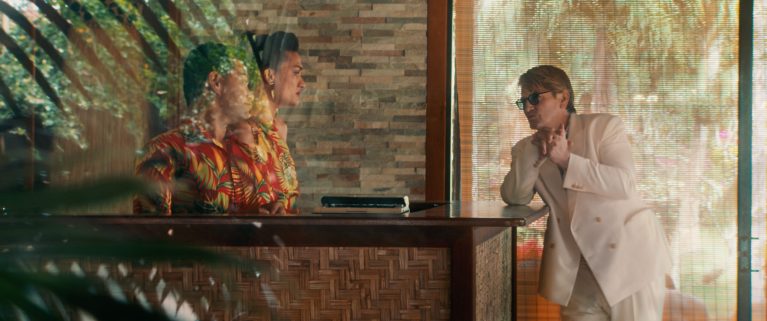
When we viewed Matthew Rankin’s debut feature, The Twentieth Century, we were immediately charmed by his idiosyncratic style of overlaying farce on top of a selection of events in Prime Minister William Lyon Mackenzie King’s life. The bizarre but vibrant aesthetic of the film, hearkening to Futurism, German Expressionism, and Surrealism filtered through the Golden Age of Television proclaimed the Winnipeg-born director as a clear descendent of Guy Maddin. This lineage is reaffirmed with Rankin’s second full-length, Universal Language, but the director introduces the influence of an additional parent, Iranian cinema. Universal Language reimagines Winnipeg as the Tehran of Canada, a place where the beige architecture and snow of one of the world’s coldest cities live side by side with the city’s Persian culture and dominant language, Farsi. The film tells two tales and gathers them together with an enthusiastic tour guide who shows people the marvels of Winnipeg. One of the stories pays homage to Jafar Panahi’s White Balloon: two sisters (Rojina Esmaeili and Saba Vahedyousefi) roam the city looking for an ax to excavate money frozen in ice in order to pay for the replacement glasses of one of the sister’s classmates. And, in the other, a man — played by Rankin himself as a nod to the tradition of Iranian directors playing themselves in their own films — leaves Montréal and returns to Winnipeg only to find that his mother’s exact whereabouts are a mystery as his childhood home has been sold and is occupied instead by a kind family. Meanwhile, the tour guide (executive producer and co-writer Pirouz Nemati) emphatically highlights Winnipeg’s modest sights such as its abandoned mall and a forgotten briefcase that no one has ever taken or opened, which has become a city landmark as an emblem for human honesty and trustworthiness. The characters roam around Winnipeg’s streets and sidewalks seeking completely separate things, but, gradually, their paths move closer to each other and lead them to the tour guide’s apartment where revelations transpire. By superimposing Tehran on Winnipeg, Rankin implicitly raises issues around autonomy and independence inherent in the tensions between Canada’s Anglo and French origins while also noting the multiculturalism of Canada that accelerated in the twentieth century. The Winnipeg of Universal Language is as foreign to Montréal as Paris is and vice versa, but both cities are related through their history, particularly by Louis Riel, whose monument is notably featured in the film next to a highway. Born in Saint Boniface (which is now a part of present-day Winnipeg) to a Métis father and French-Canadian mother in 1844 and educated in Montréal, Riel founded the province of Manitoba and fought against the Canadian government’s attempts to take over Métis land in the region. His charge of treason and subsequent execution catalyzed a rise in Québec nationalism in the late 1880s, which, in the century to follow, gave rise to the Québec sovereignty movement. Riel thus embodies Canadian plurality, and the scenes featuring his monument stress this concept that is dear to the film and its filmmaker. Universal Language envisions an entirely Persian Winnipeg, but in doing so, it demonstrates how we, despite our divisions, are inextricably linked in ways seen and unseen, and there’s something lovely and amazing about that.

• •

Inside the Yellow Cocoon Shell (Bên Trong Vỏ Kén Vàng) / Vietnam, Singapore / dir. Phạm Thiên Ân

A sinuous road film flowing with sensorial delights, Inside the Yellow Cocoon Shell takes us from Saigon to the Lâm Đồng province in Vietnam’s Southern Central highlands where the director Phạm and his cinematic analog, Thiên (Lê Phong Vũ), grew up. In the earliest parts of Inside the Yellow Cocoon Shell, we observe Thiên moving listlessly through his life in Saigon: he edits wedding videos in his small apartment; he hangs out with his friends; he gets a massage. Phạm, along with his cinematographer, Đinh Duy Hưng, present these moments in long takes, allowing the audience to see what’s happening around Thiên and how it all fails to inspire any activation from him. When Thiên’s young nephew Đào (Nguyễn Thịnh) manages to survive a motorbike accident that kills his mother, Thiên suddenly becomes Đào’s guardian and takes on the duty of bringing his nephew as well as his sister-in-law’s body back to their shared hometown in the countryside. Once the van that he hires for transport out of Saigon arrives at Lâm Đồng, Thiên is reimmersed in the physical and the spiritual landscape that he had left behind. The service for his sister-in-law is held in the Catholic church that he attended as a child. And, he is surrounded by the lush mountains of the highlands and a constant mist and fog, evoking a mixed sense of the mystical, primordial, and holy. The long takes continue here, but Thiên is noticeably more aware and pensive as figures and moments from his past re-emerge and lead him to embark on a mission to find his brother, Tâm, who departed years ago on a spiritual mission with destination unknown. Thiên rides his motorbike and walks on mountainous roads, and his upward movement physically parallels his ascension of metaphysical planes. Navigating between multiple dualities — reality and dreams, city and country, earthly and divine — to render the complexity and beauty of the spiritual quest, Inside the Yellow Cocoon Shell is a highly accomplished debut feature that remained in our minds throughout 2024. We had the privilege of speaking with Phạm Thiên Ân at the beginning of this year about his Camera d’Or winning film. You can read that conversation here.

• •

SUPPLEMENTAL FILMS

Anora / USA / Sean Baker

It’s too easy to simply reclassify Sean Baker’s Palme d’Or-winning feature Anora as a modern and more realistic reimagining of one of the most inept and insulting Hollywood films ever made, Pretty Woman. Sure, the setup is virtually the same…A streetwise sex worker from the wrong side of the tracks comes to know a wealthy John who pulls her into a world of privilege she never dreamed of, and it all seems grand until the straights complain about the woman of a questionable past, and it becomes a fight to end the affair. But, with its torrid pace, central characters, and, most importantly, the silent growing camaraderie between its central characters who are put into an impossible situation that reflects upon their place in New York City, Baker remarkably manages with Anora to draw an unlikely comparison to one of the finest genre masterworks of 1970s American cinema, Sidney Lumet’s Dog Day Afternoon. Here, the titular Anora (Mikey Madison) is, in her voice and attitude, the pure embodiment of many generations of Brooklyn rolled into one. A descendant of Russian immigrants, Anora lives in a second-story working-class apartment with her sister, where she sleeps during the day and works as an exotic dancer at night at a less-than-opulent men’s club. On one of those nights, she is commanded by the club’s owner to utilize her Russian language skills in order to attend to Vanya (Mark Eydelshteyn), the spastic adult son of absent oligarch parents who have left their boy in the States with just a palatial mansion and an unlimited expense account to keep him entertained while he skips out on college. Always up for a good time, Vanya requests that Anora come to his estate for a paid sexual encounter, which then turns into a party invitation and a request to exclusively escort him for a week, leading to some casual hangs and an airplane ride that lands the pair in Vegas for a quickie wedding.

It’s all starry-eyed for a moment for the newlyweds until they head back to New York, where the beleaguered paid assistants of Vanya’s parents, Toros (Karren Karagulian), Garnick (Vache Tovmasyan), and Igor (Yura Borisov), race to the mansion to send Anora packing. Once at the mansion, though, the goonish trio subdues Anora after a long, drawn-out fight, and Vanya, ever the cowardly brat, runs away, leaving his bride behind. For the remaining two-thirds of Baker’s film, Anora, Toros, Garnick, and Igor frantically race through a frozen NYC on a desperate and, at times, comedic search for Vanya, and it is this grouping of broken individuals, who should be constantly at one another who come to realize that they are all, by their lot in life, stuck in this miserable situation in an unforgiving city, that pulls Anora into the same universe inhabited by Sonny, Sal, the scared tellers, and even the cops of Lumet’s sweltering summer bank heist film gone wrong. In the end, like Dog Day AfternoonAnora ultimately benefits from stunning, unique performances that fuel the well-written characters in each film to wholly depict New York City in their respective eras as a place where anything can happen, but where the majority of its citizens are struggling under the thumb of a power too strong to overcome.

• •

Youth (Spring) / France, Luxembourg, Netherlands / dir. Wang Bing

Carved from 2,600 hours of footage, Wang Bing’s Youth (Spring) exhaustively considers the cyclical nature of the terms of its title as expressed by the everyday moments of teenagers and young adults working in small factories in Zhili City, approximately 150 kilometers away from Shanghai. For each year’s garment making season, which begins in colder months and ends sometime in spring, the young from rural provinces travel to Zhili City to make children’s clothing. Each factory produces a set of styles determined by the managers and owners, and payment for each laborer is based on a pattern’s complexity and the total number of pieces sewn by the end of the season. The work is undoubtedly grueling, but the workers manage to find life and do the things that newly emerging adults do: bicker and fight, fall in and out of love, play video games, scroll on phones, hang out with their friends and colleagues, and find creative ways to bear each day of labor. The vivacity and wide-eyedness of the workers is not far from the spirit and energy of their university-bound peers, but Wang reminds us with small details — such as the decaying walls of the dormitories that house our laboring youth and the various social rituals performed around fetching water from industrial spigots to wash each night because the buildings are not equipped with showers — and the constant reiteration of miniature pants, dresses, jackets, and shirts being sewn and stacked, along with extended scenes of negotiation for better payment prices per style, that the factory setting is not a place of mind expansion and development: it is a vicious cycle where youth is commodified and cannibalized, leaving little promise of a different future for the children who will wear the clothes being manufactured. Much has been made about the over three hour runtime of Youth (Spring), but all of that time is needed because the minutiae and the high, low, and in-between moments from the workers’ lives show us how youth disappears not in a single grand event, but rather day-by-day, which is a heartbreaking tragedy that no one can stop, but one that we should avoid accelerating as much as possible.

• •

Los delincuentes (The Delinquents) / Argentina / dir. Rodrigo Moreno

There are two outstanding original Argentine crime films on our list this year: Hernán Rosselli’s harrowing hybrid-fiction essay that challenges our perception of family and identity and its comedic and ethereal counterpart from Rodrigo Moreno that reimagines the bank heist genre into a masterfully entertaining statement on the duality of man. The Delinquents begins with longtime bank employee Morán (Daniel Elías), a paunchy and balding middle-aged man whose visual appearance could easily meld into the corduroy couch of a 70s sitcom, getting ready for his work. One day, with the ease of a master criminal, Morán absconds from his place of employment with a few hundred thousand dollars in a satchel. Later that evening, he meets up with and blackmails his coworker Román (Esteban Bigliardi) to become a post-crime accomplice. The deal: Morán promises to confess to the theft after he returns from a trip out of town and will cut Román in for half of the money if he hides it for him while he serves a three-year jail sentence — the sum for each share of the loot equaling another twenty-plus years of drudgery in the bank. Unfortunately for Román, if he turns this opportunity down, Morán will name him as an accessory, leaving Román with no choice but to nervously stash the plunder in his flat without telling his adoring girlfriend. From this moment on, Román and Morán’s experiences existentially diverge and converge as Morán’s peacefully planned incarceration is rudely interrupted by his extortion-heavy cell block leader, who is, of course, played by the same actor who portrayed his bank supervisor (Germán de Silva), while Román flees to the countryside to hide the cash, where he meets the luminous pastoral Norma (Margarita Molfino), who unbeknownst to Román has previously shared a tryst with Morán (yes, anagrams delightfully abound here)! For its over three-hour running time that blithely goes by, The Delinquents thoughtfully shares notes of criminal symmetry and absurdity with Jarmusch’s Down By Law and yet still emerges as its own distinctly beguiling epic on greed and contentment, richly played through two characters who are the incomplete sides of the same coin.

• •

Soundtrack to a Coup d’Etat / Belgium, France, Netherlands / dir. Johan Grimonprez

In the same way that jazz musicians come together to create a dazzling, intricate mixture of sound comprised of melody and rhythm, regrettably, so too did the Belgian monarchy, the US government, and a slew of corporations in January of 1961 to conspire to execute their insipid plot to delegitimize and kill the first prime minister of the Democratic Republic of the Congo, Patrice Lumumba. As he did with his 2017 feature documentary Blue Orchid, which delved into the global arms trade, Belgian multimedia artist and filmmaker Johan Grimonprez once again turns his camera towards the unsavory underbelly of political maneuvering where lives are traded for profit with Soundtrack to a Coup d’Etat. Drawing from the books My CountryAfrica: Autobiography of the Black PasionariaTo Katanga and Back: A UN Case History, and Congo, Inc., here, Grimonprez expertly fuses everything from spoken word pieces to archival footage of the jazz that was performed by a who’s who of iconic artists who were sent by the US State Department to Africa during the 1950s and 60s under the guise of a goodwill mission that actually functioned as a smokescreen for covert operations to undermine post-colonial governments. Implementing a method to cleverly beguile you into a sense of nostalgic joy early in the narrative, Grimonprez and his team of editors enthrall you with a cascade of mesmerizing sounds and visuals from jazz legends, luring you into a state of bliss before steadily pulling the carpet out from under you when the onerous details substantiated through various forms of hard evidence paint a grotesque and calculated picture of America and Belgium’s joint mission to preserve access to Africa’s vast mineral resources, resources that the US feared were slipping away when many of Africa’s nations began to, one by one, unify, strengthen, and pull away from their colonial oppressors. As Soundtrack to a Coup d’Etat details the actions of an American propaganda machine that sought to turn every message of support for Africa’s first post-colonial nation into one of fear and Communist rhetoric, the film thankfully calls out the few brave western artists who caught wind of the plot to dismantle Lumumba’s government who subsequently boycotted being used in the campaign, and so, as the plot unfolds and these musicians and activists express their disdain, the music responds in kind by moving away from bop and into sounds of protest from the Africa that incorporate the continent’s many original rhythms. Given the ambitious nature of the entire composition of Grimonprez’s film, one may fear that the method might overwhelm the subject at times, but instead, the inevitable death of Lumumba still hits hard as it’s presented here, as an outro for the piece that draws a line towards a present-day Congo where dour campaigns continue by governments who now vie for that nation’s coltan, a mineral required to power today’s electronics.

• •

Yeohaengjaui pilyo (A Traveler’s Needs) South Korea / dir. Hong Sang-soo

Considering the seemingly effortless nature of their previous collaborations, it is a surprise that Isabelle Huppert and Hong Sang-soo have only worked together twice in the last dozen years. As seen in 2012’s In Another Country and 2017’s Claire’s Camera, Hong’s immense adoration for Huppert fills the duo’s latest joint project, A Traveler’s Needs, and his absurdist setups continue to showcase Huppert’s considerable talents as a comedic actress. Huppert portrays Iris, a French woman whose mysterious mission in South Korea leans on a method she recently developed to teach the locals her native tongue in order to pay for a portion of her stay, and although she has doubts about her system’s capacity to facilitate language learning, her eccentric nature allows her to test it on anyone who is open to giving it a try. Iris, whose fanciful manner of speaking hangs perfectly inside of a Hong Sang-soo frame, asks her clients to share their most personal thoughts as part of her quasi-remedial process, and after having lengthy discussions with the student in English, Iris writes a succinct synopsis of the ideas and thoughts that emerge in French and requests that the student recite it repeatedly into a tape machine prior to their next meeting. Hong presents two lessons with two different pupils, and within both sessions happens an unprovoked musical performance executed in a lifeless fashion by the students who identically critique their own poor proficiency and admit the desire to have better skill with the same exact words. Iris includes these musical incidents with her students’ disclosed thoughts in the French sentences she gives them, but each line exists as her own reflection on them and commentary on their lack of self-awareness. Each of these statements composed by Iris thereby act as a vehicle for Hong’s criticism of his own people’s desire to constrain art with precise and rigid execution instead of allowing it to flourish with joy from the act of expression and inspiration from the elemental. To this end, Hong carefully distinguishes Iris’s wardrobe from that of the people around her: others mostly wear neutral shades, but Iris wears a delightful springtime nymph inspired ensemble featuring a bright pink floral dress and grass-green sweater, which blends as easily into a park’s landscape as it does into a green terrace where Iris pauses for a rest, suggesting that she is a representation of the natural flow that needs to be embraced by those around her. Alternately, when the scene shifts from the pastoral to the confines of Iris’s apartment bedroom, where she is serenaded by the piano-playing of her flatmate, a poet named In-guk (Ha Seong-guk), Iris’s attire changes to suitably match the room’s warm tones as she persuades her friend and willing benefactor who is allowing her to stay for free to not over fixate on the notes he needs to play next and instead focus on the present sound. But soon, this thoughtful and gentle moment between two friends is interrupted by In-guk’s mother, whose insecurities and unreasonable desire for safety are directed towards her son as she casts doubt on Iris’s wholesome intentions. This dire moment between In-guk and his mother in the final third of A Traveler’s Needs radically shifts the film away from the whimsical and into an even starker cultural statement by Hong of his own people’s reluctance to relinquish their need for control, which suppresses their capacity to connect with their emotions and, in the long run, hinders any meaningful form of expression. The success of A Traveler’s Needs can be largely attributed to Huppert, who gives Iris several dimensions with a single look and contributes significantly to the most recent chapter in Hong’s post-COVID output, which once more features our director issuing a sobering wake-up call to those asleep in complacency in the face of an uncertain future.

• •

Bai ta zhi guang (The Shadowless Tower) / China / dir. Zhang Lü

For his fourteenth feature, Sino-Korean director Zhang Lü presents a subtle and poignant examination of urban loneliness, memory, and reconciliation with The Shadowless Tower. As the title suggests, the Miaoying Temple, with its looming pagoda erected in the thirteenth century in Beijing’s Xicheng district, is known by locals as the “tower without shadow,” as its architectural design allows the absence of a visible imprint on the ground below from any angle. Serving as the tower’s personified center is Gu Wentong (Xin Baiqing), a middle-aged divorced food critic and father of a young daughter who leads an otherwise stable, but emotionally distant life that will soon be pulled into several different directions. On the occasion of the second anniversary of the passing of his mother, Wentong receives news that his long-estranged father has been keeping tabs on him and his sister via his sister’s husband, Li (Wang Hongwei), who has kept this secret for decades. Wentong, now with his father’s nearby address and phone number in his hand, considers a possible reconnection. Concurrently, he develops a cautious relationship with Ouyang Wenhui (Huang Yao), a pixie-like young photographer who takes pictures of the restaurant food to accompany Wentong’s articles and is drawn to him by a great respect and admiration for his writing. The pair spend ample time together in various locales around the city, and although Wenhui is blissfully youthful and expressive, Wentong remains subdued and polite, but when Wenhui admits that she is from Beidaihe, where his father Gu Yunlai (portrayed by the brilliant director of The Blue Kite, Tian Zhuangzhuang) currently resides, he suggests they take a trip there. Once they descend on the beach town, Wentong gently stalks his father while he is out and about, going as far as to tour his apartment when his father is not home, and Wenhui unknowingly befriends Wentong’s father during his regular kite-flying sessions. Wentong tries to better understand his father by looking through the few items in his modest apartment, and when his father returns, Wentong has left, but the father senses his son’s visit and proceeds to leave treats for him, an act of recognition and hope that he will return. These dreamlike and lovely scenes of skewed unspoken reconnections are some of our favorite moments from The Shadowless Tower, and they eventually culminate in an actual reacquaintance between father and son facilitated by Wenhui that sheds light on Yunlai’s absence from Wentong’s life, a reveal that may help Wentong to look inward and reconnect with the world around him. Elegantly lensed by Piao Songri, The Shadowless Tower explores characters in their environment as few films did this year, offering us a skillful and thoughtful commentary on post-COVID urban alienation in modern China.

• •

Louis Riel or Heaven Touches the Earth (Louis Riel or Heaven Touches the Earth ) / Canada, Mexico / dir. Matías Meyer

Few genres in cinema are as hackneyed and overwrought as the biopic. And funny enough, we have two quasi-biopics in our list this year, Quentin Dupieux’s Daaaaaalí! and Matías Meyer’s Louis Riel or Heaven Touches the Earth. While Daaaaaalí! is a parody of the making of a biopic that becomes an essay on the creation of the fantastical artistic and public persona that was Salvador Dalí, Meyer’s foray into the form is a personal reflection on one’s own ethnic, national, and spiritual identity as an outsider channeled through the legendary Canadian figure, Louis Riel, leader of the Métis people and founder of Manitoba. The director, like Louis Riel, speaks English and French fluently, is close in age to Riel during the time period captured in the film (in fact, during production, Meyer was only one year older), is also from a Catholic culture, and has similar spiritual beliefs grounded in the connection between nature and God. At this point, you may have some expectations of a conversational film between Meyer, the director, and Riel, the subject, but let us make it clear that Meyer never directly discusses any of his own experiences in Louis Riel or Heaven Touches the Earth. The director does, however, play the titular character/historical figure and reads Riel’s own diaries and writings throughout the film, Meyer’s first feature directed outside of his home country of Mexico and in Canada instead, where he’s lived since 2011. Louis Riel is one of the most written about and chronicled figures in Canadian history, and consequently, determining which part of Riel’s life to study is a challenge. Meyer selects the period of Riel’s imprisonment prior to his execution for treason and focuses on his messianic visions, reconciliation with the Catholic church, and articulation of the spiritual legacy he’d like to leave for his children and people. The director presents to us a meditative Riel preparing for the end of his life, making Louis Riel or Heaven Touches the Earth less concerned about specific biographical details and more interested in portraying Riel’s state of mind. Hence, the film navigates between Riel’s earthly existence and his heavenly projections, and what makes it particularly commendable is its discipline in tone, which is consistently reflective and never dramatic as Riel’s turmoils in life are quieted by his own thoughts into a place of peace. We had the opportunity to interview Matías Meyer prior to the premiere of the film at FICUNAM 2024. You can read that conversation here.

• •

Daaaaaalí! / France / dir. Quentin Dupieux

It’s been seventeen years since the release of Steak, the directorial debut feature from Quentin Dupieux (a.k.a. Mr. Oizo), and since Steak, we have been treated to a dazzling array of wildly imaginative surrealist comedies that usually find their way into our favorite film list year after year. Of course, as we’ve been admirers of his work, which usually stars a modest cast of exceptionally talented actors, we were beyond stunned early this year when we read that his film, The Second Act (Le Deuxième Acte), featured the A-list talents of Léa Seydoux, Vincent Lindon, and Louis Garrel, and was selected as the opening film at the 2024 Cannes Film Festival! For a director whom we’ve often viewed as an idiosyncratic outsider, we wondered how Dupieux could prepare for that thrush of mainstream attention. Perhaps the most astute way to pre-humble oneself for the glare of the spotlight is to construct a portrait of an artist whose immense popularity in his lifetime helped to foster a media persona that would, at times, outweigh the impact of his work: Salvador Dalí! First premiering at Venice in September of 2023 and released here in the States this fall, Daaaaaalí! is a sublimely narratively scrambled seventy-seven-minute snapshot of the personage of Dalí, which, despite its short running time, could not be portrayed by simply one actor but five: Eduoard Baer, Jonathan Cohen, Pio Marmai, and a couple of Dupieux’s usual suspects: Gilles Lellouche and Alain Chabat. The film’s setup has Judith (played by another of Dupieux’s regulars, Anaïs Demoustier), a pharmacist turned documentarian who has scheduled an interview with Dalí for print, which he hopes/expects/demands as a documentary piece, complete with giant cameras and microphones. Eager for a chance at a big break, Judith agrees to a filmed conversation, which is again aborted by Dalí, who destroys the camera. This is then followed by a third meeting where Dalí insists on interviewing Judith, much to the ire of her short-tempered producer, Jérôme (Romain Duris). Eventually, the overwhelming amount of Dalí’s machinations incorporates Judith, and the film is led down paths-a-plenty that are rapidly reimagined, from desert sojourns to killer cowboys to trips to Hell to Dalí repeatedly imagining himself as an elderly Dalí, all in service of the creation of the Dalí celebrity monolith. Despite its dizzying tangents that purposely fragment in multiple directions, Daaaaaalí! is a disarmingly funny poke at the timeless art of self-mythologization, a practice that is all too common and far less entertaining in our constantly connected and documented lives.

• •

BEST REPERTORY/RESTORATION SCREENING

Coup de Torchon (Clean Slate) / France / dir. Bertrand Tavernier

As devoted fans of Jim Thompson’s novels, there has been a long-running conversation in our home around the sharpest cinematic adaptations of Thompson’s work. Back in 2020, we were treated to the sublime 4K restoration of Série noire, Alain Corneau’s rarely screened take on Thompson’s A Hell of a Woman, and earlier this year we rewatched another of our favorites, James Foley’s 1990 compelling go at Thompson’s After Dark, My Sweet, but inevitably, the debate ends at Coup de Torchon, Tavernier’s radical transformation of Thompson’s Pop. 1280, which rises high above the rest. Cleverly, Tavernier, along with legendary screenwriter Jean Aurenche, extracted Thompson’s bumbling, ineffectual, cuckolded, Southern cop and placed him deep into the misery of 1938 French West Africa to create an occasionally grotesque black comedy that takes dead aim at the inhumanity inherent in colonialism. The wonderful Philippe Noiret commands the film as the philandering, corrupt police chief, Lucien Cordier, who embraces his public role as the town fool only to obfuscate his true self, that of a nihilistic and calculating killer who is more than willing to execute anyone who opposes the moral code that he himself has created. Step by step throughout Coup de Torchon, Cordier becomes the human personification of a colonial government. At first, he appears to carry with him the formal code of justice from his homeland, but as time goes on and the absurdist nature that he and his fellow countrymen represent in this foreign land where the locals have become nothing more than exploited labor, Cordier becomes more hypocritical to his own code of ethics. A last spark of rational hope comes for Cordier in the form of a comely French school teacher, who embodies the good of all that is the homeland’s culture, yet she too becomes another blight for our police chief that makes his colonialist cancer complete with a body count formed out of the mutation. Noiret, who excelled in Tavernier’s L’Horloger de Saint-Paul (The Clockmaker) and La Vie et Rien D’autre (Life and Nothing But), delivers his finest and most emotionally complex performance in a very unsavory role for the ages. The Cleveland Cinematheque screened the new 4K restoration of Coup de Torchon in March, and we thank them immensely for the opportunity to see one of our favorite films of all time restored to new brilliance.

Featured photo courtesy of Epicmedia Productions Inc.

Lily and Generoso Fierro
AFI Fest 2024

Standard
Originally published on Ink19 on November 5, 2024

Los Angeles, California • October 23-27, 2024
by Lily and Generoso Fierro

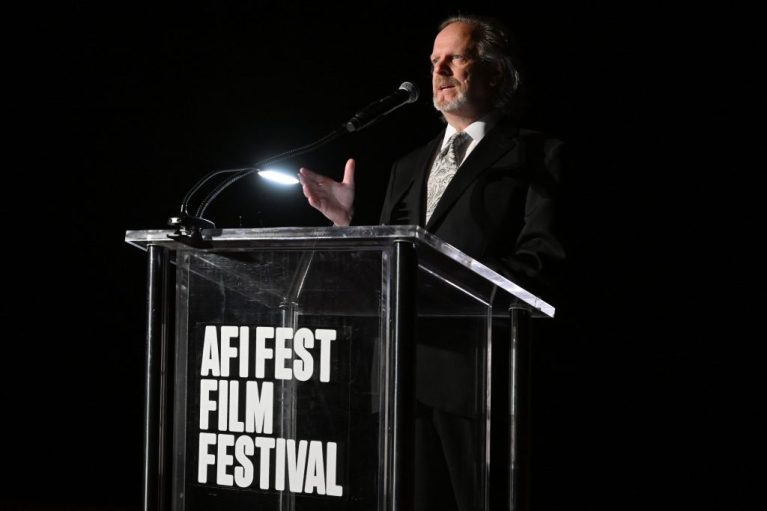
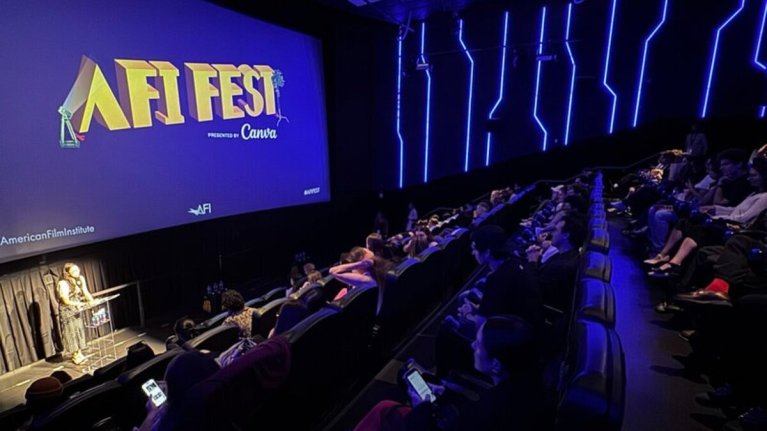
We are extremely proud to write that this year marks our tenth time covering Los Angeles’s unofficial premiere film festival, AFI Fest!

This year saw one of the largest totals of films programmed at the festival at 158, of which four were World Premieres, six were North American Premieres, and seven were US Premieres! The program represented forty-four countries and boasted nine Best International Feature Oscar® submissions, such as Mati Diop’s hybrid documentary, Dahomey, and Matthew Rankin’s second feature, Universal Language, two of our favorite watches from the impressive slate of films that we were able to catch during the five days of AFI Fest 2024!

In fact, this time around, we took in a total of sixteen features during the festival, and as per usual, our selections drew heavily from the World Cinema, Luminaries, and Discovery sections, but with an added focus this year on the Documentary section, where we caught four features, including the aforementioned Dahomey and Soundtrack to a Coup d’Etat, Johan Grimonprez’s innovative and impactful essay on the events that led to the killing of the first prime minister of the Democratic Republic of the Congo, Patrice Lumumba.

As always, we couldn’t make it to everything that we had hoped to see. We’re saddened that the stars didn’t align so that we could attend screenings of the new offerings from Miguel Gomes, Payal Kapadia, and Alain Guiraudie, but we’re extremely glad that we were able to view the latest features from Albert Serra, Hong Sang-soo, and Philippe Lesage, amongst other notable filmmakers we’ve come to appreciate!

Overall, the films that we selected to review below constitute one of the most eclectic mixes of cinema that we have seen over our ten years of coverage of AFI Fest, and for our piece, we have chosen the thirteen movies that we admired the most, beginning with our number one selection from the festival!

• •

Việt and Nam

dir. Trương Minh Quý / Philippines, France, Singapore, Italy, Germany, Vietnam

With each of Trương Minh Quý’s films, the director sets forth ideas of the cosmic and the historic along with the multi-layered conceptions of house and home and allows us to watch all of these forces clash and interplay. In his most recent feature, Việt and Nam, Trương’s method has reached its highest form to date, resulting in a hypnotic, moving film made up of various interwoven, open-ended essays on Vietnamese culture and history, all of which are framed by the relationship between the two titular characters. The plot of Việt and Nam is simple albeit particular: Việt and Nam are miners who are best friends and lovers. In the year 2001, Nam is getting ready to leave Vietnam in search of a better future outside of the country, and the film documents the period where Nam looks towards his unknown future and bids his farewell to a present that will soon become the past. As such, history and collective memories weigh heavily on each of Nam’s interactions with his surroundings — his home, his workplace in the mine, and the forest where he attempts to help his mother recover the remains of his father who was killed in the Vietnam War — and his relationships with his mother and Việt, imbuing Việt and Nam with a profoundly elegiac tone. Haunted by the real future incident of the discovery of thirty-nine Vietnamese migrants who were killed in a lorry container that landed in the UK in 2019, Việt and Nam intimates a tragic end to Nam’s departure, but remains fixed throughout on all of the forces that encourage Nam’s migration. Trương offers a multitude of ways that fixations on the past extinguish potential, swelling up Việt and Nam into a mourning cry for the loss of home for all who departed Vietnam’s shores and the loss of opportunities and vibrancy for a country that lost its people. Misinterpreted as a work of slow cinema in the manner of Apichatpong Weerasethakul, Việt and Nam is, in fact, a collage of cinematic techniques ranging from long-takes to cross-cuts, which build the momentum of the film to take us from the bowels of the Earth to its surface and then to a plane above. We had the honor of speaking with Trương Minh Quý in the days before Việt and Nam screened at AFI Fest 2024. You can read that conversation here.

• •

Tardes de soledad (Afternoons of Solitude)

dir. Albert Serra / Spain

In many of Albert Serra’s films, the frame is the theater stage with a pedestal, and on it is some figure(s) of grand stature, by way of history, notoriousness, and/or national standing, whom the director will strip down and reduce to their most basic form for all of us to examine away from any facades that once entranced us. This Serra method is in full effect in his latest film, Afternoons of Solitude, a documentary which meticulously captures the in-arena trials and tribulations of the world’s leading torero, Andrés Roca Rey. There’s little glory to be had or found in Serra’s rendering of Spain’s controversial, but nevertheless significant national pastime: the director presents close-up studies of multiple corridas without any shot of audience reactions, and though the fights are stitched together by a handful of beyond the arena scenes of transit, undressing, and dressing, the bullfights develop into an increasingly predictable loop, with each fight differentiated merely by the change in costumes by Rey and his cuadrilla and, of course, by the change in the bull opponent. Like a three-act play, a bullfight is structured in thirds, and its script plays out as consistently as that of a passion play. Occasionally, the fight veers off course: a bull attacks and nearly steps on Rey in one and pins him to the arena wall in another, but the script corrects itself each time, with the cuadrilla stepping in to help, Rey returning to the battle full of bravado, and voices exclaiming admiration for Rey’s manhood heard over the images of the torero continuing on until the bull is killed and dragged away by horses, leaving a large streak of blood in the arena sand. Even though we see the arcs of the bullfight over and over again, Serra’s documentation of this national play/shared ritual never becomes tedious thanks to the incredible close-ups and dynamic editing that draws our eyes to the faces and the natural materials and fluids as well as the man-made substances and objects that are essential to a bullfight. The horror of the violence repeatedly enacted towards the bulls in the arena does not go away, but our emotional activation dampens with each fight, replaced by a new lucidity: bullfighting is a tradition that feeds the spectator’s primeval motivations and tendencies at the cost of animal and human life. Afternoons of Solitude dissolves our collective consciousness’s fascination with bullfighting and confronts the culpability of the viewers of the sport. It could become one of the most important records of a long extinct pastime some day in the future — if only we could step away from our deeply rooted attachment to violence.

• •

Comme le feu (Who by Fire)

dir. Philippe Lesage / Canada, France

One of the most energetic reflexive works about filmmaking that we’ve seen in many years, Philippe Lesage’s Who By Fire lures us into a spider web overseen by Blake Cadieux (Arieh Worthalter), a once famous fiction filmmaker who has moved on to become a documentarian and a woodsman (of sorts). Blake invites his former screenwriting partner, Albert Gary (Paul Ahmarani), for a retreat and reunion at his palatial cabin in the woods, and Albert brings along his college-aged children, his daughter, Aliocha (Aurélia Arandi-Longpré), and his son, Max (Antoine Marchand-Gagnon). And Max brings along his best friend, Jeff (Noah Parker), an aspiring filmmaker. When Albert and company arrive to the cabin by a seaplane flown by Blake himself, they meet Blake’s editor, Millie (Sophie Desmarais), his best friend and assistant/wilderness guide, Barney (Carlo Harrietha), and the house chef, Ferran (Guillaume Laurin). At this point, nearly all of the crew members needed to make a film are present, and Blake naturally takes on his role as the director as well as the lead actor in the group’s dynamic even though the cameras aren’t rolling. Blake’s command at the dinner table the first night raises old tensions between him and Albert, and this clash between the former collaborators lets loose an uneasiness that permeates the film. Despite the dominance of Blake as a character, Lesage anchors Who By Fire on Jeff, and as the film progresses, we see the awkward and highly sensitive Jeff get caught between his attraction to Aliocha and his eagerness to impress and learn from Blake, who is quick to share his director’s copy of the screenplay for one of his most famous films with his aspiring disciple. Much to his embarrassment, Jeff gets lost in the woods at night after making a confusing pass at Aliocha and has to be rescued by Blake the next morning. Then, in the late hours of the same day, Jeff catches Blake and Aloicha together as his would-be mentor takes partially clothed photos of his object of desire. Jeff seethes, but he can do little in this space where all activities, including lounging, fishing, dining, or canoeing, are set up and helmed by Blake. As a result, Who By Fire materializes a microcosm where artistic striving crashes into grappling between generations, the older clutching onto what remains of its dominance and the younger trying to ascend while also desperate to glean knowledge and wisdom from its contender. And yet, the film is also an ode to filmmaking: a celebration of the joy, dread, drama, and sadness that the moving image can bring because Blake takes Jeff and all of the people in the cabin through each of these emotions with different situations masterfully constructed and integrated together by Lesage and effortlessly lensed by cinematographer Balthazar Lab. In turn, Who By Fire rejoices the possibilities of cinema as an artform while also sharply articulating the limitations to its progression that people, be it themselves or others, place on it.

• •

Universal Language

dir. Matthew Rankin / Canada

When we viewed Matthew Rankin’s debut feature, The Twentieth Century, we were immediately charmed by his idiosyncratic style of overlaying farce on top of a selection of events in Prime Minister William Lyon Mackenzie King’s life. The bizarre but vibrant aesthetic of the film, hearkening to Futurism, German Expressionism, and Surrealism filtered through the Golden Age of Television proclaimed the Winnipeg-born director as a clear descendent of Guy Maddin. This lineage is reaffirmed with Rankin’s second full-length, Universal Language, but the director introduces the influence of an additional parent, Iranian cinema. Universal Language reimagines Winnipeg as the Tehran of Canada, a place where the beige architecture and snow of one of the world’s coldest cities live side by side with the city’s Persian culture and dominant language, Farsi. The film tells two tales and gathers them together with an enthusiastic tour guide who shows people the marvels of Winnipeg. One of the stories pays homage to Jafar Panahi’s White Balloon: two sisters (Rojina Esmaeili and Saba Vahedyousefi) roam the city looking for an ax to excavate money frozen in ice in order to pay for the replacement glasses of one of the sister’s classmates. And, in the other, a man — played by Rankin himself as a nod to the tradition of Iranian directors playing themselves in their own films — leaves Montréal and returns to Winnipeg only to find that his mother’s exact whereabouts are a mystery as his childhood home has been sold and is occupied instead by a kind family. Meanwhile, the tour guide (executive producer and co-writer Pirouz Nemati) emphatically highlights Winnipeg’s modest sights such as its abandoned mall and a forgotten briefcase that no one has ever taken or opened, which has become a city landmark as an emblem for human honesty and trustworthiness. The characters roam around Winnipeg’s streets and sidewalks seeking completely separate things, but, gradually, their paths move closer to each other and lead them to the tour guide’s apartment where revelations transpire. By superimposing Tehran on Winnipeg, Rankin implicitly raises issues around autonomy and independence inherent in the tensions between Canada’s Anglo and French origins while also noting the multiculturalism of Canada that accelerated in the twentieth century. The Winnipeg of Universal Language is as foreign to Montréal as Paris is and vice versa, but both cities are related through their history, particularly by Louis Riel, whose monument is notably featured in the film next to a highway. Born in Saint Boniface (which is now a part of present-day Winnipeg) to a Métis father and French-Canadian mother in 1844 and educated in Montréal, Riel founded the province of Manitoba and fought against the Canadian government’s attempts to take over Métis land in the region. His charge of treason and subsequent execution catalyzed a rise in Québec nationalism in the late 1880s, which, in the century to follow, gave rise to the Québec sovereignty movement. Riel thus embodies Canadian plurality, and the scenes featuring his monument stress this concept that is dear to the film and its filmmaker. Universal Language envisions an entirely Persian Winnipeg, but in doing so, it demonstrates how we, despite our divisions, are inextricably linked in ways seen and unseen, and there’s something lovely and amazing about that.

• •

Yeohaengjaui pilyo (A Traveler’s Needs)

dir. Hong Sang-soo / South Korea

Considering the seemingly effortless nature of their previous collaborations, it is a surprise that Isabelle Huppert and Hong Sang-soo have only worked together twice in the last dozen years. As seen in 2012’s In Another Country and 2017’s Claire’s Camera, Hong’s immense adoration for Huppert fills the duo’s latest joint project, A Traveler’s Needs, and his absurdist setups continue to showcase Huppert’s considerable talents as a comedic actress. Huppert portrays Iris, a French woman whose mysterious mission in South Korea leans on a method she recently developed to teach the locals her native tongue in order to pay for a portion of her stay, and although she has doubts about her system’s capacity to facilitate language learning, her eccentric nature allows her to test it on anyone who is open to giving it a try. Iris, whose fanciful manner of speaking hangs perfectly inside of a Hong Sang-soo frame, asks her clients to share their most personal thoughts as part of her quasi-remedial process, and after having lengthy discussions with the student in English, Iris writes a succinct synopsis of the ideas and thoughts that emerge in French and requests that the student recite it repeatedly into a tape machine prior to their next meeting. Hong presents two lessons with two different pupils, and within both sessions happens an unprovoked musical performance executed in a lifeless fashion by the students who identically critique their own poor proficiency and admit the desire to have better skill with the same exact words. Iris includes these musical incidents with her students’ disclosed thoughts in the French sentences she gives them, but each line exists as her own reflection on them and commentary on their lack of self-awareness. Each of these statements composed by Iris thereby act as a vehicle for Hong’s criticism of his own people’s desire to constrain art with precise and rigid execution instead of allowing it to flourish with joy from the act of expression and inspiration from the elemental. To this end, Hong carefully distinguishes Iris’s wardrobe from that of the people around her: others mostly wear neutral shades, but Iris wears a delightful springtime nymph inspired ensemble featuring a bright pink floral dress and grass-green sweater, which blends as easily into a park’s landscape as it does into a green terrace where Iris pauses for a rest, suggesting that she is a representation of the natural flow that needs to be embraced by those around her. Alternately, when the scene shifts from the pastoral to the confines of Iris’s apartment bedroom, where she is serenaded by the piano-playing of her flatmate, a poet named In-guk (Ha Seong-guk), Iris’s attire changes to suitably match the room’s warm tones as she persuades her friend and willing benefactor who is allowing her to stay for free to not over fixate on the notes he needs to play next and instead focus on the present sound. But soon, this thoughtful and gentle moment between two friends is interrupted by In-guk’s mother, whose insecurities and unreasonable desire for safety are directed towards her son as she casts doubt on Iris’s wholesome intentions. Ultimately, this dire moment between In-guk and his mother in the final third of A Traveler’s Needs radically shifts the film away from the whimsical and into an even starker cultural statement by Hong of his own people’s reluctance to relinquish their need for control, which suppresses their capacity to connect with their emotions and, in the long run, hinders any meaningful form of expression. The success of A Traveler’s Needs can be largely attributed to Huppert, who gives Iris several dimensions with a single look and contributes significantly to the most recent chapter in Hong’s post-COVID output, which once more features our director issuing a sobering wake-up call to those asleep in complacency in the face of an uncertain future.

• •

Soundtrack to a Coup d’Etat

dir. Johan Grimonprez / Belgium, France, Netherlands

In the same way that jazz musicians come together to create a dazzling, intricate mixture of sound comprised of melody and rhythm, regrettably, so too did the Belgian monarchy, the US government, and a slew of corporations in January of 1961 to conspire to execute their insipid plot to delegitimize and kill the first prime minister of the Democratic Republic of the Congo, Patrice Lumumba. As he did with his 2017 feature documentary Blue Orchid, which delved into the global arms trade, Belgian multimedia artist and filmmaker Johan Grimonprez once again turns his camera towards the unsavory underbelly of political maneuvering where lives are traded for profit with Soundtrack to a Coup d’Etat. Drawing from the books My Country, Africa: Autobiography of the Black PasionariaTo Katanga and Back: A UN Case History, and Congo, Inc., here, Grimonprez expertly fuses everything from spoken word pieces to archival footage of the jazz that was performed by a who’s who of iconic artists who were sent by the US State Department to Africa during the 1950s and 60s under the guise of a goodwill mission that actually functioned as a smokescreen for covert operations to undermine post-colonial governments. Implementing a method to cleverly beguile you into a sense of nostalgic joy early in the narrative, Grimonprez and his team of editors enthrall you with a cascade of mesmerizing sounds and visuals from jazz legends, luring you into a state of bliss before steadily pulling the carpet out from under you when the onerous details substantiated through various forms of hard evidence paint a grotesque and calculated picture of America and Belgium’s joint mission to preserve access to Africa’s vast mineral resources, resources that the US feared were slipping away when many of Africa’s nations began to, one by one, unify, strengthen, and pull away from their colonial oppressors. As Soundtrack to a Coup d’Etat details the actions of an American propaganda machine that sought to turn every message of support for Africa’s first post-colonial nation into one of fear and Communist rhetoric, the film thankfully calls out the few brave western artists who caught wind of the plot to dismantle Lumumba’s government who subsequently boycotted being used in the campaign, and so, as the plot unfolds and these musicians and activists express their disdain, the music responds in kind by moving away from bop and into sounds of protest from the Africa that incorporate the continent’s many original rhythms. Given the ambitious nature of the entire composition of Grimonprez’s film, one may fear that the method might overwhelm the subject at times, but instead, the inevitable death of Lumumba still hits hard as it’s presented here, as an outro for the piece that draws a line towards a present-day Congo where dour campaigns continue by governments who now vie for that nation’s coltan, a mineral required to power today’s electronics. Soundtrack to a Coup d’Etat opens nationally in theaters on Friday, November 15th.

• •

Harvest

dir. Athina Rachel Tsangari / UK, US, Germany, France

For Harvest, Athina Rachel Tsangari, one of the pillars of the Greek Weird Wave, deviates away from the odd to tell the story of the beginning of modern Western civilization, right at the precipitating moment marking our transition from an agrarian society to an industrialized one. Set in a village in Scotland loosely around the 1600s, Harvest gives us Walter Thirsk (Caleb Landry Jones) as a guide to the idyllic, fairytale-like expanse of lands owned by the village’s lord, Master Charles Kent (Harry Melling). All of the residents tend to the fields except for Walter, who was Charles’s manservant in childhood and adolescence and, as an adult, has somewhat continued to exist in this same capacity. Consequently, Walter is not treated as a member of the village tribe and exists as a bystander and observer who studies the people in his surroundings as much as the flora along the nearby hills. When Charles’s stable is set ablaze, Walter steps in to rescue his lord’s beloved horse, and although he knows the culprits of the act of arson, he withholds their names, aware of how the others would perceive his identification of the offenders as some of their own. Thankfully, the good-natured Charles dismisses the fire as an accident, but this event quietly ushers in a massive wave of change. Soon after, a woman and two men arrive by canoe and try to camp by the side of the nearby lake, but instead are blamed for the stable fire and are accordingly punished. At the celebration for the end of the growing season, Charles introduces everyone to Phillip Earle, a mapmaker who has arrived to survey the land, and announces a new economic vision for the village: sheep herding for the purposes of the burgeoning wool industry. With the villagers’ paranoia already raised by these recent events, their suspicions and fears escalate further upon the arrival of Edmund Jourdan, Master Kent’s late wife’s cousin and the incarnate of malevolence, who asserts himself as the true owner of the land and the mastermind behind the new vision of sheep. On the request of Charles, Walter assists Phillip Earle, but through all of these changes, which severely impact the villagers and even Charles himself, Walt mostly observes and maintains his distance. As the film proceeds, inaction becomes more despicable, and Harvest reveals itself as a sharply contemporary tale of a non-hero, a man caught between forces that he can’t overcome, one who must piece together some semblance of integrity in a cruel world with few options. Walter isn’t accepted as a member of the peasant class. He’s certainly not a member of the lord class. He’s in the void between, and he must determine if he’s going to participate in Edmund Jordan’s future for him as an administrator of the new business or venture on to new lands and unimagined futures.

• •

Devo

dir. Chris Smith / USA

Before writing this critique of Chris Smith’s deliriously entertaining feature on New Wave pioneers Devo, we seriously considered recusing ourselves from the assignment as we have long revered this innovative outfit that rose up from the Rubber City (also known as Akron, Ohio) to national prominence. Over the years, we’ve seen far too many documentaries on musical artists we admire that fire dead center into the cookie-cutter model of assembling onscreen celebrity talking heads who espouse fanatical adoration and intercutting these lionizations with faded clips from the musician’s heyday, a tiresome approach in direct conflict with the creativity and the vibrancy of the subject artist. Thankfully, for Devo, veteran documentarian Smith (American MovieThe Yes Men) thoughtfully utilizes the abundant library of avant-garde footage created by the band themselves as his documentary’s base and interweaves it with only retro-commercial footage and interviews with the band’s members and outside collaborators, sidestepping all of the antiquated conventions of the rock doc as the director sheds light on the enigmatic political underpinnings of the band’s origins, which began after the protest shootings at Kent State, their mindset behind their early performance art styled live shows, and their subsequent rise through the corporate record industry machine that was the enemy of their self-defined ethos that extolled the ever-evolving de-evolution of man. Though Devo saw fame as a method for getting their social messaging out, the level of how famous the band wanted to become is left intentionally ambiguous by Smith. There are glimpses into the amount of joy that the lucrative record contracts gave the band, but that success was also something that caused Devo endless internal strife. This all may sound a bit serious in tone and warrant comparisons to Todd Haynes’s fittingly austere and highly accomplished doc on the Velvet Underground from 2021, but the editing of Smith’s treatment on what makes Devo who they are comes at you in bright waves, matching the wit and tongue-in-cheek spirit that are fundamental to the band. Smith’s film is funny when he listens to the band’s early forays into creating an image, dour during moments when founding members Gerald Casale and Mark Mothersbaugh reveal their frustrations with the powers that be, and joyful when we see footage of the band doing what they do best — exercising their ample talents to subversively criticize the dysfunctional system that they slyly ascended and innovated within, if only for a few years.

• •

Dahomey

dir. Mati Diop / France, Senegal, Benin

Five years have passed since the premiere of French-Senegalese director Mati Diop’s critically lauded feature debut, Atlantique. Set in the capital city of Dakar, Diop’s first full-length fiction work, is a gripping and mystical drama where Diop expertly melded the film’s environment with the characters’ responses to desperate situations to create an absorbing contemporary portrait of a place and its people. For her latest feature, Dahomey, Diop again combines elements of environment and a fictional engine, but here she also joins them with a key moment in history to present a slender yet affecting hybrid documentary that fosters critical dialogues around France’s 2021 repatriation of 26 stolen relics (from a total of over 7,000 looted) to the Republic of Benin, the former Kingdom of Dahomey. Diop presents this repatriation of stolen items in three fluid parts. The first section introduces us to the 26 artifacts still housed in the Musée du Quai Branly followed by their transportation from Paris to Cotonou. In the film’s second section, we witness students from the University of Abomey-Calavi engage in a fierce and impassioned debate about the significance of the return of their cultural possessions; and in the final third, the statues and other artifacts are displayed for the first time in a Beninese museum. When outlined, Dahomey’s overall narrative structure may sound like the makings of a standard documentary, but Diop’s imaginative choice to anthropomorphize the 26th item returned, the figure of King Ghézo, who ruled the Kingdom of Dahomey from 1797 to 1818, boldly distinguishes her work. As the film’s central narrator, King Ghézo speaks in the Dahomean language of Fon, articulating his thoughts on being trapped in the darkness of his shipping crate and his ruminations on his own existence and history. Resoundingly rendered so that Ghézo’s voice sounds like a soul communicating from centuries long ago, Diop’s technique brings emotionality to Ghézo’s symbolic plight as a representative of the items being returned to Benin, while also elevating the difficult eternal debate around the ethics and impact of any attempt by colonial governments to repatriate plundered culturally significant items, an act that serves as only a banal gesture towards the citizens of the victimized country who long for their remaining stolen artifacts and resources that will most likely never be returned.

• •

Christmas Eve in Miller’s Point

dir. Tyler Taormina / USA

One must always remember that the word “nostalgia” is a learned formation of a Greek compound consisting of nóstos, meaning “homecoming,” and álgos, meaning “pain.” Keeping that in mind, possibly no song provokes greater “nostalgia” within us than the Goffin-King-penned track, “Point of No Return,” a top 40 hit for Gene McDaniels back in 1962. To digress for a moment…When we first moved to Knoxville in 2018, the sole oldies station in town was clearly engaged in an all-out blitzkrieg to revive this McDaniels’ cut, which, if you’ve never heard it before, is rife with over-annunciation, stark dramatic pauses, and a lavish orchestration that feels more akin to a John Barry score or a Tom Jones performance for Ed Sullivan than the soulful arrangement the song’s heartbreaking lyrics warranted. For about a year or so, we would giggle whenever “Point of No Return” blasted through our kitchen, but all that changed after months of being trapped inside during COVID. The McDaniels song took on an entirely different meaning, circumventing any semblance of kitsch and veering towards something closer to political reeducation announcements. Since his impressive debut feature, Ham on Rye, director Tyler Taormina has harnessed the fiendish power that nostalgia has over us by selectively introducing us to warm and fuzzy sounds and images from multiple eras via film language whilst loudly injecting an underlying tone that suggests the layers of brokenness we mindlessly gloss over while engaging in pointless, familiar ritual. So, with Taormina’s ethos firmly established, we readied ourselves for a viewing of the director’s latest, knowing full well that there is no greater Holy Grail of nostalgia than that of the holiday film. Christmas Eve in Miller’s Point is a faded and ragu-smeared Yuletide snapshot gathering of the obtusely Long Island blue-collar Italian-American family, the Bolsanos, whom we observe as they merrily and not-so-merrily bask in the clichés of the season. Food cooks, gifts are exchanged, teens sneak out to be with their friends, and the grownups argue about putting Mom into a home while sonically lurking by the boughs of holly and bowls of green and red M&Ms is “Point of No Return,” one of the many ironic non-holiday torch songs from yesteryear that gets a bonus play or two on the soundtrack for that extra taste of a past becoming further obsolete. Sharply edited into a frenzy so that no thread is followed beyond a moment or two of tension-filled dialog, leaving zero chance for the development of any dramatic event that would distinguish this celebration from the myriad of other Christmas Eves in the Bolsano home, even though traces of impending change creep throughout, Taormina’s film works like that final obligatory school Christmas pageant, an extravagant display of holiday tropes that are overshadowed by individual interests and concerns unrelated to the event, with its paraphernalia and associated warmth soon destined, just like the oldies of the soundtrack, for dusty boxes in storage once and for all.

• •

Karlovy Vary (Second Chance)

dir. Subhadra Mahajan / India

It is almost impossible to believe that only a few generations ago a sense of community in an urban landscape was alive and well. Before the 2000s and the rapid repopulation of cities by people of substantial means, communities were kept alive by the residents who carried innate knowledge of their neighborhood, creating an environment that, despite its mammoth size, was able to foster a sense of belonging by its people who were imbibed by a firm sense of that place and its capabilities to foster its own world. For Nia (Dheera Johnson), an emotionally distraught upper-class young woman, an exodus from Delhi becomes critical for her well-being following the abandonment by her boyfriend due to her unwanted pregnancy. Physically and psychologically fragile after ingesting abortion pills, Nia, with a nervously clutched cellphone in hand, arrives at her family’s summer home high up in the Pir Panjal mountain range to recuperate. It’s a place that Nia has come to know well since her youth, and with the winter descending on the region, she is promised a quiet space to convalesce with only the caretaker Raju (Rajesh Kumar) and his small family on the property. But, shortly after Nia arrives, Raju is called away, and Nia is left with Raju’s elderly mother-in-law, Bhemi (Thakra Devi), and his wildly boisterous yet disarmingly sweet son, Sunny (Kanav Thakur), both of whom offer assistance to Nia whichever way they can. However, omnipresent throughout the growing relationship between Nia, Bhemi, and Sunny is a question of class prerogative, and director Mahajan adeptly implies the socioeconomic distance between the three with the small moments that occur between them, whether it be Nia’s joy in soundly beating Sunny in a casual game of cricket or Nia’s refusal to eat the food that Bhemi skillfully crafts for her. The divide is never overtly stated, but it generates a tension early on that drives the narrative while also giving insight into Nia’s inability to feel comfortable in her own skin, whether she is in Delhi or seemingly light years away in nature. As the days go by and Nia is thrust into distressing situations that require serious assistance, she begins to accept the emotional and physical help that she gets from her surrogate family and starts to recognize their extraordinary symbiosis with the land, which gives Nia the strength to solemnly examine her own situation. Aided by the superb black and white camerawork by Swapnil Suhas Sonawane that captures not only the beauty, but also the harsh isolation of the film’s setting, Mahajan’s impressive feature debut goes far beyond the cliché of the urbanite who finds themself by succumbing to the mystical wiles of nature: Second Chance is a somber, yet occasionally funny, and ultimately complex character study that speaks volumes about the ever-growing chasm between the societally mandated expectations we thoughtlessly place on ourselves and the power of place and the people connected to it who help us reestablish our natural sense of self.

• •

Gou Zhen (Black Dog)

dir. Guan Hu / China

Set in the months before the 2008 Beijing Olympics in a small town on the outskirts of the Gobi desert, Guan Hu’s, Black Dog, the winner of Un Certain Regard at this year’s Cannes, is, at its core, a man and his dog story elevated to a sprawling, sometimes allegory-overwrought, but absorbing political drama. Returning to his slowly withering hometown to spend time with his dying father is our near-silent anti-hero, Lang (Eddie Peng), a musician of some notoriety, stunt motorcyclist, and ex-con who just ended his ten year prison sentence after being convicted of manslaughter for the accidental death of his riding partner, a crime that many of the locals still hold over Lang’s head. Left with few friends in town and even slimmer prospects for work, Lang joins the local governmental effort to round up the exceedingly large number of wild dogs deemed undesirable by the town, with the infamous titular canine, a rumored carrier of rabies, singled out as the coveted prize given the sizable reward for its capture. Although Lang, slightly mauled by the hunted emaciated dog early in the film, makes the decision to keep the cur once his job dictates that he captures the animal, this act of defiance unites these outcasts, who along with the packs of stray dogs, serve as a symbol against Beijing’s plan for sweeping change in this arid region that would require the elimination of any roadblocks and eyesores standing in the way of progress. Alternating between comedy, sentimentality, and social commentary mixed with healthy doses of magical realism, Guan Hu’s film is affecting for a good portion of its 149 minute running time, especially in the quieter moments when it concentrates on the relationship between Lang and his newfound four-legged friend, but the narrative stumbles a bit when it expands its scope to include too many subplots, such as the underdeveloped romance between Lang and a traveling circus performer named Grape. But, despite its desire for an unnecessarily epic scale and a nagging sense that some intended messaging may have been censored, Black Dog is a well-acted and poignant take on an ever-evolving China that may be changing too quickly without any regard for its own people.

• •

All films were screened at AFI Fest 2024. Many thanks and congratulations to the staff and volunteers of AFI Fest for another excellent year of cinema and conversations, and a special thanks to Johanna Calderón-Dakin, Senior Publicity Associate for AFI Fest, who made our coverage possible.

Featured photo courtesy of AFI Fest.

AFI Fest

BEST OF FILM 2022

Standard


Originally published on Ink 19 on December 1, 2022
by Lily and Generoso Fierro


Over the past few years, we’ve tried to select a handful of words to describe undercurrents in our favorite films of the year. For 2022, one word overwhelmingly emerged as the winner to link the films that inspired and demanded us to look more closely at the cinematic form and our world at large: connectivity.

This year, every film in our Best Of list addresses our attempts to connect with people and/or places in some way. Sometimes the connections are new ones. Other times, they are old ones that are changing. And, more often than not, they fail to meet original expectations. Despite the likelihood of disappointment, connectivity is more important than ever, and our favorite films underscore the fragility of human interactions in an era where a past pandemic is now in the rearview mirror and distant warning signals of future ones may be ahead, keeping isolation at the top of our minds.

There are a multitude of approaches to such a broad concept in our shifting times, and consequently, this year’s list has entries from a variety of genres. Some veer towards science fiction. Many incorporate hybrid cinema techniques. One is a pure documentary. A few are dialogue-centric. And, a couple even have comedic roots. As thus, we hope that each film covers a distinct facet/perspective of our world and that, collectively, they propel us towards a hope for a new (or at least restored) sense of awareness for everything, big and small, moving around us.

We send immense gratitude to the fine folks at Acropolis Cinema, AFI Fest, Independent Film Festival Boston, the Brattle Theater, Films at Lincoln Center, and the Coolidge Corner Theater for their outstanding programming efforts that brought exceptional works to screens and audiences throughout the year. Please support these festivals, microcinemas, and independent theaters as they are vital to the progress and strengthening of our communities.

• •

Pacifiction / France, Spain / dir. Albert Serra

In the earliest scenes of Pacifiction, French Navy sailors land at a small harbor, and soon after, a disarmingly sickly, yet mesmerizing sky fills the screen. Immediately, we begin to suspect that we are somewhere in Rainer Werner Fassbinder’s adaptation of Jean Genet’s Querelle. But, as Pacifiction hones in on Monsieur De Roller (Benoît Magimel), a High Commissioner to French Polynesia, we start to detect echoes of Bertrand Tavernier’s Coup de Torchon, setting in place the expectations of a story about a wayward colonial government representative long forgotten because of time, distance, and insignificance. However, throughout Pacifiction, Serra navigates away from any familiar narrative devices and continuously re-directs all of our attention to Monsieur De Roller, whose actions present a fascinating, morally ambiguous, and unsettlingly contemporary character. De Roller is not like the morally decrepit of the past. He’s not a hedonist. He’s not an ideologue. And, in fact, he maintains positive (though palpably fragile) relationships with most around him — so much so that he is someone that both Polynesian community leaders and French expats trust. But, De Roller is a deceptive, complex figure, and Serra allows us to study his actions and conversations to try to decipher his motivations. After we see stern, diplomatic, amiable, and pseudo-casual versions of De Roller through his interactions with others, we take notice of something consistent in his demeanor: control. Not that of a dictatorial kind, but rather control that comes from a keen understanding of the people around him and the ability to push and pull different strengths and tensions in order to maintain stability and peace for himself in his environment. De Roller’s attentive yet noticeably distant countenances in most settings reveal his lack of commitment to any particular cause, yet his words, particularly terms of negotiation, often acknowledge, address, and take some action on his conversational partner(s) concerns. De Roller doesn’t want to help people, but he does want to maintain his control over the systems he has mastered in his surroundings: positive outcomes are necessary, and acts of physical violence towards his fellow inhabitants are generally avoided because of their long-term consequences. This approach works perfectly for De Roller until an admiral (Marc Susini) arrives and continues to reappear in De Roller’s social circles while rumors of the return of nuclear testing spread, stirring up paranoia in De Roller as French military powers threaten the equilibrium he’s created for himself and remind him of his insignificance beyond the shores of French Polynesia. Pacifiction stands out as Albert Serra’s most approachable work to date, but despite the illusion of a narrative laden with images that evoke familiar motifs in fictions of the past, Pacifiction slyly uses known conventions to mislead you towards a grand ending or a climax that never happens. Instead, we enter a paradoxically hyper-real and hyper-fictionalized world that mirrors our own distortions of reality and see it through the hyperbolic, morally indifferent eyes of De Roller, who perfectly represents the collision of unsavory geopolitical histories, strategic diplomacy and conciliation, basic self-interest, and powers far beyond our grasp and perception, all of which are forces that underlie our own daily actions, even if we don’t want to be aware of them.

• •

Memoria / Colombia, Thailand / dir. Apichatpong Weerasethakul

Though many in the US had the opportunity to see Apichatpong Weerasethakul’s Memoria in 2021, it arrived in our town via its roadshow (which is still ongoing!) earlier this year. Set in Colombia, Memoria centers our attention on Jessica (Tilda Swinton), an orchidologist on a visit to Bogotá for a mix of professional and personal reasons. Her sister lives there and is currently in the hospital with a peculiar unknown illness, so Jessica has arrived to comfort her, and while there, she takes the opportunity to do some research on orchid fungi for her work as well. However, the sudden onset of a thunderous sound that only she can hear pulls her out of her own life as she tries to find its source, and in doing so, she experiences a different kind of life guided by her connections to the people and places around her. Jessica becomes a transistor for the collective energies and memories of her surroundings: she absorbs and amplifies tones from modern histories, individual pasts, primordial times, and possibly even extraterrestrial presents, and through her immersion, we too are able to connect the same frequencies reverberating in ourselves as we sit in our theater seats. A film not to be watched but rather experienced because of its sensuous audio and visual elements, Memoria has been (and will only ever be) available in the US through limited engagements in theaters, major and minor, across the country. And such an exhibition and distribution method is only too apt for Memoria because, in going to theaters to see the film, we too are actively sharing a collective experience, a practice that had been put on pause since the COVID-19 pandemic and, as a result, has become layered with our own recollections of the past and hopes that communal connectivity around cinema can be restored again one day soon. Read our full review of Memoria here.

• •

The Cathedral / United States / dir. Ricky D’Ambrose

It is oddly fitting that this review of Ricky D’Ambrose’s family epic, The Cathedral, is being written only a few days after the passing of Jean-Marie Straub, as D’Ambrose’s second full-length feature bears many of the minimalist visual attributes and verbal punctuations indicative of the works of Straub and his longtime partner, Danièle Huillet. However, The Cathedral diverges from the mostly text to screen relational works of Straub-Huillet in its narrative construction, which is based on moments that are naturally recalled from memory. Created as a semi-autobiography, The Cathedral focuses the on the pre-college life of only child Jesse Damrosch (portrayed by both Robert Levey II and William Bednar Carter), the son of Richard (Brian d’Arcy James) and Lydia (Monica Barbaro), suburban Italian-American parents who struggle mightily to maintain their family’s middle-class identity and status. Framed against a backdrop composed of major world events from the 1980s through the 2000s, which are dispensed through interjected news reports, the moments of familial misunderstandings and deafening silences endured by Jesse during his upbringing reach levels that rival these grand historical events when experienced through the mind of a young man who knows only his family’s contained world. Impressively, D’Ambrose presents the Damrosch/his family’s tribulations without the use of any over-dramatic staging of their dysfunctional moments, which has become the norm in films that depict the Italian-American experience. As we watch businesses fail and relationships falter in The Cathedral, we clearly understand the causality of these shortcomings: they stem more from the Damrosch family’s inability to fully integrate due to a socioeconomic system that is likely set against them, and less from what is usually seen in cinema when the failures of Italian-Americans are the results of a lack of desire to acclimate and, thus, move away from an outdated cultural imperative. Throughout The Cathedral, D’Ambrose artfully maintains a distance to his story through sound and framing that provide us with a clear lens that, to some, may feel overly unemotional, but is no less impactful and honest in its personal message of disenfranchisement.

• •

El Gran Movimiento / Bolivia, France, Qatar, Switzerland / dir. Kiro Russo

In the La Paz presented in El Gran Movimiento, practices and traditions of the past coexist alongside the mercantile systems of the present and the forces of capitalism steadily making their way through the geographies, architecture, and sociopolitical structures in and around the city. Kiro Russo takes us through and between all of these different energies with flashes of sound and images, zoomed in and out, to form a buzzing kaleidoscope of La Paz with components radiating from (or perhaps towards) its central point, Elder (Julio César Ticona), a coal miner who has walked to the city after losing his job. Elder simply wants to find any kind of work, but his body and the city have other intentions for him. He has a mysterious respiratory disease that intensifies when he arrives. Initially, we suspect that the mines have caused Elder’s illness, but the longer he remains in the urban heart of La Paz, where he’s exploited by market suppliers, mocked by stall-keepers, and even somewhat teased by his able-bodied friends, the more he weakens, and soon we realize that Elder’s spirit is being consumed by the malevolent forces in his surroundings. Thankfully, Mama Pancha (Francisa Arce de Aro), a woman who takes in Elder and claims to be his godmother, and Max (Max Bautista Uchasara), a shaman who provides treatments for both Mama Pancha and Elder, counter with those of a more humane past and provide hope as they manage to survive in or near the city — Mama Pancha in a building down a long forgotten alley and Max in the mountainous forest beyond the urban center — and through them, Elder has a chance to live. El Gran Movimiento is certainly political at its core, but its politics are neither dogmatic nor rigid: they are inherently human-centric and understand how an individual person manifests their flaws and triumphs to varying degrees, sometimes modulated by internal motivations, other times by external societal pressures, and oftentimes by some combination of both, which aggregate in the cities where people gather, assemble, and clash. La Paz in El Gran Movimiento is bewildering, haunting, and striking because it is an ecosystem that has its own mechanisms for operation and survival with chaos regularly injected. The city is its own character brimming with imperfections and occasional flecks of kindness and virtue. And hence, it is fundamentally representative of the modern human.

• •

Mato Seco em Chamas (Dry Ground Burning) / Brazil, Portugal / dirs. Joana Pimenta and Adirley Queirós

Back in the spring of 2018, we were extremely fortunate to catch a screening of Once There Was Brasilia (Era uma Vez Brasília) at Locarno in Los Angeles. That politically urgent, low-budget science fiction film, which was awarded a Special Mention in Locarno the previous year, was the first collaboration between director Adirley Queirós and his then cinematographer, Joana Pimenta. A top ten film for us in 2018, Queirós’s feature inventively blended tropes from dystopian sci-fi and post-apocalyptic cinema to deliver a poignant statement on contemporary Brazil from a futuristic world devoid of hope. With their new feature, Dry Ground Burning, Joana Pimenta has returned as the DP and, in addition, has joined Adirley Queirós as a co-director for an ambitious docu-fiction work that brings our filmmakers back to the beleaguered district of Ceilândia, the site of their aforementioned sci-fi film.

At the center of Pimenta and Queirós’s Dry Ground Burning are half-sisters Chitara (Joana Darc Furtado) and Léa (Léa Alves da Silva), leaders of a gang who sell purloined gasoline to bikers in their Sol Nascente favela, a community that has long given up on the promises and hopes of societal enrichment from governmental investment into the Brazilian infrastructure after the extraction of untold amounts of oil found in the country during the mid-2000s. As the sisters run gasoline with their all-female crew, we learn about the pervasive history and impact of crime and incarceration in their current lives and future. Timelines pause, reverse, and skip forward in Dry Ground Burning, but the oil rig and refinery remains as the emanating point for Chitara, Léa, and their teammate Andreia (Andreia Vieira), who together provide their neighborhood with gasoline while also supporting themselves and their families before splitting apart as the surrounding police state descends on them. From its early scenes, Dry Ground Burning is intentionally framed as a neo-western mixed with shades of City of God, but, as the film progresses, Pimenta and Queirós strip away any cinematic tropes and build the film’s strength not from typical action scenes, but from raw dialogues heard between the sisters and their gang and long takes of the women working at the rig and living outside of its gates, which humanize the overall feeling of desperation and survival in Sol Nascente in a way that slickly shot gunplay could never achieve. We discussed Dry Ground Burning with co-director Joana Pimenta during this year’s AFI Fest, and that interview is available here on Ink 19.

• •

De Humani Corporis Fabrica / France, United States / dir. Véréna Paravel and Lucien Castaing-Taylor

Unseen systems that generate outputs that we interact with, such as water purification or the conversion of gasoline into energy, continuously operate all around us. We understand some systems abstractly. But with others, we don’t even quite know their parts. The systems in our bodies fall into both of these categories, and for the longest time, we would only learn about them through ailments with clear, perceptible symptoms, and we rarely saw into the physiological culprits. Hospitals too are their own systems that we engage with when we need treatment for our bodies and minds, but unless we are (or intimately know) medical professionals, we rarely get to see how parts of the hospital system work and how operations are performed. In De Humani Corporis Fabrica, directors Véréna Paravel and Lucien Castaing-Taylor present images and sounds from studies of components of hospital and body systems far from perfection and provide us new, visceral, uncomfortable, and amazing views into both. In operating rooms, via laparoscopic cameras, we travel through unknown ducts and tubes to watch surgical graspers, scissors, and needles cut, repair, or remove tissues and organs. In labs, we see tumors prepared for microscopic study and the resulting psychedelic slices projected onto screens. In geriatric hallways, we see how our physical and mental faculties wear down with age. And, in the morgue, we see masses of bodies that have reached the end of their lifecycles. Mixed into these varying internal and external views of the human form, Paravel and Castaing-Taylor pipe in casual conversations throughout various hospital settings that reveal the less than ideal conditions doctors and nurses face with unsustainable case loads, staff reductions, and even surgical supply shortages. Yet, despite the feeling that everything inside the hospitals featured in De Humani Corporis Fabrica may be broken, the doctors and nurses manage to continue maintaining and fixing the human body and keeping the hospitals’ systems running, instilling in us wonder that our bodies work at all and awe in the fortitude and resilience of medical professionals who see our bodies at their lowest points every day.

• •

Espíritu sagrado (The Sacred Spirit) / Spain, France, Turkey / dir. Chema García Ibarra

As seen by the church activities of the protagonists living in the district of Ceilândia in Joana Pimenta and Adirley Queirós’s film Dry Ground Burning, spiritual identity and connection are essential in a place enduring through economic hardship, and the same message can be said, but in a radically different way for the residents of the depressed town of Elche, the setting for Chema García Ibarra’s inventive feature-film debut, The Sacred Spirit. With its cold open to the mid-essay speech given by a seraphic young girl who directly speaks to her class about the need for priests in her town to baptize babies lest they become the unwilling organ donors to devil-worshippers, Ibarra abruptly and surrealistic offers us the town of Elche as a place that is wildly devoid of traditional religion as guide for conduct. After that first moment, we find out that the young orator is Veronica, the twin sister of Vanessa, who may have been kidnapped by a gang of organ thieves operating the in the town, a dire situation that leaves their mother Charo (Joanna Valverde) with no other option than to take to the airwaves to plead for her daughter’s return. Soon, the film shifts to Vanessa and Veronica’s uncle, José Manuel (Nacho Fernández), a cafe owner and member of the local UFO collective Ovni-Levante, who must tend to his disabled mother, Carmina (Rocío Ibáñez), the town’s medium who has been rendered fairly uncommunicative due to the progression of Alzheimer’s. Though it would seem that the grim reality of Vanessa’s disappearance should take center stage in José Manuel’s life, the death of Ovni-Levante’s leader takes precedence instead, as José Manuel is the only one with deep enough knowledge to guide humanity through the approaching extraterrestrial phenomenon. For its engine, Ibarra fills The Sacred Spirit with fantastical instances that thrive in the uncomfortable space between laughter and tragedy to purposefully misdirect you before delivering his film’s closing message of how our frenzied need to believe in the unreal in a time filled with dizzying untruths can cloud our judgment to dangerously obscure a real evil.

• •

Re Granchio (The Tale of King Crab) / Italy, France / Alessio Rigo de Righi and Matteo Zoppis

With their feature, The Tale of King Crab, directors Alessio Rigo de Righi and Matteo Zoppis weave the folklore of the Tuscia town of Vejano into its current reality then spin a new myth from both. The final film of a triptych concentrated on stories told by the members of a hunting lodge in Vejano, The Tale of King Crab opens with the hunters regaling the beginnings of the heroic journey of Luciano (Gabriele Silli), the son of the town’s doctor and a local drunkard who lived in Vejano some time near the end of the 19th century and the beginning of the 20th. Born into a class awkwardly straddled in between the peasants of the town and the royalty and clergy that rule it, Luciano contends with both when he expresses his love for Emma (Maria Alexandra Lungu), the daughter of a shepherd. Emma’s father refuses to allow Luciano to be with Emma. And, much to the disdain of Luciano, who has never been a fan of the oppressive and seemingly trivial rules of royalty, Emma catches the attention of the local prince when she’s selected to be the symbolic Mary of the Feast of St. Orsio. With these dual forces pulling Emma away from him, Luciano commits a tragic act of arson that leads to his exile to Tierra del Fuego, a purgatory for him to reflect on his sins in Vejano. At the other end of the world, Luciano, who now fashions himself as a priest, embarks on an archetypal quest for redemption, but along the way, Rigo de Righi and Zoppis intertwine a set of uncouth pirates, a compass in the form of Tierra del Fuego’s iconic king crab, and diverse landscapes that shouldn’t coexist but somehow do at this point at the end of the earth. All of these rich details build a mythology around Luciano that has its own distinctive world with all of the essentials of a grand epic, and altogether, they breathe life into a classical genre that is centuries old, the fairy tale, reminding us that timeless narrative traditions can still be relevant and significant to the imaginations of today because the travails and triumphs of an imperfect hero will always manage to resonate with us in some way. Our full-length review of The Tale of King Crab is available here.

• •

Das Mädchen Und Die Spinne (The Girl and the Spider) / Switzerland / dirs. Ramon Zürcher and Silvan Zürcher

Silence can emphasize sound and action, or it can take on a meaning of its own. In The Girl and the Spider, the absence of sound carries the weight of the film’s mood and gives us a glimpse into the history, complications, and uncommunicated sentiments hiding below and in between its characters’ actions and words. The premise of the film is simple in concept: Lisa (Liliane Amuat) is moving out of an apartment that she has been sharing with Mara (Henriette Confurius) and Markus (Ivan Georgiev) and into an apartment for herself alone. We see the moving day activities in the former and the new apartment, and as boxes get filled and depart then arrive, we meet characters connected to the spaces. In the old apartment, we meet neighbors who exist across multiple generations, and in the new apartment, we meet a neighbor with two young children and repairmen hired to make the place a home for Lisa. In between the movements, there are plenty of glances and conversations, but all of the characters remain fairly enigmatic to us as the viewers: even if they say or do something, they all seem burdened with words that cannot or will not come out into the open. Mara is noticeably upset with Lisa’s departure, but remains relatively quiet with the exception of an outburst. Lisa is determined to make the move happen, but we’re never quite sure as to why she wants it so intensely. Lisa’s mother (Ursina Lardi) is trying her best to help with the moving efforts, but looks out of place and oddly draws recurring acts of passive and active aggression from her daughter. In turn, directors Ramon and Silvan Zürcher transform this common, domestic event of moving apartments into a microcosm of transition periods in life, that fleeting period where the connections and intimacy of the previous state collide with fresh motivations and anticipation of future interactions in the state to come. Such a transient period flows with a variety of paradoxical reactions and memories, and in the process, little can be done to express all of the feelings looming around the impending change, especially when many people are involved, so we proceed with what needs to be done or what feels proper to make the change happen, creating a forward motion even as tangents away from it continuously emerge. The Girl and the Spider stages all of these motions in the confines of the new and old apartment, and in doing so, amplifies everything around Lisa’s move and guides us to a quiet acceptance of the constancy of change.

• •

Dangsin-Eolgul-Apeseo (In Front of Your Face) / South Korea / dir. Hong Sang-soo

In 2022, we managed to view three new Hong Sang-soo films. As fans since seeing The Day He Arrives in 2012, we’ve always looked forward to the next iteration of Hong’s signatures: the uncomfortable pauses and glances, the conversations in various states of inebriation or caffeination, the cyclical actions of characters, and the quiet, yet unnerving disconnections of artists trying to interact with the world around them. These motifs always bring comfort and yet never feel stale, and consequently, most Hong films of late have felt like fresh variations on a treat that you adore. However, this is not the case with In Front of Your Face, which contains Hong’s dialogue and mood hallmarks assembled this time into a semi-linear structure far more urgent in tone than the circuitous ones of his previous films. From the earliest moments of meeting the elegant Sang-ok (Lee Hye-young), who has returned to Seoul to visit her sister (Cho Yunhee) and her home city after living in the US for many years, we sense that each interaction to come has greater meaning and stakes for her than what she superficially conveys. In a modest discussion over coffee with her sister, we learn that Sang-ok’s hopes for success in America never came true, and in her time away, an enormous chasm emerged between her and her sister, not for any dramatic reasons but rather because they took very different paths in their lives. As the sisters continue to familiarize themselves with each other, we learn about each one’s legacies in Seoul. Sang-ok gets recognized by strangers in the park, and we learn that she was once a prominent actress in Korea. And, in a separate moment, we meet Jeong-ok’s adult son, who is a kind and respectful owner of a small restaurant specializing in tteokbokki. From these scenes, we overwhelmingly sense that Sang-ok is on some kind of farewell tour, and we get full confirmation of this suspicion when she meets with a director, Jae-won (played by the frequent Hong proxy Kwon Hae-Hyo), who is a longtime fan and who drunkenly promises to make Sang-ok’s final film. Melancholic overall with fleeting infusions of playfulness, In Front of Your Face is perhaps Hong’s most sentimental film to date, but every second has an effortlessness, humanity, and honesty that makes Sang-ok’s experiences all the more meaningful, slowing down time and building an appreciation for life’s oddities, failures, and accomplishments.

• •

SUPPLEMENTAL FILMS

• •

Trenque Lauquen / Argentina, Germany / dir. Laura Citarella

At the center of the cosmos of Laura Citarella’s Trenque Lauquen is Laura (Laura Paredes), a woman who has gone missing. A botanist sent to Trenque Lauquen for a cataloging project that could cement her success as an academic, Laura has her own pulsating, shifting orbit that intersects with those of Rafael (Rafael Spregelburd), her boyfriend and academic partner in Buenos Aires, Ezequiel (Ezequiel Pierri), her institute assigned driver turned investigative partner in Trenque Lauquen, and Elisa (Elisa Carricajo), a brusque and mysterious local doctor. In the moments she shares with each of these main players, sometimes in person, other times through phone calls and voice messages, we as the audience learn more about the transformations that led up to Laura’s disappearance. In part one of the film, Citarella primarily focuses our attention on Laura, Rafael, and Ezequiel. Rafael and Ezequiel actively search for Laura by car, and as they ask for information from various shop owners and farmers along the roads, their chances of success look slim. Rafael and Ezequiel are both discreet in what they share about their own relationships with Laura, preventing them (and us) from piecing together a complete understanding of Laura. However, as Citarella takes us back in time to learn about the evolution of Ezequiel and Laura’s relationship through Laura’s discovery and compulsive excavation of letters written in the 1960s between two lovers (Carmen, a teacher in the town, and Paolo, the father of two of her students) and Ezequiel’s contributions to the investigation to understand who the lovers were and how their relationship fell apart, we begin to better understand Laura in the period before her disappearance. Upon discovering a letter between the lovers hidden in a book by Alexandra Kollontai, Laura abandons her plant cataloging project and instead spends all of her time voraciously combing through the Martín Fierro estate’s large donation to the Trenque Lauquen library to hunt for the rest of the letters hidden inside of the collection. As she attempts to piece together the letters’ timelines and portraits of their writers, she shares the knowledge with Ezequiel, and with his own connections to the history of Trenque Lauquen, he helps Laura connect Carmen and Paolo to their positions and statuses in the town. But, despite this expanded knowledge and Laura’s success in extracting the complete series of correspondence between Carmen and Paolo, the letters point towards a surprisingly unclear resolution, for, as they progressed in time, Carmen’s location became more ambiguous and eventually unknown.

As the second part of Trenque Lauquen opens, we learn about how Laura became intertwined with Elisa, beginning with the moment when she asked Laura for a sample of a short yellow flower. This simple request pulls Laura into a local event and its fallout — the discovery and presence of a half-human, half-amphibian child in Trenque Lauquen’s lake and Elisa and her partner Romina’s roles in becoming the child’s caretakers and secret guardians. When Laura finally brings a sample of the flowers to Elisa’s home, she gains partial entry into Elisa’s life. However, little is shared about the child and Elisa’s intentions for it, even as Elisa and Romina (Verónica Llinás) ask Laura for her assistance with growing plants and finding materials for something that Laura can only assume is a simulated habitat. Though Laura never gets to see the child/creature, she nevertheless works harmoniously alongside Elisa and Romina and develops a more collaborative spirit, allowing her to open up, receive, and accept what may come, regardless of how irrational or unexplainable it may be. So, when Elisa, Romina, and the child must flee and Laura receives instructions from Elisa explaining things to collect and meet up points, Laura complies, and as she works to fulfill Elisa’s requests, she is sharply aware of everything around her and absorbs it all. Trenque Lauquen doesn’t seek a solution to a mystery. Instead, it documents the awakenings and transformations caused by and within Laura, making her whereabouts far less important than her impact on the people and places she interacted with and their influence on her. We spoke with director Laura Citarella during AFI Fest 2022, and that interview is available here on Ink 19.

• •

A Chiara / Italy, France / dir. Jonas Carpignano

The winner of the Directors’ Fortnight Award at the 2021 Cannes Film Festival, A Chiara is the final installment of director Jonas Carpignano’s Calabrian triptych set in the southern Italian port of Gioia Tauro. Here, the focus is on 15-year-old Chiara (Swamy Rotolo), the middle daughter of upper-middle class parents, Claudio (Claudio Rotolo) and Carmela (Carmela Fumo) Guerrasio. As a Gen Z Italian teen of some privilege, Chiara blissfully goes about her days without a concern, but when she witnesses a car bombing that occurs on the street outside of her sister Giulia’s (Grecia Rotolo) eighteenth birthday party, that moment of seemingly random violence sets in a motion of chain of events that alerts Chiara to the nefarious nature of her father’s illicit activities. When news reports detailing her father’s ties to the ‘Ndrangheta reach school, a disgraced Chiara sets out on a search for answers and enlists the help of Ayiva (Koudous Seihon), who brings Chiara to Ciambra, the center of the Roma community in Gioia Tauro and the neighborhood of the Amato family, whom we lived with in Carpignano’s previous entry of the triptych. But in A Chiara, we approach the Ciambra from a different perspective as Chiara begrudgingly tries to comprehend the role that her father has played in exploiting this community and responds to her frustrations by committing a violent action against a Roma teen girl. Now guilty of a crime herself, Chiara’s sentence enacts a governmental order created to break up crime families: she must sever all ties with her family in Gioia Tauro and relocate to Urbino to live with a government-approved, wealthy family helmed by a pediatrician. With each film in Carpignano’s triptych, we see how family, ethnicity, and economic standing influence the actions of and the ramifications against each of the films’ main characters. Each protagonist is forced at some point to make a decision related to their individual family, and the available choices are determined by their statuses as Italians, varying from newly arrived immigrant to a member of a Roma community to a more established multigenerational family, which reflect the current state of acculturation and national identity in Italy overall. Read our full review of A Chiara here.

• •

Wood and Water / Germany, France / dir. Jonas Bak

At the opening of Wood and Water, we meet Anke on a monumental day in her adult life: her last day of work before retirement. Anke has worked as an employee of a small church in an idyllic village in the Black Forest for many years, and the tranquility of her work setting extends into her last day and retirement, which are both peaceful, but somewhat lonely. As a new retiree, Anke first sets out to organize a modest reunion with her children at a cabin by the Baltic Sea that was the site of many past vacations, but when her son, Max, fails to make it because he’s stuck in Hong Kong as the pro-democracy protests surge, Anke decides to go to him. Amidst the high tensions and energy in Hong Kong, Anke walks and observes all that is around her and converses with older denizens of the city who articulate pasts long gone and a present that is somewhat alien but, alas, is right in front of them. The longer she remains in Hong Kong, the more Anke finds her own pace to experience her new reality as a retiree, a foreigner, and a mother of adult children. For the role of Anke, director Jonas Bak casted his own mother, Anke Bak, who at the time of filming was not retired but was in the twilight of her working years. This decision imbues Wood and Water with a tenderness that never veers towards the cloyingly sweet because the film projects Anke forward to a retirement that doesn’t regress into the past but rather explores a changing future with self-assurance and heightened awareness. A confident debut feature, Wood and Water gifts us with a refreshing sense of calm, not through escape but rather through absorption.

• •

Incroyable mais vrai (Incredible But True) / France, Belgium / dir. Quentin Dupieux

Over the last two decades plus, director Quentin Dupieux has excelled far beyond any other filmmaker in accentuating the absurd in his comedies to reveal our shortcomings. Case in point is last year’s hysterically funny effort from Dupieux, Mandibules, where he gave us the most extreme version of a slacker film where our protagonists’ total lack of desire to earn an honest wage prompts them to transform a giant house fly into a thief to do their bidding. One of two comedies directed this year by Dupieux (the other being Smoking Causes Coughing), Incredible But True sees Léa Drucker and Dupieux regular Alain Chabat playing Marie and Alain, a middle-aged couple who purchase a run down house that contains one remarkable supernatural quality — a basement manhole access to an upstairs hallway corner that progresses time by a half-day while also reversing aging by three days for whoever travels through it. Though this feature would be of endless fascination to some, in the world of Dupieux, Alain and Marie find it merely amusing at first and simply revel in their new digs, but all that changes after their first dinner party when their friend and Alain’s boss, Gégé (played by Benoît Magimel whose boorish character here is clearly more evil than his turn as Monsieur De Roller in Albert Serra’s Pacifiction), boasts of his recent surgery that replaced his perfectly functional penis with one that is bluetooth-enabled and (in theory) is always ready on-demand. Now, face to face with Gégé’s wonder phallus and his young and beautiful partner, Jeanne (Anaïs Demoustier), Marie sees green and subsequently takes fanatical advantage of her new time machine with the hopes of eventually turning the clock back far enough so that she can become a teenage fashion model, and while she regresses in age and outlook, Alain’s concern for her deteriorating mental health situation grows each day. Though only 74 minutes in length and fairly simple in its overall message of the consequences of envy that arise with the fear of mortality, Dupieux fills Incredible But True with scenes of laugh out loud comedy and understated emotion that make the film a remarkably compassionate watch.

• •

Cette Maison (This House) / Canada / dir. Miryam Charles

After the sudden loss of a loved one, there is an essential need within many of us to understand the why before we can imagine what could’ve been. For director Miryam Charles, the tragic loss of her cousin, Terra, who died under violent and mysterious circumstances at the age of fourteen in Bridgeport, Connecticut in 2008, is experienced in Cette Maison through a reconstruction, not of the crime, but of the trajectory of Terra in her real and imagined life via her family’s reactions to her passing and their connections to the physical spaces that they’ve existed in through their migrations years prior and since her passing. As an experiential process, Charles depicts the varying states of sadness, grief, and resignation through different visual motifs that recurrently pull us closer then away to emulate time against impact. When we witness the day that Terra is found dead, Charles recreates the moments as a formal stage play, complete with facades and direct lighting in a way that feels dramatic and intense but classical and familiar in appearance. Charles ages Terra through the performance of actress Schelby Jean-Baptiste, who is close to the age of Terra had she lived, and as Terra engages with her mother (Florence Blain Mbaye) in confrontational conversations, their communication evokes a bi-directional transference of spirit that manifests as a documentary of mourning, memory, and imagination which carries Terra’s spirit back and forth from Connecticut to Quebec to Haiti through her mother’s grief. These erratic shifts of location and storytelling style are juxtaposed with Charles’s use of grainy 16mm film and warm natural light, which imbue us with a sense that Terra’s death and her family’s inability to find a place of belonging are forever intertwined. We spoke with director Miryam Charles during this year’s AFI FEST, and that conversation is available here.

• •

Los Conductos (The Conduits) / Colombia, France, Brazil / dir. Camilo Restrepo

Luis Felipe “Pinky” Lozano has escaped the insidious grasp of a cult and its leader to find himself roaming the streets of Medellín in a profound state of loss. Loosely based on Pinky’s actual experiences after fleeing a tyrannical religious sect, Los Conductos follows Pinky through a psychedelic purgatorial state of consciousness as he takes refuge in an illegal factory where he produces textiles embossed with images of eternal fire, indulges in narcotics, and plots future revenge (or perhaps past actions of vengeance) on the cult’s “padre.” Though set in contemporary Colombia, Restrepo creates a enigmatic sense of time that adds layers to the hallucinatory atmosphere by drawing from the visual aesthetic of Jodorowsky’s 70s output, while incorporating elements of the past, such as the story of the real life 1950s outlaw Desquite (Revenge), who acts as a mirror of sorts to Pinky’s feelings of rage and contempt for the oppressive world that he left behind and the damaged place he now inhabits. Adventurously shot by Guillaume Mazloum on grainy 16mm that adds a palpable unease, as Los Conductos freely progresses in a non-linear fashion without a definitive sense of era, it feels less like a statement about today’s Colombia and more like one from Restrepo that aims at a country that has historically exploited its inhabitants and has never been united in a goal for a peaceful existence. Drawing its strength from its contrasting elements, Los Conductos steers us through each of Pinky’s denouncements of the violence permeating every strata of his identity, and by the end, we are ultimately left to ruminate on a single line of a poem by Gonzalo Arango that asks, “When will Colombia stop killing its sons?”

• •

BEST REPERTORY FILM EXPERIENCE

• •

Flaming Ears (4K Restoration) / Austria / dirs. Angela Hans Scheirl, Ursula Pürrer, and Dietmar Schipek

Though set in the year 2700, 1991’s dystopian and prophetic science fiction film Flaming Ears is a fitting work to be restored and re-released in 2022. After two years plus of COVID-19 fatalities, lockdowns, and social distancing, our concept of urban society is even more unsettled now than it was during the ruinous period surrounding the initial release of Flaming Ears in which the aftermath of the consumerist 1980s coupled with a decade of fears from the HIV epidemic reimagined urban landscapes for worse. Set during the Year of the Toads, Angela Hans Scheirl, Ursula Pürrer, and Dietmar Schipek’s feature primarily focuses its attention on three denizens of the fictional industrial wasteland city of Asche: Spy (Susanna Heilmayr), Volley (co-director Ursula Pürrer), and Nun (co-director Angela Hans Scheirl), whose existences begin to intersect when the rollerskating pyromaniac and sex performer Volley destroys the work and printing means of Spy, a comicbook creator. At the same time, Volley’s lover Nun wanders around Asche as a corrective force that challenges both the anarchic and perverse elements of the city, and when Spy is injured as she seeks revenge on Volley, Nun rescues her. As Nun figuratively devours the plagues from the book of Exodus while searching for pure expressions of love, she becomes a symbol of everyone who once strived to help invigorate and protect the extreme factions of attitudes, both cultural and social, that kept cities vibrant. As a statement on the 1980s, Flaming Ears provided a biting comment on the homogenizing effects that HIV and the rapid gentrification by urban professionals had on most megalopolises, and in 2022, it is a grim reminder that our major cities, though densely packed, are filled with isolated people who only see their neighbors as obstacles standing in the way of their contentment. You can read our full review of Flaming Ears here

Featured image courtesy of Grasshopper Films

Generoso and Lily Fierro

AFI Fest 2022

Standard

Originally published on Ink 19 on November 9, 2022
by Lily and Generoso Fierro

For the past eight years, the arrival of November has always brought us immense excitement because AFI Fest has been guaranteed to showcase an impressive program of films representing many vital approaches to cinema across the world in that moment in time. As with last year’s iteration, AFI Fest 2022 had a slightly leaner lineup than the versions in pre-COVID-19 days, but this worked to the advantage of AFI Fest’s programmers, for the slate for this year’s festival was tightly focused and featured strong and bold works from both debut and well-established directors.

This year’s festival also showcased one of the strongest lineups of features from directors returning to AFI Fest in recent memory. Over this past week, a monumental list of filmmakers ranging from Albert Serra to Joanna Hogg to Alice Diop to Hong Sang-soo came back to the TCL theater screens on Hollywood Boulevard to present their newest works, and overall, AFI Fest 2022 offered attendees 125 titles split into eight sections this time around: 7 in Red Carpet Premieres, 6 in Special Screenings, 12 in Discovery, 12 in World Cinema, 12 in Documentary, 30 in Short Film Competition, 43 in AFI Conservatory and 3 in Guest Artistic Director Selections!

Faced with such an eclectic range of choices, we — as we always have in previous years — made a plan to spend most of AFI Fest taking in all that the World Cinema section had to offer, but, in the end, the outstanding documentary curation, which had an overwhelming amount of compelling titles that veered towards the experimental, vied for a good percentage of our viewing time! Regardless of genre, if there was a consistent theme that existed throughout most of the films that we favored at this year’s AFI Fest, it would be that of identity transformation in response to environments and/or consequential events, which feels all too appropriate in our rapidly changing world.

This year’s AFI Fest programming was particularly formidable, and below are our reviews of the ten features that we consider as essential watches, beginning with our favorite.

• •

Pacifiction / dir. Albert Serra

In the earliest scenes of Pacifiction, French Navy sailors land at a small harbor, and soon after, a disarmingly sickly, yet mesmerizing sky fills the screen. Immediately, we begin to suspect that we are somewhere in Rainer Werner Fassbinder’s adaptation of Jean Genet’s Querelle. But, as Pacifiction hones in on Monsieur De Roller (Benoît Magimel), a High Commissioner to French Polynesia, we start to detect echoes of Bertrand Tavernier’s Coup de Torchon, setting in place the expectations of a story about a wayward colonial government representative long forgotten because of time, distance, and insignificance. However, throughout Pacifiction, Serra navigates away from any familiar narrative devices and continuously re-directs all of our attention to Monsieur De Roller, whose actions present a fascinating, morally ambiguous, and unsettlingly contemporary character. De Roller is not like the morally decrepit of the past. He’s not a hedonist. He’s not an ideologue. And, in fact, he maintains positive (though palpably fragile) relationships with most around him — so much so that he is someone that both Polynesian community leaders and French expats trust. But, De Roller is a deceptive, complex figure, and Serra allows us to study his actions and conversations to try to decipher his motivations. After we see stern, diplomatic, amiable, and pseudo-casual versions of De Roller through his interactions with others, we take notice of something consistent in his demeanor: control. Not that of a dictatorial kind, but rather control that comes from a keen understanding of the people around him and the ability to push and pull different strengths and tensions in order to maintain stability and peace for himself in his environment. De Roller’s attentive yet noticeably distant countenances in most settings reveal his lack of commitment to any particular cause, yet his words, particularly terms of negotiation, often acknowledge, address, and take some action on his conversational partner(s) concerns. De Roller doesn’t want to help people, but he does want to maintain his control over the systems he has mastered in his surroundings: positive outcomes are necessary, and acts of physical violence towards his fellow inhabitants are generally avoided because of their long-term consequences. This approach works perfectly for De Roller until an admiral (Marc Susini) arrives and continues to reappear in De Roller’s social circles while rumors of the return of nuclear testing spread, stirring up paranoia in De Roller as French military powers threaten the equilibrium he’s created for himself and remind him of his insignificance beyond the shores of French Polynesia. Pacifiction stands out as Albert Serra’s most approachable work to date, but despite the illusion of a narrative laden with images that evoke familiar motifs in fictions of the past, Pacifiction slyly uses known conventions to mislead you towards a grand ending or a climax that never happens. Instead, we enter a paradoxically hyper-real and hyper-fictionalized world that mirrors our own distortions of reality and see it through the hyperbolic, morally indifferent eyes of De Roller, who perfectly represents the collision of unsavory geopolitical histories, strategic diplomacy and conciliation, basic self-interest, and powers far beyond our grasp and perception, all of which are forces that underlie our own daily actions, even if we don’t want to be aware of them.

• •

Mato Seco em Chamas (Dry Ground Burning) / dirs. Joana Pimenta and Adirley Queirós

Back in the spring of 2018, we were extremely fortunate to catch a screening of Once There Was Brasilia (Era uma Vez Brasília) at Locarno in Los Angeles. That politically urgent, low-budget science fiction film, which was awarded a Special Mention in Locarno the previous year, was the first collaboration between director Adirley Queirós and his then cinematographer, Joana Pimenta. A top ten film for us in 2018, Queirós’s feature inventively blended tropes from dystopian sci-fi and post-apocalyptic cinema to deliver a poignant statement on contemporary Brazil from a futuristic world devoid of hope. With their new feature, Dry Ground Burning, Joana Pimenta has returned as the DP and, in addition, has joined Adirley Queirós as a co-director for an ambitious docu-fiction work that brings our filmmakers back to the beleaguered district of Ceilândia, the site of their aforementioned sci-fi film.

At the center of Pimenta and Queirós’s Dry Ground Burning are half-sisters Chitara (Joana Darc Furtado) and Léa (Léa Alves da Silva), leaders of a gang who sell purloined gasoline to bikers in their Sol Nascente favela, a community that has long given up on the promises and hopes of societal enrichment from governmental investment into the Brazilian infrastructure after the extraction of untold amounts of oil found in the country during the mid-2000s. As the sisters run gasoline with their all-female crew, we learn about the pervasive history and impact of crime and incarceration in their current lives and future. Timelines pause, reverse, and skip forward in Dry Ground Burning, but the oil rig and refinery remains as the emanating point for Chitara, Léa, and their teammate Andreia (Andreia Vieira), who together provide their neighborhood with gasoline while also supporting themselves and their families before splitting apart as the surrounding police state descends on them. From its early scenes, Dry Ground Burning is intentionally framed as a neo-western mixed with shades of City of God, but, as the film progresses, Pimenta and Queirós strip away any cinematic tropes and build the film’s strength not from typical action scenes, but from raw dialogues heard between the sisters and their gang and long takes of the women working at the rig and living outside of its gates, which humanize the overall feeling of desperation and survival in Sol Nascente in a way that slickly shot gunplay could never achieve. We spoke with co-director Joana Pimenta during this year’s AFI Fest, and that interview will be available here on Ink 19 in the coming weeks.

• •

De Humani Corporis Fabrica / dir. Véréna Paravel and Lucien Castaing-Taylor

Unseen systems that generate outputs that we interact with, such as water purification or the conversion of gasoline into energy, continuously operate all around us. We understand some systems abstractly. But with others, we don’t even quite know their parts. The systems in our bodies fall into both of these categories, and for the longest time, we would only learn about them through ailments with clear, perceptible symptoms, and we rarely saw into the physiological culprits. Hospitals too are their own systems that we engage with when we need treatment for our bodies and minds, but unless we are (or intimately know) medical professionals, we rarely get to see how parts of the hospital system work and how operations are performed. In De Humani Corporis Fabrica, directors Véréna Paravel and Lucien Castaing-Taylor present images and sounds from studies of components of hospital and body systems far from perfection and provide us new, visceral, uncomfortable, and amazing views into both. In operating rooms, via laparoscopic cameras, we travel through unknown ducts and tubes to watch surgical graspers, scissors, and needles cut, repair, or remove tissues and organs. In labs, we see tumors prepared for microscopic study and the resulting psychedelic slices projected onto screens. In geriatric hallways, we see how our physical and mental faculties wear down with age. And, in the morgue, we see masses of bodies that have reached the end of their lifecycles. Mixed into these varying internal and external views of the human form, Paravel and Castaing-Taylor pipe in casual conversations throughout various hospital settings that reveal the less than ideal conditions doctors and nurses face with unsustainable case loads, staff reductions, and even surgical supply shortages. Yet, despite the feeling that everything inside the hospitals featured in De Humani Corporis Fabrica may be broken, the doctors and nurses manage to continue maintaining and fixing the human body and keeping the hospitals’ systems running, instilling in us wonder that our bodies work at all and awe in the fortitude and resilience of medical professionals who see our bodies at their lowest points every day.

• •

Trenque Lauquen / dir. Laura Citarella

At the center of the cosmos of Laura Citarella’s Trenque Lauquen is Laura (Laura Paredes), a woman who has gone missing. A botanist sent to Trenque Lauquen for a cataloging project that could cement her success as an academic, Laura has her own pulsating, shifting orbit that intersects with those of Rafael (Rafael Spregelburd), her boyfriend and academic partner in Buenos Aires, Ezequiel (Ezequiel Pierri), her institute assigned driver turned investigative partner in Trenque Lauquen, and Elisa (Elisa Carricajo), a brusque and mysterious local doctor. In the moments she shares with each of these main players, sometimes in person, other times through phone calls and voice messages, we as the audience learn more about the transformations that led up to Laura’s disappearance. In part one of the film, Citarella primarily focuses our attention on Laura, Rafael, and Ezequiel. Rafael and Ezequiel actively search for Laura by car, and as they ask for information from various shop owners and farmers along the roads, their chances of success look slim. Rafael and Ezequiel are both discreet in what they share about their own relationships with Laura, preventing them (and us) from piecing together a complete understanding of Laura. However, as Citarella takes us back in time to learn about the evolution of Ezequiel and Laura’s relationship through Laura’s discovery and compulsive excavation of letters written in the 1960s between two lovers (Carmen, a teacher in the town, and Paolo, the father of two of her students) and Ezequiel’s contributions to the investigation to understand who the lovers were and how their relationship fell apart, we begin to better understand Laura in the period before her disappearance. Upon discovering a letter between the lovers hidden in a book by Alexandra Kollontai, Laura abandons her plant cataloging project and instead spends all of her time voraciously combing through the Martín Fierro estate’s large donation to the Trenque Lauquen library to hunt for the rest of the letters hidden inside of the collection. As she attempts to piece together the letters’ timelines and portraits of their writers, she shares the knowledge with Ezequiel, and with his own connections to the history of Trenque Lauquen, he helps Laura connect Carmen and Paolo to their positions and statuses in the town. But, despite this expanded knowledge and Laura’s success in extracting the complete series of correspondence between Carmen and Paolo, the letters point towards a surprisingly unclear resolution, for, as they progressed in time, Carmen’s location became more ambiguous and eventually unknown.

As the second part of Trenque Lauquen opens, we learn about how Laura became intertwined with Elisa, beginning with the moment when she asked Laura for a sample of a short yellow flower. This simple request pulls Laura into a local event and its fallout — the discovery and presence of a half-human, half-amphibian child in Trenque Lauquen’s lake and Elisa and her partner Romina’s roles in becoming the child’s caretakers and secret guardians. When Laura finally brings a sample of the flowers to Elisa’s home, she gains partial entry into Elisa’s life. However, little is shared about the child and Elisa’s intentions for it, even as Elisa and Romina (Verónica Llinás) ask Laura for her assistance with growing plants and finding materials for something that Laura can only assume is a simulated habitat. Though Laura never gets to see the child/creature, she nevertheless works harmoniously alongside Elisa and Romina and develops a more collaborative spirit, allowing her to open up, receive, and accept what may come, regardless of how irrational or unexplainable it may be. So, when Elisa, Romina, and the child must flee and Laura receives instructions from Elisa explaining things to collect and meet up points, Laura complies, and as she works to fulfill Elisa’s requests, she is sharply aware of everything around her and absorbs it all. Trenque Lauquen doesn’t seek a solution to a mystery. Instead, it documents the awakenings and transformations caused by and within Laura, making her whereabouts far less important than her impact on the people and places she interacted with and their influence on her. We spoke with director Laura Citarella during AFI Fest 2022, and that interview will be available here on Ink 19 very soon.

• •

Piaffe / dir. Ann Oren

It is nearly impossible not to think of Bruce Robinson’s woefully forgotten 1989 black comedy, How to Get Ahead in Advertising, when watching Ann Oren’s debut feature, Piaffe. Arriving near the end of the single most commerce-obsessed decade in human history, Robinson’s film tells the story of Denis Bagley (Richard E. Grant), a highly successful advertising executive who develops a crisis of conscience when a pharmaceutical company tasks him with one too many boil cream campaigns. Fraught with ethical concerns, Denis feverishly proclaims his worries to his wife and friends about the inherent evil of the product he must promote and his desire to walk away from the endless barrage of adverts he’s inflicted on humanity. Unfortunately, an enormously fiendish boil, complete with eyes and a mouth, appears on Denis’s shoulder to guide him towards a different undesired outcome. In Piaffe, Eva (Simone Bucio), a reserved Foley artist charged with creating the sounds of a horse featured in an endorsement for the fittingly-named “Equili,” a mood-stabilizing medication, is the analog to Denis in How to Get Ahead in Advertising. When her early attempts at duplicating the animal’s sounds are rejected by the commercial’s director due to their perceived unnaturalness, Eva throws herself deeper into the project while also struggling to care for her non-binary sibling, Zara (Simon(e) Jaikiriuma Paetau), who is hospitalized for an unknown condition. Now, as Eva is left with no other option but to successfully complete her Foley assignment, she visits a stable to get closer to her subject and takes that experience back into the sound studio where her uncanny embodiment of the horse’s mannerisms results in her own Denis-esque physical manifestation: a small tail, which emerges on her lower back. As Eva’s tail begins to grow longer, she draws the attention of botanist Dr. Novak (Sebastian Rudolph), who fetishizes her new appendage and seemingly integrates his research around fern roots (which he manipulates and binds) and ferns at gametophyte stage (which is of particular interest to him because it’s a time when ferns produce both sperm and eggs) into his sexual practice with Eva. The amorphous spaces between species, gender, and sexuality build and shift around Eva and disorient her as they push her in new directions. And, with each moment of transformation, we see Eva fall into a disquieting state where she has the approval and interest of people around her — something that she never had prior to her newly grown tail — but is now at their mercy more than ever before. In this hazardous territory, Eva, who was awkward, alone, and frightened at the beginning of Piaffe, becomes disaffected and aloof in an unsustainable persona that doesn’t feel like her own. With Piaffe, Oren effectively and insightfully nuances the core message of How to Get Ahead in Advertising for today’s generation, one that is equally bombarded with medicinal “cures” alongside a dizzying array of societal norms and transgressions, which together can potently convolute the concept of self.

• •

Walk Up / dir. Hong Sang-soo

Since the onset of the COVID-19 pandemic, our relation to the physical space that we inhabit and the reflection of that space back onto our lives has taken on a greater meaning than ever before. For director Hong Sang-soo’s 28th feature, he continues his recent shift to an even more threadbare filmmaking style and inserts his avatar into a four-story, multi-purpose building that takes him through a four-part narrative that allows us to gain a deeper insight into his despairs by utilizing each floor as an affecting stage to play against the women he encounters there. Starting on the first floor, Sang-soo stand in Byung-soo (Kwon Haehyo), a well-respected film director, travels with his estranged daughter, Jeongsu (Park Miso) to our emotional edifice to introduce her to Ms. Kim (Lee Hyeyoung), the landlord of the building, who Byung-soo hopes will offer some advice to his daughter before she embarks on her career in interior design, a field in which Ms. Kim has enjoyed some success. Given that the handsome, gray-haired Byung-soo is in the thick of a successful career and Ms. Kim is enamored with his fame, she not only offers Jeongsu an internship, but also gifts Byung-soo a free rooftop apartment to use as an office if he so desires. After some time passes, we find a more fragile Byung-soo drinking again in the second floor restaurant run by Sunhee (Song Sunmi), an equally fragile, but failed artist, who adores Byung-soo’s work and engages him in an earnest but awkward conversation that leads to their eventual coupling. By the time we get to the third floor, a COVID-compromised Byung-soo is cohabitating with Sunhee and both are cracking under the claustrophobic stagnation of their living situation and their failed careers. Eventually, Byung-soo makes it up to the fourth floor, and with that final space comes another woman and an even greater reveal into the director’s true self. With Walk Up, Hong once again masterfully jars us with uncomfortable human moments interjected into casual scenes and surrounds these moments with paced build ups and deflections that altogether underscore the frailty and humanness of his flawed characters. Much of the success of Hong’s signature technique in Walk Up can be attributed to the naturalistic performances throughout the film as well as Hong’s clever decision to entrap his characters in a set space that forces us to look as closely into their actions as we looked into our own while under lockdown.

• •

Cette Maison (This House) / dir. Miryam Charles

After the sudden loss of a loved one, there is an essential need within many of us to understand the why before we can imagine what could’ve been. For director Miryam Charles, the tragic loss of her cousin, Terra, who died under violent and mysterious circumstances at the age of fourteen in Bridgeport, Connecticut in 2008, is experienced in Cette Maison through a reconstruction, not of the crime, but of the trajectory of Terra in her real and imagined life via her family’s reactions to her passing and their connections to the physical spaces that they’ve existed in through their migrations years prior and since her passing. As an experiential process, Charles depicts the varying states of sadness, grief, and resignation through different visual motifs that recurrently pull us closer then away to emulate time against impact. When we witness the day that Terra is found dead, Charles recreates the moments as a formal stage play, complete with facades and direct lighting in a way that feels dramatic and intense but classical and familiar in appearance. Charles ages Terra through the performance of actress Schelby Jean-Baptiste, who is close to the age of Terra had she lived, and as Terra engages with her mother (Florence Blain Mbaye) in confrontational conversations, their communication evokes a bi-directional transference of spirit that manifests as a documentary of mourning, memory, and imagination which carries Terra’s spirit back and forth from Connecticut to Quebec to Haiti through her mother’s grief. These erratic shifts of location and storytelling style are juxtaposed with Charles’s use of grainy 16mm film and warm natural light, which imbue us with a sense that Terra’s death and her family’s inability to find a place of belonging are forever intertwined. We spoke with director Miryam Charles during this year’s festival, and that interview will be available here on Ink 19 soon.

• •

Saint Omer / dir. Alice Diop

Consistently throughout her career as a documentarian, director Alice Diop, the daughter of Senegalese parents, has explored the difficulties of assimilation for people of African descent in her native France by maintaining a close proximity to her subjects that feels urgent and factual, but never clinical or detached. Such a dynamic and personal approach to a subject so close to one’s own experience carries with it a dangerous propensity to sacrifice objectiveness for empathy, and it is the investigation of that precarious balance which stands at the core of Saint Omer, Diop’s first narrative feature as a director. Based on the 2016 court case of Fabienne Kabou, a Senegalese immigrant and graduate student in philosophy accused of drowning her 15-month-old daughter, Diop explores the connection between subject and storyteller through Rama (Kayije Kagame), a novelist of Senaglese descent, who attends the trial of defendant Laurence Coly (Guslagie Malanda) with the hopes of adapting Coly’s alleged crime into a modern version of Medea.

As Saint Omer begins, Diop provides us with a snapshot of Rama lecturing a class on Marguerite Duras and Alain Resnais’s Hiroshima Mon Amour and then shifts us back to her mother’s home, where she enjoys positive discussions with her white musician husband and supportive sisters, as well as some less comfortable moments with her mother at the dinner table. Once in the courtroom, Rama observes and studies Laurence, who remains remarkably stoic while the presiding white female judge sums up the allegations that she murdered her baby Elise. When Laurence is ultimately questioned as to why she committed this heinous crime, she reservedly responds that she hopes that the trial will unearth the reasons behind her actions. Just as the first day ends, Rama meets Laurence’s mother, who provides Rama with a view into Laurence’s background, which included a strict upbringing in a home where Laurence was told to only speak perfect French and to refrain from speaking Wolof. The next day, witnesses are called, one of whom is the father of baby Elise, Luc Dumontet (Xavier Maly), an older white man who testifies of the love he had for his child while more testimony establishes that Elise was born in secret and that Dumontet had no real feelings for Laurence. With each successive revelation in the case in Saint Omer, the symmetry and discrepancies that exist between Rama’s and Laurence’s backgrounds and capabilities are illuminated, and with every epiphany, Diop adeptly mirrors the fragile relationship between an empathetic creator and subject and the more perilous hazards of adapting that real connection into fiction.

• •

Rewind & Play / dir. Alain Gomis

It would be easy to dismiss the disastrous Thelonious Monk interview at the center of director Alain Gomis’s experimental and provocative new documentary as simply another example of an uninformed host so far out in the weeds that he embarrasses himself with every contrived, half-heartedly delivered question that inevitably falls flat. Easy indeed, except for the fact that the string of bland and clueless queries directed at one of most innovative figures in jazz history is not only being uttered by a personal acquaintance of Monk’s, but also one of France’s finest talents in the genre, Henri Renaud, a famed pianist and producer who recorded extensively with a who’s who of jazz luminaries, including artists such as Al Cohn, Zoot Simms, and Clifford Brown! Herein lies the great curiosity of Rewind & Play, but before we are allowed to witness the verbal minefield perpetrated on the set of the long-running television program, Jazz Portrait, we are lulled into a familiar music documentary setup that has Monk and his wife Nellie arriving in Paris and being whisked away into town for drinks at a cozy bar. The mood is cool in these early minutes, and in narrative terms, it feels like a safe place, but from the moment it leaves the smoke and libations and we see Monk planted piano side with searing studio spotlights bearing down on his face, we immediately sense all is not well. What follows for the remainder of the film is a barrage of awkward and inappropriate inquiries from Renaud that you would never expect to hear from a musician speaking to a fellow musician, much less a friend, and throughout these proceedings, Gomis cleverly chops together the questions and answers uttered during rehearsals into an absurd and redundant cacophony of bewildered looks and unpleasant reactions with the only salvations coming from Monk who is finally left alone to play “Round Midnight” and “Crepuscule with Nellie.” As Rewind & Play comes to a close, you have a perfectly articulated declaration of the struggles that arise from being avant-garde within a known form. If Monk’s friend, fellow musician, and jazz scholar, Henri Renaud, was genuinely puzzled as to why Monk languished in semi-obscurity for years, you can only cringe at the notion of how Monk was perceived by those of influence who existed outside of his inner circle.

• •

Le Pupille (The Pupils) / dir. Alice Rohrwacher

During our 2018 conversation after the AFI Fest screening of her feature, Happy as Lazzaro, director Alice Rohrwacher stressed the disparity between the religions that coexisted in her film: the historical religion of the Catholic Church, which primarily served in her film as a force of suppression over a group of anachronistic sharecroppers, and a religion of innocence, or the pure belief that human beings have in other human beings.

A comparable delineation of faith and religion comes into play again in Rohrwacher’s newest creation, Le Pupille, a sumptuously shot 16mm short set during the Second World War in the days leading up to Christmas in a sparse boarding school for girls. At the helm of this school is The Mother Superior (Alba Rohrwacher), who uses Catholicism as a method of control over her group of innocent subjects for power and profit, much like Happy as Lazzaro’s Marchesa Alfonsina De Luna did. As it is the holiday season, the money-making tool in Le Pupille takes the form of a Nativity play consisting of our perfectly-costumed seraphic students suspended by wires in the church to form a devotion-inspiring Renaissance painting of sorts. This living painting then becomes a service for the townspeople who offer what little food and lira they have to get these posed innocents to pray for whatever their patrons desire. Given that it is wartime, most villagers pray for the safe return of their loved ones, but when a well-to-do woman (Valeria Bruni Tedeschi) offers the ultimate symbol of royal privilege during rationing — a perfectly made Zuppa Inglese — in exchange for prayers that will bring her scoundrel of a fiancé back to her, the Zuppa Inglese becomes a symbol of rebellion for one of the girls who was unfairly maligned prior to the Christmas Day dinner. Based on a letter composed by writer Elsa Morante as a Christmas greeting to a friend, Le Pupille simultaneously functions as a playful holiday watch while cleverly expanding on Rohrwacher’s thoughts regarding the true essence of human nature over organized morality. 

All films were screened at AFI Fest 2022. Many thanks and congratulations to AFI for another excellent year of cinema and conversations, and a special thanks to Johanna Calderón-Dakin, Senior Publicity Associate for AFI Fest, who made our festival coverage possible.

AFI Fest

Featured photo courtesy of AFI