
Originally published on Ink19 on November 5, 2024
Los Angeles, California • October 23-27, 2024
by Lily and Generoso Fierro
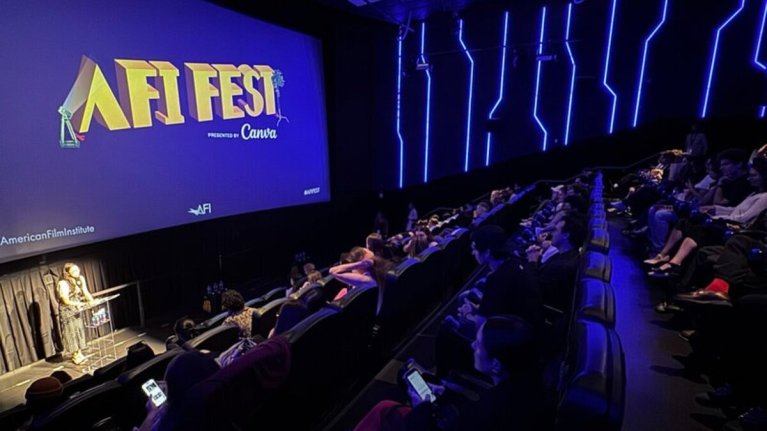
We are extremely proud to write that this year marks our tenth time covering Los Angeles’s unofficial premiere film festival, AFI Fest!
This year saw one of the largest totals of films programmed at the festival at 158, of which four were World Premieres, six were North American Premieres, and seven were US Premieres! The program represented forty-four countries and boasted nine Best International Feature Oscar® submissions, such as Mati Diop’s hybrid documentary, Dahomey, and Matthew Rankin’s second feature, Universal Language, two of our favorite watches from the impressive slate of films that we were able to catch during the five days of AFI Fest 2024!
In fact, this time around, we took in a total of sixteen features during the festival, and as per usual, our selections drew heavily from the World Cinema, Luminaries, and Discovery sections, but with an added focus this year on the Documentary section, where we caught four features, including the aforementioned Dahomey and Soundtrack to a Coup d’Etat, Johan Grimonprez’s innovative and impactful essay on the events that led to the killing of the first prime minister of the Democratic Republic of the Congo, Patrice Lumumba.
As always, we couldn’t make it to everything that we had hoped to see. We’re saddened that the stars didn’t align so that we could attend screenings of the new offerings from Miguel Gomes, Payal Kapadia, and Alain Guiraudie, but we’re extremely glad that we were able to view the latest features from Albert Serra, Hong Sang-soo, and Philippe Lesage, amongst other notable filmmakers we’ve come to appreciate!
Overall, the films that we selected to review below constitute one of the most eclectic mixes of cinema that we have seen over our ten years of coverage of AFI Fest, and for our piece, we have chosen the thirteen movies that we admired the most, beginning with our number one selection from the festival!
• •
Việt and Nam
dir. Trương Minh Quý / Philippines, France, Singapore, Italy, Germany, Vietnam
With each of Trương Minh Quý’s films, the director sets forth ideas of the cosmic and the historic along with the multi-layered conceptions of house and home and allows us to watch all of these forces clash and interplay. In his most recent feature, Việt and Nam, Trương’s method has reached its highest form to date, resulting in a hypnotic, moving film made up of various interwoven, open-ended essays on Vietnamese culture and history, all of which are framed by the relationship between the two titular characters. The plot of Việt and Nam is simple albeit particular: Việt and Nam are miners who are best friends and lovers. In the year 2001, Nam is getting ready to leave Vietnam in search of a better future outside of the country, and the film documents the period where Nam looks towards his unknown future and bids his farewell to a present that will soon become the past. As such, history and collective memories weigh heavily on each of Nam’s interactions with his surroundings — his home, his workplace in the mine, and the forest where he attempts to help his mother recover the remains of his father who was killed in the Vietnam War — and his relationships with his mother and Việt, imbuing Việt and Nam with a profoundly elegiac tone. Haunted by the real future incident of the discovery of thirty-nine Vietnamese migrants who were killed in a lorry container that landed in the UK in 2019, Việt and Nam intimates a tragic end to Nam’s departure, but remains fixed throughout on all of the forces that encourage Nam’s migration. Trương offers a multitude of ways that fixations on the past extinguish potential, swelling up Việt and Nam into a mourning cry for the loss of home for all who departed Vietnam’s shores and the loss of opportunities and vibrancy for a country that lost its people. Misinterpreted as a work of slow cinema in the manner of Apichatpong Weerasethakul, Việt and Nam is, in fact, a collage of cinematic techniques ranging from long-takes to cross-cuts, which build the momentum of the film to take us from the bowels of the Earth to its surface and then to a plane above. We had the honor of speaking with Trương Minh Quý in the days before Việt and Nam screened at AFI Fest 2024. You can read that conversation here.
• •
Tardes de soledad (Afternoons of Solitude)
dir. Albert Serra / Spain
In many of Albert Serra’s films, the frame is the theater stage with a pedestal, and on it is some figure(s) of grand stature, by way of history, notoriousness, and/or national standing, whom the director will strip down and reduce to their most basic form for all of us to examine away from any facades that once entranced us. This Serra method is in full effect in his latest film, Afternoons of Solitude, a documentary which meticulously captures the in-arena trials and tribulations of the world’s leading torero, Andrés Roca Rey. There’s little glory to be had or found in Serra’s rendering of Spain’s controversial, but nevertheless significant national pastime: the director presents close-up studies of multiple corridas without any shot of audience reactions, and though the fights are stitched together by a handful of beyond the arena scenes of transit, undressing, and dressing, the bullfights develop into an increasingly predictable loop, with each fight differentiated merely by the change in costumes by Rey and his cuadrilla and, of course, by the change in the bull opponent. Like a three-act play, a bullfight is structured in thirds, and its script plays out as consistently as that of a passion play. Occasionally, the fight veers off course: a bull attacks and nearly steps on Rey in one and pins him to the arena wall in another, but the script corrects itself each time, with the cuadrilla stepping in to help, Rey returning to the battle full of bravado, and voices exclaiming admiration for Rey’s manhood heard over the images of the torero continuing on until the bull is killed and dragged away by horses, leaving a large streak of blood in the arena sand. Even though we see the arcs of the bullfight over and over again, Serra’s documentation of this national play/shared ritual never becomes tedious thanks to the incredible close-ups and dynamic editing that draws our eyes to the faces and the natural materials and fluids as well as the man-made substances and objects that are essential to a bullfight. The horror of the violence repeatedly enacted towards the bulls in the arena does not go away, but our emotional activation dampens with each fight, replaced by a new lucidity: bullfighting is a tradition that feeds the spectator’s primeval motivations and tendencies at the cost of animal and human life. Afternoons of Solitude dissolves our collective consciousness’s fascination with bullfighting and confronts the culpability of the viewers of the sport. It could become one of the most important records of a long extinct pastime some day in the future — if only we could step away from our deeply rooted attachment to violence.
• •
Comme le feu (Who by Fire)
dir. Philippe Lesage / Canada, France
One of the most energetic reflexive works about filmmaking that we’ve seen in many years, Philippe Lesage’s Who By Fire lures us into a spider web overseen by Blake Cadieux (Arieh Worthalter), a once famous fiction filmmaker who has moved on to become a documentarian and a woodsman (of sorts). Blake invites his former screenwriting partner, Albert Gary (Paul Ahmarani), for a retreat and reunion at his palatial cabin in the woods, and Albert brings along his college-aged children, his daughter, Aliocha (Aurélia Arandi-Longpré), and his son, Max (Antoine Marchand-Gagnon). And Max brings along his best friend, Jeff (Noah Parker), an aspiring filmmaker. When Albert and company arrive to the cabin by a seaplane flown by Blake himself, they meet Blake’s editor, Millie (Sophie Desmarais), his best friend and assistant/wilderness guide, Barney (Carlo Harrietha), and the house chef, Ferran (Guillaume Laurin). At this point, nearly all of the crew members needed to make a film are present, and Blake naturally takes on his role as the director as well as the lead actor in the group’s dynamic even though the cameras aren’t rolling. Blake’s command at the dinner table the first night raises old tensions between him and Albert, and this clash between the former collaborators lets loose an uneasiness that permeates the film. Despite the dominance of Blake as a character, Lesage anchors Who By Fire on Jeff, and as the film progresses, we see the awkward and highly sensitive Jeff get caught between his attraction to Aliocha and his eagerness to impress and learn from Blake, who is quick to share his director’s copy of the screenplay for one of his most famous films with his aspiring disciple. Much to his embarrassment, Jeff gets lost in the woods at night after making a confusing pass at Aliocha and has to be rescued by Blake the next morning. Then, in the late hours of the same day, Jeff catches Blake and Aloicha together as his would-be mentor takes partially clothed photos of his object of desire. Jeff seethes, but he can do little in this space where all activities, including lounging, fishing, dining, or canoeing, are set up and helmed by Blake. As a result, Who By Fire materializes a microcosm where artistic striving crashes into grappling between generations, the older clutching onto what remains of its dominance and the younger trying to ascend while also desperate to glean knowledge and wisdom from its contender. And yet, the film is also an ode to filmmaking: a celebration of the joy, dread, drama, and sadness that the moving image can bring because Blake takes Jeff and all of the people in the cabin through each of these emotions with different situations masterfully constructed and integrated together by Lesage and effortlessly lensed by cinematographer Balthazar Lab. In turn, Who By Fire rejoices the possibilities of cinema as an artform while also sharply articulating the limitations to its progression that people, be it themselves or others, place on it.
• •
Universal Language
dir. Matthew Rankin / Canada
When we viewed Matthew Rankin’s debut feature, The Twentieth Century, we were immediately charmed by his idiosyncratic style of overlaying farce on top of a selection of events in Prime Minister William Lyon Mackenzie King’s life. The bizarre but vibrant aesthetic of the film, hearkening to Futurism, German Expressionism, and Surrealism filtered through the Golden Age of Television proclaimed the Winnipeg-born director as a clear descendent of Guy Maddin. This lineage is reaffirmed with Rankin’s second full-length, Universal Language, but the director introduces the influence of an additional parent, Iranian cinema. Universal Language reimagines Winnipeg as the Tehran of Canada, a place where the beige architecture and snow of one of the world’s coldest cities live side by side with the city’s Persian culture and dominant language, Farsi. The film tells two tales and gathers them together with an enthusiastic tour guide who shows people the marvels of Winnipeg. One of the stories pays homage to Jafar Panahi’s White Balloon: two sisters (Rojina Esmaeili and Saba Vahedyousefi) roam the city looking for an ax to excavate money frozen in ice in order to pay for the replacement glasses of one of the sister’s classmates. And, in the other, a man — played by Rankin himself as a nod to the tradition of Iranian directors playing themselves in their own films — leaves Montréal and returns to Winnipeg only to find that his mother’s exact whereabouts are a mystery as his childhood home has been sold and is occupied instead by a kind family. Meanwhile, the tour guide (executive producer and co-writer Pirouz Nemati) emphatically highlights Winnipeg’s modest sights such as its abandoned mall and a forgotten briefcase that no one has ever taken or opened, which has become a city landmark as an emblem for human honesty and trustworthiness. The characters roam around Winnipeg’s streets and sidewalks seeking completely separate things, but, gradually, their paths move closer to each other and lead them to the tour guide’s apartment where revelations transpire. By superimposing Tehran on Winnipeg, Rankin implicitly raises issues around autonomy and independence inherent in the tensions between Canada’s Anglo and French origins while also noting the multiculturalism of Canada that accelerated in the twentieth century. The Winnipeg of Universal Language is as foreign to Montréal as Paris is and vice versa, but both cities are related through their history, particularly by Louis Riel, whose monument is notably featured in the film next to a highway. Born in Saint Boniface (which is now a part of present-day Winnipeg) to a Métis father and French-Canadian mother in 1844 and educated in Montréal, Riel founded the province of Manitoba and fought against the Canadian government’s attempts to take over Métis land in the region. His charge of treason and subsequent execution catalyzed a rise in Québec nationalism in the late 1880s, which, in the century to follow, gave rise to the Québec sovereignty movement. Riel thus embodies Canadian plurality, and the scenes featuring his monument stress this concept that is dear to the film and its filmmaker. Universal Language envisions an entirely Persian Winnipeg, but in doing so, it demonstrates how we, despite our divisions, are inextricably linked in ways seen and unseen, and there’s something lovely and amazing about that.
• •
Yeohaengjaui pilyo (A Traveler’s Needs)
dir. Hong Sang-soo / South Korea
Considering the seemingly effortless nature of their previous collaborations, it is a surprise that Isabelle Huppert and Hong Sang-soo have only worked together twice in the last dozen years. As seen in 2012’s In Another Country and 2017’s Claire’s Camera, Hong’s immense adoration for Huppert fills the duo’s latest joint project, A Traveler’s Needs, and his absurdist setups continue to showcase Huppert’s considerable talents as a comedic actress. Huppert portrays Iris, a French woman whose mysterious mission in South Korea leans on a method she recently developed to teach the locals her native tongue in order to pay for a portion of her stay, and although she has doubts about her system’s capacity to facilitate language learning, her eccentric nature allows her to test it on anyone who is open to giving it a try. Iris, whose fanciful manner of speaking hangs perfectly inside of a Hong Sang-soo frame, asks her clients to share their most personal thoughts as part of her quasi-remedial process, and after having lengthy discussions with the student in English, Iris writes a succinct synopsis of the ideas and thoughts that emerge in French and requests that the student recite it repeatedly into a tape machine prior to their next meeting. Hong presents two lessons with two different pupils, and within both sessions happens an unprovoked musical performance executed in a lifeless fashion by the students who identically critique their own poor proficiency and admit the desire to have better skill with the same exact words. Iris includes these musical incidents with her students’ disclosed thoughts in the French sentences she gives them, but each line exists as her own reflection on them and commentary on their lack of self-awareness. Each of these statements composed by Iris thereby act as a vehicle for Hong’s criticism of his own people’s desire to constrain art with precise and rigid execution instead of allowing it to flourish with joy from the act of expression and inspiration from the elemental. To this end, Hong carefully distinguishes Iris’s wardrobe from that of the people around her: others mostly wear neutral shades, but Iris wears a delightful springtime nymph inspired ensemble featuring a bright pink floral dress and grass-green sweater, which blends as easily into a park’s landscape as it does into a green terrace where Iris pauses for a rest, suggesting that she is a representation of the natural flow that needs to be embraced by those around her. Alternately, when the scene shifts from the pastoral to the confines of Iris’s apartment bedroom, where she is serenaded by the piano-playing of her flatmate, a poet named In-guk (Ha Seong-guk), Iris’s attire changes to suitably match the room’s warm tones as she persuades her friend and willing benefactor who is allowing her to stay for free to not over fixate on the notes he needs to play next and instead focus on the present sound. But soon, this thoughtful and gentle moment between two friends is interrupted by In-guk’s mother, whose insecurities and unreasonable desire for safety are directed towards her son as she casts doubt on Iris’s wholesome intentions. Ultimately, this dire moment between In-guk and his mother in the final third of A Traveler’s Needs radically shifts the film away from the whimsical and into an even starker cultural statement by Hong of his own people’s reluctance to relinquish their need for control, which suppresses their capacity to connect with their emotions and, in the long run, hinders any meaningful form of expression. The success of A Traveler’s Needs can be largely attributed to Huppert, who gives Iris several dimensions with a single look and contributes significantly to the most recent chapter in Hong’s post-COVID output, which once more features our director issuing a sobering wake-up call to those asleep in complacency in the face of an uncertain future.
• •
Soundtrack to a Coup d’Etat
dir. Johan Grimonprez / Belgium, France, Netherlands
In the same way that jazz musicians come together to create a dazzling, intricate mixture of sound comprised of melody and rhythm, regrettably, so too did the Belgian monarchy, the US government, and a slew of corporations in January of 1961 to conspire to execute their insipid plot to delegitimize and kill the first prime minister of the Democratic Republic of the Congo, Patrice Lumumba. As he did with his 2017 feature documentary Blue Orchid, which delved into the global arms trade, Belgian multimedia artist and filmmaker Johan Grimonprez once again turns his camera towards the unsavory underbelly of political maneuvering where lives are traded for profit with Soundtrack to a Coup d’Etat. Drawing from the books My Country, Africa: Autobiography of the Black Pasionaria, To Katanga and Back: A UN Case History, and Congo, Inc., here, Grimonprez expertly fuses everything from spoken word pieces to archival footage of the jazz that was performed by a who’s who of iconic artists who were sent by the US State Department to Africa during the 1950s and 60s under the guise of a goodwill mission that actually functioned as a smokescreen for covert operations to undermine post-colonial governments. Implementing a method to cleverly beguile you into a sense of nostalgic joy early in the narrative, Grimonprez and his team of editors enthrall you with a cascade of mesmerizing sounds and visuals from jazz legends, luring you into a state of bliss before steadily pulling the carpet out from under you when the onerous details substantiated through various forms of hard evidence paint a grotesque and calculated picture of America and Belgium’s joint mission to preserve access to Africa’s vast mineral resources, resources that the US feared were slipping away when many of Africa’s nations began to, one by one, unify, strengthen, and pull away from their colonial oppressors. As Soundtrack to a Coup d’Etat details the actions of an American propaganda machine that sought to turn every message of support for Africa’s first post-colonial nation into one of fear and Communist rhetoric, the film thankfully calls out the few brave western artists who caught wind of the plot to dismantle Lumumba’s government who subsequently boycotted being used in the campaign, and so, as the plot unfolds and these musicians and activists express their disdain, the music responds in kind by moving away from bop and into sounds of protest from the Africa that incorporate the continent’s many original rhythms. Given the ambitious nature of the entire composition of Grimonprez’s film, one may fear that the method might overwhelm the subject at times, but instead, the inevitable death of Lumumba still hits hard as it’s presented here, as an outro for the piece that draws a line towards a present-day Congo where dour campaigns continue by governments who now vie for that nation’s coltan, a mineral required to power today’s electronics. Soundtrack to a Coup d’Etat opens nationally in theaters on Friday, November 15th.
• •
Harvest
dir. Athina Rachel Tsangari / UK, US, Germany, France
For Harvest, Athina Rachel Tsangari, one of the pillars of the Greek Weird Wave, deviates away from the odd to tell the story of the beginning of modern Western civilization, right at the precipitating moment marking our transition from an agrarian society to an industrialized one. Set in a village in Scotland loosely around the 1600s, Harvest gives us Walter Thirsk (Caleb Landry Jones) as a guide to the idyllic, fairytale-like expanse of lands owned by the village’s lord, Master Charles Kent (Harry Melling). All of the residents tend to the fields except for Walter, who was Charles’s manservant in childhood and adolescence and, as an adult, has somewhat continued to exist in this same capacity. Consequently, Walter is not treated as a member of the village tribe and exists as a bystander and observer who studies the people in his surroundings as much as the flora along the nearby hills. When Charles’s stable is set ablaze, Walter steps in to rescue his lord’s beloved horse, and although he knows the culprits of the act of arson, he withholds their names, aware of how the others would perceive his identification of the offenders as some of their own. Thankfully, the good-natured Charles dismisses the fire as an accident, but this event quietly ushers in a massive wave of change. Soon after, a woman and two men arrive by canoe and try to camp by the side of the nearby lake, but instead are blamed for the stable fire and are accordingly punished. At the celebration for the end of the growing season, Charles introduces everyone to Phillip Earle, a mapmaker who has arrived to survey the land, and announces a new economic vision for the village: sheep herding for the purposes of the burgeoning wool industry. With the villagers’ paranoia already raised by these recent events, their suspicions and fears escalate further upon the arrival of Edmund Jourdan, Master Kent’s late wife’s cousin and the incarnate of malevolence, who asserts himself as the true owner of the land and the mastermind behind the new vision of sheep. On the request of Charles, Walter assists Phillip Earle, but through all of these changes, which severely impact the villagers and even Charles himself, Walt mostly observes and maintains his distance. As the film proceeds, inaction becomes more despicable, and Harvest reveals itself as a sharply contemporary tale of a non-hero, a man caught between forces that he can’t overcome, one who must piece together some semblance of integrity in a cruel world with few options. Walter isn’t accepted as a member of the peasant class. He’s certainly not a member of the lord class. He’s in the void between, and he must determine if he’s going to participate in Edmund Jordan’s future for him as an administrator of the new business or venture on to new lands and unimagined futures.
• •
Devo
dir. Chris Smith / USA
Before writing this critique of Chris Smith’s deliriously entertaining feature on New Wave pioneers Devo, we seriously considered recusing ourselves from the assignment as we have long revered this innovative outfit that rose up from the Rubber City (also known as Akron, Ohio) to national prominence. Over the years, we’ve seen far too many documentaries on musical artists we admire that fire dead center into the cookie-cutter model of assembling onscreen celebrity talking heads who espouse fanatical adoration and intercutting these lionizations with faded clips from the musician’s heyday, a tiresome approach in direct conflict with the creativity and the vibrancy of the subject artist. Thankfully, for Devo, veteran documentarian Smith (American Movie, The Yes Men) thoughtfully utilizes the abundant library of avant-garde footage created by the band themselves as his documentary’s base and interweaves it with only retro-commercial footage and interviews with the band’s members and outside collaborators, sidestepping all of the antiquated conventions of the rock doc as the director sheds light on the enigmatic political underpinnings of the band’s origins, which began after the protest shootings at Kent State, their mindset behind their early performance art styled live shows, and their subsequent rise through the corporate record industry machine that was the enemy of their self-defined ethos that extolled the ever-evolving de-evolution of man. Though Devo saw fame as a method for getting their social messaging out, the level of how famous the band wanted to become is left intentionally ambiguous by Smith. There are glimpses into the amount of joy that the lucrative record contracts gave the band, but that success was also something that caused Devo endless internal strife. This all may sound a bit serious in tone and warrant comparisons to Todd Haynes’s fittingly austere and highly accomplished doc on the Velvet Underground from 2021, but the editing of Smith’s treatment on what makes Devo who they are comes at you in bright waves, matching the wit and tongue-in-cheek spirit that are fundamental to the band. Smith’s film is funny when he listens to the band’s early forays into creating an image, dour during moments when founding members Gerald Casale and Mark Mothersbaugh reveal their frustrations with the powers that be, and joyful when we see footage of the band doing what they do best — exercising their ample talents to subversively criticize the dysfunctional system that they slyly ascended and innovated within, if only for a few years.
• •
Dahomey
dir. Mati Diop / France, Senegal, Benin
Five years have passed since the premiere of French-Senegalese director Mati Diop’s critically lauded feature debut, Atlantique. Set in the capital city of Dakar, Diop’s first full-length fiction work, is a gripping and mystical drama where Diop expertly melded the film’s environment with the characters’ responses to desperate situations to create an absorbing contemporary portrait of a place and its people. For her latest feature, Dahomey, Diop again combines elements of environment and a fictional engine, but here she also joins them with a key moment in history to present a slender yet affecting hybrid documentary that fosters critical dialogues around France’s 2021 repatriation of 26 stolen relics (from a total of over 7,000 looted) to the Republic of Benin, the former Kingdom of Dahomey. Diop presents this repatriation of stolen items in three fluid parts. The first section introduces us to the 26 artifacts still housed in the Musée du Quai Branly followed by their transportation from Paris to Cotonou. In the film’s second section, we witness students from the University of Abomey-Calavi engage in a fierce and impassioned debate about the significance of the return of their cultural possessions; and in the final third, the statues and other artifacts are displayed for the first time in a Beninese museum. When outlined, Dahomey’s overall narrative structure may sound like the makings of a standard documentary, but Diop’s imaginative choice to anthropomorphize the 26th item returned, the figure of King Ghézo, who ruled the Kingdom of Dahomey from 1797 to 1818, boldly distinguishes her work. As the film’s central narrator, King Ghézo speaks in the Dahomean language of Fon, articulating his thoughts on being trapped in the darkness of his shipping crate and his ruminations on his own existence and history. Resoundingly rendered so that Ghézo’s voice sounds like a soul communicating from centuries long ago, Diop’s technique brings emotionality to Ghézo’s symbolic plight as a representative of the items being returned to Benin, while also elevating the difficult eternal debate around the ethics and impact of any attempt by colonial governments to repatriate plundered culturally significant items, an act that serves as only a banal gesture towards the citizens of the victimized country who long for their remaining stolen artifacts and resources that will most likely never be returned.
• •
Christmas Eve in Miller’s Point
dir. Tyler Taormina / USA
One must always remember that the word “nostalgia” is a learned formation of a Greek compound consisting of nóstos, meaning “homecoming,” and álgos, meaning “pain.” Keeping that in mind, possibly no song provokes greater “nostalgia” within us than the Goffin-King-penned track, “Point of No Return,” a top 40 hit for Gene McDaniels back in 1962. To digress for a moment…When we first moved to Knoxville in 2018, the sole oldies station in town was clearly engaged in an all-out blitzkrieg to revive this McDaniels’ cut, which, if you’ve never heard it before, is rife with over-annunciation, stark dramatic pauses, and a lavish orchestration that feels more akin to a John Barry score or a Tom Jones performance for Ed Sullivan than the soulful arrangement the song’s heartbreaking lyrics warranted. For about a year or so, we would giggle whenever “Point of No Return” blasted through our kitchen, but all that changed after months of being trapped inside during COVID. The McDaniels song took on an entirely different meaning, circumventing any semblance of kitsch and veering towards something closer to political reeducation announcements. Since his impressive debut feature, Ham on Rye, director Tyler Taormina has harnessed the fiendish power that nostalgia has over us by selectively introducing us to warm and fuzzy sounds and images from multiple eras via film language whilst loudly injecting an underlying tone that suggests the layers of brokenness we mindlessly gloss over while engaging in pointless, familiar ritual. So, with Taormina’s ethos firmly established, we readied ourselves for a viewing of the director’s latest, knowing full well that there is no greater Holy Grail of nostalgia than that of the holiday film. Christmas Eve in Miller’s Point is a faded and ragu-smeared Yuletide snapshot gathering of the obtusely Long Island blue-collar Italian-American family, the Bolsanos, whom we observe as they merrily and not-so-merrily bask in the clichés of the season. Food cooks, gifts are exchanged, teens sneak out to be with their friends, and the grownups argue about putting Mom into a home while sonically lurking by the boughs of holly and bowls of green and red M&Ms is “Point of No Return,” one of the many ironic non-holiday torch songs from yesteryear that gets a bonus play or two on the soundtrack for that extra taste of a past becoming further obsolete. Sharply edited into a frenzy so that no thread is followed beyond a moment or two of tension-filled dialog, leaving zero chance for the development of any dramatic event that would distinguish this celebration from the myriad of other Christmas Eves in the Bolsano home, even though traces of impending change creep throughout, Taormina’s film works like that final obligatory school Christmas pageant, an extravagant display of holiday tropes that are overshadowed by individual interests and concerns unrelated to the event, with its paraphernalia and associated warmth soon destined, just like the oldies of the soundtrack, for dusty boxes in storage once and for all.
• •
Karlovy Vary (Second Chance)
dir. Subhadra Mahajan / India
It is almost impossible to believe that only a few generations ago a sense of community in an urban landscape was alive and well. Before the 2000s and the rapid repopulation of cities by people of substantial means, communities were kept alive by the residents who carried innate knowledge of their neighborhood, creating an environment that, despite its mammoth size, was able to foster a sense of belonging by its people who were imbibed by a firm sense of that place and its capabilities to foster its own world. For Nia (Dheera Johnson), an emotionally distraught upper-class young woman, an exodus from Delhi becomes critical for her well-being following the abandonment by her boyfriend due to her unwanted pregnancy. Physically and psychologically fragile after ingesting abortion pills, Nia, with a nervously clutched cellphone in hand, arrives at her family’s summer home high up in the Pir Panjal mountain range to recuperate. It’s a place that Nia has come to know well since her youth, and with the winter descending on the region, she is promised a quiet space to convalesce with only the caretaker Raju (Rajesh Kumar) and his small family on the property. But, shortly after Nia arrives, Raju is called away, and Nia is left with Raju’s elderly mother-in-law, Bhemi (Thakra Devi), and his wildly boisterous yet disarmingly sweet son, Sunny (Kanav Thakur), both of whom offer assistance to Nia whichever way they can. However, omnipresent throughout the growing relationship between Nia, Bhemi, and Sunny is a question of class prerogative, and director Mahajan adeptly implies the socioeconomic distance between the three with the small moments that occur between them, whether it be Nia’s joy in soundly beating Sunny in a casual game of cricket or Nia’s refusal to eat the food that Bhemi skillfully crafts for her. The divide is never overtly stated, but it generates a tension early on that drives the narrative while also giving insight into Nia’s inability to feel comfortable in her own skin, whether she is in Delhi or seemingly light years away in nature. As the days go by and Nia is thrust into distressing situations that require serious assistance, she begins to accept the emotional and physical help that she gets from her surrogate family and starts to recognize their extraordinary symbiosis with the land, which gives Nia the strength to solemnly examine her own situation. Aided by the superb black and white camerawork by Swapnil Suhas Sonawane that captures not only the beauty, but also the harsh isolation of the film’s setting, Mahajan’s impressive feature debut goes far beyond the cliché of the urbanite who finds themself by succumbing to the mystical wiles of nature: Second Chance is a somber, yet occasionally funny, and ultimately complex character study that speaks volumes about the ever-growing chasm between the societally mandated expectations we thoughtlessly place on ourselves and the power of place and the people connected to it who help us reestablish our natural sense of self.
• •
Gou Zhen (Black Dog)
dir. Guan Hu / China
Set in the months before the 2008 Beijing Olympics in a small town on the outskirts of the Gobi desert, Guan Hu’s, Black Dog, the winner of Un Certain Regard at this year’s Cannes, is, at its core, a man and his dog story elevated to a sprawling, sometimes allegory-overwrought, but absorbing political drama. Returning to his slowly withering hometown to spend time with his dying father is our near-silent anti-hero, Lang (Eddie Peng), a musician of some notoriety, stunt motorcyclist, and ex-con who just ended his ten year prison sentence after being convicted of manslaughter for the accidental death of his riding partner, a crime that many of the locals still hold over Lang’s head. Left with few friends in town and even slimmer prospects for work, Lang joins the local governmental effort to round up the exceedingly large number of wild dogs deemed undesirable by the town, with the infamous titular canine, a rumored carrier of rabies, singled out as the coveted prize given the sizable reward for its capture. Although Lang, slightly mauled by the hunted emaciated dog early in the film, makes the decision to keep the cur once his job dictates that he captures the animal, this act of defiance unites these outcasts, who along with the packs of stray dogs, serve as a symbol against Beijing’s plan for sweeping change in this arid region that would require the elimination of any roadblocks and eyesores standing in the way of progress. Alternating between comedy, sentimentality, and social commentary mixed with healthy doses of magical realism, Guan Hu’s film is affecting for a good portion of its 149 minute running time, especially in the quieter moments when it concentrates on the relationship between Lang and his newfound four-legged friend, but the narrative stumbles a bit when it expands its scope to include too many subplots, such as the underdeveloped romance between Lang and a traveling circus performer named Grape. But, despite its desire for an unnecessarily epic scale and a nagging sense that some intended messaging may have been censored, Black Dog is a well-acted and poignant take on an ever-evolving China that may be changing too quickly without any regard for its own people.
• •
All films were screened at AFI Fest 2024. Many thanks and congratulations to the staff and volunteers of AFI Fest for another excellent year of cinema and conversations, and a special thanks to Johanna Calderón-Dakin, Senior Publicity Associate for AFI Fest, who made our coverage possible.
Featured photo courtesy of AFI Fest.

 LILY & GENEROSO 4EVER!