Comikaze Spotlight: Kel McDonald and Jose Pimienta’s From Scratch

Standard

On the far edge of the exhibition booths with towers of toys, old and new comics, and any other merchandise tied to pop culture of the past and present you could imagine, Stan Lee’s Comikaze’s Artist Alley stood in modest rows. As per our usual approach to any comic con, we first focused our attention on this section looking for independent work and new experiments in the comicbook form (based on Stan Lee’s introduction to the extended weekend celebration of comics and pop culture, he insisted that “comic books” should be “comicbooks,” and in honor of that, I’ll stick to the nomenclature he prefers). After winding through the tables and passing by plenty of illustrators who were selling prints, we stopped at Jose Pimienta’s table, lured in by copies of The Leg, which he illustrated (and I reviewed in the past), sitting at the edge of the table.

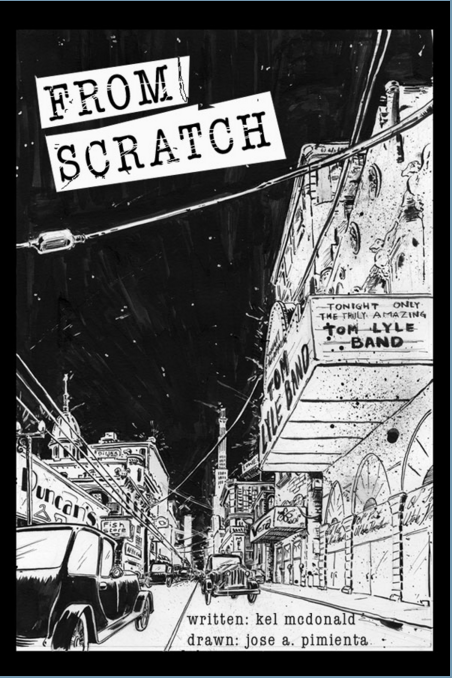
As fans of the illustration style in The Leg, we decided to pick up From Scratch, illustrated by Pimienta and written by Kel McDonald. Independently published by McDonald, From Scratch contains plenty of familiar creatures of the supernatural that we’ve come to know, but rather than showcasing the powers we have seen them utilize for decades, these beings exhibit their more human components and foibles. Set in the 1920s, From Scratch has a hint of a film noir look to it, but it is far looser in its storytelling and visual style than most noir comics out there.
FromScratchCover

Noir Pulp-esque Cover for From Scratch

From Scratch opens with Aaron and Seth arguing in a dark speakeasy. Aaron has agreed to join Seth and his group on a job to eliminate a Mr. Zamboni and his group of mobsters, but not without some doubt about where this first foray into paid killing will take him in the future.

When the two meet the rest of the team, we begin to realize that the crew is not composed of your average hit men. Aaron and Seth are vampires as well as Loki, who also possesses specific sorcery power in addition to his ones as an undead creature of the night. Beyond the vampires, we also have Sasha the werewolf and Lady Kimaya the ice demon, and all of these folks take their instructions for the job from a demon with a sinister grin and face paint to match named Darkfire or, in more human terms, Mr. Tamura.

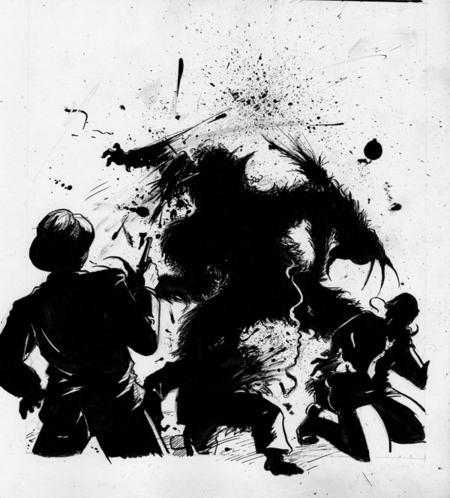
After the introduction to the cast, the plot focuses on one specific job for the group as their more human characteristics such as common sense lead them into blunders and an overall messy and too overt execution of their task. In the course of running through the halls of a stately art deco hotel looking for their target, Mr. Zamboni, the members of the team attempt to handle the order as humans, causing struggle that leads to them resorting to using their supernatural powers. Despite your natural assumption that these characters have a far greater advantage in accomplishing their deed because of the fact that they are not human, their powers cause more inconvenience than efficiency; the superpowers cause more destruction to the building and make far more noise, making the demon assassins less anonymous and quiet in their attempt to clear out everyone guarding Zamboni.

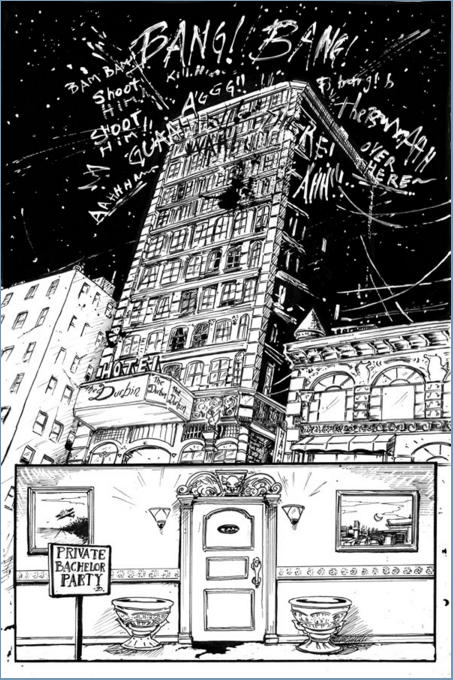
From Scratch sets its sights on placing familiar supernatural characters in circumstances and settings that deviate from their archetypal courses and succeeds. In addition to McDonald’s fun and distinctive script, Pimienta’s work here shines, with each page containing a unique visual element, ranging from varying lettering to abstract forms created from the bloodshed of the crew’s deed. While the book is comprehensive and complete, it leaves some fascinating remaining questions open, perfect for a second volume and even more. Unfortunately, only one book for the From Scratch crew and scenario exists, which is the real shame because it generates an imaginative and absurdist world with strong characters that I would love to learn more about.
BuildingPage-FromScratch

Example of Mixed Art and Lettering Style

Regardless of my disappointment that more of From Scratch does not exist, it stands as an excellent example of the type of gems buried in the crowded aisles of the Artist Alley of any comic convention. Next time you’re at a con, take some time away from the walls of mesmerizing Funko toys to talk to creators at their tables in Artist Alley. You’ll most likely discover a work that tests your expectations for comicbooks, and that’s always a treat well worth the time and effort.

From Scratch is written by Kel McDonald and illustrated by Jose Pimienta and is available in print and electronic forms here

Also, keep an eye out soon for our wrap up on Comikaze, which will be posted on Forces of Geek soon!
The Leg: The Tale of the Silent Stranger Known as Santa Anna’s Leg

Standard

As a Texan, Santa Anna is the name of a historical figure that immediately transports me back to my mandatory seventh grade Texas history class. In America, we know Santa Anna as Mexico’s president and military commander who lost the wars resulting in Mexico’s loss of Texas and much of the American southwest. However, long before those years of battling for land against American settlers, Santa Anna was a revered and feared leader in his own country.

The Leg or The Remarkable Reappearance of Santa Anna’s Disembodied Limb explores the folklore of Santa Anna, the paradoxical folkhero and villain of Mexico. Despite his active role in fighting for Mexico’s independence from Spain and establishing Mexico as a republic, Santa Anna grew a reputation as a hedonistic, corrupt, and vain tyrant, creating many enemies throughout his career as a politician and military leader. Santa Anna simultaneously strengthened Mexico as he chipped away the nation’s own foundation.

After his loss in the Texas Revolution, Santa Anna returned to Mexico and faced another battle, this time with French forces in what is now known as The Pastry War. In the war, which Mexico barely won, Santa Anna lost his leg, and in an act too indicative of his egocentric and eccentric character, he held a ceremony and buried his own lost leg with military honors. With the heartstrings of the nation in his hands gathered by his military intervention and consequent wound and the overwhelming nationalism stemming from the victory over France, Santa Anna regained the trust of Mexico to lead again. Unfortunately, Santa Anna’s popularity had always vacillated along with his own inability to balance his selfish desires against the needs of his nation, and eventually, Mexico grew so disgusted of their folkhero dictator that they exhumed his leg, paraded it, and threw it aside to be left in the open as carrion for vultures.

Cover of The Leg

Cover of The Leg

The whereabouts of the leg have since been unknown, giving a perfect history and setting for the creation of mythology around its travels and outcome. In The Leg, Santa Anna’s limb has returned to life as a tall and sentient boot that lives with a blind old cobbler who discovered and rescued it. When a group of well dressed men enter the old man’s home under the guise of being lost and decide to kill him, Santa Anna’s leg must try to avenge the death of his companion. Furthermore, the men are on a trip to disrupt Mexico’s progress by eliminating the new president, and alas, the well being and future of Mexico lies in the figurative hands of Santa Anna’s leg.

Along the way, the leg meets a young girl named Ana who accompanies him on his journey. The illegitimate granddaughter of Santa Anna, Ana is alone in Mexico, with her parents in America and her guardian, her grandmother, no longer alive. Deciding not to reveal its identity, the boot simply tells Ana of the mission, and she immediately agrees to help him, hoping to arrive in Mexico City also to find redemption for her family. On their travels, the two encounter fantasy and historical figures of Mexico including a witch, demon, wizard, eagle, crow, and ogre along with labor protesters, Leon Trotsky, Frida Kahlo, and Diego Rivera. In The Leg, we get glimpses into the political and religious fragility and volatility of Mexico. We understand the nation’s history of leaders with false promises who leeched off of the people whom they promised glory and prosperity. The Mexico of The Leg is in need of a hero, and Ana and the leg hope to fill this void.

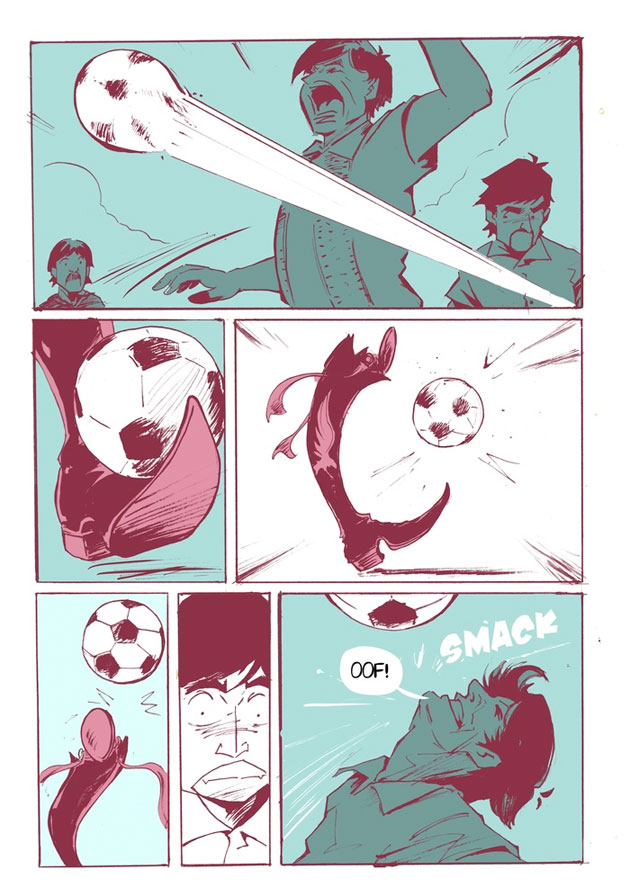
An example of the inventive, fun fiction in The Leg: Santa Anna’s Leg and The Ogre

As the extraordinary narrative progresses, The Leg reveals itself as a tale about redemption, following the tradition of westerns and samurai tales, with the Jose Pimienta’s beautiful artwork and Matthew Petz’s rich colors paying homage to the distinctive visual style of these two genres. There’s a bit of anthropomorphism here and some allusions to political movements there, but overall, The Leg focuses on the redemption of Santa Anna and his leg’s final ability to battle for his nation rather than his own greed. The Leg is the ghost limb in Mexico version of Clint Eastwood’s High Plains Drifter. Santa Anna’s leg is a mysterious, silent stranger who also returns to a place he once lived in to seek revenge and redemption and, like Clint Eastwood’s character, carries a dark past full of misdeeds. Despite the pure goodness of Santa Anna, in an imperfect world, an imperfect hero may just be what we need.

The Leg has great ideas and stories weaved into it, even though it does not read smoothly. Commendably, Van Jensen attempts to layer historical realism with traditional and new mythology into his first comic book but not every piece fits seamlessly into the narrative. There are moments when the story transitions too abruptly from one arc to another and other moments when the dialog is too fragmented from panel to panel. The Leg could have been longer or shorter to better execute its goal, but it nevertheless deserves praise for its ambition and creativity.

Overall, The Leg is a fiercely imaginative novel about the duality of a character rarely discussed in American history. Through its mythology, The Leg conveys the human ability to choose a path of glory over one of depravity, one of honor over one of cowardice, and how we as humans sometimes jump between both paths in a lifetime. What is best about The Leg is its positivity in the light of dire situations, which is refreshing in an age of cynicism and skepticism. In a modern time where many of our leaders, political or spiritual, never seem to be inherently good or evil, The Leg, gives us a breath of optimism that perhaps our leaders will one day choose a path of true benevolence for others. At the very least, it reminds us that we too can choose to veer back on a path of good even if we have strayed away.

The Leg or The Remarkable Reappearance of Santa Anna’s Disembodied Limb is written by Van Jensen, illustrated by Jose Pimienta, and lettered and colored by Matthew Petz. It is available now via Blue Creek Creative.