
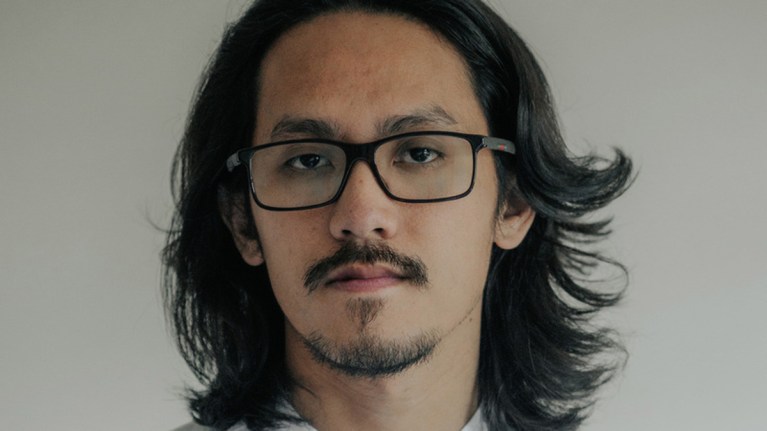
Originally published on Ink 19 on January 27, 2024
Interview conducted by Lily and Generoso on January 12, 2024
Phạm Thiên Ân’s meditative, experiential debut feature, Inside the Yellow Cocoon Shell (Bên Trong Vỏ Kén Vàng), opens in Saigon with a game of soccer followed by the spiritual discourse of three friends seated around a hotpot near the field. One friend has decided to abandon the bustling city life for the simplicity of the mountains to reconnect with his faith in God. The other is a cynic who doubts that a more rural existence of solitude will lead to any revelation and asks if his soon-to-be ascetic friend has sold his PS4 yet. The third, Thiên (Lê Phong Vũ), admits that he wants to have faith, but currently lacks it. The discussion between the three is cut short by a surge of rain and the sound of a motorcycle crash involving a man, a woman, and a child. The three ignore the crash and retreat from the rain to a massage center.
Inside a dark massage room, Thiên is mistaken for someone else, and the intimate procession between him and a female masseuse is interrupted by a phone call indicating a family emergency. As Thiên proceeds to walk through the crowded halls of a hospital, he’s calm and almost disaffected as we learn through his interactions with his nephew, Đào (Nguyễn Thịnh), and the hospital coroner, that the motorcycle accident in the opening of the film had, in fact, taken the life of his sister-in-law, Hạnh. With his brother, Tâm, missing for years, Thiên immediately becomes Đào’s primary caretaker and the escort for Hạnh’s body, which needs to be returned to their shared hometown in the Lâm Đồng province in Vietnam’s Southern Central highlands, which is also where the director himself grew up.
The tone and pace of Inside the Yellow Cocoon Shell shifts as the van carrying Hạnh’s coffin exits the city limits and climbs up a steep road to arrive at the misty and lush surroundings of the highlands: time expands; dusk, dawn, day, and night blend into each other; memories, daydreams, and reality flow in and out of the present. And, in the process of Hạnh’s wake and funeral, a dominant Catholic presence is introduced into the film. In this spiritual and physical landscape, Thiên unquestioningly performs his duties to pay respects to Hạnh and her family and to support Đào, but as he completes each request asked of him, he collides into critical moments and places of his past and is forced to unravel the origins of his struggles in finding faith and purpose. When he finally resolves to search for Tâm, he embarks on a motorbike ride and walk that takes him to new spaces within and beyond himself.
Inside the Yellow Cocoon Shell is undoubtedly a child of slow cinema, particularly of the Apichatpong Weerasethakul and Bi Gan kind. The film pays tribute to the dream-like feeling and long-takes of both directors, but it interweaves concepts of Catholicism, which are not often explored in contemporary Asian cinema, into a magnificent and personal portrait of Vietnam’s highlands. For the occasion of the US opening of Inside the Yellow Cocoon Shell on January 19th at Film at Lincoln Center, we had the fortunate opportunity to speak with director Phạm Thiên Ân about the nature of spiritual crises for young Catholics in contemporary Saigon, the magical elements of cinema, and the image creation and definition process for his Camera d’Or winning film.
• •
LF: There’s a play on the Holy Trinity in the relation between Tâm, Thiên, and Đào, with Tâm as the ghost, Thiên as the surrogate father, and Đào as the son. Can you talk about how you thought of the representation of this trio in relation to the discoveries and mysteries of faith that you wanted to portray in the film?
PTA: I wasn’t thinking of the image of the Holy Trinity when I was writing the script, and this is the first time that I’ve heard of that relationship being addressed in this way. It is quite special that you thought of it in that sense, and I will definitely be thinking about it with that lens. At first, I wanted the protagonist to be much closer to myself, and then with the nephew character of Đào, I wanted to emphasize the relationship between these two people.
When it came down to the brother, Tâm, the details of the relationship were left ambiguous in the end because, at first, I wanted Thiên to meet Tâm and have a conversation and create a completely different ending, but I found that if I took it in that direction, I would then give the audience a definitive answer, which would force them into an intended ending that would make the film feel all too predictable. So, when I was filming, I realized that I had to change the ending, and when the song “Tôi Đi Tìm Tôi” (“I Am Going To Find Myself”) came on, it gave me the idea that Thiên will find himself in the film and not another person, not his brother. The brother is a person, but he is also a reflection of Thiên’s inner self. As far as the image of Đào, he is special in that both of his parents have a kind of divine arrangement, and he is there to bridge the gaps between all of these worlds, and he pushes Thiên to embark on this journey to find himself. So, the characters are connected, but I definitely have never thought deeper into that connection in terms of religious imagery, but it always depends on each person to have their own take on what these characters are. That said, I find your view of this relationship to be unique, and I will now try and look at it from this perspective.
GF: In the flashback between Thiên and Thảo, we find it interesting that the ringing of the bell solicits a call out to Frank Capra’s It’s a Wonderful Life. In a faith sense, bells are associated with both Buddhist and Catholic tradition and ritual. But for Thiên, the bell relates to a seminal Western film. How pervasive was Western cinema in your hometown of Bảo Lộc? How did it co-exist with your Catholic upbringing?
PTA: The image of the bell from It’s a Wonderful Life is an attempt to bring in a significant part of myself. Overall, where I grew up, there wasn’t a strong presence of Western cinema because people there are much more attuned to watching films that are shown on television, so not many people have seen It’s a Wonderful Life. However, I found the film very inspiring when I was making Inside the Yellow Cocoon Shell because, even though the Capra film doesn’t talk about religion or anything that is remotely close to it at all, it brings up the concept of questioning one’s own fate that is very attached to my own life. I am always contemplating questions around purpose: what someone’s purpose is, your own purpose, or the purposes of everyone around you. And, that is why I feel that the Capra film connects with what I was trying to portray with my film — I wanted to show that these questions are also at the core of my central characters.
When I was making Inside the Yellow Cocoon Shell, I wasn’t consciously thinking about including an allusion to Capra’s film alongside the use of the bell, but right before filming, I had an instinct to change that dialogue, and it suddenly reminded me of It’s a Wonderful Life and its meaning to me personally. So, when Thiên quotes, “Every time a bell rings, an angel gets his wings,” and Thảo says that she would cry whenever she heard the line, and then asks, “Why don’t people make films like that anymore?” that response in particular came from comments that I read from audience members who had seen It’s a Wonderful Life. I agreed with what they were saying and wanted to include this sentiment in my film.
LF: We understand that Vietnam is the only Asian Communist country that has maintained ties with the Vatican. And for that reason, Thiên’s hometown (and yours too) has a strong Catholic base, but his crisis of faith surfaces in Saigon. Do you feel that’s due to the heavy capitalist/Western influence in Saigon, or is there something about the post-Diệm view of Catholicism in the city that would cause a crisis of faith while living in it?
PTA: Regarding crises of faith in Saigon for young people, and here, as a Catholic, I can only speak about this issue as it relates to my own community and not other communities and other religions, but for young people in Saigon, I’ve found that they are asking more questions about the purpose of their lives and spiritual questions overall as more of their daily needs are readily met — what are they supposed to do in this life? When it comes to Catholicism, I found that my own grandparents were already asking these kinds of questions when they were young, but I am really only seeing this as a widespread issue now. My film is my attempt to ask those questions as well because I found that usually, when people want to investigate a crisis of faith, they will go to religious spaces and meet with figures there to assist them, but I wanted to approach it in a way that brings these internal questions to more public places like the hospitals and the streets of Saigon, places that carry the essence of the city so that you’re more immersed into the inner ponderings of the characters. Within my religion, I got to know a lot of young people and their difficult situations which left them with many questions, but only when these people are challenged by things that are too hard to handle on their own, do they ever seek help from divinity. When life becomes fulfilling, it enables a sense of complacency, and thus there isn’t a motivation to ask these kinds of questions anymore. It was my goal to address these pressing concerns, and I tried to answer these questions for myself through my film.
LF: Magic is often in direct conflict with the divine. In particular, this is highlighted in the Old Testament when the Pharaoh’s magicians were used as proof against God’s miracles presented through Moses. How then does Thiên’s practice and interest in magic play a role in his overall struggle with his own faith?
PTA: Magic actually speaks directly to my own path and interests in middle school, and as this is my first feature film, I wanted to bring more of myself into it, even when it gets to be a bit strange. As for Thiên doing magic, it was first a way for Thiên to get Đào to stop talking about his mother when they were in the hospital, and then it became a way to present the bell as a memory object bridging between Thiên, Đào, and Thảo. I wasn’t thinking about magic as an opposing force to the divine — instead, I was thinking about it in terms of my connection to cinema because, in my head, magic is very similar to cinema. When a film is presented, the audience suspends their beliefs and expects to be fooled to a certain extent. They know that they are watching a fictional work, but they also accept it as truth. Similarly, when I am doing magic tricks for my friends, they know that the trick is not real, but I still want them to believe in it. So, there is this parallel between cinema and magic that I wanted to explore. I also feel that all of the images that are related to magic in the film like the cards and the fish are beautiful. I wasn’t attempting to dig deeper into the metaphorical nature of magic. Instead, Thiên’s tricks are primarily a distraction and a relief for Đào as he grieves the death of his mother. But, when Thiên later gives the bell used in one of his tricks to Thảo at the daycare where he drops off Đào, the additional meaning surrounding that object becomes a force that furthers the story.
GF: When working with your DP, Đinh Duy Hưng, on filming the natural settings of your film, what kind of discussions did you have around creating a purposeful landscape that is dream-like but not too distant from reality, not too mystical?
PTA: Because this was my first feature, I wanted to put as much of where I came from as I could into my film. That was of first importance to me, and I wanted to bring out the most unique aspects of these places. I recognized that where I was from had an unparalleled landscape, and as a child of that land, it would be a disservice not to put it into my first feature. I wasn’t really aware of the uniqueness of my environment when I was growing up: only after I arrived in the United States and returned home did I find my homeland so beautiful, and that’s what furthered my desire to capture it. When I was speaking with my DP, we discussed how we could best find and depict the distinctiveness of these places, and that was a decision that was made from the beginning before anything was set. We were in constant agreement about this approach during the filming, and we worked diligently throughout to adjust the shot that we were planning to the landscape in order to effectively convey what we found to be special about each setting. The surroundings ended up having their own voice, and we followed it as we made the film. ◼
This interview was edited for length and clarity. Many thanks to Ari-Duong Nguyen for her translation assistance in this interview.
Featured photo courtesy of Kino Lorber.
 LILY & GENEROSO 4EVER!