
Originally published on Ink 19 on June 6, 2025
A Bright Future
directed by Lucía Garibaldi
Central to the narratives created around the young female protagonists of director Lucía Garibaldi’s first two features are the interplay between the physical and the familial surroundings and their collective effect on each film’s lead. In both features, the fractured state of a particular geography influences the encircling family who in turn bestows its expectations on the psyche of its lead.
The off-season Uruguayan coastal resort that was the setting of Garibaldi’s full-length feature debut, The Sharks (Los tiburones), which earned Garibaldi a Best Director award at the 2019 Sundance Film Festival in the World Cinema Dramatic competition, provides little hope for the teenage Rosina, who begins the film by drawing her family’s ire after she damages her sister’s eye during a fight. Due to the scorn she faces for her transgression and the lack of anything to do in her dumpy seaside town, which is additionally threatened by a shark sighting that removes the sea as a possible egress and jeopardizes any remaining opportunities from tourism, Rosina takes a job with her father’s small landscaping crew, where she is the only female employee.
Angst-ridden, introverted, and with her burgeoning sexual curiosity surfacing, Rosina fixates on Joselo, an equally awkward co-worker who rejects her advances, leaving Rosina confused, vengeful, and frustrated enough to kidnap his dog, and then eventually enraged enough to use the sharks that imprison her to strike out against him. With clear visual and atmospheric nods to the early films of Lucrecia Martel and a central character who is driven to existentially rebel like Arthur Seaton in Saturday Night, Sunday Morning, The Sharks is a rawly delivered and evocative contemporary metaphor for the search for identity in the face of a grim future where the ways to ascend or escape are scarce.
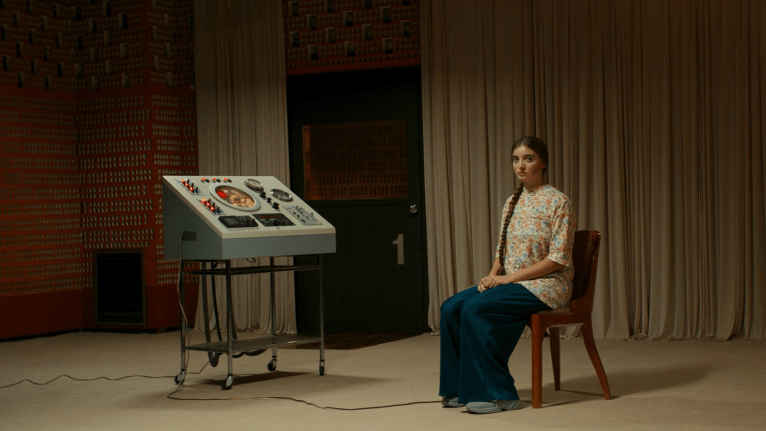
Amazingly, as pallid and hopeless as the metaphoric seaside landscape was in The Sharks, it is a blissful wonderland compared to the youth-depleted and hyperbolically decrepit town at the center of Lucía Garibaldi’s more narratively and visually ambitious second feature, A Bright Future (Un Futuro Brillante). Cleverly juxtaposed against The Sharks’ Rosina is A Bright Future’s Elisa (Martina Passeggi), a smart, thoughtful, and upright teen who lives with her doting mother in a dilapidated housing complex set in a land where environmental circumstances have left it devoid of canines, who have been replaced by barking speakers, and plagued by an “invasion” of ants. Here, Elisa exists not only as her mother Nélida’s (Soledad Pelayo) constant source of pride, but also as the joy of her neighborhood, as Elisa becomes the final young person selected from there to go to the fabled North, an organized utopia where her older sister and the promising neighboring youths have been sent, never to return. Nélida, unfazed by this sad reality, responds to her eldest daughter’s absence by working two jobs to try to win an auction that would also allow her passage to the North and would fulfill her dream of reuniting her family in the region of progress.
At first, Elisa plays along with her mom’s plan for her, and she attends the circa mid-70s self-help-styled adaptation appointments developed by the comfy-sweatered representatives of the North who are searching for brilliant, emotionally repressed and unexpressive candidates under the guise of genetic and psychological stability. Elisa keeps it together and makes it through the early rounds with flying colors, but when her numerous attempts to contact her sister go unreturned, the rumblings of doubt begin to manifest inside her. Adding to the general disruption of her life is the recently arrived Leonor (Sofía Gala Castiglione), a nurse with a prosthetic leg, a thousand-yard stare, and a film noir vibe of danger, who has moved into Elisa’s building where she has Elisa’s mom and the neighbors buzzing due to her sonic nocturnal carnal omissions that somehow succeed in morally drowning out the noise of the ever-present synthetic animal sounds that are the norm.
With all of this fracturing around her, Elisa turns to the one constant person who never leans heavily on her, her uncle Andrés (Alfonso Tort), who owns and operates a run-down convenience store with his husband/partner and stocks its mostly empty shelves with rare items scavenged during his regular trips to the sequestered and unprotected South. Although it’s a dubious voyage, Elisa tags along, but she is forced to exit before crossing over by the border guards who recognize her as a candidate for the North. This moment provides the representative geographic boundary that was also present via the predator-filled waters of The Sharks. Elisa, now trapped, finds comfort in spending her evenings with her uncle and his partner at their store, and it is in this setting, which inherently symbolizes a passive rebellion, where she and Leonor execute a scheme to raise money to support Elisa’s mother’s journey north, which involves Elisa selling the one valuable asset she possesses: her youth.
As was the case with The Sharks, Garibaldi delivers minimal exposition in A Bright Future as she walks a fine line that risks the potential for audience disengagement in favor of a narrative that is wholly unpredictable. This approach pays off as the film builds towards its final act when the narrative’s unexpected maneuvers fuse with the obtuseness of the dialog and visuals to heighten the emotional fissures opening up in Elisa.
Though more playful in tone and infinitely less dour in plot, Garibaldi’s film neatly melds its world construction and dystopian themes in a way that touches on one of our favorite films from 2021, Chema García Ibarra’s The Sacred Spirit, a film that also ran wild with its fantastical elements to comment on our present-day failures in human connection. Much of the credit here should also go to the film’s cinematographer, Arauco Hernandez, whose tight framing and occasionally awkward viewpoints drive the film deeper into the absurd, and production designer Cecilia Guerriero, who creates a fittingly dilapidated yet feebly forward aesthetic that hearkens to the muted and glaring motifs of failed industrial ambition omnipresent in the Greek Weird Wave.
A Bright Future is a daring second feature for Garibaldi, who, along with co-screenwriter Federico Alvarado, cinematically embraces all the trappings of the brave new world to further explore and expand on the way that society and family profoundly impact young people as they drive them towards a misguided and unsuitable vision of progress.
A Bright Future screens in the Viewpoints section of the Tribeca Film Festival from Thursday, June 5, through Saturday, June 7, 2025.
A Bright Future
Feature photo courtesy of Cinema Tropical
Lily and Generoso Fierro
 LILY & GENEROSO 4EVER!