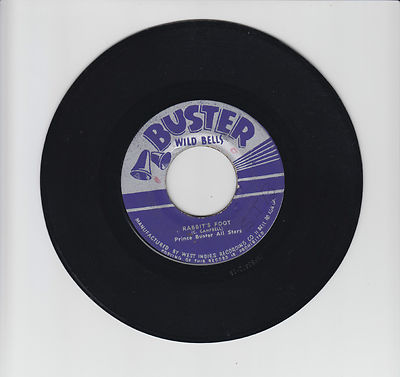
Bovine Ska and Rocksteady 7/7/15: Prince Buster’s Wild Bells Label

Standard
wild bells 2

A great Gabbidon cut on Buster’s Wild Bells Label


This week (July 7th) on Generoso and Lily’s Bovine Ska and Rocksteady, we started off with a version to version to version extravaganza from Phil Pratt’s Sun Shot Label.  We began the second set again with another version to version from Derrick Harriott and the late DJ Scotty, then our bouncy mento set before a long set of early Jamaican rhythm and blues that featured an early Jimmy Cliff side from Leslie Kong’s Beverley’s label called “You Are Never Too Old” to set up the spotlight on Prince Buster’s Wild Bells label.

Born as Cecil Bustamente Campbell, Prince Buster has one of my all time favorite stories about his entry into the music industry. After living with his grandmother in rural Jamaica as a boy, Buster gained an interest in music after singing in churches. Consequently, as a teenager, when he lived on Orange Street, he naturally became attracted to the soundsystem culture, particularly with Tom the Great Sebastian’s soundsystem. As soundsystems further emerged and began to compete against each other, particularly the big two, Coxone Dodd’s and Duke Reid’s, Prince Buster and his crew aligned himself with Coxone, whose soundsystem was more of an underdog in comparison to Duke’s, to provide Coxone’s dances with security. As he stuck around Coxone, Buster learned enough about running a soundsystem that he created his own, which he called Voice of the People. With his soundsystem up and ready for records, Buster was ready to begin recording his own singles, but originally before he could get to producing music for his soundsystem alone, he was asked by Duke Reid to produce records for him. Buster ended up recording 12 tracks at Feral studios, and he gave one to Duke Reid, leaving the rest to be pressed on his own Wild Bells label, which we highlighted this epsiode, beginning with Buster’s very first track as a vocalist, Little Honey, which was released in 1961.

Buster’s Group, the backing band for the Wild Bells label,  included members of the future renowned Skatalites band. On drums and percussion was Arkland Parks, better known as Drumbago. On tenor sax was Dennis Ska Campbell. On guitar was Jah Jerry Haynes. On trombone was Rico Rodriguez, and on tenor sax as well was Val Bennett

If you would like to listen to the show, it is HERE!

Please subscribe to our show, its FREE!: https://www.mixcloud.com/bovineska/

Join us on Facebook to know what our future spotlight will be, shows and record shops of Jamaican interest in the Southern California area, and the occasional posting of a rare photo or side:

https://www.facebook.com/groups/175321709220304/

Love,

Lily and Generoso


Peter Yates’ “Mother, Jugs, and Speed” And The “Workplace” Comedies Of The 1970s

Standard
jugs-first-appearance

Raquel Welch as well, “Jugs”

There are two events, one positive and one negative, that precipitated my review of the much maligned 1976 dark comedy, “Mother, Jugs, and Speed:”  Extremely negative is the recent damning evidence against Bill Cosby, the titular “Mother” of the film that I am reviewing here, a fellow Philadelphian, and my comic hero whose self-admitted criminal behavior has broken my heart. And on a separate positive note, is the complete Robert Altman retrospective that is currently being mounted in my former town of Boston at The Harvard Film Archive that many of my dear friends are now enjoying. Why Altman you may ask? I will theorize that somewhere in the mix of 70s subgenres, is a rarely discussed collection of films that stem from the success of Altman’s game-changing counterculture film that began the decade, “MASH,” that I will define as “workplace” films. You remember this seemingly endless flow of films that feature a group of irreverent misfits that are all stuck in a job whom you feel real empathy for and are always trying to get one over on the man. A wide array of films from the successful “Blue Collar” to “Car Wash” and ending somewhere around 1981 with “Underground Aces,” an epic flop starring a young Melanie Griffith, about a group of wacky employees in a hotel parking garage in LA. Yes, by that point Hollywood must have ran out of every conceivable place of employ to stage a workplace comedy. At least that film had a kicking theme song from Lionel Ritchie-led Commodores that one-ups the messy soundtrack of the even messier scripted “Mother, Jugs, and Speed.”

In the middle of America’s finest decade of film making, Peter Yates, who had just come off the success of directing Barbra Streisand in “For Pete’s Sake,” and Robert Mitchum in “The Friends Of Eddie Coyle,” decided to throw his hat into the ring of “workplace comedies” with this tale of a group of bawdy Los Angeles ambulance drivers who seem to have an unlimited amount of time to do drugs, mess with each other, pull pranks on their chief competitors, and even buzz a few nuns crossing the street for a quick laugh. Watching the nuns scatter at the sound of an ambulance siren is the main joy of “Mother,” a beer-swilling, message parlor visiting meat wagon driver played by Cosby who per usual manages to be part of these bad goings on without uttering a blue word. This should come as no surprise as Cosby even made a couple of blaxploitation films during that time; “Uptown Saturday Night” and “Let’s Do It Again,” that similarly to “Mother, Jugs, and Speed” received a PG rating. So, unlike our friends at the 4077th, the hijinks committed by our band of upstart paramedics are a bit toned down. Upon my third viewing of this film, I wondered if more than a few  urban workplace appropriate expletives would’ve made it into the final script if Gene Hackman (Yates’ original choice for the role of Mother) had accepted Cosby’s part before filming began.

Added to the cast is Harvey Keitel, who that very same year had his pimpish hand off blown off in a whorehouse by Travis Bickle in “Taxi Driver.” Keitel plays the soft-spoken “Speed,” a recently suspended cop and Vietnam Vet who may or may not have sold amphetamines whilst on the job, hence his epitaph. Lastly, there is “Jugs,” played Raquel Welch, who does her best uptight feminist “Hot Lips” Houlihan imitation. “Jugs” never dates the drivers, much to their chagrin, as she spends every night going to school to get her EMT license. She brandishes her license one day at work but has no chance of actually driving a wagon as her boss, Mr. Fishbine (Allen Garfield at his uptight finest) is not going to put a woman out as a paramedic. No 1970s genre film is complete without an ex-football player/actor and here we get Dick Butkus as the cowboy hat wearing “Rodeo,” think a physically larger but similarly racist Duke Forrest from “MASH,” and finally to stay on the “MASH” target, we have the film’s heavy, Murdoch (Larry Hagman) who fills in for Frank Burns as the womanizing and boorish workplace dickhead. There is some real acting talent here and to imitate the character’s idioms from “MASH” is a venial sin, but where the wheels really come off on “Mother, Jugs, and Speed” is the script and Yates’ direction, which reminds us as to why Altman’s 1970 film is considered the masterpiece that it is to this day.

Altman had the gift in “MASH” of balancing some of the funniest moments captured on film with other moments of real drama and even a bit of viscera. Altman’s comic timing is perfect in “MASH,” and it makes the overall experience into a gem. “Mother, Jugs, and Speed” supplies us with many decadent, funny scenes that keep my attention when the film runs on late night cable, but these scenes are awkwardly pressed up against a multitude of poorly framed moments of pathos. Case in point is the scene where Mother’s ambulance partner, Leroy, is murdered by a crazed junkie who wants a fix. It’s a real and tough scene, but Yates immediately follows that scene with a comedic scene that just does not fit, negating any feeling the viewer has towards Leroy’s death and the laughs of the next moment.  There are countless scenes that play out this way in “Mother, Jugs, and Speed,” and after a while, you just lose your taste for the film as you wait for inevitable laugh after an ugly moment. Unlike many of the workplace films where the moments of tragedy create empathy for the characters predicament at their job, such as Smokey’s ugly “accidental” death in Paul Schrader’s fine 1978 film, “Blue Collar,” the poor positioning of these moments in “Mother, Jugs, and Speed” feel too divisive and thus become the film’s undoing. Perhaps it was the low budget of the film had that forced such sloppy decisions. We now know that Gene Hackman and the original choice for “Jugs,” Valerie Perrine, both backed out due to low salary offers and perhaps other choices were made to cut corners that resulted in this mess of a film? Sadly, Yates’ film goes down as a sometimes hysterically funny but intensely uneven urban dark comedy whose inability to know what it wants to be stamps out any potential of being a classic in the genre.

Original Trailer for Mother, Jugs, And Speed

A few years later in 1979, Yates would shed the A-list stars and their salaries for a team of then unknowns (Dennis Quaid, and Daniel Stern to name a couple) and master the comedy-drama with the five time Academy Award nominated film,“Breaking Away.” A modern masterpiece that unlike “Mother, Jugs, and Speed”  is almost eerily intuitive of American working class people’s dilemmas and dreams.

Up Yours Netherlands! The Mondoesque “This is America” (aka Jabberwalk) From 1977

Standard
jabberwock b

Hey Vanderbes, we didn’t build the statue!

For many of us over forty year old Americans, the children of the VHS explosion, we remember the notorious “Mondo” films well. Those sort of documentaries from Italy depicting acts of perverse cruelty and sexuality from all over the world were quite popular from the 1960s onwards and made their way from house to house to bootlegs when I was growing up in Philadelphia. If you have never seen them, you weren’t missing much as these “docs” existed only to shock you with sometimes real/sometimes staged footage of bestial violence, war, and torture framed as commentary on the sick nature of humanity. In our neighborhood, the Mondo films would only be surpassed in underground popularity of the even more wretched and even less cinematographic straight to video refuse offerings entitled “Faces Of Death,” a poorly strung together collection of real and fake clips of human and animal suffering that to this day represent the lowest point of the VHS bootleg craze.

Keeping in line with the Mondo films is the first mockumentary from Dutch director Romano Vanderbes, “This Is America” (originally released under the title, “Jabberwalk”). For ninety minutes, Vanderbes takes you to USA to show you the sick excesses of the world’s richest country in all it’s shocking glory because I guess we aren’t as civilized as red light district walking, sex-obsessed Dutchmen. The film promisingly begins with the dulcet sounds of The Dictators performing “America The Beautiful,” and then director Vanderbes immediately takes you to one of the most hallowed traditions in 1970s American culture, that of the demolition derby. The over narration (the star of the film) goes on and on about America’s obsession with the automobile, and I guess the demolition derby is that obsession gone wild. As is the Indianapolis 500, which Vanderbes shows in all its crash up glory as well. Little Romano must’ve been thrilled to have found the footage from what appears to be the 1973 race, as he presents a montage of horrific accidents that took the lives of drivers and crew members. After that dose of bodies being thrown about the tracks of downtown Indianapolis, we immediately cut to the real focus of “This Is America,” …the sex.

We are now at the 1975 “Miss All Bare America Pageant” where, as you guess it, a parade of robust, nude American women goes full frontal for fun and prizes. I’ll save you the suspense; the woman with the largest breasts wins the contest, and she proudly wears her sash between her two massive mammary glands. In the slight chance that a few women may be lurking in the audience of “This Is America” we are whisked away to a ladies club where rejects from Magic Mike “erotically” dance in front of a sea of Melissa McCarthy clones who seem bewildered by the scraggly mess of gyrating men jamming their covered manhood in their faces. OK, that’s it for the ladies as we then are transported to scenic Nevada for a tour of seedy cathouses, some that even come complete with airstrips for that trick on the go who needs his corporate rod smooched. After a trip some naughty American massage parlors (the Netherlands have none of these I imagine) and the Eros Awards (the Oscars for XXX film industry), the director reminds Americans of their fast food fascination by explaining to us the shocking exploitative meat origins of the “hot dog.” Next is a triptych through many of the religious foibles of America, the drive-up church, a Lutheran Church where the priest makes himself up as a clown before handing out the body of Christ, various corny Las Vegas wedding chapels, and an up-close and clearly fake peek into the day to day life of a Mormon man with twelve wives.  But then, it’s back to….the sex.

For those kinky folks on a budget who cannot afford a wooden pillory, we have “Rent A Dungeon” where the bored middle class can whip and rack each other into a sexual fantasy. And if that doesn’t shock you, then be prepared for the greatest shock of the entire “documentary,” a tour of an actual dildo factory! Maybe shock isn’t the right word, as I was more stunned by the fact that such things were once manufactured in the good old US of A and not Taiwan.  Yes, once in America, teams of middle-aged sexually frustrated women toiled away molding, carving, and shining some of the finest sexual prosthetics that the world has ever known. In this factory, a sexual laboratory once existed to make strides into gratification technology by creating not only dildos the size of a Cub Scout’s arm, but also items like the “Accu-Jack” a personal masturbation machine bears an almost Orwellian quality in modern  shape and efficiency. Sorry ladies but if you’re thinking that you get to see the aforementioned item used on a Channing Tatum, you are out of luck as we only get to see “Accu-Jack” tested on a mannequin with a painfully bored countenance.

This Is America/Jabberwalk Full Movie

What sets  “This Is America” apart from the predominance of the Mondo films is that it is more on the sex and less on the violence and the entire film is done with a funny; tongue-in-cheek over narration that highlights the ridiculousness of the presented footage. In its few moments of attempted seriousness, the doc gains an almost surrealistic quality as seen through current eyes that exults it into cult film status. After 25 years of bad reality television, “This Is America” stands as a jolly “video nasty” that would pulled out of many of 1980s teenaged boy’s backpack for the purpose of wowing his friends into thinking that he found the Holy Grail of naughty tapes. A watch well worth your time in 2015 if you can gather a group together for giggles or if you can go back in time to my friend Sam’s basement where many a Mondo screened after his mom and dad went to sleep.

Dimension Traveling at Its Finest: Warren Ellis & Tula Lotay’s Supreme: Blue Rose

Standard

As I write this, I am in a post-4th of July haze induced by hot dogs, jazz, the sound of forbidden fireworks fired in the streets, and a long walk through what felt like an abandoned Los Angeles. In this state, I’m reading two works at the same time that lead me toward disorientation because I could not imagine two series more opposite in tone and content. The crazy two are Daniel Clowes’s The Complete Eightball and Warren Ellis’s Supreme: Blue Rose.

To heighten this sense of confusion, Supreme: Blue Rose may just be one of the most dream-like and ethereal comics for the masses I’ve seen in some time.

Cover for Volume One of Supreme: Blue Rose

Warren Ellis must never sleep. His sharp series, Trees, has progressed a few months after the first volume was released earlier this year, and simultaneously, another series, Injection, has begun this summer. And in addition to these two, he’s also managed to complete seven issues of Supreme: Blue Rose, which are collected into the first volume for the series that hit comic book stores this week on July 1st.

When Ellis actually sleeps between all of this work, his dreams must be filled with multiple dimensions and plenty of time travelling into places we will never see, but thankfully for us, he and Tula Lotay have materialized these forbidden foreign places in between the folds of the spectrum of time with Supreme: Blue Rose.

Diana Dane (yes, that’s probably the epitome of a superhero name) seems to have ties to some alternate universe. In her dreams, a man warns her about trusting a complete stranger named Darius Dax (and yes, that’s the epitome of a supervillian name), and a faceless man, cleverly named Enigma, stands on the shore staring into a bay where he claims a guardian of the future once descended and spoke to him as she surveyed the land one last time before it would change. And if things could not get any more ominous, the faceless man appears at a street corner as Diana travels to a meeting with Darius Dax at the National Praxinoscope Company for some reason undisclosed to her.

But let me warn you, despite the superhero names and some familiar archetypes seen in some superhero comics, Supreme: Blue Rose is far beyond a superhero tale. It is not really even an anti-superhero comic….

Diana has fallen from grace from her rising journalism career, and consequently, when Dax offers her a total of one million dollars to investigate the whereabouts of Ethan Crane, even under  far beyond ordinary, most likely supernatural circumstances, she has little reason to say no. One million dollars does not come without some level of grief, and Diana has quite a lot of it in store for her.

As it turns out, the universe resembles some giant, self releasing software development machine. It releases versions of reality and merges them into the time space continuum, creating multiple branches of reality that may or may not shift when a new version arrives. Unfortunately, a recent version has disrupted the separation of realities, and fragments of others are falling into the one Diana Dane and Darius Dax inhabit. The answer to the clashing of alternate realms lies with Ethan Crane, but he has seemingly vaporized, and his disappearance may be a sign of the end to come.

In parallel to Diana’s quest to find Ethan Crane, Ellis also presents the worlds of Professor Night, a television serial character, and Chelsea Henry, a professor turned dimension jumper. Professor Night battles his own enemy and lover in Evening Primrose in a decaying futuristic world, and Chelsea attempts to understand her own powers and the truth behind the universe. Both Professor Night and Chelsea wander through their worlds and also multiple dimensions in search of something, and as Supreme: Blue Rose unfolds, they both travel into Diana Dane’s world, all culminating into a final scene where the past, the present, and the future collide, shatter, and fold.

Supreme: Blue Rose feels like Ellis’s “fuck you, I can do it better” to the frequent use of alternate universes in superhero dynasties. Ellis expands that inherently human fascination with what ifs and regrets to create a whole series around alternate realities that constantly and cryptically twist and turn. With this series, in our post-modern world, Ellis proves that he shall remain as the king of futuristic, nihilistic concepts; every character in Supreme: Blue Rose has no control over his or her existence(s), and all of their perceived realities remain in a fragile state, ready to fall at any moment, rejecting any belief that we as humans can hold true power over our own reality.

Beyond the experiences of the characters, the instability of the worlds of Supreme: Blue Rose are most evident in the artwork by Tula Lotay. All of the illustrations have a looseness and haziness to them accomplished by pastel and watercolor techniques that blur the lines between dreams, pasts, presents, and futures, making us as the readers question what is real and what is not and if the concept of the real even matters. Lotay’s artwork paired with Ellis’s narrative makes Supreme: Blue Rose transcend above all other dimension shifting series.

By the end of Supreme: Blue Rose, Diana Dane may or may not have succeeded her mission, and Ethan Crane may or may not have helped change the universe, but alas, an exact answer may not exist because we have no idea which reality the events occurred in. A goal directed plot certainly exists, but the most fascinating parts of the series occur across dimensions with the reveal of different versions of a single character which can be pieced together to establish each character’s fundamental motivations and inclinations toward good or evil or nothing at all. With Supreme: Blue Rose, Ellis pushes the storytelling technique of fragmented character building into a new territory, all while reminding us not to get too swept up in our own fantasies of our own possible alternate realities, since after all, we have an essential character and spirit, and that will permeate all of the dimensions, whether you’re a desk clerk in one reality or a supermodel in another.

Supreme: Blue Rose by Warren Ellis and Tula Lotay is available now via Image Comics. 

Bovine Ska and Rocksteady 6/30/15: Keith and Tex Interview and Spotlight

Standard
Keith and Tex and Generoso and Lily

Keith and Tex with Lily and Generoso June 28th, 2015

While living in Los Angeles these last two months, Lily and I have picked up some amazing vinyl and been the beneficiary of some truly great shows of the Jamaican oldies variety.  This week, after seeing Keith and Tex wow a crowd at Don The Beachcomber in Huntington Beach, we had the opportunity to get an interview with the dynamic duo of Derrick Harriott’s Crystal/Move and Groove Label.  That interview, along with a few selected cuts would be our spotlight for this week’s (June 30th, 2015) episode of the Bovine Ska and Rocksteady.

Before we got to the interview and music spotlight on Keith and Tex, we started off the program with two sets of red hot ska starting with one of our favorite ska-era cuts from Toots and The Maytals entitled “Peggy,” a fun record from BMN in 1965 that begins with some snappy guitar riffs.  After our mento set, we went version to version crazy, beginning with the Lee Perry produced Untouchables track, “Confusion” from 1970 and it’s version from Val Bennett and The Upsetters, “Big John Wayne.” After Ken Boothe’s sublime 1969 record, “Just Another Girl” and The Rudies 1970 classic, “The Split,” it was on to the Keith and Tex spot.

We learned much from our interview with Keith and Tex, especially their writing technique from now and then, their output for Derrick Harriott, and their feelings for Lynn Taitt, who played on many of their finest recordings from back in the day, including the iconic riffs present in their biggest and perennially covered classic, “Stop That Train.”  Thanks to Keith and Tex for taking the time out to speak with us.  Lovely gentlemen that you should see as they are currently on tour. And also thanks to Keith and Tex ‘s manager, Nathan Ranking, for setting up the interview on such short notice.

Check out the show for yourself HERE and do subscribe to our FREE podcast at: https://www.mixcloud.com/bovineska/

To find out about uncoming spotlights, shows and record shops in the So. Cal area, join us on Facebook at:

https://www.facebook.com/groups/175321709220304/

Our podcast is posted every Tuesday evening at 9PM (EST) midnight (PST)


Currants, Capers, and Pollock Join Forces For Generoso’s Involtini di Pesce

Standard

As my dearest Lily kicked my butt last week with her Cha Gio (Vietnamese Egg Rolls) I had to return the favor by making rolls of my own and so I whipped a pan of my Involtini di Pesce (Italian fish rolls) my take on the traditional Sicilian dish, Involtini di Pesce Spada (Swordfish Rolls).  I have made this dish using swordfish before but truthfully, I have used a variety of fish based on whatever was the freshest option I had before me at the market that day, so for this version I am using six beautiful fresh pollock filets.  From prep to plate should only take you an hour and you’ll have a sweet and savory piece of fish that will take your taste buds for a loop.

You will need a decently sized backing pan, aluminum foil, and about two pounds of pollock filets, breadcrumbs (I like panko for this), cashew nuts,capers, currants, olive oil, salt, pepper. Enjoy and let us know how yours turned out. Love, Generoso XOXO

Music: Dvorak-String Quintet in E-flat Major, Op. 97, B. 180