Originally published on INK19 ON JUNE 30, 2026
directed by James N. Kienitz Wilkins
starring Jesse Wakeman, Jess Barbagallo, John Magary, and Callie Hernandez
Automatic Moving
If there is an element that most defines contemporary American independent cinema, it is the cloying relatability, in the guise of authenticity, deployed to elicit an overwhelming sense of catharsis. But throughout his career, James N. Kienitz Wilkins has experimented with narrative and visual constructs to eschew any semblance of approachability that would lead to comforting appeasement, allowing him to articulate incisive theses about cinema and our presentation of the self. Wilkins’s narrative work frequently focuses on what should be the most intimate aspect of his life: the struggles of a low-budget filmmaker. It seems that, for all of us who love cinema, gaining firsthand perspective from a creator of our preferred medium is a tantalizing exploration that needs revisiting with every new major technological advance in filming equipment and with every dramatic downturn of the economy. How will the scrappy artists get their project done in the face of the filmmaking clichés that we know so well? Wilkins builds off of these clichés and the current zeitgeist to unearth uncomfortable truths about our own duplicitousness (and appetite for it) by drawing parallel lines between his commentary on his art form and our own participation in image-making in a Post-Internet era.
Such is the case with Wilkins and co-writer Robin Schavoir’s 2019 feature, The Plagiarists, which strands advertising cameraman and budding filmmaker Tyler (Eamon Monaghan) with his fledgling novelist fiancée, Anna (Lucy Kaminsky), on a desolate snowy road due to car trouble. The pair are then saved by Clip (Clip Payne), a much older Black creative who offers the “broke” white urbanites (they need to conserve what they can for a Costa Rican vacation this year) a place to crash for the night and the number of a cheap mechanic. The racially charged setup gives the vociferously brash Tyler and hesitant Anna plenty of fodder to challenge their definitions of the authentic and their own social attitudes while they treat Clip’s home like an Airbnb of their own. The appearance of a young white child innocuously playing games in an upstairs room is a curiosity/suspicion that doesn’t directly draw out a sticky question for Clip, but the room of archaic video equipment is a safe open door for Tyler to fill the awkwardness of the circumstances with pontifications on aesthetic tastes of the time, his desires to film a movie, and his thoughts on the state of indie filmmaking. Listening attentively to Tyler’s rant, Clip generously gifts him a professional Sony Betamax camera that harkens back to the long-gone era of take-no-prisoners, low-budget American independent cinema.
In fact, all of The Plagiarists is shot on circa 1980s video, which works throughout to push Tyler’s pedantic soliloquies further into irrelevance as we learn later in the film that he never did anything with the camera, while, on the other hand, the evening meaningfully affected Anna. Clip’s poetic recitation in his kitchen of a childhood memory inspires Anna to commit to finishing her novel, but that inspiration becomes sullied when she eventually finds out that Clip was quoting, word-for-word, a passage from Karl Ove Knausgård’s My Struggle. It should all be real, if only because of the earnestness inherent in the film technology that fostered the myth of “They wouldn’t go through the struggle to create this film if the message wasn’t sincere,” but artifice prevails for Anna and Tyler: the artifices of their own characters and the artifice they project onto Chip.
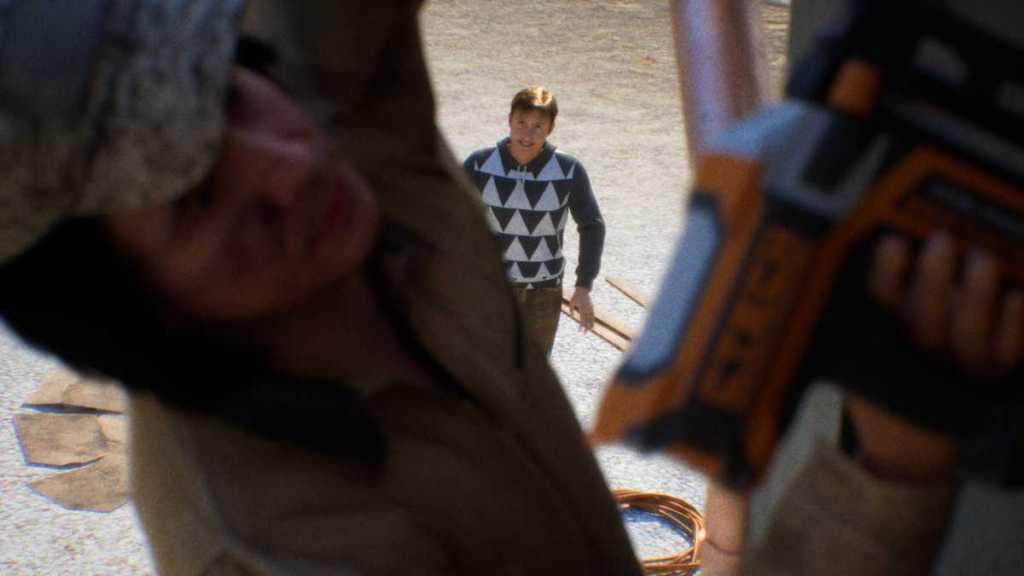
With The Misconceived, Wilkins removes any chance of sincerity in the image by utilizing the 3D computer graphics game engine Unreal Engine (yes, the irony is not lost on us) to create interiors and sculpt characters in a way that we haven’t seen since the cutscenes from Hidetaka Suehiro’s woefully underappreciated 2010 video game homage to Twin Peaks, Deadly Premonition. Also, a conversation around 80s films during a driving scene in Suehiro’s game came to mind when a main character in the first third of The Misconceived blathers on about the more budget-conscious low-tech work of Soderbergh and Sean Baker and the rise of independent-adjacent production houses like A24, creating a similar level of white noise, but we digress. Wilkins’s choice of an early 2010s faux visual aesthetic is a befitting skin for the overutilized plot of old college friends who reunite with the power dynamic disproportionally weighted onto one side of the relationship à la Sex, Lies, and Videotape.
We first meet the more unfortunate end of the friendship, Tyler (voiced by John Magary but motion captured and performed by co-writer Robin Schavoir), the same character of Tyler from The Plagiarists who has noticeably aged and has long since abandoned any cinematic aspirations due to the accidental fathering of a child and the subsequent daily difficulties of single parenting because of his son’s unstable mother. This perpetually beleaguered Tyler is now part of the contractor crew tasked with renovating the hopefully idyllic Upstate home of sculptor and art school buddy and former roommate Tobin (voiced and motion captured by Jesse Wakeman) and his web-designing, breadwinning Chinese-American wife, Gwen (the voice and body of Rachel Lin), who controls the worksite primarily through the phone, reminiscent of the way a CEO’s dehumanized voice would ominously command through a board meeting intercom in a 1960s office comedy.
Tobin is initially reasonably genial, ham-handedly offering to help Tyler out of his financial predicament while also trying to seem regular with the other men in Tyler’s small crew, composed of a grizzled boomer with compromised health named Widgey (voiced by J. Dixon Byrne) and a young Casey Affleck-Good Will Hunting-styled Middle-earth troll named Mikey (voice and body of Jess Barbagallo) who, like the townies in Gus Van Sant’s Oscar-winner, lives for incessant verbal linestepping that has, as its crescendo, a few mocking questions for Tobin regarding sex and his possible “yellow fever,” which Tobin does his best to deflect without causing a row. Co-writer Schavoir works in construction in real life, so the film has a sharp understanding of contractors and the omnipotence they possess in a culture where constant restoration and flipping are the norm. A contractor can pretty much get away with anything short of murder as long as the job is done well. What a better way to illustrate that than through the Middle-earth presentation of Mikey.
For the first two thirds of The Misconceived, Tobin does his tone-deaf best to seem in control of his world by letting things slide like the occasional Mikey transgression or workman mistake while also giving misinformed advice to Tyler in a banal attempt to reignite his passion for filmmaking. In moments of kidnapping Tyler’s after-work time, Tobin offers his college friend commentary about the trends within music and cinema by giving the standard dodge of “what is old is in” to feel some sense of relevancy, as Tobin knows that his modestly lauded sculptures will be a hard sell for the curator of the upcoming Whitney Biennial when she visits his studio. For the most part, Tyler plays along with Tobin’s self-rationalizations even though his phone constantly beckons him back to his parental duties because, in the end, he is only in Tobin’s home for one reason — a paycheck — but as the weeks turn into months and Gwen becomes increasingly unsatisfied with the work done and the security of the worksite, the rejection of the couple’s loan application becomes a timely out for Tobin to play the pseudo-heavy and replace the crew.
On paper, The Misconceived seems overtly dramatic, but the omnipresent, somewhat human-like, somewhat machine-like awkwardness of the motion capture work mixed with the game engine characterizations and the strategically placed nods to Wilkins’s previous films depicting the plight of the languishing creative amplify the delusions and compromises we make for ourselves while also recognizing the real urgency of survival practically and artistically. Like The Plagiarists and his 2017 feature Common Carrier, it’s all done with an absurdist humor, and there are plenty of unsettling moments to nervously giggle at Wilkins’s caricatures.
Rest assured, the term “caricature” here is not used as a criticism of Wilkins’s methodology. The characters in The Misconceived all have exaggerated qualities that play out clichés in independent filmmaking, online gaming culture, and liberal politics. We can recognize these characters and their discourses from a mile away, and that’s the point because by stripping them of individual idiosyncrasies, the kinds that once upon a time were the engine of character-driven cinema, Wilkins orchestrates a clever magic trick: the few scenes where characters do show honest self-reflection, such as Tobin remembering his experience of 9/11 with Tyler, Mikey sharing his screenwriting aspirations, and Gwen’s epilogue, ring out loudly like a sobering alarm that demands our attention to the many post-2000s events and undercurrents that have driven us towards misunderstanding and a regression to clichés in our perspectives and our self-curated online/offline images of ourselves.
By stripping The Misconceived of traditional narrative plotting and visual likeness to reality, Wilkins composes a work that manages to encompass the morass of complex, often conflicting issues we’re wrangling with in contemporary society and forces us as the viewer to repeatedly triangulate how those issues play out in our own daily roles in life. The Misconceived intentionally avoids feeling as the route to truth because, alas, that no longer works. Instead, it offers an analytical pathway where we attempt to find the signals of truth amidst a cacophony of insincere noise and pixels.
The Misconceived will have its Los Angeles premiere on July 9, 2026, at Dead Brain Studios with director James N. Kienitz Wilkins in attendance.
Lily and Generoso Fierro

