Originally published on INK19 ON July 6, 2026
directed by STILLZ
starring Brahian Acevedo, Juan Pablo Baena, and Samuel Andrés Celis
Film Movement
Given our current state of media consumption, where constant connectivity diminishes our ability to empathize with situations outside of our personal experiences, the gap between reality and its representation is widening. As a result, creating a comprehensive portrait of any group dealing with trauma is becoming increasingly difficult to achieve accurately and effectively. After any horrific incident, we are inevitably bombarded with a collection of cellphone videos interspliced with hastily conducted interviews with witnesses, ubiquitous surveillance footage, and the official statement, which all get force fed into a news piece cut to support any version of the story the editor wants out there, and whether you sit on the left or the right, somewhere in your conscience, you know that you are a million miles away from the pain, raising the frightening suspicion that some or perhaps all of what you are seeing may not even be real.
Though AI wasn’t common in 2014, the media spin overwhelmingly worsened the morale of residents in the already troubled district of Traiano in Naples after police accidentally shot and killed seventeen-year-old Davide Bifolco during a chase. At the time, the people of that community were certain that Davide was innocent, but in the five years between the killing and the culpable officer’s sentencing, there was a constant flow of news stories that tried to assign guilt to Davide, which promptly changed the filming methodology of Agostino Ferrente, who was working on a piece about the incident.
Ferrente decided that the best way to counter the distortion of the narrative presented by mainstream media was to hand the documenting responsibilities to Pietro and Alessandro, two lifelong best friends from Traiano who knew Davide and who were exactly Davide’s age when he died. Ferrente, along with Letizia Caudullo and Chiara Russo, then edited together the cellphone materials recorded by Pietro and Alessandro of their day-to-day lives in Traiano and then mixed in the same cold CCTV footage that we usually see when viewing criminal activity to create the 2019 feature Selfie, which, by proxy, provided us with some connection to Davide’s life that would never be afforded to people outside of his community otherwise.
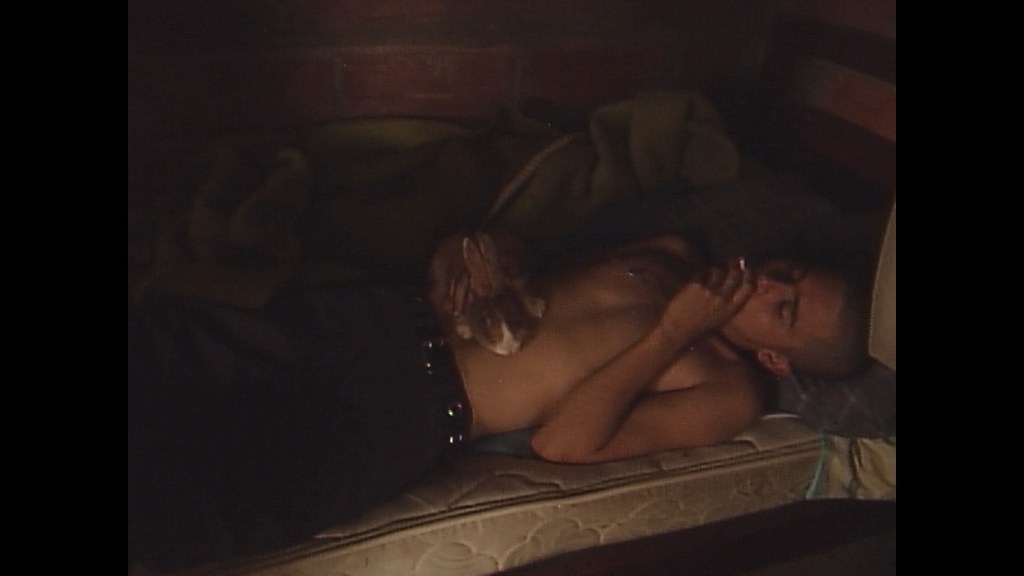
For his first feature, Barrio Triste, music video director Stillz, who has long been haunted by stories of the rash of kidnappings and disappearances of teens in his old neighborhood in Medellín, Colombia, decades earlier, begins his hybrid fiction in a similar fashion as Selfie by handing over the first-person perspective to some teens living in an unspecified barrio. Given the film’s late 1980s/early ’90s pre-cellphone setting congruent to the era of the disappearances, the group needs a video camera to record their activities, which they acquire in the form of a professional Betacam rig that they rob from a news crew visiting their district to do a story on the many reports of peculiar nocturnal lights and sounds.
Now, with an expensive camera in hand, the teens first plan out options to fence their ill-gotten gains but unconsciously decide instead to take it with them through their neighborhood, wandering through the dilapidated alleys and streets, into the abandoned spots where they crash, and even into the seats of the ultimate symbol of ’80s prosperity, a purloined Mercedes sedan, that the teens, disguised in ornate masks, use to carry out a brazen jewelry store smash and grab where a member of the group needlessly shoots a clerk who may or may not have pulled an alarm. Rattled, the gang still makes a clean getaway, but with the extra heat of being hunted for a potential murder, infighting breaks out between the friends who must now discard any evidence.
Though confused and worried by the events that have transpired which piggyback on the dire predicament of their environment and situation, the friends carry on and continue to wander through their neighborhood; something important has happened, but it doesn’t change their lives dramatically as far as we can tell. However, as a counterpoint to this stasis, Stillz introduces close-up interviews with the teens, providing a visually intimate framing device for Barrio Triste that allows us glimpses into their thoughts as they speak about the state of their beings, their desires, and what events led them to be who they are. Soon after presenting the fiery images from the destruction of the getaway car, Stillz distinguishes his film as he takes a dramatic turn away from the found footage/Blair Witch horror aesthetic that became the norm in the 1990s and redirects the teens’ fears towards a nebulous journey that transforms the reality of the era’s real-life shocking disappearances into a kaleidoscope of visuals and sounds that purposefully raises more questions than it answers.
That journey, which the teens take through the district’s evening landscape, fills the narrative of the final third of Barrio Triste in a way that resembles late 1960s British psychedelic horror, which brings us psychologically closer to the teens than any conventional documentary could offer. The already desperate landscape that we see in the daytime is now transformed into a pastiche of jarring moments derived from magical realism and the supernatural, all punctuated by the grandiose modern score composed by Venezuelan electronic musician and record producer Arca and the experimental sound design by veteran cinematic audio engineer Leslie Shatz. The score and sound produce a feeling of constant existential danger that supersedes the era of the film’s setting. Combined with the absence of major period identifiers and Stillz’s abundant visual storytelling abilities, these elements altogether transport the viewer away from any semblance of the Medellín from decades earlier, extract these teens from what has happened in the past, and form a space that exists outside of time as we know it in life and in cinema.
As we understand from the production notes, Stillz and his crew had to carefully negotiate with the residents, including local gangsters, in the area (Barrio Paraíso) that represents the title of the film, and that tenuous relationship comes through in the consistent unease throughout and in the naturalistic performances from the non-professional actors who portray the characters and who also live there. It all plays out as reality because, despite any scripting, what transpires on camera is always at the mercy of the unpredictable nature of the place and its people.
With Selfie, Ferrente took a dynamic step forward in honest representation by allowing his protagonists’ lives to play out before you on their own terms, giving an impression of what their friend’s life could’ve been if he had not been killed. This low-fi technique builds a rare level of compassion and connects you to a place, but in the seven years since the film, it has unfortunately been imitated many times without the earnestness and potency of Selfie, thus necessitating a new approach. The first-person raw perspective to real-life tragedy initially grounds Barrio Triste in the familiar but sets the stage for the disruptive final third to jolt our understanding as it challenges what we think we’re seeing and eliminates any belief that we can fully relate to what these teens are going through. Barrio Triste is the teens’ world. We’re invited to observe, but we’re also able to leave it, and Stillz deeply understands this privilege of the viewer. The film’s balance of found-footage spontaneity, anthropological long takes, enigmatic shots of figures of light and darkness, and candid interviews prevents us from conning ourselves into self-gratifying empathy for the plight of people suffering in distant lands. Instead, it leaves us with unresolved, ghostly images and sounds that linger in our senses well past the hours and days after the film has ended.
Barrio Triste opens July 10, 2026 in Los Angeles at the Landmark NuArt Theatre, in NYC at the IFC Center, and in Toronto at the TIFF Bell Lightbox.
Featured image courtesy of Film Movement.
Lily and Generoso Fierro

