Originally published on INK19 ON July 15, 2026
directed by Nicolás Pereda
starring Teresita Sánchez, Rosa Estela Juárez Vargas, Luisa Pardo, Lázaro G. Rodríguez, Francisco Barreiro, and José Rodríguez López
En Chinga Producciones
Since the 2010s, the surge of hybrid cinema has challenged our notions of reality and fiction, forming a fruitful intermediary space between the two seemingly opposing worlds. Some works, like Gürcan Keltek’s Meteors (Meteorlar), spliced news and documentary footage into a fictional construct. Others, such as Miguel Gomes’s magnum opus, The Arabian Nights (As Mil e uma Noites), took stories from real headlines and reenacted them within fictional tales. Throughout the years, this third space between nonfiction and fiction continues to give rise to the most fascinating works as our culture of self-documentation and self-surveillance pulls our identities closer to the images we capture and project of ourselves.
At some point, fiction becomes our daily modus operandi. We tell stories outward to convey who we are. We tell stories inward to explain our actions and motivations to ourselves. We infuse spontaneous elements from reality into our narratives. If we’re lucky, these threads manage to come into some configuration that resonates with truth, or at the very least some form of internal validity. At the worst, we fall into a psychosis where our real selves become trapped in a house of mirrors by our own design.
Many of director Nicolás Pereda’s films occupy this reflective space where his characters’ and actors’ realities are imbued with fiction and vice versa. Since his first film in 2007, Where Are Their Stories (¿Dónde están sus historias?), Pereda has collaborated with actors Teresita Sánchez and Lázaro G. Rodríguez, and over time, the group has expanded to include Rosa Estela Juárez Vargas, Luisa Pardo, and Francisco (Paco) Barreiro as regulars as well. The director’s characters typically have the same name as the actors playing them, and the actors have their own distinctive naturalistic presence that carries across the films they appear in, making it difficult to disentangle each actor’s way of being from Pereda’s writing and constructs for them. With such grounding from the same actors and their true essences, the director has room to bend notions of fiction and reality in intriguing ways where lies, myths, tales, and stories lead to revelations about the world surrounding his characters.
Some of Pereda’s films look at distortions of truth in the lives of working people struggling to make a living. After discovering a dead body on his way to work, Lázaro (Lázaro G. Rodríguez), a miner in Copper (Cobre), develops an unknown illness and needs an oxygen tank. As he and others begin to doubt his sickness, he must cope with his own unspoken desires and dissatisfaction rooted in the futility of his work, his home, and his place in a society that is completely indifferent to his existence. Some of the director’s other features examine the reality-tinged fantasies of artists. In Lázaro at Night (Lázaro de noche), Luisa (Luisa Pardo), Lázaro, and Paco (Francisco Barreiro) attempt to maintain the myth of a friendship formed as young writers early in their careers even though many years have passed, and now Luisa is married to Lázaro and is having a tryst with Paco. Both men are aware of the situation because Luisa tells them the truth, but neither wants reality to creep into their relationship with each other. As the three play act, their failures in life and their writing inevitably emerge and reveal their fading motivations to create as they approach their 40s.
For many of Pereda’s previous works, self-constructed fictions precipitate the arrival of an unpleasant reality. Everything Else Is Noise (Lo demás es ruido), his latest film, takes the director’s fascination with this slippery line to realization to a new place: a playground where you have the opportunity to toy with outsiders’ assumptions about you. If you understand yourself and your situation well, then you will know how you are perceived and what others expect of you. Here, empowerment comes from your ability to see through artifice and to control your own narrative while staying honest to yourself.
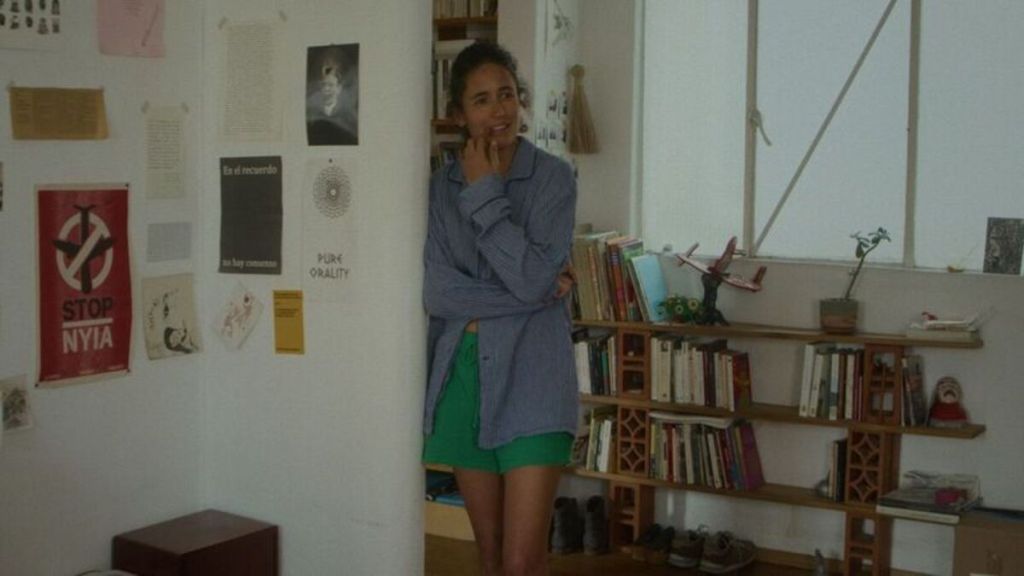
As Everything Else Is Noise opens, Pereda gives us a bird’s-eye view of a gridlock at a four-way intersection where drivers selectively follow the rules of traffic. Soon after, Rosa Esquivel (Rosa Estela Juárez Vargas), a rising composer and cellist, arrives at an apartment above the intersection owned by her friend and fellow cellist and composer, Tere (Teresita Sánchez). Rosa has asked to borrow the home for an interview for Canal 22, a public television station dedicated to Mexico’s arts and culture. She initially explains that she feels Tere’s apartment is more suited for filming, and we can sense this because of the warmth of the living and dining rooms abundant with plants and large windows along with various posters and pictures pinned and taped to the walls. Tere’s home completely lacks any self-awareness and looks like the space of an artist comfortable with her existence. As the two women speak, we learn that Rosa’s husband disapproves of any interviews, so she couldn’t film in her own home. And, surprisingly, we learn that Rosa and Tere, though friendly, may be more acquaintances than friends.
While waiting for the film crew, Tere practices interview questions with Rosa and begins with the standard set of artist origin questions. Rosa provides honest but uninteresting answers, so Tere encourages her colleague to tell fantastical stories instead and spins a yarn about how her keen sense of smell led her to a jar of imported, artisanal salt at a party and eventually inspired her to write her piece, “Like Salt in Salt.” Tere delivers the story with such a captivating feeling of introspection and earnestness that we and Rosa believe her until she smiles and admits that she made it all up.
When the interviewer, Lázaro, arrives with his cameraman, Paco, and asks Rosa to stage her day-in-the-life in Tere’s apartment and surrounding neighborhood, she refuses, and the reality of the space continuously prevents the interview from following its planned course. Power intermittently stops and starts. The traffic outside of the apartment filters in just enough that the car horns and ignition sounds become a part of the soundscape. A neighbor’s dog incessantly barks. Rosa answers Lázaro’s ostentatious questions, mostly designed to show off his own intelligence, with concise, blunt answers, and she redirects questions over to Tere, who explains that she studied with the famous Maestro Estévez and had her daughter, Luisa, with him.
Such a connection to the nationally renowned musician excites Lázaro, and he proceeds to include Tere in the interview as well. She humorously performs the role of the wise, eccentric woman artist with gusto and intentional unreliability, and when Luisa enters the scene, she shifts the entire ordeal towards music as she performs a staggeringly impressive experimental cello piece. Pereda turns the camera away from Luisa when she insists that everyone must experience the sound and not the image of her performance, and we, the audience, watch everyone in the room as they listen and react to the music with their eyes closed. At this moment, we can finally hear the substance of truth for Rosa, Tere, and Luisa, who are all cellists and composers and represent different generations. They know they operate in a world where their male counterparts receive more acclaim, and cultural commentators like Lázaro expect a certain femininity and artistic mystique from them, but in the safety of Tere’s apartment, the women dissolve the edifices projected onto them, each in their own way, and confirm that, more than anything, they are serious artists who care more about their work than their public personas.
With Everything Else Is Noise, Pereda perfectly intermixes all of his techniques and his abilities to manipulate fiction and reality from his nearly two decades-long career. No scene epitomizes this more than a shot of the three women commiserating in the apartment overlaid with the audio from the conversation between Lázaro and Paco as they walk to get coffee while waiting for power to turn back on. Paco describes the plot of his debut film, which shares the same exact premise as Pereda’s own Minotaur (Minotauro), and Lázaro talks about living with his mother, a key part of Lázaro at Night. All the while, Rosa, Tere, and Luisa chat and enjoy each other’s company away from the eyes of the interviewer. We don’t hear them, and we watch them at a distance, almost like an on-set observer viewing the off-camera moments of making Everything Else Is Noise itself. Reality folds into fiction so gracefully throughout many layers in Pereda’s latest that the resulting arrangement sounds brightly across the planes of reality inside and outside of the film with a freedom where we manage internal and external fictions on our own terms and reconcile them with truth with a newfound sense of levity, one that we can hope to carry into our real lives.
Featured image courtesy of Moveria Film.
Lily and Generoso Fierro
 LILY & GENEROSO 4EVER!