Originally published on INK19 ON August 29, 2026
directed by Sompot Chidgasornpongse
starring Amara Ramnarong, Surachai Ningsanond, and Sompop Songkampol
Kick the Machine Films
Perhaps owing to divine intervention or, more likely, his responsibilities serving as first assistant director on Apichatpong Weerasethakul’s 2022 film Memoria, nine years ironically sit between Sompot Chidgasornpongse’s funny and piercing new feature, 9 Temples to Heaven, and his debut documentary feature, Railway Sleepers.
Shot on video over eight years from 2008 to 2016 on multiple lines of Thailand’s national train system, Railway Sleepers is an experimentally constructed cinematic voyage from northern to southern Thailand over what is presented as a few days but exists as a slow unfolding of a country’s collective attitudes over time. Offering little overnarration, the film languidly follows the seemingly mundane activities of passengers on the system. Students do homework. Soldiers walk down the aisle on patrol. Contemplative monks ride in silence. Merchants move from car to car peddling everything from a wild plethora of homemade foods, toys, and even horoscope books based on the year of a customer’s birth.
Presented in a similarly reflective manner as Weerasethakul’s Syndromes and a Century, for which Chidgasornpongse also served as assistant director, Railway Sleepers lures you into your role as a calm observer while emphasizing the train’s function in uniting strangers in a shared space where multiple generations gracefully collide. In the first two-thirds of the film, we witness crowded cars and hear the mechanical sounds of the engine blended into the personal conversations and music performed by travellers, which, in its final third, gives way to more upscale sleeper compartments where, subsequently, conversations are virtually non-existent. A violin is brandished, but only to be polished, rosined, and stored. Chidgasornpongse’s piece never exoticizes the people or the landscape, nor does it aspire to move the viewer’s focus from place to place like a travelogue; it passively yet decisively takes us from the regal 19th-century origins of a system designed to move Siam/Thailand into the modern era to a rapidly shifting contemporary Thailand.
For his first fiction film, 9 Temples to Heaven, Chidgasornpongse continues the metaphoric and critical journey through Thailand today and dramatically shifts the tone into the comedic and, at times, absurd, with his second feature as we watch the more intimate story of a family engaged in a haphazardly executed and preposterous spiritual quest.
After hearing a strange but concise negative prophecy from his boss about his mother Saluay (Amara Ramnarong) that will occur close to her birthday, middle-aged businessman Sakol (Surachai Ningsanond) rents a van and sets a plan in motion for a merit-making trip to the titular temples to, at best, bolster Saluay’s failing health or, at worst, guarantee her a peaceful experience in the hereafter. With the clock ticking as the anniversary of Saluay’s birth rapidly approaching in only two weeks, Sakol, along with his wife Anchalee (Klaichan Phunman), daughter Prae (Nichmon Shintadapong), son Tor (Sompop Songkampol) and Tor’s girlfriend Yam (Yada Karnjanisakorn), his sister Wimol (Yaneenan Jiraphatjittrin), his brother Pongpol (Jirawut Chiwaruck), and nephew Koon (Sirapob Sanhabhakdi) agree to take part in the hastily thrown-together temple pilgrimage which they hope to accomplish in a single day. Three generations, nine people in total, who are packed into two vehicles loaded with gift boxes full of appropriately selected alms for the monks, are now as ready as they will ever be to gain merit for Grandma Saluay as they set out from the seaside city of Samut Prakan.
As with Railway Sleepers, it is evident from the earliest scenes of 9 Temples to Heaven that this journey will serve as another multilayered comment by Chidgasornpongse on his present-day homeland. The focus here is on a nation which had been under the governance of a military junta from 2014 to 2019, resulting in religion falling into a grey area where its rituals have become more about solidifying traditions than cultivating faith as the country seeks to re-establish its national identity. Throughout the film, members of Sakol’s family, as they proceed from one temple to another, individually challenge the necessity of the ascribed pilgrimage, and in turn, each comes to represent the fractioning occurring in contemporary Thailand.
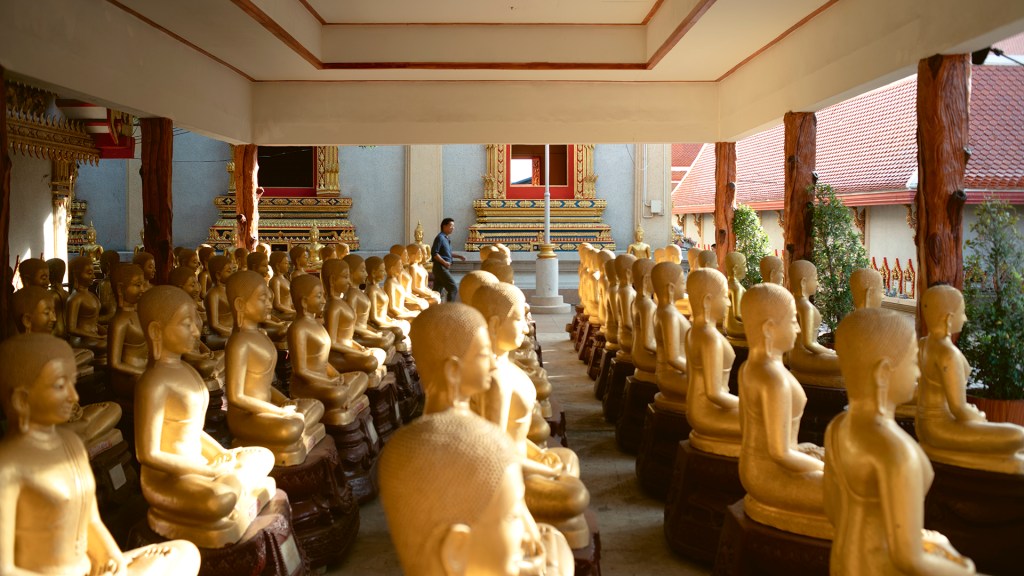
Providing ammunition to the strained space that Buddhism now occupies in the country, each interaction the family has with the monks from whom they seek guidance and blessings varies greatly, ranging from the banal—where the meditations offered by part-time clergy and respected elders provide little comfort to Grandma—to the borderline insipid when alms donated for merit are unpackaged, dissected for their specific use, and shelved in warehouse spaces that, on the surface, could easily be mistaken for stock footage of the backroom of a big box store, minus the glowing robes and perfectly shaved heads of the workers performing the tasks. As surreal as these pilgrimage stops may sound, the temple facades and interiors on their own start to fluctuate between the garish, the austere, and the bizarre middle ground where traditional iconography meets modern convenience, as exemplified by one scene in particular. One of the temples has a nine-floor tower as its latest attraction, and a monk emphatically encourages the family to visit it. The group apologetically explains that Grandma cannot physically ascend all of the stairs, but of course, the temple leaders foresaw this as a concern for elderly worshippers and installed an elevator, which the monk recommends may get Grandma to heaven “quicker.”
Regardless of the above disappointments towards achieving better karma, Sakol is firm in his resolve to complete the trip, which seems to be motivated more by his personal and physical issues rather than the health and spiritual well-being of his mother, a fact that becomes clear to his family the longer they travel. But with each visit, Grandma, who is nestled in her seat and mummified in jackets by the van’s side window, sleeps intermittently and opts to pretend to be tired whenever someone asks her to take a more active role in the visits. When she finally can’t/won’t venture into another temple, monks are persuaded to come to the van to offer their blessings, making the core ethos of the trip even more ludicrous, which is not lost on the family whose squabbling grows louder and more frequent as they question everything from the state of their future to Tor going as far as questioning the worshipping of Buddha, as his lot as a prince had him in a better place than they will ever have in their current reality. Only a delicate scene between Tor, Koon, and Grandma and a shared song-like prayer in the final third of the film suggests that faith still exists without place, hierarchy, and pageantry.
Ultimately, the train in Railway Sleepers symbolized Thailand’s hopeful journey toward progress with its promise of connecting people, closing distances, and ushering the nation into the future and the deviation from such aspirations. With 9 Temples to Heaven, the symbol of the temple as a gateway to spiritual ascendence is poignantly contrasted with the contemporary reliance on Buddhist rituals subverted to shallowly anchor people during personal and societal upheaval. Following the coup and the erosion of confidence in royalty, these sacred spaces now serve as familiar ground, offering a semblance of normalcy and a promise of the ability to gain something better in an uncertain future. What once was a refuge for prayer and deep spiritual connection beyond the earthly plane has become an institution for seeking personal assurances, intertwining the temple’s traditional role with capitalism and banking on the hunger to find meaning and comfort amidst turmoil.
9 Temples to Heaven will screen at the 64th annual New York Film Festival on October 7th and 8th with director Sompot Chidgasornpongse and producer Kissada Kamyoung in attendance.
Featured image courtesy of Playtime.
Lily and Generoso Fierro

