Originally published on INK19 ON SEPTEMBER 26, 2026
directed by Ana Vaz
starring Yukari Morimoto, Kota Takeuchi, K.A., Ayami Awazuhara, and Yoko Hayasuke
Onzer Films
Beginning with her impressive first experimental short in 2008, Sacris Pulso, director Ana Vaz has, through the use of avant sound, collage, and assembled motion, devised an oeuvre that works to blend memory and art to reshape our perception of ethnographic filmmaking away from documentary and towards multi-modal poetry.
An interpretation of Clarice Lispector’s lyrical prose piece from 1974, Brasília, which elucidates on the construction of the capital city and the disruption of the natural order, Sacris Pulso intersplices footage from Sérgio Basi and Zuleika Porto’s Brasiliários, where her parents met on the set, Paul Ritchard’s Flat Walking, and Hannah Brooks and Jack Farley’s exhibit, Human/Animal/Artist, along with a performance from her own mother, Cláudia Pereira, and music from her composer father, Guilherme Vaz, into a document that creates a personal reflection on her own origins while unveiling her hometown and its conflict with itself.
Similar themes of urbanization, memory, and the physical and emotional impact of governmental agendas continued into Vaz’s next film, Entre Temps, which she created while studying at Le Fresnoy in 2012. Originally conceived as a documentary of the France’s Priority Urbanization Zone (ZUPs), an urban planning procedure enacted between 1958 and 1967 to address the then immediate housing problem in the country, Entre Temps fluidly observes the structures of the buildings, their significance as a promised future when they were created, and the desperate realities of contemporary Europe.
Subsequently, Vaz’s 2014 film Occidente (West) sculpts together Google Maps images, 16mm footage, and HD video to address the infringement on nature through colonialism in present-day Lisbon, and her 2018 short, Look Closely at the Mountains (Olhe Bem As Montanhas), artfully juxtaposes the environmental destruction caused by years of mining in the state of Minas Gerais under the dictatorship that controlled Brazil from the mid-60s to the mid-80s against landscapes and natural elements in Nord-Pas-de-Calais in northern France, which has also been permanently transformed by hundreds of years of mining. Vaz’s powerful follow-up short, 2020’s Apiyemiyekî?, further investigates the Brazilian dictatorship’s haphazard mining agenda that also tragically led to the genocide of the Waimiri-Atroari people.
For her first feature-length offering, 2022’s It Is Night in America (É Noite na América), Vaz thrusts us back to her hometown of Brasília, first through a disorienting and jarring soundscape that commands your full attention, which eventually gives way to scenes of various animals, some in the wild, others in zoos, overlaid with the real-life voices of concerned zookeepers, veterinarians, and environmental police tasked with the growing crisis of a plethora of species of wild animals who have been reintroducing themselves into the urban landscape which they once called home, reasserting the director’s commitment to examining upheaval caused by systematic attempts at human progress with imagistic and sonic assemblage.
For her newest feature, Hanabi (Fire Flower), Vaz, as she had done with Sacris Pulso, adapts the written word, drawing inspiration and text from Yoko Hayasuke’s Journal of a Radioactive Brain, which originally appeared as part of the 2018 essay anthology Fukushima et ces Invisibles (Fukushima and Its Invisible Ones) and features the writings from six Japanese activists reflecting on the seen and unseen in the aftermath of the Fukushima-Daiichi Nuclear Power Station accident, the second-worst nuclear catastrophe behind Chernobyl. When waves from the tsunami emanating from the March 11th, 2011, Tōhoku magnitude 9.0 earthquake damaged the backup generators at the facility, the loss of power caused the cooling systems, which were handling the residual heat within each reactor’s core, to cut out, eventually leading to a meltdown, a buildup of hydrogen gas, and then explosions. Ensuing threats of radiation resulted in government officials declaring a 10-mile no-fly zone at the plant site and an evacuation of a 232-square-mile area.
Vaz started filming what would become Hanabi two years prior to encountering Yoko Hayasuke’s essay. The Fukushima-Daiichi accident, with its dual effects on humans and the environment and consequent public narrative manipulated by governmental response, aligned with the examinations and curiosities of the director’s previous work. And, once the director met the author, Hayasuke’s essay emerged as the basic map for the ideas and conceptual spaces of the film as well as the rhythmic backbone for interplays and clashes between Hayasuke’s words and the testimonies from a variety of people impacted by the catastrophe. Vaz’s resultant film is a provocative tonal experiment that, like her earlier work, focuses more on putting you in the many shoes of those impacted as they attempt to move on from the tragedy by striking a balance between the typical worries about radiation and a degree of denial imposed on them by the Japanese government, which has seen any kind of dissent against its assurances of safety post-disaster management efforts as anti-nationalistic rhetoric.
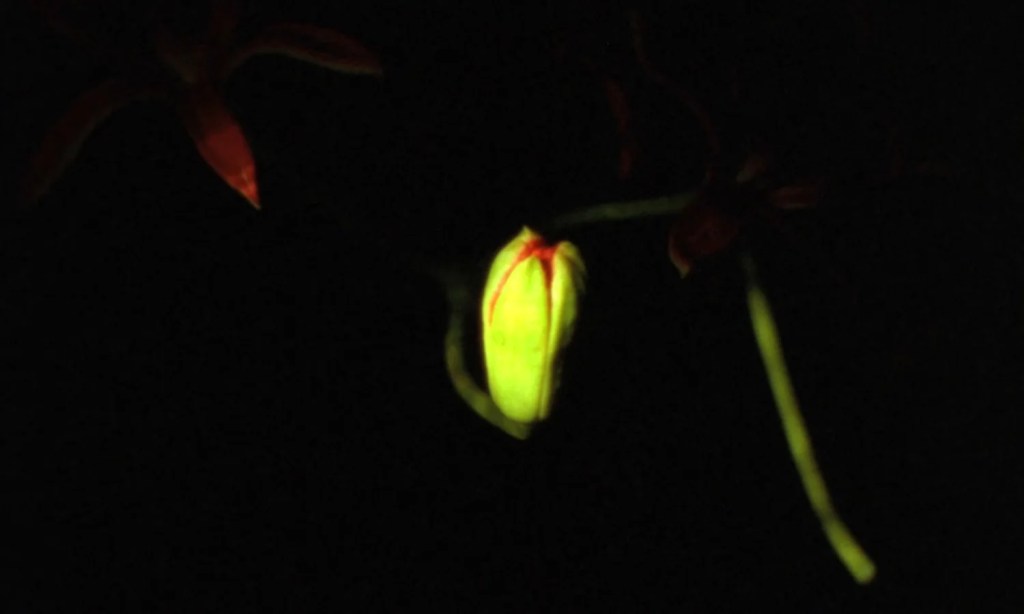
In the film’s earliest moments, the vision of an irradiating light aimed at the camera that subs in for the sun and a hybrid score from Nuno da Luz that mixes improvisational compositions with field recordings of low frequencies establish the unsettling mood as the scene shifts dramatically from Tokyo and nearby islands to Brazil and then back to Tokyo. Vaz’s disaffected voice reads passages translated into English from Hayasuke’s piece, which the author herself has asked not to be recited in Japanese, as she has lost faith in the language, that highlight the myriad of anxieties related to something that was commonplace pre-disaster, such as the act of drinking banana juice in a cafe. Where did the bananas come from? If they are fresh, they must be local or perhaps flown in from China or Canada? What about the honey they’re adding, which is highly vulnerable to radioactive contamination, or the milk, which must surely be local and therefore a problem? Hayasuke, at odds with the doctors who deem her concerns to be unnecessary, still makes the choice to turn to the safety of tea. Later in the film, Vaz will hearken back to these worries about radiation and the paralysis to do anything to address them in daily city life by showing us flipped perspectives: citizens who operate their own food testing laboratory, the beekeepers and female farmers who independently collect and send off samples to check radiation levels when the government refuses to share any data with the public, and the secretly captured footage of men and women clad in hazmat gear charged with the decontamination initiatives in Fukushima soon after the disaster.
In contrast to these active efforts to face radiation concerns head-on, we additionally witness others continuing their daily lives with a quiet acceptance of radiation as the norm. A woman tends to the flowers of her garden outside of her house despite the fact that it has been deemed uninhabitable due to contamination. Farmers feed their animals while we listen to one’s disembodied voice casually discussing the official decrees to slaughter thousands of livestock in fear of radiation poisoning, the failure of the government to follow through on said orders, and the farmer’s indifference towards the government’s empty words. And surrounding these images and personal stories, we view an abundance of plants and animals: some noticeably harmed by contamination and others managing to persist.
The locations jump from place to place without notice, from short takes to long, with the viewer never knowing if they are in an affected area or not, inducing a sense of confusion and creating empathy for the lack of any guidance on how to move forward past the incident for everyone involved. A moment of reflection in the form of an elongated shot of a sunset allows for a pause to separate the first and second halves. Vaz takes us through post-nuclear accident life with its multi-layered attitudes for physical and emotional survival, but all of it hinges on a precarious and ambitious balancing act between documenting a foreign culture and crafting visual poetry to harmoniously bring together a multitude of viewpoints and realities. And unlike in any of her previous films, here, the director includes a clear delineation between herself, the filmmaker, Yoko Hayasuke, the author, and the complex subject matter at hand.
From the e-mails onscreen between Vaz and Hayasuke throughout, we see a constant reframing of thought and a shift in perspective that goes beyond the adaptation of Hayasuke’s essay, culminating in the film’s final third, when a haunting message from Hayasuke details the concept of “tendenko,” the accepted practice of running away from an approaching tsunami without concerns for loved ones who may be left behind. “Tendenko” in Japanese means “everyone is scattered,” a community-ingrained concept that Hayasuke knows is cruel in a sense, yet it still provides her comfort as recent movements towards nationalism have called on a need for unity, which tendenko proves does not exist. Hayasuke then goes further in her message to question the explorations of “healing” in Vaz’s previous films, a word that she has grown tired of as it has been bandied about thoughtlessly but also one that she recognizes could have new meaning during and after this period.
Allowing us to witness these messages from Hayasuke is perhaps Vaz’s way of commenting on the necessary objective distance that an ethnographic filmmaker must acknowledge in their work. Or perhaps it’s an honest assessment of the chasm between filmmaker and subject that can’t be overcome. Vaz can observe, but invariably, she is not in her own land as she was when making Sacris Pulso about her family in her native Brazil, so it would be presumptuous of her to define any overarching thesis and conform the inherent multiplicity of responses to the Fukushima-Daiichi explosion to it. Her poetic approach throughout Hanabi thus captures tendenko more than she may have even intended because despite all efforts of documentation, examination, and analysis, much remains unknown and unseen for all, the outsider filmmaker and everyone who contributed their perspectives. The images of fireworks exploding in reverse follow Hayasuke’s e-mail and bring the beauty of the image back to an invisible instant, an originating point of darkness, and with it, Hanabi becomes a bold admission by Vaz of the limitations of her own cinematic methods and an open invitation to accept that fragmented understanding is the only certainty we have when looking at human effects on our environment and how we cope with them.
Hanabi will screen at the 64th Annual New York Film Festival on October 8th and 9th, with director Ana Vaz in attendance.
Featured image courtesy of Onzer Films.
Lily and Generoso Fierro

