Originally published on INK19 ON October 5, 2026
directed by Julia Loktev
starring Anna Nemzer, Valeria Ratnikova, Ksenia Mironova, Elena Kostyucheko, Yana Kuchina, Irina Dolinina, Alesya Marokhovskaya, Peter Ruzavin, Nataliya Gumenyuk, and Sonya Groysman
When one thinks about the current state of Vladimir Putin’s Russia, which has been waging war with Ukraine since February of 2024 and had whittled down independent news in the years leading up to the invasion, it’s astonishing that TV Rain, Russia’s last counterculture voice of dissent, was ever able to broadcast from its Moscow studios. During the immediate months prior to the conflict, as the rumors of war transformed into Russian troops beginning to amass at the border with Ukraine, Putin’s government unabashedly ramped up its campaign to suppress any media opposition to the war by labeling journalists as “foreign agents,” which inspired director Julia Loktev to travel to Moscow, where over the next four months she closely filmed the day-to-day lives of a small group of reporters inside and outside of the TV Rain studios.
During a four-month period from the fall of 2021 until February of 2022, when Russian troops crossed the border into Ukraine and ignited a bloody conflict that continues to this day, Loktev, who existed as a film crew of one with only a cellphone and a few lav mics as gear, chronicled the steadily increasing oppression experienced by these journalists, who, despite the knowledge of previous atrocities perpetrated by their government in Crimea and the rumors of potential aggression against Ukraine, were still waylaid when the invasion began. This left our dedicated band of reporters with little choice but to frantically scramble for destinations and flights out of Russia, as they all faced the possibility of arrest and the eradication of their ability to tell the truth about the atrocities to come. That last frenetic and terrifying night concludes Loktev’s urgent and harrowing six-hour documentary, My Undesirable Friends: Part I — Last Air in Moscow.
Premiering at the New York Film Festival in October of 2024, My Undesirable Friends: Part I — Last Air in Moscow was released internationally the following January at the Berlin Film Festival, and we thankfully had the opportunity to view it shortly thereafter. A top ten film for us in 2025, Loktev’s film triumphs by emotionally bringing us into contact with this diverse group of mostly young, mostly female protagonists while giving us a step-by-step, seldom-seen look at how governmental censorship of the press could lead to the complete suppression of the truth under a brutal dictatorship. We left that film with the knowledge of what the war will become and with a desire to follow these brave women and men as they scatter to different cities around the world. We worry for their safety; we understand their guilt as citizens of the country that started this war, and we know through their conversations with each other in the film that they will never, despite the risks, give up their commitment to exposing the reality behind the propaganda distributed by their government.
Beginning with a short recap of Part I, Loktev’s My Undesirable Friends: Part II — Exile takes off shortly after where the last installment ended, in a state of chaos. The invasion has just begun, and our journalists have grabbed whatever personal belongings they could thrust into a couple of carry-on bags and have rapidly exited Russia for any city where they can enter without visas, with most going to Tbilisi and Istanbul. They understandably first appear disoriented by their immediate need to flee, saddened by their personal predicaments and the safety of loved ones back home, and angered by the actions of their government. They still need to find some shelter, but that proves challenging as their bank cards fail in a foreign land and many apartments require local bank accounts that they don’t have in order to pay rent. All of these factors swirl together as Russia increasingly perceives the journalists’ continued honest reporting on its unprovoked military aggression as illegal.
After the earliest moments of the first of five segments of Exile, Loktev and her editor, Michael Taylor, establish a different emotional cadence than the one felt throughout Part I. Though certainly a documentary, Part I was consistently imbued through circumstance and editing with the urgency of a fictional political thriller where you can feel and almost see the proverbial clock ticking down towards the moment of catastrophe in every frame. In Part II, the bell has rung, and though the threats to safety and the logistical compromises involved with being able to create some foreign version of TV Rain abroad still loom above the heads of all involved, the overall mood has shifted from impending destruction to the daily frustrations of putting as much of your life back together again, coupled with the overarching goal of persisting credible reporting from afar.
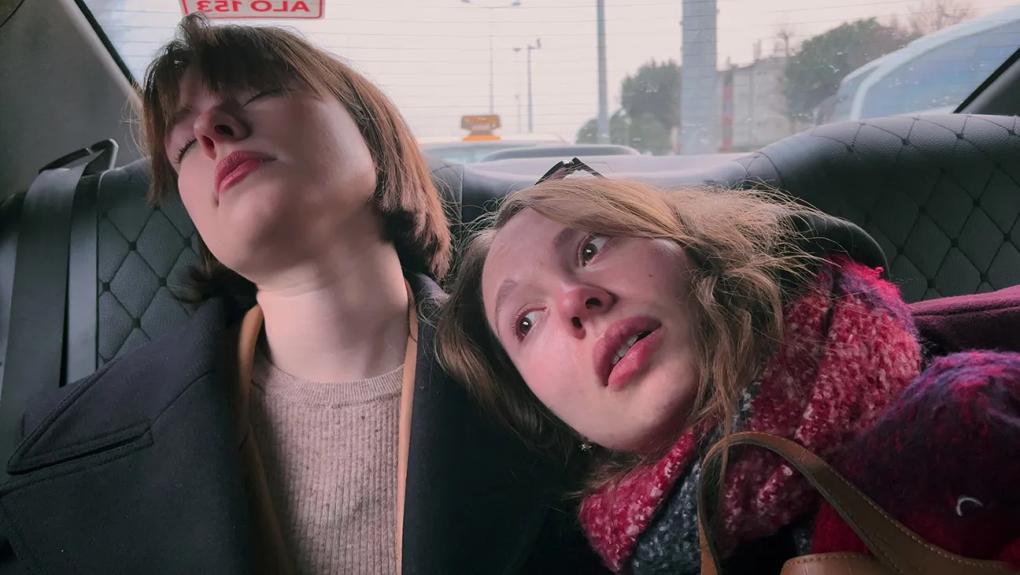
A notable factor contributing to the tonal shift in Exile, beyond the journalists’ resignation regarding their personal circumstances, is their growing familiarity with Loktev’s constant presence in their lives. Credit is due to Loktev, who filmed Exile over a span of four years, significantly longer than the four months dedicated to Last Air in Moscow. During this extended period, she invested considerable time capturing the reporters in various locations, including Tbilisi, Istanbul, Riga, Tel Aviv, Vienna, Amsterdam, and New York City. As Exile unfolds, the connection between the reporters and Loktev increases palpably, establishing a dynamic that was far less pronounced in Part I and exemplified by the many times in which our protagonists directly call Julia by name as they speak to the camera. This change can largely be attributed to the turmoil experienced during the four months leading up to the war, coupled with the heightened paranoia regarding actions taken by Putin, as well as the novelty of Loktev’s involvement in their lives in Part I evolving into a sense of trust as the director stays as committed to our journalists as they are to their work despite their geographic dispersal.
The observation of deeper emotional engagement among the reporters in Exile, including candid moments of interaction and confession with the director, significantly enhances our empathy for all parties involved. Even in some of the film’s most emotionally complex scenes, a greater understanding emerges. One particularly poignant statement in the first half of the film comes from a journalist who is grappling with the dual challenge of facing persecution from her government due to her criticisms, while simultaneously being perceived abroad as merely a Russian aggressor aligned with Putin. She quotes a friend who succinctly articulates her dilemma with the line, “It’s like 1941, and you’re simultaneously the German and the Jew.” This sentiment, enriched by the open discourse we have engaged in throughout the film, resonates profoundly, as does the frank dialog that emerges between journalist Anna Nemzer and her husband Andrey when they argue in low voices over their permanent political refugee status and how that will impact their young daughter, who must also move from country to country as they search for asylum. If you’ve come into the film after Part I with the erroneous assumption that Anna’s or any of the reporters’ loved ones are also completely onboard with the hazards of their allegiance to delivering real news, you are gobsmacked out of that belief as you hear them relay misunderstood reactions from parents, grandmothers, and various extended family members.
As we acclimate ourselves to these intimate and unexpected moments of inclusion, they ultimately set us up for the most agonizing part of watching Exile: the known future. We feel this dread the most when a number of our reporters in 2022 predict that the war would only last a few months, possibly to allay the fears of those around them. But, we, the audience, have the heartbreaking knowledge that by 2026, the conflict has only gotten worse and has no end in sight. Equally painful is a segment that feels like it was taken from an Armando Iannucci script, but without any humor. When TV Rain finally reassembles and finds a new home in Latvia, for a brief period, things appear to be back on track. However, Latvian officials misinterpret a possessive determiner used by reporters during a few live broadcasts. This simple misunderstanding triggers a series of unfortunate decisions by TV Rain’s staff. Soon after, the government revokes the station’s broadcasting license, and the station’s owner unexpectedly posts a video that puts TV Rain’s future at further risk. It’s a crushing blow, but our group pushes forward to live their lives wherever they can find refuge and provide an opposition to Putin however they can.
There is a fragile balance achieved throughout My Undesirable Friends: Part II – Exile between the optimism of the protagonists and the harsh realities revealed by documented history. The film addresses tragedies we are all too familiar with, such as the 2022 occupation of Bucha and the widely reported massacre there. However, these events are discussed on camera without graphic depictions. This choice by Loktev and Taylor is strategic, as any visceral image could overwhelm the audience and undermine the expressed hope of the journalists for a quicker end to the conflict and for their ability to someday return to Russia without fear of arrest or death, both being the case for many of their colleagues and heroes, such as the famed opposition leader and activist Alexei Navalny.
Thus, My Undesirable Friends Part I and Part II are not mere documentaries detailing the invasion of Ukraine. Instead, they offer in-depth explorations of the unwavering danger faced by these journalists in their dedication to accurately portray Putin’s Russia and the futility of the war. For more than four years, Loktev has followed these individuals and presented us with whole portraits of beleaguered professionals who somehow manage to dream for a positive outcome; we never for a moment believe that they have forgotten what they’ve seen and heard or the situation that they’re in, and we wholeheartedly admire their belief that their reporting could change the results someday in their homeland, even if they may never get to experience it themselves.
My Undesirable Friends: Part II — Exile opens on October 9th at the Film Forum in NYC with screenings that feature appearances from Julia Loktev and subjects, Irina Dolinina, Ksenia Mironova, and Valeria Ratnikova. The film subsequently opens in Los Angeles at the Laemmle Royal on October 16th.
Featured photo courtesy of Acme PR.
My Undesirable Friends: Part II — Exile
Lily and Generoso Fierro

