Crystal Dumplings With Pork and Shrimp in Banana Leaves: Banh Bot Loc

Standard

I’ve been thinking about the treats I remembered eating when I was a kid, and I recalled family functions with trays of banh bot loc wrapped in banana leaves. These chewy, sweet, and savory tapioca flour based dumplings are fragrant and delicious for lunch or even breakfast.

While the filling traditionally contains pork belly and shell on shrimp, I prefer to use minced pork loin and shrimp. Served with Nuoc Mam, banh bot loc is a lot of fun for your next party or for a dinner with friends. Its transparent dough wrapped in the bright green banana leaf makes for a very pretty presentation, and its bouncy texture combined with the rich flavors of the filling make for a layered and satisfying bite.

Enjoy! Music provided by Liszt’s Piano Sonata in B minor, S. 178.

Alfredo Castelli and Lucio Filippucci’s Elaborate Steampunk Parody: True Memoirs of Docteur Mystere

Standard

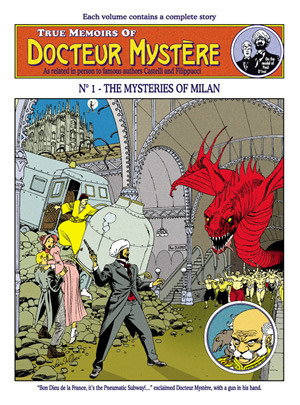
A few weeks ago, while perusing through the used comics section at Amoeba Records, I picked up Alfredo Castelli and Lucio Filippucci’s True Memoirs of Docteur Mystere, No. 1: The Mysteries of Milan on a complete whim. With its science fiction, steampunk style, on a quick flip through the pages, the True Memoirs of Docteur Mystere appeared like something outside of my normal taste, but something about it intrigued me, and despite my usual genre and style preferences, I decided to give it a closer look.

This sense of undefinable instinctive allure I felt while deciding on purchasing this comic book continued as I delved into the early pages of The Mysteries of Milan.

A dragon, mob of Chinese warriors, cathedral, damsel in distress, and silver train, all on the cover of The Mysteries of Milan

Docteur Mystere may be the most interesting and capable man in the world. He has a stupendous wealth of knowledge and skills gained from his extensive travels and interactions with every martial arts, monastic, criminal, and dark arts group in the world. Docteur Mystere almost possesses too many skills and knows almost too many people. He excessively fits his character as a Jules Verne-esque, savvy, and worldly hero.

Similarly, all of the other characters in The Mysteries of Milan fit their archetypes to excess. Lady B***, the truest damsel in distress and the woman who calls on Docteur Mystere to help find her husband who disappeared after completing his top secret pneumatic subway, cries out, “Virgin Mother,”and faints anytime she sees anything shocking. Chin, Docteur Mystere’s long-time friend and his accomplice and aid for the mission to find Lady B***’s husband, looks and speaks like he stepped out of a hybrid production between Flower Drum Song and a C grade knock-off of Enter the Dragon that you would see on cable in the wee hours of a Tuesday morning. Lastly, Cigale plays the all too ignorant and naive sidekick/assistant to Docteur Mystere, constantly making you ask, “Why in the world would such a great man as Mystere have such a nimrod for a sidekick?”

This question of Cigale’s existence exposes the intention of Castelli and Filippucci’s Docteur Mystere series, since the ridiculousness of his behavior and Mystere’s patronizing remarks to him hearken back to many comedic sidekicks we’ve seen before, especially Igor from Young Frankenstein and Cato from The Pink Panther. After Mystere’s third insult to Cigale, Lady B**’s fourth faint, and Chin’s fifth line in broken Chin-glish, you realize the True Memoirs of Docteur Mystere parodies the science fiction set in Victorian times fueling the steampunk movement. And when that elucidating moment of realization arrives, The Mysteries of Milan transforms into a rollicking, hilarious, and over-the-top adventure.

Beyond jests at the the science fiction of Jules Verne and H.G. Wells, The Mysteries of Milan also takes a stab at conspiracy theory fiction, particularly the works of Dan Brown. Released in 2004 at the height of the world’s obsession with Dan Brown’s novels about conspiracy in the Catholic Church, The Mysteries of Milan pokes fun at conspiracies churning in the catacombs of Italy and unveiled by what seems like an unrelated, isolated event. The entirety of this first issue of the True Memoirs of Docteur Mystere focuses on the search for Lady B***’s husband, but in the process, the search takes a step back from the foreground to give more importance to a mission to save the world from the sorcerer Fu Manchu. Lady B***’s husband may have accidentally gotten mixed up with Fu and his minions attempting world domination, so in order to find him, Mystere and Chin will need to figure out how to first defeat Fu, the ethnic caricature of Asians seen in literature in the early to mid 1900s.

Indicative of the sense of humor of Castelli and Filippucci, Chin and Fu have a history together, and Chin has been carrying around his own pinky fingers laced with magic powers for the day that he and Fu cross paths again. Fu cut off Chin’s pinky fingers, and Chin wants these severed digits to be his humiliating weapon of choice to destroy Fu. Consequently, the climax of The Mysteries of Milan contains outrageously funny illustrations of pinky fingers flying from an ornamented box toward Fu Manchu’s eyes. This battle scene, more than any other in the book, conveys the humor in the utter abandon of any sense of reality and the exaggeration of character and plot archetypes in True Memoirs of Docteur Mystere.  

Without revealing too much of the end, all of the hullaballoo to find Lady B***’s husband occurs in complete futility, completing the entire parody of science and conspiracy fiction that had transpired with a single punchline. The Mysteries of Milan ends without inspiring any sense of catharsis for the reader or any satisfaction of the answer to the primary mystery; it simply ends by provoking one giant, hearty laugh.

Clever and awakening in its humor, True Memoirs of Docteur Mystere: The Mysteries of Milan, points out the silliness of fiction set in complete fantasy where the characters are not represented as fellow humans. Admittedly, I loved Matt Fraction’s Five Fists of Science, the work I would consider to most resemble the type of story Castelli and Filippucci scorn with the True Memoirs of Docteur Mystere, but I do understand that there’s an absurdly ridiculous amount of suspension of disbelief required to read a steampunk type work like Five Fists of Science. In sum, Castelli and Filippucci mock the fiction that utilizes characters less as empathetic humans and more as devices to fuel an extravagant plot and to establish and perpetuate a mood and setting, which could apply to multiple genres, but unfortunately, science fiction of the steampunk variety is the major culprit of this style and, in turn, makes itself most susceptible to their parody.

Sadly, the wittiness of Castelli and Filippucci and their True Memoirs of Docteur Mystere only lasted for two issues. It must have turned off science fiction fans, and fans of more realistic fiction must have completely bypassed it. I still do not entirely know what lured me in based on just the cover and a few cursory page flips, but I’m so glad my instinct picked up on the gem hiding inside the overwhelmingly busy, action-packed, and insane cover.

The Timeless Humor and Wit of George Herriman’s Krazy and Ignatz

Standard

Last Sunday, Generoso and I visited the Los Angeles Comic Book and Science Fiction Convention on a bit of whim. The first comic book convention for us, we did not know what exactly to expect, but we nevertheless entered the room of The Reef exhibition space like bright eyed toddlers when we caught sight of tables of vintage comics, stands of toys, and wire racks and bins of hard to find DVDs.

While most of the convention was dedicated to comics of the DC and Marvel universe, one exhibition table stood out from all of the others, and that was the stand of Tony Raiola Books and his Pacific Comics Club. After walking up and down the rows of The Reef, strolling by the line to meet Hayley Atwell from Agent Carter, and searching through bins for any underground comics, Tony’s table lured me in with an extensive collection of Italian comics, including multiple English volumes of Milo Manara’s gorgeous and almost dangerously erotic comics. Then, the Raiola area quickly reeled in a Generoso with multiple Flash Gordon collections available in large print with vibrant, stunning colors.

After extensive internal debate on what to take home, especially given that we only had only a bit of cash left, and the ATMs in the building had been drained, we decided on a three volume collection of Krazy Kat daily strips from one of the original fathers of alternative, underground comics, George Herriman.

As a fan of Harvey Kurtzman and Robert Crumb, I’ve always seen George Herriman’s name in their company but had yet to encounter a collection of his work in comic book stores. Fantagraphics has printed multiple volumes of his work, but for the most part, they are only available online. Consequently, when I saw the paperback volumes of Pacific Comics Club Presents Krazy and Ignatz, I knew I could not leave without them.

4389028-pac1

Cover for the Book 1 with the strips printed in 3.25 x 4 inch blocks

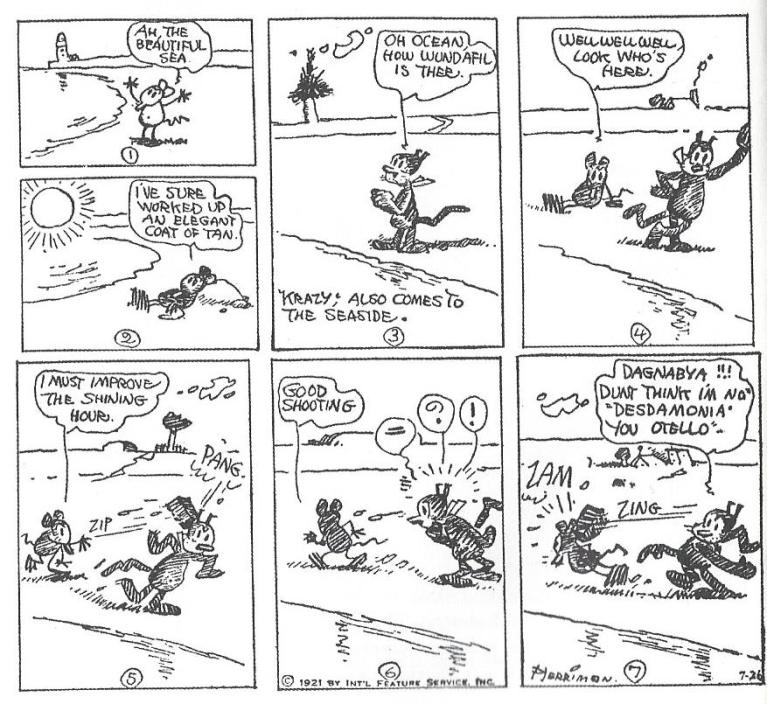
Book one of the Krazy and Ignatz volumes collects Krazy Kat daily strips from January 1921 to December of the same year. Upon opening the book, what immediately catches your eye is Herriman’s boldness, outlandishness, and intelligent playfulness in Krazy Kat. Despite its age, the Krazy Kat comics, like the silent films of Charlie Chaplin, still pack laughs while tackling some high political, social, and artistic concepts in a welcoming and relatable form.

Each page of the book contains one strip, more often than not beginning with Krazy Kat or Ignatz talking about something and always ending with Ignatz delivering a brick to Krazy’s head paired with a clever, laugh out loud punchline. Sure, this may sound repetitive after 300 pages, but each Krazy Kat and Ignatz strip has its own fascinating story, and despite the same start and ends, each strip has a different path to travel between the two points.

Beyond the timeless absurdist humor embedded in all of Krazy Kat that consistently reminded me of W.C. Fields (a Fierro house favorite), the various topics addressed by the strips pushes the series far ahead of its time. First and foremost, the ambiguous, possibly sado-masochistic relationship between Ignatz the male mouse, and the sometimes male, sometimes female Krazy Kat almost shocks even a modern day reader. Krazy Kat pines for Ignatz and his bricks as Ignatz gains pleasure from tormenting Krazy. In addition, Herriman implicitly yet keenly addresses race relations between Americans, illustrating Krazy Kat with black fur and Ignatz with white fur and occasionally swapping their colors. And in between the Krazy Kat and Ignatz frenzy stands Officer Pupp, the policeman of the town, who has an overwhelming affection for Krazy Kat and always tries to protect him/her from Ignatz, though such a thing stands against Krazy’s desires.

Beyond the advanced understanding and representation of dysfunctional relationships between people (though conveyed by animals), Krazy Kat and Ignatz also addresses blue laws, prohibition, race relations, and English language and societal idiosyncrasies, presenting questions about the various aspects of life we encounter but all with a smirk. In addition to these political and societal topics, Herriman also plays with the cartooning form itself, having Krazy and Ignatz interacting with drawing elements on the page such as a horizon line or adding in his own commentary about the colors of objects, since the strips were printed in black and white.

Above all, Herriman constructs a distinctively humorous and fantastical set of comics with the dailies of Krazy Kat. Light on his feet with his story and illustration techniques and sharp as a tack with his wit, George Herriman set the foundation of comics and cartoons in the generations to come. After reading Krazy and Ignatz, you’ll see his influence everywhere ranging from Looney Tunes to Tom and Jerry to The Simpsons to Crumb’s Fritz the Cat to maybe even George Orwell’s Animal Farm (after all, Herriman did very early popularize in media the practice of using animals to satirize human behavior), signifying his lasting impact on our culture, even if his name may not exist today as a household one.

Go out and pick up the Pacific Comics Club collections of Krazy and Ignatz; you’ll get paradoxically transported back to the 1920s and forward to an almost outer space planet/desert with the bizarre, smart, and fascinating comic styling of George Herriman allowing for constant laughter and self-reflection throughout your journey.

A Story for All Ages – Diana Thung’s August Moon

Standard

While I spend most of my media consumption focused on adult-oriented works, I always savor a breath of fresh, more optimistic air when I get the opportunity to enjoy a work made for both children and adults. Let me reassure you, I’m not one of those Disney Princess loving gals that lives with a constant childish naivete; however, I must admit that sometimes, when I’m feeling somber about being an adult, I enjoy reading a book or seeing a television show made for kids, since the best children’s content can approach serious topics with whimsy and spirit, which is sobering for an adult jaded by reality. Refreshingly, such an awakening occurred for me with Diana Thung’s August Moon.

Cover for August Moon

Filled with bright imagination, August Moon most resembles the Japanese folk tales I recall reading as a child. I have fond memories of tip-toeing out of my room to a wire shelving cart in the living room on quiet Saturday mornings when no one was awake to read stories filled with mysterious visitors, giant peaches, altering gusts of wind, and magical fish. Around the age of 7, I was introduced to the world of second hand books, and on one of my visits to what felt like an enormous warehouse (which in retrospect was just a two story bookstore), I found a hardback collection of Japanese folktales for a few dollars and asked to take it home. That collection remained on the wire shelving for years, and on Saturday mornings or lazy afternoons, I opened it up to read a new story or to re-read one I wanted to recall.

These Japanese folk tales could have elaborate mythologies, but those fictional components remained distinctively grounded in reality, making the tales more relatable as they taught valuable lessons in honor and kindness. Like these Japanese tales of my quiet Saturdays, August Moon has an intricate and playful mythology of fictional creatures, but these creations of pure imagination exist in a reality not too far from our own, allowing the book to convey its core teaching without ever getting dogmatic or severe.

In August Moon, Fi Gan returns to Chino, her mother’s home city, one that time has somewhat forgotten, when her scientist father receives reports of the discovery of a potentially undiscovered species. As the daughter of a pragmatic scientist, Fi hardly believes in anything beyond what her own eyes can see and remains distant, passive, and overall, stoic. Fi takes pictures to document her experiences, but she hardly seems to experience anything at all, including feelings of grief for her mother’s recent passing.

But, Fi’s indifference cannot remain in a city like Chino, where belief in the unknown still exists and most likely for a reason. Chino has no factories; its economy runs on the shops and the food carts that provide to the community. Beyond its own efforts to sustain its own people, the community of Chino also takes great pride in the nearby forest and spends much time and care preserving it and allowing it to remain as untouched as possible. Consequently, much of the forest remains undiscovered, leaving much to the imagination of Chino’s citizens.

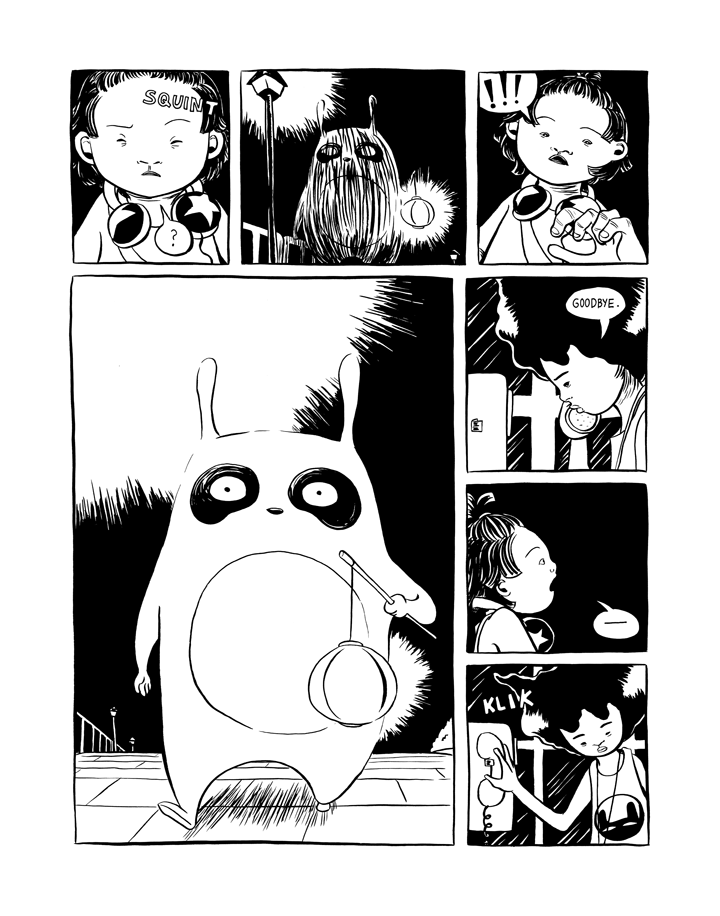
Of the stories of creatures seen in the forest and around Chino, the tales of Soul Fires, creatures who carry the spirit of past ancestors who light up the sky, dominate the myths of Chino. Children report on seeing them as large rabbit/hamster/bear-like creatures, and many adults recall seeing them too, so Soul Fires have been woven into the culture of the city. In fact, the Soul Fires play such a large part of the Chino’s heritage that a yearly festival exists to celebrate them.

Fi and her father arrive to Chino in the days before the festival, led by Fi’s uncle, Simon Bo. The Bos, Fi’s mother’s family, have long resided in Chino, and as a result, they have more imagination, faith in the unknown, spirituality, and a love for the phenomenons of nature. On the other hand, the Gan side of the family, has lived more in an industrialized world, so they place value on the pragmatic, especially in science. Since her mother’s passing, Fi has experienced mostly a science perspective on life, but everything changes when she meets Jaden, the leader of the children of Chino and a boy with a super-human ability to move quickly and to leap long distances.

After befriending Jaden, Fi meets a Soul Fire, and quickly, her father’s rationality driven upbringing fades away. A group of industrialists known as the Monkeys have discreetly entered Chino and have plans to eliminate the Soul Fires, the forest, and the overall spirit of Chino, and in order to prevent the Monkeys from laying siege on the beloved forest and city, Jaden will need Fi’s help. However, in order to help, Fi’s demeanor must change; her disaffect and disbelief must turn into passion and care. She must begin to engage with other people, and she must begin to express a full spectrum of her emotions, since only these definitively human tools will help to give her the courage and strength to support the battle against the Monkeys.

2010-02-25-30403c64

Fi Meets Koo, a Soul Fire

Despite the adorable visual representation of the Soul Fires, August Moon never patronizes its audience and never feels cloyingly sweet and sentimental. Over the course of Fi’s transformation and battle against the Monkeys with Jaden, Diana Thung masterfully blends moments of lightness and darkness and fantasy and reality together to create an awe-inspiring story for children and captivating plot for adults. With the Soul Fires, Jaden, and Fi, Thung creates a tale that not only entertains but also teaches people, regardless of age, to understand the destructive environmental, cultural, and societal effects of industrialization and technology. While the work of the Monkeys will surely damage the land, it will also bring with it a disregard and dismissal of forces beyond humans, and that, may be the most devastating loss of all.

August Moon discusses a highly adult concept but without any air of pretension or heavy-handedness, making it highly effective, for the book can facilitate discussions across and within multiple generations. It has plenty of whimsy and action to pull in children, and it has absolute relevance to adults’ present and past. Given this balance of material for audiences of different ages and according experiences, August Moon simultaneously returned me to those Saturday mornings of my own childhood and kept me in my current reality, allowing me to enjoy it with both a childish joy and an adult perceptiveness along with my own ageless, timeless fascination for engaging storytelling.

August Moon by Diana Thung is available via TopShelf Productions. 

Tan Tan Memories of a Different Type of Omlette – Making Lily’s Banh Bot Chien

Standard

Growing up in Houston, I frequently ate at Tan Tan Restaurant on Bellaire, as so many Vietnamese and Chinese Houstonians do. Beyond the delicious egg and rice noodle dishes I devoured, the highlight of each meal at Tan Tan was the opening appetizer, Banh Bot Chien. Crispy, soft, eggy, sweet, salty, and tart all at the same time, Banh Bot Chien at Tan Tan was a staple of my childhood.

Since leaving Houston, I have not consumed Banh Bot Chien. It’s a bit of a hybrid Chinese-Vietnamese dish, with its foundation taking cues from daikon rice cakes often eaten at Chinese Dim Sum, and it’s most commonly consumed as a street dish item in Saigon, so it seems to be unpopular in most Vietnamese restaurants.

After years of Banh Bot Chien’s absence from my diet, I finally decided to make it in the Fierro home. While the rice cakes require quite a bit of time to cook and then cool, the final product is a perfect blend of flavors and textures that will lead to a great amount of joy, whether or not Banh Bot Chien is a new or an old friend to your dining table.

The rice cake here is made with chicken broth, so for a vegetarian version, feel free to use vegetable stock or a vegetable bouillon base. Hope you enjoy it!

Background music provided by Brahms’ Sonata for Cello and Piano No1 in E minor Op38


Bovine Ska and Rocksteady 8/11/2015: Coxsone Dodd’s Tabernacle Label

Standard
tabernacle b

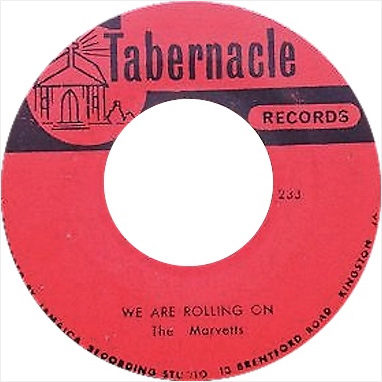
Great Jamaican Gospel From The Marvetts

Howdy there Bovine Ska listeners!

For this past week’s show, we decided to take the spotlight in a bit of a different direction by focusing on the Gospel recordings of Coxone Dodd’s Tabernacle label. We’ve always talked about how some of Studio One’s stars recorded beautiful tracks for the Tabernacle label, and we realized it was time to shine a light on a genre of Jamaican music we’ve only briefly touched upon in the past. But, before that spotlight, we had two sets of ska, one set of mento, and one set of rocksteady to build up to the midway spotlight. In the first hour, we shared two skas from Prince Buster’s Islam label: “Country Girl” by The Charmers and “The Soldier Man” by Prince Buster himself. We also were thrilled to play the airplane opening “One Minute to Zero” by Karl Walker & The All Stars. In our rocksteady track, we included the lovely vocal stylings of The Heptones with “Cool It Amigo” and The Wrigglers with “Get Right.”

Then, we proceeded to the Tabernacle spotlight, starting off with “I Left My Sins,” a stunning Gospel recording from none other than Bob Marley and The Wailers.

As many know, Coxone Dodd was a major fixture of the Jamaican music industry. Originally trained as a cabinet maker and auto mechanic, Coxone Dodd was inspired to enter the music industry after spending some time in America as a farm laborer and then returning to Jamaica with jazz and  blues records in hand, allowing him to get a jump start on his Downbeat sound system and marking his arrival into Jamaica’s music industry. From his initial sound system emerged plenty of record labels as he began to record artists. Beyond Studio One, the other familiar imprints are Worldisc, D. Darling, Muzik City, Allstars, Supreme, and C&N. While most of Coxone Dodd’s productions focused on secular music, Coxone did have a gospel label, appropriately named Tabernacle. As a lifelong Christian, Coxone recorded Tabernacle tracks on Sundays, and many artists from his secular music labels would record a gospel track for Tabernacle on those Sundays. 

And after the Tabernacle spotlight, we closed off the show with a reggae set filled with outstanding cuts, including the sensational “Face Your Trouble” from Vin Morgan and The Soul Defenders.

Listen to the Tabernacle spotlight and the ska, rocksteady, mento, and reggae tracks of the August 11, 2015 edition of the Bovine Ska and Rocksteady on Mixcloud HERE.

Subscribe to the show on Mixcloud to get reminders when we post up the show, and join us on Facebook to get updates on upcoming spotlights, record discoveries, and upcoming Jamaican music performances and shows in the Southern California area!

Enjoy!

XOXOXO Lily & Generoso

Filler Bunny Becomes Filler: The Collected Works of Filler Bunny

Standard

Over the course of media and art, the creative process itself has stepped into the foreground as a topic of discussion around and in works. Some have succeeded in capturing the turmoil and the joy of creation while others have wallowed in pretentious failure. To understand the creative process of a piece of art or media, there have been two approaches: a realistic, documentary one or a metaphoric, symbolic (and often surrealistic) one.

The Collected Works of Filler Bunny takes the more fictional route of the two. Filler Bunny documents the struggles of a dark, bizarre comic book creator, such as the comics’ own, by putting Filler Bunny through torture and suffering as the fictional creator of Filler Bunny, as a character and as a comic book series, has enormous difficulty filling up the pages for each story. At its best, Filler Bunny entertains with its clever bouncing between the creator’s and the bunny’s world, and the breaking of the walls between them and you as a reader.  

Cover for the Collection

Filler Bunny speaks to you and his creator, and the creator does the same, leading to a fascinating concept of Filler Bunny literally filling the pages in nonsense scenarios his creator puts him in as the creator himself attempts to beat the clock to deliver his work with some level of quality. Given that Filler Bunny as a concept within the series exists to only meet a deadline, no limits exist on what he can or cannot do to pass the time on each page. Filler Bunny eats a lot, poops often, sees his new friends killed off, and gets frequently tortured throughout the collection, and as a result, he also spends a lot of time begging the reader to end his existence for him. Filler Bunny lives an iterative existence of pain and suffering; rather than filling the pages up with plot lines and character arcs, the creator makes Filler Bunny repeatedly experience horrible situations and wish for change.

At its core, Filler Bunny serves as a comedically bleak and nihilistic discourse on the purpose of creating characters and storylines in a comic book. Each story seems almost like a surreal daydream or nightmare coming from Vasquez’s twisted mind asking himself, “What if I created a comic book character used only to fill pages?” Rather than creating lukewarm B-side pieces, Vasquez’s fillers jeer at the idea of creating filler comics in the first place, making the first Filler Bunny encounter quite fun, silly, and even smart.

Unfortunately, the novelty of parodying the idea of creation only for creation sake in Filler Bunny wears off quickly, especially as the grotesqueness of the comics amplifies from story to story. By the second story, “Revenge! of the Filler Bunny,” the comics already begin to lose their initial charm. As Filler Bunny continues to get tortured by his creator, he becomes mediocre filler, the one thing he was created to defy. Filler Bunny takes beating after beating in one over-extended joke; Vasquez tries to make the tormenting more ridiculous over the course of the stories, but the repetition of Filler Bunny’s distress delivers fewer and fewer laughs, leading to a state of general boredom.

As short exercises, Filler Bunny may have served its purpose to transition between stronger stories and to poke fun at filler at the same time. However, when collected together, their disgust-inducing approach for the meta-analysis discourse on creation wears far too thin, lacking any change or exploration of new ideas into how Filler Bunny can fill a page. I would have loved to have seen Filler Bunny waiting in line at the bank, Filler Bunny watching his favorite movie, or Filler Bunny feeding his pet lizard. Other ways for Filler Bunny to pass time would have made the series funnier and more engaging and less dependent on revulsion as a mechanism to deliver Vasquez’s own exploration of how creating something can feel so futile.

After the first story, “Filler Bunny in I Fill 15 Pages,” I so badly hoped the collection would succeed, since the core idea of the comics was a strong one, but after the tenth time of seeing Filler Bunny raped by a monkey, all of that hope disappeared. Perhaps I’m too normal for Filler Bunny and its sick world; I just get far too tired of comics that overuse shock and vulgarity as their only devices for satire. Call me square, but one moment of projectile intestine expulsion is one too many in a comic collection…

Jhonen Vasquez definitely has talent, imagination, and a distinct perspective as seen by his work on Invader Zim, and perhaps that is largest disappointment of Filler Bunny. Vasquez could pack so much more into Filler Bunny, but his unrelenting toilet humor prevents this collection from developing beyond a pubescent teenager’s scribbles in class or in a dark basement at home. Filler Bunny could have progressed into a witty and astute statement on creation, but instead, it goes down an excrement and assault filled road, losing sight of its original intention and its fundamental joke, making it the filler it dreaded and teased to become.  

The Collected Works of Filler Bunny by Jhonen Vasquez is available via SLG Publishing. 

Com Chien Do – The Vietnamese Counterpart to Risi e Bisi

Standard

We’re having a rice and peas battle in the Fierro household! Last week, Generoso made the creamy and savory Risi e Bisi, and this week, I decided to take rice and peas in a Vietnamese direction. Tomato fried rice is the perfect side dish to any protein. Traditionally served with bo luc lac, com chien do is a nice alternative to a more soy based fried rice. My version has peas and onions in it, which are purely a personal preference. This com chien do here is served with ga luc lac, since chicken was in the fridge. Feel free to serve the tomato fried rice with fried tofu, fried chicken, grilled pork chops, or of course with bo luc lac. Make a huge bowl of com chien do for a summertime party or picnic to share!

Music: Fryderyk Chopin’s Polonaise-Fantasy in A-flat Major, Op. 61

Truth Be Known and the 1990s Comics Underground

Standard

Inspired by last week’s pick of Tadao Tsuge’s Trash Market, I hoped to dig even deeper to unearth more avant-garde/underground comics treasures this week (and in general going forward).  And to my luck, on a bookcase of used comics at Amoeba Records yesterday, I found Maximum Traffic’s Truth Be Known.

Cover of the Truth Be Known Collection

An anthology of Traffic’s work as an Obscuro comics artist along with his editing work for the White Buffalo Gazette zine, Truth Be Known contains a underlying, cohesive argument in the midst of a frenetic mix of semi-collage artwork, comic panels, and single pages of text. Fiercely bold, political, philosophical, comedic, and absurd, Truth Be Known exemplifies the independent voice of zine culture, one I only know a little about, especially since the comics from zines of the 1990s were created when I was a still a small child.

Adding to my own lack of familiarity of  the 1990s comics underground, little mass public attention (even via the internet today) has been given to the zines producing those comics. Plenty has been written about the early underground comics, especially on that now famous San Francisco scene Robert Crumb led with its foundations in the satirical works of Will Eisner and Harvey Kurtzman. However, the next generation of the comics zine world of the 1990s and its delivery of the descendants of original underground comics has remained largely underground and accessible only through zine fests. Consequently, my own knowledge of the vitality and content of this alternative media form before and after the the internet age is pretty thin.

What I do know about zine culture of the 90s comes from stories of Generoso’s friends who notoriously gobbled up two industrial sized toner cartridges publishing an edition of their anarchist focused zine. A media form with no rules and often even no desire for monetization, anything goes in the zine world, making it a perfect incubator for creative, political, and philosophical opinion. As a result, there’s plenty of noise found amongst the zines published in the past and present, but given the wild west freedom of the media outlet, there are plenty of gems, and one gem distinctively comes from Maximum Traffic and his stable of artists and writers of the White Buffalo Gazette and Obscuro group.

A labor of love, passion, and desire to discuss current morality, politics, faith, and any element of society that influences our thoughts and opinions for better or more likely for worse, Truth Be Known contains works that study and investigate our fears, our comforts, and our culture with righteousness, humor, and most importantly humanity. Some of the comics are more traditional in structure, and others are more like a psychedelic dream, creating a nice pace of reading and viewing throughout the collection. The moment you begin to feel you’ve had enough of the ethereal, a more traditional (though no less entertaining and insightful) comic arrives, and the moment you begin to crave something a bit more challenging and unclassifiable, one of the looser, hallucinogenic comics starts. You never get too complacent with stability or instability with Truth Be Known, since both exist and constantly complement each other.

Some of this ebb and flow between the avant-garde and the traditional comes from the mix of artists and corresponding styles included in the anthology. Steve Willis contributes his funny and reality crossing Morty Dog comics; Mike Hill contributes his satirical Modernman comics; and, Maximum Traffic contributes his outstandingly beautiful Neo-Psychedelic Man comics. With this mix of artists and voices, every story in the anthology has a purpose; Maximum Traffic excluded anything that would be considered as filler here, showcasing his clever and deft editing skills in addition to his brilliant collages that alone make Truth Be Known worth a look.

Truth Be Known contains an energy and a specific commitment to honesty and creativity only found in a publication where no commercial expectations exist. All are free to roam in the world of Truth Be Known, and despite their drastically different approaches, all unite to develop works to not only entertain readers but also provide an alternative perspective on life, mass media, and existence.

While the references in the anthology may clearly date Truth Be Known, the collection still stands as a relevant body of underground comics. In their challenge to existing popular comic forms and desires to innovate in a format with established conventions, Maximum Traffic and his Obscuro friends progressed the comic form then and hopefully continue to inspire artists today to do the same now. If you can find it, do pick up Truth Be Known and any copies of the White Buffalo Gazette, and while you’re at it, go out and pick up any zine for a fresh, sobering breath of zine frontier air.

Thankfully, the creative and thought independence of the tradition of zine culture still lives on, which means that modern underground comics gems are out there; they’re just waiting to be discovered and shared.

Truth Be Known collected by Maximum Traffic is available via Maximum Traffic publications. 

Bovine Ska and Rocksteady 7/28/2015: Jamaica Covers Doo Wop

Standard
heptones sea of love

The Heptones brilliant cover of the classic, “Sea Of Love”

For many years, Generoso and Lily have talked about collecting all of the Doo Wop covers we know of in  Jamaican music into a show. Generoso was born and raised in a Doo Wop center, and he carried over that love to Lily, so this show was built on a great love for American Doo Wop and the humming of melodies to try to match them to what we heard in Jamaican music. Consequently, as each show happened and a Doo Wop cover was identified, we would tag and label the tracks in the hope to eventually culminate all of the songs into one grand Doo Wop extravaganza.

Finally, this past week, our celebration of Jamaica’s Doo Wop covers occurred. Despite all of our efforts to collect tracks over the years, this show took a particularly unique amount of hunting, given that plenty of the covers did not have the same name as the original tracks. Thankfully, we uncovered plenty of gems and are thrilled to share them with you.

This Doo Wop show had plenty of highlights. In the first set, Prince Buster and his All Stars showed how to improve on the slightly offensive “Ling Ting Tong” by the Five Keys. Then, in the third set, one of our favorite discoveries appeared, a lesser known cover of Gene Chandler’s “Duke of Earl” by Cornell Campbell, which emphasized how much a doo wop track could be transformed and enhanced by a reggae rhythm and vocal styling. In the second hour, we also included a 4 song set of different versions of The Moonglows’ “Sincerely” from Dorothy Russell and Ken Parker, Owen Gray, and Joe Higgs.

Listen to this special Bovine Ska and Rocksteady from July 28, 2015 HERE. Enjoy!

Join us on Facebook to hear about upcoming spotlights, to see rare Jamaican music photos, and more!

 https://www.facebook.com/groups/175321709220304/