Lily Makes Summertime Bun Thit Xao Xa!

Standard

Summer is almost here, and with the warm weather, Generoso very kindly asked Lily if she could make a bun dish.

Bun (vermicelli) comes in many forms. It can be served with soup, or it can be served with crisp, fresh veggies.

For this week’s recipe, Lily made bun with lemongrass pork, a cross between the very traditional Bun Thit Nuong (Vermicelli with BBQ pork) and Ga Xao Xa Ot (chicken with lemongrass and chilies) that you will find in most Vietnamese restaurants.

This episode also has a new friend in it….the mandolin! It is a great tool to prepare the carrots and the cucumbers that give this dish perfect amounts of crisp textures and freshness.

Music by Franz Liszt, Piano Sonata in B minor, S. 178

Enjoy! Happy summertime!

Mixing Media and Reality – Pistolwhip: The Yellow Menace

Standard

With Dark Horse’s release of the complete Pistolwhip last week, I figured it was time to jump into this series. Oddly enough, I dived into the Pistolwhip series in a disjointed way…I started with the second volume: Pistolwhip: The Yellow Menace.

Cover for Volume Two of Pistolwhip

Cover for Dark Horse’s The Complete Pistolwhip

Even though I began with the second volume, which was the only volume available at my local comic book store, this volume stands as its own solid, self-contained piece; the arc is fully realized and resolved in The Yellow Menace volume that you could even be fooled into believing that this volume was a single graphic novel and not a volume containing only a snippet of stories part of a much bigger series.

Before the days of Kick-Ass and Super, Jason Hall and Matt Kindt explored the idea of blurring lines between superheros, supervillains, and everyday people with Pistolwhip. Jack Peril guards a city reminiscent of a 1940s Los Angeles, but some uncertainty lies around whether he really even exists. A fixture of popular media, Jack has a radio show program, a comic book series, a film series, and a pulp novel series dedicated to his various adventures and battles against evil with a particular focus on his arch nemesis, the Yellow Menace, a grim, cruel, and abominable villain who commits some quite macabre crimes.

When a possible copycat killer who follows the ghastly attacks of the Yellow Menace in each week’s new episode of Jack Peril, be it in the comic book, radio program, pulp novel, or film, brings fear to the city, reality and the fictional world of Jack Peril begin to intertwine. Jack Peril is seen on the streets by some. The Yellow Menace is fatally seen by others too. Caught between the fiction and the reality, Pistolwhip, a down-and-out private investigator begins to work with Jack Peril to figure out the whereabouts and the identity of the Yellow Menace.

Beyond Pistolwhip, Jack Peril, and the Yellow Menace himself, there are the main players of the mystery behind the Yellow Menace killer: Mr. Loom, Isla Rose, Ray Ford, and Charlie Minks.

With this battle between Jack Peril and the Yellow Menace unfolding on radios, on pages, on big screens, and on newspaper front pages, the Jack Peril media dynasty captures the attention of the city, much to the horror (and maybe even a bit of satisfaction) of Roderick Loom, a pseudo-academic philosopher/preacher preparing for a lecture at the Chase Hotel which will cite recent Yellow Menace events to demonstrate how fictional media corrodes our society.

Along with Mr. Loom, we also meet Isla Rose and Ray Ford in the Chase Hotel. Isla is a housekeeper at the hotel carrying a heaviness coming from her past. Ray is a chipper but over-zealous police officer placed on guard after the Hotel’s previous night detectives on duty were murdered. And, in the mix of all of the characters stands Charlie Minks, Jack Peril’s confidant who carries a secret past and operates on a covert mission; she’s most likely our femme fatale, but there’s some humanity to her which may suggest otherwise.

Fundamentally, all of the characters in Pistolwhip represent archetypal mystery and film noir characters. Almost all of them have something burdensome in their past that haunts them and has lead to their downfall. Consequently, they relish in any opportunity to return to any level of grace. Yet, despite the archetypal characters, Jason Hall and Matt Kindt manage to deviate from preconceived notions of each of the characters by blurring the lines between reality and fiction from within the volume, making the reader question who is real and who is not, and making the motivations of each character difficult to guess, and as a result, the series lures you in because of its twists and turns and your own curiosity and desire for a resolution to the mystery behind the Yellow Menace.

However, what really makes Pistolwhip a commendably innovative and imaginative series is its ability to build up and shift character personas in non-sequential pieces weaved into the core narrative. While the mystery of the identity of the Yellow Menace sets the pace of the story, each character adds rich texture and harmonies to the narrative. As a result, over the course of the volume, your interest in the final answer to the mystery will begin shift because you will not only wonder, “Who did it?” but also “How will [insert character name here] be affected by the reveal of the Yellow Menace?”

One of the most exciting reads I’ve encountered, Pistolwhip brilliantly mixes in mystery, film noir, and superhero motifs to create a self-contained world where parts of a story can emerge from any source of realistic or fictional media, all from within a fictional media form itself. With its various layers of reality and fiction, it brings up fundamental questions around goodness and evil in each person’s individual actions as a regular human and/or as a hyperbole of a human. All together, Pistolwhip places us in a morally ambiguous world, where some semblance of hope still exists, and ultimately, we still long for a good guy to triumph, even if that good guy may not be who we expect.

Pistolwhip: The Yellow Menace by Jason Hall and Matt Kindt is available via Top Shelf Productions. The Complete Pistolwhip is available via Dark Horse Comics. 

Horror, Nature, and Polish Cinema in Sand & Fury

Standard

Generoso and I rarely write about works that have almost identical characters and themes. Perhaps it’s the nature of the medium we each focus on, or perhaps it’s the time period, but in general we seldom manage to cross paths.

Consequently, when I picked up Sand & Fury a few days before our cross country move, I would have never guessed that the book would somewhat be an adaptation and expansion on Jerzy Skolimowski’s The Shout and the Robert Graves poem it adapted.

Cover of Sand & Fury

Whereas Alan Bates’s Crossley character in The Shout remains for the most part an enigma, his female screaming/shouting counterpart in Ho Che Anderson’s Sand & Fury receives a full character development treatment in the graphic novel. Our unnamed female lead carries a scream that brings death onto a person destined to die. Though her supernatural skills make her somewhat of a grim reaper, this angel of death is unwillingly on duty for someone else’s reign of terror; she has met and interacted with all of the victims of the the summer Hammer Killer, and all of these victims hear the angel’s scream right before the Hammer Killer strikes.

Consequently, the moments with the victims before the scream and before the Hammer Killer’s fatal blow haunt our grim reaper. To make matters worse, she let the Hammer Killer escape death from her scream once upon a time. She undoubtedly lives a horrific reality, but flashes of the angel’s previous life weave in and out of the current time, and gradually we understand that our reaper’s existence and all of the sadness and terror she must come to terms with stems from her hedonistic and selfish past.

Unlike some supernatural spirit directly out of the mouth of the underworld, this grim reaper once lived on Earth. A shark-like businesswoman and human being over all, she preyed on others’ emotions to reach her goals. Ranging from business partners to lovers to spouses, she chewed them up and spit them out with her philosophy of existence consisting of solely reckless hedonism unchecked by morality, loyalty, or any crumb of selflessness.

Though her pleasure seeking methods for the most part worked, she crossed paths with Elio Angermeyer, her boss, and after a long winded affair and a promotion, she also threw him aside, but alas, he was the wrong one to toss away. In a moment of pure wrath, Elio murdered the human predecessor to our angel of death and buried her in the desert; however, nature had something else planned for her, and when a rancher’s boy discovers her body and unearths it, she is unconscious but alive. When she wakes from her coma, she emits a scream that kills the family that discovers and begins her life as the angel of death bearing the fatal scream.

Loosely structured with fragments of various moments of time weaved together out of sequence, Sand & Fury experiments with the narrative structure to slowly reveal our angel of death’s connection to the Hammer Killer, but the reveal of this mystery lives in the shadow of the strength of the narrative: its ability to develop a rich understanding of why our unnamed reaper possesses her difficult power.

Toward the last third of the novel, our angel of death meets another screamer , Lydia Philadelphia and asks why they have the powers they do, and Lydia replies with, “It’s our burden.” In that simple and vague statement combined with the moments of the reaper’s past, we begin to understand that her current existence as the reaper and thus all of the awful moments she has to witness and prompt serve as an atonement to nature for her evil ways on earth before she died. The unnamed reaper carried no burden despite her cruel actions toward other people in her life, and after her mortal death, she now must carry the burden of the force of death.

Ho Che Anderson fills Sand & Fury with unnervingly horrific ideas, some which are realistic and others which are supernatural, and together, they succeed in what horror does best: understanding the truth behind human behavior under the most intense terror and duress. To further heighten each moment of terror, Anderson transitions his art style from a more flat black-and-white style to a more realistic black-and-white drawing style with splashes of red anytime blood is spilled, making each moment of violence more painful for the reader and for our grim reaper as well.

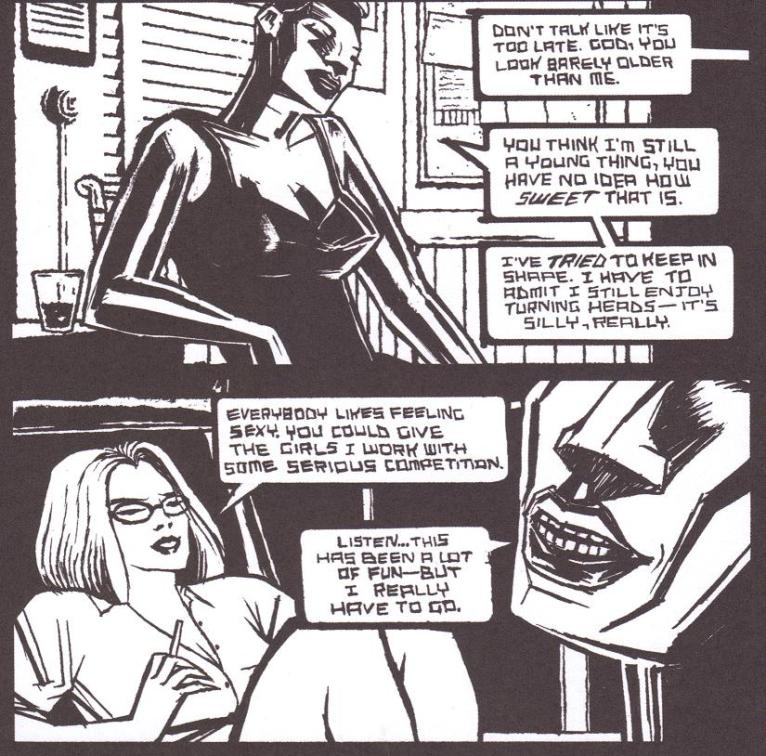
An example of the Black, White, and Red Illustration Style

With his narrative and visual form, Anderson alludes plenty of film styles, especially those of gialos and film noirs, but alas, his style in Sand & Fury most closely parallels that of Andrzej Żuławski’s in Possession with his use of hyperbolic moments of violence, fantasy, and horror and frenetic energy to better understand human existence. Whereas Possession uses horror to capture a spouse’s fears and sentiments about an infidelity, Anderson uses the same devices to understand karma-like forces, which restore balance to the world and to individual lives.

With the tale of the unnamed grim reaper in the Sand & Fury, we realize, as with The Shout, that as much as we feel we have control over our own environment and existence, forces exist (be it karma, God, Mother Earth, or the god and goddesses on Mount Olympus) that have their own plans for us, especially if we live only to please ourselves without any regard for others and even more so if we believe we can live beyond the grasp of their powers.

Sand & Fury by Ho Che Anderson is available via Fantagraphics Books.

Bovine Ska and Rocksteady 4/15/2015: Slim Smith With The Techniques

Standard

This past week began a special series for the Bovine Ska and Rocksteady. After 4/29/2015, the Bovine Ska and Rocksteady will no longer be on WMBR because we are moving out of Boston. To commemorate the last three shows of the Bovine Ska and Rocksteady in Cambridge/Boston, we began a three episode spotlight on an artist dearest to our hearts, Keith “Slim” Smith.

The mission of the Bovine Ska and Rocksteady has always been to share and uncover rare Jamaican music. Consequently, these last shows will feature short record label spotlights for small labels in addition to the three part spotlight on a star who should be in the global company of Bob Marley and Jimmy Cliff but is not well known outside of Jamaica.

For the 4/15/2015 edition, we started the show with two sets of early reggae, featuring “Dengue Fever” from The Scorchers and the ever-too-pretty “If I Had the Right” from Alton Ellis. After the opening reggae sets, we presented mento from Jamaica’s hotel bands, specifically The Hiltonaires, the house band of Kingston’s Hilton Hotel, The Wrigglers, one of the bands for the Arawak Hotel, and Monty Reynolds and His Silver Seas Orchestra, the house band for the Silver Seas Hotel.

Then, to close the first hour, we presented a short label spotlight on a record label that we’ve wanted to review for sometime but had great difficulty in finding the tracks: the Moo’s label. We know that the man behind the Moo’s label was Charlie Moo, but beyond that, we don’t know much about the origins or the end of the label. The spotlight featured Jamaican Rhythm and Blues tracks from each of the artists from the small catalog of Moo’s label releases: Lloyd Clarke, Basil Gabbidon, Rico Rodriguez, Johnny Moore, Owen Gray and Clancy Eccles.

The second hour was dedicated entirely to the first part of the Slim Smith tribute trilogy: his time with The Techniques.

Techniques-Favorite

Our Selected Favorite from The Techniques


Slim Smith began his music career as a teenager attending Kingston Senior School. He along with classmates Frederick Waite, Franklyn White, the Richards Brothers, and Winston Riley entered Edward Seaga’s Chocomo Lawn youth club in Wellington Street in 1962 to emerge as the house band for the club with all members singing and playing instruments. After spending time backing up solo singers who visited the club and in concerts, Seaga arranged for The Techniques vocal group, now consisting of just Slim Smith on lead vocals, Winston Riley, Frederick Waite, and Franklyn White, to record on their own at Federal records with the track, “No One,” which was produced by Byron Lee and released on Kentone in 1963 to some attention but not too much. We heard this first track and another early Kentone track from the Techniques to kick off this spotlight on Slim Smith.

Everything began to change in 1964 for the Techniques. “No One” would be internationally distributed by Columbia in England in 1964 and by the Curtis Mayfield compiled This Real Jamaica Ska, which was released on Epic in America. Then, as the Victor Youths Band, Slim, Winston, Frederick, and Franklin were winners in the ska and mento contest in the 1964 Jamaica Festival. And, in that same year the Techniques were introduced to Duke Reid by Ken Boothe and Stranger Cole, and they would record, “Little Did You Know” with him, which would become the first major hit for the group. To kick off the spotlight, we presented The Techniques’ finest work with Duke Reid.

After their time with Duke Reid and his Treasure Isle, The Techniques then recorded with Sonia Pottinger at her Gayfeet label, which we presented next.

Often Generoso calls The Techniques the greatest vocal band in Jamaica, and this is because beyond Slim Smith, many of the members who rotated in then out of the group were stars in their own right. After Slim Smith left, the mighty Pat Kelly was brought in to take over lead vocals. Shortly after the arrival of Pat, Bruce Ruffin also joined the group, and this version of the Techniques was responsible for some of the best adaptations of tracks from Curtis Mayfield and The Impressions. In addition to these two talents, the Techniques would also have the voices of Junior Menz, Lloyd Parks, and Dave Barker during the group’s various re-incarnations.

Listen to The Techniques spotlight and the full show HERE.

The archive will be available until 4/28/2015. Enjoy!

And don’t worry, the Bovine Ska will return in another radio form. We’ll be sure to update here!

Bovine Ska and Rocksteady 4/8/2015: Horace Faith

Standard

For this past week’s show, we began with two sets of mid-tempo ska, beginning with a spectacular one from Henry Buckley himself on his own Merritone label entitled, “Reap What You Sew.” Afterwards, in the second set of ska, we presented the amazing “Run Rudies Run” from Lee Perry and the Gaylads.

After the first two sets, we jumped into the mento with “Tongue Tied Mopsie” from The Wrigglers on the Kalypso label. And then to transition into the spotlight on Horace Faith, we shared an extended set of rocksteady, beginning with a too cool Prince Buster track named “Sweet Beat.”

Cover for 7″ of Black Pearl

To start the second half of the show, we featured a memorial spotlight on Horace Faith, who passed away on March 8, 2015.

Unfortunately, we don’t know too much about Horace’s bio. We do know he was born as Horace Smith in Jamaica, but given his extensive recording for English labels and a small tidbit shared with us on an annotated episode of Top of the Pops, we know that he immigrated to England as a young man and spent a good chunk of his music career there.

Faith’s career is an interesting one; he recorded lots and lots of covers in reggae and soul but with very lush arrangements. We presented all of his best work in this memorial retrospective on Faith, including his major hit, “Black Pearl.”

“Black Pearl” is a cover of the song with the same title by Sonny & The Checkmates, and with this cover, Horace Faith gained quite a bit of popularity. It reached #13 on the U.S. Billboard top 100 and #13 on the UK singles chart as well.

The spotlight included both reggae and soul cuts from Horace Faith, all of which had beautiful and lavish compositions.

Listen to the spotlight and the full program HERE.

Enjoy! The archive will be available until 4/21/2015.

Jeffrey Brown’s Robot Slapstick: Incredible Change-Bots

Standard

I spend quite a bit of time reading graphic novels with some commentary on life experiences, philosophical concepts, or traditional genres and cultural motifs. However, more often than not, I love a good, silly yet clever work of comedy. And, there is no better comedic graphic novel creator than Mr. Jeffrey Brown.

For this week’s review, I’m reaching a little further back in time for a series of Brown’s that deserves some attention, particularly after the string of Transformers films; that is the Incredible Change-Bots.

Cover for Incredible Change-Bots


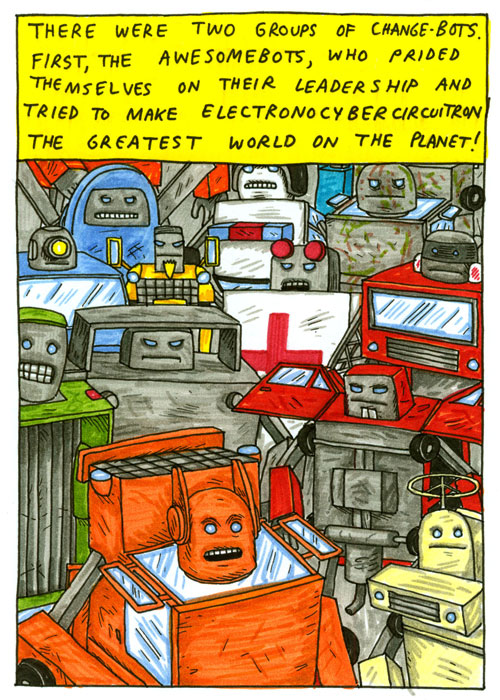
Released in August 2007, right after the release of the Michael Bay all flash re-vamp of the Transformers series, Incredible Change-Bots parodies the Transformers world of robot heroism. The change-bots live on Electranocybercircuitron in the midst of a War of the Roses a la robot, where the two leading tribes, the Awesomebots and the Fantasticons, battle for control over the planet they inhabit. Despite all efforts to succeed over the other tribe, both end at a stalemate and manage to destroy the planet they spent time and energy fighting over.

The two enter a shaky truce and decide to head to another planet, but, alas, their futile feud reappears on their spaceship in transit, and the whole group ends up landing on Earth after a few haphazard laser shots at each other. After their landing, the Awesomebots and Fantasticons reinitiate their war, but this time with human beings on each side. The two forces endlessly fight, and in the war on Earth, Brown introduces lots of jeering stabs at the plot “twists” we see from miles away in action and superhero films until the two forces, to yet again, lead to another robot war stalemate.

There is little to be said about the intellectual properties of Incredible Change-Bots beyond its warping and distortion of common superhero motifs. Ultimately, both the Awesomebots and Fantasticons are led by incompetent alpha-male type characters, which carries most of the comedy of the book. Brown’s re-envisioning of the Transformers’ Autobots and Decepticons as bumbling, clumsy, and myopic egoists delivers plenty of inappropriate laughs because these change-bots have no redeeming qualities to them and from their incompetence comes many moments of awkwardness, discomfort, and hilariousness.

Acutely honing in on all of the plot devices used in superhero movies to appeal to general audiences ranging from the peripheral love story to the interior betrayal to the hidden familial tie between enemies, Brown irresponsibly and cleverly uses the same plot conventions to turn the Transformers series into a complete and utter spectacle and debacle. But, in its comedic and absurdist approach, there is something oddly very human about the Incredible Change-Bots, for the change-bots act so badly because they possess more human foibles than any hero or protagonist in any superhero story. As a result, the change-bots stand less like the pinnacles of human virtue and more like robot versions of the Three Stooges.

As with most Jeffrey Brown novels, his comedy lies in the dialog, and the same goes for Incredible Change-Bots. The change-bots insult each other, comment on their own robot characteristics, and expel the best onomatopoeia when they transform from cars to standing robots. In addition, with every action each change-bot takes and every word spoken, you get a sense that Jeffrey Brown took a look at each item he encountered in the Transformers series and asked himself, “How could I make this both more absurd and realistic?”

With summer always bringing about superhero blockbusters (which do occasionally carry their own entertainment value), do check out the Incredible Change-Bots in parallel to that next outrageous super action film you see. It’s certainly a graphic novel challenging the motifs attractive to the summer superhero audience, but it will have you endlessly laughing and then cringing at the thought that you invested time into the fantasy of any of the films of the Transformers series or really any superhero series in the first place.

I’d love to think of a universe where Jeffrey Brown wrote all screenplays; it would be a world with fewer car chases and explosions and many more honest yet never caustic comments on the ridiculousness of the things that tend to capture our collective attention.

Incredible Change-Bots One and Two are available via Top Shelf Productions. 

Bovine Ska and Rocksteady 4/1/2015: Early Clancy Eccles

Standard

For the 1001 episode of the Bovine Ska and Rocksteady, we kicked off the show with an amazing version-to-version-to-version-to-version excursion with the Satta Massa Ganna rhythm, beginning with the original recording of “Satta Massa Ganna” by The Abyssianians.

After that trip down version road, we presented some more reggae, including the chilling and stunning “Devil in Bed” from Cornell Campbell.

After those first two reggae sets, we played the mento set of the week, which included a beautiful one from Laurel Aitken entitled, “Nightfall in Zion.”

Then, in order to glide into the spotlight on Clancy Eccles’s early recordings, we shared a set of Jamaican rhythm and blues, which included “Since Lately,” a very early track from Jimmy Cliff, long before his days in “The Harder They Come.”

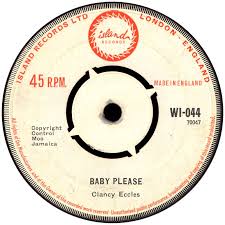
Clancy Eccles's Baby Please - Released in England on Island and in Jamaica on Moo's

Clancy Eccles’s Baby Please – Released in England on Island and in Jamaica on Moo’s

So, you may ask, why only the early Clancy Eccles tracks? In 1965, Clancy left the music industry as a performer and became a tailor and additionally a stage wear designer for Kes Chin, The Mighty Vikings, Byron Lee and the Dragonaires, Carlos Malcolm and The Blues Busters

Consequently, in the spotlight, you will only hear the songs he recorded before he took his two year hiatus from recording and before he returned to the music industry in 1967 when he would record again and produce other artists.

Born in Saint Mary parish in 1940 to a tailor and builder, Clancy Eccles began his love for music in the church. Particularly inspired by his uncle who was a spiritual revivalist, Eccles began singing at church as a boy. As a teenager, he moved to secular music, singing to tourists in the hotel circuit on the Northern Coast of Jamaica. Then, as a young man, he moved to Ocho Rios and performed in nighttime shows where he shared stages with the Blues Busters, Higgs & Wilson, and Buster Brown.

After working the live performance circuit for a few years, Clancy decided to move to Kingston in 1959 where the recording industry was beginning to rise, and eventually, he began working with Coxone Dodd. He first recorded Freedom for Coxone, which was a single played on his sound system before it was pressed for distribution. As a political song discussing repatriation to Africa, Freedom was actually one of the earliest songs to be used in a political campaign; Alexander Bustamente used it in his battle against the Federation of the West Indies in 1960.

You’ll hear Freedom to kick off the spotlight on Clancy Eccles’ early recordings.

By 1962, Clancy began running his own talent shows and producing live shows for artists such as The Clarendonians and The Wailers. The next year, Clancy began working with other producers including Charlie Moo and Lyndon Pottinger. You’ll hear his work from these producers in the second part of the spotlight.

Happy April! Hope you enjoy the show!

Listen to this episode HERE

The archive link will be available until 4/14/2015.


Apocalypse by Trees: Warren Ellis’s Trees

Standard

Given the revival of zombies and other forms of apocalypse in modern media and culture, perhaps today’s media creators are all honing in on a general instability hiding under our technology age where the future seems bright but something rotten lurks underneath.

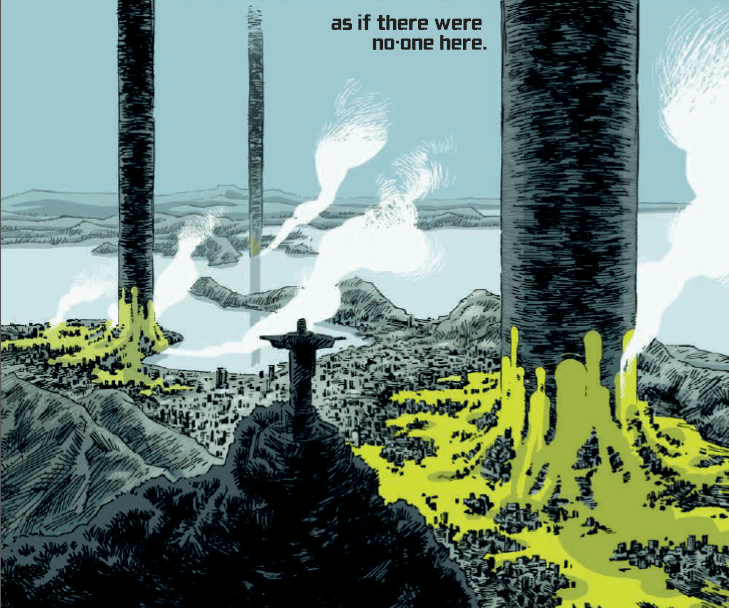
Warren Ellis’s Trees capitalizes on the concept and the fear of the apocalypse in the modern age with alien tree-like creatures falling from space and landing on Earth. However, unlike the zombies and any active attacking force galvanizing the end of the world, the trees rule and stand with a nearly silent presence, growing and oozing a mysterious green acidic liquid. In a way, the trees do not intentionally inflict malevolence on the humans and communities of Earth. They simply grow and live, but as they flourish, they interrupt human life, landscapes, natural resources, and societies, leaving humans to adapt in the wake.

Cover for Warren Ellis’s Trees Volume One

Given the indifference of the trees, they really cannot serve as villains in the series. Consequently, as seen in the wake of most natural disasters, the enemies and the heroes rise from humans as they try to live in a new world from the rubble of the past. And though the non-sentient trees now control the world without communicating their intentions (or really even having the facilities to do so), evil rises in varying degrees from different people futilely grasping for control, and good rises from people understanding the triviality of life given the inexplicable damage of the trees and have thus tried to adapt and life as freely and happily as possible.

The first volume of Trees compiles the starting eight issues and covers the reactions and survival strategies of people across different classes and countries across the world. In this first volume, we see how politicians, dictators, scientists, farmers, painters, lower level gangsters, police, and everyday, regular people live in the shadows of the trees. Each group of focus brings a radically different perspective to the circumstances, and given the direness of the world of the trees, each group’s intentions are truer to their characters and personas than ever.

In this first volume, a scientist studies in isolation in Norway, unrelentlessly and irresponsibly committing everything to understanding the tree’s expansion. An uncommonly wealthy man in Rio de Janeiro contemplates on his political career and his desire to change the current regime of law enforcement. In the city of Shu, a former farmer crosses barricaded gates to enter an artist and freak community centered and thriving around a tree and separated from everyone else by concrete walls and military guard. In Somalia, a dictator plans on using a tree as an object of military strategy. And, in Cefalu, small time mobsters reign over the mostly abandoned wasteland caused by the arrival and permanent residence of a tree.

Despite the presence of these uncaring and unrelenting trees in these people’s lives, the world has really not changed too much. Power struggles still exist. Kindness still exists. Brutality still exists. Greed still exists. Vices and virtues all remain the same but each has been magnified, and the territory between has become even more unclear in this world. And, this grey area is what makes Trees a fascinating read because this amplified ambiguity between good and evil parallels the same territory in our globalized, technology linked world.

Undoubtedly, the fiction of the trees linger in the background of the narrative, but they exist exactly the way they do in the world of the series as silent, domineering giants, ready to make a move that could dissolve an entire community at any moment. Consequently, a sense of transience runs throughout every branch and arc of Trees. Unlike in most fiction, a character or setting can disappear from the narrative at anytime due to the unpredictability of the trees and the administrations of the various people who attempt to run the world, making the fictional world detailed in Trees far less different than our own transient real world.

Absolutely an exercise in existentialism, as expected from most post-apocalyptic works, Trees asks plenty of hard questions about human motivations and purpose. Each character in the series approaches the question in a different way in light of the mercurial and death-inducing trees, and in turn, Ellis asks us to think about our own existence in reality where life is just as fragile and temporary. Despite the heavy topic, the combination of Ellis’s prose-like narration with fluid dialog and Jason Howard’s semi-realist artwork makes Trees emerge as more of a naturalist rather than allegorical work. Though it may border the line between insightfully powerful and heavy-handedly pretentious, Trees has the potential to capture and interpret all of the struggles, conflicts, and moments of hope seen in modern times around the world, preparing it to become one of the most comprehensive series offering commentary on the experience of living as a human being on Earth in the 21st century.

Trees Volume One is written by Warren Ellis and illustrated by Jason Howard. This first volume collects issues 1-8, and issue 9 will be available in May.

Bovine Ska and Rocksteady 3/18/2015: Joe Higgs

Standard

In this week’s edition of the Bovine Ska and Rocksteady, we kicked off the show with early reggae with Bob Andy’s beautiful “Unchained” as part of the show’s dedication to Bob Andy, who was stabbed in a robbery on 3/13/2015. Thankfully, his injuries were not fatal, and he is recovering and healing.

In the second set of reggae, we heard a version-to-version of Shenley Duffus & The Upsetters cover of The Moonglows’ “Sincerely.” A hit on the U.S. Billboard R&B charts for Chess records, “Sincerely” gets a great treatment in reggae for Lion records. For the mento set this week, we were thrilled to share “De Buggy Bruck” from Louise Bennett’s album “Listen to Louise,” a new record discovered over the weekend.

Before the spotlight on Joe Higgs, we focused on some ska gems before beginning the spotlight. In this ska set, we featured “Fire” from The Leaders, a trio long overdue for a spotlight on the BSR given that the group consisted of superstars Joe White, Roy Shirley, and Ken Boothe.

Joe Higgs’ The World Is Upside Down from 1971

After the set of ska, to kick off the spotlight on Joe Higgs, we presented his early solo recordings for Coxone’s Studio One.

Joe Higgs began his music career with Roy Wilson in the duo Higgs &Wilson. The two lived on the same street and actually met and began their collaboration at a contest where eight solo contestants were to be selected from ten to move to the next round, but the promoter could not narrow the group down, so he asked Higgs & Wilson to compete as a duo. Together, Higgs & Wilson reached great popularity early, with their first single, “Manny Oh,” a production from Edward Seaga that sold 50,000 copies. Consequently, as a musician of note early in the Jamaican music scene, Higgs attracted a group of young musicians in his yard in Trenchtown, whom he mentored and taught. One of those musicians was Bob Marley and two others were Bunny Livingston and Peter Tosh. Beyond his teaching, Joe Higgs continued to perform with Roy Wilson and saw additional success with Coxone Dodd, who Higgs would continue to work with during his solo recordings after Roy Wilson emigrated from Jamaica to America in 1964.

As part of a well known Jamaican duo, Higgs took a break from recording after working with Coxone as a soloist and performed as a guest vocalist for both Carlos Malcolm and Lyn Taitt’s groups on the hotel circuit. When he returned to recording, Higgs worked with a variety of producers, including Harry J and Rupie Edwards, who he recorded some of his finest solo records with. These were the tracks of the second set in the spotlight.

Higgs also had his own label, Elevation, which he named after his own ability to elevate himself from a dark and hard world. From the Elevation label, we shared “Let Us Do Something,” a release that was as DIY as can be. Joe recorded multiple parts on the track, including guitar, in addition to singing. He also completed the lettering on the label by hand.

In 1972, Higg’s song, “Invitation to Jamaica” won the Jamaica Tourist Board Song competition, which allowed his to tour the U.S. and also brought him further popularity, so much so that Chris Blackwell planned on releasing Higgs’ debut  LP for Island Records that same year. This LP was “Life of Contradiction.” Blackwell did not release the LP because he felt it would be too difficult to market, but it was eventually released by Pete Weston’s Micron Music in 1975, and thankfully so because the songs on this record have amazing layers of rich sounds.

“Mademoiselle” rounded off our spotlight on Joe Higgs as our favorite of his recordings.

We hope you enjoy this show!

Listen to the archive HERE.

The archive will be available until 3/31/2015.

Stay tuned for the show on 3/25/2015. It will be a celebration of the 1000th edition of the Bovine Ska and Rocksteady!!!


Hello to a New Age of Marvel Heroes: The Unbeatable Squirrel Girl

Standard

In the past few years, the folks at Marvel have definitely tried to expand their repertoire to better suit today’s more culture, gender, and human aware world. From Ms. Marvel to Captain Marvel to Hawkeye, the publisher is definitely trying to shift their line of comic books away from macho, stoic white male superheroes to relatable (in both character and image) yet flawed male and female characters facing struggles against both villains and common human problems.

As part of this progressive movement, Marvel introduced in 2015 a new character and a new series with The Unbeatable Squirrel Girl.

Cover for Issue One

With the release of the first issue, an enormous amount of praise went out to Ryan North, Erica Henderson, and Rico Renzi, and after diving into the earliest issues (it’s only three issues in so far), I must admit The Unbeatable Squirrel Girl deserves the excitement and praise directed toward it. North has created a hilariously goofy and yet all the more charming character, and Henderson and Renzi have created a perfect visual style to match, but what really makes this series shine are all of the small details included in each issue to make the story richer and often funnier and allow us to understand how Doreen Green, our protagonist, fits into the rest of the Marvel world.

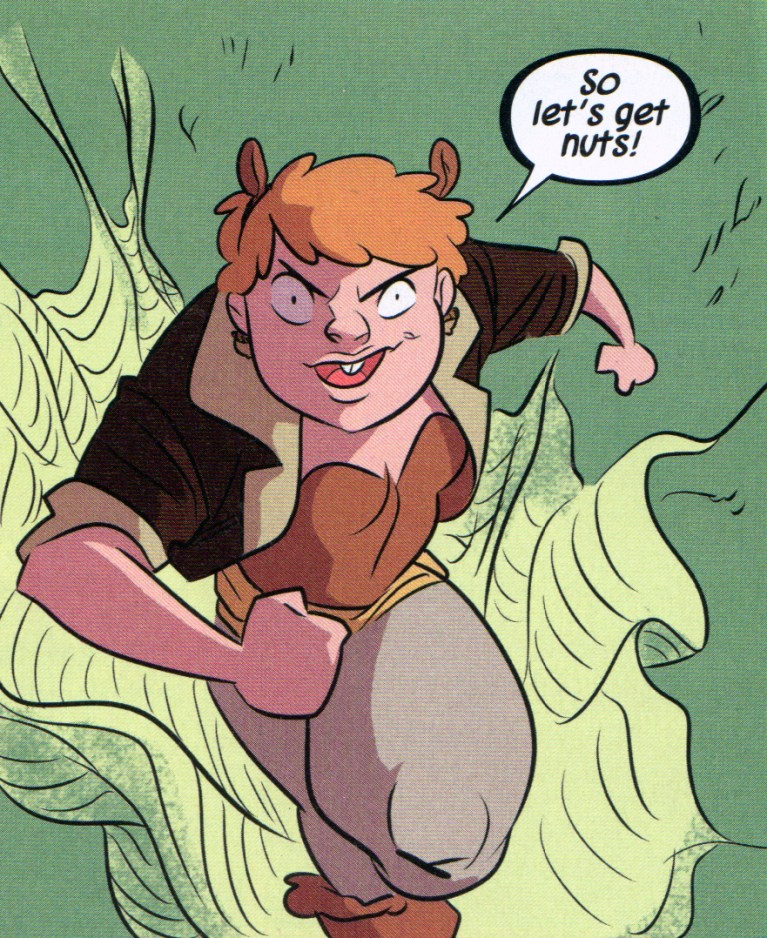
Doreen Green is part girl and part squirrel. She possesses strength and agility and an overall excellent sense of humor. She battles villains with her sidekick Tippy with ease, but now, she faces a new challenge: college.

The series opens up with Doreen on her move-in day for her first year of college. Already a time challenging for most humans, Doreen will have an even tougher time in school because she must (like so many superheroes before her) try to integrate into society as a somewhat normal girl while maintaining watch and diligence on the world around her for any approaching villains.

In the first issue, Kraven the Hunter pays Doreen a visit on her college campus, and before she even has the time to unpack her boxes, she must already shed her “normal girl” identity and reveal her superhero costume and her hidden tail. With Kraven’s visit, the false hope she had to live a regular life shatters with the reality that danger lurks all around her and her own responsibility to face that danger. In addition to her superhero duties, Doreen also must face the awkwardness of making new friends, living with a complete stranger, and developing a crush, which is really why I return to this series (and suspect why others will too!).

The Unbeatable Squirrel Girl carries plenty of laughs from Doreen alone with her self-effacing humor, social clumsiness, and overall frenetic tendencies (after all, Doreen is part squirrel…), but as I mentioned before, North and company pack many small details into each issue to fortify the comedy in this series. From Deadpool’s Guide to Super Villains and Super Villain Accessories to Squirrel Girl’s theme song, North has put a lot of love into making The Unbeatable Squirrel Girl not just an action filled superhero comic but also one with humor, joy, and vivacity to accompany Doreen’s hyperactivity.

A Kraven the Hunter info card from Deadpool’s Guide to Super Villains Card Series

Furthermore, The Unbeatable Squirrel Girl has a feature that makes it more charming than almost anything else out there: a protagonist who also acts as a direct narrator to the audience independent from the narrative. At the bottom of each page, in pale text, Ms. Doreen speaks directly to the reader, giving her own feedback on the events in the panel on the page and providing further detail into her character. Combined with the conversations, comments, and interactions on the panels, these sentences lingering at the bottom of the page create a series with a character who readers can identify with and almost even interact with.

Like the other Marvel series I mentioned at the beginning of the review, The Unbeatable Squirrel Girl is emerging to become a more character-driven series with a relatable, approachable, and realistic lead. Gone are the days of valiant, knight-in-shining armor heroes (which I truthfully do like; I began my own love for heroic characters from reading Sir Thomas Malory’s Le Morte d’Arthur). We’re now in an era of heroes who have real lives and face similar growing and life pains as we do while they continue to commit heroic acts. Despite my own love for the tradition of heroes, I wholeheartedly welcome Marvel’s next generation of comic book leads, for they better suit today and bring a fresh and bright light to a concept that was almost obsolete in our morally ambiguous world in need of more complex and more human heroes.

The Unbeatable Squirrel Girl Issues 1-3 are available NOW! Go get them!