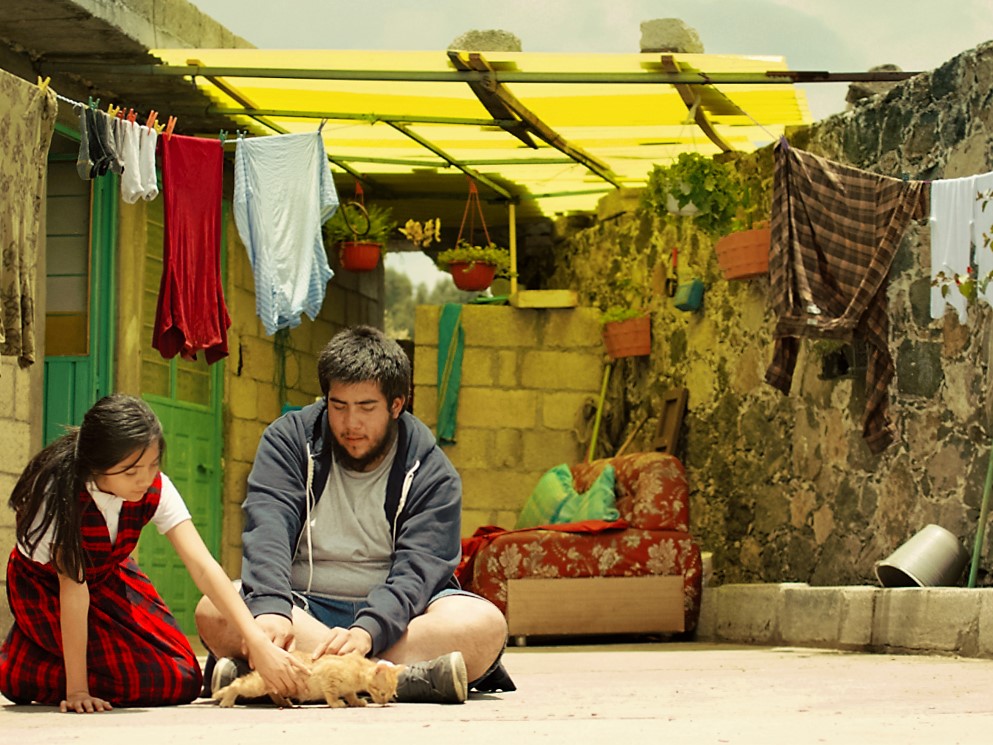
Anca Miruna Lǎzǎrescu

Standard

Originally published in Ink 19 on May 22, 2017

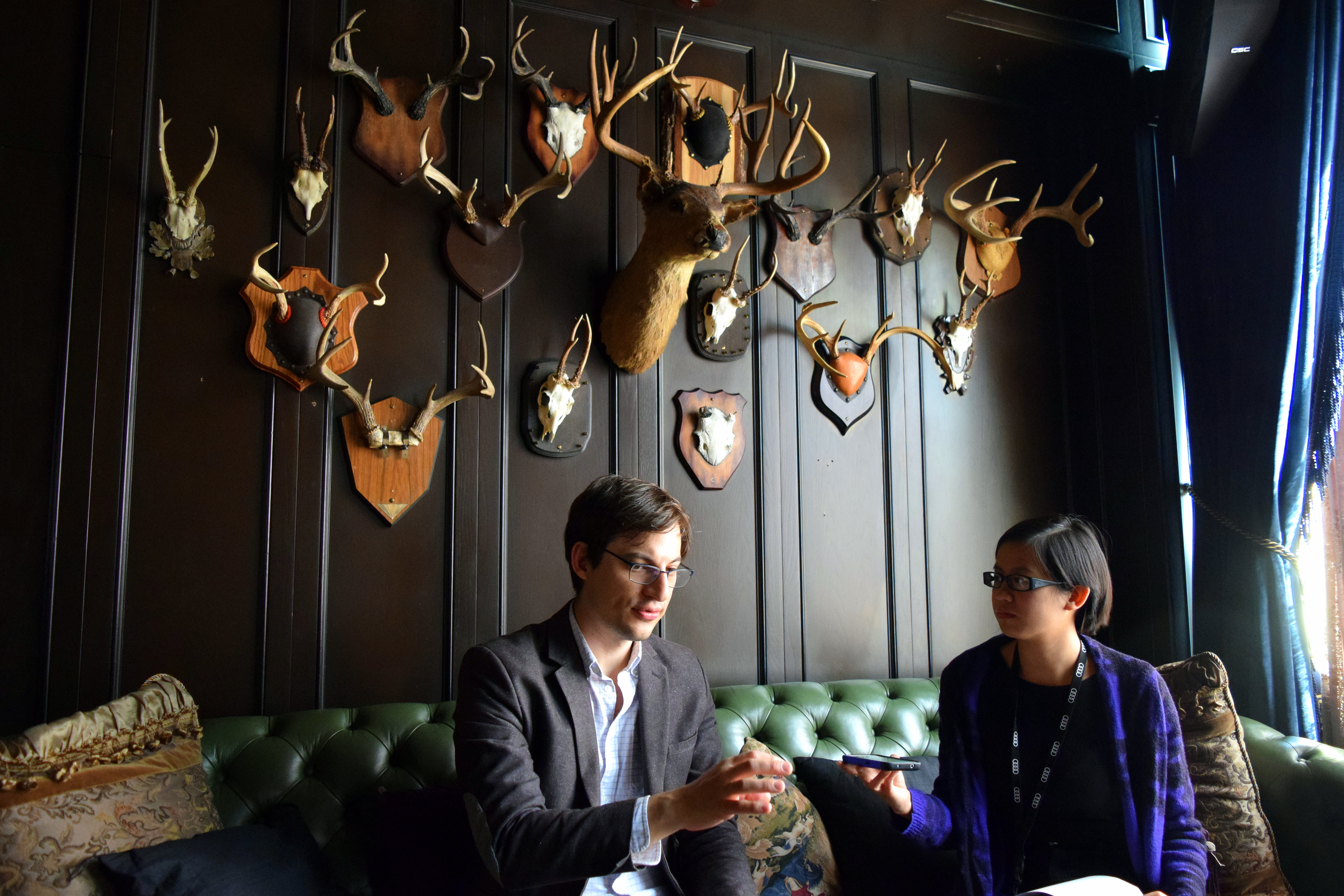
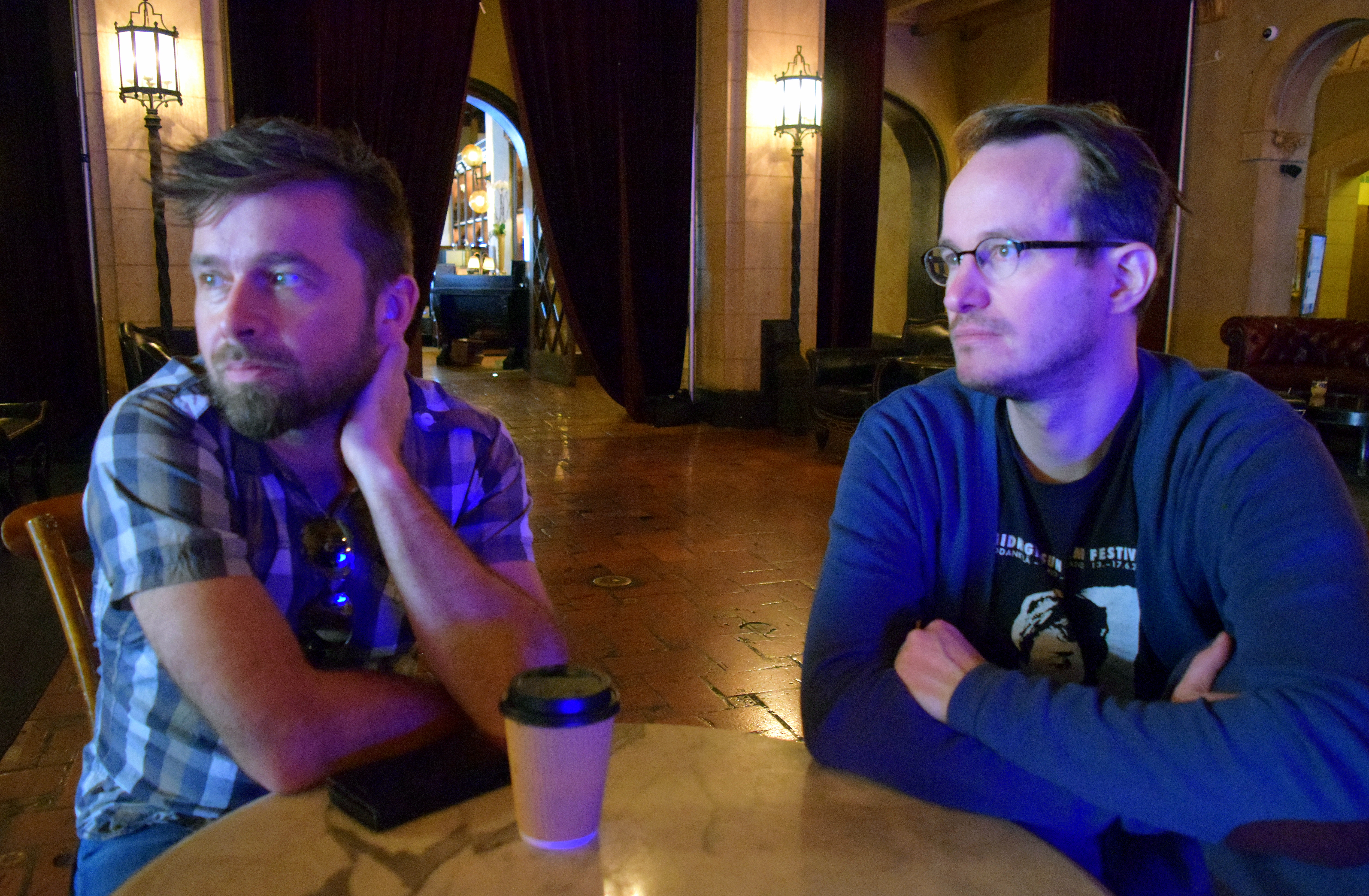
During the next to last night of SEEFest (the South East European Film Festival), which took place in Los Angeles from April 27 to May 4th, I was thrilled to have a conversation that was long in the making…A decade ago, when I was co-curating the European Short Film Festival in Boston, we programmed a clever short film that we enjoyed from Romanian director, Anca Miruna Lǎzǎrescu entitled Bucuresti-Berlin. Five years later, we not only programmed her short, Silent River, but it impressed us to the degree that we awarded it our top prize. At SEEfest, our conversation centered on her wonderful feature debut, That Trip We Took With Dad, a sometimes absurd, comedic drama based on her own family’s experiences during a trip to Germany in August of 1968 that was disrupted by the Soviet invasion of Czechoslovakia.  


Interview conducted by Generoso Fierro

GF: Back in 2007, I was co-curating the European Short Film Festival at MIT in Boston, and we selected your film, Bucuresti-Berlin, which stars Ana Ularu as a young Romanian woman who immigrates to Berlin. Her story is told urgently, but ends lightheartedly. Five years later, we awarded our top prize to your short film, Silent River, which is a story of three desperate people who attempt to sneak over a border in the dead of night that is presented as pure drama. When you were originally writing the screenplay of your family’s story for That Trip We Took With Dad, which some describe as a comedic drama, did you feel compelled to balance the tone due to the differences between your previous short films about immigration? Do you feel that your family’s story that you depict in your debut feature has naturally comedic elements in it?


AL: Yes, I would say that it definitely does. I grew up with this story, which I am sure that you have read about by this point. That Trip We Took With Dad is indeed based on my father’s story, and it was told to me so many times, usually at the Christmas table after presents were exchanged, so there was always this kind of nostalgia in the air, and whenever this tale was brought up, there was always a level of melancholy in the room that always presented the question, “What would have happened if we had decided differently and stayed in Germany?” I really did grow up with this story being an integral part of my lifein fact I cannot even remember the first time that I heard it. So, it was part of my family’s story, but it is also very common in Romania to tell such a tragic story with one happy eye and one sad eye, as people would say, so it is in my blood to tell such a tragic tale in a light and even an absurdist way so that in certain moments, one doesn’t know whether to laugh or to cry.

Starting with the story itself, it is a family story, one where the family is given a present that they don’t even want to have in the first place. It is a burden to make a decision of such importance about your future when this choice is one that you never imagined having to make. So, when I start writing a script, I am always analyzing, which I know sounds very rational, but I would say that it comes more from my gut because I really rely on my intuition to guide me in crafting the exact tone so that scenes hit the emotions of the viewer in the way that I want. In the case of my short film, Silent River, it is a straightforward story about three people who are trying to survive, and the characters have their own existentialist dilemmas as they struggle to cross the Danube and have to trust each other in multiple capacities, making the film more of a drama than a tragic comedy, even though a lot of criticisms suggested that Silent River does have some light, more relaxed moments. But, That Trip We Took With Dad does not have that same existential dilemma attached to the main character, Mihai, whose responsibilities as a makeshift maternal figure to his father and brother drive his behavior and actions. In the end, it is a family story, and that family is chaotic and has a main character who is juggling the problems they face to try to keep the family together. The character of Mihai does have a plan on how to fix things, but this plan gets challenged because of his dad’s health and his crazy little brother, who Mihai must act as a mother to because their mother has died. And then, even his backup plan gets ruined by the Soviet invasion of Czechoslovakia, so they end up in the middle of a socialist commune in West Germany, and that is why for me there was no issue in balancing the tone because what actually transpired was already so absurd.

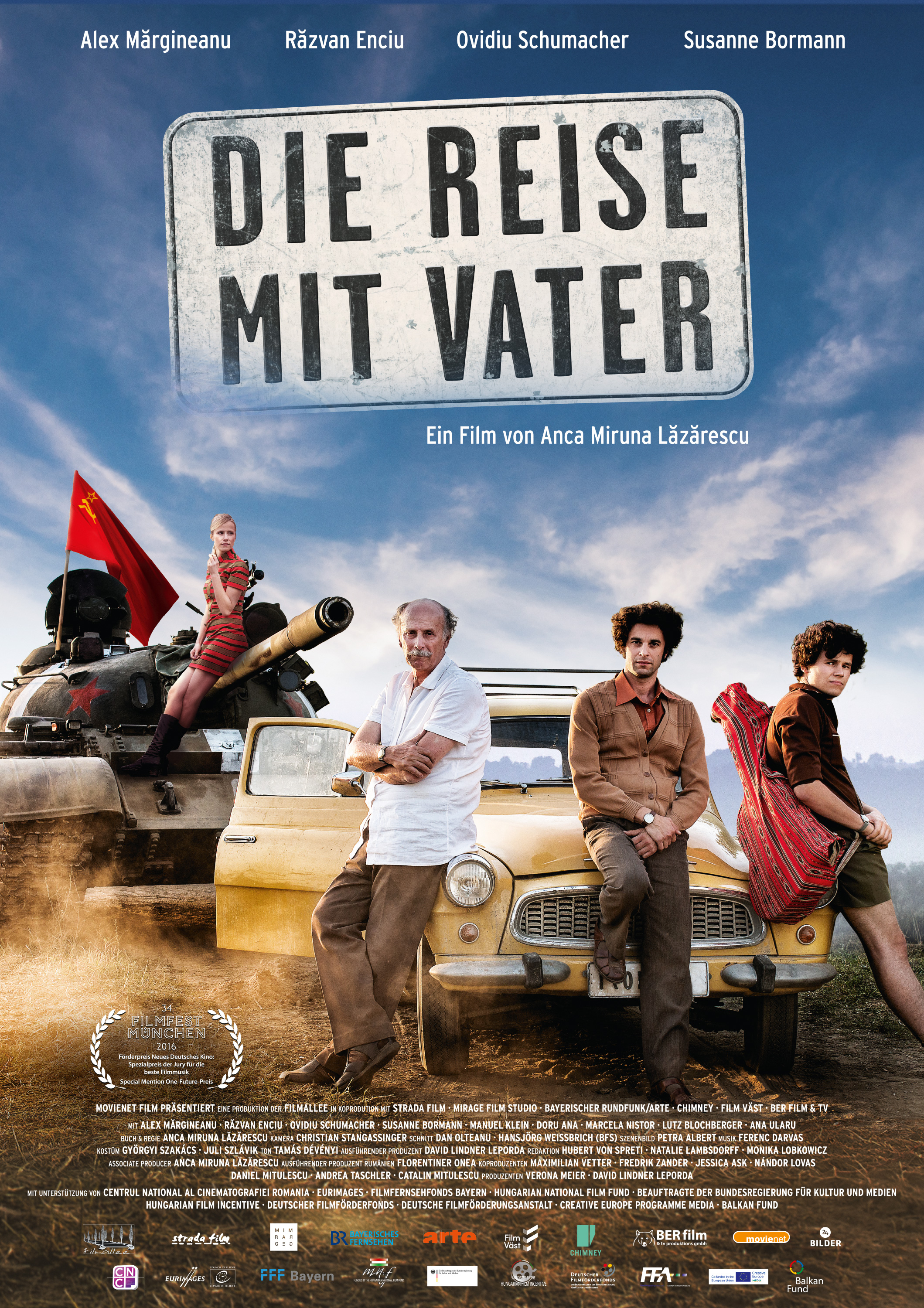
The stars of That Trip We Took With Dad (from left to right) Razvan Enciu, Alexandru Margineanu, and Ovidiu Schumacher


GF: As I understand, the character of the younger brother, Emil, is your father in the story, but you center the film on Mihai, Emil’s older brother. Can you discuss your decision of making Mihai the center of your film?


AL: I loved the story that my father gave me, and I loved this idea of being able to love and to hate and to be full of passion for your dreams and ideals, as I was the same way between the ages of sixteen and eighteen, but when I started writing this, I was already in my mid-twenties, and at that time I felt that Emil was a perfect antagonist, a perfect troublemaker, perfect to cause a disruption of all of someone’s plans. For me, I was already embedded in my life in my mid-twenties, so I was too far away from seeing life in a clear, black and white way as I did when I was a teenager and was well aware that when I was older that most issues had shades of grey in them. In my first version of the screenplay, I tried telling the story with the characters being a mother, father, and an eighteen year old. I completed the entire first draft, but when it was all done, the story was just not there, and by that I mean it was just not as complex as I had hoped for. This leads me to the day that I killed the mother character, which was one of the best days of my screenwriting process for this script because I really felt that a female role in that car traveling from Romania to Germany was not what I wanted. I realized that the interactions between three men who forgot what it was like to fall in love and to have passion would create the tension and conflicts I was interested in, so that is when the character of Mihai, who is based on a real person, rose up as the central figure of the story, as the character and the real person did have a huge influence on me, but in reality, my father did not have an older male sibling, so I think that the final decision to make Mihai central in the story was that the character reminded me of myself in that time, and Emil was my father when he was young.

Razvan Enciu (left) as Emil, and Ovidiu Schumacher as William


GF: As we are discussing the character of Mihai, I understand from a previous interview that you wrote a backstory about Mihai and Ana Ularu’s character, Dr. Sanda Berceanu, that was not intended for use in the final cut of the film, but only to serve as motivation for the character of Mihai? Was there ever a desire to add these scenes as to more clearly define Mihai’s feelings towards his brother’s relationship with Neli and Mihai’s overall disillusionment with his own reality?

AL: Well, to tell you the truth, the director Anca is quite happy with the final cut of the film, but of course there are some details that I would like to shoot differently, but all in all, I am very happy with the film as it is now. Now, the scriptwriter Anca has a lot of questions like, “How can it be that such a huge, beautiful, long script had to be chopped?” and the answer is in fact quite simple. This romantic backstory that I wrote for Mihai that I thought, and many of my colleagues thought, was a very strong scene was one that we indeed shot and then had to delete, which you can see for yourself as part of the DVD extras when it is released on May 19th. I personally thought that it was a bit ridiculous to not give this handsome, young doctor a love story—I mean he cannot be a monk afterall! I had written this scene and was so glad that Ana Ularu came to casting and performed the scene, besides the fact that we are such good friends and have worked together before, her performance is wonderful, and I have issues with it not being in the film. Also, I felt for Mihai that there must be someone who ruined his possibility of a romantic relationship, for in the scene, she is pregnant and has a new husband, so I am somewhat bothered by the loss of this part of the film, but, in the end, the editors felt that it was an important cut as we agreed that being that the scene in question occurs early in the film, and that stylistically at least, given that the film is a road movie, we should not delay their travel scenes any further in the narrative.

GF: You show Nicolae Ceaușescu’s August 1968 speech condemning the Soviet aggression in Czechoslovakia, but a year later we know that Ceaușescu would invite Richard Nixon to Romania, which led to many Romanians disillusionment with their leader. We also see a disillusionment with Dubček occur after the Soviet invasion. Does the betrayal felt by Mihai’s father foreshadow the way most loyal Socialists would soon feel in Eastern Europe? Do you feel that betrayal is the underlying theme of your film?


AL: I thought about this a great deal when I was editing the screenplay. My main topic for this film is “How free are we to choose freedom?” because, my theory about freedom is the line that Janis Joplin sang, “Freedom’s just another word for nothin’ left to lose,” so it is easier to speak about freedom and make the decision to be free when you have family, or if you have a burden, or if you have such a system like where I grew up, and so, I thought about this question for Mihai: How free is Mihai actually to choose freedom, and is the freedom in the west really the freedom that he is looking for, or is it some kind of inferior freedom that he is allowed to reach? I think that at the end of the film, he is as free as he would ever be. As far as Ceaușescu’s speech in 1968 that you mention, I grew up with a father who blamed himself for all of his life for the decision that he made to go back to Romania. He took almost two years to realize that he made the wrong decision because when he came back home, he and his girlfriend Neli really did break up the way I show it in the film, and Ceaușescu did not become the Romanian version of Dubček that he so hoped that he would become. So, this speech and this particular moment that my father faced in the west had a huge influence on his life because, whenever he told me this story, tears filled his eyes.

On the one hand, my father blamed himself for what he did, but on the other hand, he never felt the level of pride of being Romanian than the way that he felt during those days of being in West Germany during that time. Many people congratulated him on the street when they found out that he was Romanian. Even the German policemen, who picked them up on the road when they ran out of gas, congratulated them because of the speech that Ceaușescu gave, and my father, who always felt that he came from a country that was usually considered second class, suddenly he believed that he came from a place that could emerge as a strong voice in Europe, and maybe that this was indeed the right way to live your life, away from the capitalists who lived in West Germany. You have to understand that during this moment, Ceaușescu really believed that he was right, and, in fact, he was right in his condemnation of the Soviet aggression against Czechoslovakia, but as you know just a few weeks later Ceaușescu was called to Moscow, and after that, no one was allowed to even mention his speech in Romania. That is why I needed to add this speech into the film, and the result is that many people who have seen my film in the west, and even some back in Romania, discovered that they were unaware that this speech even took place.  

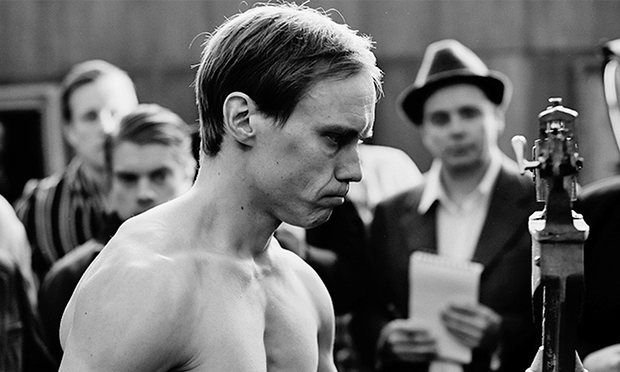
Alexandru Margineanu as Mihai


GF: I’m impressed you went as far as to create a band with a sound from the period called The Stormy Sundays. I know that budget may have played a role, but what was your impetus for doing this and not simply acquiring a song from a lesser-known band of the era? Being that this is a period film, was there a concern for using a song that may have been used in the past in another film that would have evoked different emotions and sentimentality that you wouldn’t have wanted?  


AL: When I was writing the film, Creedence Clearwater Revival was a huge influence on me; they inspired me so much. They were a good guiding point because, although their songs may sound uplifting, there is a depth to the lyrics, and here I am thinking of their song, “Bad Moon Rising.” The budget sadly wouldn’t allow for the use of their music, but we were so lucky to have found songwriter brothers from Nashville who recorded music that was perfect for the era. Also, with Mihai, I wanted something that truly belonged to him and whenever you start to imagine that Mihai would be a huge fan of Creedence, you would then immediately have an opinion on it, or as you say, it would draw up personal feelings and opinions. There is also the concern that people might start wondering if Creedence was even music that Mihai would have heard in Romania in 1968, so all of these factors played a role in acquiring music specially made for the film.  

GF: Thank you Anca for this interview and for your film.
Kivanç Sezer

Standard

Originally published in Ink 19 on May 25, 2017

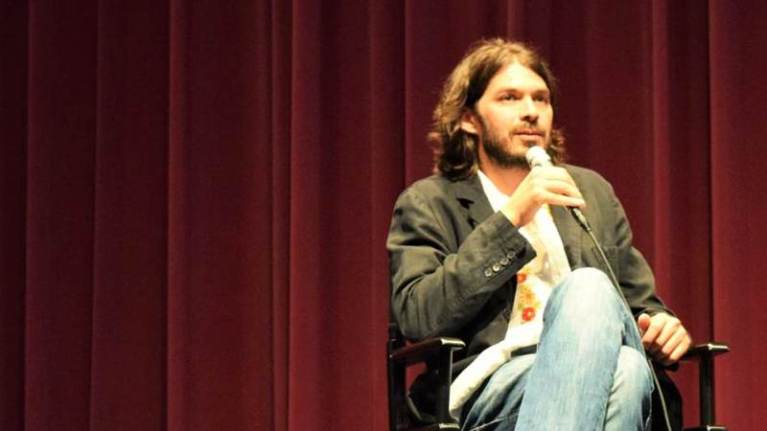
We saw over fourteen feature films at this year’s SEEFest (the South East European Film Festival) in Los Angeles, but the film that most impressed us was My Father’s Wings (Babamin Kanatlari), the debut feature from Turkish director Kivanç Sezer. Inspired by a workplace accident that claimed the life of a university student in the director’s native Turkey, Sezer’s film draws attention to the issue of poor worker safety that has become a crisis because of unregulated subcontracting practices in the high profit market of constructing new homes in high rise buildings that meet updated earthquake codes emerging after the destruction caused by the 1999 earthquake in Istanbul and the 2011 earthquake in Van, along with the ongoing concern of the impact of expected future earthquakes. We sat down with Kivanç Sezer to discuss his feature in depth, specifically focusing on how his education in bioengineering impacted his creative process, his character development, as well as choices in how he depicted the different cultures that exist in contemporary Istanbul in his film.  : After the screening at SEEFest of your debut feature, you stated that your intention for creating it was to draw attention to Turkey’s dubious distinction of leading Europe in worker-related fatalities. We know that some of these issues are due to an increase in construction because of the Turkish earthquakes in 2011 causing a severe homelessness situation. Has this already dire situation been exacerbated by Erdoğan’s decision to prioritize the building of an overpriced presidential palace? Was his action to disregard the crisis further inspiration for your need to create this film?

KS: The Van earthquake of 2011 actually did not affect the whole country. However, it had a very strong effect on the region and on our character, İbrahim, who is from there, but Istanbul was central to the script construction, and therefore it is the main setting for the film. Now, regarding the story, my main inspiration was a news article that I read in 2010 about a university student who was working on a construction site and was killed there. It deeply affected me, and this started my interest in the subject. After I began researching this incident, I began to realize that worker safety was a large problem that was not being covered by the news, and this situation is symptomatic of a system that does not give working class and poor people proper access to education, so they are forced to work these kind of jobs while attending school. The safety problems in many of these workplaces are well known, but the bosses are just concerned about their profits. When I started going to worksites to do research, it became apparent that the building industry is the driving force of the Turkish economy, but on the other side, the government does little to control the hazardous situations that many workers face every day. The government is just focused on the wealth that this industry brings in and little else, as there is high demand for the apartments that are being built, a demand that is not only coming from within Turkey, but also from Arab nations as well. Investors pump money into these projects and hire contractors who demand quick results. So, my main concern was to address this hyper-profit driven model and the resulting human stories within this growing but broken industry. As for Erdoğan’s palace, that is something else. It is a high profile example of the issue, but the safety problems going on all over Turkey are more dramatic. I am deeply concerned about these workers’ safety and wanted to make a film centered on them.

İbrahim (Menderes Samancilar) and Yusuf (Musab Ekici) and their colleagues at the building worksite


LF: Based on your film’s subject of building construction and your personal interest in workers’ stories, we would like to get a better understanding of your shift from engineering over into filmmaking. One of the things that I found interesting about your film is the way you put it in the context of fears of future earthquakes. In one scene, we see a couple interested in buying an apartment in this building because they want a space that is more structurally sound. Was part of your interest in human stories partially derived from your own decision to depart from engineering and to become a filmmaker? And, did your understanding of engineering lead you to focus in on this specific situation of construction dangers for the subject of your debut film? I ask this because, when you are a scientist or an engineer, scenarios happen a lot in the field where you create some sort of solution on paper, but you might not completely think of the impact of that solution on the people who have to build it.


KS: Let me add one additional point regarding the earthquake. Before the 2011 earthquake in Van, a very strong earthquake happened very close to Istanbul in 1999, and thousands of people died in the Marmara region. So after this incident, all construction regulations changed and adapted to prepare for an earthquake in Istanbul that the experts predict will occur in upcoming years and will cause thousands of death when it arrives. Coming to my education, yes, I do believe that my background in engineering had some influence on me in terms of this project, but my background is in bioengineering, so my work was mostly done in the laboratory. When I was studying, I appreciated the notion of optimization in engineering, and that, I do believe, affected me when I was creating my characters. In a way, I optimized my characters for the story. The story itself has a context and a backdrop, which in this case is construction, but it also has an internal aspect in it as well as drama, which both come from my heart and not my mind. My engineering background will always influence my mind in some way, but I am trying to find the stories that touch my heart, and then through my heart, I go to screenings to see audiences and hope that it reaches them in the same way. I put this husband and wife in the film because they are like many people who are looking for a place to live and who are afraid of the upcoming Istanbul earthquake, which they are sure will happen, and so they want to buy a new house which will be constructed properly. You see a predominance of the buildings that were constructed before the earthquake that were not built properly and were consequently damaged, and that is why this couple wants a flat in this new building. This couple is important to me as they are buyers, and they are the ones who will be paying for this apartment for ten or twenty years with a huge mortgage, so they are the ones who keep this system intact, and that is why they are going to be the focus of my second film of this trilogy. In the third film in the trilogy, I would like to then focus on the lives of the big bosses who make this building happen with all of the corruption and money that is involved. So, the connection will be from the earthquake to the construction and from the lower, middle, and upper class people involved.

GF: Hearing now about your plans to create a trilogy centered around this building, I cannot help but to be reminded of Krzysztof Kieślowski’s Decalogue, which you know adapts the biblical Ten Commandments in a modern context by playing out each one through the lives of the residents within one housing complex. Was this series an inspiration to you at all?

KS: Actually, Kieślowski’s Three Colours trilogy was my inspiration for these films in terms of overlapping stories in three different films. For instance, you see a character from White in Blue as an extra in the background, and then in White, that character you saw in Blue is now the focus, and that is what I want to do in my trilogy. That is why I show the couple who is looking to buy an apartment in My Father’s Wings, for they will be the subject of the second film, and in the second film you will see a glimpse of the big bosses who will then be at the center of the third film. There will be a lot of interactions between them, all of which I feel connects them, which is important, for in life, we are not usually aware of these connections. You are usually not aware of who built your house, or if someone died while they were building it, and it is that kind of alienation that keeps us going, and I think that cinema can break this kind of alienation and obliviousness that we have.

GF: An aspect of your film that we also found interesting was the depiction of faith between the character of Master İbrahim and Yusuf. İbrahim is an older family man, who is seen praying at the mosque, whereas Yusuf uses colloquialisms attached to faith, almost with a level of disdain, and seems to be more of a secular being. Can you discuss your intentions with the faith depiction within these two men? Is this simply a comment on these two different generations?

KS: Faith is an important element in the film, and for İbrahim, his is a pure religious faith. He goes to the mosque to pray, but he also gambles as part of his character. The bad things that he has done in the past are also part of him, but then he decides to quit doing bad things, but his dilemma still remains: his faith is not enough to make his life better, which drives him to the edge where he must confront his reality of needing money. This leads İbrahim to the decision to commit suicide so that he can receive compensation money from the company that hired him which he can leave to his family, and this, of course, is a sin. Yusuf on the other hand, has little religious faith and only believes in himself and his future, a future that he believes will bring him success as he will rise through the ranks and no longer be a worker, but perhaps a contractor himself with his own company someday. In a way, their perspectives on life connect these two characters, because, to me, they are the different sides of the same coin. They both are looking in different directions, but at the same goal and with the same level of self-sacrifice. I should also say that without the character of Yusuf, the film would be too grim, giving little hope to the audience to sustain them throughout. Yusuf is also important in adding a level of humor and a look into the younger generation in Turkey that hopes for a positive future. One critic remarked that Yusuf is actually the central character of the film, and not İbrahim, which I am fine with as I am aware that they are very close to one another, so to designate one or the other as a supporting actor was not that important. Establishing the unity between this uncle and nephew was more important to me.

İbrahim (Menderes Samancilar) reflecting after gambling away his money

LF: In terms of their unity, İbrahim and Yusuf are different when it comes to faith, but can you speak of the halay (dance traditions) that connect them and many of the characters to the region they are from?

KS: İbrahim and Yusuf are Kurdish, and the Kurdish people express a good amount of their feelings through the halay. In demonstration, people dance the halay; at a wedding, of course, they dance the halay, and even while they mourn, they dance the halay. It is very common, and during my preparation for the film, I watched a lot of videos of workers dancing at construction sites. To me, it is a sign of life because in the construction site — where it is so cold, where it is so grey — they need something to carry on, and for these characters, dancing the halay is the will for life.

GF: Understanding the importance of dance in the Kurdish culture increases the impact of the scene when Yusuf, after speaking to his friend about wanting to become a boss, breaks up the dance that the Kurdish workers are teaching the Uzbeks at the construction site. It says a great deal about what sacrifices he is willing to make in order to succeed.  

LF: And, to that point, I love that you show the halay and its role in multiple moments throughout the film. One of my favorite scenes in My Father’s Wings is when you see Yusuf and his girlfriend dancing with a group of young people in the town square. Yusuf’s girlfriend, Nihal, is wearing a hijab, but you also see a mix of women who aren’t wearing a hijab and are dressed more in a western style.


KS: And that is what we have in Turkey. I think that many people who have never been there think that we all are still wearing fez hats like we did during the Ottoman Empire and that everyone wears a burqa or a hijab that covers everything but the eyes. In contemporary Turkey, the hijab is a common source of debate because, for many years, the secular people asserted that in schools and in public places the hijab should not be allowed. It has even sometimes been so much of an issue that students who wear hijabs have left the university. After Erdoğan came to power, the opposite began to occur, and now you see more women wearing hijabs in public. I have no problem with this either way, but this issue has two sides…The secular people sometime criticize me for depicting a woman wearing a hijab, and then the conservatives say that they like how I use the character because I show her fairly in that I don’t insult her or judge her in any way. The critics in Turkey liked the way that I framed the character of Nihal (Kubra Kip). It was her first film, and she does not wear a hijab in her personal life, but a lot of people thought that she wore it naturally. One conservative even joked and told her that she looked so natural in it that she should consider wearing it all of the time (laughs). She actually won three awards at three big festivals in Turkey for her performance.  

GF: I am glad to hear that as she is wonderful with her character. One aspect of Nihal that I find interesting as well is that as she is a more conservative person, I would imagine that it would be difficult for her to date someone like Yusuf because of the more secular way that he chooses to live his life, but she never tries to proselytize him in any way. I think that for western audiences it is important to see a character like Nihal who is so open minded.

KS: It indeed was very important for me as well, and even though her character is only onscreen for fourteen minutes, she adds so much to the film. She is so open about how she feels that she, in turn, opens up Yusuf’s character.

Yusuf (Musab Ekici) and Nihal (Kubra Kip)

LF: Lastly, beyond the building, we get some glimpses of the surrounding architecture, but for most of the film, the setting is extremely sparse. Is the focus on the building of this faceless development indicative of a movement to create new buildings with complete disregard for any history of the city of Istanbul or Turkey overall?

KS: I should say that the reason that I selected this particular place to shoot the film is because, when most international audiences see Istanbul, you usually see it depicted with a lot of older architecture, and we of course do have that, but in reality most of the population lives in the suburbs, and most of the buildings there are really designed in an inhuman way. I mean, how can people live normally on the fourteenth floor of a building, not being able to see any trees or having to look down to see people the size of ants? There are hundreds of blocks near Istanbul with buildings like the ones I show in my film. These buildings are also so very expensive, and given that so many people live so far from the city center, there are traffic jams everyday just to get to work. I wanted to show this side of Istanbul that you rarely see, and even though this district has its own culture, overall, it was not my goal to make a tourism video to sell Istanbul to the audience.

The skyline of the surrounding buildings in My Father’s Wings

GF and LF: Thank you Kivanç for your time and for your film.

Apichatpong Weerasethakul

Standard

Originally published in Ink 19 on Oct 31, 2016

As part of his recent week-long visit to Los Angeles sponsored by the Los Angeles Filmforum, Film at REDCAT, and CalArts Film/Video, during which he taught classes and screened his globally acclaimed features at The Cinefamily and the Aero Theatre, director Apichatpong Weerasethakul visited the Billy Wilder Theater at the UCLA Film and Television Archive to take part in a two-night complete retrospective of his rarely screened short films. These appearances by Weerasethakul had long been circled on our calendars (and those of many others who attended the sold-out screenings) as we have joyously followed his career since seeing his exceptional 2004 Cannes Jury Prize winning film, Tropical Malady.

We were thrilled to have an opportunity to sit down with Weerasethakul for a short interview that turned into a fascinating and sometimes bizarre ninety minute discussion about everything from his filmography to the beauty and ugliness of Buddhism to censorship issues in pre- and post-military coup Thailand to the failure of media to represent innovations in science. Weerasethakul has exceptional sensibilities in capturing the many layers of reality around him, and for that reason his films and his conversations with us and the audiences who attended any of his screenings are engaging, giving, and outstandingly thought-provoking.

Lily Fierro (LF): One of the things I’ve loved about your films is that they are films of contrast. And this is especially true for Uncle Boonmee Who Can Recall His Past Lives and Syndromes and a Century, where you have very different characters, time periods, ghosts, and problems in and outside of the city. Could you speak about how you get inspired by the city and the places outside of it and how the two can exist in the same space even though they are so different?

Apichatpong Weerasethakul (AW): I grew up in a small town that now is big, so I’ve seen really rapid change all over Thailand and also Asia over the past 30 to 40 years. Also, these contrasts are even clearer because there’s this feeling in Thailand that everything is always part of a very centralized culture that revolves around Bangkok. So, I have had this feeling that I don’t like the city of Bangkok, and that lasted until now. When I started in movies, I tried to avoid Bangkok, and I just traveled around. And then with my next film, Tropical Malady, I was in the jungle in a small town, and with that, I was really interested in the contrast because even though the movie is staying in place, the emotion is shifting from the beginning, which starts very pleasantly, to the end, where even the same environment, the same sounds of birds become very oppressive, very heavy So, I think it kind of shifts, and also when shooting in the jungle, you see the shadow and the sun, and when you are waiting for something or when you are preparing during the day and night, you see different characters of nature, so that’s why I decided to make Tropical Malady about this difference between darkness and light, present and past.

LF: As a practicing Buddhist, I must say that you perfectly capture the conflicts and difficulties with living with the belief system in society, past or present. Here, in the West, it is rare to see the complexities of Buddhism on the big screen, and your films always have a Buddhist influence. For example, many of your films mention the merit system at one point or another, especially when a monk appears. Could you talk about how you look at Buddhism and how you integrate your perspective and thoughts on it into your films?

AW: In fact, I’m quite fascinated by the karmic law that we believe. And, it’s so hard to shake it off, especially when you were young and raised with those ideas, and I just feel that it’s a curse. I really feel that karmic law is so, in this century in a third world country, prone to abuse politically, and so people become quite passive. For example, they would say, “This is our faith. This guy gained good merit before, so he deserves to be that and that.” It creates a strong hierarchy system in Thailand, so that and also the awakening of the country’s narrative through different media and the internet over the years makes you start to feel that there was a lot of propaganda around when you were growing up. The identity of the country is kind of shaking, so with the history, politics, and religion, it placed Thailand onto a very dangerous path now, I think. For me, we have so many rituals dealing with Buddhism from Hindu influence, and I think that is a big problem, to install something so physical into these beliefs, and so over the years, I was less and less interested in the ritual and more into what to present from karmic law. It is so fascinating; it’s just so beautiful and ugly at the same time, this manifestation of the merit system. I’m also quite interested in the meditation parts and how Buddhist philosophy is so scientific.

LF: Yes, there are the cosmic planes! I really appreciate your description of the implementation of the merit system as “beautiful and ugly” because as someone born into the faith system in America, I always saw this in the temples here, and it is something I always struggled with, and it is why your films mean so much to me because they capture this paradox between the faith and the way it is practiced.

AW: It shows in daily life, and so for me when I make film, sometimes I add just a little jab, or sometimes I am just inspired by these actions of myself and people.

LF: Was this conflict of Buddhism in daily life something you noticed and had a discourse on before you went to America, or did you notice it more after your time at the School of the Art Institute of Chicago?

AW: After. After. Before, when I studied architecture in Thailand, let’s say, I still believed in reincarnation. Even the first few years after going back home, I still believed, but now, I don’t. I just feel that it’s such a waste of time, and also it doesn’t really make people see the beauty of life actually, of just living. Instead of opening their eyes, they always think about the future; they always think about just going to the temple. Physically, you know, it is beautiful; it is exotic, but in fact, there’s a trap, and I feel that is the wrong path of Buddhism in Thailand.

LF: It makes sense that Buddhism has led to passiveness because you’re always thinking about the next life, and you think to yourself, “I’ll get to that in the next life,” so you don’t do it in this one. Do you think this passiveness of people caused by Buddhism integrated into society is going to change after King Adulyadej’s passing?

AW: No, I think it might get worse because the King’s passing is prone to manipulation by the current government. The situation is already showing on the street. How this situation has been used to make people feel together is a good thing, of course, but at the same time, it can justify certain evil from the government. I never approved of the army government that used weapons to create fear in people and silence critics, so with this collective mourning time, people are really fragile, so they can follow things so easily, so I am very worried about that.

LF: Now that I think about it, you always include military figures or monks in all of your films. Is that because you see the military and monks regularly when you live in a town, or is it that they are supposed to be symbolic representations of forces at play in Thai society?

AW: Oh, did I? Not really for the monks. For the military, yes. But for monks, I did not consciously put them in because you can see them so easily in the street. For military, yes, it’s the role I’ve seen them take over the years to be more and more repressive figures.

apichatpong-weerasethakul-syndromes
A scene from Syndromes and a Century (2006)

Generoso Fierro (GF): During the Q&A session from last night here at UCLA, you said that Syndromes and a Century was censored by the Thai government. I can see the issue that the post-military coup government might have with Cemetery of Splendor, but it’s unclear to me as to what issue the previous government had with Syndromes and a Century.

AW: It was not really a military time–we had a normal government then. They objected to moral issues because Thailand is super conservative, even though we have so many vices, but they just think of film as something that does not represent reality; it should serve some purpose. That’s why films in Thailand have a lot of fantasy, ghosts, or martial arts. With a film that is reflecting life and being done in such a natural way, they were alarmed about things like the doctors drinking, or the monk playing guitar, or the monk playing with the UFO toy, even though in real life, you see a lot worse. So, they really asked me to cut these moments out. At the time, the police department was taking care of film censorship, and they invited different people from different organizations that were linked to the film’s content, meaning that they invited people from a doctor’s association, a Buddhist group, and a journalist association along with a film scholar too to meet with a policeman around this round table, and I wasn’t allowed to enter the discussion until later when they decided, “We have #1, this scene, this scene.” And then, each one started to say, “Why don’t you make a film that shows doctors helping patients in surgery? Why don’t you make a film that shows the monks being good?” It was a really backwards way of thinking of film as propaganda that has to serve certain things. That was 2007; it was not 100 years ago, and the scary thing is that many people have this mentality until now, a majority of people, more than half, I’m sure. I was really angry, of course, and the film teacher from the university said, “Hey Apichatpong, you should stop making film. You should go back to school and learn how to make movies again.” That was really hurtful, but anyway, I just got out of that session, and I started the campaign for the Free Thai Cinema movement. We had protests, and we went to Parliament to try to change this law; it was an archaic law that had been around for a long time. And then, the censorship role shifted from the police to the ministry of culture, and so they have a rating system now, better but still a little backwards, but better than before.

GF: With Tropical Malady and any other time when you address homosexuality in your films, have the censors drawn issues with that?

AW: Not really. Now, somehow, homosexuality has been in the media for quite a long time. We have a very popular series about this teenager’s love, and it really is accepted. Thailand is one of those very odd countries in terms of human rights; there are many problems, but at the same time, people are very accepting of gay issues. It’s really common to see two men or two women holding hands. When you go to a 7-11, sometimes the people behind the counter are transvestites; this is really common. Transexuals also are often flight attendants. Sexuality is quite fluid in Thailand. I live with my boyfriend in a small village in a remote area, and people are very friendly and so accepting.

LF: We’re glad to hear that. Southeast Asia is still so conservative politically and socially, so it is fascinating that somehow, Thailand is at least somewhat progressive on issues surrounding sexuality.

AW: Thailand is still really xenophobic, but gay issues are okay somehow.

apichatpong-weerasethakul-tropical-malady
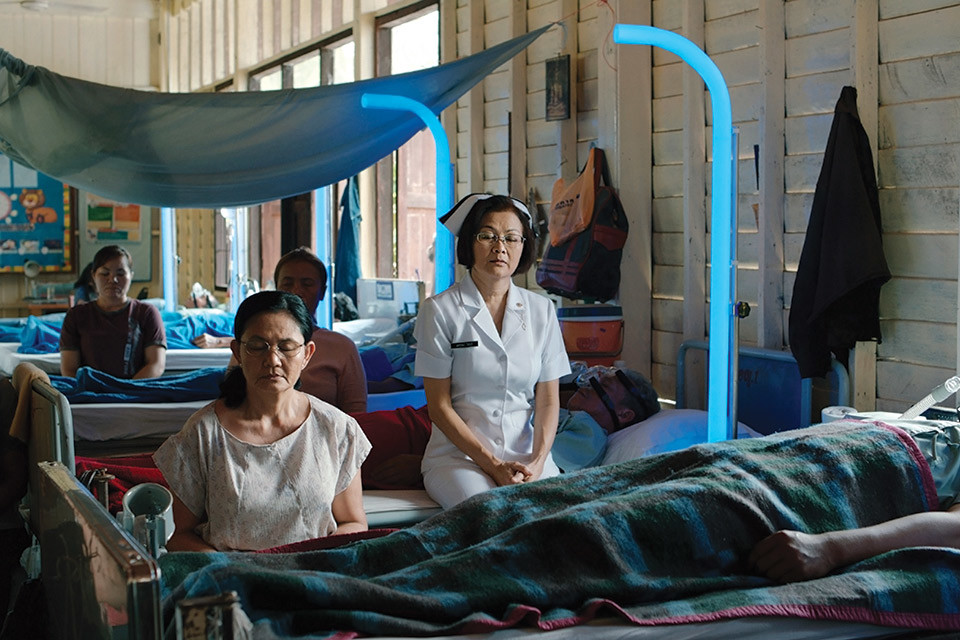
A scene from Tropical Malady (2004)

GF: While Uncle Boonmee Who Can Recall His Past Lives has been often described as dream-like, I always thought of it more as an experiment of imagination because I’ve always wondered what forms people will take once they have passed away. How did you determine what form each of Boonmee’s visitors would take?

AW: Oh, the forms came up from my memories of media because Boonmee is a tribute to things that I love: old television, old royal costume drama, old horror movies. Actually, Boonmee has six reels; it’s the film that I knew would be my last film shot on celluloid, and it was, so I divided it into the film system because when you show the film, each 35mm can holds about 20 minutes max, so for me, the film has six reels, and each reel has a different representation. The audience might not notice because it creates one storyline, but if you look at each reel, there is some different shift in color, different shift in lighting, and even the acting style, which sometimes is really realistic or sometimes really stiff like old TV. And one reel is a royal costume drama, the one with the princess. And the jungle in the last reel is my old adventure tales memory. Compared to the jungle in Tropical Malady, which is almost like a realistic jungle, the jungle for Uncle Boonmee is a jungle of media, so it has this day for night shooting, so there’s a really artificial blue tint for the jungle. This is why I introduce this film as a collection of memories.

GF: In many of your conversations during your screenings this past week, you have mentioned your love for old science fiction. You have spoken of making a film called Utopia, which you originally said had a setting of the Starship Enterprise and would include notable science fiction film leading ladies like Jane Fonda from Barbarella. We have been hoping to hear word of you filming this. We love old science fiction, and this premise is too alluring. Is there any chance it will ever happen?

AW: I think it’s very hard because I think I need to rewrite a lot of that. Because for me when I do projects, it is always about, like Mekong Hotel, which is showing now, revisiting old ideas but then changing it because it represents myself; not me, I mean, I’m not the person in the past called “Apichatpong,” and now, everything feels really distanced very quickly for me, so Utopia needs to be rewritten, but of course, if someone gives me the money, of course I would love to do it. It’s quite universal, and it’s really relevant now actually. I don’t know why I wrote that originally, but Utopia is all about violence in nature. The whole film is about the collapsing of the landscape in North America. Not in the city, but in the snow mountains and in all of these places. It’s almost like a very violent nature.

apichatpong-weerasethakul-uncle-boonmee
A scene from Uncle Boonmee Who Can Recall His Past Lives (2010)

GF: Your regular cinematographer, Sayombhu Mukdeeprom, was stolen from you by Miguel Gomes for Arabian Nights, leading to him spending more time in Portugal than expected, which prevented him from being able to film Cemetery of Splendor. When you and Sayombhu work together, how much do you influence each other’s vision because you can definitely see elements of your style in Arabian Nights and Cemetery of Splendor has a different look in its use of artificial lighting and color?

A: AW: Yes, Sayombhu was stolen. With Sayombhu, it went back to Blissfully Yours. That was his first feature film, and he used to only work in advertising, but he really understands me; he’s one of the very few DPs who understands what’s the difference between advertising and cinema in terms of image, and he also studied at a Russian film school under the DP of Tarkovsky, so he has quite an eye and a philosophy of cinema, so we got along very well from the first film. And so he influenced me a lot, and also, he knows me and my preferences. It is the same with my editor and sound designer.

GF: You develop that personal relationship. We saw Leos Carax speak about his cinematographer who recently passed away. Though the two weren’t great friends, they ate breakfast together nearly everyday, and that’s not something you can easily replace. I can imagine that it was strange when Sayombhu was stolen. Did you get a chance to see Arabian Nights yet?

AW: Unfortunately no. It was at Cannes, and I was just too busy.

GF: It is a magnificent film. If it is a consolation, you lost Sayombhu, but he did phenomenal work on Arabian Nights.

LF: Cemetery of Splendor was filmed by Diego García who came recommended from Carlos Reygadas, a director whose sensibilities are not too far from yours. You have said that Cemetery of Splendor is most likely your last film shot in Thailand, and in last night’s Q&A, you mentioned that Latin America may be your next destination. Did working with García and/or speaking with Reygadas point you even closer to Latin America?

AW: Exactly. Not only Carlos, but also just being there in Mexico City because I have a gallery there that I work with for visual art, so I went there quite a number of times, and I think my draw to Mexico is because it is actually the reflection of Thailand because it’s so comparable. Something like Tropical Malady or other Thai myths and jungle stories that I liked were written in the ’60s and ’70s, and they were actually influenced by the American or European writers that went to South America to create stories about these adventures and animals during colonial times, and they wrote, really, about a romanticized jungle. So actually, for me, there’s a trace of this influence to make me interested in the allure of the jungle, so I think maybe going to South America is like going back to the source to this thing. I was in Peru, and it was like going home somehow. I don’t know why. To see the ruins and the technology of the past is almost like science fiction to me but reversed in time.

GF: When you see a Mayan temple, it really does feel as though you are entering a science fiction film. South America has become so fruitful in its cinema too–the new movements in Chilean and Argentinian cinema are just two of the scenes that are thriving, so it would be a wonderful place for you.

apichatpong-weerasethakul-cemetary
A scene from Cemetery of Splendor (2015)

LF: Science is clearly something you love; it always has a visual influence in your films, and it also has a thematic role too. In Syndromes and a Century, science has a very interesting role in the way that it impacts our daily relationships. How much of your interpretation of science, its applications to the past and present and how it can make people more separated from each other even though it can help make life better, goes into your films?

AW: For me, science is like art. For me, they are very inter-woven. In Cemetery of Splendor, it is really about perception, and how our brain works and how loneliness can trigger something, and how dreams can manifest desire and imagination. I don’t know; it’s hard to explain, but it’s all these inner-workings when we sleep or when we dream that I am interested in, and I did quite a lot of research and tried to present it in the film–how some logic seems to be in our dreams, how some logic seems to be okay even though it seems so outlandish sometimes. So, this representation of dream is very interesting to me. It’s not like when you dream in let’s say mainstream cinema, sometimes you can see something like a Salvador Dalí painting, things melting or something like that, but for me dreams are really so ordinary, but there is some little chip of logic in them.

LF: And, that’s why you have the different colors of light in the hospital, right? I read that you had been interested in how colors can modulate brain activity?

AW: Yeah, there is really amazing research about how colors can trigger false memories in mice; it can introduce information there. I think maybe we already do that with film. When you look at cinema or media it’s already there, you know, you just put information in people. For me, the sleeping soldiers and all this shifting light maybe are about just putting all this narrative into their dreams. It’s like education; it’s like how we grow up: what we are told and how we are being lied to about different pasts.

GF: You had mentioned in a Q&A after the first night of short films that you were a big fan of Gattaca, so much so that it was part of one of the listening exercises that you conducted with students at CalArts this week to get them to be more aware of sound. Gattaca was so underappreciated here because I think that when most Americans think of science fiction, they think of Star Wars and that type of science fiction film. Gattaca is a very intelligently made film; I wish Hollywood would look at science fiction less as action cinema and more as an opportunity to operate a narrative in a genre that is so expansive; you can do so much with science fiction, but for the most part, it always turns into Guardians of the Galaxy. And, it doesn’t have to be that.

LF: And science in and of itself, has smaller things happening than space travel that are fascinating, and you can explore them in film. For example, we’ve seen research where microelectrodes can be implanted into a mouse’s brain, and a radio can be used to control their movements. There’s also active research about the neural encoding activity of birds as they learn how to form their own birdsongs. There are a lot of strange and amazing things happening in science that would be great platforms for science fiction, but I don’t think they will get used.

AW: I love Gattaca. This country is so big that the progress of science is so fascinating, the research. But at the same time, it is not reflected in the media, in popular media, so it seems like it is not really well synchronized. It should, no? Media should reflect the humanity of these times, so scientific progress should be in the media.

GF: Thank you so much for taking the time to speak with us. This conversation reminds me of the one that I was very fortunate to have when I had the opportunity to interview Abbas Kiarostami many years ago in Boston before it became impossible for him to get a visa to visit the United States. A great deal of our conversation that day involved his issues in creating cinema during the Iranian Revolution and the continued censorship he had to deal with as a filmmaker. Understanding your current issues with censorship, we so appreciate your open candor in regards to not only your work but also your comments about the current state of Thailand.

We would like to give special thanks as well to Los Angeles Filmforum, CalArts Film/Video, and Film at REDCAT for bringing Apichatpong Weerasethakul for an expansive retrospective. We would also like to give additional thanks to Kelly Anne Graml of the UCLA Film & Television Archive for making this conversation possible.

Dash Shaw

Standard
afi-fest-dash-shaw-a

Director Dash Shaw speaking with Lily Fierro

We have long praised the comics of Dash Shaw. After our introduction to Shaw’s intriguing, layered visual style through Three New Stories, we have always kept an eye out for any of his creations. Consequently, when we heard that his debut feature film, My Entire High School Sinking Into the Sea, would screen at AFI Fest 2016, we were excited to see it, and we were even more excited to get the opportunity to sit down and speak with him about his approach to image-making. My Entire High School Sinking Into the Sea is lighter in tone than books such as Doctors or Bottomless Belly Button, but it condenses all of Shaw’s clever, innovative visual techniques into a hypnotic array of animated sequences, conveying Shaw’s and lead animator Jane Samborski’s abilities to create and experiment within a time-based visual medium.

LF: For those who are familiar with your comics work, could you explain where the development of My Entire High School Sinking Into the Sea falls into the course of your career? Did you start working on it at the same time as New School?

DS: Well, My Entire High School Sinking Into the Sea originated as a comic short story that I had written around 2008, and the initial impetus for it was that when I was a teenager in the 90s, the main kind of opposing schools of comics were the alternative comics that were mostly autobiographical and the mainstream, boys’ adventure, superhero comics, and I liked both of them, so the joke of the story was that I combined the two. It had a character named Dash, but it was clearly showing his warped fantasy view, so it engaged and combined both of those schools. I tried to make another animated movie, a different one for many years, starting around 2007, and I did an IFC series in 2009, but I was thinking about making an independent movie as soon as I saw that the tools to do so were easily accessible using a scanner instead of a camera and using Photoshop to make traditional animation with a computer. Up until that time, all of the computer animation that I had seen looked too “computery,” so when I figured out that I could scan a painted background, and it could look the way I really wanted it to, I was encouraged, and then I was off and running, but the discovery of the creation process I wanted, overall, took a long time.

I did the Sundance Labs in 2010 on a different project, which ultimately didn’t get made, but during that same year, I wrote the script for My Entire High School Sinking Into the Sea. Bodyworld had just come out at the time, and I was working on New School and Cosplayers while I was making this movie, which took many years to finish. I picked this story because it felt the most doable; even though a lot of other great artists worked on the project and painted backgrounds, I initially didn’t know that they would come onboard to help finish the film. This story all takes place in a school, and I thought that it was completely feasible to paint all these backgrounds myself because I was not sure if, in the long run, I would be able to communicate what I truly wanted to other artists who may work on the project. I kind of thought of My Entire High School Sinking Into the Sea like Sam Rami’s Evil Dead—we see that he had a cabin locked in for the setting and very limited means, but the film gets by on energy and enthusiasm. So with my film, it felt doable with what I had and what I thought I could do by shooting as much energy into the movie; even though it’s only composed with drawings, I felt the film could succeed based on how energetic those drawings could be. We only had the actors come to the project in 2014, and by then, I already had a majority of the movie drawn. And then, I re-drew things based on what the actors provided and had them come back to record more, creating this cycle of my drawing updates based on their recordings, which repeated until the film was completed. I hope the next one will be faster.

LF: With the total creation process spanning over such a long time, did the story change over time, or did you have fixed storyboards in place?

DS: The good thing about my animation process is that everything is malleable. If I needed a shot, I could paint it and stick it in, and there was a lot of that. It was boarded around 2011; the boards were made in color markers, so there were indications of how the film would look, but My Entire High School Sinking Into the Sea changed like a collage made over time. I would have one background in place, and a year later, Andrew Lorenzi, a great artist, would re-paint that background and make it better, and then a year after that, I would think, “Oh, this figure could go there,” so I would draw it and plug it in. The whole creation process was very collage-like.

LF: In terms of the acting, which eventually influenced your drawing calibrations for the film, we understand that you met Jason Schwartzman through your comics work. Given the character of Dash and the plot of My Entire High School Sinking Into the Sea, was Max Fischer from Rushmore in your mind when you approached him for the voice of your character?

DS: Strangely, I didn’t. Another reason why I felt the movie was doable was that I didn’t think I would get major actors for the parts. I thought I would be able to just record it with friends, so I tried to write a script that was basically like an action movie in its simplicity, but with the joke that even though the movie is centered on a disaster, the characters continue to speak mostly about high school stuff, their writing, and books. With that script, I thought that I could do it with people I know, and it would be interesting in an experimental theater way where there’s this dissonance between how people are reacting and what is going on around them.

Then, I realized I had Jason’s email, and Jason, Lena Dunham, and John Cameron Mitchell, who I work with often, understood the sensibility of the movie because of their familiarity with my work, and when we went to people we didn’t know, they thankfully understood that sensibility as well. In approaching the actors who would suit the part, I thought to myself, “Would this actor have hung out with me eight years ago? Would this actor be drawn to the material?”

Jason, who would have played all of these writers and had that sensibility that we know from these other movies, also is the kind of person who would hang out with a comic book artist. And so, when he came on board, I was absolutely delighted because I think he is great, and the reason why he’s played a lot of writers and why we recognize these other characters he’s played in those roles is that there’s something genuinely writerly about him. He would want to hang out with me from having made books, and in the recording sessions, he was very good at altering words in sentences because he’s a writer himself, so he was the perfect person for the role of Dash.

afi-dash-shaw-onstage

Dash Shaw and AFI Programmer Lane Kneedler

GF: I had not realized that you have worked with John Cameron Mitchell (Shortbus, Hedwig and the Angry Itch). What are the works that you have collaborated on outside of My Entire High School Sinking Into the Sea?

DS: I made the comic book seen in Rabbit Hole, the movie he directed. I also did all of the artwork in his adaptation of Neil Gaiman’s “How to Talk to Girls at Parties,” which is coming out next year. A character in that film makes zines, and I made those. We also co-wrote the video for Sigur Rós’ “Seraph.” And, he was the producer of that project that went through Sundance Labs, so I hung out with him at least once a week for years.

LF: Some of the most beautiful sequences in the film are the advances between the school floors and the corresponding grade levels, where each journey seems closer to some state of enlightenment and/or maturity symbolically and to rescue literally. Could you speak about how you mixed in your own reflections of high school in creating the floors and the journey that Dash and Assaf experience as they ascend the floors?

DS: Well, I wanted the high school structure to have many purposes in the film. When I thought of each floor being a different grade, that became an organizing structure for the script. For example, we know that cafeterias in school are where students divide themselves in the middle of the day, so in the middle of the movie, there should be this scene where students are dividing themselves but instead in a disaster relief ward. And so much of the movie is about making literal feelings; there are these scenes in movies that we’ve also seen in real life such as the bully that goes into the restroom, and so we’re just heightening these familiar moments and feelings by making them fantastical or tragic inside of this setting in the school.

Also, the floors gave the film a videogame-like structure. I never played a ton of videogames, but I grew up watching other people play them. There’s a joke in games and in the film where it seems like society is telling us that we get better, so we move up through floors or grades—that seniors are smarter than juniors, and you’re somehow working to some kind of success, which in my mind, is not true. When Dash says, “We’ll move up to the Senior floor and graduate to the roof,” I ask myself, “What does it mean to be on a roof?” It’s silly. It’s a parody of how people think about getting better or moving up through society or school, and also, it is a parody of movies that have rising levels of tension to some kind of party at the end, so the high school structure did all of this at once in a very simple way.

Speaking of the influence of videogames on the movie, when characters move into a different room, there’s a zooming through door shot that comes from the Resident Evil games. When I first saw that technique, it seemed like a graceful way to solve the issue of how to draw someone moving into another room because it is very complicated to draw someone getting smaller as they move through space. It’s a really hard problem, and that game solved it, and the zooming through door technique also gave the room movements an experimental movie quality; it looks like a shot in a film you would expect to see at the Anthology Film Archives where there is this single door that is opening for you. Also, a lot of the conversations are action sequence based: “We have to climb through that bus to trigger this thing,” and that, to me, is very much like action movie and videogame logic. I liked that movies, videogames, and experimental films could meet in My Entire High School Sinking Into the Sea, and those moments where they do are the most visually exciting ones for me.

afi-my-entire-high-school-still

Still from My Entire High School Sinking Into The Sea

LF: With your film, you use collage techniques seen in your comics, and you use many shifts in textures as well. Particularly, some of the most interesting shifts occur with the characters themselves, who we see represented in flat, realistic color or in one solid color or in varying brushstrokes. Could you speak about how you decided when to use the flatter, more traditional comics representation of the characters as compared to the more painterly representations?

DS: When I was a teenager, I loved anime. I particularly loved a period when they were trying to animate more illustrative techniques. Fist of the North Star is a good example. This animation period looked at comics drawn in a densely illustrated, hatched style, and when you try to animate that, it’s hard. So, when someone punches another person, the hatch marks of the arm are flickering and changing; that inconsistency, that wrongness to the animation was something I found super awesome. It felt like not only is there this story about this guy punching another guy but also there’s a formal story about lines changing and colors changing. The more wrong that the cartoons got, where one frame could be completely off from another frame, the more it felt like I was watching some crazy alive drawing—that there were these two tracks of what’s happening and how it’s being presented that are changing. This was exciting, and it was also produced a kind of stonery effect too. It’s well known that stoners like to watch cartoons and zone out and see the changes in airbrush textures, and I wanted the animation to work in that way where the film could be a light show for people.

GF: And the swimming scenes also reminded me of Ralph Bakshi’s psychedelic backgrounds for ‘67 Spiderman.

DS: Definitely. Ralph Bakshi was a big influence. When you draw comic books, you are drawing the same thing over and over, and the inconsistencies can be maddening, where you look at one page and say, “Man, this character’s head is drawn this way here, and six panels later it is drawn differently. I messed up.” Some cartoonists embrace the inconsistencies; every cartoonist has a different way to execute repetition in panels, but in animation, I liked it better when things were changing because the images are flying past you in time, so they are not frozen in a way that allows you to see them next to each other in one single moment, which would make it easier for you to see where something is incorrect. Instead, what that character looks like is always morphing in animation. In figure drawing, someone will take one pose, and you’ll draw it one way, and then they’ll turn their head, and the light will change, so you’ll pick up a conté crayon to capture how it is different in that moment, and the drawings don’t have to be read. We understand it is the same person; it’s just that different sides of this person are being drawn, and so, these changes for each character flying past in time, I thought, would look super cool.

GF: Given the consistency concern in comics, do you think that having My Entire High School Sinking Into the Sea set in one place in one fixed period of time made it easier or harder to create?

DS: That helped make the project doable. The characters don’t change clothes, so that helps make the process easier. You’re working on this whole thing over many years, and you’re working on different parts at different times, so we know that a character will always be recognizable if they are always wearing glasses.

LF: This film is visually beautiful, which is always indicative of your work. What’s fun about My Entire High School Sinking Into the Sea is that it is an exploration into codes of nobility regarding love and friendship. Your comics always understand the complexities of human relationships well; are there any specific relationships you want to explore further or revisit in the future, whether in comics or in animation?

DS: Hmm…I have to think about it. I’ve been drawing comics for many more years, so I feel much more skilled as a comic book artist. I learned so much making this movie that I feel that for the second movie, I can be more ambitious with the complexities of the characters and what’s happening. Part of the fun of this movie is that it is very broad and videogame-like, but I have made all of these comics, and they are very different from My Entire High School Sinking Into the Sea. I think that I can now use some of those things from those other comics and apply them to animation with more confidence. Something that was really amazing about animation is that actors can project anything through any line—that a character can be talking about one thing but somehow because of the actor’s ability we can understand that what they’re really talking about is something else. In comics, that is very difficult to convey. The reader can look at how something is drawn, but they are hearing the words with their own interior voice. So, actors provide a voice, which creates a new arena of subtlety for me, especially in terms of how characters interact with each other. Now that I made this and amazingly figured out how to get all of these great actors, I know I can enter the next one foolishly assuming that I can get great actors who can contribute a lot to those characters. I can then try to write something that provides richer material. I hope to just do better overall.

LF: Lastly, there have been rumblings that Doctors will be made into a live action film. Is that still happening? How involved will you be in the process?

DS: I’m not very involved. Mike Cahill (The Path, Another Earth) will work on it. I know they have a screenplay written and that everyone is psyched about the script. I hope that it goes through to the finish line, but I’m working on my own stuff. I hope they make it, and I hope it goes well.

GF: Is it tough to let go of?

No, because that book was a whole long haul for me, so I’m done with it.
____________

Interview conducted by Lily and Generoso Fierro on Tuesday November 15th at The Roosevelt Hotel in Hollywood.

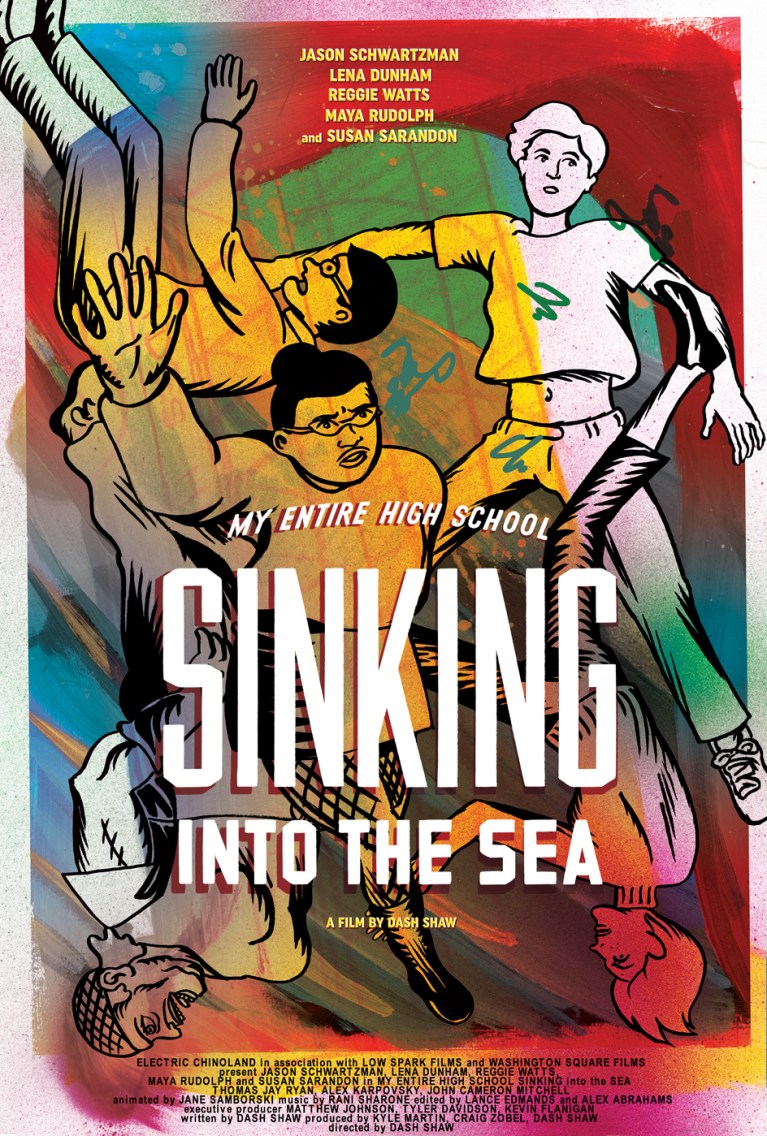
afi-my-entire-high-school-poster

Sarah Adina Smith

Standard
afi-sarah-adina-smith

Buster’s Mal Heart Director Sarah Adina Smith

I was thrilled to speak with director Sarah Adina Smith after viewing her impressive second feature, Buster’s Mal Heart, our favorite film of the New Auteurs programming section at this year’s AFI Film Festival. Set during the Y2K panic but eerily relevant for present day, Smith’s film presents a complex antihero named Jonah (Rami Malek), a hotel concierge who decides to take refuge in the empty vacation homes of the wealthy while being hunted by the law. As the mystery of Jonah’s crime unfolds via a clever and ambitious blending of dream logic, fantasy, and reality, we start to get a portrait of a young man who is barred from acceptance into the community he so desperately wanted to become a part of for the sake of his family, and whose apparently insane actions might be fueled by an abundantly clear vision of society that is seemingly on the brink of disaster.  

One of the aspects of Buster’s Mal Heart that struck me is the way that you deal with issues of class and race within the film. Jonah is a Hispanic and working poor man who is trying to take care of his family in a predominantly white, middle class area during the Y2K panic of 1999. What do you feel is important in terms of that era and the class and race relations that you are trying to say with the film?

It was extremely important to me that Jonah’s character be a bilingual person of color at the center of this class struggle that you especially feel more acutely when you are part of a community that doesn’t look or sound like you. So, I wanted Jonah to be at the center of that hurricane of social pressures. In terms of setting it near Y2K, for me, that was a very interesting moment in time. I was in high school and was completely convinced that the world was going to come to an end—that it was going to end in a nuclear holocaust, and then I had this absurd feeling when nothing actually happened. (laughs) I liked the notion of setting it during Y2K as part of a sort of psychotic break or part of this feeling that the end was nigh or that all of this was leading to a more cosmic rift in the universe. For Jonah, these social pressures don’t just end on a socio-political level; the social class pressures translate into this larger problem of whether or not it is possible to be free in a universe governed by causality and the oppression of a God, or lack thereof, or nature or whatever you want to call it—this way in which we are oppressed on a cosmic or spiritual level. So, I wanted to tie all of those things together in his psyche to fuel what, on appearance, may seem like a psychotic break. I don’t know that I chose Y2K for any particular historical reasons in terms of the economy and the history of racism. It just felt like a strange moment that had all of this momentum moving towards it, but then suddenly the hysteria seemed to be forgotten the next day.

I was reminded while watching your film of Ondi Timoner’s documentary, We Live In Public, about the first internet millionaire. For years, that was the definitive film that captured the hysteria of Y2K and the things that people were envisioning as a potential outcome, with people gearing up for conflict and/or going off the grid. That’s why I must give you extra kudos for casting DJ Qualls in Buster’s Mal Heart as “The Last Free Man.”  His performance truly embodies that grim level of panic that existed at the time. Which of Qualls’ previous performances made you think that he was perfect for the role?

DJ Qualls is just amazing. I had seen DJ in so many films where he, for lack of a better term, plays the “nerd,” or the guy without much confidence, and I thought it was be a twist to have him play this character who is a hyper-confident/borderline arrogant man, which was something we had never seen him do before, and I think that is why he had so much fun playing that character…the guy who owns the room. Mostly, I knew DJ from Hustle and Flow, but even in the Road Trip scenario, his character was designed to be as though we are all in on this joke about this nerdy kid, and then we find out in the end that he can be cool. I just liked the idea that he is the guy who has all of the answers at the beginning, and then later in the film, when he is weaker and vulnerable, we see his realization that he needs some human connection and wants to be loved.  

In terms of comparison between your first feature, The Midnight Swim, and Buster’s Mal Heart, when I think about The Midnight Swim, I think of a natural setting where you have main characters who on appearance seem broken, even obsessive. The characters in The Midnight Swim immerse themselves in the natural environment, whereas Jonah seems to be happy to subsist with what humans make out of that setting. Could you explain that shift in your approach to human relationships with nature?

There is a scene in Buster’s Mal Heart when Jonah has an argument with Marty (Kate Lyn Sheil) in the kitchen where Marty angrily says, “You don’t even know how to build a fucking house!” Jonah has all of these ideas about being this self-sufficient mountain man who is in communion with nature, but he isn’t that. Like so many of us who would love to have that connection with nature, we just do not have the skills to know how to survive when push comes to shove. So, I thought that there was something particularly sweet and sad about a portrait of an American man during this time when our environment is rapidly dwindling, and our relationship with nature is disappearing with it. It feels that soon we will not remember how to survive in the wild without the trappings of civilization.

afi-rami-malek

Rami Malek as Jonah in Buster’s Mal Heart

I’m glad that you mentioned that moment in the kitchen when Jonah and Marty have an extremely ugly argument. Jonah appears fairly docile up to this point in the film, and that is the first time we see his anger take over his persona, which in context becomes more startling. You have very real scenes like this balanced against moments of absurdist humor such as the genteel kidnapping of the elderly couple who enjoy Jonah’s homemade Christmas dinner. The somewhat comedic scenes blend well into the film and seem to happen naturally within the flow of the narrative. What were your thoughts about adding these elements to the film?

For me, the humor does come into the film naturally. I was interested in reflecting the tone of our experiences in life—that struggle and suffering that meets absurdity within our human existence and a lack of grace in our darkest and most dire moments. We start to expect that we will be part of this perfect narrative of our lives in some way, but it usually doesn’t work out like that because life is clumsier than the way that we imagine it. There was one image that came to mind very early in the process of writing this film, and that was the image of Jonah walking up a snowy hill and stumbling back down again, over and over, and not being able to gain traction. That sad portrait, which is absurd and comical too, is almost like this Sisyphean image of being this eternal joke. Part of the tragedy of this story is Jonah’s lament from wanting to become free of being the butt of this joke, and he is seeking a reckoning with the powers that be, and he just wants out and wants to become free, but that is directly in conflict with love, as there always seems to be this paradox between freedom and love, and the movie asks whether it is possible to have both at the same time and, at the end of the day, which is the stronger force.

Jonah is a truly tragic character for those reasons. He wants traction in the “real world,” but he doesn’t have the skills/tools necessary, so he ends up as a concierge in this hotel where he gets walked on by both the guests and the management.

When we meet him, Jonah is the most stable that he has ever been in his whole life. I only give hints of this in the film, but you can imagine that Jonah has has struggled with mental health issues for most of his life. He was homeless when Marty meets him, and he is saved by her and her church, and, in some ways, he has gotten it together by getting the job in the hotel, so when we see Jonah at the beginning, he has started to behave like a functioning member of society, and he wants to be functional because he loves his family. He doesn’t want to have a bad heart, so his own struggle is really against the heart that he is born with, which is not his fault. None of us choose to be here. None of us get to choose the circumstances into which we are born. None of choose the heart that we are given. Jonah wants to heal his own heart, and from this desire, he almost achieves the ability to function in normal society, but I think this sleeplessness cracks him.

This might be a strange reference, but I remembered an episode of the Korean war sitcom, M*A*S*H, when Hawkeye, the character Alan Alda plays, endures an intense few days of insomnia that cause him to go into an almost trancelike state where he seems to experience clarity about the war and the situation that he is in, which reminded me of Jonah’s condition in your film.  
(Laughs) I think that this is true that sleeplessness can allow a trancelike state of mind to take over, where you have a kind of honesty in ideas and feelings that you do not normally have access to in a regular frame of mind. There is an easy interpretation of this movie where Jonah struggles with mental illness in a world that is not meant for him, but I do think that there is another interpretation of this movie where Jonah is a visionary and a rebel in some ways who sees more than we see and who is rebelling against a system that is rigged against him.

I also accept the latter interpretation of Jonah in the way that you visually construct his inner conflict through “The Last Free Man,” who to me represents his alter-ego, one that desires to go completely off the grid yet also is someone who has avarice and craves a room in the hotel when it is cold outside. In normal consciousness, he sees the system that he cannot survive through, but this insomnia state gives him the clear message that he must completely get out of the system that is sublimating him. What I wondered about when watching Buster’s Mal Heart, in terms of improvisation, is that given the different states of Jonah’s being that you depict in the film: the reality of the present day as a mountain man, his past with Marty, his current employment at the hotel, and the dream sequences on the boat, it became clear that the structure of the film did not lend itself too much room to go off of the script, since balancing these states must have been difficult. Was there a place for the actors to improvise?

The process was very structured and specific in terms of creating the architecture of the film, but within that architecture there was quite a lot of improv, although improv may not be exactly the perfect word for my process. The script that we used was more of a weirdo document outline/short story with images and bits of fully scripted dialog and bits of stuff that were more lyrical in nature, so there was a lot of room to flush out these characters together on set in a very sort of deliberate way; the improvisation was rarely, if ever, a free-for-all; it was much more directed, which is a credit to the tremendous cast who dove in and were willing to go through that process with me. We all just really trusted each other. In the case of DJ Qualls’ character, “The Last Free Man,” he was much more fully scripted because he is this almost otherworldly vision or messenger, so there is a certain heightened quality to his visitations, and so that needed to be fully scripted, whereas the scenes with the family at home are much more organic as we wanted the audience to feel that they we are simply observing their world.

Thank you so much Sarah and the best of luck with your film.
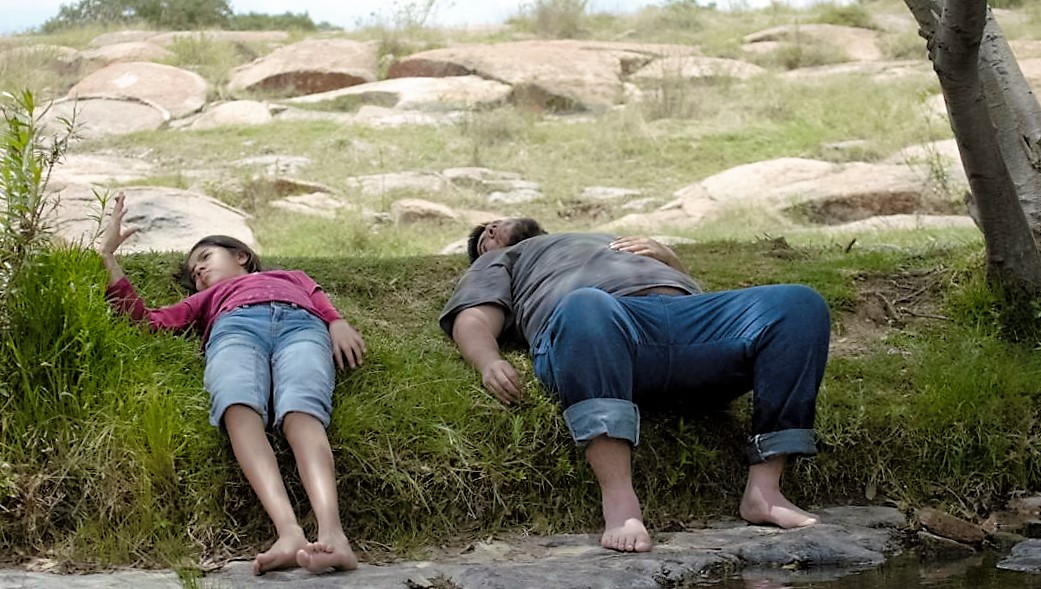
Interview conducted by Generoso Fierro on Nov 16th, 2016

Official Trailer for Buster’s Mal Heart


afi-busters-mal-heart


Juho Kuosmanen and J.P. Passi

Standard
afi-juho-and-jp

Cinematographer J.P. Passi and Director Juho Kuosmanen

In the midst of the frantic final day of this year’s AFI Film Festival, we were very excited to sit down with director, Juho Kuosmanen and cinematographer, J.P. Passi to discuss their wonderful new film, The Happiest Day in the Life of Olli Mäki, which was honored with Un Certain Regard at this year’s Cannes Film Festival. Their film is an endearing but critical look at the true story surrounding the highly publicized World Featherweight Title fight between the Finnish born Olli Mäki and the American champion, Davey Moore, which took place in Helsinki in 1962. Kuosmanen creates a unique boxing film, one that is less concerned with the Hollywood cliché of building up to the big fight and more interested in the manipulation of the media and the creation of a false heroes. In our conversation, we discuss Kuosmanen’s approach to telling this well-known story, the input he received from the real life Olli and his wife Raija, the challenges contained in hiding present day Helsinki to allow the film to appear like the early 1960s, and the good and the bad associated with making film in Finland under the shadow of the nation’s most applauded director, Aki Kaurismäki.

GF: I understand that you were born in the same town as Olli Mäki, and so you knew of him, of course, but what aspect of his famed fight inspired you to tell his story?

JK:  I think that came down to a moment after I had done some research about Olli Mäki when I discovered a documentary that was made about him during the period when they were trying to make him into the next world boxing champion. When I saw the documentary, I thought that there was something comical inherent in the contradiction of people wanting Olli to become a hero when Olli himself had the feeling that he had no chance of winning the fight.

GF: After speaking with Olli, do you feel that his belief that he was unable to win the fight was more from his inability as an athlete to beat Davey Moore or the fact that he felt that the promoters and his manager were building the whole event up in a way that wasn’t honest to Olli and the people who were buying tickets?

JK: Olli knew at the time that the whole thing was fake—that the whole world that he is being dragged into is being built out of these images that weren’t real at all. For example, in the scene where Olli sees the photo advertisement of himself where he is taller than model standing next to him as he and Raija are walking down the street, he knows that, in reality, he had to stand on a stool to be taller than the model; he knows he is living in an environment where everything is false.  

GF: Was Olli aware of how good of a boxer Davey Moore was at the time?

JK: Olli did know Moore’s record, but Olli and his manager also knew that Moore had issues with his weight and that he (Moore) was a bit past his prime at the time. So, even though Moore was the better boxer, he had weaknesses, so Olli’s manager did believe that there was some chance that Olli could win or at least go for more rounds so that the fight would make for a better event. Olli himself said that there was no chance of winning, and that is why everyone annoyed him so much as they kept insisting for their personal reasons that he would be the champion.

GF: Being from a boxing town (Philadelphia), I myself boxed when I was young. I have a genuine love for the sport, which is one of the reasons I really wanted to see your film, and I genuinely enjoyed it for how realistically you depicted boxing. One thing did strike me as odd when I watched your film. For many years, I remember there being a three-knockdown rule in place to protect fighters in the event that they hit the canvas three times. In your film, during the second and final round, Olli does get knocked down three times, but the referee allows him to continue fighting. I know that you studied the actual footage of the Moore/Mäki fight; is that what actually happened?
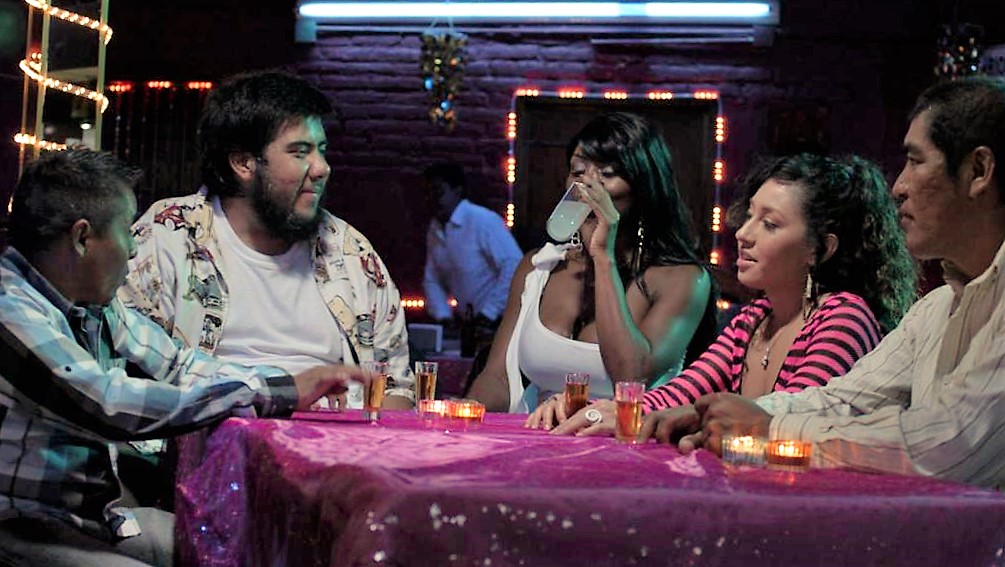
JK: We did exactly reference the footage of the actual fight. At the time of the Moore vs. Mäki fight, the rules of the match could be agreed upon before the fight by both sides, and in this case, both Moore’s and Mäki’s team agreed to allow the fight to continue in the event that either boxer was knocked down three times. But again, this rule has to be agreed upon before the fight occurs as it did here.  

GF: J.P., I wanted to compliment you, as the cinematography of the film is quite remarkable; it seems to fit the era perfectly. You said in the post screening Q&A that the film was shot on 16mm, but did you use a special film stock or an older camera or vintage lenses?

JP: The film stock I used is Kodak 3X Reversal black and white stock. I used a modern camera, but I used very old Zeiss lenses.  
LF: J.P., yesterday, during the Q&A as well, you said you dreaded making a boxing film due to the fact that there are so many other boxing films that this film would be compared to, which is understandable. Can you talk a bit about filming the final fight sequence? That scene has some gloriousness to it, and it is beautifully shot, but it is not like any of the fight scenes in more legendary Hollywood boxing films like Raging Bull. Instead, Mäki’s final fight is shot in a way that magnifies Olli’s thoughts on the insignificance of the event.  

JP: We wanted there to be a clear difference between the way the sparring matches were filmed and the way that the final bout was filmed. We shot the sparring scenes with cameras in the ring with Olli, but when it came to the title fight, we wanted Olli to be alone in the ring with Moore, with the camera outside the ropes to create distance so that we could amplify how Olli was feeling alone during the fight. It was much easier overall to shoot the final fight. The sparring scenes required us to be very close to the fighters, and to do this, we had to study their choreography, so we could get in close for the best shot while trying to avoid accidentally getting hit in the process.  

Jarkko Lahti as Olli Mäki

GF: That level of intimacy does come through during the sparring with those closeup shots but also with the sound design, which was excellent in conveying how brutally the punches echoed when a boxer was hit. Did you use live sound for that, or was it all foleyed in post production?

JK: Both actually. We did use the original sound, but we added so many foley layers.  

JP:  Truthfully, the original sounds were not very fierce because the actors were not allowed to hit each other with real force, so we had to compensate for that.  

JK: When we did the foleys, we wanted to have more than the punch itself. We wanted to add textures to the sounds like sweaty skin; in the scene when they are sparring in the rain, we wanted to add wet layers. We worked with this Danish sound mixer, sound designer, and foley artist who were involved with the film even before shooting began, so yes, we had many discussions about the sound design before filming those scenes. They were all extremely talented. We knew that if you didn’t include these textures of leather, skin, and water that, in the end, it would end up sounding artificial.

GF: The film is set during August, but given that a large portion of the film is shot outdoors, and in Finland, you really only have a few months on the calendar in which you can shoot without fear of wintry weather, did that cause issues with filming?

JK: Not really. We started shooting on the last day of August and ended in the last week of October—six weeks in total.

GF:  Were you able to shoot the film chronologically?  

JP:  We did shoot all of the countryside scenes in the film in the first week. We broke the chronology early, but we tried to maintain the chronology as best as possible after that because it really helps the feel of the film when you can shoot in chronological order. That said, even though we were shooting in the countryside at the end of August, when we filmed the scene where Olli swims in the lake, the temperature was 10 degrees Celsius, which is quite cold.  

GF: Have Olli and his wife Raija seen the film yet?

JK: Seven times actually!

GF: They must really love it then, but was there anything onscreen that they objected to?

JK: Both Raija and Olli saw the script beforehand, and the only thing that Raija objected to was that her character was smoking in the film, and she never smoked. We added that into the script because there were many scenes where Raija is just standing there with no dialog, and we thought that if she were smoking that it would make her appear less tense about what was happening, but since the real Raija didn’t like the idea, we removed that characteristic.

LF: Your film is not a period piece, but there is a difference between 1962 Helsinki and present day Helsinki. This isn’t so much an issue when shooting in the countryside, but how did you scout city locations?

JK: It was very difficult at times. We wanted to shoot in many directions, but that was very hard to do sometimes.

JP:  The format was a huge help here. For example, there are a few scenes that we filmed where there are modern cars in the background of the shot, but because of the black and white texture and because we shot from a long distance, we were able to hide them from the audience.  

JK: We also filmed most of the city scenes at night, and post-production helped as well. In one of the shots, there was a large building that we had to wipe out, and we did that in post. In the scene at the airport, which we wanted to shoot 360, we would always have something modern in the background, but there was enough in the foreground that we could work with in order to make it look correct. We could move a camera one way, and if someone could position themselves in front of a modern object in the background it would work; in one case, we even put an extra in front of a new garbage can that we couldn’t simply move. It sounds hard, but it was fun.  

GF: This might be an odd question, but what inspired it was a screening that we attended this past Sunday when we saw a Polish mermaid musical called, The Lure. Before the screening, the director felt that she had to explain that she was happy to finally be able to make a musical in Poland because, for years, no one wanted to because Krzysztof Kieślowski hated musicals. What influence, if any, did Aki Kaurismäki, Finland’s most prominent director in the eyes of most of the world, have either directly or inspirationally?

JK:  Well, first I should show you this photo of Aki, Olli, and Raija. Aki actually arranged the screening and the afterparty for our film. While it was going on, he said lots of nice things, and he was joking when he said to me, “I have been waiting thirty-five years to have a colleague in Finland.” He also said that we shared two of the same locations and exactly the same images that are in his new film. Particularly, he pointed out the scene where Olli is walking alone with his suit on when he is traveling the post-fight party; Aki has the same scene except that his character is walking the other way in the same place.  

afi-juho-aki

Juho shows us a photo of the real Olli and Raija Mäki sitting with legendary director Aki Kaurismäki

JP: I think that he is one of a kind in Finland. Finnish financiers, for example, don’t expect anyone else to do the kind of films that Aki makes.

JK: Outside of Finland, people are always trying to find similarities or differences between our film and Aki’s films; some people feel that the ending to our film is similar to Aki’s work, but if you watch classic films, you will also see similarities between our ending and those of other classic Hollywood films. One other fact of note about the ending is that the older couple who walk past the actors playing Olli and Raija are actually the real Olli and Raija themselves.
 
GF: That is wonderful.  Were the real Olli and Raija on set for a lot of the shooting?

JK:  They were in two other scenes in the film as well. They are in the wedding scene that takes place in the countryside, and they are also in the stadium scene because, that day, they were both being interviewed for the newspapers about our film.

JP:  They used that opportunity to stage a photo shoot with the real Olli in the ring for the newspapers so that they could commemorate the occasion of the fight after fifty-four years.

Interview conducted by Lily and Generoso Fierro on November 17th, 2016 at the Roosevelt Hotel in Hollywood

The Happiest Day in the Life of Olli Mäki Official Trailer

afi-fest-olli-maki-poster


Matías Meyer

Standard

Originally published on Ink19 on July 14, 2016

Interview conducted by Lily and Generoso Fierro

On June 17th and 18th, the UCLA Film & Television Archive presented the first complete retrospective on the work of emerging independent Mexican filmmaker Matías Meyer. The retrospective collected the short films across Meyer’s career, including his first films made as a student at Centro de Capacitación Cinematográfica, and his four feature films, with his most recent film, Yo, receiving its US premiere on the opening night of the series.

In all of Meyer’s films, voyages frame the narratives for both the characters and the viewers, and in each voyage, the environment and the characters have a tacit yet well-understood relationship with each other, moving in a fluid call-and-response way to the presence of one another. As a result, the environment is as much, if not more, of a character than the people in Meyer’s films. With the exception of his most recent short, which was filmed in Meyer’s current half-home of Quebec, Le champ des possibles (“The Field of Possible”), the director’s focus is committed to the ever-changing environment of Mexico, whether looking at its past, as seen in his documentary, Moros y Cristianos (“Moors and Christians”), about the largest open-air group presentation in all of Latin America, a re-enactment of the 16th century Battle of Lepanto, and his most ambitious narrative feature, Los Últimos Cristeros (“The Last Cristeros”), set during Zapata-era Mexico, or its present day, with films like Wadley, an experimental view into one man’s journey through the wild Mexican landscape, and Yo, which, based on our conversation with Matías during the series, is his most personal film to date.

Yo refers to the title character (played by Raúl Silva Gómez), a large man in his early twenties who we soon realize is functional, yet developmentally challenged, and as thus, he remains in a state of perpetual adolescence. Yo is under the care of his mother (Elizabeth Mendoza), and they both live and work at the family restaurant where Yo has the unenviable task of slaughtering and plucking the chickens that they serve. Also residing with Yo is his mother’s lover Pady (Ignacio Rojas Nieto), a brutish man in his fifties who has a tendency towards being abusive towards Yo, which seems to have become so commonplace that no one in the house raises any concern, including Yo, who seems content with his menial tasks and chances to play with his coins on the floor of the restaurant and goes unnoticed to the patrons as though he is a piece of furniture, a trivial part of the restaurant setting. This is the first moment that one notices humans’ interactions with their surroundings, a key element in most of Meyer’s previous work.

Furthering this motif of man’s reaction to his environment, man-made or natural, are the moments when Yo, who takes great joy in watching the giant tractor-trailer trucks that tear through his normally serene Mexican village, becomes plagued by nightmares of the local river dangerously overflowing, which wakes Yo from his sleep and forces his mother to reassure him by taking him to the still, placid river in the middle of the night. Even though Yo’s mother turns a blind eye to the abuses in the home by championing her lover over her son, she is still overprotective of Yo when it comes to how he might function outside of her grasp.

With business in the restaurant improving, Yo’s mother hires a woman to help her out who must also bring her eleven-year-old daughter, Elena (Isis Vanesa Cortés), to the restaurant everyday. Elena and Yo immediately become friends, but with this newfound friendship comes a layer of tension for the viewer as Yo, who has had limited interactions with women, may not have the emotional maturity to control his sexual impulses. Yo and Elena take frequent trips to the nearby river together and play with one another in a flirtatious way, but Elena, who seems beyond her years in maturity, deflects any casual advances from Yo. Though Yo is twenty-two, these moments with Elena are most likely his first foray into society without the guarded eye of his mother there to establish order. No one has gotten hurt, but soon Yo will be forced to face the outside world head-on when Pady purchases a machine that can handle Yo’s singular chore of killing and plucking the chickens for the restaurant. Pady then calls in friends to get Yo work hauling rubble at a local construction site, so Yo can begin the process of becoming an adult away from his mother’s daily reach.

Matías Meyer

Once on the construction site, Yo does hard physical labor and is up to the task, much to the delight of his co-workers and his supervisor. Yo even makes friends at his new job, friends who expose Yo even further to mainstream society as they introduce Yo to the vices of alcohol and prostitution. Whether Yo’s newfound friends are laughing with him or at him, they welcome him as part of their group and take him to nightspots where Yo again blends into his surroundings without appearing too out of place, but just like the river that Yo imagines overflowing, how long will his inner peace remain intact given the ever changing environment around him?

As opposed to Meyer’s previous feature, the Zapata-era film, Los Últimos CristerosYo is a fairly modest production that involves a small amount of actors, the usual use of the set, one-camera shot for most scenes, and a few locations, but like his previous feature, it utilizes the spacious natural terrain of Mexico to cleverly further the development of the film’s central characters. The tension that Meyer creates with his character of Yo and his disenfranchisement with his surroundings is palpable throughout the film in the same eerily quiet and ominous way that Iranian director Jafar Panahi presents in his equally marginalized central character of Hussein, the beleaguered and impoverished pizza delivery man who wanders through a unwelcoming Tehran, in his 2003 film, Crimson Gold. As in Crimson Gold, an excellently crafted level of tension is what drives the narrative even during the most tranquil of scenes, which provided the main reason why we were so completely engaged with the film.

Impressed by Meyer’s achievement in his fourth feature, my wife Lily and I were fortunate enough to sit down with the young director to discuss his work the day after attending the screening of Yo at UCLA.

Director Matías Meyer speaks with Lily Fierro at the UCLA's Hammer Museum
PHOTO BY GENEROSO FIERRODirector Matías Meyer speaks with Lily Fierro at the UCLA’s Hammer Museum

• •

Lily Fierro : Last night, during the premiere of Yo, you spoke about the invisibility of Mexican cinema. In your answer, you had mentioned that some of your fellow directors believe that making films more specific to what audiences want, is a solution to this issue. You said that this would not be your own approach. In what way do you think that Mexican filmmakers can make films that capture Mexico’s landscape, culture, and tradition without concern that foreign audiences may feel alienated?

Matías Meyer : The thing is in Mexico City, recently, there was the Mexican “Oscars,” called The Ariel Awards, and we went to the ceremony and saw the famed director Paul Leduc, who was receiving a Golden Ariel for his career, make a speech for fifteen minutes that focused on the invisibility of Mexican cinema. The government is very proud to say that they have produced one hundred and fifty films a year, and he responded by saying that yes, but no one ever sees them. He then said something that really registered for me, and that was, “Mexicans do not really want to be Mexican. Culturally, they are more into the American cultural empire.”

I myself, grew up in a small town in Mexico, and for most young people, it was about wearing Nikes to be more like Michael Jordan or about American football and Deion Sanders, so it was more about this part of American culture. So, you have this American dream, about how cool it is to live in the United States, and for entertainment and films, you have the Rambos and the Commandos that you watched on television, but on the other side, you have the telenovelas, that are all about drama and class struggles. Mexicans are always watching television; even when you see a taco vendor in the street, they will have a small television, and if they are not watching sports, they are watching the telenovelas. So, the public has not been created for accepting other kinds of movies, which leads me to think that the problem is that the public has not been properly informed. I think that the bigger problem in Mexico is about education. Now, there is a large movement of teachers pushing for educational reform, but the roadblocks are the syndicates and the political power of syndicates, so the whole thing ends up being not about learning and educating. I don’t know how we can fight against this problem; we can try to find a goal via entertainment, but I don’t believe that we can succeed.

I am working on a new film that I hope is less niche than the films that I have done to this point in the hopes of having a wide appeal, but I am not sure if I can achieve this. In the long term, perhaps showing more Mexican films on television is the solution, so Mexican culture, instead of American culture, becomes the norm on the most popular medium for people of Mexico.

Generoso Fierro : Given that Mexicans prefer television as their main source of ingesting media, does a place exist where arthouse cinema is still shown on a large screen?

Matías Meyer : There is in Mexico City, in Coyoacán, which is the area where Frida Kahlo used to live, a cinematheque that has existed for thirty or forty years that has just been remodeled. It used to have six screening rooms, and now, it has twelve. It is a beautiful place where you can have coffee, and there are even outdoor screenings that are free for the public. The theater gets about a million patrons a year, and if your film is there, it will definitely have an audience. I have just released Yo in Mexico City and six other cities, and to this point, five thousand people have seen the film, and the cinematheque represents forty-five percent of that total viewership. As far as the other theaters that have shown it, they have pulled it after one week, so films like this shouldn’t be at a multiplex; they should be screened at arthouse cinemas, so we really need more of them. Mexico City has twenty five million people but only one arthouse theater, so the need is there for more cinematheques in not only Mexico City but in the other cities and villages as well.

Lily Fierro : Could you speak about the origins of Yo?

Matías Meyer : Yo was made right after Los Últimos Cristeros (2012), which is the biggest film I have made until now. That film is a western that is set in the 1930s during the revolution, which was a labor-intensive process, so after its completion, I was looking for a different kind of project. One day, my mother gave me this book by Jean-Marie Le Clézio, and she told me that it was a collection of short stories and that there was one story that she felt that I might like, and she was correct. Even though I liked all of the stories, there was indeed one story that I wanted to adapt and see onscreen and that was the story called “Yo”. Also, these days, whenever I think of a film, I immediately take into account the production concerns, which ultimately makes me ask myself the question: Am I going be able to make this film? Most of the story takes place in the restaurant and only involves a few characters, so the production would not be too complicated, and as Jean-Marie Le Clézio was a friend of my family, since he met my father while they were in their early twenties, he graciously gave me the rights to make the film. As “Yo” impacted me so heavily, the next day I contacted a screenwriter friend of mine in Canada and told him that this story would make a good film and that I would send it to him immediately. He read it soon afterwards and agreed that it would make an excellent film.

In a personal way, I wanted to make the film as I have a nephew who reminds me of Yo, as they have similar developmental issues, and my nephew was at the same point in his life where he was becoming an adult and was beginning to have a sexual attraction to other people. For my nephew and Yo, dealing with sexuality becomes so socially awkward because even if they have been presented with normal societal examples of how to deal with their feelings, they still have issues with their expressions of sexual desire. Besides the connection to my nephew, I also wanted to make a more narrative film as Los Últimos Cristeros is more about wandering and experiences, and with “Yo” I thought there was the potential for more traditional narrative structure and the opportunity to convey the anxiety that comes through in the story. There is a feeling of suspense that manifests due to unpredictable nature of Yo’s character that I also found interesting.

Matías Meyer

Generoso Fierro : Does the short story by Jean-Marie Le Clézio occur in France? What was the process of adapting an originally French story for Mexico?

Matías Meyer : I felt that the story was very universal. It is about this boy living with his mother on the side of the highway and his relationship with the little girl and the workers whom he comes to be with, so the film could’ve been shot anywhere. I knew that funding would’ve been easier in Mexico as opposed to where I live now in Canada, but I did write the script in French and translated it to Spanish because the co-writer is French-Canadian.

Lily Fierro : We were able to see two of your films yesterday evening that focused on sojourns into nature. The lead character in your first feature film, Wadley, exists entirely in nature as he escapes the city for the desert, and in your newest film, Yo, the titular character uses the the nearby river as a place to re-center himself, for it is a place of purity. But, does the river also represent the source of Yo’s essence of being, where he is more of an embodiment of nature than others?

Matías Meyer : I think that is a good interpretation. I like to leave my films open to personal interpretation to allow the viewer to be more interactive and less passive with what is onscreen. There is the scene in Yo when the mother takes the girl Elena and says, “Where were you? I was very worried, and I do not want you going to that place again,” and Yo goes to the waterfalls, and there is the moonlight, and I don’t know why, but this scene reminds me of Percival from Le Morte d’Arthur. I had this memory from when I was a child of watching this film on television where Percival is showered with the blood of a dragon that he has slain and that blood will make him immortal. So, I don’t know why, but I felt that this scene always made me believe that nature is a mystical place.

Generoso FIerro : There is a level of mechanization that increases in Yo as he is haphazardly forced onto a journey to manhood. The chicken barrel displaces his role as a chicken plucker in his mom’s restaurant, and on the construction site, trucks and cranes appear and carry far more than any human can, foreshadowing the eventual mechanization of his job hauling construction excess. Simultaneously, Yo is encountering more men in his life, and they place him in precarious situations involving alcohol and sexuality. How were you thinking about balancing conflicts between the pure essence of male human nature and evolving environment?

Matías Meyer : In a certain way, I think that it is good that Pady, the man who is the lover of Yo’s mother, is a bit forceful with Yo because mothers can be a bit too protective of their children. So, I like that Pady pushes Yo, which forces will him evolve and to find his own place in society. In his mother’s house, Yo is never going to succeed, and I think that is part of the problem when you have a disabled child: that you, as a parent, become too frightened for them if they go out into the world.

Generoso Fierro : I think that you exemplify that point visually about halfway through in the film. There is a great shot where Yo is playing on the floor of his mother’s restaurant when Pady brings in the construction workers who Yo will eventually work for as Yo’s role in the restaurant has changed now that a machine has been brought in to pluck the chickens.

Matías Meyer : Yes, there is a position in nature, and there is also a place for human constructed spaces like the beautiful land near the restaurant that is violated by the highway with its cars and loud noise. There is this element of man against nature that I wanted to show: how the world that man has created is so noisy, which conflicts with nature, and how by immersing yourself in a natural setting we can find a more original state where we can live harmoniously.

Lily Fierro : Given your fascination with Mexico’s culture and your desire to depict it on screen, we have to address the non-secular elements of Yo. Specifically, Yo’s Madonna-Whore complex that plays out between the four main women of the film: his mother, Elena, Jenny, Luisa. You avoid idolatry in all of the settings, but elements of Catholicism are subtly portrayed through Elena’s parochial school uniform and in the music you use, especially in the club scene where a disco version of “Ave Maria” plays in the background. Do you see organized faith (or its integration into society) as being as much in conflict with the natural environment as rapid mechanization?

Matías Meyer : That disco version of “Ave Maria” is in the book, actually. There are some people who say that Roman Catholicism is a lie because the day that Christ is born is actually the shortest day of the year, so by doing that, they are associating astronomy with religion. And I respond with, “Well yes, but is that is the opposite of religion?” I personally don’t think so as Christ is the son of God, and you can see this with the use of icons, which only help us to identify more with faith. It is just a very intelligent construction of symbolism. So, I would never say that faith or religion is bad; it is what we make of it, the same as science, which you should never say is a bad thing. I come from a religious family, but I never went to church. In terms of faith, my father would read the Bible to us on Sunday night before we went to sleep, and for me this was perfect, and that is why I don’t have any issues with Catholicism because I was never forced to go to church, which I think is a terrible way to introduce faith to a child. It is better for your children to discover God in their own way.

Matías Meyer

• •

We would live to give special thanks to Matías Meyer for his time and for his generous responses during our interview with him, and to Shannon Kelley, the Head of Public Programs, UCLA Film & Television Archive, who made this series possible.

Official Trailer: https://vimeo.com/151978177