Memory, Sin, and a Welcome to the Apocalypse: Inio Asano’s Nijigahara Holograph

Standard

After two readings of Inio Asano’s Nijigahara Holograph, I, like many other reviewers that tackled the 2014 English translation of the collected chapters of the seinen manga originally released in parts from November 2003 to December 2005 in Japan, will admit that I may not completely understand the series. However, absolute comprehension does not prevent any enjoyment of this tale; in fact, it mostly relies on an ebb and flow of guttural reactions ranging from repulsion to somber recollection in the best Takeshi Miike way but with a bit (though not much) more anchored in reality.

Cover of the English Volume of Nijigahara Holograph

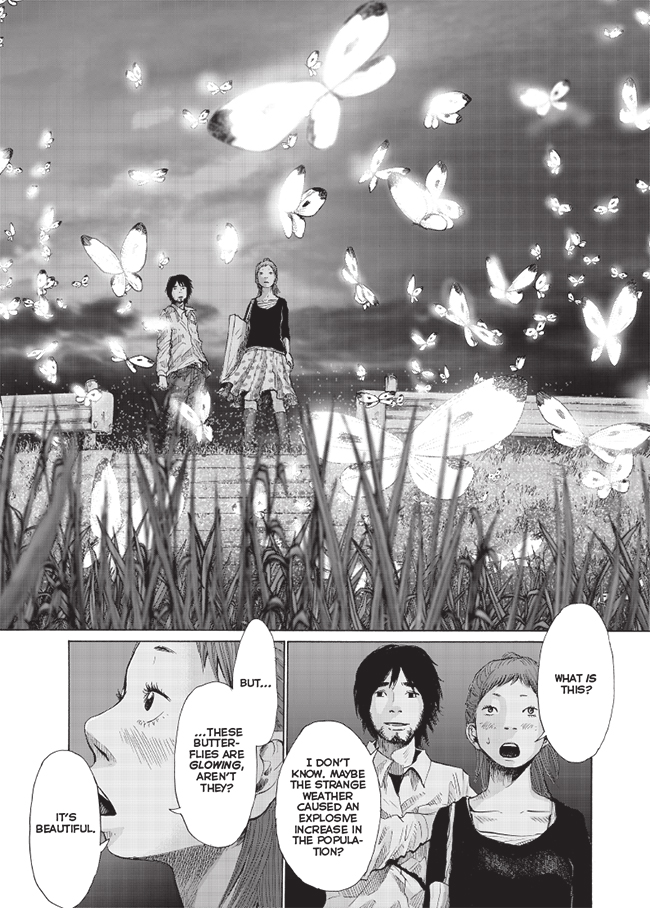
Opening with butterflies, a boy walking on the exterior of a school, and then a young man speaking about his ill father and the merging of reality and dreams to an elderly man whose face we cannot see, Nijigahara Holograph immediately distinguishes itself from what the West generally expects from manga. Expect no adolescent scantily clad women here; in fact, leave any hope for romance or lost love or even any bit of catharsis at the door. The world of Nijihara Holograph is severe, bleak, and unforgiving, and every single character suffers for his or her own actions or for the sins of others. This is not a read for the faint of heart.

The Eerie Second Page of Nijigahara Holograph

Time has no constancy in Nijigahara Holograph as ghosts and memories of the past never fade away: beyond the flashes we see in the minds of the characters, the evils of the past have a physical manifestation as glowing butterflies that swarm the city. As time unravels in the novel, so does reality, with everything in the present clouded by recollections, dreams, hallucinations, and even a touch of prophecy fulfillment. While the different characters have their own branches and paths that occasionally intersect, their arcs remain rooted together by Airé Kimura, a young woman who has remained in a coma in the local hospital since childhood. Airé prophesied the end of the world via a monster in the Nijigahara tunnel, and the people around her did not believe her and caused her harm by attempting to sacrifice her to the monster in the tunnel.

Airé is not new to the world; her spirit has transformed multiple times, with each version warning the surrounding world about the apocalypse to come and each message of caution receive with skepticism and distrust. The citizens of the village murdered Airé’s previous incarnations, but in the most recent cycle, after a majority of her classmates push her down a vent that ends in the tunnel fated to have the monster, Airé survives, but she remains unconscious through her adolescence and early adulthood. This permanent state of sleep keeps Airé safe from the world around her, away from the various predators who have either psychologically or physically attacked her, but it also keeps her force present on the earth. While life has remained quiet for most of the people who crossed paths with Airé, with her classmates growing uneventfully into adults and teachers having families as they approach their early 40s, an energy of dysfunction and hysteria has recently descended on the town, causing macabre scenes of violence and various, seemingly unconnected journeys toward the Nijigahara embankment, the entry to the tunnel that contains the creature of the apocalypse. An awakening to Nijigahara will arrive soon, and as the time approaches, more and more butterflies spread across the town and begin to consume people connected to Airé in one way or another.

While Asano alludes to philosopher Zhuangzi’s well translated and studied quote about the philosopher’s dream or reality as a butterfly, whether or not all of Nijigahara Holograph captures the dreams of Airé, her childhood friend Kohta, or Amahiko, the student transfer from Tokyo who never met Airé in person but who may have encountered her spirit, remains unclear by the end of the series, but whether everything occurred under dream logic or not is unimportant to Nijigahara Holograph, for the actions in the series speak as gravely in dream form as in reality about the cyclical desecration of purity through violence, cowardice, and fear.

Highly experimental in its image and story construction, Nijigahara Holograph creates a unique mood of dread with its sudden juxtapositions of visual beauty of Airé and the butterflies against the most abject and abominable acts of human will. As a result, the feelings of desperation and futility do not stem from Airé’s declarations of the impending end of the world; they come from the abject nature of the humans which gets passed on from generation to generation without a clear end in sight. This cyclical nature of pain, torment, and the destruction of beauty drives the world of Nijigahara Holograph, making the idea of the apocalypse paradoxically welcoming because while it does end life, it finally will end suffering generations of people have inflicted on each other.

More of a punch in the chest rather than a distanced, ruminative read, Nijigahara Holograph demands and consumes all of your attention. It challenges your own perspective, thoughts, and dreams along with the definitions and conventions of the comics and manga medium, making it a sobering read in the first week of the new year. While I still feel that I may not understand all of the layers of Nijigahara Holograph, I do know that it encourages me in 2016 to dig deeper for comics that test the boundaries of storytelling, and for that inspiration alone, I am grateful to Inio Asano, even if this work accomplished a remarkably overwhelming sense of gloom and desolation in its exploration of some of the deepest, darkest crevices of our collective hearts and minds.
Anti-nostalgia for P.S. 49 in Robert Triptow’s Entertaining Class Photo

Standard

The holidays always conjure up past memories, with some related to family, others related to friends, and some related to people who have no role in your life but manage to stay in your memory because you managed to cross paths with them whether in pre-school or at a party many years ago. While your imagination cannot be as active with pondering the courses of the lives of your family and friends if you still are in contact with them, it can ruminate on the people who you briefly met or only knew as an acquaintance, spending endless amounts of time thinking about “where are they now?” It is this curiosity that leads to shameless fascination in the Jerry Springer episodes focused on that question and to moments of deliberation on whether or not to attend your nth year high school or college reunion.

In our wired world, some of the allure of imagining what became of people you knew has been lost with the ability to search workplace websites and social media in order to get a small sense of what happened. But, what about people you never knew? People who lived in an era long before you were born? People who are pretty untraceable today? In this realm, your fictional whims and thoughts can thrive and wander on these strangers of the past, so much so that you could dig yourself into a perpetual abyss unless you had a group of people to fixate on.

Robert Triptow thankfully has a cast of strangers he can focus on for Class Photo while letting his imagination soar with their fictional lives. Inspired by a class photograph taken in 1937 of the P.S. 49 school in Brooklyn that he discovered with his uncle, Triptow creates humorous, strange, and wacky outcomes for each of the children in the photo while weaving in pieces of pre and post WWII American history and culture into each person’s life. No one in Class Photo can escape Triptow’s rampant and wild fantastes, and as a result, the class members’ lives veer toward the insane and the extraordinary despite their humble beginnings in a school that is believed to have existed for children seeking refuge from Hitler’s reign in Europe.

Cover for the Fantagraphics Release of Class Photo

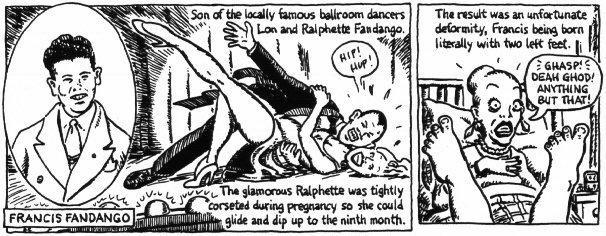
Triptow takes great care in developing complex and concise profiles on each of the Class of 1937, and in the spirit of the American underground, leaves in all of the lurid details of life and injects the outrageous and sensational into his characters to conversely remind us of how we are simultaneously more regular and more strange than we believe. Beginning with Francis Fandango, the double left footed child of famous dancers who eventually became a Best Boy for a television show, and ending with Pat Flatt, the only member of the class to live an All-American life, the collected futures of the class remind us in the most hyperbolic way possible that life is strange and takes different turns for a variety of people. Yet, despite all of the crazy things that happen to various members of the class ranging from preventing an alien invasion to ascending the royal throne of Iceland, Triptow manages to capture how people’s lives tend to re-converge because of a similarity based on a specific place and time, and this is a normal concept that anchors the novel amidst his grandiose fantasies for the class members

As a result of the mix of the imaginary and the real, with a bias toward the fictional, Class Photo feels like an absurd walk through a 50th school reunion, making you laugh at the ridiculousness of some of the events of the individuals’ lives (I kept giggling as I read the tale of Gunther Spalch, the man with flatulence so potent that he became a research weapon for the U.S. government) and making you wonder about how peculiar your own future and those of your classmates will be. Sure, for the most part, our lives will lean more toward the ordinary, but reality does have a way of surpassing imagination sometimes, so who knows?

While there is a bit of a philosophical layer in Class Photo, the graphic novel, Triptow’s first solo book, ultimately showcases the author’s humor, sharply delivered through the expressions of his characters, the narration of their lives, and the dialog throughout the profiles of the Class of ’37. All of Class Photo can be summed up by one statement in its opening, “This book is highly recommended for your bathroom, as each page is about the right reading length per sitting and handy if you run out of tissue.” Class Photo entertains without ever getting too pretentious, despite its NPR-worthy found media premise, because of its self-deprecation and absurdity, so, really, enjoy it on an abbreviated or extended #2, depending on whether one page does or does not provide enough time for you to do your business. That is, after all, one of the common places for you to wonder about where people are today, since what else is there to do in a sanitary fashion while on the toilet?

Class Photo is written and illustrated by Robert Triptow and is available via Fantagraphics Books. 

A Journey into Adulthood With Witches and Haints: Cullen Bunn and Tyler Crook’s Harrow County

Standard

Supernatural creatures seem to dominate media attention in cycles. In a matter of 5 years, we’ve seen vampires return to vogue with an oversaturation of vampire themed TV, books, and films that made the blood-sucking motif transition into the trendy and then the passé. At the moment, the zombie craze may just reach a similar oversaturation line, forcing the subgenre to also begin to lose its steam, which means that a new supernatural horror creature can take over. Will we see a return of the werewolf next? Or Frankenstein? If comics continue to influence TV and film and vice versa, then I suspect the new supernatural fixture to capture the terror of the  public will be…witches.

Witches? Is there anything new to add to the mythology? Haven’t witches remained in our collective imaginations for hundreds of years? While witches never really disappeared from the horror genre over the years, the last time I can recall witches in the foreground of public attention is in the 1990s, and those witches tended to be more of the sillier, more kid-friendly kind (think Sabrina the Teenage Witch, Hocus Pocus, Halloween Town, and late night episodes of Bewitched on Nick at Nite). Based on the enormous success of Scott Snyder’s Wytches, it looks like the cute witches of the 90s are getting a makeover, one that brings them closer to the primordial connection of witches to the earth and to evil.

Taking a similar approach with the grim, eerie witches of Snyder’s creation, Cullen Bunn, the mind behind the magnificent Western series, Sixth Gun, creates Harrow County, the fictional setting that gives the the series its name and the place destined to feel the influence of Hester, a witch who once healed the citizens of the area with her powers but eventually succumbed to the evil around her and in her inherent power. Though the residents of Harrow County killed Hester, her connection to the earth allows her to live on, particularly through her ability to create humans from elements of the earth, and to carry on her own spirit, she has created Emmy, a child born from a tree. While everyone in Harrow knows about Emmy’s non-human origins, she does not, and on the eve of her eighteenth birthday, when dreams become strange and people begin to gather in the night, Emmy and her powers begin to awaken.

Cover for Harrow Country Volume One: Countless Haints

As with any strong horror work, the horror here represents something more universal; in Harrow County, Emmy’s discovery of her power and her attempt to wrangle its darkness symbolize a less supernatural experience almost all of us go through: growth into adulthood. For Emmy, adulthood not only means learning more about life away from the farm she knows but also learning about the forest, all of the Haints (ghosts of wandering spirits who cannot seem to leave the world) who wander there, and the graveness of her powers. Emmy’s struggle to understand the internal and external ambiguities between good and evil in her world exaggerate the belief formation process we experience as we develop as adults and begin to understand that good and evil can be relative rather than exact.

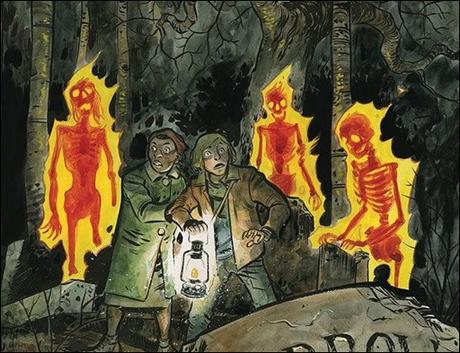
Consequently, while Harrow County certainly exists as a work of the horror genre, it is ultimately a coming of age tale. As a result, the core plot of the series focusing on Emmy’s growth and conflict does not contribute anything particularly groundbreaking and is a tiny bit stale. However, Tyler Crook’s artwork and Cullen Bunn’s imagination for the creatures Emmy encounters strengthens Harrow County and pulls it up from falling into being yet another alternative form of the bildungsroman. In Harrow County, there are uniquely creepy ideas and images. From glowing skeleton ghosts to multi-eyed creatures that look like minotaurs crossed with Giger’s Aliens to a decrepit tree with jaws and crooked teeth to a little boy who can shed his skin and use it as a communication device while the rest of his body travels elsewhere and reports back on any impending danger, the creepy crawlies of Harrow County are the reason to return to this series. Bunn’s ideas for characters capture your fear and dread, and Crook’s illustrations colored with loose and haunting watercolors make them just real enough to be believable but also loose enough to be almost mythical and archetypal.

Emmy discovering the boy whose skin can speak about what his flesh sees

The first volume of Harrow County, Countless Haints, includes character development sketches as well as the original prose chapters for the story, which Bunn originally intended to publish in parts online. These materials provide an insight into Crook and Bunn’s collaboration and their thought process in creating a complex setting, making the first volume a fun first read but also an enjoyable re-read after getting a better sense of the creators’ thoughts on the world they have created. For someone taking a beginner’s step into contemporary horror comics, Harrow County Countless Haints is a strong candidate as a starter book; it has a balance of horror and non-horror concepts, providing some chills but with the familiarity of a coming of age drama.      

Though I prefer Snyder’s take on the witch, Bunn and Crook have undoubtedly created a fascinating, unsettling, and scary world in Harrow County that I hope will get further incorporated into the plot as the series progresses. After the first four issues, Harrow County has promise, but I would like to see it steer away from familiar journey to adulthood devices and move toward exploring the combination of its environmental and external horror with psychological internal horror for Emmy, which will take her character on more uncharted paths. Regardless, if my prediction comes true that witches will soon dominate our television sets and movie screens, I will look forward to seeing a version of Harrow County beyond comicbook pages.

Harrow County Volume One: Countless Haints collects issues 1-4 of the series, which is written by Cullen Bunn and illustrated by Tyler Crook. It is available now via Dark Horse Comics. 


Taking Cues from Steinbeck and the Bible: Fábio Moon and Gabriel Bá’s Two Brothers, an Adaptation of Milton Hatoum’s Dois Irmãos

Standard

In recent years, the graphic novel has emerged as an alternative medium for literary adaptations. From the writings of Victor Hugo to Edgar Allen Poe, graphic novel writers and artists have begun to dissect and reimagine famous Western literary works into word bubbles and panels of illustration. Generally, I avoid such adaptations (there’s something a bit disorienting about the idea of reading The Black Cat in comicbook panels), but sometimes, when the adaptation is placed in capable hands, a gem can emerge, one that not only has a distinct style of its own but also pays respect to the source material in a way that encourages the readers to delve further into the origin of the adaptation; this is the case with Fábio Moon and Gabriel Bá’s Two Brothers.

Cover for Two Brothers, released in October 2015

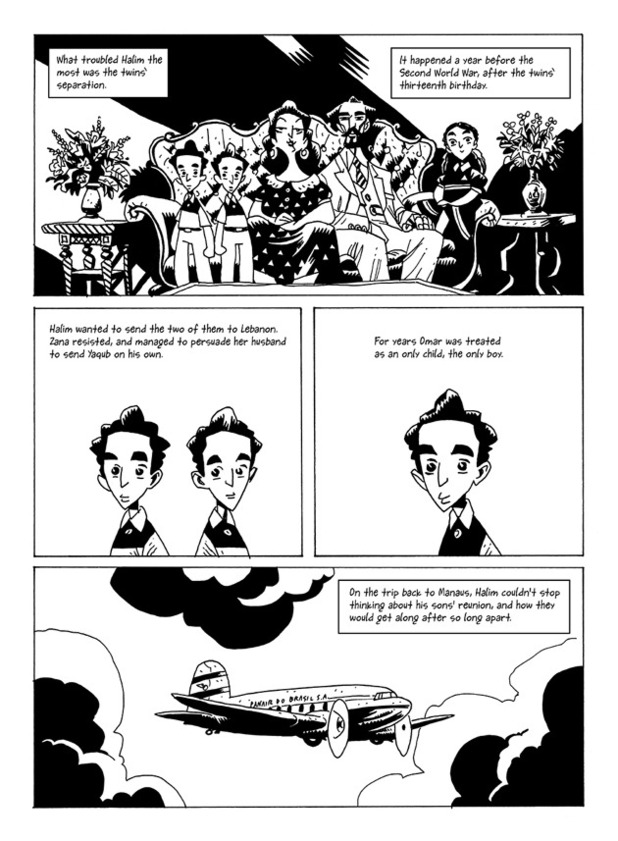
Adapted from Milton Hatoum’s celebrated novel, Dois Irmãos, released in Brazil in 2000 and translated into English in 2002, Two Brothers opens with the images of an industrialized town center before abruptly transitioning to the haunting, decayed remains of a once glorious European style manor in the Brazilian town of Manaus. Immediately, the narrator, once intimate with the family that lived in the home but not necessarily a member himself, prepares you for a tale of the rivalry between two twin brothers and their disastrous consequences on the people and the world around them. From the start, you know that Two Brothers will follow the course of Cain and Abel or Jacob and Esau, but Hatoum’s tale travels to the bowels of uncertain morality as foreign investment and industrialization creep into Manaus, eliminating its quaint history as a quiet port town and the people tied to the city’s former heart.

While Two Brothers certainly alludes to the biblical battle between brothers, it most resembles Steinbeck’s approach to the adaptation of Cain and Abel in the early 20th century in East of Eden. Like Cal and Aron, Omar and Yaqub are twins, with Omar possessing a darker complexion and more sinister in nature like Cal and Yaqub possessing a kinder heart and an affinity for education like Aron. Zana, the twins’ mother, fixates on Omar, a sick and weak infant who required more care as a baby. Omar continues to devour Zana’s affection and attention throughout his growth, and as a result of his mother’s incessant doting, Omar never seeks to accomplish anything because, after all, he will always stand as his mother’s favorite, guaranteeing him a home for the rest of his life or at least as long as his mother is alive.  

The same cannot be said for Yaqub. As the more accomplished and kinder son, Yaqub must fend off most of the world himself. Zana abandoned Yaqub as an infant, leaving him primarily in the care of Domingas, an orphan given to Zana and Halim as a servant for their home, and this first act bears course on Yaqub’s status in his home for the rest of his life. When an adolescent Omar slices Yaqub’s face open with a broken bottle upon seeing Yaqub with Lívia, a girl both brothers have tried to pursue, Zana and Halim send Yaqub away to Lebanon in the guise of allowing him to learn more about his family’s roots, but in such an act, they cast away their first born son, placing him on a course of aloofness and solidifying the contempt between the two brothers and Yaqub’s conviction to establish himself without the aid of his family.

For the first half of the book, Omar emerges as the obvious antagonist in Two Brothers, but by the end, it is difficult to determine whether Omar or Yaqub possesses more evil. While Omar outwardly displays his jealousy toward his brother as Yaqub succeeds as an engineer in Rio de Janeiro, Yaqub quietly holds his spite and acts on it in a more backhanded and manipulative manner. Though Omar has the darker complexion, Yaqub has a permanent scar on his face, a mark which can parallel the mark placed on Cain after he murders Abel. Both brothers have inherent malice and malevolence, but they choose to act on it differently. Omar conveys his evil in the sense of an irresponsible child; he’s hedonistic, violent, lazy, and outrageously selfish. Yaqub’s evil manifests in a more covert manner; he’s a vengeful industrialist determined to wipe away the history of the town and members of his family who made him a pariah. Which is worse?  

To contrast the graveness of the tale of Omar and Yaqub’s destructive relationship, Moon and (twin brothers who we imagine have a far better standing with each other) illustrate Two Brothers with a deceiving simplicity and lightness. The wilderness surrounding the family home has a certain whimsy to it, and the fading of this magical sense of the jungle into decay then manicured, superficial gardens of a parody of the Orient on the edges of the Amazon jungle best conveys the changing face of Brazil in the years after World War II. The shifts in the settings along with the physical appearance of the characters help to tie each character to a certain place and time and aid us in understanding why as time passes, certain types of people rise as others fall depending on their connection and adaptation to the evolution of society.

Though the story of Omar and Yaqub dominate the plot because their actions influence all of the peripheral plotlines and the future of the town of Manaus, Two Brothers, at its core, addresses and explores the psychological motivations of individual family members and how their differing states lead each to interact differently with each other. While Omar and Yaqub do possess inherent evil, the expression of this evil comes from the environment that their parents created in the family home. Halim, the patriarch of the family, never wanted to have a family, and as a result, he keeps a specific distance from his family that prevents him from being a strong parent. Zana displaces her original passion for her husband on her son Omar, alienating the rest of her family. As a result of the psychological states of Zana and Halim, we spend the rest of the Two Brothers studying their impact on their sons and anyone else who crosses the threshold to enter the family home, adding a richness to the story that keeps you engaged with every character and page.

Fábio Moon and Gabriel handle the adaptation of a novel containing severe ideas and concepts with poise and grace, making Two Brothers a captivating and enlightening but never heavy-handed read. They manage to extract the fundamentals of the book without overly simplifying its themes, and in doing so, have me interested in picking up and visiting Hatoum’s original novel, which is a result that every adaptation should try to achieve.

After reading Two Brothers, I realize that I perhaps have been too judgemental against graphic novel adaptations of literature. Admittedly, I have avoided the adaptations of works by literary authors I adore, so perhaps I read Two Brothers simply because I have no familiarity with the original work. Thus, my opinion may change after reading Hatoum’s Dois Irmãos, but I can say that a standalone piece, Two Brothers, balances layers of complexity in a graphic novel in a way that few other releases have this year, and for that, it should be commended regardless of its relationship to its source material.

Two Brothers by Fábio Moon and Gabriel Bá is available via Dark Horse ComicsIt’s a heck of a gift for any graphic novel enthusiast this Christmas. 

Wilfrid Lupano and Jérémie Moreau’s The Hartlepool Monkey: A Microcosm of England and France’s Ugly Past

Standard

After reading Wilfrid Lupano and Jérémie Moreau’s The Hartlepool Monkey, I began to prepare myself for giving, at best, a lukewarm review for the book. At face value, I found the monkey trial of espionage on behalf France and consequent hanging by a group of townies in Hartlepool to be a bit of a heavy handed metaphor in combination with the final discourse and cautionary message about the effects of severe xenophobia. In fact, immediately after my first read, I felt that The Hartlepool Monkey possessed the satire sensibilities of Voltaire’s Candide but diluted with a few buckets of distilled water.

But, everything changed when I delved into the cultural history of the legend of the Hartlepool monkey. Sure, the back cover alluded to the inspiration from the legend, but prior to reading the book, I had not realized the influence of the monkey across the course of time.

Cover for the English Edition of The Hartlepool Monkey

So at this point, you must be asking, what is the Hartlepool monkey legend? And what about it caused you to reverse your perspective of the work?

The legend/myth/tale of the Hartlepool monkey claims that during the Napoleonic Wars, when Napoleon attempted to extend his ruling domain across Europe, a French commercial ship crashed off the coast of Hartlepool, a small city on the eastern coast of England. It is believed that the only survivor was a monkey, most likely some type of chimpanzee, and given that the denizens of the town had never interacted with any citizen of France, they believed that the monkey was in fact a spy for France. The legend then claims that the town gave the monkey a trial, and as expected , they found the creature guilty of espionage and lynched it on the beach (how could a monkey proclaim its innocence in the first place?).

Though the exact origins and the truth of the tale remain somewhat contentious, Hartlepool has continued to embrace the story, so much so that the city’s soccer club’s mascot is H’Angus the Monkey. And as if the impact of the tale could not get more absurd, the man who dressed up as H’Angus for Hartlepool F.C. became the mayor of Hartlepool in 2002, serving the town for ten years until the city decided to eliminate the role of mayor in favor of a ruling local committee. With absurd and macabre origins, the legacy of the Hartlepool monkey got even more bizarre in modern times.

Given the generally positive perspective of the myth of the monkey hanging in Hartlepool, it makes sense that Moreau and Lupano would want to revitalize the story with a focus on its outrageousness and absurdity. The skeleton of the story focuses on the Hartlepool monkey, and the flesh focuses on building the mannerisms and cultural practices of the people of the setting. Unlike in the original myth and the song popularized by Ned Corvan in the 1800s, The Hartlepool Monkey contains a voice of reason whose thoughts weave through the tragedy of the monkey. A doctor, whose carriage fails on a trip, stops into Hartlepool and offers a more modern perspective on human brutality and xenophobia. However, it becomes clear that his perspective is out of place, and as thus, the course of events of the legend will have to occur.

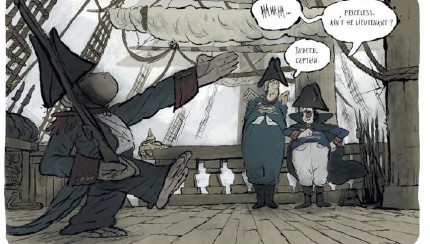
While most of the narrative focuses on Hartlepool’s rogues, who Moreau illustrates to their utmost grisliness, Lupano prefaces all of the events in Hartlepool with a sequence that casts light on the overall ugliness of the people of the time. The Hartlepool Monkey opens up on the decks of the French vessel that crashed, where the captain himself proves to be as ignorant and vulgar as the Hartlepudlians to come. As a former slave trader turned navy man, the captain reigns over his ship with a reverse direction xenophobic severity as the Hartlepool yokels. In foreshadowing the idiocy ahead, the captain sentences a French servant boy to death when he sings a sea shanty and mentions that his nanny was English. Though the tale of the Hartlepool monkey certainly exposes a dark truth about the town, the actions of the French navy on the ships do not make the French citizens more sympathetic than the Hartlepudlians. In this period, France hates England; England hates France, and both act stupidly and violently out of their hatred.

With the contrasting settings on the boat and in Hartlepool, Lupano conveys the overall heinousness committed by humans, regardless of nationality, in the era of the Napoleonic Wars, which is by far the strongest part of the novel. Sadly, it stands in the shadow of the doctor’s more philosophical statements and eventual closing speech on the brutality of man in the name of patriotism, which the book could do without, for we as readers should be able to infer such a message from the story. But, I’ll pardon these more dogmatic and heavy-handed panels, since after all, perhaps we need a more explicit reiteration of the learnings from the tale of the Hartlepool monkey, since a slightly disconcerting pride in the tale continues to exists nearly two centuries later.

The Hartlepool Monkey is written by Wilfrid Lupano and illustrated by Jérémie Moreau. The English edition is available via Knockabout.

A Tale of Parenting Beneath a Vietnam Veteran and Werewolf Tale: Brian Buccellato’s Foster

Standard

A devilish cold has been rampaging through the Fierro house, and in the midst of our cough syrup and cold medicine stupor, I rummaged through a couple of stacks of recent comicbook purchases looking for this week’s review piece. After recent convention visits and trips to our local comic book shops, the “to read” pile is steadily getting out of hand. Consequently, I completely forgot about the volume of Brian Buccellato’s Foster that was hiding underneath a copy of Will Eisner’s To the Heart of the Storm (on the to read list…) until I pulled apart the precarious stack of books above our modest comicbook shelf.

Cover for Foster Volume One

Truth be told, I probably never would have picked up Foster based on its cover. Upon opening up the collection, it is evident that Foster wants to eat, breathe, and consume the 70s of Martin Scorsese’s Mean Streets and James Toback’s Fingers, but the cover gives off more of a Rambo with a hint of werewolf scent. Thankfully, the psudo-script opening written by Robert Place Napton describing or pondering on Buccellato’s origins lured me in and opened the curtain for the character of Eddie Foster and the setting of Vintage City, a future wasteland and composite of America’s major cities in the 1970s.

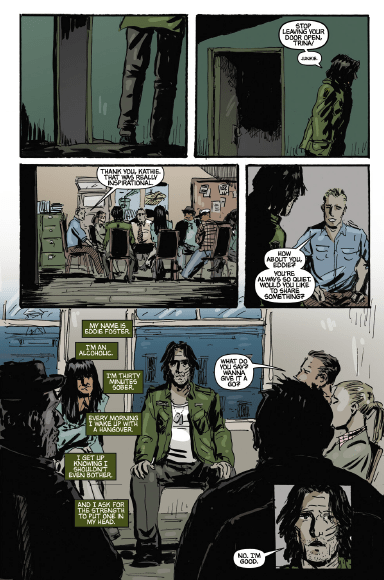
Buccellato’s first full-creator controlled series, Foster, exists in 6 issues that trace the first arc for Eddie Foster. A Vietnam War veteran, Eddie struggles to re-adapt into society. We know he saw ghastly things and committed the same in Vietnam, and as a result of his sins and those of others, Eddie cannot function as a husband, father, or working man. Instead, he remains in a haze of depression and alcoholism, languishing in the ruins of his past and present.

Adapted to the wreckage of his current state, Eddie attempts to rise above, but he lacks a clear reason to live. Redemption may be something he craves, but he is so mired in his regrets that he is unaware of it. That is, until, one day, his next door neighbor’s son, Ben, appears to be orphaned by his dysfunctional mom, and Eddie Foster must serve as his guardian, caretaker, and protector in the days to come.

In parallel to Eddie Foster’s chance to redeem himself as a father, the leader of the Dwellers has returned to Vintage City, and he wants his son back to become the heir of the Dweller kingdom. Part ape, part wolf, part human, the Dwellers lurk in the night, picking off the unnoticable of members of the city’s society. They quietly rule the underworld of Vintage City, and they are ready to emerge at the surface.

The Dwellers not only interest those fascinated with the supernatural beings of nightmares but also the geneticist Doctor Marjorie Fisher, who wants to learn more about the biology of the creatures. Consequently, Marjorie has had a few conversations with Ben’s mother, Trina, because Ben is not just the adorable six year old he appears to be. In fact, he may only be the only documented half-human, half-Dweller to exist.

Thus, the task of caring for Ben involves far more than just taking him to school, preparing his meals, and providing him with a place called home. Eddie must protect Ben from Dr. Fisher and the Dweller king, both who want him for their own motivations, and both who will prevent Ben from ever having any consent in the course of his future. So, despite the characters and plot which have hues of Vietnam Veteran, werewolf, and science fiction tales, Foster, at its core, explores the meaning of being a parent in a world in disrepair. Eddie, the Dweller king, and Dr. Fisher all represent different parental motivations with Eddie as the unlikely (and unconventional) but most supportive parent, the Dweller king as the genetically tied parent demanding filial loyalty, and Dr. Marjorie Fisher as the parent interested in studying and experimenting on her own child.

While the dialog does get a bit clumsy here and there, Foster, stands as an accomplished first full creator-owned work for Buccellato because his own battles with parenting ascend from the action sequences and the Dweller battles of the series, making Foster a far more introspective and ruminative work than it would seem on its action-packed surface. I am a firm believer in synchronicity, and it is of no surprise that reading Foster reminded me of a film we caught at AFI Fest 2015 and remains fresh in my mind, Jacques Audiard’s Dheepan. Buccellato and Audiard have similar sensibilities in understanding the differences between genetic and constructed families, and both Dheepan and Foster involve war veterans on a track for redemption via the protection of their non-traditional families. In turn, both are able to balance an enormous amount of action with sympathy and emotion, creating a story that should not only pull in people attracted to explosions and gunfire but also those who prefer more conversationally based, pensive works.

And while I do emphasize that Foster at a superficial level looks like a comicbook inspired by a extravagant action films of the 70s and beyond, I must admit that I love Walter Hill’s Southern Comfort and Streets of Fire, both of which have covers and surfaces that do the same, so perhaps my appreciation of Foster is not such a surprise after all.   

Foster is written and colored by Brain Buccellato and drawn by Noel Tuazon. The first volume with the first six chapters/issues is available via OSSM Comics. 

Learning How to Create Comics With a Rabbit Samurai – Stan Sakai’s Usagi Yojimbo: Samurai and Other Stories

Standard

Given my natural affinity to Westerns, I am amazed that I have yet to dive to far into the samurai genre, the foundation for most of the tropes and themes in the Westerns I adore. With the variety of samurai adaptations seen over the years, I always wonder what each incarnation has to offer. Melville’s Le Samouraï placed the concept of the bushido code in 1960s France. In contrast, Kobayashi’s and Takeshi Miike’s versions of Harakiri remained true to the Edo period. Consequently, when I found the gallery edition of Usagi Yojimbo, I was curious to see the effect of anthropomorphism on the story of the traveling ronin.

UsagiCover

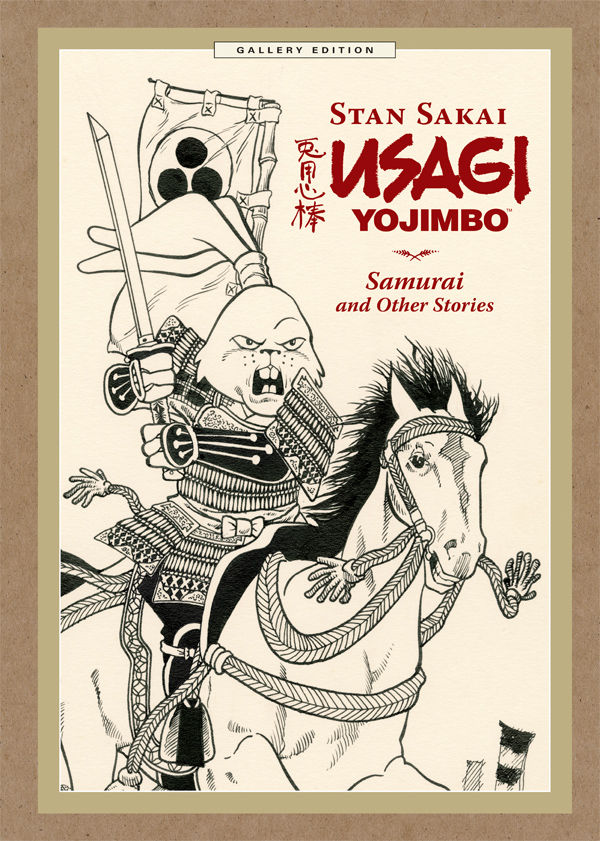
Cover for Gallery Edition Volume One of Usagi Yojimbo: Samurai and Other Stories

A series spanning over nearly three decades, Usagi Yojimbo follows Miyamoto Usagi, a former samurai whose lord died in battle. As a ronin (i.e. lordless samurai), Miyamoto wanders across Japan during the shifting Edo period, offering aid to towns in need and offering services as a yojimbo, a bodyguard. Unlike the images of samurai we know, Miyamoto is a rabbit, and his world involves other animals in the place of humans.

Certainly entertaining, Usagi Yojimbo has a far different tone than the standard samurai tale. Rather than using minimal and distant storytelling, Stan Sakai, the creator of the series, focuses on making Usagi Yojimbo more didactic. By using animals in the place of humans, Sakai invites younger audiences to read the stories, and by including explanations of core samurai concepts, Sakai also teaches readers about the fundamental basics of the samurai genre.

The early stories of Miyamoto included in the gallery edition, Usagi Yojimbo: Samurai and Other Stories, explore the bushido code in addition to human motivations, ranging from honor to guilt to greed. In sum, all of the stories focus on Miyamoto’s code of ethics in a changing world where the samurai has begun to face extinction. While less dire than Harakiri, the Japan of Miyamoto Usagi needs the original samurai code of ethics, but the people do not seem to realize it. Usagi Yojimbo teaches readers about the way of a righteous samurai in contrast to the ignoble ones he encounters as the feudal society around him begins to change.

Given its educational leanings, Usagi Yojimbo may be a bit frustrating for readers looking for a new perspective on the samurai. However, for what Usagi Yojimbo lacks in complexity, it makes up in charm. With the gallery edition, Sakai earnestly draws himself introducing the collection, and he even conveys how he creates each page of Usagi Yojimbo. Furthermore, the gallery edition includes re-prints of the original, unedited, Bristol artboards used for the collected stories, which span the first ten years of Miyamoto Usagi. Thus, as a collection, the gallery edition of Usagi Yojimbo not only teaches the audience about standard samurai motifs but also how to create a professional comic. In addition to explaining techniques at the beginning, the stories include imperfect pages with an occasional whiteout spot here or there, serving to remind and encourage any new or seasoned comic book artist or letterer to keep on practicing and creating.

Admittedly, if it were not for the gallery presentation of Usagi Yojimbo, I am not sure if I would have enjoyed the book as much. Miyamoto Usagi, the samurai rabbit, is an appealing character, but beyond his manifestation as an animal, he differs little from other ronins we’ve seen in samurai films and the various versions of ronin adapted over the years ranging from the man without a name to the rogue yukuza. Despite this, Sakai’s humble and welcoming introduction along with the large format pages make the book something special. You can study each line, each letter, each character and combine all of them to admire Sakai’s vibrant, kinetic visual style. Usagi Yojimbo: Samurai and Other Stories serves best as a comic book creator’s resource or as a gateway into the samurai genre for a new reader, but regardless of your understanding of samurai or comicbooks, you’ll still have fun seeing rabbits with top knots fight rhinos, moles, and cats and get excited to see the adorable tokage (lizards) that look like a cuddly cross between a brontosaurus and Al Capp’s Schmoo; I know I certainly did.

Usagi Yojimbo: Samurai and Other Stories by Stan Sakai is available via Dark Horse. 

American Flagg! Howard Chaykin’s Dystopian, Futuristic Noir

Standard

As seen by my great affection for Satellite Sam, I really enjoy Howard Chaykin’s work, perhaps a little more than I should. Thus, it is of no surprise that American Flagg!: Hard Times from 1985 forced me to stop my digging as I flipped past collections of Bill Griffith’s Zippy and Will Eisner’s The Spirit on the Comikaze exhibition floor.

Cover for Hard Times Trade Paperback

Chaykin’s male protagonists and femme fatales (or really any peripheral female character in general) fit the idealized form for both genders. They are figures inherently from the past in that they really no longer exist. The women are almost always voluptuous and clad to emphasize their curves; they have the proportions of Jayne Mansfield and the sultriness of Marilyn Monroe or Barbara Stanwyck, with much of their words loaded with double entendre. As for the other part of the Chaykin gender equation, the protagonist men are rugged with square jawlines and shoulders; they have somewhat charmingly naive faces and ever so slightly sinister smirks to remind you that they have more than just brawn; Chaykin’s male protagonists are the Guy Madisons, Rock Hudsons, and Gary Coopers of comics.

The villains, on the other hand, deviate far from the ideal images of the male protagonists and the women. They are overly thin or portly. They are too short. They are balding. They are unkempt.

But, despite the visual contrast between the protagonists and the antagonists, the characters in Chaykin’s work tend to all be quite flawed and somewhat rotten, and such is the case with the cast in American Flagg!

In the opening by Michael Moorcock, he addresses, rather bluntly, the consistent criticism of American Flagg!: that it is sexist. Sure, it is true that the protagonist of American Flagg! is your all-American, standard white, heterosexual male. However, returning to my previous statement, no character in the series is perfectly clean and pure; everyone in the Chicago of American Flagg! has clear weaknesses, be it power, wrath,  lust, or greed, and those vices drive them toward poor decisions. Under the pristine faces and bodies lies dark thoughts and deeds, making the characters fundamentally more like characters of film noir and less like those of 1980s teen films. In fact, you should be more offended by John Hughes films’ portrayal of women than Chaykin’s in the comics he was creating in the same time period, but I’ll avoid saying more and let you ruminate on that statement.

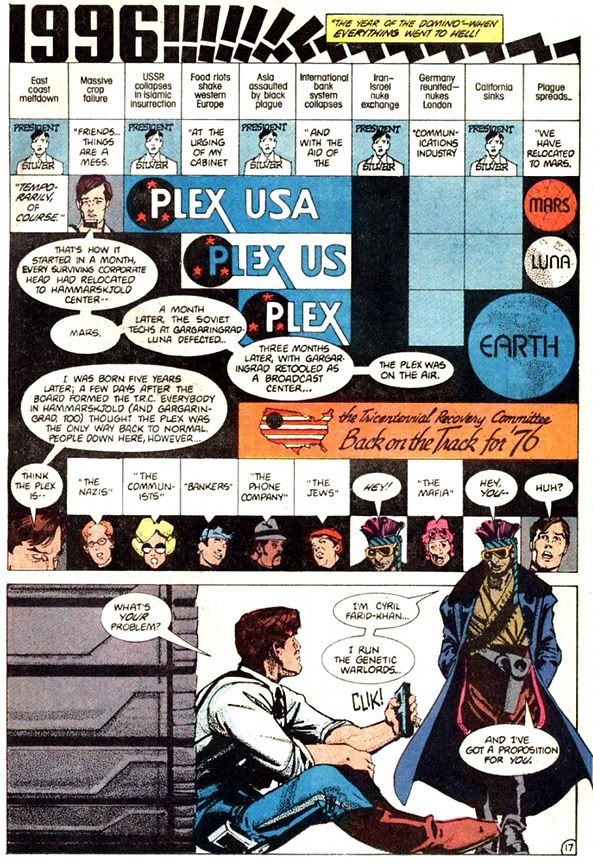
American Flagg!: Hard Times collects issues 1-3 of the series, completing the story arc of Rueben Flagg’s arrival to Chicago and his first experience as a ranger for Plex, the corporation that runs the universe after a series of great misfortunes and catastrophes force the government and corporation onto Mars. As a washed up television star replaced by a hologram and drafted into service duty by Plex, Rueben Flagg lands on Earth as a Martian by birth but Earthling by blood. Flagg has a naive patriotism for America and feels an obligation to help make Chicago a safer town to live in, but after meeting Chief Ranger Krieger and his daughter Mandy, he realizes that his gun-toting, Western style understanding of good and evil does not exist in the place he has landed.

The Chicago of 2031 has the rampant corruption of the Chicago of 1931. Plex, the major corporation that rules over the universe, parallels the organized crime outfits running the major cities in America in the 1920s and 1930s. Like the mobsters of the past, Plex has tyrannical control over everything, and every law has seemingly only one purpose: to make the executives at Plex richer and thus more powerful.

As with any dystopian government/authority, Plex also manipulates its people. Here, in American Flagg!, the company uses media to galvanize violence and create gang wars that generate profit through arms dealing and highly popular television broadcasting of the fights. Plex also uses subliminal messaging to encourage violence on innocent people, leaving the citizens in Chicago feeling vulnerable and in need of the Plex Rangers for security.

Unfortunately, Rueben does not understand the magnitude of Plex’s omniscience before his assignment, and he spends Hard Times finding out about its corruption of society and humanity. American Flagg!, at its core, is a science fiction noir; where Rueben, the outsider, must navigate a dirty, filthy world that will likely swallow him whole in his attempts to fix it.

And as a noir, American Flagg! could not be complete without its potential femme fatales. In this case, we have Mandy Krieger, the sharp-shooting, blunt, coarse, and sensuous daughter of Rueben’s boss. Mandy has a clear fascination with Flagg that draws the two closer and closer (and into bed, of course). In addition to Mandy, we also have the hostess (i.e. madame) Gretchen Holstrum and pilot Crystal Marakova. By the end of Hard Times, it is a bit unclear who will lead Flagg to the greatest danger, but we do know that his own lasciviousness will naturally get him into trouble. Combine his inclination to jump into bed with any attractive woman who approaches and his overly optimistic sense of duty to incite change, and Rueben Flagg stands on a course that cannot lead to neither a good end nor an overwhelming sense of catharsis.

Beyond the alluring characters and plot, American Flagg!: Hard Times also features exceptional artwork, mixing structured panels and free-form constructions on its pages. The Chicago of 2031 as imagined by Chaykin in the mid-1980s certainly has more art-deco influences than I suspect the real 2031 one will have when it arrives, but as a result, his world, while cold in its pervasive technology, also has a certain elegance to it in its clothing, cars, and marquees.

Given its noir qualities, American Flagg!, though set in 2031, which is not too far away from today, still remains relevant. It serves as a reminder that despite the progress we make in technology, we will still fundamentally have issues with corruption and media manipulation in the future to come, and if we get wrapped up in the consumerism associated with technological advances, we’ll have progressed no further as a society than from where we were in the 1930s. I wonder if 2031 will also bring about a talking cat such as Raul, Reuben Flagg’s confidante, that can sense subliminal messages and navigate through the human world as a covert listener and watcher. I hope so, since he’ll be an especially insightful, enlightening, and perhaps the last neutral party in a post-internet, advanced data and technology age.

American Flagg!: Hard Times was first published in 1985 by First Comics.  Image and Dynamite have since published collected volumes of American Flagg! 

Comikaze Spotlight: Kel McDonald and Jose Pimienta’s From Scratch

Standard

On the far edge of the exhibition booths with towers of toys, old and new comics, and any other merchandise tied to pop culture of the past and present you could imagine, Stan Lee’s Comikaze’s Artist Alley stood in modest rows. As per our usual approach to any comic con, we first focused our attention on this section looking for independent work and new experiments in the comicbook form (based on Stan Lee’s introduction to the extended weekend celebration of comics and pop culture, he insisted that “comic books” should be “comicbooks,” and in honor of that, I’ll stick to the nomenclature he prefers). After winding through the tables and passing by plenty of illustrators who were selling prints, we stopped at Jose Pimienta’s table, lured in by copies of The Leg, which he illustrated (and I reviewed in the past), sitting at the edge of the table.

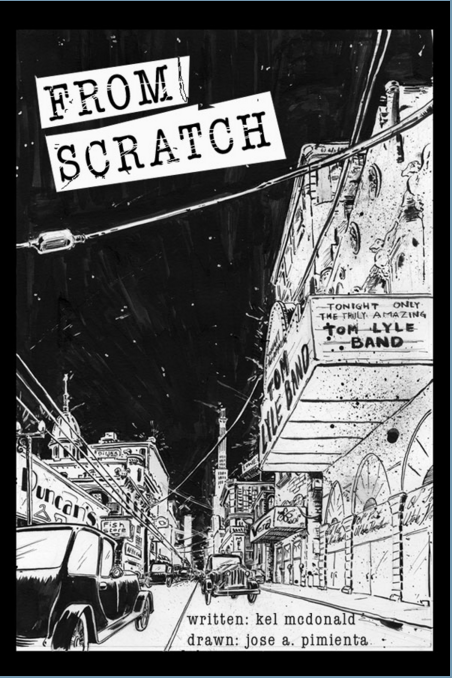
As fans of the illustration style in The Leg, we decided to pick up From Scratch, illustrated by Pimienta and written by Kel McDonald. Independently published by McDonald, From Scratch contains plenty of familiar creatures of the supernatural that we’ve come to know, but rather than showcasing the powers we have seen them utilize for decades, these beings exhibit their more human components and foibles. Set in the 1920s, From Scratch has a hint of a film noir look to it, but it is far looser in its storytelling and visual style than most noir comics out there.

FromScratchCover

Noir Pulp-esque Cover for From Scratch

From Scratch opens with Aaron and Seth arguing in a dark speakeasy. Aaron has agreed to join Seth and his group on a job to eliminate a Mr. Zamboni and his group of mobsters, but not without some doubt about where this first foray into paid killing will take him in the future.

When the two meet the rest of the team, we begin to realize that the crew is not composed of your average hit men. Aaron and Seth are vampires as well as Loki, who also possesses specific sorcery power in addition to his ones as an undead creature of the night. Beyond the vampires, we also have Sasha the werewolf and Lady Kimaya the ice demon, and all of these folks take their instructions for the job from a demon with a sinister grin and face paint to match named Darkfire or, in more human terms, Mr. Tamura.

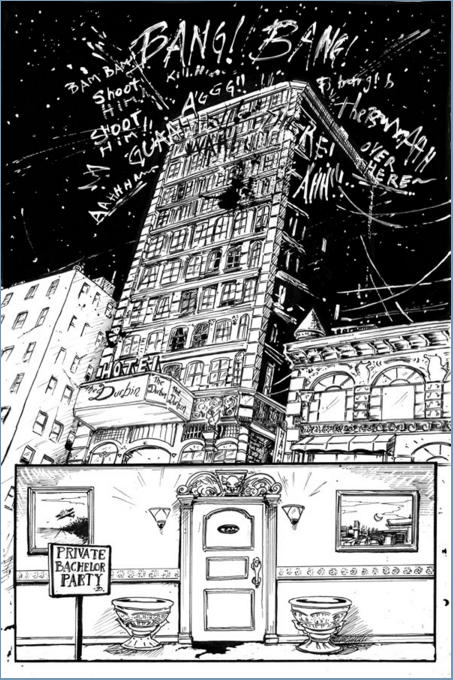
After the introduction to the cast, the plot focuses on one specific job for the group as their more human characteristics such as common sense lead them into blunders and an overall messy and too overt execution of their task. In the course of running through the halls of a stately art deco hotel looking for their target, Mr. Zamboni, the members of the team attempt to handle the order as humans, causing struggle that leads to them resorting to using their supernatural powers. Despite your natural assumption that these characters have a far greater advantage in accomplishing their deed because of the fact that they are not human, their powers cause more inconvenience than efficiency; the superpowers cause more destruction to the building and make far more noise, making the demon assassins less anonymous and quiet in their attempt to clear out everyone guarding Zamboni.

From Scratch sets its sights on placing familiar supernatural characters in circumstances and settings that deviate from their archetypal courses and succeeds. In addition to McDonald’s fun and distinctive script, Pimienta’s work here shines, with each page containing a unique visual element, ranging from varying lettering to abstract forms created from the bloodshed of the crew’s deed. While the book is comprehensive and complete, it leaves some fascinating remaining questions open, perfect for a second volume and even more. Unfortunately, only one book for the From Scratch crew and scenario exists, which is the real shame because it generates an imaginative and absurdist world with strong characters that I would love to learn more about.

BuildingPage-FromScratch

Example of Mixed Art and Lettering Style

Regardless of my disappointment that more of From Scratch does not exist, it stands as an excellent example of the type of gems buried in the crowded aisles of the Artist Alley of any comic convention. Next time you’re at a con, take some time away from the walls of mesmerizing Funko toys to talk to creators at their tables in Artist Alley. You’ll most likely discover a work that tests your expectations for comicbooks, and that’s always a treat well worth the time and effort.

From Scratch is written by Kel McDonald and illustrated by Jose Pimienta and is available in print and electronic forms here

Also, keep an eye out soon for our wrap up on Comikaze, which will be posted on Forces of Geek soon!

The Failed Graphic Novel Extension of Olivier Morel’s Film On the Bridge – Walking Wounded

Standard

There’s no doubt that Olivier Morel and Maël’s Walking Wounded addresses a serious topic.

The Iraq War (and the overall War on Terrorism) most certainly stands as this generation’s Vietnam War. The war itself has some highly questionable motivations and practices (which I will omit to discuss at length here because I, by no means, am an expert, but for further context, I will direct you to this). And, like the veterans of the Vietnam War, the veterans of the Iraq War have returned home to a similar indifference and lack of support. To make matters worse, the veterans of this war all decidedly enlisted to protect our country; a mandatory draft did not exist at the time of the war, adding a further layer of complexity to veterans’ experiences upon returning because the decision to join the battle was even more of a conscious one even if the battles they were placed in were completely unexpected, potentially making these soldiers feel even more guilty about the horrors they experienced and implicitly making the public even more passive about the welfare of these troops with a, “you should have known what you were getting yourself into” sentiment.  

Before we proceed, let me establish that this review in no way will address my own opinions of the Iraq War or American foreign policy over the past two decades. In addition, before I go on to explain the flaws of the Walking Wounded: Uncut Stories From Iraq, let me also say that I have always and will always support American veterans; my family has multiple veterans, and I have multiple friends who are currently in the military or have returned from service, so my criticism of the Morel graphic novel does not come from any political leanings or judgement on American soldiers; it comes from the novel’s  failure to execute a coherent story and failure to evoke empathy in addition to pathos and sympathy.

Now, onto the analysis and review…

We as a general public should demand more sophisticated and nuanced discussions of war and its psychological impact on our soldiers. During and after the Vietnam War, we saw a wealth of films that allowed those of us at home (and those of us who were not born at the time such as myself) to understand what our soldiers experienced and how they felt. Ranging from Walter Hill’s Southern Comfort to Bob Clark’s Deathdream, viewers, even now, could begin to understand the absurdity our soldiers faced and, in turn, the great difficulty they would endure upon returning home and attempting to re-integrate into civilian society. On the non-fiction side of film, war documentaries such as Peter Davis’s Hearts and Minds dropped you right into soldiers’ daily lives in war, thus showing us how and why Vietnam veterans would face immense hardship when they returned home. With these Vietnam War films, you do not sit through conjecture or hear any platitudes about the brutality of war; you walk side by side with the people in front of you, seeing what they see, making you feel completely consumed by their worlds. Sure, there’s a message lying in all of these works (some that you could even describe as propaganda), and the plot, the characters, and the editing exist to convey this message, but you do not spend 90 minutes sitting with people who repeat the director’s intended message to you over and over.

In today’s documentaries about any serious topic (war, environmental damage, health care accessibility, hunger, and really any topic that addresses the suffering of living things), more often than not, you get spoon fed the message of the director with talking head interviews with various people who essentially say the same thing. Again, to repeat, these topics are important, but the recent trend in the documentary form with its perspective-less interviews frequently fails to produce any deeper empathy than that of a public service announcement. And even worse than the cold, distanced, content-less interviews are the moments of “artistic expression” meant to convey the message in some abstract way. These moments frequently do even more damage to the communication of the theme of the work, breaking up the tone of the interviewees with these abstractions that at best evoke some short sense of pathos and some pat on the back for pretentious creativity that is difficult to critique in public without some dissent.

Now, what happens when one of these serious modern documentaries filled with heart-wrenching interviews and artistic interludes gets extended into graphic novel form?

You get the Walking Wounded: Uncut Stories From Iraq, a clumsy, awkward novel that fails to provide further dimensionality and richness to Morel’s documentary film On the Bridge (which in itself haphazardly handles the stories of the veterans it includes) and feels more like an attempt to capitalize on a “hot” media form without ever studying how to create a story in the comic form that everybody is ranting and raving about.

Cover for Walking Wounded

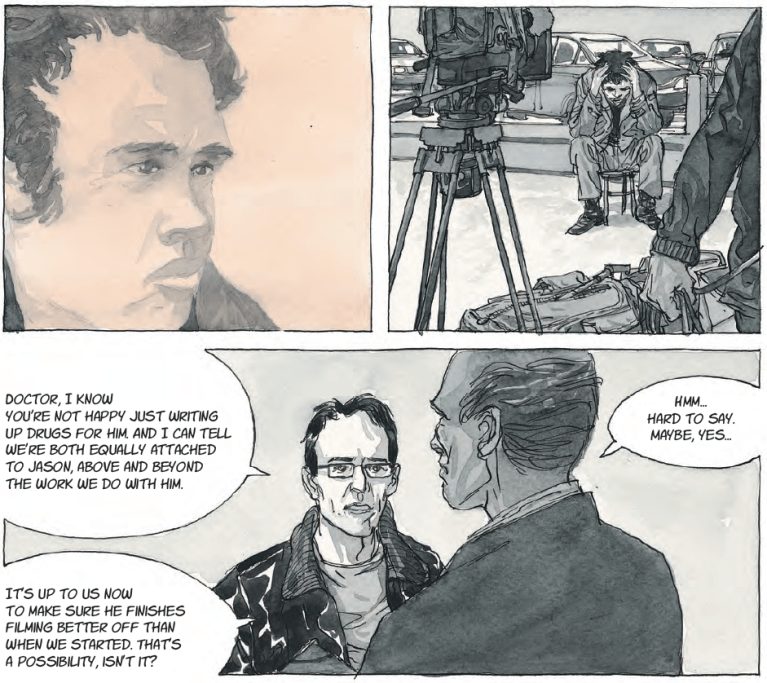
The Walking Wounded includes the stories of the veterans included in On the Bridge with a tiny bit of Morel’s perspective as he made the film. In the novel, Morel does address the moral line between storytelling and exploitation that all documentarians face, but given the sparseness of these moments of reflection in the novel, his own perspective on the making of the film only feels like a digression away from the stories of the veterans. So, if the novel does not expand on Morel, then shouldn’t he use the graphic novel to expand on the stories of the veterans?

Well, he does include some moments of how the interviews with our veterans, Wendy, Vince, Ryan, Jason, Kevin, and Lisa and parents of veteran Jeff Lucey came to happen, but with his attempt at non-linear storytelling to portray each veteran’s role in the film paired with their experience in and out of war, Morel butchers the stories and throws them incongruously together, making it difficult to get to know each veteran beyond the panels where they discuss how they felt deceived by our politicians and how the terrors of war make it difficult to experience regular life. We get no time to live with our veterans and have them naturally recount their experiences in war and in civilian life; we only get their answers to Morel’s pointed questions. Consequently, given all of the veteran stories included in the 122 pages of the Walking Wounded, the novel is a modge-podge collage of understanding post-traumatic stress syndrome rather than an insightful, pensive work which explores and attempts to comprehensively understand how PTSD manifests and affects our veterans.

Thus, what makes the Walking Wounded an infuriating read is its absolute failure to extend the stories of the veterans featured in On the Bridge; in fact, he chops them shorter in the novel and interrupts them with making of the film moments, failing to build greater perspective and empathy, which, in total, fails the veterans included in the novel and the cause-at-large to provoke change in our society’s approach to veteran care and support in reintegration into civilian life. The Walking Wounded provides no more depth or information than a news item, and with its attempt to include so many stories into a small book, it feels like a human interest piece about veterans that you would see produced for CNN or PBS. Morel would have seen far more success if he focused on one specific veteran, but instead, he includes only didactic moments from each veteran’s story, making the whole book as thought-provoking as a pamphlet on veterans’ PTSD in a psychologist’s office; and, to further this info pamphlet vibe, Morel even includes a patronizing Notes section which includes elementary definitions for a range of items such as The Subprime Crisis and Crash of 2008 and Abu Ghraib, all of which need far more discussion and analysis than what he provides (did he not think his readers were capable of looking up information about the topics he described?).  

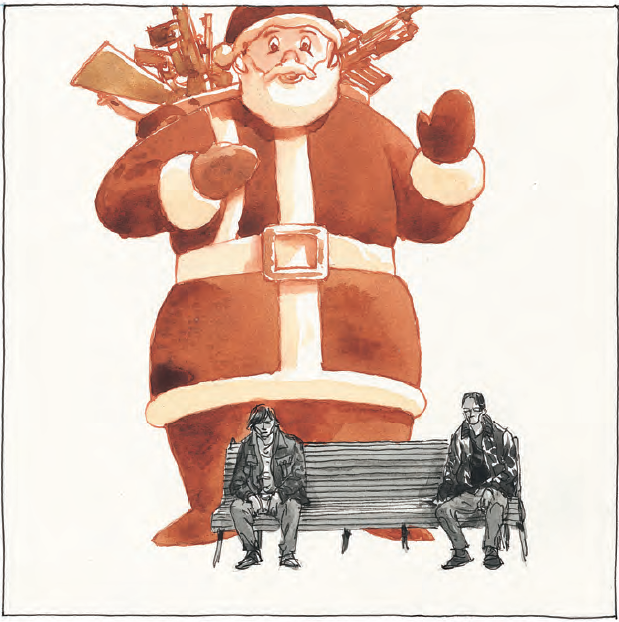
All of my anger at Morel’s incompetence can be summed up in one moment…When Morel meets Ryan Endicott, a young marine who is sitting alone at a Christmas party, and strikes up a conversation with him, Ryan discusses how he hates everything, especially Santa. To hammer home Ryan’s struggle with the trivialness of everyday civilian life compared to his experiences in war, Morel and Maël include an image of Morel and Ryan speaking on a bench dwarfed by a sepia image of a giant Santa carrying a bag of weapons. If that one scene alone does not convey the utterly poor and grossly heavy handed execution of the Walking Wounded, then I pray for the future of documentaries and nonfiction graphic novels, for we have regressed in our expectations of how to present, digest, and comprehend controversial and difficult topics, thus doing no justice to the stories of the people ultimately affected.

Santa-WalkingWounded

Walking Wounded by Olivier Morel and Maël is available via NBM.