Remembering the Daily Life of World War I in Alban B. Butler’s “Happy Days!”

Standard

World War I is gradually disappearing from the American collective memory. The history that remains is passively stirred up on a few occasions with History Channel’s specials and books such as Erich Maria Remarque’s All Quiet On the Western Front, with both highlighting the devastation by the technology introduced to make WWI the the first impersonal and massively destructive war. However, most children only skim over WWI in history classes, focusing more on WWII, given its even larger annihilation of human life and its opening of the age of weapons of mass destruction. Consequently, most common knowledge about WWI only exists around the introduction of gas warfare and the crippling German defeat that would eventually fuel the rise of National Socialism.

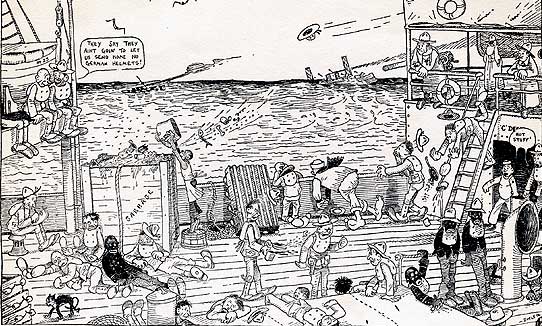
Written from the perspective of an infantryman on the frontline, “Happy Days!” by Alban B. Butler, Jr. documents the daily lives and occurrences of the First Division during WWI, beginning with their journey to Europe in 1917 and ending with their return home in 1919. Unlike most historical retellings of WWI, the grisly details of the war are almost entirely avoided. As a collection of cartoons written for the the men of the First Division and their daily trench newspaper, the First Field Artillery Brigade Observer,  “Happy Days!” provides nearly one hundred snapshots of the little moments of absurdity, insanity, and silliness in the war, all hoping to deliver a laugh to the men battling in dire conditions against difficult forces and weapons.

Cover of “Happy Days!”

From the absurdity depicted in the cartoons, Butler’s work reminds us that WWI was not a war where the United States was at its pinnacle as a world power. Men had to adapt to trench warfare, the French language and culture, multiple nation armed forces, and new weapons to protect oneself with but also to protect oneself against. With all of these new things to learn and understand, there were plenty of mistakes, mishaps, and altogether poor planning along with strange but effective procedures and protocols, creating a point of comedy for Butler’s cartoons to occupy.

Ranging from horse races with sated horses that were excessively fed after being starved due to a prolonged journey in harsh climate to the firing celebration on the 4th of July by the Division for the French forces’ acquisition and delivery of gas shells, Butler documents the endless humor existing in many of the soldiers’ activities. Although the cartoons certainly stand alone, what really makes “Happy Days!” special is the additional commentary included with each cartoon about the context of its creation. With the cartoon and the commentary, each page of the collection feels like the diary of Alban Butler, making the reader feel much closer to events occurring almost one hundred years ago.

Life in the Trenches from Butler’s eyes

In addition to Butler’s work, the introduction, preface, and afterword all provide further context for Butler’s cartoons, making the book a perfectly packaged moment in history. Arguably, “Happy Days!” may be interpreted by a modern eye as pro-morale propaganda for soldiers, but each cartoon has the voice of a soldier addressing something of specific concern or interest, making each cartoon feel as if it were created after hearing soldiers speak in the trenches or in a mess hall.

As a result of its distinct voice, “Happy Days!” contains a different, more personal perspective on WWI. While it is essential for us to remember and learn from the wreckage of WWI, it is also important to understand the people who lived, worked, and served our nation in it. Through comedy but not satire or allegory, Butler reminds us of the absurdity of the war while allowing the reader to relate to the men who were in it. The men of the First Division valiantly served in a war where a lot of inexperienced people led and fought on both sides, but they also had their own lives outside of battle that are worth understanding and remembering now that war tactics and activities have deviated so far away from where they were at the beginning of the 20th century.

“Happy Days!” by Alban B. Butler, Jr. is available via Osprey Publishing and The First Division Museum at Cantigny. 
 

The Leg: The Tale of the Silent Stranger Known as Santa Anna’s Leg

Standard

As a Texan, Santa Anna is the name of a historical figure that immediately transports me back to my mandatory seventh grade Texas history class. In America, we know Santa Anna as Mexico’s president and military commander who lost the wars resulting in Mexico’s loss of Texas and much of the American southwest. However, long before those years of battling for land against American settlers, Santa Anna was a revered and feared leader in his own country.

The Leg or The Remarkable Reappearance of Santa Anna’s Disembodied Limb explores the folklore of Santa Anna, the paradoxical folkhero and villain of Mexico. Despite his active role in fighting for Mexico’s independence from Spain and establishing Mexico as a republic, Santa Anna grew a reputation as a hedonistic, corrupt, and vain tyrant, creating many enemies throughout his career as a politician and military leader. Santa Anna simultaneously strengthened Mexico as he chipped away the nation’s own foundation.

After his loss in the Texas Revolution, Santa Anna returned to Mexico and faced another battle, this time with French forces in what is now known as The Pastry War. In the war, which Mexico barely won, Santa Anna lost his leg, and in an act too indicative of his egocentric and eccentric character, he held a ceremony and buried his own lost leg with military honors. With the heartstrings of the nation in his hands gathered by his military intervention and consequent wound and the overwhelming nationalism stemming from the victory over France, Santa Anna regained the trust of Mexico to lead again. Unfortunately, Santa Anna’s popularity had always vacillated along with his own inability to balance his selfish desires against the needs of his nation, and eventually, Mexico grew so disgusted of their folkhero dictator that they exhumed his leg, paraded it, and threw it aside to be left in the open as carrion for vultures.

Cover of The Leg

Cover of The Leg

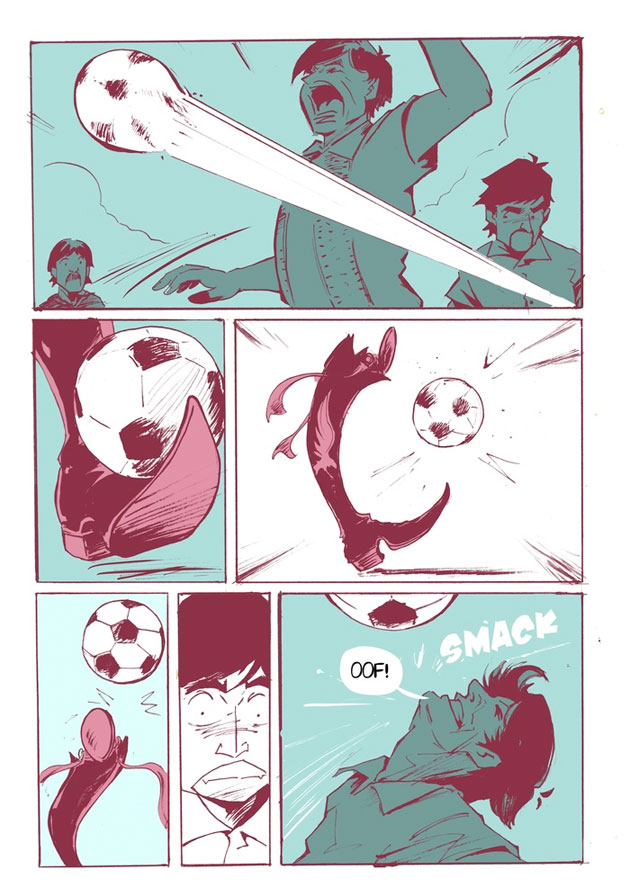
The whereabouts of the leg have since been unknown, giving a perfect history and setting for the creation of mythology around its travels and outcome. In The Leg, Santa Anna’s limb has returned to life as a tall and sentient boot that lives with a blind old cobbler who discovered and rescued it. When a group of well dressed men enter the old man’s home under the guise of being lost and decide to kill him, Santa Anna’s leg must try to avenge the death of his companion. Furthermore, the men are on a trip to disrupt Mexico’s progress by eliminating the new president, and alas, the well being and future of Mexico lies in the figurative hands of Santa Anna’s leg.

Along the way, the leg meets a young girl named Ana who accompanies him on his journey. The illegitimate granddaughter of Santa Anna, Ana is alone in Mexico, with her parents in America and her guardian, her grandmother, no longer alive. Deciding not to reveal its identity, the boot simply tells Ana of the mission, and she immediately agrees to help him, hoping to arrive in Mexico City also to find redemption for her family. On their travels, the two encounter fantasy and historical figures of Mexico including a witch, demon, wizard, eagle, crow, and ogre along with labor protesters, Leon Trotsky, Frida Kahlo, and Diego Rivera. In The Leg, we get glimpses into the political and religious fragility and volatility of Mexico. We understand the nation’s history of leaders with false promises who leeched off of the people whom they promised glory and prosperity. The Mexico of The Leg is in need of a hero, and Ana and the leg hope to fill this void.

An example of the inventive, fun fiction in The Leg: Santa Anna’s Leg and The Ogre

As the extraordinary narrative progresses, The Leg reveals itself as a tale about redemption, following the tradition of westerns and samurai tales, with the Jose Pimienta’s beautiful artwork and Matthew Petz’s rich colors paying homage to the distinctive visual style of these two genres. There’s a bit of anthropomorphism here and some allusions to political movements there, but overall, The Leg focuses on the redemption of Santa Anna and his leg’s final ability to battle for his nation rather than his own greed. The Leg is the ghost limb in Mexico version of Clint Eastwood’s High Plains Drifter. Santa Anna’s leg is a mysterious, silent stranger who also returns to a place he once lived in to seek revenge and redemption and, like Clint Eastwood’s character, carries a dark past full of misdeeds. Despite the pure goodness of Santa Anna, in an imperfect world, an imperfect hero may just be what we need.

The Leg has great ideas and stories weaved into it, even though it does not read smoothly. Commendably, Van Jensen attempts to layer historical realism with traditional and new mythology into his first comic book but not every piece fits seamlessly into the narrative. There are moments when the story transitions too abruptly from one arc to another and other moments when the dialog is too fragmented from panel to panel. The Leg could have been longer or shorter to better execute its goal, but it nevertheless deserves praise for its ambition and creativity.

Overall, The Leg is a fiercely imaginative novel about the duality of a character rarely discussed in American history. Through its mythology, The Leg conveys the human ability to choose a path of glory over one of depravity, one of honor over one of cowardice, and how we as humans sometimes jump between both paths in a lifetime. What is best about The Leg is its positivity in the light of dire situations, which is refreshing in an age of cynicism and skepticism. In a modern time where many of our leaders, political or spiritual, never seem to be inherently good or evil, The Leg, gives us a breath of optimism that perhaps our leaders will one day choose a path of true benevolence for others. At the very least, it reminds us that we too can choose to veer back on a path of good even if we have strayed away.

The Leg or The Remarkable Reappearance of Santa Anna’s Disembodied Limb is written by Van Jensen, illustrated by Jose Pimienta, and lettered and colored by Matthew Petz. It is available now via Blue Creek Creative.

The Absurd Eyes, Creatures, and People of The Heavy Hand

Standard

The Heavy Hand is the graphic novel equivalent of a giant pile of multi-colored strings. Beautiful, yes. Amorphous, yes. Mysterious, yet. Can you trace where each string goes? Can you name the shape that the string congregation forms? Does understanding the complex mass even matter?

The mysterious and alluring cover of The Heavy Hand

In this book, Chris C. Cilla has a distinctive visual style, creating a setting in a dream-like reality where humans and human-like animals coexist, and a variety of odd and potentially dangerous creatures live on the fringes. The story focuses on Alvin Crabshack, a mediocre, actually not so great, scientist and human who has gained a research position with a Professor Berigan in the Honeypot Caverns. To begin this research, Alvin must pick up his monotonous life in Dirksburg, leaving behind his ladies, Lily and Heather, and his current apartment, in the name of science.

After his goodbyes and false reminders that he will be back, Alvin boards a car with his root beer loving friend, Walter, to travel to the caverns, but Alvin’s move to his new working location completely halts when Walter abandons him at a gas station lacking gas but at least has some hot dogs. As Alvin waits for the friendly station owner to close up to give him a ride to the nearest bus station, Karl, a researcher for another professor in the caverns, appears. Karl is exactly what we expect of a scientist who spends most of his days in caverns; he’s a modern day environmentalist wearing an insignificant pro-Earth t-shirt paired with a cargo vest to hold all of his research tools. In the company of Karl and his clutter packed van, Alvin, an ordinary and indistinguishable dresser with a personality to match, already seems out of place.

In the van, Karl warns Alvin of strange, dangerous creatures in the caverns and explains to Alvin that the Professor Berigan is a reclusive, broke researcher with questionable sanity. Regardless, Alvin has his heart set on researching and studying with Professor Berigan, and Karl agrees to guide him to the professor’s lair. Upon arrival to the Honeypot Caverns, in order to get Alvin to Berigan’s lab, Karl tells his own professor, a pretty Doctor Corbett who has taken a liking to our Mr. Crabshack, that Alvin is a spelunker who lost his ride rather than the truth that he is the new research assistant of her foe. Alvin has longed for a career and a life with more excitement, but he has no idea what is in store for him.

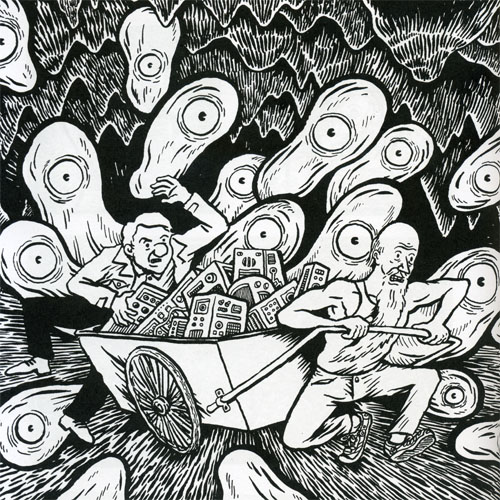
Ranging from a wizard-appearing, obsolete technology-obsessed Professor Berigan to flying cyclops blobs to human-eating tentacled creatures to a strange house party with a giant eyeball in the middle of a desert, Alvin encounters much more than he could have anticipated on his new career turned journey where every turn leads into unfamiliar and maybe impossible territories. As the narrative strays and wanders, The Heavy Hand reveals itself as a psychedelic, science fiction, road story grounded by the secret normalcy cravings of our Alvin Crabshack.

By the end, Alvin Crabshack’s many peculiar, absurd, and psychedelic means meet a somewhat regular end. He’s doing some irrational, irregular things to pay his bills, but he is in a stable relationship with Doctor Corbett and living in a scenic town called Limberlost. He and Doctor Corbett conduct normal conversation between two people in a relationship, and Alvin even interacts with his ex-girlfriend Heather in a reasonable way when he runs into her. Despite his wayward path to his existence, Alvin does not want anything outside of normal human needs and does not achieve beyond them either.

At it’s heart, The Heavy Hand is the epitome of Emerson’s maxim: “Life is a journey, not a destination.” Alvin’s journey may not translate into the most coherent novel (in fact, I am still deciphering the purpose of each fragment as I write this), but The Heavy Hand is a read with an abundance of absurdly entertaining and comedic creativity and style that will take you on a disorienting and hypnotizing ride. Let go of trying to find a message in everything you see, and The Heavy Hand will pull you right into its world of eyeballs, humans with dog heads, goats breaking out from glass globes, and a mysterious masked man who warns about the end of the world and prepares turkey for lunch.

The Heavy Hand by Chris C. Cilla is available now via Sparkplug Comic Books.

Peeking into the Mind and Style of Joseph Lambert in I Will Bite You!

Standard

I Will Bite You! may be the hardest collection of comics to review to date. The stories dramatically vacillate in narrative and illustration style with very few words used in each one.

After gaining acclaim for his short comic, Turtle Keep It Steady! (which is included in this collection), Joseph Lambert pulled together some of his early work for his first book, I Will Bite You!. Though the collection is somewhat randomly assembled and a bit disjointed like a young artist’s portfolio, it showcases Lambert’s great potential as a comic book artist and author with a distinct voice, with his strength stemming from his wildly whimsical style and imagination.

There’s not too much to analyze about each of the stories, so in the spirit of the textually minimal narrative methods in I Will Bite You!, I will give you a short overview of each of the stories in three or fewer sentences. Let’s see if I can accomplish this….

Cover for I Will Bite You! featuring a laughing and howling moon

I Will Bite You!

This is the title comic, and it is a perfect one about a little boy who has an insatiable desire to bite everyone he sees. Funny and beautifully illustrated, it introduces Lambert’s favorite motif of elements of nature as sentient beings interacting with humans and his own strange sense of humor when it comes to the creatures of his imagination.

After School Snacks

Probably the funniest, most innovative, and most grotesque of the bunch, After School Snacks begins with two hungry monsters hiding in the bushes near a sidewalk. They eat everything but have a specific appetite for pudding and children, and when one little girl gets eaten by them, her schoolyard crush must try to save the day. This story cleverly explores the role of the writer versus that of the characters in comics, with the characters able to reshape and reform the dialog bubbles used to portray speech into tools for deception and survival.

Mom Said

When two younger brothers play, things tend to get out of hand and beyond control for older siblings. In Mom Said, two brothers exclude their older, adolescent brother from their adventures and manage to pull the moon out of the sky, leaving their older brother to clean up but also leaving him in peace. A silly and whimsical exploration on the relationship between older and younger children in a family, Mom Said is a simple but effective comic.

Turtle Keep It Steady!

As a rendition of the tortoise and the hare set in the world of rock ‘n roll, Turtle Keep It Steady! lives up to its praise as one of the comics included in the collection, The Best American Comics 2008. In the world of Turtle Keep It Steady!, speed is not based on distance traveled but rather the pace of one’s living as a drummer. A clever adaptation of the tortoise and the hare, Turtle Keep It Steady! is a precautionary tale for children living in a post-70s hard rock, hard partying generation.

PSR

In building a narrative around the classic childhood game, Paper, Scissors, Rock, Lambert creates a full tale about a more extreme world where winning involves a trophy in the form of ice cream and the ability continue to roam the earth and losing involves being pulled into an underground world to be imprisoned by an abominable snowman-like creature for a year. PSR is an interesting experiment in understanding and mitigating the irrational severity that children feel when losing a game, reminding us that as bad as it may seem, losing a game of Paper, Scissors, Rock in real life cannot be worse than losing the game in this story.

Too Far

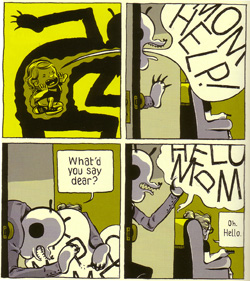
When an older teenage brother does not know how to handle his interactions with his brother and father, he seems to solve his problems by eating up and then regurgitating the world into space. A hyperbole on the self-alienation of teenagers, Too Far is my favorite story of the collection. Here, Lambert’s illustration and metaphor construction through the absurd are at their finest.

(Caveman)

This is the only full color comic of the book. Exploring the mourning process for a caveman, this story is an interesting visual experiment, but it is the most unsuccessful of the collection. It lacks the off-the-wall insanity that the other stories contain and feels too distant from Lambert’s voice and style.

Everyday

Everyday follows the monotonous of life of two brothers over the course of a week. Despite what happens in the middle of the day, everyday seems to start and end the same way until the youngest brother decides on Saturday to take on his nemesis of the past week, the sun. Everyday is the epitome of Lambert’s style and returns his favorite theme of people interacting with human-like elements of nature to the pages. It is the perfect story to end on, neatly wrapping up and delivering all of the best that Lambert has to offer.

I Will Bite You! may not contain the most insightful comments about life, but it is immensely fun to read (though perhaps view is a better word since the book uses text so sparsely). Lambert has a fantastic imagination and a wonderful talent for creating some of the most visually interesting creatures you will see in animation. Pick up I Will Bite You!, and read it when you long for something strange, silly, and amusing to take a break from your day.

I Will Bite You! by Joseph Lambert is available now via Secret Aces. 


The Modern Ms. Marvel for a New Audience

Standard

Thanks to Samantha for sending me something that I would not necessarily read on my own. 2014 has been an interesting year for women in comics, and I must admit that a lot of the new series to emerge are not ground-breaking or intelligent in their discussion of gender and are in fact somewhat irresponsible in their lessons. However, Ms. Marvel is the exception to the trend.

Ms. Marvel bypasses the common complaint of the absence of redeeming females in superhero comic books to address something even more rare in superhero narratives: cultural minorities.

Kamala Khan is a 16 year old Pakistani-American Muslim girl living in present day Jersey City. As a teenager, she has fairly normal societal teenage pressures, but her path to adulthood is a more difficult and tumultuous one with the additional burden of her parents’ cultural and religious expectations for their only daughter. Consequently, as with many young females who come from cultures that have restrictions on women contradictory to those of their Caucasian American counterparts, Kamala has a bit of an identity crisis; she does not want to reject her Pakistani heritage, but she is also American, and the two cultural expectations for young women don’t play well together.

What does not make this identity conflict any easier is the fact that Kamala does not fit it with the Caucasian teenagers at her school or really even her Muslim friends. She’s stuck somewhere in the middle, and it seems like the only other person who understands her is another fellow child of immigrants, Bruno Carrelli. And to make Kamala’s attempt to understand herself even more difficult, she suddenly gains superpowers one night as she wishes that she did not have to be Pakistani. In return to her wish, Kamala can suddenly morph into the All-American superhero Ms. Marvel with big blonde hair, a Ms. America physique, high-rise boots, and the ability to transform into various sizes with super-human strength. In her Ms. Marvel form, Kamala can choose to entirely reject her Pakistani roots, but this cultural dismissal does not always work out the way she expects.

Ms. Marvel Volume One: No Normal Cover

Beyond Kamala’s emergence as a superhero, the action of Ms. Marvel Volume One: No Normal focuses on Kamala’s task to save Bruno’s younger brother, Vittorio, from the damaging and potentially fatal influence of some unknown villain known as the The Inventor. In the process of trying to save Vittorio, Kamala must understand how to use her powers, which are out of control when she takes on the All-American heroine Ms. Marvel form. Consequently, the unwieldiness of this stereotypical Ms. Marvel transformation provokes Kamala’s simultaneous development of her cultural identity as an American and a Pakistani woman and her identity as a superhero.

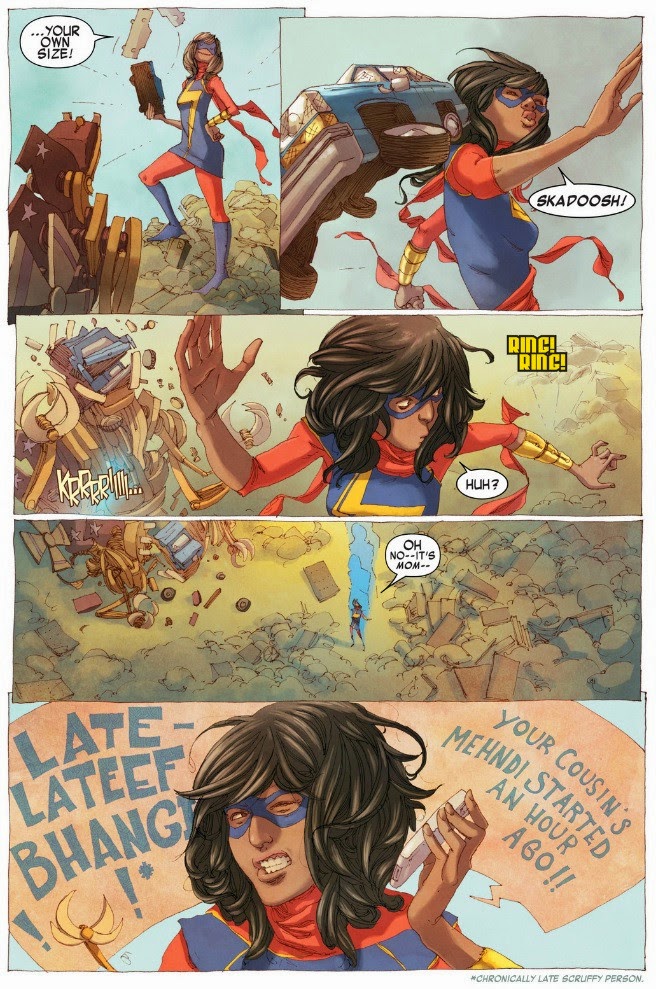
By the end of the first volume, when Kamala emerges as her own Ms. Marvel, she has a darker complexion and a name very different than “Mary’” or “Jane” and is much more clothed and a much less buxom. Kamala’s Ms. Marvel integrates her American and Pakistani cultures, and in parallel, in her regular life, she also combines both cultures and becomes more comfortable with her ethnic identity, even if it differs from the people around her, because after all, what’s more alienating: superpowers or being Pakistani and Muslim? In one moment Kamala battles a robot in a garbage dump in her own, individual costume. In the next moment, she must change into shalwar kameez for her cousin’s wedding procession. Though Kamala is a little in over her head with her obligations as a teenager, a daughter, and a superhero, her new-found superpowers galvanize the growth and reflection that she needs to decide who she wants to be in all parts of her life.

Kamala Khan’s Ms. Marvel

Bravo G. Willow Wilson and Adrian Alphona. You two have created a superhero that has a distinct identity relevant to the second-generation immigrant experience. I commend you both on your adaptation of Ms. Marvel for creating a hero for today’s non-homogenous America for an audience previously unaddressed and unengaged in superhero narratives. Kamala Khan is a superhero I wish I had as a Vietnamese American teenager, and I am so very grateful that she now exists for adults and for today’s youth. The modern Ms. Marvel is a superhero unlike the white audience tailored ones such as Superman and Wonder Woman who are crafted from centuries-old Western archetypes. Ms. Marvel has the same noble intentions to save the world, but she finally has a personal story that we second-generation immigrants can empathize with in contemporary times.

Ms. Marvel is written by G. Willow Wilson and illustrated by Adrian Alphona. Volume One is now available via Marvel Now!

To Live or Die: Dash Shaw’s Doctors

Standard

I promise that this is my last Dash Shaw review for a while. I’ve been anxiously awaiting the release of Doctors, and alas, I have it and have been unable to maintain my patience to reasonably space out my reviews of Shaw’s books.

Of the Shaw works I’ve read so far, Doctors has an unsettling cynicism and darkness about it. Bottomless Belly Button and 3 New Stories contained some comments alluding to the occasionally malevolent and duplicitous nature of people but not to the degree of Doctors. Perhaps this change in tone is the product of the topic discussed in Doctors: death.

Cover of Doctors

Despite the general existential tone of Doctors, the overall narrative still has the absurd and occasionally comically strange moments characteristic of Shaw’s style. Doctor Cho and his daughter, Tammy, run a laboratory where they test the Doctor’s invention, the Charon. For a hefty fee, the Cho lab can bring a loved one back from the dead when they are in an intermittent afterlife between death and the final end known as “the fade to black.” When we enter the world of the Cho family business, they are in the midst of bringing back Miss Bell, a wealthy widow who died suddenly and whose daughter, Laura, would like back in the world.

Even though the Charon and its capabilities suggest that Doctors is a science fiction work, the device itself is hardly the subject of the narrative. The short novel contains short fragments from multiple narrators, ranging from Tammy to Will, the lab assistant, to Miss Bell, with each story describing the history of the character and building up to their current intersecting point in the revival of Miss Bell. And to add an additional layer of cleverness to the book, each fragment in the book is drawn above a different color to remind the reader of each different perspective and the changes over the course of each page.

From Tammy and Will’s perspective, we understand the severity and seriousness of their work: They are defying the rules of nature and do not quite understand how to tackle the consequences. What does not help is the callousness of Doctor Cho, a naturally distant man made more insensitive and cold by the murder of his wife. Unlike Tammy and Will, Doctor Cho looks at the Charon as purely a lucrative business, a way to make a lot of money with technology without considering any emotional disturbances experienced by the revival process of his invention. The Charon is simply a solution to a scientific question for Doctor Cho. Could he bring someone back to life from the dead? Yes, and that yes is all that matters to him.

On the opposite side of the Charon experience, we see Miss Bell’s attempt to re-integrate into her life after her revival. Unfortunately, her return to life is not quite what she had hoped. After her death, Miss Bell, in the intermittent state between death and nothingness, created an afterlife where she was in love and no longer alone; for the first time since her husband’s death, she felt joy and youthfulness again. Upon being ripped out of this pleasant state, Miss Bell is thrust in front of her attorney by her daughter to settle the details of her estate, which is a beyond disappointing welcome back message.

Gradually, Miss Bell’s psychological state degrades as she realizes the bleakness of her reality as compared to her afterlife. Rather than returning to warmth and love from her daughter, Miss Bell returns to her life as a lonely widow pent up in her house. Laura is not around and only seems to appear when money is involved, and Miss Bell longs for her previous afterlife, trying to seek elements to re-create it in her current reality.

At the heart of all of the trajectories of each character in Doctors is the question: If you bring back a loved one, is that going to be better for the individual than death? The Charon, in concept is a nice idea, but in execution it is not because those brought back to life already have death programmed to occur again, and conflicting decisions to dodge or face that second death lead to crippling mental instability, making the revival useless except for having the revived sign paperwork. Consequently, what is the value for the creators and the users of the Charon?

In addition, with the examination of Charon patients such as Miss Bell, a major philosophical question for scientists emerges: even if you can create or access a device that defies nature, should you use it?  Inherent in the answer to that question is hubris. Doctors is somewhat of a tragedy, for Doctor Cho and Miss Bell’s daughter Laura exhibit the greatest amount of hubris, and they are met with tragic ends that damage their loved ones. They both believe they can overcome death to get what they desire without realizing that perhaps what nature intended was the correct course in the first place, and in turn, endure the most severe consequences of the Charon.

By the end of Doctors, you are left asking yourself who is more evil in this scenario, the scientists who create the nature defying device or the people who pay exorbitant amounts of money to use it for selfish purposes? I’m not entirely sure, but there is definitely some shared responsibility for the ill-fated consequences of toying with forces one does not understand. Doctors, on an initial read, feels like a naturalist piece of writing, but by the end, everything bad seems to fade away and life for the more accountable Will and Tammy seem okay but pretty directionless and meaningless in general, making the story much more of an existential one. Thus, if everything most likely means nothing, who is the most evil in the story? Who is the most irresponsible? Who is the most selfish? Who is the most myopic in their actions? What is the afterlife? What is death? Would you want another moment with a loved one who has passed on if achieving that moment could harm them? Those questions are much harder to answer in an existential world, and Doctors definitely will not point you in any direction, but it will make you think more carefully when you do attempt to answer them.

Doctors is now available via Fantagraphics Books.

ODY-C: An Irresponsible Trip Into Space

Standard

ODY-C has so much promise: a stunning cover, a beautiful, enormous opening fold-out, and the name of probably one of the best modern comic book and graphic novel writers attached to it.

Branded as an adaptation of Homer’s The Odyssey set in space with genders of major characters swapped or transformed, ODY-C has a lot of flash, bang, and fury…….with very little in return.

Issue one introduces Odyssia, the war monger and queen warrior on her ship, the ODY-C, trying to return home. Mental unity of its female fuel operators power ODY-C, but as with most Greek myths and tragedies, the ship operates under the capriciousness of the universe’s gods and goddesses. In the world of ODY-C, women hold all of the power and exist as the dominant population while the few men left are relegated to facile companions of the women of highest ranking.

To accompany the narrative, ODY-C has some phenomenal artwork. The colors are vibrant and rich; the drawings are gorgeously layered and textured; the characters are amazingly larger than life. Even more than the Matt Fraction name, Christian Ward’s stunning illustrations lured me into purchasing the first issue of ODY-C.

ODY-C Cover

Sadly, all of the grandiose art has been wasted on this poorly recycled mythology under the guise of female empowerment. Homer’s The Odyssey has been adapted for modern times for decades. Ranging from Walter Hill’s The Warriors and Stanley Kubrick’s 2001: A Space Odyssey, the fundamental framework of The Odyssey has never left popular culture. Consequently, yet another version of the tale in space (even with the gender changes) is superfluous.

Furthermore, what infuriates me the most about this series is its heavy-handed, irresponsible messages about female empowerment. In various press interviews, Fraction claims that he wants to create a huge adventure with superheroes that his daughter can look up to. However, this goal has led to a lackluster product with nothing insightful or new to say about women rising above. For example, ODY-C runs into trouble when one of its mental fuel-sources stops believing in the battles that Odyssia continuously enters, disconnecting the unity amongst the other “sisters” steering the ship. When this callow metaphor appears, it’s clumsily handled and manipulative, purely entered to achieve the gender politic rather than adding any narrative value to ODY-C, and these politically overwhelming interruptions render this series down to a frivolous piece of female empowerment propaganda.

By reversing genders in ODY-C, Fraction fails most to understand the historical context of the original Homer narrative, and in turn by using the same one, creates a narrative that is fundamentally gender digressive. The Odyssey was written in an era where patriarchy reigned. By using the same story and reversing characters’ genders, ODY-C’s core narrative is still fundamentally male-centric because none of the characters actually capture the experience of being a woman. Essential to the experience of being a woman is interacting with men in a man’s world, and this defining relationship between men and women is entirely missing from ODY-C. A female superhero is not a woman if she is simply a man whose exterior has a female form.

As a result of merely the physical gender replacement, Odyssia and all of the other powerful women in the world of ODY-C are completely unrelatable. They do not motivate me to rise above. If anything, they tell me that a woman-centric world is what I should try to achieve, which is a dangerous message to send out because it will further exacerbate gender strains already embedded in today’s society.

If Fraction really wanted a superhero for his daughter and for the young women of the world, he should have rooted the female protagonists in a place with realistic gender barriers. A new mythology should have been in his mind, one based in a current patriarchal world and one able to fully capture how a woman, consequently, must navigate it. ODY-C is perfect for male readers who think that they are gender progressive and for female readers who fantasize about a world that is run by women. Both of those audiences are problematic and completely misinterpret the realistic female experience and the methods by which women must figure out how thrive in a society where many standards and practices work against us. If I want to see women rising above and succeeding under dire situations (i.e. the ones who truly warrant my respect and admiration), I’ll watch The Little Girl Who Lives Down the Lane, Winter’s Bone, or Jackie Brown instead.

Changes Forced by the Loony Family Reunion in Bottomless Belly Button

Standard

A little over two months ago, I ranted and raved about Dash Shaw’s 3 New Stories. Excited by his experimental approach to graphic novel/comic book illustration and storytelling techniques, I have looked forward to the opportunity to explore more of the Shaw catalog.

Bottomless Belly Button back cover, spine, and front cover

On the surface, Bottomless Belly Button, a novel conceived from 2005 to 2007, looks like a conventional family drama. Upon the decision to divorce after forty years of marriage, the elders of the Loony family, David and Maggie, call their children and their respective families to the Loony headquarters (a beach house on a mysteriously desolate strip of sand) to break the news to everyone. As expected with any sort of major change, each member of the Loony family reacts in distinctive ways based on individual age and experience.

Dennis, the eldest brother, launches into a full adult tantrum and hysteria, determined to get an answer to why his parents decided to split. As the next-in-line head patriarch, Dennis feels a responsibility to understand his parents split and to try his best to keep the Loony family somewhat together by getting a reasonable answer. Accompanied on this trip by his wife, Aki, and son, Alex, Dennis unfortunately abandons them more and more as he delves deeper and deeper into his investigation of his parents’ relationship history and trajectory from the beginning up to the present.

On the other hand, Claire, the middle sister, remains unflinched. As a divorcee herself, marriage dissolution does not phase her; however, this indifference may stem from her current difficulty in returning to a romantic life and inability to release some residual feelings for her artist ex-husband. In addition, Claire must raise her awkward adolescent daughter, Jill, who also arrived with her mother for the family reunion before family disbanding. On the Loony beach, Claire and Jill both attempt to better understand themselves and escape their current situations, steering their focus away from Grandpa and Grandma Loony’s divorce.

Peter, the youngest of the Loony children, displays the least amount of distress of all. As the youngest and the outcast of the family (with his isolation exacerbated by Shaw’s illustration of Peter as a young man with a frog head), Peter has never felt any serious emotional connection to his family. His distance is further highlighted by the blueprints of the Loony beach house, showing how Peter’s room stands as the only room on the fourth floor of the house, far away from the rooms of his family and any communal rooms. As a failing filmmaker at the age of 26 whose inability to relate to his family transferred to a general inability to interact with other people with any modicum of social grace, Peter reacts to the divorce of his parents like a stranger invited to a family dinner where the uncomfortable news is released.

Consequently, Peter wanders, as usual, on his own course. Peter walks the beach with his kid niece Jill and eventually meets Kat, a girl who Jill bullies him to speak to. As his parents’ marriage ends, Peter begins a flourishing new relationship with Kat, a beach camp counselor who may be far younger than he is. Peter and Kat’s relationship has some truly awkward moments because of Peter’s inexperience, but their growth towards each other serves as a strong foil against the disintegration of David and Maggie Loony’s marriage.

Again, from what has been described, Bottomless Belly Button seems like a standard relationship drama for a white, middle to upper-middle class family. What I have yet to mention, though, is the presence of some undescribed, unidentified supernatural force that carries through the narrative, gradually smoothing away tensions, fears, and hatred. As Bottomless Belly Button progresses, every member of the Loony family reaches a level of acceptance of their situation; the Loony parents’ break up galvanizes a period of growth for all members of the family, and this mysterious force of nature or force of calm, be it from a deity or from elsewhere, pushes each Loony member onto a track that forces each person to experience something new and also reflect on past actions, allowing each member by the end of the book to have the resolution to return to their separate lives with a new perspective and a better ability to care and support the people in their lives.

Beyond the strength of the core narrative, what really makes Bottomless Belly Button special is its ability to weave in artifacts of each character into the story, ranging from childhood pictures to love letters between David and Maggie to even a review of Peter’s failed film. By entangling these seemingly trivial pieces of memories, Shaw immerses the reader into the characters, allowing us to understand the motivations and the full perspective of each person at the beginning of the visit, which then allows us to compare the shifts in demeanor and viewpoints by the end. Further supported by some brilliantly expressive, yet simple illustrations, Bottomless Belly Button sets a consistent tone and mood that pulls the reader into the full world of the Loony’s, making the reading of the somewhat intimidating 720 pages feel like a drive where the end is unknown, but there is a general synchrony with the surroundings that forces you to pull your eyes away from the clock and speedometer, causing you to release your thoughts and engross yourself in the small microcosm currently existing around you.

Loony Family Pictures found in Dennis’s search for answers

Bottomless Belly Button, despite its many quirks, is overall a serene and meditative work. It reminds the readers of the different stages of life in which we can attain further development and how that growth impacts the people in our lives. Though not a read for children (as the spine of the novel warns), Bottomless Belly Button is a graphic novel that should be handed to any person currently approaching a major shift in their lifestyle or in their perspective of the world.

Bottomless Belly Button by Dash Shaw is available via Fantagraphics Books.

Imagination and Reality in Lowriders in Space

Standard

I must confess that I have a secret admiration for cars, all kinds of cars.

Sports cars. Muscle cars. Hot Rods. 1930s, 1940s, 1950s cars.

There is something fascinating about the engineering behind a car. And, there is always something alluring about a beautifully designed car.

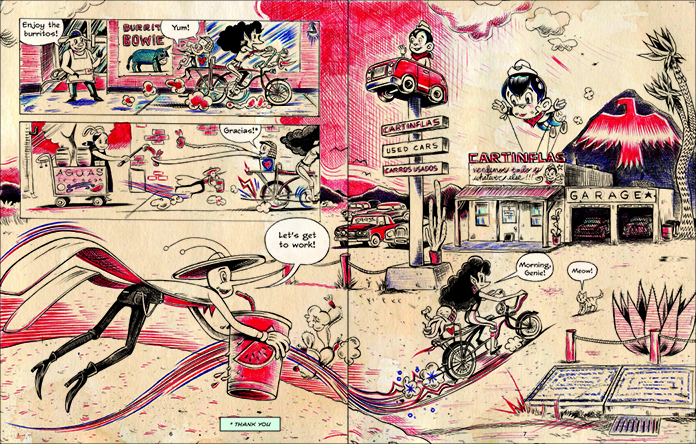
Consequently, when Generoso woke me up on Saturday morning to say that local artist Raúl the Third would be at our local comic book store (huzzah Hub Comics!) signing copies of his newest book, Lowriders in Space, we rolled out of bed on a cold, pre-winter Massachusetts morning to pick up our copy.

Cover for Lowriders in Space

Lowriders in Space written by Cathy Camper and illustrated by Raúl the Third follows the restoration process mechanic extraordinaire, Lupe Impala, auto detail wizard, El Chavo Flapjack, and dazzling auto body artist, Elirio Malaria, endeavor to win the Universal Car Competition. The competition carries recognition and fame for our team of auto transformation champions, but most importantly, it awards enough prize money for the team to open up their own independent garage, a goal that would be impossible with their currently non-existent funds.

After gathering spare parts to get a stalled (and well forgotten) car up and running into at least the base of a good lowrider, the team take their new ride on a test drive, and rather than traveling down the block, their lowrider rockets into space, where they receive the assistance of the constellations and the planets of the universe to add the final, perfect touches to make their entry into the Universal Car Competition completely unforgettable.

Lowriders in Space is a fun and imaginative adventure tale for children and adults written about a culture that is rarely discussed in children’s books. We’re used to the knight battling the dragon, the children deceiving the witch, and the princess who needs rescue in children’s tales, but rarely do the protagonists in a child’s tale have a goal of realistic creative freedom gained from skills diligently and independently developed, as our auto team in Lowriders in Space do. Furthermore, in works created for mass consumption, lowrider culture has rarely been portrayed in a non-caricature fashion, and these historical portrayals almost never delve into the mechanical details and efforts taken to create the lowriders that people adore.

Lowriders in Space, while containing a clearly fictional component with the team’s space travel in a car, conveys the hard work, care, and passion dedicated to achieve the independence to create on one’s own terms, which is a nice, realistic, non-abstract message for all audiences. It’s a simple, effective narrative enhanced by some spectacular artwork, making it a perfect read on a Saturday morning or anytime you need a reminder that regardless of your current circumstances, reality does not need to be bleak.

Lowriders in Space is written by Cathy Camper and Raúl the Third is available via Chronicle Books.


The Killer Does Not Care

Standard

Created in the tradition of Jean Pierre Melville’s impeccable Le Samouraï, The Killer has some high standards to live up to.

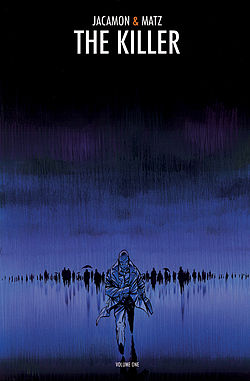
Cover of The Killer Volume One

Cover of The Killer Volume One

In The Killer, our unnamed anti-hero spends the bulk of the first volume justifying his lifestyle as a high-class hitman. The spitting image of Jean Reno in The Professional, our main assassin introduces himself and his occupation as he endures a prolonged stake out for a target. A character seeking existentialism, the contract killer pays no loyalties to anyone, with his cynicism and cold demeanor colored entirely by the notorious impact of the Nazi movement.

Beyond the explanation of our assassin’s motivations (or lack thereof), the first volume of The Killer (in the American release, issues 1-4) follows our assassin’s fall from grace as a pure mercenary as he becomes trapped in an investigation by police and an operation of betrayal by his partner after a hit goes terribly wrong in Paris. With a villa awaiting on a remote island in Venezuela, our assassin has waited his entire career for his last big hit to finally retire, but once he realizes that a police officer has been on his tail and that his partner has hired another hitman to take him out, our main character needs to find out further details about his last target and also try to figure out his next courses of action as a hitman past his prime who is now completely alone in the world.

What makes a film noir like Le Samouraï so successful is its carefully calculated distance. Throughout the film, we get a sense of Alain Delon’s motivations, but we never really get too close to him. In addition, we rarely ever hear him pontificate about his existence, for his actions reveal his quiet ethical code. Jef Costello in Le Samouraï has no need, no desire to explain himself.

Unfortunately, our counterpart in The Killer does not maintain the same distance with the audience. His constant explanation about his ambivalence towards human life and his justification of his occupation by comparing himself to other examples of genocide and human rights atrocities suppresses the interesting plot line surrounding the betrayal and the mistake of the last target. Despite his unrelenting explanations about his own morality, as the narrative continues, our main character does have some level of humanity, as seen by some of his actions, but he must continue to persuade himself and his audience that he is an existentialist without any care for others.

With this constant explanation of the assassin’s morals, Matz completely misses the essential nuances and the general silence that make a film noir and a character study of an assassin engaging. When an author presents a flawed and villainous character as the protagonist, the audience does not need to hear rhetoric about why the life of the seemingly evil character is not as immoral as expected. The audience must gain empathy with the character by his/her actions and interactions with the surrounding people. The audience must have the ability to relate to the character in some way beyond his/her explanation of politics and morality. Matz’s assassin is fundamentally not a relatable character; he is less of a regular man trying to survive and more of a priest standing and preaching on a pulpit.

What’s a sin in all of this is Jacamon’s artwork. All of the art is drawn with a certain richness in its color and simplicity in its lines. Jacamon’s illustrations are simultaneously realistic and cartoon-like, making the setting of The Killer feel brilliantly fictional but not too far away from reality. Sadly, Jacamon’s fine illustrations become the understudy to the heavy handed political and moral discussions of the narration.

Sadly, The Killer does not achieve the status of the historical works it attempts to embody. Matz needed to make a decision about his work; should this be a didactic noir, or should this be a philosophical essay? He cannot seem to make that decision, and consequently, The Killer becomes a trite and heavy handed narrative about a sanctimonious killer who delusionally believes in his own existentialism. Yes, the assassin is in serious trouble. Yes, the assassin has been betrayed by his inner circle, which is never a pleasant scenario. Yes, the assassin has a point about other heinous actions in the world surpassing the ugliness of his own. However, by the end of his sermons, I simply do not care about his life or his ethics. I guess the nothingness he preaches has come to fruition.

The Killer is available in its English translation via Archaia Studios Press.