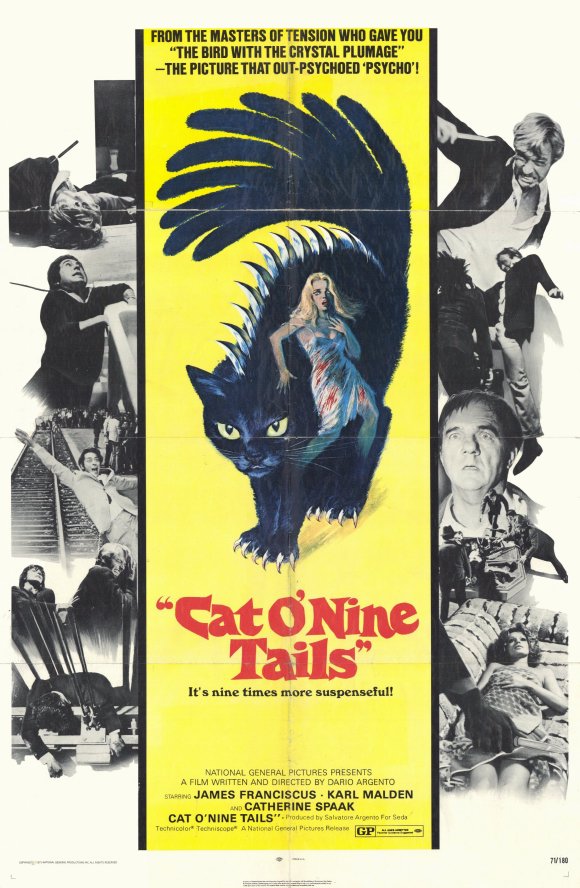
Karl Malden Shines In Part Two of Dario Argento’s “Trilogia Degli Animali,” 1971’s “The Cat o’ Nine Tails”

Standard
the-cat-o-nine-tails-1971-karl-malden-james-franciscus

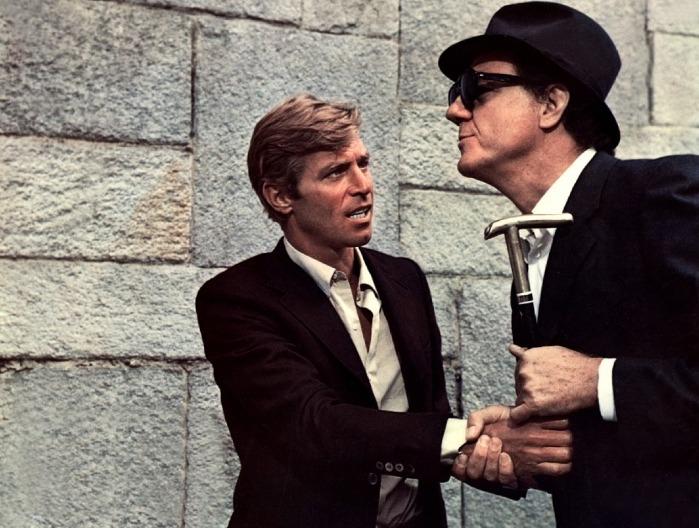
Cookie (Karl Malden) Meet Carlo (James Franciscus)

Before I write one critique about Dario Argento’s second film in his “animal trilogy,” “Cat o’ Nine Tails,” let me first commend him on casting the usually gruff talent of Karl Malden in the role of Franco “Cookie” Arno, a blind ex-reporter who creates crossword puzzles while taking care of his adorable niece, Lori. Sure, Malden is solid in this role as always, but the mind swims at the concept of Dario possibly sitting at his office and pitching to his producer/brother Salvatore that Malden would be perfect as the lovable Cookie, a year after Malden’s tough portrayal of General Omar Bradley in “Patton.” Either Dario is a genius, or Malden could just nail any part that came before him. I also wonder if Michael Douglas ever pulled the “Cookie” card on Malden the following year when they began filming “The Streets Of San Francisco?”

You might think that it is a bit odd that I am reviewing the middle film in a trilogy without ever reviewing the first and third films, but let me assure you that there is absolutely no connection between the three that might encourage you to watch Dario’s first in the series, “The Bird With The Crystal Plumage,” before reading further into my review.   What is true about this period in Argento’s work is that it represents his thriller output before he would embrace more of the supernatural aspects that would define his later films. In “Cat o’ Nine Tails” you have our young director drawing from Hitchcock, as so many of his peers were, but here he adds that element of sinister violence that is less gory than his later masterpiece “Suspiria,” but still quite jarring at times, especially one very creative and teeth-clinching elevator-related death. Though not a masterwork, I found “Cat o’ Nine Tails” to be as solid a thriller as Argento would make at this point in his career.

Our story begins with a burglary occurring at a genetics lab and the sounds of this event being picked up by our darling Cookie, who becomes interested a la James Stewart in Rear Window, so he then teams up with a young and all too hunky reporter, Carlo Giordani (played by the rugged and coiffed American television star, James Franciscus). After a few folks associated with the lab start ending up dead, it becomes clear that the lab has discovered some genetic strand that bears out the criminal tendencies that lie within people, and they have also created a drug that can cure these bad thoughts, but someone isn’t thrilled with one of these two discoveries, so the bodies start to fall. As stated earlier, the murders are not of the lavish, glowing straight razor variety that you would come to expect from Argento; most of our victims in “Cat o’ Nine Tails” are dispatched in the rope around the neck style. This is fine by me as Dario tries to make the plot the star around our killings, as opposed to a sketch of a plot that exists just to glue together a series of baroque imagery as in many of his giallos. My only real stylistic complaint comes from the enviable sex scene between Carlo, our dedicated reporter, and the wealthy daughter of the genetic lab’s director, Anna (Catherine Spaak, the gorgeous lead from Dino Risi’s 1962 film, “Il Sorpasso”). I’m not sure why Argento insisted on filming their coupling in the most robotic way possible, but as an Italian man, I am a bit taken aback by such non-emotional touching that given the dire circumstances that those two characters were surrounded by, should’ve heated up their illicit tryst.

Kudos again to Dario for the attempt at plot complexity here, but it may just be a bit too complex as the “nine” in the title refers to the nine potential criminal leads that are never followed fully enough to potentially draw your interest away from the reveal of the actual killer making the ending, despite a stunner of a death scene, fairly anticlimactic.  There is also a score created by legendary composer Ennio Morricone, that is pretty lackluster, which is not surprising considering that Ennio has scored over five hundred projects over his illustrious career. There has to be a few throwaways in the bunch, and sadly we have one of those here. Malden and Franciscus are the main reasons why you stay in your seats as they are veteran actors that can make any scene work a cut above the rest.

Original 1971 Trailer For Cat o’ Nine Tails

“Cat o’ Nine Tails” is a decent enough film that now stands as a kind of testing ground for a young Dario Argento for what would and would not work and not work in his subsequent films. There are more than enough visual creations that will make you jump, and the overall cinematography is more than a cut above the usual early 1970s giallo.  Finally, I tip my hat to director Argento for acquiring the acting talents of Malden and Franciscus for this, only his second feature film. I don’t know if I would have the nerve to fly an actor the stature of Malden across the Atlantic and saddle him with a character named “Cookie,” but I still admire Argento for thinking that Malden would fit into that character so well.

Jaromil Jires’ 1970 Film, “Valerie And Her Week of Wonders” Is A Gorgeous Czech New Wave Fairy Tale

Standard
valerieweekofwonders2

Valerie (Jaroslava Schallerova) And “The Monster”

More than most European film movements of the 1960s, I have long been an admirer of the films of the Czech New Wave and have even appreciated much of the work of some of the movement’s directors who made the jump to Hollywood, such as Milos Foreman and Ivan Passer. I am also very happy to write that over the last few years, there has been a growing appreciation for the Czech New Wave, inspired by the re-release of Věra Chytilová’s 1966 film, “Daisies,” the story of two teenage girls named Marie who enjoy pulling the odd prank. “Daisies” is an absurdist dark comedy that excels in the surreal and is completely successful in keeping you off kilter for its short, 78-minute length.

Similarly short in length but immensely visually dazzling, is the 1970 fairytale feature by Czech New Wave auteur, Jaromil Jires, “Valerie and Her Week Of Wonders.” Drawing inspiration from the likes of 1960s Buñuel and Fellini, director Jires ties together this loose narrative of the fantastical and erotic daydreams of our title character Valerie, joyously played by the luminously gorgeous, Jaroslava Schallerova. Our demented fairytale begins with the virginal Valerie, who lives with her grandmother, having her earrings stolen in the middle of the night by a man who covers his face with a weasel’s mask. She encounters the man who stole her earrings the next day who then gives the earrings back to her.

Valerie then receives a letter informing her of a church service for all of the town’s virgins. She attends and after the service, Valerie meets Eagle, who tells her that he was the one who had stolen her earrings the night before and that the man who she keeps seeing in her yard is in fact, a monster. Eagle then gives her a pearl, which should protect her from evil. Valerie goes home to the comfort of her beautiful grandmother, but I must mention that her grandmother occasionally is a vampire, and that her grandma’s ex lover is Gracian, the local Catholic priest who she flogs herself in front of in order to give him sexual gratification. When Valerie encounters Gracian, he of course sexually assaults her and she uses her pearl to force our clergyman’s suicide. In turn, Valerie is then accused of witchcraft.

While writing this summation of the story, it boggles my mind as to why I so riveted for the entirety of the film as the rapid blending of genre is downright staggering, from fairy tale to softcore porn to horror film to political satire? I’ll leave behind the likes of Fellini and Buñuel as the work that Jires’ film eventually reminds me the most of, I dare to say, is Takeshi Miike’s virginal fantasy freak out film, “Gozu.” My favorite of Miike’s oeuvre, “Gozu” follows a young yakuza who has never known a woman, accidentally kills his boss, and makes the mistake of spending the weekend hiding out in motel where he encounters an elderly woman who cannot stop lactating, a man with a cow head who drools semen, and a beautiful woman with whom his interaction with ends horrifically and hilariously on the other side of vagina dentata. Both films play on the dreamlike fears that exist in the mind of the virgin as the moment of sexual congress is becoming an ever-increasing reality, but unlike Mr. Miike’s film, which spirals more and more out of control until its final frame, making the dream logic it uses something of an afterthought, “Valerie And Her Week Of Wonders” blissfully lands in reality at the end where Valerie emerges triumphantly as a woman.

Valerie And Her Week Of Wonders Trailer
https://www.youtube.com/watch?v=GR07_yzRFMM

Created during the Soviet occupation of Czechoslovakia when the national film industry was heavily censored and when the country was rapidly becoming more industrialized, Jires’ film excels during those beautiful moments of virginal curiosity in the midst of it’s mostly bucolic settings as if the film industry seemed to be channeling the desire of the Czech people yearning for a return to a mostly pastoral existence. Furthermore, the consistent jabs at the clergy’s duality of morals plays as much into the sexual repression we see in Valerie’s daydreams as it serves an indictment of the regime of the time.

Throughout it all, Valerie And Her Week Of Wonders” is an underrated and stunning work that demands your constant attention not only for its dizzying almost cult-like blending of genre, but for its consistent promise of a pastoral fantasy world that is sometimes horrific but always dazzling.

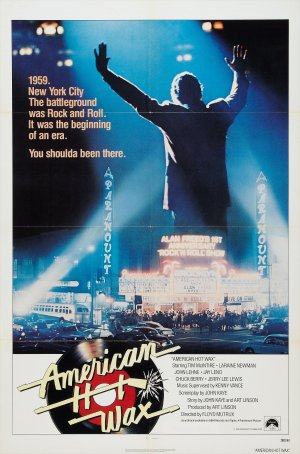
Alan Freed Deserved A Better Fate Than 1978’s “American Hot Wax”

Standard
american_hot_wax_booth

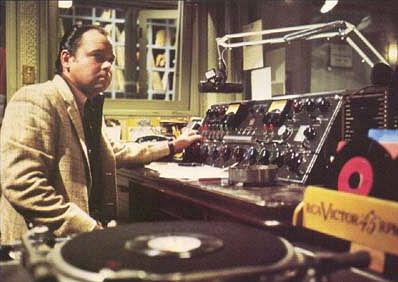
Tim McIntire As Alan Freed

Over the last nineteen years of my radio show, I have always ended with the phrase, “And in the immortal words of the late, great Alan Freed: This is not goodbye, it is just goodnight.” As a young man growing up Philly, obsessed with radio as many of us were, I was thrilled in 1978 when a biopic was made on the infamous Cleveland disc jockey who coined the term, “rock and roll,” Alan Freed.   A year earlier on a local UHF station I had seen the 1956 film, “Rock, Rock, Rock” that starred Freed, which encouraged me to go to my local library to read about Freed and his relationships with the artists he nurtured, the blacklisted music that he rebelliously played on air, and the eventual “payola” scandal that destroyed his career. So, even as a boy of ten, there was a lot riding on “American Hot Wax” in my mind, and I asked my dad to take me to see it in a downtown theater.

Before my review of the film, I should paint a more accurate picture of the 1970s for me as I mostly remember local radio, television, and film as being obsessed with the 1950s. Philly had been the home of so many doo wop groups that, even though the local FM airwaves were blessed with the sounds of Philadelphia International disco, the AM dial was firmly entrenched with the vocal harmonies of local groups such as The Penguins, The Moonglows, and The Five Satins, not to mention that young men were still vocal harmonizing these tunes on street corners. George Lucas’ nostalgic “American Graffiti” was getting regular screenings on television, “Happy Days” was a huge hit on ABC, and my sister, like so many of her age, loved “Grease.” I had indeed fallen into the nostalgia craze for a decade that I had never been a part of, which means that I was not privy to negatives of that time either, and most likely for that reason I was beyond thrilled seeing “American Hot Wax” when it was released. To be able to see the likes of Chuck Berry, Jerry Lee Lewis, and Screamin’ Jay Hawkins on screen in the days prior to our family being able to afford a VHS player was too mind-altering and to get some glimpse into that world where many of the songs I knew and loved were created was amazing to me, and regardless of where this review goes, I am so glad that those moments were put on film, especially given that Screamin’ Jay is no longer with us.

Over thirty five years later, I sat down and re-watched this film directed by Floyd Mutrux, and immediately noticed that it is shot in that same static, one camera style, similar to that of “The Buddy Holly Story,” which came out later that year, and frankly almost every television movie of that era. It’s amazing to me that a film so much about a man as it is about nostalgia would not go to the extra level of adding a visual technique to entrench it into its time period. The film immediately creates a feeling of frenzy and genuine excitement around Freed, as he goes through his hectic days leading up to the last live “rock and roll” show that he would produce in New York City. The actual Freed had been arrested in Boston months earlier for inciting a riot after he took the microphone during some unrest at a show he put on and said, “The police don’t want you to have fun.” “American Hot Wax” does make it abundantly clear that the establishment was not happy with Freed’s ability to encourage white teens to listen to sexually charged black music.

Tim McIntire does a fine job as Freed, playing him as written in history as a charismatic, intense man, who genuinely loved music and was excited to promote it, even spending his personal time with artists and signing some groups right off the street in front of WABC. Two actors whom I did not recall from 1978 and who were always at Freed’s side were his loyal secretary Sheryl, played by a less painfully annoying but adorable, Fran Drescher, and his driver, “Mookie” played by the usually unfunny Jay Leno. A real surprise in the film is the performance by then, SNL regular, Lorraine Newman, who does a great job playing the Carole King-esque Louise, an upcoming teenage songwriter who like King, wants to write for the young groups and is more than happy to stay out of the spotlight.
What is of course the real star of the film, is the very generous soundtrack, which in these days of over-inflated clearance rates for music will most assuredly never happen again. Not only are members of the cast covering many of the greatest songs of that era, but also there are the actual tracks from the 1950s that Freed played on the air. If there was ever a nostalgic moment that existed for me during this viewing of “American Hot Wax” was hearing these amazing cuts and knowing that the days of unlimited original music in film are all but gone.

Though the music is sensational (but not necessarily accurate at all times) the trade-off that “American Hot Wax” makes in terms of sacrificing narrative for a frenzied atmosphere is just too intense, and there is very little that glues this film together as far as story. For what the film captures as far as the intense hatred the establishment had for rock and roll, there is as little to take away about the actual life of Freed. There is a small moment of insight when his family painfully rejects Freed during a phone call back to his hometown of Akron, and another moment when Freed is denied the purchase of his dream home after he arrives with a group of racially mixed teens, but that’s about all you get. This failure in creating a whole character in Freed undermines what should be the emotional climax of the film, the first anniversary rock and roll show at the Brooklyn Paramount where Jerry Lee Lewis and Chuck Berry perform. The film, though not a total mess, was not well reviewed and did not do well at the box office when released in 1978.

“Alan Freed” Introduces The Brooklyn Paramount Show

Later in 1978, still riding on the heels of the 1950s nostalgia, was the sensational biopic, “The Buddy Holly Story,” on the legendary singer, songwriter, and producer which garnered a well-deserved Academy Award nomination for Gary Busey in the titular role. For me, The Buddy Holly Story is a kind of correction of the mistakes of “American Hot Wax,” as it never loses it’s main character while being as heartfelt and well-constructed as it is nostalgic.

1972’s “We Won’t Grow Old Together,” The Second Unsentimental Feature of Maurice Pialat

Standard
we wont grow old together

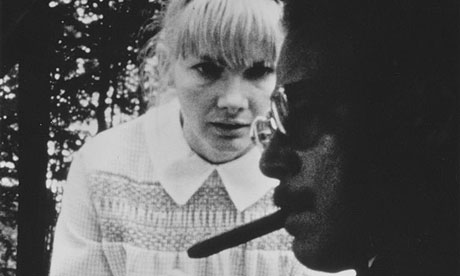
Marlene Jobert and Jean Yanne

Please bear with me, as the first part of this review is a long overdue appreciation post for someone who should’ve received more credit for shaping the film scene here in Boston. Needless to say, 2008 was a tough year for the film here as Bo Smith, the 21 year Director of the Ruth and Carl J. Shapiro Film Program at the Museum of Fine Arts, left the MFA to head the Denver Film Society for what would sadly be less than a year. Bo revitalized a dying scene of truly independent and foreign film programming here back in the 1980s and nurtured the growth of a multitude of festivals featuring work from all over the world, including The Turkish Film Festival, The Boston Iranian Film Festival, The Palestinian Film Festival, and the festival where we first met, the inaugural 1995 French Film Festival. Though Bo was always consistently clad in the finest of clothes, he walked up to a grubby, skater shorts and ska t-shirt wearing Generoso after the screening of the ninth film I saw at the festival and asked why was I there. We then engaged in a lengthy discussion on the state of French cinema, which I guessed surprised him a bit because, between films, I was playing a lot of very loud reggae through my headphones. After that exchange, Bo would frequently stop by during the remainder of the festival and ask my opinion on what I had just seen, and in turn, during the conversations that followed, I grew my appreciation of his immense knowledge and love of cinema.

Cut away to 2003, shortly after the passing of Maurice Pialat, Bo curated a complete retrospective of the work of Pialat, a director he greatly admires and resembled himself as a director who also never seemed to be remotely concerned with the commercial success of his output. By 2003, I had only seen Pialat’s most well known film, 1983’s “A Nos Amours,” and although I admired it greatly, I had never seen the rest of Pialat’s work, so based on Bo’s suggestion, I attended all of the retrospective he put together. All, except the film that I am writing about today, 1972’s “We Won’t Grow Old Together,” which was recently screened at another of this area’s institutions, The Harvard Film Archive as part of a series entitled, “Furious Cinema ’70-‘77.”

More than almost all of the films in this series at Harvard, the word “furious” is most aptly applied to “We Won’t Grow Old Together,” the story of Jean (Jean Yanne), a film cameraman and his obsessive relationship with the younger woman whom he is having a bit more than a little rocky six-year affair with, Catherine (Marlène Jobert). Jean brutally lashes out at and reconciles so many times with Catherine that it borders on the comedic, and at times it even resembles a more violent turbulence that Albert Brooks’ neurotic film editor inflicts on Kathryn Harrold in Brooks’ 1978 film,“Modern Romance.” The plot of “We Won’t Grow Old Together” can be surmised easily. You are there, intimately watching a relationship spiral out of control, but this film is like so many of Pialat’s best works in that it is so much more than the plot. As film critic Kent Jones once explained:

“Even more than Jean Eustache […] Pialat was an irascibly private artist, charting a twisted, crook-backed path with each new movie, almost always emerging with works in which the mind-bending vitality of immediate experience trumps all belief systems, allegiances, plans. […] More than Cassavetes, more than Renoir, Pialat wanted every frame of celluloid bearing his name to be marked by the here and the now.

Jean is relentless in his unsavory treatment of Catherine and she is as relentless in her tolerance of Jean’s somewhat grotesque behavior to the point of insanity. The conflict reaches such a insane mess, that even Jean’s beleaguered wife Françoise (Macha Méril) calmly counsels her husband during about his frustration with dealing with Catherine. This bizarre treatment of this relationship is portrayed as it is with most relationships, romantic or otherwise, in many of Pialat’s films, and that is a portrayal that is completely devoid of a divisive plot or sentimentality. There is no hoping for an understanding between characters or even a moment off of the ropes; you are there to witness a few sensational actors destroy one another for the better part of one hundred minutes, and you are enthralled with the process, though this process was not always appreciated by Pialat’s actors. It needs to be noted that even after winning the best actor’s award for his portrayal in “We Won’t Grow Old Together” at the 1972 Cannes Film Festival, Jean Yanne castigated the film. “I think it’s a lousy story,” he said, in part, noting also, “If I’m any good in the part, believe me, it was completely involuntary.”

The Opening Scene Of “We Won’t Grow Old Together”

Similar to Gerard Depardieu’s character, Loulou and his treatment of Isabelle Huppert’s Nelly in the 1980 Pialat film, “Loulou,” your only recourse is to watch Pialat’s characters crack and get glued together over and over again and it’s this kind of elliptical style editing, which is a Pialat trademark, and this is also why you either love or hate his work. My feelings about Pialat’s work can be summed up by a conversation with Bo Smith  after the MFA retrospective screening of “Loulou” back in 2003.  Bo came up to me and asked me as what I thought of the film and I responded: “It’s a bit like the stab in the gut that Loulou gets in the middle of the film, Loulou takes it, it knocks him down, but soon he just sucks it up and moves on.”

Though it has been many years since Bo Smith has walked or more like bicycled through the streets of Boston, I will be a bit sentimental here unlike Mr. Pialat and wish him a long overdue thank you for all of the great films he brought to town.

Unraveling The “True” Horror Of 1976’s “The Town That Dreaded Sundown”

Standard
phantom trombone

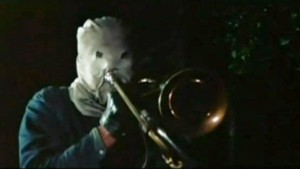
The Real “Phantom” Was Not This Crafty

“Based on a True Story” has always been an excellent marketing tool for films going back decades. From Alfred Hitchcock’s “Psycho” and Tobe Hooper’s “Texas Chainsaw Massacre,” which both took their ideas from the actions of real life Wisconsin serial killer and cannibal, Ed Gein, whose life had little to do with the aforementioned films to Kimberly Peirce’s “Boys Don’t Cry” which brutally stretched the truth to make a gender hero out of petty thief Brandon Teena, Hollywood has always taken liberties with “true” stories to suit its own political and sensationalist gains. Most recently there has been a lot of controversy surrounding the Clint Eastwood biopic “American Sniper,” based on the memoirs of Chris Kyle, the Navy Seal who was certified as the deadliest sniper in US Military History. It is clear that liberties had been taken with the history and even the memoirs written by Kyle himself for the film version, which drew the ire of many critics, who claimed that the film was just an attempt at propaganda by Eastwood. The one thing we have learned from all of this is that the evoking of the term, “too soon,” may be the best strategy that Hollywood may have to adhere to when attempting the “Based on a True Story” film. Then again, if your machine can spin the negative press that results from dramatic license, it has almost always meant more to a studio in ticket sales, which is sadly why the tagline exists in the first place.

Such was the case in 1976 when American International Pictures decided to premiere director/producer Charles B. Pierce’s drive-in film, “The Town That Dreaded Sundown” in Texarkana, Arkansas, the very town where some thirty years earlier, a masked man began slaughtering people in what would be known as “phantom attacks” of mostly young lovers in the dead of night. Family and friends of the victims were all still very much alive in 1976, and so a very powerful magnifying glass was held up to construction of characters and scenarios of director Pierce’s film. A film that is widely considered, along with Bob Clarke’s “Black Christmas,” as one of the earliest examples of the film genre we now know as the slasher film.

The film begins with a teenage couple, Sammy Fuller and Linda Mae Jenkins, who, while parked on lover’s lane, are assaulted by the “phantom.” The phantom appears faceless in a way that would become too familiar to horror film fans for years to come: think Jason Voorhees’ hockey mask from “Friday The Thirteenth,” or Mike Myers’ “Halloween” clay face, or any other version of the phantom that we would see with knife in hand in late 1970s but with the added “bonus” of occasionally seeing the victim from the killer’s eyes, which would become one of the defining characteristics of the slasher film genre. This facet was nothing entirely new to cinema as that approach had been taken by legendary British director Michael Powell’s in his 1960 film “Peeping Tom,” except that director Powell’s little death trip through the eyes of his killer cost him his film career as its brutality was too hard to handle for audiences of his era. Despite Powell’s demise, this approach to horror would be the standard for the next decade, like it or not.

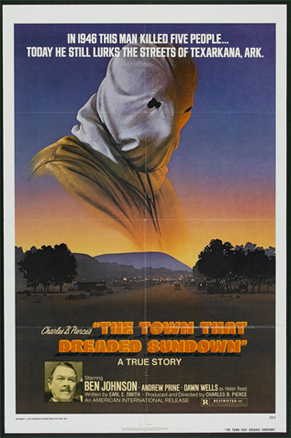
Adding to the horror of the film, Charles Pierce uses aspects of the real life attacks for “The Town That Dreaded Sundown,” and thus these scenes are still genuinely horrific but were severely augmented for the film as well. Murder victim Linda Mae Jenkins for example, is found having been “bitten and chewed on,” but that was not the case in the original killing it was based on and was an odd and unsubstantiated choice for Pierce to use that additional act to further his villain’s sadistic qualities. Where Pierce takes even more substantial liberties is in the death of the character, Peggy Loomis, who is murdered when “the phantom” ties a knife to the retractor of her trombone and kills her in a similar fashion as Mark Lewis, Powell’s “Peeping Tom” killer who uses a knife mounted to a camera as his weapon of choice. In the film, Peggy is assaulted with her boyfriend Roy while amorously parking, while the actual pair of Betty Jo Booker and Paul Martin were just friends and were shot to death. Multiple lawsuits were eventually brought against the film’s producers on a variety of issues relating to the unflattering depiction of some of real life victims. Even a lawsuit was started by the city of Texarkana against the ad campaign for the film which had as its tagline, “In 1946 this man killed five people…today he still lurks the streets of Texarkana, Ark.” Allthough director Pierce worked to remove the “still lurks” part of the tagline, it was still very present in the posters for the film.

For a “drive-in” film that was made for a mere $400,000, the cinematography and quality of performances of “The Town That Dreaded Sundown” is a cut above most of the entries that would be classified as drive-in worthy. The addition of veteran actor Ben Johnson, who appears just a few years after his Oscar awarded performance as “Sam The Lion” in Peter Bogdonovich’s “The Last Picture Show” adds much to the overall believability of the film. Though the over narration comes across as a tad ridiculous, and the humor injected in the narrative takes away from the overall tension, it is still a remarkably well-made horror film that still packs more than a few scenes of genuine terror.

Original 1976 Trailer For The Town That Dreaded Sundown

All this makes one wonder then, why was there a necessity to alter the real tragedy that had befallen Texarkana to create a more unbelievable horror story when the actual story was terrifying on its own? To create an almost documentary-style narrative, Pierce even went as far as including the dates of the actual murders on screen, but, alas, some dates were incorrect, further magnifying the oddly inconsistent commitment to the reality of the “phantom attacks.” It seems that Pierce’s desire to use the stylistic elements from Powell’s “Peeping Tom” and Bob Clarke’s “Black Christmas” outweighed the actual facts of this crime spree that occurred in 1946, leading to the strange deviations from the true story and ultimately doing a disservice to the people of that region who were still tied to the reality of those attacks. Though flawed both aesthetically and factually, “The Town That Dreaded Sundown” continues to stand as a key film that shaped the horror genre of the 1970s. Bizarrely, despite the initial negative reactions from the city the film makes its setting, it is screened every year at Halloween for free by the Parks and Recreation Department of Texarkana in the very park where some of the actual murders occurred.

I guess the “phantom” makes for a good boogie man these days, but I wonder if the good folks of Texarkana know that the real “phantom” existed and brought true terror to the town they call home.

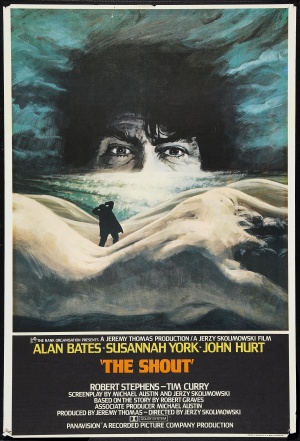
Jerzy Skolimowski Directs Alan Bates In The Mesmerizing 1978 Supernatural Thriller, “The Shout”

Standard
shout04

Alan Bates and Susannah York in “The Shout”

I first saw Jerzy Skolimowski’s “The Shout” as part of the Harvard Film Archive’s sensational retrospective of the fifty plus year career of the famed Polish director and screenwriter of Roman Polanski’s “Knife In The Water.” “The Shout” is a faithful and visually stunning adaption of a short story written by poet Robert Graves, and of all the films that were shown during that retrospective back in 2010, it was the one film that left the greatest impression on me, even to this day.

A supernatural thriller shot with a non-linear narrative, “The Shout” uses a cricket match at a mental institution as its framing device. In the eerily scenic yards of the institution, we have Crossley (Alan Bates) a newly arrived mental patient who sits in a small shack besides a foppish, coiffed man named Robert (Tim Curry) who Crossley assists in scoring the match that features a team of loons. Shortly after Crossley’s ranting, we soon meet the charming young couple, Rachel and Anthony Fielding (Susannah York and John Hurt) who have domesticated themselves into an almost brother and sister relationship, devoid of any carnality. We first meet them at the nearby beach where they vividly imagine a man armed only with a sharp bone, coming towards him in a threatening manner. Somewhat flustered, the Fieldings saunter back to their idyllic country home in Devon, England where Richard composes experimental music by mostly capturing the sounds of nature and distorting them as he sees fit. Though Richard composes secular music, he is also the local church’s organist and despite his vicar’s plea for a resurgence of faith during Sunday services, Richard will leave the church for an illicit tryst with the wife of the local cobbler, but before he does, he will encounter Crossley.

Crossley sneaks up on Richard and immediately addresses the concept of the Christian soul and how it is “imprisoned by the body.” He then asks, “if imprisoned, wouldn’t the soul be better off inside of a tree?” Richard takes leave of Crossley but returns home to find him sitting in front of his house, looking for an invitation to lunch. Richard complies and soon Crossley will make his stay last much longer than anyone had hoped for.

During the subsequent lunch, Crossley regales our pastoral couple with tales of his Aboriginal life, his bride, and the murder of his own children, which he claims is a perfectly acceptable tradition for the Aborigines, but this fact does not go over well with the Fieldings, nor does Crossley’s story of female possession that can easily occur by the keeping an item of a women’s wardrobe. It seems that Crossley has found Rachel’s shoe buckle and with that discovery, his Svengaliesque inclusion into the Fielding’s lives has begun. Our Crossley also has confided in Richard his unnatural ability to shout a sound so powerful that it will kill all around it. Richard of course needs proof and follows Crossley to the same beach where he and his wife imagined the Aborigine coming towards them. Crossley does shout and all life around him suffers for it; he is an actual force of nature, and soon, he will take his possession of Rachel in the same way he controls his surroundings.

Director Skolimowski does an excellent job at keeping the identity of Crossley a secret, allowing the viewers to draw their own conclusions, adding to the thrill. Is he an Aboriginal shaman, in line with the powers of nature? Or is Crossley in congress with the devil aiming at the possessions of the Fielding’s souls? Or is his entire existence the ramblings of a mental patient? The simple fact is that it doesn’t matter how he (Crossley) goes about affecting those around him; it is why, which may come down to the basic idea of the conflict that occurs inside the character of Richard, an opportunist who seems content to distort nature with his recordings, his masculinity with his desire for domestication, and similarly his non-secular morality with his infidelity against his wife, Rachel. Skolimowski alludes to these transgressions in both the natural and spiritual world, leading to a conclusion that is a sort of Biblical punishment for those who defy both the kingdom of God and mother nature’s reaction with the film’s loudest “shout” being created outside of Crossley’s human body.

Original Trailer for 1978’s “The Shout”

Given the critical acclaim of Skolimowski’s earlier work and the author of the source material for “The Shout,” it should come as no surprise that the film version of the Graves short story would draw the immense talent it did, hitting the screen with the prime acting abilities of York, Bates, and Hurt as well as the fearless cinematography of Mike Malloy, whose imaginative visuals add much to the stark moments of natural conflict. Reviews of the “The Shout” at the time of its release vacillated between an overall dislike to overwhelming praise, which is best thing you can say about any great work of art as to how it effects people. “The Shout” did share the Grand Prize that year at Cannes with another misunderstood film of its era, Marco Ferreri’s ode to fading masculinity by way of the destruction of the natural world, “Bye Bye Monkey.”  I guessed people actually cared about an environment and its bond to masculinity during that decade.

Alan J. Pakula and James L. Brooks Team Up To Create A Smart “Rom Com” In 1979’s “Starting Over”

Standard
starting-over-car

Reynolds and Clayburgh in “Starting Over”

I have dedicated this blog to those lost films of the 1970s mostly from the perspective of films that have been “forgotten” or “hard to find,” but this week I will use director Alan J. Pakula’s 1979 effort, “Starting Over” to discuss a genre that I feel that is truly lost: the intelligently made “rom com.” We all know the term “rom com,” that hideous mess of the last few decades of the Sarah Jessica Parker and Kate Hudson kind that serves its ideas so warmed over that the mere mention of one will send most film watchers who expect anything more than a trifle running for the hills. There was a time though when romance was not always looked at in a giggling beautiful people kind of way; you all remember the time when the Albert Brooks and Woody Allens dominated the landscape, don’t you?

Alan J. Pakula was no where near the aforementioned directors’ world during the 1970s, as he, like so many of his contemporaries, were too busy examining the paranoia of a Nixon-era America in films like “Klute,” “All The President’s Men” and “The Parralax View.” One wonders why after such huge successes, that Pakula would gravitate towards romance? Perhaps the reason lies within the critical and commercial failure of his heavy-handed 1978 film, “Comes A Horseman,” which included the death of stuntman, Jim Sheppard, or perhaps it was the chance to work with the talented young screenwriter, James L. Brooks, the successful creator of “The Mary Tyler Moore Show” that had Pakula thinking in a new direction. Regardless of the reasoning, there is much to like about “Starting Over,” Pakula’s last film of that decade.

The film opens with Phil Potter (an eerily clean-shaven Burt Reynolds, free of his Smokey and The Bandit stache) staring at his wife Jessica (Candice Bergen) as she performs a comedically flat version of her new song “Better Than Ever,” an almost mockingly nasty poke at late seventies feminism, which she wrote about their fading marriage. She soon carelessly tells Phil that she has filed and has been granted a divorce. Phil takes it passively and packs his bags for Boston where he can regroup and stay with his brother Mickey (the always solid Charles Durning) and his over-sensitive wife Marva (Frances Sternhagen, who is better known as “Cliff’s mom” on Cheers). On the request of Marva, Phil is off to a divorce workshop in the basement of Boston’s famed Trinity Church, where he and his fellow sad sacks sit and discuss their failed marriages with a sitcom-esque cadence of moans and accusations as they fight off the hoard of divorced women, who like approaching Visigoths, pound the door every time that their stay in the basement is supposed to start. Here, we can see the brilliance of James L. Brooks dialog writing in television. Sure, the jokes have laugh space like any good episode of “Rhoda” (another Brooks creation), but they are no less hysterical and real.

Phil seems happy to go to these meetings and that encourages Marva and Mickey to inflict more kindness on Phil as they secretly invite their preschool teacher friend Marilyn (ironically played by Jill Clayburgh just a year after she defined the modern divorcee in An Unmarried Woman) to a dinner/setup to meet Phil. They hit it off, but because she is equally gun shy after a failed relationship, she pushes our Phil away, even setting him up with another divorcee friend of hers, Marie, who seems more hungry to get at Phil than he had ever dreamed of, sending him running back to Marilyn as he begs her for any kind of evening, romantic or not. It’s abundantly clear that Phil is not over his ex-wife, but he craves companionship at some level, and Marilyn will begrudgingly comply, though she is still keeping her guard up. You know the wife is not out of the picture, not even close, but Marilyn just likes Phil too much to not see this through. Clayburgh’s ability with comedic dialog is to be commended here, and I truly wished that she had done more comedy, and she plays Marilyn fragile but smart and handles each scene with a demented confidence that feels like she knows what is best for her, but she also knows that the hammer will fall soon. As far as Burt is concerned, well, needless to say that this is 1970s Burt Reynolds, so you are given the same classic cocky performance you always get in every film he stars in, which you of course love, regardless of how it does or doesn’t fit the character he is playing here.

Candice Bergen Trying To Win Her Ex Back With “Song”

You may be thinking at this point that the story of “Starting Over” doesn’t exactly fall to far off the “rom coms” of today, and in some ways you are right. A romantic film that plays out with some difficultly but one where you know that the two leads will get together in the end is the book definition of a “rom com,” but using that definition alone, “Annie Hall” and “Modern Romance” would also be considered “rom coms,” except that they create interesting, intelligent characters who progress through the narrative with smartly written dialog and situations that reach a level of uncomfortable that recent entries into this genre do not have the courage to do as to not upset their callow audiences. One would only have to look at the Thanksgiving scene in “Starting Over” when Phil invites Mickey, Marva, and Marilyn over to his apartment for dinner and callously crushes our Marilyn, who finally is feeling like she’s part of Phil’s life, when his ex-wife Jessica calls up, and Phil describes his new love to Jessica as “some friend of his brother’s.” It’s a genuinely soul crushing moment that seems to come out of nowhere, but it does somehow fits Phil’s hidden resolve to get back with Jessica, though he shouldn’t even consider it.

If there is a negative critique of “Starting Over,” it is that it does move too quickly towards an ending that doesn’t seem to fit Phil’s character. It almost resembles Albert Brooks’ desperate wedding proposal to Kathryn Harrold in “Modern Romance,” except that act furthers Brooks’ insipid obsession with the woman that he cannot stop breaking up with during the film. Phil Potter’s proposal to Marilyn in the end shows the weakness in James L. Brooks writing at the time as it seems more like something that would happen at the end of a 30 minute sitcom and not a film that is taking a hard look at the modern divorced man. James L. Brooks would tighten in endings during the 1980s with “Terms Of Endearment” and “Broadcast News.” Two excellent films that occasionally slip a bit too far into melodrama, but still come out with their edge intact.

Though “Starting Over” is not in the same league as some of the more honest films about men and women in the late 1970s, it is still packed with more than enough humor and excellent performances to lay waste against anything in the desolate land of the modern “rom com.”

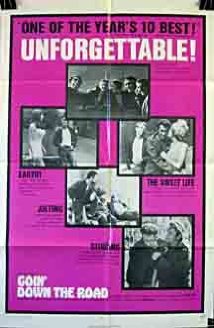
Though Once Parodied On SCTV, 1970’s “Goin’ Down The Road” Is One of Canada’s Most Iconic Films

Standard
Goin Down The Road Peter and Joey

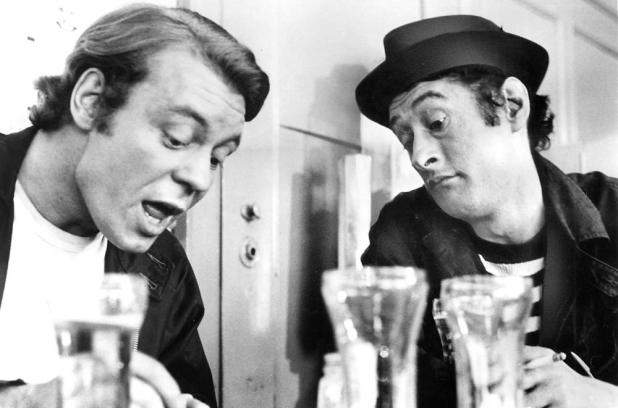
Goin Down The Road’s Peter and Joey Sharing A Pint

As a teenager, I was a huge fan of SCTV, the Canadian-based sketch comedy show that gave us such talents as John Candy, Eugene Levy, and Martin Short. For my money, SCTV blew most of Saturday Night Live away with their original characters, but there was one thing that they truly excelled in, and that was movie parodies. Their demented version of Polanski’s “Chinatown” called “Polynesian Town,” their overly abusive version of “The Godfather,” with their pimpish “network president,” Guy Cabellero, subbing in for “Don Corleone,” and one that I didn’t quite get at the time, “Garth & Gord & Fiona & Alice,” the story of a Moncton doctor and lawyer (who spoke like a more rural Bob and Doug McKenzie) heading to Yonge Street in Toronto to get “all kinds of jobs and girls.” It was an incredibly funny episode of SCTV, but as a young Philadelphian with hardly any exposure to Canadian cinema outside of David Cronenberg, I had no idea that the film that they were having a bit of fun with was one of the most iconic films in Canadian history: Donald Shebib’s documentary-styled 1970 film “Goin’ Down The Road.”

The film tells the story of Joey (Paul Bradley) and Peter (Doug McGrath), who leave their low-paying cannery jobs in Nova Scotia for the chance at a better life in Toronto. Wide-eyed and optimistic through the promises of their friend that they will get higher paying jobs and the promise of a place to stay with family, the boys head west with their car that dons the message “Our Nova Scotia Home” spray-painted on the side. The harsh reality of that move west hits home quickly when their relatives recoil and hide upon seeing how uncouth the boys are, and the promise of a job goes up in flames when they find out that their friend Anton from back home has lost his job some time ago and cannot help them find work. Though somewhat discouraged, Joey still hopes for an office job while Peter will gladly settle for anything that will get them out of their temporary Salvation Army hostel.

The next day, Peter gets a job at a bottling plant, while Joey’s dream of an office job in advertising goes down the tubes when the human resources department breaks the news that he has absolutely no qualifications. Peter then helps Joey get a job at his plant and armed with some spending money, the pair hit Yonge Street looking for girls just like Candy and Joe Flaherty in the now infamous SCTV parody. A key scene for both characters happens here as Peter prowls the street looking for anything in a skirt, while Joey tries to flirt and is rejected by a beautiful young woman who is listening to Erik Satie’s “Gymnopédie No. 1.” Again, they both want a better life, but Joey realizes for a second time that the life of an urban sophisticate may be too far out of his reach.

These scenes in the streets of Toronto are played out in the same way that John Schlesinger freely rolls out Ratso Rizzo and Joe Buck in New York City, in an honest and almost documentary-like style that had come into fashion during the recent British films of the late 1960s. This style is the defining greatness of “Goin Down The Road,” with its natural flow that feels true to the film’s two protagonists. They are lost, good-natured men in a big city and the low budget raw visuals work in line with their plight. This film is the first for actors McGrath and Bradley, and they do a fine job immersing themselves in their roles, and it shows because nothing in their performances seems remotely contrived. Also, in a perfect pairing that was becoming somewhat commonplace in that era,  like Earth, Wind, and Fire’s music for Melvin Van Peebles “Sweet Sweetback’s Baadasssss Song,” the soundtrack features two original folk songs from the then unknown talents of legendary singer Bruce Cockburn, who would go on to become one of Canada’s most celebrated musicians. Cockburn’s songs for “Goin’ Down The Road” lyrically address the plight of the film’s leads.

The Opening Scene From “Goin’ Down The Road”

http://www.youtube.com/watch?v=X3cevI9RJ4Y

“Goin’ Down The Road” reflects the real life issue that occurred  in Canada when thousands of young people emigrated from the Maritimes to Ontario looking for work throughout the 1950s and 1960s. A trend that became so prevalent at the time that the Ontario government began building many housing projects in the early 1960s just to handle the rapid influx of internal immigrants from the east. This wave of immigration changed in the late 1960s when a new group of immigrants from Africa and the Caribbean began to settle in Toronto in mass, thus leaving folks like our Joey and Peter without any affordable housing in their own country. Though the film never relates any direct conflict between the main characters and the new wave of immigrants, it does offer some insight as to why two Canadian citizens would feel estranged not too far from their own hometown. Toronto was quickly becoming an international, cosmopolitan place that was so far removed from Joey and Peter’s upbringing that they would soon be crushed by it quickly. In the end, despite the bad jobs, bad relationships, and bad luck, Peter and Joey stay true to each other like good Canadian boys, consistently bailing each other out of various jams, and director Donald Shebib does not spare any of the awkwardness and the fear of strangers in a strange land, even if it is their own country.

Barbara Loden’s Debut Film, ”Wanda” From 1970, Is A Cinema Verite “Badlands”

Standard
Wanda FilM Image

Barbara Loden and Michael Higgins in “Wanda”

There is a moment in Barbara Loden’s only directorial effort, “Wanda,” when our titular protagonist removes the onions off of the burger she was ordered to get her newest man, Mr. Dennis, that sums up this film well. You see, Wanda (also played by director Loden) has met our Mr. Dennis (Michael Higgins) just the night before while he was robbing a bar, and they are now on the lam, shacked up together in a dingy motel room when he lashes out at her for forgetting the one item he desperately wants off of his food order, the onions. It is a sad moment, but Wanda quickly performs this task soon after going out to get the food in the middle of the night and makes up for her mistake in the exact same way, with a tired resolve and dead eyes.

Wanda has recently left her husband and children in a mining town somewhere in rural Pennsylvania; she didn’t want that life anymore nor a life with the first man she jumps in bed with after her husband or the man after him. In fact, it’s made pretty clear that her lot in life traps Wanda. She is a poor, pretty, and not very bright young woman who like Sissy Spacek’s Holly in “Badlands,” is just willing to tag along for lack of anything else to do, but unlike Badland’s Holly, Wanda is emotionally numb and frankly just stupid enough to believe that she can handle what is about to go down.

There is much to be admired of “Wanda,” the first theatrically released featured film to be simultaneously written, directed, and starred by a woman here in the United States. “Wanda” has a raw, improvisational style of acting that heightens the realism of the performances and a well-matched low budget stretched 16mm cinematography by Nicholas Proferes. There are no long gorgeous shots during “magic hour” here, where the cold shabbiness of the visuals add to the hollow desperation of the film’s leads. After “Wanda,” Proferes, would go on to lens her husband, Elia Kazan’s 1972 film, “The Visitors.” Kazan, the brilliant director of “On The Waterfront,” claims to have little to do with “Wanda” during its production but would go on to say that Loden and Proferes would combine to make an excellent team by bouncing ideas off one another.

What I found to be the key in the success of “Wanda” is that Loden never betrays her two lead characters. The film is never sentimental or heroic, for Wanda and Mr. Dennis would not be heroic by any means in real life. As you go deeper into their relationship you see the shell of two very broken people, who have been told by those around them that they would never amount to much, and, despite any effort, they never will. You somehow know that the big job that they are going to pull is not going to work. A grand end just cannot happen, as that would be out of line with their life paths. It is a nihilistic yet entrancing film that steps into darker territory with each scene, culminating with one of the most soul crushing endings this side of Jeanne Dielman. But, in the end, we do not have a modern feminist hero nor an anti-hero for that matter; we only have another walking causality who will fade into nothingness.

Director Loden Speaking with Mike Douglas About “Wanda”

Shortly after winning the International Critics Award at the Venice Film Festival for “Wanda,” director Barbara Loden, who was born in Marion, North Carolina, told film critic Michel Ciment about her hometown: “If I had stayed there, I would have gotten a job at Woolworth’s, I would’ve gotten married at 17 and had some children, and would have got drunk every Friday and Saturday night. Fortunately, I escaped.”

It has been said of Barbara Loden that she was a shy and soft-spoken loner, like her character in “Wanda.” Sadly, Loden and her real life husband Elia Kazan would become estranged after she received many accolades for her directorial debut and only film, and they would remain estranged her until her death in 1980 at the age of 48 from breast cancer.

Rip Torn Plays a Mean Guitar in “Payday”, 1972’s Overlooked Country Music Tragedy

Standard
payday

“Payday’s” “hero,” Maury Dann,with his entourage

I’ll start off this review by saying that I have always been a huge fan of actor, Rip Torn. He is that hulking man with the confident grizzled look, who is armed with a voice that can only be described as “pleasantly gravelly.” Going back some twenty years ago after seeing Rip’s fine comedic performance as Albert Brooks’ jolly attorney in “Defending Your Life,” my friend Steve asked me, “Have you ever seen Rip Torn in that dark film where he plays a country singer, called “Payday?” I had never heard of it at the time, but it was his second comment that really sold me on the quest to find it, “The film is as if you followed a character from Altman’s “Nashville” into hell.” I had seen Rip Torn play mean in that world as Dino, the evil country music promoter in Alan Rudolph’s 1984 film, “Songwriter,” but nothing could prepare me for the vile character of Maury Dann, who Rip plays in Daryl Duke’s “Payday.”

To say that “Payday” is about country music is to akin to saying that “The Man With The Golden Arm” is about drumming. Rip Torn’s Maury Dann is a minor country music star, famous enough to afford a Cadillac and a driver/cook/bodyguard named Chicago (Cliff Emmich), his hot girlfriend Mayleen (Ahna Capri), and an enormous bag of uppers, but he is still playing small dive bars where he has to hustle to keep caravan moving. Maury’s crew is somewhere in Alabama heading from state to state to record and play more gigs, but along the way, Maury’s going to inflict some major damage to almost everyone around him.

The film opens with Maury performing at a roadhouse; it’s a fine song, but if you are looking for a music-filled “Inside Llewyn Davis” styled narrative, then you have the wrong film. Again, “Payday” isn’t about country music as much as the world of the country music performer rotting from the inside out. Soon after the gig, our Maury takes a young fan into the back of the Cadillac for a quickie, while his guitarist Bob (Jeff Morris) meets another fan named Rosamond (Elayne Heilveil) who he takes back to his motel room and rapes her after she is put off by Bob’s advances. The next day, Maury heads back home, as any good country singer should do to see his mama, but she is conveniently “bedridden,” strung out on uppers, and soon harasses her son for more bennies to fuel her day’s chores. He hands her a bag, picks up the hound dog, and is soon off to duck hunt with some good old boys, but this picture of southern normalcy also gets broken the moment he returns when Maury beats up Bob for asking to buy his mom’s dog because mom is too messed up to take care of it. After the fight, Bob is left behind by Maury, who leaves his dog as well, and picks up Rosamond, who he adds to his entourage despite the protests of Mayleen, who quickly understands, as we are, that Maury is thinking that he’s too big for his cowboy boots.

In a trailing car, is Maury’s band, and slick city manager McGinty (Michael C. Gwynne) who advises Maury on just about everything along the way, including a stop at a radio station to do some airtime promotion with a small time disc jockey who Maury bribes with some game birds and a bottle of Wild Turkey. Despite the “gifts,” once Maury turns down the disc jockey’s request to play a charity gig later that week, Maury clearly gets the word that his new record “Payday” might not get the additional spins he wants. Yes, payola is still alive and well in the Deep South just like the north, and we again see the breakdown of the homespun country music star take another rough tumble.

There will be more rough times ahead and Maury is coming apart with every attempt at playing the game the old country music way, but with every effort going up in flames, including what should be a touching birthday visit with his son, which ends in disaster when Maury’s ex-wife reminds him that his son’s actual birthday was eight months ago. We know now that this was the beginning of days of Merle Haggard, Waylon Jennings, and the whole outlaw country music scene, so the question becomes: Is Maury a good old boy himself pretending to be an outlaw or the other way around?

Original trailer for “Payday”

Released a few years before Altman’s “Nashville,” “Daryl Duke’s “Payday” never lets you off the hook in its viciousness, its bold non-use of music, and its total lack of joy which keeps you riveted to your seat. Sadly, Duke only directed one other film of note, the 1978 heist film, “The Silent Partner,” before spending his remaining career directing television mini-series like the highly successful, “Thorn Birds.” Rip Torn’s performance as Maury Dann is just extraordinary, a standout for 1970s, the last era of the actor and the reason why you should watch this film. Torn is the complete embodiment of his character and fills the screen with sadness and rage as he missteps over and over again while trying to balance the country music outlaw against a soft-hearted small town man who just wants to make it big.