I Was Attacked by Underwater Nazi Zombies at The Coolidge Corner: A Midnight Screening of a Restored “Shockwaves” from 1977

Standard
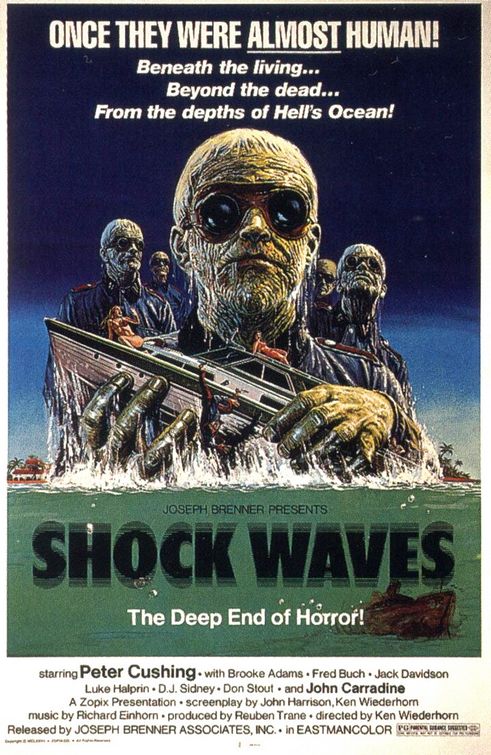
shock_waves poster

Original Poster for Shockwaves

What a mind-opening experience it was to hear director Ken Weiderhorn talk about his most famous film, “Shockwaves,” last week at the Coolidge Corner. Though I was thrilled to hear him speak in person about his now notorious 1977 underwater Nazi zombie film, his overall tone that night was that of a dad who was forced to talk about his son’s recent ballet recital. After hearing him sadly recount his story of how a late night CBS television screening of his film caused folks at his then television job to lose respect for him, thus making it difficult to thrive in his chosen career, I get it, he was not happy. But let’s put the potentially un-PC, career-ending subject matter aside, “Shockwaves” is a visually unique chunk of horror that can boast about a cast containing a pre-“Days Of Heaven,” Brooke Adams, and B-horror movie legends( who were only paid for four days of shooting BTW) Peter Cushing and John Carradine at their creepiest. Also, “Shockwaves” can still give you the thrill of saying to your co-workers, “well tonight I’m seeing one of those underwater Nazi zombie films” because that statement should be good for at least another forty years of bad looks.

The film begins with a father and son who rescue a sunburned, disturbed woman from her rudderless dinghy.   Something horrific has happened to her and you need to know why. As she starts to recall what occurred, you begin the backtracking by placing her on a pleasure boat that is being captained by a very drunk John Carradine (he’s was really good at this) , with a salty crew of young and old, and a passenger list containing a cast of vacationers that any 70s film would be proud to have: You have the hunky curly-haired guy, the annoying know-it-all redhead, who is of course married to the whiny Herb Tarlick-styled salesman, and the radiant, raven haired, level-headed protagonist of our film, Brooke Adams, who was our gal adrift at sea whom we just saw at the beginning of the film. The boat is far from ship-shape, the meals are cooked my a man who usually eats chili with his fingers, and the captain played the always cantankerous John Carradine, who has a pony bottle of Bob’s Vodka permanently glued to his hand as an accessory. As mutiny begins to fill the air, they are sideswiped by a ghost ship which does some damage and are forced to land the SS Minnow on a desolate island that has the shell of a long since destroyed military ship off its coast. Our captain goes missing and is then found dead, and so now it’s up to the passengers crew to figure out a rescue plan.

photo 2

Director Ken Weiderhorn at The Coolidge Corner

They soon come across the lavish, dilapidated estate of a semi-retired SS Commander (Peter Cushing), I say “semi” as he almost immediately explains that his group of “Death Corps,” a scientifically created group of immortal soldiers, still roam the island. These troops were designed to be U-Boat crew members so they really like the deep blue sea and continue to live there, but as World War Two had ended some thirty years prior, they just got to kill everything they see out of loyalty or boredom once they uniformly pop up from the various rivers and ponds on the island. Armed with this knowledge, the crew find a place to hide and try not get killed before they can and make a dash off of Club Hitler the next day. I must admit the story is pretty thin but the Death Corps zombies are the most interesting thing about “Shockwaves.” These zombies (for lack of a better word) behave more like” Val Lewton” zombies and not like the Romeroesque “eat your face” zombies of “Night Of The Living Dead” which had come  forth from beyond a decade earlier. More maniacal and cunning than shambolic, yes this 70s cast will not be a food source for walking meatloaves; they will be drowned and strangled by these highly trained, and oddly nostalgic, undead fascists. These choices of murder strategies that they employ were due more to budgetary restraints, than a thoughtful desire to omit bloody outcomes. In fact, as we learned from Mr. Weiderhorn that night, a lot of this film was guided by the lack of funds. Ken stated that the money people had a desire to bankroll a horror film because, “they always make their money back,” and according to our director, they did make their bread back with “Shockwaves.” Also as we all know, sometimes being restricted by funds does bring out some creative alternatives that work better than the usual, and there are several clever ways that Ken got results out of small money.

As we now know, every zombie has an Achilles Heel, and these happy go lucky denizens of the deep cannot lose their special Biggles of the Camel Squadron goggles or they go all floppy. Why?  According to Ken, “we had to come up with an easy way of killing them that would not compromise their makeup, which was the biggest challenge of the shooting, as getting makeup to stay on when the Nazi’s are going in and out of water is a pain.”  Still, the look of eyeless, waterlog undead creatures of the sea writhing in pain with screeching synth music playing behind their passing adds a good amount of dare I say, “shock.” Also, getting back to their particular killing style, these whimsical fascists love bringing the living back down to their murky un-graves as they seem pretty upset about having to live out eternity as overdressed bottom-dwellers, so I suppose that they want company. Unlike the flesh-eating in Romero films which I rarely found scary, these slow suffocating deaths are actually quite chilling. And the Death Corp, unlike the boogeymen of children’s stories, love walking around in plain sight during broad daylight, which I would say is pretty ballsy. Because of this brash behavior, you usually see them before their victims see them, and that too adds to the shock of “Shockwaves.”

So where did the idea for these creatures come from? I was lucky to have personally asked Ken the question of where he got his inspiration for such a strange horror film monster. Sure, these days you can’t turn on the History Channel without some program on “Hitler and the Occult” or “The Satanic Armies of the Third Reich,” but what was there in 1975 when the film was written to inspire such a creation. Ken responded that there was a book that he had read entitled “Occult Reich” that had all of this info about Hitler and his weird obsession with the Satanic rites, so from there he thought that perhaps that wacky millennialist was using these methods to fuel his campaign of world domination by creating some kind of super solider. Ken continued by saying, “Even their symbol, the swastika, wasn’t that a sacred Buddhist symbol that was perverted by Adolf and crew to go counter-clockwise?” I’m glad he answered that question and I am very glad that he showed up to the Coolidge that night, a night when a hundred or so loyal horror film fans braved some seriously cold weather to see his film, ask him some questions, and acknowledge his 1977 work as a lost and nifty film that is packed with some well-done politically incorrect instruments of terror.

 Original 1977 trailer for “Shockwaves”
http://www.youtube.com/watch?v=AUemv6hW2S8

The good folks at Blue Underground have also acknowledged this work and just recently, they have released “Shockwaves” on Blu Ray. Pick one up, it looks great.
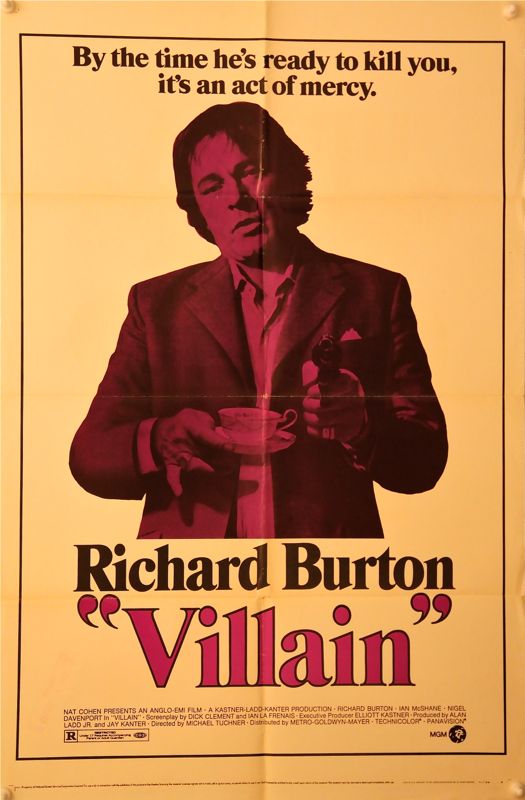
Richard Burton Doing His Best Ronnie Kray Imitation in 1971’s “Villain”

Standard
villain-movie-poster-1971-1020255446

1971 Poster for “Villain”

The British gangster film is truly its own genre that normally delineates itself from its American and Japanese counterparts by including a kind of ugly humor and coldness that is rarely seen in any other crime film genre. Starting with John Boulting’s superb 1947 film, “Brighton Rock,” through the 50s and 60s, the genre flowed next to The British New Wave and was quite popular even though the plot lines and characters had gotten a bit too formulaic that is, until real life gangsters and brothers, Reggae and Ronnie Kray dominated the headlines. Though the Krays were as violent and ruthless as Hisayuki Machii and Al Capone, there were two distinct things that differentiated them from their American and Japanese counterparts: Reggae and Ronnie were both exceedingly lovely towards their mother Violet, and Ronnie had been well known in crime circles as bisexual, a fact that British journalists had a field day with at the time.   British gangster films of course took notice of these facts and “homosexuality and bisexuality” would play a role in many of the genre’s subsequent films. From early efforts like Nicolas Roeg’s “Performance” released in 1970 to John Mackensie’s 1980 film, “The Long Good Friday,” and even recently in films such as Mike Hodges, “I’ll Sleep When I’m Dead” in 2003.” But somehow lost in this melee of bisexual, mother-loving, sadistic gangster films is Michael Tuchner’s strong 1971 film “Villain.”

“Villain” is the story of Vic Dakin, a charismatic but vicious crime lord who like the real life Ronnie Kray, loves his ailing mum and is bisexual, depicted here as Dakin maintains a turbulent sexual relationship with amateur pimp to the mob and heartthrob Wolfie (an young Ian McShane), a good-looking lad who Vic must punch around a bit before a session of lovemaking. Though Vic is the master of his neighborhood, he wants a bigger score and sets up the mark with another kingpin as they set in to rob a plastic factory. When the deal goes down badly and his co-conspirator is wounded in the heist, Vic wants to silence his partner in crime before the police inspector (well done by Nigel Davenport) can get a confession out of him.   From there its a game of cat and mouse as Vic tries to find the money and elude capture while sneaking away occasionally to share a moment or two of sexual violence with Wolfie. It must be said here that you never see any actual sexual moments in “Villain” between McShane and Burton as their one lovemaking scene was deemed too racy for early 1970s England and discarded from the final cut. What was kept in “Villain,” are a few scenes of violence that Little Alex in “Clockwork Orange” would describe as “ultra violence.” The English audiences may not have been primed for the kind of sexuality that Villain wanted to portray but the time was right for this level of “red red groovy” to be shown on the screen.

 1971 Trailer for “Villain”


The last third of this film plays out tightly and with real grit as a both main characters play off of each other in trying to avoid prison. Burton, who for most of his career had played a sex symbol, is raw and ugly and although he is not given much in terms of dialog, plays a fairly complex character well with varying intensities of emotion. Ian McShane, who had gotten good notice for his performance as Charlie in the sweet 1969 Mel Stuart film, “If Its Tuesday, This Must Belgium,” is the shining star of “Villain” as he brings a lost, desperate overtone to the character of Wolfie. If one aspect of “Villain” is truly lacking, it is the visual aesthetic of the film. Tucher, fresh off of television does not have much of an eye, and thus the cinematography seems very small-screen. Compared with “Performance” shot by the always-daring eye of Nicolas Roeg a year earlier, “Villain” must have underwhelmed an English audience hoping to see something in their favorite genre that would knock their sock offs.

Although “Villain” also boasted the star talent of the great Richard Burton, it did not do well both with critics and at the box office as it was publicly known that all was not well with Richard. Two years earlier, Burton had played Rex Harrison’s gay partner in Stanley Donen’s dreadful drama-comedy “Staircase,” about a pair of flamboyant East End barbers who are constantly at each other for laughs. That film was a critical and box office disaster and although Burton took home a hefty salary of 1.2 million, it was the beginning of a bad period for Richard as he notably took a slew of bad parts just to cash a check. Possibly after that fiasco, Britain was not ready for Burton playing bisexual again which is a pity, as they would’ve most likely had been impressed with this hard as nails fictional take on the real-life Ronnie Kray.   Audiences would have to wait almost twenty years for an actual biopic on the Krays, as director Peter Medak would enlist real life brothers Gary and Martin Kemp from the new wave group, Spandau Ballet to play Reggie and Ronnie. Who knows, given the recent successes of Nick Love and Ben Wheatley’s modern British gangster films, “Piggy” and “Down Terrace” respectively, we may see a new audience dust off “Villain” and give it the viewing it deserved in 1971.

From 1979, Bernardo Bertolucci Gives Us The Faux-Operatic “Luna”

Standard
America Luna Poster

1979 Poster for Bertolucci’s “Luna”

Given the recent success of Bernardo Bertolucci’s latest film, “Me and You,” the story of a bourgeois boy who spends a few days locked away with his gorgeous junkie half-sister while hiding from his overbearing mother in the basement of this condominium, it immediately brought to mind Bernardo’s controversial 1979 film of incest, “Luna.” “Luna” was ripped apart by the critics in 1979 and was even sermonized during a Sunday service at my local church, which, of course, made me want to leave immediately and see the film myself.

I originally didn’t see “Luna” in the most ideal way, with my elderly Italian-Catholic father in a downtown Philadelphia theater. Pa also had it in a bit for Bernardo as my dad was a proud fascist who hated Alberto Moravia, who had written the book that Bertolucci’s “The Conformist” was based on and thus despised the film. Regardless, as Dad was sweet about most things and would on my request see just about anything except for science fiction, we went to see the film at the old Ritz Theater. Let’s just say that when Luna was over, pa was not pleased. Translating from Italian, he called the film “sensationalistic garbage.” With all respect to my father, I didn’t agree with him then, but I’m not sure that it needed to be seen again.

Watching “Luna” again recently, I was immediately struck by the beautiful photography of Vittorio Storaro, who that same year had lensed Coppola’s “Apocalypse Now.” Storaro had been working with Bertolucci since they collaborated on the aforementioned “Conformist” and for his time,was the finest cinematographer on earth. Much can also be said for Jill Clayburgh, the star of “Luna,” an exceptional actress throughout the 1970s, who a year earlier had shined in the equally controversial Paul Mazursky film, “An Unmarried Woman.” Clayburgh, it has been rumored, relished the opportunity to work with Bertolucci and truly does the most she can with what was given to her and turns in a fine performance. As for Bertolucci; he was on quite the roll, from his first film in 1962, The Grim Reaper, through the 60s and 1970s, and although he had stumbled a bit in his 1976 film, “1900,” he had won every conceivable accolade possible for “Last Tango In Paris,” “Love and Anger,” and “Partners.”

So, what went wrong?

Let’s start with the story and dialog of the film, co-written by Bertolucci, his brother Giuseppe, and his wife Clare Peploe, which has no desire to either fully ground itself to reality or to allow the operatic style drama of the piece to flourish into a surrealistic experience. The story goes like this; Caterina Silveri (Clayburgh) is a wealthy opera singer who is married Douglas Winter (Fred Gwynne), and they have an erratic bratty teenage son named Joe (Matthew Berry). Together they all live happily in their New York townhouse until dad dies suddenly which makes mom whisks Joe and herself off to Italy to grow her career. Once in Italy, Caterina’s career flourishes in grand opera, while Joe becomes more bitchy, chatty, and erratic. He appears to worship his mother in an almost romantic fashion but of course, treats her like crap whenever he can, which in some ways is very Italian Catholic, but these people are supposed to be Americans, so what gives here? This character flaw is the beginning of the many issues that I have with “Luna” as I am not sure that Bernardo ever wants this to be an American family.

Joe follows this behavior by experimenting with hetero sex, gay sex, and of course heroin, a fact that his mother discovers during a somewhat hedonistic birthday party for Joe. Once Caterina discovers that little Joe is on the horse, she breaks out into full maternal mode, abandoning all and even buying a fix for Joe once his dealer Mustafa leaves town. This culminates in one “key” scene when Joe forks his arm in frustration when he runs out of needles for his fix. Even more bitchy and obnoxious, Joe is inconsolable, so mom kisses and masturbates him to climax, until he falls into a peaceful junkie sleep. This scene provides another moment of frustration for me as Caterina’s somewhat maternal but sexual reaction to Joe’s junkie freak-out is as believable as Joe even being able to get an erection while strung out. If given the stylistic context of an opera, these mistakes would be taken in as operatic license but here they just appear confused as to what they want to portray.

At this point, we aren’t sure where Joe’s addiction stands, but Caterina decides to pull Joe into the country to trace back the time when she met Joe’s father. You see, unknown to Joe, Douglas was not his biological father, so Caterina, after another few rest stops that lead to even more moments of sexual uncertainty, leads Joe to Giuseppe (Tomas Milian), a poor, country elementary school teacher, who is loved but still lives in the town where they met. Perhaps what Bernardo is saying here is that Caterina wanted more than just being a mom, so she was off to America where she has always denied who she really loved and has now brought those hidden desires to her son. Sure, there are moments when we see that Joe and Giuseppe have accidentally dressed the same, but that’s all Bernardo is going to give you to draw that conclusion. Once everything is out in the open, the film bizarrely culminates in an outdoor performance of Verdi’s “Un Balla in Maschera.”  If you are looking for a connection between Verdi’s three act opera and the story of “Luna,” I will save you some trouble.  There isn’t one, and this pseudo operatic tale of tragedy and regret is now over.  Not surprisingly, the critics of that time seemed more concerned with the audacity of the film, but they should have been more upset at its lack of focus.

Watch Joe wander and rant through the streets of Italy in “Luna”

The good news is that with 2014’s “Me and You,” Bertolucci has corrected the mistakes of “Luna” by allowing his characters’ dialog to speak for their broken realities and not by forcing them into constant over the top moments of dire melodramatics.   It is a film that is grounded in reality but is no less dramatic (or beautiful for that matter) for its choice of narrative style. Lorenzo, the struggling adolescent in “Me and You,” is selfish and callow in his actions at first, but once he understands the causes of his inner turmoil through the ranting of Olivia, his economically trapped roommate and junkie sister, he is free and able to leave the basement with peace. Though there are suggestions of possible intimacy between Lorenzo and Olivia, Bertolucci sidesteps those moments and does not allow for a physical encounter to happen, which is an excellent decision for a film that has chosen the ground for launching its familial drama. So what if it took 35 years for this to happen, I was thrilled that Bernardo was able to pull it off right this time.

Yaphet Kotto Gets More Than Whitey In Larry Cohen’s 1972 Debut Film, “Bone”

Standard
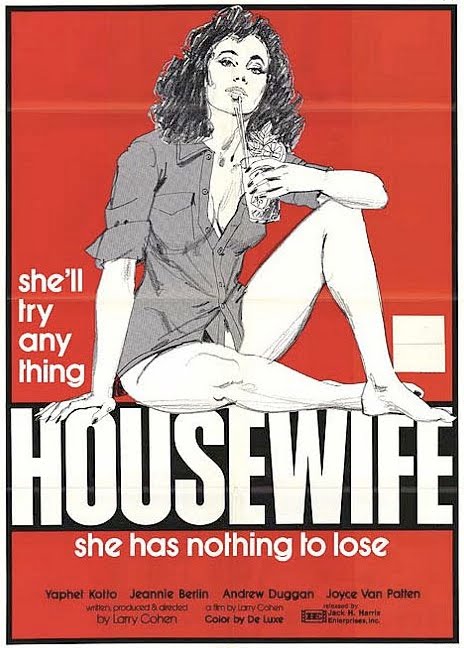
Bone-Housewife poster

One of the Many Titles of 1972’s “Bone”

OK, I admit it; I am a closeted Larry Cohen fan. I got my first taste of Larry Cohen’s handiwork when my friend Sam and I scored a VHS copy of the then notorious 1974 baby-killing-everyone-in-its-way film, “It’s Alive.” A film where a baby is born deformed and when the obstetrician tries to kill it, it goes all rip and tear on all who threaten it. Despite its bizarre concept, “Its Alive” was a sharp piece of satire on the abortion movement (Roe v. Wade was only a year earlier) and remains as Cohen’s most popular film as it did spawn (no pun intended) two more sequels. “It’s Alive” is not Cohen’s first attempt at directing a satire on the current state of American culture, his debut film “Bone,” would be Cohen’s opening and comedic salvo at an America rotting from the top down.

“Bone” begins with super car salesman, Bill Lennox (Andrew Duggan) pitching his wares which consist of mauled bodies in trashed cars during a fantasy television commercial sequence that clearly eludes to Godard’s 1967 classic, “Weekend.” I say this because reality kicks in soon afterwards, as we soon see a bourgeois Bill with his luxurious wife Bernadette (Joyce Van Patten) going through the motions in a faux paradise while Bill secretly knows that it is all a façade. And to make things worse, there is a rat in pool’s filter, a big black rat, and Bill isn’t going to fish it out and neither will Bernadette. What is there to do? Here enters our “hero,” Bone (Yaphet Kotto).

Bone first comes off as what Spike Lee would call, “a magical negro,” you know, helpful with a dash of subservience, like Harry Belafone in 1970’s “The Angel Levine,” but that doesn’t last long. Soon, “Bone” gets down to business as he has been spying on the Lennox’s lavish home and he makes the natural but incorrect assumption that there is a lot of cash waiting inside which is soon finds is not there.  Yes, the Lennox’s are mired in debt but after rifling through the Lennox’s home, Bone finds a bankbook and it seems that Bill has stashed away five grand without Bernadette’s knowledge.    Now Bill must go out and get the money from the bank or else Bone would take out his rage on Bernadette in a not too pleasant threat of rape and beheading.

For the rest of the film, Bill and Bernadette are apart and experience two different kinds of journeys. Bill is offered a loan from his bank as opposed to full cash withdrawal. Being that he now has this option, Bill doesn’t seem too anxious to get home and wanders through Los Angeles until he finds a bar where he meets the dentally obsessed boozehound, Brett Somers, of TV’s “Match Game” fame. They share a drink and a view at her ex-husband’s dental records until he tires and flees into the company of a random kleptomaniac, played by the biggest name actress in the film, Jeannie Berlin, who had just received massive kudos from her role in “The Heartbreak Kid.” They plunder a supermarket and Bill eats a stolen steak with our klepto at her fabulous pad as she goes on about her many schemes to get free products and money. Bill quickly learns that she is no less the conman than himself and they go at it quickly before Bill decides to split.

Bernadette meanwhile has the daunting task of entertaining Bone, and first she tries to do so with her best upper class whiles which do not sit well. She offers to cook for him and after that fails, Bone’s thoughts turn to sexual assault which at first repels Bernadette, but then after putting up a small fight, she agrees to the rape which immediately deflates Bone’s imposing mojo and he seems defeated. After a bit of talking out of Bone’s loss of “nigger mystique,” they both have consensual sex and team up to go after Bill, who they feel has done them both wrong. There is a lot in this segment that will not sit well with the political correctness of this era, but it doesn’t make its overall message wrong by any means.

Bill and Bernadette’s individual dystopian journeys in “Bone” are what set it apart from so many of the well-intentioned but flawed racial films of its era. “Bone” is mean and quite funny at times, but unlike films like “Watermelon Man,” it pulls no punches and really gets at white America’s fear of the scary, uncontrollable black man and its own decaying class imperative. It’s 1972 after all, and racial issues are still on the forefront of the press coverage, as is the war in Vietnam, which is handled here in another one of the Lennox’s lies as they claim that their son is a helicopter pilot in Vietnam who we eventually find out is just another rich white kid who skipped out on the draft and is serving time in Spain for smuggling hash.

“Bone” did not fare well at the theaters. It was originally distributed in suburban markets as a tawdry expose and titled “Beverley Hills Nightmare.” After that failure, it was repackaged for black audiences as “Dial Rat For Murder” and “Bone” which also didn’t work, so they splattered the poster with an image of the film’s only big name, Jeannie Berlin, and renamed it “Housewife” for a chance to cash in on her fame in the arthouse circuit, which unfortunately did not work either.

Don’t Let The Title Fool You, It’s “BONE”

This would hardly be the end of Larry Cohen, who would direct two fairly popular films in 1973 with blaxpolitation film legend Fred Williamson, entitled “Black Caesar” and “Hell Up in Harlem” before scoring his biggest hit with the aforementioned “It’s Alive.” Cohen’s critical masterpiece “God Told Me To” about a deranged serial killer who receives divine inspiration to murder would be a couple of years later. Most of Cohen’s later efforts would be less on satire and more on the pure horror side with films like “Q” and “The Stuff.”

Sometimes entertaining and always audacious, Larry Cohen is the kind of exploitation film writer and director that is so sorely missing from today’s films. The kind of nasty, uncompromising filmmaker who is needed to get out the true message of an America rotting from the head down.

An Ex-Con Writes The Story And Dustin Hoffman Sort of Directs 1978’s “Straight Time”

Standard
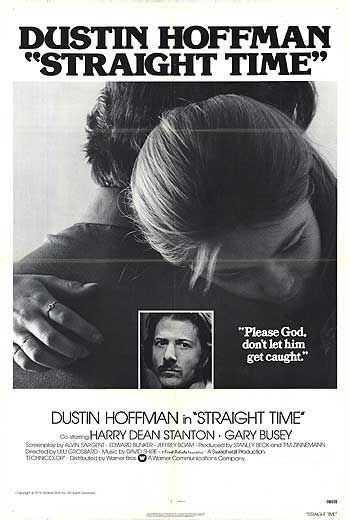
Straight Time 1978 Poster

Original poster for 1978’s “Straight Time”

The 1970s were a pretty successful time for Dustin Hoffman. After the critical and box office successes of “The Graduate” and “Midnight Cowboy” in the late 1960s, Hoffman’s career was in full flight, so by the late 1970s, he was on a torrid pace, starring in a string of films that are now viewed as modern classics such as “All The Presidents Men,” “Straw Dogs,” and “Lenny.”

So in 1978 after all of these hits, Hoffman could use his status to bring to the screen a personal project and try his hand at directing, so he subsequently purchased the film rights to the novel, “No Beast So Fierce,” about an ex-con trying to go “straight,” which was actually written by an ex-con, Edward Bunker. Bunker had initially written the manuscript while still serving time in San Quentin for theft and eventual the murder of another convict (he says he didn’t do it). After his release, Bunker would help write the screenplay for “Straight Time” with Alvin Sargent, Jeffrey Boam, and Nancy Dowd (uncredited), and to add even more authenticity, Hoffman would even give Edward Bunker a small acting part in the film.

The rumor then, which is now Hollywood legend, was that Hoffman was incredibly difficult to work with and that he had been known  as an insufferable perfectionist, a fact that Hoffman later exploited for comedic sake in 1983’s “Tootsie.” Yes, Hoffman was known to drive so many directors insane that it shouldn’t come as a surprise that he even fired himself as the director of “Straight Time,” because he felt that combining acting and directing was compromising his performance. Hoffman hated failure, so in a decade where he didn’t make too many missteps, he oddly decided to replace himself as the director of his own film with Ulu Grosbard, the celebrated Broadway director and the man behind Hoffman’s only universally accepted flop of his 70s career, 1971’s whiny, “A Star Is Born”  styled mess that was painfully entitled,  “Who Is Harry Kellerman and Why Is He Saying Those Terrible Things About Me?”

Though he repudiated his performance, Hoffman is excellent as Max Dembo, a career thief was has just been released after a six year prison sentence. His parole officer Earl (M. Emmet Walsh) hounds Max in a way that makes you believe that he has absolutely nothing else to do. No personal vendetta in place here, Earl is just exceedingly confident that Max is going to trip up soon and violate his own parole. This almost surrealistic, obsessive persecution seems to be a clear manifestation of Bunker’s own fear of going back inside prison.

As part of his parole, Max must find work and does so at an employment agency where he meets a young woman named Jenny (Theresa Russell) who he asks out, and they immediately become a thing.   Max punches the clock at his canning factory job and tries to keep it clean, but after Earl discovers some proof of the heroin that Max’s friend Willy (a pre-Buddy Holly Gary Busey) left in his room, Max is dragged back to jail for a parole violation.  Inside, Max’s blood is tested clean of dope, and he is released but soon realizes that he will never again be left alone and ditches Earl to go back to a life of thieving with his pal, Jerry (Harry Dean Stanton).

If you were reading the last two paragraphs correctly, you would have noticed that there is a ton of talent in the supporting cast in “Straight Time.” I even neglected to mention Academy Award winning actress “Kathy Bates” who has a small role here as well. Here in lies the major strength’s of this film, it’s casting. Hoffman may have been critical of his own talent, but his performance is desperate and strong, and it is his critical nature that may have truly saved this production as he really knew how to pick them. Though the dialog rings true in “Straight Time,” the story and direction are pretty standard, but it does provide a solid frame to showcase this collection of acting talent.

The official 1978 trailer to “Straight Time”

“Straight Time” opened in 1978 to mixed reviews and a weak box office, which makes me think that maybe Hoffman wasn’t the only one with standards that might have been a bit too high during that decade. “Straight Time” is not a masterpiece by any means but should be noted for its performances, which as I wrote earlier in this review are very fine. Sadly, Dustin Hoffman would not try his hand at directing for another thirty years until he made the elderly snorefest, “Quartet,” another trite old white folks film made for the Judy Dench crowd.  Hoffman doesn’t act in “Quartet,” which I guess corrects his earlier mistake of acting and directing at the same time, but I wished that he had at least tried to direct one more film during that charmed period when he held acting to such a high standard.

Homosexuality On American Television: 1972’s “That Certain Summer”

Standard
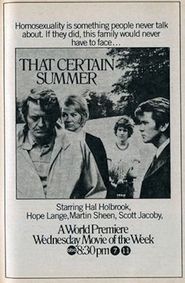
ThatCertainSummerAd

1972 Print Ad for “That Certain Summer”

Last week for this blog, I reviewed the excellent made-for-television version of “All Quiet On The Western Front” directed by Delbert Mann of “Marty” fame. During that review I reveled in the daring of the television films and mini-series of the 1970s, mostly concentrating on the choice of young directors who were tabbed at the time to make films for TV, such as Wes Craven, John Carpenter, and Toby Hooper. What I neglected to mention was the daring selection of topics that the networks chose during that time period, everything from drug abuse, to prostitution and yes, even the boy in the plastic bubble. Sadly, most of these topics were given the slightly heavier than ABC Afterschool Special treatment but every now and then one was handled properly, and that was the case with 1972’s “That Certain Summer” directed by Lamont Johnson.

Based on the novel by Burton Wohl, who also wrote the controversial, “A Cold Wind in August,” and “The China Syndrome,” “That Certain Summer” is the first American television movie to address homosexuality in a sympathetic way. The subject had received the big screen treatment in Hollywood to varying degrees of success in films like 1961’s “The Children’s Hour,” and 1967’s “The Fox” but it wasn’t until William Friedkin’s 1970 film, “The Boys In The Band,” that an American film showed homosexuals behaving in a less than psychotic way with no violent aftermath. Unfortunately “Boys In the Band” was not commercially successful, but due to its notoriety, it did bring the subject forward and allowed homosexuality to have a treatment for a more mainstream audience just two years later.

“That Certain Summer” is the story of Doug Salter, a divorced man who lives with his partner Gary in San Francisco. Doug’s son Nick, who resides in LA with his mother, is unaware of his father’s sexual preference, so when Nick plans to spend the summer with his dad, Doug asks Gary to move out so that their life together can stay a secret. Despite their best efforts, Nick finds out about Doug and Gary’s relationship, becomes upset and runs away, and eventually returns to his father who tries to help his son understand his sexuality, which isn’t all together successful. The handling of these moments for its era is done surprisingly well, and much of that success can be attributed to its choice of stars.

Playing Doug would be Hal Holbrook, who would soon become one of the busiest actors of the 1970s with roles in “Julia” and “All The President’s Men.” In 1972, Holbrook had only been in films for a few years and the general sentiment in Hollywood at the time was that any part playing a homosexual was career suicide. He initially turned down the role but eventually accepted the part because he felt a kinship to the main character of Doug, primarily due to the fact that he had recently separated from his wife but was unable to tell his young children about the split.

The actor selected to play his partner, Gary, was Martin Sheen, who like Holbrook had only been in films for a few years, so when presented with the possible negative reaction to playing a gay character he responded, “I’d robbed banks and kidnapped children and raped women and murdered people, you know, in any number of shows. Now I was going to play a gay guy and that was like considered a career ender. Oh, for Christ’s sake! What kind of culture do we live in?”

The film did not harm either of their careers as soon after “That Certain Summer,” Sheen would portray Kit Carruthers, the charismatic sociopath in Terrence Mallick’s masterpiece, “Badlands,” and just two years later he would work again with “That Certain Summer” director Lamont Johnson on another superb and controversial television movie, “The Execution of Private Slovik” about the only American solider to be executed for desertion in World War Two.  In 2007, Holbrook, after a long, varied career, would receive an Oscar nomination for Best Supporting Actor for “Into The Wild,” making him the oldest actor (at age 82) to get an Oscar nomination for a supporting role.

http://www.youtube.com/watch?v=-XEN_m3wf5o

As for “That Certain Summer,” after re-watching it after all these years, I will attest that it is a fairly tame handling of the material, but again it is always done tactfully and with great attention to small emotional moments by the film’s excellent leads. Sadly, it should also be noted that despite films like “That Certain Summer,” and “The Boys In The Band,” LGBT issues were not automatically given the respect that you would hope for in Hollywood, and unfortunately, for the rest of the decade, gay-themed but exploitative films like “A Different Story” were produced and released. Regardless, it is extraordinary that a film like “That Certain Summer” was greenlit for television in the early 1970s, and we should consider ourselves lucky to have seen such two distinguished actors take a chance by working on a film with such a volatile subject matter for its time.

The Director of “Marty” Boldly Adapts A Classic for Television: 1979’s “All Quiet On The Western Front”

Standard
All-Quiet-on-the-Western-Front DVD

All Quiet On The Western Front UK Blu Ray

Director Delbert Mann, who passed away in 2007, was one of those great pioneers of early dramatic television. Mann began his career in the late 1940s and saw success through the 1950s directing episodes of The Philco-Goodyear Television Playhouse, a weekly teleplay program of adapted classics and newer work that was being written by some of the best talents of the day such as Tad Mosel, David Shaw, and Paddy Chayefsky. In fact, Mann and Chayesfsky would team up in 1953 for the teleplay of “Marty,” the story of a lonely, unattractive, Brooklyn butcher who is desperate to find love. The original  teleplay version had a talented young actor named Rod Steiger in the titular role, but when a film version was to be adapted two years later they went with the more experienced actor, Ernest Borgnine, to play the hapless lead.  This choice in casting proved a good move, as the film was both a critical and commercial success, winning both the Academy Award for Best Picture and the Palm D’Or at Cannes in the same year, a feat that has only been done twice since in film history. Mann then spent most of the 1960s bizarrely making lighthearted and successful Hollywood bedroom comedies with Doris Day but would eventually return exclusively to directing television after his successful adaptation of Johanna Spyri’s “Heidi” in 1968.

In the 1970s, television movies and miniseries were a real cultural phenomenon as cinemas were losing out to the growing television audience. Blockbusters would eventually start to change this in the coming decades, but there was still a real audience for serious drama that could be watched at home.  First class Hollywood actors and directors were lured into making television movies and mini-series that drew incredible ratings such as: “The Autobiography of Miss Jane Pittman,” which starred Cicely Tyson, “The Execution of Private Slovik” which starred Martin Sheen and Ned Beatty and most notably the “Holocaust” mini-series which not only brought in A-list talent like Meryl Streep and James Woods but also raised the ante on the depiction of graphic violence on mainstream television. The brutal horrors of war shown in that NBC mini-series did not dissuade viewers from watching, so a year later in 1979, Mann embarked on a high budget television adaptation of the classic but brutal anti-war novel, “All Quiet On The Western Front” for CBS.

As in his days at The Philco-Goodyear Television Playhouse, Mann went with some bright young stars from television for his project, here in the form of Richard Thomas, the soft-voiced “John Boy” from the Waltons, he who would play the main character, “Paul Baumer,” from Erich Maria Remarque’s book. As a boy, I was a huge fan of The Waltons, so seeing Richard Thomas play anyone but John Boy was difficult for me but given that his character on The Waltons was a sensitive writer like Paul Baumer, for me it added to the sadness of what his character had to endure. For Paul Baumer’s mentor, Mann would also bring in his old friend from “Marty,” Ernest Borgnine, to play Stanislaus Katczinsky or Kat, the grizzled old hand who guides Paul through the grim reality of combat. Borgnine is excellent in this role and brings a real tough compassion to the character. Rounding out the cast would be the great actress of stage and screen, Patricia Neal, to play Paul’s dying mother and notable English actors, Sir Ian Holm, as the brutal yet cowardly sergeant “Himmelstoss” and Donald Pleasance, who gives an excellent portrayal of Kantorek, the school professor who fills the minds of Paul and his friends with thoughts of  German superiority and heroism. Even with such an excellent cast that had been assembled, the adaptation must have been somewhat daunting for Mann as the original filmed version of the book, directed by Lewis Milestone in 1930, had won Best Picture and was widely regarded as a masterpiece by most critics.

Truthfully, Mann did not stray too far from Milestone’s original vision as far as the narrative but being that this production was almost fifty years later, Mann did have the ability to increase the visual expression of violence which he does to the degree that is more in line with Remarque’s book. The first time we see the grotesque horrors of trench warfare in Mann’s version, we immediately understand the futility of this war in a way that Milestone could not depict in 1930. Though the violence in the 1979 version is extremely unpleasant, it is never gratuitous and is there solely to drive the point home of the Paul’s heartbreaking experiences as a soldier during the “war to end all wars.”

I should say here that in 1978 I was in the fifth grade and we were all forced to read “All Quiet On The Western Front” by my pseudo-hippie teacher Ms. Lombardi (I say pseudo-hippie because the Catholic school I went to would only allow so much peace and love), but the book hit me hard. A year later in 1979, Mann’s film would be the first time I would see a book I read be made into a film which brought me great excitement though I feared what I would see. It would be worse than I expected as Mann harshly depicts the tragic scenes that one can never forget, such as the key moment when Paul sorrowfully regrets the bayonetting a French soldier who he must then stay with during a shelling barrage, or the moment when a young recruit is fatally poisoned while trying to retrieve his helmet in a trench filled with mustard gas. Then there is the saddest moment of the film in my opinion, when Paul realizes that he has carried his wounded friend Kat to an aid station to only find out that his friend had been dead for some time. Mann and his cast do great justice to the book and even though the film won an Emmy, some critics argued the necessity of another filmed version of this book, but to be honest, there had been another World War, Korea, and Vietnam since the Milestone film in 1930 so I feel strongly that even though Mann’s version may not be as artful as the original, it was very necessary to make a more relevant version for my violence-numbed generation.

Mann’s “All Quiet On The Western Front” was edited down from 150 minutes to 129 minutes for a European theatrical release in 1979 and for a while that was the only version available on DVD.  Thankfully in 2009, a UK Blu-Ray was released of the film in its full 150 minute version so that you can see for yourself the masterful adaptation of great novel by one of the true talents from the golden age of television, the late Delbert Mann.

“Rolling Thunder” Director John Flynn Takes Robert Duvall on a Revenge Ride in 1973’s “The Outfit”

Standard

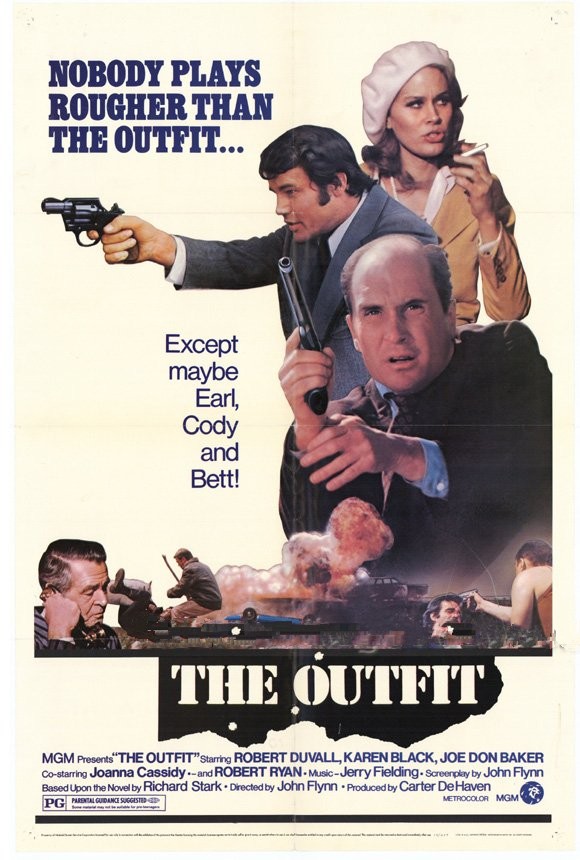
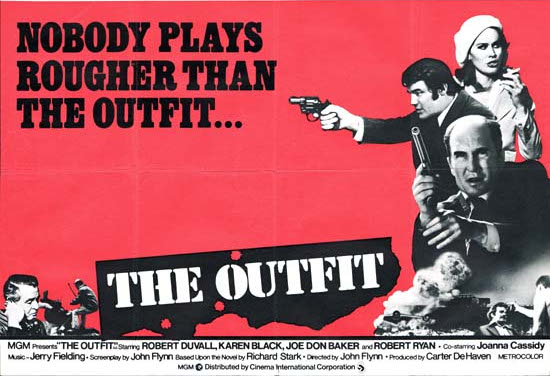
Theater poster for 1973’s “The Outfit”

In 1978, a year that saw the release of two very well-known post-Vietnam films, Michael Cimino’s “The Deer Hunter” and Hal Ashby’s “Coming Home,” there was a third film about Vietnam veterans that I loved much more than the aforementioned efforts, a truly nasty affair called “Rolling Thunder,” directed by a virtually unknown talent named John Flynn. Flynn had teamed up with screenwriters Paul Schrader and Haywood Gould to tell the story of a Vietnam POW named Charles Rane who returns home to even more grisly reception than any character in Cimino or Ashby’s post Vietnam films. Major Rane in “Rolling Thunder” seeks revenge after his family is murdered and recruits an old friend from his days as a POW to help him out. It is an unsentimental, ugly film that is punctuated by some of the most original and intense moments of violence seen in films of that era.

Five years earlier, John Flynn made his first revenge film, a brutal, unconventional action film called “The Outfit.” Written by Flynn and Donald Westlake (Point Blank, Payback), it is the story of ex-con Earl Macklin (played with superb quiet rage by Robert Duvall) who gets out of jail just after the titular “outfit” has murdered his brother Ed. It seems that the stint that Earl just did in jail was due to robbing a bank which was run by the “outfit,” and as payback, they have killed his brother who was also in on the job. Earl is pissed but doesn’t want blood from the outfit; he wants money, specifically $250,000, and he’s going to get it from the different illegal interests that the outfit controls, but he’s going to need help. In tow is his gal, Bett (the ethereally gorgeous Karen Black), who comes along for the ride and although she originally tries to betray Earl, Bett is sticking by his side because I guess because Earl needs someone to interpret his sullen grunts and erratic behavior. Earl also needs some muscle, so he pulls in his old pal Jack, who is played by everyone’s favorite 70s smiling southern goliath, Joe Don Baker. In fact 1973 was quite the banner year for Baker, having just starred in his biggest role as Sheriff Buford Pusser in “Walking Tall” and as another piece of nasty business, the hitman Molly in “Charley Varrick.”  Together they hit the road and try and to make revenge happen, one score at a time.

“The Outfit” progresses in the same way that many revenge and action films do, but it is the construction of the three main characters above along with the multitude of film noir veterans that Flynn populates this film with that really makes it watchable. These immensely talented actors bring so much to the smallest amount of screen time. Character actor Elisha Cook fills up a scene as does the great Jane Greer, who plays Earl’s grieving sister Alma. As for our Mr. Big, Mailer, Flynn went with an actor who spent an entire career playing villains and heavies, Robert Ryan. Mailer runs his empire with a dour, unhappy tone similar to that of our hero, Earl. Like Earl, he also is not too thrilled with his woman, and like Earl, he especially isn’t pleased about getting threatened. After Earl demands his appeasement in the form of 250 large, Mailer agrees to the amount, but then welches so you shouldn’t be surprised when Earl and Jack do not go away quietly. The welch happens in one of the most interesting action scenes in the film, which takes place in a homeless shelter. As the deal goes awry, a fire alarm is pulled, and a sea of homeless men, firemen, and thugs flood the street as Earl and Jack make their escape. It is that scene and the many shakedowns that Earl and Jack perform that highlight Flynn’s unique directing style in this genre. The action is never too slick; Jack and Earl are not flying out windows on jetpacks here, nor are they comical as they dole out violence, and there are some dialog inconsistencies for these brooding, silent characters, but all in all they say what needs to be said and not much more. They are professional and do what they have to do in get the job done. There is a large amount of violence in the film, but it is rarely gratuitous, as in one early scene when Earl blows the hand off of a member of the outfit for burning his woman Bett with a cigarette.  Though shocking, I think that goes far in setting up that character’s limit for vengeful acts.

Official trailer for 1973’s “The Outfit” 


Though “The Outfit” tips its hat to film noir with some of the characters, the primary structure is that of action and to be more specific, a 70s buddy film. As with many 1970s buddy films, the women are not femme fatales, but they also only get to hang in the background for most of what happens during the course of this film.  Though Bett is a fully flushed out character, she doesn’t get into the action that often and is curiously absent from a few key scenes. This is something that Flynn definitely would improve on with in his later film, “Rolling Thunder,” with his character named Linda, a gun-toting Texas woman who does a lot more than just tag along. Unlike the films of the early 1970s, women’s liberation was in full effect by the late 1978, even in male dominated action films, so Linda can thus be a fairly tough customer. Given that “The Outfit” was shot in 1973, Bett does get to plow into some bad guys with the car, but otherwise, she seems there to just provide a voice of reason and in one brutal scene, she even becomes a punching bag for Earl. Like Flynn’s “Rolling Thunder,” “The Outfit” is completely unapologetic about its male character’s actions. These are tough, insensitive men who almost seem anachronistic even for 70s film standards, which should make this an uncomfortable watch for a lot of folks.

If you’re me, when you think of early 70s manly films about revenge, you almost immediately think of Mike Hodges superb 1971 British gangster film “Get Carter.” And although “The Outfit” is not as tightly woven together as “Get Carter,” it does have the same caustic intensity and shocking violence of Hodges’ film and is well worth your time for nothing else if only to see a solid performance from the always brilliant Robert Duvall in the middle of two major films: the career-making Godfather and the nifty Conversation.

John, Paul, George, Ringo and ADOLF!: 1976’s “All This and World War Two”

Standard

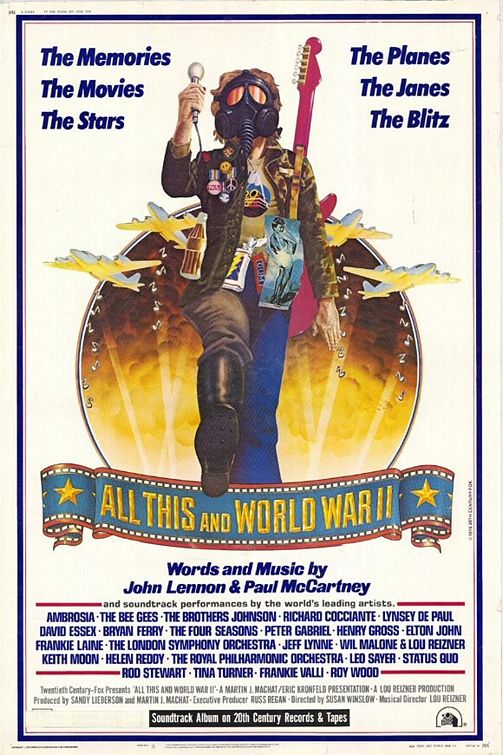
The 1976 Poster for “All This and World War II”

Film scholars seem to always look back at the 1970s as that glorious time when the studio system fell, and the freaks took over the asylum. In fact, it was this kind of, “just let the inmates do what they want,” attitude that gave us masterpieces like “Easy Rider” and “Mean Streets,” but it also gave us films that make one wonder if the entire hospital administration just ran away.  I imagine the pitch that Russ Regan, the president of 20th Century Fox Records, gave to the empty board roam went as such, “So, everyone loves the Beatles right?  And it is the bicentennial, right? And everyone is super patriotic right now, so why not get clips of old Twentieth Century films and newsreel footage from World War Two and lets glue it all together and make a hit that won’t cost a ton of money?…right?”

The first problem, besides the concept of the film, was the reality that many filmmakers discover when trying to acquire original versions of Beatles songs: the cost. The 2010 Steve Carrel comedy “Dinner for Schmucks” paid out 1.5 million dollars for the use of the Beatles “Fool on the Hill,” and if you are talking about an 86 minute long movie that is comprised of nothing but Beatles songs, well even in 1976 dollars I doubt that they could’ve done all this with a total budget of just 1.3 million. Immediately, producers scrapped the idea of Beatles performing the songs, and instead convinced many of the 70s top musical stars such as Elton John, Tina Turner, Rod Stewart, and (gulp) Helen Reddy to record versions of the Beatles classics. This may have been the only intelligent production move because the soundtrack eventually made more money than the film, a phenomenon which had happened before with Gordon Parks, Jr.’s 1972 Curtis Mayfield scored blaxpolitation film, “Superfly.”

Helming this mess would be first time director, Susan Winslow, who had just worked as a researcher on the 1975 Phillip Mora documentary, “Brother Can You Spare a Dime,” which also blended newsreel footage and film clips in a nostalgic and satirical way, that time about the great depression.  I guess that subject wasn’t dour enough for film audiences, so let’s turn to everyone’s favorite war for some smiles and a gentile poke in the ribs.

The film opens with Germany preparing for war, manufacturing munitions and mounting Panzer tanks as the smooth rock sounds of Southern California’s Ambrosia performs “Magical Mystery Tour” in the background.  At one key point, “Load up for the mystery tour” is sung while solider loads his rifle…yikes.    Though this sounds like a bad idea, and it is, it pales in comparison to the musical/visual matchups that later follow in this film. I would suppose that the overarching peace sentiment of the film was due to our withdrawal from Vietnam a year earlier in 1975, but there are just too many scenes coupled together that I feel are supposed to make you get a tad happy about our involvement in the big show. For example, I assume Hitler is played off as a bad guy here as “Fool on the Hill” is added during newsreel footage of Adolf gazing out from his mountain home above Berchtesgaden, but why is “Maxwell’s Silver Hammer” being played as Americans line up at the recruitment office?  There are a lot of contradictory moments in this film that seem to come out of a need to play some of the songs that had been recorded as opposed to writing songs based on the footage that was to be used.  By the time you get to Elton John performing “Lucy In The Sky With Diamonds,” while allied planes get ready to bomb Germany, you know that we are not dealing with surrealism here but a truly deranged mess of a movie that has no central idea.

If the horrors of war were to be contrasted against genuine human suffering for the sake of comedic irony, then why aren’t we seeing actual human suffering in the film?  With the notable exception of Japanese Americans being taken to internment camps (with The Brothers Johnson performing “Hey Jude” in the background?), you never actually see a person in peril or pain, so what you are left with is a bunch of fair to poor Beatles covers and a poor excuse for an anti-war work of art that does not even have the courage to make the audience endure true suffering to complete the satire.

The Kids Are Not All Right: The Political 1978 Spanish Horror Film, “Who Can Kill A Child?”

Standard

The 1978 Spanish Poster for “Who Can Kill A Child?”

The politics of “Quién puede matar a un niño?” (“Who Can Kill A Child” released in the US as “Island of the Damned) director Narciso Ibáñez Serrador become very clear only five minutes into the film; a heavy handed montage of real atrocities against children from World War Two to Vietnam to the famine in 1970s Central Africa that sets up the premise of this flawed but unique horror film.

Based on ideas from the then unwritten novel, “El juego de los niños” (Juvenile Game) by science fiction writer, Juan José Plans, “Who Can Kill A Child” follows the tradition of many zombie films in that it has a group of infected humans who begin to exhibit some traits of murderous behavior. It also draws from the tradition of the haunted house film but uses an island as its particular chamber of horrors. But what truly separates this film from its predecessors in those genres is that its subjects and its choice of scenery appear more normal than one could imagine before everything invariably turns to hell.   Expertly shot by a young José Luis Alcaine, who would become the cinematographer of choice for Pedro Almodovar and Bigas Luna, this film has the visual aesthetics of an idyllic day trip to a Spanish resort island where everything appears, but firmly places the idea in the mind of the viewer, that the eventual dystopia could happen anywhere.

The plot involves two English tourists, Tom, a biologist, and Evelyn his wife, who are vacationing through Spain before the birth of their third child. They spend a festive day in a coastal town but are blissfully ignorant of the fact that bodies from a nearby island they plan on visiting the next day are washing up on the shores of their vacation spot. After reading a headline of war, there is some small talk from the clerk in the photography shop of how “children are always ignored victims of war and famine,” but the couple feign their concern and go on their way. The next day Tom and Evelyn rent a small rickety boat and travel alone to Almanzora, an island four hours off the coast, for some peace and quiet. I get that they are ignorant, but really who does this with their six-month pregnant wife anyway? After their midday arrival, they begin to notice that the town is fairly deserted except for some exceptionally adorable children, which draws some concern. Soon after finding refuge in an empty bar, the couple witnesses the lone adult they encounter viciously and gleefully beaten with his own cane by one of the children. They now begin to understand that things are not well in this “village of the damned.”

Given that we are now dealing with a group of evil children doing unnaturally bad things, I have to address the difference between the inceptions of the behavior of the little assassins of the John Wyndham novel from 1957, “Village of The Damned” and “Who Can Kill a Child.” In “Village of The Damned,” it is made clear that a specific military incident produced the unnatural evil effects of the children, but in “Who Can Kill A Child,” we are led to believe by his use of the aforementioned montage of grotesque documentary footage that opens the film, that Serrador wants you to believe that these concerted attacks by the damned children are an almost evolutionary product of generations of child-killing by adults who show no concern for their well being.   In fact, in the novel “Juvenile Games”, Plans, uses the military spraying of a yellow dust as the agent of behavioral change but Serrador admits in a 2007 interview that “this was not necessary to show that children as a race needed to become more active in their fate without the use of a chemical.”

http://www.youtube.com/watch?v=KIBd-DmzUp8

The unique horror that eventually ensues in the Serrador film comes from contrast of the innocence and beauty that is evident in the children’s faces and their picturesque town against the vile actions that the children mob performs. Almost all of the violence, with the exception of one notable scene, occurs during the day, which jolts the viewer differently than most horror films do in that genre because you normally cringe as you wait for the fall of darkness, which despite building some tension also prepares you for the eventual shock as opposed to here where the horror can come at any moment. Our protagonists, Tom and Evelyn are chased through the town during broad daylight by a horde of blood-thirsty Brady Bunch looking maniacs, but through the use of close-ups that show their playful indifference, the horror really hits home. And in a truly brilliant turn, you even begin to fear the one child you do not see, the one that is growing inside of Evelyn.

The key to this film is that once Tom finds a gun, the question arises; Even if warranted, “could you kill these adorable children if you could see their faces?” or “is wartime death of children a necessity that people have gotten used to after thousands of years of war and famine?” These are the political questions that Serrador presents to the viewer, and he does so pretentiously but is very successful by utilizing the genre of horror to carry this message.

Serrador later stated that if he had to make this film over again, he would’ve put the documentary montage at the end instead of the beginning, so that the violence that the children exact on Tom and Evelyn would almost seem justified after thousands of years of violence that adults have reaped on children. Again a heavy handed way to end a film, but given that this was made just two years after the death of Franco, it would mark the beginning of many Spanish films that would ask similarly hard questions about the true casualties of war.