The Writers of American Graffiti Direct a Lovecraftian Giallo: 1973’s “Messiah of Evil”

Standard

messiahofevil poster

Give credit where credit is due, husband and wife team, Willard Huyck and Gloria Katz, wrote two of the most entertaining films of their generation, George Lucas’ American Graffiti and Steven Spielberg’s “Indiana Jones and The Temple of Doom”. Now, let’s step back a second and immediately take some credit away from them, as they also wrote and directed the disastrous “Howard The Duck” and “Best Defense”, the 1984 “comedy” that almost singlehandedly destroyed Eddie Murphy’s career before it started.   Now that we have established that you have two very talented people who occasionally make some serious errors in judgment, let’s get to their only horror film, a film that despite having some shortcomings, is a surprisingly brilliant surrealistic horror film, Messiah Of Evil.

“Messiah” opens intensely with a frightened man running down the street, we aren’t sure who or what he is running from, suddenly the running man is rescued by an innocent-looking young girl who allows him into her backyard. As the man collapses from exhaustion, the girl of course leans over and unemotionally slices his throat. After watching “Messiah of Evil”, I came to learn that the dead man is another iconic American director of the 1970s, Walter Hill, a friend of Gloria and Willard’s, who was also pretty busy in 1973, having just written John Huston’s “The MacIntosh Man.” Why kill Walter so early? Maybe Katz and Huyck saw into the future and wanted to stop Hill before he made “Another 48 Hours”.

After setting the tone of the film with such an opening scene, you are hammered with the sight of an over lit long hall, where the film’s protagonist, the ethereally beautiful, Arletty (Marianna Hill) is wandering in an almost dreamlike state.   After a fairly horrific stop at a cadaver filled gas station (just a bit worse than an average South Jersey rest stop) Arletty soon makes her way to coastal town of Point Dune, California to visit her painter/father but instead finds just his empty, eerie home that is complete with pop-art murals of straight ahead suited people. She also finds her father’s diary but only reads enough to realize that dad doesn’t want his little girl trying to find him. So now if that piece of information mixed with the opening scenes hasn’t tipped you off yet, things in Point Dune are not too Norman Rockwell.

The Awesomely Intense Trailer For “Messiah”

To make matters infinitely more scary, Arletty meets a sort of now-era sophisto named Thom (a stoic Michael Greer) and his two groupies/traveling companions, the savagely hip 70s sexy Toni (Joy Bang) and Laura (Anitra Ford) who are interviewing the clairvoyant hobo, Charlie (sure, every town has one, they just don’t care to interview them) about the upcoming weirdness involving the centennial return of “the dark stranger,” who will inspire the town into a murderous frenzy. Charlie also warns Arletty about her father who has become one of the town’s crazies (I use the word “crazies” as they act the closest to the villains of the same-named Romero film.) All this weirdness gets to Toni and Laura, and they split the company of the well-coifed Thom to only meet with some really well filmed giallo-style ends. I must say that these scenes are the visual horror gems of the film; sensational buildups to a stark zombie-like finishes. I say “zombie-like” because I feel that our ghouls are more vampire than zombie but their ends look like the work of cannibalistic consumption. OK, too geeky, the point is, they’re dead. Of course, the “stranger,” (or possibly the titled “messiah,” were not sure here) a kind of H.P. Lovecraftesque demonic minister from the days of the Donner Party, has now returned and yes, all hell has broken loose. The police arrive and fire at the crowd of ghouls but fail in stopping the onslaught. The stranger/messiah/vampire/zombie bites Thom, so Thom and Arletty finally do the right thing and split for the coast.

Without giving away the ending of the film, what does transpire is left to the viewers interpretation. Did this actually happen and the trauma broke Arletty so badly that she ended up in a sanitarium? Or, is this entire film the creation of a woman whose mind has decayed while in a sanitarium?   And what was the political statement that Katz and Huyck are making here?   The one thing that Romero, the father of the modern zombie has taught us is that zombies show up hungry, they are also showing up with a defined political agenda. We know that the older well-suited, square ghouls in “Messiah” have recruited Arletty’s failed artist father to their ranks, but they only seem to be hungry to eat the hip, young people; Thom, Arletty, Toni, and Laura. Was this a post-hippie statement that the establishment was coming after the remains of the Love Generation?

Though I am not sure of its underlying purpose, what I am sure about is that “Messiah of Evil” remains as one of the few real giallo-inspired films produced in the U.S. from that time. A film that purposely does not contain an ounce of humor, and is unrelenting in its grim tone, a rarity for its time.   It is also a testament to writer/directors Katz and Huyck, who in 1973 could simultaneously fill our hearts with joy, giving us the iconic California film, “American Graffiti”, and at the same time give us a very different trip to California with “Messiah of Evil”.

1979’s “That Sinking Feeling”: The Very Charming and Overlooked First Film Of Director Bill Forsyth

Standard

By 1984, Scottish director Bill Forsyth was getting quite a bit of notice here in the States. His second film released here in 1981, was a painfully funny and sweet coming of age story called “Gregory’s Girl,” which achieved critical, if not commercial success. Local Hero, his second film, and an art house favorite from 1983 starring Burt Lancaster, remains one of the classic quirky, dry comedies of that decade.   So, in 1984, I, like so many other fans of his work were wondering…What was Bill Forsyth’s debut film like? Much to my delight, a limited release of “That Sinking Feeling” premiered in Philadelphia in 1984 at Sansom Street’s Roxy Theater, which meant I immediately had to go see it after school that Friday.

“That Sinking Feeling” begins with the tagline, “The action of this film takes place in a fictitious town called Glasgow. Any resemblance to any real city called Glasgow is purely coincidental.” Truly, Glasgow seems a dreary, sad place in the late 1970s or at least the “Glasgow” depicted by our Mr. Forsyth, as our hero Ronnie (played by Robert Buchanan who would later portray Gregory’s close friend in Gregory’s Girl) is quite down about his inhabitance of this particular “Glasgow.” So much so, that he tries to commit suicide by drowning himself (with a bowl of cornflakes of course) which after he fails in achieving that small task, propels him into the idea that there might be another way out.   He proposes to his friends Vic and Wal the idea of a burglary involving the theft of many stainless steel sinks to bring in much needed cash. They are so broke that even the paltry sum of 45 pence for a burger and coffee seem galaxies out of their grasp.

BFI Trailer for “That Sinking Feeling”

In the formation of their master plan is the gathering of their crew, most specifically their friend Bobby, who will make a drug that will allow them to obtain a vehicle for their crime and a little boy called the “Wee Man.” The plot saunters forward with the usual quirky pace of any Forsyth film, allowing you to pick up the odd character or two with the plot almost becoming secondary to the small moments that Forsyth does so brilliantly in later films. The red jogger who comes through scene after scene without any backstory or explanation is reminiscent of the phantom dirt bike racer in “Local Hero” who seems to appear just to remind the viewer that there is a reality of some sort existing outside of Forsyth’s lackadaisical but always entertaining plot.

As the film progresses, we do not see a Bressonian attention to criminal techniques, what we do see is a dozen or so maneuvers that will have you have you laughing sideways. From Bobby’s over doping of a bakery truck driver, to Vic, who gets into drag every night to sexually lure the night watchman into distraction. You won’t go more than a few minutes in “That Sinking Feeling” without a moment of pure Forsyth silly invention made real by his clever actors, who were selected directly from the Glasgow Youth Theater and who would be again be thrust into service in “Gregory’s Girl.”

That Sinking Feeling Poster

Though only given a small release back in 1984, one has to wonder if a young Wes Anderson had watched this film as he was writing “Bottle Rocket,” Wes’s debut film. “Bottle Rocket” is also the story of a group of hapless, lost young people who are using crime as a means of escape. Though “That Sinking Feeling’s” Ronnie, Vic, and Wal kind of need the money a bit more than just something to give them an identity, it still means a same outcome in terms of a good laugh at a group of likable boys who are trying to escape their youth by going for whatever they can steal.

Forsyth himself would revisit this theme of youthful clueless thievery in his hysterical, and also overlooked, 1989 film “Breaking In,” his next to last American film and one that contains an Oscar-worthy performance from Burt Reynolds and a punchy script co-written by Forsyth and John Sayles.  I so wish Forsyth had continued making crime films, because as perhaps, as his character Eddie suggests to his young cohort in “Breaking In”,…“You may have some larceny in your blood, kid.”

Sergio Leone Pulls The Strings, Damiano Damiani Take The Fall: The Fiasco That Is “A Genius, Two Partners, and a Dupe”

Standard

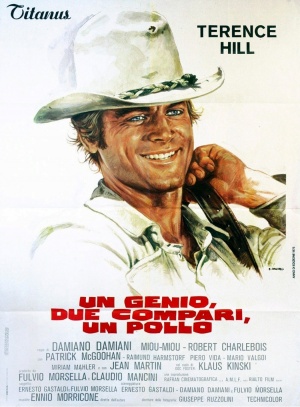
In a strange follow up to last week’s review of Bertrand Blier’s “Calmos,” is the Blier inspired 1975 spaghetti western, “A Genius, Two Partners, and a Dupe” (Un Genio, due Comparu, un Pollo) directed by Damiano Damiani by way of Sergio Leone. Leone had been an admirer of Blier’s awkward sex comedy “Les Valsuses” and was determined to make a western based on its themes. Leone had just also come off the success of the comedic “My Name Is Nobody” (ghost directed by Tonino Valerii) and was interested in making a sequel but with more of a Blier touch. Here enters Damiani, a serious political auteur (director of the superb “Quien Sabe” in 1966) who wasn’t going to be down with the endless slapstick and fart jokes of a “My Name Is Nobody”, and Terence Hill (Mario Girotti), the star of “My Name Is Nobody” who was not OK with the awkward sexuality of “Les Valsuses.” According to Alex Cox, director of “Repo Man” and the writer of the superb book “10,000 Ways To Die”, Leone then decided that this sequel to “Nobody” was going to be his take on George Roy Hill’s con film, “The Sting.”

A clip from “A Genius, Two Partners, and a Dupe”

The comedic plot centers on “The Genius,” Joe Thanks (Terence Hill), and his friends “The Partners,” Lucy (Miou Miou from Les Valsuses) and Steam Train (Robert Charlebois), who concoct a plan to steal $300,000 that belongs to the Navajo but is currently controlled by Colonel Pembroke (Patrick MacGooghan, yep from BBC’s The Prisoner). Damiani had never directed comedy and would further undermine Leone’s comedic intentions by bringing in the all too serious MacGooghan, and everyone’s favorite spaghetti western heavy and total psychopath, Klaus Kinski. My first issue after an hour of watching the film was that I wasn’t sure as to whom the “genius” actually was, as three of the main set of characters was called “a genius” on several occasions. I did find myself laughing at some of the setups and dialog but the script from Ernesto Gastaldi, who wrote “A Genius” as either a political film or slapstick comedy, becomes neither comfortably.  For example, “A Genius” tries to make statements on racism that fall flat and even play into racial stereotypes that kills comedic moments. Lastly, the film’s score, done by the brilliant Ennio Morricone, is very jovial and fits the mood of what could be a comedy, but there is only so much merriment that his talent can add.

I will hold back on condemning the acting and visuals because the original negative to “A Genius” was stolen, along with Pasolini’s “Salo” and Fellini’s “Casanova,” and held for ransom. Producer Fulvio Morsella refused to negotiate with the thieves and thus a version of the film was cut together using outtakes (gulp). This goes beyond a small problem, so I will be kind about performances, which go from Hill’s usually solid, cute, and charming characterization of “Joe Thanks” to Robert Charlebois’ almost bored portrayal of “Steam Train” to Miou Miou’s “Lucy” who offers the viewer little more than her adorable face and constantly radiating smile. The visuals unfortunately suffer even more, as there are what looked like an overabundance of 2nd camera wide shots, many of which are usually washed out and tough to watch.

Being that “A Genius” was labeled as a sequel to the very successful “My Name Is Nobody,” the film did well on its European release despite being hammered by critics but was not successful here in the U.S. Leone claimed to have never directed a scene (though photographic evidence of him and Damiani on set exists) and that means that the failure of “A Genius” was stuck on Damiani, who passed away in 2013 at the age of 90. So, for those of you who are completists like I am and just need to see everything that Leone ever touched that is a western, do watch “A Genius, Two Partners, And a Dupe.” Though almost two hours, you’ll still get a few laughs out of it. For the ladies, Terence Hill is pretty handsome, and for the gents, Miou Miou is nothing to sneeze at, but most of all, you’ll be reminded that even the greats can misstep every now and then.

Hell, here’s the whole film.  I don’t think that Leone’s going to miss it.

Hang Gliding Into A Giant Vagina! Bertrand Blier’s Lost 1976 film, “Calmos”

Standard

I was 21 when I saw my first Bertrand Blier film, “Too Beautiful for You” (Trop belle pour toi) at the Ritz Theater in downtown Philadelphia, one of the city’s few sophisticated art house cinemas in the late 80s.  I hadn’t seen anything quite like it, the story of a successful car dealer (played by Blier regular Gerard Depardieu) who rejects the love of his beautiful wife to have an affair with his frumpy middle-aged secretary.  Its almost surrealistic dialog and narrative construction were actually shocking to me and even more shocking to some of the audience, who walked out during a now notorious dinner scene.  At the time, I assumed that the scene in question was a bit too “sophisticated” for the audience, but as this film sparked an obsession with Bertrand Blier that forced me to watch his oeuvre, I eventually came to realize that “sophistication” was not a concern for this director.

Most audiences in the States first saw Blier when his second film was released here in 1974, the thrillingly audacious “Going Places” (Les Valseuses) , which garnered great, if not horrified reviews and turned its three leads, Gerard Depardieu, Patrick Dewaere, and Miou Miou into international stars.  The story follows two hippies/Visigoths who screw just about everything they find in the French countryside (and even each other when no one else is around) until they get a clue that women possibly want something more than a play by play commentary during a ménage à trois, or to get paid to be nuzzled on a train.  It’s upsetting and hysterical but miraculously ends as an almost tender film.  Yep, Blier managed to pull that off.

I saw “Les Valseuses” shortly after “Trop Belle Pour Toi” on video and was floored, so naturally I wanted to see what Blier came up with next, which was not easy.  I would eventually discover that his next effort was a much maligned 1976 film called “Femme Fatales” (Calmos).   But being that this search began in 1989, and “searching” meant more than typing a few words into IMDB, I was left with just film guides and microfiche to hunt for more information on this film that was not available in any media format.  Even Montreal’s excellent Francophile video store” La Boite Noire” could not track it down for me.  In fact, as I write this, there has yet to be an English subtitled release for “Calmos” on VHS or DVD.   And here’s why…

“Calmos” (written by Blier and Philippe Dumarçay, who also co-wrote Going Places) is basically “Les Valseuses” in reverse.    Here we have two middle-aged men, Paul (a bored gynecologist played by Jean-Pierre Marielle) and Albert (an almost eerily successful pimp portrayed by Jean Rochefort) who flee the city and the female gender only to be hunted down by their wives, and virtual army of horny, militant women who crave only the power of their middle-aged libidos.    At first, I enjoyed Paul and Albert’s transition from their “normal” lives into this misogynistic nightmare.  It’s what you would you expect from Blier: the absurdly entertaining bawdiness, mixed with terse moments of dizzying hate that expose the protagonists’ shortcomings with the opposite sex.  Unfortunately, as we get deeper and deeper into a dizzying comical surrealism that would make even Luis Buñuel cringe, the ideas play out as audacity for audacity’s sake, and even the brilliance of our heroes landing into a soon-to-be penetrated giant vagina cannot save “Calmos”.  (if you don’t believe me, look at the clip below)

Not surprisingly, “Calmos” was not well received both critically and commercially, but two years later in 1978, Blier would receive accolades with, “Get Out Your Hankerchiefs” (Préparez vos mouchoirs), by again reworking some of the ideas of “Going Places” . It was awarded “Best Film” by the National Society of Film Critics here in the U.S., and the Academy gave it the most ill-advised Best Foreign Film Oscar in 1979.

Blier, much to my delight, would finally move away from the scenario of “Les Valseuses” for his next three films, 1979’s Cold Cuts (Buffet Froid), 1981’s “My Father” (Beau Pere) and 1983’s “My Best Friend’s Girl (La Femme de mon pote) which truthfully also crudely play with our ideas of sexuality and normal relationships, but they have an almost, dare I say “restraint”?  Or at least, restraint in Bertrand Blier terms anyway.

Blier, now 75, won a Cesar (France’s equivalent to the Academy Award) in 2011 for his last film, “The Clink of Ice”.