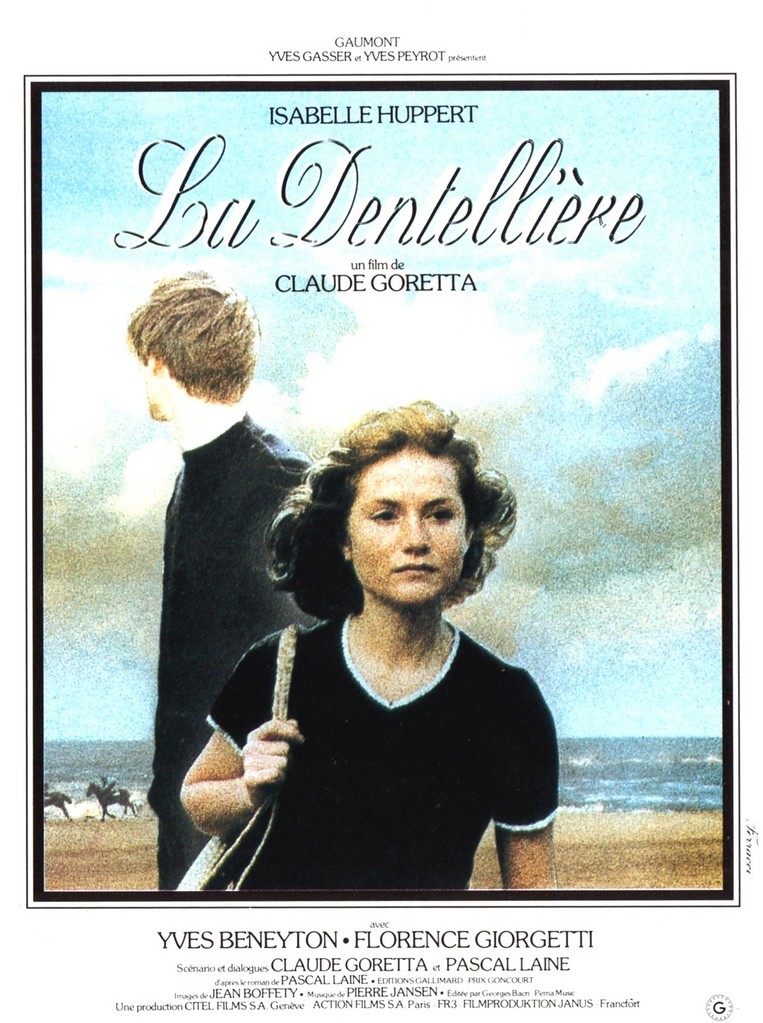
Isabelle Huppert Quietly Triumphs In Claude Goretta’s 1977 Masterpiece “The Lacemaker”

Standard
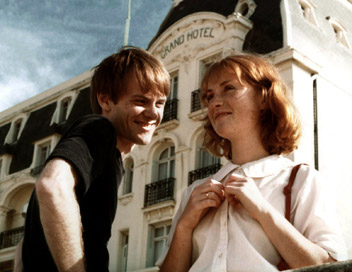
Yves Beneyton, Isabelle Huppert

Actors Yves Beneyton and Isabelle Huppert


He will have passed by her, right by her without really noticing her, because she was one who gives no clues, who has to be questioned patiently, one of those difficult to fathom. Long ago, a painter would have made her the subject of a genre painting…

Seamstress

Water girl

Lacemaker

The lines above roll up screen at the end of Claude Goretta’s 1977 film, “The Lacemaker” and are there to sum up Beatrice, a naturally beautiful and shy young woman in a Parisian hair salon where she works as the shampoo girl and occasionally sweeps up the clipped hair. Beatrice lives with her mother, a lovely middle-aged woman who, like her daughter, lives a quiet, unassuming life without apparent joy or anger. Though Beatrice’s dad left them both when Beatrice was still a small child, both mother and daughter go through their days appearing content and relatively unfazed by everyone and everything around them. This setup is similar to that of his previous film from 1974, “The Wonderful Crook,” where Goretta creates an almost too peaceful environment before showing the small cracks in the armor of his characters and their surroundings. With “The Lacemaker,” Goretta has shifted from the pastoral French countryside to an almost overly serene Paris where our protagonist will soon be faced with options for her life, which to this point could be the life of a thirteen year old and not a young woman.

In an early scene, we see Beatrice at the apartment of the comely Marylene (Florence Giorgetti), Beatrice’s closest friend at the salon. Beatrice watches Marylene’s world come apart as she achingly ends her three year relationship with a married man over the phone. Marylene, overwhelmed with grief, threatens suicide via her apartment window, but, instead, she opts to toss out the over sized teddy bear gifted to her from her lover, serving as a comedic sacrifice that establishes Marylene’s flighty character. Still sour over getting dumped, Marylene drags Beatrice for company to the French coastal town of Calbourg during the off season to help get over her ex lover. Once in the sleepy town, the women immediately go to their hotel room, where they listen to the couple next door in mid-coitus, which seems to only mildly embarrass Beatrice and somewhat turn Marylene on to the point that she asks Beatrice to turn down the radio. Goretta leaves Marylene’s sexuality as somewhat ambiguous as she seems to have a somewhat romantic bend towards her friend, but it becomes very clear that the chaste Beatrice has no desire to be outwardly amorous with anyone. After a couple of trips to the local discotheque where Beatrice refuses to dance with male suitors, Marylene hooks up with an American man and abandons Beatrice for the remainder of their vacation, which again does not effect Beatrice in the slightest. Here, one begins to wonder, if anything will make Beatrice finally react positively or negatively. The only pleasure that Beatrice indulges in is chocolate ice cream, which she eats alone until she meets Francois (Yves Beneyton), an awkward, scrawny and slightly older literature student who awkwardly engages Beatrice in conversation. The pair do not exchange contact information, but in one of the best scenes in the early part of the film, they each spend the entire next afternoon trying hard to casually meet again, which they do. With Marylene nowhere to be found, Beatrice and Francois spend every day together, and after Francois proposes they spend the night together, Beatrice, as she does with everything proposed to her, goes along with it, and they becomes a couple.

Once back in Paris, Beatrice and Francois find an apartment together, and after a brief conversation with Beatrice’s mother which ends with “as long as she is happy,” the young couple are off to start a life together in a modest (tiny) Parisian apartment. I need to establish something that I think is key before this world comes crashing down: Director Goretta shows in more than a few scenes that the couple are actually in love; although it is never said, Francois is at times overwhelmed with affection for his woman. I believe that this moment is key as the conflict that will soon arise from Francois’ rapid growth as a budding pseudo-intellectual university student will cause doubt in his mind as to the adaptability of his new found love. When a colleague of Francois’ arrives before Beatrice gets home from work, Francois begins to describe her to his friend in the same way that a teacher would talk about a elementary school student rather than a fully formed adult in regards to potential. You begin to believe at this point that Goretta may begin to make an overarching statement about the anti-humanist tendencies of academics, but it doesn’t go in that direction as Francois’ intellectual friends appreciate Beatrice for who she is and believe that she is good for Francois, who seems to be regarded by them as emotionally closed. You might also believe that this is a setup for demonizing the character of Francois, but that is not Goretta’s intention either, nor is it his intention to paint Beatrice as a dolt. They are both portrayed sympathetically, but their conflict as a couple becomes more a question of being content with one’s own persona. Simply put… Beatrice is content with her passive existence, and Francois, who clearly loves Beatrice, is not content with any of his roles of his own life, as a son, a boyfriend, or as an academic and projects his insecurities onto Beatrice.

As I stated in an earlier review of Goretta’s “The Wonderful Thief,” the Swiss-born Goretta does not simply attack class as Luis Buñuel would in “Diary Of A Chambermaid,” for example. Though Goretta and his writing partner Pascal Lainé on “The Lacemaker” initially create characters who have simple desires, they also create an environment that exposes the smallest discrepancies in those characters, which allows their transformations to occur naturally if you notice their faults. Such is the case when Francois invites Beatrice for dinner at his parents home. Goretta takes painstaking efforts setting this scene up for the viewer. Francois’ family home, once stately, is now rundown. His parents have a servant, as any good upper middle class family would, but she acts more familiar with her employers, further indicating that the days of their historically held wealth are most likely in the past. Francois’ fear (or perhaps hope) that his parents will reject Beatrice are unfounded as his father takes an immediate liking to Beatrice, whereas Francois’ mother is colder but not condemning of his relationship in any way. Again, there is not a class war happening here, since the only person who is unhappy with Beatrice, is Francois, because he is not happy with anything about himself.

Original Trailer (no English subtitles, sorry!)

Goretta leaves nothing to chance with “The Lacemaker” in selecting every facet of his character’s world, and just as he did with The Wonderful Crook”, Goretta formulates early pleasant scenes to allow you to calmly gather your feelings towards his protagonists before leading you to a tragic ending when you suffer with all involved. Once the screen fades to black and the statement that I posted at the beginning of this article appears in front of you, it is painfully clear that the beauty that Francois wants to posses in Beatrice has always been in demand for many generations and that perhaps the beauty comes with a passivity that you must allow to continue for the beauty to stay intact.
Comikaze Spotlight: Kel McDonald and Jose Pimienta’s From Scratch

Standard

On the far edge of the exhibition booths with towers of toys, old and new comics, and any other merchandise tied to pop culture of the past and present you could imagine, Stan Lee’s Comikaze’s Artist Alley stood in modest rows. As per our usual approach to any comic con, we first focused our attention on this section looking for independent work and new experiments in the comicbook form (based on Stan Lee’s introduction to the extended weekend celebration of comics and pop culture, he insisted that “comic books” should be “comicbooks,” and in honor of that, I’ll stick to the nomenclature he prefers). After winding through the tables and passing by plenty of illustrators who were selling prints, we stopped at Jose Pimienta’s table, lured in by copies of The Leg, which he illustrated (and I reviewed in the past), sitting at the edge of the table.

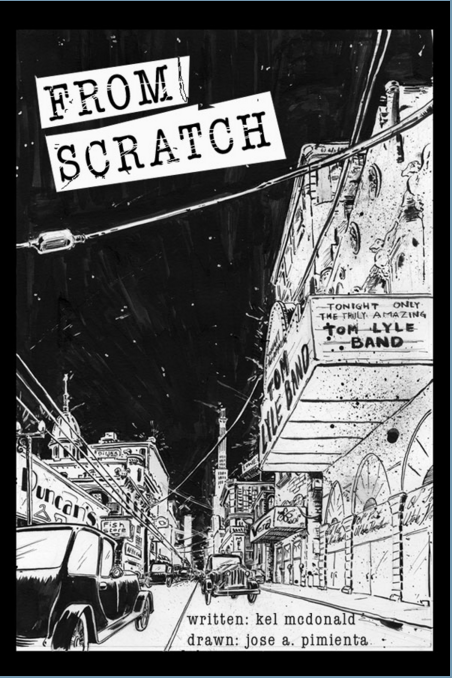
As fans of the illustration style in The Leg, we decided to pick up From Scratch, illustrated by Pimienta and written by Kel McDonald. Independently published by McDonald, From Scratch contains plenty of familiar creatures of the supernatural that we’ve come to know, but rather than showcasing the powers we have seen them utilize for decades, these beings exhibit their more human components and foibles. Set in the 1920s, From Scratch has a hint of a film noir look to it, but it is far looser in its storytelling and visual style than most noir comics out there.

FromScratchCover

Noir Pulp-esque Cover for From Scratch

From Scratch opens with Aaron and Seth arguing in a dark speakeasy. Aaron has agreed to join Seth and his group on a job to eliminate a Mr. Zamboni and his group of mobsters, but not without some doubt about where this first foray into paid killing will take him in the future.

When the two meet the rest of the team, we begin to realize that the crew is not composed of your average hit men. Aaron and Seth are vampires as well as Loki, who also possesses specific sorcery power in addition to his ones as an undead creature of the night. Beyond the vampires, we also have Sasha the werewolf and Lady Kimaya the ice demon, and all of these folks take their instructions for the job from a demon with a sinister grin and face paint to match named Darkfire or, in more human terms, Mr. Tamura.

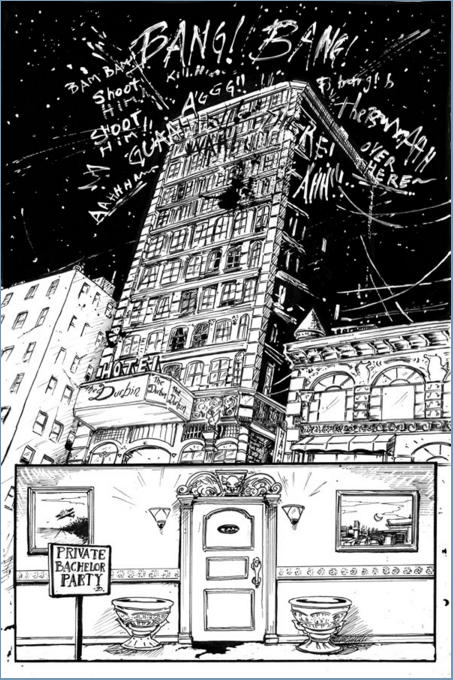
After the introduction to the cast, the plot focuses on one specific job for the group as their more human characteristics such as common sense lead them into blunders and an overall messy and too overt execution of their task. In the course of running through the halls of a stately art deco hotel looking for their target, Mr. Zamboni, the members of the team attempt to handle the order as humans, causing struggle that leads to them resorting to using their supernatural powers. Despite your natural assumption that these characters have a far greater advantage in accomplishing their deed because of the fact that they are not human, their powers cause more inconvenience than efficiency; the superpowers cause more destruction to the building and make far more noise, making the demon assassins less anonymous and quiet in their attempt to clear out everyone guarding Zamboni.

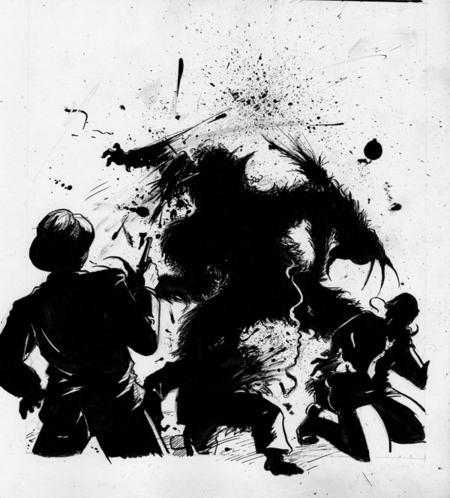
From Scratch sets its sights on placing familiar supernatural characters in circumstances and settings that deviate from their archetypal courses and succeeds. In addition to McDonald’s fun and distinctive script, Pimienta’s work here shines, with each page containing a unique visual element, ranging from varying lettering to abstract forms created from the bloodshed of the crew’s deed. While the book is comprehensive and complete, it leaves some fascinating remaining questions open, perfect for a second volume and even more. Unfortunately, only one book for the From Scratch crew and scenario exists, which is the real shame because it generates an imaginative and absurdist world with strong characters that I would love to learn more about.

BuildingPage-FromScratch

Example of Mixed Art and Lettering Style

Regardless of my disappointment that more of From Scratch does not exist, it stands as an excellent example of the type of gems buried in the crowded aisles of the Artist Alley of any comic convention. Next time you’re at a con, take some time away from the walls of mesmerizing Funko toys to talk to creators at their tables in Artist Alley. You’ll most likely discover a work that tests your expectations for comicbooks, and that’s always a treat well worth the time and effort.

From Scratch is written by Kel McDonald and illustrated by Jose Pimienta and is available in print and electronic forms here

Also, keep an eye out soon for our wrap up on Comikaze, which will be posted on Forces of Geek soon!

Lily Takes on Pasta! Nui Xao Bo

Standard

Nui Xao Bo may be the first and only dish I present that intersects with Generoso’s Italian cooking!

When I was a kid and teenager, I loved Nui Xao Bo, a Vietnamese interpretation of pasta. Generally made with tomato paste, I wanted to make a version that was similar to the version I had as a child but without the acidity and harshness of tomato paste. Consequently, I opted to make a tomato sauce inspired by Generoso’s techniques as the primary sauce for the pasta. In addition, I used Italian pasta instead of Vietnamese pasta, which is a personal preference. The outcome is a rich and delicious meal that I lighten with a bed of lettuce and fresh cilantro and scallions.

This is a pretty quick dish that can be prepared the night before and assembled right before eating! It’s also quite good cold as a pasta salad!

Enjoy!

Music via César Franck Piano Concerto from 1878

Generoso and Lily’s Bovine Ska and Rocksteady: Jamaican Halloween Reggae And Ska 10-27-15

Standard
halloween A

Halloween Without King Horror? Never!


Happy Halloween Bovine Ska and Rocksteady Listeners!

Truthfully, back in 1996 when I put together my first Jamaican Halloween radio show at WMBR, I couldn’t find more than a couple of sets  spooky reggae and ska from 1955 to 1975 but year by year just like the lost souls rising from the beyond, we have found a coven of rare Jamaican cuts to make a two hour show of eerie sounding reggae, ska, mento, and rocksteady happen!  This year’s show was a blast as we mixed those cuts that feature horrifying screams, corpses rising out of graves, and heavy rhythms with some haunting sounds of our own, and Lily’s explanations of the different types of undead apparitions which was pretty mind-blowing!   In years past we always did a half-hour spotlight of the enigmatic vocalist known as King Horror but being that Mixcloud does not allow so many tracks glued together from one artist, we played a greater variety of Halloween reggae and ska than ever before!

Of course, we did start the show with King Horror with what could be the most bizarre organ intro of any track we will play this evening…The Joe Mansano produced 1969 classic, “Dracula Prince Of Darkness!”  In fact, the first set of four songs was a tribute to the former Vlad The Impaler and his urban counterpart, Blacula!  We followed  King Horror with a creepy one from the Crystal label house band, The Crystalites with “Blacula” from 1973, The Vulcans 1973 cut for Trojan, “Dracula,” and The Upsetters ending that set with their homage to our fanged friend, “Dracula” from 1970.  We had a mento set that began with an appropriate selection from Chin’s Calypso Sextet, “Woman Ghost Fool Man” and ending with the classic “Zombie Jamboree” performed by Lord Jellicoe in 1966.  We ended the first hour with a ska set that included such holiday wonders as Byron Lee and The Dragonaires “Frankenstein Ska” from 1964, and our favorite dark ska cut, Lloyd Clarke’s “Living Among The Dead” which Lloyd recorded in 1964 at Federal.

The second hour featured a six reggae tribute to satan with a highlight being “Dr. Satan’s Echo Chamber” by Rupie Edwards from 1974, and a nine song version to version laden set of “duppy” (Jamaican for ghost) including four versions of Bob Marley and The Wailers Duppy Conqueror performed by The Wailers, Dennis Alcapone, and The Joe Gibbs All Stars.

You can hear our full show from October 27th, 2015 HERE. Subscribe to our show on Mixcloud, it’s free and you’ll get an email every Tuesday when our new show goes up.

Happy Halloween!!! Please help us and spread the word and repost if you liked the show! Repost anywhere you see fit.

Join the group for the radio show on Facebook.

Love,
Generoso and Lily

The Failed Graphic Novel Extension of Olivier Morel’s Film On the Bridge – Walking Wounded

Standard

There’s no doubt that Olivier Morel and Maël’s Walking Wounded addresses a serious topic.

The Iraq War (and the overall War on Terrorism) most certainly stands as this generation’s Vietnam War. The war itself has some highly questionable motivations and practices (which I will omit to discuss at length here because I, by no means, am an expert, but for further context, I will direct you to this). And, like the veterans of the Vietnam War, the veterans of the Iraq War have returned home to a similar indifference and lack of support. To make matters worse, the veterans of this war all decidedly enlisted to protect our country; a mandatory draft did not exist at the time of the war, adding a further layer of complexity to veterans’ experiences upon returning because the decision to join the battle was even more of a conscious one even if the battles they were placed in were completely unexpected, potentially making these soldiers feel even more guilty about the horrors they experienced and implicitly making the public even more passive about the welfare of these troops with a, “you should have known what you were getting yourself into” sentiment.  

Before we proceed, let me establish that this review in no way will address my own opinions of the Iraq War or American foreign policy over the past two decades. In addition, before I go on to explain the flaws of the Walking Wounded: Uncut Stories From Iraq, let me also say that I have always and will always support American veterans; my family has multiple veterans, and I have multiple friends who are currently in the military or have returned from service, so my criticism of the Morel graphic novel does not come from any political leanings or judgement on American soldiers; it comes from the novel’s  failure to execute a coherent story and failure to evoke empathy in addition to pathos and sympathy.

Now, onto the analysis and review…

We as a general public should demand more sophisticated and nuanced discussions of war and its psychological impact on our soldiers. During and after the Vietnam War, we saw a wealth of films that allowed those of us at home (and those of us who were not born at the time such as myself) to understand what our soldiers experienced and how they felt. Ranging from Walter Hill’s Southern Comfort to Bob Clark’s Deathdream, viewers, even now, could begin to understand the absurdity our soldiers faced and, in turn, the great difficulty they would endure upon returning home and attempting to re-integrate into civilian society. On the non-fiction side of film, war documentaries such as Peter Davis’s Hearts and Minds dropped you right into soldiers’ daily lives in war, thus showing us how and why Vietnam veterans would face immense hardship when they returned home. With these Vietnam War films, you do not sit through conjecture or hear any platitudes about the brutality of war; you walk side by side with the people in front of you, seeing what they see, making you feel completely consumed by their worlds. Sure, there’s a message lying in all of these works (some that you could even describe as propaganda), and the plot, the characters, and the editing exist to convey this message, but you do not spend 90 minutes sitting with people who repeat the director’s intended message to you over and over.

In today’s documentaries about any serious topic (war, environmental damage, health care accessibility, hunger, and really any topic that addresses the suffering of living things), more often than not, you get spoon fed the message of the director with talking head interviews with various people who essentially say the same thing. Again, to repeat, these topics are important, but the recent trend in the documentary form with its perspective-less interviews frequently fails to produce any deeper empathy than that of a public service announcement. And even worse than the cold, distanced, content-less interviews are the moments of “artistic expression” meant to convey the message in some abstract way. These moments frequently do even more damage to the communication of the theme of the work, breaking up the tone of the interviewees with these abstractions that at best evoke some short sense of pathos and some pat on the back for pretentious creativity that is difficult to critique in public without some dissent.

Now, what happens when one of these serious modern documentaries filled with heart-wrenching interviews and artistic interludes gets extended into graphic novel form?

You get the Walking Wounded: Uncut Stories From Iraq, a clumsy, awkward novel that fails to provide further dimensionality and richness to Morel’s documentary film On the Bridge (which in itself haphazardly handles the stories of the veterans it includes) and feels more like an attempt to capitalize on a “hot” media form without ever studying how to create a story in the comic form that everybody is ranting and raving about.

Cover for Walking Wounded

The Walking Wounded includes the stories of the veterans included in On the Bridge with a tiny bit of Morel’s perspective as he made the film. In the novel, Morel does address the moral line between storytelling and exploitation that all documentarians face, but given the sparseness of these moments of reflection in the novel, his own perspective on the making of the film only feels like a digression away from the stories of the veterans. So, if the novel does not expand on Morel, then shouldn’t he use the graphic novel to expand on the stories of the veterans?

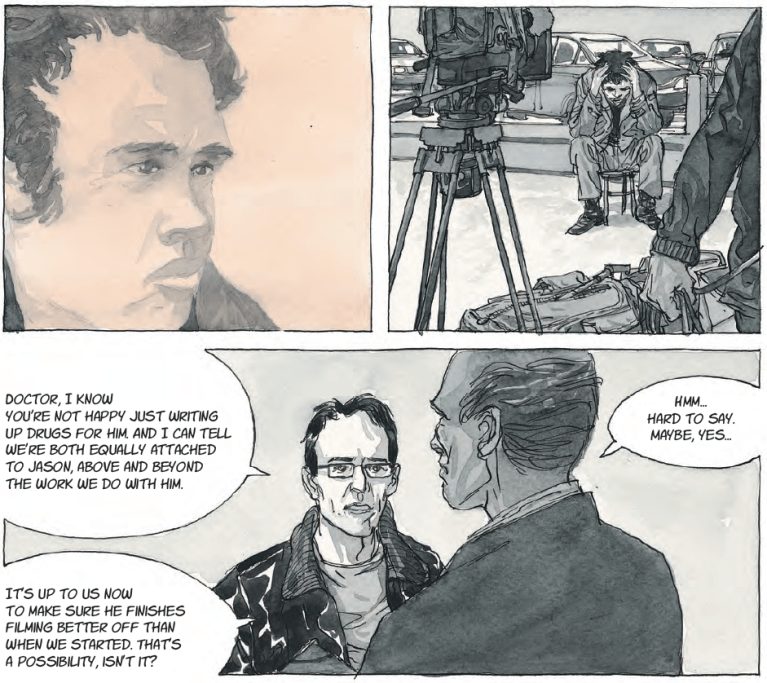
Well, he does include some moments of how the interviews with our veterans, Wendy, Vince, Ryan, Jason, Kevin, and Lisa and parents of veteran Jeff Lucey came to happen, but with his attempt at non-linear storytelling to portray each veteran’s role in the film paired with their experience in and out of war, Morel butchers the stories and throws them incongruously together, making it difficult to get to know each veteran beyond the panels where they discuss how they felt deceived by our politicians and how the terrors of war make it difficult to experience regular life. We get no time to live with our veterans and have them naturally recount their experiences in war and in civilian life; we only get their answers to Morel’s pointed questions. Consequently, given all of the veteran stories included in the 122 pages of the Walking Wounded, the novel is a modge-podge collage of understanding post-traumatic stress syndrome rather than an insightful, pensive work which explores and attempts to comprehensively understand how PTSD manifests and affects our veterans.

Thus, what makes the Walking Wounded an infuriating read is its absolute failure to extend the stories of the veterans featured in On the Bridge; in fact, he chops them shorter in the novel and interrupts them with making of the film moments, failing to build greater perspective and empathy, which, in total, fails the veterans included in the novel and the cause-at-large to provoke change in our society’s approach to veteran care and support in reintegration into civilian life. The Walking Wounded provides no more depth or information than a news item, and with its attempt to include so many stories into a small book, it feels like a human interest piece about veterans that you would see produced for CNN or PBS. Morel would have seen far more success if he focused on one specific veteran, but instead, he includes only didactic moments from each veteran’s story, making the whole book as thought-provoking as a pamphlet on veterans’ PTSD in a psychologist’s office; and, to further this info pamphlet vibe, Morel even includes a patronizing Notes section which includes elementary definitions for a range of items such as The Subprime Crisis and Crash of 2008 and Abu Ghraib, all of which need far more discussion and analysis than what he provides (did he not think his readers were capable of looking up information about the topics he described?).  

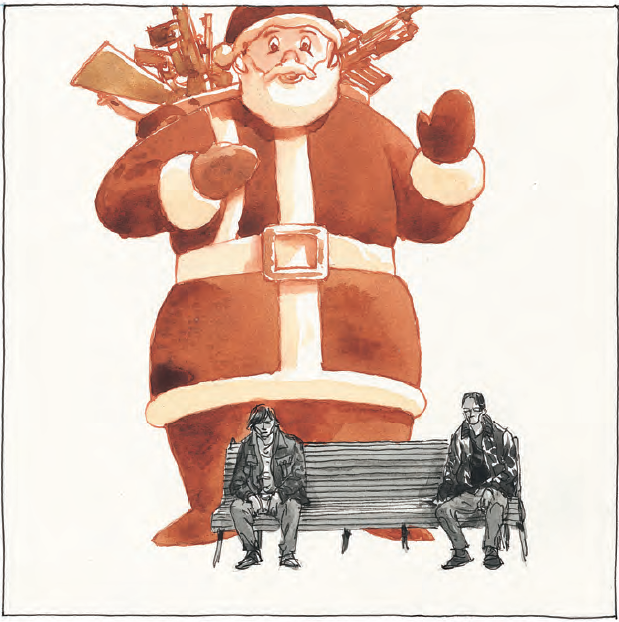
All of my anger at Morel’s incompetence can be summed up in one moment…When Morel meets Ryan Endicott, a young marine who is sitting alone at a Christmas party, and strikes up a conversation with him, Ryan discusses how he hates everything, especially Santa. To hammer home Ryan’s struggle with the trivialness of everyday civilian life compared to his experiences in war, Morel and Maël include an image of Morel and Ryan speaking on a bench dwarfed by a sepia image of a giant Santa carrying a bag of weapons. If that one scene alone does not convey the utterly poor and grossly heavy handed execution of the Walking Wounded, then I pray for the future of documentaries and nonfiction graphic novels, for we have regressed in our expectations of how to present, digest, and comprehend controversial and difficult topics, thus doing no justice to the stories of the people ultimately affected.

Santa-WalkingWounded

Walking Wounded by Olivier Morel and Maël is available via NBM. 

The Second Of Kim Ki-young’s “Housemaid” Trilogy, 1971’s “Woman Of Fire,” Is A Colorfully Perverse Remake

Standard
Woman Of Fire Still

The Grim Truth Within 1971’s “Woman Of Fire”

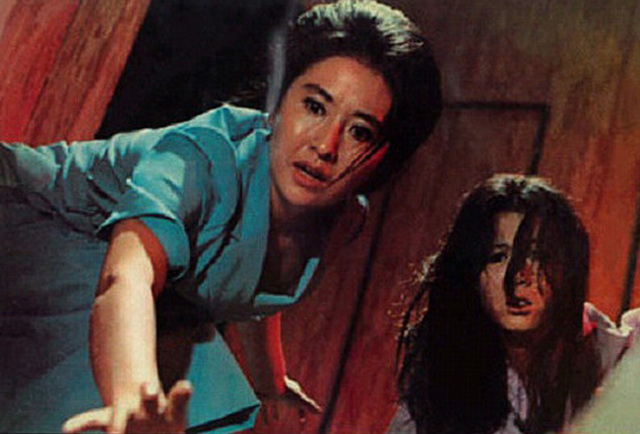
Just how much had Korea changed during the eleven years between the Kim Ki-young’s wildly successful Buñuelesque 1960 film about fading societal roles, “The Housemaid,” and the frenetic remake Kim directed in 1971, “Woman Of Fire?” Korea was neither politically nor economically stable in the decade between the two films and this constant upheaval seriously threatened the urban middle classes, who like every class, dreamed of economic growth. As was the case with most 20th century post-war economies, rapid production and a rebuilding of the infrastructure meant that the social order was going to be affected, and both men and women laborers from the countryside became a human resource for industry or servants in urban middle-class families. This economic situation was clearly present when Kim directed the original “Housemaid,” but it is clear from the earliest scenes in the “Woman Of Fire” that the nuances to the story were primarily intended to reflect the roles that women were now playing in contemporary early 1970s Korean society, which like America, had seen a change in attitudes from women resulting from the liberation movement.

Kim Ki-young cleverly acknowledges the impact of his original film by opening “Woman Of Fire” at a police station where Jeong-suk, the matriarch of a doomed middle class family, is being interrogated about the murder of her husband and the family’s housemaid. A deranged young man has confessed to the murders, but also in the interrogation room is a close friend of our murdered housemaid who is there with a letter from her dead friend that points to the matriarch as the actual killer. The ending is un fait accompli as, again, we are keeping the progression of the story fairly close to the original of the 1960 film, which was massively successful, so there seemed to be no need to build suspense and progressively unfold the tragedy, and by doing so, the viewer can spend time watching the entire narrative reacting to the nuances made to the characters which brings out Kim’s clear comments about the changing roles of women.

As with the original, we have a middle class family in trouble. This traditional middle class family has a mother, father, and two children, a boy and girl. They own a home where the father Dong-sik is a piano-playing songwriter who primarily lives off the labor of his wife, but unlike its 1960 counterpart, in “Woman Of Fire,” the wife, Jeong-suk, isn’t just a seamstress who is pregnant and is having issues maintaining the home and her layabout husband. The matriarch of the family in the 1971 version owns a large chicken ranch, which is profitable but not profitable enough for her to afford a housemaid for the family, which is essential in keeping up the false appearance of a successful middle class family living in Seoul. Still, Jeong-suk is off to a placement service broker to find a suitable housemaid and soon meets Myeong-ja, a country girl who runs away to the city with her friend after killing the two men who tried to rape them in the countryside, who has arrived in Seoul with different agenda than her companion. Myeong-ja’s friend wants to become a barmaid (polite term for prostitute), but Myeong-ja wants to be a housemaid in a wealthy home where she could “learn valuable things” and eventually find a husband. Jeong-suk is quick to tell Myeong-ja that she has financial issues, which suits Myeong-ja fine as she only asks that her new boss find her a suitable husband as payment, which becomes their agreement for her employment. This scene and an earlier scene in which the investigating officer expresses his loathing for “country girls who come to Seoul for illicit purposes” quickly bear out the fragile economic situation in South Korea of the early 1970s.

The sexuality is another area in which the differences between the two films become readily apparent. Though not visually graphic, the situations and dialog force to the surface an attitude where women are beginning to take a more demonstrative role in the urban family. Such is the scene where Jeong-suk, after a tryst, playfully jokes with her husband and freely discusses their need for innovation and “role playing” with their love making to which Dong-sik satirically responds by condemning the “things that women write these days about sex.” This frank discussion occurs while Myeong-ja is in her bedroom, but what is not clear is whether Kim Ki-young wants us to believe that Myeong-ja has overheard this conversation. Regardless, something motivates Myeong-ja to creep towards her employer’s bedroom where she definitively sees them having intercourse and responds by falling to the floor while having a fit.

I find this scene somewhat problematic as it sets up Myeong-ja’s eventual psychotic over-sexual behavior and possessiveness as being more of a result of either Myeong-ja’s attempts to emulate the fairly healthy attitudes she overheard about sexuality or as a PSTD response to seeing sexuality after her rape in the countryside, as opposed to the point of the original film, where there is no doubt that Myeong-ja is a victim of a fraudulent class imperative that is enforced on her after she must miscarriage (here it is an abortion) when she becomes pregnant from a rape by Dong-sik which leads to her subsequent sexual and violent actions. The original class elements of the 1960 original film are in place with the remake, but the focus here in the 1971 remake is on Kim Ki-young’s sexual message, where Myeong-ja’s friend from the country, who now works a prostitute, is applauded by the director for being honest about her intentions with money and men, which conflicts with the then current attitude where a middle class woman lives a lie by prostituting herself for a husband in order to maintain the social order. The final shot of the film, where Myeong-ja’s seductively dressed friend carries a fallen, shoeless, all-in-white Jeong-suk through the rain, is a grim final statement about a fading society where the modern promiscuous yet honest woman is seen as stronger than the middle class family woman.

Two things that Kim ki-young does greatly improve on in his 1971 entry into the “Housemaid” trilogy is the use of sound and visuals. The original 1960 film is shot in grim black and white, and Kim uses shadows and dimly lit rooms to express the middle class failure in the home of the main characters. The way characters enter each scene and from what direction are good visual tools that help us subliminally understand their intentions. In “Woman Of Fire” the black and white is gone and replaced with two primary colors, blue and red, that aggressively add to the mood of certain scenes. The scenes where either the married couple make love or Myeong-ja is raped have the same red filter to indicate that there is the same negative connotation to the sexuality in those vastly different interactions. In a scene where Myeong-ja eavesdrops on a conversation between Dong-sik and Jeong-suk where they discuss getting rid of their housemaid, Myeong is bathed in a tragic blue light. Alternatively, the off-kilter music that is used when the children are playing to express unrest in the home is also played when Myeong-ja kills a rat under her foot shortly afterwards. These choices add to the mood of “Woman Of Fire” and match the scenes of complete insanity that will soon follow as things spiral out of control in a louder, uglier way that its predecessor perhaps couldn’t do in 1960.

The Full “Woman Of Fire” With English Subs

I have in the past questioned a director’s desire to remake a successful film which they have already created. Such was the case with Michael Haneke’s superb 1997 film,”Funny Games,” which seems to have been remade with Hollywood actors in 2007 if only to further mock the”Hollywood/happy ending” where the good guys always win. Even with that intention, I found the shot by shot remake to be a waste of that talented director’s skills, and after hearing Haneke speak at the Harvard Film Archive in the same year the Naomi Watts/Tim Roth version was released, it seemed clear that the request to remake the film came as an edict from Haneke’s US representation. As for Kim ki-young’s 1971 remake of “The Housemaid,” despite some needlessly harsh comments the director makes in the film regarding the divisive use of sexuality by women in early 1970s South Korea, “Woman Of Fire,” remains as an important document that sometimes brutally stresses the reality of a ever fading middle class, with its impossible to maintain social imperatives that were still hanging around in a economically ravaged South Korea that wasn’t improving even after a decade. Whereas the original took its family’s decline in a slow. but ultimately shocking conclusion, Kim ki-young directs “Woman Of Fire” in a dizzying and even borderline nightmarish way that amplified the need for an immediate change in social attitudes that were harming both the rich and the poor for no other purpose but preserving pride.


Generoso’s Creamy And Yummy: Penne alla Norma

Standard

This delicious and beautifully easy to make dish comes from Catania on the north coast of Sicily and is always perfect for a cool fall day.   From prep to table should take about ninety minutes but there is not a huge amount of chopping to be done here.  My recipe for this dish varies on a few ingredients, one being the use of ricotta salata which is usually a bit tough to find no matter where I’ve lived so I have always used large grated pieces of romano instead.  I also love a bit of kick to my Norma sauce so I add a good amount of crushed red pepper and then for an extra mellow flavor that melds perfectly, I opt for a few ounces of olives.

Here’s what you will need to make this dish happen: One box of penne pasta, one can of puree tomatoes, one large eggplant, olive oil, a dozen olives, 6 ounces of hard romano cheese, fresh parsley, fresh thyme, salt, and pepper.

We were joined by our dear friend Oriana for this video. Thanks for her help and smiles when we were making this dish.

Let us know how yours turns out and thanks for watching!

Love,
Generoso

Music: Tchaikovsky’s Concerto No.1 in B flat minor Op.23

Generoso and Lily’s Bovine Ska and Rocksteady: Theo Beckford’s King Pioneer Label 10-20-15

Standard
King Pioneer A

Our Opening Tune For The King Pioneer Spotlight


Hello Bovine Ska and Rocksteady Listeners,

First off, thanks again to all of you who wrote and wished Generoso a happy birthday!  Last week’s all 1968 show was a tad silly but we had fun doing it and we were glad you liked it as much as you did.  We are also happy to announce are very happy to say that our weekly show besides being uploaded to Mixcloud will now also be part of Rasta Radio JA, Barbara Blake Hannah’s radio station based out of Kingston, Jamaica. Every Friday from 2PM-4PM Jamaican time our show will air for the good people of Jamaica. We could not be prouder.

This week’s show began with two sets of rare rare rocksteadys, starting with a tune from a little known group, The Swingers, with a track called “Show It Now” which was released on Prince Buster’s Olive Blossom Label in 1967.  We followed that with another rare cut, this time from Coxsone in the same year, 1967, “Have Mercy” from The Jamaican Shadows.  Two wonderful tracks that got the ball rolling.  After another set of rocksteady, we started our weekly mento set with “How You Come Over,” a tune from the queen of mento, Louise Bennett from her “Jamaican Folk Songs” LP which was released back in 1954.  We ended the first hour with a long set of Jamaican rhythm and blues to put you in the mood for our King Pioneer spotlight.  A standout duet during that last set of the first hour featured two amazing singers who both visited The Bovine Ska in the past, Owen Gray and Laurel Aitken. They teamed up in 1962 for the Dee’s Label with the boisterous “She’s Gone To Napoli.”  After that set, we started our half hour tribute to Theo Beckford’s King Pioneer Label….

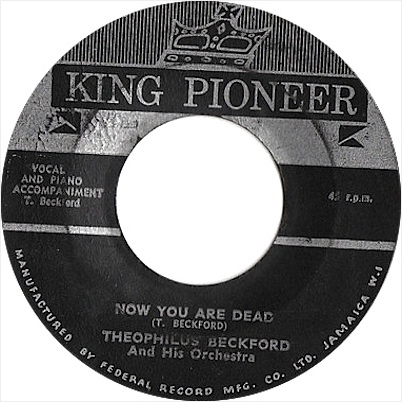
Born in Trenchtown, Kingston, Theophilus (Theo) Beckford taught himself how to play piano at the Boys’ Town School, gaining inspiration from Roscoe Gordon and Fats Domino, whose records were extremely popular in 1940s and 1950s Jamaica. With Stanley Motta’s mento recording business (his side project from his photo supply shop), Beckford found a role as a session musician for the MRS label, backing up mento artists such as Lord Composer and the mighty Count Lasher. In 1956, Beckford recorded “Easy Snappin” for Coxone Dodd’s Downbeat soundsystem, during what is believed to be Coxone Dodd’s first studio session at a time in Jamaican music history where 78s were no longer popular and when American R&B was not as accessible in Jamaica. Beckford met Coxone Dodd through Ken Khouri; Beckford would sing for Khouri’s Federal Records, and Coxone Dodd decided to record at Federal Studios. While “Easy Snappin” is often considered and regarded as the first ska track in Jamaica, it contains that signature rollick of Jamaican Rhythm & Blues, so that claim is a little questionable. Regardless of where “Easy Snappin” falls in the transition from R&B and into ska, it was a huge hit for the soundsystem and eventually for Dodd’s Studio One when it was released as a record in 1959. Beckford would continue to record for Dodd and eventually all of the major soundsystem operators: King Edwards, Prince Buster, and Duke Reid. In 1963, after much experience as a session musician, Theo Beckford opened up his own label for greater independence, and that is the King Pioneer label, our label spotlight of tonight. King Pioneer was a full labor of love. Beckford created the name and the label artword, drawing the signature crown himself.

Backing up the the King Pioneer records were the The Theophilus Beckford Orchestra and The King Pioneer All Stars are not 100% clear; as with many house bands, there’s a rotating cast. Some of the members were: Drumbago and Wackie Henry on drums, Lennie ‘Blues’ Gordon on bass, Lloyd ‘Ace’ Richard and Lord Jellicoe on guitar, Val Bennett and John the Baptist on alto sax, Baba Brooks and Raymond Harper on trumpet, Ronald Wilson on trombone, Lester Pegart, Stanley Notice, and Dennis Campbell on tenor sax, and of course, to round out the instrumentalists, Theo himself contributes piano and organ in addition to production.

You can hear our full show from October 20th, 2015 HERE.  Subscribe to our show on Mixcloud, it’s free and you’ll get an email every Tuesday when our new show goes up.

Enjoy!!  Please help us and spread the word and repost if you liked the show!  Repost anywhere you see fit.

Join the group for the radio show on Facebook.

Love,
Generoso and Lily

1979 Was A Tough Year For Malcolm McDowell Sans The Charming Time Travel Film, “Time After Time”

Standard
timeaftertimeAAA

HG Wells Watching Tele with Jack The Ripper

In between his brilliant feature film debut in Lindsay Anderson’s prophetic 1968 counterculture film “If” and his current job making “Lunchables” commercials, the wheels came off the career of legendary English actor Malcolm McDowell.

During the late 1970s, with his career booming off of critical and commercial successes such as Lindsay Anderson’s “O Lucky Man,” which Malcolm starred in and co-wrote the screenplay, to portraying Captain Flashman in Richard Lester’s 1975 hit “Royal Flash” to his most famed role as Little Alex in Kubrick’s adaptation of Burgess’ “A Clockwork Orange,” it seemed that nothing could unseat him from being regarded as one of the great young talents in British cinema. That is until 1979, when Malcolm appeared in three films, two of which saw small popularity and decent press and one film which saw international headlines but for all the wrong reasons: the Tinto Brass directed and Bob Guccione produced hardcore porn Roman epic, “Caligula.” “Caligula’s” rank violence and often grotesque sexuality offended just about everyone and was relegated to a single screen in a NYC theater that Guccione purchased just so that his X-Rated opus could screen anywhere without incident. “Caligula” starred John Gielgud, Peter O’ Toole, and a young Helen Mirren, all of whom came out of the experience with their careers fairly unscathed, but after all, none of them were playing the title character, and for that, McDowell saw his performance singled out and savaged for its flamboyancy, which frankly was no less flamboyant than the performance that he gave as a ruthless Nazi commander in “The Passage,” which was released the same year. Then again, in our polite society, I guess it’s more acceptable to play a torturing fascist than a Roman leader with a penchant for anal fisting newlyweds.

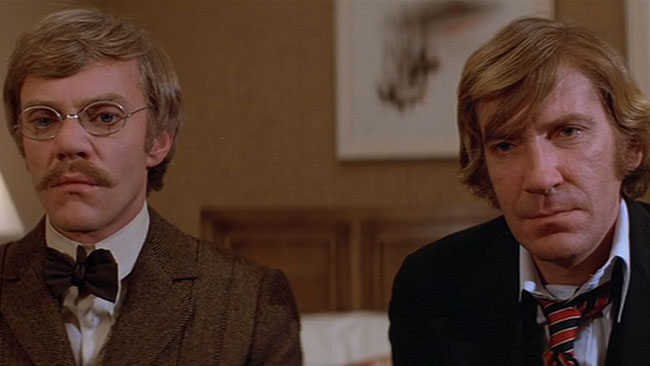
In the summer of 1979, Caligula had been released in Rome and the word of this bleak, over budget porno had begun to hit the United States with word that the film would be released early the following year. That same summer I was thrilled to head to my local single-screen theater to see McDowell, who I had followed since seeing “A Clockwork Orange” at the age of ten when my friend and I watched it on tape, playing author HG Wells in a new movie called “Time After Time.” In this whimsical, mostly romantic and far less geeky film, McDowell plays Wells with a heartfelt charming conviction. The film opens in the year 1896 with a grizzly killing committed by none other than real life serial killer, Jack The Ripper. Soon, we are whisked to the home of Wells who is hosting a dinner party for his peers where he plans to give special unveiling of a new project later in the evening. Once the last of his dinner guests, Doctor Stevenson (David Warner), arrives, Wells adjourns the group to his basement where he shows them his proud creation, a very ornate almost amusement park ride looking contraption Wells calls “a time machine” (we are to guess that he has not written that book yet). Wells boldly explains the functionality of his creation, but when he is asked if it actually works he sheepishly admits that he has not “worked up the nerve to test it out yet.” His guests laugh off the invention, but the laughter soon ends when Scotland Yard knocks on the door. As we the viewer know but Wells’ guests don’t, The Ripper has struck again, and the proof that Doctor Stevenson is most likely the man that they are looking for sends the austere house into a frenzy, but after a thorough search, the bad doctor is nowhere to be found. It then dawns on Wells that someone had the nerve to use his invention, and that man is Stevenson whom Wells, well known for his utopian ideals, must now stop as he (Wells) is certain that Stevenson will run amok with violence in the future, a place where HG imagines being devoid of war and strife. So, our protagonist must follow Stevenson into the future, 1979 San Francisco to be exact.

After a dazzling time-travel sequence, Wells arrives in swinging 1979 San Francisco. Cleverly the future has allowed him to land his ship in a museum exhibit featuring Wells’ entire study and his time machine which the sign indicates “never worked,” which is odd as the key that only Wells possesses is only needed to prevent the machine from automatically returning to where it came from, meaning that anyone could just type in a date and make it fly. OK, I feel me getting geeky here, so I will move along, but did you notice how I didn’t mention that Wells could’ve simply ended the story at the beginning by taking his time machine back an hour in 1896 to alert the police that Stevenson was The Ripper?  Yes, the story does have some gaping holes when playing with its time travel plot, but, as I don’t want to trip out on the sci-fi aspects just yet, I will now really move along.

Wells immediately understands that the utopia he had predicted in the future has not yet arrived. There is violence, mistrust, and poverty, but McDowell shrugs it off and like Sherlock Holmes, who he mentions many times in the film, uses deductive reasoning and goes bank to bank asking about Stevenson as Wells suspects that he will try and exchange Sovereigns somewhere in the city before building up a body count. Wells’ quest leads him to a desk at the Bank of England where he meets a young manager named Amy (a wonderfully ditsy Mary Steenburgen). Amy does point HG in the right direction as she referred Stevenson to the Hyatt, where the nebbish Wells will soon confront the larger serial killing Stevenson and try, through conversation, to get him to return to 19th Century England to face the authorities (not sure how the screenwriter thought that made any sense). Stevenson tells Wells that their present location and time in the United States is a violent place where Stevenson finally feels at home, and after a scuffle where Stevenson unsuccessfully tries to locate the time machine key on Wells, they take their chase on foot to the streets, where Stevenson is hit by a car and is presumed dead. Wells, believing that his job is now over, seeks out our good bank clerk Amy for a chance at gaining knowledge of this place in time and perhaps the odd chance at a cuddle. Not phased that HG is dressed like a Sherlock Holmes-era dandy, Amy beds and falls in love with Wells, who is in no rush to go back to the days when seeing a woman’s exposed ankle was considered erotic.

Through news reports on the radio, Wells soon realizes that The Ripper is still alive and well and slicing up the women in the Bay area, so he must hunt him down and inadvertently gets Amy mixed up in the quest, so she then becomes hunted by Stevenson as Wells will not surrender his key. Of course Stevenson could just get back into the time machine and go farther into the future or deeper into the past to kill prostitutes but without the key, that would mean that Holmes would still be after him. I, for one, began to wonder, even at the age of eleven, why that would even be of concern to Stevenson unless he is foolish enough to head back to 1896 England. Anywhere else, Wells would be seen as a crackpot having to explain his investigation of Stevenson through the time space continuum.

In this way, “Time After Time” does not succeed as science fiction; in fact the science fiction engine of this film is only there to set up the romance between HG and Amy, which is fine for me. There is a palpable chemistry between McDowell and Steenburgen onscreen, as they did actually fall in love during filming of “Time After Time” and were married the next year, and they stayed married for the next decade. To add to the lovely performances of McDowell and Steenburgen, David Warner is also fantastic as Jack The Ripper, and if the plot had less about the relationship between HG and Amy, it would’ve been an entirely different film, one that would’ve relied more on the facts that we know about Jack The Ripper and HG Wells to further a plot of cat and mouse as opposed to the fictional character of Amy, a perspective that has me curious of the outcome, but, nevertheless, I greatly enjoyed the romantic perspective that director Meyer takes with the story. Adding further to the enchanting mood of “Time After Time” is a lavish old Hollywood score composed by the great Miklós Rózsa, who had scored almost one hundred films in his career from “Ben Hur” to “Spellbound” to “Double Indemnity.”  The score for “Time After Time” would mark the end of Rózsa’s magnificent Hollywood career.

The following year in 1980, Steenburgen would deservedly win the Academy Award for her portrayal of Lynda the wife of Melvin Dummar in Jonathan Demme’s classic “Melvin and Howard.”  That same year Caligula would open in the U.S., and its presence on our shores would cause immense controversy and forever link McDowell negatively to the titular role. Buried with the controversy that year and now virtually forgotten was another fine performance by McDowell in “Look Back In Anger,” directed by his friend Lindsay Anderson. Two years later, Anderson would direct McDowell in the last of his Mick Davis trilogy in the dark comedy that is “Britannia Hospital.” That film, a smart satire on the British Health Service, also failed at the box office. In the following years, McDowell was mostly relegated to villainous roles, a few notable performances being “Mr. A” from Robert Altman’s ballet drama “The Company” in 2003 and that same year as the heavy in Mike Hodges’ underrated anti-gangster film, “I’ll Sleep When I’m Dead.”

“Time After Time” Original Trailer

Despite its flaws in storytelling, I always looked at “Time After Time” as that last beautiful moment for McDowell in cinema. Pigeonholing an actor, either positively or negatively, is never a good thing if you have the talent that McDowell exhibited during his career. “Time After Time” proved that Malcolm could be comedic but also romantic and charming while eating up the screen as he did as a psychotic in many films. Sadly, there isn’t a real time machine for McDowell to go back and reconsider his role of a demented orgy-obsessed Roman emperor, but let’s hope that before he leaves this world, he turns down a check to shill for a packaged lunchtime product to make a small film that mattered like his “Caligula” counterpart Peter O’Toole did in 2006’s sublime film “Venus.”

Generoso and Lily’s Bovine Ska and Rocksteady: 1968 Only! The 19th On-Air Birthday Show 10-13-15

Standard
1968 A

A Top 1968 Release From The Consumates

Hello Bovine Ska and Rocksteady Listeners!

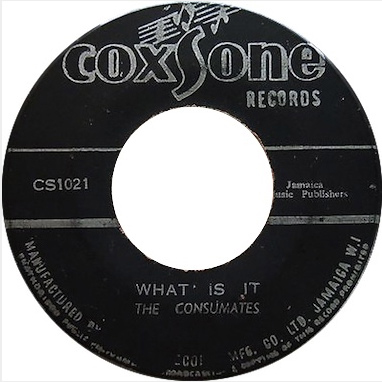
This show this past week had a singular purpose, and that was to celebrate Generoso’s birthday the only way he knows how: By playing only Jamaican cuts from the year of his birth, 1968.  He has been doing exactly that since the show started on WMBR, 88.1FM  in Cambridge in 1996.  As for 1968, that was a tumultuous year in history as it saw the assassinations of Martin Luther King Jr. and Robert Kennedy.  The shooting of Andy Warhol by Valerie Solanis, the May 1968 riots in Paris but in the positive was the successful Apollo 8 mission, Shatner laying a kiss on Nichelle Nichols on Star Trek, and the end of rocksteady and the birth of reggae in Jamaica!

We began Generoso’s birthday with two sets of rocksteady and reggae that feature “1968” in their title.  In the sets you heard cuts like The Three Tops track for Coxsone, “Great 68′ Train.” Lord Creator’s “Come Down ’68” which he recorded for  Vincent Randy Chin.  Some of the sensational 1968 rocksteady and early reggae cuts that made it onto the show are “Soul Day” from The Ethopians on Merritone, “Fun Galore” a top side from The Kingstonians on JJs and many many more.  Between these songs, we played promos from 1968 television shows, we talked about the big records in the United States that year.  A silly, fun, program that we hope you will enjoy!

You can hear our full show from October 13th, 2015 HERE.  Subscribe to our show on Mixcloud, it’s free and you’ll get an email every Tuesday when our new show goes up.

Enjoy!!  Please help us and spread the word and repost if you liked the show!  Repost anywhere you see fit.

Join the group for the radio show on Facebook.

Love,
Generoso and Lily