From Dirty Harry To Messy Diapers: Ted Post’s 1973 Infantilism Fantasy Film “The Baby”

Standard
the baby still photo

“No, I think that it’s your turn to change “Baby.”

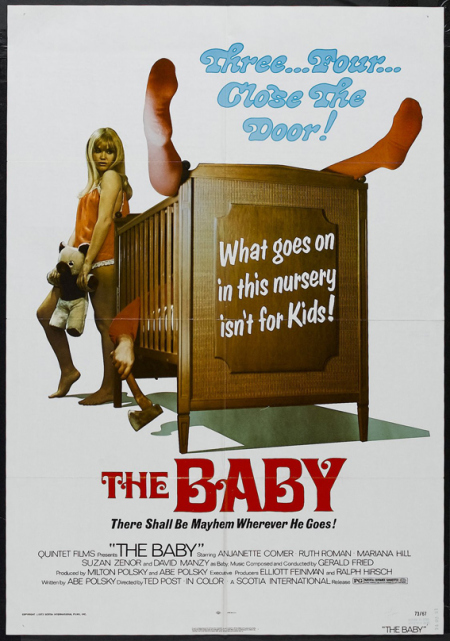
For his output in 1973, Ted Post may go down as having the single most wildly eclectic year for an American director.  He scored a huge hit that year with “Magnum Force,” the second of Clint Eastwood’s “Dirty Harry” series about the somewhat racist San Francisco cop who shoots a lot of bad guys but still ends up pissing off his captain. Though critically panned, “Magnum Force” ended the year outgrossing the original film in the series by a bunch. Ted also directed a young hunky Don Johnson and Don’s soon to be mother-in-law, Tippi Hedren, that same year in The Harrad Experiment, a pseudo-serious sexploitation take on the best selling novel of the same name about a Dr. Kinsey inspired college where students are encouraged to do the horizontal cha cha. Much to no one’s surprise, “The Harrad Experiment” went flaccid at the box office.  So, if you think that the two films I just referenced are wildly apart in themes, then allow me to introduce you to the third film that Mr. Post’s directed in 1973, a torrid tale of forced infantilism entitled, “The Baby.”

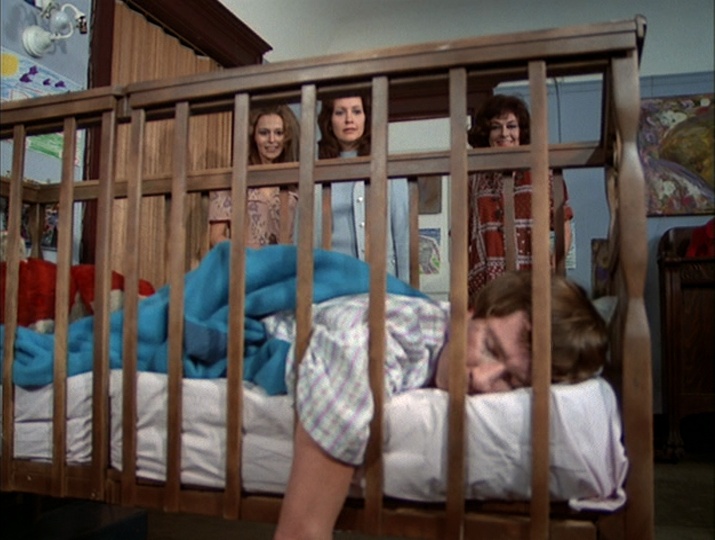
At the core of “The Baby” is bright young social worker Ann Gentry (Anjanette Comer) a dedicated young woman who gets the stunningly suburban Wadsworth family as her case. The Wadsworths have a “mother” for the ages (Ruth Roman); her two oversexed daughters, Germaine (Marianna Hill) and Alba (Susanne Zenor) and their brother Baby (David Manzy), a grown man in diapers who is enabled by the Wadsworths to live in a state of perpetual newborn. Ann’s response, being that she is a seemingly normal state worker who soon realizes that Baby’s disfunction is not physical but conditional, is to get Baby some therapy so that he can stop sucking his thumb and pooping himself in his massive crib. A crazy idea indeed, but mother always knows best and soon mother Wadsworth  puts an end to Ann’s wild idea of turning her son into a grownup who could potentially leave the home and have a life of his own or at least a son that doesn’t need his bum bum talced thrice daily. I guess if our hero Ann investigated a bit further she could’ve had Baby legally taken away from the Wadworths, what with his sisters occasionally supplying Baby with sexual enticement and the odd poke from a cattle prod.  No, this isn’t just maternal instinct gone Munchausen syndrome, it’s more like a reversal of Baby Jane done during the feminism movement. By 1973, the Vietnam war had been going on for over a decade, and women finally were expressing a desire to be something more than a baby machine. Most importantly, an entire generation of men had been taken away, and I guess the ones that were left to look after the women weren’t seen as the epitome of the manly man, and thus we have it’s most extreme example, Baby.

You would think that all of the above activities in “The Baby” would define it as a dark comedy. I mean, we are talking about a draft aged male prancing around in diapers while a family of almost human Stepfordesque women simultaneously nurture and torment our grown infant into further regression, but you never feel okay enough to laugh at this because somewhere in all of the exaggerated moments is the horrifying thought that this behavior shown on Baby most likely didn’t start last week, and that it is a systematic routine of going back to Baby’s actual infancy. You suddenly think back to Alba’s freewheeling use of the cattle prod on Baby as being done on an actual newborn, and the goings on don’t exactly bring one to giggles. If director Post’s goal was to show a new generation of feminist women who look at a child as an albatross, then the point is well made here in a frenetically unfunny way. You have Mrs. Wadsworth as the matriarch who hails from a past generation, a woman can only see herself as a mother and her young daughters who are reviled by the thought of motherhood. Even our young social worker Ann, who appears loving and concerned is hiding a pretty big skeleton in her closet as well.

“The Baby” 1973 Trailer

A scene that truly brings home the notion that Mrs. Wadsworth is beyond seeing herself as a sexual being and just a mother as any woman would from her generation is the birthday party for Baby. Mrs. Wadsworth gets a ton of attention from the men at the party (who by the way don’t seem remotely bothered to be there to celebrate the birth of man baby), but she soon shrugs off that attention as she remains mommy, first, second, and third. After a decade of young men going off to Vietnam and not coming back or coming back broken, Mrs. Wadsworth has created her own version of the perfect man. A “man” who will always need her, and one who is going to be with her for ever and ever. “The Baby” was promoted as horror in the same way that Larry Cohen’s baby-gone-psycho film, “It’s Alive” was promoted a year later. And although “The Baby” doesn’t pack the visceral punch as director Cohen’s film, it still has enough cringeworthy moments to nestle it firmly into that genre more than just pure satire. I guess that generation had lots to fear from the newborn, whether that newborn be big or small. As for this generation, I immediately wondered if “The Baby” would play well as midnight cult film or would a screening end up like it did in our home, with confused looks and muffled giggles and a bit more than a little concern for why this film was made in the first place.

More than the feminism movement, America’s participation in Vietnam effected almost every film genre from action, to romance, to yes, the family horror dramas as is the case with “The Baby.”  A few years later, our director Ted Post to a look at the beginning of our involvement in Vietnam when he directed “Go Tell The Spartans,” a film about a US Army major, played by Burt Lancaster, who goes to South Vietnam in the early 1960s as an advisor who immediately begins to understand that our growing presence there would be a futile effort that would just get a lot of Americans killed. Perhaps it was our major who had a talk with with Mrs. Wadsworth that encouraged her to go into the eternal-baby making business?
Bovine Ska and Rocksteady 6/2/2015: The Rulers

Standard
The Rulers 2

Superb rocksteady from The Rulers prod by JJ

After a one month hiatus where we packed up and moved across the country, Lily and I are back this week to continue the Bovine Ska and Rocksteady as a weekly podcast through Mixcloud being uploaded every Tuesday at 9PM (PST) midnight (EST).  The show’s format will remain the same as it has since 1996, concentrating on early Jamaican music from 1955-1975,with a mento set and artist spotlight midway through the program.  What is new is that we will report out on live Jamaican music happening in the Southern California area as well as Boston area music updates.  We began this week with four versions of The Melodians “Everybody Bawling” that we always send to our friend, Magnus Johnstone.  We ended the first hour with a set of ska which fed directly into a spotlight on the JJ Johnson produced vocal group, The Rulers.

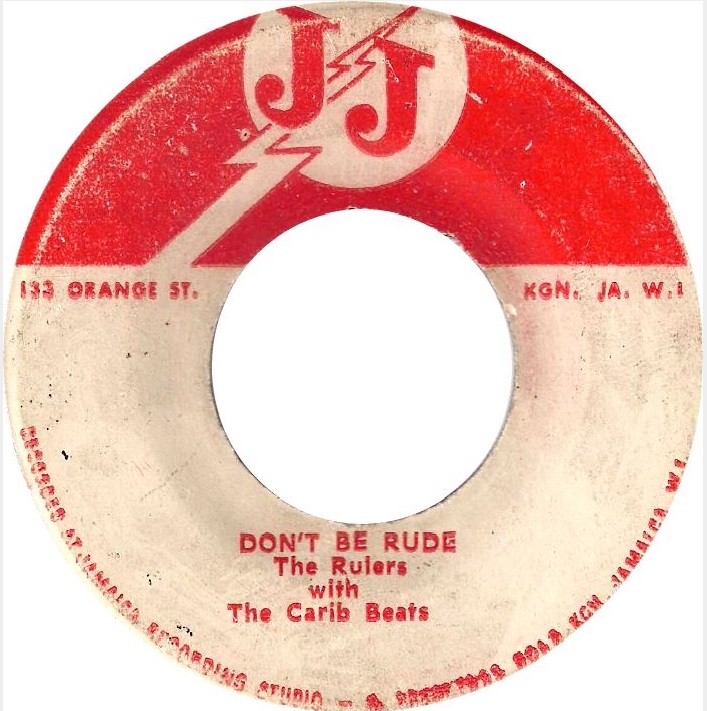
Surprisingly, there is not much known about The Rulers considering their track, Wrong Emboyo, which was originally produced by JJ in 1967, would become one of the many Jamaican songs that would gain notoriety by being covered by The Clash.  What we do know about The Rulers is that the aforementioned track and many of their others have a writing credit to Clyde Alphonso. We also know that JJ’s preferred house band was Bobby Aitken and the Carib Beats, who backed up all of The Rulers’ releases we will hear this evening, for they were all produced by JJ Johnson for his JJ label. Given that the preponderance of their releases are during the rocksteady era, it is no surprise that many of the tracks’’ lyrics are concerned about rude boys. Similar to Alton Ellis, the Rude Boy tracks cut by The Rulers condemn the actions of the rude boys, such as the first track on this evening’s podcast from 1966, Don’t Be a Rude Boy.

This week’s podcast which will remain up for one week, can be heard here:

https://www.mixcloud.com/bovineksa/generoso-and-lilys-bovine-ska-and-rocksteady-6-2-15/

Please let us know what you think and do join us on Facebook for information about the next spotlight artist and relevant Jamaican shows that you can attend.  Click here:

https://www.facebook.com/groups/175321709220304/

Best,
Lily and Generoso


Generoso’s Delicious Timballo di Melanzane

Standard

Be warned: This dish is not a quick meal. Prep and cooking time should be about three hours but I assure you that it’s well worth it! Think timpano but instead of dough and bechemel you will used fried eggplant slices. You will need two large eggplants, a box of penne pasta, romano cheese, sweet Italian sausage, 1/2 pound of ground beef, one onion, one can of puree tomatoes, olive oil, salt, pepper, ground oregano, six cloves of garlic, 1 ounce of fresh basil.

Make sure you let the dish cool for 30-40 minutes before cutting as it will fall apart.

Music: Ravel’s Ma mère l’oye

Bob and Carol and Ted and Alice and a Whole Lot of LSD: The Sexorcists From 1970 Seen With The Cinefamily

Standard
sexocists beautiful_people

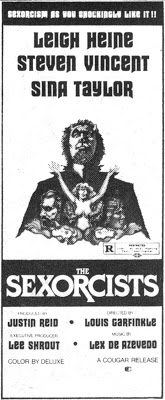
Original poster from 1970 Beautiful People/Sexorcists

My wife Lily and I have recently relocated to Los Angeles, and for one of our first film experiences here in the city, we went on down to the Cinefamily/Silent Film Theater on Fairfax, which is widely known for its rare niche programming to see “The Sexorcists,” a film that they even described as “one of the great white whales of sexploitation cinema—so elusive and rare, even we haven’t seen it yet.” Armed with that too tantalizing blurb we were thrilled to spend our late Thursday night on one of the plush couches at the Silent Film Theater.

Before I get into the experience of seeing this rarely seen cult film, directed by Louis Garfinkle, one of the screenwriters of The Deer Hunter no less, I should say that as a lifelong East Coaster, I have to address my preconceived notions of California that I concocted during my adolescence of watching spacey exploitation films depicting California as land of sexed out LSD ingesting freaks who are always trying to “experience” things that most East Coast Catholic boys would simply deem as satanic. Even more “mature” California scene films ranging from Mazursky’s 1969 film, “Bob And Carol And Ted And Alice,” to Bill Persky’s massively underrated 1980 film, “Serial,” did little to change my hardened heart that the other coast was a deranged place of self-help gurus and orgies. So, now that we know where I stand here, let’s address “The Sexorcists.”

Originally released in 1970 as “Beautiful People” to cash in on the aforementioned psychedelic scene, the film was re-titled and re-released (with a few scenes added in to keep it up to date with its new epitaph) as “The Sexorcists” in 1974. The film begins with Dr. Voxuber (in Halloween quality devil’s attire) letting you in on his evil plot to control the desires of his group of victims. We then cutaway to a pastoral camp known as “Godiva Springs” where our not good doctor runs a camp in which a group of California clichés is put together to “learn more about their bodies than they would ever dream of learning.” The group consists of Boobs (Leigh Heine), a gorgeous example of a wild 1970s California love child, Ruby Begonia (Sonja Dunson), a repressed African American church woman who is not too thrilled to be surrounded by a gaggle of messed up Caucasians, Shrink (Sina Taylor), a pretty housewife who is looking for a quick screw, Howitzer (Frank Whiteman), a hunky and slightly uptight man looking to lay whatever he can find, and Ding Dong (Ann Staunton), a spinster teacher who never gets much screen time. There is also Bubblegum (John Quinn), a blonde surferboy who chews a lot of gum and does little else, Sheena (Branch Halford), a gay transvestite who takes his character to a place that would make the average liberal arts school undergraduate snap in half from political incorrectness, and finally Burp (Harvey Shain), who is mute except for the occasional expressive oral flatulence.

Voxuber has a list of draconian rules that he announces to his California clan at the start of their stay that includes one that causes more than a few arguments which is “no touching under the waist and above the knees.”  Howitzer seems the most pissed by this development and the doctor would spend the entirety of the film, pulling him off of almost every woman in the camp at some point, much to the delight of the Cinefamily crowd. And as I now write about this evening’s crowd at Cinefamily, I would be remiss in my duties to not share their favorite moment, which seems to go off about every ten minutes of the film: an EST-style primal scream that each character does in an ISO shot directly into the camera. They come as randomly as the rest of the plot, and those moments are always met with a good laugh from the audience because they frankly are pretty damn funny. Voxuber spends most of the film putting our group of 1970s California cartoon characters through a series  of random self-help exercises but seems to spend most time with the most repressed Ruby Begonia, trying to bring her to  a state of self-induced seizure orgasm while our campers watch in amazement and joy. Even after such an experience, Ruby is still filled with enough uptightness to freak out a room of Junior League women.

You may be wondering where the mandatory LSD scenes are hiding, and they are of course near the end of our film when or Voxuber dispenses his LSD infused brandy. An all-night group grope ensues of the trippy kind, but the next day the fuzz is there to whisk Voxuber away because (drum roll) he’s not an actual doctor. Oh no! What is our group to do with Dr. Voxuber’s list of commandments? I guess they just have an even bigger orgy involving a series of shots of underwater boobies and wee wees which is really the only time the “sex” in “Sexorcists” appears on the screen.  Now comes another added scene of Dr. Voxuber (now  looking a tad like Jon Lovitz’s SNL devil) explaining his successful execution of his master plan or the “orcists” portion of “Sexorcists.”

The evening ended with the Cinefamily curators receiving an ovation of the almost packed house and a promise from them to search for more lost cult films if we liked “The Sexorcists.” I then wondered at this moment how a film like this would’ve played out to an East Coast cult film crowd who might be looking at these characters with the same level of “you see, I told you they are all freaks out here” lodged in their subconscious as it was with me at the start of this evening. Then the thought occurred to me that California residents in attendance might actually have known real people like the ones depicted in the film, which brought me my first moment of actual horror from the evening.

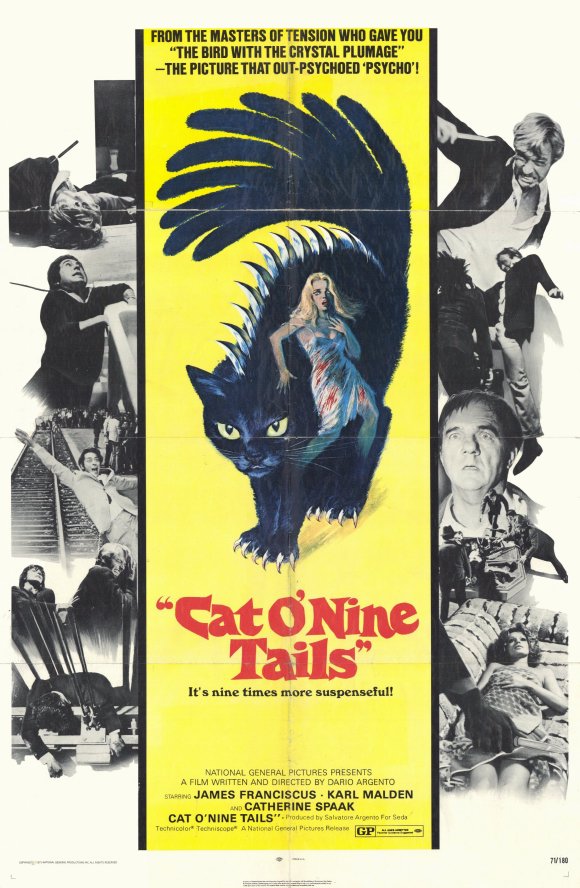
Karl Malden Shines In Part Two of Dario Argento’s “Trilogia Degli Animali,” 1971’s “The Cat o’ Nine Tails”

Standard
the-cat-o-nine-tails-1971-karl-malden-james-franciscus

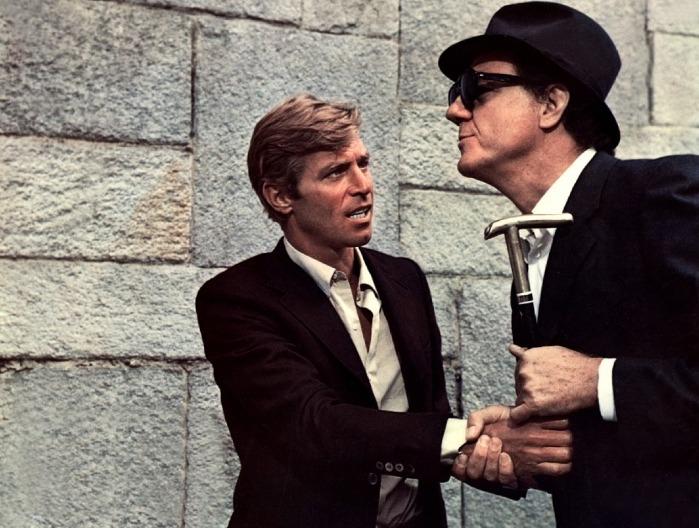
Cookie (Karl Malden) Meet Carlo (James Franciscus)

Before I write one critique about Dario Argento’s second film in his “animal trilogy,” “Cat o’ Nine Tails,” let me first commend him on casting the usually gruff talent of Karl Malden in the role of Franco “Cookie” Arno, a blind ex-reporter who creates crossword puzzles while taking care of his adorable niece, Lori. Sure, Malden is solid in this role as always, but the mind swims at the concept of Dario possibly sitting at his office and pitching to his producer/brother Salvatore that Malden would be perfect as the lovable Cookie, a year after Malden’s tough portrayal of General Omar Bradley in “Patton.” Either Dario is a genius, or Malden could just nail any part that came before him. I also wonder if Michael Douglas ever pulled the “Cookie” card on Malden the following year when they began filming “The Streets Of San Francisco?”

You might think that it is a bit odd that I am reviewing the middle film in a trilogy without ever reviewing the first and third films, but let me assure you that there is absolutely no connection between the three that might encourage you to watch Dario’s first in the series, “The Bird With The Crystal Plumage,” before reading further into my review.   What is true about this period in Argento’s work is that it represents his thriller output before he would embrace more of the supernatural aspects that would define his later films. In “Cat o’ Nine Tails” you have our young director drawing from Hitchcock, as so many of his peers were, but here he adds that element of sinister violence that is less gory than his later masterpiece “Suspiria,” but still quite jarring at times, especially one very creative and teeth-clinching elevator-related death. Though not a masterwork, I found “Cat o’ Nine Tails” to be as solid a thriller as Argento would make at this point in his career.

Our story begins with a burglary occurring at a genetics lab and the sounds of this event being picked up by our darling Cookie, who becomes interested a la James Stewart in Rear Window, so he then teams up with a young and all too hunky reporter, Carlo Giordani (played by the rugged and coiffed American television star, James Franciscus). After a few folks associated with the lab start ending up dead, it becomes clear that the lab has discovered some genetic strand that bears out the criminal tendencies that lie within people, and they have also created a drug that can cure these bad thoughts, but someone isn’t thrilled with one of these two discoveries, so the bodies start to fall. As stated earlier, the murders are not of the lavish, glowing straight razor variety that you would come to expect from Argento; most of our victims in “Cat o’ Nine Tails” are dispatched in the rope around the neck style. This is fine by me as Dario tries to make the plot the star around our killings, as opposed to a sketch of a plot that exists just to glue together a series of baroque imagery as in many of his giallos. My only real stylistic complaint comes from the enviable sex scene between Carlo, our dedicated reporter, and the wealthy daughter of the genetic lab’s director, Anna (Catherine Spaak, the gorgeous lead from Dino Risi’s 1962 film, “Il Sorpasso”). I’m not sure why Argento insisted on filming their coupling in the most robotic way possible, but as an Italian man, I am a bit taken aback by such non-emotional touching that given the dire circumstances that those two characters were surrounded by, should’ve heated up their illicit tryst.

Kudos again to Dario for the attempt at plot complexity here, but it may just be a bit too complex as the “nine” in the title refers to the nine potential criminal leads that are never followed fully enough to potentially draw your interest away from the reveal of the actual killer making the ending, despite a stunner of a death scene, fairly anticlimactic.  There is also a score created by legendary composer Ennio Morricone, that is pretty lackluster, which is not surprising considering that Ennio has scored over five hundred projects over his illustrious career. There has to be a few throwaways in the bunch, and sadly we have one of those here. Malden and Franciscus are the main reasons why you stay in your seats as they are veteran actors that can make any scene work a cut above the rest.

Original 1971 Trailer For Cat o’ Nine Tails

“Cat o’ Nine Tails” is a decent enough film that now stands as a kind of testing ground for a young Dario Argento for what would and would not work and not work in his subsequent films. There are more than enough visual creations that will make you jump, and the overall cinematography is more than a cut above the usual early 1970s giallo.  Finally, I tip my hat to director Argento for acquiring the acting talents of Malden and Franciscus for this, only his second feature film. I don’t know if I would have the nerve to fly an actor the stature of Malden across the Atlantic and saddle him with a character named “Cookie,” but I still admire Argento for thinking that Malden would fit into that character so well.

Jaromil Jires’ 1970 Film, “Valerie And Her Week of Wonders” Is A Gorgeous Czech New Wave Fairy Tale

Standard
valerieweekofwonders2

Valerie (Jaroslava Schallerova) And “The Monster”

More than most European film movements of the 1960s, I have long been an admirer of the films of the Czech New Wave and have even appreciated much of the work of some of the movement’s directors who made the jump to Hollywood, such as Milos Foreman and Ivan Passer. I am also very happy to write that over the last few years, there has been a growing appreciation for the Czech New Wave, inspired by the re-release of Věra Chytilová’s 1966 film, “Daisies,” the story of two teenage girls named Marie who enjoy pulling the odd prank. “Daisies” is an absurdist dark comedy that excels in the surreal and is completely successful in keeping you off kilter for its short, 78-minute length.

Similarly short in length but immensely visually dazzling, is the 1970 fairytale feature by Czech New Wave auteur, Jaromil Jires, “Valerie and Her Week Of Wonders.” Drawing inspiration from the likes of 1960s Buñuel and Fellini, director Jires ties together this loose narrative of the fantastical and erotic daydreams of our title character Valerie, joyously played by the luminously gorgeous, Jaroslava Schallerova. Our demented fairytale begins with the virginal Valerie, who lives with her grandmother, having her earrings stolen in the middle of the night by a man who covers his face with a weasel’s mask. She encounters the man who stole her earrings the next day who then gives the earrings back to her.

Valerie then receives a letter informing her of a church service for all of the town’s virgins. She attends and after the service, Valerie meets Eagle, who tells her that he was the one who had stolen her earrings the night before and that the man who she keeps seeing in her yard is in fact, a monster. Eagle then gives her a pearl, which should protect her from evil. Valerie goes home to the comfort of her beautiful grandmother, but I must mention that her grandmother occasionally is a vampire, and that her grandma’s ex lover is Gracian, the local Catholic priest who she flogs herself in front of in order to give him sexual gratification. When Valerie encounters Gracian, he of course sexually assaults her and she uses her pearl to force our clergyman’s suicide. In turn, Valerie is then accused of witchcraft.

While writing this summation of the story, it boggles my mind as to why I so riveted for the entirety of the film as the rapid blending of genre is downright staggering, from fairy tale to softcore porn to horror film to political satire? I’ll leave behind the likes of Fellini and Buñuel as the work that Jires’ film eventually reminds me the most of, I dare to say, is Takeshi Miike’s virginal fantasy freak out film, “Gozu.” My favorite of Miike’s oeuvre, “Gozu” follows a young yakuza who has never known a woman, accidentally kills his boss, and makes the mistake of spending the weekend hiding out in motel where he encounters an elderly woman who cannot stop lactating, a man with a cow head who drools semen, and a beautiful woman with whom his interaction with ends horrifically and hilariously on the other side of vagina dentata. Both films play on the dreamlike fears that exist in the mind of the virgin as the moment of sexual congress is becoming an ever-increasing reality, but unlike Mr. Miike’s film, which spirals more and more out of control until its final frame, making the dream logic it uses something of an afterthought, “Valerie And Her Week Of Wonders” blissfully lands in reality at the end where Valerie emerges triumphantly as a woman.

Valerie And Her Week Of Wonders Trailer
https://www.youtube.com/watch?v=GR07_yzRFMM

Created during the Soviet occupation of Czechoslovakia when the national film industry was heavily censored and when the country was rapidly becoming more industrialized, Jires’ film excels during those beautiful moments of virginal curiosity in the midst of it’s mostly bucolic settings as if the film industry seemed to be channeling the desire of the Czech people yearning for a return to a mostly pastoral existence. Furthermore, the consistent jabs at the clergy’s duality of morals plays as much into the sexual repression we see in Valerie’s daydreams as it serves an indictment of the regime of the time.

Throughout it all, Valerie And Her Week Of Wonders” is an underrated and stunning work that demands your constant attention not only for its dizzying almost cult-like blending of genre, but for its consistent promise of a pastoral fantasy world that is sometimes horrific but always dazzling.

Generoso’s Stufato di Maiale Italiano Con Farfalle (Italian Pork Stew)

Standard

Generoso’s take on the Italian pork stew is a sweet and hearty dish that was made for these late winter’s when you crave something rich and filling after a long day. Think of this as an Italian Beef Bourguignon! You will need 2 pounds of pork sirloin, a can of puree tomato, ground bay leaf, salt, pepper, parsley, one cup of red wine, white flour, cinnamon, one box of farfalle, and a large onion. Takes about 2 hours to make from prep to plating.  Let us know how yours turned out!!  XO Generoso and Lily

Music: Aaron Dunn’s Sonata No. 1

Alan Freed Deserved A Better Fate Than 1978’s “American Hot Wax”

Standard
american_hot_wax_booth

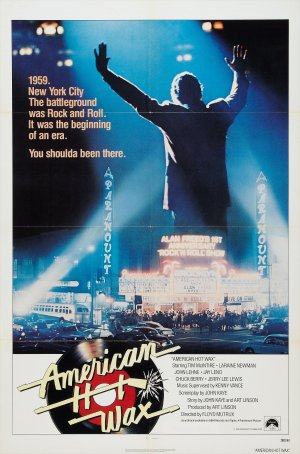
Tim McIntire As Alan Freed

Over the last nineteen years of my radio show, I have always ended with the phrase, “And in the immortal words of the late, great Alan Freed: This is not goodbye, it is just goodnight.” As a young man growing up Philly, obsessed with radio as many of us were, I was thrilled in 1978 when a biopic was made on the infamous Cleveland disc jockey who coined the term, “rock and roll,” Alan Freed.   A year earlier on a local UHF station I had seen the 1956 film, “Rock, Rock, Rock” that starred Freed, which encouraged me to go to my local library to read about Freed and his relationships with the artists he nurtured, the blacklisted music that he rebelliously played on air, and the eventual “payola” scandal that destroyed his career. So, even as a boy of ten, there was a lot riding on “American Hot Wax” in my mind, and I asked my dad to take me to see it in a downtown theater.

Before my review of the film, I should paint a more accurate picture of the 1970s for me as I mostly remember local radio, television, and film as being obsessed with the 1950s. Philly had been the home of so many doo wop groups that, even though the local FM airwaves were blessed with the sounds of Philadelphia International disco, the AM dial was firmly entrenched with the vocal harmonies of local groups such as The Penguins, The Moonglows, and The Five Satins, not to mention that young men were still vocal harmonizing these tunes on street corners. George Lucas’ nostalgic “American Graffiti” was getting regular screenings on television, “Happy Days” was a huge hit on ABC, and my sister, like so many of her age, loved “Grease.” I had indeed fallen into the nostalgia craze for a decade that I had never been a part of, which means that I was not privy to negatives of that time either, and most likely for that reason I was beyond thrilled seeing “American Hot Wax” when it was released. To be able to see the likes of Chuck Berry, Jerry Lee Lewis, and Screamin’ Jay Hawkins on screen in the days prior to our family being able to afford a VHS player was too mind-altering and to get some glimpse into that world where many of the songs I knew and loved were created was amazing to me, and regardless of where this review goes, I am so glad that those moments were put on film, especially given that Screamin’ Jay is no longer with us.

Over thirty five years later, I sat down and re-watched this film directed by Floyd Mutrux, and immediately noticed that it is shot in that same static, one camera style, similar to that of “The Buddy Holly Story,” which came out later that year, and frankly almost every television movie of that era. It’s amazing to me that a film so much about a man as it is about nostalgia would not go to the extra level of adding a visual technique to entrench it into its time period. The film immediately creates a feeling of frenzy and genuine excitement around Freed, as he goes through his hectic days leading up to the last live “rock and roll” show that he would produce in New York City. The actual Freed had been arrested in Boston months earlier for inciting a riot after he took the microphone during some unrest at a show he put on and said, “The police don’t want you to have fun.” “American Hot Wax” does make it abundantly clear that the establishment was not happy with Freed’s ability to encourage white teens to listen to sexually charged black music.

Tim McIntire does a fine job as Freed, playing him as written in history as a charismatic, intense man, who genuinely loved music and was excited to promote it, even spending his personal time with artists and signing some groups right off the street in front of WABC. Two actors whom I did not recall from 1978 and who were always at Freed’s side were his loyal secretary Sheryl, played by a less painfully annoying but adorable, Fran Drescher, and his driver, “Mookie” played by the usually unfunny Jay Leno. A real surprise in the film is the performance by then, SNL regular, Lorraine Newman, who does a great job playing the Carole King-esque Louise, an upcoming teenage songwriter who like King, wants to write for the young groups and is more than happy to stay out of the spotlight.
What is of course the real star of the film, is the very generous soundtrack, which in these days of over-inflated clearance rates for music will most assuredly never happen again. Not only are members of the cast covering many of the greatest songs of that era, but also there are the actual tracks from the 1950s that Freed played on the air. If there was ever a nostalgic moment that existed for me during this viewing of “American Hot Wax” was hearing these amazing cuts and knowing that the days of unlimited original music in film are all but gone.

Though the music is sensational (but not necessarily accurate at all times) the trade-off that “American Hot Wax” makes in terms of sacrificing narrative for a frenzied atmosphere is just too intense, and there is very little that glues this film together as far as story. For what the film captures as far as the intense hatred the establishment had for rock and roll, there is as little to take away about the actual life of Freed. There is a small moment of insight when his family painfully rejects Freed during a phone call back to his hometown of Akron, and another moment when Freed is denied the purchase of his dream home after he arrives with a group of racially mixed teens, but that’s about all you get. This failure in creating a whole character in Freed undermines what should be the emotional climax of the film, the first anniversary rock and roll show at the Brooklyn Paramount where Jerry Lee Lewis and Chuck Berry perform. The film, though not a total mess, was not well reviewed and did not do well at the box office when released in 1978.

“Alan Freed” Introduces The Brooklyn Paramount Show

Later in 1978, still riding on the heels of the 1950s nostalgia, was the sensational biopic, “The Buddy Holly Story,” on the legendary singer, songwriter, and producer which garnered a well-deserved Academy Award nomination for Gary Busey in the titular role. For me, The Buddy Holly Story is a kind of correction of the mistakes of “American Hot Wax,” as it never loses it’s main character while being as heartfelt and well-constructed as it is nostalgic.

Lily’s Fluffy And Crispy Banh Tieu

Standard

Lily grew up eating Banh Tieu almost every weekend. In Houston, it could be picked up at most bakeries and sometimes even in Vietnamese grocery stores.

However, in Boston, Banh Tieu is not quite as available. Because of the scarceness of Banh Tieu, Lily must make it at home! For Easter, she will show you how to make these fluffy pieces of fried dough covered in sesame seeds.

Remember to flatten the dough into thin discs; thinner discs will help make the dough puff up!

Enjoy!

Music: Sinfonietta, Op. 60 by Leoš Janáček

1972’s “We Won’t Grow Old Together,” The Second Unsentimental Feature of Maurice Pialat

Standard
we wont grow old together

Marlene Jobert and Jean Yanne

Please bear with me, as the first part of this review is a long overdue appreciation post for someone who should’ve received more credit for shaping the film scene here in Boston. Needless to say, 2008 was a tough year for the film here as Bo Smith, the 21 year Director of the Ruth and Carl J. Shapiro Film Program at the Museum of Fine Arts, left the MFA to head the Denver Film Society for what would sadly be less than a year. Bo revitalized a dying scene of truly independent and foreign film programming here back in the 1980s and nurtured the growth of a multitude of festivals featuring work from all over the world, including The Turkish Film Festival, The Boston Iranian Film Festival, The Palestinian Film Festival, and the festival where we first met, the inaugural 1995 French Film Festival. Though Bo was always consistently clad in the finest of clothes, he walked up to a grubby, skater shorts and ska t-shirt wearing Generoso after the screening of the ninth film I saw at the festival and asked why was I there. We then engaged in a lengthy discussion on the state of French cinema, which I guessed surprised him a bit because, between films, I was playing a lot of very loud reggae through my headphones. After that exchange, Bo would frequently stop by during the remainder of the festival and ask my opinion on what I had just seen, and in turn, during the conversations that followed, I grew my appreciation of his immense knowledge and love of cinema.

Cut away to 2003, shortly after the passing of Maurice Pialat, Bo curated a complete retrospective of the work of Pialat, a director he greatly admires and resembled himself as a director who also never seemed to be remotely concerned with the commercial success of his output. By 2003, I had only seen Pialat’s most well known film, 1983’s “A Nos Amours,” and although I admired it greatly, I had never seen the rest of Pialat’s work, so based on Bo’s suggestion, I attended all of the retrospective he put together. All, except the film that I am writing about today, 1972’s “We Won’t Grow Old Together,” which was recently screened at another of this area’s institutions, The Harvard Film Archive as part of a series entitled, “Furious Cinema ’70-‘77.”

More than almost all of the films in this series at Harvard, the word “furious” is most aptly applied to “We Won’t Grow Old Together,” the story of Jean (Jean Yanne), a film cameraman and his obsessive relationship with the younger woman whom he is having a bit more than a little rocky six-year affair with, Catherine (Marlène Jobert). Jean brutally lashes out at and reconciles so many times with Catherine that it borders on the comedic, and at times it even resembles a more violent turbulence that Albert Brooks’ neurotic film editor inflicts on Kathryn Harrold in Brooks’ 1978 film,“Modern Romance.” The plot of “We Won’t Grow Old Together” can be surmised easily. You are there, intimately watching a relationship spiral out of control, but this film is like so many of Pialat’s best works in that it is so much more than the plot. As film critic Kent Jones once explained:

“Even more than Jean Eustache […] Pialat was an irascibly private artist, charting a twisted, crook-backed path with each new movie, almost always emerging with works in which the mind-bending vitality of immediate experience trumps all belief systems, allegiances, plans. […] More than Cassavetes, more than Renoir, Pialat wanted every frame of celluloid bearing his name to be marked by the here and the now.

Jean is relentless in his unsavory treatment of Catherine and she is as relentless in her tolerance of Jean’s somewhat grotesque behavior to the point of insanity. The conflict reaches such a insane mess, that even Jean’s beleaguered wife Françoise (Macha Méril) calmly counsels her husband during about his frustration with dealing with Catherine. This bizarre treatment of this relationship is portrayed as it is with most relationships, romantic or otherwise, in many of Pialat’s films, and that is a portrayal that is completely devoid of a divisive plot or sentimentality. There is no hoping for an understanding between characters or even a moment off of the ropes; you are there to witness a few sensational actors destroy one another for the better part of one hundred minutes, and you are enthralled with the process, though this process was not always appreciated by Pialat’s actors. It needs to be noted that even after winning the best actor’s award for his portrayal in “We Won’t Grow Old Together” at the 1972 Cannes Film Festival, Jean Yanne castigated the film. “I think it’s a lousy story,” he said, in part, noting also, “If I’m any good in the part, believe me, it was completely involuntary.”

The Opening Scene Of “We Won’t Grow Old Together”

Similar to Gerard Depardieu’s character, Loulou and his treatment of Isabelle Huppert’s Nelly in the 1980 Pialat film, “Loulou,” your only recourse is to watch Pialat’s characters crack and get glued together over and over again and it’s this kind of elliptical style editing, which is a Pialat trademark, and this is also why you either love or hate his work. My feelings about Pialat’s work can be summed up by a conversation with Bo Smith  after the MFA retrospective screening of “Loulou” back in 2003.  Bo came up to me and asked me as what I thought of the film and I responded: “It’s a bit like the stab in the gut that Loulou gets in the middle of the film, Loulou takes it, it knocks him down, but soon he just sucks it up and moves on.”

Though it has been many years since Bo Smith has walked or more like bicycled through the streets of Boston, I will be a bit sentimental here unlike Mr. Pialat and wish him a long overdue thank you for all of the great films he brought to town.