Alice Rohrwacher

Standard

The eclectic World Cinema programming at the American Film Institute Fest is always exceptional, as year after year they have brought the most eagerly awaited new features from established talents who have consistently garnered prizes at Cannes, Venice, and Berlin, and this year was no exception as AFI Fest 2018 welcomed the newest and justifiably distinguished works from Nuri Bilge Ceylan, Hirokazu Kore-eda, and Jafar Panahi to name a few. As strong as the features were from veteran directors, what distinguishes the curation this time around was the work of some of the newer voices in international cinema, most notably the brilliant third feature by Italian director Alice Rohrwacher titled Happy as Lazzaro, which earned her a Best Screenplay award at Cannes. Amazingly, given that Rohrwacher’s first feature, Heavenly Bodies, was only released seven years ago, this 2018 Best Screenplay win for Happy as Lazzaro is not her first award at Cannes, as her accomplished 2014 feature, The Wonders, received that year’s Grand Prix.

Like The WondersHappy as Lazzaro shares that film’s timeless and naturalist core narrative of rural people who are out of sync with the modern world. Both films also interestingly utilize the talents of veteran actresses playing against type (Monica Bellucci in The Wonders, and Nicoletta Braschi in Happy as Lazzaro), and the two features both contain exceptional performances from the director’s sister, Alba Rohrwacher.

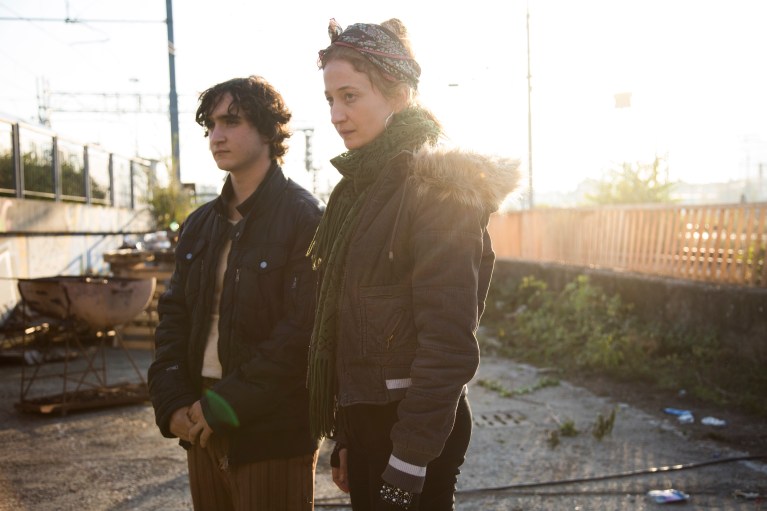
Happy as Lazzaro follows the titular character, a pure spirited man (played by the seraphic-faced Adriano Tardiolo) who works amongst a community of sharecroppers in the mythical town of Inviolata where they toil for a tobacco overlord, the Marchesa Alfonsina de Luna (Nicoletta Braschi). Through the use of organized religion and a certain amount of twisting of the truth, which convinces the workers that they are environmentally unable to leave their village, the Marchesa exploits the sharecroppers who are overwhelmingly unhappy with their situation, except for Lazzaro, whose unblemished soul allows him to complete his farming tasks without issue while he even becomes the unknowing victim of his already exploited community. Regardless of his treatment, Lazzaro lives beatifically in the hills above Inviolata until one afternoon when Lazzaro befriends Tancredi (Luca Chikovani), a young nobleman and member of the Marchesa’s family who wishes to remain separate from his people as well. Shortly after sealing their friendship, Lazzaro hides Tancredi so that this cynical privileged man can fake his own kidnapping to make some funds to escape his own predicament, but the subsequent search for Tancredi uncovers the ugly truth of the Marchesa’s activities, which have a ripple effect that forces the workers of Inviolata into the urban landscape, bringing them face to face with an even more grim reality.

I spoke with Alice Rohrwacher during AFI Fest 2018 about her meditative feature, focusing on her symbolic use of the Roman Catholic religion, her comments in the film on systematic exploitation, and the use of surrealism and the grotesque to draw attention to urgent contemporary economic and social issues.

• •

Q: After the family’s liberation from Inviolata, Antonia regales to Pippo on the bus a story of a saint and a wolf. You do not identify the saint as St. Francis of Assisi, but given the story, are we to assume that this is a reference to St. Francis’ experience with the Wolf who terrorized the town of Gubbio, and who St. Francis eventually appeased by offering it food from the very people whom it had terrorized? If it is a direct reference, then is what we see as the inability of Lazzaro to appease the wolf of the modern, urban society beyond Inviolata due to the fact that this wolf is an unnatural being?

A: There are many ways to explain this. Let’s say that Antonia only knows stories of saints. In fact, she is unable to tell any other kind of story, but somehow with the power of these narratives, she can bring us to another time. Of course there are references to the Wolf of Gubbio and St. Francis of Assisi, but I think that Lazzaro is a saint that exists outside of religion, so we can see similarities between Lazzaro and St. Francis, but I wanted Lazzaro to exist outside of that world. He’s almost prehistoric. He’s beyond a formal human era.

For me, in my film there are two religions: On one side is Roman Catholicism, and it is a very historical religion, and in a way, it is part of the problem in the film because it is an instrument that is being used by the Marchesa Alfonsina De Luna to keep the sharecroppers in ignorance. So, in Happy as Lazzaro, the Catholic religion is a very strong force over people, but there is another religion in my film, a religion of the people who believe. It is the religion of innocence, and there is no name for this religion — it is just the belief that human beings have in other human beings, so in Antonia’s story, you can see how the individual names of these saints could be connected, but there is not a direct reference.

Q: What I find interesting in your film is that the exploitation comes from the sharecroppers as well as the Marchesa, suggesting that exploitation and even cruelty is an essential part of natural existence, and here I am thinking of the moment when Pippo is being teased when he was a child that his mother committed suicide because of how ugly he is.

A: I wanted to establish that there are behaviors that are good and bad in this film, and we cannot simply make the conclusion that the peasants are good and the Marchesa is bad, as this kind of exploitative behavior is like a chain effect in that the people who are being exploited will occasionally seek out others to exploit who they feel are beneath them, but sometimes there are miracles because, in this ugly cycle, there are people who remain free of this need to take advantage of others, and they are considered by their peers as fools, but maybe they are in fact, saints.

Q: In terms of the geographic change that occurs in your film from a rural to an urban landscape and how that change plays out as far as the behavior of your characters, do you suggest that nature provides a protection of sorts for innocence? I ask this question as I feel that your film, in terms of its message, has a kinship with Lee Chang-dong’s most recent feature, Burning, in which two of the protagonists, both rural characters, find themselves in Seoul for different reasons, and the various challenges of urban existence and their inabilities to react quickly enough play out in tragic ways.

A: From one side, I think that over the last fifty years the world has changed in such a dramatic way that we are sort of stunned, and for that reason, we don’t acknowledge the good and the bad the way we used to — we just acknowledge the size of the change. Before all of this rapid change that has occurred recently, humans moved in conjunction with what had occurred in the eras before them, but now, like what happens to Lazzaro in my film, we seemed to have jumped from one era to another without any link to the past. Now, I am not saying in any way that it was better or worse in the past. I am not nostalgic, and as a woman, I have absolutely no desire to return to a time long ago, as it was even harder than it is now, even with the problems that the world is seeing today, to have been a woman in any point of the past, but I do feel a need to show to my children and the people in my life that something monumental has happened to humans, that we once had a common language somehow against enemies, that we now have passed from a social middle age to a human middle age. So, I think that if you were making a movie about this phenomenon you need to do it right now, because things are moving so fast that in a few years, even the storytelling language will be fantasy, and for that reason I feel that this generation is on the precipice of something, and we have to document this before we move on.

There is something available for these rural people to use in the city, as I show with the group from Inviolata finding the chicory to eat right by the squat where they live, so there is nature thriving in the city, but this isn’t as much about the urban environment making nature unavailable as it is about there being no place for innocence. I tried to create an atmosphere in Happy as Lazzaro that is timeless. When the sharecroppers are in Inviolata, they do not know about the outside world, and so they are able to maintain their sense of innocence, so they aren’t necessarily good or evil because the definitions of good and evil are not clear to them, but now that they have experienced the reality of the outside world, they have become skeptical, and I feel that my film tries to divide these two times. As for nature, it is always there, and it is consistent to all experiences, just like the wolf that you see in the bank and in the street with cars, you also see the plants that grow on the borders by the side of the train, but the problem is that people do not want to see it.

Q: As in the way the sharecroppers harvested tobacco for the Marchesa, but yet, could not identify the plants that they could easily eat in the area around them because they were never instructed in Inviolata on how to sustain themselves?

A: Yes, and because of being so insular in their environment in Inviolata, they ate only what the Marchesa gave them, so now, when living in the city, they only try and eat processed, packaged food that they steal.

Q: There’s something that I discussed at last year’s AFI Fest with your colleague, director Jonas Carpignano, when we spoke about his film, A Ciambra, regarding the dilemmas faced by rural people who are being thrust into more urban situations, that I’d like to discuss with you. There are moments in his film that, to me, conjure up memories of the Italian grotesque films of Ettore Scola, Marco Ferreri, and Lina Wertmüller. Specifically in your Happy as Lazzaro, there is also an absurd, but no less real possibility of people today living like the people from Inviolata, who are forced to live in city and have no choice but to squat in an abandoned oil tanker and who would have to steal an entire display of potato chips from a gas station to feed their group. Do you feel that these moments in your film appear because the dire economic and refugee situations that exist in today’s Italy, and throughout the world, mirror the era when the Italian grotesque films were being produced? Do you feel that given the extreme issues going on now, that a more exaggerated, almost surrealist treatment needs to be employed in order affect audiences, as the grotesque films did in the 60s and 70s?

A: I didn’t make any direct references to any particular scenes in those Italian films, but I very much do feel that, specifically how the platforms of most politicians have become so nightmarish, even yes, grotesque as their agendas are not based on what anyone would see as rational thought, so during this time, I truly feel that we do indeed need more surrealism in cinema to get people to understand their reality. For example, let’s look at the scene in (Happy as) Lazzaro when Nicola is selecting refugee workers to pick olives, and he is having them outbid each other so that he can select the workers who will work for nothing. The scene, as I created it, is done in an absurd, surrealistic manner, but in this desperate time, it plays out more realistically than a scene using realism. So, sometimes you indeed need to be grotesque to understand reality when the reality is this vulgar.

Q: Finally, this is a personal question, but it has been quite a while since we’ve seen Nicoletta Braschi in a film, and so my wife and I were thrilled to see her in Happy as Lazzaro. We love her work, especially her films with Jim Jarmusch where she plays wide-eyed, sweet characters. In your film, her performance as the Marchesa exudes a conniving insipidness that I have never seen her do in a film before. To my knowledge, she has never played a villainous role before, so why did you feel that she was right for this part?

A: I always love to work with great actors and to ask them to play against type, the way that we imagine them in our imaginations, like the way that I used Monica Bellucci in my film, The Wonders. So, for Nicoletta in Lazzaro, it was fun for me to have her play a villain because she almost always plays characters who are good spirited and sweet, like the parts she plays in Jarmusch’s films, so I felt that it added something intangible to her role as the Marchesa.
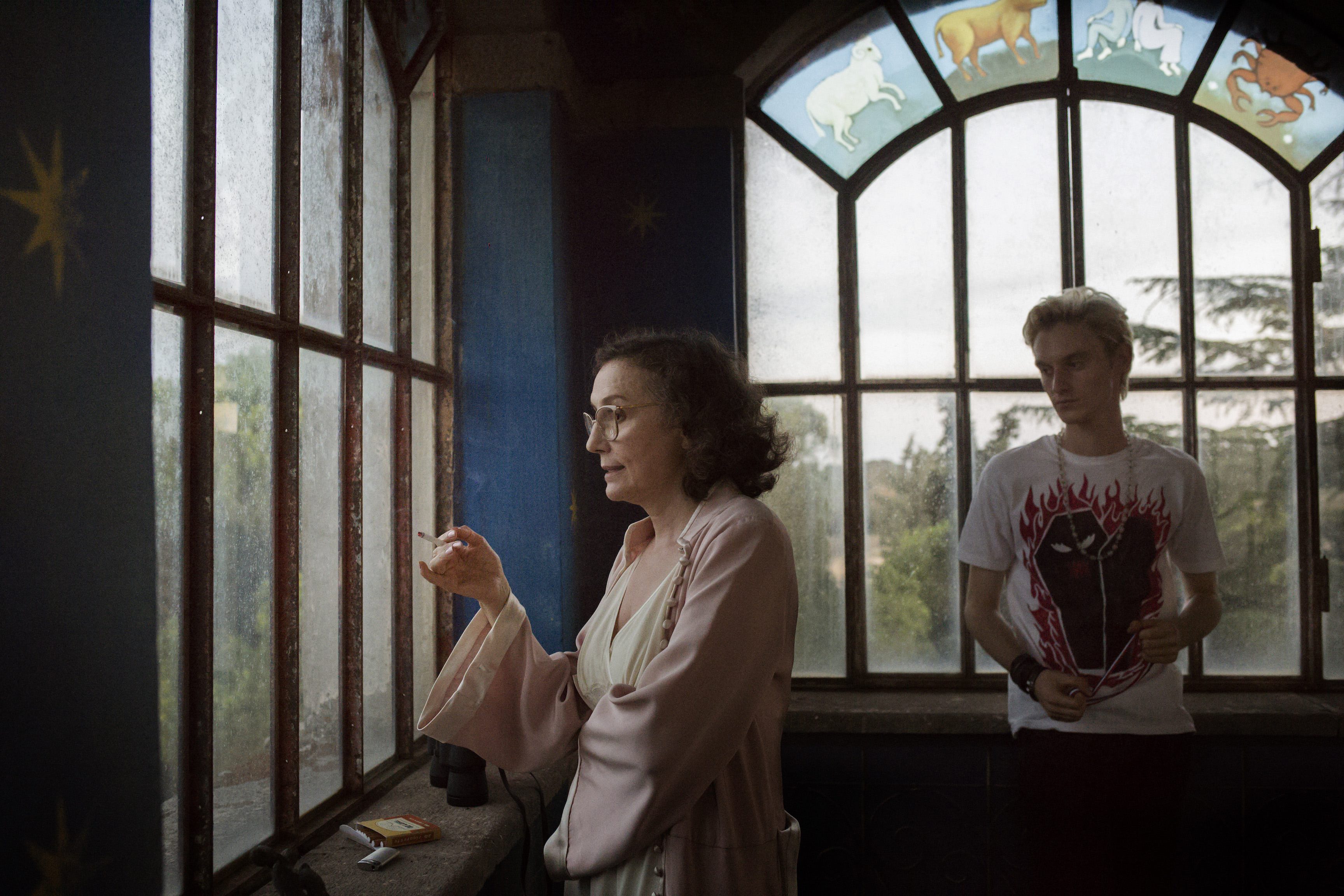
Nicoletta Braschi as the Marchesa Alfonsina De Luna, Credit: Cinetic Media

Special thanks to Rachel Allen at Cinetic Media for her valued assistance with this interview.

Happy as Lazzaro is available now on Netflix.

https://www.palacefilms.com.au/happyaslazzaro/

This interview was conducted by Generoso Fierro and was originally published on Ink19.com.
Tarik Aktaş

Standard

Year after year, AFI Fest, through their New Auteurs section, dedicates a substantial amount of their programming to the feature film work of new talents, whose usual port of entry into festivals that are this prestigious is through the short film programming. AFI Fest’s robust New Auteurs selections draw from works from all over the world, and in 2018, the amount of features that were screened in the section went up to eighteen as opposed to the eleven that were shown there in 2017, and in fact, two of our most appreciated films came from the New Auteurs section last year, both best described as having experimental narratives: Júlia Murat’s Pendular, and Joshua Bonnetta & J.P. Sniadecki’s El Mar La Mar. This year, our favorite film to come out of the New Auteurs selections was the confident first feature by Turkish director, Tarik Aktaş, Dead Horse Nebula, which to be candid, we also felt employed an experimental narrative construction like Pendular and El Mar La Mar, but after my conversation with Aktaş, I now realize that I was mistaken in a way.

Utilizing naturalist elements and a sparse, but effective amount of dialog, Dead Horse Nebula follows Hay (Baris Bilgi), who first experiences death as a boy by way of interacting with the titular deceased horse. As Hay stands in awe of the horse, he begins to poke at the rotting horse’s stomach and then witnesses the life that is subsisting within the animal’s organs, which creates a thought in Hay’s mind about the transitory/cyclical nature of death. The film then jumps to Hay as an adult, who we then observe having more interactions with death, and we see how these cumulative experiences and his memories of these moments shape his behaviors as he encounters more episodes dealing with mortality. Impressively executed in its 73 minute running time, Dead Horse Nebula succeeds by allowing the viewer to clearly examine the experiences of Hay, the passive protagonist, and interpret how Hay’s memories determine his future.

My lively and meditative conversation with Aktaş examines the director’s own particular method of production, his preference for working with non-professional actors, the challenges and rewards that choice presents, and his thought process for creating his central character.

• •

Q: I’ve been thinking about the pure definition of a nebula, a dark cloud that blocks light while forming an environment where stars and planets can form. If we are to assume that mortality is the dark cloud that shadows Hay’s thoughts, how then do you see that nebula allowing for Hay’s ability to grow in the world around him?

A: Actually, I never thought about the nebula as a darkness, but perhaps something that is just material that has no life, but in the end when it comes together, and there is an explosion, the planets are formed, which leads to organic life. In another way, regarding the material world, the incidents that we see also, through memory, shape this one particular soul. I have always seen the film as having two parallel motifs: one motif is for the material world, and the other is for the more metaphysical side.

Q: Hay first observes death with the horse, then partakes in death by way of slaughtering the sheep, and then faces his own death in the end. In terms of the construction of the film, how do you feel that his earlier experiences address Hay’s mindset on the construction site as he is almost killed while behaving a bit recklessly?

A: I think that death merely initiates his skill of observation. Death is of course important; it is something that is important for every human being because of its inevitability, and because of this inevitability, it is something that ignites a fire in someone’s character. If you look at Hay’s friends, for example, in the scene at the beach, they are concerned about the dead bodies on the sand, but not in the way that Hay is concerned, as they have a more ethical question, and ethics always emerge after reality. The reality is the boy’s lying dead on the sand, and then if you start talking about the ethics of the situation, it becomes something else, a way of reacting as we tend to do as human beings. Similarly, when we see the women in that scene crying, we understand that they are having an emotional reaction, but as you can clearly see, the effect overall is indeed very material. So for Hay, death is something material, but the emotional side of his reaction is somewhat lacking because of the previous incidents that he experienced, such as the way that he saw the dead horse—it was no longer a living animal, it was material, but from the dead animal, he saw life coming out of it. Of course, since he experienced the dead horse as a small child, he could not intellectualize the moment at that time, but he did find an awesomeness in the experience. There was a huge body, and it was dead, but when he saw the animal’s insides come out and witnessed the living parasites on the organs, he understood death produces more life, and this understanding carries through his perspective as an adult.

Q: Then, in terms of the perception of life, and here I am thinking of your film in contrast to Michelangelo Frammartino’s Le Quattro Volte, like Frammartino’s film, you have a naturalist setting, but in his film you witness a transitional progression of life from man to goat, from goat to tree, and then finally from tree to mulch, whereas in Dead Horse Nebula you see death as a looming obstruction more than a natural transition inherent in life. Frammartino’s film is about the circle of life in reincarnation, so death is not an obstruction, but again, in your film, even the removal of the horse takes on an element of conflict by having the need to blow the horse to bits in order to clear it from the field because it is a potential impediment to the community’s water source. Then, while slaughtering the goat, Hay almost dies from cutting the artery in his leg, and by the end, Hay takes the tree he and his friend have chopped down and brings its processed planks to a building site, but Hay almost dies working on it. So, to me, in your film, there is always this obstruction that appears in the cycle of life. How does that play into Hay’s perception of death?

A: I think that in our daily routine we mostly miss the point of death. Maybe this is just me who does this, but I am pretty sure that I am not the only one, but I see things, and I find some value in almost everything. For example, right now I am sitting in my hotel room, and looking at the curtains, I see a value there and that value is in the crafting of the cotton, and then I see agriculture in it, and then I see our civilization in it, and that is what I do. So, in our daily routine, no matter what our industry is, let’s say education or really any other work, there is always a meaning there. For Hay, this obstruction as you say, is like a veil between life and what life carries as a meaning, and for him that veil is becoming more invisible. At a certain point, when Hay sees the bird when he is hanging from the ledge in the construction site, he sees that bird as a savior, not that the bird could physically save Hay, but the bird is a savior because he looks into his eyes. The bird’s existence itself is already a savior for Hay.

Q: I find that very interesting as I saw the bird in that scene as something completely different. I wouldn’t say that I thought the bird was mocking Hay, but I interpreted that moment as one where Hay might feel that the bird’s natural ability of flight, which allows it escape the unnatural predicament that he is in where he could potentially fall to his own death on the worksite, is kind of taunting Hay, who killed the tree, a natural material, which has now become the structure that might end his life.

A: That is not too far from my point then if you feel that the bird is mocking Hay in that situation, or mocking death to be more specific, because Hay already has already confronted death, so he will not be so sorry if he dies, and he shouldn’t be, given what he has seen so far in his life.

Q: This is your first feature Tarik, and it has been described as having an experimental narrative, but compared to your short film work, Dead Horse Nebula seems to have a more conventional structure, especially visually.

A: Indeed, my early short film work has much more of an experimental nature than Dead Horse Nebula does. And although I do understand why you might call my feature experimental, I myself would not call it that. My short films use elements of illustration, and I incorporate small fragments from very well known movies and other found footage to build up a narrative. I am fortunate as when I made them, they soon were accepted to national film festivals and then to international festivals. But again, about Dead Horse Nebula being experimental, or why does my feature have such a structure? I will say that my next feature will possibly not have have a structure like this film does in its fractured, fragmented sense of time. As I see it, reality is completely fragmented, at least in terms of memory, for when you try to remember moments, you rarely to never remember them chronologically. You might remember a sound or an emotion, or a smell, so there is an illusion in your mind that you remember that day, but in reality it is very fragmented, and your brain combines these pieces, and that combination becomes your memory, whether you are fond of that memory not, and that is why this film has this structure.

Q: Narrative structures similar to yours are normally assessed as works of “dream logic,” but I appreciate that in your film, you are trying to replicate the narrative through the way we recall memory. Will you further explore this kind of narrative with your next feature?

A: This might sound even more abstract, but my next film will be about what I mentioned before, and that is the “veil.” So to explain further, Dead Horse Nebula is about, “seeing,” and more specifically, when the veil disappears. In my second feature, you will understand how to move once the veil vanishes, so it is then about movement and the will to do it. In Nebula, Hay is a very passive character. He just observes, but in the next film, the character, though not in the very beginning of the film, will begin to learn how to move to change his fate.

Q: Not to dwell on this point, but Hay is, as you describe him, a completely passive character, but do you feel that any of his actions lead to his potential demise or to an implicit tie between the events leading up to his death?

A: I think these two things, passiveness and assertiveness, merge together, and by this I mean, that if you do something or if you do nothing, the nature of your action or inaction will lead to this conclusion. For example, Hay is not the one who says, “Hi friends, I have found a job for us. We will chop down this tree and sell it to this construction company.” Hay is just the friend of the person who is being proactive in getting work. So, when I say, “passive” or “active,” I am referring to a person who makes decisions, and in the case of my film, Hay is never the person who makes the decision. In the first edit, for example, I had Hay asking, “Why don’t we go fishing tonight?” to his friends, but of course, I edited that moment out of the final cut because it shows Hay as being more of an active participant than he really is.

Q: I must ask then, how did that moment of proactive speech come about in the earlier cut?

A: That line came about from a motivation for the actor. You see, these are all non-professional actors. Baris Bilgi, who plays Hay, just a few months before shooting the film, was working as security guard in an apartment building. The characters were all played by my friends and family, so when Baris asked me, “Why don’t I ask my friends to go fishing?,” I said, “Sure,” because it was part of the process, since there was no script for him to reference. None of the actors in this film actually had to read a script. We would all just meet in the morning on location, and I would give them direction like, “Now, let’s cut down this tree,” and they would all say, “Sure, O.K.” We bonded so well because I started working with the actors three months before shooting, but I never actually rehearsed a scene with them because I wanted their natural reactions to come through.

Some directors, I feel, make a big mistake when they select non-professionals to be in their film, but then apply acting methods on them, which destroys the natural feel of their performances. So, I never discussed the movie with my performers. I never had them read the script so that they could simply focus on the physical activity that they needed to do that day.

Q: I really appreciate that method and your philosophy there Tarik. Almost twenty years ago, I was very fortunate to have interviewed Abbas Kiarostami, and he told me something that I keep with me to this day. I asked him if he still preferred to use non-professional actors, or if he was unable, since the revolution in Iran, to find actors whom he really wanted to work with on his films? As a response Abbas asked me, “Do you know the game of polo?” and I said, “Yes,” and he said, “Well, in polo you are on the horse, and you are supposed to control the ball, correct? But, the ball is always in front of you, and that is why I insist on using non-professional actors.” I didn’t understand it at first, but it soon became clear. You must direct these performers, but the flow of movement and of the pitch will send them places that are more natural, even with your direction.

A: Yes, exactly. But, do not get me wrong as everything on Dead Horse Nebula was indeed scripted, and in this film, as was the case in my short experimental films, I draw up storyboards for every scene. Everything that you see onscreen has been scripted and drawn up prior to filming. Let’s take the scene where the Ömer character delivers the monologue where he talks about the time when he almost drowned in the sea. Well, that scene is a mixture of Ömer’s own memory and mine. There was a moment like that in the script, but the scene came about as such: I told Ömer that in the scene, “You need to come up with a memory of your own, so what can you recall that involves this moment and that moment?” I gave him the keywords, and we made the scene happen together.

Q: I am not sure if he continued it throughout his career, Tarik, but, to me, your method is somewhat similar to what Mike Leigh did with his 1996 film, Secrets and Lies. Leigh would take Brenda Blethyn and Marianne Jean-Baptiste to the shoot location, and before a scene would start, he would hand the actors each a slip of paper that would have written on it, something to the effects of, “This is your mother, who you are meeting for the first time.” And then, they would have to improvise the scene from there. How did your method come about?

A: In my art school, we also had an acting department, but even with that talent there, I always used my friends or family to act in my short films instead because I could place them on the frame wherever I wanted to place them. You just cannot take how the acting should be done for granted, more specifically, what kind of acting does your film require? Perhaps in my second feature, I will need professional actors, but as a director you have to think about it, and truthfully, I am not sure if every director thinks about the kind of acting their film needs prior to shooting. For example, we can see the difference between a director’s approach to the camera: the framing, the lighting, but we usually don’t focus in on the director’s choices for the acting.

As you mentioned Mike Leigh, you can see how realistic the acting is in his films, and I recently showed one of his shorts to my students, and it really was incredible, the acting in his films, especially the flow, and I feel that filmmakers are indeed using this powerful kind of tool in their work, and that has always been my approach, and I have never thought about acting differently.

Q: Once you have selected the type of acting you require, and given that you, at least for this film, preferred a more natural reaction from your performers, did you then only rehearse a scene on location?

A: Since I didn’t want them to overthink the scene, the only rehearsal that took place was on location. In Dead Horse Nebula, there are two or three monologues that take place, and like I stated earlier, I only give keywords, and those words are incorporated in the dialog, but what is really open for improvisation is the structure of the sentences, which I feel is important, as it is necessary for the idiosyncratic aspects of the Turkish language to come through.

Generoso: Thank you very much Tarik, and best of luck on your next film.

Tarik: Thank you so much. This was a very nice experience.

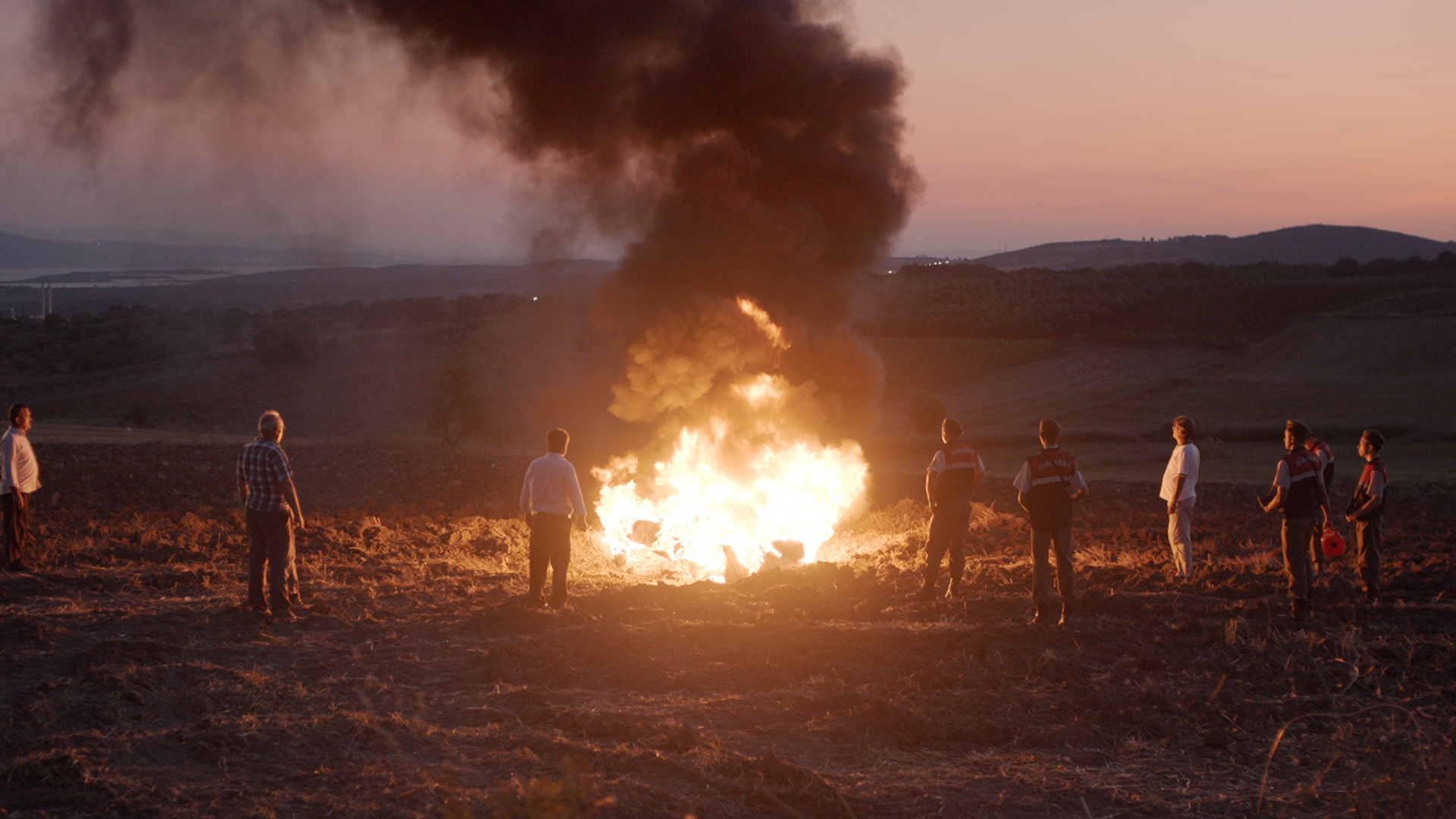
Still from Dead Horse Nebula, Credit: AFI Fest

Thank you to Johanna Calderón-Dakin for her valued assistance in making this interview possible.

Featured image credit: AFI – Manny Hebron

This interview was conducted by Generoso Fierro and was originally published on Ink19.com.
Tyrel

Standard

Tyrel is directed by Sebastián Silva and stars Jason Mitchell, Christopher Abbott, Michael Cera, Caleb Landry Jones.

There are a multitude of clever, small tension-building mechanisms at play in Sebastián Silva’s newest feature, Tyrel, which due to the specific casting, will of course draw comparison to last year’s Get Out, but here, what will become the strongest generator of tension is our concern for the outcome of the main character based on our understanding of what can occur in Silva’s work, which is usually aimed at challenging the ethos of Americans who consider themselves progressive. Specifically here, I am thinking about Silva’s controversial 2015 feature, Nasty Baby, which had as its protagonists, a gay couple who wish to have a child, joined by their female friend who is acting as their surrogate mother, and the grief that they endure and the action that they regrettably take once they are threatened.

In fact, the Chilean-born Silva, in his relatively short career as a director, has had his way in poking sharp holes into the American left’s perception of their own racial and social tolerance, tolerances that are usually coupled with the image that we hope to present to others as non-ethnocentric beings. Usually, Silva attacks this image by portraying the affluent left as a group who will invariably betray their deeply held beliefs the moment their safety is threatened, or in the case of the narrative of Tyrel, when a copious amount of alcohol or mind altering substance is in play, which was also the case in another of Silva’s features, Crystal Fairy & the Magical Cactus, which starred the director’s favorite ugly American, Michael Cera (actually Cera is a Canadian, Sebastián). We’ve been on these finger-pointing excursions into the American left with Silva before, and with those cinematic experiences firmly implanted in our memory, we are about to meet Tyler.

Jason Mitchell is Tyler, or Tyrel, as he is called in a misunderstood introduction, the first micro-aggression committed against our protagonist by a friend of his friend Johnny (Christopher Abbott), who is taking Tyler up to the scenic mountain home of an old Argentine friend, Nico (Nicolas Arze), for a brotastic weekend to celebrate the birth of Pete (Caleb Landry Jones from Get Out), another of Johnny’s friends. Tyler, who is heading to the country to avoid the familial intensity stemming from his girlfriend’s sick mother’s decision to reject dialysis treatments, is now going to be the new guy and the only African-American on this retreat surrounded by Johnny’s old buddies, which will naturally make him feel out of place, but the many possible sources of uneasiness is what is key here: How much of the general awkwardness that Tyler seems to feel is coming from just being in a house of strangers? How does this discomfort change with those strangers’ growing level of intoxication? With their awkward insensitive racial remark? And perhaps, with the overall need for any group of animals, humans or otherwise, to test the new being in the group by seeing how far they can push him? What will send the friendly Tyler into a rage? Adding into the tension is the setting of a comfortably snowed-over Martha Stewart-ish winter home, complete with Christmas light adornment, a home that might potentially be a blackout away from a setting closer to John Carpenter’s claustrophobic horror classic, The Thing, with the invasive alien entity being replaced by the time period of the film, the winter after the 2016 election that won Trump the White House, which was the culmination of a campaign that we all know caused more violent verbal riffs about race and class than any campaign in recent U.S. history.

What becomes apparent and admirable about Silva’s construction of characters and situations in Tyrel, a construction that is intended to have the audience gyrating in their seats as they fear the oncoming conclusion, is that given recent films like Get Out and Silva’s own filmography, the director can reference a plethora of moments to bombard you with cinematic cliches that you will immediately recognize as beneficent. You get the overly sympathetic gay man in the group, who will of course side with Tyler, and the kind hearted foreigner (the Sebastián Silva stand-in) who provides outside wisdom of how the world truly is, and who will try in vain to explain the way it should be to counteract the vulgar utterances dispensed by the drunken Americans in the group, who will of course team up against our beleaguered hero Tyler, who at one point is even put to the ultimate test of having to participate in a fate worse than death: an impromptu R.E.M. fireside sing-along of the group’s obnoxious hit, “Stand,” which in this author’s mind is a moment that should never occur in any free society that values basic human decency. Tyler’s reaction to this does appear like he is feeling out of place, and so he appears annoyed as many of us would, but is it really this particular outpouring of suburban white pride that is getting at Tyler, or is it something else rumbling under the surface?

A key moment that might shed some light on the answer occurs early in the film. Before any of the frenetic drunkenness takes place, Tyler leaves the home to find a cell phone hotspot to speak with his girlfriend, Carmen, who begs Tyler to stay on the phone and pray along with her and her family in Spanish. During what should be a solemn moment, we see Tyler looking disinterested and checking out prank videos on his phone and playing on Instagram. Juxtapose that with a moment later in the film when the bro gathering begins to scrutinize and then burn a bunch of religious paintings. In this scene, Tyler appears to become agitated again and is slightly calmed down by Johnny, who tells Tyler that there is no intended anti-religious meaning behind the burning, and that, in fact, burning items is just a common release for the group, suggesting that Tyler’s anger is less about Johnny’s friends entitled acting-out or blasphemous behavior, and more about how this moment of immolating religious imagery recalls Tyler’s own guilt for feigning interest during his failed moment of prayer with his girlfriend.

There clearly are moments in Tyrel where Tyler’s race becomes the brunt of jokes, and Silva does set up these scenes for the audience to create empathy for his protagonist and to drive the tension to build towards a dramatic climax, but we also see Tyler as someone who rarely cares about anyone else but himself throughout the entire narrative as well. Sure, he doesn’t want to (nor should he have to) partake in the R.E.M. sing-along, but why is he so adamant against playing ping pong? He is at a birthday celebration after all. And, why did he decide to go to a birthday celebration of someone he does not know instead of being with his girlfriend, who needs his support as she tries to cope with her mother’s grave and fatal decision? If Tyler does not want to be around this group of strangers, nor around his girlfriend and her family, where does he want be?

Thus, is Tyler’s alienation his overreaction to the mindless titular name mistake that begins the weekend with Johnny’s friends? Or, is he regretting his decision to spend a weekend hanging out instead of being with his girlfriend? Does being around Johnny’s friends bring out a nagging guilt about what Tyler has had to do in quashing his own identity to become a successful restaurateur, or is there simply nowhere that Tyler, or any person of color, will feel comfortable in this post-Trump election America? Tyrel does an amazing amount with its small and larger observations in its short 84 minute running time, and the film is a huge step forward for the always provocative Silva, who for the first time with his storytelling devices, leaves the target of the finger-pointing for the audience to determine.

Tyrel is directed by Sebastián Silva and stars Jason Mitchell, Christopher Abbott, Michael Cera, Caleb Landry Jones.

Tyrel is in theaters and available on-demand now.

http://www.tyrelmovie.com/

Written by Generoso and Lily Fierro, Originally published on Ink19.com

Failure, Success, and Life in Turkey: Özge Samanci’s Dare to Disappoint

Standard

When Marjane Satrapi’s Persepolis reached worldwide audiences, the book legitimized the graphic novel form as a medium for nonfiction, personal perspectives on historical events. With Persepolis, Satrapi materialized a subject we would expect more in literature than in cartooning, opening the floodgates for other autobiographical stories to emerge in graphic novels and to be taken with seriousness and read by audiences inside and outside of the comicbook world. But, despite this climate ripe for more “serious” graphic novels, few other autobiographical stories have received such broad appeal and even fewer have given glimpses into historical topics and cultural traditions bypassed by western media and schools.

Thankfully, within the last year, multiple graphic novels have risen to carry on the flame of history based stories told through a relatable narrator. Sonny Liew’s outstanding 2016 novel, The Art of Charlie Chan Hock Chye, employs a fictional memoir to recount an unbiased view of the modern history of Singapore, and Özge Samanci’s 2015 release, Dare to Disappoint, gives us insight into the cultural and political of landscape of Turkey during civil war, martial law, and afterward.  

When you open Dare to Disappoint, you may have the temptation to draw parallels between Samanci’s work and the seminal Persepolis, but let me prevent you from doing so. Do both document the effects of cultural and political turmoil on a person? Yes. Can both books be classified as a Bildungsroman for women? Yes. Do both look at the Islamic fundamentalism? Yes. Are both autobiographical? Yes.

The two books have a substantial amount of content in common, but Dare to Disappoint has four factors that distinguish it from Persepolis: its tone, its visual style, its setting, and its narrator’s journey of maturation. Consequently, silence any initial instincts to dismiss Dare to Disappoint as a Persepolis wannabe because if you do not, you will miss out on an intimate view into Turkey in the 1980s and an encouraging tale for adolescents to think for oneself.

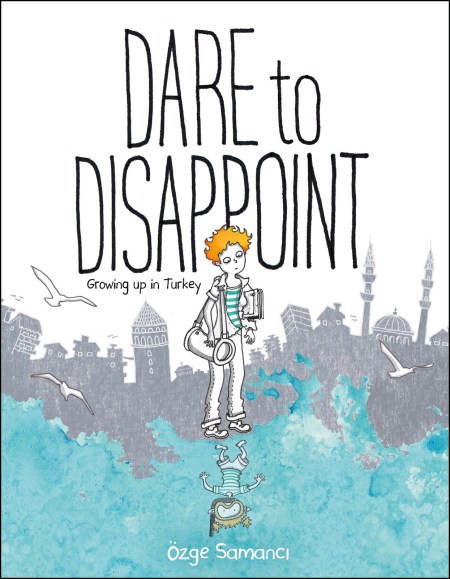
Cover for the light-hearted and relevant Dare to Disappoint

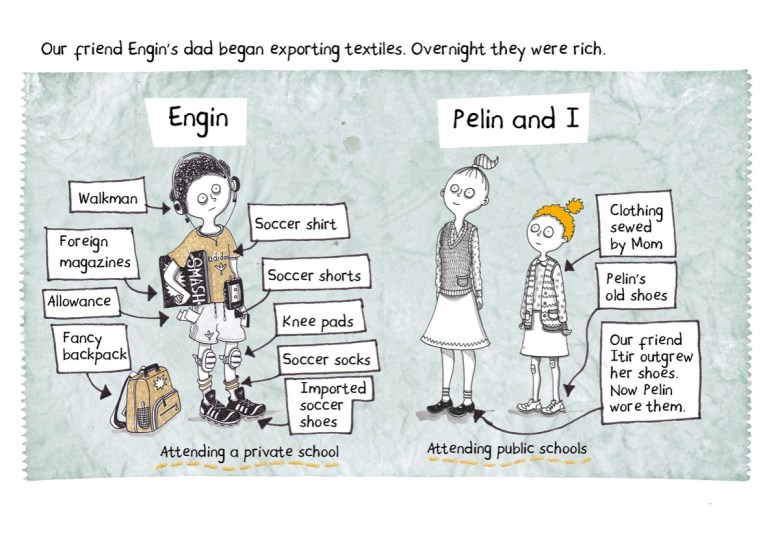
In Dare to Disappoint, Samanci captures the familial and societal pressures for professional success in a culturally repressed world and how all of those forces can influence and shape growth from childhood to adulthood. In under 200 pages, we see Samanci transform herself based on her desire to please various people in her life. Her teacher, Atatürk, the first president of Turkey, her father, and her sister all impact Samanci’s decisions throughout childhood and adolescence; the satisfaction of others takes first priority during these formative years. Even though Samanci has a wildness in her spirit that stems from her mother’s side, she mostly represses her desires to see the world and sea like her idol Jacques Cousteau and to work in the arts. As a result, by the time Samanci prepares to attend the same prestigious college as her sister, she has little self-confidence and possesses almost no understanding for what she really wants in life.

After continuing to follow the standards of others into adulthood, Samanci finds herself with a math degree she has taken too long to complete and a failed attempt to get a drama degree. Doing what will garner oohs and ahhs from neighbors and extended family has led her to failure in multiple ways, and ultimately, no one is happy, especially Samanci herself. Fortunately, failure tends to awaken a person, and by the end of Dare to Disappoint, Samanci finally realizes that thinking for herself has more value than her current course of conforming to the expectations of others; even though making her own decisions may lead to failure and disappointment, the disappointment in herself weighs heavier than the disappointment of others, especially since they will most likely be disappointed regardless, which she sees through everyone’s disappointment in Pelin, Samanci’s sister who graduates with a praised degree in engineering from the best school in Turkey but does not succeed in the field and works instead in a bank.  

As Samanci progresses, we see the changes happening to the Turkish political and cultural climate woven into the story of growth. Samanci’s observations on the severity of Turkish government on the daily lives of the nation’s citizens grow in depth and acuteness as she develops, and through these comments, we receive a perspective into Turkish history delivered without an overburdening omniscient narrator or a cold, sterile textbook presentation. This personal approach makes the understanding of Turkish history richer and more enjoyable. Occasionally, Samanci’s visual and tonal playfulness borders on the edge of too light, making the illustration of some moments in Turkish history feel far too jovial to be considered as an example of irony (one glaring case is the silliness of the drawings of the killings of the civil war between the liberal left and conservative right and the resulting military coup), but overall, the style effectively conveys the self-effacing nature of Samanci’s reflection on her own life.

With its vivid and lively visual style that mixes cartooning and artwork synthesized from images of real objects, Dare to Disappoint will appeal the most to teenagers, but it also has value for adults in its perspective on Turkish history. If you look at Dare to Disappoint and expect to find Persepolis, you will not get what you hope for, but that is not necessarily a bad thing. Samunci’s Dare to Disappoint centers itself more on the road to failure via the desires of others and the realization of this truth, making Samanci’s path to adulthood far different from that of the strong-willed and impassioned Satrapi. Both novels inspire; both inform; both offer complex views into cultural and political change. They just take different paths to get to their final messages of enlightenment.

Created by Özge Samanci, Dare to Disappoint is available via Margaret Ferguson Books.

Matías Meyer

Standard

Originally published on Ink19 on July 14, 2016

Interview conducted by Lily and Generoso Fierro

On June 17th and 18th, the UCLA Film & Television Archive presented the first complete retrospective on the work of emerging independent Mexican filmmaker Matías Meyer. The retrospective collected the short films across Meyer’s career, including his first films made as a student at Centro de Capacitación Cinematográfica, and his four feature films, with his most recent film, Yo, receiving its US premiere on the opening night of the series.

In all of Meyer’s films, voyages frame the narratives for both the characters and the viewers, and in each voyage, the environment and the characters have a tacit yet well-understood relationship with each other, moving in a fluid call-and-response way to the presence of one another. As a result, the environment is as much, if not more, of a character than the people in Meyer’s films. With the exception of his most recent short, which was filmed in Meyer’s current half-home of Quebec, Le champ des possibles (“The Field of Possible”), the director’s focus is committed to the ever-changing environment of Mexico, whether looking at its past, as seen in his documentary, Moros y Cristianos (“Moors and Christians”), about the largest open-air group presentation in all of Latin America, a re-enactment of the 16th century Battle of Lepanto, and his most ambitious narrative feature, Los Últimos Cristeros (“The Last Cristeros”), set during Zapata-era Mexico, or its present day, with films like Wadley, an experimental view into one man’s journey through the wild Mexican landscape, and Yo, which, based on our conversation with Matías during the series, is his most personal film to date.

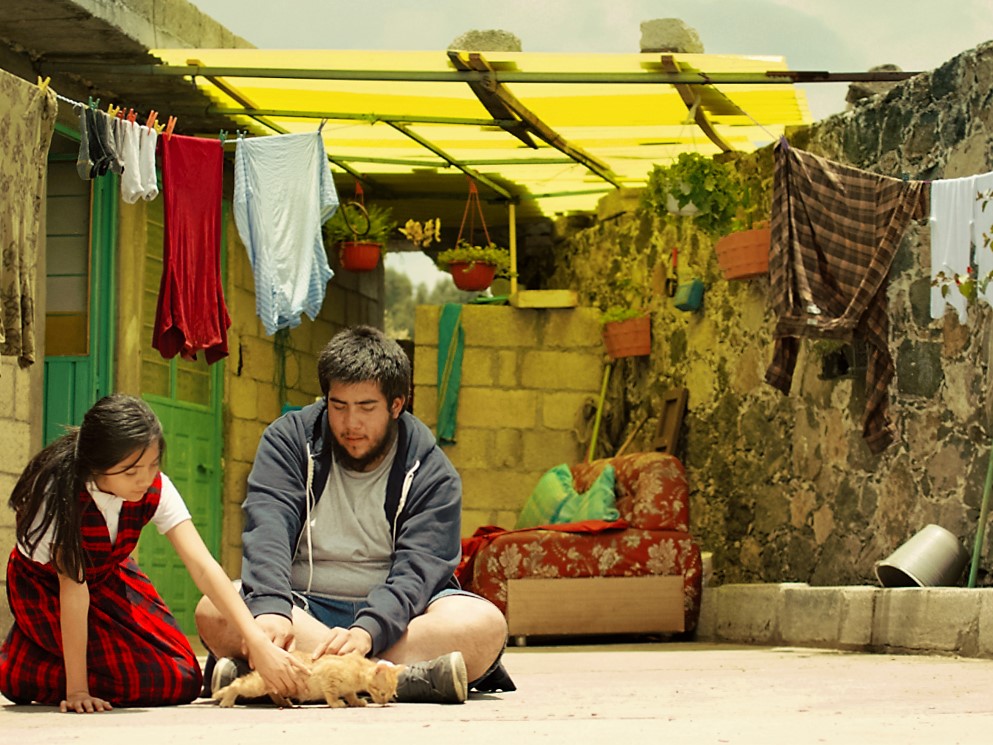
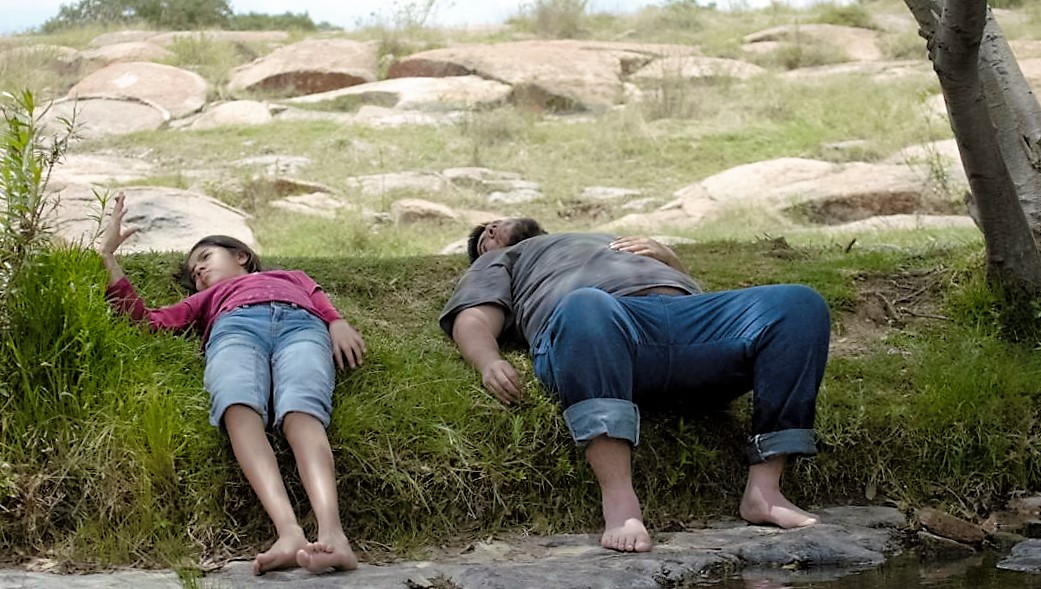
Yo refers to the title character (played by Raúl Silva Gómez), a large man in his early twenties who we soon realize is functional, yet developmentally challenged, and as thus, he remains in a state of perpetual adolescence. Yo is under the care of his mother (Elizabeth Mendoza), and they both live and work at the family restaurant where Yo has the unenviable task of slaughtering and plucking the chickens that they serve. Also residing with Yo is his mother’s lover Pady (Ignacio Rojas Nieto), a brutish man in his fifties who has a tendency towards being abusive towards Yo, which seems to have become so commonplace that no one in the house raises any concern, including Yo, who seems content with his menial tasks and chances to play with his coins on the floor of the restaurant and goes unnoticed to the patrons as though he is a piece of furniture, a trivial part of the restaurant setting. This is the first moment that one notices humans’ interactions with their surroundings, a key element in most of Meyer’s previous work.

Furthering this motif of man’s reaction to his environment, man-made or natural, are the moments when Yo, who takes great joy in watching the giant tractor-trailer trucks that tear through his normally serene Mexican village, becomes plagued by nightmares of the local river dangerously overflowing, which wakes Yo from his sleep and forces his mother to reassure him by taking him to the still, placid river in the middle of the night. Even though Yo’s mother turns a blind eye to the abuses in the home by championing her lover over her son, she is still overprotective of Yo when it comes to how he might function outside of her grasp.

With business in the restaurant improving, Yo’s mother hires a woman to help her out who must also bring her eleven-year-old daughter, Elena (Isis Vanesa Cortés), to the restaurant everyday. Elena and Yo immediately become friends, but with this newfound friendship comes a layer of tension for the viewer as Yo, who has had limited interactions with women, may not have the emotional maturity to control his sexual impulses. Yo and Elena take frequent trips to the nearby river together and play with one another in a flirtatious way, but Elena, who seems beyond her years in maturity, deflects any casual advances from Yo. Though Yo is twenty-two, these moments with Elena are most likely his first foray into society without the guarded eye of his mother there to establish order. No one has gotten hurt, but soon Yo will be forced to face the outside world head-on when Pady purchases a machine that can handle Yo’s singular chore of killing and plucking the chickens for the restaurant. Pady then calls in friends to get Yo work hauling rubble at a local construction site, so Yo can begin the process of becoming an adult away from his mother’s daily reach.

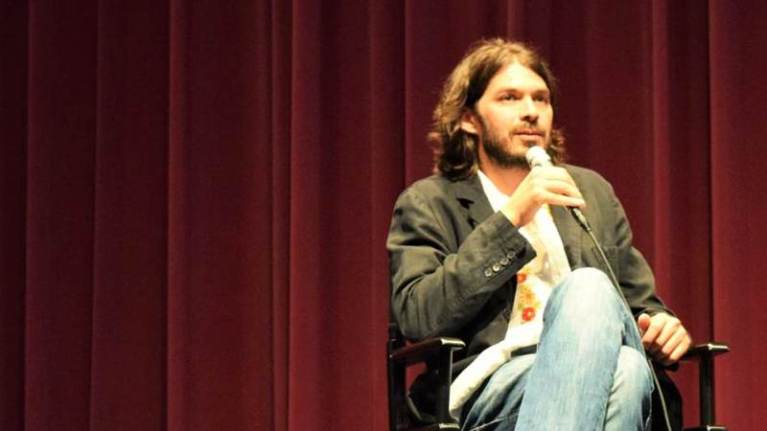
Matías Meyer

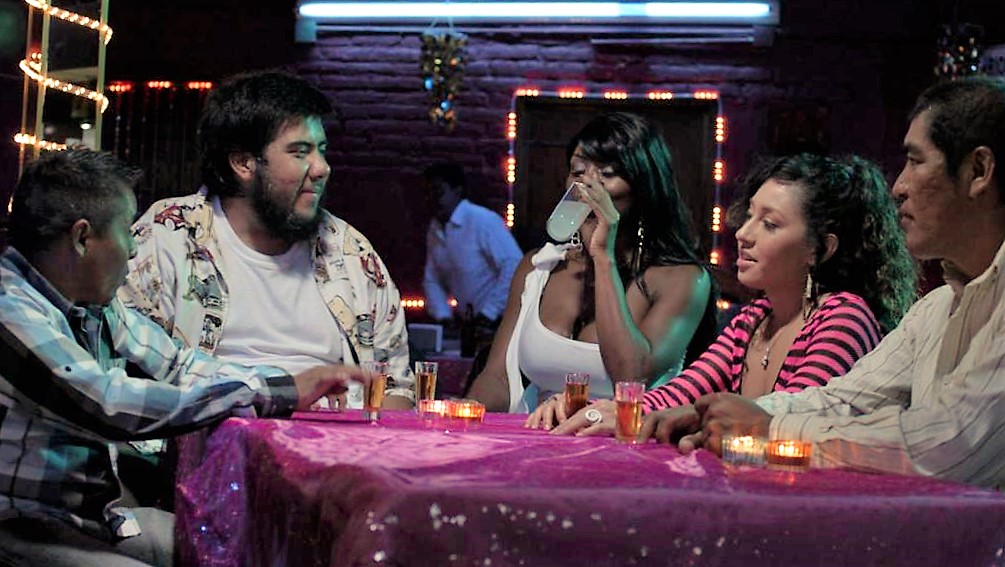
Once on the construction site, Yo does hard physical labor and is up to the task, much to the delight of his co-workers and his supervisor. Yo even makes friends at his new job, friends who expose Yo even further to mainstream society as they introduce Yo to the vices of alcohol and prostitution. Whether Yo’s newfound friends are laughing with him or at him, they welcome him as part of their group and take him to nightspots where Yo again blends into his surroundings without appearing too out of place, but just like the river that Yo imagines overflowing, how long will his inner peace remain intact given the ever changing environment around him?

As opposed to Meyer’s previous feature, the Zapata-era film, Los Últimos CristerosYo is a fairly modest production that involves a small amount of actors, the usual use of the set, one-camera shot for most scenes, and a few locations, but like his previous feature, it utilizes the spacious natural terrain of Mexico to cleverly further the development of the film’s central characters. The tension that Meyer creates with his character of Yo and his disenfranchisement with his surroundings is palpable throughout the film in the same eerily quiet and ominous way that Iranian director Jafar Panahi presents in his equally marginalized central character of Hussein, the beleaguered and impoverished pizza delivery man who wanders through a unwelcoming Tehran, in his 2003 film, Crimson Gold. As in Crimson Gold, an excellently crafted level of tension is what drives the narrative even during the most tranquil of scenes, which provided the main reason why we were so completely engaged with the film.

Impressed by Meyer’s achievement in his fourth feature, my wife Lily and I were fortunate enough to sit down with the young director to discuss his work the day after attending the screening of Yo at UCLA.

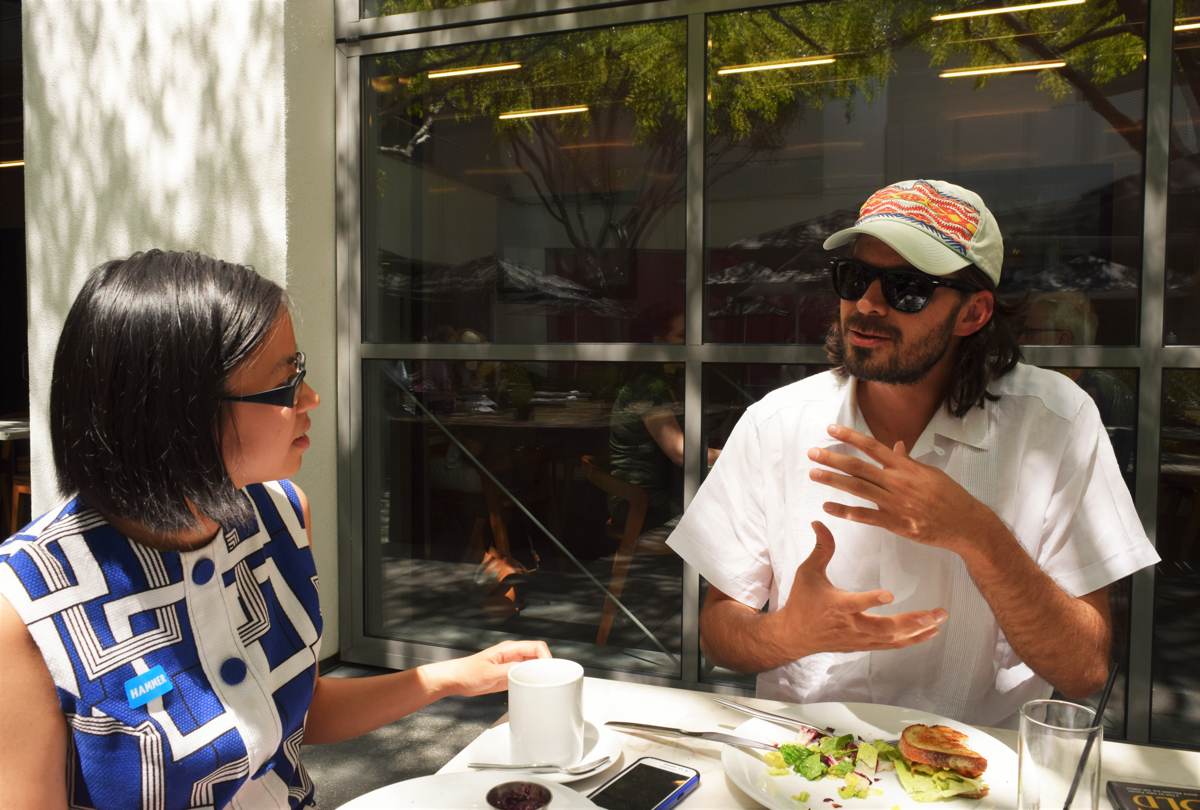
Director Matías Meyer speaks with Lily Fierro at the UCLA's Hammer Museum
PHOTO BY GENEROSO FIERRODirector Matías Meyer speaks with Lily Fierro at the UCLA’s Hammer Museum

• •

Lily Fierro : Last night, during the premiere of Yo, you spoke about the invisibility of Mexican cinema. In your answer, you had mentioned that some of your fellow directors believe that making films more specific to what audiences want, is a solution to this issue. You said that this would not be your own approach. In what way do you think that Mexican filmmakers can make films that capture Mexico’s landscape, culture, and tradition without concern that foreign audiences may feel alienated?

Matías Meyer : The thing is in Mexico City, recently, there was the Mexican “Oscars,” called The Ariel Awards, and we went to the ceremony and saw the famed director Paul Leduc, who was receiving a Golden Ariel for his career, make a speech for fifteen minutes that focused on the invisibility of Mexican cinema. The government is very proud to say that they have produced one hundred and fifty films a year, and he responded by saying that yes, but no one ever sees them. He then said something that really registered for me, and that was, “Mexicans do not really want to be Mexican. Culturally, they are more into the American cultural empire.”

I myself, grew up in a small town in Mexico, and for most young people, it was about wearing Nikes to be more like Michael Jordan or about American football and Deion Sanders, so it was more about this part of American culture. So, you have this American dream, about how cool it is to live in the United States, and for entertainment and films, you have the Rambos and the Commandos that you watched on television, but on the other side, you have the telenovelas, that are all about drama and class struggles. Mexicans are always watching television; even when you see a taco vendor in the street, they will have a small television, and if they are not watching sports, they are watching the telenovelas. So, the public has not been created for accepting other kinds of movies, which leads me to think that the problem is that the public has not been properly informed. I think that the bigger problem in Mexico is about education. Now, there is a large movement of teachers pushing for educational reform, but the roadblocks are the syndicates and the political power of syndicates, so the whole thing ends up being not about learning and educating. I don’t know how we can fight against this problem; we can try to find a goal via entertainment, but I don’t believe that we can succeed.

I am working on a new film that I hope is less niche than the films that I have done to this point in the hopes of having a wide appeal, but I am not sure if I can achieve this. In the long term, perhaps showing more Mexican films on television is the solution, so Mexican culture, instead of American culture, becomes the norm on the most popular medium for people of Mexico.

Generoso Fierro : Given that Mexicans prefer television as their main source of ingesting media, does a place exist where arthouse cinema is still shown on a large screen?

Matías Meyer : There is in Mexico City, in Coyoacán, which is the area where Frida Kahlo used to live, a cinematheque that has existed for thirty or forty years that has just been remodeled. It used to have six screening rooms, and now, it has twelve. It is a beautiful place where you can have coffee, and there are even outdoor screenings that are free for the public. The theater gets about a million patrons a year, and if your film is there, it will definitely have an audience. I have just released Yo in Mexico City and six other cities, and to this point, five thousand people have seen the film, and the cinematheque represents forty-five percent of that total viewership. As far as the other theaters that have shown it, they have pulled it after one week, so films like this shouldn’t be at a multiplex; they should be screened at arthouse cinemas, so we really need more of them. Mexico City has twenty five million people but only one arthouse theater, so the need is there for more cinematheques in not only Mexico City but in the other cities and villages as well.

Lily Fierro : Could you speak about the origins of Yo?

Matías Meyer : Yo was made right after Los Últimos Cristeros (2012), which is the biggest film I have made until now. That film is a western that is set in the 1930s during the revolution, which was a labor-intensive process, so after its completion, I was looking for a different kind of project. One day, my mother gave me this book by Jean-Marie Le Clézio, and she told me that it was a collection of short stories and that there was one story that she felt that I might like, and she was correct. Even though I liked all of the stories, there was indeed one story that I wanted to adapt and see onscreen and that was the story called “Yo”. Also, these days, whenever I think of a film, I immediately take into account the production concerns, which ultimately makes me ask myself the question: Am I going be able to make this film? Most of the story takes place in the restaurant and only involves a few characters, so the production would not be too complicated, and as Jean-Marie Le Clézio was a friend of my family, since he met my father while they were in their early twenties, he graciously gave me the rights to make the film. As “Yo” impacted me so heavily, the next day I contacted a screenwriter friend of mine in Canada and told him that this story would make a good film and that I would send it to him immediately. He read it soon afterwards and agreed that it would make an excellent film.

In a personal way, I wanted to make the film as I have a nephew who reminds me of Yo, as they have similar developmental issues, and my nephew was at the same point in his life where he was becoming an adult and was beginning to have a sexual attraction to other people. For my nephew and Yo, dealing with sexuality becomes so socially awkward because even if they have been presented with normal societal examples of how to deal with their feelings, they still have issues with their expressions of sexual desire. Besides the connection to my nephew, I also wanted to make a more narrative film as Los Últimos Cristeros is more about wandering and experiences, and with “Yo” I thought there was the potential for more traditional narrative structure and the opportunity to convey the anxiety that comes through in the story. There is a feeling of suspense that manifests due to unpredictable nature of Yo’s character that I also found interesting.

Matías Meyer

Generoso Fierro : Does the short story by Jean-Marie Le Clézio occur in France? What was the process of adapting an originally French story for Mexico?

Matías Meyer : I felt that the story was very universal. It is about this boy living with his mother on the side of the highway and his relationship with the little girl and the workers whom he comes to be with, so the film could’ve been shot anywhere. I knew that funding would’ve been easier in Mexico as opposed to where I live now in Canada, but I did write the script in French and translated it to Spanish because the co-writer is French-Canadian.

Lily Fierro : We were able to see two of your films yesterday evening that focused on sojourns into nature. The lead character in your first feature film, Wadley, exists entirely in nature as he escapes the city for the desert, and in your newest film, Yo, the titular character uses the the nearby river as a place to re-center himself, for it is a place of purity. But, does the river also represent the source of Yo’s essence of being, where he is more of an embodiment of nature than others?

Matías Meyer : I think that is a good interpretation. I like to leave my films open to personal interpretation to allow the viewer to be more interactive and less passive with what is onscreen. There is the scene in Yo when the mother takes the girl Elena and says, “Where were you? I was very worried, and I do not want you going to that place again,” and Yo goes to the waterfalls, and there is the moonlight, and I don’t know why, but this scene reminds me of Percival from Le Morte d’Arthur. I had this memory from when I was a child of watching this film on television where Percival is showered with the blood of a dragon that he has slain and that blood will make him immortal. So, I don’t know why, but I felt that this scene always made me believe that nature is a mystical place.

Generoso FIerro : There is a level of mechanization that increases in Yo as he is haphazardly forced onto a journey to manhood. The chicken barrel displaces his role as a chicken plucker in his mom’s restaurant, and on the construction site, trucks and cranes appear and carry far more than any human can, foreshadowing the eventual mechanization of his job hauling construction excess. Simultaneously, Yo is encountering more men in his life, and they place him in precarious situations involving alcohol and sexuality. How were you thinking about balancing conflicts between the pure essence of male human nature and evolving environment?

Matías Meyer : In a certain way, I think that it is good that Pady, the man who is the lover of Yo’s mother, is a bit forceful with Yo because mothers can be a bit too protective of their children. So, I like that Pady pushes Yo, which forces will him evolve and to find his own place in society. In his mother’s house, Yo is never going to succeed, and I think that is part of the problem when you have a disabled child: that you, as a parent, become too frightened for them if they go out into the world.

Generoso Fierro : I think that you exemplify that point visually about halfway through in the film. There is a great shot where Yo is playing on the floor of his mother’s restaurant when Pady brings in the construction workers who Yo will eventually work for as Yo’s role in the restaurant has changed now that a machine has been brought in to pluck the chickens.

Matías Meyer : Yes, there is a position in nature, and there is also a place for human constructed spaces like the beautiful land near the restaurant that is violated by the highway with its cars and loud noise. There is this element of man against nature that I wanted to show: how the world that man has created is so noisy, which conflicts with nature, and how by immersing yourself in a natural setting we can find a more original state where we can live harmoniously.

Lily Fierro : Given your fascination with Mexico’s culture and your desire to depict it on screen, we have to address the non-secular elements of Yo. Specifically, Yo’s Madonna-Whore complex that plays out between the four main women of the film: his mother, Elena, Jenny, Luisa. You avoid idolatry in all of the settings, but elements of Catholicism are subtly portrayed through Elena’s parochial school uniform and in the music you use, especially in the club scene where a disco version of “Ave Maria” plays in the background. Do you see organized faith (or its integration into society) as being as much in conflict with the natural environment as rapid mechanization?

Matías Meyer : That disco version of “Ave Maria” is in the book, actually. There are some people who say that Roman Catholicism is a lie because the day that Christ is born is actually the shortest day of the year, so by doing that, they are associating astronomy with religion. And I respond with, “Well yes, but is that is the opposite of religion?” I personally don’t think so as Christ is the son of God, and you can see this with the use of icons, which only help us to identify more with faith. It is just a very intelligent construction of symbolism. So, I would never say that faith or religion is bad; it is what we make of it, the same as science, which you should never say is a bad thing. I come from a religious family, but I never went to church. In terms of faith, my father would read the Bible to us on Sunday night before we went to sleep, and for me this was perfect, and that is why I don’t have any issues with Catholicism because I was never forced to go to church, which I think is a terrible way to introduce faith to a child. It is better for your children to discover God in their own way.

Matías Meyer

• •

We would live to give special thanks to Matías Meyer for his time and for his generous responses during our interview with him, and to Shannon Kelley, the Head of Public Programs, UCLA Film & Television Archive, who made this series possible.

Official Trailer: https://vimeo.com/151978177


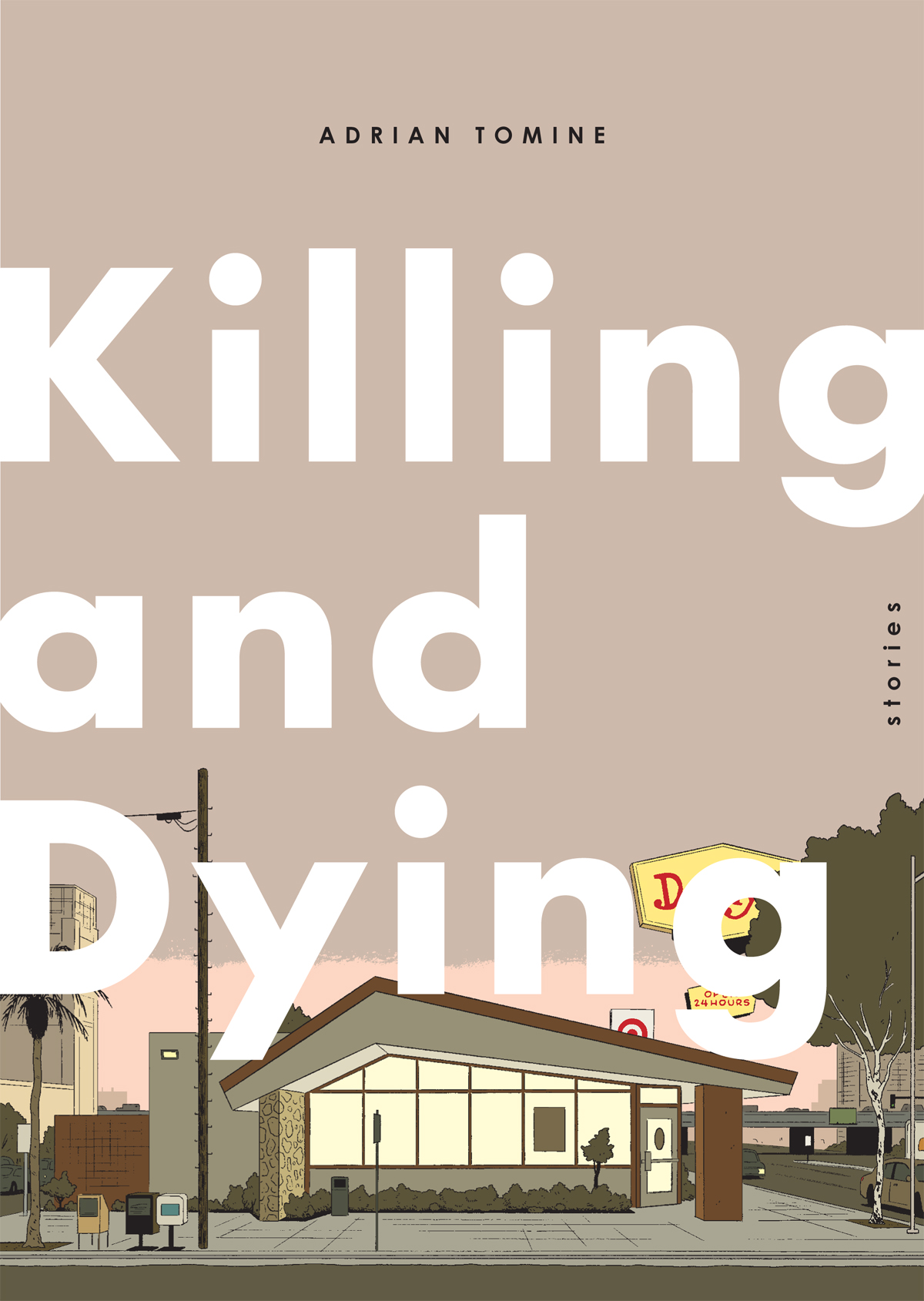
The Distance of California in Adrian Tomine’s Killing and Dying

Standard

When completing Adrian Tomine’s Killing and Dying, only one word could describe my first reaction: distance. When reading Killing and Dying, you always feel like an outsider looking into the world of the people in the six stories. You never feel close to the characters, and the visual style has a sterile perfection to it that reinforces this sense of distance. Reality inspires the world of the graphic novel, but a genericness to the scenery makes every setting seem like a faceless suburb somewhere in California, giving way to a coldness in the delivery of each story.

However, this distance is not a bad thing, and it makes plenty of sense when you live here.

Yes, I’m late to this renowned graphic novel of last fall, but after living in California for a year, the atmosphere of the book makes more sense now than it would have in October 2015. This state has an abundance of beauty in it, and it still has an undercurrent of untamed energy that you can trace back to the wild west of the past, but California, despite the sun, mountains, trees, and ocean, has this palpable sadness to it. Maybe it comes from the lost hope from dreams that never came true or maybe from the interactions that never happen because so many spend a large percentage of time in their cars, making a sense of community feel far away, but regardless of the reason, this dourness lies just under the topsoil that sees the frequent sun. This gloom manifests itself in many ways, and one of them emerges in distance between people.

Adrian Tomine perfectly captures this sullen mood of life in California with his stories in Killing and Dying. Similar in its construction and tone to Wong Kar-wai’s Fallen Angels, but with desperation and sadness stemming from a different place than the return of Hong Kong to China, each story has similar elements of compulsion and absurdity stemming from miscommunication or misinterpretation by people and their actions.

tomine-killing-and-dying

The Cover for Killing and Dying with a composite of California and a Denny’s from Pasadena


In “A Brief History of the Art Form Known as ‘Hortisculpture,’Harold, a gardener, finds inspiration in the thoughts and work of Isamu Noguchi and begins a new creative enterprise, which he terms as “Hortisculpture.” Part formal sculpture, part horticulture, Harold’s art fuels a passion in him for his work, and this passion develops into obsession as his Hortisculptures fail to attract the attention and capital of his gardening clients, his colleagues, and his own family. The Hortisculpture fixation lasts six years, and it consumes his existence and tears up his family. In a state historically looked at as a beacon of opportunity, Harold’s story resembles that of every actor, actress, technologist, and inventor whose creations and work fail to gain the attention of people, making it an excellent opening story to set the tone of the book. He gives everything to his creativity, but it goes nowhere and takes him far too long to realize when his artistic dreams need to be placed on a hiatus.

In the title bearing story, the daughter in a family wants to test out comedy as a potential for a career. The mother offers unbounded support and gives the daughter the opportunity to try out this creative outlet, and the father, the pragmatist, offers his skeptical opinions. As we see the daughter’s development and failures in comedy, we also see how the mother’s illness shapes the father’s bitterness, the daughter’s fearlessness, and the mother’s optimism. The strongest of the six stories included in the graphic novel, “Killing and Dying,” condenses killing in a comedic sense, dying of embarrassment, dying of humiliation, and death into a quiet story constructed entirely from conversations and comedic performances, good and bad. The dream to become an entertainer makes “Killing and Dying” a California-centric story, and its disappointments coming from failures and life further place the story here.

Killing and Dying closes with “Intruders,” hearkening again to Wong Kar-wai, but this time, to the film Chungking Express. In between tours, a man returns to his home city. Unwelcome by his family and lacking a permanent home, he establishes a base camp in a hotel room, waiting to travel again. During this period, he gets the keys to his old apartment from a young woman who once house sat for him, and he begins to live in the apartment in the hours that the current tenant leaves it for work. Like “Killing and Dying,” “Intruders” toys with multiple interpretations of the term intruder, and it concisely sums up the book, for by the end, you also feel like you have intruded on the lives of all of the people in the stories, and as a result, you will most likely have one of two reactions. You may want to start narrowing this separation from others, or you may want to make it larger and only view people and places through your windshield.

Killing and Dying has received adulations from the literary and alternative comics world, and that praise is well deserved. Tomine understands the motivations, disappointment, and derailment of people, and he discusses them with minimalism and detachment that draws empathy without pathos, allowing you to see the underlying sadness of the setting, which exactly feels like modern day California.

California is a place where people can become larger than life. California is a place where people can fall far from grace. California is a place where finding your own identity and understanding yourself feels far harder than anywhere else because others always feel far away physically and emotionally, and Killing and Dying examines this distance and resulting melancholy with a sharp eye and efficient tongue, reminding all that not everything is golden on the edge of the Pacific.  

Killing and Dying is written and illustrated by Adrian Tomine and is available via Drawn & Quarterly. 

Springtime Soup Galore! Asparagus, Crab, and Egg Make a Delicious Sup Mang Cua

Standard

At every Vietnamese celebration, there is always a bowl of piping hot Sup Mang Cua. Incredibly simple, the crab meat of the soup has somewhat made the dish a delicacy for only special events, but whenever crab meat is on sale, I always think of this soup.

Overall, Sup Mang Cua is pretty light, making it a perfect soup for springtime, especially with the addition of fresh asparagus and the garnish of cilantro and scallions. Hope that it makes it to your table this May!

The City Troll: Not Quite Whit Stillman, Not Quite Jeffrey Brown

Standard

After a bit of a hiatus from the blog due to a surge of event reporting, interviews, work, regular life, and the facelift of this site (we have our own domain now!), we’re finally back. During the past few months, I’ve picked up plenty of comicbooks and graphic novels, and they have piled up waiting for review. In the spirit of the content I post here, I figured the return should be a selection from the underground, and after a debate, I grabbed Aaron Whitaker’s The City Troll, a graphic novel I picked up at the hectic but fruitful LA Zine Fest 2016.

From start to finish, there is nothing entirely original about The City Troll, yet it managed to have this peculiarly engaging rhythm and momentum that kept me reading. After spending a few days ruminating on how to describe the novel, I finally realized why I continued to care about the characters in The City Troll: they vaguely remind of characters in Whit Stillman’s films.

Stillman’s characters tend to be criticized for their unrealistic dialog, but regardless of how you feel about the formalist and dialectic nature of the characters’ speech, the best Stillman characters capture the dysfunction and hypocrisy of young bourgeoisie adults trying to understand their own lives. Whitaker’s main characters, Ian and Paul similarly represent the modern young bourgeoisie with their actions and reactions to the various parts of life, and as a result, even though I cannot necessarily agree with the trajectories that they take, they do reflect the nebulous lines between morality, loyalty, and love that exist in our post-internet times. Thus, Ian and Paul probably resemble more of the leads of a Mumblecore film, and Whitaker does allude to this similarity to the indie talkie genre in the formation of Paul’s ideal love, but Whit sets the gold standard of conversation-focused films on young people, so I had his work most in mind as I read The City Troll.

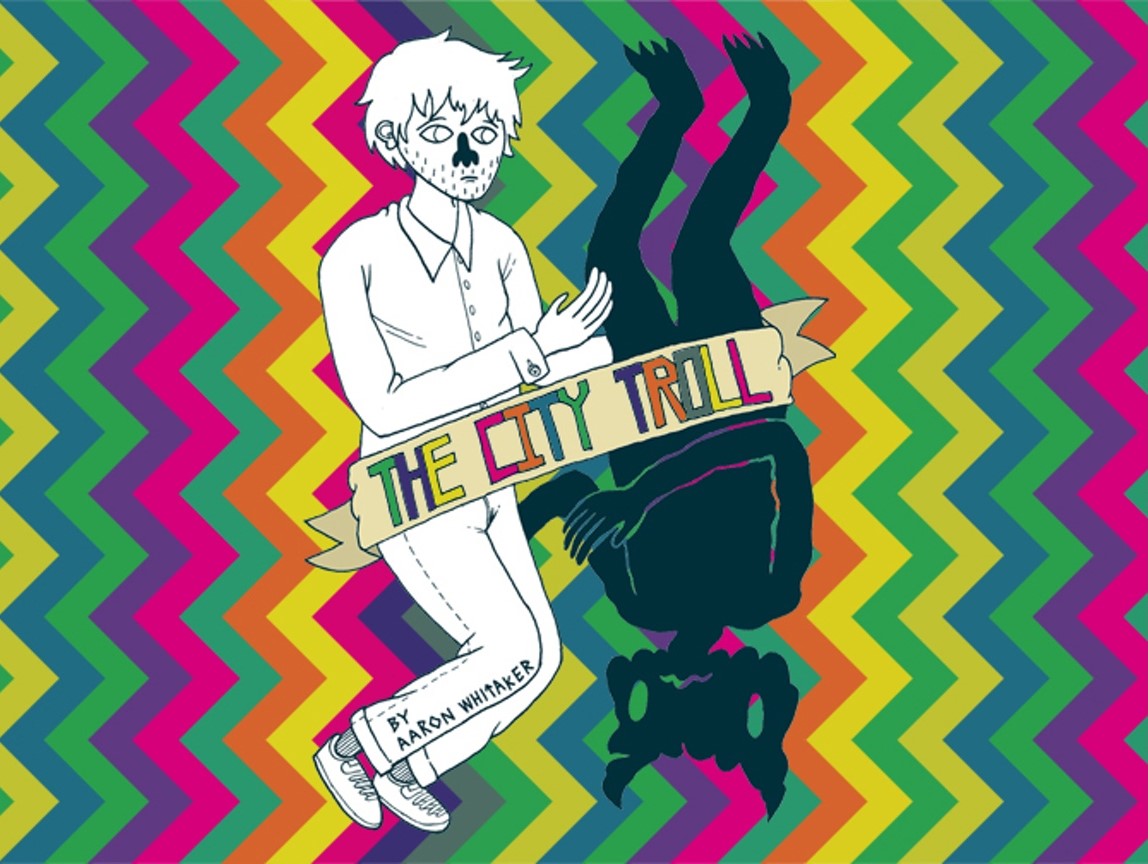
CityTrollCover (2)

Cover for Whitaker’s debut graphic novel

Ian is a perfect being with one exception: his sad-sack, pathetic, self-loathing friend Paul. The two come as a package, so they both move in tandem, for better or for worse. Ian always falls in love, and Paul always pines for love, creating the foundation for an eventual disaster from conflicts between jealousy and loyalty. Amazingly, the two are in their late 20s, and a meltdown has yet to occur, but that entirely changes when Emily enters both men’s lives at separate moments. Ian completely falls for Emily and wants to spend his life with her, but Paul also believes that Emily is the long awaited girl of his fantasies. Ian, as expected, makes the first move, but Paul sneaks himself in between the two, forming a classic love triangle. The battle for Emily’s attention and love follows the course you would expect from all love triangles, making this narrative center the weakest part of the book, since you can predict the entire course that it will take between Ian and Emily, Paul and Emily, and of course, Ian and Paul.

If the core frame of the book fails, then why did I feel compelled to read The City Troll further? The answer: for Paul’s interactions with his father.

Paul struggles with his verbally abusive mother, and we see a few glimpses into that battle, but his relationship with his father is a loving one, even though the two very clearly do not understand each other, especially given that his father has met a hippie woman named Understanding who drastically changes his father’s lifestyle. As Understanding begins to play a larger role in Paul’s family life, we begin to see more of Paul’s evil alter ego, the City Troll, who survives on Paul’s own inability to handle any change and aims to destroy in order to feel satisfied.

This interaction with his father gives us the deepest insight into Paul, and the exchanges between father and son feel the most honest, uncomfortable, and relatable. Given his strained relationship with his mother, it is of no surprise that Paul struggles with the opposite sex, but how he finds shelter in non-romantic relationships with other males creates a far denser premise. Unfortunately, Whitaker focuses on the dysfunction with women through the trite device of a love triangle, pushing the relationships with Ian and the father to the side when they have the most substance to form a stronger narrative. But, tidbits of the father-son bond and the friendship with Ian do remain in The City Troll, and they encourage you to continue on to see what happens to Paul, even if the relationship with Emily feels far too cliché.

As a first graphic novel, The City Troll is unspectacular, but it is not awful. Constructed from Whitaker’s own screenplay, the book’s strongest asset comes from its deliberate yet empathetic conversations between characters, and the weakest comes from the romantic parts, which, sadly, are the most marketable in the film world. Alas, graphic novels and comicbooks do not require as much return on investment as a film does, so marketability should take lower priority than character development and investigation, but the need for a profit in the screenplay rears its head into the graphic novel creation. The City Troll shows that the comicbook medium could work for Whitaker, but he may need a little less American arthouse cinema in his work and more Clumsy era Jeffrey Brown.

The City Troll is written and illustrated by Aaron Whitaker. It is a self-published work. 


Giallos and Expressionism in a Family Drama: Sarah Horrocks’s The Leopard

Standard

With a new year always comes new goals. We have whirred past a month and a half of 2016, and this year, I am committed to digging deeper into the physical and digital shelves of the comics world to find the unexpected. As a result, I’ll try my best to veer away from the major independent publishers here on this blog, with the exception of works that I just cannot pass up, in the hopes of excavating works that strive for something bolder, be it by a visual style, a narrative structure, or a subject.

In this quest, after a bit of searching, I’m happy to present a review for Sarah Horrocks’s The Leopard.

Alluring Cover for Volume 1 of The Leopard

Sure, a cover never tells a full story, but sometimes a cover strikes you and forces you to peek inside. After spending a couple of hours searching through various online comics providers only to find too many recycled genre motifs and archetypes (vampires are over, zombies are fading, time travel is an overused method of transportation across story arcs…), I saw the cover for volume two of The Leopard and a description which included the term “giallo”and was instantly intrigued.

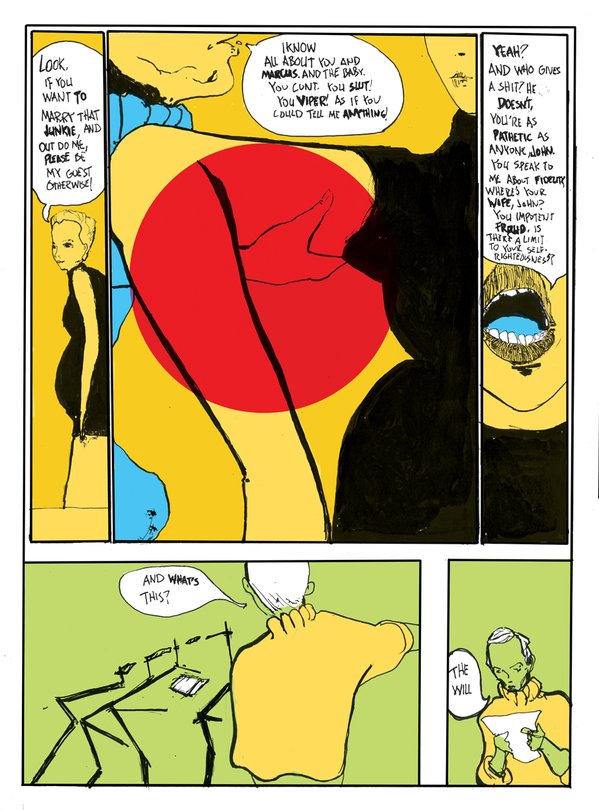
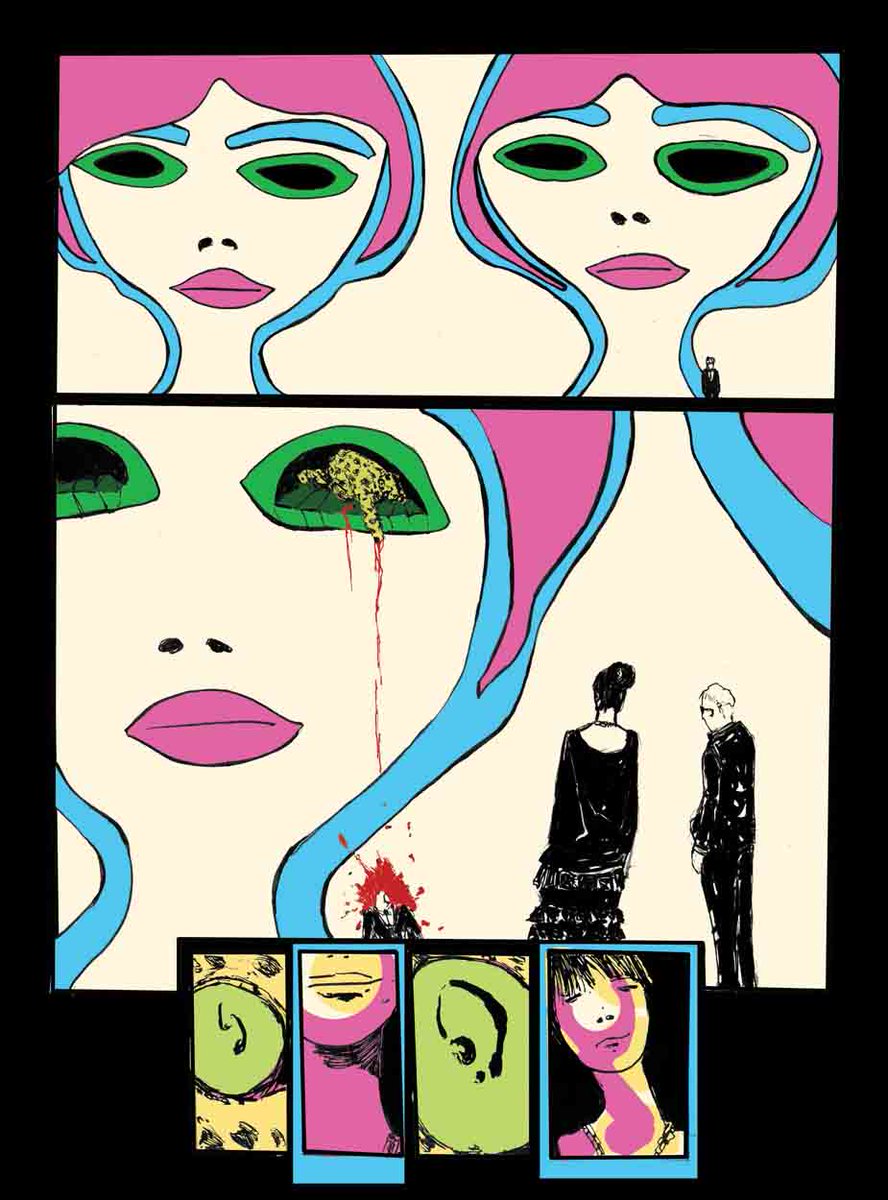
From a premise perspective, nothing in the basic plot of The Leopard is out of the ordinary. The matriarch of a wealthy family lies on her deathbed, and her offspring return to their childhood home to determine the fate of the family’s riches. As expected, the children despise each other, united only in their hate for their mother and their thirst for fortune, and consequently, when all of the siblings must remain in the same place for more than an hour, nothing good will come from the bonding time. The warring wealthy family is not a foreign theme in media; from Antigone to Dallas to You’re Next, family members have battled and killed each other over inheritances and power for thousands of years, regardless of changes in society, so the family of The Leopard does not experience an unfamiliar conflict to any reader; however, the art and the development of the different characters involved distinguish The Leopard from other family dramas and horror stories, creating a visually fascinating and psychedelic mystery that pays homage to Dario Argento, Mario Bava, and Andrzej Żuławski along with, of course, Luchino Visconti and his film that shares the same name as this series.

Given the clear inspiration from three filmmakers with outstanding and unique visual styles, Horrocks, like the three mentioned above, persistently experiments with the visual style on her medium. Every page of the the first three volumes of The Leopard presents something surprising, and while some ideas work better than others, every single page demands extra study and admiration. In The Leopard, you will find piercing color combinations, collage, and even some radial paneling, all of which help to create an appropriately ominous and disorienting mood for the sinister deeds on the horizon. While at points, the art may exceed the complexity of the story, it never takes over and makes The Leopard just a collection of artwork; every visual detail has a role in conveying the motivations and personas of each character, and this is the strongest feature of Horrocks’s style as a creator.

One of my favorite pages of giallo-inspired artwork from The Leopard (page from Volume 2)

To emphasize themes and ideas in horror, The Leopard and the comics paired with each volume have rich references to brilliant works and iconic images for any cineaste. Horrocks alludes to the in-shower eye gouging of Fulci’s Zombi, Isabelle Adjani’s disconcerting lovemaking with a tentacled creature in Żuławski’s Posession, and the ballet school of Argento’s Suspiria in her work here, conveying her own inspiration in visual storytelling and connecting the reader to the tones and moods of these works. While I was excited to see any reference to Żuławski, these specific allusions somewhat hurt the success of the comics. Horrocks already has her own strong style that blends influences from giallo, horror, and experimental film, so the inclusion of nearly exact ideas from the works that inspire her as allusions or homage distract your focus from the characters, the story, and the artwork of the comics because you leave Horrocks’s world that she has meticulously created to think about the work of other creators that are somewhat but not entirely connected to The Leopard

While The Leopard absolutely contains deeply embedded cues from cinema in its storytelling, the overall aesthetic of the series has a starkness and grotesque nature much like the artists of the Die Brücke group. The sharp color combinations of the pages form images that are unified but also jarring, severe, and fantastic, much like the work of Kirschner. And in a similar stylistic vein, the family members have exaggerated forms that make them appear more like demons than people, which, based on their personas as the series progresses, makes sense, for none of their ugliness lies internally; the hideousness presents its plumage on the faces and figures of the characters and reinforces the incorporation of German Expressionist visual concepts.

With such a distinctive combination of styles, Horrocks proves her awareness in her own work in addition to her unconventional (by comics standards, at least) sources of inspiration. In turn, The Leopard aims for far more than your traditional comic, and though at times, the influences slightly overwhelm the series (after all, it’s a great challenge to incorporate stalwarts of Western art and cinema), all of the diligence to create a new and daring comics reading experience shows itself on the pages.

Currently only available in digital format, this is one of the first digital comics I really wished I had in print, and for that statement alone, The Leopard should be on your reading list as soon as possible; I suspect Horrocks will have even more to admire and astonish in future volumes, and you will want to be there for the extravaganza.

The Leopard is written and illustrated by Sarah Horrocks. It is available via Gumroad here

Martyrs or Not: Sean Lewis and Ben Mackey’s Saints

Standard

Upon returning to America from travels in Italy, it seemed wholly appropriate to pick up Sean Lewis and Ben Mackey’s Saints. As much as Generoso and I have been adjusting our diets as we re-acclimate with America, I figured that I should also readjust to American culture in comics by reading something mildly related to the Catholic churches and the gargantuan paintings we encountered last week. Also, at one point, we stood by the altar that contained Saint Peter’s remains, so Saints feels like a reasonable selection to reacquaint myself with the secular and non-secular blending that is embedded in the identity of America.

Lewis’s first foray into comics, Saints explores the intersection of reincarnation, sainthood, and the battle against evil. The spirits and the powers of Saint Lucy, Sebastian, Blaise, and Stephen have emerged in today’s world as adults who not only need to adjust to life but also have a divine calling to join together to battle a surge of evil. In biblical times, the archangel Michael defeated the devil and the fallen angels in the battle in heaven, but in our contemporary world, a man who claims to be the incarnation of Michael leads a society of congregations who offer their children to battle against saints, who are believed to bring about the end of times when they reappear on earth. With Michael’s increasing power, Lucy, Sebastian, Blaise, and Stephen begin receiving messages from God that lead them to each other in order to face Michael’s new children’s crusade.

Favorite cover: Issue 5

Within a five issues, Saints packs in a ton. Lewis anchors the ensemble tale with the introspection and growth of Blaise, the saint with the least amount of confidence in his own identity much less his responsibilities to God and humanity. In secular reality, Blaise has attached himself to failed metal groups in order to relate to other people, but his connection to the metal groups feels all too thin and full of false idols. Consequently, when Blaise begins having recurring cryptic dreams set entirely in gold with strangers he feels some familiarity with, he does not dismiss them, but he also does not attempt to understand them. That is, until Sebastian, one of the people in the dream appears at a concert and explains that Blaise’s dreams signify a higher calling.

Once Sebastian and Blaise find Lucy and Stephen, the group attempts to decode why they have received messages to come together as well as their history in their previous lives. When the modern Michael’s army begins to attack them, the group goes into hiding and spend more time trying to understand each other, making Saints less of a superhero tale about the battle between good and evil and more of a road tale, where traveling forces characters to better understand their purpose.

Saints has a fascinating premise, and I must admit it kept me engaged even though the execution of the storytelling may not be the best. In an interview, Lewis described the writing process as one where he wrote a short story that he and Mackey then dissected to form the panels. This distillation from a longer story rather than the construction of a script or storyboard leads the first couple of issues of Saints to have a clumsiness and awkwardness in the progression of ideas and conversations from panel to panel and page to page, but by the fourth issue, the bumps begin to smooth out. Mackey’s shifts in color help ease the transitions from dream sequences to the saints’ reality to the building of Michael’s congregation and army, so even though the panel flow does not always work in the first three issues, you never get lost between the different branches of the story.

Given its non-secular focus, I cannot bypass a discussion of the adaptation of biblical concepts. I, in no way, am a scholar of Christianity, but I do understand some of the core tenants of the Bible. Lewis definitely loosely interprets the archangel Michael, but his modernization of the saints does not feel too distant from their original personas. While a secular fictional tale about the faith could use saints’ powers as superpowers, I appreciate that Lewis de-emphasizes the saints’ supernatural abilities and focuses the series on the saints understanding their divine calling; I hope Saints begins to focus more on the psychological aspect of the martyrdom of these saints, for those ruminations could make this series rise from just being entertaining to something daring and innovative. Additionally, the martyrdom aspect of the saints distinguishes these characters from any others out there in the comic book world that have some supernatural ability and some responsibility to other humans; by exploring this security or insecurity in faith and grace or hesitation toward martyrdom, Saints can emerge as a faith based series that intelligently and relatably discusses how to interpret and apply faith in a modern world.

Saints has solid footing in an excellent concept. I hope it digs further into the hearts and minds of its characters and their conflicts with their higher calling, but regardless, I’ll still follow along because Lewis and Mackey are aiming for a big idea and have yet to enter the pretentious territory, and that impresses me.

Saints is written by Sean Lewis and illustrated by Ben Mackey. Issues 1-5 are available via Image Comics.