A Stark, Desperate Post-War Japan in Tadao Tsuge’s Trash Market

Standard

I have not delved too far into Japanese manga, not to mention gekiga, so the recent collection of Tadao Tsuge’s comics collected into a volume entitled Trash Market was a sobering breath of fresh air into new territory for me.

Cover of the Trash Market Volume

Perhaps the Japanese counterpart to America’s Harvey Pekar, Tadao Tsuge’s work has the same spirit of sharp observation as American Splendor but with a bleakness and dourness only possible from a person living in the slum and red light district of post war, attempting to reconstruct Tokyo. And, if the approaches toward comics realism did not parallel Tadao’s work to Harvey Pekar’s enough, his brother, Yoshiharu Tsuge is known as the Robert Crumb of Japan, who attempted to get Tadao work as professional cartoonist and who also included Tadao’s works in his own publications. However, while Tadao did have a few years where he worked solely as a cartoonist, he spent most of his life working low skill blue collar or white collar jobs by day to make a living and drawing and writing at night as somewhat of a hobby, making his life and perspective that much closer to those of Harvey Pekar.

But, unlike Pekar, Tadao Tsuge’s stories, though somewhat autobiographical, do not have Tsuge in the foreground teaching a specific lesson to the reader; they attempt to capture societal issues faced by the lower and middle classes in a Japan devastated by war purely through observation combined with a layer of surrealism and absurdism without explicit rhetoric or argument. In addition, Tsuge’s work has an overwhelming sense of sorrow that punches you in the stomach, for his stories have few moments of lightness and focus on the desperation of people trying to survive after a devastating war that not only destroyed the land but also the morale of the nation.

Trash Market contains six stories: “Up on the Hilltop, Vincent Van Gogh…,” “Song of Showa,” “Manhunt,” “Gently Goes the Night,” “A Tale of Absolute and Utter Nonsense,” and “Trash Market.” In addition, the volume also contains, “The Tadao Tsuge Revue (1994-1997)”, a short memoir about his life and the people and issues he encountered as a dual working class Japanese man and cartoonist in the late 1950s and early 1960s. With all six stories and the memoir, Tsuge reveals a side of Japan rarely seen by Western audiences, devoid of the honor and stoic countenance of the samurai culture Westerners have come to love and completely devoid of the hyperbolic style and sexuality of manga. In relation to film, Tsuge is less Akira Kurosawa and more of Susumu Hani, with his realistically surreal style to portray a decrepit Japan stumbling from the ashes of war.

Tsuge at his best captures masculine pain and men’s misguided attempts to handle it in a highly repressive culture where most of the men have died and those who remain carry the shame of losing a war. As a result, “Song of Showa,” “Gently Goes the Night,” and “Trash Market” rise as the strongest stories of the Trash Market collection. The most autobiographical of the bunch, “Song of Showa,” details the erosion of the family unit in Japan’s red light district. “Gently Goes the Night” follows the mental breakdown of a veteran once sent to fight in Burma who is now at home attempting to live a normal life with a loving family. And lastly, “Trash Market,” a perfect closer to the volume and the ideal title piece, expands on a note in a urinal at the blood bank Tadao worked at from a former Japanese naval lieutenant forced to sell blood to live. Tsuge’s Japan has no glory, no honor, just plenty of broken people trying to make ends meet.

Consequently, Tadao Tsuge’s work walks the line between existentialism and pure nihilism. Defiantly apolitical, Tsuge’s stories in Trash Market do not glamorize or celebrate any of the student movements and protests occurring as he wrote and published in the late 1960s and early 1970s. In fact, he articulates his own sense of politics in the supremely nihilistic “A Tale of Absolute and Utter Nonsense,” where revolutionary, idealistic students clash against the police and soldiers of the government, and both sides completely destroy each other, leading to no progress whatsoever. From this destruction, we are able to see that Tsuge had far less interest in the politics of the government and of the rising youth and far more interest in studying people in their daily lives without a political lens stemming from any manifesto or ideals.

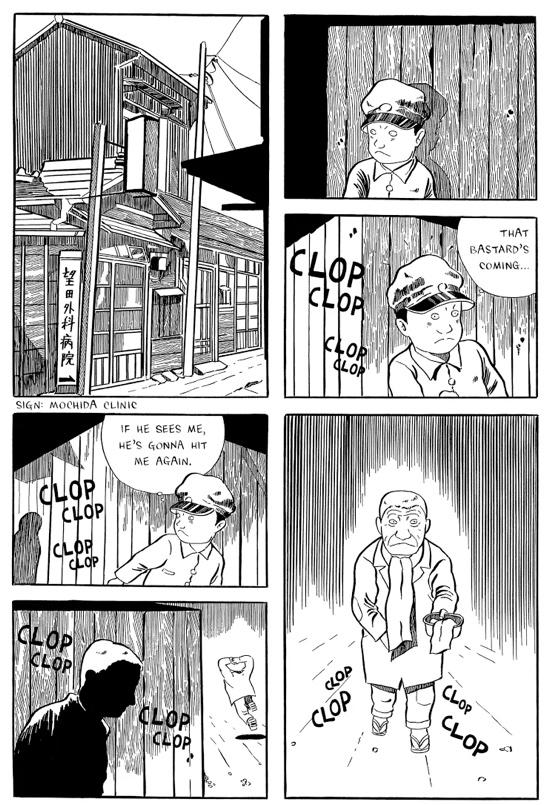
A page from Song of Showa

Given his topics and perspective, Tadao Tsuge’s comics are incredibly far from manga. His drawings are simple and at times coarse, and his storytelling methods are more atmospheric, lacking a definitive plot structure and clear protagonists and antagonists. His work focuses on the daily activities of a declining civilization, and, as a result, Trash Market conveys a unique, stark sense of despair and gloom. Thus, it is of no surprise that Ryan Holmberg, the editor and translator of Trash Market, reversed the orientation of the original stories, making the volume read from left to right instead of the right to left that we as the West have come to correlate with the novelty of manga.

Tsuge’s work may not be the best reading choice on a bad day, but his own portrayal of life’s small brutalities will force you to see a world hardly discussed in Western history and will provoke sympathy for a former enemy nation during a time when it was still considered as the enemy. Through interactions between people, Tsuge details a rotting, abject world that few deserve to experience. Altogether, Trash Market reveals a part of Japan’s history that we should better understand.

Expect no babydolls or samurai here–only the honest, somber post-occupation Japanese reality lurking beneath the luster of Japan’s exports lies in Tadao Tsuge’s stories.

Trash Market is written and illustrated by Tadao Tsuge and edited and translated by Ryan Holmberg. It collects six stories published from 1968-1972It is available now via Drawn & Quarterly.


A Bite Sized Appetizer Transforms Into a Meal: Lily’s Banh It

Standard

Vietnamese food from the Hue region is some of my favorite food. Particularly, I have fond memories of eating a version of banh it with a chewy, crispy piece of fried dough underneath it in a grimy restaurant specializing in food from the Hue region in Houston as a child. Man, that restaurant was a rough place to eat at, but the food really was unlike any other.

Unable to find that version of banh it again, I decided to make my own interpretation. The version I had as a kid was served in bite sized servings as an appetizer, but since I lack such a level of portion restraint, I made my banh it much larger, making them less of an appetizer and more of a meal.

There are many steps to this recipe, but I promise the outcome is a delicious mix of flavors and textures, especially when served with a piece of lettuce to wrap around these hybrid steamed and fried rice flour dumplings and all topped with nuoc mam.

Perfect for a special occasion, banh it will definitely impress your friends and loved ones! Enjoy!

LA Inspired Apocalypse: Ed Laroche’s Almighty

Standard

There’s something paradoxical about Los Angeles as a city. Right beneath the neon lights and the glitter lies a deep layer of decay and loss. Under the bright California sun lies both buildings of glass and steel and abandoned, empty buildings of eras long past. It’s a city of hopes and dreams, both simultaneously fulfilled and unfulfilled. Thus, it is of no surprise that LA has inspired film and literature for nearly a century, and after living here for only a few months, I understand why this is the city of film noir.

Consequently, after reading Ed Laroche’s post-apocalyptic Almighty, I was not surprised to learn that he has lived in this City of Angels for his entire life and that Almighty was released in 2008, the year of the modern economic collapse we remember most.

Opening Image of Almighty

Set in a wasteland hill and plain then mutant city possibly in California in 2098, Almighty grabs that sensation of lost hope and despair ever rampant in LA and pulls it to the surface. After a devastating economic collapse in the future, a new Great Depression arrives. And in addition to the crippling economic failure leaving people homeless and without any infrastructure to re-create the society they knew, a major military conflict stifles any potential to return to normalcy, and an experiment has gone very wrong, leaving an entire section of the region filled with infantile mutants covered in boils who were once human but now roam the desolate streets looking to tear apart animals and returning to a great mother for sustenance.

As expected with any great economic downturn, some people attempt to sustain themselves on meager means while others resort to crime. In the world of Almighty, those who resort to crime band together as a group of paramilitary vultures, bringing terror to the people who bypass their headquarters far outside of the city and picking off whatever they can from their victims. On one of their attacks on an RV filled with supplies, the group, known as Golden State, capture Del, a volunteer medic, after they murder everyone else in the vehicle. Held prisoner for days, she finally tries to escape, but her captors stay quickly on her tail and confront her.

However, as the captors narrow in on Del, an unknown guardian and protector fires from an unseen location, allowing her to survive. After the blink of carnage that eliminates seven of the captors on Del’s trail, Fale, an androgynous woman, emerges from the tall grass in the field to the clearing where Del lies to explain she has been hired to rescue and return Del home. Immediately, the two jump on Fale’s bike to begin the long trek back, but unfortunately, that first battle will be the easiest one the two will encounter for the rest of the rescue mission.

Most of Almighty focuses on the grim state of the world through the eyes of Del and Fale, with Del as the crestfallen and jaded idealist and Fale as the ultimate survivor and mercenary. Both are new to this world of all lost hope, and both try to adapt and maintain their own humanity as the line between human and animal blurs. As a result, the mission of Almighty serves merely as a framework to the plot; the meat of the volume lies in all of the post-apocalypse terrors they encounter and the consequent effects on their relationship as humans in a dying world.

For a graphic novel set in catastrophe, Almighty has an enormous amount of restraint. Laroche never overburdens the dialog, and he presents every moment of violence and action with an incredible amount of detail and viscera but quickly balances it with a moment of reflection or assessment of the damage done. In addition, the visual style of the volume follows a similar ebb and flow, with action sequences drawn with a sharp style with disorienting and unstable energy and more narrative sequences drawn with a more static, calm style. Reading Almighty feels like a natural harmony between stress and rest and despair and hope.

Ultimately, Almighty explores the fundamental question of what exactly draws the line between human beings and animals. By setting the story in a world where society has been broken, Laroche can ask that question without the frivolities and the pseudo-stability we find in our civilized world and hone in on an answer when that line of humanity is truly tested. He offers his answer in the graphic novel, but as with any great work, he leaves you the room to decide on your own.

Almighty exploits our greatest fears of when the world goes wrong in a large metropolis and, through its horror inspired methods of removing the blocks of civilization that we have become so familiar with, forces us to think about what lies beneath all of the baubles and the images we create for ourselves. As I wander through this land of image myself, I wonder what lies beneath all of the sparkling glass and gold as well. To get a hint of my answer and the one Laroche has proposed with Almighty, you only need to look to the abandoned theaters and offices with decaying ornate plaster and gilded molding in almost every neighborhood in LA, and soon you will see.

Almighty by Ed Laroche is available via Blackhalo Productions. 


Failure to Travel from TV to Comics: Rick and Morty

Standard

Rick and Morty restored my faith in animation on television.

As a devout Simpsons fan from about 1996 to 2009, I once had a great love for television animation. After my college years without a TV, when I did return to watching television regularly, with the guidance and wisdom of Generoso, I dedicated myself to Adult Swim’s programming. At first, mostly the live action shows captured my attention. The Eric Andre Show, Loiter Squad, and Your Pretty Face Is Going To Hell were early favorites. And one day, a commercial for Rick and Morty appeared after an episode of The Eric Andre Show, signaling the arrival of a new favorite.

After the first season of Rick and Morty brought hours of unbearable laughs to the Fierro home, when news of a comic book extension of the series emerged, I was ecstatic; however, a formal review would have to wait until I had amassed a few issues.

Now, I’ve collected issues 1-3 of the comic book arm of Rick and Morty, so I have enough material for a review, but unfortunately, as much as I had hoped to write a positive review this week, the Rick and Morty comics did not warrant one.

Cover for Rick and Morty Issue 1

Rick and Morty, the television show, possesses a unique frenetic energy and wild unpredictability to hypnotize its audience. Consequently, transferring Rick Sanchez’s fast, slurred speech and consistent, overly caffeinated, hyperactive manner along with Morty Smith’s stammering and constant state of unease proved to be an enormous challenge for the comic series’ writers. In addition to the difficulty of embodying Rick and Morty in print, the balance of energy, bizarreness, and occasionally sweetness of Rick and Morty’s adventures compared to the parallel ones of Jerry, Beth, and Summer Smith’s, make the television show even harder to adapt to a static medium.

The comic makes one major damning mistake; the adventure Rick and Morty go on in the comic feels uncharacteristic of their personas. In the comic book, Rick and Morty travel in space to invest in stocks that will succeed in the future, leading them to enormous prosperity. As expected, the time traveling and illicit stock trading lead the grandfather-grandson pair into trouble, and when Jerry reports the two to the time police, Rick and Morty have a much bigger adventure to experience.

Fundamental to their characters, Rick and Morty rarely go on adventures to seek great riches; they go on adventures as a consequence of Rick’s scientific tampering, which often leads to Morty needing to help Rick in some way. Occasionally, they travel for Rick to make some sort of illicit sale or trade for more resources or funds for his experiments, but the two never go on an adventure only to strike it rich. As a result, their adventures focus less on the goal and more on the twists and turns the two experience together. Thus, surprisingly, Rick and Morty, the television show, is less about a misanthropic, outcast scientist and more about a story of a grandfather and grandson getting to know each other. Sure, Rick and Morty follows a dysfunctional family, but beneath all of the aliens, the time traveling, the Meseeks, and the laser guns, lies a story about a mad scientist making reparations with a family he once abandoned.

Given this warm, fuzzy heart buried underneath Rick and Morty, all of the characters involved have a mix of paradoxical characteristics. Rick is angry yet nonchalant and weirdly loving in his own eccentric way. Morty is the hesitant and weary sidekick who somehow manages to keep his wily grandfather in check. Jerry is the anxious, failing husband who craves attention from his wife Beth and is somewhat jealous of Rick, but he continues to try his best to impress Beth and the rest of his family. Summer is the passive teenager with standard teenage issues, but she also seeks adventures and time with her grandfather Rick and her mom. And, Beth is a genius who had big dreams until she unexpectedly began her family, and though her family exists as her burden, she still greatly cares for them.

With the television show, we get to see all of the dimensions of the characters. With the comic book, we only see shells of each. The comic series could have expanded on the complex characters beloved by the fans of the show, but instead, it dilutes them and the adventures that make Rick and Morty stand out as one of the most entertaining, funny, innovative, and watchable television series out there.

More disappointing than the characters and the narrative arcs in the Rick and Morty comics is the lack of Dan Harmon and Justin Roiland’s presence in them. Consequently, the wit and humor of the comics lack the charming acidity of the show, and the jokes and conversations lack the references to pop culture and the sneering jabs at media works appropriately deemed unacceptable by Harmon and Roiland (remember the unrelenting insults toward Inception in the “Lawnmower Dog” episode?). As a result, Rick and Morty the comic feels much less vital and less relevant.

I had hoped that the Rick and Morty comic book would stave off my hunger during my wait for the return of the series for its second season, but instead, it only reminded me that sometimes TV empires should not cross over into comic books and/or vice versa. Rick and Morty had the opportunity to explore each character through small vignettes or stories as seen with the Bob’s Burgers comics or expand the television narrative into a different storytelling form like Joss Whedon’s Serenity comics, but it does does neither, failing to understand the full complexity of the narratives, settings, and characters established by the show, thus guaranteeing that it will not add any additional richness to the Rick and Morty universe. As a result, I’m more agitated by the paltry offerings of the comic version and much more ravenous for the television Rick and Morty.

If the comic series was a ploy to create a foil against the television series to lure fans into buying the comics only to allow them to articulate why Rick and Morty the television show rises above all other shows, then bravo to the mastermind who came up with the plan. Only a deviant like Rick Sanchez could come up with that outlandish, conniving plan, so perhaps after all, the creators of the comic book do understand their main character. But then again, Rick does not seem like he would love being part of a marketing/PR racket, so it looks like the comic creators have still missed the mark on understanding Rick and Morty.

Let’s leave the cryptic, insane mind of Rick Sanchez to Dan Harmon and Justin Roiland, and the Rick and Morty empire will be mighty fine on its own.

Rick and Morty (the comic series) is written by Zac Gorman with art by CJ Cannon, Ryan Hill, and Marc Ellerby and available via Oni Press. 

Ginger Syrup and Vietnamese Mochi: Che Xoi Nuoc

Standard

Here in the Fierro house, we are trying to push our own boundaries of our cooking. In my last edition, I made egg rolls with the help of my new friend, the deep fryer, and this week, I attempted to make Che Xoi Nuoc, one of my favorite Vietnamese desserts.

Made from sweet rice flour, the mochi in Che Xoi Nuoc are filled with savory mung bean and then served with a ginger brown sugar syrup and salty-sweet coconut milk.

A bit of a heavier dessert, it is perfect when served at room temperature or warm. There’s quite a bit of work (and many pans!) involved, but it is completely worth it for the sweet, savory, and chewy fun of Che Xoi Nuoc.

If you have left over mung bean filling, you can use it to make mung bean pancakes or more of the mochi treats! And if you’re feeling adventurous, you can deep fry the mung bean filled mochi as well and serve with nuoc mam for a savory appetizer as compared to a dessert. Enjoy!

Si Spencer’s Disjointed/Unified England in Bodies

Standard

This weekend, synchronicity rules my selection of what to read and review. On Friday night, I watched Mike Leigh’s Naked, a spectacular masterpiece of English filmmaking and possibly one of the most English films to date. Then, on Saturday, after visiting Golden Apple Comics, I picked up Si Spencer’s Bodies, and to my surprise, when I arrived home to read it, I realized Tula Lotay of last week’s review of Supreme: Blue Rose illustrated a part of Bodies.

Now, how exactly do Naked, Supreme: Blue Rose, and Bodies tie together?

Most clearly, all three have English creators. All three take place in some form of dystopia, be it more of a realistic one in Naked or a futuristic one in Supreme: Blue Rose or both in the case of Bodies. Naked and Bodies center their narratives on forces perceived or known to corrupt the existence of English citizens. Bodies and Supreme: Blue Rose construct their protagonists and antagonists in fragments across time. Bodies contains the realism of Naked crossed with the time traveling and futurism of Supreme: Blue Rose.

All three tackle major political and philosophical concepts. Naked has a fiercely raw energy weaving throughout the film, which enforces its overwhelming sense of desperation and desolation in Thatcher’s England. Supreme: Blue Rose reinvents the Supreme mythology into a fresh new, time-shifting and complex exercise in understanding fundamental existence and persona. Bodies aims to construct a murder mystery across time in order to understand the history of England’s perceived internal enemies to English tradition and values. While Naked and Supreme: Blue Rose reach for ambitious concepts with underlying comments on politics and human existence and successfully execute them without ever stepping to the pulpit, Bodies reaches for the moon in its concept, but unfortunately, it only reaches the troposphere of the earth.

Cover for Bodies Volume One

Bodies divides its narratives into 4 timelines in London: 1890, 1940, 2014, and 2050. In each, a detective of the time discovers a mutilated body in Longharvest Lane in the East End of London. At a first glance, each of the detectives tie the body to Jack the Ripper, but upon further inspection, the corpse shows ties to something far more supernatural. Each detective possesses some quality which has been or will be rejected by the traditional English society. Inspector Hillinghead, the detective of the 1890 component of the story, is homosexual. Inspector Karl Whiteman, the 1940 detective, is a Polish Jew who escaped from Krakow. Detective Sergeant Shahara Hasan, the 2014 detective, is Pakistani and Muslim. And, Detective Maggie Belwood, the 2050 detective, is an amnesic rendered into almost a borderline infantile state from some unknown force.

Across each narrative arc, the corpse has wounds which bring about suspicions of some form of ritualistic killing. To make things stranger, as each detective dives deeper into the investigation, the corpse disappears and returns to life. In each incarnation, the corpse emerges from death as a slender blonde man with an eyepatch with a variety of names, but fundamentally, he encourages each detective to accept his or her own identity and past, coaxing each into an act which will allow them to finally incorporate themselves into the world they belong, whether that world is a past or future England or a void beyond the earth.

After unpacking all of the characters and the role of the revived corpse, Bodies studies the history of England’s disenfranchised people across time, addressing the conflicts each face and how they eventually assimilate into society. Unfortunately, Bodies does a disservice to its detailed discussion of different marginalized groups by incorporating a facile message of acculturation: “Know you are loved.” As a result, by the end, Bodies feels less like an intelligent discourse on England’s hesitance toward foreign cultures and lifestyles across time and more like a hippy peace rally filled with chants of love without a full understanding of how a conservative nation comes to accept once marginalized groups.

Ultimately, the detectives who do assimilate into English society with the help of the reborn one-eyed man accept their differences while still proclaiming their pride as citizens of England, revealing Spencer’s belief in patriotism as a unifying force. Then, to reinforce his thesis, Spencer closes Bodies with a sanguine salute to England that accepts all of its flaws, cherishes its strength, and aims to instill a sense of pride in the nation, a pride which allows each of the characters to become accepted by others, and a pride which Spencer hopes will allow future disenfranchised groups to feel unity with the people around them.

However, this belief that a common pride in a nation can create bridges between people of different gender, sexuality, culture, and heritage is one that is far too idealistic and far too removed from reality. Undoubtedly, patriotism can unify people to a certain degree, but understanding between people occurs at a much more personal level than pride in one’s own nation. Consequently, Bodies exists more as a manifesto of ungrounded beliefs and less as an observational argument on assimilation and mutual understanding.

Bodies lacks nuance and evidence to establish its thesis, and as a result, even the wonderful artwork and the fascinating idea to have different illustrators dedicated to each time period cannot save this series. After all of the time traveling and the rise from the dead are said and done, only the unfounded thesis is left along with many irritating repetitions of, “Know you are loved.” More of a comic book stylized kumbaya, Bodies contains naive politics mixed with an ambitious concept, thus creating an all too pretentious (and of course completely marketable) series.

With the rise of the xenophobic national front spreading across England and Europe, Spencer had an excellent opportunity to research and discuss the origins of the movement and its recent resurgence, but instead of asking, “What is the origin of the fear of foreigners in England? Why is this happening in mass again?” he asks “Why can’t we love each other?” making Bodies much less of an effective and galvanizing work.

If you’re looking for a work which studies the marginalization of England’s people, go watch Mike Leigh’s Naked instead. I promise you will not be able to look at media and its ability to comment on the fragmentation of a society in the same way again. You probably also will not be preaching a message of universal love at the end of it either…

Bodies is written by Si Spencer with artwork by Dean Ormston, Phil Winslade, Meghan Hetrick, and Tula Lotay and coloring by Lee Loughridege. It is available via Vertigo. 

Dimension Traveling at Its Finest: Warren Ellis & Tula Lotay’s Supreme: Blue Rose

Standard

As I write this, I am in a post-4th of July haze induced by hot dogs, jazz, the sound of forbidden fireworks fired in the streets, and a long walk through what felt like an abandoned Los Angeles. In this state, I’m reading two works at the same time that lead me toward disorientation because I could not imagine two series more opposite in tone and content. The crazy two are Daniel Clowes’s The Complete Eightball and Warren Ellis’s Supreme: Blue Rose.

To heighten this sense of confusion, Supreme: Blue Rose may just be one of the most dream-like and ethereal comics for the masses I’ve seen in some time.

Cover for Volume One of Supreme: Blue Rose

Warren Ellis must never sleep. His sharp series, Trees, has progressed a few months after the first volume was released earlier this year, and simultaneously, another series, Injection, has begun this summer. And in addition to these two, he’s also managed to complete seven issues of Supreme: Blue Rose, which are collected into the first volume for the series that hit comic book stores this week on July 1st.

When Ellis actually sleeps between all of this work, his dreams must be filled with multiple dimensions and plenty of time travelling into places we will never see, but thankfully for us, he and Tula Lotay have materialized these forbidden foreign places in between the folds of the spectrum of time with Supreme: Blue Rose.

Diana Dane (yes, that’s probably the epitome of a superhero name) seems to have ties to some alternate universe. In her dreams, a man warns her about trusting a complete stranger named Darius Dax (and yes, that’s the epitome of a supervillian name), and a faceless man, cleverly named Enigma, stands on the shore staring into a bay where he claims a guardian of the future once descended and spoke to him as she surveyed the land one last time before it would change. And if things could not get any more ominous, the faceless man appears at a street corner as Diana travels to a meeting with Darius Dax at the National Praxinoscope Company for some reason undisclosed to her.

But let me warn you, despite the superhero names and some familiar archetypes seen in some superhero comics, Supreme: Blue Rose is far beyond a superhero tale. It is not really even an anti-superhero comic….

Diana has fallen from grace from her rising journalism career, and consequently, when Dax offers her a total of one million dollars to investigate the whereabouts of Ethan Crane, even under  far beyond ordinary, most likely supernatural circumstances, she has little reason to say no. One million dollars does not come without some level of grief, and Diana has quite a lot of it in store for her.

As it turns out, the universe resembles some giant, self releasing software development machine. It releases versions of reality and merges them into the time space continuum, creating multiple branches of reality that may or may not shift when a new version arrives. Unfortunately, a recent version has disrupted the separation of realities, and fragments of others are falling into the one Diana Dane and Darius Dax inhabit. The answer to the clashing of alternate realms lies with Ethan Crane, but he has seemingly vaporized, and his disappearance may be a sign of the end to come.

In parallel to Diana’s quest to find Ethan Crane, Ellis also presents the worlds of Professor Night, a television serial character, and Chelsea Henry, a professor turned dimension jumper. Professor Night battles his own enemy and lover in Evening Primrose in a decaying futuristic world, and Chelsea attempts to understand her own powers and the truth behind the universe. Both Professor Night and Chelsea wander through their worlds and also multiple dimensions in search of something, and as Supreme: Blue Rose unfolds, they both travel into Diana Dane’s world, all culminating into a final scene where the past, the present, and the future collide, shatter, and fold.

Supreme: Blue Rose feels like Ellis’s “fuck you, I can do it better” to the frequent use of alternate universes in superhero dynasties. Ellis expands that inherently human fascination with what ifs and regrets to create a whole series around alternate realities that constantly and cryptically twist and turn. With this series, in our post-modern world, Ellis proves that he shall remain as the king of futuristic, nihilistic concepts; every character in Supreme: Blue Rose has no control over his or her existence(s), and all of their perceived realities remain in a fragile state, ready to fall at any moment, rejecting any belief that we as humans can hold true power over our own reality.

Beyond the experiences of the characters, the instability of the worlds of Supreme: Blue Rose are most evident in the artwork by Tula Lotay. All of the illustrations have a looseness and haziness to them accomplished by pastel and watercolor techniques that blur the lines between dreams, pasts, presents, and futures, making us as the readers question what is real and what is not and if the concept of the real even matters. Lotay’s artwork paired with Ellis’s narrative makes Supreme: Blue Rose transcend above all other dimension shifting series.

By the end of Supreme: Blue Rose, Diana Dane may or may not have succeeded her mission, and Ethan Crane may or may not have helped change the universe, but alas, an exact answer may not exist because we have no idea which reality the events occurred in. A goal directed plot certainly exists, but the most fascinating parts of the series occur across dimensions with the reveal of different versions of a single character which can be pieced together to establish each character’s fundamental motivations and inclinations toward good or evil or nothing at all. With Supreme: Blue Rose, Ellis pushes the storytelling technique of fragmented character building into a new territory, all while reminding us not to get too swept up in our own fantasies of our own possible alternate realities, since after all, we have an essential character and spirit, and that will permeate all of the dimensions, whether you’re a desk clerk in one reality or a supermodel in another.

Supreme: Blue Rose by Warren Ellis and Tula Lotay is available now via Image Comics. 

Deep Frying Fun Episode #1 – Lily’s Gia Gio

Standard

The Fierros have now acquired a deep fryer!!!! Now, with both a deep fryer and a mandolin, we can finally make gia gio a.k.a Vietnamese egg rolls.

Lily grew up eating egg rolls made from these egg roll wrappers:

But after years of eating Vietnamese egg rolls with a delicious bubbly, crispy skin in restaurants, she decided she would use the filling she loved with rice paper to make cha gio that would achieve this more complex egg roll skin.

Rolled gingerly and fried carefully in medium low heat, these cha gio are fun for a summertime party. Wrap with crisp lettuce and dip in fish sauce, and you have a perfect bright, fresh, crispy, chewy bite! They’re also super delicious cold and straight from the refrigerator! Enjoy!

Motherlover: The Reality in the Underground

Standard

When in a comic book store, sometimes the most exciting finds come from the small press/consignment sections. Last year, I picked up Dash Shaw’s 3 Stories, and that led to a binge reading of Dash Shaw graphic novels.

Consequently, with our arrival to a new city, I looked forward to what I would find in a new comic book store now that my beloved Hub Comics is so many miles away. After a few excursions through the small press section of Sunset Boulevard’s Meltdown Comics, we managed to dig out a couple of books from stacks of very pretty (and quite expensive) DIY comics with impeccable artwork but alas very little content. What makes small press DIY comics special is also what sometimes kills it: there are no rules.

As a result, these comics fall everywhere across the good to bad spectrum, with the good potentially being exceptional, the bad being remarkably so, and the mediocre being outrageously lukewarm. Thankfully, one of our selections fell on the good side of that aforementioned spectrum.

Motherlover: An Anthology contains four small works from Nic Breutzman and John and Luke Holden with elaborate coloring by Raighne Hogan. Each piece experiments with visual technique or storytelling forms, making Motherlover a fun, fast, and quite sinister read.

motherlover-product-1

Cover of Motherlover: An Anthology

Hailing from Minnesota’s comic underground, the authors and artists of the Motherlover anthology fill their work with a darkness, vulgarity, and absurdity reminiscent of the glory days of San Francisco’s comic underground but progressed into the 21st century. The opening bit, Mood Ring sets the tone and pace of the adventure to come. Intentionally crudely drawn in an almost comic book Expressionist way, Mood Ring shows adolescent boys just being boys with a stolen mood ring. General indifference…check. Cursing…check. Reference to their hormonal state of hyper-sexuality…check. Mood Ring borders the obscene in its topic and in its shortness, but it certainly sets the mood with its punch-line type ending which transitions into the title card.

Photograph, the next story in line, opens with a stunning and ominous photograph of a man holding a skull at a gravesite on a snowy mountain. With this picture, we expect to hear a tale about a curse stemming from the picture or some ill fortune occurring to the man in it, but Breutzman surprises us and focuses on the process of creating a picture and the story of the people behind it. Photograph centers its narrative on the grandson of the man in the opening photograph attempting recreate a photo of Louise Bourgeois, and in the course of the day after the photo attempt, we find out the origin of the mysterious skull picture. Photograph, in few pages, explores why we take pictures in a state of boredom and how we come to reflect on those photos in the moments and years after.

The Boys, the third in the book, stands out as the strongest story of the bunch. Styled with grotesque looking characters and almost ghost-like smears and splotches of purples, reds, and acid green, The Boys features the best of mix of discomfort, crudeness, and strangeness that makes Motherlover an entrancing read. The Boys explains the odd characters we encounter in life and each of their idiosyncrasies and how we come to interpret them when we are young and somewhat sheltered. The Boys is by far the most unsettling work of the book, but, despite its uncanniness, it captures a certain honesty about what an adolescent boy wants and sees in the imperfect world around him.

You Can’t Be Here closes off the anthology, and of the collection, and I must admit I really did not know what to make of it. After re-reading it a few times, I began to like it much more; I initially thought it was the weakest, but after a while I realized my initial reaction of dislike came from my surprise in its difference in visual style and storytelling; You Can’t Be Here is the most normal and traditional looking story in Motherlover, but it contains the most insight into nostalgia for a place called home. With a bits of humor stemming from the main character’s cluelessness in the world, Breutzman digs into that uncomfortable, aloof feeling you have when you realize you do not belong in the place you grew up, and you really do not belong in the place you always aimed to escape to. In few words and few pages, You Can’t Be Here captures the conflicted feelings of nostalgia and disassociation you have when you return to a familiar place because you do not really know where else to go.

Without any structure or formal guidelines to follow, Motherlover thrives. With the brevity of each story, you realize every image matters, every word matters, every bit of detail has an intention. Motherlover has no fatty excess on it; sure, there are plenty of moments of lewdness, but none of them exist just to be shocking, which is a critical feature to the ebb and flow of the full book. While reading the 72 pages of Motherlover, you’ll manage to feel a full range of emotions including horror, humor, regret, disgust, nostalgia, and befuddlement, all which lead to a final moment of contemplation and sobering to allow you to reflect on similar moments you may have had as an adolescent or young adult. Let’s just hope that your moments had fewer occasions of braless demon-like moms, adventures in digging up graves, and/or out in the open pooping.

Motherlover: An Anthology by Nicholas Breutzman and John and Luke Holden is available via 2dcloud.

Rampant Consumerism and Indifference in Hunt Emerson’s Calculus Cat

Standard

There’s an insidiousness in the implicit connection between entertainment and advertising. When we consume any media form, we make ourselves vulnerable to consuming other products, for in the act of consuming entertainment, which we have committed to see and/or hear based on our own tastes and preferences, we make a tacit pact with the entertainment provider that we like the program they offer, so we are willing to stick to the program even if it is interrupted by advertisements. In today’s digital age, commericals are completely and utterly inevitable. For the most part, they carry more burden than any utility in that they rarely advertise a product or service we actually want, and they interrupt the entertainment forms we consume, whether that is a TV show, a YouTube video, a Netflix show, a Facebook news feed, or even this blog (is there an ad on this page? Probably).

Before today’s highly diverse world of entertainment channels, Hunt Emerson acutely critiqued the dubious relationship between entertainment and advertising that drives people in a never-ending cycle of consumerism in his comic, Calculus Cat, picking up on the same topic addressed in John Boorman’s Having a Wild Weekend but a decade later and in a more television saturated world. Beginning in 1978, Calculus Cat first focuses on the role of commercials on television. By day, Calculus Cat grins, attempting to entertain and give people joy for free, and by night, after a day of heckling and attacks from the people he encounters on the job, Calculus Cat finds himself trying to drown out the miseries of his day with his favorite television shows.

Cover for the Calculus Cat Collection

Unfortunately, his television has its own priorities that conflict with Calculus Cat’s expectations for his television. While Calculus Cat’s shows do play on the TV, they will not begin until a TV announcer repeatedly declares commercials for Skweeky Weets, a cereal company. The incessant commercials drive Calculus to the brink of madness on a daily basis, but right at the moment when he prepares to destroy the television, the commercials for Skweeky Weets end, and the program he had hoped for finally starts.

This battle between Calculus Cat and the television repeats everyday, and each story in the Calculus Cat collection focuses on a new day of their altercation and Calculus Cat’s eventual surrender to the television, pulling our cat into a never-ending cycle of consumption, where he grudgingly consumes the commercials of Skweeky Weets then consumes his favorite television show, be it Rawhide, The Addams Family, or Bronco. Skweeky Weets commercials dominate every station and every type of program and eventually begin to dominate the markets such that it becomes the only cereal bar available in Calculus Cat’s world, and given the persistent commercials that infuriatingly block entertainment programming and the elimination of all other snack food choices, Calculus Cat too must succumb to finally purchasing Skweeky Weets products.

Calculus Cat, though filled with humor stemming from his belligerence toward his TV, contains a grim statement about the state of the human interaction with entertainment media in a post television age. With the expansion of the series for the collection released by Knockabout Comics last year, Emerson must have felt some pride (and horror) in his initial assessment of how we digest an enormous amount of advertisements in return for a chunk of entertainment given that this compromise between entertainment and commercials have permeated so much of society. Ultimately, Calculus Cat documents the numbing of individual thought and preferences through commercials and entertainment seen all in the comfort of one’s home because with each repetition of a commercial, especially the same one, we begin to become more indifferent toward the commercial itself and eventually toward the entertainment itself because we have to bear the commercials in order to actually see the entertainment we want, making it unclear what we actually want to consume. And after all desire wears away, we transform into mindless couch potatoes, seated and hypnotized by the television (or in this modern day, the computer) by compulsion and habit, and when we do go out, we purchase the products we see on the screens without second thought or question about whether or not we really need them.

Beyond the dissolution of human thought and preferences, what really makes the relationship between entertainment and advertising manipulated to drive consumerism really despicable is its ability to isolate individuals and pull them out of any socially or intellectually stimulating scenario, so much so that we begin to lose our ability to interact positively with others. Outside of Calculus Cat’s war with his television is his war with the world around him that he attempts to bring happiness to with simply a smile, but that world cannot process the smile and only returns anger and bitterness to his toothy grin. In seeking entertainment from a screen in the isolation of our homes, have we become unable to bear our own realities?

Calculus Cat really has no ties to calculus other than its attempt to understand the derivation of the malaise of our existence today. The series managed to foreshadow the general indifference toward each other and toward even entertainment in the decades to follow its incarnation, especially in today’s highly connected internet world where entertainment in the palm of your hand is more instantaneous than ever, and for that, it deserves a thorough read for anyone who just cannot get their phone out of their hand or cannot bear to do anything after work but return home to surf the web or watch television. If you are one of those people, please do read this collection in its book form, and perhaps, if you dare, read it in a public place or with someone. Otherwise, just go out and make something and talk to someone face to face….it’s a good thing, and avoid any Sweeky Weets products if you can.

Calculus Cat by Hunt Emerson is available via Knockabout Comics.