Richard Dreyfuss Makes Blue Movies The Old Hollywood Way in 1975’s “Inserts”

Standard
Inserts_1_1975

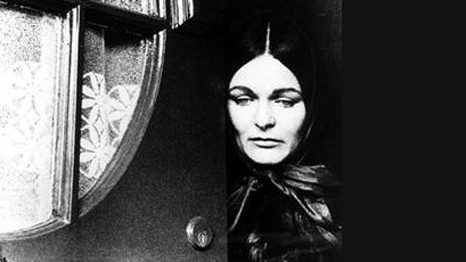
Richard Dreyfuss as “Boy Wonder” in “Inserts”

There is something magical about In Your Ear, a Boston record store/institution that lies in the basement of a Brazilian martial arts center on Commonwealth Ave. An eclectic shop where after a particularly bad week you will most likely find my wife Lily and I gleefully rummaging through the endless supply of old records, 8-track players, Mexican lobby cards, and vintage movie posters, many of which are for films that have been long forgotten. Unless of course you are Reed Lappin, a lovely man whom I’ve known for most of my thirty years in this city. Reed is the owner of In Your Ear and has always had a great admiration for movies, especially those small lost American movies, which to our good luck, he is always in the mood to talk about late on a Friday night. This past week’s excavation project at In Your Ear produced a poster of a British film from 1975 that starred Richard Dreyfuss and Jessica Harper that we had never heard of entitled “Inserts.” This nostalgic poster was reminiscent of Peter Bogdanovich’s “Nickelodeon,” but this one advertised a film that instead possessed an “X” rating and a tagline reading “A Degenerate Film, With Dignity.” As a result, it piqued our interests, and after a quick description of the plot by Reed, we decided to track it down.

The film is set in a disheveled Hollywood bungalow, sometime in the early 1930s, where we find a scruffy Boy Wonder (Richard Dreyfuss) sauntering around his home in the middle of the day, wine bottle in hand  but still in his house robe as he talks up a one-hundred–words-a-second actress named Harlene (Veronica Cartwright) about shooting a scene. We soon find out that something has happened to Boy Wonder, and he has not left this home in some time, and, due to his fallout with the Hollywood system, he has been reduced to shooting pornographic loops in his living room. Harlene is one of his regular actresses, a pretty girl with a fairly irritating voice that is so shrill that we immediately understand why her transition to “talkies” has not been an easy one. Boy Wonder also had a problem making the jump from silent films, but we are not sure as to why this has happened, since directors made the move much easier than some actors who just did not have a “voice.” Early on, Harlene regales Boy Wonder with a conversation between Josef von Sternberg and Clark Gable that she overheard while waitressing where Sternberg had said that Boy Wonder was so down and out that he was panhandling, but that “this kid Gable” had defended him stating that “Boy Wonder was the only real genius in Hollywood and that he wanted to make a film with him,” a fact that Boy Wonder just shrugs off as he gets Harlene ready to shoot some “inserts,” which are short cuts to edit into to final film. Harlene does some smack and then tries to turn Boy Wonder on, even though it is widely known that his “rope won’t rise even a magic flute.”

Soon the male “talent” enters, an actor/mortician comically called “Rex The Wonder Dog” (Stephen Davies), a handsome, stoic young man who is a bit on the slow side and so very anxious to get a role in a “real movie” that he must hustle through his scene today to meet with some Hollywood producer in his hotel room for a shot. Boy Wonder then uses every director’s trick in his bag to get a violent rape scene out of Rex and Harlene, which is indeed as intense as needed, but, alas, Boy Wonder’s camera runs out of film before the climax, so he will eventually need to shoot another “insert” to finish his porno. It is during this scene that we understand that deep inside the dishevelment, Boy Wonder is a real director who is drowning in his own fear.

In walks in our heavy, Big Mac (a pre-“Pennies From Heaven” Bob Hoskins), the new Hollywood, tough and mean with enough money to bankroll Boy Wonder’s skin flick. Big Mac is thinking burger chains and freeways and reminds everyone in the room of Boy Wonder’s collapse from fame. He’s also shown up as usual, unexpectedly, but this time with another wannabe starlet, Cathy Cake (Jessica Harper). She wants to get into the “real movies” as well and makes it clear that although she may appear to just be “silly girl,” she is also more than willing to do what it takes to make it as a star. All that Harlene is looking for right now is her fix of heroin from Big Mac, who supplies her quickly so she is off to go upstairs to fix up despite the pleas of Boy Wonder who tells her she’s had enough. But she doesn’t heed Boy Wonder’s suggestion as we can clearly see that Harlene has had enough in more ways than one and soon she is found dead upstairs. It’s now up to Big Mac to make Harlene disappear, so he leans on Rex’s desire to become a star as Rex has the funeral connection that they need to get rid of the body. That leaves us with Boy Wonder and Cathy who give us almost sixty minutes of intense back and forth dialog as Cathy not only wants to get in the pictures but also get in the head of Boy Wonder. It is this scene with these two fine actors, which makes up the emotional core of the film. Here, Jessica Harper does provide us with the finest performance of the film as she brilliantly skirts the line between vulnerable ingénue and sexual coach.

Director John Byrum Talks About Casting Richard Dreyfuss

First time director John Byrum, who also wrote “Inserts,” creates this world in just one room and amazingly enough, in one take. It should not be surprising then that I should say that “Inserts,” though about the film industry, is really arranged like a stage play with actors having marked dramatic entrances. Though shot on one set, “Inserts” could’ve benefitted from a more daring cinematographer who could have exploited the small moments between Dreyfuss and Harper, which would have better accented the emotional intensity of their performances. One also wonders the necessity of the “X” rating the film received from the MPAA in 1975. Though the dialog may be tawdry, there is little sexually that would warrant an “X,” which even during this decade of sexual freedom might have been the reason for its unfortunate box office failure. One still has to admire this film’s ability to capture 1930’s Hollywood so well, a time and place where one small mistake could make or break a career and where talents could rise up through some very dark passages.

Thanks Reed for picking this one out of the bin for us.
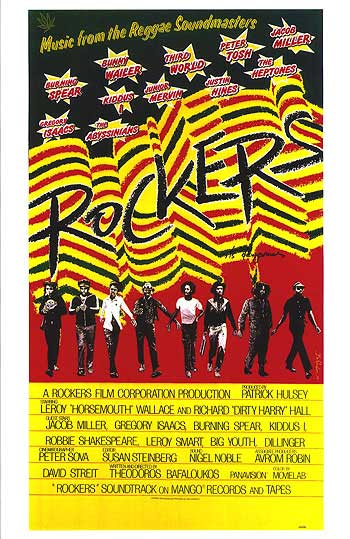
De Sica’s “Bicycle Thieves” Turned Robin Hood in Jamaica, 1978’s Reggae Film,“Rockers”

Standard
rockers ted-and-leroy-horsemouth

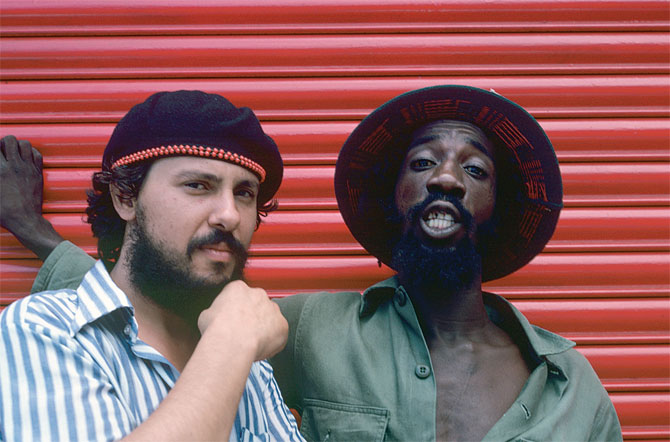
Director Ted Bafaloukos and Leroy “Horsemouth” Wallace from 1978

Living in Boston these last thirty years, I have come to have great pride in the role this town had in bringing international fame to Perry Henzell’s breakthrough cult reggae film, “The Harder They Come.”  The film had not been well received on its initial release in 1972 but was eventually launched into cult film status when the Orson Welles Theater here in Cambridge began running it continuously as a midnight film in 1973 and would continue to do so over the next ten years.  Despite the sometimes frigid weather, this town has been a hotbed for reggae music ever since and in 1996 I even began deejaying a ska and rocksteady radio show which I still produce to this day on WMBR in Cambridge and I even directed a few docs on the subject of reggae myself.  Also for many years I curated the European Short Film Festival here so with “Rockers,” I have found a movie that falls right I between those two great loves of mine, Jamaican music and European cinema.   Though “Rockers” is centrally about the Rastafarian lifestyle, I also believe that it falls into the sub-genre of the many films inspired by Vittorio De Sica’s 1948 neo-realist masterpiece, “Bicycle Thieves.”  Well at least it begins that way for sure.

De Sica’s “Bicycle Thieves” begins with our protagonist, Antonio, who is struggling to feed his family in an economically depressed post-war Italy.  To get work as a poster hanger, Antonio Ricci needs a bicycle so his wife sells their wedding linens, the only prize possession of the family, to afford to buy a bike for Antonio.    Shortly after Antonio buys his bike; it is stolen, putting the lives of his family to risk so he must take swift action to find it before he loses his new job.  Move the time and location to a post-colonial economically-depressed late 1970s Jamaica and you have the beginning of Greek-born director, Theodoros Bafaloukos’ “Rockers.”   Antonio Ricci is replaced by Leroy “Horsemouth” Wallace, who in real life is a very well respect drummer who many credit as creating the “rockers” style, and a man who is trying to feed his family on the meager money he makes as a session drummer and for playing watered-down reggae for tourists at a posh hotel outside of Kingston.   He proposes to his wife the idea of being a record salesman to make more money and so he needs a motorcycle which she must begrudgingly fund.  Horsemouth collects some debts, makes some loans and buys his motorcycle and immediately has it painted with the “Lion of Judah,” which refers to Revelations 5:5 to which Rastafarians interpret as the arrival Emperor Haile Selassie I of Ethiopia.  Horsemouth keeps his word and hustles some discs that he gets on account from legendary producer Joe Gibbs, and proceeds to sell them to the various record shops and sound system operators like Jack Ruby.  This does not last long as just like our hero in Bicycle Thieves, Horsemouth’ s motorcycle is soon stolen and he must take action to recover it quickly or his future is in serious jeopardy.

What becomes interesting is the way that Horsemouth, our hero in “Rockers,” distinguishes himself not only from De Sica’s film, but also from its reggae predecessor, “The Harder They Come. “  Jimmy Cliff’s Ivanhoe is at least on appearance, a born-again Christian, but is also the quintessential angry young man that uses violence at the first opportunity when trouble arises.  Whereas our Horsemouth, shortly after he avoids a violent encounter, goes through the trouble of breaking the fourth wall, speaking directly to the camera as he explains that he is an avowedly a non-violent Rastafarian.    Horsemouth saunters through the early parts of “Rockers” not with a pistol in his hand like “The Harder They Come’s” Ivanhoe but with a smile and a passive attitude, that is until he realizes that his autocratic cheapskate boss at the hotel is also responsible for stealing his beloved motorcycle leaving Horsemouth, as he would say, “vexed.”   After a botched attempt to retrieve his motorbike where Horsemouth takes a beating from his boss’ goons, he (Horsemouth) must now assemble his friends, who happen to be some of the greatest names in 1970s reggae music, from Big Youth to Dillinger to Richard “Dirty Harry” Hall, to not only steal back his beloved motorbike but to also “acquire” a wealth of riches to spread through Trenchtown in a Robin Hood-styled way.  Different than the outcome of De Sica’s film but they both share an ending where the common man understands the reality of the economic slide.

All of the above occurs with a laid-back and even almost comedic level; different from the previous incarnations of the plot as this is a Jamaica that has begun to look at Rastafarianism, not as previous generations have in the past as a dangerous cult, but as a religion with accepted social practices.  No scene bears this out more than when Horsemouth runs into his grandmother who berates him for his non-Christian lifestyle during a baptism in a river. Horsemouth is respectful of his grandma but still walks away with a smile as he extolls his Rastafarian beliefs as he is down but not out because he knows that Jah will see him through.    It is a small scene but one that puts the protagonist’s actions in this film in the right framework.

The mostly non-professional actors do their best with their roles, especially the late “Dirty Harry” who shines in a now notorious scene where he and Horsemouth take over a DJ booth at a club because they just aren’t down with soul (the West).  Of course the real star of the film is the soundtrack which has too many scenes of note to list here but three that always stand out for me: the aforementioned deejay scene with Dirty Harry, a concert scene featuring a beautiful performance from Gregory “The Cool Ruler” Issacs, and a small poignant scene where Burning Spear sings a cappella to Horsemouth to affirm his resolve after his motorcycle is stolen.

“Rockers” Trailer 1978

Though produced on a small budget, “Rockers” is visually more accomplished than “The Harder They Come” as many of these scenes are smartly framed by cinematographer Peter Sova and director Bafaloukos, who sadly would never direct another feature film but would go on to be the production designer for many of Errol Morris’ finest documentaries including: “TheThin Blue Line,” “A Brief History of Time,” and “The Fog of War.”  It is uncanny to me that a Greek citizen, whose introduction to Jamaica was getting arrested there in 1975 on suspicion of being a CIA spy while on assignment as a press photographer, would have the kind of understanding of Jamaican culture that would be needed to make a film like “Rockers.”  Though given the desperate political and economic realities of Greece these last fifty years, he might have understood a character and situation like Horsemouth’s more than any of us could.


1970’s “Soldier Blue” Is a Vile Exploitation of the Sand Creek Massacre

Standard
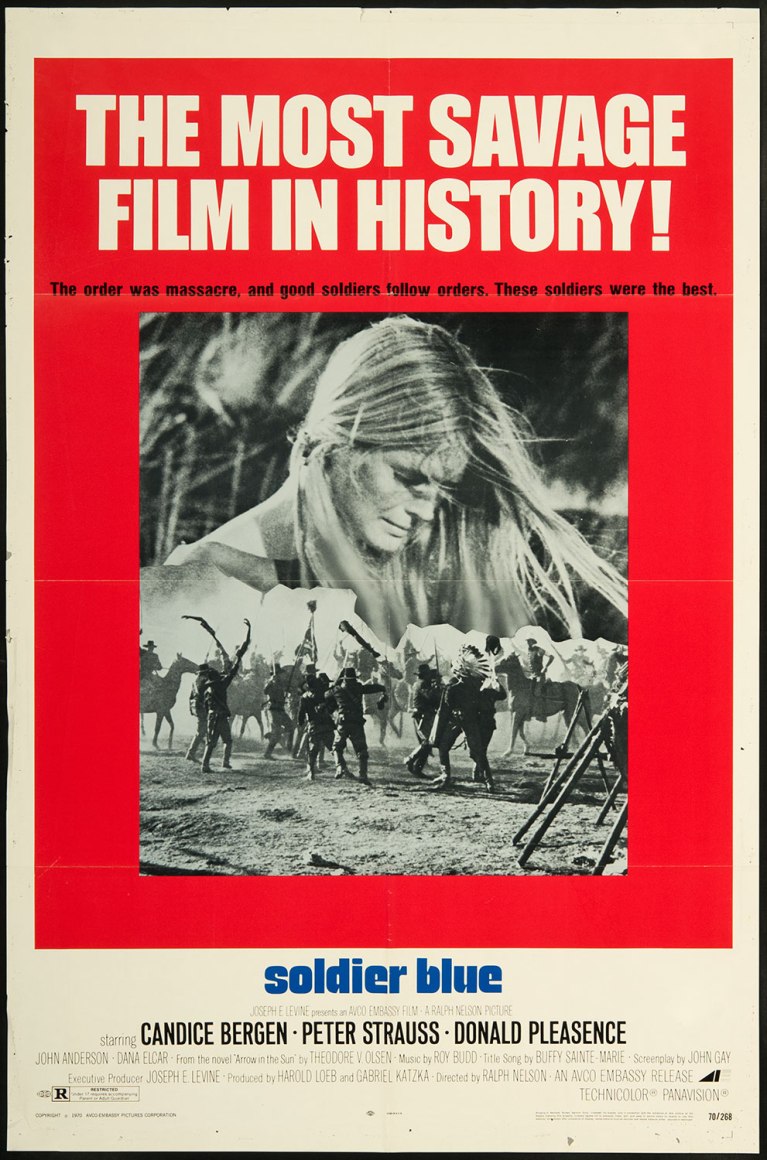
soldier blue landscape poster

Why Is There An Image Of A Naked Bound Native American Woman Next to A White Couple Kissing?

Before anything can be said of Ralph Nelson’s 1970 film, “Soldier Blue,” we must first look at the horrific real-life event that film is based on; The Sand Creek Massacre of November 29, 1864. On that day, the Colorado Territory militia descended on a village of peaceful Cheyenne and Arapaho, murdering, raping and even mutilating over 150 people, mostly women and children. Led by US Army Colonel John Chivington, the cavalrymen planned the attack on a village, one that had entered into a peace treaty with their attackers and were even flying an American flag as well as a white flag to show their peaceful intention. Though the event was investigated by the Joint Committee on the Conduct of War, no one was ever prosecuted. A statement was issued by the committee on the massacre that included the following: “Having full knowledge of their friendly character, having himself been instrumental to some extent in placing them in their position of fancied security, he took advantage of their in-apprehension and defenseless condition to gratify the worst passions that ever cursed the heart of man.”

Some seventy plus years later, Hollywood began to take notice of this grim chapter in American history and began to depict the massacre in several films to varying degrees of accuracy and correct accountability, including; “The Guns of Fort Petticoat” (1957) and “Tomahawk” (1951). By 1970, the world had been shocked at the news of the My Lai Massacre of 1968, in which a company of the US Army soldiers premeditated the murder of a village of unarmed Vietnamese women and children. During this same era, activism lead by Native Americans had increased, culminating in the nineteen-month occupation of Alcatraz by United Indians of All Tribes, a group of predominantly university educated Native Americans in 1969. The time was right for a mainstream film to accurately capture the almost forgotten tragedy of the Sand Creek Massacre. Unfortunately, “Soldier Blue” was to be that film.

“Soldier Blue” was advertised in 1970 as “The Most Savage Film in History” which already draws some concern as this would be the selling point for this mess of a film. Indeed, the violence goes far beyond the threshold of violence that was set by Arthur Penn’s “Bonnie and Clyde” a few years earlier. Truthfully, the Sand Creek massacre scene is as wretched as advertised and does include every horrific detail that was brought up in testimony to the Joint Committee on the Conduct of War. On this point, director Ralph Nelson did not leave anything out to spare domestic audiences, but it is what leads up this moment that concerns me, as the narrative is banal collection of awkward acting and moments that cannot justify the coup de grace that occurs at the end of the film. Though applauded during its time, it is just another film that explores a tragedy in American history that was perpetrated by whites, where the whites come off as the real heroes. I usually refer to this phenomenon as “Mississippi Burning Syndrome,” referring to the dreadful 1988 Alan Parker film, where two FBI agents become the real heroes of the civil rights movement.

In “Solider Blue,” two white people, Cresta (Candice Bergen whose accent and behavior appear as though she was pulled out a checkout line during a Labor Day sale at JC Penney) and a soldier, Honus Gent (a sheepish Peter Strauss), who are the only survivors of a Cheyenne attack on their group. They must now travel across the frontier together to get to Fort Reunion where Cresta’s fiancée, an Army officer, awaits. Like so many films where a couple must battle the wilderness to only become closer, their story is eerily similar to many that have come before them with the only difference being that Cresta has lived with the Cheyenne for the last two years and is empathetic to their plight (think Radcliffe girl with a cause of the week). While our cavalryman, Honus, is a flag waver who believes that the USA can do no wrong and must be convinced of the opposite. The film of course leads to the scene in which Honus watches in terror as his beloved cavalry burn, rape and murder an entire village of innocent people. Director Nelson’s major error here is Cresta, who is played by Bergen as though she has no concept of the era her character is acting in during the film, or the fact that Cresta, despite her overwhelming sense of hippie entitlement, would never be allowed the kind of righteous access to the Cheyenne culture as an outsider and as a woman in the mid-nineteenth century. Sadly, the actual perspective of the Cheyenne and Arapaho is all but an afterthought. Lastly, the acting from our two leads as well the many supporting actors don’t go far beyond a mid-1960 TV western serial in quality.

Original Trailer for “Soldier Blue”

http://www.youtube.com/watch?v=IXh1x9cRyNw

Though critically praised, “Soldier Blue” was not well received here in the US by audiences as I assume that most people here circa 1970 during the height of the Vietnam War were just not in the mood to see American soldiers commit more atrocities on screen so soon after My Lai. Soldier Blue did do surprisingly well in England, where it was the #3 box office draw when it was released there in 1971, which should not be a surprise as I would imagine that the folks who lined up to see Cy Enfield’s “Zulu” were waiting on another film to satisfy their blood lust for witnessing another massacre of indigenous peoples by occupying forces. We weren’t too much better here in the States; before the news of My Lai hit the news broadcasts in 1968, folks lined up in glee for John Wayne’s pro-US involvement in Vietnam film, “The Green Berets.”

Director Ralph Nelson had on many occasions taken up the plight of marginalized people in his films, ranging from 1978’s “A Hero Ain’t Nothin’ But A Sandwich” to “Charly” to “…tick…tick…tick..,” and to his defense, most directors cannot control the kind of advertising that a distributor can create for a film, but, with “Soldier Blue,” Nelson’s original intentions just cannot accurately be understood here as the desire to bring this story to light is just buried under a morass of old western clichés, lame performances, and a campaign to stress the film’s violence as a selling point and not the perspective of the people who were really affected.

Wim Wenders Smartly Adapts Peter Handke’s “The Goalie’s Anxiety at the Penalty Kick”

Standard
the-goalies-anxiety-at-the-penalty-kick still

A still from “The Goalie’s Anxiety at the Penalty Kick”

Seen from the other end of the soccer field, Josef Bloch (Arthur Brauss) appears to be in control, but as all goalies are during many moments of the game, he is completely alone. But to the extent of how alone and how lonely is Josef Bloch, we will soon find out. Though we see the play is happening from a distance, Josef is a rickety mess of twitches and ticks.  Eventually, the play moves towards him, and his skills should be put to the test, but do to a moment of uninspired carelessness; we soon understand how a small mistake can become the tipping point for a man on the emotional decline.

For his second feature film, Wim Wenders had decided to adapt the novel by Peter Handke, a book that remains as one of the best analogies for sport defining human emotions. Tragically, the mistake that Josef makes on the pitch precipitates a series of events that transpire in a way that some would look at as soulless, but when you take a closer look, Josef is coming apart with a blinding silent rage. You see, Josef’s mistake does not end on the field; his blunder is carried with him to Vienna where he goes to a film, listens to some Roy Orbison at a bar, meets a nice girl who takes him home; they make love; she makes him breakfast, and then he strangles her, which on the surface does not impact him a bit, but as the viewer we are inexplicably drawn to his character. Josef passively keeps track of the investigation of the death of his victim, and as a viewer we soon fear that other murders may occur, but we feel more concerned about the moment when Josef’s disconnected façade will begin to show the cracks.

“Anxiety at the Penalty Kick” is a meticulous film of small movements and dialog. At times, one would even think that they are watching an Aki Kaurismaki film, as “Anxiety” even possesses the mandatory jukebox scene in the midst of the all of the disaffected gestures, but absent is the humor that lies underneath the saddest moments of Kaurismaki’s work. Josef is also not the silent murderess Iiris, of Kaurismaki’s film “The Match Factory Girl, who saunters around her life of infinite sadness, getting by with her bleak job and horrible family to eventually commit an act of defiant freedom. Here, our Josef has lashed out, but Wenders does not frame his crime with any clear motive except that Josef wanted to commit the act.  We imagine that the inspiration of this act might be the pressures of sport, but perhaps we are just seeing behavior that is more like Meursault, the protagonist of Camus’ “The Stranger.”  There will be more actions that cannot be explained throughout this film, and Wenders wants your imagination to figure out why.

A Short Scene from “The Goalie’s Anxiety at the Penalty Kick”

Though a low budget production, Wenders is aided for the second time by the soon to be legendary cinematographer, Robbie Muller, who usually keeps his distance from our central figure as the viewer would in real life, but at times pulls in to see what we fear the most, a hollowed out shell of a human that has no regard for those around him. Mueller correctly pulls back in several scenes when we begin to feel that Josef is connecting, giving us the false hope of a moment that is warm in nature but cold and distant in reality. The camera is static for every shot, and, with that, it amplifies the passive nature of Josef’s idiosyncratic inner being. “Anxiety,” though striking in its composition, does not possess the eerie beauty that exists in Wenders and Muller’s greatest collaboration, 1976’s “Im Lauf der Zeit” (Kings of the Road), nor is it an elegy on the passing of eras. Instead, it is a hard look at a modern world, where the Josefs are not the melodramatic villains of Hitchcock’s mind but the villains of a non-communicative world that allows them to slip in and out without notice.

The Last Great Spaghetti Western: Enzo Castellari’s Elegiac “Keoma”

Standard
keoma_ulc_08

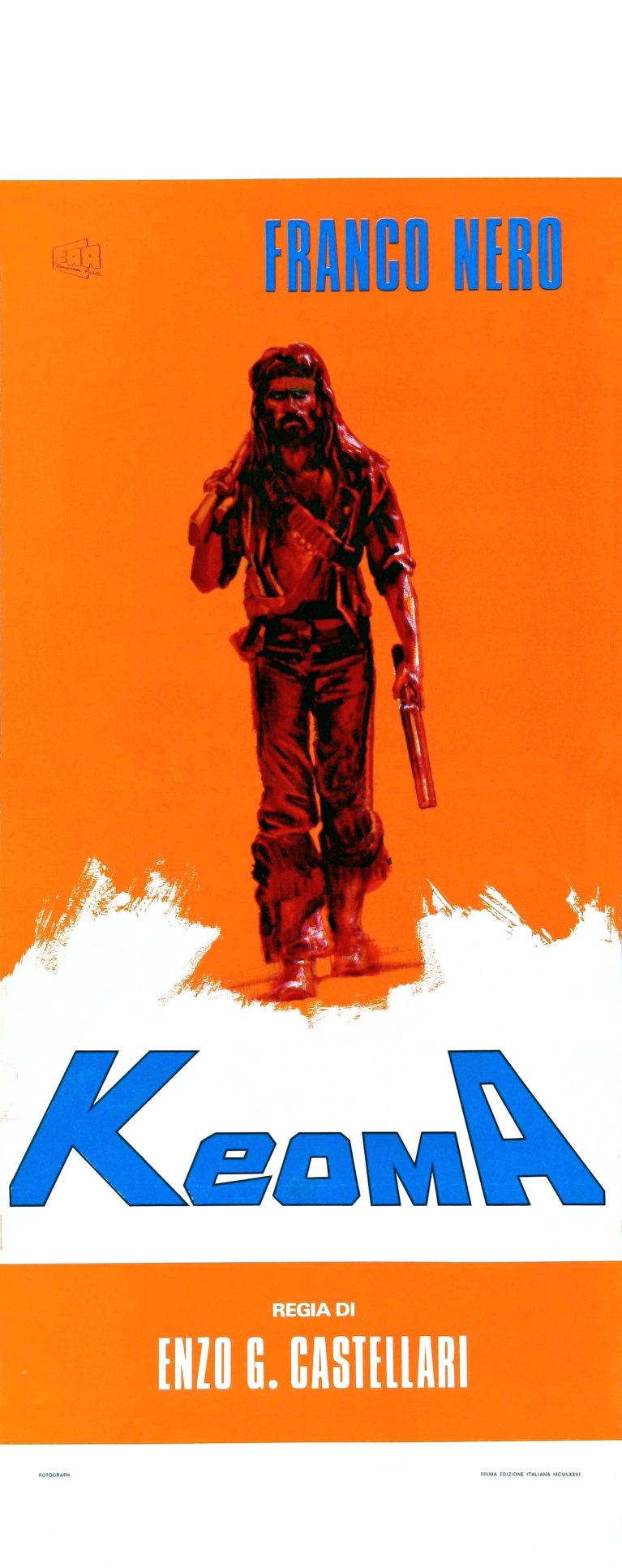
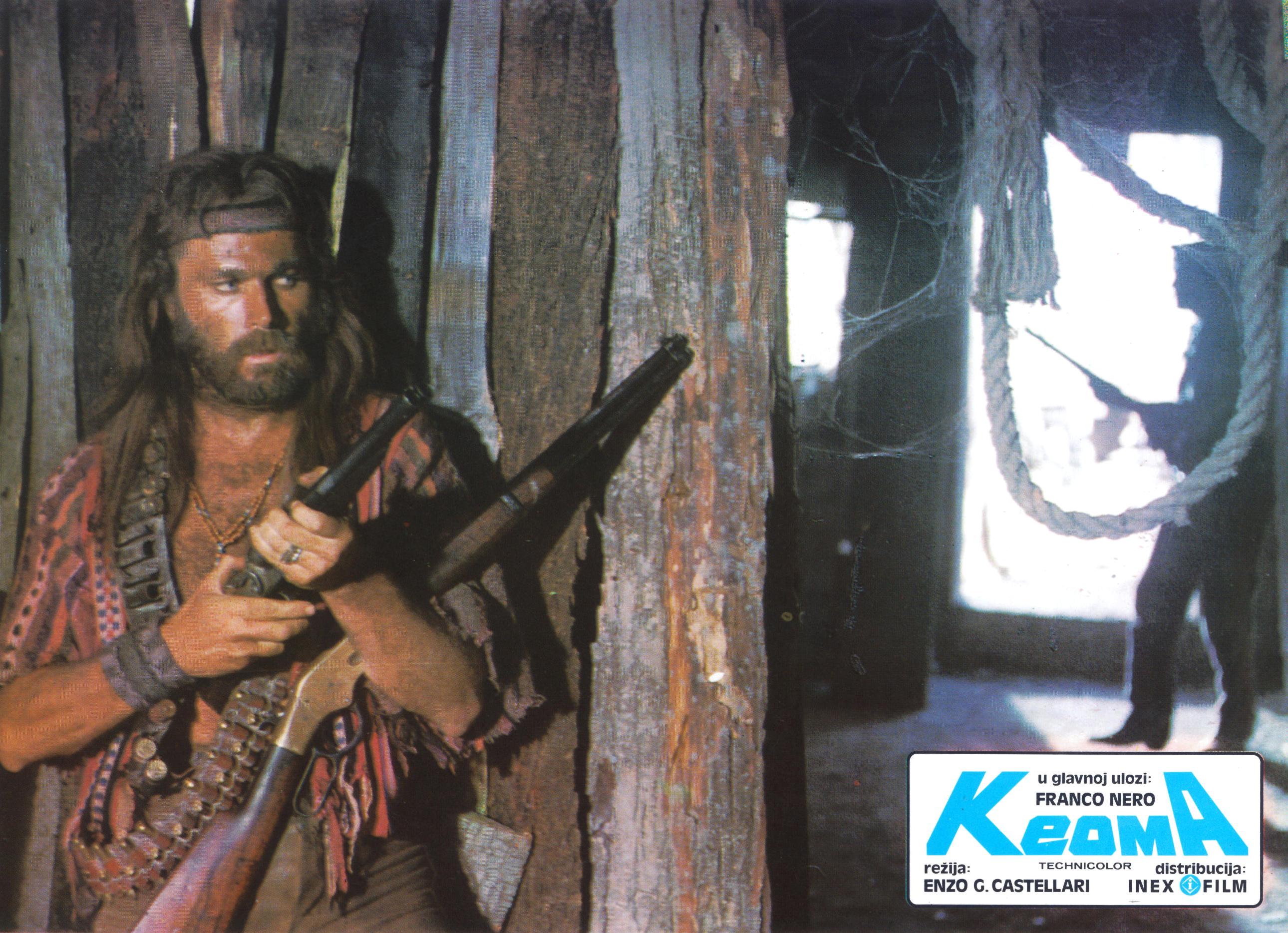
1976 Lobby Card for “Keoma”


By 1976, the mania surrounding the spaghetti western had all but died out. Due to the success of the Godfather films, Italian crime dramas were all the rage and the few westerns that were being produced in Europe fell more into the comedic realm than the dramatic one due to the success of the Terence Hill/Bud Spencer films that became extremely popular in the early part of the decade. Even veteran directors like Enzo Castellari, who had directed several superb spaghetti westerns, including “Johnny Hamlet,” had moved on to Italian crime dramas, as did the genre’s biggest star, Franco Nero, of “Django” fame. Gone was Nero’s cowboy hat in favor of his Borsalino; that is until “Keoma.”

There is a real reverence for all westerns in “Keoma,” which was written and directed by Castellari and released in 1976. I say “all westerns” because the film is packed with many of the standard motifs of fellow Italian western directors, Corbucci and Leone but also Sam Peckinpah and even John Ford. I guess if this was to be Castellari’s last western, he was going to put all of it out on the table.

Playing Keoma (the word means “far away” in Cherokee) is Franco Nero, and he is again the quiet ex-soldier who comes to a town in trouble and who must now fight valiantly to save everyone. There is a plague in the town that is killing everyone, but evil landlord Caldwell is keeping medicine and supplies away from townspeople and is sending the infected to a camp to die. Keoma is half-Native American and was adopted by William Shannon (William Berger), who already had three sons of his own who are now part of Caldwell’s gang. The brothers were brutal to Keoma when he was a child, detesting that their father would raise a half-breed, which is seen during one of the many flashbacks (another key motif in many spaghetti westerns) in the film. After Keoma rescues a pregnant woman who is about to be sent to camp, he draws the ire of Caldwell’s men, setting up the conflict of the film. The dour and almost hopeless tone of these scenes rival Sergio Corbucci’s, “The Great Silence,” the 1968 film that set the standard for surrealistically depressing westerns for years to come.

Many of the gunfights that ensue are those of the Peckinpah variety, with long slow motion shots of diving shooters and the over pronounced sounds of ricochets, but as so many spaghetti westerns have taken their cues from Peckinpah, this is not a surprise. What is a surprise influence in the film is Ingmar Bergman, whose inspiration takes form in a witch (Gabriella Giacobbe) who speaks to our ex-solider Keoma in the same way about the purpose of it all as the Grim Reaper would speak with Antonious in “The Seventh Seal.” Our witch is asking Keoma why he would put the effort in to save a town that is beyond saving; however, Keoma is there to not only to save the people of his town but to correct the wrongs that had been done to him as a boy.

Trailer for “Keoma” 

Nero is great in the titular role, as is the cast, which was comprised of many spaghetti western regulars doing some of their finest work. What sadly hurts “Keoma,” though not fatally, is the ear-piercing folksy soundtrack. It has been written that during filming, Castellari had been enamored of the music that Leonard Cohen had done for Altman’s “McCabe and Mrs. Miller” and wanted something that worked in the same way to propel the narrative. Unfortunately, the virtually shrieking vocals from the soundtrack composed by the De Angelis brothers and sung by Sybill and Guy bombard many scenes in the film and do not give the same kind of earthy goodness that Cohen’s tracks give Altman’s revisionist masterpiece.

The soundtrack is an otherwise small mistake in a film that provides a somber yet triumphant elegy to the spaghetti western. Like previous films in the spaghetti western genre, “Keona” uses every cliché available to tell it’s grim story, but this isn’t a cheaply made lark thrown together to try and cash in on a trend. No, it is an elegantly composed farewell by Castellari and Nero to a kind of film that clearly meant so very much to them and all of those who still loved the raw storytelling of the spaghetti western.

Marco Ferreri’s 1978 Film, “Bye Bye Monkey,” Says So Long To Masculinity

Standard
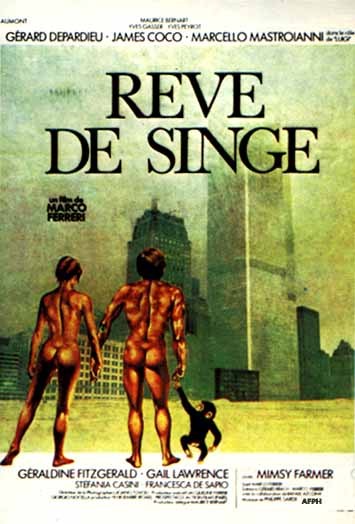
bye-bye-monkey french poster

French Poster for “Bye Bye Monkey”

Surprisingly, as an excessively sexual and carnivorous Italian man, I had been ignorant of Ferreri’s work until my soon to be roommate Doug ranted to me about a 1973 Ferreri film entitled, “The Grande Bouffe.” A film whose plot is centered around four middle-aged men who lock themselves into a villa and then proceed to fatalistically gorge on food and wine while screwing until they die. A kind of stay-at-home, non-violent, Italian version of “The Wild Bunch,” with these four men, who have become tired of their lives, end it all without firing a shot, which if you think about it, was more in line with the softening seventies male. If the passing of masculinity into the sensitive seventies had not been metaphorically shot down there, Ferreri’s next film, 1976’s “The Perfect Woman,” went so far with this new emasculation that our director would make hunky French film star, Gerard Depardieu, cut off his own manhood with an electric kitchen knife after another deflating argument with his wife.

For his first U.S. film, the dystopian “Bye Bye Monkey,” Ferreri would keep up this same trend of metaphorically depicting the downward spiral of masculinity, and why wouldn’t he? After all, wasn’t the United States responsible for setting the world standard in that decade for helping the loafer clad males get in touch with their feelings through overpriced weekend sensitivity training classes? For this film, Ferreri reenlists the beefy Depardieu to play the down and out New York electrician, Lafayette (sarcastically named for the gallant French General who would help American revolutionaries win the war of independence) who works two jobs: one, as an electrician at a Roman Empire wax museum and another as the lighting technician for an all female feminist acting troupe. While men in hazmat suits roam the streets hunting down rats during an epidemic, our feminist theater group laments the fact that they have not experienced any of the real hardships that modern women have faced, so when they come up blank for a theme for what their next performance should be, they sheepishly select rape. The “bad” news is that none of them have been victims of rape, so they decide to rape their electrician, Lafayette, after a member of the company knocks him out.

The next day Lafayette is angered by the events of the previous evening and takes a walk with his older friend Mr. Luigi (Marcello Mastroianni) on the beach near the World Trade Center where they discover a life-sized King Kong lying on the beach dead, with Kong, of course, as the ultimate symbol of a tough guy from a distant place who hit NYC and got the prettiest girl in town. Clutched in Kong’s hand though would not be scantily clad Fay Wray but instead a tiny monkey baby whom Mr. Luigi refuses to take care of due to his advanced age, so Lafayette takes the job and plays mother to the orphaned baby, raising it like a human child. Once home and domesticated, Lafayette becomes the target of admiration for Angelica (Gail Lawrence, better known as Abigail Clayton during her porn star years), one of the theater troupe who originally spurned Lafayette’s advances but is now interested due to what I can determine is Lafayette’s new found maternal instinct. This is where we really see Ferreri, drawing the hard line between men and women. Not during the female on male rape but here as a faux mother is where Lafayette succumbs to his sensitive side and becomes more accessible to the women around him.

On several occasions in the film, Lafayette seeks out the advice of his boss at the wax museum, Mr. Flaxman (James Coco), so when Lafayette arrives with his new monkey to work, Mr. Flaxman tells Lafayette that the monkey will eventually lead to his downfall (loss of masculinity for those following in the cheap seats). Lafayette heeds his boss’s advice and tries to abandon the monkey, the soon be named Cornelius (Planet of the Apes anyone?) But when Lafayette tries to leave Cornelius in the park, Cornelius cries and runs to Lafayette who just cannot leave his new baby, so his motherhood is now complete. Lafayette tries to go about his life, but with Cornelius with him, the prophecy of Mr. Flaxman comes true and everything goes south for Lafayette. In fact his friend Mr. Luigi, a clear symbol of the masculinity of the past, sees his penchant for non-vegetarian eating and his inability to find love in the new land as a harbinger for his eventual checking out of this world. Even Mr. Flaxman sees the writing on the wall when he is blackmailed into changing the faces of his wax sculptures Julius Caesar and Nero into Nixon and Kennedy.

1996 Interview With Marco Ferreri About “Bye Bye Monkey”

Ferreri cleverly uses Depardieu and Mastroianni as examples of two generations of actors from Europe, which was still going through an ultra machismo period, behaving here like they would in a contemporary film from their home countries. As outsiders, it is then up to their characters to decide in “Bye Bye Monkey” on whether they will acquiesce to the way of the seventies male or just stop living all together. What is made clear then by Ferreri with his “punch you in the head but you still find it uneasily interesting” symbolism, is that empires will always fall, and it is the rats who come out of every civilization that expires. Of course Marco Ferreri is not a soothsayer like his Mr. Flaxman, but the now eerie image of the former World Trade Centers looming in the background during many of “Bye Bye Monkey’s” key moments, somewhat bear out Marco Ferreri’s prediction of an American empire, once lead by strong men, fading out in the not too distant future.

Long Before “Inherent Vice” And Even Altman’s “The Long Goodbye,” Stephen Frears Gave Us “Gumshoe.”

Standard
gumshoe lobby card

“Gumshoe” Lobby Card from 1971

With all of the deserved praise being bestowed up the new post-modernist detective film by Paul Thomas Anderson, “Inherent Vice,” I thought that this week I would take a look back at “Gumshoe,” the debut work of Stephen Frears and a favorite dysfunctional detective film of mine, that, like our PT Anderson film and Altman’s “The Long Goodbye,” would take the best ideas of Dashiell Hammett and Raymond Chandler and spin them in a way that is less concerned about a cohesive narrative and more about the small moments and gestures of a flawed private eye.

Though we now recognize his talents, I had always wondered how director Frears had been able to land a talent like Albert Finney for his first film.  After all, Finney had been on an epic roll as an actor since his sensational debut in Karel Reisz’s 1960 British New Wave masterpiece, “Saturday Night, Sunday Morning.”   And with Tony Richardson’s “Tom Jones” and Stanley Donen’s “Two for Road” included in Finney’s oeuvre from the sixties, it just didn’t add up that Finney would go for this odd role of a hapless comedian turned private eye in “Gumshoe” for a then virtually unknown Frears. Perhaps it was that Frears had directed some television for the BBC?  But it is more likely that it was due to Frears having been the assistant director for two of the finest English films of the late 1960s, Lindsay Anderson’s “If…” and Karel Reisz’s “Morgan!”

“Gumshoe” combines two of my favorite genres, film noir and the lesser known “everyman who gets in way over his head” genre, a la “North by Northwest” and “Into The Night.” Finney plays Eddie Ginley, a small time comedian and bingo caller who would rather be the next Sam Spade. One day, Eddie decides to put his fantasy to the test and places an ad in the paper offering his services as a private investigator, which gets immediate results. Eddie goes to a local hotel where he meets the big man who tells him that he has a job for him and proceeds to give our Eddie a package with a thousand pounds, an address for a book store that deals in the occult, and a gun. Bizarrely enthusiastic, Eddie takes the job and is soon thrust into the exact world that he has always dreamed of, complete with corpses, femme fatales, and a whole lot of trouble. Not surprisingly, Finney eats up the screen and seems to love playing Eddie with all of that character’s nods to Mitchum and Bogart. In every scene, Finney just looks like he’s in love with his trench coat.

“Gumshoe” shares much with the newest Paul Thomas Anderson film in that its humor and drama switch up on you so fast that you start to not care about the plot. And I’ll say that with both films, I am perfectly OK with this approach as by 2014, we know that we aren’t making the next “Maltese Falcon,” so why not carve it up into tasty bits and give us a main character who just seems to glide through the body count? Also with both films, all of the supporting characters add the necessary color needed to make any noir a blast to watch, and the classic noir-ish dialog here spoken with Liverpoolian accents becomes as entertaining as watching a Thai Western for its ethnocentrism.

Sadly, one major error in the film is the score by Andrew Lloyd Webber (yes, the guy who did “Cats”), which never seems right for any scene. It is as if he was hoping to score a different, more serious kind of noir than the one that was before him. He doesn’t kill it, but his music, which frankly is too intense for many scenes, was just not the best choice for our young director, even if Frears himself wanted the score to supplement the disorienting environments and events in “Gumshoe.” The other tragic error in the film, and one that might keep it from a repertory theater screening anytime soon, is its casual use of racial epitaphs, which in a film like 1973’s “The Friends of Eddie Coyle,” make complete sense given the vérité of its titular lead character, but in “Gumshoe,” it just comes off as a clumsy attempt to make a bad joke that I cannot imagine was even that funny in 1971.

Gumshoe Trailer :

http://www.youtube.com/watch?v=srZgdloqrzE

Despite these two errors in judgment, “Gumshoe” is successful in giving us a character who you can say was one of the first to demystify the classic hard-boiled detective; Altman’s very successful version of a sloppy Phillip Marlowe in “The Long Goodbye” wouldn’t be released for another two years. Sadly, “Gumshoe” did not find an audience in 1971, so it would be another fourteen years before Frears would make a feature film again, but he would come back with a vengeance by directing Terence Stamp in the massively underrated and terribly serious 1984 British gangster film, “The Hit” before becoming one of the hottest English directors of the 1980s with “My Beautiful Laundrette” and “Prick Up Your Ears.”

So, if you haven’t had enough well-intentioned mess of a detective after seeing “Inherent Vice,” I think a trip to “Gumshoe” will give you not only a different take on the messy private eye but also will hand  you a world class actor in Finney and a soon to be brilliant director in Frears, whose first go at it was trying to break up a noir the best he could.

The Political Grunts and Groans of Claude Faraldo’s 1973 Film, “Themroc “

Standard
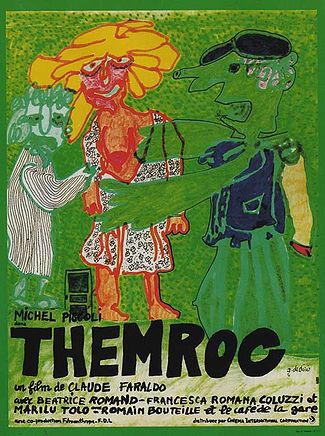
Themroc_(movie_poster) green

1973 Poster for “Themroc”

During the final two hours of Jacques Rivette’s four hour 1969 film “L’Amour Fou”, we see the dissolving marriage of two theatrical sophisticates, Claire and Sebastien, turn into an almost primitive sequestration whose sole purpose is to reject the intellectual ideals that have strangled their love. So, if the next step for the sophisticates in that Rivette film is a transformation into a state of small moments and music, combined with gentle moments of love making, then what is to become of our titular working-poor hero, “Themroc?”

Themroc (Michel Piccoli) lives with his widowed mother, his miserable wife, and his sister who saunters around the flat in various states of undress. Themroc also exists on the lowest rung of the proletariat ladder, a member of the “exterior maintenance crew” whose charge is to paint the outside of a fence while (you guessed it) the “interior maintenance crew” paints the inside of the same fence. Rarely has the stifling monotony of the working man been so aptly recognized. Though he is not happy, Themroc goes about his tedious job until one day when he witnesses his boss nuzzling the secretary of the company and is summarily dismissed. Themroc’s response to his sacking is a trip back home where he will begin his withdrawal from society but not in a “Neil Simon/Prisoner of Second Avenue” neurotic New Yorker kind of way. No, our Themroc sledgehammers a hole in his wall out into the street where he lobs the conveniences of modern society out for all to see while he turns his sexual frustrations away from his wife and towards his own sister (Beatrice Romand from Rohmer’s infinitely tamer masterpiece,  “Claire Knee”).

Now that Themroc has gone off the rails, he continues to turn his place into a sort of man cave but again not one with a hi-fi system and lava lamp or even the gentile “L’Amour Fou” kind; our Themroc is going back to the stone-age. Again, this would be fine normally sans the incest and the fact that he is living in a city where these kinds of things tend to be frowned upon. Eventually, his threatening actions will soon draw the attention of the police, and they come by to check on our man but because Themroc is unemployed, and no longer hitting the grocery shops, and the man who is playing him in the film, Michel Piccoli, appears somehow still hungry after starring in Marco Ferreri’s equally shocking glutton-a-thon from the same year (1973) “Le Grande Bouffe”, he (Themroc) turns our boys in blue into a barbeque dinner complete with rotating spit. Adding to the frenetic mood that takes over the second half of the film is that none of what has happened or will happen in this film is translated through a recognizable language. It will be all grunts and groans from here on out which adds to the primordial hostilities of the main character and just like Faraldo’s previous work, “La Jeune Morte,” this is a low-budget piece of guerrilla film-making that fits the harshness and in some ways the comedy that is coming through here in the same way that forces you to laugh in between the revulsion of non-stop eating and whore-screwing that is “Le Grande Bouffe.”

Added into the mix are the acting talents of Miou Miou and the late Patrick Dewaere, who would star two years later in Bertrand Blier’s breakthrough comedic classic of stunted sexuality, “Going Places.” With that, I must write that “Themroc” now seems like a harbinger for what would happen in European cinema over this decade. As exciting as the Italian Neo-Realist Movement, The French and British New Waves were to audiences in the 1950s and 1960s, there appears to have been a collection of young filmmakers who were poised to pull film into visceral and nasty place that would seem a natural response to the May 1968 riots.  The aforementioned Marco Ferreri and Betrand Blier, Alan Clarke, and the last films of Pier Paolo Pasolini would set standards of honesty and raw depravity that few filmmakers around the world would be able to match.

Themroc (1973) Full Movie:

http://www.youtube.com/watch?v=Z3E53MNP6K8

Though it received mixed critical and box office reception upon its release in 1973, I feel that “Themroc” would have fit right in with the recent films from European filmmakers like Bruno Dumont, Catherine Breilliat, and Gaspar Noe who would emerge the malaise of the 1980s with the same-minded style of Claude Faraldo and Jean Pierre Mocky, whose primary purpose was to pull the politeness out of what was a tired medium for their generation.

Mike Leigh’s Debut Film Is a Small Masterpiece: 1971’s “Bleak Moments”

Standard
bleak-moments-1971

The brilliant Anne Raitt of “Bleak Moments”

There have been few British film directors over the last forty years whose overall body of work I would label as “uncompromising.” Especially difficult was to stay real past the era of creative freedom that was the 1970s; there was the creative lock down and resulting button down stiffness of the 1980s, a decade that forced the British film industry to get all “Chariots of Fire” on us. Which of course, lowered our standards and set the plate for what would be the most successful English filmmaker of today, the human codpiece, Danny Boyle. Truly one British director whom never succumbed to the vile era of the period piece and or uptown glitz over this time is director Mike Leigh.  With Leigh’s 24th film, “Mr. Turner,” about to be released here in the States, I thought to go back and look at Mike’s astonishing 1971 debut effort, “Bleak Moments.”

I cannot imagine as to what folks thought of “Bleak Moments” when it was released in the early 1970s. Though devotees of the films from the British New Wave were used to seeing fairly tough to watch fare like “A Taste of Honey” and “Saturday Night, Sunday Morning,” we must remind ourselves that although those films possessed some fairly shocking themes for the time (abortion, homosexuality), their actors and the overall tone would still rise above the hardships to provide the viewer with many entertaining moments.  No such uplifting time exists within “Bleak Moments,” a film that succeeds in a dour, hopeless tone that few films have been able to reach since.  Much of that not only is due to our Mr. Leigh, who both wrote and directed “Bleak Moments,” and its talented actors who convey the desperation to create this unrelenting, low mood but also it’s modest budget, which lead to the dark visuals and low-fi sound to enhance its already stark feeling of hopelessness.

The film is about Sylvia (Anne Raitt) an office worker, who after putting in a hard day, tends to her mentally challenged sister in her tiny apartment. She is a pretty and somewhat cynical woman whose only amusements given her charge in life and financial situation are the occasional good book and a glass of sherry. At work she chats with her friend Pat, (Joolia Cappleman) who also has the burden of taking care of a physically incapable family member, her elderly mother. They commiserate, but little is actually said about their true sadness that is their lot in life.   Sylvia has a man in her life, the equally quite teacher, Paul (Eric Allan) who wants to be with Sylvia but lacks the fire necessary to break through to her and show her how he really feels. There is also Norman (Mike Bradwell), a hippie folk song singer who also fancies Sylvia and rents the garage, but he also lacks in the self-worth category, so when he is dismissed by Paul as a failure, Norman takes the failure route out.

Paul and Sherry go out on a date, but what follows is a series of awkward dialogs, an incredibly rude waiter that exposes Paul’s inabilities to be a man, and a scene of courtship that occurs back at Sylvia’s place that may never be rivaled for its depiction of sad desperation in screen history. Again, whereas an earlier British New Wave film would’ve resorted to moments of comedy in such a scene, Leigh never lets you off the ropes because he shouldn’t.  These are people whom we all know, good-natured people whom life has pushed aside, but you know that deep down inside that there is little in their makeup to allow them to overcome their self-imposed malaise. You know that they are doomed to “live lives of quiet desperation” that I’m sure would even go well beyond Thoreau’s imagination of such as he penned that line. First time director Leigh allows for every small moment to hit home. It is exceptionally intelligent work for a director the age of 28.

Though this was Leigh’s first outing as a film director, his knowledge of the theater allowed him to select the right acting talents to head this project, a project that was funded by the stars of many of those British New Wave classics, Albert Finney and Michael Medwin, whose production company, Memorial Films, had just bankrolled Lindsay Anderson’s “If” and provided the twenty thousand Pounds that was necessary to get Leigh’s career as a director off the ground. This decision was made by the two after they saw Leigh direct “Bleak Moments” at the Open Space Theater. Though Finney and Medwin could boast such illustrious acting careers, I personally would also hope that they would be as proud as to have helped start the career of our Mr. Leigh.

Norman Sings Us A Sad One in “Bleak Moments”
http://www.youtube.com/watch?v=E62rL6v2GBg

I was once asked by my friend Charlie some thirty years ago, shortly after I described “Bleak Moments” to him and before I shoved a VHS copy of the film into my player; “Why would you ever want to watch something that would make everything seem so hopeless for decent people?” A question I really respected at the time and one that made me wonder for years to come. Though this answer is some thirty years late, I think that in the case of “Bleak Moments,” you feel there is a poetic beauty in even the saddest moments of the film because as much as you hope that characters like Sylvia and Paul could just rise above the troubles that have been bestowed upon them, you are moved to see how they delicately maintain themselves in the face of it all.

Bob Clark, Director of “A Christmas Story,” Gives Us a Soldier’s Horrific Homecoming from Vietnam: 1972’s “Deathdream.”

Standard
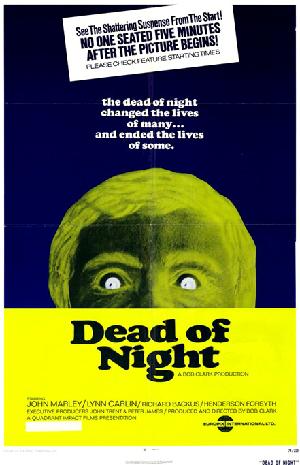
Deathdream Poster

“Dead of Night” (Deathdream) Original Poster from 1972

I could easily dedicate this blog to just “post-Night of The Living Dead zombie films of the 1970s” as the genre was simply flooded after the cult film success of the Romero classic that defined the word zombie for decades to come. In fact to show how niche the genre got, just last week I reviewed the sublime and campy 1977 underwater Nazi zombie film by Ken Weiderhorn, “Shockwaves,” about a group of extremely loyal soldiers (they’re dead) of Adolf who still live and fight for the Third Reich while vacationing in the Caribbean. Someone else who definitely took inspiration from Romero was director Bob Clark, who knocked out a couple of rare underrated films in that genre, 1972’s “Dead of Night” (Deathdream) and 1973’s “Children Shouldn’t Play With Dead Things,” before bizarrely going off to make the seminal holiday film, “A Christmas Story” and the equally seminal but repulsive ten sex comedy, “Porky’s.”

“Deathdream” could easily be lumped into another genre that was also quite overloaded during this time period, the misery the returning Vietnam veteran film. The intense drama of those Vietnam era films is very much in place in “Deathdream,” with the caliber of acting from two of its leads, John Marley and Lynn Carlin, who were last seen together in Cassavetes “Faces” carrying much of the sadness of this horrific and well thought out film. It is the story of a US Soldier, Andy Brooks (Richard Backus), who is shot and killed in Vietnam, and as he lies dying, he hears his mother’s plea to “come back home.” The family receives Andy’s official death notice from another soldier, but his mom Christine (Lynn Carlin) still believes in her heart that the message is a lie and someday her son will come home. Unfortunately, Christine is right and Andy is on his way home, but Andy has been changed by the war; he rarely speaks, and for some unknown reason, he murders and drains the blood out of a truck driver who has kindly given Andy a lift home.

Andy sneaks into his family’s house soon after the killing, and after being warmly greeted by his family, Andy is still very quiet, avoiding seeing anyone outside of the immediate family and exhibiting small moments of rage, which seems just about right for a soldier just recently removed from combat. The next day, while lounging outside, Andy is greeted by the mailman, a longtime friend of the family, who gleefully explains how his experiences during World War Two were vastly different than Vietnam. This enrages Andy, and he finds refuge in his old bedroom where he pathologically rocks in rocking chair all day and night, drawing the concern of his father Charlie (John Marley) who will also recount how he never behaved like that after his service in World War Two. It is in these scenes where Bob Clark reminds the viewer of the old adage that was once uttered by the head of the Veterans Administration; “When a soldier returned from World War Two, everyone bought him a drink. When a soldier came back from Korea, he bought his own drink. And when a solider came back from Vietnam, he has to buy everyone else a drink.” Even though the town is adorned in flags and patriotic symbols, there is little patience for the PTSD exhibited by the soldiers who served in Vietnam, and in “Deathdream,” the PTSD is transformed into a need for Andy to drain the blood from the living in order to continue being part of this society that may not have time for him. More than most political metaphors that the zombie genre has carried over the years, this one really hits home.

Though there are a few scenes where a kind of comic relief is put in, the overall mood of “Deathdream” is dire and extremely sad. Attempts to reintegrate Andy into a world that no longer exists for him by his family are met with brutally violent ends, physically manifesting any soldier’s genuine contempt for those around him who have no desire to understand his pain and sacrifice during that unpopular war. The unrelenting and tragic end of this film, involving Andy’s parents and sister, show a commitment by Clark to illustrate the level of impact that war takes on a solider and those around him, even when the soldier is met by the best intentions of loved ones who even offer psychological counseling as the Brooks family offers their son Andy. “Deathdream” though brutal, hammers home the sad truth that if your son were even able to come home, he may never actually be home again.

Deathdream Trailer from 1972:
http://www.youtube.com/watch?v=eIqA1ZbpYFw

As stated earlier, what truly pulls “Deathdream” together are the performances of Carlin, Marley, and Backus who take a minimal amount of dialog top help create a terse, heartfelt film that makes for a very necessary statement piece on the particular plight of Vietnam veterans. “Deathdream” succeeds by using grotesque horror methods to illustrate the struggle of Vietnam vets in ways that even award winning films like “Coming Home” and “The Deer Hunter” sometime fail to execute.

Director Bob Clark showed a clear talent for being able to draw top flight performances out of his actors in his early career.  Several years after “Deathdream, Clark would direct legendary actor, Jack Lemmon, to an Oscar nominated performance in the equally forgotten 1980 drama, “Tribute.” It is a pity that the end of Clark’s career would be filled with the likes of Sylvester Stallone’s “Rhinestone,” and “Baby Geniuses,” as there was a true maverick talent that seemed to be destroyed after the unbelievable financial success of his “Porky’s films. Sadly, Bob Clark was killed in 2007 in a car accident with his son Ariel, a tragic end to a talent who for at least a decade was making interesting films, both in and out of the Hollywood system.