Bovine Ska and Rocksteady 2/4/15: Bobby Aitken

Standard
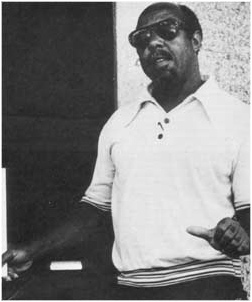
Bobby Aitken photo

Our spotlight artist Bobby Aitken 

Coming to you from a frozen, snow-covered Cambridge, it’s the Bovine Ska and Rocksteady!  Wow, these last few weeks have been rough with bad weather.  We are also back this week, after missing last week’s show due to Generoso’s hospital stay.  He’s improving but that combined with the snow has made doing the show difficult but we were glad to be back.   Starting the show off this week were two sets of delicious early reggae, beginning with a massive tune from Sound Dimension, “Great Mu Gu Ra Ga” which was released on Bamboo in the UK in 1970.  Our spotlight would be on the early vocal tracks of Bobby Aitken.

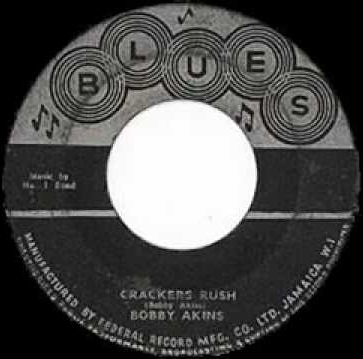
Brother of the godfather of ska, Laurel Aitken, Bobby Aitken, was born in Havana in 1933 and was orphaned in Jamaica at the age of eight. As a boy, he became a mason when his uncle pulled him away from a street gang and introduced him to the masonry trade in order to survive on his own. However, music became a more reasonable means for Bobby, especially seeing that he had a natural gift for it. A precocious 11 year old Bobby built his first banjo from sardine cans and learned how to play guitar on his own. And, by his mid-20s, Bobby had built up his guitar skills and formed the Carib Beats with Charlie Organaire and a man named Morgan in late 1959/early 1960. Together, the group performed primarily calpyso with a few skas, but the trio broke up after the rest of the group did not show up for a performance at the Blue Ribbon Club in Kingston.  As a result, Bobby returned to masonry for a stint, only to make a comeback to music within a year as a solo artist with his single, Cracker’s Rush, which commented on a food shortage in Jamaica and was released in 1961 on the Blues label by Count P, an operator of a soundsystem on Spanishtown Road. We’ll began with this first solo recording of Bobby Aitken to kickoff tonight’s spotlight.

Eventually, after recording for a range of producers including Prince Buster, Coxone Dodd, Linden Pottinger, and King Edwards, Bobby Aitken formed The Carib Beats again with Charlie Organaire and Mike Williams. Other musicians including Bobby Kalphat, Vincent White, Conroy Cooper, Ansel Collins, Carlton Santa Davis, and Val Bennet would also rotate in and out of the group. The Carib Beats recorded for Joe Gibbs, Clancey Eccles, Bunny Lee, and most famously, JJ Johnson.  The second incarnation of The Carib Beats would eventually break up as Bobby decided to focus more on his faith and became who he is known as today: the Reverend Robert Simmonds.

Listen to the full program with our Bobby Aitken spotlight: HERE.

Enjoy! The archive will be available until 2/17/2015 

Bovine Ska and Rocksteady 1/21/2015: The Cables

Standard
cables what kind of world

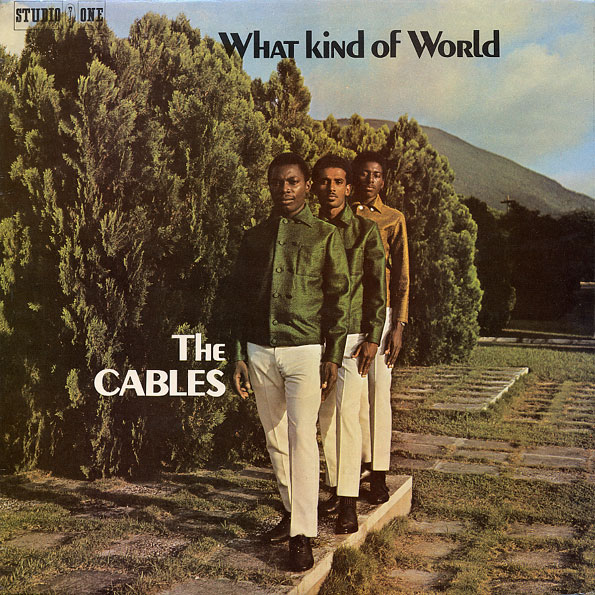
The Cables superb LP, “What Kind of World,” on Studio One

This week’s program began with two sets of fantastic ska which started with a cut from the virtually unknown artist named “Pulus” with a track entitled “Sow To Reap” for Merritone in 1966. Thanks again to the good folks at Dub Store in Japan for finding and pressing these lost tapes from the Merritone vaults.  I hope that there is only more lurking somewhere to be released soon.  After a brisk mento set, we launched into the sounds of vocal group extraordinaire, The Cables.

The Cables are Vincent Stoddard, Elbert Stewart and Keble Drummond. Named after a modified spelling of Keble’s own name into The Cables, which he felt was a right name because cables could send a message to the world. Born in St. Elizabeth, The Cables’ frontman Keble Drummond moved to Kingston as a child and grew up in the dire neighborhoods that would produce some of Jamaica’s greatest talent. Spending most of his adolescent years in Ghost Town, Drummond interacted with some of Jamaica’s greatest talents including Rita Marley, who lived in Ghost Town as well. Drummond attended Chetola Park School and then Kingston Senior School, a school that produced the great talents of Earl Morgan from the Heptones and Marcia Griffiths, so music was not a surprising path for him. Growing up in neighborhoods where musicians were often performing, Keble began to interact and sing with local groups. Eventually, Kebel met Peter Austin of the Clarendonians who taught him his first guitar chords. Keble then saw a flyer for Herb Moral Song Studio Training, and he attended a song writing course. In this course, he wrote his first song, “You Lied,” which would be the first track he would record with The Cables for Linden Pottinger’s SEP label, the track that begun our hour long spotlight on this phenomenal vocal group.   It’s a bit of a coincidence that the last of the Cables is called “You Betrayed Me.” The Cables would stop working with the Pottingers because they did not receive payment for their recordings, which had gone directly to Bobby Aitken and his band, who was the backing band for many of the tracks on the SEP label. After leaving the Pottingers, The Cables traveled over to Coxone Dodd to record for his labels. At Studio One, The Cables had to audition for Jackie Mittoo, who at first pushed off the group, but after a bit of a yelling scuffle, finally gave the group a chance to record. We then played The Cables’ Studio One output next.

One of their most popular tracks, “Baby Why” was written about a failed relationship with one of his Keble’s girlfriends who moved from the country to the city to try to start a new life with him.  As with many Jamaican artists, The Cables did not have great financial success or luck with Coxsone. Consequently, when an up-and-coming Harry Johnson (Harry J) met The Cables as he was transitioning out of insurance sales and into the recording industry, the group took the opportunity to go over to the Harry J and show him how to record while they were still on contract with Coxone. With Harry J, Keble developed a friendship with him, and their closeness is definitely reflected in the music because the Harry J cuts are some of the strongest Cables’ recordings.  When Harry J did not have his own recording studio, his recording sessions happened at Dynamic, so it is natural that The Cables would also record for the Dynamic label, except with Syd Bucknor at the Producer helm.  In following the trend of befriending his producers, Keble and the Cables were also close to Hugh Madden, who Keble still visits in Jamaica .

Thankfully, the Cables perform to this day.

Listen to the full program with The Cables smooth vocals sounds: HERE.

Enjoy! The archive will be available until 2/3/2015

Bovine Ska and Rocksteady 1/14/2015: King Sporty

Standard

Prior to the preparation for this week’s show, we were informed of the sad news of King Sporty’s passing. Consequently, this past week’s show featured a memorial on the great DJ who would emerge as an amazing songwriter and producer.

To begin the show, we began with two sets of rocksteady, including never-before-played tracks from The Merritone Singers and Victor Morris. We then heard mento from Count Owen, Lord Foodos, and Charlie Binger prior to a set of ska to precede King Sporty’s early ska toasting tracks.

R-2265428-1273249302.jpeg

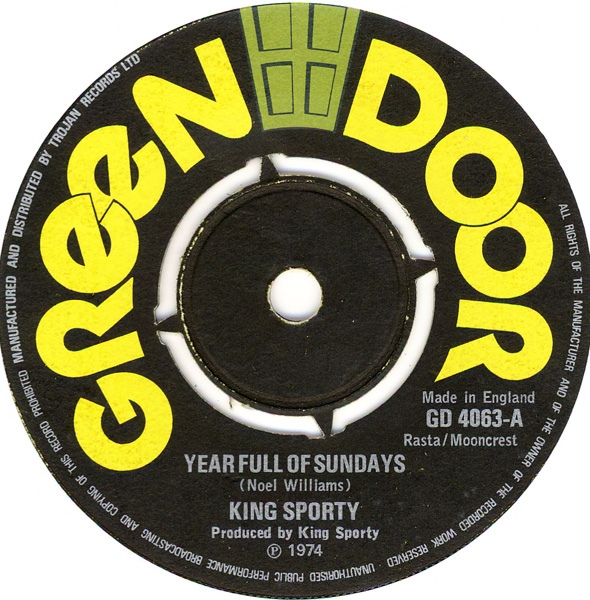
King Sporty’s Self-Produced Single Yearfull of Sundays

King Sporty passed at the age of 71 in Miami on January 5th. Born as Noel G. Williams, King Sporty began his career in Jamaican music as one of Coxone Dodd’s DJs for his soundsystem. In Jamaica, King Sporty would record for Coxone and for Justin Yap prior to his move to Miami in 1968.

Upon his move and work in America, King Sporty would transition his writing and production into soul and disco. However,we will focus this spotlight on King Sporty’s own tracks in ska and reggae before he gained popularity in the world music arena. We will pay honor to the great talents of King Sporty in an one hour tribute of his best DJ recordings, beginning with his first vocal toasting track in ska named El Cid, which was released on Justin Yap’s Top Deck label.

Even though the memorial spotlight focuses on his own recordings, King Sporty was not only a phenomenal DJ and producer but also a talented songwriter. He penned many hits for Studio One and such well known tracks as the Blues Busters, “Thinking of You” and a song that he originally recorded that Bob Marley made globally famous, “Buffalo Soldier.”

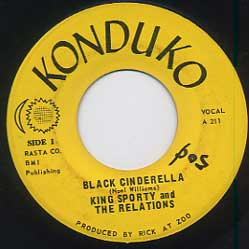
In Miami, King Sporty opened up his labels, Tashamba and Konduko, allowing him to write, produce, and release his own recordings and those of artists he liked. During this time in Miami, King Sporty would become very close to the Miami soul scene, distributing records from his label through Henry Stone, the king of the Miami’s T.K. Records. Sporty also married Betty Wright, T.K. Records’ leading soul lady.

One of the tracks that King Sporty sold to Henry Stone was one from Lily’s favorite Glades/T.K. Records artists, Timmy Thomas. In fact, King Sporty had discovered Timmy Thomas’s “Why Can’t We Live Together” and brought the track to Henry Stone’s door. Stone purchased it from Sporty immediately and pressed it on his Glades label in 1972. The Timmy Thomas track gained traction on the American charts, and this would be one of King Sporty’s most successful discoveries within the Miami soul world.

Listen to the full program with King Sporty’s stellar recordings in ska, reggae, and even soul HERE.

Enjoy! The archive will be available until 1/27/2015.

Bovine Ska and Rocksteady 1/7/2015: Gregory Isaacs

Standard

For this past week’s edition of the Bovine Ska and Rocksteady, we kicked off the show with a newly unearthed Justin Hinds and the Dominoes ska track entitled, “Verona.” Then, in order to make sure that all genres were covered, the program progressed from ska to mento to the rocksteady, with recordings from Winston and Bibby, Clyde Hoyte, Tomorrow’s Children, and The Lyrics before all of the reggae featured in our hour long spotlight on the early recordings of Gregory Isaacs.

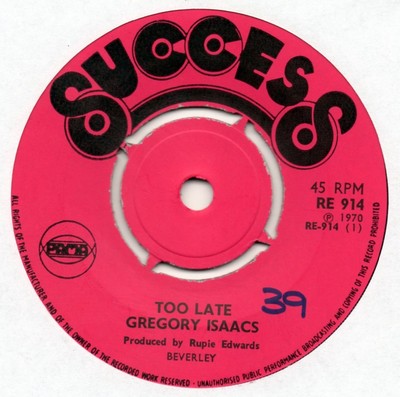
Too Late – One of Gregory Isaacs’ first solo recordings

Gregory Isaacs is a singer who gained great popularity during his early career, so much so that he was even signed to a record contract with Virgin Records in his later career. Admittedly, the Bovine Ska and Rocksteady has not featured Isaacs as a spotlight because his most popular tracks are ones that stylistically do not fit in the time frame that we like to focus this show on. However, we were able to find some of Isaacs’s first recordings, and they were perfect for this artist spotlight.

Born in Fletcher’s Land, Kingston, Gregory Isaacs was raised by his mother near Denham Town. Attracted to music through his own mother’s singing as she ironed, as a teenager, Isaacs began competing in talent shows and showcasing his voice, occasionally even performing duets with his brother Sylvester. A duet with another artist, Winston Sinclair, from his neighborhood would be Isaacs’s first recording in the Jamaican music industry. This duet track, “Another Heartache,” did not gain a ton of success, and Isaacs went on to join The Concords with two men known as Penroe and Bramwell. The group was short lived, but they produced some really beautiful recordings.

After beginning his music career working with other singers, Isaacs eventually decided to become a solo artist, continuing to work with Rupie Edwards, who worked with The Concords and would be a continuing collaborator throughout Isaacs’s career.

In 1973, Isaacs scored his first hit with the Phil Pratt produced track, “All I Have is Love.” After that success, he would jump to other producers including Leonard Chin, Alvin Ranglin, and  Sydney Crooks, with Isaacs scoring a number one hit on the Jamaican charts with “Love is Overdue,” a single recorded for Alvin Ranglin’s GG label. And with the success seen in 1973 and 1974, Isaacs’s career would propel in the coming years.

In 1973, Gregory Isaacs teamed up with Errol Dunkley to create the African Museum record label and shop. Here, Isaacs would write, record, and produce his own tracks, with the earliest African Museum releases exploring more of a roots reggae sound.

After a long battle with lung cancer, Isaacs died on 25 October 2010 at his home in south London. As a testament to his fame and popularity, a memorial service was held on November at Kingston’s National Indoor Sports Centre, including a musical tribute from artists including Lloyd Parks and We the People Band, Ken Boothe, Freddie McGregor, Shaggy, Judy Mowatt, The Tamlins, and Bongo Herman, before his remains were interred at the Dovecot Cemetery.

This spotlight on Gregory Isaacs features his earliest recordings and follows his early progress and growth as a singer, songwriter, and producer, giving honor to his great talent as a young musician.

Listen to the full program HERE.

This edition of the Bovine Ska and Rocksteady is available until  1/20/2014. Enjoy!

Bovine Ska and Rocksteady 12/31/2014: A Show of Firsts!

Standard
Jack Sparrow-Ice Water

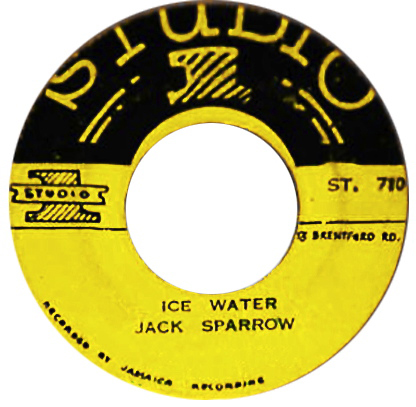
Jack Sparrow’s (Leonard Dillon) First Recording


To celebrate the arrival of the first day of 2015, this past week’s Bovine Ska and Rocksteady featured the first recordings from some of Jamaica’s greatest artists.

Following the chronological order of each artist’s debut to the Jamaican recording industry, this New Year’s Eve show also follows the progression of movements in Jamaican music, beginning with Rhythm and Blues, then Ska, then Rocksteady.

In this special show, not only will you hear the first recordings from the legends, such as John Holt, Bob Marley, Jimmy Cliff, and Desmond Dekker, you will also hear the first tracks from BSR favorites including The Jamaicans, The Pioneers, Roman Stewart, and Nora Dean. In addition, you will also hear anecdotes about the artists and how their first recordings emerged. It was a tough show to research, but we hope that you will enjoy hearing how your favorite artists sounded when they began their music careers!

Enjoy! Happy 2015 from Lily and Generoso! May this year be a wonderful one for all!

Listen to the New Year’s Celebration Show HERE.

The archive will be available until 1/12/2015.


Bovine Ska and Rocksteady 12/24/14: Christmas In Jamaica!

Standard
rupie edwards-Christmas Rush

Rupie Edwards from 1974

We have done a Christmas in Jamaica show every one of the eighteen years that the Bovine Ska and Rocksteady has been in existence.  And every year, we do our best to remove the intense cheesiness that is on display from every other radio show that tries to do a holiday program.   This lack of cheesiness was evidenced in our selection of Jamaican rhythm and blues, ska, rocksteady and even dub records of a Christmas kind but alas the Christmas disco from the SalSoul Orchestra which was used in the background did not live up to the rigid standards set forth by us during the selection of sets.  To put it mildly, it was cheese town when we were on the microphone but don’t let that dissuade you from checking out this show while it is still the holiday season.  Lily spoke about Jamaican Christmas traditions, we played a Jamaican patois version of “The Christmas Story” and played a lot of stellar records!

You will hear many rare holiday cuts, from artists like The Upsetters, Reuben Anderson from Andy and Joey fame, and the late great Desmond Dekker.

Merry Christmas from Lily and Generoso!

Listen to the two hour holiday program HERE.

The archive will be up until 1/6/15. Enjoy!


Bovine Ska and Rocksteady: 12/17/2014: Charlie Ace

Standard

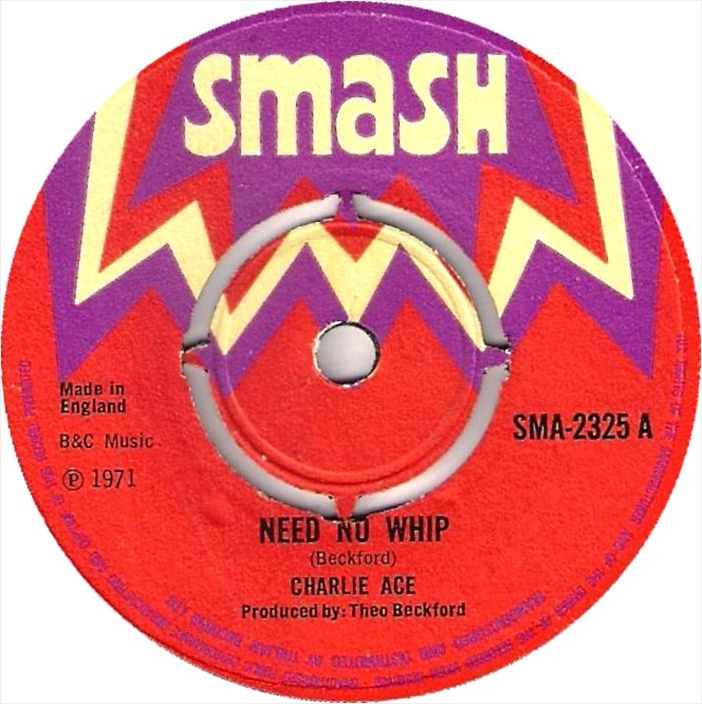
In this past week’s edition of the Bovine Ska and Rocksteady, we began the show with Jamaican Rhythm and Blues, giving us a chance to feature some gems from the Jiving Juniors, Owen Gray, and Cosmo and Dennis. After the opening Rhythm and Blues sets, we presented this week’s mento set dedicated to the delicious fruit that makes us remember warmer days, mango. Then, in order to transition us into the spotlight on the DJ extraordinaire, Charlie Ace, we played two sets of rocksteady, including beautiful tracks from Hopeton Lewis, The Heptones, and Eddie Perkins.

With the arrival of the second hour, we were thrilled to present to spotlight on Charlie Ace, a man who became known for his record store on wheels but a man we know as a DJ great who should be considered in the same ranks as Big Youth and U Roy.

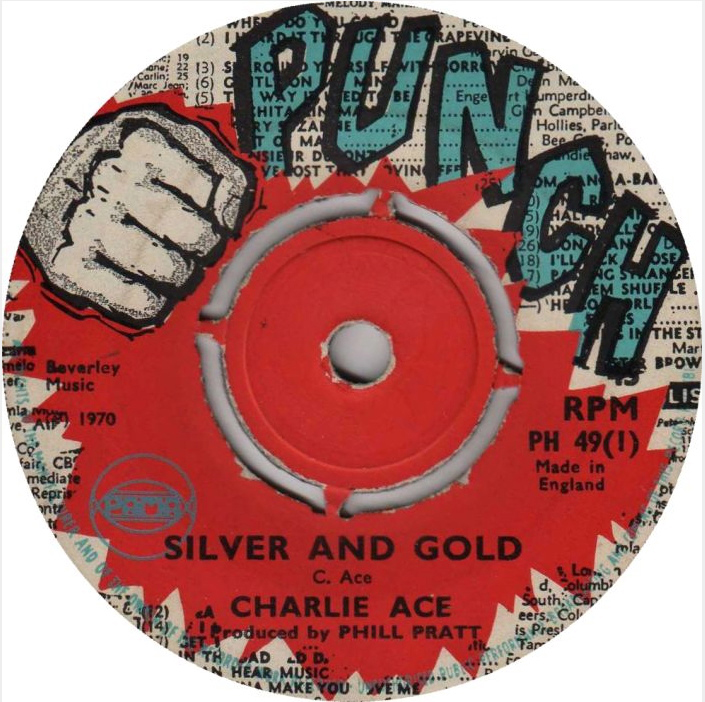
Charlie Ace's Silver and Gold

Charlie Ace’s Silver and Gold Produced by Phil Pratt

Born Valdene Dixon, Charlie Ace was a DJ who gained his name and signature style when he worked with Lee Scratch Perry. After some mild success with his recordings, Charlie Ace would become best known for his Swing-A-Ling Record Shop on wheels that he would drive around to sell records pressed on his own Swing-A-Ling label and on other Jamaican labels as well. A great DJ who was overshadowed by U-Roy and Big Youth and Dennis Alcapone, Charlie Ace is an artist that deserves a spotlight on his large collection of recordings. This review on Charlie Ace’s tracks featured some of the strangest and most experimental productions to date on the Bovine Ska and Rocksteady and began with one of his earliest recordings for Joe Gibbs Amalgamated label, the track entitled, “Seeing Is Believing.” The spotlight followed Charlie’s work with producers such as Phil Pratt, Alvin Ranglin, and Sonia Pottinger to lead up to our favorite track, a Lee Sctratch Perry production named “Cow Thief Skank.”

Sadly, Charlie Ace was murdered in the mid-1980s in a drive-by during one of Kingston’s endless ghetto wars. He was an innovative DJ and great talent who is severely missed.

Listen to the Charlie Ace spotlight and the full show HERE.

The archive will be up until 12/29/2014. Enjoy!

Bovine Ska and Rocksteady: 12/10/14: Winston Samuels

Standard
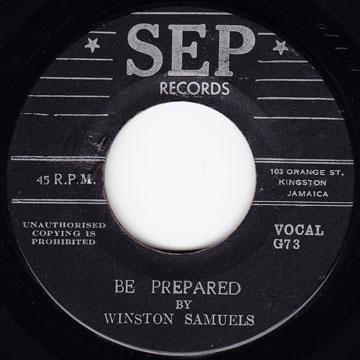
Winston Samuels-Be Prepared

Winston Samuel’s Biggest Hit on Lyndon Pottinger’s “SEP” Label

We started off this past week’s very mysterious Bovine Ska and Rocksteady, with the enigmatic, “Prince of Darkness” who tossed down the incredibly danceable sounds of “Burial of Longshot,” for Dandy Livingstone on the Downtown label in 1969.   The track is a response to the classic cut “Longshot” by The Pioneers.  We then burned through two sets of reggae, a very fast mento set and a set of ska to get you in the mood for the ska sounds of Winston Samuels.

Winston Samuels, after much research and reaching out to scholars and Jamaican legend, remains somewhat of a mystery. What we can gather about this magnificent singer is that with the exception of his hit, “Be Prepared,” there is very little known about Winston’s personal history and his career beginnings. According to Studio One artist and Bovine Ska and Rocksteady friend, Dudley Sibley, we know that Winston Samuels first recorded for Coxone in the early 1960s , and other sources indicate that his first release on Coxsone’s All Star imprint was a single with two sides with conflicting names and themes: “Paradise” and “In Jail.” We started off the spotlight on mighty vocalist Winston Samuels, with “In Jail” and with that you got a preview of the amazing voice that he would hone and perfect throughout his career.  One of the real surprises was the magnificent quality of the tracks Winston would do curing the rocksteady period for Prince Buster.  His voice may be at it’s best here.

There are some rumors that he was a member of The Four Aces, but we were not able to confirm this, but what could be verified was that Winston Samuels was a prolific song writer who penned two festival song winners for Eric Donaldson: “Sweet Jamaica” and “Land of My Birth,” in 1977 and 1978, respectively. Then, after spending quite some time in the music industry, Winston Samuels moved to America, but his whereabouts since have been pretty mysterious.

Listen to the spotlight and the full show HERE.

Enjoy! The archived file will be available until 12/23/2014.

Bovine Ska and Rocksteady 12/3/2014: The Emotions

Standard

On this past week’s episode of the Bovine Ska and Rocksteady, we started off the show with two full sets of ska, including some supremely danceable tracks from Prince Buster and his All Stars and The Pioneers.

In the first hour, we also played some unearthed rocksteady singles from The Merritone Singers and The Dynamites in preparation for the early rocksteady tracks from Max Romeo’s first musical endeavor with The Emotions, the vocal group for this week’s spotlight.

After his mother decided to immigrate to England, Max Romeo lived with his father near Wareika Hills. However, after continued disagreement between Max and his stepmother, he decided to run away at 14, living in the hills and trying to get by as best as he could.

In trying to get stable work, Max ended up working in a sugar cane field in Clarendon as a canal cleaner. In the field, he met Denham Edwards, and the two sang together at work. It was at work where Denham would write a song for Max to sing, which was his entry for a regional song competition. Max sang the track with Kes Chin and the Souvenirs at the contest and won, putting him on the track to a music career.

Eventually, Max moved to Kingston and met Lloyd Shakespeare through his friend Suckro. Then, through Lloyd Shakespeare, he met Lloyd’s singing partner, Kenneth Knight. Originally, the two were going to be the duo Ken and Lloyd, but given that they were not entirely ready as a duo, Max offered to join the group and lead.

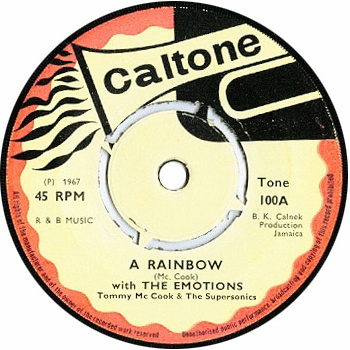
Max would then become a salesman for Blondel Calnek, an importer of Chinese figurines. During this time, Blondel would open a record label and create a pseudonym for his persona as a record producer. This name was Ken Lack, his last name backwards. Lack’s label, Caltone would be the first label to record The Emotions, which was initiated by Lack when he heard Max singing one day at work. The first track to start the spotlight was, “I’ll Buy You a Rainbow,” the first track they recorded for Caltone

Lack decided to move to the U.S. in 1968, which caused the Caltone label to dissolve. After the dissolution of Caltone, the Emotions would travel over to Phil Pratt to record some pretty singles before Max decided to pursue a solo career in 1968. During this time he was replaced by Audrey Rollins. Audrey would eventually decide to work for Lloyd Daley at his Matador label and was then replaced with Lloyd Brown. However, when Max’s solo career did not flourish as much as he had hoped, Max re-joined the Emotions by the end of 1968.

Around the same time, Max Romeo worked as a salesman for Bunny Lee. Max wrote the now infamous “Wet Dream” and gave it to Bunny Lee to find a vocalist for the track. Bunny offered it to Derrick Morgan, John Holt, and Slim Smith, but all of them passed on it because of its salacious content. Bunny then told Max that he would have to be the one to record it, or else it would never be recorded. “Wet Dream” became Max’s track to put him on the map in music, with its notoriety pushing it up in the charts, especially in the U.K. where it was banned on BBC radio, but, regardless, it made it into the top ten of the charts. After the popularity gained by “Wet Dream,” Max toured England and recorded further innuendo-laden tracks and ended up staying there until 1970 when he returned to Jamaica to form his Roman record label and soundsystem.

Listen to the spotlight and the full show HERE.

Enjoy! The archived file will be available until 12/16/2014.


Bovine Ska and Rocksteady 11/25/14: Bunny and Skitter

Standard
Bunny and Skitter Chubby Single

Count Ossie Adds Some Furious Drumming To This Bunny and Skitter Classic

As this week’s show aired twenty four hours before Thanksgiving 2014, we just had to start with the only Jamaican track to honor our day of overeating, football, and some thanks, Prince Buster’s sublime mid-tempo ska, Thanksgiving.  A fun cut that was released in Jamaica on the “What a Hard Man Fe Dead” LP in 1967.    We then surrounded that cut with two sets of tantalizing rocksteady, culminating with a Merritone label track from Hopeton Lewis entitled “At The Corner of The Street,” which up until recently was a long forgotten song on tape until the kind folks at Dub Store Records in Japan released it.

Our last set of the first hour featured some splendid ska instrumentals which included “One More Time” from Lloyd Brevett and his Group, released on Lyndon Pottinger’s SEP Label in 1964 and ending with a sensational instrumental from Roland Alphonso recorded for Justin Yap called, “Live Desire.”

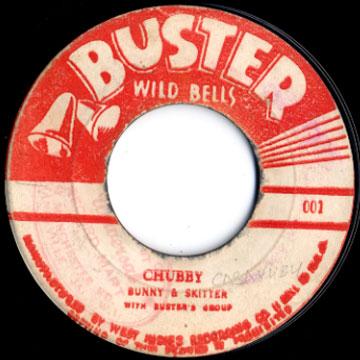
For our spotlight this week, we chose the early Jamaican rhythm and blues duo, Bunny and Skitter, who despite recording some fantastic hits during the pre-ska era, also remain quite the enigma as there’s still a little bit of mystery surrounding the identities of Bunny and Skitter.  There is some solid agreement on the identity of Skitter, who was Vernon Allen. There are reports that Bunny was Zoot Simms and other reports that identify him as George Dudley. Though, the exact identity of Bunny is not clear, we do know quite a bit about their discography. Bunny and Skitter recorded their earliest tracks for Coxone’s Worldisc label and after working with Coxone, the duo would work with Prince Buster and Vincent Randy Chin.  It must be said that although they would only do one session with Buster, it would produce a high point for their career in the song called “Chubby.”

When “Chubby” was recorded in 1961, the Rastafarian was still viewed as a cult by proper Jamaican society.  This fact seemed to elude Buster who had always operated with a downtown ethic.  For this recording, Buster brought in the Nyahbingi drumming of Count Ossie and a team of four burro drummers as he had with the Folks Brothers R&B hit, “Oh Carolina” but here Buster removed the R&B elements to produce the first pure example of Nyahbingi drumming ever recorded in Jamaica which also proved a hit for Bunny and Skitter.  Shortly after the success of “Oh Carolina” and “Chubby”, several other Jamaican producers such as Coxsone Dodd and Vincent Chin would turn to Count Ossie for a hit.  With Bunny and Skitter’s voices and the Count Ossie drumming, a musical revolution had begun.

We were delighted to present the spotlight on Bunny and Skitter. Listen to this past week’s show HERE.

The archive will be available until 12/8/2014. Enjoy!