Bovine Ska and Rocksteady 8/18/2015: Saying Goodbye To Maurice Roberts And A Spotlight On Justin Yap’s Top Deck Label

Standard
top deck label A

BB Seaton Thrills On This Top Deck Cut

Hello Bovine Ska and Rocksteady Listeners,

Unfortunately, we started off the show this week with some very sad news from BB Seaton of The Gaylads…He posted that his friend, bandmate and co-founder of The Gaylads, Maurice Roberts had passed away.  “Joe” as he was affectionately called by his friends, died after a long period of illness.  We first heard of Joe’s passing health when we interviewed BB Seaton back in the spring of 2012, but there was little information being released on the status of his health so this comes as a surprise.  We started off our program with a few of our favorite Gaylads tracks that were recorded in the early reggae period, including “Someday I Will Be Free,” “Wha She Do Now,” and “My Jamaican Girl” as well as the version of that tune recorded by the Conscious Minds, to which Joe also passed bass.  We send our love and respect to Maurice Robert’s family, and The Gaylads.  RIP Joe.  We ended the first hour with some rare Jamaican rhythm and blues tracks before going into the spotlight of Justin Yap’s Top Deck Label.

Born in 1944 as Phillip Yap, Justin Yap had an early entry into the music industry. As the son of ice cream parlour and restaurant owners, he had the opportunity to play music for his parents customers, setting up an in house sound system. Like so many other sound system operators, Yap realized that in order to stand out, especially to a girl he had a crush on, he had to record original music. Consequently, he began writing songs, and he recruited Ephraim Joe Henry to record  a few tracks for his emerging Top Deck label, including“There She Goes,” which is the track that kicked off our spotlight on the Top Deck label. After the first recordings of Joe Henry, Top Deck was not quite a successful label, but after the arrival of Fitzroy “Larry” Marshall, the label began to gain traction with his cover of Paul Martin’s “Snake in the Grass,” which reached the number one spot in the Jamaican charts.   After working with Baba Brooks and recording his hit of “Jungle Drums,” Yap began to search for more instrumentals. And as a result, he arrived to The Skatalites after finding out that they were not exclusive to Coxone Dodd through a friend. To make the most of his recording time with the Skatalites, which he offered a double rate for, Yap had one enormous session with them that resulted in Ska-Boo-Da-Ba. This outstanding record was recorded in an intense 18 hour session in November of 1964.

Yap moved to America in 1966, where he became a soldier and would eventually fight in the Vietnam War. Consequently, no Top Deck recordings exist in reggae, but thankfully, Yap brought his master tapes with him to America, and consequently, his tapes have been re-mastered and re-released over time. Sadly, Justin Yap passed away in 1999 in liver cancer, but the legaacy of his recordings have continued to live on.

You can listen to our show from August 18th, 2015 by clicking HERE.

Subscribe to the show on Mixcloud to get reminders when we post up the show, and join us on Facebook to get updates on upcoming spotlights, record discoveries, and upcoming Jamaican music performances and shows in the Southern California area!

Enjoy!

XOXOXO Lily & Generoso


Riding The Early 1970s Post Apocalyptic Wave In Jim McBride’s “Glen and Randa”

Standard
glenandranda1

Glen and Randa Huddled Together

One can only imagine the level of artistic prostitution that occurs on any given day in production offices all over Tinseltown. The scene opens with an ambitious, yet sincere young film director who has a couple of acclaimed small budget arthouse films under his belt. Spurred on by the desire to have a meal that isn’t just boiled spaghetti with nothing on it, or the calls from an agent that is tired of only receiving a percentage of his client’s critical well wishes as payment, he takes a meeting with a production house that is interested in making his next masterpiece. Now, let’s say that year is 1970, and two years earlier the riotously popular post apocalyptic mythology of “The Planet Of The Apes” was thrust upon the world. Well, it would seem that no matter what pitch walked in the door, it most likely would be reset in a world after the great wave of nuclear/space travel gone wrong madness. The good news is that you can get a paycheck and still retain the option of not having your leads as ape people as long as they’re cute, and you show some full frontal because that sells as well. There were a bevy of films of varying degrees of quality made after the box office triumph of “The Planet Of The Apes” that seem to fit this scenario and one that always stuck out for me as somewhat positive was Jim McBride’s 1971 X-rated film, “Glen and Randa.”

I should go on record by saying that I have always had an almost unreasonable love for McBride’s work, even to the degree of my declaring that his tawdry 1983 remake of Godard’s classic “Breathless” superior to the original…Yes, even with the slightly more dismal acting talents of Valerie Kaprinsky as Gere’s paramour. I adored the frenetic energy of that version, energy that seemed to be missing from Godard’s story of a pair of shoegazing lovers, one being an obnoxious poseur, the other being a beautiful, yet relatively soulless dolt. Regardless of which version you prefer, “Breathless” is at its core is a love letter to low budget films from a Hollywood that already had disappeared. Before making the big jump to mainstream films, McBride had received accolades for a trio of very personal independent docudramas, beginning with his debut film, 1967s “Henry Holzman’s Diary,” a film that toys with the trappings of cinema vérité. McBride’s 1971 post-apocalyptic film, “Glen and Randa” is also is having a go at cinema but not at something as esoteric as cinema vérité; this is more of an ode to the death of the Hollywood system, whether the producer was aware of it or not.

The film opens with a magician (Garry Goodrow) who wanders the wasteland on his motorbike that is packed with all of the essential vestiges of a world long since destroyed: Comic books, porno, maps, and more which he shows to a group of survivors, including the titular, Glen and Randa. Fueled by his recent finds, a Wonder Woman comic and a map of Idaho, Glen (Steve Curry) drags his apathetic and pregnant mate Randa (the lovely Shelley Plimpton from “Putney Swope”) and a horse like the figures of a lost western through the treacherous forest and mountains to the sea in search of the mythical city of Metropolis described in his comic he carries. The pair eventually reaches the ocean where they meet Sidney (played by Woodrow Chambliss) who gives them shelter (with his wife’s skeleton inside, but it’s the apocalypse so what can you do?), so Randa can give birth. Sidney regales Glen and Randa with stories from the past and even goes as far as to point to the sea in the same way that Charlton Heston would glance at a submerged Statue of Liberty uttering the line, “Howard Hawks owned all the land in there. He grew the best potatoes in Idaho,” an obvious slam by McBride and his writing partner Rudy Wurlitzer, who that same year had also penned the equally elegiac “Two Lane Blacktop,” on the current unimaginative sad state of Hollywood storytelling in the face of its once glorious past.

Similar to “Two Lane Blacktop” much of “Glen and Randa” flows without dramatic intensity as it seems more than happy to give you a meandering plotline that is punctuated with small visual jabs at Hollywood and the awesome character of Sidney, who becomes the most enjoyable part of McBride’s whimsical film. Steve Curry does a decent enough job as the wide-eyed dreamer Glen, but he is limited by his obnoxiously boyish/hippyish dialog that makes him more of an optimistic fool than probably intended by McBride and Wurlitzer’s script. Another unavoidable failing of this film that fits its era is the unjustified X-Rating it received, which places it in the company of a slew of other mainstream films during that era such as “Midnight Cowboy” and “Fritz The Cat” that rode the “X,” except that the latter two films reached a level of popularity that most films given the mark of shame could not replicate. What Jim McBride does particularly well with “Glen and Randa” is its tongue in cheek delivery of what the Hollywood system was wanting while simultaneously showing Hollywood everything that was missing after the fall of the studio system.

Original Trailer For Glen and Randa

Though “Glen and Randa” was not huge box office hit for Sidney Grazier ( I assume the character of Sidney was ironically named after him), who had just successfully produced Woody Allen’s “Take The Money and Run” and Mel Brooks’ “The Producers,” he must’ve been somewhat pleased with the results when Time Magazine picked “Glen and Randa” as one of the top ten films of 1971, helping it to make a small profit on its $500,000 investment. With more films being produced like “Glen and Randa,” it was clear that Hollywood wouldn’t be casually investing on the Cleopatra scale anymore, but it would soon be bailed out by a generation of forward thinking filmmakers who would tell stories in the way that would be more in line with their generation, as opposed to picking through potato fields that had had long since been washed up.

A Story for All Ages – Diana Thung’s August Moon

Standard

While I spend most of my media consumption focused on adult-oriented works, I always savor a breath of fresh, more optimistic air when I get the opportunity to enjoy a work made for both children and adults. Let me reassure you, I’m not one of those Disney Princess loving gals that lives with a constant childish naivete; however, I must admit that sometimes, when I’m feeling somber about being an adult, I enjoy reading a book or seeing a television show made for kids, since the best children’s content can approach serious topics with whimsy and spirit, which is sobering for an adult jaded by reality. Refreshingly, such an awakening occurred for me with Diana Thung’s August Moon.

Cover for August Moon

Filled with bright imagination, August Moon most resembles the Japanese folk tales I recall reading as a child. I have fond memories of tip-toeing out of my room to a wire shelving cart in the living room on quiet Saturday mornings when no one was awake to read stories filled with mysterious visitors, giant peaches, altering gusts of wind, and magical fish. Around the age of 7, I was introduced to the world of second hand books, and on one of my visits to what felt like an enormous warehouse (which in retrospect was just a two story bookstore), I found a hardback collection of Japanese folktales for a few dollars and asked to take it home. That collection remained on the wire shelving for years, and on Saturday mornings or lazy afternoons, I opened it up to read a new story or to re-read one I wanted to recall.

These Japanese folk tales could have elaborate mythologies, but those fictional components remained distinctively grounded in reality, making the tales more relatable as they taught valuable lessons in honor and kindness. Like these Japanese tales of my quiet Saturdays, August Moon has an intricate and playful mythology of fictional creatures, but these creations of pure imagination exist in a reality not too far from our own, allowing the book to convey its core teaching without ever getting dogmatic or severe.

In August Moon, Fi Gan returns to Chino, her mother’s home city, one that time has somewhat forgotten, when her scientist father receives reports of the discovery of a potentially undiscovered species. As the daughter of a pragmatic scientist, Fi hardly believes in anything beyond what her own eyes can see and remains distant, passive, and overall, stoic. Fi takes pictures to document her experiences, but she hardly seems to experience anything at all, including feelings of grief for her mother’s recent passing.

But, Fi’s indifference cannot remain in a city like Chino, where belief in the unknown still exists and most likely for a reason. Chino has no factories; its economy runs on the shops and the food carts that provide to the community. Beyond its own efforts to sustain its own people, the community of Chino also takes great pride in the nearby forest and spends much time and care preserving it and allowing it to remain as untouched as possible. Consequently, much of the forest remains undiscovered, leaving much to the imagination of Chino’s citizens.

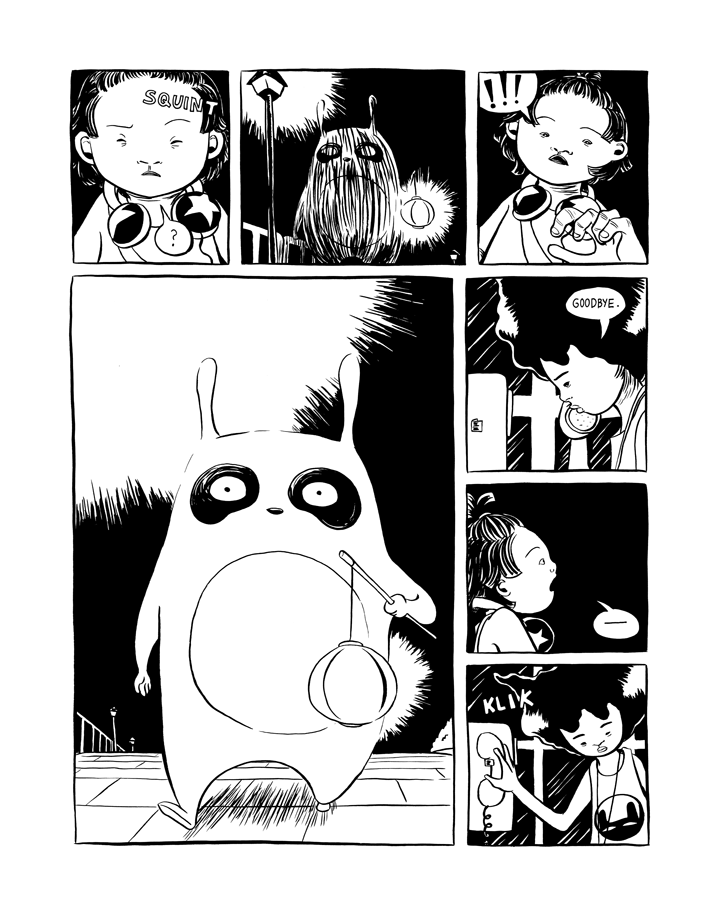
Of the stories of creatures seen in the forest and around Chino, the tales of Soul Fires, creatures who carry the spirit of past ancestors who light up the sky, dominate the myths of Chino. Children report on seeing them as large rabbit/hamster/bear-like creatures, and many adults recall seeing them too, so Soul Fires have been woven into the culture of the city. In fact, the Soul Fires play such a large part of the Chino’s heritage that a yearly festival exists to celebrate them.

Fi and her father arrive to Chino in the days before the festival, led by Fi’s uncle, Simon Bo. The Bos, Fi’s mother’s family, have long resided in Chino, and as a result, they have more imagination, faith in the unknown, spirituality, and a love for the phenomenons of nature. On the other hand, the Gan side of the family, has lived more in an industrialized world, so they place value on the pragmatic, especially in science. Since her mother’s passing, Fi has experienced mostly a science perspective on life, but everything changes when she meets Jaden, the leader of the children of Chino and a boy with a super-human ability to move quickly and to leap long distances.

After befriending Jaden, Fi meets a Soul Fire, and quickly, her father’s rationality driven upbringing fades away. A group of industrialists known as the Monkeys have discreetly entered Chino and have plans to eliminate the Soul Fires, the forest, and the overall spirit of Chino, and in order to prevent the Monkeys from laying siege on the beloved forest and city, Jaden will need Fi’s help. However, in order to help, Fi’s demeanor must change; her disaffect and disbelief must turn into passion and care. She must begin to engage with other people, and she must begin to express a full spectrum of her emotions, since only these definitively human tools will help to give her the courage and strength to support the battle against the Monkeys.

2010-02-25-30403c64

Fi Meets Koo, a Soul Fire

Despite the adorable visual representation of the Soul Fires, August Moon never patronizes its audience and never feels cloyingly sweet and sentimental. Over the course of Fi’s transformation and battle against the Monkeys with Jaden, Diana Thung masterfully blends moments of lightness and darkness and fantasy and reality together to create an awe-inspiring story for children and captivating plot for adults. With the Soul Fires, Jaden, and Fi, Thung creates a tale that not only entertains but also teaches people, regardless of age, to understand the destructive environmental, cultural, and societal effects of industrialization and technology. While the work of the Monkeys will surely damage the land, it will also bring with it a disregard and dismissal of forces beyond humans, and that, may be the most devastating loss of all.

August Moon discusses a highly adult concept but without any air of pretension or heavy-handedness, making it highly effective, for the book can facilitate discussions across and within multiple generations. It has plenty of whimsy and action to pull in children, and it has absolute relevance to adults’ present and past. Given this balance of material for audiences of different ages and according experiences, August Moon simultaneously returned me to those Saturday mornings of my own childhood and kept me in my current reality, allowing me to enjoy it with both a childish joy and an adult perceptiveness along with my own ageless, timeless fascination for engaging storytelling.

August Moon by Diana Thung is available via TopShelf Productions. 

Tan Tan Memories of a Different Type of Omlette – Making Lily’s Banh Bot Chien

Standard

Growing up in Houston, I frequently ate at Tan Tan Restaurant on Bellaire, as so many Vietnamese and Chinese Houstonians do. Beyond the delicious egg and rice noodle dishes I devoured, the highlight of each meal at Tan Tan was the opening appetizer, Banh Bot Chien. Crispy, soft, eggy, sweet, salty, and tart all at the same time, Banh Bot Chien at Tan Tan was a staple of my childhood.

Since leaving Houston, I have not consumed Banh Bot Chien. It’s a bit of a hybrid Chinese-Vietnamese dish, with its foundation taking cues from daikon rice cakes often eaten at Chinese Dim Sum, and it’s most commonly consumed as a street dish item in Saigon, so it seems to be unpopular in most Vietnamese restaurants.

After years of Banh Bot Chien’s absence from my diet, I finally decided to make it in the Fierro home. While the rice cakes require quite a bit of time to cook and then cool, the final product is a perfect blend of flavors and textures that will lead to a great amount of joy, whether or not Banh Bot Chien is a new or an old friend to your dining table.

The rice cake here is made with chicken broth, so for a vegetarian version, feel free to use vegetable stock or a vegetable bouillon base. Hope you enjoy it!

Background music provided by Brahms’ Sonata for Cello and Piano No1 in E minor Op38


Bovine Ska and Rocksteady 8/11/2015: Coxsone Dodd’s Tabernacle Label

Standard
tabernacle b

Great Jamaican Gospel From The Marvetts

Howdy there Bovine Ska listeners!

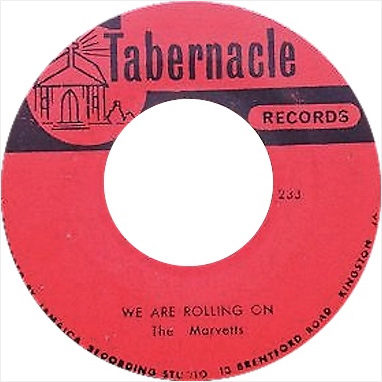
For this past week’s show, we decided to take the spotlight in a bit of a different direction by focusing on the Gospel recordings of Coxone Dodd’s Tabernacle label. We’ve always talked about how some of Studio One’s stars recorded beautiful tracks for the Tabernacle label, and we realized it was time to shine a light on a genre of Jamaican music we’ve only briefly touched upon in the past. But, before that spotlight, we had two sets of ska, one set of mento, and one set of rocksteady to build up to the midway spotlight. In the first hour, we shared two skas from Prince Buster’s Islam label: “Country Girl” by The Charmers and “The Soldier Man” by Prince Buster himself. We also were thrilled to play the airplane opening “One Minute to Zero” by Karl Walker & The All Stars. In our rocksteady track, we included the lovely vocal stylings of The Heptones with “Cool It Amigo” and The Wrigglers with “Get Right.”

Then, we proceeded to the Tabernacle spotlight, starting off with “I Left My Sins,” a stunning Gospel recording from none other than Bob Marley and The Wailers.

As many know, Coxone Dodd was a major fixture of the Jamaican music industry. Originally trained as a cabinet maker and auto mechanic, Coxone Dodd was inspired to enter the music industry after spending some time in America as a farm laborer and then returning to Jamaica with jazz and  blues records in hand, allowing him to get a jump start on his Downbeat sound system and marking his arrival into Jamaica’s music industry. From his initial sound system emerged plenty of record labels as he began to record artists. Beyond Studio One, the other familiar imprints are Worldisc, D. Darling, Muzik City, Allstars, Supreme, and C&N. While most of Coxone Dodd’s productions focused on secular music, Coxone did have a gospel label, appropriately named Tabernacle. As a lifelong Christian, Coxone recorded Tabernacle tracks on Sundays, and many artists from his secular music labels would record a gospel track for Tabernacle on those Sundays. 

And after the Tabernacle spotlight, we closed off the show with a reggae set filled with outstanding cuts, including the sensational “Face Your Trouble” from Vin Morgan and The Soul Defenders.

Listen to the Tabernacle spotlight and the ska, rocksteady, mento, and reggae tracks of the August 11, 2015 edition of the Bovine Ska and Rocksteady on Mixcloud HERE.

Subscribe to the show on Mixcloud to get reminders when we post up the show, and join us on Facebook to get updates on upcoming spotlights, record discoveries, and upcoming Jamaican music performances and shows in the Southern California area!

Enjoy!

XOXOXO Lily & Generoso

“Il Grande Racket” Is Director Enzo Castellari’s Nastiest Poliziotteschi

Standard
Big Racket Testi

Testi and Gardenia Talk Shop In “Il Grande Racket”

In the late 1960s, there had already been many American crime films that were able to let the blood and filth flow to show the true stories reflected in the current wave of rapidly growing street crime. Even the subgenre of the serial killer film saw its birth during this time as the American public was finally ready to hear about real life mass killers, Raymond Fernandez and Martha Beck in the underrated Leonard Castle film released in September of 1969, “The Honeymoon Killers.” It only makes sense that the public was up for it as the Zodiac Killer was making his murderous way around San Francisco, and the Manson Family had tried their best to start Helter Skelter in March of 1969. The stories that had dominated the evening news in the states were finally allowed to be given the Hollywood treatment in such a graphic way that even the brutally shocking 1960 Alfred Hitchcock film, “Psycho,” had not been able to get away with showing. As far as organized crime was concerned, we had always made gangster films here, but they rarely showed mobsters as they truly were. Even Coppola’s superb 1972 film, “The Godfather,” as violent as it was, still gave the mob a style and even an elegance in the carrying out their wrongdoings that definitely sent the wrong message out to future crime lords living on the East Coast on what the day to day of an organized crime boss was like. Trust me, as an Italian-American growing up in Philadelphia when the Godfather came out, more of my classmates wanted to grow up to be a Michael Corleone than a Richard Nixon.

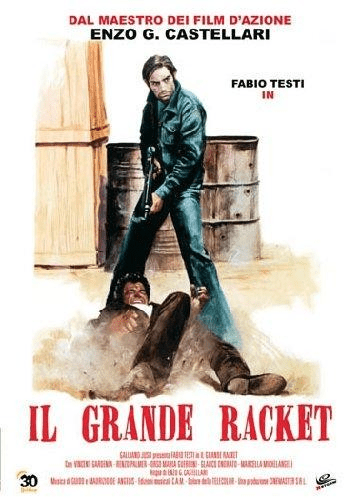
In Italy during the late 1960s, especially in the south and Sicily, organized crime and the corruption that traveled with it was akin to our street crime in that it was everywhere, especially in urban areas. So during this robust period of the high art films of Antonioni, Fellini, and Pasolini, when the extremely popular genre cinema of the Spaghetti Western was filing box offices in Italy and soon after in the US, the Italians were crafting another genre, The Poliziotteschi, crime films that were reflecting Italy’s growing concerns with the brutality and growth of organized crime that were made without the nostalgia of many of the French New Wave’s low budget crime films. The Poliziotteschis as well as the Spaghetti Westerns took their cues from the new wave of American crime films as far as their brutality was concerned, but it was the realism of the American police films that made the poliziotteschis so intense when it came to revealing the corruption and savagery of organized crime in Italy. As the 1970s rolled in and the Spaghettis started to repeat their plots and even characters (how many Django films were there anyway?), many of the directors of that genre began to also work on the crime film. Such was the case with Enzo Castellari. As far as Italian genre cinema goes, Enzo may be the king with Macaroni Combat films, Spaghetti Westerns, a Giallo here and there and yes, many many Poliziotteschis.

Castellari had scored big with two Poliziotteschis, “High Crime” (1973) and “Street Law” (1974) both starring the original Django, Franco Nero. Franco carried a lot of presence to any film he starred in, but as he was in such high demand, Castellari had to look for another lead for his next entry into the genre, and that actor would be rising international star, Fabio Testi. By 1976, Testi had a few leads in Poliziotteschis, starring in “Blood In The Streets” with Oliver Reed, and “Gang War In Naples” with Jean Seberg. In contrast to Nero’s smoldering sensuality and intensity, Testi was an almost too pretty and brooding actor of the Daniel Day Lewis variety. An accomplished actor, Testi brought a real sadness and empathy to any of the righteous characters of he would play in Italian crime dramas.

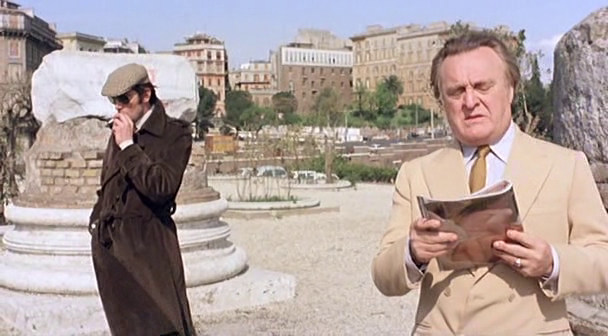
In 1976s “Il Grande Racket” (The Big Racket) Testi plays Nico Palmieri, a straight and narrow Rome detective who while witnessing a gang crime is violently attacked and is thrown off a cliff while still in his car in one of the more visually impressive scenes of action in this film. Nico survives, but his righteousness goes into overdrive while in the hospital as he becomes obsessed with taking down this gang who almost did him in and who is also shaking down every local business in the area for protection money. This gang in question, led by an English gangster named Rudy (Joshua Sinclair) is almost surrealistically brutal, almost past the point of most villains in poliziotteschi films, as evidenced in one early scene where a restaurant owner goes to Palmieri to become a prosecution witness after being leaned on for protection. It only takes one cut for the gang to be in possession of the restaurant owner’s young daughter who they gang rape to death in a grotesque scene clearly inspired by the gang rape at the beginning of the American film, “Death Wish.” In a later scene where an Olympic skeet champion aids Palmieri with some shotgun fire during an ambush, Rudy’s gang shows up again to rape and incinerate his wife.

After the gang skips through the judicial system again, Palmieri realizes that he has no ability legally to get Rudy and his posse, so he reaches out to a con friend, Pepe, played by veteran American character actor Vincent Gardenia, the detective in “Death Wish.” The casting of Gardenia is clearly the strongest nod to that revenge film, which was very popular in Italy at the time. He enlists Pepe and Pepe’s nephew to pull a few jobs and guarantees that there won’t be any police interference in order for them to be recruited into Rudy’s gang. When that fails due to some snitch high up, Palmieri is fired from the police force and decides to grab another hood from jail, who is a contract killer, a conman/club owner who had been screwed over by Rudy, the restaurant owner whose daughter had been killed, and the Olympic skeet shooter who lost his wife to form a killing team to wipe out all of the bosses and their henchmen in one spree. As the theme of overall corruption from government, police, and industry is key to many of Castellari’s poliziotteschis, “The Big Racket” has as its final location a manufacturing plant owned by the bosses.

Il Grande Racket Original Trailer

The final scene is done with an immense amount of gunplay, punctuated with the individual revenge fantasies of all of Palmieri’s group. There may not be a better payoff for a revenge film made during the entirety of the Italian crime drama genre. It is a glorious ending to a no holds barred, one hundred minute blast of a movie that for me, goes down as one of the nastiest poliziotteschis. Castellari’s film was indeed a box office hit in Italy, and inspired by the success of this crime film he would reunite with Testi a year later in 1977 and direct, “La via della Droga” (The Heroin Busters), another intensely violent and satisfying poliziotteschi.

Somewhere in between filming “The Big Racket” and “The Heroin Dealers,” Castellari would once again enlist Franco Nero and he would make the last great spaghetti western, “Keoma,” which needs mentioning because as I write this in the summer of 2015, Castellari has announced that he will start filming “Keoma Unchained,” a new Spaghetti where he has enlisted not only his favorite leads, Nero and Testi but also a virtual who’s who of Spaghetti Western royalty: Bud Spencer, Thomas Milian, and American actor John Saxon, the star of one of Castellari’s earliest Westerns, 1968’s “The Three That Shook The West.” Just like Detective Palmieri in “The Big Racket,” no matter what happens, there seems to be no loss of the fight inside Castellari. From Macaroni Combats, Giallos, and post-apocalyptic action films, give the man a genre, and he will crush it no matter what.  

Generoso’s Spaghetti alla Vongole Is Clam Paradise

Standard

As a proud Neapolitan I am thrilled to show you how to make Spaghetti alle Vongole (spaghetti and clams) which originated in Naples and is very popular throughout the surrounding Campania region. Easy to make but as all Italian food is about ingredients, you cannot skimp when it comes to your clams. Make sure that they are fresh and closed when you buy them. I’ll show you how to clean your clams and the entire process. You will need a box of spaghetti, two pounds of manila clams, 1/2 cup of white wine ( I like Riesling for this), 3 ounces of fresh parsley, 4 cloves of garlic, 8 ounces of cherry tomatoes, red pepper flakes, olive oil, salt, and black pepper.

Let us know how yours turns out!

Music: Dvorak: String Quintet in E-flat Major, Op. 97, B. 180


Filler Bunny Becomes Filler: The Collected Works of Filler Bunny

Standard

Over the course of media and art, the creative process itself has stepped into the foreground as a topic of discussion around and in works. Some have succeeded in capturing the turmoil and the joy of creation while others have wallowed in pretentious failure. To understand the creative process of a piece of art or media, there have been two approaches: a realistic, documentary one or a metaphoric, symbolic (and often surrealistic) one.

The Collected Works of Filler Bunny takes the more fictional route of the two. Filler Bunny documents the struggles of a dark, bizarre comic book creator, such as the comics’ own, by putting Filler Bunny through torture and suffering as the fictional creator of Filler Bunny, as a character and as a comic book series, has enormous difficulty filling up the pages for each story. At its best, Filler Bunny entertains with its clever bouncing between the creator’s and the bunny’s world, and the breaking of the walls between them and you as a reader.  

Cover for the Collection

Filler Bunny speaks to you and his creator, and the creator does the same, leading to a fascinating concept of Filler Bunny literally filling the pages in nonsense scenarios his creator puts him in as the creator himself attempts to beat the clock to deliver his work with some level of quality. Given that Filler Bunny as a concept within the series exists to only meet a deadline, no limits exist on what he can or cannot do to pass the time on each page. Filler Bunny eats a lot, poops often, sees his new friends killed off, and gets frequently tortured throughout the collection, and as a result, he also spends a lot of time begging the reader to end his existence for him. Filler Bunny lives an iterative existence of pain and suffering; rather than filling the pages up with plot lines and character arcs, the creator makes Filler Bunny repeatedly experience horrible situations and wish for change.

At its core, Filler Bunny serves as a comedically bleak and nihilistic discourse on the purpose of creating characters and storylines in a comic book. Each story seems almost like a surreal daydream or nightmare coming from Vasquez’s twisted mind asking himself, “What if I created a comic book character used only to fill pages?” Rather than creating lukewarm B-side pieces, Vasquez’s fillers jeer at the idea of creating filler comics in the first place, making the first Filler Bunny encounter quite fun, silly, and even smart.

Unfortunately, the novelty of parodying the idea of creation only for creation sake in Filler Bunny wears off quickly, especially as the grotesqueness of the comics amplifies from story to story. By the second story, “Revenge! of the Filler Bunny,” the comics already begin to lose their initial charm. As Filler Bunny continues to get tortured by his creator, he becomes mediocre filler, the one thing he was created to defy. Filler Bunny takes beating after beating in one over-extended joke; Vasquez tries to make the tormenting more ridiculous over the course of the stories, but the repetition of Filler Bunny’s distress delivers fewer and fewer laughs, leading to a state of general boredom.

As short exercises, Filler Bunny may have served its purpose to transition between stronger stories and to poke fun at filler at the same time. However, when collected together, their disgust-inducing approach for the meta-analysis discourse on creation wears far too thin, lacking any change or exploration of new ideas into how Filler Bunny can fill a page. I would have loved to have seen Filler Bunny waiting in line at the bank, Filler Bunny watching his favorite movie, or Filler Bunny feeding his pet lizard. Other ways for Filler Bunny to pass time would have made the series funnier and more engaging and less dependent on revulsion as a mechanism to deliver Vasquez’s own exploration of how creating something can feel so futile.

After the first story, “Filler Bunny in I Fill 15 Pages,” I so badly hoped the collection would succeed, since the core idea of the comics was a strong one, but after the tenth time of seeing Filler Bunny raped by a monkey, all of that hope disappeared. Perhaps I’m too normal for Filler Bunny and its sick world; I just get far too tired of comics that overuse shock and vulgarity as their only devices for satire. Call me square, but one moment of projectile intestine expulsion is one too many in a comic collection…

Jhonen Vasquez definitely has talent, imagination, and a distinct perspective as seen by his work on Invader Zim, and perhaps that is largest disappointment of Filler Bunny. Vasquez could pack so much more into Filler Bunny, but his unrelenting toilet humor prevents this collection from developing beyond a pubescent teenager’s scribbles in class or in a dark basement at home. Filler Bunny could have progressed into a witty and astute statement on creation, but instead, it goes down an excrement and assault filled road, losing sight of its original intention and its fundamental joke, making it the filler it dreaded and teased to become.  

The Collected Works of Filler Bunny by Jhonen Vasquez is available via SLG Publishing. 

Com Chien Do – The Vietnamese Counterpart to Risi e Bisi

Standard

We’re having a rice and peas battle in the Fierro household! Last week, Generoso made the creamy and savory Risi e Bisi, and this week, I decided to take rice and peas in a Vietnamese direction. Tomato fried rice is the perfect side dish to any protein. Traditionally served with bo luc lac, com chien do is a nice alternative to a more soy based fried rice. My version has peas and onions in it, which are purely a personal preference. This com chien do here is served with ga luc lac, since chicken was in the fridge. Feel free to serve the tomato fried rice with fried tofu, fried chicken, grilled pork chops, or of course with bo luc lac. Make a huge bowl of com chien do for a summertime party or picnic to share!

Music: Fryderyk Chopin’s Polonaise-Fantasy in A-flat Major, Op. 61

Sidney Poitier Fights Against Apartheid Again In 1975’s “The Wilby Conspiracy”

Standard
Wilby-Conspiracy

From left to right, Hauer, Caine, Gee, and Poitier.

Until the 1980s the word “apartheid” had been absent from daily speech here in America. Suddenly with growing attention from the western news, the anti-Sun City Movement, and films like “Cry Freedom,” “A Dry White Season,” and “A World Apart,” “apartheid” began to be a part of an open dialog in the USA. As a pre-teen in the late 1970s, I distinctly remember the first time that I heard the word spoken, which happened during an episode of the CBS drama, “The White Shadow,” a weekly series about a white coach of an almost all-African American basketball team in South Central Los Angeles. During one particular episode, Coach Reeves appoints the only white, but popular, player on the team, “Salami,” to be captain, which is fine with most of the team except for one player who speaks openly about the then current political situation in South Africa called “apartheid,” where the white privileged minority had been ruling the land without any members of the black African majority. The episode had left me curious, but even though I was growing up in a largely African American neighborhood in South Philadelphia, finding any information about apartheid at my local library was fairly impossible, that was of course until the middle of the subsequent decade when t-shirts declaring  “Free Nelson Mandela” were seen everywhere you went in the city.

Even though the policies of apartheid had been established in after the general elections in South Africa in 1948, Hollywood had stayed clear of the subject until I assume it became a profitable “cause.” Finally, when television and film began depicting stories of this oppression from the last forty years, I became curious again, except this time I wondered if Hollywood had ever tried to tell these stories before during a period when it perhaps wasn’t in vogue to do so. The only example that stands out for me occurred in during the mid-1950s, when the massively underrated talents of director Richard Brooks touched on the subject in his film, “Something Of Value” which starred Rock Hudson and Sidney Poitier. Though the film was not about South Africa but Kenya, it successfully brought to the screen Robert C. Ruark’s novel of the same name about the real Mau Mau uprising that occurred in colonial Kenya during the 1950s. In that film, Sidney Poitier plays the African, Kimani, who despite being raised with his white friend Peter (Rock Hudson) has his father imprisoned by Peter’s father who protests Kimani’s father’s participation in a native Kenyan custom then deemed to barbaric by the colonial government. Outraged by his father’s imprisonment, Kimani joins an insurgency group called the Mau Mau that leads a bloody rebellion against the colonial leadership and eventually this forces Kimani to clash with his lifelong friend Peter. Though the film doesn’t directly address the situation in South Africa, it is Hollywood’s first and really only attempt before the 1980s (Brooks’ film was a box office flop) to expose American audiences to the growing political unrest in Africa stemming from apartheid colonial rule.

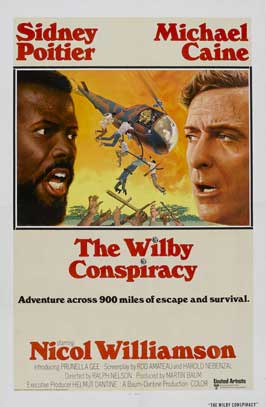
Twenty years later in 1975, Sidney Poitier is at his anti-apartheid ways again in the UK produced film “The Wilby Conspiracy,” an entertaining action film disguised as a political/cause thriller. What may have prompted the production of this UK film was that by the mid-1970s, mass paranoia was coming into vogue due to the Watergate scandal and Hollywood was frantically putting out political/anti-government thrillers with fairly complex plots such as David Miller’s “Executive Action,” Sydney Pollack’s “Three Days Of Condor,” and Alan J. Pakula’s “The Parallax View,” all of which were met with good critical and commercial success which surely prompted our friends in the UK to follow suit. “The Wilby Conspiracy” uses the apartheid situation in South Africa to run its plot, but due to the subject matter, filming was not permitted in South Africa and bizarrely the film would have to be shot in Kenya, the country that was the setting for Poitier’s earlier film, “Something Of Value.” Here Poitier plays Shack Twala, a jailed revolutionary who is released from prison at the beginning of the film by his Afrikaner attorney Rina van Niekerk (Prunella Gee) who has recently left her husband Blane (played by a very young Rutger Hauer in his first English speaking role), and she is now seeing British mining engineer Jim Keogh (Michael Caine).

Shortly after Shack’s release, the three are off to celebrate but are soon met by the South African police who hassle them for identification. When Shack, Jim, and Rita cannot produce the necessary ID needed, they are arrested but successfully fight off the police and make a run for it. Their arrest angers Major Horn (brilliantly played by Nicol Williamson who is best known to US audience as “Merlin” in John Boorman’s Excalibur) who chastises his second in command for not only his campaign of harassing black South Africans but also for arresting Shack, as his arrest will drive even more against the prevailing government. On the run yet again, Shack seeks out the assistance of Doctor Mukharjee (Saeed Jaffrey), an Indian dentist and fellow member of Black Congress. Soon Jim, Rita, and Shack are in the possession of a stash of uncut diamonds that will aid the Black Congress and their leader, Wilby (Joe De Graft), but, despite this success, they still must outrun the cunning Major Horn, who is still manically hunting them. You then have the necessary prerequisites for a 70s political action film with a few clever twists, a lot of very exciting car chases (Caine and Poitier were actually almost killed in one accident involving the car camera which became displaced), and even a bit of an unnecessary sex scene which is reminiscent of thrown in Dunaway/Redford tryst in “Condor.” Poitier and Caine do the absolute most given the fairly thin dialog which heavily leans on the buddy film tip, and they do produce some chemistry in their scenes together. Overall, the actors do a fine job, and script does provide a few laughs, but Nicol Williamson does steal the show as the intelligently written but villainous Major Horn.

“The Wilby Conspiracy” was directed with flair by American Ralph Nelson, who twelve years earlier had helmed the wildly successful and enjoyable nun extravaganza, “Lilies Of The Field,” which garnered an Oscar for his lead, Sidney Poitier, the first best actor Oscar awarded to an African American. Nelson would also direct Poitier and James Garner and hone his talents as an action director in the less successful but still entertaining 1966 western “Duel At Diabolo.” Through not possessing the intense drama of Brooks’ “Something Of Value,” Nelson keeps the pace quick in “The Wilby Conspiracy,” and with that fast pace he keeps up your interest in the story while never losing focus of dire conditions in South Africa at that time in history.

The Wilby Conspiracy Trailer

It would be almost a decade more before Hollywood would jump on the anti-apartheid bandwagon with their tear-jerking/heavy-handed offerings; films which now seem more concerned with preaching to a left leaning choir than opening up the discussion by presenting the situation in an action-driven political thriller format that would speak to a  wider audience. Nelson’s film is illustrative about apartheid rather than didactic and thus, more effective in getting its core message out.