Generoso’s Crispy and Sweet Polenta Fritto con Spinaci!

Standard

Polenta is that delicious corn meal bite that is perfect for dinner after a cold day outside. My recipe for these fried polenta slices with spinach should make for a different appetizer for your next event. You will need cornmeal, spinach, butter, red wine, garlic, salt, olive oil, black pepper, and whole milk mozzarella. Let us know how yours turned out!

XO Generoso and Lily

Music: Robert Schumann’s Fantasiestucke Op 88


Bovine Ska and Rocksteady 7/14/15: Derrick Morgan’s Hop Label

Standard
hop label A

An early rocksteady hit for the Hop Label

Hello Bovine Ska and Rocksteady Listeners!

This past week Lily and I started off with two sets of rare ska, beginning with Larry Lawrence side on Beverley’s called “Garden Of Eden.”  We ended that first set with a very early cut from The Sensations entitled “Juvenile Delinquent” that they recorded for Treasure Isle in 1966.  Our mento set started off with Lord Power taking a mento classic and converting it into an advert for “Special Amber Calypso.” We ended the first hour with a six song set of rocksteady, ending with the great Roy Panton and The Cabeleros performing “Control Your Temper.”  We then dove right into our spotlight of Derrick Morgan’s Hop Label….

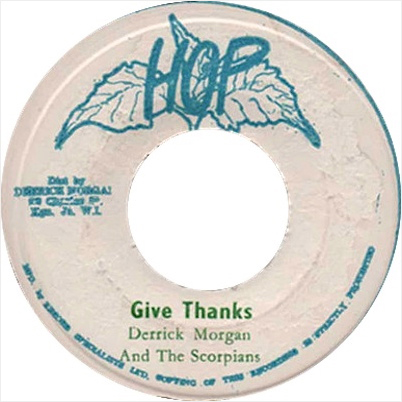
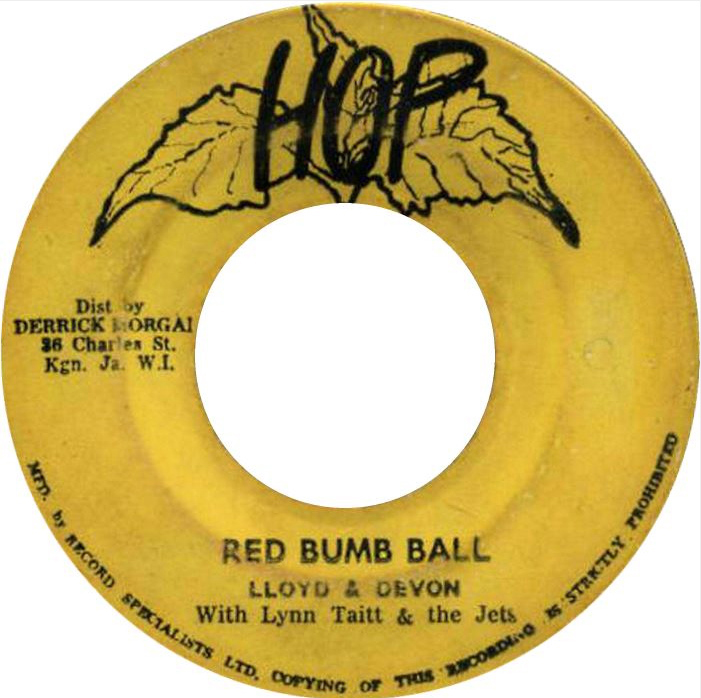
Known as one of the first superstars of Jamaican music, we know Derrick Morgan as a star singer. After recording for Duke Reid, Prince Buster, Coxone Dodd, and Simeon Smith in Jamaica and Emil Shalit in England, Derrick  Morgan arrived at the Beverley’s label. At Beverley’s, Derrick not only sang for Leslie Kong but also ran auditions, discovering Bob Marley, Desmond Dekker, and The Maytals. Furthermore, he ran rehearsals with singers before they recorded, and he also began producing records for Beverley’s as well. Consequently, Derrick was more than prepared to run his own label. So, when ska transitioned into rocksteady, Derrick opened his Hop label, named after his ska hit,under the pseudonym Seymour Morgan and backed by the mighty talent of Lynn Taitt and The Jets as the house band. The first release on the Hop label, Lloyd & Devon’s Red Bum Ball, was a huge hit, and as a result, Derrick continued on with his Hop label. We started off this spotlight on Hop with this first release and hit for Morgan’s label.

In these early tracks, you’ll hear Lynn Taitt on guitar. With Hop productions, Lynn and Derrick worked very collaboratively, with Lynn composing the guitar and bass line and Derrick arranging the vocals. The two worked closely from 1966 up until 1968, when Derrick Morgan moved to England for a second time to produce records for Pama’s Crab subsidiary. After about a year in England, Derrick returned to Jamaica, and picked back up on his Hop releases, recording in reggae, now that rocksteady had fully transitioned into reggae. We then focused the spotlight on rare Hop reggae releases before playing our favorite cut from the label.

This show is available for you to listen on Mixcloud, right HERE! https://www.mixcloud.com/bovineska/generoso-and-lilys-bovine-ska-and-rocksteady-7-14-15/

Join us on Facebook to find out about future spotlights, Jamaican shows of interest in the So. Cal area and more!
https://www.facebook.com/groups/175321709220304/

The Joyous Power Within The 1971 Concert Film, “Soul To Soul”

Standard
ike and tina

Ike and Tina Turner Stun The Crowd In “Soul To Soul”

The concert film, that relic of the screen before MTV, is still kicking around in 2015, though an artist has to reach the level of international fame of a Katy Perry or Justin Bieber before producers are willing to bankroll a two hour ego extravaganza to be seen by screaming teeny boppers worldwide. Prior the dawn of MTV, the concert film was the only way for many small town folks throughout USA and the globe to see a range of world class acts who wouldn’t come to their town in a larger than life way. As a boy I loved staying up late to watch Don Kirschner’s Rock Concert, the syndicated weekly live music show that brought many of us our first glimpse at rock and soul acts from Curtis Mayfield to Cheap Trick, but there was nothing like going to a theater to see a twenty foot tall Mick Jagger strut his stuff. In these years prior to the insanely expensive fees that now exist for music licensing, the concert film of the 1970s was a low risk moneymaker.

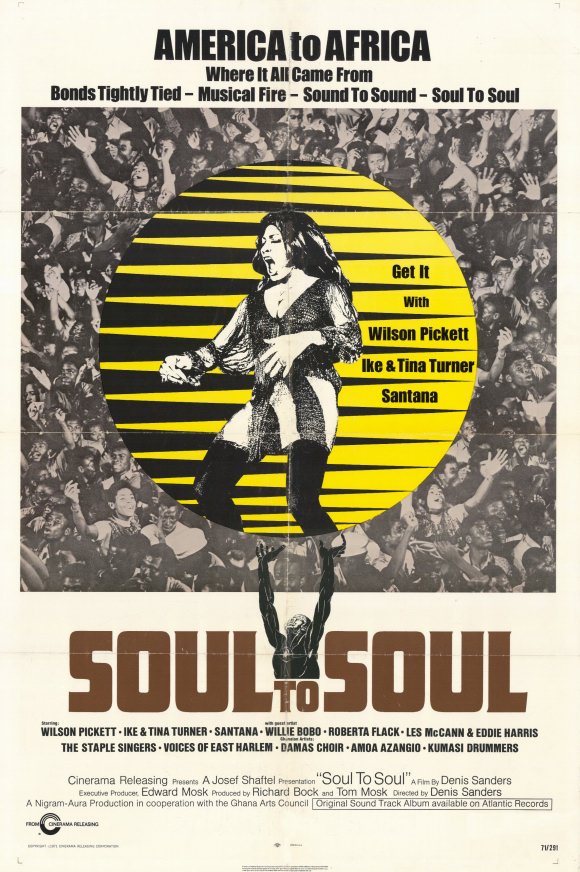
Adding into the frenzy of rock concert films was the wake left by the popularity of Gordon Park’s 1971 blaxploitation crime drama “Shaft” and its Academy Award winning soundtrack by Issac Hayes. Finally, Hollywood was now not only looking to distribute Afro American narrative films but also documentary films celebrating soul music that had the added potential of releasing a high selling soundtrack. Columbia distributed “Wattstax,” a 1973 concert film depicting the Stax Label fueled musical event that commemorated the Watts riots of 1965, and “Save The Children,” the film of the star-studded show attached to 1972 Jesse Jackson-led PUSH exposition held in Chicago, which was distributed by Paramount Pictures. Hot on the heels of “Shaft” and before even “Wattstax” and “Save The Children” was Denis Sanders’ superb documentary on the fourteen-hour concert that took place in Accra, Ghana in 1971, “Soul To Soul.”

After declaring its independence from England in 1957, Ghana had attempted to connect with a multitude of African diasporas and succeeded by getting the attention of poet Maya Angelou, who reached out to Ghana’s Prime Minister, Kwame Nkrumah, to invite many Afro American musicians to Ghana to help the newly independent country celebrate its freedom. Many years later, after Nkrumah was deposed, producers Tom and Ed Mosk presented the same idea to the Ghana Arts Council who agreed that the time was right for such an event to happen and thus the Soul To Soul concert was born. Amongst the American artists who would perform were some immensely popular soul artists: The Staple Singers, Ike and Tina Turner, Roberta Flack, and Wilson Pickett. The San Francisco rock group Santana would join the bill as would jazz performers Les McCann and Eddie Harris. Many Ghanian artists such as Kwa Mensah, The Kumasi Drummers, Charlotte Dada, and even house band for the Ghana Arts Council, The Anansekromian Zounds would play their hearts out for the tens of thousands in attendance.

The narrative construction of “Soul To Soul” would be much different from the previous mentioned “Wattstax” and “Save The Children” as far as showing the political (read: non musical) environment surrounding the concert. Gone are the moments within the town to hear what non-musicians think about the day-to-day lives. The few interviews that do exist in this documentary are mostly relegated to the beginning of the film, when the planeload of traveling soul artists is asked about their expectations for performing in Ghana. The musicians speak with great enthusiasm on their feelings about going back to the motherland, the clothes they will find and the people they will meet, but they all seem rather underwhelmed by the potential of hearing great music while there. Once they all land in Ghana, the wide-eyed tourist in our American envoy quickly disappears, as once they hear what their fellow musicians from Ghana can bring to the table, it becomes all about the music from that moment onward. A wide-eyed Tina Turner learning how to sing from a powerful Ghanian vocalist in the street is a moment that sums up the early collaborations well.

We then see the live concert, expertly filmed with brilliant sound that surpasses many films of its kind from that era. On stage, Ghanian musicians playing solo or with some of the American acts add a powerful communal element to the show. Also not lost on this viewer are the looks of awe from the audience upon seeing Tina and her backup singers howling out notes and gyrating wildly during “River Deep-Mountain High” in a way that I am sure would be scandalous for musical performances by women in Ghana at that time. Some dance in the crowd, but many just stare with open mouths and confused stares. More subdued but no less awe inspiring is the performance of Curtis Mayfield/Donny Hathaway written soul stirrer; “Gone Away” that Roberta Flack heartbreakingly sings that almost silences the enormous crowd. Strangely, Santana performs the most African sounding music of any of the American artists much to the crowd’s delight. The Staple Singers are given a few numbers on film and in general perform even better than they did on “Wattstax,” especially Mavis Staples on lead vocals, and the great Wilson Pickett, an audience favorite, gives his all as he always does.

There many powerful moments woven in between the live concert scenes, including a wedding and a funeral ritual that are seen without any over narration, and a trip to one of the many “slave castles” in Ghana that is done with few words from the guide and with a very poignant rendition of “Free” sung in acapella in the background. These scenes feel organic due to their placement, and therefore, flow well within the film’s construction as opposed to the attempts at similar emotional moments that are dispersed haphazardly in “Save The Children,” which leave you cold.

Original 1971 Trailer For Soul To Soul

 Sadly, “Soul To Soul” saw less distribution than needed during its initial run, and the Mosks did not make back their initial investment, so the documentary was near impossible to locate for many years. Thankfully, The Grammy Foundation paid for a restoration of the film and reissued it back in 2005 with added footage, interviews, and a companion soundtrack that I’m sure would’ve been a must-have had the film be seen by more of an audience back in the day.

Failure to Travel from TV to Comics: Rick and Morty

Standard

Rick and Morty restored my faith in animation on television.

As a devout Simpsons fan from about 1996 to 2009, I once had a great love for television animation. After my college years without a TV, when I did return to watching television regularly, with the guidance and wisdom of Generoso, I dedicated myself to Adult Swim’s programming. At first, mostly the live action shows captured my attention. The Eric Andre Show, Loiter Squad, and Your Pretty Face Is Going To Hell were early favorites. And one day, a commercial for Rick and Morty appeared after an episode of The Eric Andre Show, signaling the arrival of a new favorite.

After the first season of Rick and Morty brought hours of unbearable laughs to the Fierro home, when news of a comic book extension of the series emerged, I was ecstatic; however, a formal review would have to wait until I had amassed a few issues.

Now, I’ve collected issues 1-3 of the comic book arm of Rick and Morty, so I have enough material for a review, but unfortunately, as much as I had hoped to write a positive review this week, the Rick and Morty comics did not warrant one.

Cover for Rick and Morty Issue 1

Rick and Morty, the television show, possesses a unique frenetic energy and wild unpredictability to hypnotize its audience. Consequently, transferring Rick Sanchez’s fast, slurred speech and consistent, overly caffeinated, hyperactive manner along with Morty Smith’s stammering and constant state of unease proved to be an enormous challenge for the comic series’ writers. In addition to the difficulty of embodying Rick and Morty in print, the balance of energy, bizarreness, and occasionally sweetness of Rick and Morty’s adventures compared to the parallel ones of Jerry, Beth, and Summer Smith’s, make the television show even harder to adapt to a static medium.

The comic makes one major damning mistake; the adventure Rick and Morty go on in the comic feels uncharacteristic of their personas. In the comic book, Rick and Morty travel in space to invest in stocks that will succeed in the future, leading them to enormous prosperity. As expected, the time traveling and illicit stock trading lead the grandfather-grandson pair into trouble, and when Jerry reports the two to the time police, Rick and Morty have a much bigger adventure to experience.

Fundamental to their characters, Rick and Morty rarely go on adventures to seek great riches; they go on adventures as a consequence of Rick’s scientific tampering, which often leads to Morty needing to help Rick in some way. Occasionally, they travel for Rick to make some sort of illicit sale or trade for more resources or funds for his experiments, but the two never go on an adventure only to strike it rich. As a result, their adventures focus less on the goal and more on the twists and turns the two experience together. Thus, surprisingly, Rick and Morty, the television show, is less about a misanthropic, outcast scientist and more about a story of a grandfather and grandson getting to know each other. Sure, Rick and Morty follows a dysfunctional family, but beneath all of the aliens, the time traveling, the Meseeks, and the laser guns, lies a story about a mad scientist making reparations with a family he once abandoned.

Given this warm, fuzzy heart buried underneath Rick and Morty, all of the characters involved have a mix of paradoxical characteristics. Rick is angry yet nonchalant and weirdly loving in his own eccentric way. Morty is the hesitant and weary sidekick who somehow manages to keep his wily grandfather in check. Jerry is the anxious, failing husband who craves attention from his wife Beth and is somewhat jealous of Rick, but he continues to try his best to impress Beth and the rest of his family. Summer is the passive teenager with standard teenage issues, but she also seeks adventures and time with her grandfather Rick and her mom. And, Beth is a genius who had big dreams until she unexpectedly began her family, and though her family exists as her burden, she still greatly cares for them.

With the television show, we get to see all of the dimensions of the characters. With the comic book, we only see shells of each. The comic series could have expanded on the complex characters beloved by the fans of the show, but instead, it dilutes them and the adventures that make Rick and Morty stand out as one of the most entertaining, funny, innovative, and watchable television series out there.

More disappointing than the characters and the narrative arcs in the Rick and Morty comics is the lack of Dan Harmon and Justin Roiland’s presence in them. Consequently, the wit and humor of the comics lack the charming acidity of the show, and the jokes and conversations lack the references to pop culture and the sneering jabs at media works appropriately deemed unacceptable by Harmon and Roiland (remember the unrelenting insults toward Inception in the “Lawnmower Dog” episode?). As a result, Rick and Morty the comic feels much less vital and less relevant.

I had hoped that the Rick and Morty comic book would stave off my hunger during my wait for the return of the series for its second season, but instead, it only reminded me that sometimes TV empires should not cross over into comic books and/or vice versa. Rick and Morty had the opportunity to explore each character through small vignettes or stories as seen with the Bob’s Burgers comics or expand the television narrative into a different storytelling form like Joss Whedon’s Serenity comics, but it does does neither, failing to understand the full complexity of the narratives, settings, and characters established by the show, thus guaranteeing that it will not add any additional richness to the Rick and Morty universe. As a result, I’m more agitated by the paltry offerings of the comic version and much more ravenous for the television Rick and Morty.

If the comic series was a ploy to create a foil against the television series to lure fans into buying the comics only to allow them to articulate why Rick and Morty the television show rises above all other shows, then bravo to the mastermind who came up with the plan. Only a deviant like Rick Sanchez could come up with that outlandish, conniving plan, so perhaps after all, the creators of the comic book do understand their main character. But then again, Rick does not seem like he would love being part of a marketing/PR racket, so it looks like the comic creators have still missed the mark on understanding Rick and Morty.

Let’s leave the cryptic, insane mind of Rick Sanchez to Dan Harmon and Justin Roiland, and the Rick and Morty empire will be mighty fine on its own.

Rick and Morty (the comic series) is written by Zac Gorman with art by CJ Cannon, Ryan Hill, and Marc Ellerby and available via Oni Press. 

Ginger Syrup and Vietnamese Mochi: Che Xoi Nuoc

Standard

Here in the Fierro house, we are trying to push our own boundaries of our cooking. In my last edition, I made egg rolls with the help of my new friend, the deep fryer, and this week, I attempted to make Che Xoi Nuoc, one of my favorite Vietnamese desserts.

Made from sweet rice flour, the mochi in Che Xoi Nuoc are filled with savory mung bean and then served with a ginger brown sugar syrup and salty-sweet coconut milk.

A bit of a heavier dessert, it is perfect when served at room temperature or warm. There’s quite a bit of work (and many pans!) involved, but it is completely worth it for the sweet, savory, and chewy fun of Che Xoi Nuoc.

If you have left over mung bean filling, you can use it to make mung bean pancakes or more of the mochi treats! And if you’re feeling adventurous, you can deep fry the mung bean filled mochi as well and serve with nuoc mam for a savory appetizer as compared to a dessert. Enjoy!

Si Spencer’s Disjointed/Unified England in Bodies

Standard

This weekend, synchronicity rules my selection of what to read and review. On Friday night, I watched Mike Leigh’s Naked, a spectacular masterpiece of English filmmaking and possibly one of the most English films to date. Then, on Saturday, after visiting Golden Apple Comics, I picked up Si Spencer’s Bodies, and to my surprise, when I arrived home to read it, I realized Tula Lotay of last week’s review of Supreme: Blue Rose illustrated a part of Bodies.

Now, how exactly do Naked, Supreme: Blue Rose, and Bodies tie together?

Most clearly, all three have English creators. All three take place in some form of dystopia, be it more of a realistic one in Naked or a futuristic one in Supreme: Blue Rose or both in the case of Bodies. Naked and Bodies center their narratives on forces perceived or known to corrupt the existence of English citizens. Bodies and Supreme: Blue Rose construct their protagonists and antagonists in fragments across time. Bodies contains the realism of Naked crossed with the time traveling and futurism of Supreme: Blue Rose.

All three tackle major political and philosophical concepts. Naked has a fiercely raw energy weaving throughout the film, which enforces its overwhelming sense of desperation and desolation in Thatcher’s England. Supreme: Blue Rose reinvents the Supreme mythology into a fresh new, time-shifting and complex exercise in understanding fundamental existence and persona. Bodies aims to construct a murder mystery across time in order to understand the history of England’s perceived internal enemies to English tradition and values. While Naked and Supreme: Blue Rose reach for ambitious concepts with underlying comments on politics and human existence and successfully execute them without ever stepping to the pulpit, Bodies reaches for the moon in its concept, but unfortunately, it only reaches the troposphere of the earth.

Cover for Bodies Volume One

Bodies divides its narratives into 4 timelines in London: 1890, 1940, 2014, and 2050. In each, a detective of the time discovers a mutilated body in Longharvest Lane in the East End of London. At a first glance, each of the detectives tie the body to Jack the Ripper, but upon further inspection, the corpse shows ties to something far more supernatural. Each detective possesses some quality which has been or will be rejected by the traditional English society. Inspector Hillinghead, the detective of the 1890 component of the story, is homosexual. Inspector Karl Whiteman, the 1940 detective, is a Polish Jew who escaped from Krakow. Detective Sergeant Shahara Hasan, the 2014 detective, is Pakistani and Muslim. And, Detective Maggie Belwood, the 2050 detective, is an amnesic rendered into almost a borderline infantile state from some unknown force.

Across each narrative arc, the corpse has wounds which bring about suspicions of some form of ritualistic killing. To make things stranger, as each detective dives deeper into the investigation, the corpse disappears and returns to life. In each incarnation, the corpse emerges from death as a slender blonde man with an eyepatch with a variety of names, but fundamentally, he encourages each detective to accept his or her own identity and past, coaxing each into an act which will allow them to finally incorporate themselves into the world they belong, whether that world is a past or future England or a void beyond the earth.

After unpacking all of the characters and the role of the revived corpse, Bodies studies the history of England’s disenfranchised people across time, addressing the conflicts each face and how they eventually assimilate into society. Unfortunately, Bodies does a disservice to its detailed discussion of different marginalized groups by incorporating a facile message of acculturation: “Know you are loved.” As a result, by the end, Bodies feels less like an intelligent discourse on England’s hesitance toward foreign cultures and lifestyles across time and more like a hippy peace rally filled with chants of love without a full understanding of how a conservative nation comes to accept once marginalized groups.

Ultimately, the detectives who do assimilate into English society with the help of the reborn one-eyed man accept their differences while still proclaiming their pride as citizens of England, revealing Spencer’s belief in patriotism as a unifying force. Then, to reinforce his thesis, Spencer closes Bodies with a sanguine salute to England that accepts all of its flaws, cherishes its strength, and aims to instill a sense of pride in the nation, a pride which allows each of the characters to become accepted by others, and a pride which Spencer hopes will allow future disenfranchised groups to feel unity with the people around them.

However, this belief that a common pride in a nation can create bridges between people of different gender, sexuality, culture, and heritage is one that is far too idealistic and far too removed from reality. Undoubtedly, patriotism can unify people to a certain degree, but understanding between people occurs at a much more personal level than pride in one’s own nation. Consequently, Bodies exists more as a manifesto of ungrounded beliefs and less as an observational argument on assimilation and mutual understanding.

Bodies lacks nuance and evidence to establish its thesis, and as a result, even the wonderful artwork and the fascinating idea to have different illustrators dedicated to each time period cannot save this series. After all of the time traveling and the rise from the dead are said and done, only the unfounded thesis is left along with many irritating repetitions of, “Know you are loved.” More of a comic book stylized kumbaya, Bodies contains naive politics mixed with an ambitious concept, thus creating an all too pretentious (and of course completely marketable) series.

With the rise of the xenophobic national front spreading across England and Europe, Spencer had an excellent opportunity to research and discuss the origins of the movement and its recent resurgence, but instead of asking, “What is the origin of the fear of foreigners in England? Why is this happening in mass again?” he asks “Why can’t we love each other?” making Bodies much less of an effective and galvanizing work.

If you’re looking for a work which studies the marginalization of England’s people, go watch Mike Leigh’s Naked instead. I promise you will not be able to look at media and its ability to comment on the fragmentation of a society in the same way again. You probably also will not be preaching a message of universal love at the end of it either…

Bodies is written by Si Spencer with artwork by Dean Ormston, Phil Winslade, Meghan Hetrick, and Tula Lotay and coloring by Lee Loughridege. It is available via Vertigo. 

Bovine Ska and Rocksteady 7/7/15: Prince Buster’s Wild Bells Label

Standard
wild bells 2

A great Gabbidon cut on Buster’s Wild Bells Label


This week (July 7th) on Generoso and Lily’s Bovine Ska and Rocksteady, we started off with a version to version to version extravaganza from Phil Pratt’s Sun Shot Label.  We began the second set again with another version to version from Derrick Harriott and the late DJ Scotty, then our bouncy mento set before a long set of early Jamaican rhythm and blues that featured an early Jimmy Cliff side from Leslie Kong’s Beverley’s label called “You Are Never Too Old” to set up the spotlight on Prince Buster’s Wild Bells label.

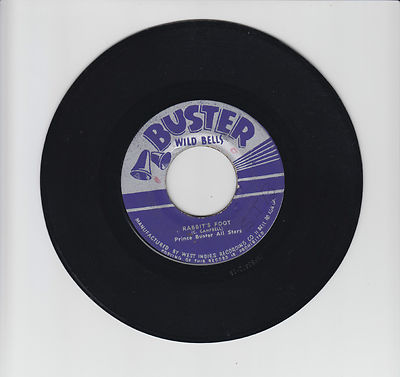
Born as Cecil Bustamente Campbell, Prince Buster has one of my all time favorite stories about his entry into the music industry. After living with his grandmother in rural Jamaica as a boy, Buster gained an interest in music after singing in churches. Consequently, as a teenager, when he lived on Orange Street, he naturally became attracted to the soundsystem culture, particularly with Tom the Great Sebastian’s soundsystem. As soundsystems further emerged and began to compete against each other, particularly the big two, Coxone Dodd’s and Duke Reid’s, Prince Buster and his crew aligned himself with Coxone, whose soundsystem was more of an underdog in comparison to Duke’s, to provide Coxone’s dances with security. As he stuck around Coxone, Buster learned enough about running a soundsystem that he created his own, which he called Voice of the People. With his soundsystem up and ready for records, Buster was ready to begin recording his own singles, but originally before he could get to producing music for his soundsystem alone, he was asked by Duke Reid to produce records for him. Buster ended up recording 12 tracks at Feral studios, and he gave one to Duke Reid, leaving the rest to be pressed on his own Wild Bells label, which we highlighted this epsiode, beginning with Buster’s very first track as a vocalist, Little Honey, which was released in 1961.

Buster’s Group, the backing band for the Wild Bells label,  included members of the future renowned Skatalites band. On drums and percussion was Arkland Parks, better known as Drumbago. On tenor sax was Dennis Ska Campbell. On guitar was Jah Jerry Haynes. On trombone was Rico Rodriguez, and on tenor sax as well was Val Bennett

If you would like to listen to the show, it is HERE!

Please subscribe to our show, its FREE!: https://www.mixcloud.com/bovineska/

Join us on Facebook to know what our future spotlight will be, shows and record shops of Jamaican interest in the Southern California area, and the occasional posting of a rare photo or side:

https://www.facebook.com/groups/175321709220304/

Love,

Lily and Generoso


Peter Yates’ “Mother, Jugs, and Speed” And The “Workplace” Comedies Of The 1970s

Standard
jugs-first-appearance

Raquel Welch as well, “Jugs”

There are two events, one positive and one negative, that precipitated my review of the much maligned 1976 dark comedy, “Mother, Jugs, and Speed:”  Extremely negative is the recent damning evidence against Bill Cosby, the titular “Mother” of the film that I am reviewing here, a fellow Philadelphian, and my comic hero whose self-admitted criminal behavior has broken my heart. And on a separate positive note, is the complete Robert Altman retrospective that is currently being mounted in my former town of Boston at The Harvard Film Archive that many of my dear friends are now enjoying. Why Altman you may ask? I will theorize that somewhere in the mix of 70s subgenres, is a rarely discussed collection of films that stem from the success of Altman’s game-changing counterculture film that began the decade, “MASH,” that I will define as “workplace” films. You remember this seemingly endless flow of films that feature a group of irreverent misfits that are all stuck in a job whom you feel real empathy for and are always trying to get one over on the man. A wide array of films from the successful “Blue Collar” to “Car Wash” and ending somewhere around 1981 with “Underground Aces,” an epic flop starring a young Melanie Griffith, about a group of wacky employees in a hotel parking garage in LA. Yes, by that point Hollywood must have ran out of every conceivable place of employ to stage a workplace comedy. At least that film had a kicking theme song from Lionel Ritchie-led Commodores that one-ups the messy soundtrack of the even messier scripted “Mother, Jugs, and Speed.”

In the middle of America’s finest decade of film making, Peter Yates, who had just come off the success of directing Barbra Streisand in “For Pete’s Sake,” and Robert Mitchum in “The Friends Of Eddie Coyle,” decided to throw his hat into the ring of “workplace comedies” with this tale of a group of bawdy Los Angeles ambulance drivers who seem to have an unlimited amount of time to do drugs, mess with each other, pull pranks on their chief competitors, and even buzz a few nuns crossing the street for a quick laugh. Watching the nuns scatter at the sound of an ambulance siren is the main joy of “Mother,” a beer-swilling, message parlor visiting meat wagon driver played by Cosby who per usual manages to be part of these bad goings on without uttering a blue word. This should come as no surprise as Cosby even made a couple of blaxploitation films during that time; “Uptown Saturday Night” and “Let’s Do It Again,” that similarly to “Mother, Jugs, and Speed” received a PG rating. So, unlike our friends at the 4077th, the hijinks committed by our band of upstart paramedics are a bit toned down. Upon my third viewing of this film, I wondered if more than a few  urban workplace appropriate expletives would’ve made it into the final script if Gene Hackman (Yates’ original choice for the role of Mother) had accepted Cosby’s part before filming began.

Added to the cast is Harvey Keitel, who that very same year had his pimpish hand off blown off in a whorehouse by Travis Bickle in “Taxi Driver.” Keitel plays the soft-spoken “Speed,” a recently suspended cop and Vietnam Vet who may or may not have sold amphetamines whilst on the job, hence his epitaph. Lastly, there is “Jugs,” played Raquel Welch, who does her best uptight feminist “Hot Lips” Houlihan imitation. “Jugs” never dates the drivers, much to their chagrin, as she spends every night going to school to get her EMT license. She brandishes her license one day at work but has no chance of actually driving a wagon as her boss, Mr. Fishbine (Allen Garfield at his uptight finest) is not going to put a woman out as a paramedic. No 1970s genre film is complete without an ex-football player/actor and here we get Dick Butkus as the cowboy hat wearing “Rodeo,” think a physically larger but similarly racist Duke Forrest from “MASH,” and finally to stay on the “MASH” target, we have the film’s heavy, Murdoch (Larry Hagman) who fills in for Frank Burns as the womanizing and boorish workplace dickhead. There is some real acting talent here and to imitate the character’s idioms from “MASH” is a venial sin, but where the wheels really come off on “Mother, Jugs, and Speed” is the script and Yates’ direction, which reminds us as to why Altman’s 1970 film is considered the masterpiece that it is to this day.

Altman had the gift in “MASH” of balancing some of the funniest moments captured on film with other moments of real drama and even a bit of viscera. Altman’s comic timing is perfect in “MASH,” and it makes the overall experience into a gem. “Mother, Jugs, and Speed” supplies us with many decadent, funny scenes that keep my attention when the film runs on late night cable, but these scenes are awkwardly pressed up against a multitude of poorly framed moments of pathos. Case in point is the scene where Mother’s ambulance partner, Leroy, is murdered by a crazed junkie who wants a fix. It’s a real and tough scene, but Yates immediately follows that scene with a comedic scene that just does not fit, negating any feeling the viewer has towards Leroy’s death and the laughs of the next moment.  There are countless scenes that play out this way in “Mother, Jugs, and Speed,” and after a while, you just lose your taste for the film as you wait for inevitable laugh after an ugly moment. Unlike many of the workplace films where the moments of tragedy create empathy for the characters predicament at their job, such as Smokey’s ugly “accidental” death in Paul Schrader’s fine 1978 film, “Blue Collar,” the poor positioning of these moments in “Mother, Jugs, and Speed” feel too divisive and thus become the film’s undoing. Perhaps it was the low budget of the film had that forced such sloppy decisions. We now know that Gene Hackman and the original choice for “Jugs,” Valerie Perrine, both backed out due to low salary offers and perhaps other choices were made to cut corners that resulted in this mess of a film? Sadly, Yates’ film goes down as a sometimes hysterically funny but intensely uneven urban dark comedy whose inability to know what it wants to be stamps out any potential of being a classic in the genre.

Original Trailer for Mother, Jugs, And Speed

A few years later in 1979, Yates would shed the A-list stars and their salaries for a team of then unknowns (Dennis Quaid, and Daniel Stern to name a couple) and master the comedy-drama with the five time Academy Award nominated film,“Breaking Away.” A modern masterpiece that unlike “Mother, Jugs, and Speed”  is almost eerily intuitive of American working class people’s dilemmas and dreams.

Up Yours Netherlands! The Mondoesque “This is America” (aka Jabberwalk) From 1977

Standard
jabberwock b

Hey Vanderbes, we didn’t build the statue!

For many of us over forty year old Americans, the children of the VHS explosion, we remember the notorious “Mondo” films well. Those sort of documentaries from Italy depicting acts of perverse cruelty and sexuality from all over the world were quite popular from the 1960s onwards and made their way from house to house to bootlegs when I was growing up in Philadelphia. If you have never seen them, you weren’t missing much as these “docs” existed only to shock you with sometimes real/sometimes staged footage of bestial violence, war, and torture framed as commentary on the sick nature of humanity. In our neighborhood, the Mondo films would only be surpassed in underground popularity of the even more wretched and even less cinematographic straight to video refuse offerings entitled “Faces Of Death,” a poorly strung together collection of real and fake clips of human and animal suffering that to this day represent the lowest point of the VHS bootleg craze.

Keeping in line with the Mondo films is the first mockumentary from Dutch director Romano Vanderbes, “This Is America” (originally released under the title, “Jabberwalk”). For ninety minutes, Vanderbes takes you to USA to show you the sick excesses of the world’s richest country in all it’s shocking glory because I guess we aren’t as civilized as red light district walking, sex-obsessed Dutchmen. The film promisingly begins with the dulcet sounds of The Dictators performing “America The Beautiful,” and then director Vanderbes immediately takes you to one of the most hallowed traditions in 1970s American culture, that of the demolition derby. The over narration (the star of the film) goes on and on about America’s obsession with the automobile, and I guess the demolition derby is that obsession gone wild. As is the Indianapolis 500, which Vanderbes shows in all its crash up glory as well. Little Romano must’ve been thrilled to have found the footage from what appears to be the 1973 race, as he presents a montage of horrific accidents that took the lives of drivers and crew members. After that dose of bodies being thrown about the tracks of downtown Indianapolis, we immediately cut to the real focus of “This Is America,” …the sex.

We are now at the 1975 “Miss All Bare America Pageant” where, as you guess it, a parade of robust, nude American women goes full frontal for fun and prizes. I’ll save you the suspense; the woman with the largest breasts wins the contest, and she proudly wears her sash between her two massive mammary glands. In the slight chance that a few women may be lurking in the audience of “This Is America” we are whisked away to a ladies club where rejects from Magic Mike “erotically” dance in front of a sea of Melissa McCarthy clones who seem bewildered by the scraggly mess of gyrating men jamming their covered manhood in their faces. OK, that’s it for the ladies as we then are transported to scenic Nevada for a tour of seedy cathouses, some that even come complete with airstrips for that trick on the go who needs his corporate rod smooched. After a trip some naughty American massage parlors (the Netherlands have none of these I imagine) and the Eros Awards (the Oscars for XXX film industry), the director reminds Americans of their fast food fascination by explaining to us the shocking exploitative meat origins of the “hot dog.” Next is a triptych through many of the religious foibles of America, the drive-up church, a Lutheran Church where the priest makes himself up as a clown before handing out the body of Christ, various corny Las Vegas wedding chapels, and an up-close and clearly fake peek into the day to day life of a Mormon man with twelve wives.  But then, it’s back to….the sex.

For those kinky folks on a budget who cannot afford a wooden pillory, we have “Rent A Dungeon” where the bored middle class can whip and rack each other into a sexual fantasy. And if that doesn’t shock you, then be prepared for the greatest shock of the entire “documentary,” a tour of an actual dildo factory! Maybe shock isn’t the right word, as I was more stunned by the fact that such things were once manufactured in the good old US of A and not Taiwan.  Yes, once in America, teams of middle-aged sexually frustrated women toiled away molding, carving, and shining some of the finest sexual prosthetics that the world has ever known. In this factory, a sexual laboratory once existed to make strides into gratification technology by creating not only dildos the size of a Cub Scout’s arm, but also items like the “Accu-Jack” a personal masturbation machine bears an almost Orwellian quality in modern  shape and efficiency. Sorry ladies but if you’re thinking that you get to see the aforementioned item used on a Channing Tatum, you are out of luck as we only get to see “Accu-Jack” tested on a mannequin with a painfully bored countenance.

This Is America/Jabberwalk Full Movie

What sets  “This Is America” apart from the predominance of the Mondo films is that it is more on the sex and less on the violence and the entire film is done with a funny; tongue-in-cheek over narration that highlights the ridiculousness of the presented footage. In its few moments of attempted seriousness, the doc gains an almost surrealistic quality as seen through current eyes that exults it into cult film status. After 25 years of bad reality television, “This Is America” stands as a jolly “video nasty” that would pulled out of many of 1980s teenaged boy’s backpack for the purpose of wowing his friends into thinking that he found the Holy Grail of naughty tapes. A watch well worth your time in 2015 if you can gather a group together for giggles or if you can go back in time to my friend Sam’s basement where many a Mondo screened after his mom and dad went to sleep.

Dimension Traveling at Its Finest: Warren Ellis & Tula Lotay’s Supreme: Blue Rose

Standard

As I write this, I am in a post-4th of July haze induced by hot dogs, jazz, the sound of forbidden fireworks fired in the streets, and a long walk through what felt like an abandoned Los Angeles. In this state, I’m reading two works at the same time that lead me toward disorientation because I could not imagine two series more opposite in tone and content. The crazy two are Daniel Clowes’s The Complete Eightball and Warren Ellis’s Supreme: Blue Rose.

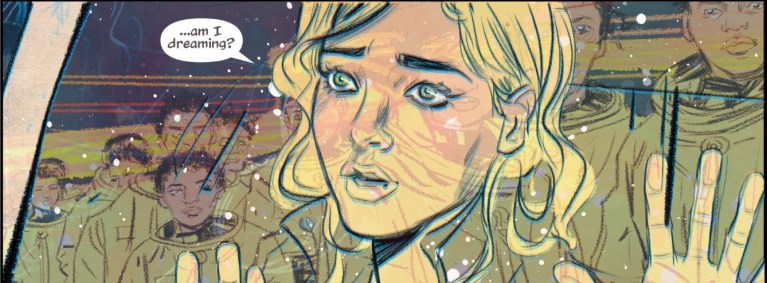
To heighten this sense of confusion, Supreme: Blue Rose may just be one of the most dream-like and ethereal comics for the masses I’ve seen in some time.

Cover for Volume One of Supreme: Blue Rose

Warren Ellis must never sleep. His sharp series, Trees, has progressed a few months after the first volume was released earlier this year, and simultaneously, another series, Injection, has begun this summer. And in addition to these two, he’s also managed to complete seven issues of Supreme: Blue Rose, which are collected into the first volume for the series that hit comic book stores this week on July 1st.

When Ellis actually sleeps between all of this work, his dreams must be filled with multiple dimensions and plenty of time travelling into places we will never see, but thankfully for us, he and Tula Lotay have materialized these forbidden foreign places in between the folds of the spectrum of time with Supreme: Blue Rose.

Diana Dane (yes, that’s probably the epitome of a superhero name) seems to have ties to some alternate universe. In her dreams, a man warns her about trusting a complete stranger named Darius Dax (and yes, that’s the epitome of a supervillian name), and a faceless man, cleverly named Enigma, stands on the shore staring into a bay where he claims a guardian of the future once descended and spoke to him as she surveyed the land one last time before it would change. And if things could not get any more ominous, the faceless man appears at a street corner as Diana travels to a meeting with Darius Dax at the National Praxinoscope Company for some reason undisclosed to her.

But let me warn you, despite the superhero names and some familiar archetypes seen in some superhero comics, Supreme: Blue Rose is far beyond a superhero tale. It is not really even an anti-superhero comic….

Diana has fallen from grace from her rising journalism career, and consequently, when Dax offers her a total of one million dollars to investigate the whereabouts of Ethan Crane, even under  far beyond ordinary, most likely supernatural circumstances, she has little reason to say no. One million dollars does not come without some level of grief, and Diana has quite a lot of it in store for her.

As it turns out, the universe resembles some giant, self releasing software development machine. It releases versions of reality and merges them into the time space continuum, creating multiple branches of reality that may or may not shift when a new version arrives. Unfortunately, a recent version has disrupted the separation of realities, and fragments of others are falling into the one Diana Dane and Darius Dax inhabit. The answer to the clashing of alternate realms lies with Ethan Crane, but he has seemingly vaporized, and his disappearance may be a sign of the end to come.

In parallel to Diana’s quest to find Ethan Crane, Ellis also presents the worlds of Professor Night, a television serial character, and Chelsea Henry, a professor turned dimension jumper. Professor Night battles his own enemy and lover in Evening Primrose in a decaying futuristic world, and Chelsea attempts to understand her own powers and the truth behind the universe. Both Professor Night and Chelsea wander through their worlds and also multiple dimensions in search of something, and as Supreme: Blue Rose unfolds, they both travel into Diana Dane’s world, all culminating into a final scene where the past, the present, and the future collide, shatter, and fold.

Supreme: Blue Rose feels like Ellis’s “fuck you, I can do it better” to the frequent use of alternate universes in superhero dynasties. Ellis expands that inherently human fascination with what ifs and regrets to create a whole series around alternate realities that constantly and cryptically twist and turn. With this series, in our post-modern world, Ellis proves that he shall remain as the king of futuristic, nihilistic concepts; every character in Supreme: Blue Rose has no control over his or her existence(s), and all of their perceived realities remain in a fragile state, ready to fall at any moment, rejecting any belief that we as humans can hold true power over our own reality.

Beyond the experiences of the characters, the instability of the worlds of Supreme: Blue Rose are most evident in the artwork by Tula Lotay. All of the illustrations have a looseness and haziness to them accomplished by pastel and watercolor techniques that blur the lines between dreams, pasts, presents, and futures, making us as the readers question what is real and what is not and if the concept of the real even matters. Lotay’s artwork paired with Ellis’s narrative makes Supreme: Blue Rose transcend above all other dimension shifting series.

By the end of Supreme: Blue Rose, Diana Dane may or may not have succeeded her mission, and Ethan Crane may or may not have helped change the universe, but alas, an exact answer may not exist because we have no idea which reality the events occurred in. A goal directed plot certainly exists, but the most fascinating parts of the series occur across dimensions with the reveal of different versions of a single character which can be pieced together to establish each character’s fundamental motivations and inclinations toward good or evil or nothing at all. With Supreme: Blue Rose, Ellis pushes the storytelling technique of fragmented character building into a new territory, all while reminding us not to get too swept up in our own fantasies of our own possible alternate realities, since after all, we have an essential character and spirit, and that will permeate all of the dimensions, whether you’re a desk clerk in one reality or a supermodel in another.

Supreme: Blue Rose by Warren Ellis and Tula Lotay is available now via Image Comics.