Jaromil Jires’ 1970 Film, “Valerie And Her Week of Wonders” Is A Gorgeous Czech New Wave Fairy Tale

Standard
valerieweekofwonders2

Valerie (Jaroslava Schallerova) And “The Monster”

More than most European film movements of the 1960s, I have long been an admirer of the films of the Czech New Wave and have even appreciated much of the work of some of the movement’s directors who made the jump to Hollywood, such as Milos Foreman and Ivan Passer. I am also very happy to write that over the last few years, there has been a growing appreciation for the Czech New Wave, inspired by the re-release of Věra Chytilová’s 1966 film, “Daisies,” the story of two teenage girls named Marie who enjoy pulling the odd prank. “Daisies” is an absurdist dark comedy that excels in the surreal and is completely successful in keeping you off kilter for its short, 78-minute length.

Similarly short in length but immensely visually dazzling, is the 1970 fairytale feature by Czech New Wave auteur, Jaromil Jires, “Valerie and Her Week Of Wonders.” Drawing inspiration from the likes of 1960s Buñuel and Fellini, director Jires ties together this loose narrative of the fantastical and erotic daydreams of our title character Valerie, joyously played by the luminously gorgeous, Jaroslava Schallerova. Our demented fairytale begins with the virginal Valerie, who lives with her grandmother, having her earrings stolen in the middle of the night by a man who covers his face with a weasel’s mask. She encounters the man who stole her earrings the next day who then gives the earrings back to her.

Valerie then receives a letter informing her of a church service for all of the town’s virgins. She attends and after the service, Valerie meets Eagle, who tells her that he was the one who had stolen her earrings the night before and that the man who she keeps seeing in her yard is in fact, a monster. Eagle then gives her a pearl, which should protect her from evil. Valerie goes home to the comfort of her beautiful grandmother, but I must mention that her grandmother occasionally is a vampire, and that her grandma’s ex lover is Gracian, the local Catholic priest who she flogs herself in front of in order to give him sexual gratification. When Valerie encounters Gracian, he of course sexually assaults her and she uses her pearl to force our clergyman’s suicide. In turn, Valerie is then accused of witchcraft.

While writing this summation of the story, it boggles my mind as to why I so riveted for the entirety of the film as the rapid blending of genre is downright staggering, from fairy tale to softcore porn to horror film to political satire? I’ll leave behind the likes of Fellini and Buñuel as the work that Jires’ film eventually reminds me the most of, I dare to say, is Takeshi Miike’s virginal fantasy freak out film, “Gozu.” My favorite of Miike’s oeuvre, “Gozu” follows a young yakuza who has never known a woman, accidentally kills his boss, and makes the mistake of spending the weekend hiding out in motel where he encounters an elderly woman who cannot stop lactating, a man with a cow head who drools semen, and a beautiful woman with whom his interaction with ends horrifically and hilariously on the other side of vagina dentata. Both films play on the dreamlike fears that exist in the mind of the virgin as the moment of sexual congress is becoming an ever-increasing reality, but unlike Mr. Miike’s film, which spirals more and more out of control until its final frame, making the dream logic it uses something of an afterthought, “Valerie And Her Week Of Wonders” blissfully lands in reality at the end where Valerie emerges triumphantly as a woman.

Valerie And Her Week Of Wonders Trailer
https://www.youtube.com/watch?v=GR07_yzRFMM

Created during the Soviet occupation of Czechoslovakia when the national film industry was heavily censored and when the country was rapidly becoming more industrialized, Jires’ film excels during those beautiful moments of virginal curiosity in the midst of it’s mostly bucolic settings as if the film industry seemed to be channeling the desire of the Czech people yearning for a return to a mostly pastoral existence. Furthermore, the consistent jabs at the clergy’s duality of morals plays as much into the sexual repression we see in Valerie’s daydreams as it serves an indictment of the regime of the time.

Throughout it all, Valerie And Her Week Of Wonders” is an underrated and stunning work that demands your constant attention not only for its dizzying almost cult-like blending of genre, but for its consistent promise of a pastoral fantasy world that is sometimes horrific but always dazzling.
Jeffrey Brown’s Robot Slapstick: Incredible Change-Bots

Standard

I spend quite a bit of time reading graphic novels with some commentary on life experiences, philosophical concepts, or traditional genres and cultural motifs. However, more often than not, I love a good, silly yet clever work of comedy. And, there is no better comedic graphic novel creator than Mr. Jeffrey Brown.

For this week’s review, I’m reaching a little further back in time for a series of Brown’s that deserves some attention, particularly after the string of Transformers films; that is the Incredible Change-Bots.

Cover for Incredible Change-Bots


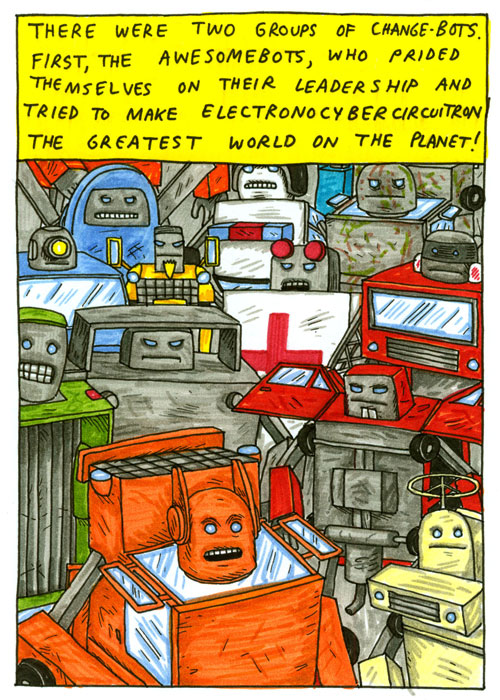
Released in August 2007, right after the release of the Michael Bay all flash re-vamp of the Transformers series, Incredible Change-Bots parodies the Transformers world of robot heroism. The change-bots live on Electranocybercircuitron in the midst of a War of the Roses a la robot, where the two leading tribes, the Awesomebots and the Fantasticons, battle for control over the planet they inhabit. Despite all efforts to succeed over the other tribe, both end at a stalemate and manage to destroy the planet they spent time and energy fighting over.

The two enter a shaky truce and decide to head to another planet, but, alas, their futile feud reappears on their spaceship in transit, and the whole group ends up landing on Earth after a few haphazard laser shots at each other. After their landing, the Awesomebots and Fantasticons reinitiate their war, but this time with human beings on each side. The two forces endlessly fight, and in the war on Earth, Brown introduces lots of jeering stabs at the plot “twists” we see from miles away in action and superhero films until the two forces, to yet again, lead to another robot war stalemate.

There is little to be said about the intellectual properties of Incredible Change-Bots beyond its warping and distortion of common superhero motifs. Ultimately, both the Awesomebots and Fantasticons are led by incompetent alpha-male type characters, which carries most of the comedy of the book. Brown’s re-envisioning of the Transformers’ Autobots and Decepticons as bumbling, clumsy, and myopic egoists delivers plenty of inappropriate laughs because these change-bots have no redeeming qualities to them and from their incompetence comes many moments of awkwardness, discomfort, and hilariousness.

Acutely honing in on all of the plot devices used in superhero movies to appeal to general audiences ranging from the peripheral love story to the interior betrayal to the hidden familial tie between enemies, Brown irresponsibly and cleverly uses the same plot conventions to turn the Transformers series into a complete and utter spectacle and debacle. But, in its comedic and absurdist approach, there is something oddly very human about the Incredible Change-Bots, for the change-bots act so badly because they possess more human foibles than any hero or protagonist in any superhero story. As a result, the change-bots stand less like the pinnacles of human virtue and more like robot versions of the Three Stooges.

As with most Jeffrey Brown novels, his comedy lies in the dialog, and the same goes for Incredible Change-Bots. The change-bots insult each other, comment on their own robot characteristics, and expel the best onomatopoeia when they transform from cars to standing robots. In addition, with every action each change-bot takes and every word spoken, you get a sense that Jeffrey Brown took a look at each item he encountered in the Transformers series and asked himself, “How could I make this both more absurd and realistic?”

With summer always bringing about superhero blockbusters (which do occasionally carry their own entertainment value), do check out the Incredible Change-Bots in parallel to that next outrageous super action film you see. It’s certainly a graphic novel challenging the motifs attractive to the summer superhero audience, but it will have you endlessly laughing and then cringing at the thought that you invested time into the fantasy of any of the films of the Transformers series or really any superhero series in the first place.

I’d love to think of a universe where Jeffrey Brown wrote all screenplays; it would be a world with fewer car chases and explosions and many more honest yet never caustic comments on the ridiculousness of the things that tend to capture our collective attention.

Incredible Change-Bots One and Two are available via Top Shelf Productions. 

Generoso’s Stufato di Maiale Italiano Con Farfalle (Italian Pork Stew)

Standard

Generoso’s take on the Italian pork stew is a sweet and hearty dish that was made for these late winter’s when you crave something rich and filling after a long day. Think of this as an Italian Beef Bourguignon! You will need 2 pounds of pork sirloin, a can of puree tomato, ground bay leaf, salt, pepper, parsley, one cup of red wine, white flour, cinnamon, one box of farfalle, and a large onion. Takes about 2 hours to make from prep to plating.  Let us know how yours turned out!!  XO Generoso and Lily

Music: Aaron Dunn’s Sonata No. 1

Bovine Ska and Rocksteady 4/1/2015: Early Clancy Eccles

Standard

For the 1001 episode of the Bovine Ska and Rocksteady, we kicked off the show with an amazing version-to-version-to-version-to-version excursion with the Satta Massa Ganna rhythm, beginning with the original recording of “Satta Massa Ganna” by The Abyssianians.

After that trip down version road, we presented some more reggae, including the chilling and stunning “Devil in Bed” from Cornell Campbell.

After those first two reggae sets, we played the mento set of the week, which included a beautiful one from Laurel Aitken entitled, “Nightfall in Zion.”

Then, in order to glide into the spotlight on Clancy Eccles’s early recordings, we shared a set of Jamaican rhythm and blues, which included “Since Lately,” a very early track from Jimmy Cliff, long before his days in “The Harder They Come.”

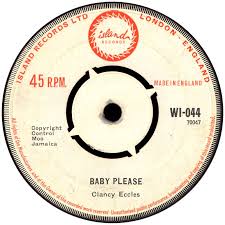
Clancy Eccles's Baby Please - Released in England on Island and in Jamaica on Moo's

Clancy Eccles’s Baby Please – Released in England on Island and in Jamaica on Moo’s

So, you may ask, why only the early Clancy Eccles tracks? In 1965, Clancy left the music industry as a performer and became a tailor and additionally a stage wear designer for Kes Chin, The Mighty Vikings, Byron Lee and the Dragonaires, Carlos Malcolm and The Blues Busters

Consequently, in the spotlight, you will only hear the songs he recorded before he took his two year hiatus from recording and before he returned to the music industry in 1967 when he would record again and produce other artists.

Born in Saint Mary parish in 1940 to a tailor and builder, Clancy Eccles began his love for music in the church. Particularly inspired by his uncle who was a spiritual revivalist, Eccles began singing at church as a boy. As a teenager, he moved to secular music, singing to tourists in the hotel circuit on the Northern Coast of Jamaica. Then, as a young man, he moved to Ocho Rios and performed in nighttime shows where he shared stages with the Blues Busters, Higgs & Wilson, and Buster Brown.

After working the live performance circuit for a few years, Clancy decided to move to Kingston in 1959 where the recording industry was beginning to rise, and eventually, he began working with Coxone Dodd. He first recorded Freedom for Coxone, which was a single played on his sound system before it was pressed for distribution. As a political song discussing repatriation to Africa, Freedom was actually one of the earliest songs to be used in a political campaign; Alexander Bustamente used it in his battle against the Federation of the West Indies in 1960.

You’ll hear Freedom to kick off the spotlight on Clancy Eccles’ early recordings.

By 1962, Clancy began running his own talent shows and producing live shows for artists such as The Clarendonians and The Wailers. The next year, Clancy began working with other producers including Charlie Moo and Lyndon Pottinger. You’ll hear his work from these producers in the second part of the spotlight.

Happy April! Hope you enjoy the show!

Listen to this episode HERE

The archive link will be available until 4/14/2015.


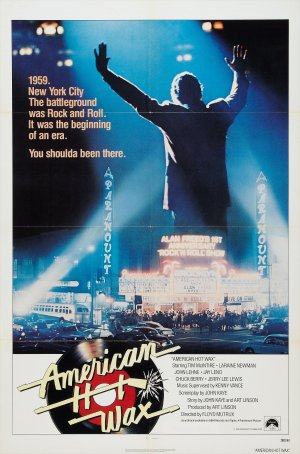
Alan Freed Deserved A Better Fate Than 1978’s “American Hot Wax”

Standard
american_hot_wax_booth

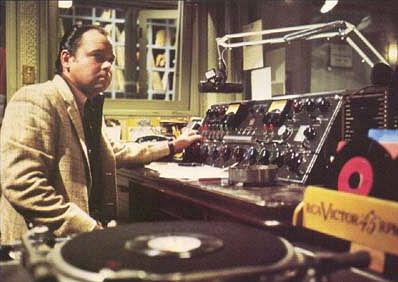
Tim McIntire As Alan Freed

Over the last nineteen years of my radio show, I have always ended with the phrase, “And in the immortal words of the late, great Alan Freed: This is not goodbye, it is just goodnight.” As a young man growing up Philly, obsessed with radio as many of us were, I was thrilled in 1978 when a biopic was made on the infamous Cleveland disc jockey who coined the term, “rock and roll,” Alan Freed.   A year earlier on a local UHF station I had seen the 1956 film, “Rock, Rock, Rock” that starred Freed, which encouraged me to go to my local library to read about Freed and his relationships with the artists he nurtured, the blacklisted music that he rebelliously played on air, and the eventual “payola” scandal that destroyed his career. So, even as a boy of ten, there was a lot riding on “American Hot Wax” in my mind, and I asked my dad to take me to see it in a downtown theater.

Before my review of the film, I should paint a more accurate picture of the 1970s for me as I mostly remember local radio, television, and film as being obsessed with the 1950s. Philly had been the home of so many doo wop groups that, even though the local FM airwaves were blessed with the sounds of Philadelphia International disco, the AM dial was firmly entrenched with the vocal harmonies of local groups such as The Penguins, The Moonglows, and The Five Satins, not to mention that young men were still vocal harmonizing these tunes on street corners. George Lucas’ nostalgic “American Graffiti” was getting regular screenings on television, “Happy Days” was a huge hit on ABC, and my sister, like so many of her age, loved “Grease.” I had indeed fallen into the nostalgia craze for a decade that I had never been a part of, which means that I was not privy to negatives of that time either, and most likely for that reason I was beyond thrilled seeing “American Hot Wax” when it was released. To be able to see the likes of Chuck Berry, Jerry Lee Lewis, and Screamin’ Jay Hawkins on screen in the days prior to our family being able to afford a VHS player was too mind-altering and to get some glimpse into that world where many of the songs I knew and loved were created was amazing to me, and regardless of where this review goes, I am so glad that those moments were put on film, especially given that Screamin’ Jay is no longer with us.

Over thirty five years later, I sat down and re-watched this film directed by Floyd Mutrux, and immediately noticed that it is shot in that same static, one camera style, similar to that of “The Buddy Holly Story,” which came out later that year, and frankly almost every television movie of that era. It’s amazing to me that a film so much about a man as it is about nostalgia would not go to the extra level of adding a visual technique to entrench it into its time period. The film immediately creates a feeling of frenzy and genuine excitement around Freed, as he goes through his hectic days leading up to the last live “rock and roll” show that he would produce in New York City. The actual Freed had been arrested in Boston months earlier for inciting a riot after he took the microphone during some unrest at a show he put on and said, “The police don’t want you to have fun.” “American Hot Wax” does make it abundantly clear that the establishment was not happy with Freed’s ability to encourage white teens to listen to sexually charged black music.

Tim McIntire does a fine job as Freed, playing him as written in history as a charismatic, intense man, who genuinely loved music and was excited to promote it, even spending his personal time with artists and signing some groups right off the street in front of WABC. Two actors whom I did not recall from 1978 and who were always at Freed’s side were his loyal secretary Sheryl, played by a less painfully annoying but adorable, Fran Drescher, and his driver, “Mookie” played by the usually unfunny Jay Leno. A real surprise in the film is the performance by then, SNL regular, Lorraine Newman, who does a great job playing the Carole King-esque Louise, an upcoming teenage songwriter who like King, wants to write for the young groups and is more than happy to stay out of the spotlight.
What is of course the real star of the film, is the very generous soundtrack, which in these days of over-inflated clearance rates for music will most assuredly never happen again. Not only are members of the cast covering many of the greatest songs of that era, but also there are the actual tracks from the 1950s that Freed played on the air. If there was ever a nostalgic moment that existed for me during this viewing of “American Hot Wax” was hearing these amazing cuts and knowing that the days of unlimited original music in film are all but gone.

Though the music is sensational (but not necessarily accurate at all times) the trade-off that “American Hot Wax” makes in terms of sacrificing narrative for a frenzied atmosphere is just too intense, and there is very little that glues this film together as far as story. For what the film captures as far as the intense hatred the establishment had for rock and roll, there is as little to take away about the actual life of Freed. There is a small moment of insight when his family painfully rejects Freed during a phone call back to his hometown of Akron, and another moment when Freed is denied the purchase of his dream home after he arrives with a group of racially mixed teens, but that’s about all you get. This failure in creating a whole character in Freed undermines what should be the emotional climax of the film, the first anniversary rock and roll show at the Brooklyn Paramount where Jerry Lee Lewis and Chuck Berry perform. The film, though not a total mess, was not well reviewed and did not do well at the box office when released in 1978.

“Alan Freed” Introduces The Brooklyn Paramount Show

Later in 1978, still riding on the heels of the 1950s nostalgia, was the sensational biopic, “The Buddy Holly Story,” on the legendary singer, songwriter, and producer which garnered a well-deserved Academy Award nomination for Gary Busey in the titular role. For me, The Buddy Holly Story is a kind of correction of the mistakes of “American Hot Wax,” as it never loses it’s main character while being as heartfelt and well-constructed as it is nostalgic.

Apocalypse by Trees: Warren Ellis’s Trees

Standard

Given the revival of zombies and other forms of apocalypse in modern media and culture, perhaps today’s media creators are all honing in on a general instability hiding under our technology age where the future seems bright but something rotten lurks underneath.

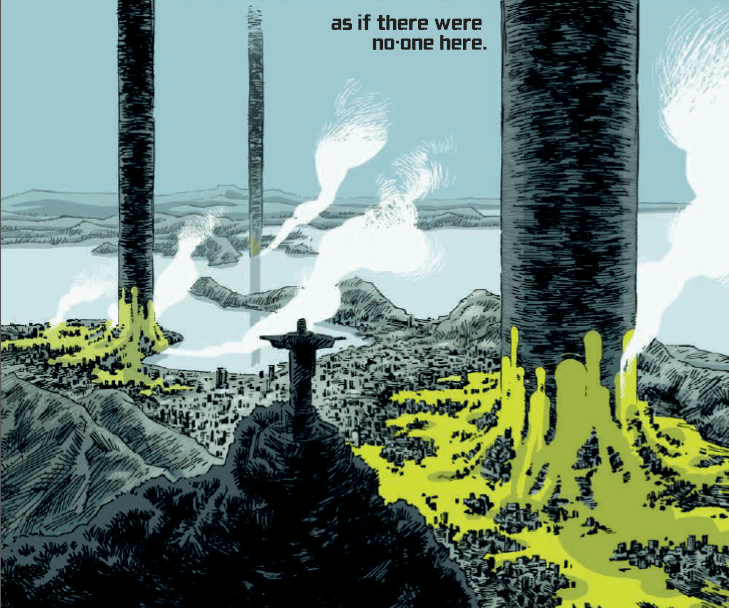
Warren Ellis’s Trees capitalizes on the concept and the fear of the apocalypse in the modern age with alien tree-like creatures falling from space and landing on Earth. However, unlike the zombies and any active attacking force galvanizing the end of the world, the trees rule and stand with a nearly silent presence, growing and oozing a mysterious green acidic liquid. In a way, the trees do not intentionally inflict malevolence on the humans and communities of Earth. They simply grow and live, but as they flourish, they interrupt human life, landscapes, natural resources, and societies, leaving humans to adapt in the wake.

Cover for Warren Ellis’s Trees Volume One

Given the indifference of the trees, they really cannot serve as villains in the series. Consequently, as seen in the wake of most natural disasters, the enemies and the heroes rise from humans as they try to live in a new world from the rubble of the past. And though the non-sentient trees now control the world without communicating their intentions (or really even having the facilities to do so), evil rises in varying degrees from different people futilely grasping for control, and good rises from people understanding the triviality of life given the inexplicable damage of the trees and have thus tried to adapt and life as freely and happily as possible.

The first volume of Trees compiles the starting eight issues and covers the reactions and survival strategies of people across different classes and countries across the world. In this first volume, we see how politicians, dictators, scientists, farmers, painters, lower level gangsters, police, and everyday, regular people live in the shadows of the trees. Each group of focus brings a radically different perspective to the circumstances, and given the direness of the world of the trees, each group’s intentions are truer to their characters and personas than ever.

In this first volume, a scientist studies in isolation in Norway, unrelentlessly and irresponsibly committing everything to understanding the tree’s expansion. An uncommonly wealthy man in Rio de Janeiro contemplates on his political career and his desire to change the current regime of law enforcement. In the city of Shu, a former farmer crosses barricaded gates to enter an artist and freak community centered and thriving around a tree and separated from everyone else by concrete walls and military guard. In Somalia, a dictator plans on using a tree as an object of military strategy. And, in Cefalu, small time mobsters reign over the mostly abandoned wasteland caused by the arrival and permanent residence of a tree.

Despite the presence of these uncaring and unrelenting trees in these people’s lives, the world has really not changed too much. Power struggles still exist. Kindness still exists. Brutality still exists. Greed still exists. Vices and virtues all remain the same but each has been magnified, and the territory between has become even more unclear in this world. And, this grey area is what makes Trees a fascinating read because this amplified ambiguity between good and evil parallels the same territory in our globalized, technology linked world.

Undoubtedly, the fiction of the trees linger in the background of the narrative, but they exist exactly the way they do in the world of the series as silent, domineering giants, ready to make a move that could dissolve an entire community at any moment. Consequently, a sense of transience runs throughout every branch and arc of Trees. Unlike in most fiction, a character or setting can disappear from the narrative at anytime due to the unpredictability of the trees and the administrations of the various people who attempt to run the world, making the fictional world detailed in Trees far less different than our own transient real world.

Absolutely an exercise in existentialism, as expected from most post-apocalyptic works, Trees asks plenty of hard questions about human motivations and purpose. Each character in the series approaches the question in a different way in light of the mercurial and death-inducing trees, and in turn, Ellis asks us to think about our own existence in reality where life is just as fragile and temporary. Despite the heavy topic, the combination of Ellis’s prose-like narration with fluid dialog and Jason Howard’s semi-realist artwork makes Trees emerge as more of a naturalist rather than allegorical work. Though it may border the line between insightfully powerful and heavy-handedly pretentious, Trees has the potential to capture and interpret all of the struggles, conflicts, and moments of hope seen in modern times around the world, preparing it to become one of the most comprehensive series offering commentary on the experience of living as a human being on Earth in the 21st century.

Trees Volume One is written by Warren Ellis and illustrated by Jason Howard. This first volume collects issues 1-8, and issue 9 will be available in May.

Lily’s Fluffy And Crispy Banh Tieu

Standard

Lily grew up eating Banh Tieu almost every weekend. In Houston, it could be picked up at most bakeries and sometimes even in Vietnamese grocery stores.

However, in Boston, Banh Tieu is not quite as available. Because of the scarceness of Banh Tieu, Lily must make it at home! For Easter, she will show you how to make these fluffy pieces of fried dough covered in sesame seeds.

Remember to flatten the dough into thin discs; thinner discs will help make the dough puff up!

Enjoy!

Music: Sinfonietta, Op. 60 by Leoš Janáček

1972’s “We Won’t Grow Old Together,” The Second Unsentimental Feature of Maurice Pialat

Standard
we wont grow old together

Marlene Jobert and Jean Yanne

Please bear with me, as the first part of this review is a long overdue appreciation post for someone who should’ve received more credit for shaping the film scene here in Boston. Needless to say, 2008 was a tough year for the film here as Bo Smith, the 21 year Director of the Ruth and Carl J. Shapiro Film Program at the Museum of Fine Arts, left the MFA to head the Denver Film Society for what would sadly be less than a year. Bo revitalized a dying scene of truly independent and foreign film programming here back in the 1980s and nurtured the growth of a multitude of festivals featuring work from all over the world, including The Turkish Film Festival, The Boston Iranian Film Festival, The Palestinian Film Festival, and the festival where we first met, the inaugural 1995 French Film Festival. Though Bo was always consistently clad in the finest of clothes, he walked up to a grubby, skater shorts and ska t-shirt wearing Generoso after the screening of the ninth film I saw at the festival and asked why was I there. We then engaged in a lengthy discussion on the state of French cinema, which I guessed surprised him a bit because, between films, I was playing a lot of very loud reggae through my headphones. After that exchange, Bo would frequently stop by during the remainder of the festival and ask my opinion on what I had just seen, and in turn, during the conversations that followed, I grew my appreciation of his immense knowledge and love of cinema.

Cut away to 2003, shortly after the passing of Maurice Pialat, Bo curated a complete retrospective of the work of Pialat, a director he greatly admires and resembled himself as a director who also never seemed to be remotely concerned with the commercial success of his output. By 2003, I had only seen Pialat’s most well known film, 1983’s “A Nos Amours,” and although I admired it greatly, I had never seen the rest of Pialat’s work, so based on Bo’s suggestion, I attended all of the retrospective he put together. All, except the film that I am writing about today, 1972’s “We Won’t Grow Old Together,” which was recently screened at another of this area’s institutions, The Harvard Film Archive as part of a series entitled, “Furious Cinema ’70-‘77.”

More than almost all of the films in this series at Harvard, the word “furious” is most aptly applied to “We Won’t Grow Old Together,” the story of Jean (Jean Yanne), a film cameraman and his obsessive relationship with the younger woman whom he is having a bit more than a little rocky six-year affair with, Catherine (Marlène Jobert). Jean brutally lashes out at and reconciles so many times with Catherine that it borders on the comedic, and at times it even resembles a more violent turbulence that Albert Brooks’ neurotic film editor inflicts on Kathryn Harrold in Brooks’ 1978 film,“Modern Romance.” The plot of “We Won’t Grow Old Together” can be surmised easily. You are there, intimately watching a relationship spiral out of control, but this film is like so many of Pialat’s best works in that it is so much more than the plot. As film critic Kent Jones once explained:

“Even more than Jean Eustache […] Pialat was an irascibly private artist, charting a twisted, crook-backed path with each new movie, almost always emerging with works in which the mind-bending vitality of immediate experience trumps all belief systems, allegiances, plans. […] More than Cassavetes, more than Renoir, Pialat wanted every frame of celluloid bearing his name to be marked by the here and the now.

Jean is relentless in his unsavory treatment of Catherine and she is as relentless in her tolerance of Jean’s somewhat grotesque behavior to the point of insanity. The conflict reaches such a insane mess, that even Jean’s beleaguered wife Françoise (Macha Méril) calmly counsels her husband during about his frustration with dealing with Catherine. This bizarre treatment of this relationship is portrayed as it is with most relationships, romantic or otherwise, in many of Pialat’s films, and that is a portrayal that is completely devoid of a divisive plot or sentimentality. There is no hoping for an understanding between characters or even a moment off of the ropes; you are there to witness a few sensational actors destroy one another for the better part of one hundred minutes, and you are enthralled with the process, though this process was not always appreciated by Pialat’s actors. It needs to be noted that even after winning the best actor’s award for his portrayal in “We Won’t Grow Old Together” at the 1972 Cannes Film Festival, Jean Yanne castigated the film. “I think it’s a lousy story,” he said, in part, noting also, “If I’m any good in the part, believe me, it was completely involuntary.”

The Opening Scene Of “We Won’t Grow Old Together”

Similar to Gerard Depardieu’s character, Loulou and his treatment of Isabelle Huppert’s Nelly in the 1980 Pialat film, “Loulou,” your only recourse is to watch Pialat’s characters crack and get glued together over and over again and it’s this kind of elliptical style editing, which is a Pialat trademark, and this is also why you either love or hate his work. My feelings about Pialat’s work can be summed up by a conversation with Bo Smith  after the MFA retrospective screening of “Loulou” back in 2003.  Bo came up to me and asked me as what I thought of the film and I responded: “It’s a bit like the stab in the gut that Loulou gets in the middle of the film, Loulou takes it, it knocks him down, but soon he just sucks it up and moves on.”

Though it has been many years since Bo Smith has walked or more like bicycled through the streets of Boston, I will be a bit sentimental here unlike Mr. Pialat and wish him a long overdue thank you for all of the great films he brought to town.

Bovine Ska and Rocksteady 3/18/2015: Joe Higgs

Standard

In this week’s edition of the Bovine Ska and Rocksteady, we kicked off the show with early reggae with Bob Andy’s beautiful “Unchained” as part of the show’s dedication to Bob Andy, who was stabbed in a robbery on 3/13/2015. Thankfully, his injuries were not fatal, and he is recovering and healing.

In the second set of reggae, we heard a version-to-version of Shenley Duffus & The Upsetters cover of The Moonglows’ “Sincerely.” A hit on the U.S. Billboard R&B charts for Chess records, “Sincerely” gets a great treatment in reggae for Lion records. For the mento set this week, we were thrilled to share “De Buggy Bruck” from Louise Bennett’s album “Listen to Louise,” a new record discovered over the weekend.

Before the spotlight on Joe Higgs, we focused on some ska gems before beginning the spotlight. In this ska set, we featured “Fire” from The Leaders, a trio long overdue for a spotlight on the BSR given that the group consisted of superstars Joe White, Roy Shirley, and Ken Boothe.

Joe Higgs’ The World Is Upside Down from 1971

After the set of ska, to kick off the spotlight on Joe Higgs, we presented his early solo recordings for Coxone’s Studio One.

Joe Higgs began his music career with Roy Wilson in the duo Higgs &Wilson. The two lived on the same street and actually met and began their collaboration at a contest where eight solo contestants were to be selected from ten to move to the next round, but the promoter could not narrow the group down, so he asked Higgs & Wilson to compete as a duo. Together, Higgs & Wilson reached great popularity early, with their first single, “Manny Oh,” a production from Edward Seaga that sold 50,000 copies. Consequently, as a musician of note early in the Jamaican music scene, Higgs attracted a group of young musicians in his yard in Trenchtown, whom he mentored and taught. One of those musicians was Bob Marley and two others were Bunny Livingston and Peter Tosh. Beyond his teaching, Joe Higgs continued to perform with Roy Wilson and saw additional success with Coxone Dodd, who Higgs would continue to work with during his solo recordings after Roy Wilson emigrated from Jamaica to America in 1964.

As part of a well known Jamaican duo, Higgs took a break from recording after working with Coxone as a soloist and performed as a guest vocalist for both Carlos Malcolm and Lyn Taitt’s groups on the hotel circuit. When he returned to recording, Higgs worked with a variety of producers, including Harry J and Rupie Edwards, who he recorded some of his finest solo records with. These were the tracks of the second set in the spotlight.

Higgs also had his own label, Elevation, which he named after his own ability to elevate himself from a dark and hard world. From the Elevation label, we shared “Let Us Do Something,” a release that was as DIY as can be. Joe recorded multiple parts on the track, including guitar, in addition to singing. He also completed the lettering on the label by hand.

In 1972, Higg’s song, “Invitation to Jamaica” won the Jamaica Tourist Board Song competition, which allowed his to tour the U.S. and also brought him further popularity, so much so that Chris Blackwell planned on releasing Higgs’ debut  LP for Island Records that same year. This LP was “Life of Contradiction.” Blackwell did not release the LP because he felt it would be too difficult to market, but it was eventually released by Pete Weston’s Micron Music in 1975, and thankfully so because the songs on this record have amazing layers of rich sounds.

“Mademoiselle” rounded off our spotlight on Joe Higgs as our favorite of his recordings.

We hope you enjoy this show!

Listen to the archive HERE.

The archive will be available until 3/31/2015.

Stay tuned for the show on 3/25/2015. It will be a celebration of the 1000th edition of the Bovine Ska and Rocksteady!!!


Hello to a New Age of Marvel Heroes: The Unbeatable Squirrel Girl

Standard

In the past few years, the folks at Marvel have definitely tried to expand their repertoire to better suit today’s more culture, gender, and human aware world. From Ms. Marvel to Captain Marvel to Hawkeye, the publisher is definitely trying to shift their line of comic books away from macho, stoic white male superheroes to relatable (in both character and image) yet flawed male and female characters facing struggles against both villains and common human problems.

As part of this progressive movement, Marvel introduced in 2015 a new character and a new series with The Unbeatable Squirrel Girl.

Cover for Issue One

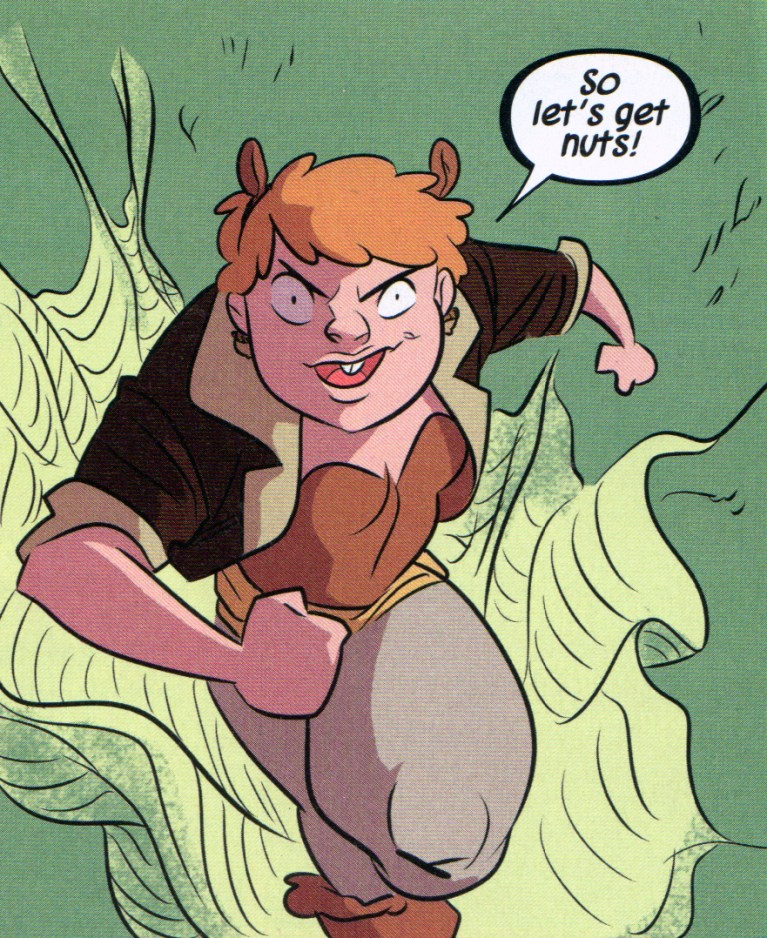
With the release of the first issue, an enormous amount of praise went out to Ryan North, Erica Henderson, and Rico Renzi, and after diving into the earliest issues (it’s only three issues in so far), I must admit The Unbeatable Squirrel Girl deserves the excitement and praise directed toward it. North has created a hilariously goofy and yet all the more charming character, and Henderson and Renzi have created a perfect visual style to match, but what really makes this series shine are all of the small details included in each issue to make the story richer and often funnier and allow us to understand how Doreen Green, our protagonist, fits into the rest of the Marvel world.

Doreen Green is part girl and part squirrel. She possesses strength and agility and an overall excellent sense of humor. She battles villains with her sidekick Tippy with ease, but now, she faces a new challenge: college.

The series opens up with Doreen on her move-in day for her first year of college. Already a time challenging for most humans, Doreen will have an even tougher time in school because she must (like so many superheroes before her) try to integrate into society as a somewhat normal girl while maintaining watch and diligence on the world around her for any approaching villains.

In the first issue, Kraven the Hunter pays Doreen a visit on her college campus, and before she even has the time to unpack her boxes, she must already shed her “normal girl” identity and reveal her superhero costume and her hidden tail. With Kraven’s visit, the false hope she had to live a regular life shatters with the reality that danger lurks all around her and her own responsibility to face that danger. In addition to her superhero duties, Doreen also must face the awkwardness of making new friends, living with a complete stranger, and developing a crush, which is really why I return to this series (and suspect why others will too!).

The Unbeatable Squirrel Girl carries plenty of laughs from Doreen alone with her self-effacing humor, social clumsiness, and overall frenetic tendencies (after all, Doreen is part squirrel…), but as I mentioned before, North and company pack many small details into each issue to fortify the comedy in this series. From Deadpool’s Guide to Super Villains and Super Villain Accessories to Squirrel Girl’s theme song, North has put a lot of love into making The Unbeatable Squirrel Girl not just an action filled superhero comic but also one with humor, joy, and vivacity to accompany Doreen’s hyperactivity.

A Kraven the Hunter info card from Deadpool’s Guide to Super Villains Card Series

Furthermore, The Unbeatable Squirrel Girl has a feature that makes it more charming than almost anything else out there: a protagonist who also acts as a direct narrator to the audience independent from the narrative. At the bottom of each page, in pale text, Ms. Doreen speaks directly to the reader, giving her own feedback on the events in the panel on the page and providing further detail into her character. Combined with the conversations, comments, and interactions on the panels, these sentences lingering at the bottom of the page create a series with a character who readers can identify with and almost even interact with.

Like the other Marvel series I mentioned at the beginning of the review, The Unbeatable Squirrel Girl is emerging to become a more character-driven series with a relatable, approachable, and realistic lead. Gone are the days of valiant, knight-in-shining armor heroes (which I truthfully do like; I began my own love for heroic characters from reading Sir Thomas Malory’s Le Morte d’Arthur). We’re now in an era of heroes who have real lives and face similar growing and life pains as we do while they continue to commit heroic acts. Despite my own love for the tradition of heroes, I wholeheartedly welcome Marvel’s next generation of comic book leads, for they better suit today and bring a fresh and bright light to a concept that was almost obsolete in our morally ambiguous world in need of more complex and more human heroes.

The Unbeatable Squirrel Girl Issues 1-3 are available NOW! Go get them!