Bovine Ska and Rocksteady 1/21/2015: The Cables

Standard
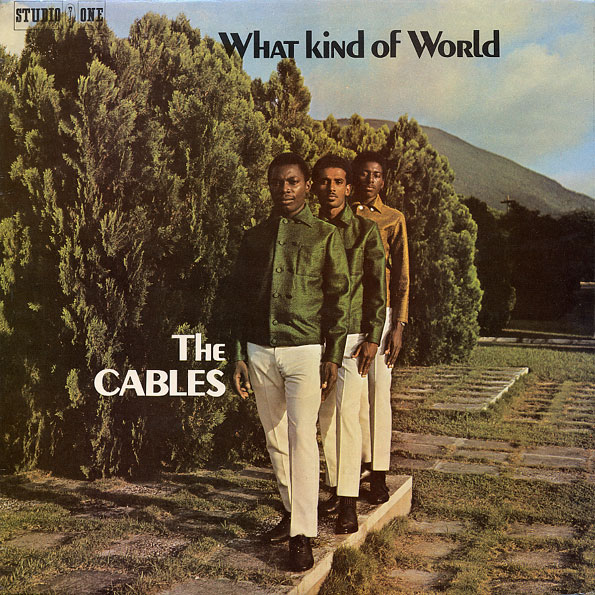
cables what kind of world

The Cables superb LP, “What Kind of World,” on Studio One

This week’s program began with two sets of fantastic ska which started with a cut from the virtually unknown artist named “Pulus” with a track entitled “Sow To Reap” for Merritone in 1966. Thanks again to the good folks at Dub Store in Japan for finding and pressing these lost tapes from the Merritone vaults.  I hope that there is only more lurking somewhere to be released soon.  After a brisk mento set, we launched into the sounds of vocal group extraordinaire, The Cables.

The Cables are Vincent Stoddard, Elbert Stewart and Keble Drummond. Named after a modified spelling of Keble’s own name into The Cables, which he felt was a right name because cables could send a message to the world. Born in St. Elizabeth, The Cables’ frontman Keble Drummond moved to Kingston as a child and grew up in the dire neighborhoods that would produce some of Jamaica’s greatest talent. Spending most of his adolescent years in Ghost Town, Drummond interacted with some of Jamaica’s greatest talents including Rita Marley, who lived in Ghost Town as well. Drummond attended Chetola Park School and then Kingston Senior School, a school that produced the great talents of Earl Morgan from the Heptones and Marcia Griffiths, so music was not a surprising path for him. Growing up in neighborhoods where musicians were often performing, Keble began to interact and sing with local groups. Eventually, Kebel met Peter Austin of the Clarendonians who taught him his first guitar chords. Keble then saw a flyer for Herb Moral Song Studio Training, and he attended a song writing course. In this course, he wrote his first song, “You Lied,” which would be the first track he would record with The Cables for Linden Pottinger’s SEP label, the track that begun our hour long spotlight on this phenomenal vocal group.   It’s a bit of a coincidence that the last of the Cables is called “You Betrayed Me.” The Cables would stop working with the Pottingers because they did not receive payment for their recordings, which had gone directly to Bobby Aitken and his band, who was the backing band for many of the tracks on the SEP label. After leaving the Pottingers, The Cables traveled over to Coxone Dodd to record for his labels. At Studio One, The Cables had to audition for Jackie Mittoo, who at first pushed off the group, but after a bit of a yelling scuffle, finally gave the group a chance to record. We then played The Cables’ Studio One output next.

One of their most popular tracks, “Baby Why” was written about a failed relationship with one of his Keble’s girlfriends who moved from the country to the city to try to start a new life with him.  As with many Jamaican artists, The Cables did not have great financial success or luck with Coxsone. Consequently, when an up-and-coming Harry Johnson (Harry J) met The Cables as he was transitioning out of insurance sales and into the recording industry, the group took the opportunity to go over to the Harry J and show him how to record while they were still on contract with Coxone. With Harry J, Keble developed a friendship with him, and their closeness is definitely reflected in the music because the Harry J cuts are some of the strongest Cables’ recordings.  When Harry J did not have his own recording studio, his recording sessions happened at Dynamic, so it is natural that The Cables would also record for the Dynamic label, except with Syd Bucknor at the Producer helm.  In following the trend of befriending his producers, Keble and the Cables were also close to Hugh Madden, who Keble still visits in Jamaica .

Thankfully, the Cables perform to this day.

Listen to the full program with The Cables smooth vocals sounds: HERE.

Enjoy! The archive will be available until 2/3/2015

Generoso Makes The Italian Wedding Soup Happen!

Standard

Generoso has been asked on many occasions, “Is Italian wedding soup actually served at weddings?” to which he usually responds, “Not only is Italian wedding soup not served at weddings, it isn’t even Italian in origin!”  So, why is Generoso making Italian wedding soup for this week’s blog video?  Because it is synonymous in the Fierro house with a snowy day which it is here in Boston.  The “wedding” in question comes from the marriage of meat and vegetables, so no people are involved.  The tradition of “minestra maritata” (wedding soup) harkens back to the Spanish occupation of Italy as forms of this delicious soup were brought to Italy by the Spaniards, who make their version with a heavy heavy meat base.  For our version you will need a bunch of things, escarole (or endive), pork,  three eggs, bread crumbs, salt, pepper, flour, one onion, fresh parsley, pecorino romano cheese, four cups of chicken stock.  Have fun and let us know how yours turned out!  Love from Generoso and Lily.  Music: Symphony in Dm by César-Auguste-Jean-Guillaume-Hubert Franck


Bovine Ska and Rocksteady 1/14/2015: King Sporty

Standard

Prior to the preparation for this week’s show, we were informed of the sad news of King Sporty’s passing. Consequently, this past week’s show featured a memorial on the great DJ who would emerge as an amazing songwriter and producer.

To begin the show, we began with two sets of rocksteady, including never-before-played tracks from The Merritone Singers and Victor Morris. We then heard mento from Count Owen, Lord Foodos, and Charlie Binger prior to a set of ska to precede King Sporty’s early ska toasting tracks.

R-2265428-1273249302.jpeg

King Sporty’s Self-Produced Single Yearfull of Sundays

King Sporty passed at the age of 71 in Miami on January 5th. Born as Noel G. Williams, King Sporty began his career in Jamaican music as one of Coxone Dodd’s DJs for his soundsystem. In Jamaica, King Sporty would record for Coxone and for Justin Yap prior to his move to Miami in 1968.

Upon his move and work in America, King Sporty would transition his writing and production into soul and disco. However,we will focus this spotlight on King Sporty’s own tracks in ska and reggae before he gained popularity in the world music arena. We will pay honor to the great talents of King Sporty in an one hour tribute of his best DJ recordings, beginning with his first vocal toasting track in ska named El Cid, which was released on Justin Yap’s Top Deck label.

Even though the memorial spotlight focuses on his own recordings, King Sporty was not only a phenomenal DJ and producer but also a talented songwriter. He penned many hits for Studio One and such well known tracks as the Blues Busters, “Thinking of You” and a song that he originally recorded that Bob Marley made globally famous, “Buffalo Soldier.”

In Miami, King Sporty opened up his labels, Tashamba and Konduko, allowing him to write, produce, and release his own recordings and those of artists he liked. During this time in Miami, King Sporty would become very close to the Miami soul scene, distributing records from his label through Henry Stone, the king of the Miami’s T.K. Records. Sporty also married Betty Wright, T.K. Records’ leading soul lady.

One of the tracks that King Sporty sold to Henry Stone was one from Lily’s favorite Glades/T.K. Records artists, Timmy Thomas. In fact, King Sporty had discovered Timmy Thomas’s “Why Can’t We Live Together” and brought the track to Henry Stone’s door. Stone purchased it from Sporty immediately and pressed it on his Glades label in 1972. The Timmy Thomas track gained traction on the American charts, and this would be one of King Sporty’s most successful discoveries within the Miami soul world.

Listen to the full program with King Sporty’s stellar recordings in ska, reggae, and even soul HERE.

Enjoy! The archive will be available until 1/27/2015.

The Leg: The Tale of the Silent Stranger Known as Santa Anna’s Leg

Standard

As a Texan, Santa Anna is the name of a historical figure that immediately transports me back to my mandatory seventh grade Texas history class. In America, we know Santa Anna as Mexico’s president and military commander who lost the wars resulting in Mexico’s loss of Texas and much of the American southwest. However, long before those years of battling for land against American settlers, Santa Anna was a revered and feared leader in his own country.

The Leg or The Remarkable Reappearance of Santa Anna’s Disembodied Limb explores the folklore of Santa Anna, the paradoxical folkhero and villain of Mexico. Despite his active role in fighting for Mexico’s independence from Spain and establishing Mexico as a republic, Santa Anna grew a reputation as a hedonistic, corrupt, and vain tyrant, creating many enemies throughout his career as a politician and military leader. Santa Anna simultaneously strengthened Mexico as he chipped away the nation’s own foundation.

After his loss in the Texas Revolution, Santa Anna returned to Mexico and faced another battle, this time with French forces in what is now known as The Pastry War. In the war, which Mexico barely won, Santa Anna lost his leg, and in an act too indicative of his egocentric and eccentric character, he held a ceremony and buried his own lost leg with military honors. With the heartstrings of the nation in his hands gathered by his military intervention and consequent wound and the overwhelming nationalism stemming from the victory over France, Santa Anna regained the trust of Mexico to lead again. Unfortunately, Santa Anna’s popularity had always vacillated along with his own inability to balance his selfish desires against the needs of his nation, and eventually, Mexico grew so disgusted of their folkhero dictator that they exhumed his leg, paraded it, and threw it aside to be left in the open as carrion for vultures.

Cover of The Leg

Cover of The Leg

The whereabouts of the leg have since been unknown, giving a perfect history and setting for the creation of mythology around its travels and outcome. In The Leg, Santa Anna’s limb has returned to life as a tall and sentient boot that lives with a blind old cobbler who discovered and rescued it. When a group of well dressed men enter the old man’s home under the guise of being lost and decide to kill him, Santa Anna’s leg must try to avenge the death of his companion. Furthermore, the men are on a trip to disrupt Mexico’s progress by eliminating the new president, and alas, the well being and future of Mexico lies in the figurative hands of Santa Anna’s leg.

Along the way, the leg meets a young girl named Ana who accompanies him on his journey. The illegitimate granddaughter of Santa Anna, Ana is alone in Mexico, with her parents in America and her guardian, her grandmother, no longer alive. Deciding not to reveal its identity, the boot simply tells Ana of the mission, and she immediately agrees to help him, hoping to arrive in Mexico City also to find redemption for her family. On their travels, the two encounter fantasy and historical figures of Mexico including a witch, demon, wizard, eagle, crow, and ogre along with labor protesters, Leon Trotsky, Frida Kahlo, and Diego Rivera. In The Leg, we get glimpses into the political and religious fragility and volatility of Mexico. We understand the nation’s history of leaders with false promises who leeched off of the people whom they promised glory and prosperity. The Mexico of The Leg is in need of a hero, and Ana and the leg hope to fill this void.

An example of the inventive, fun fiction in The Leg: Santa Anna’s Leg and The Ogre

As the extraordinary narrative progresses, The Leg reveals itself as a tale about redemption, following the tradition of westerns and samurai tales, with the Jose Pimienta’s beautiful artwork and Matthew Petz’s rich colors paying homage to the distinctive visual style of these two genres. There’s a bit of anthropomorphism here and some allusions to political movements there, but overall, The Leg focuses on the redemption of Santa Anna and his leg’s final ability to battle for his nation rather than his own greed. The Leg is the ghost limb in Mexico version of Clint Eastwood’s High Plains Drifter. Santa Anna’s leg is a mysterious, silent stranger who also returns to a place he once lived in to seek revenge and redemption and, like Clint Eastwood’s character, carries a dark past full of misdeeds. Despite the pure goodness of Santa Anna, in an imperfect world, an imperfect hero may just be what we need.

The Leg has great ideas and stories weaved into it, even though it does not read smoothly. Commendably, Van Jensen attempts to layer historical realism with traditional and new mythology into his first comic book but not every piece fits seamlessly into the narrative. There are moments when the story transitions too abruptly from one arc to another and other moments when the dialog is too fragmented from panel to panel. The Leg could have been longer or shorter to better execute its goal, but it nevertheless deserves praise for its ambition and creativity.

Overall, The Leg is a fiercely imaginative novel about the duality of a character rarely discussed in American history. Through its mythology, The Leg conveys the human ability to choose a path of glory over one of depravity, one of honor over one of cowardice, and how we as humans sometimes jump between both paths in a lifetime. What is best about The Leg is its positivity in the light of dire situations, which is refreshing in an age of cynicism and skepticism. In a modern time where many of our leaders, political or spiritual, never seem to be inherently good or evil, The Leg, gives us a breath of optimism that perhaps our leaders will one day choose a path of true benevolence for others. At the very least, it reminds us that we too can choose to veer back on a path of good even if we have strayed away.

The Leg or The Remarkable Reappearance of Santa Anna’s Disembodied Limb is written by Van Jensen, illustrated by Jose Pimienta, and lettered and colored by Matthew Petz. It is available now via Blue Creek Creative.

Lily’s Delicious Xoi Dau Xanh (Sweet Rice with Mung Beans)

Standard

Xoi refers to the glutinous sweet rice dish with many forms in Vietnamese cooking. There are savory versions of xoi, and there are sweet versions of xoi. Lily will show you how to make Xoi Dau Xanh, which is a sweet version of xoi with mung beans that she grew up eating for breakfast. Xoi Dau Xanh is served with sesame sugar salt and is perfect when you need a midday snack. This is a super simple recipe that requires little preparation and more passive cooking time depending on the type of steamer you use.

Lily used Korean sweet rice here, but if you find Thai sweet rice, do go for it!

Enjoy! Let us know how it goes!

Music provided by Conradin Kreutzer’s Grand Septet Eb, Op, 62.


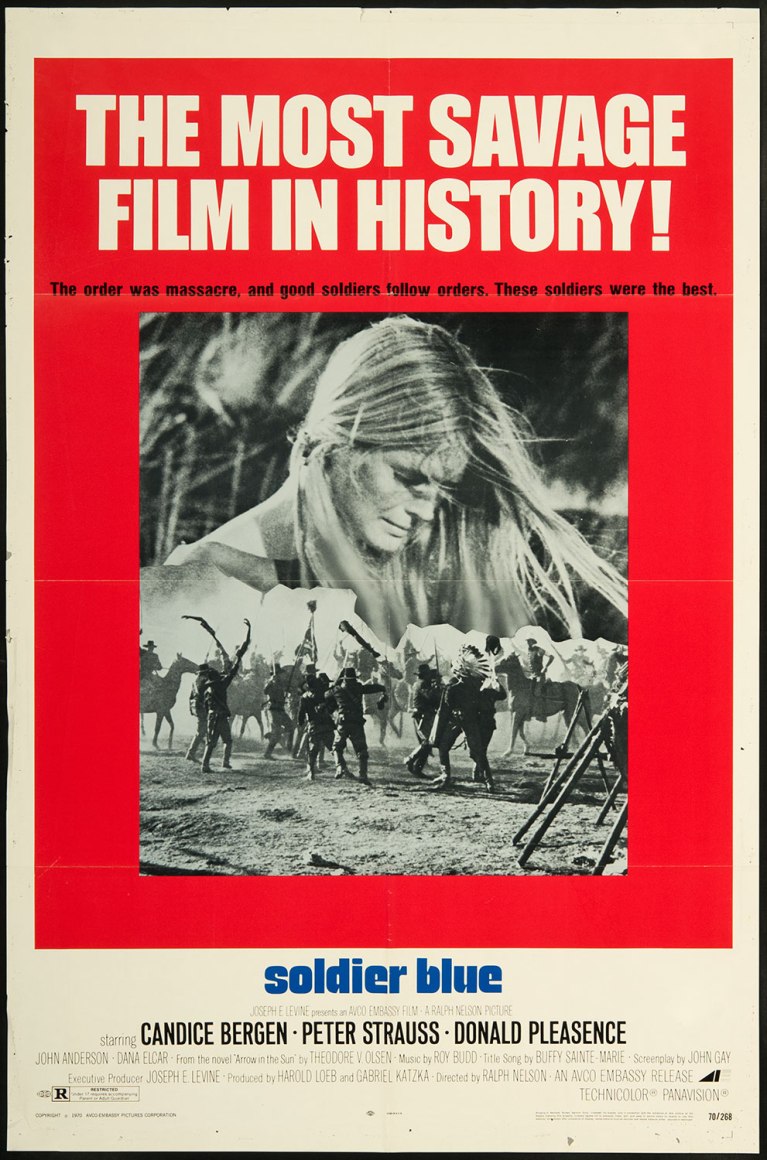
1970’s “Soldier Blue” Is a Vile Exploitation of the Sand Creek Massacre

Standard
soldier blue landscape poster

Why Is There An Image Of A Naked Bound Native American Woman Next to A White Couple Kissing?

Before anything can be said of Ralph Nelson’s 1970 film, “Soldier Blue,” we must first look at the horrific real-life event that film is based on; The Sand Creek Massacre of November 29, 1864. On that day, the Colorado Territory militia descended on a village of peaceful Cheyenne and Arapaho, murdering, raping and even mutilating over 150 people, mostly women and children. Led by US Army Colonel John Chivington, the cavalrymen planned the attack on a village, one that had entered into a peace treaty with their attackers and were even flying an American flag as well as a white flag to show their peaceful intention. Though the event was investigated by the Joint Committee on the Conduct of War, no one was ever prosecuted. A statement was issued by the committee on the massacre that included the following: “Having full knowledge of their friendly character, having himself been instrumental to some extent in placing them in their position of fancied security, he took advantage of their in-apprehension and defenseless condition to gratify the worst passions that ever cursed the heart of man.”

Some seventy plus years later, Hollywood began to take notice of this grim chapter in American history and began to depict the massacre in several films to varying degrees of accuracy and correct accountability, including; “The Guns of Fort Petticoat” (1957) and “Tomahawk” (1951). By 1970, the world had been shocked at the news of the My Lai Massacre of 1968, in which a company of the US Army soldiers premeditated the murder of a village of unarmed Vietnamese women and children. During this same era, activism lead by Native Americans had increased, culminating in the nineteen-month occupation of Alcatraz by United Indians of All Tribes, a group of predominantly university educated Native Americans in 1969. The time was right for a mainstream film to accurately capture the almost forgotten tragedy of the Sand Creek Massacre. Unfortunately, “Soldier Blue” was to be that film.

“Soldier Blue” was advertised in 1970 as “The Most Savage Film in History” which already draws some concern as this would be the selling point for this mess of a film. Indeed, the violence goes far beyond the threshold of violence that was set by Arthur Penn’s “Bonnie and Clyde” a few years earlier. Truthfully, the Sand Creek massacre scene is as wretched as advertised and does include every horrific detail that was brought up in testimony to the Joint Committee on the Conduct of War. On this point, director Ralph Nelson did not leave anything out to spare domestic audiences, but it is what leads up this moment that concerns me, as the narrative is banal collection of awkward acting and moments that cannot justify the coup de grace that occurs at the end of the film. Though applauded during its time, it is just another film that explores a tragedy in American history that was perpetrated by whites, where the whites come off as the real heroes. I usually refer to this phenomenon as “Mississippi Burning Syndrome,” referring to the dreadful 1988 Alan Parker film, where two FBI agents become the real heroes of the civil rights movement.

In “Solider Blue,” two white people, Cresta (Candice Bergen whose accent and behavior appear as though she was pulled out a checkout line during a Labor Day sale at JC Penney) and a soldier, Honus Gent (a sheepish Peter Strauss), who are the only survivors of a Cheyenne attack on their group. They must now travel across the frontier together to get to Fort Reunion where Cresta’s fiancée, an Army officer, awaits. Like so many films where a couple must battle the wilderness to only become closer, their story is eerily similar to many that have come before them with the only difference being that Cresta has lived with the Cheyenne for the last two years and is empathetic to their plight (think Radcliffe girl with a cause of the week). While our cavalryman, Honus, is a flag waver who believes that the USA can do no wrong and must be convinced of the opposite. The film of course leads to the scene in which Honus watches in terror as his beloved cavalry burn, rape and murder an entire village of innocent people. Director Nelson’s major error here is Cresta, who is played by Bergen as though she has no concept of the era her character is acting in during the film, or the fact that Cresta, despite her overwhelming sense of hippie entitlement, would never be allowed the kind of righteous access to the Cheyenne culture as an outsider and as a woman in the mid-nineteenth century. Sadly, the actual perspective of the Cheyenne and Arapaho is all but an afterthought. Lastly, the acting from our two leads as well the many supporting actors don’t go far beyond a mid-1960 TV western serial in quality.

Original Trailer for “Soldier Blue”

Though critically praised, “Soldier Blue” was not well received here in the US by audiences as I assume that most people here circa 1970 during the height of the Vietnam War were just not in the mood to see American soldiers commit more atrocities on screen so soon after My Lai. Soldier Blue did do surprisingly well in England, where it was the #3 box office draw when it was released there in 1971, which should not be a surprise as I would imagine that the folks who lined up to see Cy Enfield’s “Zulu” were waiting on another film to satisfy their blood lust for witnessing another massacre of indigenous peoples by occupying forces. We weren’t too much better here in the States; before the news of My Lai hit the news broadcasts in 1968, folks lined up in glee for John Wayne’s pro-US involvement in Vietnam film, “The Green Berets.”

Director Ralph Nelson had on many occasions taken up the plight of marginalized people in his films, ranging from 1978’s “A Hero Ain’t Nothin’ But A Sandwich” to “Charly” to “…tick…tick…tick..,” and to his defense, most directors cannot control the kind of advertising that a distributor can create for a film, but, with “Soldier Blue,” Nelson’s original intentions just cannot accurately be understood here as the desire to bring this story to light is just buried under a morass of old western clichés, lame performances, and a campaign to stress the film’s violence as a selling point and not the perspective of the people who were really affected.

Bovine Ska and Rocksteady 1/7/2015: Gregory Isaacs

Standard

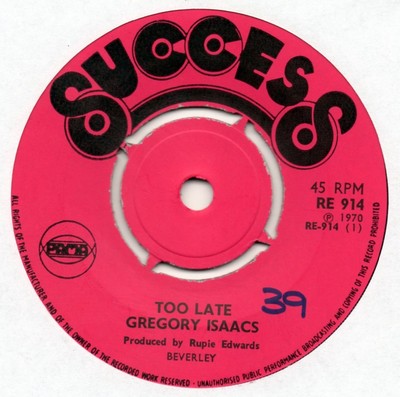
For this past week’s edition of the Bovine Ska and Rocksteady, we kicked off the show with a newly unearthed Justin Hinds and the Dominoes ska track entitled, “Verona.” Then, in order to make sure that all genres were covered, the program progressed from ska to mento to the rocksteady, with recordings from Winston and Bibby, Clyde Hoyte, Tomorrow’s Children, and The Lyrics before all of the reggae featured in our hour long spotlight on the early recordings of Gregory Isaacs.

Too Late – One of Gregory Isaacs’ first solo recordings

Gregory Isaacs is a singer who gained great popularity during his early career, so much so that he was even signed to a record contract with Virgin Records in his later career. Admittedly, the Bovine Ska and Rocksteady has not featured Isaacs as a spotlight because his most popular tracks are ones that stylistically do not fit in the time frame that we like to focus this show on. However, we were able to find some of Isaacs’s first recordings, and they were perfect for this artist spotlight.

Born in Fletcher’s Land, Kingston, Gregory Isaacs was raised by his mother near Denham Town. Attracted to music through his own mother’s singing as she ironed, as a teenager, Isaacs began competing in talent shows and showcasing his voice, occasionally even performing duets with his brother Sylvester. A duet with another artist, Winston Sinclair, from his neighborhood would be Isaacs’s first recording in the Jamaican music industry. This duet track, “Another Heartache,” did not gain a ton of success, and Isaacs went on to join The Concords with two men known as Penroe and Bramwell. The group was short lived, but they produced some really beautiful recordings.

After beginning his music career working with other singers, Isaacs eventually decided to become a solo artist, continuing to work with Rupie Edwards, who worked with The Concords and would be a continuing collaborator throughout Isaacs’s career.

In 1973, Isaacs scored his first hit with the Phil Pratt produced track, “All I Have is Love.” After that success, he would jump to other producers including Leonard Chin, Alvin Ranglin, and  Sydney Crooks, with Isaacs scoring a number one hit on the Jamaican charts with “Love is Overdue,” a single recorded for Alvin Ranglin’s GG label. And with the success seen in 1973 and 1974, Isaacs’s career would propel in the coming years.

In 1973, Gregory Isaacs teamed up with Errol Dunkley to create the African Museum record label and shop. Here, Isaacs would write, record, and produce his own tracks, with the earliest African Museum releases exploring more of a roots reggae sound.

After a long battle with lung cancer, Isaacs died on 25 October 2010 at his home in south London. As a testament to his fame and popularity, a memorial service was held on November at Kingston’s National Indoor Sports Centre, including a musical tribute from artists including Lloyd Parks and We the People Band, Ken Boothe, Freddie McGregor, Shaggy, Judy Mowatt, The Tamlins, and Bongo Herman, before his remains were interred at the Dovecot Cemetery.

This spotlight on Gregory Isaacs features his earliest recordings and follows his early progress and growth as a singer, songwriter, and producer, giving honor to his great talent as a young musician.

Listen to the full program HERE.

This edition of the Bovine Ska and Rocksteady is available until  1/20/2014. Enjoy!

Wim Wenders Smartly Adapts Peter Handke’s “The Goalie’s Anxiety at the Penalty Kick”

Standard
the-goalies-anxiety-at-the-penalty-kick still

A still from “The Goalie’s Anxiety at the Penalty Kick”

Seen from the other end of the soccer field, Josef Bloch (Arthur Brauss) appears to be in control, but as all goalies are during many moments of the game, he is completely alone. But to the extent of how alone and how lonely is Josef Bloch, we will soon find out. Though we see the play is happening from a distance, Josef is a rickety mess of twitches and ticks.  Eventually, the play moves towards him, and his skills should be put to the test, but do to a moment of uninspired carelessness; we soon understand how a small mistake can become the tipping point for a man on the emotional decline.

For his second feature film, Wim Wenders had decided to adapt the novel by Peter Handke, a book that remains as one of the best analogies for sport defining human emotions. Tragically, the mistake that Josef makes on the pitch precipitates a series of events that transpire in a way that some would look at as soulless, but when you take a closer look, Josef is coming apart with a blinding silent rage. You see, Josef’s mistake does not end on the field; his blunder is carried with him to Vienna where he goes to a film, listens to some Roy Orbison at a bar, meets a nice girl who takes him home; they make love; she makes him breakfast, and then he strangles her, which on the surface does not impact him a bit, but as the viewer we are inexplicably drawn to his character. Josef passively keeps track of the investigation of the death of his victim, and as a viewer we soon fear that other murders may occur, but we feel more concerned about the moment when Josef’s disconnected façade will begin to show the cracks.

“Anxiety at the Penalty Kick” is a meticulous film of small movements and dialog. At times, one would even think that they are watching an Aki Kaurismaki film, as “Anxiety” even possesses the mandatory jukebox scene in the midst of the all of the disaffected gestures, but absent is the humor that lies underneath the saddest moments of Kaurismaki’s work. Josef is also not the silent murderess Iiris, of Kaurismaki’s film “The Match Factory Girl, who saunters around her life of infinite sadness, getting by with her bleak job and horrible family to eventually commit an act of defiant freedom. Here, our Josef has lashed out, but Wenders does not frame his crime with any clear motive except that Josef wanted to commit the act.  We imagine that the inspiration of this act might be the pressures of sport, but perhaps we are just seeing behavior that is more like Meursault, the protagonist of Camus’ “The Stranger.”  There will be more actions that cannot be explained throughout this film, and Wenders wants your imagination to figure out why.

A Short Scene from “The Goalie’s Anxiety at the Penalty Kick”

Though a low budget production, Wenders is aided for the second time by the soon to be legendary cinematographer, Robbie Muller, who usually keeps his distance from our central figure as the viewer would in real life, but at times pulls in to see what we fear the most, a hollowed out shell of a human that has no regard for those around him. Mueller correctly pulls back in several scenes when we begin to feel that Josef is connecting, giving us the false hope of a moment that is warm in nature but cold and distant in reality. The camera is static for every shot, and, with that, it amplifies the passive nature of Josef’s idiosyncratic inner being. “Anxiety,” though striking in its composition, does not possess the eerie beauty that exists in Wenders and Muller’s greatest collaboration, 1976’s “Im Lauf der Zeit” (Kings of the Road), nor is it an elegy on the passing of eras. Instead, it is a hard look at a modern world, where the Josefs are not the melodramatic villains of Hitchcock’s mind but the villains of a non-communicative world that allows them to slip in and out without notice.

The Absurd Eyes, Creatures, and People of The Heavy Hand

Standard

The Heavy Hand is the graphic novel equivalent of a giant pile of multi-colored strings. Beautiful, yes. Amorphous, yes. Mysterious, yet. Can you trace where each string goes? Can you name the shape that the string congregation forms? Does understanding the complex mass even matter?

The mysterious and alluring cover of The Heavy Hand

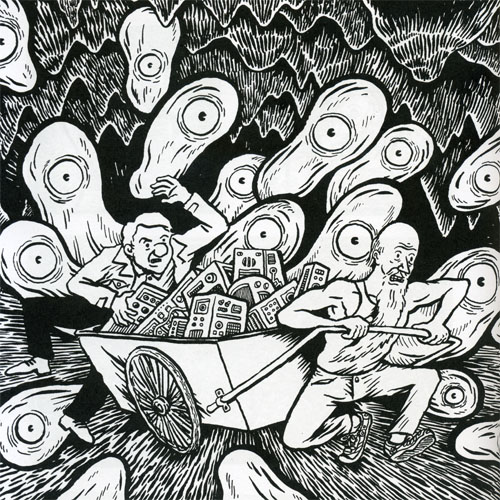
In this book, Chris C. Cilla has a distinctive visual style, creating a setting in a dream-like reality where humans and human-like animals coexist, and a variety of odd and potentially dangerous creatures live on the fringes. The story focuses on Alvin Crabshack, a mediocre, actually not so great, scientist and human who has gained a research position with a Professor Berigan in the Honeypot Caverns. To begin this research, Alvin must pick up his monotonous life in Dirksburg, leaving behind his ladies, Lily and Heather, and his current apartment, in the name of science.

After his goodbyes and false reminders that he will be back, Alvin boards a car with his root beer loving friend, Walter, to travel to the caverns, but Alvin’s move to his new working location completely halts when Walter abandons him at a gas station lacking gas but at least has some hot dogs. As Alvin waits for the friendly station owner to close up to give him a ride to the nearest bus station, Karl, a researcher for another professor in the caverns, appears. Karl is exactly what we expect of a scientist who spends most of his days in caverns; he’s a modern day environmentalist wearing an insignificant pro-Earth t-shirt paired with a cargo vest to hold all of his research tools. In the company of Karl and his clutter packed van, Alvin, an ordinary and indistinguishable dresser with a personality to match, already seems out of place.

In the van, Karl warns Alvin of strange, dangerous creatures in the caverns and explains to Alvin that the Professor Berigan is a reclusive, broke researcher with questionable sanity. Regardless, Alvin has his heart set on researching and studying with Professor Berigan, and Karl agrees to guide him to the professor’s lair. Upon arrival to the Honeypot Caverns, in order to get Alvin to Berigan’s lab, Karl tells his own professor, a pretty Doctor Corbett who has taken a liking to our Mr. Crabshack, that Alvin is a spelunker who lost his ride rather than the truth that he is the new research assistant of her foe. Alvin has longed for a career and a life with more excitement, but he has no idea what is in store for him.

Ranging from a wizard-appearing, obsolete technology-obsessed Professor Berigan to flying cyclops blobs to human-eating tentacled creatures to a strange house party with a giant eyeball in the middle of a desert, Alvin encounters much more than he could have anticipated on his new career turned journey where every turn leads into unfamiliar and maybe impossible territories. As the narrative strays and wanders, The Heavy Hand reveals itself as a psychedelic, science fiction, road story grounded by the secret normalcy cravings of our Alvin Crabshack.

By the end, Alvin Crabshack’s many peculiar, absurd, and psychedelic means meet a somewhat regular end. He’s doing some irrational, irregular things to pay his bills, but he is in a stable relationship with Doctor Corbett and living in a scenic town called Limberlost. He and Doctor Corbett conduct normal conversation between two people in a relationship, and Alvin even interacts with his ex-girlfriend Heather in a reasonable way when he runs into her. Despite his wayward path to his existence, Alvin does not want anything outside of normal human needs and does not achieve beyond them either.

At it’s heart, The Heavy Hand is the epitome of Emerson’s maxim: “Life is a journey, not a destination.” Alvin’s journey may not translate into the most coherent novel (in fact, I am still deciphering the purpose of each fragment as I write this), but The Heavy Hand is a read with an abundance of absurdly entertaining and comedic creativity and style that will take you on a disorienting and hypnotizing ride. Let go of trying to find a message in everything you see, and The Heavy Hand will pull you right into its world of eyeballs, humans with dog heads, goats breaking out from glass globes, and a mysterious masked man who warns about the end of the world and prepares turkey for lunch.

The Heavy Hand by Chris C. Cilla is available now via Sparkplug Comic Books.

Portobello Mushroom and Spring Onion Risotto with Generoso

Standard

Inspired by the sensational risotto we ate at Rosso B, a brand new corner pizzeria in Haymarket here in Boston, I decided to make my family’s take on risotto for you this week.  Risotto is really a blank canvas and you can make it however you would like.  This week, Lily and I found some beautiful spring onions and portobello mushrooms for cheap at Haymarket so that was going to be the basis for this risotto.  I also love making it with a pesto base and seafood but I find that the vegetable risotto really brings out the creaminess of the arborio rice, which is the one essential ingredient for our risotto, that and a lot of butter and goat cheese.  You will need about 4 cups of vegetable broth, 2 cups of arborio rice, 4 ounces of goat cheese, 1/2 cup of white wine, 2 sticks of butter, 5 gloves of garlic, 1 spring onion, two portobello mushrooms, pepper, salt.  Let us know how yours turned out and buona fortuna!

Music is Pictures At An Exhibition by Modest Mussorgsky.