The Modern Ms. Marvel for a New Audience

Standard

Thanks to Samantha for sending me something that I would not necessarily read on my own. 2014 has been an interesting year for women in comics, and I must admit that a lot of the new series to emerge are not ground-breaking or intelligent in their discussion of gender and are in fact somewhat irresponsible in their lessons. However, Ms. Marvel is the exception to the trend.

Ms. Marvel bypasses the common complaint of the absence of redeeming females in superhero comic books to address something even more rare in superhero narratives: cultural minorities.

Kamala Khan is a 16 year old Pakistani-American Muslim girl living in present day Jersey City. As a teenager, she has fairly normal societal teenage pressures, but her path to adulthood is a more difficult and tumultuous one with the additional burden of her parents’ cultural and religious expectations for their only daughter. Consequently, as with many young females who come from cultures that have restrictions on women contradictory to those of their Caucasian American counterparts, Kamala has a bit of an identity crisis; she does not want to reject her Pakistani heritage, but she is also American, and the two cultural expectations for young women don’t play well together.

What does not make this identity conflict any easier is the fact that Kamala does not fit it with the Caucasian teenagers at her school or really even her Muslim friends. She’s stuck somewhere in the middle, and it seems like the only other person who understands her is another fellow child of immigrants, Bruno Carrelli. And to make Kamala’s attempt to understand herself even more difficult, she suddenly gains superpowers one night as she wishes that she did not have to be Pakistani. In return to her wish, Kamala can suddenly morph into the All-American superhero Ms. Marvel with big blonde hair, a Ms. America physique, high-rise boots, and the ability to transform into various sizes with super-human strength. In her Ms. Marvel form, Kamala can choose to entirely reject her Pakistani roots, but this cultural dismissal does not always work out the way she expects.

Ms. Marvel Volume One: No Normal Cover

Beyond Kamala’s emergence as a superhero, the action of Ms. Marvel Volume One: No Normal focuses on Kamala’s task to save Bruno’s younger brother, Vittorio, from the damaging and potentially fatal influence of some unknown villain known as the The Inventor. In the process of trying to save Vittorio, Kamala must understand how to use her powers, which are out of control when she takes on the All-American heroine Ms. Marvel form. Consequently, the unwieldiness of this stereotypical Ms. Marvel transformation provokes Kamala’s simultaneous development of her cultural identity as an American and a Pakistani woman and her identity as a superhero.

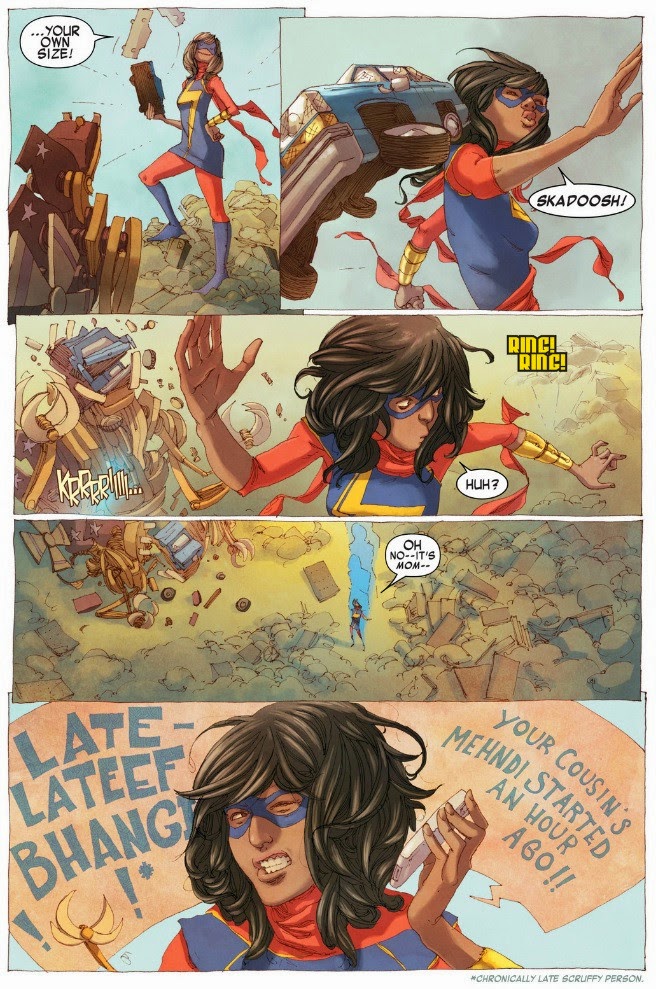
By the end of the first volume, when Kamala emerges as her own Ms. Marvel, she has a darker complexion and a name very different than “Mary’” or “Jane” and is much more clothed and a much less buxom. Kamala’s Ms. Marvel integrates her American and Pakistani cultures, and in parallel, in her regular life, she also combines both cultures and becomes more comfortable with her ethnic identity, even if it differs from the people around her, because after all, what’s more alienating: superpowers or being Pakistani and Muslim? In one moment Kamala battles a robot in a garbage dump in her own, individual costume. In the next moment, she must change into shalwar kameez for her cousin’s wedding procession. Though Kamala is a little in over her head with her obligations as a teenager, a daughter, and a superhero, her new-found superpowers galvanize the growth and reflection that she needs to decide who she wants to be in all parts of her life.

Kamala Khan’s Ms. Marvel

Bravo G. Willow Wilson and Adrian Alphona. You two have created a superhero that has a distinct identity relevant to the second-generation immigrant experience. I commend you both on your adaptation of Ms. Marvel for creating a hero for today’s non-homogenous America for an audience previously unaddressed and unengaged in superhero narratives. Kamala Khan is a superhero I wish I had as a Vietnamese American teenager, and I am so very grateful that she now exists for adults and for today’s youth. The modern Ms. Marvel is a superhero unlike the white audience tailored ones such as Superman and Wonder Woman who are crafted from centuries-old Western archetypes. Ms. Marvel has the same noble intentions to save the world, but she finally has a personal story that we second-generation immigrants can empathize with in contemporary times.

Ms. Marvel is written by G. Willow Wilson and illustrated by Adrian Alphona. Volume One is now available via Marvel Now!

To Live or Die: Dash Shaw’s Doctors

Standard

I promise that this is my last Dash Shaw review for a while. I’ve been anxiously awaiting the release of Doctors, and alas, I have it and have been unable to maintain my patience to reasonably space out my reviews of Shaw’s books.

Of the Shaw works I’ve read so far, Doctors has an unsettling cynicism and darkness about it. Bottomless Belly Button and 3 New Stories contained some comments alluding to the occasionally malevolent and duplicitous nature of people but not to the degree of Doctors. Perhaps this change in tone is the product of the topic discussed in Doctors: death.

Cover of Doctors

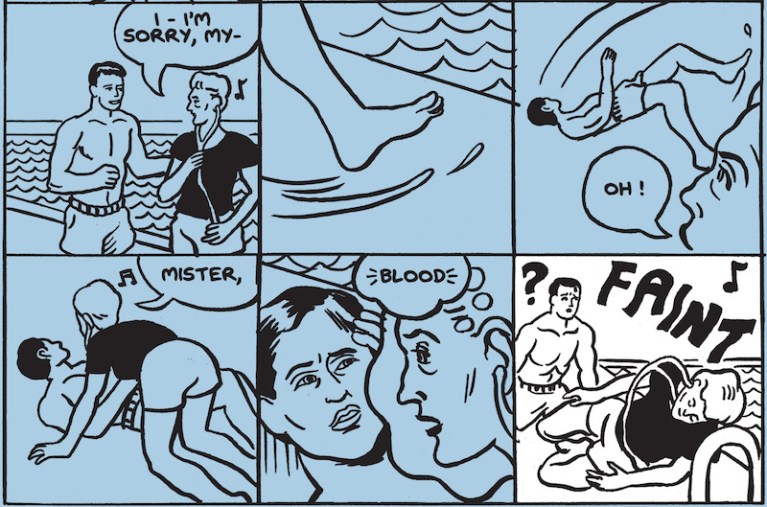
Despite the general existential tone of Doctors, the overall narrative still has the absurd and occasionally comically strange moments characteristic of Shaw’s style. Doctor Cho and his daughter, Tammy, run a laboratory where they test the Doctor’s invention, the Charon. For a hefty fee, the Cho lab can bring a loved one back from the dead when they are in an intermittent afterlife between death and the final end known as “the fade to black.” When we enter the world of the Cho family business, they are in the midst of bringing back Miss Bell, a wealthy widow who died suddenly and whose daughter, Laura, would like back in the world.

Even though the Charon and its capabilities suggest that Doctors is a science fiction work, the device itself is hardly the subject of the narrative. The short novel contains short fragments from multiple narrators, ranging from Tammy to Will, the lab assistant, to Miss Bell, with each story describing the history of the character and building up to their current intersecting point in the revival of Miss Bell. And to add an additional layer of cleverness to the book, each fragment in the book is drawn above a different color to remind the reader of each different perspective and the changes over the course of each page.

From Tammy and Will’s perspective, we understand the severity and seriousness of their work: They are defying the rules of nature and do not quite understand how to tackle the consequences. What does not help is the callousness of Doctor Cho, a naturally distant man made more insensitive and cold by the murder of his wife. Unlike Tammy and Will, Doctor Cho looks at the Charon as purely a lucrative business, a way to make a lot of money with technology without considering any emotional disturbances experienced by the revival process of his invention. The Charon is simply a solution to a scientific question for Doctor Cho. Could he bring someone back to life from the dead? Yes, and that yes is all that matters to him.

On the opposite side of the Charon experience, we see Miss Bell’s attempt to re-integrate into her life after her revival. Unfortunately, her return to life is not quite what she had hoped. After her death, Miss Bell, in the intermittent state between death and nothingness, created an afterlife where she was in love and no longer alone; for the first time since her husband’s death, she felt joy and youthfulness again. Upon being ripped out of this pleasant state, Miss Bell is thrust in front of her attorney by her daughter to settle the details of her estate, which is a beyond disappointing welcome back message.

Gradually, Miss Bell’s psychological state degrades as she realizes the bleakness of her reality as compared to her afterlife. Rather than returning to warmth and love from her daughter, Miss Bell returns to her life as a lonely widow pent up in her house. Laura is not around and only seems to appear when money is involved, and Miss Bell longs for her previous afterlife, trying to seek elements to re-create it in her current reality.

At the heart of all of the trajectories of each character in Doctors is the question: If you bring back a loved one, is that going to be better for the individual than death? The Charon, in concept is a nice idea, but in execution it is not because those brought back to life already have death programmed to occur again, and conflicting decisions to dodge or face that second death lead to crippling mental instability, making the revival useless except for having the revived sign paperwork. Consequently, what is the value for the creators and the users of the Charon?

In addition, with the examination of Charon patients such as Miss Bell, a major philosophical question for scientists emerges: even if you can create or access a device that defies nature, should you use it?  Inherent in the answer to that question is hubris. Doctors is somewhat of a tragedy, for Doctor Cho and Miss Bell’s daughter Laura exhibit the greatest amount of hubris, and they are met with tragic ends that damage their loved ones. They both believe they can overcome death to get what they desire without realizing that perhaps what nature intended was the correct course in the first place, and in turn, endure the most severe consequences of the Charon.

By the end of Doctors, you are left asking yourself who is more evil in this scenario, the scientists who create the nature defying device or the people who pay exorbitant amounts of money to use it for selfish purposes? I’m not entirely sure, but there is definitely some shared responsibility for the ill-fated consequences of toying with forces one does not understand. Doctors, on an initial read, feels like a naturalist piece of writing, but by the end, everything bad seems to fade away and life for the more accountable Will and Tammy seem okay but pretty directionless and meaningless in general, making the story much more of an existential one. Thus, if everything most likely means nothing, who is the most evil in the story? Who is the most irresponsible? Who is the most selfish? Who is the most myopic in their actions? What is the afterlife? What is death? Would you want another moment with a loved one who has passed on if achieving that moment could harm them? Those questions are much harder to answer in an existential world, and Doctors definitely will not point you in any direction, but it will make you think more carefully when you do attempt to answer them.

Doctors is now available via Fantagraphics Books.

Bovine Ska and Rocksteady: 12/10/14: Winston Samuels

Standard
Winston Samuels-Be Prepared

Winston Samuel’s Biggest Hit on Lyndon Pottinger’s “SEP” Label

We started off this past week’s very mysterious Bovine Ska and Rocksteady, with the enigmatic, “Prince of Darkness” who tossed down the incredibly danceable sounds of “Burial of Longshot,” for Dandy Livingstone on the Downtown label in 1969.   The track is a response to the classic cut “Longshot” by The Pioneers.  We then burned through two sets of reggae, a very fast mento set and a set of ska to get you in the mood for the ska sounds of Winston Samuels.

Winston Samuels, after much research and reaching out to scholars and Jamaican legend, remains somewhat of a mystery. What we can gather about this magnificent singer is that with the exception of his hit, “Be Prepared,” there is very little known about Winston’s personal history and his career beginnings. According to Studio One artist and Bovine Ska and Rocksteady friend, Dudley Sibley, we know that Winston Samuels first recorded for Coxone in the early 1960s , and other sources indicate that his first release on Coxsone’s All Star imprint was a single with two sides with conflicting names and themes: “Paradise” and “In Jail.” We started off the spotlight on mighty vocalist Winston Samuels, with “In Jail” and with that you got a preview of the amazing voice that he would hone and perfect throughout his career.  One of the real surprises was the magnificent quality of the tracks Winston would do curing the rocksteady period for Prince Buster.  His voice may be at it’s best here.

There are some rumors that he was a member of The Four Aces, but we were not able to confirm this, but what could be verified was that Winston Samuels was a prolific song writer who penned two festival song winners for Eric Donaldson: “Sweet Jamaica” and “Land of My Birth,” in 1977 and 1978, respectively. Then, after spending quite some time in the music industry, Winston Samuels moved to America, but his whereabouts since have been pretty mysterious.

Listen to the spotlight and the full show HERE.

Enjoy! The archived file will be available until 12/23/2014.

Generoso Finally Makes Spaghetti and Meatballs!

Standard

As I stated very early in this video, I think that the hidden desire within everyone who knows an Italian who cooks is; When will that man or woman make me spaghetti and meatballs!”  This has been told to me over the years by several people whom I presented a plate of the aforementioned family favorite dish.  The length of time that this takes you in entirely dependent on who sweet you would like your tomatoes to be.  The longer the cooking time, the more mellow the tomato will be.  For this dish you will need two pounds of a ground beef and pork mix that cannot be less than 80% lean, two cans of puree tomatoes, two eggs, ten gloves of garlic, fresh parsley, oregano, salt, pepper parmesan cheese and of course, spaghetti.  Please let us know how yours turned out!  Music: Giuseppe Torelli’s Trumpet Concerto in D ‘Estienne Roger 188.  Enjoy!!!


The Political Grunts and Groans of Claude Faraldo’s 1973 Film, “Themroc “

Standard
Themroc_(movie_poster) green

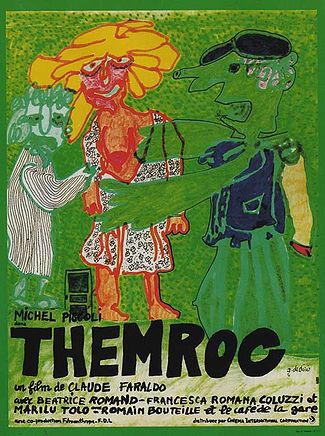
1973 Poster for “Themroc”

During the final two hours of Jacques Rivette’s four hour 1969 film “L’Amour Fou”, we see the dissolving marriage of two theatrical sophisticates, Claire and Sebastien, turn into an almost primitive sequestration whose sole purpose is to reject the intellectual ideals that have strangled their love. So, if the next step for the sophisticates in that Rivette film is a transformation into a state of small moments and music, combined with gentle moments of love making, then what is to become of our titular working-poor hero, “Themroc?”

Themroc (Michel Piccoli) lives with his widowed mother, his miserable wife, and his sister who saunters around the flat in various states of undress. Themroc also exists on the lowest rung of the proletariat ladder, a member of the “exterior maintenance crew” whose charge is to paint the outside of a fence while (you guessed it) the “interior maintenance crew” paints the inside of the same fence. Rarely has the stifling monotony of the working man been so aptly recognized. Though he is not happy, Themroc goes about his tedious job until one day when he witnesses his boss nuzzling the secretary of the company and is summarily dismissed. Themroc’s response to his sacking is a trip back home where he will begin his withdrawal from society but not in a “Neil Simon/Prisoner of Second Avenue” neurotic New Yorker kind of way. No, our Themroc sledgehammers a hole in his wall out into the street where he lobs the conveniences of modern society out for all to see while he turns his sexual frustrations away from his wife and towards his own sister (Beatrice Romand from Rohmer’s infinitely tamer masterpiece,  “Claire Knee”).

Now that Themroc has gone off the rails, he continues to turn his place into a sort of man cave but again not one with a hi-fi system and lava lamp or even the gentile “L’Amour Fou” kind; our Themroc is going back to the stone-age. Again, this would be fine normally sans the incest and the fact that he is living in a city where these kinds of things tend to be frowned upon. Eventually, his threatening actions will soon draw the attention of the police, and they come by to check on our man but because Themroc is unemployed, and no longer hitting the grocery shops, and the man who is playing him in the film, Michel Piccoli, appears somehow still hungry after starring in Marco Ferreri’s equally shocking glutton-a-thon from the same year (1973) “Le Grande Bouffe”, he (Themroc) turns our boys in blue into a barbeque dinner complete with rotating spit. Adding to the frenetic mood that takes over the second half of the film is that none of what has happened or will happen in this film is translated through a recognizable language. It will be all grunts and groans from here on out which adds to the primordial hostilities of the main character and just like Faraldo’s previous work, “La Jeune Morte,” this is a low-budget piece of guerrilla film-making that fits the harshness and in some ways the comedy that is coming through here in the same way that forces you to laugh in between the revulsion of non-stop eating and whore-screwing that is “Le Grande Bouffe.”

Added into the mix are the acting talents of Miou Miou and the late Patrick Dewaere, who would star two years later in Bertrand Blier’s breakthrough comedic classic of stunted sexuality, “Going Places.” With that, I must write that “Themroc” now seems like a harbinger for what would happen in European cinema over this decade. As exciting as the Italian Neo-Realist Movement, The French and British New Waves were to audiences in the 1950s and 1960s, there appears to have been a collection of young filmmakers who were poised to pull film into visceral and nasty place that would seem a natural response to the May 1968 riots.  The aforementioned Marco Ferreri and Betrand Blier, Alan Clarke, and the last films of Pier Paolo Pasolini would set standards of honesty and raw depravity that few filmmakers around the world would be able to match.

Themroc (1973) Full Movie:

Though it received mixed critical and box office reception upon its release in 1973, I feel that “Themroc” would have fit right in with the recent films from European filmmakers like Bruno Dumont, Catherine Breilliat, and Gaspar Noe who would emerge the malaise of the 1980s with the same-minded style of Claude Faraldo and Jean Pierre Mocky, whose primary purpose was to pull the politeness out of what was a tired medium for their generation.

Lily Does Her Chao Right! (Vietnamese Congee)

Standard

A simple version of congee with an onion broth and fish sauce and Lily will show you how to make it! It can be eaten on its own or with a meat and veggie of your choice. Finish it off with pepper and sesame oil to make it extra special 🙂  Please let us know what you think of it if you make your own!  Music by Edvard Grieg, Peer Gynt Suite no. 1, Op. 46


Bovine Ska and Rocksteady 12/3/2014: The Emotions

Standard

On this past week’s episode of the Bovine Ska and Rocksteady, we started off the show with two full sets of ska, including some supremely danceable tracks from Prince Buster and his All Stars and The Pioneers.

In the first hour, we also played some unearthed rocksteady singles from The Merritone Singers and The Dynamites in preparation for the early rocksteady tracks from Max Romeo’s first musical endeavor with The Emotions, the vocal group for this week’s spotlight.

After his mother decided to immigrate to England, Max Romeo lived with his father near Wareika Hills. However, after continued disagreement between Max and his stepmother, he decided to run away at 14, living in the hills and trying to get by as best as he could.

In trying to get stable work, Max ended up working in a sugar cane field in Clarendon as a canal cleaner. In the field, he met Denham Edwards, and the two sang together at work. It was at work where Denham would write a song for Max to sing, which was his entry for a regional song competition. Max sang the track with Kes Chin and the Souvenirs at the contest and won, putting him on the track to a music career.

Eventually, Max moved to Kingston and met Lloyd Shakespeare through his friend Suckro. Then, through Lloyd Shakespeare, he met Lloyd’s singing partner, Kenneth Knight. Originally, the two were going to be the duo Ken and Lloyd, but given that they were not entirely ready as a duo, Max offered to join the group and lead.

Max would then become a salesman for Blondel Calnek, an importer of Chinese figurines. During this time, Blondel would open a record label and create a pseudonym for his persona as a record producer. This name was Ken Lack, his last name backwards. Lack’s label, Caltone would be the first label to record The Emotions, which was initiated by Lack when he heard Max singing one day at work. The first track to start the spotlight was, “I’ll Buy You a Rainbow,” the first track they recorded for Caltone

Lack decided to move to the U.S. in 1968, which caused the Caltone label to dissolve. After the dissolution of Caltone, the Emotions would travel over to Phil Pratt to record some pretty singles before Max decided to pursue a solo career in 1968. During this time he was replaced by Audrey Rollins. Audrey would eventually decide to work for Lloyd Daley at his Matador label and was then replaced with Lloyd Brown. However, when Max’s solo career did not flourish as much as he had hoped, Max re-joined the Emotions by the end of 1968.

Around the same time, Max Romeo worked as a salesman for Bunny Lee. Max wrote the now infamous “Wet Dream” and gave it to Bunny Lee to find a vocalist for the track. Bunny offered it to Derrick Morgan, John Holt, and Slim Smith, but all of them passed on it because of its salacious content. Bunny then told Max that he would have to be the one to record it, or else it would never be recorded. “Wet Dream” became Max’s track to put him on the map in music, with its notoriety pushing it up in the charts, especially in the U.K. where it was banned on BBC radio, but, regardless, it made it into the top ten of the charts. After the popularity gained by “Wet Dream,” Max toured England and recorded further innuendo-laden tracks and ended up staying there until 1970 when he returned to Jamaica to form his Roman record label and soundsystem.

Listen to the spotlight and the full show HERE.

Enjoy! The archived file will be available until 12/16/2014.


ODY-C: An Irresponsible Trip Into Space

Standard

ODY-C has so much promise: a stunning cover, a beautiful, enormous opening fold-out, and the name of probably one of the best modern comic book and graphic novel writers attached to it.

Branded as an adaptation of Homer’s The Odyssey set in space with genders of major characters swapped or transformed, ODY-C has a lot of flash, bang, and fury…….with very little in return.

Issue one introduces Odyssia, the war monger and queen warrior on her ship, the ODY-C, trying to return home. Mental unity of its female fuel operators power ODY-C, but as with most Greek myths and tragedies, the ship operates under the capriciousness of the universe’s gods and goddesses. In the world of ODY-C, women hold all of the power and exist as the dominant population while the few men left are relegated to facile companions of the women of highest ranking.

To accompany the narrative, ODY-C has some phenomenal artwork. The colors are vibrant and rich; the drawings are gorgeously layered and textured; the characters are amazingly larger than life. Even more than the Matt Fraction name, Christian Ward’s stunning illustrations lured me into purchasing the first issue of ODY-C.

ODY-C Cover

Sadly, all of the grandiose art has been wasted on this poorly recycled mythology under the guise of female empowerment. Homer’s The Odyssey has been adapted for modern times for decades. Ranging from Walter Hill’s The Warriors and Stanley Kubrick’s 2001: A Space Odyssey, the fundamental framework of The Odyssey has never left popular culture. Consequently, yet another version of the tale in space (even with the gender changes) is superfluous.

Furthermore, what infuriates me the most about this series is its heavy-handed, irresponsible messages about female empowerment. In various press interviews, Fraction claims that he wants to create a huge adventure with superheroes that his daughter can look up to. However, this goal has led to a lackluster product with nothing insightful or new to say about women rising above. For example, ODY-C runs into trouble when one of its mental fuel-sources stops believing in the battles that Odyssia continuously enters, disconnecting the unity amongst the other “sisters” steering the ship. When this callow metaphor appears, it’s clumsily handled and manipulative, purely entered to achieve the gender politic rather than adding any narrative value to ODY-C, and these politically overwhelming interruptions render this series down to a frivolous piece of female empowerment propaganda.

By reversing genders in ODY-C, Fraction fails most to understand the historical context of the original Homer narrative, and in turn by using the same one, creates a narrative that is fundamentally gender digressive. The Odyssey was written in an era where patriarchy reigned. By using the same story and reversing characters’ genders, ODY-C’s core narrative is still fundamentally male-centric because none of the characters actually capture the experience of being a woman. Essential to the experience of being a woman is interacting with men in a man’s world, and this defining relationship between men and women is entirely missing from ODY-C. A female superhero is not a woman if she is simply a man whose exterior has a female form.

As a result of merely the physical gender replacement, Odyssia and all of the other powerful women in the world of ODY-C are completely unrelatable. They do not motivate me to rise above. If anything, they tell me that a woman-centric world is what I should try to achieve, which is a dangerous message to send out because it will further exacerbate gender strains already embedded in today’s society.

If Fraction really wanted a superhero for his daughter and for the young women of the world, he should have rooted the female protagonists in a place with realistic gender barriers. A new mythology should have been in his mind, one based in a current patriarchal world and one able to fully capture how a woman, consequently, must navigate it. ODY-C is perfect for male readers who think that they are gender progressive and for female readers who fantasize about a world that is run by women. Both of those audiences are problematic and completely misinterpret the realistic female experience and the methods by which women must figure out how thrive in a society where many standards and practices work against us. If I want to see women rising above and succeeding under dire situations (i.e. the ones who truly warrant my respect and admiration), I’ll watch The Little Girl Who Lives Down the Lane, Winter’s Bone, or Jackie Brown instead.

Mike Leigh’s Debut Film Is a Small Masterpiece: 1971’s “Bleak Moments”

Standard
bleak-moments-1971

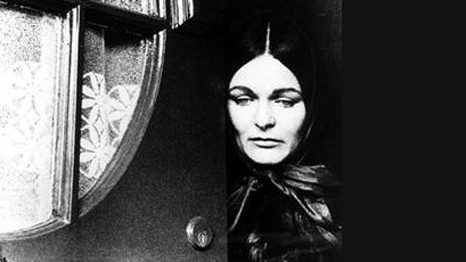
The brilliant Anne Raitt of “Bleak Moments”

There have been few British film directors over the last forty years whose overall body of work I would label as “uncompromising.” Especially difficult was to stay real past the era of creative freedom that was the 1970s; there was the creative lock down and resulting button down stiffness of the 1980s, a decade that forced the British film industry to get all “Chariots of Fire” on us. Which of course, lowered our standards and set the plate for what would be the most successful English filmmaker of today, the human codpiece, Danny Boyle. Truly one British director whom never succumbed to the vile era of the period piece and or uptown glitz over this time is director Mike Leigh.  With Leigh’s 24th film, “Mr. Turner,” about to be released here in the States, I thought to go back and look at Mike’s astonishing 1971 debut effort, “Bleak Moments.”

I cannot imagine as to what folks thought of “Bleak Moments” when it was released in the early 1970s. Though devotees of the films from the British New Wave were used to seeing fairly tough to watch fare like “A Taste of Honey” and “Saturday Night, Sunday Morning,” we must remind ourselves that although those films possessed some fairly shocking themes for the time (abortion, homosexuality), their actors and the overall tone would still rise above the hardships to provide the viewer with many entertaining moments.  No such uplifting time exists within “Bleak Moments,” a film that succeeds in a dour, hopeless tone that few films have been able to reach since.  Much of that not only is due to our Mr. Leigh, who both wrote and directed “Bleak Moments,” and its talented actors who convey the desperation to create this unrelenting, low mood but also it’s modest budget, which lead to the dark visuals and low-fi sound to enhance its already stark feeling of hopelessness.

The film is about Sylvia (Anne Raitt) an office worker, who after putting in a hard day, tends to her mentally challenged sister in her tiny apartment. She is a pretty and somewhat cynical woman whose only amusements given her charge in life and financial situation are the occasional good book and a glass of sherry. At work she chats with her friend Pat, (Joolia Cappleman) who also has the burden of taking care of a physically incapable family member, her elderly mother. They commiserate, but little is actually said about their true sadness that is their lot in life.   Sylvia has a man in her life, the equally quite teacher, Paul (Eric Allan) who wants to be with Sylvia but lacks the fire necessary to break through to her and show her how he really feels. There is also Norman (Mike Bradwell), a hippie folk song singer who also fancies Sylvia and rents the garage, but he also lacks in the self-worth category, so when he is dismissed by Paul as a failure, Norman takes the failure route out.

Paul and Sherry go out on a date, but what follows is a series of awkward dialogs, an incredibly rude waiter that exposes Paul’s inabilities to be a man, and a scene of courtship that occurs back at Sylvia’s place that may never be rivaled for its depiction of sad desperation in screen history. Again, whereas an earlier British New Wave film would’ve resorted to moments of comedy in such a scene, Leigh never lets you off the ropes because he shouldn’t.  These are people whom we all know, good-natured people whom life has pushed aside, but you know that deep down inside that there is little in their makeup to allow them to overcome their self-imposed malaise. You know that they are doomed to “live lives of quiet desperation” that I’m sure would even go well beyond Thoreau’s imagination of such as he penned that line. First time director Leigh allows for every small moment to hit home. It is exceptionally intelligent work for a director the age of 28.

Though this was Leigh’s first outing as a film director, his knowledge of the theater allowed him to select the right acting talents to head this project, a project that was funded by the stars of many of those British New Wave classics, Albert Finney and Michael Medwin, whose production company, Memorial Films, had just bankrolled Lindsay Anderson’s “If” and provided the twenty thousand Pounds that was necessary to get Leigh’s career as a director off the ground. This decision was made by the two after they saw Leigh direct “Bleak Moments” at the Open Space Theater. Though Finney and Medwin could boast such illustrious acting careers, I personally would also hope that they would be as proud as to have helped start the career of our Mr. Leigh.

Norman Sings Us A Sad One in “Bleak Moments”
http://www.youtube.com/watch?v=E62rL6v2GBg

I was once asked by my friend Charlie some thirty years ago, shortly after I described “Bleak Moments” to him and before I shoved a VHS copy of the film into my player; “Why would you ever want to watch something that would make everything seem so hopeless for decent people?” A question I really respected at the time and one that made me wonder for years to come. Though this answer is some thirty years late, I think that in the case of “Bleak Moments,” you feel there is a poetic beauty in even the saddest moments of the film because as much as you hope that characters like Sylvia and Paul could just rise above the troubles that have been bestowed upon them, you are moved to see how they delicately maintain themselves in the face of it all.

Generoso’s 2014 Top Ten Film List, Supplemental Films, Biggest Disappointments, Worst Film Of The Year and, Best Rep Film Experience

Standard

2014…Another excellent year of cinema has passed.   Much love to my dearest Lily who watched all but two of these films with me.  Romania and Chile continue to pour out excellent new work and my favorite is by the great Arnaud Desplechin, who can do no wrong in my book.

Note; At the time of the final edit, I regrettably have not seen the new Mike Leigh film “Mr. Turner,which I hear is sensational or the new one by Bruno Dumont or Hong Sang-soo but I did just see the new Paul Thomas Anderson film “Inherent Vice” and Bennett Miller’s “Foxcatcher,” and both did not make the cut.  


_______________________________________


MY FAVORITE FILMS OF 2014

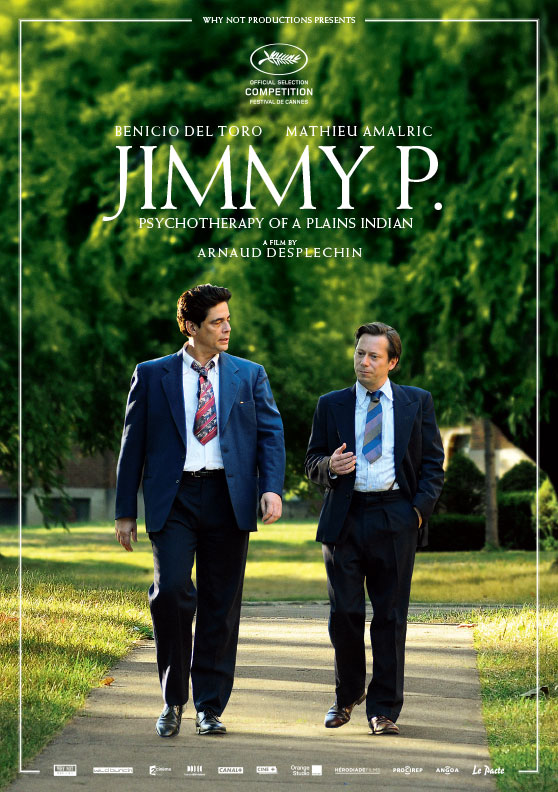
1) Jimmy P: The Psychotherapy of a Plains Indian-Arnaud Desplechin (France)

There is much that went into my selection of this film for my pick as the best of 2014.  We have all seen the films based on psychological case studies but Desplechin offers no quick solution to this very complex case of a World War Two Native American who is suffering from catatonia and severe headaches.  Benecio Del Toro turns in the best performance of his career as Jimmy P, a Plains Indian who is treated and becomes friends with a psychoanalyst named Georges Devereux (Mathieu Alamaric) who is one of the few people in his field that understand the culture of the Plains Indian .  There is no buildup to a melodramatic breakthrough as it blends this very particular psychological trauma while fostering a compelling friendship between its leads.  As with all work by Desplechin, “Jimmy P” is masterful storytelling on a level that few directors can accomplish these days.

2) Norte: The End of History-Lav Diaz (Philippines)

Cast in the same mold as the films of Bela Tarr and Jacques Rivette, Lav Diaz’s approach to narrative storytelling relies heavily on the duration of scenes to set up mood than most directors working today.  A brilliant re-working of the Dostoyevsky’s classic “Crime and Punishment” with a length of 250 minutes, Diaz nuances that classic of Russian literature with the changing social imperatives that have resulted from the political nightmare in his native Philippines.  Diaz supplants Dostoyevsky’s Raskolnikov with Fabian, a law school dropout who quotes Neitzsche and radical philosophies to his friends until he must deliver on his threats of revolution.  What truly distinguishes this adaptation of Crime and Punishment from other previous versions is the creation of “Joaquin,” a simple farmer who is sentenced for Fabian’s crime.  The story then becomes Fabian’s eventual self-destruction from guilt, but without pressure and fear from a detective like Porfiry; Instead the guilt comes only from what Fabian’s crime has done to Joaquin and his family which causes their lives to descend into a sad hell, which then parallels Fabian’s journey into madness.   An epic adaptation that never feels it’s running time.  Despite the unrelenting tone of the film, you remain transfixed until the very end.

3) Winter Sleep-Nuri Bilge Ceylan (Turkey)

For almost two decades, Nuri Bilge Ceylan has set a standard for filmmaking that few directors can live up to.  In fact, Nuri’s major competition has been Nuri himself.  With the increasing high standards that he has set for himself with his last three films, all better than the last, it would take a miracle for him to surpass the genius of his 2011 film “Once Upon a Time In Anatolia.”  Winter Sleep is a semi-autobiographical sequel of sorts to the wretched character he created in his own image in “Climates.” Here we have Mr. Aydin, a vile egoist who sits like a king inside his mountainside hotel, pontificating about his epic thespian past while his local business interests stifle the village below.  Mr. Aydin is married to the beautiful Nihal, who is eyeing the door, and they both live with Aydin’s sister Necla, who tears at Mr. Aydin with sharp, sometimes hysterical barbs throughout the first half of the film.  Funnier than any previous Ceylan outing, “Winter Sleep” does not have the complex plot or transcendence of “Once Upon a Time In Anatolia” but it is no less daring and intense on its bold attack of its villain (a Ceylan in the future perhaps?).


4) Under The Skin-Jonathan Glazer (England)

Before I make one single comment about this sensational film from Jonathan Glazer, I would just like to apologize to our director for the hideous Q&A that he endured at the hands of the audience at the Coolidge Corner.  Pretentious twats they all were, and I truly feel sorry for the onslaught of the usual Boston, “I must ask a question so you know that I am smart” question/statement: “Why didn’t you adapt the better novel by Michael Faber?” Asked one consistently irritating audience member who should have met the end of many of Scarlett Johansson’s victims in Under The Skin.  Now, let’s talk about the film…Glazer took one of the most desirable women the world, Scarlett Johansson, donned her in a black wig to not only hide her celebrity but to enhance her inner femme fatale, and set her lose in Scotland to lure actual unsuspecting men on the street into her van as to then bring them into the eventual destination of her alien abattoir to become a food product back on her world.  What remains is a clever essay on what makes us desirable and ultimately human in the same way that Roeg’s “Performance” would challenge our ideas of gender and sexuality.

5) Night Moves-Kelly Reichardt (USA)

To me, Kelly Reichardt, is one of the few great voices left in American independent cinema.  Since her debut film, River of Grass, some twenty years ago, Reichardt has established herself as the queen of minimalist filmmaking here in the States.  She has been noticeable absent since her last gem, 2010s “Meek’s Cutoff” and she has come back with her best film to date, “Night Moves.”  Less the pure observational construction of her earlier films such as “Oldjoy”, “Night Moves” is a critical indictment of the modern eco movement. Here, Josh (Jesse Eisenberg) and Dena (Dakota Fanning) live among the faux-liberal collective farms, ignoring their own privilege as they plot to destroy a seemingly unimportant hydroelectric dam with the help of Harmon (Peter Saarsgard), a hypocritical and marginalized Gulf War veteran.  Josh and Dena seem to be existing in an era that no longer exists, and only plot to prove themselves as true believers in the cause as suggested by the title of the film which is drawn from a boat they use in their terrorist action.  The boat is interestingly named after the long lost Arthur Penn film from the 1970s when such actions were still relevant.   Reichardt skillfully attacks their belief system and methods by getting top performances from the films three leads.

6) Exhibition-Joanna Hogg (England)

Hogg casts Viv Albertine of The Slits as “D” and artist Liam Gillick as “H,” a childless couple who live in their gorgeous modernist London apartment sans children.  They are both quite successful, sexually dead, and obsessive over their splendid home, which for some unknown reason, they are dying to unload.  While alone, “D” roams about and eroticses her surrounding with a masturbatory array of poses and grindings.  As ridiculous as it all seems, Hogg’s purpose it seems is not to humiliate this couple, but to have the audience almost revel in their perverse bourgeois tendencies to find a impossible explanation for their erratic behavior.   Are they simply falling apart?  Or are “D” and “H” finally understanding that this amount of comfortable living may in conflict with their own creative and intellectual growth?  Hogg leaves that decision for you.

7) A Field In England-Ben Wheatley (England)

I might be alone here in my adoration of this psychedelic history piece set during the English Civil War, written and directed by the always surprising Ben Wheatley.   Here Wheatley takes a group of war deserters on a whimsical path through the countryside until they meet with the brutal necromancer, O’Neil (Michael Smiley) who doses our deserters with magic mushrooms in order for them to help him on his quest to find a proverbial pot of gold.  Shot handheld and  in black and white,  Wheatley creates a disturbing environment that is unnerving, clumsy, but ultimately victorious as his (Wheatley) determination to tell a story in a way that has never been done before wins out over any small shortcomings that this film possess.  All of this culminating in the best three minutes of experimental imagery and sound  that I have witnessed from a pseudo mainstream director this year.   This may not be for all, but it did make me excited for every scene in a way that only a handful of films have done in this decade.

8) Child’s Pose- Calin Peter Netzer (Romania)

And the winner of this year’s overbearing mother award goes to Cornelia Keneres (amazing performance from veteran actress, Luminita Gheorghiu).  Like many films of this Romanian New Wave that we have been graced with over the last decade, older characters such as our Cornelia, represent the old Ceausescu led Romania, a slightly more corrupt world of bribes and favors that still has not died off to this day.  Cornelia is a well-off and successful architect who is not pleased at her son Barbu’s (Bogdan Dumitrache) choice of partners, a fact that she makes very clear to her sister early in the film.  When Barbu causes a major incident, mom comes to the rescue but not in the intense, unconditional loving way that Kim Hye-ja modest matriarch does in Boon Joon Ho’s.”Mother.” No, Cornelia is packing misery in the form of backroom deals to get her son off, and she is thoroughly despised for her actions by all parties.  A critical, mean film from the country that loves a dour moment and a film that also contains one powerhouse performance from Gheorghiu.  A phenomenal sour punch in the gut.

9) The Overnighters-Jesse Moss (USA)

It has been said that some documentaries connect an audience simply due to its subject matter now matter how it’s presented (Marc Singer’s excellent 2000 film, “Dark Days” is a fine example) and some receive notice  to its production value alone, amounting to little more than eye candy (like 2010s Detropia).  Given the subject matter and editing of Jesse Moss’ fine documentary, “The Overnighters,” I would still be impressed if the doc were shot on a 2004 flip phone.   Since the controversial technique of “fracking” arrived in North Dakota in 2008, the state has had an employment boom and has also become the second largest oil producing state behind Texas.  So, what is there to do with a town like Wiliston, North Dakota, a town that has been besieged by workers from all over America who are looking for a chance to make good money during this dead economy. Considering that there is absolutely no housing available, and that it is illegal to sleep in your car, where will all of these incoming workers sleep?   Here enters our hero, Pastor Jay Reinke, who much to the outrage of his fellow neighbors is allowing these workers to sleep in his church and in the church’s parking lot.  Herein lies the conflict of the documentary, but the answer to this problem is much more complicated than anyone had ever imagined.  Hopeful and heartbreaking, this non-glamourous documentary clearly shows the modern ramifications that result from an act of charity towards desperate group of strangers by a flawed but very good man.

10) When Evening Falls On Bucharest or Metabolism-Corneliu Porumbiou (Romania)

Paul (Bogdan Dumitrache) , the protagonist and possibly the alter-ego of Romanian director, Corneliu Porumbiou, is faking an ulcer during the filming of his new movie so he could have some extra romantic time with his lead actress Alina (Diana Avramut).  This may sound like the beginning of some “rom com” but fans of Pourumbiou’s work fully know that these two characters words and actions will be picked apart clean by the time the credits roll.  This film has little to do with their actual relationship but more about how that relationship plays out in the form of cinema.  If they speak about nudity for example, the visuals will follow suit and every action will either affirm or condemn the statements that were previously made.  Like Porumbiou’s last film, the dark and comedic, “Police Adjective” there is an analysis of the medium and language that occurs here in “When Evening Falls…” that allows the viewer a chance to connect dialog and visuals in a way that only Porumbiou can do.  Also, never has there been a funnier colonoscopy scene and if that doesn’t pull you in, I don’t know what will.


______________________________________________________

SUPPLEMENTAL LIST

1) Gloria-Sebastian Leilo (Chile)

Since the fall of Pinoche, Chile has been experiencing an exciting  new wave of film production.  Pablo Larraín, Patricio Guzmán, and Sebastian Leilo have all looked back at the days during Pinoche and have also shown us a modern Chile that is both full of hope and promise but sometimes regret for what occurred there between 1973 and 1990.  “Gloria,” Leilo’s fourth feature film since 2006 is a sometimes sad and heart wrenching story of two divorced people who are trying to bury a past that never seems to leave them. Wonderful performances from Paulina García and Sergio Hernández in the lead roles make this a can’t miss film.

2) Super Duper Alice Cooper-Sam Dunn (Canada)

Admittedly, I am a huge Alice Cooper fan so my expectations were very high for this biopic on everyone’s favorite horror madman from Detroit.  Sure, there are the usual moments of “Behind The Music drug use and abuse” that would be in almost any biopic centered around a musician from the 1970s, right?  What does propels this story; Is the absolutely daring use of no on-screen interviews.  Yes, all of your information is transmitted through over-narration and a dazzling array of animated photos and graphics, as well as rarely seen archival footage and although I normally repel from such slick documentaries, this particular time the unique presentation of information gives the narrative a timeless effect.  Like Alice himself, this doc has a lot of flash and viscera, but inside there is a compelling story of a very entertaining preacher’s son who got very weird, was widely adored, and became a music legend while still being a pretty nice guy.

3) Me and You-Bernardo Bertolucci (Italy)

To be frank, Bertolucci has been on quite a bad tear since “The Last Emperor” won every award possible in 1987.  To be blunt, as much as I admire his early work, from “Le Commare Secca” in 1962 to “The Last Emperor,” I am as repelled by most of his output since.  To make matters worse, a few of these films during this time have been a kind of clumsy apology for some of Bertolucci’s earlier beliefs and artistic mistakes such as Bernardo’s awful 1993 film, “Little Buddha”,  which is clearly an apology for his previously held Marxist beliefs.  That said,  I truly feel that his superb film from this year, “Me and You” is an on-point correction of all of the mistakes that Bertolucci made with his controversial 1979 film, “Luna”, a film that wasted a superb performance from the late Jill Clayburgh as an opera singing mother who has an incestuous relationship with her junkie son.  “Me and You” is the story of Lorenzo (Jacopo Olmo Antinori), the discontented son of a wealthy overbearing mother who is so attached to her son that he schemes to go on a school trip so that he can simply hide in the basement of his apartment building to get a few days of peace and freedom.  All is well until Lorenzo’s gorgeous junkie half-sister, Olivia (Tea Falco), shows up with a ton of attitude and crashes Lorenzo’s hideout because she has no place to go. Over the next few days, Olivia begins to fascinate Lorenzo, but where an older Bertolucci would have infused an awkward sexuality, here their relationship turns into several small conversations that help Lorenzo figure out why their parents divorced in the first place.  Though not in the realm of his earlier masterworks, “Me and You” is a  modest film with real things to say about urban young people in today’s Italy and unlike the pointless nostalgic bore that was Linklater’s “Boyhood,”  “Me and You” is a concise film that goes deep into the thought process of its two main characters and is never concerned with just feeding you slices of nostalgia.

4) Jodorowsky’s Dune– Frank Pavich (USA)

The story of Alejandro Jodorowsky’s attempt at producing a film version of Frank Herbert’s epic science fiction novel, “Dune,” has been bandied about for years in film circles.  The legend had it that in 1973, Jodorowsky, fresh off the cult successes of his films “El Topo” and “The Holy Mountain,” had spent considerable time and resources to assemble a group of some of the hottest young talent in Hollywood to come up with storyboards and a script to make a pitch for funds from Hollywood to make “Dune.”  His bizarre selection of actors from Orson Welles, to Salvadore Dali was part of this insane plan, which according to this very entertaining doc was completely true.  Jodorowsky himself fuels the narrative of this documentary by regaling sometimes hysterical stories of how he lured in talents like Swiss surrealist painter and sculptor, H.R. Giger and young special effects guru, Dan O’Bannon, to work on this adaptation of a book that Jodorowsky had never bothered to read in the first place!  After years of pitches, the job of filming “Dune” went to David Lynch who we all know really made a humongous mess out of the project;  A fact that still seems to bring Jodorowsky much joy to this day.  A incredibly entertaining documentary, that not only clears up the myths of this attempted version of “Dune,” but also gives you a glimpse into what Hollywood can fiendishly do with the creative remnants of projects that are sent to the scrap bin.

5) Closed Curtain-Jafar Panahi (Iran)

This is Jafar Panahi’s second film that he has made while under house arrest.  The sentence carried out a couple of years ago also stated that Panahi could not make any films for the next two decades, so this film was actually directed by Kambuzia Partovi (not really).  Unlike his last outing, “This Is Not A Film,”  “Closed Curtain” is a sort-of narrative piece that tells the story of  a famed writer who arrives at his beautiful home on the shore with a very interesting piece of contraband in tow, a dog named “Boy.” I say “contraband” because the act of walking or owning a dog will soon cost you 74 lashes in the country of Iran because these animals have been deemed “unclean” and a symbol of decadent influence from the West.  While our protagonist covers his windows to keep the eyes of the government off of his new friend, “Boy” watches a real television report that shows the grotesque execution of dogs.  Our writer then hopes to rest quietly but is awoken late into the night by a brother and sister who are being hunted by the police.  Our hero offers to hide the sister who behaves erratically and she is soon tearing down the writer’s curtains.  Soon after that, the real Jafar Panahi appears and interacts with neighbors and it is at this point that the narrative of the film gets thrown away.  The brother, sister, and the writer occasionally reappear in the film, but these moments are fragmented and this new structure suggests that Panahi does not see a point in making a film under these conditions.  As to not give spoilers, I feel that the pervasive tone and structure of “Closed Curtain”  is there solely to makes the viewer wonder as to how long Panahi will continue to make films given these circumstances. If Panahi’s  “This Is Not a Film” was an act of rebellion, “Closed Curtain” may be his waving of the white flag.

_______________________________________________________


MOST DISAPPOINTING FILM (TIED)

Ida-Pawel Pawlikowski (Poland)

After watching two of his previous films, “Summer of Love” and “Last Resort,” I did not have any desire to see more work from director Pawel Pawlikowski until I read astonishing reviews of his new film, “Ida”  in both Film Comment and Cinemascope.  Sadly, as I believed about his film “Last Resort” which I found to be an almost shot for shot rip off of Victor Nuñez’s superior 1993 film,  “Ruby In Paradise,” “Ida” is an watered down “homage” that carelessly references other masterworks of Polish cinema (here he borrows from Kawalerowicz and Wajda) to tell the story of a novice nun who is met by her Jewish aunt before she is to take her final vows.  What follows in this brief throwaway of a film is a kind of road movie where our novice nun is exposed to the hideous truth of her Jewish parents demise during World War Two, which has little dramatic impact given the speed of the narrative.  After her aunt’s suicide, our novice then begins an immediate and almost surrealistic transformation (Or is it a dream? Dear Lord, save me)  that includes wild jazz musicians, parties, and promiscuity that borders on the comical.   A hack job of a film.

The Grand Budapest-Hotel-Wes Anderson (USA)

Everyone’s white hope of direction, Wes Anderson, had been shooting little adorable blanks since his 1999 masterpiece, “Rushmore.” Based on my love for his first two films, I also admit to being as guilty as every other American male of my generation who kept seeing each subsequent film in the hopes that Wes would regain his form. So, when “Moonrise Kingdom” was released to much deserved critical praise in 2012, it reminded all of us that maybe Wes should have possibly slowed down a bit during the last decade so that he could have made something that was a worthy followup to the aforementioned “Rushmore.”  That is why I am saddened to say that “The Grand Budapest Hotel” can be tossed into the woodpile along with the other trite Anderson efforts in the 2000s.  This star heavy mess neither excels through its leads or its story, a Marx Brothers styled farce whose allegory suggests a condensed World War One style conflict centered around the titular hotel.  Ralph Fiennes is the only redeemable thing about this tired, frenetic mess that seemed to wow the audience more with its star power more than any other aspect it tried to present.  Let’s just call it “A Mad Mad Mad Mad World Part Two” and file this ornate phone cozy in a cute hand-painted box.

Boyhood –Richard Linklater (USA)

I have been assassinating this film from about a thousand directions since I saw it a few months back, so let me try and take a new angle on this overlong farce..So, if “Boyhood” is just an observational film about a boy and his family with no direct political slant infused into the narrative (or at least that is how it has been explained than Mr. Linklater) then please explain how this “working poor” or even “lower middle class” family can exist in cities like Houston or San Marcos, Texas without one Hispanic or Latino person in their inner circle?   I have never pulled the race card in a review, but if this film has no intended statement and it is just a honest look at a boy growing up in this geographic region with those socioeconomic levels, than explain how that could possibly happen?  Also, your main character’s celebratory journey to whitebread Austin to hunt for colleges must be the bee’s knees for the milquetoast set who need to escape the world of hard working brown people, but to me it is another reminder that your films have almost consistently been made for the upper class Johnsons and Smiths of this world so if its OK with you, I’ll sit out your next few films.

__________________________________________________________

WORST FILM OF THE YEAR (TIED)

Memphis-Tim Sutton (USA)

Hi Tim Sutton, it is so awesome that you love African American culture, but here’s the problem; After seeing your film, I am fairly confident that you are another useless over privileged Brooklyn hipster who has never really known any African Americans.  At least known them  in a profound enough way that would have given you the confidence to make a film about their world like you done and failed with here.  So your hackneyed, done a million times, sketch of a story which just seems to be the framework for a bevy of Instagram-style imagery to make other sad talent-less children like you think that they are seeing “art,” is actually doing immense disservice to the people and community whom you are trying to lovingly represent.  Feel better?  Your finished film comes across as one of those mid 1960s well-intentioned, but hopelessly clueless liberal trifles like 1965s “A Patch of Blue”  that bored me to tears then so believe me that your little “musical drama” put me into an expensive coma ($13 at the IFC Center in NYC to watch this on a screen the size of a card table).  Couldn’t you have just have easily asked mom and dad for less money and made a film about your true roots, like a hard-hitting documentary about your favorite Williamsburg ukulele or cronut shop?

Snowpiercer-Bong Jo Hong (Korea-US/France)

I had feared that this mess would happen last year not soon after seeing Bong Joon-ho’s fellow countryman Park Chan-wook flounder in his American film debut “Stoker,”  To make matters worse, Bong Joon-ho has suffered an even worse fate than Park, as he has tried to adapt French graphic novel Le Transperceneige by Jean-Marc Rochette, into English (a language Bong does not speak) with the help of the meager talent that is playwright Kelly Masterson (who speaks no Korean, of course).  You got all that, right?  “Snowpiercer” is a dreadful, heavy handed, pandering political “science fiction” film that contains the funniest (not intentional) moment of dialog in cinema this year; The line occurs when our hero played by Chris Evans utters the following line, “I hate them because they forced me to find out what a baby tastes like,” during the supposed dramatic climax of the film.  You want more?  Tilda Swinton with fake teeth, playing comically spastic (I’m done with her now BTW), a bunch of unsympathetic extras from the “occupy movement,” and a clairvoyant who can predict the future but not what’s through the door in front of her.  Also, I cannot count the amount of internet and print media crybabies who posted about upset they were that “the Weinstein’s shuffled the film off to suburban theaters after Bong refused to edit the film down to two hours.”  Well, you know what makes me upset?  The fact that this film made me agree for the first time in my life with that talentless enemy of the people, Harvey Weinstein.  Well, not completely, as I think that “Snowpiercer” isn’t even good enough for the mall theaters that it was forced into and should have been sent directly to North Korea in the hopes that they wouldn’t take the USA (or South Korea for that matter) seriously enough to invade.  Lastly, as a loyal devotee of graphic novels for my entire life, I have this message for all of you who have not yet learned from awful graphic novel adaptations like;  “Scott Pilgrim,” “Blue Is The Warmest Color,” or this hunk of crap..Just because it was adapted from an indie comic book, it does not make it cutting edge.  And before you say anything else..Yes, film adaptations of video games are a much worse proposition.

______________________________________________


BEST REPERTORY EXPERIENCE (TIED)

Fat City (1972) Director: John Huston.  Novelist/Screenwriter Leonard Gardner’s Q&A

Former boxer turned screenwriter Leonard Gardner’s March 31st, 2014 appearance at the Harvard Film Archive will go down as one of the best experiences that I have ever had at the Carpenter Center.  Still as sharp as a tack, Gardner had a bottomless bag of stories about his experiences working with legendary director John Huston on set in Stockton, California during the filming of “Fat City.”  To me, the simple fact that Huston allowed Gardner to amend the script during shooting tells me why the film has a brilliant looseness of dialog that is on par with any film made during that period by much younger, more “hip” directors.  The only thing that I regret about that night was that I didn’t try to shake Gardner’s hand in fear that I might accidentally kiss his cheek in gratitude for his appearance, and thus possibly me getting a mouth full of fist. Still, that would have been worth it for me.

Killer Joe (2012) Director: William Friedkin

William Friedkin, is a scholar and a gentleman who the evening before the screening of his film “Killer Joe” had stayed at the Harvard Film Archive until almost midnight to speak with film students and fans alike after the screening of his ignored masterpiece, “Sorcerer.”.  So, when his brutal, 2012 film, “Killer Joe” screened the next night, I didn’t expect Mr. Friedkin to be as insanely hysterical as he was, culminating with a response to my friend Sean Burn’s question about Friedkin’s choice to use Clarence Carter’s suggestive song “Strokin,” during the credits of what was a very nasty film.  Friedkin retorted that “every film and play, even “Hamlet” would be drastically improved with “Strokin” at the end.”  The next five minutes of his response were a blur due to my laughter.   Somewhere lost in this was Friedkin, whom my wife Lily and I had met the night before, began his Q&A by waving at us and saying; “Hey guys, great to see you again.”  All I have to say is; “Wow, what a guy.”

See you next year!