The Director of “Marty” Boldly Adapts A Classic for Television: 1979’s “All Quiet On The Western Front”

Standard
All-Quiet-on-the-Western-Front DVD

All Quiet On The Western Front UK Blu Ray

Director Delbert Mann, who passed away in 2007, was one of those great pioneers of early dramatic television. Mann began his career in the late 1940s and saw success through the 1950s directing episodes of The Philco-Goodyear Television Playhouse, a weekly teleplay program of adapted classics and newer work that was being written by some of the best talents of the day such as Tad Mosel, David Shaw, and Paddy Chayefsky. In fact, Mann and Chayesfsky would team up in 1953 for the teleplay of “Marty,” the story of a lonely, unattractive, Brooklyn butcher who is desperate to find love. The original  teleplay version had a talented young actor named Rod Steiger in the titular role, but when a film version was to be adapted two years later they went with the more experienced actor, Ernest Borgnine, to play the hapless lead.  This choice in casting proved a good move, as the film was both a critical and commercial success, winning both the Academy Award for Best Picture and the Palm D’Or at Cannes in the same year, a feat that has only been done twice since in film history. Mann then spent most of the 1960s bizarrely making lighthearted and successful Hollywood bedroom comedies with Doris Day but would eventually return exclusively to directing television after his successful adaptation of Johanna Spyri’s “Heidi” in 1968.

In the 1970s, television movies and miniseries were a real cultural phenomenon as cinemas were losing out to the growing television audience. Blockbusters would eventually start to change this in the coming decades, but there was still a real audience for serious drama that could be watched at home.  First class Hollywood actors and directors were lured into making television movies and mini-series that drew incredible ratings such as: “The Autobiography of Miss Jane Pittman,” which starred Cicely Tyson, “The Execution of Private Slovik” which starred Martin Sheen and Ned Beatty and most notably the “Holocaust” mini-series which not only brought in A-list talent like Meryl Streep and James Woods but also raised the ante on the depiction of graphic violence on mainstream television. The brutal horrors of war shown in that NBC mini-series did not dissuade viewers from watching, so a year later in 1979, Mann embarked on a high budget television adaptation of the classic but brutal anti-war novel, “All Quiet On The Western Front” for CBS.

As in his days at The Philco-Goodyear Television Playhouse, Mann went with some bright young stars from television for his project, here in the form of Richard Thomas, the soft-voiced “John Boy” from the Waltons, he who would play the main character, “Paul Baumer,” from Erich Maria Remarque’s book. As a boy, I was a huge fan of The Waltons, so seeing Richard Thomas play anyone but John Boy was difficult for me but given that his character on The Waltons was a sensitive writer like Paul Baumer, for me it added to the sadness of what his character had to endure. For Paul Baumer’s mentor, Mann would also bring in his old friend from “Marty,” Ernest Borgnine, to play Stanislaus Katczinsky or Kat, the grizzled old hand who guides Paul through the grim reality of combat. Borgnine is excellent in this role and brings a real tough compassion to the character. Rounding out the cast would be the great actress of stage and screen, Patricia Neal, to play Paul’s dying mother and notable English actors, Sir Ian Holm, as the brutal yet cowardly sergeant “Himmelstoss” and Donald Pleasance, who gives an excellent portrayal of Kantorek, the school professor who fills the minds of Paul and his friends with thoughts of  German superiority and heroism. Even with such an excellent cast that had been assembled, the adaptation must have been somewhat daunting for Mann as the original filmed version of the book, directed by Lewis Milestone in 1930, had won Best Picture and was widely regarded as a masterpiece by most critics.

Truthfully, Mann did not stray too far from Milestone’s original vision as far as the narrative but being that this production was almost fifty years later, Mann did have the ability to increase the visual expression of violence which he does to the degree that is more in line with Remarque’s book. The first time we see the grotesque horrors of trench warfare in Mann’s version, we immediately understand the futility of this war in a way that Milestone could not depict in 1930. Though the violence in the 1979 version is extremely unpleasant, it is never gratuitous and is there solely to drive the point home of the Paul’s heartbreaking experiences as a soldier during the “war to end all wars.”

I should say here that in 1978 I was in the fifth grade and we were all forced to read “All Quiet On The Western Front” by my pseudo-hippie teacher Ms. Lombardi (I say pseudo-hippie because the Catholic school I went to would only allow so much peace and love), but the book hit me hard. A year later in 1979, Mann’s film would be the first time I would see a book I read be made into a film which brought me great excitement though I feared what I would see. It would be worse than I expected as Mann harshly depicts the tragic scenes that one can never forget, such as the key moment when Paul sorrowfully regrets the bayonetting a French soldier who he must then stay with during a shelling barrage, or the moment when a young recruit is fatally poisoned while trying to retrieve his helmet in a trench filled with mustard gas. Then there is the saddest moment of the film in my opinion, when Paul realizes that he has carried his wounded friend Kat to an aid station to only find out that his friend had been dead for some time. Mann and his cast do great justice to the book and even though the film won an Emmy, some critics argued the necessity of another filmed version of this book, but to be honest, there had been another World War, Korea, and Vietnam since the Milestone film in 1930 so I feel strongly that even though Mann’s version may not be as artful as the original, it was very necessary to make a more relevant version for my violence-numbed generation.

Mann’s “All Quiet On The Western Front” was edited down from 150 minutes to 129 minutes for a European theatrical release in 1979 and for a while that was the only version available on DVD.  Thankfully in 2009, a UK Blu-Ray was released of the film in its full 150 minute version so that you can see for yourself the masterful adaptation of great novel by one of the true talents from the golden age of television, the late Delbert Mann.
The Myths of the Afterlife with Ten Grand

Standard

In anticipation of its second volume’s release next month, for this week’s graphic novel pick, I selected the newest series by the comic book and graphic novel veteran, J. Michael Straczynski, Ten Grand.

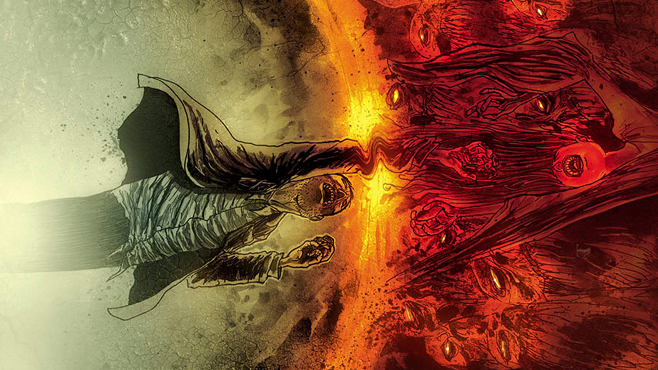
The Intriguing Cover of the First Volume of Ten Grand

Following last week’s trend of super agents/guns-for-hires of organizations, Ten Grand is the story of a former mob contracted enforcer, Joseph Fitzgerald (who is referred to as Joe in the series and for the rest of this review), who took his last job to get out of the life and ended up in a contract much more difficult to maintain and handle than that of his severe mob boss. Joe is the hired agent of Heaven, kept on earth to do what he is asked to and resurrected from death in order to continue to do anything and everything Heaven requests.

Oddly enough, Heaven’s tasks for Joe are not as easy or as peaceful as one would expect. In fact, the contract exists because Joe could only choose between separation from his beloved wife, Laura, with eternal damnation in Hell or long-term separation from Laura by remaining on Earth as a perpetual agent of Heaven, with the benefit of 5 minute breaks to see and spend time with Laura in the time window between his noble death on the job and his resurrection to continue his now destined work. Given the darkness and evil of Joe’s past, his contract requires him to dig into the darkest, most decrepit corners of humanity and the edges of Hell. In order to repent for the sins of his first life, Joe, in each of his resurrected lives, must do the dirty work of Heaven: tracking the work of the devil and preventing the devil and his demons from taking over Earth.

In his spare time, beyond the jobs requested by Heaven, Joe works as a private investigator for people in the most dire situations for a fee of $10,000, thus giving us the title of the series. The first volume of Ten Grand begins with the job to find Sarah Thomas, the sister of Debbie Thomas, a woman who hires Joe for the job. Sarah joined a new demonic cult known as the Divine Will, and her sister Debbie is very concerned about her whereabouts since joining. At first, the request seems like an easy one, but it quickly spirals out of control when Joe realizes that the leader of the Divine Will, Brother James, is an agent of the devil’s demons and the man who he had killed previously in order to avenge Laura’s death.

The job to find Sarah eventually transforms into the personal quest to find and destroy Brother James. On the surface, Ten Grand is a story about vengeance, but as the narrative unfolds, we embark on a modern spin on a mythological battle between good and evil with an expansion on the worlds of Heaven and Hell and all of the planes in between. In the tradition of mythology, we meet many archetypal characters, ranging from the blind prophet to the guardian angel. And in the same tradition, there is cryptic symbology and an understanding of the abilities and difficulties to pass between the different dimensions of existence.

Though Ten Grand contains the supernatural forces and events expected in any mythology, its elements of realism make it captivating and relatable. The characters in Joe’s reality on Earth are by far some of the most interesting. One of them is the spirit of a woman who committed suicide but has not left Earth because she is too attached the the memories in her home; she communicates with and longs for the company of Joe, who was one of the first people to try to understand her spirit’s cries after her death. Another is a coroner at the local morgue who interacts with Joe as if he were a regular customer. Another is Lenny  (who we barely meet), the bartender who allows Joe to run his private investigation business in his bar. Like any good mythology, Ten Grand blends the supernatural with the real, with both worlds containing fragments of each other, and making the narrative seem like it is not to far from our own reality.

Beyond the characters and the pretty awesome premise, what I think is the most interesting about Ten Grand is its discourse on salvation and damnation and what happens if your fate does not include either one. With the help of the artists Ben Templesmith and C.P. Smith, Straczynski presents multiple options for those who cannot be sent to Heaven or Hell. There are some who are determined travelers of the planes like Joe. There are messengers of the planes like the spirit who remains at the home she died in or the blind prophet, Johnny. And there are others who are stuck in purgatory, those whose souls are lost and do not belong.

Ten Grand is an original, imaginative modern mythology, with thought-provoking criteria for existence in the different levels of afterlife. In an enlightening discussion with the boat guide on what looks like the River Styx, we find out that those who are in purgatory are those who betray their hearts and suppress their souls in life. According to Straczynski’s myth, the people who remain in purgatory are those who have eroded their souls by the time they die: the people who concede to what is expected of them without thought and the people who live lives determined by other people, or in other words, the people who settle and become complacent with lives they do not want. Ten Grand is a fascinating story about a very flawed man who lives an almost futile existence, but in its narrative paths, it allows us to ask ourselves who we want to be, what afterlife we hope to reach, and how we should and should not act to try to get there.

Ten Grand is available via Image Comics. Volume One was released in January 2014, and Volume Two is set to be released on November 12, 2014. 

Bovine Ska and Rocksteady 10/1/14: Bop and The Beltones

Standard

1968 Trojan Records release of “I’ll Follow You.”


A joyous week at the Bovine Ska and Rocksteady as we celebrated our first wedding anniversary as married peoples 🙂  Thus we began with two sets of killer Jamaican ska and a mento set of questionable virtues!  We also did as our spotlight, one that has never been done on this show, that of Bop and the Beltones!

Bop and The Beltones were originally Rudolph Simmonds (who was known as Bop the dancer), Keith Mitchell, and Owen Laing who first recorded with Coxsone at Studio One and were under contract with him for some time in their early career. Trevor Shields was a young musician who would practice with his guitar and sing at school when he would one day run into The Beltones who invited him to ‘jam’ with them.  This was a strange time for the group because they were frustrated with the lack of progress coming from Studio One, and at the same time Bop left the group in order to pursue a dancing career in the U.S.   In a moment of fate, Keble Drummond introduced the Beltones to Harry J, who at the time was only an insurance salesman looking to enter the music industry. Harry J heard the group and wanted the Beltones to be a part of his emerging label, and the group accepted.

After hearing the group rehearse No More Heartaches, a track written by the newly appointed Beltone, Trevor Shields, Harry J actually rearranged the harmonies in the group, making Trevor the Lead instead of Keith, who was the original lead for the track. After the rearrangement, the group recorded No More Heartaches with Harry J as the producer, but given that Harry did not have a studio yet, the single was actually physically recorded at the studio of Studio One. After No More Heartaches got the Beltones some popularity in Jamaica, the group performed at the Carib theater, toured the North Coast, and appeared on both  TV at JBC and radio at RJR.  Their recordings ended up doing well in England because they were distributed by Trojan, but the band did not see a ton of success, and eventually, they called it quits, with Owen moving to Canada and Keith moving to the U.S. Trevor would continue recording as a solo artist and with other groups.

On October 1st, 2014, we did our spotlight on Bop and the Beltones from the earliest recordings during the rocksteady era with Studio One through their time with Harry J.

Listen to the full spotlight and the show via the WMBR archives here: LISTEN HERE

This link will be active until 10/14/2014.


The Joy of Making Pasta e Fagioli With Generoso

Standard

“Pasta e Fagioli” is the best proof of the Italian language helping to make even the most basic things sound elegant.  The direct translation for the essential dish, is “pasta with beans” but as I stated with my recipe for chicken cacciatore, it is not a put it down because basic can sometimes be very delicious.  Many people make this dish like a soup but not in the Fierro household, where Pasta e Fagioli has always been prepared as a non-watery, intensely garlicky pasta dish.   The ingredients are super basic; tomatoes, garlic, cannellini beans (sometimes called navy beans), ditalini pasta and olive oil.  Also, by definition, this dish is vegetarian, even vegan actually, and should only take an hour or so to prepare.  Enjoy the video and let me know how yours turned out!  Music is the Concerto for Cello and Orchestra in D Minor by Edouard Lalo


“Rolling Thunder” Director John Flynn Takes Robert Duvall on a Revenge Ride in 1973’s “The Outfit”

Standard

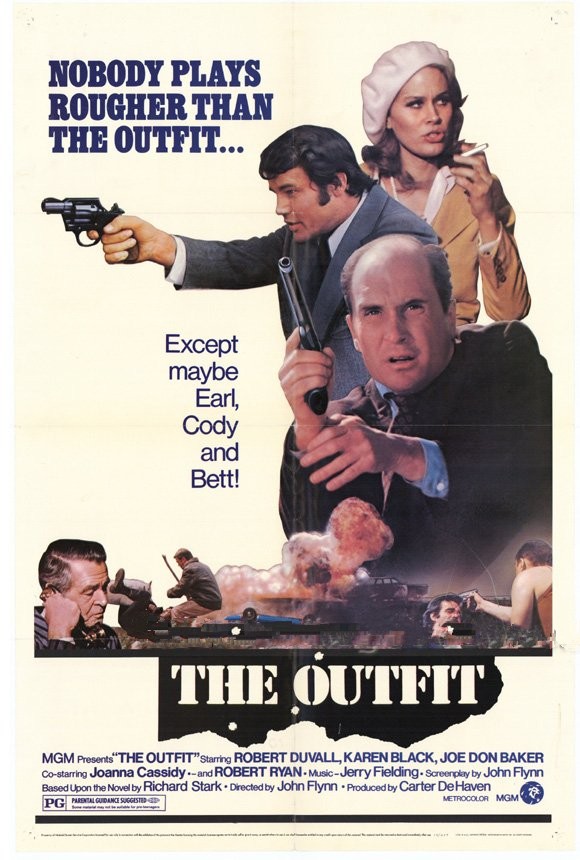
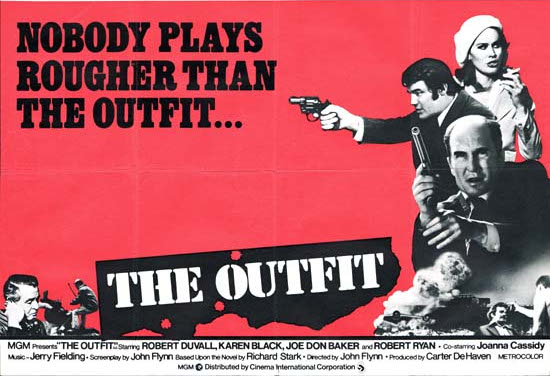
Theater poster for 1973’s “The Outfit”

In 1978, a year that saw the release of two very well-known post-Vietnam films, Michael Cimino’s “The Deer Hunter” and Hal Ashby’s “Coming Home,” there was a third film about Vietnam veterans that I loved much more than the aforementioned efforts, a truly nasty affair called “Rolling Thunder,” directed by a virtually unknown talent named John Flynn. Flynn had teamed up with screenwriters Paul Schrader and Haywood Gould to tell the story of a Vietnam POW named Charles Rane who returns home to even more grisly reception than any character in Cimino or Ashby’s post Vietnam films. Major Rane in “Rolling Thunder” seeks revenge after his family is murdered and recruits an old friend from his days as a POW to help him out. It is an unsentimental, ugly film that is punctuated by some of the most original and intense moments of violence seen in films of that era.

Five years earlier, John Flynn made his first revenge film, a brutal, unconventional action film called “The Outfit.” Written by Flynn and Donald Westlake (Point Blank, Payback), it is the story of ex-con Earl Macklin (played with superb quiet rage by Robert Duvall) who gets out of jail just after the titular “outfit” has murdered his brother Ed. It seems that the stint that Earl just did in jail was due to robbing a bank which was run by the “outfit,” and as payback, they have killed his brother who was also in on the job. Earl is pissed but doesn’t want blood from the outfit; he wants money, specifically $250,000, and he’s going to get it from the different illegal interests that the outfit controls, but he’s going to need help. In tow is his gal, Bett (the ethereally gorgeous Karen Black), who comes along for the ride and although she originally tries to betray Earl, Bett is sticking by his side because I guess because Earl needs someone to interpret his sullen grunts and erratic behavior. Earl also needs some muscle, so he pulls in his old pal Jack, who is played by everyone’s favorite 70s smiling southern goliath, Joe Don Baker. In fact 1973 was quite the banner year for Baker, having just starred in his biggest role as Sheriff Buford Pusser in “Walking Tall” and as another piece of nasty business, the hitman Molly in “Charley Varrick.”  Together they hit the road and try and to make revenge happen, one score at a time.

“The Outfit” progresses in the same way that many revenge and action films do, but it is the construction of the three main characters above along with the multitude of film noir veterans that Flynn populates this film with that really makes it watchable. These immensely talented actors bring so much to the smallest amount of screen time. Character actor Elisha Cook fills up a scene as does the great Jane Greer, who plays Earl’s grieving sister Alma. As for our Mr. Big, Mailer, Flynn went with an actor who spent an entire career playing villains and heavies, Robert Ryan. Mailer runs his empire with a dour, unhappy tone similar to that of our hero, Earl. Like Earl, he also is not too thrilled with his woman, and like Earl, he especially isn’t pleased about getting threatened. After Earl demands his appeasement in the form of 250 large, Mailer agrees to the amount, but then welches so you shouldn’t be surprised when Earl and Jack do not go away quietly. The welch happens in one of the most interesting action scenes in the film, which takes place in a homeless shelter. As the deal goes awry, a fire alarm is pulled, and a sea of homeless men, firemen, and thugs flood the street as Earl and Jack make their escape. It is that scene and the many shakedowns that Earl and Jack perform that highlight Flynn’s unique directing style in this genre. The action is never too slick; Jack and Earl are not flying out windows on jetpacks here, nor are they comical as they dole out violence, and there are some dialog inconsistencies for these brooding, silent characters, but all in all they say what needs to be said and not much more. They are professional and do what they have to do in get the job done. There is a large amount of violence in the film, but it is rarely gratuitous, as in one early scene when Earl blows the hand off of a member of the outfit for burning his woman Bett with a cigarette.  Though shocking, I think that goes far in setting up that character’s limit for vengeful acts.

Official trailer for 1973’s “The Outfit” 


Though “The Outfit” tips its hat to film noir with some of the characters, the primary structure is that of action and to be more specific, a 70s buddy film. As with many 1970s buddy films, the women are not femme fatales, but they also only get to hang in the background for most of what happens during the course of this film.  Though Bett is a fully flushed out character, she doesn’t get into the action that often and is curiously absent from a few key scenes. This is something that Flynn definitely would improve on with in his later film, “Rolling Thunder,” with his character named Linda, a gun-toting Texas woman who does a lot more than just tag along. Unlike the films of the early 1970s, women’s liberation was in full effect by the late 1978, even in male dominated action films, so Linda can thus be a fairly tough customer. Given that “The Outfit” was shot in 1973, Bett does get to plow into some bad guys with the car, but otherwise, she seems there to just provide a voice of reason and in one brutal scene, she even becomes a punching bag for Earl. Like Flynn’s “Rolling Thunder,” “The Outfit” is completely unapologetic about its male character’s actions. These are tough, insensitive men who almost seem anachronistic even for 70s film standards, which should make this an uncomfortable watch for a lot of folks.

If you’re me, when you think of early 70s manly films about revenge, you almost immediately think of Mike Hodges superb 1971 British gangster film “Get Carter.” And although “The Outfit” is not as tightly woven together as “Get Carter,” it does have the same caustic intensity and shocking violence of Hodges’ film and is well worth your time for nothing else if only to see a solid performance from the always brilliant Robert Duvall in the middle of two major films: the career-making Godfather and the nifty Conversation.

John, Paul, George, Ringo and ADOLF!: 1976’s “All This and World War Two”

Standard

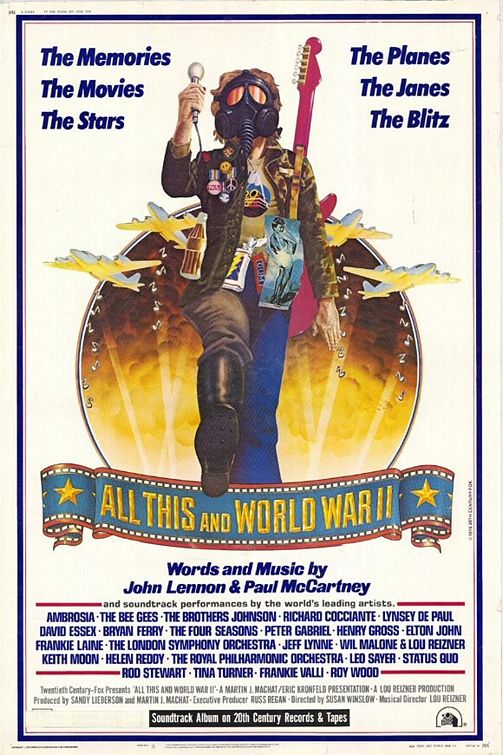
The 1976 Poster for “All This and World War II”

Film scholars seem to always look back at the 1970s as that glorious time when the studio system fell, and the freaks took over the asylum. In fact, it was this kind of, “just let the inmates do what they want,” attitude that gave us masterpieces like “Easy Rider” and “Mean Streets,” but it also gave us films that make one wonder if the entire hospital administration just ran away.  I imagine the pitch that Russ Regan, the president of 20th Century Fox Records, gave to the empty board roam went as such, “So, everyone loves the Beatles right?  And it is the bicentennial, right? And everyone is super patriotic right now, so why not get clips of old Twentieth Century films and newsreel footage from World War Two and lets glue it all together and make a hit that won’t cost a ton of money?…right?”

The first problem, besides the concept of the film, was the reality that many filmmakers discover when trying to acquire original versions of Beatles songs: the cost. The 2010 Steve Carrel comedy “Dinner for Schmucks” paid out 1.5 million dollars for the use of the Beatles “Fool on the Hill,” and if you are talking about an 86 minute long movie that is comprised of nothing but Beatles songs, well even in 1976 dollars I doubt that they could’ve done all this with a total budget of just 1.3 million. Immediately, producers scrapped the idea of Beatles performing the songs, and instead convinced many of the 70s top musical stars such as Elton John, Tina Turner, Rod Stewart, and (gulp) Helen Reddy to record versions of the Beatles classics. This may have been the only intelligent production move because the soundtrack eventually made more money than the film, a phenomenon which had happened before with Gordon Parks, Jr.’s 1972 Curtis Mayfield scored blaxpolitation film, “Superfly.”

Helming this mess would be first time director, Susan Winslow, who had just worked as a researcher on the 1975 Phillip Mora documentary, “Brother Can You Spare a Dime,” which also blended newsreel footage and film clips in a nostalgic and satirical way, that time about the great depression.  I guess that subject wasn’t dour enough for film audiences, so let’s turn to everyone’s favorite war for some smiles and a gentile poke in the ribs.

The film opens with Germany preparing for war, manufacturing munitions and mounting Panzer tanks as the smooth rock sounds of Southern California’s Ambrosia performs “Magical Mystery Tour” in the background.  At one key point, “Load up for the mystery tour” is sung while solider loads his rifle…yikes.    Though this sounds like a bad idea, and it is, it pales in comparison to the musical/visual matchups that later follow in this film. I would suppose that the overarching peace sentiment of the film was due to our withdrawal from Vietnam a year earlier in 1975, but there are just too many scenes coupled together that I feel are supposed to make you get a tad happy about our involvement in the big show. For example, I assume Hitler is played off as a bad guy here as “Fool on the Hill” is added during newsreel footage of Adolf gazing out from his mountain home above Berchtesgaden, but why is “Maxwell’s Silver Hammer” being played as Americans line up at the recruitment office?  There are a lot of contradictory moments in this film that seem to come out of a need to play some of the songs that had been recorded as opposed to writing songs based on the footage that was to be used.  By the time you get to Elton John performing “Lucy In The Sky With Diamonds,” while allied planes get ready to bomb Germany, you know that we are not dealing with surrealism here but a truly deranged mess of a movie that has no central idea.

If the horrors of war were to be contrasted against genuine human suffering for the sake of comedic irony, then why aren’t we seeing actual human suffering in the film?  With the notable exception of Japanese Americans being taken to internment camps (with The Brothers Johnson performing “Hey Jude” in the background?), you never actually see a person in peril or pain, so what you are left with is a bunch of fair to poor Beatles covers and a poor excuse for an anti-war work of art that does not even have the courage to make the audience endure true suffering to complete the satire.

How to Make Lily’s Version of Cantonese Tomato and Egg

Standard

Tomato and egg is a very pedestrian dish that is a common quick bite in the Fierro House. Lily grew up eating it right after school with rice, but as an adult, she began to make her own version with thick rice noodles (mostly only because she is a noodle fiend). Lily’s version incorporates the egg into the tomato, which is different from the traditional stir fry. See how to make this simple, yet satisfying dish! Enjoy!

Music courtesy of Joseph-Maurice Ravel’s Ma mère l’oye

The Unoriginal Life of Edward Zero

Standard

Edward Zero is the “Agency’s” former best secret operative whose life in 2038 is at the hands of a child operative from the agency in which he was once the shining star. As he speaks to the child, he begins to explain his story about how one of the world’s best agents fell from grace. From chapter to chapter, we see many of Zero’s missions, ranging from returning a stolen bioweapon in the Gaza Strip to eliminating a former agent who is now the leader of a nonviolent community in Brazil. Along the way, we meet the people in Zero’s life: Zizek, his trainer and mentor, Mina, his childhood love, Cooke, the new leader of the agency who is highly suspicious of Zero, and Ginsberg Nova, a masked man who is known as the leader of global terrorism who claims to know and remember Zero.

Zero Volume 1: “An Emergency”

What ensues in Zero Vol. 1: “An Emergency,” is a relatively standard story of a rogue agent of the CIA or some fictional secret operative agency that is supposed to represent the CIA. For the most part, each checkpoint in Zero’s escape from the agency is fairly predictable; Zero begins to break away from his stoic, machine-like, humanity-void countenance and protocol when he experiences emotional trauma. The first break happens when his love Mina is killed. The second break happens when he has to kill another rogue agent. Then, the major break happens when he simultaneously begins to ask questions about his parents, whom he cannot remember, and also realize that his agency is responsible for some bio-hazard material that has transformed people into lumpy, blob-like beings that look a little too much like a hybrid cross between Samantha Eggar in David Cronenberg’s The Brood and the pustule-laden  Baron Harkonnen in David Lynch’s Dune.

I reference these two films because the blob creatures are only a minor example of a sad and disappointing trend in the Zero series: watered down motifs, plot devices, and characters taken directly from films. As a graphic novel, Zero is not entirely a failure. As I read it, I was moderately interested and was at least motivated enough to complete the volume. And from a visual perspective, there is some stunning artwork in the series, with each chapter illustrated by a different artist in order to add visual segmentation of the different phases of Edward Zero. However, upon completing the reading, I had an overwhelmingly unsettling feeling that what I had just read was a graphic novel reconstitution of pieces of films. After spending some time talking to Generoso about the volume, three films came up in our discussion: the Bourne trilogy, The Conversation, and Three Days of the Condor.

Zero takes plot devices and themes from these films and fails to do what they all do so brilliantly: create suspense and an overall feeling of cynicism toward the agency one is part of while creating a sympathetic central figure that the audience hopes will succeed. Like the Bourne series, the narrative of Zero has a semi-paternal relationship between Zizek (the trainer) and Zero, the agent/trainee. In addition, Zero begins to go rogue as he begins to question about his past which has been wiped from his memory, which is the identical to the motivations of  Jason Bourne when he goes rogue. Like Joe Turner in Three Days of the Condor,  Zero falls from the top of the agency when he gains prohibited knowledge of a secret operation. And, like Harry Caul in The Conversation, what leads to Zero’s end is what he was himself.

Okay, so sure, as long as the story was engaging, I should not take too many points away from the graphic novel. But what makes Zero an unsatisfying read is that not only did it mimic narrative branches from some excellent films about espionage and secret operations but it also failed to combine these duplicated devices in a way that created suspense or allowed me to connect with Edward Zero as a character. Despite the small moments of human emotion that we see in Edward Zero, there is little to motivate the reader to sympathize with him and to desire to see him accomplish and triumph, which I feel is essential in any narrative where anyone leaves an affiliated organization and former friends and colleagues become enemies.

By the time I completed the first volume of Zero, I felt that I wished I had seen a film instead. There are intricacies in the espionage genre that just were not captured in Zero, despite the fact that it used material from some impeccable sources. Consequently, the failure of Zero as a graphic novel is even more upsetting because the story is both unoriginal, with identifiable pieces from other older material, and dull, failing to capture the paranoia, the suspense, and the constant desire to see the protagonist triumph over corruption and evil that make a betrayal, rebellion, or fall from grace story thought-provoking and alluring. Zero combines multiple motifs and themes used in the espionage genre, and yet, is unable to execute any one of them completely and successfully.

Zero is written by Ales Kot and is available via Image Comics.

Bovine Ska and Rocksteady 9/24/14: The Passing of Tito Simon

Standard

R.I.P. Tito Simon

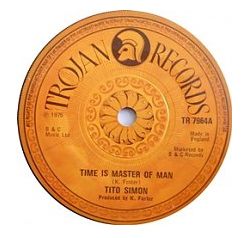
The last few weeks have been hard for lovers of Jamaican music as Hopeton Lewis and Jackie Bernard have both left this earth.  It brings us great sadness to bring the news that another reggae star has died, as Tito Simon passed away on Saturday Sept 20th, 2014 in Jamaica from a sudden heart attack. Born as Keith Foster in St. Mary Jamaica in 1948, Tito would record ska, soul, and reggae recordings during his career. He recorded and wrote under a ton of aliases including Sugar Simone, Lance Hannibal, and also under his birth name. However, he was most commonly known and referred to as Tito Simon.

In 1961, Tito moved to England and began his recording career in 1964 with Dandy Livingstone as the duo Sugar ‘N’ Dandy. Together, the two would record ska tracks with the Carnival label. There has been a rumor over the years that Sugar ‘N’ Dandy was actually just Dandy Livingstone recording solo and having his voice doubled to appear as a duo, as duos were very popular at that time in Jamaican music. What we can say is at the time of Tito’s passing Dandy took to social media to express his sadness for the loss of his “singing partner, ” Sugar Simone, aka Tito Simon.

To answer the rumor of “Was there vocal doubling on Sugar N’ Dandy tracks?”  We received this message from Dandy Livingstone himself a few weeks after the show that finally answers the question:

“Hi Generoso,Tito Simon and I only did one session together. The songs were….. “Only Heaven Knows” and “Let’s Ska.”The late Roy Smith and I did two sessions. Those dates produced three songs…….1.One Man Went to Mow 2.Time and Tide 3.I’m Not Crying Now…….The remainder were doubled by me. Nuff greetings from Jamdown”

After Sugar ‘N’ Dandy, the two parted ways for solo careers, and Tito took a two-year break from recording. In 1967, he returned to the music industry, singing very briefly with the Jetliners, who only have one single to be found. As for his return as a solo artist, in the same year, Tito began recording great soul tracks, which were released on Sue Records. After the solo soul tracks, Tito took another two year break from recording. When he returned to the music industry this time, he began recording in yet another style, reggae, which is what he is best known for.

During the show we played Tito’s reggae recordings for the Dr. Bird and Upfront labels, starting with Tell Me, released on Dr. Bird in 1969. In1972, Tito returned to Jamaica and worked with Clancy Eccles. With Clancy, he would record some of his most popular tracks. We’ll first hear Easy Come Easy Go off of the Just LP released on Horse in England in 1973

On September 24th, we did a full retrospective of Tito’s career, from those early recordings as Sugar ‘N” Dandy through his soul music period and his subsequent triumphs in reggae. R.I.P. Tito.

Listen to the full spotlight and the show via the WMBR archives here: LISTEN HERE

This link will be active until 10/6/2014.

The Mythology of The Sixth Gun

Standard

As many may know, I really love westerns.

They seem to always have a paradoxical moral simplicity and complexity. They almost always have a protagonist with questionable motivations. And yet, the good almost always triumphs the evil, leading to an overwhelming catharsis for the reader or watcher (depending on the medium). Consequently, the simplicity of the fundamental structure of the basic western lends itself to transformation and evolution without losing its core.

After spending some time looking around for the next series to read, I found this list from IGN. Yes, I was a little weary of the source, but I figured I’d at least try to read something that other people are talking about. After scrolling through, I settled on The Sixth Gun, a western set in Reconstruction era America.

The Sixth Gun Vol. 1 Cold Dead Fingers

The Sixth Gun is an excellent example of a successful transformation of a western. It has the archetypal characters and themes of a western with new layers of horror and the supernatural that could only occur in the comic book, rather than film, form. Cullen Bunn and Brian Hurtt, the creators of the series, realized that despite their inability to mimic the epic film landscapes and the tense duels in the comic book form, they had the ability to add fantasy elements that could not be captured in any old western films. While The Sixth Gun adds innovative ideas and characters to the basic structure of the western, it also pays homage and reverence to a genre that the creators clearly love.

At the opening of The Sixth Gun Vol. 1 Cold Dead Fingers, we meet the sinister looking Mrs. Hume, a widow of the former Confederate General Oleander Bedford Hume, as she speaks to Pinkerton detectives she has hired to find her husband and some of his possessions. After that very brief introduction, we meet Drake Sinclair, a man dressed like a Pinkerton, as he approaches the prophetic spirits of the Gallows Tree (a really interesting take on the hanging tree motif). Sinclair is looking for some treasure and the spirits of the tree send him to the home of the Montcrief family. From the introduction of the two story branches, we immediately get the sense that Mrs. Hume is going to be our force of evil and Sinclair our flawed and seemingly dubious protagonist.

The story then jumps to the Montcrief farm, where Becky Montcrief, is taking care of her ill father. As her father gives her instructions on how to live after he has passed, he hands her a box and asks her to get rid of it in a place where no one can find it. As he begins to explain why, a crowd approaches the farm, and a shootout begins. The Pinkertons have arrived, and they are looking for the contents of the box, a gun with a small red symbol brandished on the ivory handle.

After, one of the Pinkertons kills the father, Becky picks up the gun and immediately faints. When another man tries to pick up the gun, and it burns him with a green fire, we immediately understand that the desired gun has supernatural powers that must be valuable to Mrs. Hume. When Sinclair arrives at the scene and recognizes the father Montcrief, he gets details about the goal of the Pinkertons from a dying man shot in the gunfight, galvanizing the plot.

The setting then abruptly shifts to a mission with a group of priests preparing for a brutal fight. When an army of ghouls arrives at the mission, they demand for the body of their leader, the former General Oleander Hume. After a bloody battle between the army and the fathers of the mission, the General is excavated from a well, and his ghost-like, demon form awakens and immediately demands his gun.

As the plot continues, we slowly find out more about the goblin General Hume and his army of the undead. We also learn more about Sinclair, who is much closer to Hume’s nefarious army than expected. Most interestingly, we learn about the gun that we are introduced to in the Montcrief home; it is one of a set of six guns which never need to be reloaded and each grant a specific power to the owner.

With one gun in the hands of Becky Montclief and the other five in the hands of Hume’s leading commanders, the complete powers of the collection cannot be harvested by General Hume. On one branch of the narrative, we follow Hume’s hunt for his gun. On the other branch of the narrative, we travel with Becky Montcrief, who is taken under Drake Sinclair and another bounty hunter, Billjohn O’Henry’s wing, on the quest to find the General’s treasure at a fort with a pit leading to the mouth of hell.

The rest of the first volume of The Sixth Gun follows the cat and mouse chase between General Hume and Sinclair. In the process of the chase and the clashes, we meet an incredible spectrum of characters ranging from a giant bird demon who guards the valleys in the canyon to soldiers of the dead killed by Hume who emerge as sand figures. As we encounter each of these fantastic characters and creatures, each one becomes a landmark hurdle and counter forces marking the course of our protagonists’ odyssey.

While the plot sounds like one engulfed in fantasy, The Sixth Gun is not exactly a fantasy or mystical western. Throughout the narrative, buzzards reappear as the storytellers of the supernatural events and as the guides in the transition from one’s current life to the afterlife. Given that the buzzards are often the last witnesses to a disastrous event, they are able to give the final words about life on Earth and are the only ones who are left to explain all of the secrets of our existence. The buzzards serve as a chorus to the odyssey, revealing the mythology approach of The Sixth Gun.

What is great about The Sixth Gun is that it a western Homeric odyssey, with myths conveying a spiritual reverence for nature, an understanding of the thin line between the present life and the underworld, the manifestation of evil, and the plight of hubris. It is a western at its heart, but it also provides an insight into the face of evil and how to avoid and escape it. The Sixth Gun is able to use elements of the supernatural without straying too far from reality, and by the end of the first volume, we are able to step away with a myth about decline of General Oleander Hume from his hubris and the triumph of Drake Sinclair when he finally understands courage, humility, and self-sacrifice.

The Sixth Gun Volumes 1-6 are available via Oni Press.