Bovine Ska and Rocksteady 1/14/2015: King Sporty

Standard

Prior to the preparation for this week’s show, we were informed of the sad news of King Sporty’s passing. Consequently, this past week’s show featured a memorial on the great DJ who would emerge as an amazing songwriter and producer.

To begin the show, we began with two sets of rocksteady, including never-before-played tracks from The Merritone Singers and Victor Morris. We then heard mento from Count Owen, Lord Foodos, and Charlie Binger prior to a set of ska to precede King Sporty’s early ska toasting tracks.

R-2265428-1273249302.jpeg

King Sporty’s Self-Produced Single Yearfull of Sundays

King Sporty passed at the age of 71 in Miami on January 5th. Born as Noel G. Williams, King Sporty began his career in Jamaican music as one of Coxone Dodd’s DJs for his soundsystem. In Jamaica, King Sporty would record for Coxone and for Justin Yap prior to his move to Miami in 1968.

Upon his move and work in America, King Sporty would transition his writing and production into soul and disco. However,we will focus this spotlight on King Sporty’s own tracks in ska and reggae before he gained popularity in the world music arena. We will pay honor to the great talents of King Sporty in an one hour tribute of his best DJ recordings, beginning with his first vocal toasting track in ska named El Cid, which was released on Justin Yap’s Top Deck label.

Even though the memorial spotlight focuses on his own recordings, King Sporty was not only a phenomenal DJ and producer but also a talented songwriter. He penned many hits for Studio One and such well known tracks as the Blues Busters, “Thinking of You” and a song that he originally recorded that Bob Marley made globally famous, “Buffalo Soldier.”

In Miami, King Sporty opened up his labels, Tashamba and Konduko, allowing him to write, produce, and release his own recordings and those of artists he liked. During this time in Miami, King Sporty would become very close to the Miami soul scene, distributing records from his label through Henry Stone, the king of the Miami’s T.K. Records. Sporty also married Betty Wright, T.K. Records’ leading soul lady.

One of the tracks that King Sporty sold to Henry Stone was one from Lily’s favorite Glades/T.K. Records artists, Timmy Thomas. In fact, King Sporty had discovered Timmy Thomas’s “Why Can’t We Live Together” and brought the track to Henry Stone’s door. Stone purchased it from Sporty immediately and pressed it on his Glades label in 1972. The Timmy Thomas track gained traction on the American charts, and this would be one of King Sporty’s most successful discoveries within the Miami soul world.

Listen to the full program with King Sporty’s stellar recordings in ska, reggae, and even soul HERE.

Enjoy! The archive will be available until 1/27/2015.

The Leg: The Tale of the Silent Stranger Known as Santa Anna’s Leg

Standard

As a Texan, Santa Anna is the name of a historical figure that immediately transports me back to my mandatory seventh grade Texas history class. In America, we know Santa Anna as Mexico’s president and military commander who lost the wars resulting in Mexico’s loss of Texas and much of the American southwest. However, long before those years of battling for land against American settlers, Santa Anna was a revered and feared leader in his own country.

The Leg or The Remarkable Reappearance of Santa Anna’s Disembodied Limb explores the folklore of Santa Anna, the paradoxical folkhero and villain of Mexico. Despite his active role in fighting for Mexico’s independence from Spain and establishing Mexico as a republic, Santa Anna grew a reputation as a hedonistic, corrupt, and vain tyrant, creating many enemies throughout his career as a politician and military leader. Santa Anna simultaneously strengthened Mexico as he chipped away the nation’s own foundation.

After his loss in the Texas Revolution, Santa Anna returned to Mexico and faced another battle, this time with French forces in what is now known as The Pastry War. In the war, which Mexico barely won, Santa Anna lost his leg, and in an act too indicative of his egocentric and eccentric character, he held a ceremony and buried his own lost leg with military honors. With the heartstrings of the nation in his hands gathered by his military intervention and consequent wound and the overwhelming nationalism stemming from the victory over France, Santa Anna regained the trust of Mexico to lead again. Unfortunately, Santa Anna’s popularity had always vacillated along with his own inability to balance his selfish desires against the needs of his nation, and eventually, Mexico grew so disgusted of their folkhero dictator that they exhumed his leg, paraded it, and threw it aside to be left in the open as carrion for vultures.

Cover of The Leg

Cover of The Leg

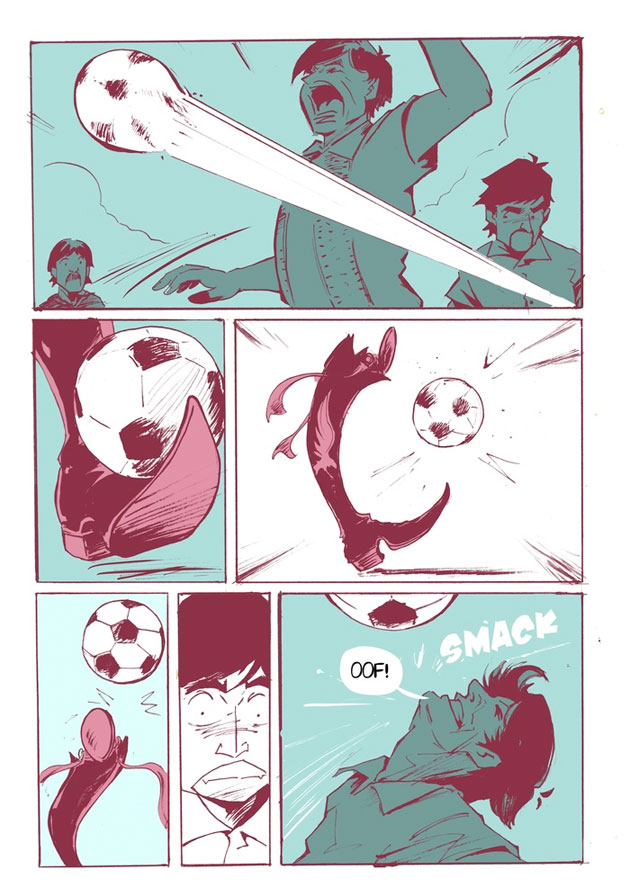
The whereabouts of the leg have since been unknown, giving a perfect history and setting for the creation of mythology around its travels and outcome. In The Leg, Santa Anna’s limb has returned to life as a tall and sentient boot that lives with a blind old cobbler who discovered and rescued it. When a group of well dressed men enter the old man’s home under the guise of being lost and decide to kill him, Santa Anna’s leg must try to avenge the death of his companion. Furthermore, the men are on a trip to disrupt Mexico’s progress by eliminating the new president, and alas, the well being and future of Mexico lies in the figurative hands of Santa Anna’s leg.

Along the way, the leg meets a young girl named Ana who accompanies him on his journey. The illegitimate granddaughter of Santa Anna, Ana is alone in Mexico, with her parents in America and her guardian, her grandmother, no longer alive. Deciding not to reveal its identity, the boot simply tells Ana of the mission, and she immediately agrees to help him, hoping to arrive in Mexico City also to find redemption for her family. On their travels, the two encounter fantasy and historical figures of Mexico including a witch, demon, wizard, eagle, crow, and ogre along with labor protesters, Leon Trotsky, Frida Kahlo, and Diego Rivera. In The Leg, we get glimpses into the political and religious fragility and volatility of Mexico. We understand the nation’s history of leaders with false promises who leeched off of the people whom they promised glory and prosperity. The Mexico of The Leg is in need of a hero, and Ana and the leg hope to fill this void.

An example of the inventive, fun fiction in The Leg: Santa Anna’s Leg and The Ogre

As the extraordinary narrative progresses, The Leg reveals itself as a tale about redemption, following the tradition of westerns and samurai tales, with the Jose Pimienta’s beautiful artwork and Matthew Petz’s rich colors paying homage to the distinctive visual style of these two genres. There’s a bit of anthropomorphism here and some allusions to political movements there, but overall, The Leg focuses on the redemption of Santa Anna and his leg’s final ability to battle for his nation rather than his own greed. The Leg is the ghost limb in Mexico version of Clint Eastwood’s High Plains Drifter. Santa Anna’s leg is a mysterious, silent stranger who also returns to a place he once lived in to seek revenge and redemption and, like Clint Eastwood’s character, carries a dark past full of misdeeds. Despite the pure goodness of Santa Anna, in an imperfect world, an imperfect hero may just be what we need.

The Leg has great ideas and stories weaved into it, even though it does not read smoothly. Commendably, Van Jensen attempts to layer historical realism with traditional and new mythology into his first comic book but not every piece fits seamlessly into the narrative. There are moments when the story transitions too abruptly from one arc to another and other moments when the dialog is too fragmented from panel to panel. The Leg could have been longer or shorter to better execute its goal, but it nevertheless deserves praise for its ambition and creativity.

Overall, The Leg is a fiercely imaginative novel about the duality of a character rarely discussed in American history. Through its mythology, The Leg conveys the human ability to choose a path of glory over one of depravity, one of honor over one of cowardice, and how we as humans sometimes jump between both paths in a lifetime. What is best about The Leg is its positivity in the light of dire situations, which is refreshing in an age of cynicism and skepticism. In a modern time where many of our leaders, political or spiritual, never seem to be inherently good or evil, The Leg, gives us a breath of optimism that perhaps our leaders will one day choose a path of true benevolence for others. At the very least, it reminds us that we too can choose to veer back on a path of good even if we have strayed away.

The Leg or The Remarkable Reappearance of Santa Anna’s Disembodied Limb is written by Van Jensen, illustrated by Jose Pimienta, and lettered and colored by Matthew Petz. It is available now via Blue Creek Creative.


Bovine Ska and Rocksteady 1/7/2015: Gregory Isaacs

Standard

For this past week’s edition of the Bovine Ska and Rocksteady, we kicked off the show with a newly unearthed Justin Hinds and the Dominoes ska track entitled, “Verona.” Then, in order to make sure that all genres were covered, the program progressed from ska to mento to the rocksteady, with recordings from Winston and Bibby, Clyde Hoyte, Tomorrow’s Children, and The Lyrics before all of the reggae featured in our hour long spotlight on the early recordings of Gregory Isaacs.

Too Late – One of Gregory Isaacs’ first solo recordings

Gregory Isaacs is a singer who gained great popularity during his early career, so much so that he was even signed to a record contract with Virgin Records in his later career. Admittedly, the Bovine Ska and Rocksteady has not featured Isaacs as a spotlight because his most popular tracks are ones that stylistically do not fit in the time frame that we like to focus this show on. However, we were able to find some of Isaacs’s first recordings, and they were perfect for this artist spotlight.

Born in Fletcher’s Land, Kingston, Gregory Isaacs was raised by his mother near Denham Town. Attracted to music through his own mother’s singing as she ironed, as a teenager, Isaacs began competing in talent shows and showcasing his voice, occasionally even performing duets with his brother Sylvester. A duet with another artist, Winston Sinclair, from his neighborhood would be Isaacs’s first recording in the Jamaican music industry. This duet track, “Another Heartache,” did not gain a ton of success, and Isaacs went on to join The Concords with two men known as Penroe and Bramwell. The group was short lived, but they produced some really beautiful recordings.

After beginning his music career working with other singers, Isaacs eventually decided to become a solo artist, continuing to work with Rupie Edwards, who worked with The Concords and would be a continuing collaborator throughout Isaacs’s career.

In 1973, Isaacs scored his first hit with the Phil Pratt produced track, “All I Have is Love.” After that success, he would jump to other producers including Leonard Chin, Alvin Ranglin, and  Sydney Crooks, with Isaacs scoring a number one hit on the Jamaican charts with “Love is Overdue,” a single recorded for Alvin Ranglin’s GG label. And with the success seen in 1973 and 1974, Isaacs’s career would propel in the coming years.

In 1973, Gregory Isaacs teamed up with Errol Dunkley to create the African Museum record label and shop. Here, Isaacs would write, record, and produce his own tracks, with the earliest African Museum releases exploring more of a roots reggae sound.

After a long battle with lung cancer, Isaacs died on 25 October 2010 at his home in south London. As a testament to his fame and popularity, a memorial service was held on November at Kingston’s National Indoor Sports Centre, including a musical tribute from artists including Lloyd Parks and We the People Band, Ken Boothe, Freddie McGregor, Shaggy, Judy Mowatt, The Tamlins, and Bongo Herman, before his remains were interred at the Dovecot Cemetery.

This spotlight on Gregory Isaacs features his earliest recordings and follows his early progress and growth as a singer, songwriter, and producer, giving honor to his great talent as a young musician.

Listen to the full program HERE.

This edition of the Bovine Ska and Rocksteady is available until  1/20/2014. Enjoy!

The Absurd Eyes, Creatures, and People of The Heavy Hand

Standard

The Heavy Hand is the graphic novel equivalent of a giant pile of multi-colored strings. Beautiful, yes. Amorphous, yes. Mysterious, yet. Can you trace where each string goes? Can you name the shape that the string congregation forms? Does understanding the complex mass even matter?

The mysterious and alluring cover of The Heavy Hand

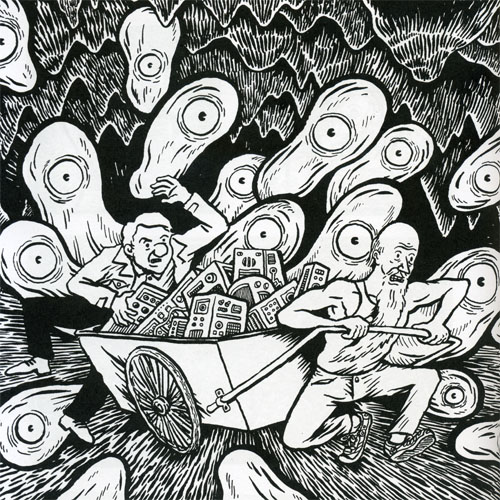
In this book, Chris C. Cilla has a distinctive visual style, creating a setting in a dream-like reality where humans and human-like animals coexist, and a variety of odd and potentially dangerous creatures live on the fringes. The story focuses on Alvin Crabshack, a mediocre, actually not so great, scientist and human who has gained a research position with a Professor Berigan in the Honeypot Caverns. To begin this research, Alvin must pick up his monotonous life in Dirksburg, leaving behind his ladies, Lily and Heather, and his current apartment, in the name of science.

After his goodbyes and false reminders that he will be back, Alvin boards a car with his root beer loving friend, Walter, to travel to the caverns, but Alvin’s move to his new working location completely halts when Walter abandons him at a gas station lacking gas but at least has some hot dogs. As Alvin waits for the friendly station owner to close up to give him a ride to the nearest bus station, Karl, a researcher for another professor in the caverns, appears. Karl is exactly what we expect of a scientist who spends most of his days in caverns; he’s a modern day environmentalist wearing an insignificant pro-Earth t-shirt paired with a cargo vest to hold all of his research tools. In the company of Karl and his clutter packed van, Alvin, an ordinary and indistinguishable dresser with a personality to match, already seems out of place.

In the van, Karl warns Alvin of strange, dangerous creatures in the caverns and explains to Alvin that the Professor Berigan is a reclusive, broke researcher with questionable sanity. Regardless, Alvin has his heart set on researching and studying with Professor Berigan, and Karl agrees to guide him to the professor’s lair. Upon arrival to the Honeypot Caverns, in order to get Alvin to Berigan’s lab, Karl tells his own professor, a pretty Doctor Corbett who has taken a liking to our Mr. Crabshack, that Alvin is a spelunker who lost his ride rather than the truth that he is the new research assistant of her foe. Alvin has longed for a career and a life with more excitement, but he has no idea what is in store for him.

Ranging from a wizard-appearing, obsolete technology-obsessed Professor Berigan to flying cyclops blobs to human-eating tentacled creatures to a strange house party with a giant eyeball in the middle of a desert, Alvin encounters much more than he could have anticipated on his new career turned journey where every turn leads into unfamiliar and maybe impossible territories. As the narrative strays and wanders, The Heavy Hand reveals itself as a psychedelic, science fiction, road story grounded by the secret normalcy cravings of our Alvin Crabshack.

By the end, Alvin Crabshack’s many peculiar, absurd, and psychedelic means meet a somewhat regular end. He’s doing some irrational, irregular things to pay his bills, but he is in a stable relationship with Doctor Corbett and living in a scenic town called Limberlost. He and Doctor Corbett conduct normal conversation between two people in a relationship, and Alvin even interacts with his ex-girlfriend Heather in a reasonable way when he runs into her. Despite his wayward path to his existence, Alvin does not want anything outside of normal human needs and does not achieve beyond them either.

At it’s heart, The Heavy Hand is the epitome of Emerson’s maxim: “Life is a journey, not a destination.” Alvin’s journey may not translate into the most coherent novel (in fact, I am still deciphering the purpose of each fragment as I write this), but The Heavy Hand is a read with an abundance of absurdly entertaining and comedic creativity and style that will take you on a disorienting and hypnotizing ride. Let go of trying to find a message in everything you see, and The Heavy Hand will pull you right into its world of eyeballs, humans with dog heads, goats breaking out from glass globes, and a mysterious masked man who warns about the end of the world and prepares turkey for lunch.

The Heavy Hand by Chris C. Cilla is available now via Sparkplug Comic Books.

Bovine Ska and Rocksteady 12/31/2014: A Show of Firsts!

Standard
Jack Sparrow-Ice Water

Jack Sparrow’s (Leonard Dillon) First Recording


To celebrate the arrival of the first day of 2015, this past week’s Bovine Ska and Rocksteady featured the first recordings from some of Jamaica’s greatest artists.

Following the chronological order of each artist’s debut to the Jamaican recording industry, this New Year’s Eve show also follows the progression of movements in Jamaican music, beginning with Rhythm and Blues, then Ska, then Rocksteady.

In this special show, not only will you hear the first recordings from the legends, such as John Holt, Bob Marley, Jimmy Cliff, and Desmond Dekker, you will also hear the first tracks from BSR favorites including The Jamaicans, The Pioneers, Roman Stewart, and Nora Dean. In addition, you will also hear anecdotes about the artists and how their first recordings emerged. It was a tough show to research, but we hope that you will enjoy hearing how your favorite artists sounded when they began their music careers!

Enjoy! Happy 2015 from Lily and Generoso! May this year be a wonderful one for all!

Listen to the New Year’s Celebration Show HERE.

The archive will be available until 1/12/2015.


Making Banh Cuon in the Western Kitchen

Standard

Banh Cuon is a dish that Lily grew up eating often in restaurants because it required too much effort to make. The best Banh Cuon has a paper thin, chewy wrapper that is created by a stretched out cloth on a large steamer. However, on a few lucky occasions, her grandmother would make it at home, and for this week’s recipe, Lily shows you how to make Banh Cuon with a non-stick pan and a lid.

Banh Cuon is a very general name for rice flour rolls filled with meat. Traditional versions are filled with ground pork and wood ear mushrooms or deep fried scallions, but the filling is completely up to you! Lily’s grandmother actually filled her Banh Cuon with ground pork and crab meat, and some Vietnamese restaurants will even fill them with BBQ pork! This video recipe uses a pork and scallion filling.

Included in this video is a recipe to make a very simple Nuoc Mam (fish sauce for dipping), which is the final serving component of any Banh Cuon dish.

As a warning, the process to make the rolls can be difficult; the rolls should be paper thin, but on the stove, that is not the easiest thing to achieve. It took Lily and Generoso a few tries before we found the method that worked best. Be patient with the first few rolls; they may not be the prettiest, but we promise that they will taste great! Music: Luigi Boccherini’s Cello Concerto no. 9 in Bb, G. 482


Peeking into the Mind and Style of Joseph Lambert in I Will Bite You!

Standard

I Will Bite You! may be the hardest collection of comics to review to date. The stories dramatically vacillate in narrative and illustration style with very few words used in each one.

After gaining acclaim for his short comic, Turtle Keep It Steady! (which is included in this collection), Joseph Lambert pulled together some of his early work for his first book, I Will Bite You!. Though the collection is somewhat randomly assembled and a bit disjointed like a young artist’s portfolio, it showcases Lambert’s great potential as a comic book artist and author with a distinct voice, with his strength stemming from his wildly whimsical style and imagination.

There’s not too much to analyze about each of the stories, so in the spirit of the textually minimal narrative methods in I Will Bite You!, I will give you a short overview of each of the stories in three or fewer sentences. Let’s see if I can accomplish this….

Cover for I Will Bite You! featuring a laughing and howling moon

I Will Bite You!

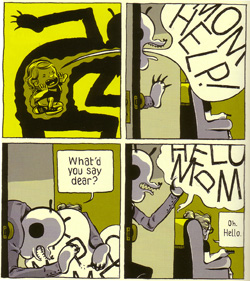
This is the title comic, and it is a perfect one about a little boy who has an insatiable desire to bite everyone he sees. Funny and beautifully illustrated, it introduces Lambert’s favorite motif of elements of nature as sentient beings interacting with humans and his own strange sense of humor when it comes to the creatures of his imagination.

After School Snacks

Probably the funniest, most innovative, and most grotesque of the bunch, After School Snacks begins with two hungry monsters hiding in the bushes near a sidewalk. They eat everything but have a specific appetite for pudding and children, and when one little girl gets eaten by them, her schoolyard crush must try to save the day. This story cleverly explores the role of the writer versus that of the characters in comics, with the characters able to reshape and reform the dialog bubbles used to portray speech into tools for deception and survival.

Mom Said

When two younger brothers play, things tend to get out of hand and beyond control for older siblings. In Mom Said, two brothers exclude their older, adolescent brother from their adventures and manage to pull the moon out of the sky, leaving their older brother to clean up but also leaving him in peace. A silly and whimsical exploration on the relationship between older and younger children in a family, Mom Said is a simple but effective comic.

Turtle Keep It Steady!

As a rendition of the tortoise and the hare set in the world of rock ‘n roll, Turtle Keep It Steady! lives up to its praise as one of the comics included in the collection, The Best American Comics 2008. In the world of Turtle Keep It Steady!, speed is not based on distance traveled but rather the pace of one’s living as a drummer. A clever adaptation of the tortoise and the hare, Turtle Keep It Steady! is a precautionary tale for children living in a post-70s hard rock, hard partying generation.

PSR

In building a narrative around the classic childhood game, Paper, Scissors, Rock, Lambert creates a full tale about a more extreme world where winning involves a trophy in the form of ice cream and the ability continue to roam the earth and losing involves being pulled into an underground world to be imprisoned by an abominable snowman-like creature for a year. PSR is an interesting experiment in understanding and mitigating the irrational severity that children feel when losing a game, reminding us that as bad as it may seem, losing a game of Paper, Scissors, Rock in real life cannot be worse than losing the game in this story.

Too Far

When an older teenage brother does not know how to handle his interactions with his brother and father, he seems to solve his problems by eating up and then regurgitating the world into space. A hyperbole on the self-alienation of teenagers, Too Far is my favorite story of the collection. Here, Lambert’s illustration and metaphor construction through the absurd are at their finest.

(Caveman)

This is the only full color comic of the book. Exploring the mourning process for a caveman, this story is an interesting visual experiment, but it is the most unsuccessful of the collection. It lacks the off-the-wall insanity that the other stories contain and feels too distant from Lambert’s voice and style.

Everyday

Everyday follows the monotonous of life of two brothers over the course of a week. Despite what happens in the middle of the day, everyday seems to start and end the same way until the youngest brother decides on Saturday to take on his nemesis of the past week, the sun. Everyday is the epitome of Lambert’s style and returns his favorite theme of people interacting with human-like elements of nature to the pages. It is the perfect story to end on, neatly wrapping up and delivering all of the best that Lambert has to offer.

I Will Bite You! may not contain the most insightful comments about life, but it is immensely fun to read (though perhaps view is a better word since the book uses text so sparsely). Lambert has a fantastic imagination and a wonderful talent for creating some of the most visually interesting creatures you will see in animation. Pick up I Will Bite You!, and read it when you long for something strange, silly, and amusing to take a break from your day.

I Will Bite You! by Joseph Lambert is available now via Secret Aces. 


Lily Makes Her Vietnamese/Chinese Cabbage Rolls

Standard

Lily has no idea of the origins of this dish. She simply remembers eating cabbage rolls with soup ever since she was a young child. She suspects that it is a dish completely invented from the necessity to feed a family and the availability of cabbage, ground pork, and the standard pantry of a Vietnamese-Chinese household.

In this video, she shows you how to make her version of cabbage rolls, a dish that requires a fair amount of work but is perfect for the cold winters.

Music by Karl Goldmark Symphony No. 1 “Rustic Wedding,” Opus. 26

Enjoy! Let us know how your cabbage rolls turn out!

Bovine Ska and Rocksteady: 12/17/2014: Charlie Ace

Standard

In this past week’s edition of the Bovine Ska and Rocksteady, we began the show with Jamaican Rhythm and Blues, giving us a chance to feature some gems from the Jiving Juniors, Owen Gray, and Cosmo and Dennis. After the opening Rhythm and Blues sets, we presented this week’s mento set dedicated to the delicious fruit that makes us remember warmer days, mango. Then, in order to transition us into the spotlight on the DJ extraordinaire, Charlie Ace, we played two sets of rocksteady, including beautiful tracks from Hopeton Lewis, The Heptones, and Eddie Perkins.

With the arrival of the second hour, we were thrilled to present to spotlight on Charlie Ace, a man who became known for his record store on wheels but a man we know as a DJ great who should be considered in the same ranks as Big Youth and U Roy.

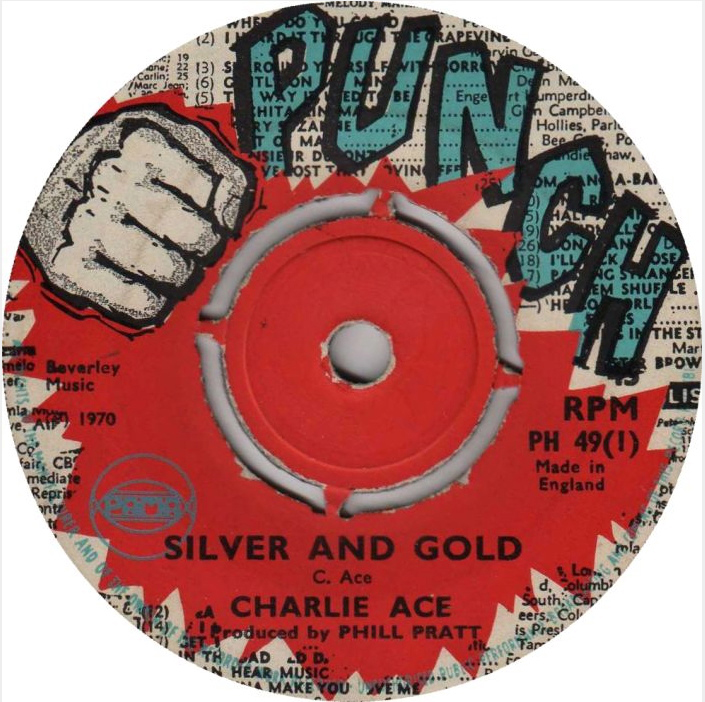
Charlie Ace's Silver and Gold

Charlie Ace’s Silver and Gold Produced by Phil Pratt

Born Valdene Dixon, Charlie Ace was a DJ who gained his name and signature style when he worked with Lee Scratch Perry. After some mild success with his recordings, Charlie Ace would become best known for his Swing-A-Ling Record Shop on wheels that he would drive around to sell records pressed on his own Swing-A-Ling label and on other Jamaican labels as well. A great DJ who was overshadowed by U-Roy and Big Youth and Dennis Alcapone, Charlie Ace is an artist that deserves a spotlight on his large collection of recordings. This review on Charlie Ace’s tracks featured some of the strangest and most experimental productions to date on the Bovine Ska and Rocksteady and began with one of his earliest recordings for Joe Gibbs Amalgamated label, the track entitled, “Seeing Is Believing.” The spotlight followed Charlie’s work with producers such as Phil Pratt, Alvin Ranglin, and Sonia Pottinger to lead up to our favorite track, a Lee Sctratch Perry production named “Cow Thief Skank.”

Sadly, Charlie Ace was murdered in the mid-1980s in a drive-by during one of Kingston’s endless ghetto wars. He was an innovative DJ and great talent who is severely missed.

Listen to the Charlie Ace spotlight and the full show HERE.

The archive will be up until 12/29/2014. Enjoy!

The Modern Ms. Marvel for a New Audience

Standard

Thanks to Samantha for sending me something that I would not necessarily read on my own. 2014 has been an interesting year for women in comics, and I must admit that a lot of the new series to emerge are not ground-breaking or intelligent in their discussion of gender and are in fact somewhat irresponsible in their lessons. However, Ms. Marvel is the exception to the trend.

Ms. Marvel bypasses the common complaint of the absence of redeeming females in superhero comic books to address something even more rare in superhero narratives: cultural minorities.

Kamala Khan is a 16 year old Pakistani-American Muslim girl living in present day Jersey City. As a teenager, she has fairly normal societal teenage pressures, but her path to adulthood is a more difficult and tumultuous one with the additional burden of her parents’ cultural and religious expectations for their only daughter. Consequently, as with many young females who come from cultures that have restrictions on women contradictory to those of their Caucasian American counterparts, Kamala has a bit of an identity crisis; she does not want to reject her Pakistani heritage, but she is also American, and the two cultural expectations for young women don’t play well together.

What does not make this identity conflict any easier is the fact that Kamala does not fit it with the Caucasian teenagers at her school or really even her Muslim friends. She’s stuck somewhere in the middle, and it seems like the only other person who understands her is another fellow child of immigrants, Bruno Carrelli. And to make Kamala’s attempt to understand herself even more difficult, she suddenly gains superpowers one night as she wishes that she did not have to be Pakistani. In return to her wish, Kamala can suddenly morph into the All-American superhero Ms. Marvel with big blonde hair, a Ms. America physique, high-rise boots, and the ability to transform into various sizes with super-human strength. In her Ms. Marvel form, Kamala can choose to entirely reject her Pakistani roots, but this cultural dismissal does not always work out the way she expects.

Ms. Marvel Volume One: No Normal Cover

Beyond Kamala’s emergence as a superhero, the action of Ms. Marvel Volume One: No Normal focuses on Kamala’s task to save Bruno’s younger brother, Vittorio, from the damaging and potentially fatal influence of some unknown villain known as the The Inventor. In the process of trying to save Vittorio, Kamala must understand how to use her powers, which are out of control when she takes on the All-American heroine Ms. Marvel form. Consequently, the unwieldiness of this stereotypical Ms. Marvel transformation provokes Kamala’s simultaneous development of her cultural identity as an American and a Pakistani woman and her identity as a superhero.

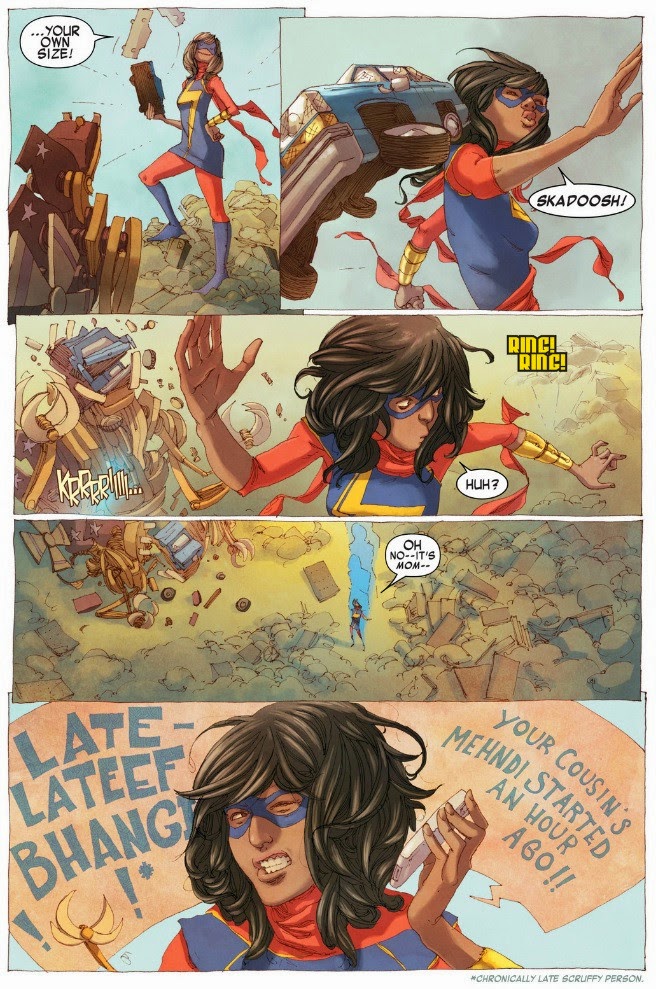
By the end of the first volume, when Kamala emerges as her own Ms. Marvel, she has a darker complexion and a name very different than “Mary’” or “Jane” and is much more clothed and a much less buxom. Kamala’s Ms. Marvel integrates her American and Pakistani cultures, and in parallel, in her regular life, she also combines both cultures and becomes more comfortable with her ethnic identity, even if it differs from the people around her, because after all, what’s more alienating: superpowers or being Pakistani and Muslim? In one moment Kamala battles a robot in a garbage dump in her own, individual costume. In the next moment, she must change into shalwar kameez for her cousin’s wedding procession. Though Kamala is a little in over her head with her obligations as a teenager, a daughter, and a superhero, her new-found superpowers galvanize the growth and reflection that she needs to decide who she wants to be in all parts of her life.

Kamala Khan’s Ms. Marvel

Bravo G. Willow Wilson and Adrian Alphona. You two have created a superhero that has a distinct identity relevant to the second-generation immigrant experience. I commend you both on your adaptation of Ms. Marvel for creating a hero for today’s non-homogenous America for an audience previously unaddressed and unengaged in superhero narratives. Kamala Khan is a superhero I wish I had as a Vietnamese American teenager, and I am so very grateful that she now exists for adults and for today’s youth. The modern Ms. Marvel is a superhero unlike the white audience tailored ones such as Superman and Wonder Woman who are crafted from centuries-old Western archetypes. Ms. Marvel has the same noble intentions to save the world, but she finally has a personal story that we second-generation immigrants can empathize with in contemporary times.

Ms. Marvel is written by G. Willow Wilson and illustrated by Adrian Alphona. Volume One is now available via Marvel Now!