Our show started with two sets of rare ska beginning with Llans Thelwell and His Celestials and their 1964 cut for Federal, Mughead Ska! We ended the second set with a classic from the trombone of Don Drummond on Beverleys, Dragon Weapon. After a mento set featuring a tune from the queen of mento, Louise Bennett Hol’ M Joe on Folkways. We ended the first hour with a reggae set that contained a version to version of the Curtis Mayfield classic, Give Me Your Love from the Superfly soundtrack. 1973’s Super Soul from Junior Soul and Superfly from I-Roy from 1974. We then went into our Little Willie label spotlight.
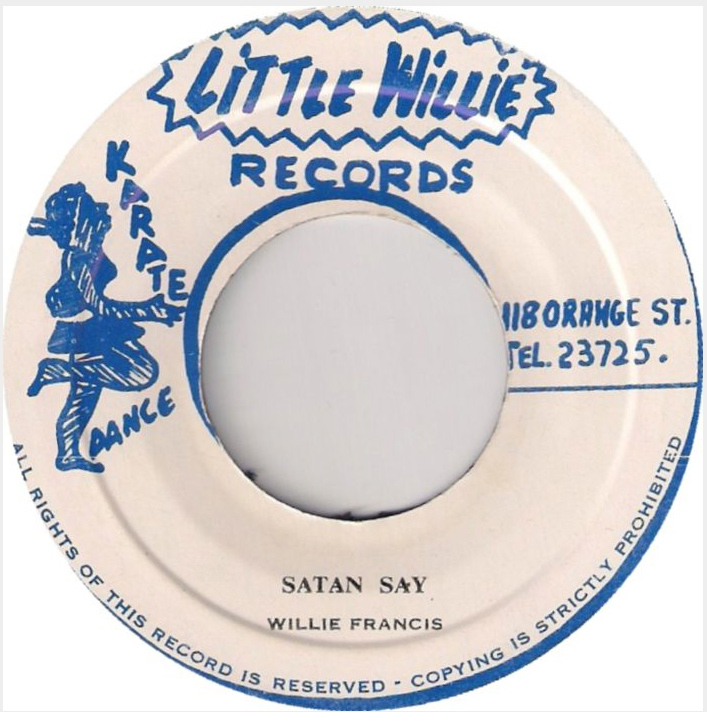
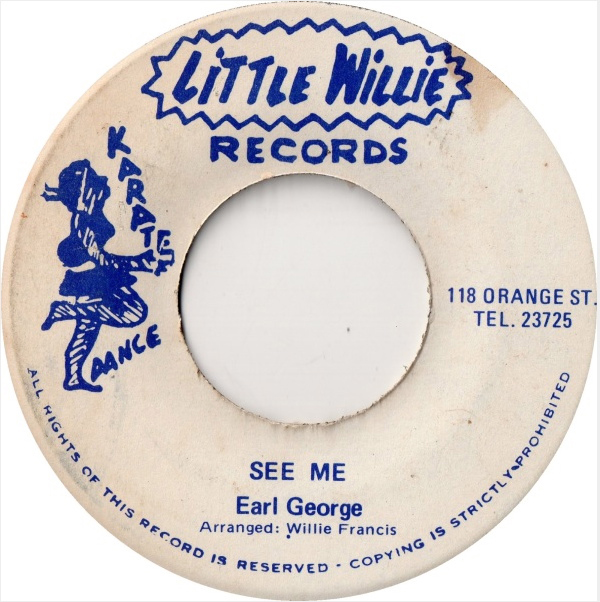
Born in South Manchester, Jamaica, Willie Francis began his career in the Jamaican music industry as a singer in ska. After recording for Prince Buster in the late 60s under the name of Francis, by the time early reggae arrived, Willie opened up the Little Willie Record Label, where he released his own recordings as an artist and as a producer for other musicians. Operating from Francis’s record store on Orange Street, the Little Willie Records label, sometimes called Little Willie Karate Dance Records for the dancer on the label art, released quite a few great reggae cuts that we’re excited to share with you tonight.
Of the artists who stopped by Little Willie, Max Romeo went to the label to record Maccabee Version, which indeed uses the melody of “Good King Wenceslas” and intended to criticize the King James translation of the bible. Searching in the Hills was the debut recording for Calvin Scott, who Willie discovered as a teenager. Willie traveled to Rocky Point, Clarendon to record a group named the Rockydonians. Calvin was the brother-in-law of one of the members, so he hung around them. When the group arrived to the studio, they did not record for Willie; instead Calvin did. Almost ten years later, Calvin would emerge as the artist Cocoa Tea, who has continued to record reggae and has also been quite an influence on dancehall.
You can listen to our full Bovine Ska and Rocksteady from January 12th, 2016 HERE. Subscribe to our show on Mixcloud; it’s FREE, and you’ll get an email every Tuesday when we post a new show.
Happy December!!! Please help us and spread the word and repost if you liked the show! Repost anywhere you see fit.
As I finished writing this review, we were informed that David Bowie has passed away. Bowie was part of the concert featured in Nicolas Roeg’s documentary, but he was omitted from the film. Right now, I wish that he had been included, as there could never have been enough footage of David Bowie.
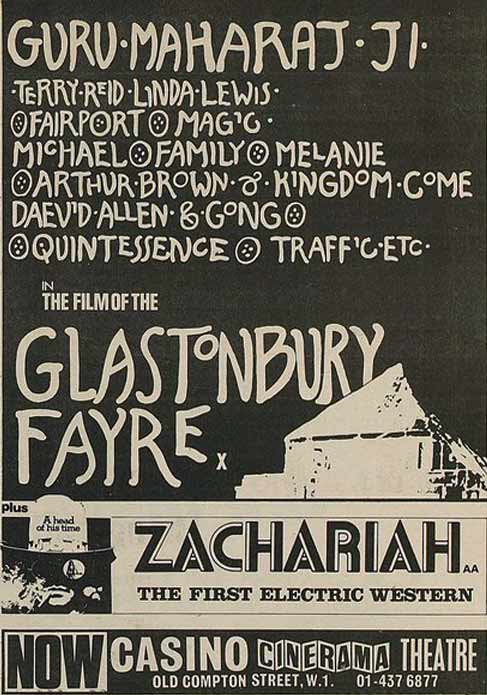
Last week’s entry into Lost In The 1970s With Generoso Blog featured a review of German director Stefan Paul’s 1979 concert film Reggae By Bus, which documented the 2nd edition of the now defunct Reggae Sunsplash Music Festival, which took place in Montego Bay back in year the film was released. As Jamaican music has always been near and dear to me, it was an unequivocal thrill to have finally have seen Paul’s film; though modestly shot with capable sound quality, Reggae By Bus successfully captures not only the music and energy of the event itself but of the community surrounding the festival and their thoughts on the importance of national music of Jamaica. So while I am still basking in the glow of that concert film, I thought to find Glastonbury Fayre, the only concert film directed by one of my all time favorite filmmakers and cinematographers, Nicolas Roeg, and although I am not a fan of most folk rock, I was curious to see what Roeg would come up with for an overall view of the event.
Glastonbury Fayre like Reggae By Bus chronicles the performers and goings on of the second incarnation of a world-renowned music event, the still going strong Glastonbury Festival, which continues to draw over 100,000 people a year to its southwest England location in Somerset. Going into Roeg’s film, I did have two overriding emotions: my love of Roeg’s body of work and what I would expect to be a brilliantly lensed film and my general disdain for the hypocrisy lying underneath the “free love and peace” concert events of the late 1960s/1970s. If that last statement seems unnecessarily caustic, you don’t need to look any further than the 1969 concert at Altamont that featured The Rolling Stones to get a picture of a group of people looking for flower power but instead getting open brutality. From members of Jefferson Airplane being assaulted on stage to the subsequent murder of an attendee, the violence at the Altamont Festival lead many to view that event as the definite cultural end of the peace movement that started in the 1960s.
The film does begin positively with the bassist of Kingdom Come wishing Arthur Brown a happy birthday onstage, a lovely moment for the artist whom many consider one of the pioneers of shock rock. Shortly thereafter, the event’s organizer Michael Eavis speaks directly into the camera as he explains the story of how he came up with the idea of producing the first concert, The Pilton Festival, as it was called before changing its name to the Glastonbury Fair and then finally to the Glastonbury Festival. You then see the masses of the hippy nation descend on the lush green of the fields with painted faces and instruments in hand whilst crews begin to construct the pyramid styled stage that would become the hallmark of the festival for years to come–a truly trippy sight indeed as its Egyptian-themed shape glows with a blue internal light.
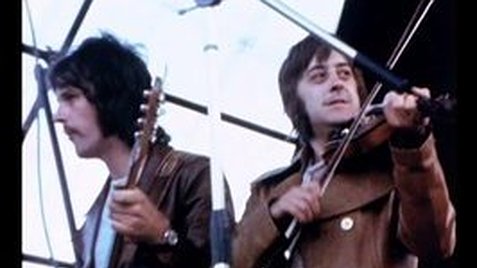
As for the music, Terry Reid armed with a fantastic mixed race band of musicians (needs to be mentioned as the event itself is intensely Caucasian) pounds out a scorching version of “Dean” whilst the camera pans through the audience as the crowd gets freakier and more naked with each drum beat. There is some more random hippiness when suddenly the absolutely stunning sounds of Ashley Hutchings’ bass fuels a number played by his group, Fairport Convention. Still active to this day, Fairport Convention delivers one of the finest performances of the film. Once their number ends, though, it’s back to the drum circles and Big Bambu sized joints until an interesting meeting with a African-English Christian minister who explains his happiness with the peaceful attitude of the event. The minister’s positive report makes it fairly clear at this point that the event would not be mired in the same ugliness that had ended so many events in the states. In fact, the appearance and acceptance of a multitude of different faiths being practiced during the film clearly delineate Glastonbury from its American festival counterparts. You see a proper Anglican minister performing a small Sunday service for a crowd of somber ticket buyers whilst the Guru Maharaj speaks to thousands of flopsy mopsy dancing potential Hare Krishna recruits, which is soon followed by Arthur Brown as he ignites a few crosses for a theatrical Satantic ritual after a tune or two. Let’s just say that there is enough polytheism at the Glastonbury Fayre to make the Book of John burst into flames but at least the different tribes are all getting along.
The overall selection of music for the film surpassed my expectations, though I would’ve appreciated the omission of American folk singer Melanie and her crying and downright vicious vocal style. I imagine that some of the selections were made due to rights issues as other artists who performed at the festival such as David Bowie, Hawkwind, Brinsley Schwartz, and Pink Fairies did not make it into the final cut of the film. The final performance by Steve Winwood’s Traffic doing a an off-rhythm version of Winwood’s own hit with The Spencer Davis Group, “Gimme Some Lovin,” was a fitting end to the frenetic musical goings on at Glastonbury.
Glastonbury Fayre Trailer
One would expect that a Nicolas Roeg shot film would possess a dazzling visual style, and there are many moments that bear out Roeg’s daring camerawork, but the cinematography does vacillate between gorgeous and simply competent, which struck me as odd. I did a bit of research here and found out that although Roeg gets the credit as director, he walked away from the project after just a few days of shooting. The story goes that Roeg arrived with several cameramen in tow and shot a decent amount of film but was called away to work on his film Walkabout. An amateur cameraman, Peter Neal, gathered Roeg’s footage and blended it with the 16mm film shot by other amateurs. Though visually inconsistent, this randomness in style and quality does add to the raw energy of the event. Glastonbury Fayre stands as an important document in terms of seeing the genesis of an enduring music festival that scarcely resembles its humble origins now.
Bollito di Carne translates into “Meat Boil” and although I am using extremely pretty beef short rib for this recipe, I left the recipe as “meat” because you can use this process with pork as well. Trust me it will be delicious. The key to this dish is the boil that the aromatics get prior to adding your meat and vegetables and the subsequent cooking of the meat that is extremely slow which guarantees an almost butter texture and flavor that runs through each bite and to make things better, you will end up with a fantastic broth as well. Total prep to plate should be about three hours but there is little prep involved.
You will need: Two pounds of sliced (1/2 inch thick) beef short rib (my favorite), 4 potatoes, 3 carrots, 4 stalks of celery (preferably with the leaves on still), thyme, parsley, salt, pepper, parsley, a bay leaf, crushed red pepper. You’ll also need at least a four quart stockpot for all of the magic to happen in one place. As always, thanks for checking this out and please let me know how yours turned out.
Love,
Generoso
Music: Georg Philipp Telemann’s Trio Sonata in A minor
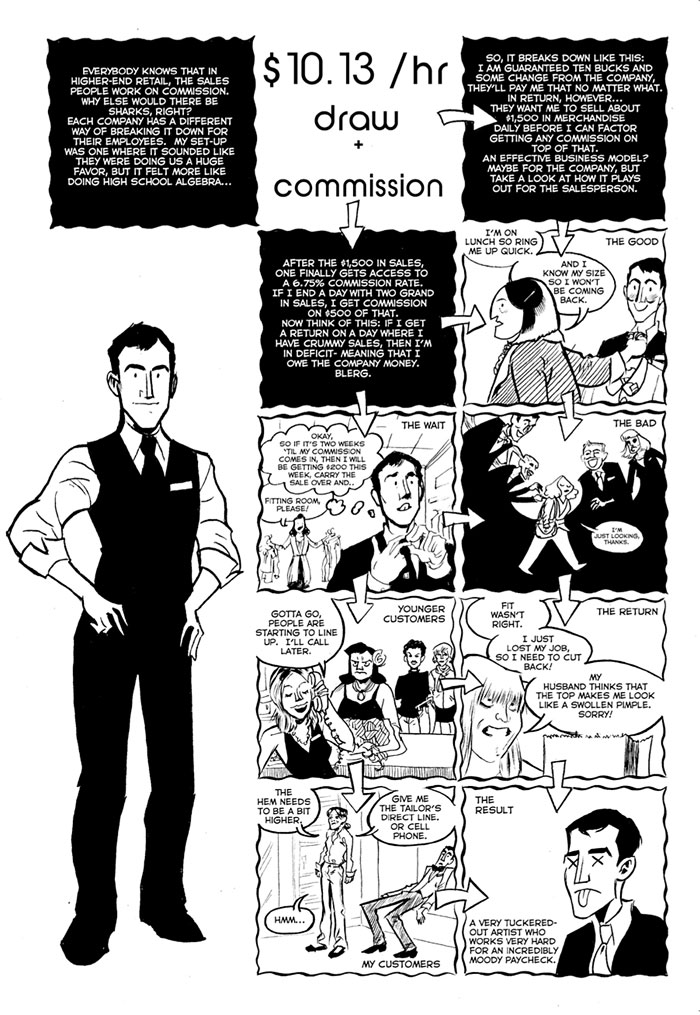
Before I jump into this review of Sina Grace’s Not My Bag, allow me to preface my thoughts with the note that I have always adored fashion. My days of fascination with couture are somewhat over, but the outrageousness of best works of John Galliano and Jean Paul Gaultier will always be near and dear to my heart. Consequently, my disappointment with Not My Bag does not stem from a lack of interest in the fashion industry, the subject of Not My Bag that may turn off many independent graphic novel readers; it comes from the lack of personal voice and introspection. As expected from a novel about a nightmarish job in the retail side of fashion, Not My Bag looks vibrant and stylish. Sadly, as with most of the prêt–à–porter world, little substance exists beyond the illustrations, making the novel far less innovative and expressive than Alexander McQueen (one of Grace’s muses for the work) and more like the sharp and sterile looking but never groundbreaking Ralph Lauren.
Alluring cover for the pitifully boring Not My Bag
Somewhat of a semi-autobiographical memoir, Not My Bag primarily focuses on the central character’s entrenchment and awakening from his retail job in a luxury department store where he sold pallid Eileen Fisher threads to middle aged women who felt that a cashmere stretch cardigan was a step up from sweatshirt. There are plenty of tales about the ignorant customers who purchased the sub-par made in China clothing he and his colleagues sold, but the main lens of Not My Bag hones in on the main character’s peers, the vapid and cutthroat brand specialists and sales associates of the nameless luxury department store that most resembles Nordstrom. Given a low base salary and a sales requirement that encourages even the shyest person to transform into a piranha, the sales folk of the store predictably have no moral compasses in their treatment of their customers not to mention each other, but alas, what else do you expect? Sales is sales, regardless of the product, so what makes the stories of these salesmen/saleswomen different from their counterparts in the notorious, reviled used car world, a group of sales miscreants that film has already explored quite thoroughly? Nothing, and if I must spend time with the dysfunctional salesmen, I’d rather watch Kurt Russell in Used Cars.
Grace adds a side arc about his broken relationships in the past to accompany his journey into the retail underworld, but we only see small vignettes of these moments into his relationship baggage with a couple more into his current relationship with a guy he calls, “the lawyer,” in a supposed to be cute, distant pet name way that comes off as dismissive and annoying. The relationships expose his insecurities, giving some insight into why he’s been consumed by the luxury clothing sales world, but overall, they add little dimension to his character. Together, his relationship history and his salesman identity create nothing engaging, nothing that explores the psyche of the multiple personas of the protagonist; he is as bland and vacuous as the Eileen Fisher clothes he sells.
In addition to the dull story, Not My Bag suffers from an inability to balance fantasy and reality. As a result, more realistic moments feel too caricaturish and more phantasmagoric panels feel half-hearted and unimaginative. The back cover describes the work as a Gothic one, and whoever felt that balloon like ghosts representing lovers of past and a slightly more sinister looking Isabella Blow who wears ominous masks constitute a Gothic work should revisit Lord Byron and Edgar Allen Poe; they (and I) are offended that anyone would ever consider Not My Bag as a piece of Gothic storytelling.
Thankfully, Not My Bag ends before hitting page 100, which was a relief as I read it, but its length is also one of its fatal weaknesses. Grace cites Craig Thompson as an inspiration, and one of the best features of Thompson’s work is his willingness to give a plot and characters time and space. Conversely, Grace presents his protagonist, his conflicts, and his characters with the brevity of a Reader’s Digest summary, which weakens the work even further because everyone is a shell of a character that offers, at best, a trait similarity to people in reality. Worst of all, Grace presents tidbits of the sources of his protagonist’s identity conflicts but does not delve into them, and this is the most frustrating because these struggles with identity could bolster the story with the richness it so desperately needs, but Grace treats them as asides, giving more attention to the hollow sales demons we really do not care about.
I wanted Not My Bag to succeed because of my own love for fashion and learned disillusionment with the industry, but unfortunately, it just does not work. Grace’s storytelling chops were definitely rusty with this one, especially since this work was his first since quitting his job as Editorial Director at Skybound. It’s a shame that everything feels so trite here because the intersection of avant-garde fashion and comics could produce something fascinating, but alas, the Eileen Fisher uninspired, drab lack of vision must have had a greater subconscious influence on Not My Bag, for the result evokes as much excitement as I would get from an overpriced denim tunic that I would barely even wear as a house garment.
Not My Bag by Sina Grace is available via Image Comics.
After two weeks of theme shows, we came back this week with our time-tested recipe for The Bovine Ska that included a spotlight of an early Coxsone imprint, Rolando And Powie which started midway through the show.
We dedicated this show to vocalist Jimmy Riley of The Sensations and The Uniques who recently announced on his official page on Facebook that he was in poor health. We send him and thoughts and prayers for a full recovery. To honor Jimmy Riley we started our show with his wonderful rocksteady from 1968 on Coxsone You Should Have Known and then followed with a version from The Gladiators, Tribulation. The second set of rocksteady began with a rarely heard Melodians cut on Treasure Isle, a beautiful harmony on Somewhere from 1967. After a nifty mento set which featured The Wrigglers 1960 tune, Little Boy which was released in 1960 Kalypso LP The Wrigglers Sing Calypso At The Arawak we threw out a scorching ska set that began with one that we have never played on the Bovine Ska, Love Is All I Had by The Federal Singers on Federal Records. Right after the ska set, we went right into our spotlight on the Rolando And Powie Label.
As a young man, Coxone Dodd moved to Florida to work as a crop picker, and during this time, he immersed himself in American Rhythm & Blues, which he had known via Tom the Great Sebastian’s soundsystem, but being in America, he was able to hear the latest hits and see live performances, giving him a new insight into the music. Consequently, when he moved back to Jamaica, Coxone Dodd opened up his Downbeat soundsystem, playing records he would regularly bring back from trips to America. As rock ‘n roll overshadowed rhythm and blues America, Coxsone decided to to record Jamaican musicians and to play fewer American records at his soundsystem. Initially, these recordings were only created as Dub plates, but upon realizing that commercial potential of the music played at the Downbeat, Coxsone Dodd began opening his own record label imprints, allowing the one off songs recorded on Dub plates to be enjoyed by anyone with a record player or via DJs on the radio.
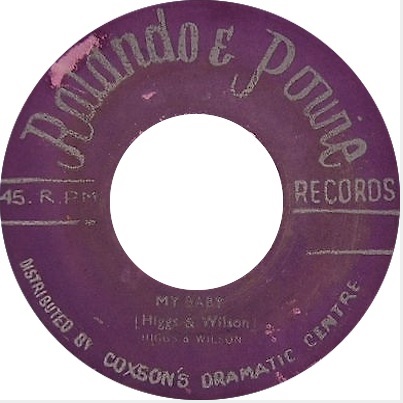
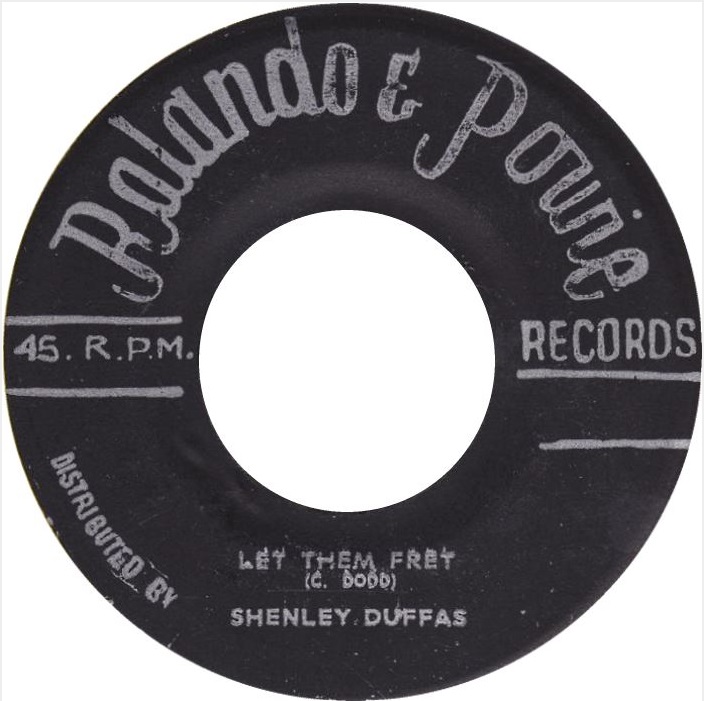
During the sessions that produced singles for Coxsone Dodd’s labels, Dodd relied heavily on the talents of Rolando Alphonso, who was well known across the music industry as an excellent saxophonist and as a result was in high demand from multiple producers. Powie, a Chinese Jamaican friend of Roland’s, opened up the Rolando and Powie label, with Powie paying for the recording sessions that Roland performed on. In less than a year, Roland decided to record more for Coxsone, so Dodd bought out the Rolando and Powie label and used it to release his own productions.
We kicked off this spotlight on the Rolando and Powie label with Powie’s Hop, a track referring to Powie and one backed by the Alley Cats, a group that Rolando helped form and would be the key group to initially record for the label before Coxsone took it over.
You can listen to our full Gladdy Anderson retrospective from January 5th, 2016 HERE. Subscribe to our show on Mixcloud; it’s FREE, and you’ll get an email every Tuesday when we post a new show.
Happy December!!! Please help us and spread the word and repost if you liked the show! Repost anywhere you see fit.
As a kid, Lily loved Banh Mi Xiu Mai, a banh mi made with savory and sweet meatballs. When she moved to Boston, the Banh Mi Xiu Mai had a softer meatball that had a tomato sauce, which was satisfying, but it did not compare to the version she had as a child.
After plenty of recipes, Lily finally decided to tackle Xiu Mai. This version has a sugar based sauce similar to that used with Thit Kho, and instead of using traditional ground pork, these Xiu Mai were made with ground turkey. You can use whatever meat you prefer; Lily herself will probably experiment with a mix of ground beef and pork in the future!
We served the Xiu Mai as a Banh Mi sandwich, but you can eat the meatballs with rice, vermicelli, or pieces of bread. If you roll the meatballs smaller, you can even make them into tasty appetizers with a small slice of pickled carrot and daikon! Enjoy!
Music provided by Georg Friedrich Händel’s Concerto Grosso no. 1, HWV 319
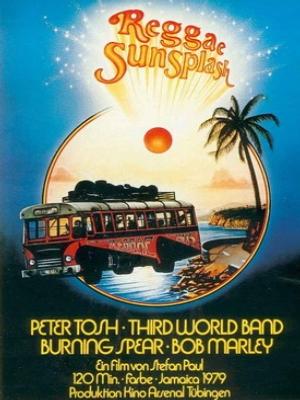
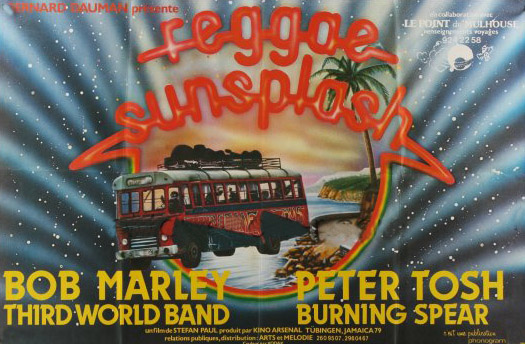
After over nineteen years of producing the Bovine Ska and Rocksteady Radio Show and being a lifelong Jamaican music fan, I am still amazed that I come across the occasional ska or reggae single that I have never heard of before, much less a full documentary. Though the island was producing hundreds of records a month during the latter half of the era that my show covers (1955-1975), Jamaica is still a geographically small island with a population a bit under three million people. Much was done by Jamaican citizens to preserve the music and culture on vinyl and film, but on many occasions, foreign directors and producers arrived on the island to capture the finest artistic moments. Such is the case with German-born director Stefan Paul, who is most noted for directing two well-known Bob Marley concert films, Bob Marley: Live In Concert and Bob Marley: The Legend Live, and 1982’s Bongo Man which featured Jimmy Cliff. All three of these films are fairly standard concert films that offer little insight into the featured artist or the attending audience, which contrast the director’s 1979 film Reggae By Bus aka Reggae Sunsplash,which centered on the notorious reggae music festival that took place in Montego Bay from July 3-7th in Jarrett Park, Montego Bay.
The Reggae Sunsplash Festivals were the invention of Jamaicans Tony Johnson, Don Green, Ronnie Burke, John Wakeling, and Ed Barclay, who staged the concerts in their homeland to further reggae music as a worldwide phenomenon. The original festival ran annually from 1978 to 1998 and was revived one final time in 2006 to feature the most notable Jamaican artists of their time, many of whom, such as Yellowman, Toots and The Maytals, and Big Youth, would subsequently release their individual performances from the festival with great returns given their prominence in the industry and the popularity of the event. After the success of the first Sunsplash, director Paul traveled to Jamaica almost a decade after his first documentary, Open Air 70, to film the second appearance of the festival and to interview artists involved with the festival and Jamaican citizens about the appeal and importance of reggae music, specifically from the Rastafarian perspective, which was rarely seen in reggae documentaries of the time.
Much like the soul music documentaries of the 1970s, Save The Children and Wattstax, concert scenes in Reggae By Bus are inter-spliced with the aforementioned interviews with artists and musicians alike. One poignant interview early on is with Winston Rodney aka Burning Spear, the consummate roots reggae vocalist and O.D. recipient, who just a year earlier had starred in the legendary narrative film, Rockers, directed by another non-Jamaican, Theodoros Bafaloukos. Interviewed playing a game of soccer in St. Ann’s Bay, Burning Spear is quick to tell director Paul that reggae reflects the voice of the Rasta community while the heavy handed, dry over narration reminds us that his music is “not about love or sex but is part of a political, nationalist Rastafarian propaganda machine.” When Paul asks Burning Spear about the togetherness of the Rastafarian community, Spear responds positively by saying, “We live together and play together. We are always together.” Soon we are oceanside with a group of Nyahbinghi drummers who sing along with their drumming and who then speak about the crucial nature of drums in Jamaican music in that the drum originated in Africa and is uplifting to the Jamaican and “puts them in the driving seat” as it brings them back to their pre-slavery roots. The drummers then discuss the “freaky nature” of modern reggae with its reliance of synthesizers and wah wah pedals, which draws away from the pure nature of the music.
Of all the acts that performed at the festival, only four acts are singled out from the 2nd Reggae Sunsplash to make it into the documentary: Bob Marley, Peter Tosh, Third World, and Burning Spear, and each are given substantial performance time on screen. A few standouts are the thrilling funk/reggae performances by Third World on the tracks Talk To Me and Third World Man, Burning Spear’s heartfelt voice on Slavery Days and much of Bob Marley’s impassioned performance, which constitutes the final third of the film, with my highlight being a reggae version of the earlier rocksteady gem from 1968 written by Marley for The Wailers’ own Wail N Soul label, “Hypocrites,”with the I-Three’s, Marley’s backing vocalists, filling in brilliantly for Peter and Bunny. By 1979, Bob Marley was a worldwide phenomenon, and thankfully there is a lot of footage floating around of his performances from the late 1970s, but this one is truly special. A short interview with Marley from his yard on Hope Road was inserted between the songs, and he speaks openly about how the other rhythms from Jamaica are for other classes of people and that reggae is the true music of the Rasta. The narrator furthers Marley’s comments about the true audience of reggae while we observe footage of the residents and shanties of Trenchtown, where Marley was born, and the impoverished area of St. Andrew’s Parish, where, despite its desperate conditions, managed to produce some of the greatest artists ranging from Alton Ellis to Delroy Wilson. Paul correctly explains that from “the mento, ska, and the rudy boy tradition that these musics were only appreciated by the lowest classes of that Jamaica” and stressed the “constant war between police and Rastas,” as they (Rastas) were still viewed in a negative way by polite Jamaican society. Though the narration is sporadically administered, and the style is delivered in an exceedingly dry way that doesn’t fit the overall feel of the film, it provides a mostly accurate cultural context for the music by showing you a 1970s Jamaica that was engulfed in political violence, which led to a mass exodus of businesses resulting in a faltering economy .
Bob Marley’s Interview In Reggae By Bus
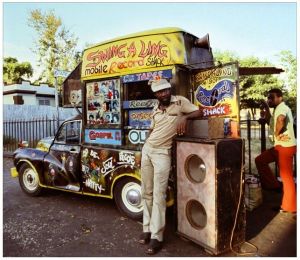
Past the essential performances seen in most concert films and the accompanying interviews, there is always one moment that stands higher for me in most films of this kind that becomes the reason why I would watch it again, and in Reggae By Bus, that is the rare glimpse of foundation deejay Charlie Ace’s Swing-A-Ling Vanin action on the streets of Kingston. Born Vernel Dixon, Charlie Ace would take his reggae-modified Morris van into all areas of Kingston selling the latest releases while live toasting over versions of newly pressed records. In Reggae By Bus we see Ace and a younger DJ taking their turns on the microphone while performing for a crowd that had gathered by the van. It is a fantastic scene that I’m sure director Paul was glad to have captured it, but again I sadly say “rare” in terms of footage as Charlie Ace was gunned down near his van roughly two years after this documentary was released.
Foundation Deejay Charlie Ace
Unlike its soul music counterpart Wattstax, I wished that Reggae By Bus spent more time collecting the stories that would frame the importance of the Reggae Sunsplash festival in terms of its cultural impact. A few attempts are made to put it in context, and they do resonate, but a few more moments with the average citizens of Kingston would’ve provided a clearer frame for the event. Regardless of that critique, there is too much essential footage within Stefan Paul’s film to discount it as just another reggae documentary, and although there has never been an official home video release, fragments of the film do exist online and are well worth your time. It’s an essential watch for the reggae fan and a good introduction for any curious viewer who wants to learn more about reggae.
After two readings of Inio Asano’s Nijigahara Holograph, I, like many other reviewers that tackled the 2014 English translation of the collected chapters of the seinen manga originally released in parts from November 2003 to December 2005 in Japan, will admit that I may not completely understand the series. However, absolute comprehension does not prevent any enjoyment of this tale; in fact, it mostly relies on an ebb and flow of guttural reactions ranging from repulsion to somber recollection in the best Takeshi Miike way but with a bit (though not much) more anchored in reality.
Cover of the English Volume of Nijigahara Holograph
Opening with butterflies, a boy walking on the exterior of a school, and then a young man speaking about his ill father and the merging of reality and dreams to an elderly man whose face we cannot see, Nijigahara Holograph immediately distinguishes itself from what the West generally expects from manga. Expect no adolescent scantily clad women here; in fact, leave any hope for romance or lost love or even any bit of catharsis at the door. The world of Nijihara Holograph is severe, bleak, and unforgiving, and every single character suffers for his or her own actions or for the sins of others. This is not a read for the faint of heart.
The Eerie Second Page of Nijigahara Holograph
Time has no constancy in Nijigahara Holograph as ghosts and memories of the past never fade away: beyond the flashes we see in the minds of the characters, the evils of the past have a physical manifestation as glowing butterflies that swarm the city. As time unravels in the novel, so does reality, with everything in the present clouded by recollections, dreams, hallucinations, and even a touch of prophecy fulfillment. While the different characters have their own branches and paths that occasionally intersect, their arcs remain rooted together by Airé Kimura, a young woman who has remained in a coma in the local hospital since childhood. Airé prophesied the end of the world via a monster in the Nijigahara tunnel, and the people around her did not believe her and caused her harm by attempting to sacrifice her to the monster in the tunnel.
Airé is not new to the world; her spirit has transformed multiple times, with each version warning the surrounding world about the apocalypse to come and each message of caution receive with skepticism and distrust. The citizens of the village murdered Airé’s previous incarnations, but in the most recent cycle, after a majority of her classmates push her down a vent that ends in the tunnel fated to have the monster, Airé survives, but she remains unconscious through her adolescence and early adulthood. This permanent state of sleep keeps Airé safe from the world around her, away from the various predators who have either psychologically or physically attacked her, but it also keeps her force present on the earth. While life has remained quiet for most of the people who crossed paths with Airé, with her classmates growing uneventfully into adults and teachers having families as they approach their early 40s, an energy of dysfunction and hysteria has recently descended on the town, causing macabre scenes of violence and various, seemingly unconnected journeys toward the Nijigahara embankment, the entry to the tunnel that contains the creature of the apocalypse. An awakening to Nijigahara will arrive soon, and as the time approaches, more and more butterflies spread across the town and begin to consume people connected to Airé in one way or another.
While Asano alludes to philosopher Zhuangzi’s well translated and studied quote about the philosopher’s dream or reality as a butterfly, whether or not all of Nijigahara Holograph captures the dreams of Airé, her childhood friend Kohta, or Amahiko, the student transfer from Tokyo who never met Airé in person but who may have encountered her spirit, remains unclear by the end of the series, but whether everything occurred under dream logic or not is unimportant to Nijigahara Holograph, for the actions in the series speak as gravely in dream form as in reality about the cyclical desecration of purity through violence, cowardice, and fear.
Highly experimental in its image and story construction, Nijigahara Holograph creates a unique mood of dread with its sudden juxtapositions of visual beauty of Airé and the butterflies against the most abject and abominable acts of human will. As a result, the feelings of desperation and futility do not stem from Airé’s declarations of the impending end of the world; they come from the abject nature of the humans which gets passed on from generation to generation without a clear end in sight. This cyclical nature of pain, torment, and the destruction of beauty drives the world of Nijigahara Holograph, making the idea of the apocalypse paradoxically welcoming because while it does end life, it finally will end suffering generations of people have inflicted on each other.
More of a punch in the chest rather than a distanced, ruminative read, Nijigahara Holograph demands and consumes all of your attention. It challenges your own perspective, thoughts, and dreams along with the definitions and conventions of the comics and manga medium, making it a sobering read in the first week of the new year. While I still feel that I may not understand all of the layers of Nijigahara Holograph, I do know that it encourages me in 2016 to dig deeper for comics that test the boundaries of storytelling, and for that inspiration alone, I am grateful to Inio Asano, even if this work accomplished a remarkably overwhelming sense of gloom and desolation in its exploration of some of the deepest, darkest crevices of our collective hearts and minds.
Happy New Year Bovine Ska and Rocksteady Listeners!
Another tradition fulfilled this week as we on The Bovine Ska have produced our nineteenth New Years show where we play the first recordings of many of your favorite Jamaican artists. In some cases, the artist was part of a vocal group and we noted this when we backtracked each cut. Here are some of the tracks we played during this show.
Alton Ellis – Alton and Eddy – Muriel
Alton teamed up with Eddy Parkins after winning a few contests to record for Coxone Dodd. Muriel is believed to be one of Coxone’s first recordings aimed at commercial, rather than sound system release. Beyond Alton’s debut, this was a special track because it was written by Alton himself while he was worker as a laborer on a construction site.
Eric Monty Morris – My Nights Are Lonely
After seeing some success with his performances at Vere John’s talent shows, Eric Monty Morris teamed up with his neighborhood friend Derrick Morgan to record for Simeon Smith.
Winston Samuels – In Jail
The exact history of Winston Samuels is unclear, but we do know that his first single, released on Coxone’s All Stars label was a single that had opposite but connected titles: Paradise and In Jail
John Holt – I Cried A Tear
Before John Holt ever entered a studio, lots of folks were already talking about him. Beginning at the age of 12, Holt performed at talent shows, including the Vere John’s Opportunity Knocks Talent Show, and in total, during his competition years, won 28 awards. Given this success, it is no surprise that Holt caught the eye of Leslie Kong, who would record and release his first song, I Cried a Tear, for the Beverley’s label in 1962
Bob Marley – Judge Not
After moving to Trenchtown and gaining more experience with the growing Kingston music scene, Bob met Jimmy Cliff and Derrick Morgan, who together in 1962 would introduce the 17 year old Marley to Leslie Kong. Kong would record and release Marley’s first song, Judge Not, with Bob under the pseudonym Bobby Martell, a stage name given to Marley by Jimmy Cliff.
Desmond Dekker – Honor Your Mother and Father
As a young man, Desmond Dekker was a welder in Kingston. Here, he would sing with his co-workers and eventually, given his voice and talent, his co-workers convinced him to pursue a career in the recording industry. Dekker auditioned for Coxone Dodd first without success, and then traveled over to Leslie Kong, who signed him to a record deal. In 1962, Dekker’s first recording, Honor Your Mother and Father, a song Dekker wrote himself and was the one he auditioned with for Kong, was released on the Beverley’s label.
Jimmy Cliff – I’m Sorry
Cut as a dub plate for Sir Cavalier’s sound system, Jimmy Cliff recorded I’m Sorry a little before his formative years at Leslie Kong’s Beverley’s label.
Hopeton Lewis – The Regals – Shammy Back
As a young man, Hopeton Lewis sang at the Burnt Savannah Holiness Church, which nurtured and encouraged his talent and passion for music. Upon entering the music industry, Hopeton Lewis joined the vocal group, The Regals, who first recorded for Coxone Dodd and his Wincox label.
Junior Soul – Miss Kushie
Junior Soul, born Murvin Junior Smith, learned how to sing from the phenomenally talented Eric Monty Morris and Derrick Harriot and gained his stage name when he would perform for people with Jackson Jones. When he first decided to record, he went over to Sonia Pottinger’s Gayfeet label to record Miss Kushie in 1966.
You can listen to our full Gladdy Anderson retrospective from December 29, 2015 HERE. Subscribe to our show on Mixcloud; it’s FREE, and you’ll get an email every Tuesday when we post a new show.
Happy December!!! Please help us and spread the word and repost if you liked the show! Repost anywhere you see fit.
Earlier this year my wife Lily and I got to meet director Larry Cohen between a double feature screening of his seldom seen 1984 film, Special Effects, and his uneven yet wildly entertaining 1990 thriller, Ambulance, at the Egyptian Theater in Hollywood. Sadly, there was only a small crowd for those Thursday night screenings at the cavernous theater on Sunset Blvd., a theater where anything less than a sellout always feels dramatically under attended.
I especially felt a bit badly about the low turnout as I have long admired Cohen’s films, an admiration that began after my friend Ron and I got our hands on a VHS copy of his 1974 newborn baby that rips up everyone classic, It’s Alive. That horror film that set our standard for“batshit crazy” which we would use for every phantasmagorical film that we saw afterwards during our teen years. Besides ranking It’s Alive against other horror films of late 1970s and early 1980s, we also hunted down any movie that Cohen directed, with many being to our delight like Perfect Strangers in 1984 and Q in 1982. You remember Q don’t you? That was the one with giant flying lizard that had a thing for eating New Yorkers, which as young Philadelphians who hated the Mets and their fans was more enjoyable than perhaps originally intended, but of all of the films that Cohen had directed post-It’s Alive, we really loved his 1976 film, God Told Me To, a visually stunning science fiction horror film that centered on Catholic guilt,which we had seen not too long after Scorsese’s Mean Streets, which for ushad set the gold standard of dealing with our own Catholic guilt.
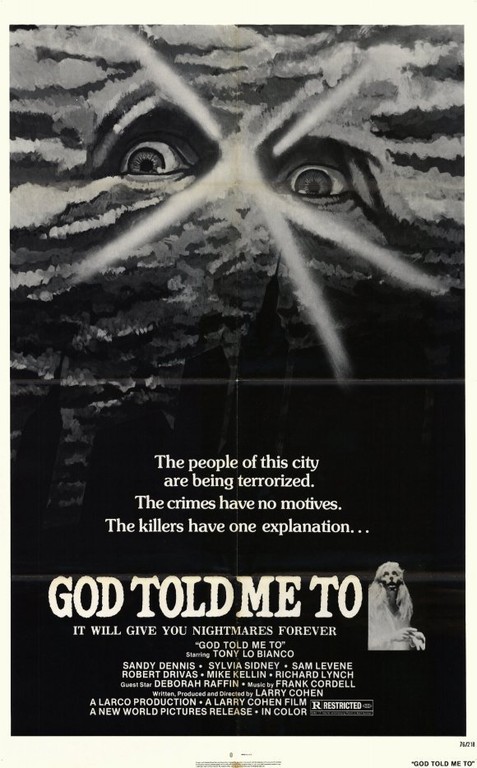
Cohen wrote, produced, and directed God Told Me To, which is centered on Catholic NYC Police Detective Peter Nicholas (Tony Lo Bianco), a well intentioned, sad sack cop who is investigating a series of random murders where the only constant is that the killers’ last utterance, which is the title of this film. If this supposedly God-inspired bloodbath doesn’t play with his Catholic guilt enough, Peter is in a severely dysfunctional open relationship between his wife of many years, Martha (the always sullen, Sandy Dennis), and his younger girlfriend, Casey (Deborah Raffin). The setup is good for a classic Italian Roman Catholic meltdown, which brings up a point that I have wondered about for years and regretfully neglected to ask Cohen that night at the Egyptian: “Why would you cast Italian-American actor Tony Lo Bianco to play essentially an Italian-American archetype but named that character Peter Nicholas?” Nicholas’s self-tormenting persona is quite similar to Mean Streets’ Roman Catholic repressed Charlie (Harvey Keitel), but as Mean Streets was released only a few years earlier, perhaps Cohen changed the character’s nationality to avoid comparison, which is almost unavoidable given the Catholic setup and its NYC location. It doesn’t change how much I appreciate this film in any way, but it does need mentioning if not for the one chance that I can face Cohen in the future without turning into a thirteen year old fan.
Through a bit of clever detective work, Peter finds out that all of the killers have been influenced by a religious cult leader named Bernard Phillips (Richard Lynch), a Christ-like figure from space whose alien race convinces these white, earth men to turn their arms on other white people, who historically had more authority and voting power in New York City. This subplot is commonplace as issues of race and social status have always been a part of most of Larry Cohen’s films since his debut dark comedy Bone in 1972 and his subsequent blaxploitation films Black Caesar and Hell Up In Harlem. Peter fittingly meets Bernard in the hell-like basement of a slum apartment building, and it’s here that Cohen creates his contrasting image of God, a hermaphroditic figure who argues with Peter about a possible revolution of minorities to bring them to the level of ruling class while still preaching hate like a dictator. It is the contrasting nature of the film that becomes God Told Me To’s strongest mechanism as it fills the narrative with a state similar to that which is occurring inside of Peter, the Madonna/whore complex that rules not only his romantic relationships but his familial relationships as we find out that the many of Bernard’s disciples may have been born out of interstellar virgin birth to make the whole guilt thing more than any Catholic can handle. In fact, all of the extraterrestrial/religious/racial themes of God Told Me To only serve to stress the real erupting urban landscape of a desperate 1970s New York that was experiencing the latter stages of white flight-inspired urban decay. Perhaps Louis Malle’s My Dinner With Andre, which would be released a few years later in 1981, defined Larry Cohen’s intentions with God Told Me To in a way that now makes complete sense: that this late 1970s New York was in fact some sort of sociological experiment or worse some sort of penal colony where the guards are actually the prisoners that never saw the kind of revolution that Bernard suggests, leaving the town in an unsatisfying malaise.
Considering the low budget of God Told Me To, Cohen leaves a lot of the money on the screen, as this may be the most visually striking piece of his career. Most impressive are the sessions between Bernard and Peter that take place in the gold-lit bathed boiler room of the apartment building. The schlock is at a minimum here as we not only feel the frenzy so present in Cohen’s work but also a state of awe that needed to be present so that the audience could empathize as to how Bernard could convince his disciples to go out and kill on his behalf. The scenes of the alien abduction of virgin brides also gets the first class sci-fi treatment here as does the score by Frank Cordell, who filled in for legendary composer Bernard Herrmann, who had scored Cohen’s It’s Alive and had agreed to score God Told Me To but passed away shortly after accepting the contract. Cordell’s score, much in the mold of Hermann’s music for It’s Alive, does a fantastic job in driving the overall creepiness of the narrative.
Original Trailer For God Told Me To
As messy as all of this sounds, God Told Me To’s science fiction/horror/sexualstructure keeps the viewer off kilter for the entire ninety minutes while never losing its protagonist Peter Nicholas in the process in the same way that Scorsese’s Mean Streets‘ over the top realism and violence never loses its hero, Charlie. Both men looking to keep the peace but neither realizing that the only peace they need cannot come solely from saving those around them but by saving themselves. So, whether Cohen saw Mean Streets and decided to give it the Cohen touch or if it is a totally original concept, only Larry knows, but either way, it brings home the damage that years of getting smacked in the hand by rulers held by potentially alien women wearing capes can do to a good Catholic boy who is only trying to do the right thing.








 LILY & GENEROSO 4EVER!