Barbara Loden’s Debut Film, ”Wanda” From 1970, Is A Cinema Verite “Badlands”

Standard
Wanda FilM Image

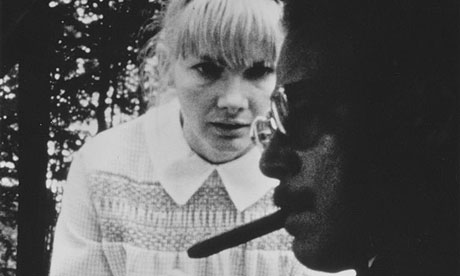
Barbara Loden and Michael Higgins in “Wanda”

There is a moment in Barbara Loden’s only directorial effort, “Wanda,” when our titular protagonist removes the onions off of the burger she was ordered to get her newest man, Mr. Dennis, that sums up this film well. You see, Wanda (also played by director Loden) has met our Mr. Dennis (Michael Higgins) just the night before while he was robbing a bar, and they are now on the lam, shacked up together in a dingy motel room when he lashes out at her for forgetting the one item he desperately wants off of his food order, the onions. It is a sad moment, but Wanda quickly performs this task soon after going out to get the food in the middle of the night and makes up for her mistake in the exact same way, with a tired resolve and dead eyes.

Wanda has recently left her husband and children in a mining town somewhere in rural Pennsylvania; she didn’t want that life anymore nor a life with the first man she jumps in bed with after her husband or the man after him. In fact, it’s made pretty clear that her lot in life traps Wanda. She is a poor, pretty, and not very bright young woman who like Sissy Spacek’s Holly in “Badlands,” is just willing to tag along for lack of anything else to do, but unlike Badland’s Holly, Wanda is emotionally numb and frankly just stupid enough to believe that she can handle what is about to go down.

There is much to be admired of “Wanda,” the first theatrically released featured film to be simultaneously written, directed, and starred by a woman here in the United States. “Wanda” has a raw, improvisational style of acting that heightens the realism of the performances and a well-matched low budget stretched 16mm cinematography by Nicholas Proferes. There are no long gorgeous shots during “magic hour” here, where the cold shabbiness of the visuals add to the hollow desperation of the film’s leads. After “Wanda,” Proferes, would go on to lens her husband, Elia Kazan’s 1972 film, “The Visitors.” Kazan, the brilliant director of “On The Waterfront,” claims to have little to do with “Wanda” during its production but would go on to say that Loden and Proferes would combine to make an excellent team by bouncing ideas off one another.

What I found to be the key in the success of “Wanda” is that Loden never betrays her two lead characters. The film is never sentimental or heroic, for Wanda and Mr. Dennis would not be heroic by any means in real life. As you go deeper into their relationship you see the shell of two very broken people, who have been told by those around them that they would never amount to much, and, despite any effort, they never will. You somehow know that the big job that they are going to pull is not going to work. A grand end just cannot happen, as that would be out of line with their life paths. It is a nihilistic yet entrancing film that steps into darker territory with each scene, culminating with one of the most soul crushing endings this side of Jeanne Dielman. But, in the end, we do not have a modern feminist hero nor an anti-hero for that matter; we only have another walking causality who will fade into nothingness.

Director Loden Speaking with Mike Douglas About “Wanda”

Shortly after winning the International Critics Award at the Venice Film Festival for “Wanda,” director Barbara Loden, who was born in Marion, North Carolina, told film critic Michel Ciment about her hometown: “If I had stayed there, I would have gotten a job at Woolworth’s, I would’ve gotten married at 17 and had some children, and would have got drunk every Friday and Saturday night. Fortunately, I escaped.”

It has been said of Barbara Loden that she was a shy and soft-spoken loner, like her character in “Wanda.” Sadly, Loden and her real life husband Elia Kazan would become estranged after she received many accolades for her directorial debut and only film, and they would remain estranged her until her death in 1980 at the age of 48 from breast cancer.

Rip Torn Plays a Mean Guitar in “Payday”, 1972’s Overlooked Country Music Tragedy

Standard
payday

“Payday’s” “hero,” Maury Dann,with his entourage

I’ll start off this review by saying that I have always been a huge fan of actor, Rip Torn. He is that hulking man with the confident grizzled look, who is armed with a voice that can only be described as “pleasantly gravelly.” Going back some twenty years ago after seeing Rip’s fine comedic performance as Albert Brooks’ jolly attorney in “Defending Your Life,” my friend Steve asked me, “Have you ever seen Rip Torn in that dark film where he plays a country singer, called “Payday?” I had never heard of it at the time, but it was his second comment that really sold me on the quest to find it, “The film is as if you followed a character from Altman’s “Nashville” into hell.” I had seen Rip Torn play mean in that world as Dino, the evil country music promoter in Alan Rudolph’s 1984 film, “Songwriter,” but nothing could prepare me for the vile character of Maury Dann, who Rip plays in Daryl Duke’s “Payday.”

To say that “Payday” is about country music is to akin to saying that “The Man With The Golden Arm” is about drumming. Rip Torn’s Maury Dann is a minor country music star, famous enough to afford a Cadillac and a driver/cook/bodyguard named Chicago (Cliff Emmich), his hot girlfriend Mayleen (Ahna Capri), and an enormous bag of uppers, but he is still playing small dive bars where he has to hustle to keep caravan moving. Maury’s crew is somewhere in Alabama heading from state to state to record and play more gigs, but along the way, Maury’s going to inflict some major damage to almost everyone around him.

The film opens with Maury performing at a roadhouse; it’s a fine song, but if you are looking for a music-filled “Inside Llewyn Davis” styled narrative, then you have the wrong film. Again, “Payday” isn’t about country music as much as the world of the country music performer rotting from the inside out. Soon after the gig, our Maury takes a young fan into the back of the Cadillac for a quickie, while his guitarist Bob (Jeff Morris) meets another fan named Rosamond (Elayne Heilveil) who he takes back to his motel room and rapes her after she is put off by Bob’s advances. The next day, Maury heads back home, as any good country singer should do to see his mama, but she is conveniently “bedridden,” strung out on uppers, and soon harasses her son for more bennies to fuel her day’s chores. He hands her a bag, picks up the hound dog, and is soon off to duck hunt with some good old boys, but this picture of southern normalcy also gets broken the moment he returns when Maury beats up Bob for asking to buy his mom’s dog because mom is too messed up to take care of it. After the fight, Bob is left behind by Maury, who leaves his dog as well, and picks up Rosamond, who he adds to his entourage despite the protests of Mayleen, who quickly understands, as we are, that Maury is thinking that he’s too big for his cowboy boots.

In a trailing car, is Maury’s band, and slick city manager McGinty (Michael C. Gwynne) who advises Maury on just about everything along the way, including a stop at a radio station to do some airtime promotion with a small time disc jockey who Maury bribes with some game birds and a bottle of Wild Turkey. Despite the “gifts,” once Maury turns down the disc jockey’s request to play a charity gig later that week, Maury clearly gets the word that his new record “Payday” might not get the additional spins he wants. Yes, payola is still alive and well in the Deep South just like the north, and we again see the breakdown of the homespun country music star take another rough tumble.

There will be more rough times ahead and Maury is coming apart with every attempt at playing the game the old country music way, but with every effort going up in flames, including what should be a touching birthday visit with his son, which ends in disaster when Maury’s ex-wife reminds him that his son’s actual birthday was eight months ago. We know now that this was the beginning of days of Merle Haggard, Waylon Jennings, and the whole outlaw country music scene, so the question becomes: Is Maury a good old boy himself pretending to be an outlaw or the other way around?

Original trailer for “Payday”

Released a few years before Altman’s “Nashville,” “Daryl Duke’s “Payday” never lets you off the hook in its viciousness, its bold non-use of music, and its total lack of joy which keeps you riveted to your seat. Sadly, Duke only directed one other film of note, the 1978 heist film, “The Silent Partner,” before spending his remaining career directing television mini-series like the highly successful, “Thorn Birds.” Rip Torn’s performance as Maury Dann is just extraordinary, a standout for 1970s, the last era of the actor and the reason why you should watch this film. Torn is the complete embodiment of his character and fills the screen with sadness and rage as he missteps over and over again while trying to balance the country music outlaw against a soft-hearted small town man who just wants to make it big.

The Impressive Realism of OR_NGE

Standard
Or_nge

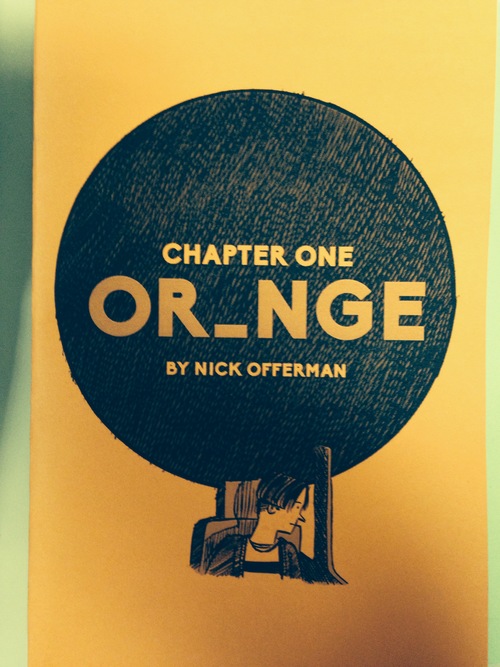
Cover for Chapter One of OR_NGE

The first chapter of OR_NGE opens Henry McNeil’s story of self-discovery. Orphaned upon the unexpected and possibly self-inflicted passing of his mother, Henry has spent most of his formative years in Detroit, raised by his uncle and aunt. There is nothing….absolutely nothing that is out of the ordinary in his daily life. He works a job as a stocker for a nameless hardware or indoor furnishings store. He occasionally sneaks a smile at a female patron as she enters the shop. He returns home after work to his aunt and uncle and repeats. However, there is something unsettling to Henry; he feels there is a hole in his life and/or identity, and his aunt and uncle feel the same thing.

Consequently, in the attempt to find a course to his life and to fill this unknown void, Henry decides to pick up his non-impacting life in Detroit and take a pilgrimage to his birthplace and his mother’s hometown, Toronto, to better understand his mother, her life, and his own origins.

By the end of the first chapter, the core narrative of OR_NGE does not offer too much in terms of innovation; like so many other protagonists before him, Henry McNeil embarks on his voyage to adulthood by trying to understand his past. With that being said, if there is nothing new to Henry McNeil’s story, then what will keep the reader excited and interested in this series? My answer: the ability of the narrative to create a world like our own and to pull you into it.

Despite the normalcy of Henry’s motivations and goals, Nick Offerman (the cartoonist and NOT the well known actor/comedian) gifts Henry and the omniscient narrator with peculiarly neurotic yet endearing voices and personas. Henry’s internal dialog fixates on numbers, whether he’s estimating the speed of a bus or counting the number of months marking the major landmarks in his past, yet, despite his slight number eccentricity, there’s a certain humbleness to Henry that makes you feel like his world is your own. You sit by Henry on the bus. You are in the store with Henry as he moves boxes. You are sitting at the table with Henry’s aunt and uncle as he tersely greets and abruptly says goodbye.

Henry’s dialog and interactions exemplify the palpable realism of OR_NGE. In Chapter One, none of the characters feel exaggerated, and none of their conversations, minimal or otherwise, seem overly constructed, allowing the reader to ease into the series and almost feel like a close observer. This realism to the characters and the events make OR_NGE shine and exhibit the potential for the series.

In addition to the notable realism and honesty established by the narrative and dialog of the first chapter, Offerman’s introduction to the series with an explanation of the properties of orange as an object and adjective conveys his strength in storytelling. Mixing in the descriptions of orange with short moments of Henry McNeil’s life, we understand that Henry’s life will intersect somewhere with the definition of orange outlined in the introduction. Here, Offerman writes and illustrates intelligently and cleverly without being overly self-aware, making even the potentially pedantic opening an inviting and welcoming one foreshadowing the things to come for the series.

OR_NGE has a strong start so far, and it looks like Chapter Two will be on its way soon. Check out the humble realism of Henry McNeil’s world in OR_NGE; he’s going to remind you very much of your own moments of directionlessness, and you’ll be just as curious to see where his travels take him as you are with your own.

OR_NGE Chapter One by Nick Offerman is an independentally published work and is available via goodklown.com

Generoso’s Dangerously Fatty and Delicious, Neapolitan Sausage Soup!

Standard

I wait for the coldest and snowiest days of the year to make this soup, a blend of small and large flavors with a whole lot of fat to keep you going through the wintry mess. Though no cream is added, you will find this to be a savory and creamy soup that I hope you will enjoy despite the rather unhealthy ingredients 🙂

You will need: One pound of sweet Italian sausage, four strips of bacon, one sweet onion, one leek, two large potatoes, ten ounces of kale, one box of vegetable stock, salt, pepper, olive oil, four cloves of garlic and shredded Parmesan. Enjoy and let me know how yours turned out!

Music: Symphonie Fantastique, Op. 14 by Hector Berlioz

Bovine Ska and Rocksteady 2/4/15: Bobby Aitken

Standard
Bobby Aitken photo

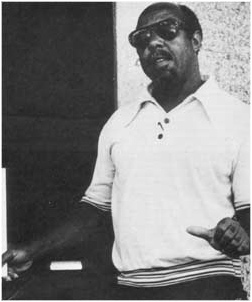
Our spotlight artist Bobby Aitken 

Coming to you from a frozen, snow-covered Cambridge, it’s the Bovine Ska and Rocksteady!  Wow, these last few weeks have been rough with bad weather.  We are also back this week, after missing last week’s show due to Generoso’s hospital stay.  He’s improving but that combined with the snow has made doing the show difficult but we were glad to be back.   Starting the show off this week were two sets of delicious early reggae, beginning with a massive tune from Sound Dimension, “Great Mu Gu Ra Ga” which was released on Bamboo in the UK in 1970.  Our spotlight would be on the early vocal tracks of Bobby Aitken.

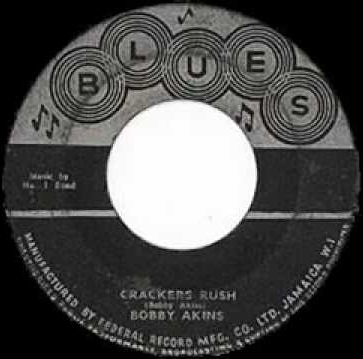
Brother of the godfather of ska, Laurel Aitken, Bobby Aitken, was born in Havana in 1933 and was orphaned in Jamaica at the age of eight. As a boy, he became a mason when his uncle pulled him away from a street gang and introduced him to the masonry trade in order to survive on his own. However, music became a more reasonable means for Bobby, especially seeing that he had a natural gift for it. A precocious 11 year old Bobby built his first banjo from sardine cans and learned how to play guitar on his own. And, by his mid-20s, Bobby had built up his guitar skills and formed the Carib Beats with Charlie Organaire and a man named Morgan in late 1959/early 1960. Together, the group performed primarily calpyso with a few skas, but the trio broke up after the rest of the group did not show up for a performance at the Blue Ribbon Club in Kingston.  As a result, Bobby returned to masonry for a stint, only to make a comeback to music within a year as a solo artist with his single, Cracker’s Rush, which commented on a food shortage in Jamaica and was released in 1961 on the Blues label by Count P, an operator of a soundsystem on Spanishtown Road. We’ll began with this first solo recording of Bobby Aitken to kickoff tonight’s spotlight.

Eventually, after recording for a range of producers including Prince Buster, Coxone Dodd, Linden Pottinger, and King Edwards, Bobby Aitken formed The Carib Beats again with Charlie Organaire and Mike Williams. Other musicians including Bobby Kalphat, Vincent White, Conroy Cooper, Ansel Collins, Carlton Santa Davis, and Val Bennet would also rotate in and out of the group. The Carib Beats recorded for Joe Gibbs, Clancey Eccles, Bunny Lee, and most famously, JJ Johnson.  The second incarnation of The Carib Beats would eventually break up as Bobby decided to focus more on his faith and became who he is known as today: the Reverend Robert Simmonds.

Listen to the full program with our Bobby Aitken spotlight: HERE.

Enjoy! The archive will be available until 2/17/2015 

Richard Dreyfuss Makes Blue Movies The Old Hollywood Way in 1975’s “Inserts”

Standard
Inserts_1_1975

Richard Dreyfuss as “Boy Wonder” in “Inserts”

There is something magical about In Your Ear, a Boston record store/institution that lies in the basement of a Brazilian martial arts center on Commonwealth Ave. An eclectic shop where after a particularly bad week you will most likely find my wife Lily and I gleefully rummaging through the endless supply of old records, 8-track players, Mexican lobby cards, and vintage movie posters, many of which are for films that have been long forgotten. Unless of course you are Reed Lappin, a lovely man whom I’ve known for most of my thirty years in this city. Reed is the owner of In Your Ear and has always had a great admiration for movies, especially those small lost American movies, which to our good luck, he is always in the mood to talk about late on a Friday night. This past week’s excavation project at In Your Ear produced a poster of a British film from 1975 that starred Richard Dreyfuss and Jessica Harper that we had never heard of entitled “Inserts.” This nostalgic poster was reminiscent of Peter Bogdanovich’s “Nickelodeon,” but this one advertised a film that instead possessed an “X” rating and a tagline reading “A Degenerate Film, With Dignity.” As a result, it piqued our interests, and after a quick description of the plot by Reed, we decided to track it down.

The film is set in a disheveled Hollywood bungalow, sometime in the early 1930s, where we find a scruffy Boy Wonder (Richard Dreyfuss) sauntering around his home in the middle of the day, wine bottle in hand  but still in his house robe as he talks up a one-hundred–words-a-second actress named Harlene (Veronica Cartwright) about shooting a scene. We soon find out that something has happened to Boy Wonder, and he has not left this home in some time, and, due to his fallout with the Hollywood system, he has been reduced to shooting pornographic loops in his living room. Harlene is one of his regular actresses, a pretty girl with a fairly irritating voice that is so shrill that we immediately understand why her transition to “talkies” has not been an easy one. Boy Wonder also had a problem making the jump from silent films, but we are not sure as to why this has happened, since directors made the move much easier than some actors who just did not have a “voice.” Early on, Harlene regales Boy Wonder with a conversation between Josef von Sternberg and Clark Gable that she overheard while waitressing where Sternberg had said that Boy Wonder was so down and out that he was panhandling, but that “this kid Gable” had defended him stating that “Boy Wonder was the only real genius in Hollywood and that he wanted to make a film with him,” a fact that Boy Wonder just shrugs off as he gets Harlene ready to shoot some “inserts,” which are short cuts to edit into to final film. Harlene does some smack and then tries to turn Boy Wonder on, even though it is widely known that his “rope won’t rise even a magic flute.”

Soon the male “talent” enters, an actor/mortician comically called “Rex The Wonder Dog” (Stephen Davies), a handsome, stoic young man who is a bit on the slow side and so very anxious to get a role in a “real movie” that he must hustle through his scene today to meet with some Hollywood producer in his hotel room for a shot. Boy Wonder then uses every director’s trick in his bag to get a violent rape scene out of Rex and Harlene, which is indeed as intense as needed, but, alas, Boy Wonder’s camera runs out of film before the climax, so he will eventually need to shoot another “insert” to finish his porno. It is during this scene that we understand that deep inside the dishevelment, Boy Wonder is a real director who is drowning in his own fear.

In walks in our heavy, Big Mac (a pre-“Pennies From Heaven” Bob Hoskins), the new Hollywood, tough and mean with enough money to bankroll Boy Wonder’s skin flick. Big Mac is thinking burger chains and freeways and reminds everyone in the room of Boy Wonder’s collapse from fame. He’s also shown up as usual, unexpectedly, but this time with another wannabe starlet, Cathy Cake (Jessica Harper). She wants to get into the “real movies” as well and makes it clear that although she may appear to just be “silly girl,” she is also more than willing to do what it takes to make it as a star. All that Harlene is looking for right now is her fix of heroin from Big Mac, who supplies her quickly so she is off to go upstairs to fix up despite the pleas of Boy Wonder who tells her she’s had enough. But she doesn’t heed Boy Wonder’s suggestion as we can clearly see that Harlene has had enough in more ways than one and soon she is found dead upstairs. It’s now up to Big Mac to make Harlene disappear, so he leans on Rex’s desire to become a star as Rex has the funeral connection that they need to get rid of the body. That leaves us with Boy Wonder and Cathy who give us almost sixty minutes of intense back and forth dialog as Cathy not only wants to get in the pictures but also get in the head of Boy Wonder. It is this scene with these two fine actors, which makes up the emotional core of the film. Here, Jessica Harper does provide us with the finest performance of the film as she brilliantly skirts the line between vulnerable ingénue and sexual coach.

Director John Byrum Talks About Casting Richard Dreyfuss

First time director John Byrum, who also wrote “Inserts,” creates this world in just one room and amazingly enough, in one take. It should not be surprising then that I should say that “Inserts,” though about the film industry, is really arranged like a stage play with actors having marked dramatic entrances. Though shot on one set, “Inserts” could’ve benefitted from a more daring cinematographer who could have exploited the small moments between Dreyfuss and Harper, which would have better accented the emotional intensity of their performances. One also wonders the necessity of the “X” rating the film received from the MPAA in 1975. Though the dialog may be tawdry, there is little sexually that would warrant an “X,” which even during this decade of sexual freedom might have been the reason for its unfortunate box office failure. One still has to admire this film’s ability to capture 1930’s Hollywood so well, a time and place where one small mistake could make or break a career and where talents could rise up through some very dark passages.

Thanks Reed for picking this one out of the bin for us.

Lily’s Shrimp-less Version of Banh Xeo

Standard

Banh xeo can be found as an appetizer in most Vietnamese restaurants. Lily has two main memories of Banh Xeo

  1. The giant banh xeo that took up an entire food tray made by a stand in a food court at the Vietnamese market/mall in Houston
  2. The hurried banh xeo made at banh xeo parties where someone was always at the stove churning out the treat and passing it to empty plates

In most translations, banh xeo is called Vietnamese crepe. Sometimes you’ll even see it described as Vietnamese pizza. Regardless of what it is called, banh xeo is a delicious dish perfect for entertaining and sharing. The coconut milk and the mung bean paste in the batter make the banh xeo batter perfectly savory, rich, and the tiniest bit sweet. Paired with lettuce, mint, and fish sauce, each bite of banh xeo has a mix of flavors, textures, and even temperatures.

There’s a good amount of preparation required for this dish, but don’t be intimidated; the cooking time is actually very short. Enjoy!

Music: Symphony no. 2 in Cm, WAB 102 by Anton Bruckner

A South to Love, Fear, and Remain: Southern Bastards

Standard

After living in the Northeast for a few years now and hearing folks mock southerners and after watching media create shows, films, and cartoons which do the same, I am always a little weary when I pick up anything that looks like it could be an inflammatory jest at the place I once considered home and still love. Despite my initial concern when I picked up Southern Bastards Volume One: Here Was A Man, when I read the introduction by Jason Aaron, I was sold on picking it up and writing about it for this week.

Cover of Southern Bastards Volume One

As a young child, I loved gothic horror, and as an adult, I came to adore westerns. It is thus of little surprise that one of my favorite short stories of all time is William Faulkner’s A Rose For Emily, my introduction to the sub-genre of the Southern gothic. Southern Bastards carries on the tradition of the southern gothic but in more modern times, which despite the missing Victorian and plantation style houses, is damn well just as terrifying.

The first volume of Southern Bastards introduces us to Earl Tubb and his return to Craw County, Alabama. Earl found every way to try to leave his hometown and succeeded when he fought in Vietnam as a U.S. Marine and when he settled in Birmingham as an adult. Craw County is an insular, country town which has traces of its past coexisting with its ugly present. It’s a paradox of a place where traces of a Christian ethic remain in the air, but a crippling economic state has left people in a new level of desperation, and humanity has been traded in order to get by.

Earl has the responsibility of packing up his family home, but his return to Craw County causes much more than just the reawakening of the ghosts and nightmares of his past. When he witnesses the oncoming of a fatal beating of an old acquaintance, Dusty, by a local gang, Earl’s father’s spirit possesses him, and he begins to shed the persona of a modern, city person that he worked so hard to build and transforms into a punishing vigilante, rising to the legacy of his tough as nails father who was once the sheriff in town. Unfortunately, Earl’s first confrontation of the gang in his valiant and successful effort to rescue Dusty is not met with gratitude from the man he saved or with resignation by the gang he beat.

By upsetting this local gang run by a man named Coach, Earl entrenches himself in the world he rejected and decides to single handedly lead a battle against the tirade of Coach and his gang. As the volume progresses, we see Earl’s noble motive and his immense bravery, but gradually we realize that Earl’s march against the Coach may just be more than he can handle as an older man.

Like every western, our protagonist Earl, has the greatest odds against him but continues to wield his signature weapon, his father’s own giant, wooden whooping stick, with a clear motive of justice. However, in the modern Craw County, Earl is a figment of the past with an antiquated and extinct mindset of unrelenting righteousness, which will most likely bring about his own end rather than begin a revolution.

In combination with the severe narrative, what really pulls together Southern Bastards as a Southern gothic is its artwork. Deftly colored with a muted palette, with moments of dark red during flashes of stinging memories or brutal violence, the illustration of Southern Bastards captures the true and consuming Hell of Craw County. With jarring panels mixing the memories of war, the present, and the ghost of Earl’s father, the artwork of Southern Bastards heightens our understanding of Earl Tubb’s experience and enforces the tone of the series. Together, the narrative and the artwork meld flashes of and allusions to William Friedkin and Tracy Lett’s Killer Joe, Steven Cronenberg’s adaptation of A History of Violence, and Clint Eastwood’s High Plains Drifter along with the tiniest splash of Gran Torino, making Southern Bastards an amalgam of familiar characters and motifs now immersed into the horrifying, miserable, and darker-than-Hell world of Craw County in need of a hero and a cleansing.

Southern Bastards Volume One: Here Was A Man captures the transitions of eras from one to another and how the fixtures of each face extinction and eradication as time passes. But, alas, there is something about the South that allows the good and bad spirits of the past linger, and there’s almost something supernatural in how these spirits return, whether it is through a seemingly coincidental strike of lightning or a wild, possibly prophetic dog reminding the people that the misery and despotism of modern Craw County once existed before and once eroded before. The violence of people’s actions never quite disappear in this South, and vengeance almost always makes an unexpected appearance. The motifs of westerns and Southern horror stemming from the South of the past re-emerge in the current Craw County where horses have been replaced by cars, gangs dress in modern garb, and the gang leader continues a reign of terror with his muscle and power harnessed through the fanaticism of high school football. Yet, despite all of the elements of modernity enveloping it, the Southern spirit of old in Southern Bastards has never been more alive.

Southern Bastards Volume One: Here Was A Man is written by Jason Aaron and illustrated by Jason Latour. It is now available via Image Comics.

De Sica’s “Bicycle Thieves” Turned Robin Hood in Jamaica, 1978’s Reggae Film,“Rockers”

Standard
rockers ted-and-leroy-horsemouth

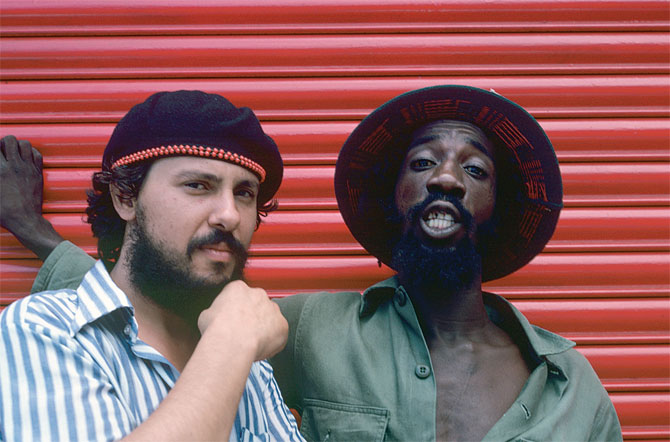
Director Ted Bafaloukos and Leroy “Horsemouth” Wallace from 1978

Living in Boston these last thirty years, I have come to have great pride in the role this town had in bringing international fame to Perry Henzell’s breakthrough cult reggae film, “The Harder They Come.”  The film had not been well received on its initial release in 1972 but was eventually launched into cult film status when the Orson Welles Theater here in Cambridge began running it continuously as a midnight film in 1973 and would continue to do so over the next ten years.  Despite the sometimes frigid weather, this town has been a hotbed for reggae music ever since and in 1996 I even began deejaying a ska and rocksteady radio show which I still produce to this day on WMBR in Cambridge and I even directed a few docs on the subject of reggae myself.  Also for many years I curated the European Short Film Festival here so with “Rockers,” I have found a movie that falls right I between those two great loves of mine, Jamaican music and European cinema.   Though “Rockers” is centrally about the Rastafarian lifestyle, I also believe that it falls into the sub-genre of the many films inspired by Vittorio De Sica’s 1948 neo-realist masterpiece, “Bicycle Thieves.”  Well at least it begins that way for sure.

De Sica’s “Bicycle Thieves” begins with our protagonist, Antonio, who is struggling to feed his family in an economically depressed post-war Italy.  To get work as a poster hanger, Antonio Ricci needs a bicycle so his wife sells their wedding linens, the only prize possession of the family, to afford to buy a bike for Antonio.    Shortly after Antonio buys his bike; it is stolen, putting the lives of his family to risk so he must take swift action to find it before he loses his new job.  Move the time and location to a post-colonial economically-depressed late 1970s Jamaica and you have the beginning of Greek-born director, Theodoros Bafaloukos’ “Rockers.”   Antonio Ricci is replaced by Leroy “Horsemouth” Wallace, who in real life is a very well respect drummer who many credit as creating the “rockers” style, and a man who is trying to feed his family on the meager money he makes as a session drummer and for playing watered-down reggae for tourists at a posh hotel outside of Kingston.   He proposes to his wife the idea of being a record salesman to make more money and so he needs a motorcycle which she must begrudgingly fund.  Horsemouth collects some debts, makes some loans and buys his motorcycle and immediately has it painted with the “Lion of Judah,” which refers to Revelations 5:5 to which Rastafarians interpret as the arrival Emperor Haile Selassie I of Ethiopia.  Horsemouth keeps his word and hustles some discs that he gets on account from legendary producer Joe Gibbs, and proceeds to sell them to the various record shops and sound system operators like Jack Ruby.  This does not last long as just like our hero in Bicycle Thieves, Horsemouth’ s motorcycle is soon stolen and he must take action to recover it quickly or his future is in serious jeopardy.

What becomes interesting is the way that Horsemouth, our hero in “Rockers,” distinguishes himself not only from De Sica’s film, but also from its reggae predecessor, “The Harder They Come. “  Jimmy Cliff’s Ivanhoe is at least on appearance, a born-again Christian, but is also the quintessential angry young man that uses violence at the first opportunity when trouble arises.  Whereas our Horsemouth, shortly after he avoids a violent encounter, goes through the trouble of breaking the fourth wall, speaking directly to the camera as he explains that he is an avowedly a non-violent Rastafarian.    Horsemouth saunters through the early parts of “Rockers” not with a pistol in his hand like “The Harder They Come’s” Ivanhoe but with a smile and a passive attitude, that is until he realizes that his autocratic cheapskate boss at the hotel is also responsible for stealing his beloved motorcycle leaving Horsemouth, as he would say, “vexed.”   After a botched attempt to retrieve his motorbike where Horsemouth takes a beating from his boss’ goons, he (Horsemouth) must now assemble his friends, who happen to be some of the greatest names in 1970s reggae music, from Big Youth to Dillinger to Richard “Dirty Harry” Hall, to not only steal back his beloved motorbike but to also “acquire” a wealth of riches to spread through Trenchtown in a Robin Hood-styled way.  Different than the outcome of De Sica’s film but they both share an ending where the common man understands the reality of the economic slide.

All of the above occurs with a laid-back and even almost comedic level; different from the previous incarnations of the plot as this is a Jamaica that has begun to look at Rastafarianism, not as previous generations have in the past as a dangerous cult, but as a religion with accepted social practices.  No scene bears this out more than when Horsemouth runs into his grandmother who berates him for his non-Christian lifestyle during a baptism in a river. Horsemouth is respectful of his grandma but still walks away with a smile as he extolls his Rastafarian beliefs as he is down but not out because he knows that Jah will see him through.    It is a small scene but one that puts the protagonist’s actions in this film in the right framework.

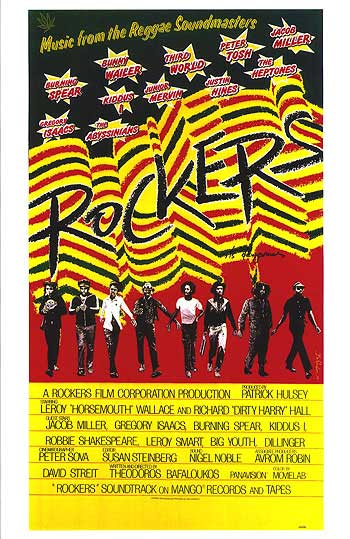
The mostly non-professional actors do their best with their roles, especially the late “Dirty Harry” who shines in a now notorious scene where he and Horsemouth take over a DJ booth at a club because they just aren’t down with soul (the West).  Of course the real star of the film is the soundtrack which has too many scenes of note to list here but three that always stand out for me: the aforementioned deejay scene with Dirty Harry, a concert scene featuring a beautiful performance from Gregory “The Cool Ruler” Issacs, and a small poignant scene where Burning Spear sings a cappella to Horsemouth to affirm his resolve after his motorcycle is stolen.

“Rockers” Trailer 1978

Though produced on a small budget, “Rockers” is visually more accomplished than “The Harder They Come” as many of these scenes are smartly framed by cinematographer Peter Sova and director Bafaloukos, who sadly would never direct another feature film but would go on to be the production designer for many of Errol Morris’ finest documentaries including: “TheThin Blue Line,” “A Brief History of Time,” and “The Fog of War.”  It is uncanny to me that a Greek citizen, whose introduction to Jamaica was getting arrested there in 1975 on suspicion of being a CIA spy while on assignment as a press photographer, would have the kind of understanding of Jamaican culture that would be needed to make a film like “Rockers.”  Though given the desperate political and economic realities of Greece these last fifty years, he might have understood a character and situation like Horsemouth’s more than any of us could.


Remembering the Daily Life of World War I in Alban B. Butler’s “Happy Days!”

Standard

World War I is gradually disappearing from the American collective memory. The history that remains is passively stirred up on a few occasions with History Channel’s specials and books such as Erich Maria Remarque’s All Quiet On the Western Front, with both highlighting the devastation by the technology introduced to make WWI the the first impersonal and massively destructive war. However, most children only skim over WWI in history classes, focusing more on WWII, given its even larger annihilation of human life and its opening of the age of weapons of mass destruction. Consequently, most common knowledge about WWI only exists around the introduction of gas warfare and the crippling German defeat that would eventually fuel the rise of National Socialism.

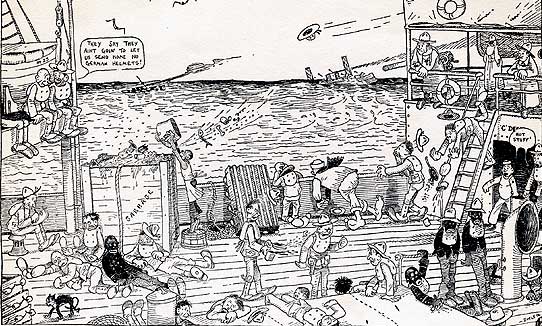
Written from the perspective of an infantryman on the frontline, “Happy Days!” by Alban B. Butler, Jr. documents the daily lives and occurrences of the First Division during WWI, beginning with their journey to Europe in 1917 and ending with their return home in 1919. Unlike most historical retellings of WWI, the grisly details of the war are almost entirely avoided. As a collection of cartoons written for the the men of the First Division and their daily trench newspaper, the First Field Artillery Brigade Observer,  “Happy Days!” provides nearly one hundred snapshots of the little moments of absurdity, insanity, and silliness in the war, all hoping to deliver a laugh to the men battling in dire conditions against difficult forces and weapons.

Cover of “Happy Days!”

From the absurdity depicted in the cartoons, Butler’s work reminds us that WWI was not a war where the United States was at its pinnacle as a world power. Men had to adapt to trench warfare, the French language and culture, multiple nation armed forces, and new weapons to protect oneself with but also to protect oneself against. With all of these new things to learn and understand, there were plenty of mistakes, mishaps, and altogether poor planning along with strange but effective procedures and protocols, creating a point of comedy for Butler’s cartoons to occupy.

Ranging from horse races with sated horses that were excessively fed after being starved due to a prolonged journey in harsh climate to the firing celebration on the 4th of July by the Division for the French forces’ acquisition and delivery of gas shells, Butler documents the endless humor existing in many of the soldiers’ activities. Although the cartoons certainly stand alone, what really makes “Happy Days!” special is the additional commentary included with each cartoon about the context of its creation. With the cartoon and the commentary, each page of the collection feels like the diary of Alban Butler, making the reader feel much closer to events occurring almost one hundred years ago.

Life in the Trenches from Butler’s eyes

In addition to Butler’s work, the introduction, preface, and afterword all provide further context for Butler’s cartoons, making the book a perfectly packaged moment in history. Arguably, “Happy Days!” may be interpreted by a modern eye as pro-morale propaganda for soldiers, but each cartoon has the voice of a soldier addressing something of specific concern or interest, making each cartoon feel as if it were created after hearing soldiers speak in the trenches or in a mess hall.

As a result of its distinct voice, “Happy Days!” contains a different, more personal perspective on WWI. While it is essential for us to remember and learn from the wreckage of WWI, it is also important to understand the people who lived, worked, and served our nation in it. Through comedy but not satire or allegory, Butler reminds us of the absurdity of the war while allowing the reader to relate to the men who were in it. The men of the First Division valiantly served in a war where a lot of inexperienced people led and fought on both sides, but they also had their own lives outside of battle that are worth understanding and remembering now that war tactics and activities have deviated so far away from where they were at the beginning of the 20th century.

“Happy Days!” by Alban B. Butler, Jr. is available via Osprey Publishing and The First Division Museum at Cantigny.