Do You Want To Make Chicken Cacciatore? Generoso Will Show You How!

Standard

In the Fierro household we love chicken cacciatore, that very hearty Italian chicken dish that could also be made with a rabbit if you happen to have one handy.  Cacciatore does mean “hunter’s style” so this is not a delicately made entree, its one that is normally made in the middle of the woods but that doesn’t mean its anything less than delicious.  Wine, onions, mushrooms. olive oil, garlic and a bit of time are all you need to make this delicious entree. Generoso will show you how, step by step as always!


Bovine Ska and Rocksteady 9/17/14: Honoring Jackie Bernard of The Kingstonians

Standard

R.I.P. Jackie Bernard

We are again saddened by the passing of another Jamaican legend, Jackie Bernard, the lead singer and founder of the seminal vocal group, The Kingstonians.  Jackie had fallen on hard times over the last decade and according to Jackie’s sister, Monica Bernard-Kelly, Jackie passed away from a pneumonia at the Kingston Public Hospital on Sept 14th.   Rafael Ruiz, a Spaniard living in Jamaica, began a foundation in January of 2014 for Jackie, who had been diagnosed with diabetes and was struggling to afford medication and treatment to battle his disease and Jackie was living in an unfurnished one room house in Maxfield, Kingston. The foundation was able to help improve his living conditions and help him get better medical attention, and for that we are grateful and send much respect to everyone involved in the Jackie Bernard Foundation.

The Kingstonians were founded in 1966 by Jackie Bernard and his brother Footy, along with their friend Lloyd Kerr, who originally recorded under the name, The Apostles, for Derrick Harriot’s Move and Groove Label, but that was short lived.  As the Kingstonians, they saw early success at JJ Johnson’s JJ label, but would continue to record for other producers as well, including Coxone Dodd, Leslie Kong, and again with Derrick Harriott.  With Harriot, they released a compilation of singles in 1970 under the album titled, Sufferer, which was the record that heightened the success of the trio. Sufferer gained much popularity in England, where it was released and distributed by the Trojan label.  After finding success with Derrick Harriot, they would return to JJ, who was also having great success with another stellar vocal group, The Ethiopians.  Over the next ten years of the 70s, Jackie Bernard would record as both a solo artist and with his fellow Kingstonians for his own Stun King label, where he would arrange and produce his own work with the writing support of his brother Footy.

On the September 17th edition of the Bovine Ska, we presented Jackie’s best work with the Kingstonians, along with his impressive solo releases to help give you an understanding of the immense talent that Jackie was.  R.I.P. Jackie.

Listen to the full spotlight and the show via the WMBR archives here:   LISTEN HERE

This link will be active until 9/30/2014.

The Kids Are Not All Right: The Political 1978 Spanish Horror Film, “Who Can Kill A Child?”

Standard

The 1978 Spanish Poster for “Who Can Kill A Child?”

The politics of “Quién puede matar a un niño?” (“Who Can Kill A Child” released in the US as “Island of the Damned) director Narciso Ibáñez Serrador become very clear only five minutes into the film; a heavy handed montage of real atrocities against children from World War Two to Vietnam to the famine in 1970s Central Africa that sets up the premise of this flawed but unique horror film.

Based on ideas from the then unwritten novel, “El juego de los niños” (Juvenile Game) by science fiction writer, Juan José Plans, “Who Can Kill A Child” follows the tradition of many zombie films in that it has a group of infected humans who begin to exhibit some traits of murderous behavior. It also draws from the tradition of the haunted house film but uses an island as its particular chamber of horrors. But what truly separates this film from its predecessors in those genres is that its subjects and its choice of scenery appear more normal than one could imagine before everything invariably turns to hell.   Expertly shot by a young José Luis Alcaine, who would become the cinematographer of choice for Pedro Almodovar and Bigas Luna, this film has the visual aesthetics of an idyllic day trip to a Spanish resort island where everything appears, but firmly places the idea in the mind of the viewer, that the eventual dystopia could happen anywhere.

The plot involves two English tourists, Tom, a biologist, and Evelyn his wife, who are vacationing through Spain before the birth of their third child. They spend a festive day in a coastal town but are blissfully ignorant of the fact that bodies from a nearby island they plan on visiting the next day are washing up on the shores of their vacation spot. After reading a headline of war, there is some small talk from the clerk in the photography shop of how “children are always ignored victims of war and famine,” but the couple feign their concern and go on their way. The next day Tom and Evelyn rent a small rickety boat and travel alone to Almanzora, an island four hours off the coast, for some peace and quiet. I get that they are ignorant, but really who does this with their six-month pregnant wife anyway? After their midday arrival, they begin to notice that the town is fairly deserted except for some exceptionally adorable children, which draws some concern. Soon after finding refuge in an empty bar, the couple witnesses the lone adult they encounter viciously and gleefully beaten with his own cane by one of the children. They now begin to understand that things are not well in this “village of the damned.”

Given that we are now dealing with a group of evil children doing unnaturally bad things, I have to address the difference between the inceptions of the behavior of the little assassins of the John Wyndham novel from 1957, “Village of The Damned” and “Who Can Kill a Child.” In “Village of The Damned,” it is made clear that a specific military incident produced the unnatural evil effects of the children, but in “Who Can Kill A Child,” we are led to believe by his use of the aforementioned montage of grotesque documentary footage that opens the film, that Serrador wants you to believe that these concerted attacks by the damned children are an almost evolutionary product of generations of child-killing by adults who show no concern for their well being.   In fact, in the novel “Juvenile Games”, Plans, uses the military spraying of a yellow dust as the agent of behavioral change but Serrador admits in a 2007 interview that “this was not necessary to show that children as a race needed to become more active in their fate without the use of a chemical.”

The unique horror that eventually ensues in the Serrador film comes from contrast of the innocence and beauty that is evident in the children’s faces and their picturesque town against the vile actions that the children mob performs. Almost all of the violence, with the exception of one notable scene, occurs during the day, which jolts the viewer differently than most horror films do in that genre because you normally cringe as you wait for the fall of darkness, which despite building some tension also prepares you for the eventual shock as opposed to here where the horror can come at any moment. Our protagonists, Tom and Evelyn are chased through the town during broad daylight by a horde of blood-thirsty Brady Bunch looking maniacs, but through the use of close-ups that show their playful indifference, the horror really hits home. And in a truly brilliant turn, you even begin to fear the one child you do not see, the one that is growing inside of Evelyn.

The key to this film is that once Tom finds a gun, the question arises; Even if warranted, “could you kill these adorable children if you could see their faces?” or “is wartime death of children a necessity that people have gotten used to after thousands of years of war and famine?” These are the political questions that Serrador presents to the viewer, and he does so pretentiously but is very successful by utilizing the genre of horror to carry this message.

Serrador later stated that if he had to make this film over again, he would’ve put the documentary montage at the end instead of the beginning, so that the violence that the children exact on Tom and Evelyn would almost seem justified after thousands of years of violence that adults have reaped on children. Again a heavy handed way to end a film, but given that this was made just two years after the death of Franco, it would mark the beginning of many Spanish films that would ask similarly hard questions about the true casualties of war.

Experimenting and Challenging the Form: “3 New Stories” by Dash Shaw

Standard

There’s always something alluring and overwhelming when you look at the consignment comics section at your local comic book shop. There’s always so much to pick from. There’s a horror comic in one section and a comic about a local coffee shop in another. There’s a plethora of comics about various incidents, supernatural or natural, that we may encounter in life. And, to make my decision more complicated, there are often books with covers and artwork that are almost too interesting to pass up.

The last time I was at my local comic book shop (Hub Comics in Somerville), there was plenty to pick from. After opening and browsing through many of the shelves, I stumbled upon 3 New Stories, a small book with a stunning cover and early pages that motivated me to pick it up.

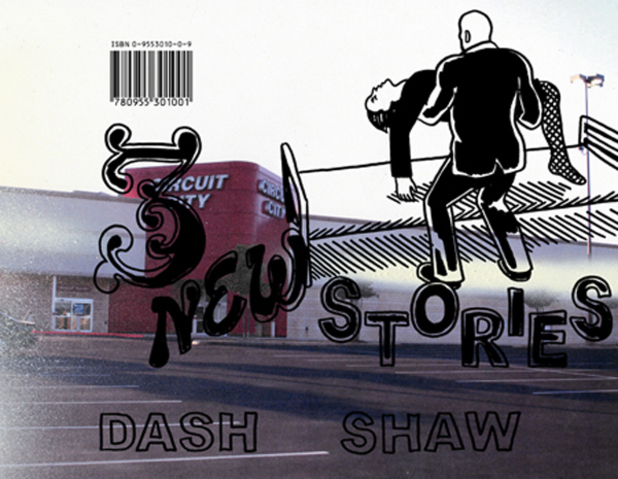
Back and Front Cover of 3 New Stories

3 New Stories, as the casual title suggests, contains a collection of three stories in three separate realities. All of the stories take place in a surrealistic, absurd America oddly reminiscent of the Springfield of The Simpsons in the 90s and frighteningly not too far away from our current reality. The first story, Object Lesson, introduces us to an anachronistic private investigator who loses his job and finds himself back in high school to finish his diploma, which he possibly did not complete due to a technicality. The second story, Acting is Reacting, briefly introduces us to the depressing, decaying world of Girls Gone Wild. Lastly, the final story, Bronx Children’s Prison, follows the life and the attempted escape of the prisoners in the Bronx Children’s Prison.

3 New Stories is really quite difficult to review. From a text based narrative perspective, Object Lesson is by far the most successful. It’s clever, funny, and surprisingly absurd. It also makes an interesting statement about how American businesses and con men prey on people through nostalgia when they get older. It also makes an implicit statement about how the American economy is very coldly and inhumanely throwing out its older workforce. Most impressively, both of these large statements are made in a matter of a few pages. In contrast to the strong text narrative of the opening story, the next two were a little disappointing and lackluster by comparison. Acting is Reacting from a pure narrative perspective falls pretty flat, and Bronx Children’s Prison is a pretty basic prison story, despite the young age of the prisoners and an element of fantasy.

However, there is a separate layer to address with 3 New Stories: its artwork as its major storyteller.

3 New Stories has some of the most daring and innovative artwork to appear in the comic book/graphic novel arena. It pays homage to the traditional flat black and white style of most comics while adding layers of exceptional texture from watercolor and paint. And from the interesting art techniques, 3 New Stories emerges as almost, dare I say it, an experimental comic book.

Given the strength of solely the text narrative of Object Lesson, the artwork is used to enrich the tone of the narrative. There are streaks of sickly olive green and rust in the backgrounds, enhancing the misery and the direness of the older students in the high school and conveying the sinister nature of the people who are running the high school. There are disjointed panels and floating images that emphasize the disorienting world the private investigator is experiencing. Here, the combination of non-traditional artwork and basic text narrative construction is at its best, demonstrating the epitome of what the medium of graphic novels and comic books can be as a storytelling form.

For Acting is Reacting, which probably is the most bizarre of the bunch, the artwork takes the stage in front of the story. While the panels of the narrative show how a Finnish girl ends up in a Girls Gone Wild video, the background artwork of maps of parts of Texas seems to be suggesting the endless roads traveled by the Girls crew to film their clips. The endlessly branching roads and the numerous letters of towns give us a sense of the monotony of the whole Girls enterprise. The Finnish girl on the panels is no more than one girl one town on a map of thousands of cities, towns, and roads. In this second narrative, the background artwork far overpowers the narrative in the panels in its ability to add layers to the storytelling, but the two nevertheless interact and project onto each other in order to form a richer and certainly more interesting story with very few words and interpretive liberty for the reader/watcher.

As for Bronx Children’s Prison, the artwork overpowers the narrative given by the text in a way that almost feels like a successful experimental film montage. In a story about children taking over and escaping a prison, there are elements of clear fantasy, and these moments are separated visually with overwhelming dots of color, evoking the feelings of a dream or hallucination. However, in the story there are moments of realistic consequences, and here, the dots are absent, leaving the reader with only sparse black and white forms. While this last story is probably my least favorite of the collection, the use of the oversaturated, overwhelming images to demarcate states of fantasy versus reality adds a layer of complexity to the narrative that had me motivated to finish the story.

3 New Stories, though flawed, is an excellent representation of how the comic book and graphic novel world can expand and challenge its boundaries. As a passionate fan of both literature and visual art, I have always felt that graphic novels have the advantage of an enormous range of visual, non-verbal techniques to tell a story. Consequently, graphic novels and comic books have more opportunities to create richer settings, to convey complexities in mood and tone, and most of all, to communicate nuances in a character, all of which Dash Shaw attempts to do in 3 New Stories.

Of everything I have written about, please do check out 3 New Stories. While it may not be the epitome of the full fruition and realization of the comic book and graphic novel media form, it is much closer than many (if not most) of its peers. And even though I admit that the text based narrative composition is lacking, I must commend its willingness to experiment with the combination of verbal and non-verbal storytelling. As much as I love more traditional forms of comics and graphic novels, I was excited and thrilled to see and read something that is trying to reach far beyond its own expectations as a storytelling form.

3 New Stories was created by Dash Shaw and is available via Fantagraphics Books


Shake! Shake! How to Make Dau Hu Luc Lac

Standard

In this week’s episode of cooking at the Fierro home, Lily shows you how to make Dau Hu Luc Lac, one of her favorite vegetarian dishes.

Luc Lac is traditionally made with beef, but the Fierros often eat the tofu version.

Watch as Lily shows you how to transform blocks of tofu into Dau Hu Luc Lac, which actually translates into “Shaking Tofu.” This dish is traditionally served under a simple salad and a side of rice, but you are welcome to serve it any way you would like!

Music provided by Francesco Geminiani and his Concerto Grosso No. 2.

Bovine Ska and Rocksteady 9/10/2014: Remembering Hopeton Lewis

Standard

We were very saddened to hear about the passing of legendary vocalist, Hopeton Lewis, on September 4th.  Hopeton had passed away at his home in Brooklyn last Thursday after a long battle with kidney disease.  Hopeton was a guest on the Bovine Ska and Rocksteady back in 2006, a very sweet and reverent man, who had been almost exclusively performing non-secular music for the last thirty years.  When we spoke back then he still had great affection for his earliest cuts for Merritone, Treasure Isle and Dynamic.  There are his landmark tracks such as his first hit, 1966’s “Take It Easy,”  which many people consider the very first rocksteady tune ever recorded, and the track he would record the same year, “Cool Collie,” the very first Jamaican record to openly speak about the positive effect of marijuana.

Hopeton Lewis was born in Kingston and raised in Burnt Savannah, Westmoreland. At the age of 6, he began signing for the Burnt Savannah Holiness Church, which was his starting point for his passion for music. As a young boy, he returned to Kingston to live with his grandparents. At the age of 15, his grandparents passed away, and Hopeton was left on his own to survive in Kingston. As a young man, he quickly entered the music industry in order to fulfill his love for singing and also to try to earn a living.   He began his recording career as a member of the vocal group, The Regals, by cutting a side at Coxsone’s Wincox label.  Not much came of it, so he took his smooth voice and began a solo career at Merritone where he scored a hit with the aforementioned “Take It Easy.” which stayed at the top of the charts for weeks and sold over 10,000 copies!

Take It Easy

Hopeton Lewis’ “Take It Easy” LP on Merritone

After leaving Merritone in 1967, Hopeton had brief stops at “JJ’s” and “Fab” before finding more success with Duke Reid at his Treasure Isle label.   Besides singing backup for many of the Duke’s established artists, his turn at lead vocals there would result in a Festival Song Competition winner with “Boom Shaka-Laka.”  He would move to Byron Lee’s Dynamic label and the hits kept on coming as “Grooving Out On Life,” the title track from his full length LP released in 1973 became a signature song for Hopeton.

On the September 10th edition of the Bovine Ska, we took you on a musical trip through Hopeton’s career and tried to help you get a better picture of his progression as one of the most talented vocalists in Jamaican music history.

Listen to the full spotlight and the show via the WMBR archives here:  LISTEN NOW

This link will be active until 9/23/2014. Enjoy!

Bovine Ska and Rocksteady 9/3/2014: The West Indians

Standard

We had a lot of fun putting together with last week’s Bovine Ska and Rocksteady because we were armed at the beginning with a great 7″ from Lloyd Charmers on the Green Door label from 1973 entitled, “Save the People.” We followed up that track with another seven tasty early reggae recordings from 1969-1975, including great ones from from the magnificent Scotty and the triumphant King Stitt.

For the spotlight of the September 20th edition of the Bovine Ska and Rocksteady, we featured the rocksteady and reggae recordings from the beautiful trio known as The West Indians.

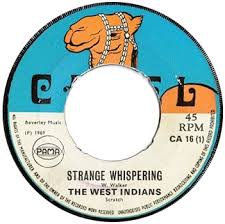
Strange Whispering on the Camel label - 1969

Strange Whispering on the Camel label – 1969

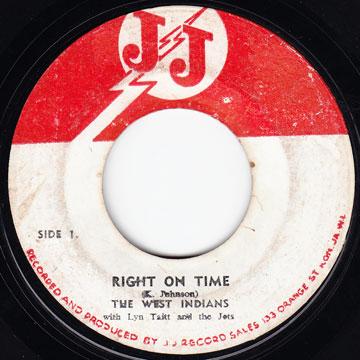
The West Indians were Leslie Burke, Hector Brooks, and Eric Donaldson. Not too much is known about Leslie Burke or Hector Brooks, but we do know a bit about Eric Donaldson. Born in 1947 in St. Catherine, Eric Donaldson originally recorded for Coxone, but, as with many other artists, Coxone decided not to release any of his recordings. After this first stint at a solo career, he joined Burke and Brooks to record as The West Indians. During their career together, The West Indians scored a minor hit in 1968 with, “Right On Time.”

Then, in 1971 Eric Donaldson released, “Cherry Oh Baby,” which won the festival song competition that year, launching his solo career. Consequently, The West Indians would exist as a vocal group for another year until 1972, when they parted ways. The West Indians best recordings happened with JJ Johnson and Lee Scratch Perry, and the spotlight began with two of their rocksteady tracks released on President in 1967.

Listen to the full spotlight and the show via the WMBR archives here: LISTEN NOW

This link will be active until 9/16/2014. Enjoy!


Am I A Western? Looking at High Moon

Standard

As a fanatic of westerns, I felt that it is appropriate that the same love for those films carried over into my graphic novel readings. In the wake of the current craze surrounding East of West, which I admittedly did not enjoy because of its pretentiousness and overbearing dialog, I read the first volume of High Moon, a former webcomic from DC’s online comic branch, Zuda. In 2009, High Moon was selected from a pool of webcomics published by Zuda to be transferred to the print format. After reading the first print volume, I cannot say that the print transition was a bad idea for Zuda, maybe just not the best.

High Moon Volume One

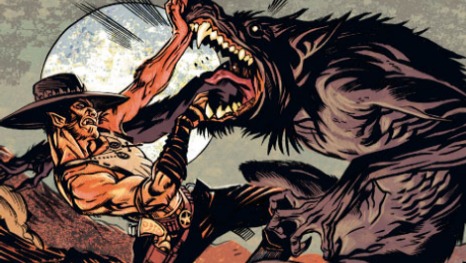
High Moon centers around a man named Macgregor in the opening of its first chapter. Macgregor is a former Pinkerton detective who now has more of the appearance of the archetypal man without a name. He is somewhat of a bounty hunter, and in the tradition of the many bounty hunters of westerns past, he speaks little with the few words he says tied to questions around getting more information on the man he is chasing. After talking to many of the town locals, we find out that there is a little girl missing and that there is something causing blight on the cows and the cowboys around the town. In parallel to Macgregor’s investigation, we get to know more about the the man he is after, Edward Conroy, and we find out that the hunter and the prey are far more similar than Macgregor would believe; both are werewolves who are able to tame their transformations, and both are trying to save the little girl.

As the chapter progresses, the true villains of the Texas town emerge and Conroy and Macgregor, in a very abrupt moment, battle together against the monsters who are the source of the destruction and the massacre in the town. And in a bizarre twist, Macgregor is killed and Conroy absorbs and bears the identity of Macgregor. In the next chapters, we see Macgregor version 2 on his adventures in Texas. On his path, Macgregor runs into traveling performers, bartenders, arguing family members, and train robbers, the universal western peripheral crew. However, he also runs into the supernatural: other werewolves, a Native American tribe with the ability to transform into bird-like super beings, and oddly enough, steampunk accomplices and assistants to Nicolas Tesla.

High Moon is a bit of a tough graphic novel to review. While the main idea of the bounty hunter werewolf is interesting, there are almost too many supernatural elements to the story. By the time the Tesla assistants emerge and use their seemingly mystical robotic weapons, the story loses its greatest strength, its core character. As Conroy Macgregor continues to encounter more monsters in his journey, he defies death more and more. We begin to get the sense that he is invincible, and thus, every monster and supernatural challenge he faces becomes less interesting and engaging because we know that he is going to definitely survive.

Don’t get me wrong; I think that having an invincible protagonist is not necessarily a bad thing, but given that the physical challenges the protagonist will face will have the same outcomes, there must be further attention given to the exact persona of the character in order to keep the reader interested. For example, we never find out why Conroy has decided to become a protagonist in the first place. In the first chapter, we know that Conroy has committed serious crimes, and in the second chapter, we found out that he is the reason behind the death of another young girl. However, we never get a sense of the origins of his change of purpose. Without the layers of character construction, the entire narrative gets reduced to a bunch of moments of big fights and victories, which get all too boring too fast.

I don’t think that the creators David Gallagher and Steve Ellis were oblivious to the fact that they were not building characters. They give us the history of the warring brothers in a town; they give us the history of  the steampunks, Tristan Macgregor and his wife. However, they just do not give history and complexity to their center character, which is a very strange decision because he is the one who warrants and rightfully deserves the most attention.

In terms of a formal style critique, High Moon has dialog and narration written in a very abrupt style. The artwork is beautiful, and I think in order to preserve the art, there are few sentences on each page. Consequently, with few words used to guide the story, there are some events that happen in the narrative that are not relayed to the reader in a clear way. I found myself too often reading a piece of narrative that did not have clear motivations or that did not make sense given the previous events.

High Moon is a messy graphic novel. It has a strong core narrative, but it feels as if someone talked to the authors about avoiding alienating non-western loving audiences, and consequently, they added all of these other elements ranging from steampunk to love triangles to try to pull in a more general audience. All of these additions lead High Moon to become a bizarre mix of stories with an identity crisis.

There is one remaining layer that is the most bizarre of all: the race politics. When we meet Macgregor version 1, he is an Anglo American, again, the archetype of westerns in the past. Then, Edward Conroy, Macgregor version 2, is African American. The authors made this explicit decision to change the race of the bounty hunter, but they did not seem to consider to try to change the clear racial stereotype tied to Conroy’s past: his criminal activity. There is some political statement trying to be made here, but it is cloudy and conflicted, which is probably the deepest, though not necessarily last, nail in the coffin for High Moon.

High Moon has some interesting ideas in it, but the execution sadly leaves the reader wanting more. The artwork is excellent, but the lettering is too sparse. The main character is interesting, but more attention is given to the peripheral characters. There is halfhearted commitment to both traditional western and werewolf narratives. It’s really a shame. High Moon had the potential groundwork to become a magnificent series, but it just got too ambitious and too confused, which is why I suspect that it ended at the beginning of 2011, a little over a year after the first volume of the graphic novel was released.

High Moon Volume One is available via DC Comics. 

Veal Marsala Is So Delicious, Learn to Make It, The Generoso Way!

Standard

Have you ever eaten veal marsala and thought…I wonder if Generoso could teach me how to make veal marsala.  And then did your mind wander and thought…If only Generoso could be in his hot little kitchen, sweating profusely, wearing the same apron he uses when he spray-paints positive messages on the seats in the back of the bus.   Well, your thoughts are my command as I show you how to make this tasty sweet Italian dish using just the right inexpensive ingredients.  Let me know how yours turns out in the comments below!  Music supplied by Boccherini because he owed me a favor.  His Concerto for Cello and Orchestra In B flat Major.


The Writers of American Graffiti Direct a Lovecraftian Giallo: 1973’s “Messiah of Evil”

Standard

messiahofevil poster

Give credit where credit is due, husband and wife team, Willard Huyck and Gloria Katz, wrote two of the most entertaining films of their generation, George Lucas’ American Graffiti and Steven Spielberg’s “Indiana Jones and The Temple of Doom”. Now, let’s step back a second and immediately take some credit away from them, as they also wrote and directed the disastrous “Howard The Duck” and “Best Defense”, the 1984 “comedy” that almost singlehandedly destroyed Eddie Murphy’s career before it started.   Now that we have established that you have two very talented people who occasionally make some serious errors in judgment, let’s get to their only horror film, a film that despite having some shortcomings, is a surprisingly brilliant surrealistic horror film, Messiah Of Evil.

“Messiah” opens intensely with a frightened man running down the street, we aren’t sure who or what he is running from, suddenly the running man is rescued by an innocent-looking young girl who allows him into her backyard. As the man collapses from exhaustion, the girl of course leans over and unemotionally slices his throat. After watching “Messiah of Evil”, I came to learn that the dead man is another iconic American director of the 1970s, Walter Hill, a friend of Gloria and Willard’s, who was also pretty busy in 1973, having just written John Huston’s “The MacIntosh Man.” Why kill Walter so early? Maybe Katz and Huyck saw into the future and wanted to stop Hill before he made “Another 48 Hours”.

After setting the tone of the film with such an opening scene, you are hammered with the sight of an over lit long hall, where the film’s protagonist, the ethereally beautiful, Arletty (Marianna Hill) is wandering in an almost dreamlike state.   After a fairly horrific stop at a cadaver filled gas station (just a bit worse than an average South Jersey rest stop) Arletty soon makes her way to coastal town of Point Dune, California to visit her painter/father but instead finds just his empty, eerie home that is complete with pop-art murals of straight ahead suited people. She also finds her father’s diary but only reads enough to realize that dad doesn’t want his little girl trying to find him. So now if that piece of information mixed with the opening scenes hasn’t tipped you off yet, things in Point Dune are not too Norman Rockwell.

The Awesomely Intense Trailer For “Messiah”

To make matters infinitely more scary, Arletty meets a sort of now-era sophisto named Thom (a stoic Michael Greer) and his two groupies/traveling companions, the savagely hip 70s sexy Toni (Joy Bang) and Laura (Anitra Ford) who are interviewing the clairvoyant hobo, Charlie (sure, every town has one, they just don’t care to interview them) about the upcoming weirdness involving the centennial return of “the dark stranger,” who will inspire the town into a murderous frenzy. Charlie also warns Arletty about her father who has become one of the town’s crazies (I use the word “crazies” as they act the closest to the villains of the same-named Romero film.) All this weirdness gets to Toni and Laura, and they split the company of the well-coifed Thom to only meet with some really well filmed giallo-style ends. I must say that these scenes are the visual horror gems of the film; sensational buildups to a stark zombie-like finishes. I say “zombie-like” because I feel that our ghouls are more vampire than zombie but their ends look like the work of cannibalistic consumption. OK, too geeky, the point is, they’re dead. Of course, the “stranger,” (or possibly the titled “messiah,” were not sure here) a kind of H.P. Lovecraftesque demonic minister from the days of the Donner Party, has now returned and yes, all hell has broken loose. The police arrive and fire at the crowd of ghouls but fail in stopping the onslaught. The stranger/messiah/vampire/zombie bites Thom, so Thom and Arletty finally do the right thing and split for the coast.

Without giving away the ending of the film, what does transpire is left to the viewers interpretation. Did this actually happen and the trauma broke Arletty so badly that she ended up in a sanitarium? Or, is this entire film the creation of a woman whose mind has decayed while in a sanitarium?   And what was the political statement that Katz and Huyck are making here?   The one thing that Romero, the father of the modern zombie has taught us is that zombies show up hungry, they are also showing up with a defined political agenda. We know that the older well-suited, square ghouls in “Messiah” have recruited Arletty’s failed artist father to their ranks, but they only seem to be hungry to eat the hip, young people; Thom, Arletty, Toni, and Laura. Was this a post-hippie statement that the establishment was coming after the remains of the Love Generation?

Though I am not sure of its underlying purpose, what I am sure about is that “Messiah of Evil” remains as one of the few real giallo-inspired films produced in the U.S. from that time. A film that purposely does not contain an ounce of humor, and is unrelenting in its grim tone, a rarity for its time.   It is also a testament to writer/directors Katz and Huyck, who in 1973 could simultaneously fill our hearts with joy, giving us the iconic California film, “American Graffiti”, and at the same time give us a very different trip to California with “Messiah of Evil”.