Bovine Ska and Rocksteady 12/31/2014: A Show of Firsts!

Standard
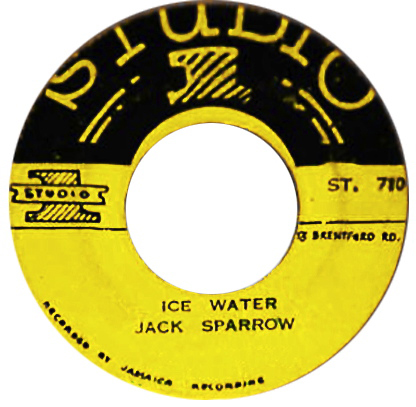
Jack Sparrow-Ice Water

Jack Sparrow’s (Leonard Dillon) First Recording


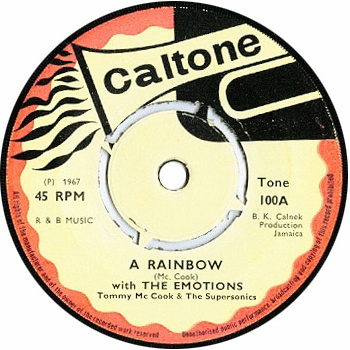
To celebrate the arrival of the first day of 2015, this past week’s Bovine Ska and Rocksteady featured the first recordings from some of Jamaica’s greatest artists.

Following the chronological order of each artist’s debut to the Jamaican recording industry, this New Year’s Eve show also follows the progression of movements in Jamaican music, beginning with Rhythm and Blues, then Ska, then Rocksteady.

In this special show, not only will you hear the first recordings from the legends, such as John Holt, Bob Marley, Jimmy Cliff, and Desmond Dekker, you will also hear the first tracks from BSR favorites including The Jamaicans, The Pioneers, Roman Stewart, and Nora Dean. In addition, you will also hear anecdotes about the artists and how their first recordings emerged. It was a tough show to research, but we hope that you will enjoy hearing how your favorite artists sounded when they began their music careers!

Enjoy! Happy 2015 from Lily and Generoso! May this year be a wonderful one for all!

Listen to the New Year’s Celebration Show HERE.

The archive will be available until 1/12/2015.


Making Banh Cuon in the Western Kitchen

Standard

Banh Cuon is a dish that Lily grew up eating often in restaurants because it required too much effort to make. The best Banh Cuon has a paper thin, chewy wrapper that is created by a stretched out cloth on a large steamer. However, on a few lucky occasions, her grandmother would make it at home, and for this week’s recipe, Lily shows you how to make Banh Cuon with a non-stick pan and a lid.

Banh Cuon is a very general name for rice flour rolls filled with meat. Traditional versions are filled with ground pork and wood ear mushrooms or deep fried scallions, but the filling is completely up to you! Lily’s grandmother actually filled her Banh Cuon with ground pork and crab meat, and some Vietnamese restaurants will even fill them with BBQ pork! This video recipe uses a pork and scallion filling.

Included in this video is a recipe to make a very simple Nuoc Mam (fish sauce for dipping), which is the final serving component of any Banh Cuon dish.

As a warning, the process to make the rolls can be difficult; the rolls should be paper thin, but on the stove, that is not the easiest thing to achieve. It took Lily and Generoso a few tries before we found the method that worked best. Be patient with the first few rolls; they may not be the prettiest, but we promise that they will taste great! Music: Luigi Boccherini’s Cello Concerto no. 9 in Bb, G. 482


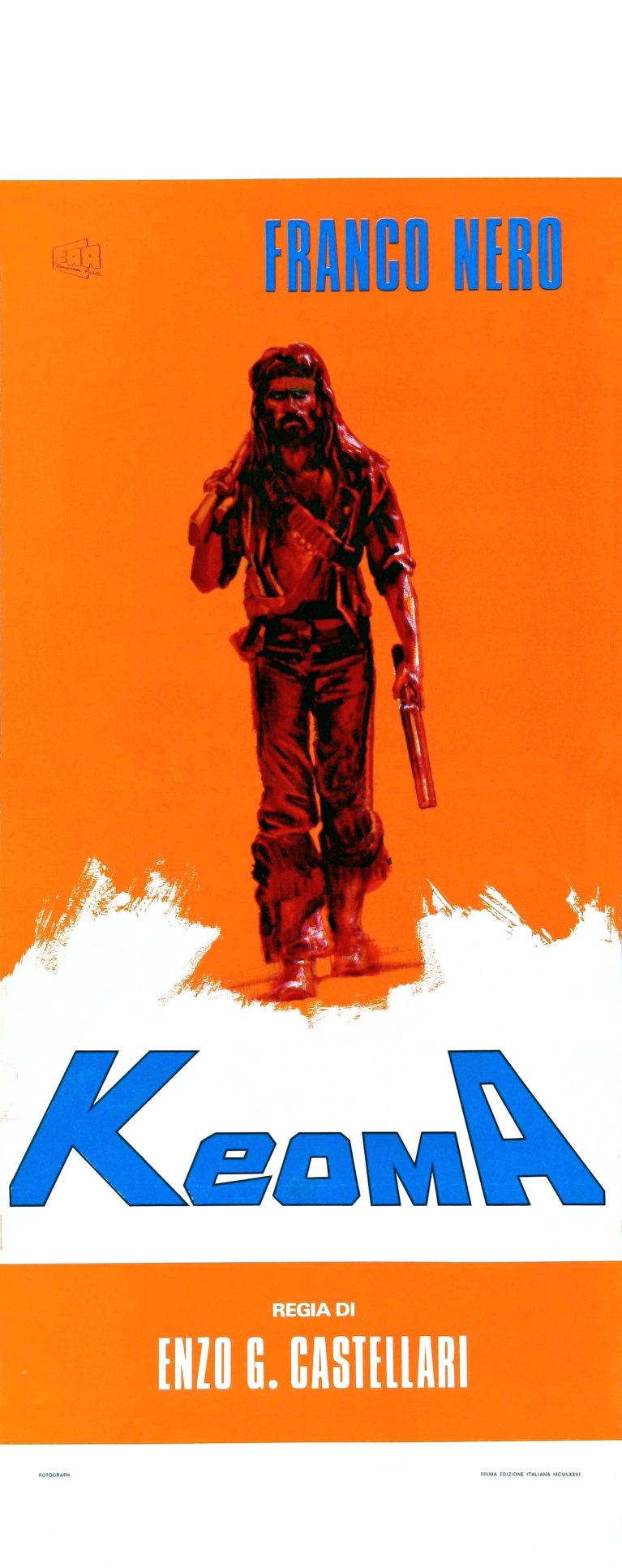
The Last Great Spaghetti Western: Enzo Castellari’s Elegiac “Keoma”

Standard
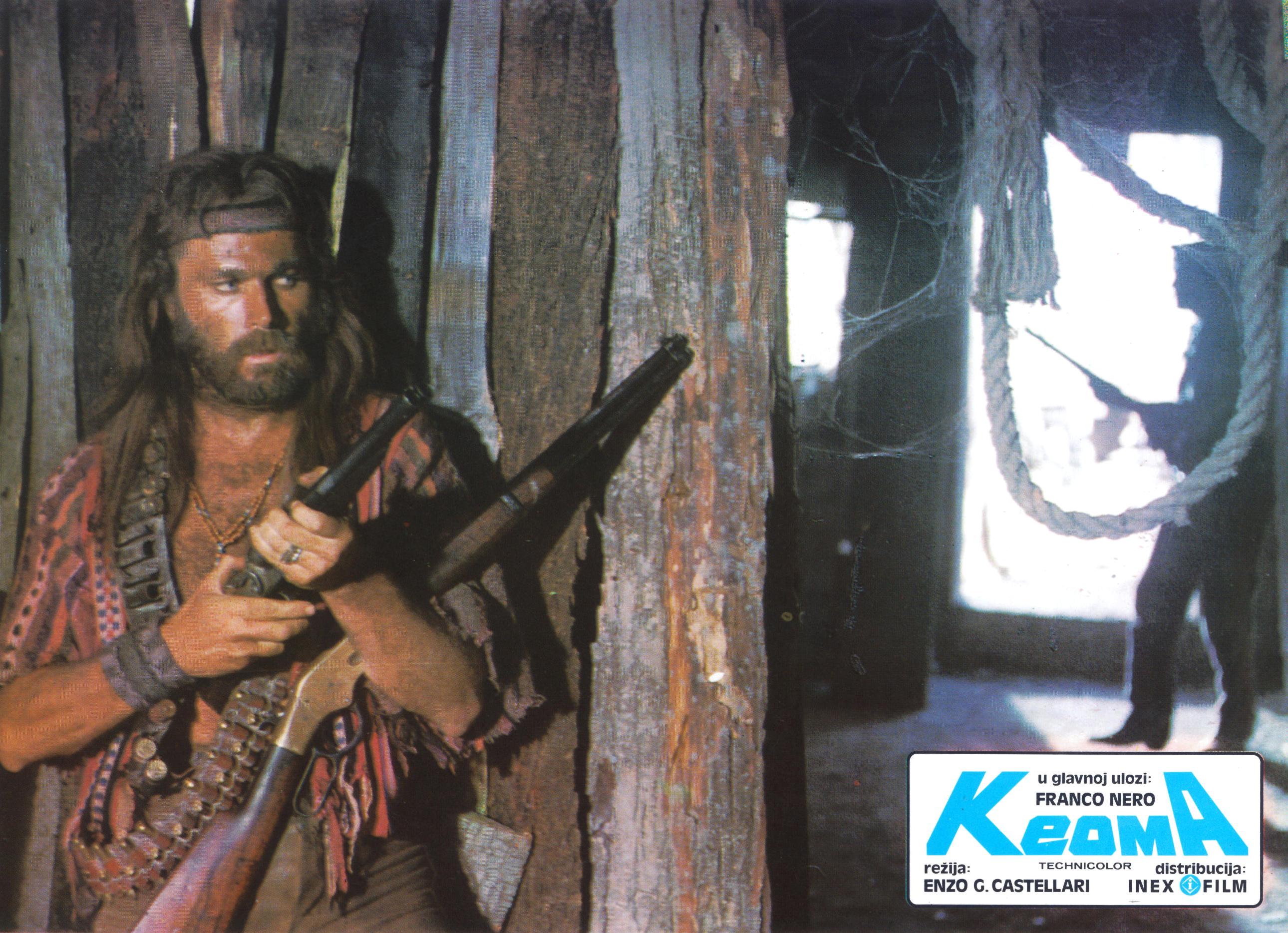
keoma_ulc_08

1976 Lobby Card for “Keoma”


By 1976, the mania surrounding the spaghetti western had all but died out. Due to the success of the Godfather films, Italian crime dramas were all the rage and the few westerns that were being produced in Europe fell more into the comedic realm than the dramatic one due to the success of the Terence Hill/Bud Spencer films that became extremely popular in the early part of the decade. Even veteran directors like Enzo Castellari, who had directed several superb spaghetti westerns, including “Johnny Hamlet,” had moved on to Italian crime dramas, as did the genre’s biggest star, Franco Nero, of “Django” fame. Gone was Nero’s cowboy hat in favor of his Borsalino; that is until “Keoma.”

There is a real reverence for all westerns in “Keoma,” which was written and directed by Castellari and released in 1976. I say “all westerns” because the film is packed with many of the standard motifs of fellow Italian western directors, Corbucci and Leone but also Sam Peckinpah and even John Ford. I guess if this was to be Castellari’s last western, he was going to put all of it out on the table.

Playing Keoma (the word means “far away” in Cherokee) is Franco Nero, and he is again the quiet ex-soldier who comes to a town in trouble and who must now fight valiantly to save everyone. There is a plague in the town that is killing everyone, but evil landlord Caldwell is keeping medicine and supplies away from townspeople and is sending the infected to a camp to die. Keoma is half-Native American and was adopted by William Shannon (William Berger), who already had three sons of his own who are now part of Caldwell’s gang. The brothers were brutal to Keoma when he was a child, detesting that their father would raise a half-breed, which is seen during one of the many flashbacks (another key motif in many spaghetti westerns) in the film. After Keoma rescues a pregnant woman who is about to be sent to camp, he draws the ire of Caldwell’s men, setting up the conflict of the film. The dour and almost hopeless tone of these scenes rival Sergio Corbucci’s, “The Great Silence,” the 1968 film that set the standard for surrealistically depressing westerns for years to come.

Many of the gunfights that ensue are those of the Peckinpah variety, with long slow motion shots of diving shooters and the over pronounced sounds of ricochets, but as so many spaghetti westerns have taken their cues from Peckinpah, this is not a surprise. What is a surprise influence in the film is Ingmar Bergman, whose inspiration takes form in a witch (Gabriella Giacobbe) who speaks to our ex-solider Keoma in the same way about the purpose of it all as the Grim Reaper would speak with Antonious in “The Seventh Seal.” Our witch is asking Keoma why he would put the effort in to save a town that is beyond saving; however, Keoma is there to not only to save the people of his town but to correct the wrongs that had been done to him as a boy.

Trailer for “Keoma” 

Nero is great in the titular role, as is the cast, which was comprised of many spaghetti western regulars doing some of their finest work. What sadly hurts “Keoma,” though not fatally, is the ear-piercing folksy soundtrack. It has been written that during filming, Castellari had been enamored of the music that Leonard Cohen had done for Altman’s “McCabe and Mrs. Miller” and wanted something that worked in the same way to propel the narrative. Unfortunately, the virtually shrieking vocals from the soundtrack composed by the De Angelis brothers and sung by Sybill and Guy bombard many scenes in the film and do not give the same kind of earthy goodness that Cohen’s tracks give Altman’s revisionist masterpiece.

The soundtrack is an otherwise small mistake in a film that provides a somber yet triumphant elegy to the spaghetti western. Like previous films in the spaghetti western genre, “Keona” uses every cliché available to tell it’s grim story, but this isn’t a cheaply made lark thrown together to try and cash in on a trend. No, it is an elegantly composed farewell by Castellari and Nero to a kind of film that clearly meant so very much to them and all of those who still loved the raw storytelling of the spaghetti western.

Peeking into the Mind and Style of Joseph Lambert in I Will Bite You!

Standard

I Will Bite You! may be the hardest collection of comics to review to date. The stories dramatically vacillate in narrative and illustration style with very few words used in each one.

After gaining acclaim for his short comic, Turtle Keep It Steady! (which is included in this collection), Joseph Lambert pulled together some of his early work for his first book, I Will Bite You!. Though the collection is somewhat randomly assembled and a bit disjointed like a young artist’s portfolio, it showcases Lambert’s great potential as a comic book artist and author with a distinct voice, with his strength stemming from his wildly whimsical style and imagination.

There’s not too much to analyze about each of the stories, so in the spirit of the textually minimal narrative methods in I Will Bite You!, I will give you a short overview of each of the stories in three or fewer sentences. Let’s see if I can accomplish this….

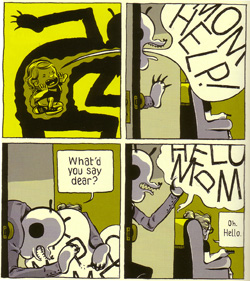
Cover for I Will Bite You! featuring a laughing and howling moon

I Will Bite You!

This is the title comic, and it is a perfect one about a little boy who has an insatiable desire to bite everyone he sees. Funny and beautifully illustrated, it introduces Lambert’s favorite motif of elements of nature as sentient beings interacting with humans and his own strange sense of humor when it comes to the creatures of his imagination.

After School Snacks

Probably the funniest, most innovative, and most grotesque of the bunch, After School Snacks begins with two hungry monsters hiding in the bushes near a sidewalk. They eat everything but have a specific appetite for pudding and children, and when one little girl gets eaten by them, her schoolyard crush must try to save the day. This story cleverly explores the role of the writer versus that of the characters in comics, with the characters able to reshape and reform the dialog bubbles used to portray speech into tools for deception and survival.

Mom Said

When two younger brothers play, things tend to get out of hand and beyond control for older siblings. In Mom Said, two brothers exclude their older, adolescent brother from their adventures and manage to pull the moon out of the sky, leaving their older brother to clean up but also leaving him in peace. A silly and whimsical exploration on the relationship between older and younger children in a family, Mom Said is a simple but effective comic.

Turtle Keep It Steady!

As a rendition of the tortoise and the hare set in the world of rock ‘n roll, Turtle Keep It Steady! lives up to its praise as one of the comics included in the collection, The Best American Comics 2008. In the world of Turtle Keep It Steady!, speed is not based on distance traveled but rather the pace of one’s living as a drummer. A clever adaptation of the tortoise and the hare, Turtle Keep It Steady! is a precautionary tale for children living in a post-70s hard rock, hard partying generation.

PSR

In building a narrative around the classic childhood game, Paper, Scissors, Rock, Lambert creates a full tale about a more extreme world where winning involves a trophy in the form of ice cream and the ability continue to roam the earth and losing involves being pulled into an underground world to be imprisoned by an abominable snowman-like creature for a year. PSR is an interesting experiment in understanding and mitigating the irrational severity that children feel when losing a game, reminding us that as bad as it may seem, losing a game of Paper, Scissors, Rock in real life cannot be worse than losing the game in this story.

Too Far

When an older teenage brother does not know how to handle his interactions with his brother and father, he seems to solve his problems by eating up and then regurgitating the world into space. A hyperbole on the self-alienation of teenagers, Too Far is my favorite story of the collection. Here, Lambert’s illustration and metaphor construction through the absurd are at their finest.

(Caveman)

This is the only full color comic of the book. Exploring the mourning process for a caveman, this story is an interesting visual experiment, but it is the most unsuccessful of the collection. It lacks the off-the-wall insanity that the other stories contain and feels too distant from Lambert’s voice and style.

Everyday

Everyday follows the monotonous of life of two brothers over the course of a week. Despite what happens in the middle of the day, everyday seems to start and end the same way until the youngest brother decides on Saturday to take on his nemesis of the past week, the sun. Everyday is the epitome of Lambert’s style and returns his favorite theme of people interacting with human-like elements of nature to the pages. It is the perfect story to end on, neatly wrapping up and delivering all of the best that Lambert has to offer.

I Will Bite You! may not contain the most insightful comments about life, but it is immensely fun to read (though perhaps view is a better word since the book uses text so sparsely). Lambert has a fantastic imagination and a wonderful talent for creating some of the most visually interesting creatures you will see in animation. Pick up I Will Bite You!, and read it when you long for something strange, silly, and amusing to take a break from your day.

I Will Bite You! by Joseph Lambert is available now via Secret Aces. 


Marco Ferreri’s 1978 Film, “Bye Bye Monkey,” Says So Long To Masculinity

Standard
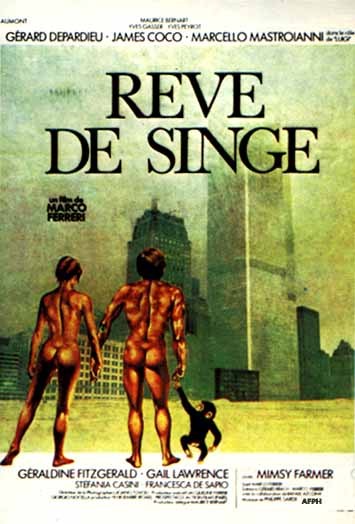
bye-bye-monkey french poster

French Poster for “Bye Bye Monkey”

Surprisingly, as an excessively sexual and carnivorous Italian man, I had been ignorant of Ferreri’s work until my soon to be roommate Doug ranted to me about a 1973 Ferreri film entitled, “The Grande Bouffe.” A film whose plot is centered around four middle-aged men who lock themselves into a villa and then proceed to fatalistically gorge on food and wine while screwing until they die. A kind of stay-at-home, non-violent, Italian version of “The Wild Bunch,” with these four men, who have become tired of their lives, end it all without firing a shot, which if you think about it, was more in line with the softening seventies male. If the passing of masculinity into the sensitive seventies had not been metaphorically shot down there, Ferreri’s next film, 1976’s “The Perfect Woman,” went so far with this new emasculation that our director would make hunky French film star, Gerard Depardieu, cut off his own manhood with an electric kitchen knife after another deflating argument with his wife.

For his first U.S. film, the dystopian “Bye Bye Monkey,” Ferreri would keep up this same trend of metaphorically depicting the downward spiral of masculinity, and why wouldn’t he? After all, wasn’t the United States responsible for setting the world standard in that decade for helping the loafer clad males get in touch with their feelings through overpriced weekend sensitivity training classes? For this film, Ferreri reenlists the beefy Depardieu to play the down and out New York electrician, Lafayette (sarcastically named for the gallant French General who would help American revolutionaries win the war of independence) who works two jobs: one, as an electrician at a Roman Empire wax museum and another as the lighting technician for an all female feminist acting troupe. While men in hazmat suits roam the streets hunting down rats during an epidemic, our feminist theater group laments the fact that they have not experienced any of the real hardships that modern women have faced, so when they come up blank for a theme for what their next performance should be, they sheepishly select rape. The “bad” news is that none of them have been victims of rape, so they decide to rape their electrician, Lafayette, after a member of the company knocks him out.

The next day Lafayette is angered by the events of the previous evening and takes a walk with his older friend Mr. Luigi (Marcello Mastroianni) on the beach near the World Trade Center where they discover a life-sized King Kong lying on the beach dead, with Kong, of course, as the ultimate symbol of a tough guy from a distant place who hit NYC and got the prettiest girl in town. Clutched in Kong’s hand though would not be scantily clad Fay Wray but instead a tiny monkey baby whom Mr. Luigi refuses to take care of due to his advanced age, so Lafayette takes the job and plays mother to the orphaned baby, raising it like a human child. Once home and domesticated, Lafayette becomes the target of admiration for Angelica (Gail Lawrence, better known as Abigail Clayton during her porn star years), one of the theater troupe who originally spurned Lafayette’s advances but is now interested due to what I can determine is Lafayette’s new found maternal instinct. This is where we really see Ferreri, drawing the hard line between men and women. Not during the female on male rape but here as a faux mother is where Lafayette succumbs to his sensitive side and becomes more accessible to the women around him.

On several occasions in the film, Lafayette seeks out the advice of his boss at the wax museum, Mr. Flaxman (James Coco), so when Lafayette arrives with his new monkey to work, Mr. Flaxman tells Lafayette that the monkey will eventually lead to his downfall (loss of masculinity for those following in the cheap seats). Lafayette heeds his boss’s advice and tries to abandon the monkey, the soon be named Cornelius (Planet of the Apes anyone?) But when Lafayette tries to leave Cornelius in the park, Cornelius cries and runs to Lafayette who just cannot leave his new baby, so his motherhood is now complete. Lafayette tries to go about his life, but with Cornelius with him, the prophecy of Mr. Flaxman comes true and everything goes south for Lafayette. In fact his friend Mr. Luigi, a clear symbol of the masculinity of the past, sees his penchant for non-vegetarian eating and his inability to find love in the new land as a harbinger for his eventual checking out of this world. Even Mr. Flaxman sees the writing on the wall when he is blackmailed into changing the faces of his wax sculptures Julius Caesar and Nero into Nixon and Kennedy.

1996 Interview With Marco Ferreri About “Bye Bye Monkey”

Ferreri cleverly uses Depardieu and Mastroianni as examples of two generations of actors from Europe, which was still going through an ultra machismo period, behaving here like they would in a contemporary film from their home countries. As outsiders, it is then up to their characters to decide in “Bye Bye Monkey” on whether they will acquiesce to the way of the seventies male or just stop living all together. What is made clear then by Ferreri with his “punch you in the head but you still find it uneasily interesting” symbolism, is that empires will always fall, and it is the rats who come out of every civilization that expires. Of course Marco Ferreri is not a soothsayer like his Mr. Flaxman, but the now eerie image of the former World Trade Centers looming in the background during many of “Bye Bye Monkey’s” key moments, somewhat bear out Marco Ferreri’s prediction of an American empire, once lead by strong men, fading out in the not too distant future.

Generoso’s Bizarre Take On Rollatini di Melanzane

Standard

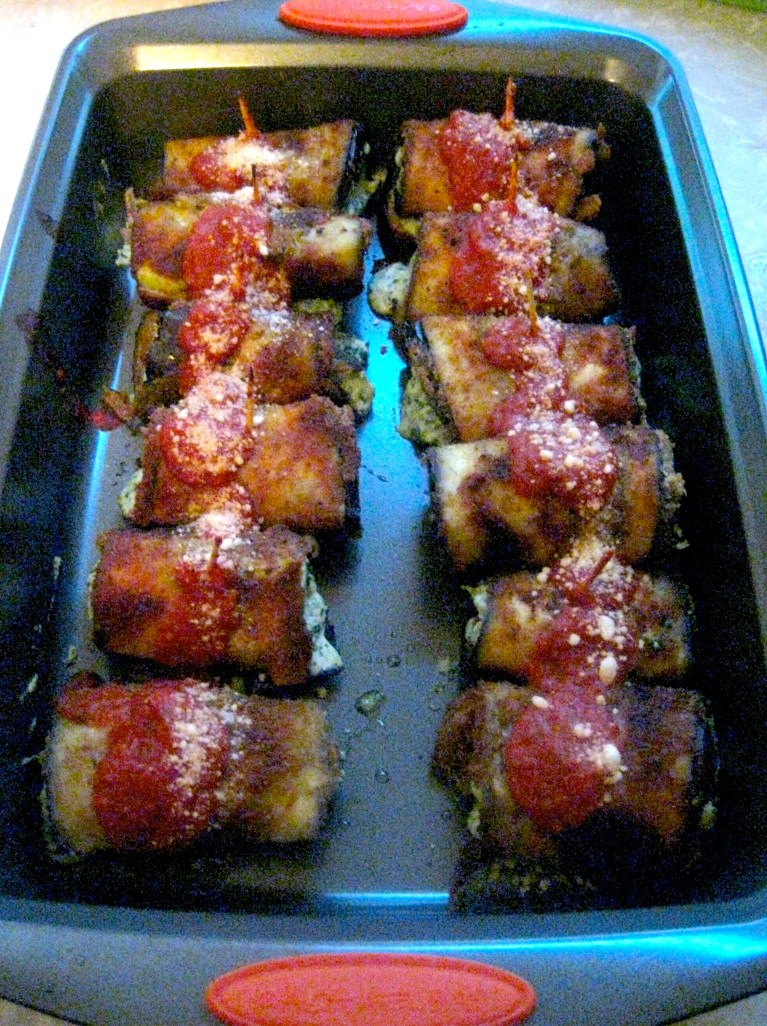
We have all had some kind of mutant version of eggplant rollatini.  Just think of all of the times where you have been accosted with this faux traditional Italian delight at work potlucks, elderly birthday parties, and bizarre down home small neighborhood baby showers (I hear that’s where this dish really lives).  Well, I have been the recipient of many of these attempts and have been making my own version for years, but soon after a visit to a Ethiopian restaurant I had the idea to add a couple of bizarre ingredients into my ricotta filling: spinach and cinnamon.  I eventually loved the way those products broke up the acidity of the tomatoes and I have been using them ever since.  Hopefully, you will love this taste as well.  You will need three long eggplants, 20 ounces of unflavored bread crumbs, four cloves of garlic, one can of crushed tomatoes, two 32 ounce containers of WHOLE MILK ricotta, 4 cups white flour, olive oil, salt, pepper, ground cinnamon, grated parmesan, and one bunch of fresh spinach.  Let me know how yours turned out! Music: Cell sonata in D, from 12 Sonatas, Op 6 by Pietro Locatelli


Bovine Ska and Rocksteady 12/24/14: Christmas In Jamaica!

Standard
rupie edwards-Christmas Rush

Rupie Edwards from 1974

We have done a Christmas in Jamaica show every one of the eighteen years that the Bovine Ska and Rocksteady has been in existence.  And every year, we do our best to remove the intense cheesiness that is on display from every other radio show that tries to do a holiday program.   This lack of cheesiness was evidenced in our selection of Jamaican rhythm and blues, ska, rocksteady and even dub records of a Christmas kind but alas the Christmas disco from the SalSoul Orchestra which was used in the background did not live up to the rigid standards set forth by us during the selection of sets.  To put it mildly, it was cheese town when we were on the microphone but don’t let that dissuade you from checking out this show while it is still the holiday season.  Lily spoke about Jamaican Christmas traditions, we played a Jamaican patois version of “The Christmas Story” and played a lot of stellar records!

You will hear many rare holiday cuts, from artists like The Upsetters, Reuben Anderson from Andy and Joey fame, and the late great Desmond Dekker.

Merry Christmas from Lily and Generoso!

Listen to the two hour holiday program HERE.

The archive will be up until 1/6/15. Enjoy!


Lily Makes Her Vietnamese/Chinese Cabbage Rolls

Standard

Lily has no idea of the origins of this dish. She simply remembers eating cabbage rolls with soup ever since she was a young child. She suspects that it is a dish completely invented from the necessity to feed a family and the availability of cabbage, ground pork, and the standard pantry of a Vietnamese-Chinese household.

In this video, she shows you how to make her version of cabbage rolls, a dish that requires a fair amount of work but is perfect for the cold winters.

Music by Karl Goldmark Symphony No. 1 “Rustic Wedding,” Opus. 26

Enjoy! Let us know how your cabbage rolls turn out!

Bovine Ska and Rocksteady: 12/17/2014: Charlie Ace

Standard

In this past week’s edition of the Bovine Ska and Rocksteady, we began the show with Jamaican Rhythm and Blues, giving us a chance to feature some gems from the Jiving Juniors, Owen Gray, and Cosmo and Dennis. After the opening Rhythm and Blues sets, we presented this week’s mento set dedicated to the delicious fruit that makes us remember warmer days, mango. Then, in order to transition us into the spotlight on the DJ extraordinaire, Charlie Ace, we played two sets of rocksteady, including beautiful tracks from Hopeton Lewis, The Heptones, and Eddie Perkins.

With the arrival of the second hour, we were thrilled to present to spotlight on Charlie Ace, a man who became known for his record store on wheels but a man we know as a DJ great who should be considered in the same ranks as Big Youth and U Roy.

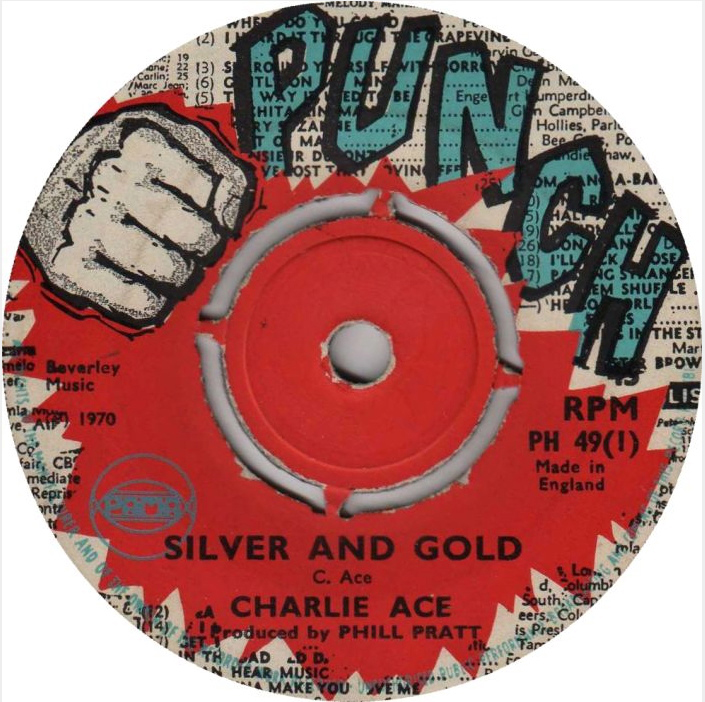
Charlie Ace's Silver and Gold

Charlie Ace’s Silver and Gold Produced by Phil Pratt

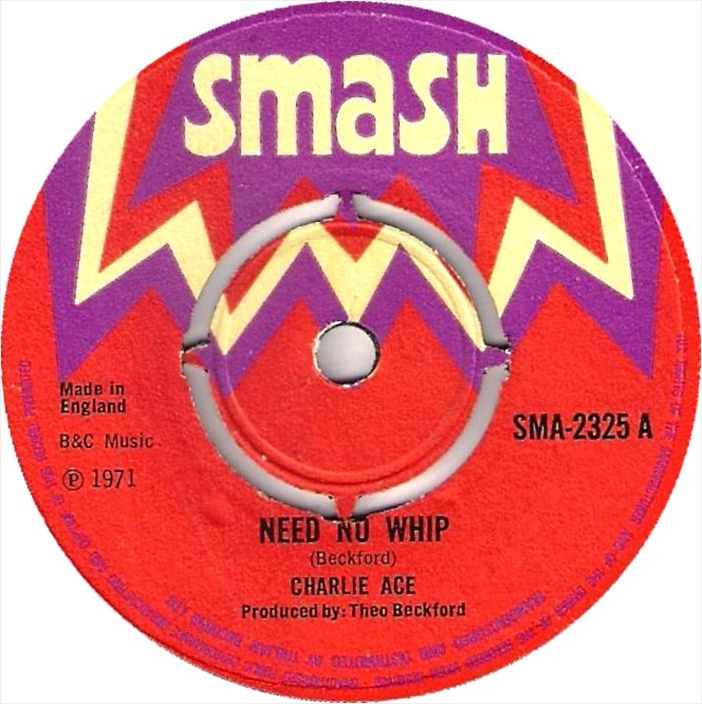
Born Valdene Dixon, Charlie Ace was a DJ who gained his name and signature style when he worked with Lee Scratch Perry. After some mild success with his recordings, Charlie Ace would become best known for his Swing-A-Ling Record Shop on wheels that he would drive around to sell records pressed on his own Swing-A-Ling label and on other Jamaican labels as well. A great DJ who was overshadowed by U-Roy and Big Youth and Dennis Alcapone, Charlie Ace is an artist that deserves a spotlight on his large collection of recordings. This review on Charlie Ace’s tracks featured some of the strangest and most experimental productions to date on the Bovine Ska and Rocksteady and began with one of his earliest recordings for Joe Gibbs Amalgamated label, the track entitled, “Seeing Is Believing.” The spotlight followed Charlie’s work with producers such as Phil Pratt, Alvin Ranglin, and Sonia Pottinger to lead up to our favorite track, a Lee Sctratch Perry production named “Cow Thief Skank.”

Sadly, Charlie Ace was murdered in the mid-1980s in a drive-by during one of Kingston’s endless ghetto wars. He was an innovative DJ and great talent who is severely missed.

Listen to the Charlie Ace spotlight and the full show HERE.

The archive will be up until 12/29/2014. Enjoy!

Long Before “Inherent Vice” And Even Altman’s “The Long Goodbye,” Stephen Frears Gave Us “Gumshoe.”

Standard
gumshoe lobby card

“Gumshoe” Lobby Card from 1971

With all of the deserved praise being bestowed up the new post-modernist detective film by Paul Thomas Anderson, “Inherent Vice,” I thought that this week I would take a look back at “Gumshoe,” the debut work of Stephen Frears and a favorite dysfunctional detective film of mine, that, like our PT Anderson film and Altman’s “The Long Goodbye,” would take the best ideas of Dashiell Hammett and Raymond Chandler and spin them in a way that is less concerned about a cohesive narrative and more about the small moments and gestures of a flawed private eye.

Though we now recognize his talents, I had always wondered how director Frears had been able to land a talent like Albert Finney for his first film.  After all, Finney had been on an epic roll as an actor since his sensational debut in Karel Reisz’s 1960 British New Wave masterpiece, “Saturday Night, Sunday Morning.”   And with Tony Richardson’s “Tom Jones” and Stanley Donen’s “Two for Road” included in Finney’s oeuvre from the sixties, it just didn’t add up that Finney would go for this odd role of a hapless comedian turned private eye in “Gumshoe” for a then virtually unknown Frears. Perhaps it was that Frears had directed some television for the BBC?  But it is more likely that it was due to Frears having been the assistant director for two of the finest English films of the late 1960s, Lindsay Anderson’s “If…” and Karel Reisz’s “Morgan!”

“Gumshoe” combines two of my favorite genres, film noir and the lesser known “everyman who gets in way over his head” genre, a la “North by Northwest” and “Into The Night.” Finney plays Eddie Ginley, a small time comedian and bingo caller who would rather be the next Sam Spade. One day, Eddie decides to put his fantasy to the test and places an ad in the paper offering his services as a private investigator, which gets immediate results. Eddie goes to a local hotel where he meets the big man who tells him that he has a job for him and proceeds to give our Eddie a package with a thousand pounds, an address for a book store that deals in the occult, and a gun. Bizarrely enthusiastic, Eddie takes the job and is soon thrust into the exact world that he has always dreamed of, complete with corpses, femme fatales, and a whole lot of trouble. Not surprisingly, Finney eats up the screen and seems to love playing Eddie with all of that character’s nods to Mitchum and Bogart. In every scene, Finney just looks like he’s in love with his trench coat.

“Gumshoe” shares much with the newest Paul Thomas Anderson film in that its humor and drama switch up on you so fast that you start to not care about the plot. And I’ll say that with both films, I am perfectly OK with this approach as by 2014, we know that we aren’t making the next “Maltese Falcon,” so why not carve it up into tasty bits and give us a main character who just seems to glide through the body count? Also with both films, all of the supporting characters add the necessary color needed to make any noir a blast to watch, and the classic noir-ish dialog here spoken with Liverpoolian accents becomes as entertaining as watching a Thai Western for its ethnocentrism.

Sadly, one major error in the film is the score by Andrew Lloyd Webber (yes, the guy who did “Cats”), which never seems right for any scene. It is as if he was hoping to score a different, more serious kind of noir than the one that was before him. He doesn’t kill it, but his music, which frankly is too intense for many scenes, was just not the best choice for our young director, even if Frears himself wanted the score to supplement the disorienting environments and events in “Gumshoe.” The other tragic error in the film, and one that might keep it from a repertory theater screening anytime soon, is its casual use of racial epitaphs, which in a film like 1973’s “The Friends of Eddie Coyle,” make complete sense given the vérité of its titular lead character, but in “Gumshoe,” it just comes off as a clumsy attempt to make a bad joke that I cannot imagine was even that funny in 1971.

Gumshoe Trailer :

Despite these two errors in judgment, “Gumshoe” is successful in giving us a character who you can say was one of the first to demystify the classic hard-boiled detective; Altman’s very successful version of a sloppy Phillip Marlowe in “The Long Goodbye” wouldn’t be released for another two years. Sadly, “Gumshoe” did not find an audience in 1971, so it would be another fourteen years before Frears would make a feature film again, but he would come back with a vengeance by directing Terence Stamp in the massively underrated and terribly serious 1984 British gangster film, “The Hit” before becoming one of the hottest English directors of the 1980s with “My Beautiful Laundrette” and “Prick Up Your Ears.”

So, if you haven’t had enough well-intentioned mess of a detective after seeing “Inherent Vice,” I think a trip to “Gumshoe” will give you not only a different take on the messy private eye but also will hand  you a world class actor in Finney and a soon to be brilliant director in Frears, whose first go at it was trying to break up a noir the best he could.